EP2025720A1 - Sprühtrocknungsverfahren zur Herstellung farbstoffhaltiger Teilchen - Google Patents
Sprühtrocknungsverfahren zur Herstellung farbstoffhaltiger Teilchen Download PDFInfo
- Publication number
- EP2025720A1 EP2025720A1 EP07114268A EP07114268A EP2025720A1 EP 2025720 A1 EP2025720 A1 EP 2025720A1 EP 07114268 A EP07114268 A EP 07114268A EP 07114268 A EP07114268 A EP 07114268A EP 2025720 A1 EP2025720 A1 EP 2025720A1
- Authority
- EP
- European Patent Office
- Prior art keywords
- dyes
- particles
- dye
- encapsulating agent
- process according
- Prior art date
- Legal status (The legal status is an assumption and is not a legal conclusion. Google has not performed a legal analysis and makes no representation as to the accuracy of the status listed.)
- Granted
Links
- 239000002245 particle Substances 0.000 title claims abstract description 120
- 238000000034 method Methods 0.000 title claims abstract description 51
- 230000008569 process Effects 0.000 title claims abstract description 39
- 238000004519 manufacturing process Methods 0.000 title description 4
- 238000001694 spray drying Methods 0.000 title description 2
- 239000000975 dye Substances 0.000 claims abstract description 122
- 239000000203 mixture Substances 0.000 claims abstract description 52
- 239000008393 encapsulating agent Substances 0.000 claims abstract description 47
- 239000007788 liquid Substances 0.000 claims abstract description 35
- 239000002243 precursor Substances 0.000 claims abstract description 29
- 238000002360 preparation method Methods 0.000 claims abstract description 12
- 238000009826 distribution Methods 0.000 claims abstract description 10
- 238000010438 heat treatment Methods 0.000 claims abstract description 7
- 230000002378 acidificating effect Effects 0.000 claims abstract description 5
- 238000002156 mixing Methods 0.000 claims abstract description 5
- VYPSYNLAJGMNEJ-UHFFFAOYSA-N Silicium dioxide Chemical compound O=[Si]=O VYPSYNLAJGMNEJ-UHFFFAOYSA-N 0.000 claims description 80
- LFQSCWFLJHTTHZ-UHFFFAOYSA-N Ethanol Chemical compound CCO LFQSCWFLJHTTHZ-UHFFFAOYSA-N 0.000 claims description 38
- 239000000377 silicon dioxide Substances 0.000 claims description 38
- 239000000243 solution Substances 0.000 claims description 22
- BOTDANWDWHJENH-UHFFFAOYSA-N Tetraethyl orthosilicate Chemical compound CCO[Si](OCC)(OCC)OCC BOTDANWDWHJENH-UHFFFAOYSA-N 0.000 claims description 16
- 239000002904 solvent Substances 0.000 claims description 16
- 238000005406 washing Methods 0.000 claims description 8
- LFQCEHFDDXELDD-UHFFFAOYSA-N tetramethyl orthosilicate Chemical compound CO[Si](OC)(OC)OC LFQCEHFDDXELDD-UHFFFAOYSA-N 0.000 claims description 7
- 239000007864 aqueous solution Substances 0.000 claims description 6
- RMAQACBXLXPBSY-UHFFFAOYSA-N silicic acid Chemical compound O[Si](O)(O)O RMAQACBXLXPBSY-UHFFFAOYSA-N 0.000 claims description 4
- 235000012239 silicon dioxide Nutrition 0.000 claims description 4
- 229940095070 tetrapropyl orthosilicate Drugs 0.000 claims description 4
- ZQZCOBSUOFHDEE-UHFFFAOYSA-N tetrapropyl silicate Chemical compound CCCO[Si](OCCC)(OCCC)OCCC ZQZCOBSUOFHDEE-UHFFFAOYSA-N 0.000 claims description 4
- 125000002091 cationic group Chemical group 0.000 claims description 3
- UQMOLLPKNHFRAC-UHFFFAOYSA-N tetrabutyl silicate Chemical compound CCCCO[Si](OCCCC)(OCCCC)OCCCC UQMOLLPKNHFRAC-UHFFFAOYSA-N 0.000 claims description 3
- ZUEKXCXHTXJYAR-UHFFFAOYSA-N tetrapropan-2-yl silicate Chemical compound CC(C)O[Si](OC(C)C)(OC(C)C)OC(C)C ZUEKXCXHTXJYAR-UHFFFAOYSA-N 0.000 claims description 3
- 229930182559 Natural dye Natural products 0.000 claims description 2
- 239000001000 anthraquinone dye Substances 0.000 claims description 2
- 239000000987 azo dye Substances 0.000 claims description 2
- 239000002131 composite material Substances 0.000 claims description 2
- 239000000978 natural dye Substances 0.000 claims description 2
- 239000001003 triarylmethane dye Substances 0.000 claims description 2
- LRFVTYWOQMYALW-UHFFFAOYSA-N 9H-xanthine Chemical compound O=C1NC(=O)NC2=C1NC=N2 LRFVTYWOQMYALW-UHFFFAOYSA-N 0.000 claims 2
- 229940075420 xanthine Drugs 0.000 claims 1
- XLYOFNOQVPJJNP-UHFFFAOYSA-N water Substances O XLYOFNOQVPJJNP-UHFFFAOYSA-N 0.000 description 24
- UJMBCXLDXJUMFB-GLCFPVLVSA-K tartrazine Chemical compound [Na+].[Na+].[Na+].[O-]C(=O)C1=NN(C=2C=CC(=CC=2)S([O-])(=O)=O)C(=O)C1\N=N\C1=CC=C(S([O-])(=O)=O)C=C1 UJMBCXLDXJUMFB-GLCFPVLVSA-K 0.000 description 18
- 235000012756 tartrazine Nutrition 0.000 description 17
- 239000004149 tartrazine Substances 0.000 description 17
- 229960000943 tartrazine Drugs 0.000 description 17
- VEXZGXHMUGYJMC-UHFFFAOYSA-N Hydrochloric acid Chemical group Cl VEXZGXHMUGYJMC-UHFFFAOYSA-N 0.000 description 16
- 239000007921 spray Substances 0.000 description 16
- NYGZLYXAPMMJTE-UHFFFAOYSA-M metanil yellow Chemical group [Na+].[O-]S(=O)(=O)C1=CC=CC(N=NC=2C=CC(NC=3C=CC=CC=3)=CC=2)=C1 NYGZLYXAPMMJTE-UHFFFAOYSA-M 0.000 description 12
- GJCOSYZMQJWQCA-UHFFFAOYSA-N 9H-xanthene Chemical compound C1=CC=C2CC3=CC=CC=C3OC2=C1 GJCOSYZMQJWQCA-UHFFFAOYSA-N 0.000 description 9
- OKKJLVBELUTLKV-UHFFFAOYSA-N Methanol Chemical compound OC OKKJLVBELUTLKV-UHFFFAOYSA-N 0.000 description 9
- 239000000443 aerosol Substances 0.000 description 9
- 239000003086 colorant Substances 0.000 description 9
- QDLAGTHXVHQKRE-UHFFFAOYSA-N lichenxanthone Natural products COC1=CC(O)=C2C(=O)C3=C(C)C=C(OC)C=C3OC2=C1 QDLAGTHXVHQKRE-UHFFFAOYSA-N 0.000 description 9
- 239000011148 porous material Substances 0.000 description 9
- SGHZXLIDFTYFHQ-UHFFFAOYSA-L Brilliant Blue Chemical compound [Na+].[Na+].C=1C=C(C(=C2C=CC(C=C2)=[N+](CC)CC=2C=C(C=CC=2)S([O-])(=O)=O)C=2C(=CC=CC=2)S([O-])(=O)=O)C=CC=1N(CC)CC1=CC=CC(S([O-])(=O)=O)=C1 SGHZXLIDFTYFHQ-UHFFFAOYSA-L 0.000 description 8
- MWPLVEDNUUSJAV-UHFFFAOYSA-N anthracene Chemical compound C1=CC=CC2=CC3=CC=CC=C3C=C21 MWPLVEDNUUSJAV-UHFFFAOYSA-N 0.000 description 8
- 238000003756 stirring Methods 0.000 description 8
- 238000001856 aerosol method Methods 0.000 description 7
- 238000004132 cross linking Methods 0.000 description 7
- 229910052708 sodium Inorganic materials 0.000 description 7
- 239000011734 sodium Substances 0.000 description 7
- IJGRMHOSHXDMSA-UHFFFAOYSA-N Atomic nitrogen Chemical compound N#N IJGRMHOSHXDMSA-UHFFFAOYSA-N 0.000 description 6
- LRHPLDYGYMQRHN-UHFFFAOYSA-N N-Butanol Chemical compound CCCCO LRHPLDYGYMQRHN-UHFFFAOYSA-N 0.000 description 6
- SMWDFEZZVXVKRB-UHFFFAOYSA-N Quinoline Chemical compound N1=CC=CC2=CC=CC=C21 SMWDFEZZVXVKRB-UHFFFAOYSA-N 0.000 description 6
- 239000002253 acid Substances 0.000 description 6
- 235000012745 brilliant blue FCF Nutrition 0.000 description 6
- 239000004161 brilliant blue FCF Substances 0.000 description 6
- 239000002537 cosmetic Substances 0.000 description 6
- 230000000694 effects Effects 0.000 description 6
- 239000000463 material Substances 0.000 description 6
- BDERNNFJNOPAEC-UHFFFAOYSA-N propan-1-ol Chemical compound CCCO BDERNNFJNOPAEC-UHFFFAOYSA-N 0.000 description 6
- DGAQECJNVWCQMB-PUAWFVPOSA-M Ilexoside XXIX Chemical compound C[C@@H]1CC[C@@]2(CC[C@@]3(C(=CC[C@H]4[C@]3(CC[C@@H]5[C@@]4(CC[C@@H](C5(C)C)OS(=O)(=O)[O-])C)C)[C@@H]2[C@]1(C)O)C)C(=O)O[C@H]6[C@@H]([C@H]([C@@H]([C@H](O6)CO)O)O)O.[Na+] DGAQECJNVWCQMB-PUAWFVPOSA-M 0.000 description 5
- GWEVSGVZZGPLCZ-UHFFFAOYSA-N Titan oxide Chemical compound O=[Ti]=O GWEVSGVZZGPLCZ-UHFFFAOYSA-N 0.000 description 5
- 235000012735 amaranth Nutrition 0.000 description 5
- 238000000089 atomic force micrograph Methods 0.000 description 5
- 238000009472 formulation Methods 0.000 description 5
- 238000005342 ion exchange Methods 0.000 description 5
- 239000006228 supernatant Substances 0.000 description 5
- CSCPPACGZOOCGX-UHFFFAOYSA-N Acetone Chemical compound CC(C)=O CSCPPACGZOOCGX-UHFFFAOYSA-N 0.000 description 4
- 240000001592 Amaranthus caudatus Species 0.000 description 4
- 235000009328 Amaranthus caudatus Nutrition 0.000 description 4
- QGZKDVFQNNGYKY-UHFFFAOYSA-O Ammonium Chemical compound [NH4+] QGZKDVFQNNGYKY-UHFFFAOYSA-O 0.000 description 4
- KFZMGEQAYNKOFK-UHFFFAOYSA-N Isopropanol Chemical compound CC(C)O KFZMGEQAYNKOFK-UHFFFAOYSA-N 0.000 description 4
- XLOMVQKBTHCTTD-UHFFFAOYSA-N Zinc monoxide Chemical compound [Zn]=O XLOMVQKBTHCTTD-UHFFFAOYSA-N 0.000 description 4
- 239000004178 amaranth Substances 0.000 description 4
- 230000015572 biosynthetic process Effects 0.000 description 4
- 239000003795 chemical substances by application Substances 0.000 description 4
- 239000003599 detergent Substances 0.000 description 4
- 239000012530 fluid Substances 0.000 description 4
- BBEAQIROQSPTKN-UHFFFAOYSA-N pyrene Chemical compound C1=CC=C2C=CC3=CC=CC4=CC=C1C2=C43 BBEAQIROQSPTKN-UHFFFAOYSA-N 0.000 description 4
- 239000013049 sediment Substances 0.000 description 4
- 238000005507 spraying Methods 0.000 description 4
- -1 triarylmethane Chemical compound 0.000 description 4
- PNEYBMLMFCGWSK-UHFFFAOYSA-N Alumina Chemical compound [O-2].[O-2].[O-2].[Al+3].[Al+3] PNEYBMLMFCGWSK-UHFFFAOYSA-N 0.000 description 3
- NLXLAEXVIDQMFP-UHFFFAOYSA-N Ammonia chloride Chemical compound [NH4+].[Cl-] NLXLAEXVIDQMFP-UHFFFAOYSA-N 0.000 description 3
- BTANRVKWQNVYAZ-UHFFFAOYSA-N butan-2-ol Chemical compound CCC(C)O BTANRVKWQNVYAZ-UHFFFAOYSA-N 0.000 description 3
- 238000004364 calculation method Methods 0.000 description 3
- 239000012159 carrier gas Substances 0.000 description 3
- 238000007796 conventional method Methods 0.000 description 3
- 230000007062 hydrolysis Effects 0.000 description 3
- 238000006460 hydrolysis reaction Methods 0.000 description 3
- 230000014759 maintenance of location Effects 0.000 description 3
- 229910052757 nitrogen Inorganic materials 0.000 description 3
- 229920005989 resin Polymers 0.000 description 3
- 239000011347 resin Substances 0.000 description 3
- 230000000717 retained effect Effects 0.000 description 3
- 238000010561 standard procedure Methods 0.000 description 3
- 239000007858 starting material Substances 0.000 description 3
- 239000000126 substance Substances 0.000 description 3
- UJMBCXLDXJUMFB-UHFFFAOYSA-K trisodium;5-oxo-1-(4-sulfonatophenyl)-4-[(4-sulfonatophenyl)diazenyl]-4h-pyrazole-3-carboxylate Chemical compound [Na+].[Na+].[Na+].[O-]C(=O)C1=NN(C=2C=CC(=CC=2)S([O-])(=O)=O)C(=O)C1N=NC1=CC=C(S([O-])(=O)=O)C=C1 UJMBCXLDXJUMFB-UHFFFAOYSA-K 0.000 description 3
- ZOXJGFHDIHLPTG-UHFFFAOYSA-N Boron Chemical compound [B] ZOXJGFHDIHLPTG-UHFFFAOYSA-N 0.000 description 2
- 238000005033 Fourier transform infrared spectroscopy Methods 0.000 description 2
- BPQQTUXANYXVAA-UHFFFAOYSA-N Orthosilicate Chemical compound [O-][Si]([O-])([O-])[O-] BPQQTUXANYXVAA-UHFFFAOYSA-N 0.000 description 2
- DKGAVHZHDRPRBM-UHFFFAOYSA-N Tert-Butanol Chemical compound CC(C)(C)O DKGAVHZHDRPRBM-UHFFFAOYSA-N 0.000 description 2
- YTPLMLYBLZKORZ-UHFFFAOYSA-N Thiophene Chemical compound C=1C=CSC=1 YTPLMLYBLZKORZ-UHFFFAOYSA-N 0.000 description 2
- ATJFFYVFTNAWJD-UHFFFAOYSA-N Tin Chemical compound [Sn] ATJFFYVFTNAWJD-UHFFFAOYSA-N 0.000 description 2
- QCWXUUIWCKQGHC-UHFFFAOYSA-N Zirconium Chemical compound [Zr] QCWXUUIWCKQGHC-UHFFFAOYSA-N 0.000 description 2
- 239000003929 acidic solution Substances 0.000 description 2
- 239000000654 additive Substances 0.000 description 2
- 239000004411 aluminium Substances 0.000 description 2
- 229910052782 aluminium Inorganic materials 0.000 description 2
- XAGFODPZIPBFFR-UHFFFAOYSA-N aluminium Chemical compound [Al] XAGFODPZIPBFFR-UHFFFAOYSA-N 0.000 description 2
- 125000000129 anionic group Chemical group 0.000 description 2
- 238000000149 argon plasma sintering Methods 0.000 description 2
- 230000003796 beauty Effects 0.000 description 2
- 229910052796 boron Inorganic materials 0.000 description 2
- 150000001768 cations Chemical group 0.000 description 2
- 238000009833 condensation Methods 0.000 description 2
- 230000005494 condensation Effects 0.000 description 2
- 239000008367 deionised water Substances 0.000 description 2
- 125000000664 diazo group Chemical group [N-]=[N+]=[*] 0.000 description 2
- 239000006185 dispersion Substances 0.000 description 2
- 238000001035 drying Methods 0.000 description 2
- 238000005538 encapsulation Methods 0.000 description 2
- 238000005516 engineering process Methods 0.000 description 2
- GVEPBJHOBDJJJI-UHFFFAOYSA-N fluoranthrene Natural products C1=CC(C2=CC=CC=C22)=C3C2=CC=CC3=C1 GVEPBJHOBDJJJI-UHFFFAOYSA-N 0.000 description 2
- UYTPUPDQBNUYGX-UHFFFAOYSA-N guanine Chemical compound O=C1NC(N)=NC2=C1N=CN2 UYTPUPDQBNUYGX-UHFFFAOYSA-N 0.000 description 2
- 239000010954 inorganic particle Substances 0.000 description 2
- ZXEKIIBDNHEJCQ-UHFFFAOYSA-N isobutanol Chemical compound CC(C)CO ZXEKIIBDNHEJCQ-UHFFFAOYSA-N 0.000 description 2
- 229960004592 isopropanol Drugs 0.000 description 2
- 229920001467 poly(styrenesulfonates) Polymers 0.000 description 2
- 239000000843 powder Substances 0.000 description 2
- 238000000634 powder X-ray diffraction Methods 0.000 description 2
- 239000000047 product Substances 0.000 description 2
- 238000010079 rubber tapping Methods 0.000 description 2
- 238000000926 separation method Methods 0.000 description 2
- 150000004760 silicates Chemical class 0.000 description 2
- NTHWMYGWWRZVTN-UHFFFAOYSA-N sodium silicate Chemical compound [Na+].[Na+].[O-][Si]([O-])=O NTHWMYGWWRZVTN-UHFFFAOYSA-N 0.000 description 2
- 238000000371 solid-state nuclear magnetic resonance spectroscopy Methods 0.000 description 2
- 239000000725 suspension Substances 0.000 description 2
- 229910052718 tin Inorganic materials 0.000 description 2
- 239000004408 titanium dioxide Substances 0.000 description 2
- 238000004627 transmission electron microscopy Methods 0.000 description 2
- 238000010977 unit operation Methods 0.000 description 2
- 239000011787 zinc oxide Substances 0.000 description 2
- 229910052726 zirconium Inorganic materials 0.000 description 2
- WLDHEUZGFKACJH-ZRUFZDNISA-K Amaranth Chemical compound [Na+].[Na+].[Na+].C12=CC=C(S([O-])(=O)=O)C=C2C=C(S([O-])(=O)=O)C(O)=C1\N=N\C1=CC=C(S([O-])(=O)=O)C2=CC=CC=C12 WLDHEUZGFKACJH-ZRUFZDNISA-K 0.000 description 1
- FTZJTZNERCQPAQ-UHFFFAOYSA-N C1=CC=CC=2OC3=CC=CC=C3CC12.N1C(=O)NC=2N=CNC2C1=O Chemical compound C1=CC=CC=2OC3=CC=CC=C3CC12.N1C(=O)NC=2N=CNC2C1=O FTZJTZNERCQPAQ-UHFFFAOYSA-N 0.000 description 1
- RZSYLLSAWYUBPE-UHFFFAOYSA-L Fast green FCF Chemical compound [Na+].[Na+].C=1C=C(C(=C2C=CC(C=C2)=[N+](CC)CC=2C=C(C=CC=2)S([O-])(=O)=O)C=2C(=CC(O)=CC=2)S([O-])(=O)=O)C=CC=1N(CC)CC1=CC=CC(S([O-])(=O)=O)=C1 RZSYLLSAWYUBPE-UHFFFAOYSA-L 0.000 description 1
- 244000208060 Lawsonia inermis Species 0.000 description 1
- 229920001730 Moisture cure polyurethane Polymers 0.000 description 1
- OKIZCWYLBDKLSU-UHFFFAOYSA-M N,N,N-Trimethylmethanaminium chloride Chemical compound [Cl-].C[N+](C)(C)C OKIZCWYLBDKLSU-UHFFFAOYSA-M 0.000 description 1
- QFRKJLJUCWNDLQ-UHFFFAOYSA-N OC(C1Br)C=CC(C2(C3=C4CCC=C3)OC4=O)=C1Oc1c2ccc(O)c1Br Chemical compound OC(C1Br)C=CC(C2(C3=C4CCC=C3)OC4=O)=C1Oc1c2ccc(O)c1Br QFRKJLJUCWNDLQ-UHFFFAOYSA-N 0.000 description 1
- ZLMJMSJWJFRBEC-UHFFFAOYSA-N Potassium Chemical compound [K] ZLMJMSJWJFRBEC-UHFFFAOYSA-N 0.000 description 1
- 239000004115 Sodium Silicate Substances 0.000 description 1
- RTAQQCXQSZGOHL-UHFFFAOYSA-N Titanium Chemical compound [Ti] RTAQQCXQSZGOHL-UHFFFAOYSA-N 0.000 description 1
- 238000002441 X-ray diffraction Methods 0.000 description 1
- 0 [*-]c1cc2ccccc2c(N=Nc2ccccc2)c1O Chemical compound [*-]c1cc2ccccc2c(N=Nc2ccccc2)c1O 0.000 description 1
- 230000001476 alcoholic effect Effects 0.000 description 1
- 150000001298 alcohols Chemical class 0.000 description 1
- 229910052783 alkali metal Inorganic materials 0.000 description 1
- 150000001340 alkali metals Chemical class 0.000 description 1
- OENHQHLEOONYIE-UKMVMLAPSA-N all-trans beta-carotene Natural products CC=1CCCC(C)(C)C=1/C=C/C(/C)=C/C=C/C(/C)=C/C=C/C=C(C)C=CC=C(C)C=CC1=C(C)CCCC1(C)C OENHQHLEOONYIE-UKMVMLAPSA-N 0.000 description 1
- WLDHEUZGFKACJH-UHFFFAOYSA-K amaranth Chemical compound [Na+].[Na+].[Na+].C12=CC=C(S([O-])(=O)=O)C=C2C=C(S([O-])(=O)=O)C(O)=C1N=NC1=CC=C(S([O-])(=O)=O)C2=CC=CC=C12 WLDHEUZGFKACJH-UHFFFAOYSA-K 0.000 description 1
- 235000019270 ammonium chloride Nutrition 0.000 description 1
- RGHILYZRVFRRNK-UHFFFAOYSA-N anthracene-1,2-dione Chemical compound C1=CC=C2C=C(C(C(=O)C=C3)=O)C3=CC2=C1 RGHILYZRVFRRNK-UHFFFAOYSA-N 0.000 description 1
- PYKYMHQGRFAEBM-UHFFFAOYSA-N anthraquinone Natural products CCC(=O)c1c(O)c2C(=O)C3C(C=CC=C3O)C(=O)c2cc1CC(=O)OC PYKYMHQGRFAEBM-UHFFFAOYSA-N 0.000 description 1
- 150000004056 anthraquinones Chemical class 0.000 description 1
- 238000004630 atomic force microscopy Methods 0.000 description 1
- 235000013734 beta-carotene Nutrition 0.000 description 1
- 239000011648 beta-carotene Substances 0.000 description 1
- TUPZEYHYWIEDIH-WAIFQNFQSA-N beta-carotene Natural products CC(=C/C=C/C=C(C)/C=C/C=C(C)/C=C/C1=C(C)CCCC1(C)C)C=CC=C(/C)C=CC2=CCCCC2(C)C TUPZEYHYWIEDIH-WAIFQNFQSA-N 0.000 description 1
- 229960002747 betacarotene Drugs 0.000 description 1
- 239000001045 blue dye Substances 0.000 description 1
- 239000006227 byproduct Substances 0.000 description 1
- 238000011088 calibration curve Methods 0.000 description 1
- 229910052799 carbon Inorganic materials 0.000 description 1
- 239000006229 carbon black Substances 0.000 description 1
- 235000012730 carminic acid Nutrition 0.000 description 1
- 239000004106 carminic acid Substances 0.000 description 1
- OIQPTROHQCGFEF-UHFFFAOYSA-L chembl1371409 Chemical compound [Na+].[Na+].OC1=CC=C2C=C(S([O-])(=O)=O)C=CC2=C1N=NC1=CC=C(S([O-])(=O)=O)C=C1 OIQPTROHQCGFEF-UHFFFAOYSA-L 0.000 description 1
- CEZCCHQBSQPRMU-UHFFFAOYSA-L chembl174821 Chemical compound [Na+].[Na+].COC1=CC(S([O-])(=O)=O)=C(C)C=C1N=NC1=C(O)C=CC2=CC(S([O-])(=O)=O)=CC=C12 CEZCCHQBSQPRMU-UHFFFAOYSA-L 0.000 description 1
- ONTQJDKFANPPKK-UHFFFAOYSA-L chembl3185981 Chemical compound [Na+].[Na+].CC1=CC(C)=C(S([O-])(=O)=O)C=C1N=NC1=CC(S([O-])(=O)=O)=C(C=CC=C2)C2=C1O ONTQJDKFANPPKK-UHFFFAOYSA-L 0.000 description 1
- 239000007795 chemical reaction product Substances 0.000 description 1
- 229940080423 cochineal Drugs 0.000 description 1
- 230000001186 cumulative effect Effects 0.000 description 1
- 229940096890 d&c violet no. 2 Drugs 0.000 description 1
- 229910021641 deionized water Inorganic materials 0.000 description 1
- 230000001419 dependent effect Effects 0.000 description 1
- 238000004090 dissolution Methods 0.000 description 1
- 239000003814 drug Substances 0.000 description 1
- 229940079593 drug Drugs 0.000 description 1
- 239000000839 emulsion Substances 0.000 description 1
- 230000007613 environmental effect Effects 0.000 description 1
- 238000002474 experimental method Methods 0.000 description 1
- 238000000605 extraction Methods 0.000 description 1
- 235000019240 fast green FCF Nutrition 0.000 description 1
- 229940057915 fd&c red no. 4 Drugs 0.000 description 1
- 229940051147 fd&c yellow no. 6 Drugs 0.000 description 1
- 238000005189 flocculation Methods 0.000 description 1
- 230000016615 flocculation Effects 0.000 description 1
- FWQHNLCNFPYBCA-UHFFFAOYSA-N fluoran Chemical compound C12=CC=CC=C2OC2=CC=CC=C2C11OC(=O)C2=CC=CC=C21 FWQHNLCNFPYBCA-UHFFFAOYSA-N 0.000 description 1
- GNBHRKFJIUUOQI-UHFFFAOYSA-N fluorescein Chemical compound O1C(=O)C2=CC=CC=C2C21C1=CC=C(O)C=C1OC1=CC(O)=CC=C21 GNBHRKFJIUUOQI-UHFFFAOYSA-N 0.000 description 1
- 230000002209 hydrophobic effect Effects 0.000 description 1
- 238000003384 imaging method Methods 0.000 description 1
- 239000011261 inert gas Substances 0.000 description 1
- 229910010272 inorganic material Inorganic materials 0.000 description 1
- 239000011147 inorganic material Substances 0.000 description 1
- 238000011068 loading method Methods 0.000 description 1
- 239000000314 lubricant Substances 0.000 description 1
- 239000011159 matrix material Substances 0.000 description 1
- 238000005259 measurement Methods 0.000 description 1
- 239000012528 membrane Substances 0.000 description 1
- 239000013335 mesoporous material Substances 0.000 description 1
- 229910021645 metal ion Inorganic materials 0.000 description 1
- 239000000693 micelle Substances 0.000 description 1
- 230000007935 neutral effect Effects 0.000 description 1
- IQZPDFORWZTSKT-UHFFFAOYSA-N nitrosulphonic acid Chemical compound OS(=O)(=O)[N+]([O-])=O IQZPDFORWZTSKT-UHFFFAOYSA-N 0.000 description 1
- 230000003287 optical effect Effects 0.000 description 1
- 230000002572 peristaltic effect Effects 0.000 description 1
- 229920003023 plastic Polymers 0.000 description 1
- 239000004033 plastic Substances 0.000 description 1
- 235000019237 ponceau SX Nutrition 0.000 description 1
- 238000002459 porosimetry Methods 0.000 description 1
- 229910052700 potassium Inorganic materials 0.000 description 1
- 239000011591 potassium Substances 0.000 description 1
- 235000019353 potassium silicate Nutrition 0.000 description 1
- 238000007639 printing Methods 0.000 description 1
- 239000012429 reaction media Substances 0.000 description 1
- 238000011084 recovery Methods 0.000 description 1
- 239000001044 red dye Substances 0.000 description 1
- 230000003252 repetitive effect Effects 0.000 description 1
- 150000003839 salts Chemical class 0.000 description 1
- 238000004626 scanning electron microscopy Methods 0.000 description 1
- 229910052710 silicon Inorganic materials 0.000 description 1
- 239000010703 silicon Substances 0.000 description 1
- 159000000000 sodium salts Chemical class 0.000 description 1
- 229910052911 sodium silicate Inorganic materials 0.000 description 1
- LJFWQNJLLOFIJK-UHFFFAOYSA-N solvent violet 13 Chemical compound C1=CC(C)=CC=C1NC1=CC=C(O)C2=C1C(=O)C1=CC=CC=C1C2=O LJFWQNJLLOFIJK-UHFFFAOYSA-N 0.000 description 1
- 239000012798 spherical particle Substances 0.000 description 1
- 238000006467 substitution reaction Methods 0.000 description 1
- 230000000475 sunscreen effect Effects 0.000 description 1
- 239000000516 sunscreening agent Substances 0.000 description 1
- 229930192474 thiophene Natural products 0.000 description 1
- 239000010936 titanium Substances 0.000 description 1
- 229910052719 titanium Inorganic materials 0.000 description 1
- OGIDPMRJRNCKJF-UHFFFAOYSA-N titanium oxide Inorganic materials [Ti]=O OGIDPMRJRNCKJF-UHFFFAOYSA-N 0.000 description 1
- 239000010457 zeolite Substances 0.000 description 1
- OENHQHLEOONYIE-JLTXGRSLSA-N β-Carotene Chemical compound CC=1CCCC(C)(C)C=1\C=C\C(\C)=C\C=C\C(\C)=C\C=C\C=C(/C)\C=C\C=C(/C)\C=C\C1=C(C)CCCC1(C)C OENHQHLEOONYIE-JLTXGRSLSA-N 0.000 description 1
Images


Classifications
-
- C—CHEMISTRY; METALLURGY
- C09—DYES; PAINTS; POLISHES; NATURAL RESINS; ADHESIVES; COMPOSITIONS NOT OTHERWISE PROVIDED FOR; APPLICATIONS OF MATERIALS NOT OTHERWISE PROVIDED FOR
- C09B—ORGANIC DYES OR CLOSELY-RELATED COMPOUNDS FOR PRODUCING DYES, e.g. PIGMENTS; MORDANTS; LAKES
- C09B67/00—Influencing the physical, e.g. the dyeing or printing properties of dyestuffs without chemical reactions, e.g. by treating with solvents grinding or grinding assistants, coating of pigments or dyes; Process features in the making of dyestuff preparations; Dyestuff preparations of a special physical nature, e.g. tablets, films
- C09B67/0001—Post-treatment of organic pigments or dyes
- C09B67/0004—Coated particulate pigments or dyes
- C09B67/0008—Coated particulate pigments or dyes with organic coatings
-
- A—HUMAN NECESSITIES
- A61—MEDICAL OR VETERINARY SCIENCE; HYGIENE
- A61K—PREPARATIONS FOR MEDICAL, DENTAL OR TOILETRY PURPOSES
- A61K8/00—Cosmetics or similar toiletry preparations
- A61K8/02—Cosmetics or similar toiletry preparations characterised by special physical form
- A61K8/0241—Containing particulates characterized by their shape and/or structure
- A61K8/0283—Matrix particles
- A61K8/0287—Matrix particles the particulate containing a solid-in-solid dispersion
-
- A—HUMAN NECESSITIES
- A61—MEDICAL OR VETERINARY SCIENCE; HYGIENE
- A61K—PREPARATIONS FOR MEDICAL, DENTAL OR TOILETRY PURPOSES
- A61K8/00—Cosmetics or similar toiletry preparations
- A61K8/18—Cosmetics or similar toiletry preparations characterised by the composition
- A61K8/19—Cosmetics or similar toiletry preparations characterised by the composition containing inorganic ingredients
- A61K8/25—Silicon; Compounds thereof
-
- A—HUMAN NECESSITIES
- A61—MEDICAL OR VETERINARY SCIENCE; HYGIENE
- A61K—PREPARATIONS FOR MEDICAL, DENTAL OR TOILETRY PURPOSES
- A61K9/00—Medicinal preparations characterised by special physical form
- A61K9/14—Particulate form, e.g. powders, Processes for size reducing of pure drugs or the resulting products, Pure drug nanoparticles
- A61K9/16—Agglomerates; Granulates; Microbeadlets ; Microspheres; Pellets; Solid products obtained by spray drying, spray freeze drying, spray congealing,(multiple) emulsion solvent evaporation or extraction
- A61K9/1605—Excipients; Inactive ingredients
- A61K9/1611—Inorganic compounds
-
- A—HUMAN NECESSITIES
- A61—MEDICAL OR VETERINARY SCIENCE; HYGIENE
- A61K—PREPARATIONS FOR MEDICAL, DENTAL OR TOILETRY PURPOSES
- A61K9/00—Medicinal preparations characterised by special physical form
- A61K9/14—Particulate form, e.g. powders, Processes for size reducing of pure drugs or the resulting products, Pure drug nanoparticles
- A61K9/16—Agglomerates; Granulates; Microbeadlets ; Microspheres; Pellets; Solid products obtained by spray drying, spray freeze drying, spray congealing,(multiple) emulsion solvent evaporation or extraction
- A61K9/1682—Processes
- A61K9/1694—Processes resulting in granules or microspheres of the matrix type containing more than 5% of excipient
-
- C—CHEMISTRY; METALLURGY
- C09—DYES; PAINTS; POLISHES; NATURAL RESINS; ADHESIVES; COMPOSITIONS NOT OTHERWISE PROVIDED FOR; APPLICATIONS OF MATERIALS NOT OTHERWISE PROVIDED FOR
- C09B—ORGANIC DYES OR CLOSELY-RELATED COMPOUNDS FOR PRODUCING DYES, e.g. PIGMENTS; MORDANTS; LAKES
- C09B67/00—Influencing the physical, e.g. the dyeing or printing properties of dyestuffs without chemical reactions, e.g. by treating with solvents grinding or grinding assistants, coating of pigments or dyes; Process features in the making of dyestuff preparations; Dyestuff preparations of a special physical nature, e.g. tablets, films
- C09B67/0097—Dye preparations of special physical nature; Tablets, films, extrusion, microcapsules, sheets, pads, bags with dyes
-
- A—HUMAN NECESSITIES
- A61—MEDICAL OR VETERINARY SCIENCE; HYGIENE
- A61K—PREPARATIONS FOR MEDICAL, DENTAL OR TOILETRY PURPOSES
- A61K2800/00—Properties of cosmetic compositions or active ingredients thereof or formulation aids used therein and process related aspects
- A61K2800/40—Chemical, physico-chemical or functional or structural properties of particular ingredients
- A61K2800/41—Particular ingredients further characterized by their size
- A61K2800/412—Microsized, i.e. having sizes between 0.1 and 100 microns
-
- A—HUMAN NECESSITIES
- A61—MEDICAL OR VETERINARY SCIENCE; HYGIENE
- A61K—PREPARATIONS FOR MEDICAL, DENTAL OR TOILETRY PURPOSES
- A61K2800/00—Properties of cosmetic compositions or active ingredients thereof or formulation aids used therein and process related aspects
- A61K2800/40—Chemical, physico-chemical or functional or structural properties of particular ingredients
- A61K2800/42—Colour properties
- A61K2800/43—Pigments; Dyes
-
- Y—GENERAL TAGGING OF NEW TECHNOLOGICAL DEVELOPMENTS; GENERAL TAGGING OF CROSS-SECTIONAL TECHNOLOGIES SPANNING OVER SEVERAL SECTIONS OF THE IPC; TECHNICAL SUBJECTS COVERED BY FORMER USPC CROSS-REFERENCE ART COLLECTIONS [XRACs] AND DIGESTS
- Y10—TECHNICAL SUBJECTS COVERED BY FORMER USPC
- Y10T—TECHNICAL SUBJECTS COVERED BY FORMER US CLASSIFICATION
- Y10T428/00—Stock material or miscellaneous articles
- Y10T428/29—Coated or structually defined flake, particle, cell, strand, strand portion, rod, filament, macroscopic fiber or mass thereof
- Y10T428/2982—Particulate matter [e.g., sphere, flake, etc.]
- Y10T428/2984—Microcapsule with fluid core [includes liposome]
Definitions
- the present invention relates to a process for the preparation of encapsulated dyes and to encapsulated dyes made by that process.
- Particles incorporating dyes for use in these fields are described in WO-A-2004/081222 .
- This document describes a process for manufacturing encapsulated dyes using the well-known sol-gel methodology, which is an emulsion technique resulting in a core/shell structure (a core of dye surrounded by a shell of a material, such as silica).
- Further examples of particles of the art are found in US-A-2005/0276774 and US-A-2005/0265938 , which describe the production of such particles by dispersive techniques and micelle formation respectively.
- particles made according to the processes described in these documents often exhibit dye leakage, which is clearly undesirable.
- a process for the preparation of amorphous particles comprising a homogeneous distribution of one or more dyes encapsulated by an amorphous, siliceous encapsulating agent, the process comprising:
- encapsulated dyes made by the processs of the first aspect of the invention are provided.
- the term "encapsulation” is understood to mean that the dye is fully surrounded or encased by an encapsulating agent and, thus, held securely within the particle. Leakage of less than 5 weight %, preferably less than 2 weight%, more preferably less than 1 weight% of the total amount of dye incorporated into the particle is achieved, as determined by the methodology described herein in Example 4.
- Both particles and the encapsulating agent comprised within the particles made according to the present invention are amorphous.
- amorphous means that there is no long range crystallographic order in one, two or three dimensions at lengths from 0.1 - 50nm, as determined in the following way by a combination of powder x-ray diffraction (XRD) on bulk samples and transmission electron microscopy (TEM) of representative portions of the same bulk sample:
- This definition excludes ordered mesoporous materials with pore sizes from 2-50nm arranged with translational crystallographic order, such as MCM-41, MCM-48 and SBA-15.
- siliceous takes its normal meaning known in the art. More specifically, a siliceous material is one of, relating to or containing silica or a silicate. Preferably, the encapsulating agent is silica per se.
- a proportion of the silicon within the amorphous silica structure may be substituted with other elements such as boron, lead, titanium, tin, zirconium and/or aluminium. This substitution of the silica framework may be useful in adjusting the properties of the silica-based particles depending upon their specific applications. For example, addition of boron, lead, tin, zirconium and/or aluminium may result in a different refractive index.
- the process of the invention is a spray-drying, or aerosol method for the preparation of amorphous particles comprising a homogeneous distribution of one or more dyes encapsulated by an amorphous, siliceous encapsulating agent.
- This process comprises the step of providing a precursor of the encapsulating agent in liquid form.
- the liquid form of the encapsulating agent may be a solution, a suspension or a dispersion, and is preferably a solution.
- the liquid form of the encapsulating agent typically comprises at least one source or precursor of the siliceous encapsulating agent per se which, during the aerosol process, ultimately provides the desired siliceous encapsulating agent.
- the source of encapsulating agent may be considered to be a pre-polymer as, during aerosolisation, it will polymerise or crosslink to form the desired siliceous encapsulating agent.
- the siliceous precursor is organic.
- Suitable sources or precursors which may be used in the aerosol process to form particles of the invention include all those conventionally used in the art to form silica, silicates and zeolites, for example.
- useful silica precursors include tetramethylorthosilicate (TMOS), tetraethylorthosilicate (TEOS), tetrapropylorthosilicate (TPOS), tetraisopropylorthosilicate (TiPOS), tetrabutylorthosilicate (TBOS), silicic acid which may for example be modified with cations such as sodium or ammonium so that it is provided in the form of sodium silicate (also known as waterglass) or ammonium silicate.
- TEOS is a particularly preferred source of silica from a safety perspective, because the by-product of the process is ethanol (not methanol, as is the case for TMOS).
- silica SiO 2
- TEOS has a molecular weight of 208g/mole
- the weight of silica produced is 60/208 or 0.29 times the amount of TEOS.
- TMOS the value is 0.39 (the molecular weight of TMOS is 152g/mole).
- TEOS, TMOS and TPOS are hydrophobic and are therefore generally solubilised in an essentially non-aqueous material, for example as an alcoholic solution such as a solution in ethanol, methanol, n-propanol, iso-propanol and/or a butanol, ie. n-butanol, 2-butanol, iso-butanol or tert-butanol.
- a solution in acetone or one or more other conventional solvents, for instance may also be employed.
- Silicic acid and the silicates are hydrophilic so may be dissolved in hydrophilic solvents such as water.
- hydrophilic solvents such as water.
- the amounts of solvent used are readily determinable by a skilled person - the lower limit is, in practice, determined by the solubility parameters of the starting material and the upper limit is a practical one- the more solvent one uses, the smaller the final particles and the smaller the production capacity.
- the solvent may be non-aqueous, some water is, nevertheless, necessary in order to hydrolyse the precursor, such as TEOS, to silicic acid prior to aerosolisation. Hydrolysis prior to aerosolisation is important to minimise the number of pores in then resulting particles, thereby minimising leakage of encapsulated dye.
- the liquid form of the dye be an aqueous solution and this aqueous solution usually acts as the source of water for hydrolysis of the precursor.
- water be included with the liquid form of the precursor as well, especially if, as discussed above, the precursor is hydrophilic. If water is present in the liquid form of the precursor, then it is preferred that the aqueous portion be an acidic solution.
- the pH is more than 1 and less than 7, is preferably more than 1 and less than or equal to 4, more preferably 1.5 or more and less than or equal to 2.5 and is advantageously approximately 2, as this is at or near the iso-electric point of silica itself.
- the pH of the precursor liquid form may be adjusted as desired using techniques conventionally used in the art, for example by addition of acid.
- a preferred acid used for this purpose is hydrochloric acid.
- Water of the requisite pH may be introduced as a solvent for the silica precursor or as a solvent for the dye, as discussed below.
- the process according to the invention comprises the step of providing a precursor of the one or more dye(s) in liquid form.
- the liquid form of the one or more dye(s) may be a solution, a suspension or a dispersion, and is preferably a solution.
- dyes refers to any dye or colorant, which is desired to be introduced into a particle and indefinitely retained within that particle.
- dyes which may be comprised within particles of the present invention include, but are not limited to, dyes or colorants conventionally used in the end application(s) of choice.
- suitability of dyes for use in applications such as cosmetic, health, personal care and detergent compositions is governed by organisations such as the Food and Drug Administration (FDA) in the USA and equivalent bodies in other countries.
- FDA Food and Drug Administration
- dyes suitable for use in the present invention may be cationic, anionic, neutral, amphoteric, zwitterionic or amphiphilic, with cationic dyes being preferred, as the positive charge on the dye molecule interacts with residual negative charge on the siliceous encapsulating agent to promote retention of the dye within the encapsulant.
- the dyes are typically selected from conventionally-known dye types such as natural dyes, ie.
- the dye may be used in an unadulterated form or it may be adapted to improve its suitability to the present process.
- the effectiveness of some dyes containing anionic groups and a mono-valent alkali metal counter-ion, such as sodium may be improved by ion-exchanging the metal ion with a mono-valent organic counter-ion such as ammonium or tetra-methyl ammonium.
- Particularly preferred colorants or dyes include xanthene, triarylmethane, anthracene, and monoazo dyes.
- the liquid form of the one or more dyes is preferably a solution.
- the solution is formed in one or more solvents conventionally used in this field, preferably water or an alcohol such as methanol, ethanol, n-propanol, iso-propanol or a butanol, and is more preferably ethanol or water.
- At least one of the liquid forms of encapsulating agent and dye should be aqueous. It is usually preferred that the dye be provided in aqueous liquid form, whereas the siliceous precursor is typically provided in non-aqueous form.
- the presence of water in the reaction medium aids pre-hydrolysis of the silica precursor which, in turn, aids subsequent polymerisation of the precursor to form the desired encapsulating agent comprising a low number of pores.
- the liquid forms of the dye and precursor are mixed together prior to entry into the aerosol chamber for this purpose.
- the dye is provided in the form of an aqueous solution, and conveniently as an aqueous solution comprising ethanol. It may be necessary to aid dissolution of the active in the chosen solvent by providing it in the form of a salt, for instance those formed with commonly-used cations such as sodium, ammonium or potassium, or by adjusting the pH of the mixture of dye and solvent, again by conventional methods as previously described.
- the solution of the one or more dyes employed in the process of the invention is in acidic form.
- the pH is more than 1 and less than 7, is preferably more than 1 and less than or equal to 4, more preferably 1.5 or more and less than or equal to 2.5 and is advantageously approximately 2, as this is at or near the iso-electric point of silica itself.
- the pH of the precursor liquid form may be adjusted as desired using techniques conventionally used in the art, for example by addition of acid.
- a preferred acid used for this purpose is hydrochloric acid.
- the amount of dye included in the liquid form of the dye will depend on the amount of dye desired in the particles of the invention and can be varied in accordance with the desired applications or effects of the particles and may also depend upon the type(s) of dye chosen to be included within the particles.
- Particles made according to the process of the invention generally comprise more than 0 and up to 25%, preferably from 3% to 20%, more preferably from 5% to 15%, and more preferably still from 8 to 12% of dye by weight of the particle. These ranges have been found to equate exactly to the percentages of the starting materials used in the process of the invention to make the particles.
- the amount of dye to be encapsulated within the particles of the invention is easily calculable by a skilled person. For example, if one wants a 10% dye loading, then, bearing in mind how much precursor one needs, as discussed above, it is a straightforward matter to calculate the amount of dye needed (a precursor solution of 10.4g of TEOS and 0.33g of dye, for example, yields silica particles comprising 90% silica (3g silica) and 10% dye (0.33g dye)).
- the liquid forms of encapsulating agent precursor and dye are mixed prior to aerosolisation.
- Mixing may be effected using any appropriate mixing unit operation, as determined by the skilled person.
- Aerosolisation may be performed under temperature, pressure and other conditions as desired by the skilled person in this technical field. Typically and conveniently, however, aerosolisation is performed under ambient temperature and pressure conditions, ie. at room temperature of approximately 18-25°C, and at a pressure of approximately atmospheric pressure. However, it will be appreciated that lower or higher temperatures and pressures may be employed as desired. In addition, although not essential to exclude humidity from the aerosol apparatus, the relative humidity (RH) within the aerosol apparatus under ambient conditions, is typically less than 50 %, as measured by conventional techniques.
- RH relative humidity
- the droplets formed in the spray chamber are typically held in the chamber for a residence time in the range of greater than 0 up to about three minutes. Residence time may affect the porosity and, to a limited extent, the size of the resulting particles. For instance, for an average particle size of approximately 3-5 ⁇ m and a minimum porosity, a residence time of approximately 10 seconds may be conveniently employed.
- the encapsulating agent undergoes crosslinking within itself, thus forming droplets of a secure cage-like structure or network within which the dye is securely held.
- the solvents evaporate.
- the particles according to the invention have a diameter which is half that of the droplets sprayed into the spray chamber.
- the droplets are heated to effect condensation and crosslinking of the siliceous encapsulating agent to give rise to substantially fully crosslinked polymer-encapsulated dye particles. Heating may be effected using any appropriate heating unit operation, as determined by the skilled person. Typically, a temperature in the range of 100°C - 300°C and preferably in the range 140°C - 260°C is employed.
- the particles may undergo a subsequent washing process, in order to ensure that all of the dye is securely encapsulated within the particles and that none remains at the surface of the particles following the process of the invention, for example.
- Conventional washing agents or solvents such as water, alcohols or acetone may be used for this purpose, the choice of washing agent typically being dependent upon the solubility characteristics of the relevant dye(s).
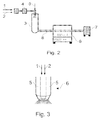
- a suitable aerosol procedure is described with reference to Figure 2 in which the encapsulating agent (1) and dye (2) are mixed, then introduced in liquid form into a spray chamber (3), generally via means of a pump (4), together with a carrier gas (5) which is typically an inert gas such as nitrogen, or air dried by conventional methods for example.
- a carrier gas (5) typically an inert gas such as nitrogen, or air dried by conventional methods for example.
- a spray nozzle (6) such as that shown in Figure 3 is used in the aerosol process, whereby the dye (2) and agent (1) are introduced through a central tube and the carrier gas is introduced through an outer tube of the nozzle.
- This type of nozzle is conventionally known as a "two-flow spray nozzle", however, other nozzle types commonly used in creating aerosols may also be employed.
- a two flow nozzle is preferred as the carrier gas flow cuts across or dissects the central flow of dye and encapsulating agent, thus facilitating more effective formation of spray droplets comprising the encapsulating agent and dye.
- the droplets are then removed from the spray chamber in a conventional manner for instance via means of a pressure differential created by a pump (7) located at the end of a tube (8), into which the droplets pass from the spray chamber.
- a pump (7) located at the end of a tube (8), into which the droplets pass from the spray chamber.
- the tube (8) into which the droplets pass is heated to a temperature which will effect drying of the particles for instance via means of a heater (9).
- a temperature in the range of approximately 140-260 °C is employed. Heating of the droplets in this way promotes condensation and, thus, further crosslinking of the siliceous encapsulating agent, preferably ultimately resulting in the formation of substantially fully crosslinked polymer-encapsulated dye particles.
- the particles made in the aerosol process are typically dried by any means conventionally known in the art, such as a heater, either before or after their recovery from the aerosol apparatus which is, again, achieved in a conventional manner.
- inorganic particles such that they comprise not only the siliceous encapsulating agent and one or more dyes, but also discrete inorganic particles such as titanium dioxide, zinc oxide, aluminium oxide and mixtures thereof, within their structure.
- titanium oxide and zinc oxide may provide additional sunscreen benefits.
- additional particles preferably have a mass average particle size of less than about 1 ⁇ m, preferably less than 100nm.
- the siliceous encapsulating agent incorporates other inorganic materials in its structure in addition to silica, these may also be provided to the aerosol process in liquid forms of conventional sources of such materials.
- it is desired to include titanium dioxide for example, it may be appropriate to include a solution tetraethoxytitanate dissolved in an appropriate solvent, such as ethanol.
- the dye molecules are typically present within the particle in more than one area or "pocket".
- the encapsulating agent may be thought of as a continuous phase or matrix, whereas the dye may be thought of as comprised within a discontinuous phase. It follows that an "encapsulating agent” is an agent, which may be used to achieve this effect.
- the encapsulating agent may also be considered to be polymeric in nature because it will tend to possess crosslinking within its structure. It is preferred that the particles made according to the process of the invention have as high a degree of crosslinking as possible, such that the dye is most effectively retained within the resulting particle and cannot leach therefrom.
- the degree of crosslinking may be observed using standard techniques such as Fourier transform infrared spectroscopy (FTIR) or solid state nuclear magnetic resonance spectroscopy (solid state NMR).
- FTIR Fourier transform infrared spectroscopy
- solid state NMR solid state nuclear magnetic resonance spectroscopy
- the particles of the invention comprise a homogeneous distribution of the one or more dyes within the encapsulating agent.
- this "homogeneous distribution" of the dye is understood to mean that the dye is homogeneously dispersed throughout the particle on a "molecular level”. This means that the dye, typically present in one or more areas or “pockets", is not visible or discernible via microscopic techniques down to a range or magnification of 2nm. In other words, the particles of the invention appear as a homogeneous or single material at this level of microscopic magnification.
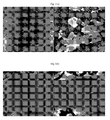
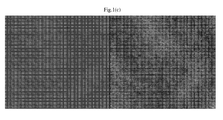
- the AFM image on the left hand side of Figure 1 (a) - (c) shows the variation within the particle in terms of its height, whereas the AFM image shown on the right hand side of Figure 1 shows the variation in phase within the particle.
- Each of the images shows that the composition of the particle is essentially homogeneous over this area range and, indeed, down to a range of at least 2nm, ie. "at a molecular level”.
- the phase image on the right hand side of Figure 1(a) - (c) essentially records an image based upon the differential hardness of the particle sample. From the phase image, it may in fact be concluded that the particle is uniformly textured almost to the resolution limit of the highest magnification image.
- any encapsulating agent cages or pockets, within which the dye molecules are held must therefore be in the range of less than approximately 2 nm in average diameter or size.
- the AFM images do not identify any regions of dye aggregates, which would appear softer and a different colour in the phase image. Therefore, the AFM results appear to show that the dye molecules are homogeneously distributed in pockets or cages within the silica network.
- compositional homogeneity of the particles appears to be key to the retention of the dye within the particles. This homogeneity has not been seen with particles of the prior art.
- the particles of the invention have a volume average particle size which renders them useful in the end application of choice. For instance, if the particles are to be used in cosmetic or beauty formulations, it is desirable that they are not discernible to the naked eye. Thus, such particles will typically have an average size of less that about 70 ⁇ m. However, if the particles are destined for used in detergent or other formulations, they may have greater sizes, for example.
- the average particle size is generally in the range of greater than 0 to 10 ⁇ m, preferably in the range of greater than 0 to 5 ⁇ m, more preferably from greater than 0 to less than 1 ⁇ m and even more preferably, is from 10nm to less than 1 ⁇ m.
- the average particle size of the particles is measured using standard techniques of the art, such as light scattering via use of a Malvern Sizer 2000 apparatus or by scanning electron microscopy (SEM).
- the particles of the invention may have any shape appropriate to the end use in question.
- the particles according to the invention are spherical because such particles may have more predictable qualities, such as optical and rheological properties.
- spherical particles may also provide improved skin feel, since they may act as a lubricant by providing a ball-bearing type effect.
- the particles of the invention achieve effective retention of dyes therein by an amorphous, siliceous encapsulating agent.
- the invention provides particles which possess good chemical and physical stability, colour fastness and tint strength as well as an acceptable environmental profile.
- a corollary of the low dye leakage is that the surface of the silica encapsulates according to the present invention has similar properties to silica per se, regardless of the dye(s) incorporated therein.
- the particles may be reliably and effectively incorporated into compositions for use in a wide variety of applications to provide colorants, which show negligible to no leakage from the compositions into which they are incorporated and which, at the same time, provide more robust coloration to the compositions than colorants of the art. Because of this, the particles of the invention may be effectively used to provide previously unattainable dye combinations, as the individual dyes are securely held in the inventive particles.
- the dye particles of the invention may be formulated into bulk colorant compositions for convenient "drop-in" use in the desired end compositions.
- This is particularly advantageous as end compositions currently formulated typically require specific, tailored formulation of all their individual components, including their colorants, in order to provide the correctly formulated end composition.
- use of colorant particles of the present invention obviates the need for this repetitive, time-consuming and, therefore, uneconomic "custom” formulation by enabling the formulation of bulk end-product compositions which may then be coloured as desired using bulk colorant compositions comprising pre-determined proportions of dye particles made by the present invention.
- Particles according to the present invention have a specific surface area of 0.1m 2 /g to 25m 2 /g, preferably 0.5m 2 /g to 5m 2 /g, more preferably 0.5m 2 /g to 3.5m 2 /g.
- particles according to the present invention have a specific internal pore volume of 0.001 to 0.03 cm 3 /g, preferably 0.001m 3 /g to 0.011cm 3 /g.
- Surface areas and pore volumes are determined using nitrogen porosimetry using nitrogen at a temperature of - 196°C or 77K. The samples are evacuated at 120-150°C for at least 4-6 hours to remove adsorbed water from the pores, and sample sizes are preferred to be around 0.5g. Otherwise standard procedures for collecting high quality N 2 isotherm data should be followed.
- the pore volumes are cumulative pore volumes for internal pores less than 50 nm in diameter and are determined using the "Barret-Joiner-Halenda" method.
- the dye commercially available from Sigma as T0388-100G (CAS# 1934-21-0) was ion-exchanged using a column with ion-exchanging resin (type Dowex 50Wx8 commercially available Dow Chemical Comp., Michigan,USA. This was necessary because the use of commercial Tartrazine induces flocculation of the tetraethylorthosilicate/ethanol/hydrochloric acid (TEOS/EtOH/HCl) encapsulating agent mixture.
- TEOS/EtOH/HCl tetraethylorthosilicate/ethanol/hydrochloric acid
- the column was loaded with 317 g Dowex 50Wx8 to obtain a 400ml bed volume.
- a 10% dye solution of sodium tartrazine was prepared in an acidic solution of water and ethanol and was eluted through the column. This solution was used to produce Tartrazine-containing silica in the subsequent procedure.
- Two batches of coloured silica were each prepared using 10.4 g TEOS, 5.4 g of HCl with a pH of around 1.25 and 12.0 g of ethanol. The components were mixed together and the mixture was left stirring for 30 minutes. Theoretically, such a mixture should give 3 g of silica after aerosolisation. The calculation of the amount of Tartrazine solution to add was based on this theoretical amount of silica. The ion-exchanged Tartrazine solution was then mixed with 4 g of ethanol.
- the starting solution blend is pumped at a constant rate of 3ml/minute using a peristaltic pump to the centre flow outlet of a coaxial two-flow spray nozzle of a spray tower.
- compressed air is pumped at 201itres/minute (at STP) to outer annular outlet located coaxially around the centre flow outlet.
- the centre flow outlet diameter is 1mm; the outer diameter is 1.5mm.
- the spraying was such that a turbulent mixture was propelled into the spray chamber, which was retained at ambient temperature. Afterwards, the mixture was heated to 220°C to induce cross-linking and drying of the particles.
- the particles were washed with de-ionized water, at a rate of 200 ml water per 1 g of particles as follows: 5 g of particles were placed into a plastic bottle and 1000 ml of water were added. The mixture was left under stirring for 5 minutes and it was then centrifuged for 10 minutes at 3500 rpm. The sediment was then separated from the supernatant fluid.
- the sediment from the centrifuged mixture was mixed with 1000 ml water in a beaker and left to settle for two days.
- the resulting supernatant fluid was then pumped into another beaker using a roll pump. Once the supernatant had been pumped into the other beaker, it was centrifuged at 3500 rpm for 20 minutes and the resulting sediment was separated using a standard separation technique from the liquid. The resulting particles were then dried in an oven at 50°C.
- the size of the resulting particles was measured using a Malvern Master Sizer 2000 apparatus, which measures particle size via light scattering
- the particle size distribution is shown in the Figure 4a , in which
- This red dye is soluble in water but it is not soluble in ethanol. It was not necessary to ionexchange the aqueous solution (as was done for Tartrazine in Example 1), however, as it did not flocculate when it was blended with the TEOS mixture. Also, even though the dye was insoluble in ethanol, it was still possible to use it directly by increasing the water proportion in the aerosol mixture.
- This blue dye is soluble in water and ethanol and it was not necessary to ion exchange the solution.
Landscapes
- Health & Medical Sciences (AREA)
- Chemical & Material Sciences (AREA)
- Life Sciences & Earth Sciences (AREA)
- Animal Behavior & Ethology (AREA)
- Veterinary Medicine (AREA)
- Public Health (AREA)
- Engineering & Computer Science (AREA)
- Bioinformatics & Cheminformatics (AREA)
- General Health & Medical Sciences (AREA)
- Epidemiology (AREA)
- Medicinal Chemistry (AREA)
- Birds (AREA)
- Organic Chemistry (AREA)
- Chemical Kinetics & Catalysis (AREA)
- Pharmacology & Pharmacy (AREA)
- Inorganic Chemistry (AREA)
- Dispersion Chemistry (AREA)
- Mathematical Physics (AREA)
- Physics & Mathematics (AREA)
- Manufacturing Of Micro-Capsules (AREA)
- Cosmetics (AREA)
- Vaporization, Distillation, Condensation, Sublimation, And Cold Traps (AREA)
- Detergent Compositions (AREA)
- Glanulating (AREA)
Priority Applications (7)
| Application Number | Priority Date | Filing Date | Title |
|---|---|---|---|
| EP07114268A EP2025720B1 (de) | 2007-08-13 | 2007-08-13 | Sprühtrocknungsverfahren zur Herstellung farbstoffhaltiger Teilchen |
| AT07114268T ATE491001T1 (de) | 2007-08-13 | 2007-08-13 | Sprühtrocknungsverfahren zur herstellung farbstoffhaltiger teilchen |
| DE602007011060T DE602007011060D1 (de) | 2007-08-13 | 2007-08-13 | Sprühtrocknungsverfahren zur Herstellung farbstoffhaltiger Teilchen |
| US12/228,373 US8168095B2 (en) | 2007-08-13 | 2008-08-12 | Spray-drying process for the manufacture of dye-loaded particles |
| PCT/IB2008/053258 WO2009022308A2 (en) | 2007-08-13 | 2008-08-13 | Spray-drying process for the manufacture of dye-loaded particles |
| JP2010520667A JP5081975B2 (ja) | 2007-08-13 | 2008-08-13 | 染料担持粒子の製造のための噴霧乾燥プロセス |
| HK09105382.6A HK1126510B (en) | 2009-06-16 | Spray-drying process for the manufacture of dye-loaded particles |
Applications Claiming Priority (1)
| Application Number | Priority Date | Filing Date | Title |
|---|---|---|---|
| EP07114268A EP2025720B1 (de) | 2007-08-13 | 2007-08-13 | Sprühtrocknungsverfahren zur Herstellung farbstoffhaltiger Teilchen |
Publications (2)
| Publication Number | Publication Date |
|---|---|
| EP2025720A1 true EP2025720A1 (de) | 2009-02-18 |
| EP2025720B1 EP2025720B1 (de) | 2010-12-08 |
Family
ID=39410251
Family Applications (1)
| Application Number | Title | Priority Date | Filing Date |
|---|---|---|---|
| EP07114268A Not-in-force EP2025720B1 (de) | 2007-08-13 | 2007-08-13 | Sprühtrocknungsverfahren zur Herstellung farbstoffhaltiger Teilchen |
Country Status (6)
| Country | Link |
|---|---|
| US (1) | US8168095B2 (de) |
| EP (1) | EP2025720B1 (de) |
| JP (1) | JP5081975B2 (de) |
| AT (1) | ATE491001T1 (de) |
| DE (1) | DE602007011060D1 (de) |
| WO (1) | WO2009022308A2 (de) |
Cited By (1)
| Publication number | Priority date | Publication date | Assignee | Title |
|---|---|---|---|---|
| EP2218437A1 (de) * | 2009-02-17 | 2010-08-18 | The Gillette Company | Rasierzusammensetzungen mit farbstofftragenden Teilchen |
Families Citing this family (17)
| Publication number | Priority date | Publication date | Assignee | Title |
|---|---|---|---|---|
| EP2062946B1 (de) * | 2007-08-13 | 2012-06-06 | Procter & Gamble International Operations SA | Farbstoffhaltige Teilchen |
| EP2025364A1 (de) * | 2007-08-13 | 2009-02-18 | Procter & Gamble International Operations SA. | Zusammensetzungen mit farbstofftragenden Teilchen |
| EP2025720B1 (de) | 2007-08-13 | 2010-12-08 | Procter & Gamble International Operations SA | Sprühtrocknungsverfahren zur Herstellung farbstoffhaltiger Teilchen |
| DE102009026746A1 (de) * | 2009-06-04 | 2010-12-09 | Sensient Imaging Technologies Gmbh | Sprühgetrocknete Farbstoffkomposite, Verfahren zu ihrer Herstellung und ihre Verwendung |
| US9237992B2 (en) | 2009-10-27 | 2016-01-19 | The Procter & Gamble Company | Two-step mascara product |
| US9216145B2 (en) | 2009-10-27 | 2015-12-22 | The Procter & Gamble Company | Semi-permanent cosmetic concealer |
| US10034829B2 (en) | 2010-10-27 | 2018-07-31 | Noxell Corporation | Semi-permanent mascara compositions |
| JP5850705B2 (ja) * | 2011-10-28 | 2016-02-03 | 日揮触媒化成株式会社 | 色素内包シリカ系粒子の製造方法、色素内包シリカ系粒子及びこれを含んだ化粧料 |
| JP5850740B2 (ja) * | 2011-12-27 | 2016-02-03 | 日揮触媒化成株式会社 | 金属酸化物粒子の製造方法 |
| WO2013163502A1 (en) | 2012-04-26 | 2013-10-31 | The Procter & Gamble Company | Two-step mascara product |
| JP2015519954A (ja) | 2012-05-15 | 2015-07-16 | ザ プロクター アンド ギャンブルカンパニー | 睫毛の凝集を定量的に判定する方法 |
| CN108025192B (zh) | 2015-09-08 | 2022-03-11 | 诺赛尔股份有限公司 | 成膜组合物 |
| FR3043683B1 (fr) * | 2015-11-12 | 2019-04-12 | Pylote | Particules spheriques et chargees en agents colorants |
| US20200022898A1 (en) | 2017-06-30 | 2020-01-23 | Coty Inc. | Film forming compositions and uses thereof |
| EP4026945A1 (de) * | 2021-01-07 | 2022-07-13 | Calik Denim Tekstil San. Ve Tic. A.S. | Verkapselter indigo |
| CN117924967A (zh) * | 2024-01-22 | 2024-04-26 | 天津科技大学 | 一种纳米颗粒染料及其制备方法和应用 |
| GB2637511A (en) * | 2024-01-24 | 2025-07-30 | Keller Services Fzco | A particle |
Citations (12)
| Publication number | Priority date | Publication date | Assignee | Title |
|---|---|---|---|---|
| GB929695A (en) * | 1961-05-19 | 1963-06-26 | Willem Dorst | A method of reducing the activity of chemically active pigments and extenders |
| GB1505100A (en) * | 1974-12-23 | 1978-03-22 | American Optical Corp | Stabilized photochromic materials |
| JPS60226805A (ja) * | 1984-04-25 | 1985-11-12 | Nippon Chem Ind Co Ltd:The | 化粧料 |
| EP0249710A2 (de) * | 1986-06-20 | 1987-12-23 | Mitsubishi Materials Corporation | Verfahren zur Herstellung eines beschichteten, wärmebeständigen Pigments |
| EP0296111A2 (de) * | 1987-06-16 | 1988-12-21 | Ciba-Geigy Ag | Mit Metalloxiden beschichtete organische Pigmente |
| JPH04352709A (ja) * | 1991-05-29 | 1992-12-07 | Tsumura & Co | 粉体の着色方法 |
| EP0528602A1 (de) * | 1991-08-16 | 1993-02-24 | Ciba-Geigy Ag | Verfahren zur Verbesserung der Lagerungsstabilität von Pigmenten |
| JPH05214264A (ja) * | 1992-02-05 | 1993-08-24 | Kanebo Ltd | 改質粉体 |
| WO2002093246A1 (en) * | 2001-05-15 | 2002-11-21 | E Ink Corporation | Electrophoretic particles |
| JP2003165921A (ja) * | 2001-12-03 | 2003-06-10 | Suzuki Yushi Kogyo Kk | 着色球状微粒子及び、これを含有した化粧料 |
| WO2005118702A2 (en) * | 2004-06-01 | 2005-12-15 | The Penn State Research Foundation | Unagglomerated core/shell nanocomposite particles |
| DE102005006767A1 (de) * | 2005-02-15 | 2006-08-24 | Heubach Gmbh | Kompositpigment, Verfahren zu dessen Herstellung sowie dessen Verwendung |
Family Cites Families (33)
| Publication number | Priority date | Publication date | Assignee | Title |
|---|---|---|---|---|
| US4173491A (en) * | 1978-03-03 | 1979-11-06 | E. I. Du Pont De Nemours And Company | Pigmented microporous silica microspheres by spray processes |
| JPS6081012A (ja) * | 1983-10-06 | 1985-05-09 | Miyoshi Kasei:Kk | 微細球状着色シリカゲルおよびその製造方法 |
| FR2571515B1 (fr) * | 1984-10-08 | 1992-05-22 | Canon Kk | Poudre pigmentaire enrobee pour le developpement d'images electrostatiques et son procede de production |
| JPS61270201A (ja) * | 1985-01-23 | 1986-11-29 | Catalysts & Chem Ind Co Ltd | 真球状無機酸化物粉末の製造法 |
| FR2605012B1 (fr) * | 1986-10-10 | 1988-11-25 | Rhone Poulenc Chimie | Pigments colores a base d'un oxyde mineral du type silice, alumine ou oxyde de titane ou de zirconium et leurs procedes de preparation. |
| JPH01138114A (ja) * | 1987-11-24 | 1989-05-31 | Mitsubishi Metal Corp | 球状着色シリカ粉の製造方法 |
| US5320835A (en) * | 1989-10-25 | 1994-06-14 | Avon Products, Inc. | Cosmetic formulation having a palette of color shades renewable by mechanical action |
| CA2080424A1 (en) * | 1991-10-25 | 1993-04-26 | Jerry Moy | Microcapsules containing inorganic colloids and method for making the same |
| CA2107253C (en) * | 1992-12-15 | 1998-04-21 | Anthony Castrogiovanni | Cosmetic compositions with improved transfer resistance |
| US5330747A (en) * | 1993-02-03 | 1994-07-19 | Dow Corning Corporation | Cosmetics with enhanced durability |
| IL115693A (en) * | 1994-10-25 | 2000-08-13 | Revlon Consumer Prod Corp | Cosmetic compositions with improved transfer resistance |
| US5654362A (en) * | 1996-03-20 | 1997-08-05 | Dow Corning Corporation | Silicone oils and solvents thickened by silicone elastomers |
| US5776214A (en) * | 1996-09-18 | 1998-07-07 | Minnesota Mining And Manufacturing Company | Method for making abrasive grain and abrasive articles |
| US5880210A (en) * | 1997-04-01 | 1999-03-09 | Dow Corning Corporation | Silicone fluids and solvents thickened with silicone elastomers |
| DE1104287T1 (de) * | 1998-08-13 | 2001-12-20 | Sol-Gel Technologies Ltd., Tel Aviv | Verfahren zur herstellung von mit funktionalisierten molekülen beladene oxid-mikrokapseln und die daraus erhaltenen produkte |
| US6238650B1 (en) * | 1999-05-26 | 2001-05-29 | Sol-Gel Technologies Ltd. | Sunscreen composition containing sol-gel microcapsules |
| US6387453B1 (en) * | 2000-03-02 | 2002-05-14 | Sandia Corporation | Method for making surfactant-templated thin films |
| US7758888B2 (en) | 2000-04-21 | 2010-07-20 | Sol-Gel Technologies Ltd. | Composition exhibiting enhanced formulation stability and delivery of topical active ingredients |
| AU2002216422A1 (en) | 2001-12-27 | 2003-07-30 | Techno Network Shikoku Co., Ltd. | Silica sphere containing fluorescent dye molecule |
| JP4352709B2 (ja) | 2002-01-31 | 2009-10-28 | 東レ株式会社 | ポリスルホン系半透膜およびそれを用いた人工腎臓 |
| EP1499895B1 (de) * | 2002-04-22 | 2008-05-07 | University Of Florida | Funktionalisierte nanopartikel und verwendungsverfahren |
| US7253017B1 (en) * | 2002-06-22 | 2007-08-07 | Nanosolar, Inc. | Molding technique for fabrication of optoelectronic devices |
| US7923030B2 (en) * | 2003-03-14 | 2011-04-12 | Sol-Gel Technologies, Inc. | Agent-encapsulating micro- and nanoparticles, methods for preparation of same and products containing same |
| EA008771B1 (ru) * | 2003-07-31 | 2007-08-31 | Сол-Джел Текнолоджиз Лтд. | Микрокапсулы, заполненные активными ингредиентами, и способ их приготовления |
| JP2005200608A (ja) * | 2004-01-19 | 2005-07-28 | Hitachi Chem Co Ltd | 色素含有ポリシロキサン、その製造方法、色素含有フィルム及びディスプレイ用前面板 |
| JP2008500341A (ja) * | 2004-05-25 | 2008-01-10 | イーエルシー マネージメント エルエルシー | 新規なカラーコスメチック組成物 |
| MXPA06014619A (es) * | 2004-06-15 | 2007-02-12 | Ciba Sc Holding Ag | Materiales zeoliticos mesoestructurados, y metodo para producir y utilizar los mismos. |
| GB0510498D0 (en) * | 2005-05-23 | 2005-06-29 | Glaxo Group Ltd | Microcapsule composition |
| JP4920685B2 (ja) * | 2005-08-09 | 2012-04-18 | ユニヴァーシティ・オヴ・サンダーランド | 質量分析を使用する指紋分析 |
| CA2671872A1 (en) * | 2006-12-07 | 2008-06-12 | University Of Florida Research Foundation, Inc. | Materials and methods for efficient and accurate detection of analytes |
| EP2025364A1 (de) * | 2007-08-13 | 2009-02-18 | Procter & Gamble International Operations SA. | Zusammensetzungen mit farbstofftragenden Teilchen |
| EP2062946B1 (de) * | 2007-08-13 | 2012-06-06 | Procter & Gamble International Operations SA | Farbstoffhaltige Teilchen |
| EP2025720B1 (de) | 2007-08-13 | 2010-12-08 | Procter & Gamble International Operations SA | Sprühtrocknungsverfahren zur Herstellung farbstoffhaltiger Teilchen |
-
2007
- 2007-08-13 EP EP07114268A patent/EP2025720B1/de not_active Not-in-force
- 2007-08-13 DE DE602007011060T patent/DE602007011060D1/de active Active
- 2007-08-13 AT AT07114268T patent/ATE491001T1/de not_active IP Right Cessation
-
2008
- 2008-08-12 US US12/228,373 patent/US8168095B2/en active Active
- 2008-08-13 WO PCT/IB2008/053258 patent/WO2009022308A2/en not_active Ceased
- 2008-08-13 JP JP2010520667A patent/JP5081975B2/ja not_active Expired - Fee Related
Patent Citations (12)
| Publication number | Priority date | Publication date | Assignee | Title |
|---|---|---|---|---|
| GB929695A (en) * | 1961-05-19 | 1963-06-26 | Willem Dorst | A method of reducing the activity of chemically active pigments and extenders |
| GB1505100A (en) * | 1974-12-23 | 1978-03-22 | American Optical Corp | Stabilized photochromic materials |
| JPS60226805A (ja) * | 1984-04-25 | 1985-11-12 | Nippon Chem Ind Co Ltd:The | 化粧料 |
| EP0249710A2 (de) * | 1986-06-20 | 1987-12-23 | Mitsubishi Materials Corporation | Verfahren zur Herstellung eines beschichteten, wärmebeständigen Pigments |
| EP0296111A2 (de) * | 1987-06-16 | 1988-12-21 | Ciba-Geigy Ag | Mit Metalloxiden beschichtete organische Pigmente |
| JPH04352709A (ja) * | 1991-05-29 | 1992-12-07 | Tsumura & Co | 粉体の着色方法 |
| EP0528602A1 (de) * | 1991-08-16 | 1993-02-24 | Ciba-Geigy Ag | Verfahren zur Verbesserung der Lagerungsstabilität von Pigmenten |
| JPH05214264A (ja) * | 1992-02-05 | 1993-08-24 | Kanebo Ltd | 改質粉体 |
| WO2002093246A1 (en) * | 2001-05-15 | 2002-11-21 | E Ink Corporation | Electrophoretic particles |
| JP2003165921A (ja) * | 2001-12-03 | 2003-06-10 | Suzuki Yushi Kogyo Kk | 着色球状微粒子及び、これを含有した化粧料 |
| WO2005118702A2 (en) * | 2004-06-01 | 2005-12-15 | The Penn State Research Foundation | Unagglomerated core/shell nanocomposite particles |
| DE102005006767A1 (de) * | 2005-02-15 | 2006-08-24 | Heubach Gmbh | Kompositpigment, Verfahren zu dessen Herstellung sowie dessen Verwendung |
Non-Patent Citations (4)
| Title |
|---|
| DATABASE EPODOC EUROPEAN PATENT OFFICE, THE HAGUE, NL; 7 December 1992 (1992-12-07), "METHOD FOR COLORING POWDER", XP002482200 * |
| DATABASE WPI Week 198551, Derwent World Patents Index; AN 1985-321713, XP002482203 * |
| DATABASE WPI Week 199338, Derwent World Patents Index; AN 1993-299810, XP002482202 * |
| DATABASE WPI Week 200427, Derwent World Patents Index; AN 2004-285984, XP002482201 * |
Cited By (1)
| Publication number | Priority date | Publication date | Assignee | Title |
|---|---|---|---|---|
| EP2218437A1 (de) * | 2009-02-17 | 2010-08-18 | The Gillette Company | Rasierzusammensetzungen mit farbstofftragenden Teilchen |
Also Published As
| Publication number | Publication date |
|---|---|
| WO2009022308A3 (en) | 2009-12-17 |
| JP5081975B2 (ja) | 2012-11-28 |
| HK1126510A1 (en) | 2009-09-04 |
| WO2009022308A2 (en) | 2009-02-19 |
| US8168095B2 (en) | 2012-05-01 |
| JP2010535929A (ja) | 2010-11-25 |
| US20090271932A1 (en) | 2009-11-05 |
| EP2025720B1 (de) | 2010-12-08 |
| ATE491001T1 (de) | 2010-12-15 |
| DE602007011060D1 (de) | 2011-01-20 |
Similar Documents
| Publication | Publication Date | Title |
|---|---|---|
| EP2025720B1 (de) | Sprühtrocknungsverfahren zur Herstellung farbstoffhaltiger Teilchen | |
| EP2062946B1 (de) | Farbstoffhaltige Teilchen | |
| US8425940B2 (en) | Agent-encapsulating micro-and nanoparticles, methods for preparation of same and products containing same | |
| AU2008288146B2 (en) | Compositions comprising dye-loaded particles | |
| DE102009026746A1 (de) | Sprühgetrocknete Farbstoffkomposite, Verfahren zu ihrer Herstellung und ihre Verwendung | |
| JP5896688B2 (ja) | 顔料内包シリカ系粒子の製造方法 | |
| US20110260110A1 (en) | Fluorescent dye-containing particle and method for producing the same | |
| JP5419338B2 (ja) | 着色アルミナ・シリカ粒子、その製造方法および該粒子を配合してなる化粧料 | |
| JP2013133410A (ja) | 染料および/または顔料内包金属酸化物粒子の製造方法および染料および/または顔料内包金属酸化物粒子、該粒子の用途 | |
| CA2752688C (en) | Shaving compositions comprising dye-loaded particles | |
| HK1126510B (en) | Spray-drying process for the manufacture of dye-loaded particles | |
| HK1132289B (en) | Dye-loaded particles | |
| JP2013095797A (ja) | 色素内包シリカ系粒子の製造方法および色素内包シリカ系粒子ならびに該粒子の用途 | |
| KR102856544B1 (ko) | 화장품 적용용 셀룰로스 나노결정 효과 안료 | |
| HK1126437A (en) | Compositions comprising dye-loaded particles | |
| HK1167672A (en) | Spray-dried dye compositions, process for the production and use thereof |
Legal Events
| Date | Code | Title | Description |
|---|---|---|---|
| PUAI | Public reference made under article 153(3) epc to a published international application that has entered the european phase |
Free format text: ORIGINAL CODE: 0009012 |
|
| AK | Designated contracting states |
Kind code of ref document: A1 Designated state(s): AT BE BG CH CY CZ DE DK EE ES FI FR GB GR HU IE IS IT LI LT LU LV MC MT NL PL PT RO SE SI SK TR |
|
| AX | Request for extension of the european patent |
Extension state: AL BA HR MK RS |
|
| 17P | Request for examination filed |
Effective date: 20090224 |
|
| 17Q | First examination report despatched |
Effective date: 20090326 |
|
| REG | Reference to a national code |
Ref country code: HK Ref legal event code: DE Ref document number: 1126510 Country of ref document: HK |
|
| AKX | Designation fees paid |
Designated state(s): AT BE BG CH CY CZ DE DK EE ES FI FR GB GR HU IE IS IT LI LT LU LV MC MT NL PL PT RO SE SI SK TR |
|
| GRAP | Despatch of communication of intention to grant a patent |
Free format text: ORIGINAL CODE: EPIDOSNIGR1 |
|
| RAP1 | Party data changed (applicant data changed or rights of an application transferred) |
Owner name: PROCTER & GAMBLE INTERNATIONAL OPERATIONS SA |
|
| GRAS | Grant fee paid |
Free format text: ORIGINAL CODE: EPIDOSNIGR3 |
|
| GRAA | (expected) grant |
Free format text: ORIGINAL CODE: 0009210 |
|
| AK | Designated contracting states |
Kind code of ref document: B1 Designated state(s): AT BE BG CH CY CZ DE DK EE ES FI FR GB GR HU IE IS IT LI LT LU LV MC MT NL PL PT RO SE SI SK TR |
|
| REG | Reference to a national code |
Ref country code: GB Ref legal event code: FG4D |
|
| REG | Reference to a national code |
Ref country code: CH Ref legal event code: EP |
|
| REG | Reference to a national code |
Ref country code: IE Ref legal event code: FG4D |
|
| REF | Corresponds to: |
Ref document number: 602007011060 Country of ref document: DE Date of ref document: 20110120 Kind code of ref document: P |
|
| REG | Reference to a national code |
Ref country code: NL Ref legal event code: VDEP Effective date: 20101208 |
|
| PG25 | Lapsed in a contracting state [announced via postgrant information from national office to epo] |
Ref country code: LT Free format text: LAPSE BECAUSE OF FAILURE TO SUBMIT A TRANSLATION OF THE DESCRIPTION OR TO PAY THE FEE WITHIN THE PRESCRIBED TIME-LIMIT Effective date: 20101208 |
|
| LTIE | Lt: invalidation of european patent or patent extension |
Effective date: 20101208 |
|
| REG | Reference to a national code |
Ref country code: HK Ref legal event code: GR Ref document number: 1126510 Country of ref document: HK |
|
| PG25 | Lapsed in a contracting state [announced via postgrant information from national office to epo] |
Ref country code: CY Free format text: LAPSE BECAUSE OF FAILURE TO SUBMIT A TRANSLATION OF THE DESCRIPTION OR TO PAY THE FEE WITHIN THE PRESCRIBED TIME-LIMIT Effective date: 20101208 Ref country code: SI Free format text: LAPSE BECAUSE OF FAILURE TO SUBMIT A TRANSLATION OF THE DESCRIPTION OR TO PAY THE FEE WITHIN THE PRESCRIBED TIME-LIMIT Effective date: 20101208 Ref country code: FI Free format text: LAPSE BECAUSE OF FAILURE TO SUBMIT A TRANSLATION OF THE DESCRIPTION OR TO PAY THE FEE WITHIN THE PRESCRIBED TIME-LIMIT Effective date: 20101208 Ref country code: SE Free format text: LAPSE BECAUSE OF FAILURE TO SUBMIT A TRANSLATION OF THE DESCRIPTION OR TO PAY THE FEE WITHIN THE PRESCRIBED TIME-LIMIT Effective date: 20101208 Ref country code: LV Free format text: LAPSE BECAUSE OF FAILURE TO SUBMIT A TRANSLATION OF THE DESCRIPTION OR TO PAY THE FEE WITHIN THE PRESCRIBED TIME-LIMIT Effective date: 20101208 Ref country code: BG Free format text: LAPSE BECAUSE OF FAILURE TO SUBMIT A TRANSLATION OF THE DESCRIPTION OR TO PAY THE FEE WITHIN THE PRESCRIBED TIME-LIMIT Effective date: 20110308 Ref country code: NL Free format text: LAPSE BECAUSE OF FAILURE TO SUBMIT A TRANSLATION OF THE DESCRIPTION OR TO PAY THE FEE WITHIN THE PRESCRIBED TIME-LIMIT Effective date: 20101208 Ref country code: AT Free format text: LAPSE BECAUSE OF FAILURE TO SUBMIT A TRANSLATION OF THE DESCRIPTION OR TO PAY THE FEE WITHIN THE PRESCRIBED TIME-LIMIT Effective date: 20101208 |
|
| PG25 | Lapsed in a contracting state [announced via postgrant information from national office to epo] |
Ref country code: CZ Free format text: LAPSE BECAUSE OF FAILURE TO SUBMIT A TRANSLATION OF THE DESCRIPTION OR TO PAY THE FEE WITHIN THE PRESCRIBED TIME-LIMIT Effective date: 20101208 Ref country code: PT Free format text: LAPSE BECAUSE OF FAILURE TO SUBMIT A TRANSLATION OF THE DESCRIPTION OR TO PAY THE FEE WITHIN THE PRESCRIBED TIME-LIMIT Effective date: 20110408 Ref country code: GR Free format text: LAPSE BECAUSE OF FAILURE TO SUBMIT A TRANSLATION OF THE DESCRIPTION OR TO PAY THE FEE WITHIN THE PRESCRIBED TIME-LIMIT Effective date: 20110309 Ref country code: BE Free format text: LAPSE BECAUSE OF FAILURE TO SUBMIT A TRANSLATION OF THE DESCRIPTION OR TO PAY THE FEE WITHIN THE PRESCRIBED TIME-LIMIT Effective date: 20101208 Ref country code: ES Free format text: LAPSE BECAUSE OF FAILURE TO SUBMIT A TRANSLATION OF THE DESCRIPTION OR TO PAY THE FEE WITHIN THE PRESCRIBED TIME-LIMIT Effective date: 20110319 Ref country code: EE Free format text: LAPSE BECAUSE OF FAILURE TO SUBMIT A TRANSLATION OF THE DESCRIPTION OR TO PAY THE FEE WITHIN THE PRESCRIBED TIME-LIMIT Effective date: 20101208 Ref country code: IS Free format text: LAPSE BECAUSE OF FAILURE TO SUBMIT A TRANSLATION OF THE DESCRIPTION OR TO PAY THE FEE WITHIN THE PRESCRIBED TIME-LIMIT Effective date: 20110408 |
|
| PG25 | Lapsed in a contracting state [announced via postgrant information from national office to epo] |
Ref country code: SK Free format text: LAPSE BECAUSE OF FAILURE TO SUBMIT A TRANSLATION OF THE DESCRIPTION OR TO PAY THE FEE WITHIN THE PRESCRIBED TIME-LIMIT Effective date: 20101208 Ref country code: RO Free format text: LAPSE BECAUSE OF FAILURE TO SUBMIT A TRANSLATION OF THE DESCRIPTION OR TO PAY THE FEE WITHIN THE PRESCRIBED TIME-LIMIT Effective date: 20101208 Ref country code: PL Free format text: LAPSE BECAUSE OF FAILURE TO SUBMIT A TRANSLATION OF THE DESCRIPTION OR TO PAY THE FEE WITHIN THE PRESCRIBED TIME-LIMIT Effective date: 20101208 |
|
| PLBE | No opposition filed within time limit |
Free format text: ORIGINAL CODE: 0009261 |
|
| STAA | Information on the status of an ep patent application or granted ep patent |
Free format text: STATUS: NO OPPOSITION FILED WITHIN TIME LIMIT |
|
| PG25 | Lapsed in a contracting state [announced via postgrant information from national office to epo] |
Ref country code: DK Free format text: LAPSE BECAUSE OF FAILURE TO SUBMIT A TRANSLATION OF THE DESCRIPTION OR TO PAY THE FEE WITHIN THE PRESCRIBED TIME-LIMIT Effective date: 20101208 |
|
| 26N | No opposition filed |
Effective date: 20110909 |
|
| PG25 | Lapsed in a contracting state [announced via postgrant information from national office to epo] |
Ref country code: MT Free format text: LAPSE BECAUSE OF FAILURE TO SUBMIT A TRANSLATION OF THE DESCRIPTION OR TO PAY THE FEE WITHIN THE PRESCRIBED TIME-LIMIT Effective date: 20101208 Ref country code: IT Free format text: LAPSE BECAUSE OF FAILURE TO SUBMIT A TRANSLATION OF THE DESCRIPTION OR TO PAY THE FEE WITHIN THE PRESCRIBED TIME-LIMIT Effective date: 20101208 |
|
| REG | Reference to a national code |
Ref country code: DE Ref legal event code: R097 Ref document number: 602007011060 Country of ref document: DE Effective date: 20110909 |
|
| PG25 | Lapsed in a contracting state [announced via postgrant information from national office to epo] |
Ref country code: MC Free format text: LAPSE BECAUSE OF NON-PAYMENT OF DUE FEES Effective date: 20110831 |
|
| REG | Reference to a national code |
Ref country code: CH Ref legal event code: PL |
|
| PG25 | Lapsed in a contracting state [announced via postgrant information from national office to epo] |
Ref country code: LI Free format text: LAPSE BECAUSE OF NON-PAYMENT OF DUE FEES Effective date: 20110831 Ref country code: CH Free format text: LAPSE BECAUSE OF NON-PAYMENT OF DUE FEES Effective date: 20110831 |
|
| REG | Reference to a national code |
Ref country code: FR Ref legal event code: ST Effective date: 20120430 |
|
| REG | Reference to a national code |
Ref country code: IE Ref legal event code: MM4A |
|
| PG25 | Lapsed in a contracting state [announced via postgrant information from national office to epo] |
Ref country code: IE Free format text: LAPSE BECAUSE OF NON-PAYMENT OF DUE FEES Effective date: 20110813 |
|
| PG25 | Lapsed in a contracting state [announced via postgrant information from national office to epo] |
Ref country code: FR Free format text: LAPSE BECAUSE OF NON-PAYMENT OF DUE FEES Effective date: 20110831 |
|
| PG25 | Lapsed in a contracting state [announced via postgrant information from national office to epo] |
Ref country code: LU Free format text: LAPSE BECAUSE OF NON-PAYMENT OF DUE FEES Effective date: 20110813 |
|
| PG25 | Lapsed in a contracting state [announced via postgrant information from national office to epo] |
Ref country code: TR Free format text: LAPSE BECAUSE OF FAILURE TO SUBMIT A TRANSLATION OF THE DESCRIPTION OR TO PAY THE FEE WITHIN THE PRESCRIBED TIME-LIMIT Effective date: 20101208 |
|
| PG25 | Lapsed in a contracting state [announced via postgrant information from national office to epo] |
Ref country code: HU Free format text: LAPSE BECAUSE OF FAILURE TO SUBMIT A TRANSLATION OF THE DESCRIPTION OR TO PAY THE FEE WITHIN THE PRESCRIBED TIME-LIMIT Effective date: 20101208 |
|
| PGFP | Annual fee paid to national office [announced via postgrant information from national office to epo] |
Ref country code: GB Payment date: 20160725 Year of fee payment: 10 |
|
| GBPC | Gb: european patent ceased through non-payment of renewal fee |
Effective date: 20170813 |
|
| PGFP | Annual fee paid to national office [announced via postgrant information from national office to epo] |
Ref country code: DE Payment date: 20180110 Year of fee payment: 11 |
|
| PG25 | Lapsed in a contracting state [announced via postgrant information from national office to epo] |
Ref country code: GB Free format text: LAPSE BECAUSE OF NON-PAYMENT OF DUE FEES Effective date: 20170813 |
|
| REG | Reference to a national code |
Ref country code: DE Ref legal event code: R119 Ref document number: 602007011060 Country of ref document: DE |
|
| PG25 | Lapsed in a contracting state [announced via postgrant information from national office to epo] |
Ref country code: DE Free format text: LAPSE BECAUSE OF NON-PAYMENT OF DUE FEES Effective date: 20190301 |