EP2030622B1 - Indication de dosage de la progestérone dans le traitement d'une blessure traumatique du cerveau - Google Patents
Indication de dosage de la progestérone dans le traitement d'une blessure traumatique du cerveau Download PDFInfo
- Publication number
- EP2030622B1 EP2030622B1 EP08167618A EP08167618A EP2030622B1 EP 2030622 B1 EP2030622 B1 EP 2030622B1 EP 08167618 A EP08167618 A EP 08167618A EP 08167618 A EP08167618 A EP 08167618A EP 2030622 B1 EP2030622 B1 EP 2030622B1
- Authority
- EP
- European Patent Office
- Prior art keywords
- progesterone
- injury
- treatment
- infusion
- hours
- Prior art date
- Legal status (The legal status is an assumption and is not a legal conclusion. Google has not performed a legal analysis and makes no representation as to the accuracy of the status listed.)
- Expired - Lifetime
Links
Images


Classifications
-
- A—HUMAN NECESSITIES
- A61—MEDICAL OR VETERINARY SCIENCE; HYGIENE
- A61K—PREPARATIONS FOR MEDICAL, DENTAL OR TOILETRY PURPOSES
- A61K31/00—Medicinal preparations containing organic active ingredients
- A61K31/56—Compounds containing cyclopenta[a]hydrophenanthrene ring systems; Derivatives thereof, e.g. steroids
- A61K31/57—Compounds containing cyclopenta[a]hydrophenanthrene ring systems; Derivatives thereof, e.g. steroids substituted in position 17 beta by a chain of two carbon atoms, e.g. pregnane or progesterone
-
- A—HUMAN NECESSITIES
- A61—MEDICAL OR VETERINARY SCIENCE; HYGIENE
- A61P—SPECIFIC THERAPEUTIC ACTIVITY OF CHEMICAL COMPOUNDS OR MEDICINAL PREPARATIONS
- A61P25/00—Drugs for disorders of the nervous system
-
- A—HUMAN NECESSITIES
- A61—MEDICAL OR VETERINARY SCIENCE; HYGIENE
- A61P—SPECIFIC THERAPEUTIC ACTIVITY OF CHEMICAL COMPOUNDS OR MEDICINAL PREPARATIONS
- A61P25/00—Drugs for disorders of the nervous system
- A61P25/28—Drugs for disorders of the nervous system for treating neurodegenerative disorders of the central nervous system, e.g. nootropic agents, cognition enhancers, drugs for treating Alzheimer's disease or other forms of dementia
-
- A—HUMAN NECESSITIES
- A61—MEDICAL OR VETERINARY SCIENCE; HYGIENE
- A61P—SPECIFIC THERAPEUTIC ACTIVITY OF CHEMICAL COMPOUNDS OR MEDICINAL PREPARATIONS
- A61P9/00—Drugs for disorders of the cardiovascular system
Definitions
- the invention relates to methods for treating a traumatic injury to the central nervous system.
- TBI traumatic brain injury
- IV infusion allows rapid drug delivery and achievement of a continuous steady state serum concentration, but this route for administration of progesterone is not FDA approved in the United States. Only three human studies involving the use of IV progesterone in the US have been reported.
- IND 33,580 Phase I clinical trial
- Christen, et al. administered IV progesterone dissolved in an ethanol-Intralipid 20% fat emulsion combined with doxorubicin over 24 hours to 32 cancer patients without toxic effects ( Christen et al. (1993) Journal of Clinical Oncology 11(12):2417-2426 ).
- a cascade of physiological events leads to neuronal loss including, for example, an inflammatory immune response and excitotoxicity resulting from the initial impact disrupting the glutamate, acetylcholine, cholinergic, GABA A , and NMDA receptor systems.
- the traumatic CNS injury is frequently followed by brain and/or spinal cord edema that enhances the cascade of injury and leads to further secondary cell death and increased patient mortality.
- Methods are needed for the in vivo treatment of traumatic CNS injuries that are successful at providing subsequent trophic support to remaining central nervous system tissue, and thus enhancing functional repair and recovery, under the complex physiological cascade of events which follow the initial insult.
- the present invention relates to methods of treating a subject with a traumatic central nervous system injury, more particularly, a traumatic brain injury, are provided.
- the methods comprise a therapy comprising a constant or a two-level dosing regime of progesterone or synthetic progestin.
- the method comprises administering to the subject in need thereof at least one cycle of therapy, wherein the cycle of therapy comprises administering a therapeutically effective two-level intravenous dosing regime of progesterone or synthetic progestin.
- the two-level dosing regime can comprise a first time period, wherein a higher hourly dose of progesterone or synthetic progestin is administered to the subject, followed by a second time period, wherein a lower hourly dose of progesterone or synthetic progestin is administered to the subject.
- the first time period comprises an hourly dose of progesterone or synthetic progestin of about 0.1 mg/kg to about 7.1 mg/kg.
- the second time period comprises an hourly dose of progesterone or synthetic progestin of about 0.05 mg/kg to about 5 mg/kg.
- a third time period comprising a tapered administration protocol is added to the progesterone or synthetic progestin dosing regime.
- the present invention relates to methods of treating a human subject with a traumatic central nervous system injury, more particularly, a traumatic brain injury.
- the methods comprise a therapy comprising a dosing regime of progesterone or synthetic progestin.
- a traumatic injury to the CNS is characterized by a physical impact to the central nervous system.
- a traumatic brain injury results when the brain is subjected to a physical force that results in progressive neuronal cell damage and/or cell death.
- a traumatic brain injury may result from a blow to the head and manifest as either an open or closed injury. Severe brain damage can occur from lacerations, skull fractures, and conversely, even in the absence of external signs of head injury. Accordingly, the methods of the invention can be used to treat a traumatic brain injury, including, blunt traumas, as well as, penetrating traumas.
- Parenchymal injuries include concussion, direct parenchymal injury and diffuse axonal injury.
- Concussions are characterized as a clinical syndrome of alteration of consciousness secondary to head injury typically resulting from a change in the momentum of the head (movement of the head arrested against a ridged surface).
- the pathogenesis of sudden disruption of nervous activity is unknown, but the biochemical and physiological abnormalities that occur include, for example, depolarization due to excitatory amino acid-mediated ionic fluxes across cell membranes, depletion of mitochondrial adenosine triphosphate, and alteration in vascular permeability.
- Postconcussive syndrome may show evidence of direct parenchymal injury, but in some cases there is no evidence of damage.
- Contusion and lacerations are conditions in which direct parenchymal injury of the brain has occurred, either through transmission of kinetic energy to the brain and bruising analogous to what is seen in soft tissue (contusion) or by penetration of an object and tearing of tissue (laceration).
- a blow to the surface of the brain leads to rapid tissue displacement, disruption of vascular channels, and subsequent hemorrhage, tissue injury and edema.
- Morphological evidence of injury in the neuronal cell body includes pyknosis of nucleus, eosinophilia of the cytoplasm, and disintegration of the cell.
- axonal swelling can develop in the vicinity of damaged neurons and also at great distances away from the site of impact.
- the inflammatory response to the injured tissue follows its usual course with neutrophiles preceding the appearance of macrophages.
- progesterone or synthetic progestin is used to promote a positive therapeutic response with respect to the traumatic central nervous system injury.
- treatment any improvement in the subject having the traumatic CNS injury including both improved morphological recovery (i.e., enhanced tissue viability) and/or behavioral recovery.
- the improvement can be characterized as an increase in either the rate and/or the extent of behavioral and anatomical recovery following the traumatic CNS injury.
- a "positive therapeutic response” includes both a complete response and a partial response.
- Neurodegeneration is the progressive loss of neurons in the central nervous system.
- "neuroprotection” is the arrest and/or reverse progression of neurodegeneration following a traumatic central nervous system injury.
- Multiple physiological events lead to the neurodegeneration of the CNS tissues following a traumatic CNS injury. These events include, for example, cerebral edema, destruction of vascular integrity, increase in the immune and inflammatory response, demyelinization, and lipid peroxidation.
- the methods of the invention also find use in reducing and/or preventing the physiological events leading to neurodegeneration.
- the present invention provides methods for reducing or eliminating neuronal cell death, edema, ischemia, and enhancing tissue viability following a traumatic injury to the central nervous system.
- the progesterone or synthetic progestin therapy of the invention is administered to a subject having a traumatic CNS injury.
- the subject can be any mammal, preferably a human.
- the human is an adult (over 18 years of age), while in other embodiments, the human is a child (under 18 years of age).
- the child can be a neonate, infant, toddler, pre-pubescent or post-pubescent and range in age from about birth, 1 month to about 2 years, about 1 year to about 5 years, about 4 years to about 9 years, about 8 years to about 14, or about 13 to about 18 years of age.
- the human can be about 55 to 60, 60 to 65, 65 to 70, 70 to 75, 75 to 80, 80 to 85, 85 to 90, 90 to 95 or older.
- the present invention provides a method of treating a traumatic CNS injury by administering to a subject progesterone or synthetic progestin in a therapeutically effective amount.
- therapeutically effective amount is meant the concentration of a progesterone or synthetic progestin that is sufficient to elicit a therapeutic effect.
- concentration of a progesterone or synthetic progestin in an administered dose unit in accordance with the present invention is effective in the treatment or prevention of neuronal damage that follows a traumatic injury to the CNS and hence, elicits a neuroprotective effect.
- the therapeutically effective amount will depend on many factors including, for example, the specific activity of the progesterone or synthetic progestin, the severity and pattern of the traumatic injury, the resulting neuronal damage, the responsiveness of the patient, the weight of the patient, along with other intraperson variability, the method of administration, and the progesterone or synthetic progestin formulation used.
- the pharmaceutical composition comprising the progesterone is administered by infusion over a period of preferably about 1 to about 120 hours.
- infusion of the progesterone or synthetic progestin occurs over a period of about 24 to about 72 hours, over a period of about 48 to about 96 hours, or over a period of about 24 to about 120 hours.
- progesterone or synthetic progestin is administered in a dose of about 0.1 ng to about 100 g per kg of body weight, about 10 ng to about 50 g per kg of body weight, from about 100 ng to about 1 g per kg of body weight, from about 1 ⁇ g to about 100 mg per kg of body weight, from about 1 ⁇ g to about 50 mg per kg of body weight, from about 1mg to about 500 mg per kg of body weight; and from about 1 mg to about 50 mg per kg of body weight.
- the amount of progesterone or synthetic progestin administered to achieve a therapeutic effective dose is about 0,1 ng, 1 ng, 10 ng, 100 ng, 1 ⁇ g, 10 ⁇ g, 100 ⁇ g, 1 mg, 2 mg, 3 mg, 4 mg, 5 mg, 6 mg, 7 mg, 8 mg, 9 mg, 10 mg, 11mg, 12 mg, 13 mg, 14 mg, 5 mg, 16 mg, 17 mg, 18 mg, 19 mg, 20 mg, 30 mg, 40 mg, 50 mg, 60 mg, 70 mg, 80 mg, 90 mg, 100 mg, 500 mg per kg of body weight or greater.
- Progesterone or synthetic progestin may be administered once or several times a day.
- the duration of the treatment may be once per day for a period of about 1, 2, 3, 4, 5, 6, 7 days or more.
- a dosage unit can be administered from about 0 hours to about 1 hr, about 1 hr to about 24 hr, about 1 to about 72 hours, about 1 to about 120 hours, or about 24 hours to at least about 120 hours post injury.
- the dosage unit can be administered from about 0.5, 1, 2, 3, 4, 5, 6, 7, 8, 9, 10, 11, 12, 13, 14, 15, 16, 17, 18, 19, 20, 21, 22, 23, 24, 30, 40, 48, 72, 96, 120 hours or longer post injury.
- Subsequent dosage units can be administered any time following the initial administration such that a therapeutic effect is achieved.
- additional dosage units can be administered to protect the subject from the secondary wave of edema that may occur over the first several days post-injury.
- the subject undergoing the therapy with progesterone or synthetic progestin is administered a constant progesterone or synthetic progestin, dosing regimen.
- constant progesterone or synthetic progestin dosing regimen is intended the subject undergoing therapy with progesterone or synthetic progestin is administered a constant total hourly infusion dose of progesterone or synthetic progestin over the course of treatment. This hourly dose of progesterone or synthetic progestin is partitioned into a series of equivalent doses that are administered according to an appropriate dosing schedule depending on the method of administration.
- the duration of the constant progesterone or synthetic progestin dosing regimen is about 12, 24, 36, 60, 72, 84, or 120 hours or about 1 to 24 hours, about 12 to 36 hours, about 24 to 48 hours, about 36 to 60 hours, about 48 to 72 hours, about 60 to 96 hours, about 72 to 108 hours, about 96 to 120 hours, or about 108 to 136 hours.
- the therapy with the progesterone or synthetic progestin comprises a "two-level progesterone or synthetic progestin dosing regimen.”
- two-level progesterone or synthetic progestin dosing regimen is intended the subject undergoing the therapy with progesterone or synthetic progestin is administered progesterone or synthetic progestin during two time periods of progesterone or synthetic progestin dosing.
- the two-time periods can have a combined duration of about 12 hours to about 7 days, including, 1, 2, 3, 4, or 5 days or about 15, 15, 30, 35, 40, 45, 50, 55, 60, 65, 70, 75, 80, 85, 90, 95, 100, 105, 110, 115, 120, 125, 130, 135, 140, or 144 hours or about 1 to 24 hours, about 12 to 36 hours, about 24 to 48 hours, about 36 to 60 hours, about 48 to 72 hours, about 60 to 96 hours, about 72 to 108 hours, about 96 to 120 hours, or about 108 to 136 hours.
- the two-level progesterone or synthetic progestin dosing regimen has a combined duration of about 1 day to about 5 days; in other embodiments, the two-level progesterone or synthetic progestin dosing regimen has a combined duration of about 1 day to about 3 days.
- the total hourly dose of progesterone or synthetic progestin that is to be administered during the first and second time periods of the two-level progesterone or synthetic progestin dosing regimen is chosen such that a higher total infusion dose of progesterone or synthetic progestin per hour is given during the first time period and a lower infusion dose of progesterone or synthetic progestin per hour is given during the second time period.
- the duration of the individual first and second time periods of the two-level progesterone or synthetic progestin dosing regimen can vary, depending upon the health of the individual and history of the traumatic injury.
- the subject is administered higher total infusion dose of progesterone or synthetic progestin per hour for at least 1, 2, 3, 4, 5, 6, 12 or 24 hours out of the 1 day to 5 day two-level progesterone or synthetic progestin dosing regimen.
- the length of the second time period can be adjusted accordingly, and range for example, from about 12 hrs, 24 hrs, 36 hrs, 48 hrs, 60 hrs, 72 hrs, 84 hrs, 96 hrs, 108 hrs, 120 hrs or about 12 to about 36 hrs, about 24 to about 36 hrs, about 24 to about 48 hrs, about 36 hrs to about 60 hours, about 48 hrs to about 72 hrs, about 60 hrs to about 84 hours, about 72 hrs to about 96 hrs, or about 108 hrs to about 120 hrs.
- the two-level progesterone or synthetic progestin dosing regimen has a combined duration of 3 days
- the higher total doses of progesterone or synthetic progestin could be administered for the first hour
- the lower total hourly dose of progesterone or synthetic progestin could be administered for hours 2 to 72.
- the total infusion dose of progestrone per hour that is to be administered during the first and second time periods of the two-level progesterone or synthetic progestin dosing regimen is chosen such that a lower total hourly dose of progesterone or synthetic progestin is given during the first time period and a higher hourly dose of progesterone or synthetic progestin is given during the second time period.
- AUC Area under the curve
- reference progesterone or synthetic progestin standard is intended the formulation of progesterone or synthetic progestin that serves as the basis for determination of the total hourly progesterone or synthetic progestin dose to be administered to a human subject with a traumatic central nervous system injury in accordance with the desired constant or two-level progesterone or synthetic progestin dosing regimen to achieve the desired positive effect, i.e., a positive therapeutic response that is improved with respect to that observed without administration of progesterone or synthetic progestin.
- the total hourly dose of progesterone or synthetic progestin to be administered during the constant or two-level progesterone or synthetic progestin dosing regimen can therefore allow for a final serum level of progesterone or synthetic progestin of about 100 ng/ml to about 1000 ng/ml, about 1100 ng/ml to about 1450 ng/ml, 100 ng/ml to about 250 ng/ml, about 200 ng/ml to about 350 ng/ml, about 300 ng/ml to about 450 ng/ml, about 350 ng/ml to about 450 ng/ml, about 400 ng/ml to about 550 ng/ml, about 500 ng/ml to about 650 ng/ml, about 600 ng/ml to about 750 ng/ml, about 700 ng/ml to about 850
- the serum level of progesterone or synthetic progestin comprises about 100 ng/ml, 250 ng/ml, 300 ng/ml, 350 ng/ml, 360 ng/ml, 370 ng/ml, 380 ng/ml, 390 ng/ml, 400 ng/ml, 410 ng/ml, 420 ng/ml, 430 ng/ml, 440 ng/ml, 450 ng/ml, 500 ng/ml, 750 ng/ml, 900 ng/ml, 1200 ng/ml, 1400 ng/ml, or 1600 ng/ml.
- the methods of the present invention also contemplate embodiments where a subject undergoing a constant progesterone or synthetic progestin therapy or a two-level progesterone or synthetic progestin dosing regimen is given a time period off from progesterone or synthetic progestin dosing.
- a progesterone or synthetic progestin dosing regime when a progesterone or synthetic progestin dosing regime is performed, the time period off from progesterone or synthetic progestin can occur between the conclusion of the first time period of the two-level progesterone or synthetic progestin dosing regimen and the initiation of the second time period of the two-level progesterone or synthetic progestin dosing regimen.
- the two-level progesterone or synthetic progestin dosing regimen is interrupted such that progesterone or synthetic progestin dosing is withheld for a period of about 15 minutes, 30 minutes, 1 hr, 2 hr, 3 hr, 4 hr, 5 hr, 6 hr or more.
- the constant progesterone or synthetic progestin therapy or the two-level progesterone or synthetic progestin therapy comprises a final time period in which the administration of progesterone or synthetic progestin is tapered.
- tapered administration is meant an administration protocol which reduces the dose of administration to the patient and thereby produces a gradual reduction and eventual elimination of progesterone or synthetic progestin, either over a fixed period of time or a time determined empirically by a physician's assessment based on regular monitoring of a therapeutic response of a subject to a traumatic CNS injury.
- the period of the tapered progesterone or synthetic progestin administration can be about 12, 24, 36, 48 hours or longer.
- the period of the tapered progesterone or synthetic progestin administration can range from about 1 to 12 hours, about 12 to about 48 hours, or about 24 to about 36 hours.
- the drug taper employed could be a "linear" taper.
- a “10%” linear taper from 500 mg would go 500, 450, 400, 350, 300, 250, 200, 150, 100, 50.
- an exponential taper could be employed which, if the program outlined above is used as an example, the exponential taper would be, e.g., 500, 450, 405, 365, 329, 296, 266, 239, etc. Accordingly, about a 5%, 10%, 20%, 30%, or 40% linear or exponential taper could be employed in the methods of the invention.
- a linear or exponential taper of about 1% to 5%, about 6% to 10%, about 11% to 15%, about 16% to 20%, about 21% to 25%, about 26% to 30%, about 31% to 35%, about 36% to 40% could be employed.
- the taper schedule can be determined based on the physician's assessment of the patient's response to therapy. Additional methods of tapered administration can be found, for example, in U.S. Provisional Application 60/729,663, filed October 24, 2005 .
- a subject undergoing therapy in accordance with the previously mentioned dosing regimens exhibits a partial response, or a relapse following completion of the first cycle of the therapy
- subsequent courses of progesterone or synthetic progestin therapy may be needed to achieve a partial or complete therapeutic response.
- a subject may receive one or more additional treatment periods comprising either constant or two-level progesterone or synthetic progestin dosing regimens.
- Such a period of time off between treatment periods is referred to herein as a time period of discontinuance. It is recognized that the length of the time period of discontinuance is dependent upon the degree of subject response (i.e., complete versus partial) achieved with any prior treatment periods of the progesterone or synthetic progestin therapy.
- maintenance cycles where each maintenance cycle comprises a completed constant or two-level progesterone or synthetic progestin dosing regimen.
- completed two-level progesterone or synthetic progestin dosing regimen is intended the subject has been administered both the first period and the second period of progesterone or synthetic progestin dosing.
- the necessity for multiple maintenance cycles can be assessed by monitoring the physiological and behavioral improvement of the patient.
- the duration between maintenance cycles can be about 1 hr, 15 hr, 1 day, 2 day, 3 day, 4 day, 5 day, 6 day or other such time periods falling within the range of about 1 day to about 14 days.
- progesterone refers to a member of the progestin family and comprises a 21 carbon steroid hormone. Progesterone is also known as D4-pregnene-3,20-dione; 84-pregnene-3,20-dione; or pregn-4-ene-3,20-dione.and its structure is provided below as formula (I).
- the progesterone used in the methods of the invention can be naturally occurring or synthetic.
- synthetic progestins are a molecule whose structure is related to that of progesterone, is synthetically derived, and retains the biologically activity of progesterone (i.e., treats a traumatic CNS injury).
- Representative synthetic progestin include, but are not limited to, modifications that produce 17a-OH esters (i.e., 17 ⁇ -hydroxyprogesterone caproate), as well as, modifications that introduce 6 ⁇ -methyl, 6-Me, 6-ene, and 6-chloro sustituents onto progesterone (i.e., medroxyprogesterone acetate, megestrol acetate, and chlomadinone acetate).
- Table 1 provides further, nonlimiting examples, of synthetic progestins.
- compositions comprising progesterone or synthetic progestin which is employed in the methods of the invention may further comprise an inorganic or organic, solid or liquid, pharmaceutically acceptable carrier.
- the carrier may also contain preservatives, wetting agents, emulsifiers, solubilizing agents, stabilizing agents, buffers, solvents and salts.
- Compositions may be sterilized and exist as solids, particulants or powders, solutions, suspensions or emulsions.
- the progesterone or synthetic progestin is dissolved in ethanol, or any other carrier which allows progesterone or synthetic progestin to dissolve.
- the progesterone or synthetic progestin can be formulated according to known methods to prepare pharmaceutically useful compositions, such as by admixture with a pharmaceutically acceptable carrier vehicle. Suitable vehicles and their formulation are described, for example, in Remington's Pharmaceutical Sciences (16th ed., Osol, A. (ed.), Mack, Easton PA (1980 )). In order to form a pharmaceutically acceptable composition suitable for effective administration, such compositions will contain an effective amount of the progesterone, either alone, or with a suitable amount of carrier vehicle.
- the pharmaceutically acceptable carrier of the present invention is liquid.
- Typical liquid carriers include syrup, peanut oil, olive oil, cyclodextrin, intralipid, and the like emulsions.
- Those skilled in the art are familiar with appropriate carriers for each of the commonly utilized methods of administration.
- the total amount of progesterone or synthetic progestin administered as a therapeutic effective dose will depend on both the pharmaceutical composition being administered (i.e., the carrier being used) and the mode of administration.
- the carrier comprises cyclodextrin.
- the formation can comprise progesterone or synthetic progestin dissolved in a 22.5% 2-hydroxypropyl- ⁇ -cyclodextrin (Sigma). See, for example, Goss et al. (2003) Pharm. Biochem. and Behavior 76:231-242 .
- the carrier comprises intralipid.
- Intralipid ® 20% (Fresenius Kabi pharmaceuticals, Clayton, NC) is employed. The lipophilic properties of Intralipid ® 20% allow up to 4 gm of progesterone or synthetic progestin per 1 liter of intralipid to be dissolved into solution.
- Controlled release preparations may be achieved by the use of polymers to complex or absorb the progesterone or synthetic progestin.
- the controlled delivery may be exercised by selecting appropriate macromolecules (for example, polyesters, polyamino acids, polyvinyl pyrrolidone, ethylene-vinylacetate, methylcellulose, carboxymethylcellulose, or protamine sulfate).
- the rate of drug release may also be controlled by altering the concentration of such macromolecules.
- Another possible method for controlling the duration of action comprises incorporating the therapeutic agents into particles of a polymeric substance such as polyesters, polyamino acids, hydrogels, poly(lactic acid) or ethylene vinylacetate copolymers.
- a polymeric substance such as polyesters, polyamino acids, hydrogels, poly(lactic acid) or ethylene vinylacetate copolymers.
- Such teachings are disclosed in Remington's Pharmaceutical Sciences (1980 ).
- At least one additional neuroprotective agent can be combined with the progesterone or synthetic progestin to enhance neuroprotection following a traumatic CNS injury.
- agents include, for example, compounds that reduce glutamate excitotoxicity and enhance neuronal regeneration.
- agents may be selected from, but not limited to, the group comprising growth factors.
- growth factor is meant an extracellular polypeptide-signaling molecule that stimulates a cell to grow or proliferate.
- the progesterone or synthetic progestin may be administered per se or in the form of a pharmaceutically acceptable salt.
- the salts of the progesterone or synthetic progestin should be both pharmacologically and pharmaceutically acceptable, but non-pharmaceutically acceptable salts may conveniently be used to prepare the free active compound or pharmaceutically acceptable salts thereof and are not excluded from the scope of this invention.
- Such pharmacologically and pharmaceutically acceptable salts can be prepared by reaction of a progesterone or a synthetic progestin with an organic or inorganic acid, using standard methods detailed in the literature.
- Examples of pharmaceutically acceptable salts are organic acids salts formed from a physiologically acceptable anion, such as, tosglate, methenesulfurate, acetate, citrate, malonate, tartarate, succinate, benzoate, etc.
- Inorganic acid salts can be formed from, for example, hydrochloride, sulfate, nitrate, bicarbonate and carbonate salts.
- pharmaceutically acceptable salts can be prepared as alkaline metal or alkaline earth salts, such as sodium, potassium, or calcium salts of the carboxylic acid group.
- the present invention also provides pharmaceutical formulations or compositions, both for veterinary and for human medical use, which comprise the progesterone or synthetic progestin or a pharmaceutically acceptable salt thereof with one or more pharmaceutically acceptable carriers thereof and optionally any other therapeutic ingredients, such as other neurotrophic agents.
- the carrier(s) must be pharmaceutically acceptable in the sense of being compatible with the other ingredients of the formulation and not unduly deleterious to the recipient thereof.
- micronized progesterone or synthetic progestin is used.
- the micronization process decreases particle size and enhances dissolution.
- Prometrian is one such example of a micronized formulation of progesterone.
- the present invention provides liposomal formulations of the progesterone or synthetic progestin and salts thereof.
- the technology for forming liposomal suspensions is well known in the art.
- the progesterone or synthetic progestin or salt thereof is an aqueous-soluble salt
- the same may be incorporated into lipid vesicles.
- the compound or salt will be substantially entrained within the hydrophilic center or core of the liposomes.
- the lipid layer employed may be of any conventional composition and may either contain cholesterol or may be cholesterol-free.
- the salt When the compound or salt of interest is water-insoluble, again employing conventional liposome formation technology, the salt may be substantially entrained within the hydrophobic lipid bilayer that forms the structure of the liposome. In either instance, the liposomes that are produced may be reduced in size, as through the use of standard sonication and homogenization techniques.
- the liposomal formulations containing the progesterone or synthetic progestin or salts thereof, may be lyophilized to produce a lyophilizate which may be reconstituted with a pharmaceutically acceptable carrier, such as water, to regenerate a liposomal suspension.
- compositions of the invention may further include one or more accessory ingredient(s) selected from the group consisting of diluents, buffers, flavoring agents, binders, disintegrants, surface active agents, thickeners, lubricants, preservatives (including antioxidants) and the like.
- accessory ingredient(s) selected from the group consisting of diluents, buffers, flavoring agents, binders, disintegrants, surface active agents, thickeners, lubricants, preservatives (including antioxidants) and the like.
- Behavioral assays can be used to determine the rate and extent of behavior recovery in response to the treatment. Improved patient motor skills, spatial learning performance, cognitive function, sensory perception, speech and/or a decrease in the propensity to seizure may also be used to measure the neuroprotective effect.
- Such functional/behavioral tests used to assess sensorimortor and reflex function are described in, for example, Bederson et al. (1986) Stroke 17:472-476 , DeRyck et al. (1992) Brain Res. 573:44-60 , Markgraf et al. (1992) Brain Res. 575:238-246 , Alexis et al. (1995) Stroke 26:2336-2346 . Enhancement of neuronal survival may also be measured using the Scandinavian Stroke Scale (SSS) or the Barthl Index.
- SSS Scandinavian Stroke Scale
- the treatment of a traumatic brain injury can be monitored by employing a variety of neurological measurements.
- a partial therapeutic responses can be monitored by determining if, for example, there is an improvement in the subjects a) maximum daily Glasgow Coma Score; b) duration of coma; 3) daily intracranial pressure - therapeutic intensity levels; 4) extent of cerebral edema/mass effect measured on serial CT scans; and, 5) duration of ventilator support.
- the Glasgow Coma Score is a reflection of the depth of impaired consciousness and is best obtained following initial resuscitation (oxygenation, rehydration and support of blood pressure) but prior to use of sedating drugs, neuromuscular blocking agents, or endotracheal intubation.
- the duration of coma will be defined as the number of hours from the time of injury that the subject is unable to purposefully respond to commands or mechanical stimulation. For non-intubated subjects, this equates to a GCS score of > 8. For intubated patients, this correlates with a GCS motor score of > 5. Duration of coma has been found to be predictive of functional outcome ( Uhler et al. (1994) Neurosurgery 34(1): 122-8 ; Jiang et al. (1996) Brain Res 735(1): 101-7 ; and Gonzalez-Vidal et al. (1998) Arch Med Res 29(2): 117-24 ). Time spent in a coma induced pharmacologically for reasons other than brain injury should be subtracted in the final analysis.
- the intracranial pressure (ICP) of patients with severe TBI is often monitored with an intracranial pressure device.
- Monitoring ICP can provide a measure of cerebral edema.
- TIL Therapeutic Intensity Level
- measures treatment aggressiveness for elevated ICPs Allolio et al. (1995) European Journal of Endocrinology 133(6): 696-700 ; Adashi et al. (1996) Reproductive endocrinology, surgery, and technology Philadelphia: Lippincott-Raven ; and, Beers et al. eds. (1999) The Merck manual of diagnosis and therapy. 17th ed., Merck Sharp & Dohme Research Laboratories, Rahway, N.J .).
- the extent of cerebral edema and mass effect can be determined by CT scans.
- the volume of focal lesions can be measured.
- Mass lesions either high-density or mixed-density abnormalities, will be evaluated by measuring the area of the abnormality as a region of interest, multiplying the area by the slice thickness, and summing these volumes for contiguous slices showing the same lesion. Each lesion will be measured three times, and the mean volume will be entered. This technique has been shown to be reliable ( Garcia-Estrada et al. (1993) Brain Res 628(1-2): 271-8 ).
- Intracerebral lesions can be further characterized by location (frontal, temporal, parietal, occipital, basal ganglia, or any combination).
- location frontal, temporal, parietal, occipital, basal ganglia, or any combination.
- VBR ventricle-brain ratio
- the duration of ventilator support will be defined as the number of hours the patient receives positive pressure mechanical ventilation ( Uhler et al. (1994) Neurosurgery 34(1): 122-8 ; Jiang et al. (1996) Brain Res 735(1): 101-7 ; and Gonzalez-Vidal et al. (1998) Arch Med Res 29(2): 117-24 ). Time spent under ventilator support for reasons other than brain injury will be subtracted in the final analysis.
- a partial therapeutic response can also be assayed through various functional and neuropsychological outcomes.
- Several standardized measures of neuropsychological and functional performance are known. For instance subjects may display an improvement in the Glasgow Outcome Scale (GOS)/Glasgow Outcome Scale Extender (GOSE) and/or in the Disability Rating Scale (DRS).
- GOS Glasgow Outcome Scale
- GOSE Glosgow Outcome Scale Extender
- DRS Disability Rating Scale
- the Glasgow Outcome Score is one of the most widely used measures of brain injury recovery in the world ( Garcia-Estrada et al. (1999) Int J Dev Neurosci 17(2): p. 145-51 ). Patients are classified into one of five categories: death, persistent vegetative state, severe disability, moderate disability, and good recovery. It is easy to administer and score, and has a high degree of reliability and validity.
- the Disability Rating Scale offers more precision than the GOS for measuring outcomes of moderate brain injury ( Goodman et al. (1996) J Neurochem 66(5): 1836-44 ).
- the DRS consists of an eight-item rating of arousal and awareness, daily living activities, physical dependence, and employability ( Vedder et al. (1999) J Neurochem 72(6):2531-8 ). Inter-rater reliability for the entire DRS is high (.97 to .98).
- the Functional Independence Measure can be used to assess physical and cognitive disability. It contains 18 items in the following domains: self-care, sphincter control, mobility, locomotion, communication, and social cognition ( Baulieu (1997) Mult Scler 3(2): 105-12 ). The FIM has demonstrated reliability and validity as an outcome measure following moderate and severe TBI ( Jung-Testas et al. (1994) J Steroid Biochem Mol Biol 48(1): 145-54 ).
- the Sickness Impact Profile is one method for measuring self-perceived health status ( Schumacher et al. (1995) Ciba Found Symp 191: p. 90-112 and Koenig et al. (1995) Science 268(5216):1500-3 ). It consists of 136 questions divided into 12 categories: sleep and rest, eating, work, home management, recreation and pastimes, ambulation, mobility, body care and movement, social interaction, alertness, behavior, emotional behavior, and communication. It has been widely used across a variety of diseases and injuries, including head injury ( Thomas et al. (1999) Spine 24:2134-8 ). Baseline SIP scores will reflect pre-injury health status, while follow-up scores will examine post-injury functioning.
- Solutions of study drug were prepared by the Investigational Drug Service of Emory Healthcare as follows: Progesterone was dissolved in 95% ethanol and filtered into sterile vials using a 0.2 ⁇ filter. Aliquots of each solution were assayed for final concentration and sterility. Stock solutions of progesterone / placebo were packaged in kits (A, B, C, D or E) that matched the randomized treatment assignments. Each kit contained six vials. Vial 1 contained 15 ml of progesterone or placebo which was used to prepare the initial bolus and first infusion dose. The remaining 5 vials contained 12 ml of progesterone or placebo for the remaining infusions.
- the diluent used to compound the progesterone solution was 95% ethanol.
- the placebo kits were also formulated with 95% ethanol. Because of the alcohol concentration, doses of study drug were mixed with Intralipid ® immediately prior to infusion. Each infusion dose was administered over 12 hours and repeated every 12 hours for a total of 72 hours. After randomizing a patient, a dosing worksheet based on body weight and final progesterone concentration was used to determine the volume of vial #1 required to be diluted in Intralipid ® for a standard loading infusion rate (14 cc/hr) and the first 11 hr of the maintenance infusion (10 cc/hr). The dosing worksheet was also used to calculate the volume of study medication to be diluted in Intralipid ® for each of the remaining infusion reservoirs at a standard rate of 10 cc/hr.
- Detection was at 247nM. A check of system suitability yielded 2769 plates per meter (minimum requirement >2500) based on the progesterone peak and a relative standard deviation (RSD) of 0.80% (minimum requirement 1.0% or less). The tailing factor for the progesterone peak was 0.5. Reproducibility as assessed by 10 injections of the same preparation on multiple different days was always less than 10%.
- progesterone preparations were diluted 1 to 10 with ethanol and 1 ⁇ L of this dilution was injected. Under these conditions, progesterone eluted at roughly 3.5 minutes. A five point standard curve was run with each analysis.
- the progesterone study drug solution was infused at the loading rate of 14 mLs/hr (0.71 mg/kg/h) for one hour, followed by a decrease in infusion rate to 10 mLs/hr (O.Smg/kg/h) for the remaining 71 hours.
- Intralipid solutions containing progesterone were found to be stable for a minimum of 24 hours, reservoirs of study drug were prepared and changed every 12 hr during the infusion period to minimize the risk of biological contamination. Any interruptions in drug administration or other deviations from the protocol were noted on a drug administration flow sheet and taken into account when calculating the total number of mg of progesterone actually administered to each patient.
- Serum progesterone concentrations were measured using the Immulite ® progesterone chemi-luminescent enzyme immunoassay by the Immunology Laboratory of the Department of Pathology, Emory University Hospital. The within and between day coefficients of variation for the assay were both ⁇ 10%. We confirmed the accuracy of our assay by comparing the results of 9 samples over the range 0.5 to 700 ng/mL assayed in our laboratory with those assayed by a reference laboratory (The Nichols Institute, San Juan Capistrano, CA).
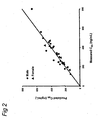
- the primary pharmacokinetic parameter, CL was estimated as the ratio of the dose to area under the serum concentration-time curve (AUC). AUC's were calculated using the linear trapezoidal rule ( Veng-Pedersen (1989) Clin Pharmacokinet, 17(6):424-40 ). The elimination phase rate constant, k e , was calculated from the serum concentration-time data following the termination of the infusion using iterative non-linear regression (WinNonlin ® , Pharsight Corporation, Mountain View, CA). Volume of Distribution was estimated as the ratio of CL and k e . C ss was estimated as the ratio of Dose and CL. Actual C ss was defined as the concentration achieved when the slope of the serum concentration-time curve for three or more consecutive samples was not different from zero.
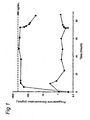
- Figure 1 is a representative serum concentration-time profile for one patient receiving progesterone and one patient receiving a placebo infusion and in whom a complete sampling paradigm was possible.
- Progesterone concentrations for patients receiving a placebo infusion remained constant throughout the study period.
- C ss concentrations in patients receiving progesterone were rapidly reached and, once achieved, were stable throughout the infusion period.
- Complete peri- and post-infusion sampling was only possible in 7/11 females and 10/21 males because of the critical nature of the injuries sustained by the study patients.
- C ss values in the current study were lower than expected based on those reported for infusions of progesterone in cancer patients ( Christen et al. (1993) Journal of Clinical Oncology 11(12):2417-2426 ).
- Table 2 is a summary of the demographic and primary pharmacokinetic data stratified by sex. There were no significant differences between males and females with respect to any of the parameters in Table 2 with the exception of body weight. As one might expect, the mean body weight for the males (81.5 ⁇ 16.2 kg) was significantly greater (p ⁇ 0.003) than that for the females (63.9 ⁇ 11.0 kg). Clearance (CL) values were calculated from the total dose of progesterone infused and the AUC( 0-72h ) rather than from AUC (0- ⁇ ) because complete post-infusion blood sampling was not possible in a number of the patients for medical reasons.
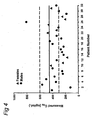
- Figure 4 is a plot of measured C ss for each patient showing these concentrations were systematically lower than the target concentration range predicted from previous studies ( Christen et al. (1993) Journal of Clinical Oncology 11(12):2417-2426 ; Allolio et al. (1995) European Journal of Endocrinology 133(6):696-700 ). These data suggest that in trauma patients with moderate to severely head injuries the resulting hyperkinetic physiologic state results in a clinically significant increase in progesterone clearance. These data suggest that to achieve our target concentration of 450 ⁇ 100 ng/mL, the maintenance infusion rate should be increased from 0.5mg/kg/h to approximately 0.8mg/kg/h.
- Brain Trauma Foundation (1996) "Guidelines for the Management of Severe Head Injury,” Journal of Neurotrauma, 13(11):643-5 ; Brain Trauma Foundation B (2000) “Management and Prognosis of Severe Traumatic Brain Injury, Parts I & II,” Journal of Neurotrauma, 17(June/July):449-627 ).
- progesterone a neurosteroid that is naturally found in the brains of men and women, has potent neuroprotective properties.
- TBI moderate to severe acute traumatic brain injury
- a solution of progesterone in 95% ethyl alcohol is stable for up to 2 years at room temperature; 2) Intralipid ® solutions containing progesterone in 95% ethyl alcohol are stable for a minimum of 24 hours; 3) A C ss of progesterone can be rapidly achieved and maintained in acute, critically ill traumatic brain injured patients with multi-system trauma using a two phase intravenous infusion paradigm; 4) Progesterone C ss values can be accurately predicted from AUC data; 5) The hyperkinetic physiologic alterations accompanying acute traumatic brain injury result in significant elevations in CL, t 1/2 , and V d for progesterone; 6) Acute traumatic brain injury, per se, does not result in endogenous release of progesterone; and 7) Alterations in progesterone pharmacokinetics following acute traumatic brain injury are not gender dependent.
- Brain Trauma Foundation (1996) "Guidelines for the Management of Severe Head Injury,” Journal of Neurotrauma, 13(11):643-5 ; Brain Trauma Foundation B (2000) “Management and Prognosis of Severe Traumatic Brain Injury, Parts I & II," Journal of Neurotrauma, 17(June/July):449-627 ; Roberts, et al. (1998) J Neurol Neurosurg Psychiatry, 65(5):729-33 ). With the exception of mannitol and barbiturates, no pharmacological agents were identified that enhance recovery.
- a pilot phase II, randomized, double-blind, controlled trial of progesterone for the treatment of a traumatic brain injury was preformed.
- the administration protocol was carried out as described above in Example 1.
- the preliminary evaluations are as follows. One hundred patients having moderate to severe TBI were enrolled in the study, which had a randomized block design 4:1 enrollment. Three days IV administration of progesterone [450 +/nmol/L] in both males and females. The administration protocol and pharmaceutical composition administered are described in detail in Example 1. Follow up regarding condition occurred at 30 days and 1 year.
- an "adverse event” is any undesirable medical event occurring to a subject in a clinical trial, whether or not related to the study drug. This includes events not seen at baseline, or worsened if present at baseline. "Serious adverse events” are defined as death, immediate risk of death, or suspicion that use or continued use would result in the patient's death, prolongation of existing hospitalization, persistent or significant disability/incapacity, or a congenital anomaly/birth defect.
- thromboembolic event deep vein thrombosis, thrombophlebitis, ischemic myocardial infarction, pulmonary embolism, stroke or transient ischemic attack
- elevated liver enzymes temperature elevation, allergic reactions, and hyperglycemia.
- All laboratory test results obtained during the course of treatment were recorded and analyzed to detect abnormal levels or worrisome trends.
- An independent internal safety monitor made the determination if an adverse event was associated with study treatment. Both the FDA and an independent NIH-appointed data safety monitoring board independently reviewed these determinations.
- Exclusion criteria included a blood alcohol concentration of >250 mg/dl; penetrating brain injury; age ⁇ 18 years; an iGCS of ⁇ 4 or >12; indeterminate time of injury; pregnancy; cancer; stroke; spinal cord injury; or unable to secure proxy consent within 11 hours of injury.
- the next kit in sequence for that subgroup was used to prepare infusions.
- the first vial was mixed in Intralipid TM 20% to deliver a one-hour loading dose of 0.71mg/kg of progesterone at a standard rate of 14 mls/hour, followed by a maintenance infusion of 0.5mg/kg/h at a standard rate of 10 mls/hour.
- the remaining vials were used to prepare 5 subsequent 12-hour infusions at the same standard rate of 10 mls/ hour for a total of 3 days of treatment. Details of drug monitoring are reported elsewhere ( Wright et al. (2005) J Clin Pharmacol 45(6):640-648 ).
- the infusion was stopped if a patient experienced an anaphylactic reaction, a major thromboembolic event, an unexplained elevation of serum aspartate aminotransferase (AST) or alanine aminotransferase (ALT) to a level greater than 5,000 IU, or a serum total bilirubin level greater than 10 mg/dl.
- AST serum aspartate aminotransferase
- ALT alanine aminotransferase
- Reliability codes were used to record reasons for non-administration of a particular measure, such as physical impairment (e.g., hemiparesis) cognitive impairment (e.g., could not understand instructions), or intoxication.
- physical impairment e.g., hemiparesis
- cognitive impairment e.g., could not understand instructions
- Data collection and processing Data collection was guided by a formal data management plan and standard operating procedures manual. Data collected at the bedside were recorded on paper case report forms (CRFs) and subsequently double entered into a web-based ORACLE® database. Entered CRFs were not accepted as valid unless the double entries matched and all range checks were met. Special edit queries were constructed to generate transport files for importing into SAS® for analysis.
- CRM paper case report forms
- Randomization - 77 subjects were randomized to progesterone; 23 to placebo. Treatment groups were highly similar with respect to gender, age, race, iGCS, mechanism of injury, revised trauma score, injury severity score, time from injury to E.D. arrival, time to study treatment, Marshal CT score ( Marshall et al. (1991) J Neurosurgery 75 (suppl):S14-20 ), and E.D. disposition (Table 4).
- progesterone The only adverse events specifically ascribed to administration of progesterone were two cases of superficial phlebitis at the IV site. Both resolved spontaneously. Three patients, all of whom received progesterone, developed a deep vein thrombosis between 6 to 23 days following completion of the infusion. All 3 cases were treated without incident. Two patients suffered ischemic strokes. One in a patient randomized to progesterone, occurred prior to treatment and was considered a major protocol violation. The other involved a patient randomized to placebo. A patient randomized to progesterone sustained a myocardial infarction two days after the study infusion was completed. At the time, he was receiving high-dose neosynephrine in an effort to boost his cerebral perfusion pressure. Post-mortem revealed no intracoronary thrombosis.
- Severe TBI patients (iGCS 4-8) treated with progesterone remained in coma significantly longer than survivors who received placebo (mean duration 10.1 days (7.7, 12.5) versus 3.9 days (2.5, 5.4) respectively).
- the mean duration of posttraumatic amnesia did not significantly differ between groups (Table 7).
- progesterone has not been previously used to treat acute traumatic brain injury, we conducted a pilot, phase II study to assess potential harms. Arriving patients were carefully screened for eligibility. Ninety nine percent of potentially eligible patients were screened, and 90 percent of those who met inclusion criteria were enrolled with proxy consent. Treatment and control patients were well matched by injury severity, time to treatment and other independent predictors of outcome.
- Severely brain-injured patients in the treatment group had a longer mean duration of coma than those in the control group. This may represent a "survivor effect". If progesterone prevented the deaths of several patients during the 30 day follow up period, it is not surprising that these survivors remained in coma for a longer duration of time. One-year survival and functional outcomes will be reported at a later date.
Landscapes
- Health & Medical Sciences (AREA)
- Pharmacology & Pharmacy (AREA)
- Veterinary Medicine (AREA)
- Public Health (AREA)
- Chemical & Material Sciences (AREA)
- General Health & Medical Sciences (AREA)
- Medicinal Chemistry (AREA)
- Animal Behavior & Ethology (AREA)
- Life Sciences & Earth Sciences (AREA)
- Engineering & Computer Science (AREA)
- Bioinformatics & Cheminformatics (AREA)
- Chemical Kinetics & Catalysis (AREA)
- Neurosurgery (AREA)
- Nuclear Medicine, Radiotherapy & Molecular Imaging (AREA)
- General Chemical & Material Sciences (AREA)
- Organic Chemistry (AREA)
- Biomedical Technology (AREA)
- Neurology (AREA)
- Epidemiology (AREA)
- Heart & Thoracic Surgery (AREA)
- Hospice & Palliative Care (AREA)
- Psychiatry (AREA)
- Cardiology (AREA)
- Pharmaceuticals Containing Other Organic And Inorganic Compounds (AREA)
- Steroid Compounds (AREA)
- Medicinal Preparation (AREA)
- Infusion, Injection, And Reservoir Apparatuses (AREA)
Claims (18)
- Progestérone destinée à être utilisée dans le traitement d'une lésion cérébrale traumatique chez un sujet humain, ledit traitement comprenant un schéma posologique de progestérone constant ou à deux niveaux où une quantité thérapeutiquement efficace de progestérone est administrée audit sujet humain par perfusion intraveineuse pour obtenir un niveau sérique final de progestérone d'environ 100 ng/ml à environ 1000 ng/ml.
- Progestérone selon la revendication 1 où le traitement réalise un niveau sérique final de progestérone d'au moins environ 200 ng/ml.
- Progestérone selon la revendication 1 ou 2 où le traitement réalise un niveau sérique final de progestérone pas supérieur à environ 950 ng/ml.
- Progestérone selon la revendication 3 où le traitement réalise un niveau sérique final de progestérone pas supérieur à environ 850 ng/ml.
- Progestérone selon l'une quelconque des revendications précédentes où la perfusion intraveineuse délivre la progestérone en une dose horaire d'au moins environ 0,1 mg/kg/h.
- Progestérone selon la revendication 5 où la perfusion délivre la progestérone à un débit d'au moins 0,5 mg/kg/h.
- Progestérone selon la revendication 6 où la perfusion délivre la progestérone à un débit d'au moins 0,71 mg/kg/h.
- Progestérone selon la revendication 7 où la perfusion délivre la progestérone à un débit d'au moins 0,8 mg/kg/h.
- Progestérone selon l'une quelconque des revendications précédentes où la perfusion délivre la progestérone à un débit pas supérieur à environ 7,1 mg/kg/h.
- Progestérone selon l'une quelconque des revendications précédentes où la durée du traitement est 1-7 jours.
- Progestérone selon l'une quelconque des revendications précédentes où la progestérone est administrée d'environ 0 heure à environ 1 heure après la lésion.
- Progestérone selon l'une quelconque des revendications 1-10 où la progestérone est administrée d'environ 1 heure à environ 120 heures après la lésion.
- Progestérone selon l'une quelconque des revendications précédentes où la progestérone est administrée par perfusion sur une durée d'environ 1 à environ 120 heures.
- Progestérone selon l'une quelconque des revendications précédentes où le traitement comprend un schéma posologique de progestérone constant.
- Progestérone selon la revendication 14 où la progestérone est administrée en une dose de perfusion horaire totale constante au cours du traitement.
- Progestérone selon l'une quelconque des revendications précédentes où la progestérone est administrée par perfusion au moyen d'un schéma posologique constant ayant une durée d'environ 1 à 136 heures.
- Progestérone selon l'une quelconque des revendications précédentes où le traitement comprend de multiples cycles d'entretien, chaque cycle d'entretien comprenant un schéma posologique de progestérone constant complet, et où la durée entre les cycles d'entretien est entre 1 heure et 1 jour.
- Progestérone selon l'une quelconque des revendications précédentes où la progestérone est administrée sous forme d'une composition qui contient en outre de l'alcool éthylique.
Priority Applications (3)
| Application Number | Priority Date | Filing Date | Title |
|---|---|---|---|
| PL08167618T PL2030622T3 (pl) | 2005-03-24 | 2006-03-24 | Wskazanie dawkowania progesteronu w leczeniu urazowego uszkodzenia mózgu |
| SI200630961T SI2030622T1 (sl) | 2005-03-24 | 2006-03-24 | Indikacija odmerka progesterona pri zdravljenju travmatske poškodbe možganov |
| CY20111100496T CY1111478T1 (el) | 2005-03-24 | 2011-05-20 | Ενδειξη δοσολογιας προγεστερονης στην αντιμετωπιση τραυματικης εγκεφαλικης βλαβης |
Applications Claiming Priority (3)
| Application Number | Priority Date | Filing Date | Title |
|---|---|---|---|
| US66472805P | 2005-03-24 | 2005-03-24 | |
| US72966305P | 2005-10-24 | 2005-10-24 | |
| EP06748657A EP1868614B1 (fr) | 2005-03-24 | 2006-03-24 | Regime posologique pour le traitement d'une lesion cerebrale liee a un traumatisme avec de la progesterone |
Related Parent Applications (2)
| Application Number | Title | Priority Date | Filing Date |
|---|---|---|---|
| EP06748657A Division EP1868614B1 (fr) | 2005-03-24 | 2006-03-24 | Regime posologique pour le traitement d'une lesion cerebrale liee a un traumatisme avec de la progesterone |
| EP06748657.1 Division | 2006-03-24 |
Publications (2)
| Publication Number | Publication Date |
|---|---|
| EP2030622A1 EP2030622A1 (fr) | 2009-03-04 |
| EP2030622B1 true EP2030622B1 (fr) | 2011-02-23 |
Family
ID=36987966
Family Applications (5)
| Application Number | Title | Priority Date | Filing Date |
|---|---|---|---|
| EP12163432A Withdrawn EP2494976A1 (fr) | 2005-03-24 | 2006-03-24 | Procédés pour le traitement d'une lésion traumatique du système nerveux central |
| EP11177154.9A Expired - Lifetime EP2431042B1 (fr) | 2005-03-24 | 2006-03-24 | Procédés pour le traitement des blessures du système nerveux central via un protocole d'administration biseauté |
| EP06739662A Expired - Lifetime EP1871382B1 (fr) | 2005-03-24 | 2006-03-24 | Methodes destinees au traitement d'une lesion au niveau du systeme nerveux central, dans lesquelles est utilise un protocole d'administration a reduction progressive |
| EP06748657A Expired - Lifetime EP1868614B1 (fr) | 2005-03-24 | 2006-03-24 | Regime posologique pour le traitement d'une lesion cerebrale liee a un traumatisme avec de la progesterone |
| EP08167618A Expired - Lifetime EP2030622B1 (fr) | 2005-03-24 | 2006-03-24 | Indication de dosage de la progestérone dans le traitement d'une blessure traumatique du cerveau |
Family Applications Before (4)
| Application Number | Title | Priority Date | Filing Date |
|---|---|---|---|
| EP12163432A Withdrawn EP2494976A1 (fr) | 2005-03-24 | 2006-03-24 | Procédés pour le traitement d'une lésion traumatique du système nerveux central |
| EP11177154.9A Expired - Lifetime EP2431042B1 (fr) | 2005-03-24 | 2006-03-24 | Procédés pour le traitement des blessures du système nerveux central via un protocole d'administration biseauté |
| EP06739662A Expired - Lifetime EP1871382B1 (fr) | 2005-03-24 | 2006-03-24 | Methodes destinees au traitement d'une lesion au niveau du systeme nerveux central, dans lesquelles est utilise un protocole d'administration a reduction progressive |
| EP06748657A Expired - Lifetime EP1868614B1 (fr) | 2005-03-24 | 2006-03-24 | Regime posologique pour le traitement d'une lesion cerebrale liee a un traumatisme avec de la progesterone |
Country Status (15)
| Country | Link |
|---|---|
| US (4) | US20090325920A1 (fr) |
| EP (5) | EP2494976A1 (fr) |
| JP (5) | JP5394059B2 (fr) |
| AT (2) | ATE520404T1 (fr) |
| AU (2) | AU2006226774B2 (fr) |
| CA (2) | CA2601715C (fr) |
| CY (2) | CY1111478T1 (fr) |
| DE (1) | DE602006020353D1 (fr) |
| DK (2) | DK1868614T3 (fr) |
| ES (2) | ES2428313T3 (fr) |
| HR (2) | HRP20120688T1 (fr) |
| PL (2) | PL1868614T3 (fr) |
| PT (2) | PT2030622E (fr) |
| RS (1) | RS52471B (fr) |
| WO (2) | WO2006102596A2 (fr) |
Families Citing this family (44)
| Publication number | Priority date | Publication date | Assignee | Title |
|---|---|---|---|---|
| DE602006020353D1 (de) * | 2005-03-24 | 2011-04-07 | Univ Emory | Progesterone Dosierungsanweisung in der Behandlung einer traumatischen Verletzung des Gehirns |
| US7473687B2 (en) * | 2005-03-24 | 2009-01-06 | Emory University | Methods for the treatment of a traumatic central nervous system injury |
| EP2052724A1 (fr) * | 2007-10-26 | 2009-04-29 | sanofi-aventis | Utilisation de norgestimate en tant qu'inhibiteur sélectif de canal d'ion TRPC3, TRPC6 et TRPC6 et TRPC7 |
| EP2260052A4 (fr) | 2008-02-26 | 2013-01-16 | Univ Emory | Analogues stéroïdiens utilisés en neuroprotection |
| RU2366466C1 (ru) * | 2008-03-25 | 2009-09-10 | Олег Васильевич Онысько | Способ лечения черепно-мозговой травмы |
| BRPI0918868B8 (pt) | 2008-09-18 | 2021-05-25 | Naurex Inc | compostos moduladores do receptor de nmda e composições compreendendo os mesmos |
| US20110306579A1 (en) * | 2009-01-30 | 2011-12-15 | Emory University | Methods of neuroprotection using neuroprotective steroids and a vitamin d |
| US8951968B2 (en) | 2009-10-05 | 2015-02-10 | Northwestern University | Methods of treating depression and other related diseases |
| US10993879B2 (en) * | 2010-02-08 | 2021-05-04 | Shenzhen Evergreen Therapeutics Co., Ltd. | Pulmonary delivery of progestogen |
| US20110262502A1 (en) * | 2010-02-08 | 2011-10-27 | Prairie Pharmaceuticals LLC | Pulmonary delivery of 17-hydroxyprogesterone caproate (17-hpc) |
| ES2773079T3 (es) | 2010-02-08 | 2020-07-09 | Shenzhen Evergreen Therapeutics Co Ltd | Métodos para el uso de progestágeno como sensibilizador de glucocorticoides |
| US10987361B2 (en) | 2010-02-08 | 2021-04-27 | Shenzhen Evergreen Therapeutics Co., Ltd. | Treating auto-immune and auto-inflammatory diseases |
| TW201138782A (en) | 2010-04-26 | 2011-11-16 | Besins Healthcare Lu Sarl | Low-oil pharmaceutical emulsion compositions comprising progestogen |
| CA2834286A1 (fr) * | 2011-04-27 | 2012-11-01 | Northwestern University | Procedes de traitement de la maladie d'alzheimer, de la maladie de huntington, de l'autisme ou autres troubles |
| WO2013043985A1 (fr) | 2011-09-23 | 2013-03-28 | The Regents Of The University Of California | Huiles comestibles favorisant l'administration de stéroïdes administrés par voie orale |
| EP2806877B2 (fr) * | 2012-01-23 | 2025-01-29 | Sage Therapeutics, Inc. | Formulations de stéroïdes neuroactifs comprenant un complexe d'allopregnanolone et de sulfobutyl ether beta-cyclodextrine |
| US20130210785A1 (en) | 2012-02-15 | 2013-08-15 | Emory University | Progesterone analogs and uses related thereto |
| BR112014021390A2 (pt) | 2012-02-29 | 2019-09-24 | Braun Melsungen Ag | emulsão do tipo óleo em água contendo hormônio e composição farmacêutica |
| RU2498826C1 (ru) * | 2012-05-14 | 2013-11-20 | Федеральное государственное бюджетное учреждение науки Комплексный научно-исследовательский институт им. Х.И. Ибрагимова Российской академии наук | Способ лечения больных с черепно-мозговой травмой |
| CA2882708A1 (fr) | 2012-08-21 | 2014-02-27 | Sage Therapeutics, Inc. | Procedes de traitement de l'epilepsie ou d'un etat de mal epileptique |
| AU2013352141B2 (en) | 2012-11-30 | 2018-04-05 | The Regents Of The University Of California | Anticonvulsant activity of steroids |
| EP2951186B1 (fr) | 2013-01-29 | 2018-07-25 | Aptinyx Inc. | Modulateurs spirolactames d'un récepteur nmda et leurs utilisations |
| PE20151416A1 (es) | 2013-01-29 | 2015-10-10 | Naurex Inc | Moduladores de receptores nmda de espiro-lactama y sus usos |
| US9758525B2 (en) | 2013-01-29 | 2017-09-12 | Aptinyx Inc. | Spiro-lactam NMDA receptor modulators and uses thereof |
| JP2016506962A (ja) | 2013-01-29 | 2016-03-07 | ノーレックス, インコーポレイテッドNaurex, Inc. | スピロラクタム系nmda受容体モジュレーターおよびその使用 |
| KR102410989B1 (ko) | 2013-01-29 | 2022-06-17 | 앱티닉스 인크. | 스피로-락탐 nmda 수용체 조절인자 및 그의 용도 |
| WO2015023593A1 (fr) | 2013-08-12 | 2015-02-19 | Emory University | Analogues de phosphates de progestérone et utilisations associées |
| JOP20200195A1 (ar) | 2014-09-08 | 2017-06-16 | Sage Therapeutics Inc | سترويدات وتركيبات نشطة عصبياً، واستخداماتها |
| US10231979B2 (en) * | 2015-08-07 | 2019-03-19 | Indiana University Research And Technology Corporation | Modulation of inflammation using progesterone metabolites |
| KR20240157128A (ko) | 2016-03-08 | 2024-10-31 | 세이지 테라퓨틱스, 인크. | 신경활성 스테로이드, 조성물, 및 그의 용도 |
| WO2017201285A1 (fr) | 2016-05-19 | 2017-11-23 | Aptinyx Inc. | Modulateurs spirolactames des récepteurs nmda et leurs utilisations |
| PE20190174A1 (es) | 2016-05-19 | 2019-02-01 | Aptinyx Inc | Moduladores del receptor espiro-lactama n-metil-d-aspartato y usos de los mismos |
| WO2018026798A1 (fr) | 2016-08-01 | 2018-02-08 | Aptinyx Inc. | Modulateurs de nmda spiro-lactame et leurs procédés d'utilisation |
| JP7036792B2 (ja) | 2016-08-01 | 2022-03-15 | アプティニックス インコーポレイテッド | スピロ-ラクタムnmda受容体修飾因子およびその使用 |
| KR102465758B1 (ko) | 2016-08-01 | 2022-11-09 | 앱티닉스 인크. | 스피로-락탐 nmda 수용체 조정제 및 그의 용도 |
| AU2017306158B2 (en) | 2016-08-01 | 2021-10-14 | Aptinyx Inc. | Spiro-lactam and bis-spiro-lactam NMDA receptor modulators and uses thereof |
| IL286107B2 (en) | 2016-08-01 | 2024-09-01 | Aptinyx Inc | Spiro-lactam nmda receptor modulators and usesthereof |
| PE20210455A1 (es) | 2018-01-31 | 2021-03-08 | Aptinyx Inc | Moduladores del receptor nmda espiro-lactama y usos de los mismos |
| US12601748B2 (en) * | 2019-01-31 | 2026-04-14 | Universite De Geneve | Prospective markers in traumatic brain injury (TBI) |
| EP3935581A4 (fr) | 2019-03-04 | 2022-11-30 | Iocurrents, Inc. | Compression et communication de données à l'aide d'un apprentissage automatique |
| US12012413B2 (en) | 2019-11-11 | 2024-06-18 | Tenacia Biotechnology (Hong Kong) Co., Limited | Methods of treating painful diabetic peripheral neuropathy |
| IL313090A (en) * | 2021-12-02 | 2024-07-01 | Marvelbiome Inc | Methods and uses of microbiome compositions, components or metabolites for the treatment of diseases, disorders and conditions related to the vagus nerve |
| US20230293722A1 (en) * | 2022-01-05 | 2023-09-21 | Metaqor Llc | Compositions and Methods for Treating Neurological-associated Disorders |
| WO2024059056A1 (fr) * | 2022-09-12 | 2024-03-21 | Emory University | Méthodes de gestion d'une lésion cérébrale traumatique |
Family Cites Families (34)
| Publication number | Priority date | Publication date | Assignee | Title |
|---|---|---|---|---|
| JPS5217085A (en) | 1975-07-30 | 1977-02-08 | Ono Pharmaceut Co Ltd | Method of quantitative determination of free fatty acids in serum usin g fatty acid activating enzymes |
| US4404366A (en) * | 1980-05-06 | 1983-09-13 | Miles Laboratories, Inc. | Beta-galactosyl-umbelliferone-labeled hapten conjugates |
| US4369250A (en) | 1981-07-31 | 1983-01-18 | Sherwood Medical Industries Inc. | Fatty acid determination |
| US5232917A (en) * | 1987-08-25 | 1993-08-03 | University Of Southern California | Methods, compositions, and compounds for allosteric modulation of the GABA receptor by members of the androstane and pregnane series |
| US5120723A (en) * | 1987-08-25 | 1992-06-09 | University Of Southern California | Method, compositions, and compounds for modulating brain excitability |
| WO1989002272A1 (fr) | 1987-08-25 | 1989-03-23 | Gee Kelvin W | Compositions et procedes soulageant le stress, l'anxiete et l'activite apoplectique |
| USRE35517E (en) * | 1987-08-25 | 1997-05-20 | University Of Southern California | Method, compositions, and compounds for modulating brain excitability |
| US5512429A (en) | 1989-09-19 | 1996-04-30 | British Technology Group Limited | Assay for enzyme activity |
| GB9105707D0 (en) | 1991-03-18 | 1991-05-01 | Wilton David C | Assay |
| US5114388A (en) * | 1991-07-26 | 1992-05-19 | True Fitness Technology, Inc. | Stair simulator exerciser with adjustable incline |
| US5212167A (en) * | 1991-09-12 | 1993-05-18 | Trustees Of Boston University | Modulation of receptor-mediated ion transport |
| US5206415A (en) * | 1991-12-20 | 1993-04-27 | Washington University | Tricyclic steroid analogs |
| SK286051B6 (sk) * | 1993-01-19 | 2008-02-05 | Endorecherche Inc. | Použitie prekurzora pohlavného steroidu na prípravu liečiva na prevenciu alebo liečenie znížených alebo nevyrovnaných koncentrácií pohlavných steroidov |
| US5776923A (en) * | 1993-01-19 | 1998-07-07 | Endorecherche, Inc. | Method of treating or preventing osteoporosis by adminstering dehydropiandrosterone |
| DE4311870C2 (de) | 1993-04-10 | 1998-07-30 | Altramed Holdings Ltd | Verwendung eines Anti-Östrigens zur Therapie und Prophylaxe von Demenz-Erkrankungen |
| WO1995005826A1 (fr) * | 1993-08-20 | 1995-03-02 | Jackson Meyer B | Procede de regulation de la secretion d'hormones de neuropeptides |
| US5763431A (en) * | 1993-08-20 | 1998-06-09 | Jackson; Meyer B. | Method for regulating neuropeptide hormone secretion |
| US5939545A (en) * | 1994-02-14 | 1999-08-17 | Cocensys, Inc. | Method, compositions, and compounds for allosteric modulation of the gaba receptor by members of the androstane and pregnane series |
| US5633011A (en) * | 1994-08-04 | 1997-05-27 | Alza Corporation | Progesterone replacement therapy |
| FR2727117A1 (fr) * | 1994-11-18 | 1996-05-24 | Geffard Michel | Utilisation de conjugues de la polylysine pour la preparation de medicaments utiles dans le traitement des maladies neurodegeneratives et des affections degeneratives a caractere autoimmun |
| US5767117A (en) * | 1994-11-18 | 1998-06-16 | The General Hospital Corporation | Method for treating vascular headaches |
| US5837544A (en) * | 1995-02-02 | 1998-11-17 | Cell Genesys, Inc. | Method of inducing a cell to proliferate using a chimeric receptor comprising janus kinase |
| ATE284895T1 (de) * | 1995-06-06 | 2005-01-15 | Euro Celtique Sa | Neuroaktive steroide der androstan- und pregnanreihe |
| MX9700850A (es) * | 1995-06-09 | 1997-09-30 | Euro Celtique Sa | Formulaciones y metodos para proporcionar anestesia local prolongada. |
| US5888996A (en) * | 1995-07-26 | 1999-03-30 | Trustees Of Boston University | Inhibition of NMDA receptor activity and modulation of glutamate-mediated synaptic activity |
| EP0954260A1 (fr) | 1996-05-22 | 1999-11-10 | Diversified Pharmaceuticals, Inc. | Compositions, procedes et dispositifs d'administration transdermique de medicaments |
| US5763492A (en) * | 1996-10-01 | 1998-06-09 | Duguesne University Of The Holy Ghost | Methods for effecting memory enhancement mediated by non-steroidal sulfatase inhibitors |
| BR9809376A (pt) | 1997-05-02 | 2000-07-04 | American Home Prod | Pregnan-3-ol-20-onas |
| US6245757B1 (en) * | 1997-10-03 | 2001-06-12 | Research Corporation Technologies, Inc. | Use of progestins to treat ischemic event |
| US6174547B1 (en) * | 1999-07-14 | 2001-01-16 | Alza Corporation | Dosage form comprising liquid formulation |
| US6268223B1 (en) | 1999-08-27 | 2001-07-31 | Viatech Imagin, Llc | Assay for detecting damage to the central nervous system |
| US20020072509A1 (en) * | 2000-10-11 | 2002-06-13 | Stein Donald Gerald | Methods for the treatment of a traumatic central nervous system injury |
| US7473687B2 (en) * | 2005-03-24 | 2009-01-06 | Emory University | Methods for the treatment of a traumatic central nervous system injury |
| DE602006020353D1 (de) * | 2005-03-24 | 2011-04-07 | Univ Emory | Progesterone Dosierungsanweisung in der Behandlung einer traumatischen Verletzung des Gehirns |
-
2006
- 2006-03-24 DE DE602006020353T patent/DE602006020353D1/de not_active Expired - Lifetime
- 2006-03-24 ES ES11177154T patent/ES2428313T3/es not_active Expired - Lifetime
- 2006-03-24 AU AU2006226774A patent/AU2006226774B2/en not_active Ceased
- 2006-03-24 AT AT06739662T patent/ATE520404T1/de not_active IP Right Cessation
- 2006-03-24 WO PCT/US2006/010797 patent/WO2006102596A2/fr not_active Ceased
- 2006-03-24 WO PCT/US2006/010984 patent/WO2006102644A2/fr not_active Ceased
- 2006-03-24 JP JP2008503262A patent/JP5394059B2/ja not_active Expired - Fee Related
- 2006-03-24 RS RS20120433A patent/RS52471B/sr unknown
- 2006-03-24 EP EP12163432A patent/EP2494976A1/fr not_active Withdrawn
- 2006-03-24 CA CA2601715A patent/CA2601715C/fr not_active Expired - Fee Related
- 2006-03-24 ES ES06748657T patent/ES2392454T3/es not_active Expired - Lifetime
- 2006-03-24 EP EP11177154.9A patent/EP2431042B1/fr not_active Expired - Lifetime
- 2006-03-24 EP EP06739662A patent/EP1871382B1/fr not_active Expired - Lifetime
- 2006-03-24 PL PL06748657T patent/PL1868614T3/pl unknown
- 2006-03-24 DK DK06748657.1T patent/DK1868614T3/da active
- 2006-03-24 US US11/909,278 patent/US20090325920A1/en not_active Abandoned
- 2006-03-24 AU AU2006226811A patent/AU2006226811B2/en not_active Ceased
- 2006-03-24 PT PT08167618T patent/PT2030622E/pt unknown
- 2006-03-24 US US11/909,276 patent/US20090221544A1/en not_active Abandoned
- 2006-03-24 AT AT08167618T patent/ATE499104T1/de active
- 2006-03-24 CA CA2602950A patent/CA2602950C/fr not_active Expired - Fee Related
- 2006-03-24 EP EP06748657A patent/EP1868614B1/fr not_active Expired - Lifetime
- 2006-03-24 DK DK08167618.1T patent/DK2030622T3/da active
- 2006-03-24 PT PT06748657T patent/PT1868614E/pt unknown
- 2006-03-24 JP JP2008503227A patent/JP5295755B2/ja not_active Expired - Fee Related
- 2006-03-24 EP EP08167618A patent/EP2030622B1/fr not_active Expired - Lifetime
- 2006-03-24 HR HRP20120688TT patent/HRP20120688T1/hr unknown
- 2006-03-24 PL PL08167618T patent/PL2030622T3/pl unknown
-
2011
- 2011-03-17 HR HR20110198T patent/HRP20110198T1/hr unknown
- 2011-05-20 CY CY20111100496T patent/CY1111478T1/el unknown
- 2011-08-17 JP JP2011178655A patent/JP2011225629A/ja not_active Withdrawn
-
2012
- 2012-04-24 US US13/454,503 patent/US20120245133A1/en not_active Abandoned
- 2012-07-16 US US13/550,148 patent/US8614203B2/en not_active Expired - Fee Related
- 2012-10-25 CY CY20121101012T patent/CY1113253T1/el unknown
-
2013
- 2013-07-12 JP JP2013146680A patent/JP2013234191A/ja not_active Withdrawn
- 2013-12-20 JP JP2013263682A patent/JP5496407B2/ja not_active Expired - Fee Related
Also Published As
Similar Documents
| Publication | Publication Date | Title |
|---|---|---|
| EP2030622B1 (fr) | Indication de dosage de la progestérone dans le traitement d'une blessure traumatique du cerveau | |
| US7915244B2 (en) | Methods for the treatment of a traumatic central nervous injury | |
| Bardin et al. | Roflumilast for asthma: efficacy findings in mechanism of action studies | |
| Pérez-Bárcena et al. | Pentobarbital versus thiopental in the treatment of refractory intracranial hypertension in patients with traumatic brain injury: a randomized controlled trial | |
| EP3191513B1 (fr) | Utilisation de reslizumab pour traiter un asthme éosinophilique modéré à sévère | |
| Saberi et al. | Ondansetron or promethazine: which one is better for the treatment of acute peripheral vertigo? | |
| Kasner et al. | Emergency identification and treatment of acute ischemic stroke | |
| Chen et al. | Intrathecal enzyme replacement for cognitive decline in mucopolysaccharidosis type I, a randomized, open-label, controlled pilot study | |
| US20140349984A1 (en) | Methods for the treatment of a traumatic central nervous system injury | |
| HK1128242B (en) | Indication of dosage of progesterone in the treatment of a traumatic brain injury | |
| HK1112579B (en) | Dosage regimen for the treatment of a traumatic brain injury with progesterone | |
| HK1175123A (en) | Methods for the treatment of a traumatic central nervous system injury | |
| ES2361213T3 (es) | Indicación de dosificación de progesterona en el tratamiento de un traumatismo craneoencefálico. | |
| Helms et al. | Hyperbaric oxygen for neurologic indications: Action plan for multicenter trials in: stroke, traumatic brain injury, radiation encephalopathy & status migrainosus | |
| JP2019515012A (ja) | スタンソポルフィン及び光線療法を用いて高ビリルビン血症を治療するための方法 | |
| Segal et al. | Effects of Long‐term 4‐Aminopyridine Therapy on Glucose Tolerance and Glucokinetics in Patients with Spinal Cord Injury | |
| TW202342049A (zh) | 治療患有腦損傷的患者的方法以及增加患有腦損傷的患者的擴展版格拉斯哥結局量表的值的方法 | |
| HK1241390A1 (en) | Use of reslizumab to treat moderate to severe eosinophilic asthma | |
| HK1241390B (en) | Use of reslizumab to treat moderate to severe eosinophilic asthma |
Legal Events
| Date | Code | Title | Description |
|---|---|---|---|
| PUAI | Public reference made under article 153(3) epc to a published international application that has entered the european phase |
Free format text: ORIGINAL CODE: 0009012 |
|
| 17P | Request for examination filed |
Effective date: 20081027 |
|
| AC | Divisional application: reference to earlier application |
Ref document number: 1868614 Country of ref document: EP Kind code of ref document: P |
|
| AK | Designated contracting states |
Kind code of ref document: A1 Designated state(s): AT BE BG CH CY CZ DE DK EE ES FI FR GB GR HU IE IS IT LI LT LU LV MC NL PL PT RO SE SI SK TR |
|
| AX | Request for extension of the european patent |
Extension state: AL BA HR MK YU |
|
| REG | Reference to a national code |
Ref country code: HK Ref legal event code: DE Ref document number: 1128242 Country of ref document: HK |
|
| AKX | Designation fees paid |
Designated state(s): AT BE BG CH CY CZ DE DK EE ES FI FR GB GR HU IE IS IT LI LT LU LV MC NL PL PT RO SE SI SK TR |
|
| AXX | Extension fees paid |
Extension state: HR Payment date: 20081027 Extension state: AL Payment date: 20081027 Extension state: MK Payment date: 20081027 |
|
| GRAP | Despatch of communication of intention to grant a patent |
Free format text: ORIGINAL CODE: EPIDOSNIGR1 |
|
| RTI1 | Title (correction) |
Free format text: INDICATION OF DOSAGE OF PROGESTERONE IN THE TREATMENT OF A TRAUMATIC BRAIN INJURY |
|
| RIN1 | Information on inventor provided before grant (corrected) |
Inventor name: HOFFMAN, STUART W. Inventor name: LOWERY-NORTH, DOUGLAS W. Inventor name: WRIGHT, DAVID W. Inventor name: STEIN, DONALD G. Inventor name: KELLERMAN, ARTHUR L. |
|
| GRAS | Grant fee paid |
Free format text: ORIGINAL CODE: EPIDOSNIGR3 |
|
| 17Q | First examination report despatched |
Effective date: 20101130 |
|
| GRAA | (expected) grant |
Free format text: ORIGINAL CODE: 0009210 |
|
| AC | Divisional application: reference to earlier application |
Ref document number: 1868614 Country of ref document: EP Kind code of ref document: P |
|
| AK | Designated contracting states |
Kind code of ref document: B1 Designated state(s): AT BE BG CH CY CZ DE DK EE ES FI FR GB GR HU IE IS IT LI LT LU LV MC NL PL PT RO SE SI SK TR |
|
| AX | Request for extension of the european patent |
Extension state: AL HR MK |
|
| REG | Reference to a national code |
Ref country code: GB Ref legal event code: FG4D |
|
| BECA | Be: change of holder's address |
Owner name: 1599 CLIFTON ROAD NE 4TH FLOOR,ATLANTA GEORGIA 303 Effective date: 20110223 Owner name: EMORY UNIVERSITY Effective date: 20110223 |
|
| REG | Reference to a national code |
Ref country code: CH Ref legal event code: EP |
|
| REG | Reference to a national code |
Ref country code: HR Ref legal event code: TUEP Ref document number: P20110198 Country of ref document: HR |
|
| REG | Reference to a national code |
Ref country code: IE Ref legal event code: FG4D |
|
| REF | Corresponds to: |
Ref document number: 602006020353 Country of ref document: DE Date of ref document: 20110407 Kind code of ref document: P |
|
| REG | Reference to a national code |
Ref country code: DE Ref legal event code: R096 Ref document number: 602006020353 Country of ref document: DE Effective date: 20110407 |
|
| REG | Reference to a national code |
Ref country code: HK Ref legal event code: GR Ref document number: 1128242 Country of ref document: HK |
|
| REG | Reference to a national code |
Ref country code: HR Ref legal event code: T1PR Ref document number: P20110198 Country of ref document: HR |
|
| REG | Reference to a national code |
Ref country code: DK Ref legal event code: T3 |
|
| REG | Reference to a national code |
Ref country code: NL Ref legal event code: T3 |
|
| REG | Reference to a national code |
Ref country code: RO Ref legal event code: EPE |
|
| REG | Reference to a national code |
Ref country code: PT Ref legal event code: SC4A Free format text: AVAILABILITY OF NATIONAL TRANSLATION Effective date: 20110523 |
|
| REG | Reference to a national code |
Ref country code: SE Ref legal event code: TRGR |
|
| REG | Reference to a national code |
Ref country code: ES Ref legal event code: FG2A Ref document number: 2361213 Country of ref document: ES Kind code of ref document: T3 Effective date: 20110615 |
|
| RAP2 | Party data changed (patent owner data changed or rights of a patent transferred) |
Owner name: EMORY UNIVERSITY |
|
| REG | Reference to a national code |
Ref country code: GR Ref legal event code: EP Ref document number: 20110401211 Country of ref document: GR Effective date: 20110614 |
|
| REG | Reference to a national code |
Ref country code: PL Ref legal event code: T3 |
|
| REG | Reference to a national code |
Ref country code: SK Ref legal event code: T3 Ref document number: E 9657 Country of ref document: SK |
|
| REG | Reference to a national code |
Ref country code: HU Ref legal event code: AG4A Ref document number: E011386 Country of ref document: HU |
|
| PLBE | No opposition filed within time limit |
Free format text: ORIGINAL CODE: 0009261 |
|
| STAA | Information on the status of an ep patent application or granted ep patent |
Free format text: STATUS: NO OPPOSITION FILED WITHIN TIME LIMIT |
|
| 26N | No opposition filed |
Effective date: 20111124 |
|
| REG | Reference to a national code |
Ref country code: DE Ref legal event code: R097 Ref document number: 602006020353 Country of ref document: DE Effective date: 20111124 |
|
| REG | Reference to a national code |
Ref country code: HR Ref legal event code: ODRP Ref document number: P20110198 Country of ref document: HR Payment date: 20140310 Year of fee payment: 9 |
|
| PGFP | Annual fee paid to national office [announced via postgrant information from national office to epo] |
Ref country code: MC Payment date: 20140304 Year of fee payment: 9 Ref country code: IE Payment date: 20140327 Year of fee payment: 9 Ref country code: CZ Payment date: 20140311 Year of fee payment: 9 Ref country code: SK Payment date: 20140305 Year of fee payment: 9 Ref country code: FI Payment date: 20140327 Year of fee payment: 9 Ref country code: LT Payment date: 20140304 Year of fee payment: 9 Ref country code: DK Payment date: 20140325 Year of fee payment: 9 Ref country code: IS Payment date: 20140304 Year of fee payment: 9 Ref country code: EE Payment date: 20140306 Year of fee payment: 9 Ref country code: NL Payment date: 20140326 Year of fee payment: 9 Ref country code: BG Payment date: 20140321 Year of fee payment: 9 Ref country code: SE Payment date: 20140327 Year of fee payment: 9 Ref country code: RO Payment date: 20140312 Year of fee payment: 9 |
|
| PGFP | Annual fee paid to national office [announced via postgrant information from national office to epo] |
Ref country code: AT Payment date: 20140305 Year of fee payment: 9 Ref country code: LU Payment date: 20140407 Year of fee payment: 9 Ref country code: TR Payment date: 20140310 Year of fee payment: 9 Ref country code: HU Payment date: 20140311 Year of fee payment: 9 Ref country code: GR Payment date: 20140327 Year of fee payment: 9 Ref country code: PL Payment date: 20140305 Year of fee payment: 9 Ref country code: SI Payment date: 20140314 Year of fee payment: 9 |
|
| PGFP | Annual fee paid to national office [announced via postgrant information from national office to epo] |
Ref country code: LV Payment date: 20140305 Year of fee payment: 9 Ref country code: PT Payment date: 20140310 Year of fee payment: 9 |
|
| PGFP | Annual fee paid to national office [announced via postgrant information from national office to epo] |
Ref country code: BE Payment date: 20140328 Year of fee payment: 9 |
|
| PGFP | Annual fee paid to national office [announced via postgrant information from national office to epo] |
Ref country code: CY Payment date: 20140305 Year of fee payment: 9 |
|
| REG | Reference to a national code |
Ref country code: PT Ref legal event code: MM4A Free format text: LAPSE DUE TO NON-PAYMENT OF FEES Effective date: 20150924 |
|
| REG | Reference to a national code |
Ref country code: HR Ref legal event code: PBON Ref document number: P20110198 Country of ref document: HR Effective date: 20150324 |
|
| REG | Reference to a national code |
Ref country code: DK Ref legal event code: EBP Effective date: 20150331 Ref country code: LT Ref legal event code: MM4D Effective date: 20150324 |
|
| PG25 | Lapsed in a contracting state [announced via postgrant information from national office to epo] |
Ref country code: FI Free format text: LAPSE BECAUSE OF NON-PAYMENT OF DUE FEES Effective date: 20150324 Ref country code: LU Free format text: LAPSE BECAUSE OF NON-PAYMENT OF DUE FEES Effective date: 20150324 Ref country code: RO Free format text: LAPSE BECAUSE OF NON-PAYMENT OF DUE FEES Effective date: 20150324 Ref country code: MC Free format text: LAPSE BECAUSE OF NON-PAYMENT OF DUE FEES Effective date: 20150331 Ref country code: CZ Free format text: LAPSE BECAUSE OF NON-PAYMENT OF DUE FEES Effective date: 20150324 Ref country code: LT Free format text: LAPSE BECAUSE OF NON-PAYMENT OF DUE FEES Effective date: 20150324 Ref country code: CY Free format text: LAPSE BECAUSE OF NON-PAYMENT OF DUE FEES Effective date: 20150324 Ref country code: PT Free format text: LAPSE BECAUSE OF NON-PAYMENT OF DUE FEES Effective date: 20150924 |
|
| REG | Reference to a national code |
Ref country code: AT Ref legal event code: MM01 Ref document number: 499104 Country of ref document: AT Kind code of ref document: T Effective date: 20150324 |
|
| REG | Reference to a national code |
Ref country code: EE Ref legal event code: MM4A Ref document number: E005624 Country of ref document: EE Effective date: 20150331 |
|
| PG25 | Lapsed in a contracting state [announced via postgrant information from national office to epo] |
Ref country code: LV Free format text: LAPSE BECAUSE OF NON-PAYMENT OF DUE FEES Effective date: 20150324 Ref country code: SE Free format text: LAPSE BECAUSE OF NON-PAYMENT OF DUE FEES Effective date: 20150325 |
|
| REG | Reference to a national code |
Ref country code: SE Ref legal event code: EUG |
|
| REG | Reference to a national code |
Ref country code: NL Ref legal event code: MM Effective date: 20150401 |
|
| REG | Reference to a national code |
Ref country code: SK Ref legal event code: MM4A Ref document number: E 9657 Country of ref document: SK Effective date: 20150324 |
|
| REG | Reference to a national code |
Ref country code: GR Ref legal event code: ML Ref document number: 20110401211 Country of ref document: GR Effective date: 20151002 |
|
| REG | Reference to a national code |
Ref country code: SI Ref legal event code: KO00 Effective date: 20151117 |
|
| REG | Reference to a national code |
Ref country code: IE Ref legal event code: MM4A |
|
| PG25 | Lapsed in a contracting state [announced via postgrant information from national office to epo] |
Ref country code: EE Free format text: LAPSE BECAUSE OF NON-PAYMENT OF DUE FEES Effective date: 20150331 Ref country code: GR Free format text: LAPSE BECAUSE OF NON-PAYMENT OF DUE FEES Effective date: 20151002 Ref country code: IE Free format text: LAPSE BECAUSE OF NON-PAYMENT OF DUE FEES Effective date: 20150324 |
|
| PG25 | Lapsed in a contracting state [announced via postgrant information from national office to epo] |
Ref country code: SK Free format text: LAPSE BECAUSE OF NON-PAYMENT OF DUE FEES Effective date: 20150324 Ref country code: IS Free format text: LAPSE BECAUSE OF FAILURE TO SUBMIT A TRANSLATION OF THE DESCRIPTION OR TO PAY THE FEE WITHIN THE PRESCRIBED TIME-LIMIT Effective date: 20151001 Ref country code: HU Free format text: LAPSE BECAUSE OF NON-PAYMENT OF DUE FEES Effective date: 20150325 Ref country code: AT Free format text: LAPSE BECAUSE OF NON-PAYMENT OF DUE FEES Effective date: 20150324 Ref country code: SI Free format text: LAPSE BECAUSE OF NON-PAYMENT OF DUE FEES Effective date: 20150325 |
|
| REG | Reference to a national code |
Ref country code: FR Ref legal event code: PLFP Year of fee payment: 11 |
|
| PG25 | Lapsed in a contracting state [announced via postgrant information from national office to epo] |
Ref country code: DK Free format text: LAPSE BECAUSE OF NON-PAYMENT OF DUE FEES Effective date: 20150331 |
|
| PG25 | Lapsed in a contracting state [announced via postgrant information from national office to epo] |
Ref country code: PL Free format text: LAPSE BECAUSE OF NON-PAYMENT OF DUE FEES Effective date: 20150324 |
|
| REG | Reference to a national code |
Ref country code: FR Ref legal event code: PLFP Year of fee payment: 12 |
|
| PG25 | Lapsed in a contracting state [announced via postgrant information from national office to epo] |
Ref country code: NL Free format text: LAPSE BECAUSE OF NON-PAYMENT OF DUE FEES Effective date: 20150401 Ref country code: BG Free format text: LAPSE BECAUSE OF NON-PAYMENT OF DUE FEES Effective date: 20150331 |
|
| PG25 | Lapsed in a contracting state [announced via postgrant information from national office to epo] |
Ref country code: BE Free format text: LAPSE BECAUSE OF NON-PAYMENT OF DUE FEES Effective date: 20150331 |
|
| PG25 | Lapsed in a contracting state [announced via postgrant information from national office to epo] |
Ref country code: TR Free format text: LAPSE BECAUSE OF NON-PAYMENT OF DUE FEES Effective date: 20150324 |
|
| REG | Reference to a national code |
Ref country code: FR Ref legal event code: PLFP Year of fee payment: 13 |
|
| PGFP | Annual fee paid to national office [announced via postgrant information from national office to epo] |
Ref country code: GB Payment date: 20180327 Year of fee payment: 13 Ref country code: CH Payment date: 20180328 Year of fee payment: 13 |
|
| PGFP | Annual fee paid to national office [announced via postgrant information from national office to epo] |
Ref country code: IT Payment date: 20180322 Year of fee payment: 13 Ref country code: FR Payment date: 20180326 Year of fee payment: 13 |
|
| PGFP | Annual fee paid to national office [announced via postgrant information from national office to epo] |
Ref country code: ES Payment date: 20180402 Year of fee payment: 13 Ref country code: DE Payment date: 20180328 Year of fee payment: 13 |
|
| REG | Reference to a national code |
Ref country code: DE Ref legal event code: R119 Ref document number: 602006020353 Country of ref document: DE |
|
| REG | Reference to a national code |
Ref country code: CH Ref legal event code: PL |
|
| GBPC | Gb: european patent ceased through non-payment of renewal fee |
Effective date: 20190324 |
|
| PG25 | Lapsed in a contracting state [announced via postgrant information from national office to epo] |
Ref country code: GB Free format text: LAPSE BECAUSE OF NON-PAYMENT OF DUE FEES Effective date: 20190324 Ref country code: LI Free format text: LAPSE BECAUSE OF NON-PAYMENT OF DUE FEES Effective date: 20190331 Ref country code: CH Free format text: LAPSE BECAUSE OF NON-PAYMENT OF DUE FEES Effective date: 20190331 Ref country code: DE Free format text: LAPSE BECAUSE OF NON-PAYMENT OF DUE FEES Effective date: 20191001 |
|
| PG25 | Lapsed in a contracting state [announced via postgrant information from national office to epo] |
Ref country code: IT Free format text: LAPSE BECAUSE OF NON-PAYMENT OF DUE FEES Effective date: 20190324 Ref country code: FR Free format text: LAPSE BECAUSE OF NON-PAYMENT OF DUE FEES Effective date: 20190331 |
|
| REG | Reference to a national code |
Ref country code: ES Ref legal event code: FD2A Effective date: 20200728 |
|
| PG25 | Lapsed in a contracting state [announced via postgrant information from national office to epo] |
Ref country code: ES Free format text: LAPSE BECAUSE OF NON-PAYMENT OF DUE FEES Effective date: 20190325 |