EP2034462A1 - Rauchsensor des schallwellentyps - Google Patents
Rauchsensor des schallwellentyps Download PDFInfo
- Publication number
- EP2034462A1 EP2034462A1 EP07742748A EP07742748A EP2034462A1 EP 2034462 A1 EP2034462 A1 EP 2034462A1 EP 07742748 A EP07742748 A EP 07742748A EP 07742748 A EP07742748 A EP 07742748A EP 2034462 A1 EP2034462 A1 EP 2034462A1
- Authority
- EP
- European Patent Office
- Prior art keywords
- sound wave
- unit
- generating unit
- sound
- wave generating
- Prior art date
- Legal status (The legal status is an assumption and is not a legal conclusion. Google has not performed a legal analysis and makes no representation as to the accuracy of the status listed.)
- Withdrawn
Links
Images








Classifications
-
- G—PHYSICS
- G08—SIGNALLING
- G08B—SIGNALLING SYSTEMS, e.g. PERSONAL CALLING SYSTEMS; ORDER TELEGRAPHS; ALARM SYSTEMS
- G08B17/00—Fire alarms; Alarms responsive to explosion
- G08B17/10—Actuation by presence of smoke or gases, e.g. automatic alarm devices for analysing flowing fluid materials by the use of optical means
-
- G—PHYSICS
- G01—MEASURING; TESTING
- G01N—INVESTIGATING OR ANALYSING MATERIALS BY DETERMINING THEIR CHEMICAL OR PHYSICAL PROPERTIES
- G01N29/00—Investigating or analysing materials by the use of ultrasonic, sonic or infrasonic waves; Visualisation of the interior of objects by transmitting ultrasonic or sonic waves through the object
- G01N29/02—Analysing fluids
- G01N29/024—Analysing fluids by measuring propagation velocity or propagation time of acoustic waves
-
- G—PHYSICS
- G01—MEASURING; TESTING
- G01N—INVESTIGATING OR ANALYSING MATERIALS BY DETERMINING THEIR CHEMICAL OR PHYSICAL PROPERTIES
- G01N29/00—Investigating or analysing materials by the use of ultrasonic, sonic or infrasonic waves; Visualisation of the interior of objects by transmitting ultrasonic or sonic waves through the object
- G01N29/44—Processing the detected response signal, e.g. electronic circuits specially adapted therefor
- G01N29/4409—Processing the detected response signal, e.g. electronic circuits specially adapted therefor by comparison
- G01N29/4427—Processing the detected response signal, e.g. electronic circuits specially adapted therefor by comparison with stored values, e.g. threshold values
-
- G—PHYSICS
- G08—SIGNALLING
- G08B—SIGNALLING SYSTEMS, e.g. PERSONAL CALLING SYSTEMS; ORDER TELEGRAPHS; ALARM SYSTEMS
- G08B17/00—Fire alarms; Alarms responsive to explosion
- G08B17/10—Actuation by presence of smoke or gases, e.g. automatic alarm devices for analysing flowing fluid materials by the use of optical means
- G08B17/103—Actuation by presence of smoke or gases, e.g. automatic alarm devices for analysing flowing fluid materials by the use of optical means using a light emitting and receiving device
-
- G—PHYSICS
- G08—SIGNALLING
- G08B—SIGNALLING SYSTEMS, e.g. PERSONAL CALLING SYSTEMS; ORDER TELEGRAPHS; ALARM SYSTEMS
- G08B17/00—Fire alarms; Alarms responsive to explosion
- G08B17/10—Actuation by presence of smoke or gases, e.g. automatic alarm devices for analysing flowing fluid materials by the use of optical means
- G08B17/11—Actuation by presence of smoke or gases, e.g. automatic alarm devices for analysing flowing fluid materials by the use of optical means using an ionisation chamber for detecting smoke or gas
- G08B17/113—Constructional details
-
- G—PHYSICS
- G01—MEASURING; TESTING
- G01N—INVESTIGATING OR ANALYSING MATERIALS BY DETERMINING THEIR CHEMICAL OR PHYSICAL PROPERTIES
- G01N2291/00—Indexing codes associated with group G01N29/00
- G01N2291/02—Indexing codes associated with the analysed material
- G01N2291/021—Gases
- G01N2291/0217—Smoke, combustion gases
-
- G—PHYSICS
- G01—MEASURING; TESTING
- G01N—INVESTIGATING OR ANALYSING MATERIALS BY DETERMINING THEIR CHEMICAL OR PHYSICAL PROPERTIES
- G01N2291/00—Indexing codes associated with group G01N29/00
- G01N2291/02—Indexing codes associated with the analysed material
- G01N2291/028—Material parameters
- G01N2291/02818—Density, viscosity
-
- G—PHYSICS
- G01—MEASURING; TESTING
- G01N—INVESTIGATING OR ANALYSING MATERIALS BY DETERMINING THEIR CHEMICAL OR PHYSICAL PROPERTIES
- G01N2291/00—Indexing codes associated with group G01N29/00
- G01N2291/02—Indexing codes associated with the analysed material
- G01N2291/028—Material parameters
- G01N2291/02881—Temperature
-
- G—PHYSICS
- G01—MEASURING; TESTING
- G01N—INVESTIGATING OR ANALYSING MATERIALS BY DETERMINING THEIR CHEMICAL OR PHYSICAL PROPERTIES
- G01N2291/00—Indexing codes associated with group G01N29/00
- G01N2291/04—Wave modes and trajectories
- G01N2291/048—Transmission, i.e. analysed material between transmitter and receiver
Definitions
- the present invention relates to a smoke sensor using sound waves or ultrasound waves.
- Smoke sensors have been widely used as fire sensors that detect smoke generated during fire or the like and produce fire alarm.
- a smoke sensor of a light scattering type is described in Japanese Patent Application Laid Open No. 2001-34862 and a smoke sensor of a light dimming type is described in Japanese Patent Application No. 61-33595 .
- the smoke sensor of a light scattering type is so configured that scattered light produced when light irradiated by a projection element composed of a light-emitting diode element into a monitoring space is scattered on smoke particles is received by a light receiving element composed of a photodiode. Where smoke particles are present in the monitoring space, the produced scattered light increases the amount of light received by the light receiving element. Therefore, the presence of smoke particles can be detected based on the increase in the amount of light received by the light receiving element.
- a labyrinth body has to be provided as a measure against stray light, when the flow of air is small, a long time is required for the smoke particles to penetrate into the monitoring space when fire occurs and problems are associated with responsiveness of the sensor.
- the smoke sensor of a light dimming type is configured so that light irradiated from a projection element is directly received by a light receiving element, and where smoke particles are present in a monitoring space between the projection element and light receiving element, the amount of light received by the light receiving element decreases and the presence of smoke particle can be detected based on the decrease in the amount of light received by the light receiving element.
- a false alarm false detection
- optical axes of the projection element and light receiving element have to be aligned with high accuracy and problems are associated with time and efforts required for installation.
- the smoke sensor in accordance with the present invention includes a sound wave generating unit that provides a sound wave to a monitoring space; a control unit that controls the sound wave generating unit; a sound wave receiving unit that receives the sound wave from the sound wave generating unit via the monitoring space; and a signal processing unit that detects an abnormality of the monitoring space by using an output of the sound wave receiving unit, wherein the signal processing unit includes a smoke density estimation unit that estimates a smoke density in the monitoring space on the basis of a difference between the output of the sound wave receiving unit and a standard value, and a smoke density determination unit that determines the abnormality on the basis of a result obtained by comparing the smoke density found by the smoke density estimation unit with a predetermined threshold.
- the effect of background light that creates a problem in the smoke sensor of a light dimming type is avoided, smoke detection sensitivity is increased, a labyrinth body that is required in the smoke sensor of a light scattering type becomes unnecessary, the diffusion of smoke particles into the monitoring space is facilitated, and responsiveness is improved.
- the sound wave generated by the sound wave generating unit is not particularly limited, provided that the above-described effect of smoke sensor can be attained, but a sound wave with a frequency, for example, equal to or higher than 1 kHz is preferred. Further, for the reasons described hereinabove, it is even more preferred that ultrasound waves with a frequency equal to or higher than 20 kHz be used.
- ultrasound waves when ultrasound waves are used, the attenuation amount of ultrasound waves passing through the monitoring space that is caused by increased smoke density therein is high. Therefore, smoke detection sensitivity increases. Furthermore, such sound waves are not heard by people around the smoke sensor when smoke is detected, the waves have high straight propagation ability, and disturbance ultrasound waves can be easily shielded.
- the sound wave generating unit has a function of providing a plurality of sound waves that have different frequencies;
- the signal processing unit has a storage unit that stores data representing a relationship between the output of the sound wave receiving unit and a frequency of the sound wave provided by the sound wave generating unit that has been examined in advance under a plurality of test conditions that differ in a type of smoke present in the monitoring space and a smoke density, and a smoke particle determination unit that determines the type of smoke particles present in the monitoring space by using the data of the storage unit and the output of the sound wave receiving unit obtained by providing each of the plurality of sound waves to an actual monitoring space; and the smoke density estimation unit estimates the smoke density in the monitoring space when smoke particles determined by the smoke particle determination unit are identical to particles determined in advance as a monitoring object.
- the particle determination unit by estimating the type of particles present in the monitoring space in the particle determination unit, it is possible to distinguish smoke particles, for example, from steam. Therefore, smoke can be detected more accurately than in the smoke sensor of a light scattering type or the smoke sensor of a light dimming type and it is possible to provide a smoke sensor suitable for use even in kitchens and bathrooms. Furthermore, because smoke density in the monitoring space is estimated when the smoke particles detected in the monitoring space are smoke particles determined in advance as a monitoring object, the computation processing necessary for subsequent estimation of smoke density can be omitted when the particles are not the monitoring object.
- smoke density in the monitoring space can be estimated based on the variation amount of the output of the sound wave receiving unit from a standard value when an ultrasound wave of a specific frequency is provided to the monitoring space.
- the data stored in the storage unit preferably include a relationship between a frequency of the sound wave provided by the sound wave generating unit and an output variation amount defined as a difference between an output of the sound wave receiving unit in the case the sound wave is received via the monitoring space in a standard state and an output of the sound wave receiving unit in the case the sound wave is received via the actual monitoring space, or a relationship between an output variation ratio obtained by dividing the output variation amount by a predetermined standard value and a frequency of the sound wave provided by the sound wave generating unit.
- the output variation ratio is used, even if the standard value of the output of the sound wave receiving unit fluctuates in response to the output frequency of the sound wave generating unit, the fluctuations of standard value can be prevented from affecting the estimation of the type of particles present in the monitoring space.
- the sound wave generating unit include a single sound wave generating element having a function of providing a plurality of sound waves having different frequencies and that the control unit control the sound wave generating element so that the plurality of sound waves are provided successively to the monitoring space.
- the sound wave generating unit can be reduced in size and cost by comparison with the configuration in which a plurality of sound wave generating elements capable of generating respective sound waves are provided.
- the sound wave generating unit periodically provide a sound wave of a predetermined frequency to the monitoring space and that the signal processing unit change at least one from among a control condition of the sound wave generating unit and a signal processing condition of the output of the sound wave receiving unit on the basis of the output of the sound wave receiving unit obtained by providing the sound wave of the predetermined frequency to the monitoring space.
- the output fluctuations of the sound wave generating unit and sensitivity fluctuations of the sound wave receiving unit can be periodically canceled and smoke particles can be detected with stable sensitivity over a long period.
- the sound wave generating unit be an ultrasound wave generating unit that generates an ultrasound wave when a thermal shock is provided to the air by temperature variations in a heat generating body caused by passing an electric current.
- the ultrasound wave generating unit has a flat frequency characteristic and can change the frequency of the generated ultrasound wave over a wide range. Furthermore, a single-pulse ultrasound wave with few reverberations can be provided from the ultrasound wave generating unit.
- the ultrasound wave generating unit include a base substrate, a heat generating body layer provided on the base substrate, and a thermally insulating layer having a porous structure and provided between the heat generating body layer and the base substrate.
- the thermally insulating layer is composed of a porous layer, thermal insulation property of the thermally insulating layer is improved, the ultrasound wave generating efficiency is increased, and power consumption is reduced by comparison with those in the case of a thermally insulating layer composed of a non-porous layer.
- control unit control the ultrasound wave generating unit so that a single-pulse ultrasound wave is provided to the monitoring space.
- the sound wave receiving unit is prevented from receiving the interference created by reflected waves from surrounding components and smoke density can be estimated with higher accuracy in the smoke density estimation unit.
- control unit control the sound wave generating unit so as to generate an alarm sound at a frequency in an audible range that is different from the frequency of the ultrasound wave provided to the monitoring space.
- the alarm sound can be generated from the sound wave generating unit, it is not necessary to provide a speaker or the like for outputting the alarm sound, and size and cost can be reduced.
- the signal processing unit further include a sound velocity detection unit that determines a sound velocity based on a time required for a sound wave from the sound wave generating unit to reach the sound wave receiving unit, a temperature estimation unit that estimates a temperature of the monitoring space on the basis of the sound velocity, and a temperature determination unit that determines an abnormality of the monitoring space on the basis of a result obtained by comparing the temperature estimated by the temperature estimation unit with a predetermined threshold.
- the signal processing unit further include a fire determination unit that determines the presence of fire when the determination of at least one from among the smoke density determination unit and the temperature determination unit indicates an abnormality.
- the fire when the smoke sensor is used as a fire sensor, the fire can be detected by the increase in temperature during fire occurrence, without using a separate temperature detection element, and the accuracy of fire detection is further increased by sensing both the smoke and the temperature. It is also preferred that a frequency correction unit be provided that corrects the frequency of the sound wave provided by the sound wave generating unit according to the temperature estimated by the temperature estimation unit by using the sound velocity found by the sound velocity detection unit. In this case, the apparatus configuration can be simplified by comparison with that in the case where separate means for finding the sound velocity is provided.
- the smoke sensor of sound wave type in accordance with the present invention preferably includes a tubular body that is disposed between the sound wave generating unit and the sound wave receiving unit and narrows a diffusion range of the sound wave, an inner space of the tubular body being used as a propagation path of the sound wave.
- the diffusion of sound waves transmitted from the sound wave generating unit is inhibited because the sound waves pass inside the tubular body.
- the decrease in sound pressure caused by diffusion of sound waves between the sound wave generating unit and sound wave receiving unit can be inhibited.
- the advantage of such a configuration is that the sound pressure of the sound wave received by the sound wave receiving unit in a state in which no smoke particles are present in the monitoring space can be maintained at a high level, the variation amount of the output of the sound wave receiving unit becomes large in comparison with the variation amount of smoke density, and the SN ratio rises.
- the sound wave generating unit preferably has a sound wave generating surface disposed so as to oppose a sound wave inlet port of the tubular body, and a surface area of the sound wave generating surface is preferably equal to or larger than an opening surface area of the sound wave inlet port.
- a surface area of the sound wave generating surface is preferably equal to or larger than an opening surface area of the sound wave inlet port.
- control unit preferably controls the sound wave generating unit so that an ultrasound wave of a resonance frequency inherent to the tubular body is continuously provided to the monitoring space over a transmission time that is longer than a propagation time required for the ultrasound wave to propagate between two ends in the longitudinal direction of the tubular body.
- the tubular body functions as an acoustic tube, a resonance is induced inside the tubular body and the sound pressure of the sound wave from the sound wave generating unit increases.
- the variation amount of the output of the sound wave receiving unit related to the variation amount of smoke density increases and the SN ratio rises.
- the effective wave propagation distance extends correspondingly to the number of reflections and the variation amount of the output of the sound wave receiving unit related to the variation amount of smoke density further, increases.
- both end surfaces in the longitudinal direction of the tubular body be closed, the sound wave generating unit be disposed at one end surface, and the sound wave receiving unit be disposed in a location with a maximum pressure variation caused by the sound wave from the sound wave generating unit, on a side surface extending in the longitudinal direction.
- the output of the sound wave receiving unit related to the variation amount of smoke density can be remarkably increased.
- the resonance is caused by reflection of sound waves at the end surfaces.
- the sound pressure decreases when the ultrasound wave is reflected at the end surface with even very small peaks and valleys present thereon, but providing the sound wave receiving unit on the side surface of the tubular body makes it possible to produce the end surface of the tubular body as a flat surface with fewer peaks and valleys than in the case in which the sound wave receiving unit is provided on the end surface of the tubular body.
- the sound pressure can be more effectively increased by the resonance, without suppressing the reflection of sound wave at the end surface of the tubular body by the sound wave receiving unit.
- control unit control the sound wave generating unit so that a sound wave with a wavelength obtained by dividing a size of the inner space of the tubular body in the longitudinal direction by a natural number is provided to the monitoring space, and the sound wave receiving unit be disposed in a central portion in the longitudinal direction of the tubular body.
- the control unit controls the sound wave generating unit so that a sound wave with a wavelength obtained by dividing a size of the inner space of the tubular body in the longitudinal direction by a natural number is provided to the monitoring space, and the sound wave receiving unit be disposed in a central portion in the longitudinal direction of the tubular body.
- the sound pressure can be detected in a position with a maximum pressure variation of the sound wave by the sound wave receiving unit disposed in the central portion in the longitudinal direction of the tubular body even when the frequency of the sound wave is different, and the cost can be reduced by comparison with the case in which sound wave receiving units are disposed in a plurality of locations.
- the smoke sensor of sound wave type in accordance with the present invention preferably further includes a reflective member that reflects the sound wave from the sound wave generating unit toward the sound wave receiving unit.
- the sound wave from the sound wave generating unit is reflected at least once by the reflective surface, instead of reaching the sound wave receiving unit as a direct wave. Therefore, a resonance is easily induced between the sound wave generating unit and sound wave receiving unit.
- control unit control the sound wave generating unit so that the sound wave of a resonance frequency based on a propagation distance of the sound wave provided by the sound wave generating unit and received by the sound wave receiving unit is provided continuously to the monitoring space over an interval that is longer than a propagation time required for the sound wave to propagate from the sound wave generating unit to the sound wave receiving unit.
- the advantage of such a configuration is that a resonance is induced between the sound wave generating unit and sound wave receiving unit and the sound pressure rises, thereby increasing the SN ratio.
- Another merit is that the effective propagation distance of the sound wave reflected by the reflective member extends correspondingly to the number of reflections, and the variation amount of the output of the sound wave receiving unit related to the variation amount of smoke density further increases.
- the reflective member include a first reflective plate disposed adjacently to the sound wave generating unit, and a second reflective plate disposed adjacently to the sound wave receiving unit so as to oppose the first reflective plate via the monitoring space.
- the sound wave from the sound wave generating unit is reflected by the reflective surface, and a resonance can be effectively induced between the sound wave generating unit and sound wave receiving unit.
- at least one of the first reflective plate and second reflective plate has a concave curved surface facing the monitoring space.
- the sound wave from the sound wave generating unit is converged by the reflective surface onto the sound wave receiving unit, the decrease in sound pressure caused by diffusion of sound waves can be inhibited, the variation amount of the output of the sound wave receiving unit related to the variation amount of smoke density increases, and the SN ratio rises.
- the sound wave generating unit comprises a first sound wave generating unit that provides a sound wave to the monitoring space into which smoke can penetrate from an outer space, and a second sound wave generating unit that provides a sound wave to a reference space into which the smoke cannot penetrate
- the sound wave receiving unit comprises a first sound wave receiving unit that receives the sound wave from the first sound wave generating unit, and a second sound wave receiving unit that receives the sound wave from the second sound wave generating unit
- the signal processing unit detects an abnormality of the monitoring space by using the output of the first sound wave receiving unit and the output of the second sound wave receiving unit.
- the standard value corresponding to variations in ambient environment (for example, temperature) of the smoke sensor is compared with the actual measured output of the first sound wave receiving unit. Therefore, abnormalities of the monitoring space can be detected with better accuracy.
- the smoke density estimation unit further include an output correction unit that estimates the smoke density in the monitoring space on the basis of a difference between the output of the first sound wave receiving unit and a standard value and corrects the output of the first sound wave receiving unit on the basis of variations with time in the output of the second sound wave receiving unit.
- a tubular body is disposed between the sound wave generating unit and the sound wave receiving unit and has an inner space thereof used as a propagation path of the sound wave, wherein the tubular body has a partition wall that partitions the inner space into the monitoring space and the reference space, part of the tubular body that provides the monitoring space has a communication hole of a size allowing smoke to penetrate from an outer space into the monitoring space, the first sound wave generating unit and the second sound wave generating unit are configured by a single sound wave generating element disposed at one end of the tubular body so that sound waves are provided simultaneously to both the monitoring space and the reference space, and the first sound wave receiving unit and the second sound wave receiving unit are disposed at the other end of the tubular body so that the sound waves provided by the single sound wave generating element are received via the monitoring space and the reference space, respectively.
- the first sound wave generating unit and second sound wave generating unit are composed of a single sound wave generating element, the first sound wave generating unit and second sound wave generating unit change in a similar matter with the passage of time. Therefore, even when the sound pressure of the sound wave from the first sound wave generating unit varies correspondingly to changes in the first sound wave generating unit with time, the effect of output fluctuations in the second sound wave generating unit caused by these variations can be reliably corrected by the above-described output correction unit and false detection is effectively reduced.
- the reference space preferably has a smoke shielding portion having fine holes of a size so as to prevent the penetration of at least smoke.
- a smoke shielding portion having fine holes of a size so as to prevent the penetration of at least smoke.
- control unit synchronously control the first sound wave generating unit and the second sound wave generating unit so that the output of the first sound wave receiving unit and the output of the second sound wave receiving unit have the same frequency and the same phase, and the signal processing unit detect an abnormality of the monitoring space by using a differential output equivalent to a difference between the output of the first sound wave receiving unit and the output of the second sound wave receiving unit.
- each of the first sound wave generating unit and the second sound wave generating unit have a function of providing a plurality of sound waves having different frequencies
- the signal processing unit have a storage unit that stores data representing a relationship between the differential output and a frequency of the sound wave provided by the first sound wave generating unit that has been examined in advance under a plurality of test conditions that differ in a type of smoke present in the monitoring space and a smoke density
- a smoke particle determination unit that determines the type of smoke particles present in the monitoring space by using the data of the storage unit and the output of the first sound wave receiving unit obtained by providing each of the plurality of sound waves to an actual monitoring space
- the smoke density estimation unit estimate the smoke density in the monitoring space when smoke particles determined by the smoke particle determination unit are identical to particles determined in advance as a monitoring object.
- smoke particles can be distinguished from steam and a smoke sensor suitable for use in kitchens and bathrooms can be provided. Further, detailed properties of fire can be distinguished, for example, a case in which liquid particles of high viscosity, such as tar-like black smoke generated by fire in a fuel system, are generated can be discriminated from that of black smoke of typical fire. As a result, more accurate information can be provided with respect to the fire present in the monitoring space by comparison with the smoke sensors of a light scattering type and a light dimming type.
- the data stored in the storage unit preferably include a relationship between a value obtained by dividing the differential output by the output of the second sound wave receiving unit, and the frequency of the sound wave outputted by the first sound wave generating unit. In this case, the fluctuations of the output of the second sound wave receiving unit can be prevented from affecting the estimation of the type of smoke particles present in the monitoring space.
- a partition is disposed between the monitoring space and the reference space, the monitoring space is defined between the first sound wave generating unit and one surface of the partition, the reference space is defined between the second sound wave generating unit and a surface on the opposite side of the partition, the first sound wave receiving unit and the second sound wave receiving unit are disposed at the partition and configured by a single differential sound wave receiving unit having a first wave receiving unit facing the monitoring space and a second wave receiving unit facing the reference space, and the differential sound wave receiving unit provides, as the differential output, a difference in sound pressure between a sound wave received by the first wave receiving unit and a sound wave received by the second wave receiving unit when the control unit synchronously controls the first sound wave generating unit and the second sound wave generating unit.
- the noise separately generated in the first sound wave receiving unit and second sound wave receiving unit is not superimposed on the differential output and the noise contained in the differential can be reduced, thereby increasing the SN ratio.
- the signal processing unit preferably further includes an output correction unit that measures, as a reference value, the output of the differential sound wave receiving unit obtained when a sound wave is provided only from the second sound wave generating unit to the reference space and corrects the differential output on the basis of variations in the reference value with time.
- an output correction unit that measures, as a reference value, the output of the differential sound wave receiving unit obtained when a sound wave is provided only from the second sound wave generating unit to the reference space and corrects the differential output on the basis of variations in the reference value with time.
- fluctuations of the variation amount of the differential output from the standard value can be removed by corrections in the output correction unit and smoke particles can be sensed with a stable accuracy over a long period even when the sensitivity of the differential sound wave receiving unit changes.
- the sound wave generating unit comprises a first sound wave generating unit that provides a first sound wave with a frequency that is higher than a fixed frequency at which the sound wave receiving unit has sensitivity and a second sound wave generating unit that provides a second sound wave with a frequency that is higher than the frequency of the first sound wave by the fixed frequency
- the control unit controls the first sound wave generating unit and the second sound wave generating unit so that the first sound wave and the second sound wave are simultaneously provided to the monitoring space
- the sound wave receiving unit receives a beat wave produced by mutual interference between the first sound wave and the second sound wave in the monitoring space.
- the frequency of the beat wave received by the sound wave receiving unit can be made comparatively small, while setting a comparatively high frequency of the first sound wave and second sound wave.
- a configuration is preferred that has disposed therein a first tubular body that is disposed between the first sound wave generating unit and the sound wave receiving unit and narrows a diffusion range of the sound wave, an inner space of the first tubular body being used as a propagation path of the sound wave, and a second tubular body that is disposed between the second sound wave generating unit and the sound wave receiving unit and narrows a diffusion range of the sound wave, an inner space of the second tubular body being used as a propagation path of the sound wave, wherein the first tubular body and the second tubular body are so disposed with respect to the sound wave receiving unit that the sound wave provided from a sound wave emission port of the first tubular body and the sound wave provided from the sound wave emission port of the second tubular body mutually interfere before the sound wave receiving unit.
- the decrease in sound pressure caused by diffusion of the sound wave propagating in the monitoring space can be inhibited.
- the beat wave is induced outside the first tubular body and second tubular body, viscous resistance of the inner circumferential surface of each tubular body causes no attenuation of the beat wave even when the frequency of the beat wave received by the sound wave receiving unit is low. Therefore, the variation amount of the output of the sound wave receiving unit related to the variation of smoke density is increased and the SN ratio rises.
- a tubular body be included that is disposed between the sound wave receiving unit and one of the first sound wave generating unit and the second sound wave generating unit and narrows a diffusion range of the sound wave, an inner space of the tubular body being used as a propagation path of the sound wave, and the tubular body be so disposed with respect to the sound wave receiving unit that the sound wave provided from a sound wave emission port of the tubular body and the sound wave provided from the other of the first sound wave generating unit and the second sound wave generating unit mutually interfere before the sound wave receiving unit.
- the tubular body by providing the tubular body, it is possible to inhibit the decrease in sound pressure caused by diffusion of the sound wave between the sound wave receiving unit and either of the first sound wave generating unit and the second sound wave generating unit. Furthermore, because the frequency of the sound wave from the other of the first sound wave generating unit and the second sound wave generating unit can be set without limitations imposed by the tubular body, the inherent frequency equivalent to the difference between the frequency of the sound wave from the first sound wave generating unit and the frequency of the sound wave from the second sound wave generating unit can be freely set. In other words, the advantage of such a configuration is that the beat wave frequency can be matched with a frequency at which the sensitivity of the sound wave receiving unit is high.
- a fire sensor using ultrasound waves will be described below with reference to the appended drawings as a preferred embodiment of the smoke sensor of sound wave type in accordance with the present invention.
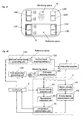
- the fire sensor of the present embodiment is mainly configured by a sound wave generating unit 1 that provides an ultrasound wave into a monitoring space, a control unit 2 that controls the sound wave generating unit 1, a wave receiving element 3 serving as an ultrasound wave receiving unit that detects a sound pressure of the ultrasound wave from the sound wave generating unit 1 via the monitoring space, and a signal processing unit 4 that determines whether fire is present based on the output of the wave receiving element 3.
- the sound wave generating unit 1 and wave receiving element 3 are disposed opposite each other with a certain spacing therebetween on a circuit substrate 5 composed of a disk-shaped printed circuit board.
- the control unit 2 and signal processing unit 4 are provided on the circuit substrate 5.
- a reference numeral 6 stands for a sound shielding wall provided around the wave receiving element 3 in order to prevent ultrasound waves generated by a source other than the sound wave generating unit 1 to fall on the wave receiving element 3. Forming the sound shielding wall 6 is effective in reducing false alarms in fire detection.
- a sound absorbing layer (not shown in the figure) that prevents the reflection of ultrasonic waves is provided on the circuit substrate 5, and the ultrasound wave reflected by the circuit substrate 5 can be prevented from interfering, as a reflected wave, and falling on the wave receiving element 3. Forming the sound absorbing layer is effective when a continuous wave is used as the ultrasound wave transmitted from the sound wave generating unit 1.
- An ultrasound generating element that generates ultrasound waves when a thermal impact is provided to the air is used as the sound wave generating unit 1 of the present embodiment, and the ultrasound wave can be provided with a reverberation time shorter than that of a piezoelectric element. Further, a microphone of an electrostatic capacity type with a short generation period of a reverberation component contained in the received signals and a Q value of a resonance characteristic sufficiently smaller than that of a piezoelectric element is used as the wave receiving element 3.
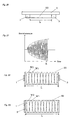
- the sound wave generating unit 1 is mainly composed of a base substrate 11 composed of a single-crystal p-type silicon substrate, a thermal insulation layer (heat insulating layer) 12 composed of a porous silicon layer formed on the surface (upper surface in FIG. 3 ) of the base substrate 11, a heat-generating body layer 13 composed of a thin metal film formed as a heat-generating body on the upper surface of the thermal insulation layer 12, and a pair of pads 14 electrically connected to the heat-generating body layer 13 on the upper surface of the base substrate 11.
- the base substrate 11 has a rectangular shape in a plan view thereof, and the thermal insulation layer 12 and heat-generating body layer 13 are also formed to have a rectangular shape in a plan view thereof.
- An insulating film (not shown in the figure) composed of a silicon oxide film is formed on the region of the upper surface of the base substrate 11 where the thermal insulation layer 12 is not formed.
- the ultrasound wave generating element constituting the sound wave generating unit 1 essentially generates an ultrasound wave propagating in the medium by converting abrupt temperature variations in the heat-generating body layer 13 accompanying the supply of electric current to the heat-generating body layer 13 into expansion and contraction of the medium. Therefore, a single-pulse ultrasound wave with smaller reverberations than those in the case of generating ultrasound waves by mechanical oscillations, as in a piezoelectric element, can be provided to the monitoring space.
- the porous silicon layer constituting the thermal insulation layer 12 has a porosity of about 60% to about 70% and can be formed by performing anodic oxidation of part of the silicon substrate used as the base substrate 11 in an electrolytic solution composed of a liquid mixture of an aqueous solution of hydrogen fluoride and ethanol.
- the porous silicon layer formed by anodic oxidation contains a large number of silicon nanocrystals composed of microcrystalline silicon with a crystal grain size of a nanosize order. Thermal conductivity and heat capacity of the porous silicon layer decrease with the increase in porosity.
- the thermal conductivity and heat capacity of the thermal insulation layer 12 lower than the thermal conductivity and heat capacity of the base substrate 11 and by making the product of thermal conductivity and heat capacity of the thermal insulation layer 12 sufficiently small by comparison with the product of thermal conductivity and heat capacity of the base substrate 11, it is possible to transmit the temperature variations in the heat-generating body layer 13 to the air. Further, efficient heat exchange can be obtained between the heat-generating body layer 13 and the air, and the base substrate 11 can efficiently receive the heat from the thermal insulation layer 12 and absorb the heat of the thermal insulation layer 12. Therefore, the heat from the heat-generating body layer 13 is prevented from accumulating in the thermal insulation layer 12.
- a porous silicon layer with a porosity of about 60% that is formed by anodic oxidation of a single-crystal silicon substrate with a thermal conductivity of 148 W/(m ⁇ K) and a heat capacity of 1.63 ⁇ 10 6 J/(M 3 ⁇ K) has a thermal conductivity of about 1 W/(m ⁇ K) and a heat capacity of about 0.7 ⁇ 10 6 J/(m 3 ⁇ K), and the porous silicon layer with a porosity of about 70% has a thermal conductivity of about 0.12 W/(m ⁇ K) and a heat capacity of about 0.5 ⁇ 10 6 J/(m 3 ⁇ K).
- the thermal insulating layer 12 of the present embodiment is formed by a porous silicon layer with a porosity of about 70%.
- the heat-generating body layer 13 is formed from tungsten, which is a metal with a high melting point, but the material of the heat-generating body layer 13 is not limited to tungsten, and tantalum, molybdenum, yttrium, aluminum, and the like may be also used.
- the thickens of the base substrate 11 is 300 to 700 ⁇ m
- the thickness of the thermal insulation layer 12 is 1 to 10 ⁇ m
- the thickness of the heat-generating body layer 13 is 20 to 100 nm
- the thickness of each pad 14 is 0.5 ⁇ m, but these values are merely exemplary and place no limitation on the aforementioned thicknesses.
- Si is employed as a material of the base substrate 11, but the material of the base substrate 11 is not limited to Si, and other semiconductor materials that can be made porous by anodic oxidation, such as Ge, SiC, GaP, GaAs, and InP, may be also used. With all these materials, a porous layer formed by obtaining a porous structure in part of the base substrate 11 can be used as the thermal insulation layer 12.
- the sound wave generating unit 1 generates an ultrasound wave following temperature variations in the heat-generating body layer 13 occurring when an electric current is passed to the heat-generating body layer 13 via a pair of pads 14.
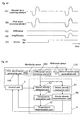
- a drive input waveform composed of a drive voltage waveform or drive current waveform supplied to the heat-generating body layer 13 is a sine waveform, for example, with a frequency f1
- the frequency of temperature fluctuations occurring in the heat-generating body layer 13 theoretically becomes a frequency f2 that is twice as high as the frequency f1 of the drive input waveform, and an ultrasound wave with a frequency about twice as high as that of the drive input waveform f1 can be generated.
- the sound wave generating unit 1 of the present embodiment has a flat frequency characteristic and can change the frequency of the generated ultrasound wave within a wide range. Further, when a half-period isolated wave of a sine waveform is supplied as a drive input waveform between the pair of pads 14, a single-pulse ultrasound wave of about one period with little reverberations can be generated. Where such single-pulse ultrasound wave is used, interference caused by reflection can hardly occur. Therefore, the aforementioned sound absorbing layer can be omitted.
- the thermal insulation layer 12 is composed of a porous layer, thermal insulation properties of the thermal insulation layer 12 are improved, ultrasound wave generation efficiency increases, and power consumption can be reduced by comparison with those of the thermal insulation layer 12 composed of a non-porous layer (for example, a SiO 2 film or the like).
- the control unit 2 that controls the sound wave generating unit 1 is composed of a drive circuit that supplies a drive input waveform to the sound wave generating unit 1 and drives the sound wave generating unit 1 and a control circuit composed of a microcomputer that controls the drive circuit (this configuration is not shown in the figures).
- the microphone of an electrostatic capacity type that constitutes the wave receiving element 3 includes a rectangular frame 30 provided with a window orifice 31 that passes through in the thickness direction to the silicon substrate and a cantilever-type pressure-receiving portion 32 disposed in a bridge-like configuration between two opposite sides of the frame 30.
- a thermal oxidation film 35 is formed on the upper surface of the frame 30, a silicon oxide film 36 is formed on the thermal oxidation film 35, and a silicon nitride film 37 is formed on the silicon oxide film 36.
- One end of the pressure-receiving portion 32 is supported by the frame 30 via the silicon nitride film 37, and the other end is disposed so as to face the silicon nitride film 37 from above.
- a fixed electrode 34 composed of a thin metal film (for example, chromium film) is formed on the silicon nitride film 37 facing the other end of the pressure receiving portion 32, and a movable electrode 33 composed of a thin metal film (for example, a chromium film) is formed on the upper surface of the other end of the pressure receiving portion 32.
- a silicon nitride film 38 is formed on the lower surface of the frame 31.
- the pressure receiving portion 32 is formed by a silicon nitride film formed by a process different from that by which the silicon nitride films 37, 38 are formed.
- a capacitor is formed by the fixed electrode 34 and movable electrode 33. Therefore, where the distance between the fixed electrode 34 and movable electrode 33 changes when the pressure receiving portion 32 receives a dilatational wave pressure, the electrostatic capacity between the electrodes also changes. Therefore, where a DC bias voltage is applied between pads (not shown in the figures) provided at the fixed electrode 34 and movable electrode 33, very small voltage variations are generated between the pads correspondingly to the sound pressure of the ultrasound wave, and the sound pressure of the ultrasound wave can be converted into an electric signal.
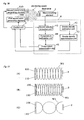
- the signal processing unit 4 includes a smoke density estimation unit 41 that estimates smoke density in the monitoring space between the sound wave generating unit 1 and wave receiving element 3 on the basis of the attenuation amount from the standard value of the output of the wave receiving element 3, a smoke density determination unit 42 that compares the smoke density estimated by the smoke density estimation unit 41 with a predetermined threshold and determines whether fire is present, a sound velocity detection unit 43 that finds a sound velocity on the basis of time required for the wave receiving element 3 to receive the ultrasound wave provided by the sound wave generating unit 1, a temperature estimation unit 44 that estimates the monitoring space temperature based on the sound velocity found by the sound velocity detection unit 43, and a temperature determination unit 45 that determines the presence of fire by comparing the temperature estimated by the temperature estimation unit 44 with an stipulated temperature.
- a smoke density estimation unit 41 that estimates smoke density in the monitoring space between the sound wave generating unit 1 and wave receiving element 3 on the basis of the attenuation amount from the standard value of the output of the wave receiving element 3
- a smoke density determination unit 42 that compare
- the signal processing unit 4 is configured by a microcomputer. Each of units 41 to 45 is realized by installing an appropriate program in the microcomputer. Further, the signal processing unit 4 is provided with an A/D converter or the like that performs analog-digital conversion of output signals of the wave receiving element 3.
- the smoke density estimation unit 41 estimates smoke density on the basis of an attenuation amount from the standard value of the output of the wave receiving element 3. Where the frequency of the ultrasound wave from the sound wave generating unit 1 is constant, the attenuation amount increases almost proportionally to the smoke density in the monitoring space. Therefore, where relationship data (for example, a relationship equation of smoke density and attenuation amount) of smoke density and attenuation amount that have been measured in advance are stored, the smoke density can be estimated based on the attenuation amount.
- relationship data for example, a relationship equation of smoke density and attenuation amount
- the smoke density determination unit 42 determines that there is "No Fire” when the smoke density estimated by the smoke density estimation unit 41 is less than the threshold, and determines that "Fire is Present” when the estimated smoke density is equal to or higher than the threshold. In the latter case, the smoke density determination unit outputs a fire sensing signal to the control unit 2.
- the control unit 2 receives the fire sensing signal, the control unit controls a drive input waveform to the sound wave generating unit 1 so that an alarm sound composed of an audible sound wave is generated from the sound wave generating unit 1. Because an alarm sound can thus be generated from the sound wave generating unit 1, it is not necessary to provide separately a speaker for outputting the alarm sound and the entire fire sensor can be reduced in size and cost.
- the sound velocity detection unit 43 finds the sound velocity by using a time required for the wave receiving element 3 to receive the ultrasound wave provided by the sound wave generating unit 1 and the distance between the sound wave generating unit 1 and wave receiving element 3.
- the temperature estimation unit 44 estimates the temperature of the monitoring space from the sound velocity by using the well known equation describing the relationship between the sound velocity in the atmosphere and absolute temperature.
- the temperature determination unit 45 determines that there is "No Fire” when the temperature estimated by the temperature estimation unit 44 is less than the stipulated temperature. When the estimated temperature is equal to or higher than the stipulated temperature, the temperature determination unit determines that "Fire is Present" and outputs a fire sensing signal to the control unit 2.
- the control unit 2 controls the drive input waveform to the sound wave generating unit 1 so that an alarm sound is generated that is composed of an audible sound wave based on the fire sensing signal.
- a configuration is employed in which the fire sensing signal outputted by the fire density determination unit 42 or temperature determination unit 45 is outputted to the control unit 2, but this signal may be also outputted to an external notification device other than the control unit 2.
- the presence of fire is determined by comparing a smoke density estimated based on the attenuation amount from the reference value of the output of the wave receiving element 3 with the predetermined threshold. Therefore, the effect of background light that causes problems in smoke sensors of a light dimming type is eliminated and the occurrence rate of false alarm can be reduced. Furthermore, a labyrinth body that is necessary for smoke sensors of a light scattering type is unnecessary and smoke particles can easily diffuse into the monitoring space when fire occurs. Therefore, the responsiveness is increased by comparison with that of smoke sensors of a light scattering type.
- the monitoring space temperature is estimated based on the sound velocity found by the sound velocity detection unit 43 and the presence of fire is determined based on the estimated temperature. Therefore, fire can be sensed by the rise in temperature when the fire occurs, without using a separate temperature detection element, and the occurrence of fire can be sensed more accurately.
- the fire sensor of the present embodiment is substantially identical to that of the first embodiment, except that the configurations of the control unit 2 and signal processing unit 4 are different, as shown in FIG. 5 . Therefore, structural elements identical to those of the first embodiment are assigned with identical reference numerals and redundant explanation thereof is omitted.
- the attenuation ratio of sound pressure will be defined as (I 0 - I x )/I 0 , where I 0 stands for a sound pressure (referred to hereinbelow as "standard sound pressure") received by the wave receiving element 3 in a state in which smoke particles are not present in the monitoring space and I x is a sound pressure received by the wave receiving element 3 in a state in which smoke particles with a density of x%/m, as estimated by a smoke density meter of a light dimming type, is present in the monitoring space.
- I 0 stands for a sound pressure (referred to hereinbelow as "standard sound pressure") received by the wave receiving element 3 in a state in which smoke particles are not present in the monitoring space
- I x is a sound pressure received by the wave receiving element 3 in a state in which smoke particles with a density of x%/m, as estimated by a smoke density meter of a light dimming type, is present in the monitoring space.
- the standard sound pressure I 0 and sound pressure I x are assumed to be detected under identical conditions, with the exception of presence/absence of smoke particles in the monitoring space.
- A is an approximation curve (black circles are measurement data) representing the relationship between the output frequency and unit attenuation ratio of sound pressure in the case where black smoke particles are present in the monitoring space
- B is an approximation curve (black circles are measurement data) representing the relationship between the output frequency and unit attenuation ratio of sound pressure in the case where white smoke particles are present in the monitoring space
- C is an approximation curve (black triangles are measurement data) representing the relationship between the output frequency and unit attenuation ratio of sound pressure in the case where steam particles are present in the monitoring space.
- the unit attenuation ratio shown herein represents data relating to the output frequency obtained when the distance between the sound wave generating unit 1 and wave receiving element 3 is 30 cm.
- FIG. 7 shows the results obtained by taking the data at an output frequency of 82 kHz as 1 and normalizing the unit attenuation ratio for each output frequency.
- the output frequency is plotted against the abscissa and a relative unit attenuation ratio is plotted against the ordinate.
- the size of white smoke particles is about 800 nm
- the size of black smoke particles is about 200 nm
- the size of steam particles is from several micrometers to about 20 ⁇ m.
- control unit 2 controls the sound wave generating unit 1 on the basis of the above-described relationship, so that a plurality of ultrasound waves of different frequencies are successively provided to the monitoring space.
- a specific feature of the signal processing unit 4 is that it includes a storage unit 48 that stores at least the standard output of the wave receiving element 3 (output of the wave receiving element 3 related to the standard sound pressure), data representing the relationship between the output frequency of the sound wave generating unit 1 corresponding to the smoke particle density and the type of smoke particles present in the monitoring space and the relative unit attenuation ratio of the output of the wave receiving element 3 (data extracted from the above-described FIG.
- the smoke density estimation unit 41 evaluates the density of smoke in the monitoring space on the basis of the attenuation amount from the standard value of the output of the wave receiving element 3 relating to the ultrasound wave of a specific frequency (for example 82 kHz) with respect to the smoke particles estimated by the smoke particle determination unit 46.
- the smoke density determination unit 42 determines the presence or absence of fire by comparing the smoke density estimated by the smoke density estimation unit 41 with a predetermined threshold.
- a plurality of ultrasound waves are successively provided from the sound wave generating unit 1 to the monitoring space, and the output of the wave receiving element 3 corresponding to each ultrasound wave is measured with the signal processing unit 4 (step S11).
- the smoke particle determination unit 46 finds the attenuation ratio of sound pressure from the output of the wave receiving element 3 and the standard output stored in the storage unit 48 for each output frequency (step S12) and computes a ratio of the attenuation ratio of sound pressure at an output frequency of 20 kHz to the attenuation ratio of sound pressure at an output frequency of 82 kHz (step S13).
- a ratio of the relative unit attenuation ratio at an output frequency of 20 kHz to the relative unit attenuation ratio at an output frequency of 82 kHz (in the case shown in FIG. 7 , this ratio is 0 for white smoke, 0.2 for black smoke, and 0.5 for steam) is stored in the storage unit 48 as data representing the relationship between the output frequency of the sound wave generating unit 1 and the relative unit attenuation ratio of the output of wave receiving element 3.
- the smoke particle determination unit 46 compares the computed attenuation ratio with the relationship data stored in the storage unit 48 and estimates the smoke particles of a type with the ratio of attenuation ratios closest to that in the relationship data as the smoke particles present in the monitoring space (step S14).
- the processing flow moves to the processing in the smoke density estimation unit 41 (step S15). Therefore, where the type of smoke particles is estimated as steam, because it is not fire, subsequent processing is omitted.
- the smoke density estimation unit 41 computes a ratio of the attenuation ratio of the output of the wave receiving element 3 relating to the ultrasound wave of a specific frequency (for example 82 kHz) to the unit attenuation ratio stored in the storage unit 48 for smoke particles of the estimated type, and where the value of this ratio is y, estimates that the smoke density in the monitoring space is equivalent to the smoke density y%/m in the evaluation performed with the smoke density meter of a light dimming type (step S16).
- a specific frequency for example 82 kHz
- the smoke density determination unit 42 compares the smoke density estimated in step S16 with a predetermined threshold (for example, a smoke density of 10%/m in the evaluation performed with the smoke density meter of a light dimming type), determines "No Fire” when the estimated smoke density is less than the threshold, or determines "Fire is Present” when the estimated smoke density is equal to or higher than the threshold and outputs a fire sensing signal to the control unit 2.
- a predetermined threshold for example, a smoke density of 10%/m in the evaluation performed with the smoke density meter of a light dimming type
- the attenuation ratio at an output frequency of 82 kHz and the attenuation ratio at an output frequency of 20 kHz are used, but this combination of output frequencies is not limiting.
- the output frequencies of different combinations may be used or the attenuation ratio relating to a larger number of output frequencies may be used, and in this case the estimation accuracy of the type of smoke particles can be increased.
- the smoke density estimation unit 41 performs estimation with respect to one specific frequency, but it is also possible to use a plurality of frequencies as specific frequencies and find an average value of smoke densities estimated for each specific frequency. In this case, the estimation accuracy of smoke density is also increased.
- the smoke particle determination unit 46 can be implemented by installing an appropriate program in a microcomputer constituting the signal processing unit 4.
- the control unit 2 changes the frequency of the ultrasound wave provided from the sound wave generating unit 1 from a lower limit frequency (for example, 20 kHz) to an upper limit frequency (for example 82 kHz) in a predetermined frequency range (for example 20 kHz to 80 kHz).
- the control is so performed that ultrasound waves of four kinds with different frequencies are successively provided to the monitoring space, but the number of frequencies of ultrasound waves provided from the sound wave generating unit 1 is not limited to four, and ultrasound waves of a plurality of kinds may be provided.
- the load on the control unit 2 and signal processing unit 4 can be reduced and the control unit 2 and signal processing unit 4 can be simplified by comparison with those employed when ultrasound waves of three or more kinds are used.
- the ultrasound wave generating element explained in Embodiment 1 is used as the sound wave generating unit 1 and single-pulse ultrasound waves can be generated. Therefore, where the ultrasound waves provided successively to the monitoring space are in the form of single-pulse ultrasound waves with mutually different frequencies, the cost and power consumption can be reduced by comparison with the case in which a plurality of piezoelectric elements with different resonance frequencies are used as the sound wave generating unit 1 and an ultrasound wave is continuously provided from each piezoelectric element. Moreover, because a plurality of ultrasound waves are generated with one ultrasound wave generating element, the size and cost of the sound wave generating unit 1 can be reduced by comparison with those of the case in which a plurality of ultrasound wave generating elements are used for generating ultrasound waves of various kinds.
- the relationship data stored in the storage unit 48 may represent the relationship between the output frequency of the sound wave generating unit 1 and the standard value of the output of the wave receiving element 3, or may be the relationship data employing the attenuation amount of the output of the wave receiving element 3 from the standard value, or the attenuation ratio obtained by dividing the attenuation amount of the output of the wave receiving element 3 from the standard value by the standard value (I 0 ), or a unit attenuation ratio, instead of the above-described relative unit attenuation ratio.
- the responsiveness can be increased over that of a fire sensor of a light scattering type and the occurrence rate of false alarm can be reduced by comparison with that of a fire sensor of a light dimming type.
- the occurrence rate of false alarm caused by steam can be reduced by comparison with that of a fire sensor of a light scattering type and a fire sensor of a light dimming type, and the fire sensor can be also used in kitchens or bathrooms.
- the smoke particle determination unit 46 makes it possible to distinguish white smoke particles from black smoke particles, information relating to properties of fire can be obtained.
- dust that floats in the air when the inside of the room where the fire sensor is disposed is cleaned or when electric works are conducted at the ceiling can be distinguished from the smoke particles, the sensor effectively reduces the occurrence of error caused by dust and the like.
- the sound wave generating unit 1 may be configured by a plurality of ultrasound wave generating elements 1a that have mutually different output frequencies, as shown in FIG. 10 .
- the sound pressure of ultrasound waves from the sound wave generating unit 1 can be increased by using elements generating ultrasound waves by mechanical oscillations, such as piezoelectric elements, as the ultrasound wave generating elements 1a and driving the ultrasound wave generating elements 1 a at respective resonance frequencies.
- the advantage of increasing the sound pressure of ultrasound waves from the sound wave generating unit 1 is that the fluctuation range of the sound pressure of ultrasound waves received by the wave receiving element 3 expands, thereby increasing the variation amount of the output of the wave receiving element 3 related to the variation amount of smoke density and rising the S/N ratio.
- a plurality of wave receiving elements 3 corresponding to respective ultrasound wave generating elements 1a are provided and the wave receiving elements 3 receive ultrasound waves from corresponding ultrasound wave generating elements 1a. Therefore, by using a piezoelectric element with a comparatively large Q value of the resonance characteristic as each wave receiving element 3 and using the wave receiving elements 3 to receive ultrasound waves at respective resonance frequency, it is possible to increase the sensitivity of the wave receiving elements 3 and rise the SN ratio. In this case, it is also possible to drive a plurality of the ultrasound wave generating elements 1a at once and generate a plurality of ultrasound waves simultaneously, instead of driving the ultrasound wave generating elements 1a sequentially and transmitting a plurality of ultrasound waves sequentially.
- a single wave receiving element 3 is provided for the sound wave generating unit 1 composed of a plurality of ultrasound wave generating elements 1a, the ultrasound wave generating elements 1a are successively driven, a plurality of ultrasound waves are provided successively to the monitoring space, and this plurality of ultrasound waves are successively received by the signal wave receiving element 3.
- an element with a small Q value of resonance characteristic for example, such as a microphone of an electrostatic capacity type explained in the first embodiment, be used as the wave receiving element 3.
- the cost of the wave receiving elements 3 and the size of the fire sensor can be reduced by comparison with those of the configuration using a plurality of wave receiving elements 3.
- an ultrasound wave generating element 1 a may be used also as the wave receiving element 3 by using an ultrasound wave generating element 1 a that can be employed for both transmitting and receiving ultrasound waves, such as a piezoelectric ultrasound sensor, and connecting the ultrasound wave generating element 1a not only to the control unit 2, but also to the signal processing unit 4.
- the sound wave generating unit 1 is configured by a plurality of ultrasound wave generating elements 1a, and by disposing a reflective wall 7 that reflects the ultrasound waves provided from the ultrasound wave generating elements 1a toward the ultrasound wave generating elements 1a opposite the sound wave generating unit 1, it is possible to receive each reflected wave of ultrasound waves from the ultrasound wave generating elements 1a.
- a single ultrasound wave generating element explained in the first embodiment is used as the sound wave generating unit 1, and the control unit 2 successively changes the frequency of the drive input waveform provided to the sound wave generating unit 1, thereby providing a plurality of ultrasound waves of different frequencies to the monitoring space, and a plurality of wave receiving elements 3 are provided.
- the control unit 2 successively changes the frequency of the drive input waveform provided to the sound wave generating unit 1, thereby providing a plurality of ultrasound waves of different frequencies to the monitoring space, and a plurality of wave receiving elements 3 are provided.
- a piezoelectric element with a comparatively large Q value of resonance characteristic as the wave receiving element 3 and using each wave receiving element 3 for receiving the ultrasound wave of a respective resonance frequency, it is possible to improve the sensitivity of wave receiving element 3, thereby increasing the SN ratio.
- the signal processing unit 4 periodically change at least one set of conditions from among the conditions under which the control unit 2 controls the sound wave generating unit 1 and signal processing conditions of the output of wave receiving element 3, so as to cancel the sensitivity fluctuations of the wave receiving element 3 or output fluctuations of the sound wave generating unit 1, based on the output of the wave receiving element 3 corresponding to an ultrasound wave of a predetermined frequency (for example, a frequency of 82 kHz that is equal to the above-described specific frequency).
- a predetermined frequency for example, a frequency of 82 kHz that is equal to the above-described specific frequency.
- the signal processing unit 4 may be also provided with a sound velocity detection unit 43, temperature estimation unit 44, and temperature determination unit 45, in the same manner as in the first embodiment.
- a fire sensor of a detachable type may be configured by disposing opposite each other a sound wave generating unit including the sound wave generating unit 1 and control unit 2 and a sound wave receiving unit including the wave receiving element 3 and signal processing unit 4.
- the sound wave generating unit 1 is not limited to the ultrasound wave generating element shown in FIG. 3 , and it is also possible to use a thin aluminum plate as a heat generating body and generate ultrasound waves by thermal shocks induced by abrupt temperature variations in the heat generating body occurring when an electric current is passed through the heat generating body.
- the control unit 2 controls the sound wave generating unit 1 so as to generate an ultrasound wave at a frequency having an insect repellent effect
- ultrasound waves at a frequency having an insect repellent effect may be periodically generated separately from the ultrasound waves that are provided from the sound wave generating unit 1 for estimating the smoke density.
- the frequency of ultrasound waves transmitted from the sound wave generating unit 1 for estimating the smoke density may be set to a frequency having an insect repellent effect.
- the fire sensor of the present embodiment is substantially identical to that of the first embodiment, except that a tubular body 50 that narrows the diffusion range of ultrasound waves and has the inner space thereof used as a propagation path for ultrasound waves is disposed between the sound wave generating unit 1 and wave receiving element 3, as shown in FIG. 14A and FIG. 14B . Therefore, structural elements identical to those of the first embodiment are assigned with identical reference numerals and redundant explanation thereof is omitted.
- the tubular body 50 is disposed in at least part of the propagation path of ultrasound waves in the monitoring space. More specifically the tubular body 50 of the present embodiment has an angular tubular structure of an almost rectangular parallelepiped in which two end surface in the longitudinal direction are open, and one end surface in the longitudinal direction (right end surface in FIG. 14A ) is disposed close to the sound wave generating unit 1. As a result, this end surface is closed by the sound wave generating unit 1. The other end surface (left end surface in FIG. 14A ) is at a predetermined distance from the wave receiving element 3.
- the tubular body 50 it is possible to prevent the diffusion of ultrasound waves transmitted by the sound wave generating unit 1 and the decrease in sound pressure.
- the surface of the heat-generating body layer 13 of the ultrasound wave generating element constituting the sound wave generating unit 1 is disposed opposite an ultrasound wave inlet port of the tubular body 50 and formed in a shape identical to or larger than, preferably almost equal in size to the ultrasound wave inlet port.
- the opening surface of the ultrasound wave inlet port of the tubular body 50 has a square shape with a side of 10 mm
- the surface of the heat-generating body layer 13 has a square shape with a side of 10 mm.
- ultrasound waves from the sound wave generating unit 1 propagate as a planar wave inside the tubular body 50. Therefore, the decrease in sound pressure of ultrasound waves can be prevented without causing interference between the ultrasound waves reflected at the side surface of the tubular body 50.
- the sound wave generating unit 1 is configured by a plurality of ultrasound wave generating elements, as shown in FIG. 15B , and these ultrasound wave generating elements are driven synchronously, by disposing the ultrasound wave generating surface of the sound wave generating unit 1 formed by arranging the plurality of ultrasound wave generating elements side by side opposite the ultrasound wave inlet port of the tubular body 50 and forming this surface in a shape identical to or larger than, preferably almost equal in size to the ultrasound wave inlet port, it is possible to obtain the effect identical to that obtained with the above-described configuration shown in FIG. 15A .
- the heat-generating body layer 13 of each ultrasound wave generating element may have a square shape with a side of 5 mm and an ultrasound wave generating surface of a square shape with a side of 10 mm may be formed by arranging these four ultrasound wave generating elements side by side.
- the tubular body 50 may have a configuration in which the sound wave generating unit 1 is covered with the tubular body 50, as shown in FIG. 16 , or a configuration in which one end surface of the tubular body 50 is disposed opposite the sound wave generating unit 1 at a predetermined distance therefrom as shown in FIG. 17 .
- the central axis of the sound wave generating unit 1 is not coaxial with the central axis of the wave receiving element 3, for example, when the wave receiving element 3 is disposed obliquely with respect to the central axis of the sound wave generating unit 1, the tubular body 50 that is curved along the propagation path may be disposed between the sound wave generating unit 1 and wave receiving element 3, as shown in FIG. 18 .
- an acoustic horn in which a cross section perpendicular to the longitudinal direction increases in size along the propagation direction of ultrasound waves may be used as the tubular body 50, as shown in FIG. 19 .
- the tubular body 50 is not limited to an angular tubular shape and may have a round shape.
- the effect obtained in addition to the effects identical to those described in the first embodiment is that the SN ratio can be increased because the decrease in sound pressure caused by diffusion of ultrasound waves can be inhibited by providing the tubular body 50. Further, it is especially preferred that the surface of the heat-generating body layer 13 of the sound wave generating unit 1 be formed to a size almost identical to that of the ultrasound wave inlet port of the tubular body 50 because such a configuration makes it possible to avoid the decrease in sound pressure caused by interference between ultrasound waves inside the tubular body 50.
- the fire sensor of the present embodiment is substantially identical to that of the first embodiment, except that the tubular body 50 having a length equal to the distance between the sound wave generating unit 1 and wave receiving element 3 is disposed so that both ends of the tubular body 50 in the longitudinal direction are closed by the sound wave generating unit 1 and wave receiving element 3, as shown in FIG. 20 . Therefore, structural elements identical to those of the first embodiment are assigned with identical reference numerals and redundant explanation thereof is omitted.
- the tubular body 50 disposed as shown in FIG. 20 has an inherent resonance frequency similarly to an acoustic tube closed at both ends.
- a resonance is induced inside the tubular body 50 and the sound pressure of ultrasound wave from the sound wave generating unit 1 is increased by controlling the sound wave generating unit 1 with the control unit 2 so that an ultrasound wave with an inherent resonance frequency is provided into the tubular body 50.
- the control unit 2 controls the sound wave generating unit 1 so as to provide a continuous ultrasound wave of m (>L/ ⁇ ) periods to the tubular body 50.
- the wave receiving element 3 detects the sound pressure of the ultrasound wave at a timing (timing "S" in FIG. 21 ) at which a resonance is generated inside the tubular body 50 and the sound pressure of the ultrasound wave is saturated.
- the sound pressure of the ultrasound wave is usually saturated when the transmission of the ultrasound wave from the sound wave generating unit 1 is completed. Therefore, the sound pressure of the ultrasound wave may be detected in the wave receiving element 3, for example, at the same time as the transmission of the ultrasound wave from the sound wave generating unit 1 is completed.
- the sound wave generating unit 1 is disposed at one end surface of the tubular body 50, and the wave receiving element 3 is disposed at the other end surface.
- the wave receiving element 3 can detect the sound pressure of the ultrasound wave in a position in which the variation in pressure caused by the ultrasound wave is the largest.
- the wave receiving element 3 can detect the sound pressure of the ultrasound wave where a loop of sound pressure of the ultrasound wave (that is, a knot of air transfer speed) is located (in FIG.
- the distance between the "W1" and “W2" in the longitudinal direction represents the amount of pressure variations).
- the variation amount of the output of the wave receiving element 3 related to the variation amount of smoke density can be greatly increased.
- the wave receiving element 3 can detect the sound pressure in a location where pressure variations caused by the ultrasound wave reach a maximum.
- the sound wave generating unit 1 at one end surface of the tubular body 50 closed at both end surfaces and dispose the wave receiving element 3 in such a location on the side surface along the longitudinal direction in which pressure variations caused by the ultrasound wave from the sound wave generating unit 1 reach a maximum.
- a zone in which pressure variations caused by the ultrasound wave reach a maximum are not only at both ends in the longitudinal direction of the acoustic tube closed at both ends, but also at each ⁇ /2 ( ⁇ is a wavelength of ultrasound wave) from one end surface in the longitudinal direction.
- the central portion in the longitudinal direction of the tubular body 50 will necessarily be in a position at a distance from one end surface in the longitudinal direction that is equal the half wavelength ⁇ /2 multiplied by n, and pressure variations caused by the ultrasound wave reach a maximum at all times.
- the wave receiving element 3 disposed in the central portion in the longitudinal direction of the tubular body 50 can detect the sound pressure in a position in which pressure variations caused by the ultrasound wave reach a maximum, and the design of the tubular body 50 is simplified by comparison with the case in which the wave receiving element 3 is disposed in locations that differ correspondingly to the frequency of the ultrasound wave.
- the resonance is caused by reflections of the ultrasound wave at the end surfaces in the longitudinal direction.
- the ultrasound wave has a short wavelength
- even very small concavities and concavities at the end surfaces can result in decreased sound pressure due to interference between the waves during reflection at the end surfaces.
- the wave receiving element 3 is disposed at the side surface of the tubular body 50 as shown in FIG. 24
- the end surface of the tubular body 50 can be made a flat surface with few concavities and convexities compared with a case in which the wave receiving element 3 is disposed at the end surface of the tubular body 50.
- the increase in sound pressure by resonance can be obtained without hindering the reflection of ultrasound waves at the end surface of the tubular body 50 with the wave receiving element 3.
- a hole (not shown in the figure) for guiding smoke and the like inside the tubular body is provided in the side surface along the longitudinal direction of the tubular body 50. From the standpoint of further facilitating the introduction of smoke, it is preferred that the hole be provided in the tubular body of another embodiment having a portion thereof opened. Further, the disposition of the hole is not limited to the side surface of the tubular body.
- the control unit 2 is provided with a frequency correction unit (not shown in the figure) that corrects the frequency of the ultrasound wave from the sound wave generating unit 1 correspondingly to variations in sound velocity that follow the variations in temperature.
- the frequency correction unit implements the frequency correction of the ultrasound wave from the sound wave generating unit 1 by using the sound velocity found based on the difference in time between the transmission of the ultrasound wave from the sound wave generating unit 1 and the reception thereof by the wave receiving element 3 in the sound velocity detection unit 43 explained in the first embodiment.
- the configuration of the smoke sensor can be simplified by comparison with that in the case in which separate means is provided for finding the sound velocity.
- the frequency of 100 kHz or 50 kHz is a resonance frequency of the tubular body 50, and where an ultrasound wave of such frequency is generated from the sound wave generating unit 1, the sound pressure of the ultrasound wave is increased by the resonance correspondingly to the time elapsed, as shown in FIG. 21 .
- the control unit 2 controls the sound wave generating unit 1 so that an ultrasound wave of about 100 periods in the case of 100 kHz and about 50 periods in the case of 50 kHz is continuously provided from the wave generating unit 1.
- the sound pressure of the ultrasound wave detected by the wave receiving element 3 at a timing (timing "S" in FIG. 21 ) at which a resonance is generated inside the tubular body 50 and the sound pressure of the ultrasound wave is saturated becomes several tens of times that in the configuration in which no tubular body 50 is present and a single-pulse ultrasound wave is transmitted and received.
- a configuration may be employed in which only one end surface in the longitudinal direction of the tubular body 50 is closed (other end surface is opened).
- the tubular body 50 also has an inherent resonance frequency similarly to the acoustic tube closed at one end.
- the control unit 2 controls the sound wave generating unit 1 so as to transmit a continuous ultrasound wave of m (>U ⁇ ) periods, rather than a single-pulse ultrasound wave.
- a loop of sound pressure of the ultrasound wave that is, a knot of air transfer speed
- ⁇ L open end correction
- the decrease in sound pressure between the wave generating unit 1 and wave receiving element 3 can be further inhibited by generating a resonance inside the tubular body 50, and the variation amount of the output of the wave receiving element 3 related to the variation amount of smoke density can be increased, thereby raising the SN ratio.
- an effective propagation path extends correspondingly to the number of reflections in an ultrasound wave that is repeatedly reflected by the end surfaces in the longitudinal direction of the tubular body 50 due to the resonance, this extension of the propagation path also contributes to the increase in the variation amount of the output of the wave receiving element 3 related to the variation amount of smoke density, and the attenuation amount of ultrasound wave becomes several times that in the configuration in which a non-resonant single-pulse ultrasound wave is received by the wave receiving element 3.
- the fire sensor of the present embodiment is substantially identical to that of the first embodiment, except that the opposing surfaces of the wave generating unit 1 and wave receiving element 3 form respective first reflective surface Re1 and second reflective surface Re2, as shown in FIG. 26 . Therefore, structural elements identical to those of the first embodiment are assigned with identical reference numerals and redundant explanation thereof is omitted.
- the propagation path of an ultrasound wave between the wave generating unit 1 and wave receiving element 3 has an inherent resonance frequency, similarly to an air column having the first and second reflective surfaces Re1, Re2 at both ends.
- L the distance between the wave generating unit 1 and wave receiving element 3
- the control unit 2 controls the sound wave generating unit 1 so that an ultrasound wave of a resonance frequency inherent to the propagation path of the ultrasound wave that is based on the distance L is provided to the monitoring space, whereby a resonance can be induced in the propagation path of the ultrasound wave between the wave generating unit 1 and wave receiving element 3 and the sound pressure of ultrasound wave can be increased.
- the sound wave generating unit 1 is controlled by the control unit 2 so that a transmission time t p at which an ultrasound wave is continuously transmitted from the ultrasound wave 1 becomes longer than a propagation time t s required for the ultrasound wave to propagate between the wave generating unit 1 and wave receiving element 3.
- the ultrasound wave from the wave generating unit 1 is superimposed at least on the reflected wave from the second reflective surface Re2, causing resonance. Therefore, the decrease in sound pressure of the ultrasound wave between the wave generating unit 1 and wave receiving element 3 can be inhibited.
- the wave receiving element 3 detects the sound pressure of ultrasound wave at a timing at which a resonance occurs between the wave generating unit 1 and wave receiving element 3 and the sound pressure is saturated.
- a frequency correction unit (not shown in the figure) that corrects the frequency of ultrasound wave from the wave generating unit 1 in response to sound velocity variations that follow temperature variations is provided in the control unit 2. Therefore, a resonance can be reliably induced between the wave generating unit 1 and wave receiving element 3.
- the frequency of 105 kHz is a resonance frequency of the propagation path, and where an ultrasound wave of such frequency is provided from the sound wave generating unit 1, the sound pressure of the ultrasound wave is increased by the resonance. In this case, it is necessary to generate a continuous ultrasound wave of m periods (>L/ ⁇ ) to the monitoring space.
- the control unit 2 controls the sound wave generating unit 1 so that an ultrasound wave of at least about 11 periods in the case of an ultrasound wave of 105 kHz is continuously provided to the monitoring space.
- an ultrasound wave of 105 kHz is transmitted continuously over 105 periods from the wave generating unit 1
- the ultrasound wave reciprocates five times between the two reflective surfaces Re1, Re2
- the reflected waves or the reflected waves and the direct wave from the sound wave generating unit 1 are superimposed, thereby increasing the sound pressure.
- the sound pressure of the ultrasound wave detected by the wave receiving element 3 at a timing at which a resonance is generated and the sound pressure of the ultrasound wave is saturated becomes several tens of times that in the configuration in which a single-pulse ultrasound wave of a frequency other than the resonance frequency is transmitted and received.
- the decrease in sound pressure during ultrasound wave propagation in the monitoring space can be inhibited by inducing a resonance in the propagation path of the ultrasound wave between the sound wave generating unit 1 and wave receiving element 3 and, therefore, the SN ratio can be increased.
- an effective propagation path extends correspondingly to the number of reflections in an ultrasound wave that is reflected by the reflective surfaces Re1, Re2 due to the resonance and the ultrasound wave substantially reaches the wave receiving element 3 via the propagation path that is several time longer than the distance L between the sound wave generating unit 1 and wave receiving element 3.
- This result also contributes to the increase in the variation amount of the output of the wave receiving element 3 related to the variation amount of smoke density, and the attenuation amount of ultrasound wave becomes several times that in the configuration in which a non-resonant single-pulse ultrasound wave is received by the wave receiving element 3.
- the fire sensor of the present embodiment is substantially identical to that of the fifth embodiment, except that reflective plates 60 increasing the reflectance of ultrasound waves are provided on opposing surfaces of the sound wave generating unit 1 and wave receiving element 3, as shown in FIG. 27 . Therefore, structural elements identical to those of the fifth embodiment and embodiments cited by the fifth embodiment are assigned with identical reference numerals and redundant explanation thereof is omitted.
- a pair of plate-shaped reflective plates 60 are disposed opposite each other, and the sound wave generating unit 1 and wave receiving element 3 are installed in almost central portions of respective reflective plates 60.
- the surface of the sound wave generating unit 1 that faces the wave receiving element 3 and the surface of the wave receiving element 3 that faces the sound wave generating unit 1 are flush with the surfaces of the reflective plates 60.
- the ultrasound wave expands due to diffusion in the propagation path between the sound wave generating unit 1 and wave receiving element 3, because the ultrasound wave is returned to the propagation path by reflection at the reflective plate 60 surrounding the wave receiving element 3 or sound wave generating unit 1, the decrease in sound pressure caused by diffusion of ultrasound wave can be inhibited, the variation amount of the output of the wave receiving element related to the variation amount of smoke density can be increased, and the SN ratio rises.
- a reflective plate 61 curved in a parabolic shape may be used, as shown in FIG. 28 . Because the reflective plate 61 has a convex curved surface as a reflective surface, the ultrasound wave is converged on the wave receiving element 3 when the ultrasound wave is reflected by each reflective plate and the decrease in sound pressure caused by diffusion of the ultrasound wave can be further inhibited.
- the reflective plate 61 having a convex curved surface as an effective surface may be disposed only on either of the sound wave generating unit 1 and wave receiving element 3.
- the sound wave generating unit 1 and wave receiving element 3 may be disposed side by side on one of a pair of plate-shaped reflective plates 60 as shown in FIG. 29 .
- the decrease in the number of elements results in cost reduction.
- the ultrasound wave from the sound wave generating unit 1 is reflected at least once by the reflective plate 60 disposed opposite thereto, rather than reaches the wave receiving element 3 as a direct wave. Therefore, a resonance is easily induced between the sound wave generating unit 1 and wave receiving element 3.
- a parabolic reflective plate 61 may be disposed instead of the plate-shaped reflective plate 60 disposed opposite the sound wave generating unit 1 and wave receiving element 3. In this case, the sound converging function is improved and the decrease in sound pressure caused by diffusion of the ultrasound wave can be further inhibited.
- the fire sensor of the present embodiment is substantially identical to the fire sensor of the first embodiment, except that the sound wave generating unit that generates ultrasound waves is configured by a first sound wave generating unit 100 and a second sound wave generating unit 110, the sound wave receiving unit that receives the ultrasound waves is configured by a first wave receiving element 120 and a second wave receiving element 130, and the signal processing unit 4 includes the below-described output correction unit 49, as shown in FIG. 31 . Therefore, identical structural elements are assigned with identical reference numerals and redundant explanation thereof is omitted.
- the first sound wave generating unit 100 and first wave receiving element 120 are disposed opposite each other via a monitoring space on the surface of a circuit board 5 configured by a disk-shaped printed board, and the second sound wave generating unit 110 and second wave receiving element 130 are disposed opposite each other via a reference space.
- the control unit 2 and signal processing unit 4 are provided on the circuit board 5.
- the monitoring space located between the first sound wave generating unit 100 and first wave receiving element 120 communicates with the outer space (outer air) around the fire sensor in order to monitor the presence or absence of fire, whereas the reference space located between the second sound wave generating unit 110 and second wave receiving element 130 is enclosed by a shielding wall 8 that shields floating particles including at least smoke particles.
- the first sound wave generating unit 100 transmits an ultrasound wave to the monitoring space
- the second sound wave generating unit 110 transmits an ultrasound wave to the reference space.
- the control unit 2 that controls the first sound wave generating unit 100 and second sound wave generating unit 110 is configured by a drive circuit that supplies a drive input waveform to drive the first sound wave generating unit 100 and second sound wave generating unit 110 and a control circuit configured by a microcomputer that controls the drive circuit.
- a specific feature of the signal processing unit 4 is that it is provided with an output correction unit 49 for correcting the output of the first wave receiving element 120, in addition to the smoke density estimation unit 41, smoke density determination unit 42, sound velocity detection unit 43, temperature estimation unit 44, and temperature estimation unit 45.
- the smoke density estimation unit 41 estimates smoke density on the basis of the attenuation amount from the standard value of the output of the first wave receiving element 120 that detects the sound pressure of ultrasound wave from the first sound wave generating unit 100.
- the smoke density determination unit 42 determines that there is "No Fire” when the smoke density estimated by the smoke density estimation unit 41 is less than a threshold. When the estimated smoke density is equal to or higher than the threshold, the smoke density determination unit 42 determines that "Fire is Present" and outputs a fire sensing signal to the control unit 2. When receiving the fire sensing signal, the control unit 2 generates an alarm sound composed of an audible sound wave from the first sound wave generating unit 100.
- the sound velocity detection unit 43 finds the sound velocity on the basis of the difference in time between the transmission of the ultrasound wave from the first sound wave generating unit 100 and the reception thereof by the first wave receiving element 120.
- the temperature estimation unit 44 estimates the temperature of the monitoring space on the basis of the sound velocity found by the sound velocity detection unit 43.
- the temperature determination unit 45 determines the presence of fire by comparing the temperature estimated by the temperature estimation unit 44 with a stipulated temperature and, similarly to the smoke density estimation unit 41, determines that "Fire is Present" and outputs a fire sensing signal to the control unit 2 when the determined temperature is equal to or higher than a predetermined threshold.
- the signal processing unit 4 is configured by a microcomputer, and various components (40 to 45, 49) constituting the signal processing unit 4 are realized by installing appropriate programs on the microcomputer.
- the output correction unit 49 which is a specific unit of the present embodiment, will be described below in greater detail.
- the output of the first wave receiving element 120 can fluctuate depending not only on the decrease or increase in smoke density in the monitoring space, but also on variations in the ambient environment in which the fire sensor is located (for example, variations in temperature, humidity, and atmospheric pressure), variations in sound pressure of the ultrasound wave from the first sound wave generating unit 100 caused by changes in the first sound wave generating unit 100 or first wave receiving element 120 with time (for example, deterioration with time), and also changes in sensitivity of the first wave receiving element 120.
- the output correction unit 49 corrects the output of the first wave receiving element 120 on the basis of the variation ratio from the initial value of output (reference value) of the second wave receiving element 130, eliminates the effect of the above-described output fluctuations, and sends the corrected output of the first wave receiving element 120 to the sound velocity detection unit 43 and smoke density estimation unit 41.
- the output correction unit 49 receives the output of the second wave receiving element 130 that detects the sound pressure of ultrasound wave generated from the second sound wave generating unit 110 in the reference space, finds a correction coefficient based on a variation ratio from the initial value of the output of the second wave receiving element 130 that has been determined in advance, and outputs the output of the first wave receiving element 120 that has been corrected by using the correction coefficient to the smoke density estimation unit 41.
- the initial value of the output of the second wave receiving element 130 is the output value of the second wave receiving element 130 detected, for example, when the ambient environment (for example, variations in temperature, humidity, and atmospheric pressure) is set to a predetermined state and does not change with time (for example, prior to shipping) and this output is stored in advance in the output correction unit 49.
- the same initial value may be set by a program at the design stage of the fire sensor.
- the present embodiment is so configured that the second sound wave generating unit 110 is driven, the output of the second wave receiving element 130 is measured, and the correction coefficient is calculated each time before the first sound wave generating unit 100 is driven and the smoke density in the monitoring space is detected. Therefore, the correction coefficient is updated each time the smoke density in the monitoring space is detected.
- the first sound wave generating unit 100 and second sound wave generating unit 110 are driven under the same conditions (for example, sound pressure and frequency of the generated ultrasound wave), the first wave receiving element 120 and second wave receiving element 130 are used under the same conditions (for example, a DC bias voltage), and the mutual arrangement of the first sound wave generating unit 100 and first wave receiving element 120 is set identically to that of the second sound wave generating unit 110 and second wave receiving element 130, thereby making the output of the first wave receiving element 120 substantially equal to that of the second wave receiving element 130 when floating particles do not penetrate in the monitoring space and the monitoring space and reference space are in the same state (for example, temperature, humidity, and atmospheric pressure).
- the first wave receiving element 120 and second wave receiving element 130 are used under the same conditions (for example, a DC bias voltage)
- the mutual arrangement of the first sound wave generating unit 100 and first wave receiving element 120 is set identically to that of the second sound wave generating unit 110 and second wave receiving element 130, thereby making the output of the first wave receiving element 120 substantially equal to that of the second wave
- the initial value of the output of the second wave receiving element 130 is substantially equal to the standard value of the output of the first wave receiving element 120.
- the control unit 2 controls them so that the cumulative total of the ultrasound wave generation time in the first sound wave generating unit 100 and second sound wave generating unit 110 is the same.
- the reference space is enclosed by the shielding wall 8, although the outer space (outer air) and monitoring space are identical in terms of temperature; no smoke particles or steam penetrate therein and the attenuation of ultrasound waves caused by the presence of smoke particles or steam is prevented.
- a filter for example, a porous ceramic filter having formed therein a large number of fine holes (not shown in the figure) of a size that prevents the passage of floating particles is provided in the shielding wall 8, and the reference space and outer space communicate via the fine holes. Therefore, the conditions in the reference space are identical to those of the outer space and monitoring space not only in terms of temperature, but also in terms of humidity and atmospheric pressure.
- the variation ratio of the actual output of the second wave receiving element 130 from the aforementioned initial value is determined correspondingly to variations in ambient conditions (for example, temperature, humidity, and atmospheric pressure) or variations in the second sound wave generating unit 110 or second wave receiving element 130 with time (identical to variations in the first sound wave generating unit 100 or first wave receiving element 120 with time). Because the output of the first wave receiving element 120 is corrected using a correction coefficient based on this variation ratio, an output of the first wave receiving element 120 is obtained from which the effect of variations in ambient environment or variations with time is excluded, and subsequent fire determination is implemented by the smoke density determination unit 42 and temperature determination unit 45 by using this output. Thus, accurate fire determination can be carried out based on information reflecting only smoke density in the monitoring space, upon removal of disturbance factors.
- the second sound wave generating unit 110 is driven before the fire sensor is shipped, the initial value of the output of the second wave receiving element 130 is acquired, and this initial value is stored in the output correction unit 49 (step S1). Then, after the fire sensor has been installed in the desired location and before the first sound wave generating unit 100 is driven, the second sound wave generating unit 110 is driven and the actual output of the second wave receiving element 130 is obtained. A correction coefficient is then calculated based on a variation ratio of the actual output of the second wave receiving element 130 from the initial value (step S2).
- step S3 the first sound wave generating unit 100 is driven, an output from the first wave receiving element 120 is acquired, and this output is corrected using the correction coefficient in the output correction unit 49, whereby the effect of variations in ambient environment and variations with time is removed from the output of the first wave receiving element 120 (step S3).
- the smoke density in the monitoring space is then estimated by the smoke density estimation unit 41 by using the corrected output of the first wave receiving element 120 and the presence or absence of fire is determined by the smoke density determination unit 42 (step S4).
- step S4 the processing flow returns to step S2 in which the correction coefficient is calculated and the operation of the above-described steps S2 to S4 is periodically repeated.
- the first sound wave generating unit 100 and second sound wave generating unit 110 and the first wave receiving element 120 and second wave receiving element 130 may be formed to have different configurations, the first sound wave generating unit 100 and second sound wave generating unit 110 may be driven under different conditions, and the first wave receiving element 120 and second wave receiving element 130 may be used under different conditions.
- the mutual arrangement of the first sound wave generating unit 100 and first wave receiving element 120 may be different from that of the second sound wave generating unit 110 and second wave receiving element 130.
- the distance between the first sound wave generating unit 100 and first wave receiving element 120 is set larger than that between the second sound wave generating unit 110 and second wave receiving element 130
- a configuration may be employed in which the calculation of correction coefficient is performed once for a plurality of times the smoke density in the monitoring space is detected. For example, in an environment with small fluctuations of correction coefficient, the correction coefficient can be calculated (that is, updated) less frequently, thereby reducing power consumption.
- the occurrence rate of false alarm can be reduced and reliability of fire sensor operation can be further improved by performing fire determination after canceling the effect of output fluctuations of the first wave receiving element 120 with the output correction unit 49.
- the fire sensor of the present embodiment is substantially identical to that of the seventh embodiment, except that a tubular body 51 is disposed between the first sound wave generating unit 100 and first wave receiving element 120 and a tubular body 52 is disposed between the second sound wave generating unit 110 and second wave receiving element 130, as shown in FIG. 35 . Therefore, structural elements identical to those of the seventh embodiment and embodiments cited by the seventh embodiment are assigned with identical reference numerals and redundant explanation thereof is omitted.
- Each of the tubular bodies 51, 52 is a linear angular tube, as shown in FIG. 35 , and one end surface thereof in the longitudinal direction is closed by the first sound wave generating unit 100 and second sound wave generating unit 110, respectively. The other end surface is closed by the first wave receiving element 120 and second wave receiving element 130, respectively. Therefore, the inside of the tubular body 51 is a monitoring space and the inside of the tubular body 52 is equivalent to a reference space.
- a plurality of holes 53 having a size enabling the passage of floating particles including smoke particles are provided in the tubular body 51, and the monitoring space and an outer space communicate via the holes 53.
- the tubular body 52 also serves as a shielding wall 8 and has at least in part thereof a filter (for example, a porous ceramic filter) having formed therein a large number of fine holes (not shown in the figure) of a size such that floating particles cannot penetrate therethrough. Because ultrasound waves from the first sound wave generating unit 100 and second sound wave generating unit 110 thus pass inside the tubular bodies 51, 52, the decrease in sound pressure of ultrasound waves caused by diffusion can be prevented.
- a filter for example, a porous ceramic filter
- the output of the first wave receiving element 120 matches that of the second wave receiving element 130 with a high degree of accuracy. As a result, the accuracy attained in correcting the output of the first wave receiving element 120 in the output correction unit 49 is further increased.
- tubular members 51, 52 may be disposed one on top the other on the surface of the circuit substrate 5, as shown in FIG. 36 . Further, the tubular body 51 may be disposed only between the first sound wave generating unit 100 and first wave receiving element 120 as shown in. FIG. 37 . In the configuration illustrated by FIG. 37 , the tubular body 51 is formed shorter than the distance between the first sound wave generating unit 100 and the first wave receiving element 120, and each end surface in the longitudinal direction is disposed at a respective distance from the first sound wave generating unit 100 and first wave receiving element 120, thereby opening both end surfaces in the longitudinal direction. In this case, the diffusion of ultrasound wave from the first sound wave generating unit 100 is also inhibited because the wave passes inside the tubular body 51. Therefore, the decrease in sound pressure of the ultrasound wave caused by diffusion can be inhibited. Because the monitoring space is located between the first sound wave generating unit 100 or the first wave receiving element 120 and the tubular body 51, the holes 53 may be eliminated.
- the effect obtained in addition to the effects described in the seventh embodiment is that the variation amount of the output of the first wave receiving element 120 related to the variation amount of smoke density becomes comparatively high and, therefore, the SN ratio increases because the decrease in sound pressure of the ultrasound wave between the first sound wave generating unit 100 and the first wave receiving element 120 that is caused by diffusion can be inhibited by disposing the tubular body 51.
- the fire sensor of the present embodiment is substantially identical to that of the seventh embodiment, except that the monitoring space and reference space are formed by dividing the inner space of the tubular body 50 in two, upper and lower, spaces by a partition wall 54 and forming the first sound wave generating unit 100 and second sound wave generating unit 110 by a single ultrasound wave generating element 140, as shown in FIGS. 38A and 38B . Therefore, structural elements identical to those of the seventh embodiment and embodiments cited by the seventh embodiment are assigned with identical reference numerals and redundant explanation thereof is omitted.
- holes 53 through which the monitoring space communicates with the outer space and which have a size enabling the passage of floating particles including smoke particles are provided in the monitoring space side, and the first wave receiving element 120 and second wave receiving element 130 are disposed at one end of the monitoring space and reference space, respectively.
- a portion of the tubular body 50 that forms the reference space also serves as a shielding wall 8, and a filter (for example, a porous ceramic filter) having formed therein a large number of fine holes (not shown in the figure) of a size that prevents the passage of floating particles is provided in at least part of the shielding wall 8.
- the first sound wave generating unit 100 and second sound wave generating unit 110 are provided in the form of a single ultrasound wave generating element 140 that is disposed over the monitoring space and outer space at the other end thereof.
- the first wave receiving element 120 and second wave receiving element 130 are omitted.
- the tubular body 50 is an angular tube having a square opening with a side of 10 mm.
- the inner space of the tubular body is divided in two equal spaces by the partition wall 54.
- the monitoring space and outer space have respective openings of 5 mm ⁇ 10 mm.
- an ultrasound wave generating surface that supplies vibrations into the air serving as a medium has a square shape with a side of 10 mm.
- the ultrasound wave generating element 140 is disposed so that ultrasound waves are generated equally in the monitoring space and outer space. In this case, the initial value of the output of the second wave receiving element 130 is equal to the standard value of the output of the first wave receiving element 120.
- the correction coefficient may be calculated by using a ratio of the initial value of the output of the second wave receiving element 130 and the standard value of the output of the first wave receiving element 120.
- the effect obtained in addition to the effects described in the seventh embodiment is that the first sound wave generating unit 100 and second sound wave generating unit 110 change in the same manner with the passage of time and the effect of output fluctuations of the first wave receiving element 120 caused by sound pressure variations in the ultrasound wave transmitted from the first sound wave generating unit 100 can be reliably removed with the output correction unit 49 because the first sound wave generating unit 100 and second sound wave generating unit 110 are configured by a single ultrasound wave generating element 140.
- the fire sensor of the present embodiment is substantially identical to the smoke sensor of the second embodiment, except that the sound wave generating unit that generates ultrasound waves is composed of the first sound wave generating unit 100 and second sound wave generating unit 110, the sound wave receiving unit that receives the ultrasound waves is composed of the first wave receiving element 120 and second wave receiving element 130, and the signal processing unit 4 comprises the below-described output correction unit 49 as shown in FIG. 39 . Therefore, structural elements identical to those of the second embodiment are assigned with identical reference numerals and redundant explanation thereof is omitted.
- the control unit 2 controls the first sound wave generating unit 100 so that a plurality of ultrasound waves of different frequencies are successively provided to the monitoring space.
- the signal processing unit 4 has a storage unit 48 that stores data representing the relationship between the reference output (output of the first wave receiving element 120 related to a standard sound pressure) of at least the first wave receiving element 120, the output frequency of the first sound wave generating unit 100 corresponding to the type of floating particles present in the monitoring space and density of floating particles, and the relative unit attenuation ratio of the output of the first wave receiving element 120 and also a unit attenuation ratio at a specific frequency (for example, 82 kHz) for smoke particles, a smoke particle determination unit 46 that estimates the type of smoke particles floating in the monitoring space by using the output of the first wave receiving element 120 for an ultrasound wave of each frequency generated in the actual monitoring space from the first sound wave generating unit 100 and the relationship data stored in the storage unit 48, a smoke density estimation unit 41 that estimates smoke density in the monitoring space on the basis of the variation amount from a
- the signal processing unit 4 is provided with the output correction unit 49 that corrects the output of the first wave receiving element 120 on the basis of the variation ratio of the output of the second wave receiving element 130 from the initial value, and the processing in the smoke particle determination unit 46 and smoke density estimation unit 41 is performed using the output of the first wave receiving element 120 after the correction in the output correction unit 49 (that is, after removing the effect of variations in ambient environment and variations with time).
- the control unit 2 successively changes the frequency of the drive input waveform supplied to the first sound wave generating unit 100, thereby causing the first sound wave generating unit 100 to generate successively a plurality of ultrasound waves having different frequencies.
- the frequency range of ultrasound waves generated by the first sound wave generating unit 100 is 20 kHz to 82 kHz.
- the control unit 2 controls the first sound wave generating unit 100 so that ultrasound waves of four types having different frequencies are successively transmitted.
- the control unit 2 successively changes the frequency of the drive input waveform supplied to the second sound wave generating unit 110, thereby causing the second sound wave generating unit 110 to generate successively a plurality of ultrasound waves having different frequencies.
- the frequency range of ultrasound waves generated by the second sound wave generating unit 110 is 20 kHz to 82 kHz.
- the relationship data stored in the storage unit 48 may represent the relationship between the output frequency of the first sound wave generating unit 100 and the attenuation amount of the output of the first wave receiving element 120 from the standard value, or may be the relationship data employing the attenuation amount of the output of the first wave receiving element 120 from the standard value, or the attenuation ratio obtained by dividing the attenuation amount of the output of the first wave receiving element 120 from the standard value by the standard value, or a unit attenuation ratio, instead of the above-described relative unit attenuation ratio.
- the effect produced by output correction described in the seventh embodiment can be also obtained. Therefore, it is possible to provide a fire sensor that excels in responsiveness and has few false alarms.
- each of the first sound wave generating unit 100 and second sound wave generating unit 110 may be configured by a plurality of ultrasound wave generating elements that have mutually different output frequencies as shown in FIG. 40 .
- the sound pressure of ultrasound waves generated from each of the first sound wave generating unit 100 and second sound wave generating unit 110 can be increased and the SN ratio can be raised by using elements generating ultrasound waves by mechanical oscillations, such as piezoelectric elements, as the ultrasound wave generating elements and driving the ultrasound wave generating elements at respective resonance frequencies.
- the ultrasound wave generating elements sequentially and generate a plurality of ultrasound waves sequentially, but also to drive a plurality of the ultrasound wave generating elements at once and generate a plurality of the ultrasound waves simultaneously.
- the attenuation amount of sound pressure of a plurality of ultrasound waves can be detected at the same time, the attenuation amount of sound pressure of a plurality of ultrasound waves can be detected, without being affected by short-term variations in the monitoring space with time (for example, changes in density of floating particles), and the type of floating smoke particles and smoke density can be estimated more accurately.
- a first wave receiving element 120 may be disposed for each of a plurality of ultrasound wave generating elements constituting the first sound wave generating unit 100 so as to face the ultrasound wave generating element
- a second wave receiving element 130 may be disposed for each of a plurality of the ultrasound wave generating elements constituting the second sound wave generating unit 110 so as to face the ultrasound wave generating element as shown in FIG. 41 .
- the sensitivity of the first wave receiving element 120 and second wave receiving element 130 can be increased by using piezoelectric elements with a comparatively large Q value of resonance characteristic for each first wave receiving element 120 and each second wave receiving element 130 and use each first wave receiving element 120 and each second wave receiving element 130 for receiving the ultrasound wave of respective resonance frequency.
- the first sound wave generating unit 100 and first wave receiving element 120 and also the second sound wave generating unit 110 and second wave receiving element 130 as ultrasound wave generating elements suitable both for generating and receiving ultrasound waves, such as piezoelectric ultrasound wave sensors.
- the cost can be reduced due to reduced number of elements.
- a configuration may be employed in which the calculation of correction coefficient is performed once each time a plurality of ultrasound waves are generated from the first sound wave generating unit 100.
- the correction coefficient can be calculated (that is, updated) less frequently, thereby reducing power consumption.
- the correction coefficient may be calculated based on the variation amount of the output of the second wave receiving element 130 from the initial value, this variation amount being related to an ultrasound wave of a specific frequency (for example, 82 kHz).
- the signal processing unit 4 of the fire sensor of the present embodiment may include the sound velocity detection unit 43, temperature estimation unit 44, and temperature estimation unit 45, thereby making it possible to increase further the fire estimation accuracy.
- the fire sensor of the present embodiment is substantially identical to the fire sensor of the first embodiment, except that the sound wave generating unit is configured by the first sound wave generating unit 100 and second sound wave generating unit 110, the sound wave receiving unit that receives the ultrasound waves is configured by the first wave receiving unit 120 and second wave receiving element 130, and a differential amplifier 9 is provided that amplifies and outputs the difference between the output of the first wave receiving element 120 and the output of the second wave receiving element 30, as shown in FIG. 42 . Therefore, structural elements identical to those of the first embodiment are assigned with identical reference numerals and redundant explanation thereof is omitted.
- the first sound wave generating unit 100 and first wave receiving element 120 are disposed opposite each other via a monitoring space and the second sound wave generating unit 110 and second wave receiving element 130 are disposed opposite each other via a reference space on the surface of a circuit substrate 5 composed of a disk-shaped printed circuit board, in the same manner as shown in FIG. 35 .
- the control unit 2, differential amplifier 9, and signal processing unit 4 are provided on the circuit substrate 5.
- the tubular body 51 is disposed between the first sound wave generating unit 100 and first wave receiving element 120
- the tubular body 52 is disposed between the second sound wave generating unit 110 and the second wave receiving element 130.
- Ultrasound waves provided by the first sound wave generating unit 100 and second sound wave generating unit 110 pass inside the tubular bodies 51, 52, thereby making it possible to prevent the sound pressure of the ultrasound waves from decreasing due to diffusion.
- a plurality of holes 53 having a size enabling the passage of floating particles including smoke particles are provided in the tubular body 51, and the monitoring space and an outer space communicate via the holes 53.
- the tubular body 52 also serves as a shielding wall and has at least in part thereof a filter (for example, a porous ceramic filter) having formed therein a large number of fine holes (not shown in the figure) of a size that prevents the passage of floating particles.
- the conditions in the reference space are identical to those of the outer space and monitoring space not only in terms of temperature, but also in terms of humidity and atmospheric pressure.
- An ultrasound wave generating element identical to that of the first embodiment can be used in each of the first sound wave generating unit 100 and second sound wave generating unit 110, and a microphone of an electrostatic capacity type that is identical to that of the first embodiment can be employed in each of the first wave receiving element 120 and second wave receiving element 130.
- the signal processing unit 4 has functions identical to those of the signal processing unit 4 of the first embodiment, except that the signal processing unit receives the output from the below-described differential amplifier 9.
- the control unit 2 is configured by a drive circuit that supplies a drive input waveform to drive the first sound wave generating unit 100 and second sound wave generating unit 110 and a control circuit configured by a microcomputer that controls the drive circuit.
- the control unit 2 has two control modes: a synchronous mode in which ultrasound waves are generated from the first sound wave generating unit 100 and second sound wave generating unit 110 so that that the ultrasound wave generated from the first sound wave generating unit 100 has the same frequency and the same phase as the ultrasound wave generated from the second sound wave generating unit 110, and an asynchronous mode in which ultrasound waves are generated only from either the first sound wave generating unit 100 or the second sound wave generating unit 110.
- the first sound wave generating unit 100 and second sound wave generating unit 110 are driven under identical conditions (for example, sound pressure of ultrasound wave) and the first wave receiving element 120 and second wave receiving element 130 are used under the same conditions (for example, a DC bias voltage). Furthermore, the phase relationship of the first sound wave generating unit 100 and first wave receiving element 120 is set identically to that of the second sound wave generating unit 110 and second wave receiving element 130.
- the control unit 2 controls the first sound wave generating unit 100 and second sound wave generating unit 110 in the synchronous mode, if no floating particles penetrate into the monitoring space and the monitoring space and reference space are in the same state (for example, in terms of temperature, humidity, and atmospheric pressure), the output of the first wave receiving element 120 has not only the same frequency and phase, but also the same intensity as the output of the second wave receiving element 130.
- the differential amplifier 9 which is a specific unit of the present embodiment, will be described below in greater detail. As described hereinabove, the differential amplifier 9 takes the difference between the output of the first wave receiving element 120 and the output of the second wave receiving element 130 and then amplifies and outputs this difference.
- the output of the differential amplifier 9 in the case where the control unit 2 controls the first sound wave generating unit 100 and second sound wave generating unit 110 in a synchronous mode will be referred to hereinbelow as "differential output".
- the differential output is equivalent to the difference in output between the first wave receiving element 120 and second wave receiving element 130 obtained when the control unit 2 synchronously controls the first sound wave generating unit 100 and second sound wave generating unit 110 so that the output of the first wave receiving element 120 and that of the second wave receiving element 130 have the same frequency and same phase. Therefore, the differential output is zero when no floating particles penetrate into the monitoring space and the monitoring space and reference space are in the same state (for example, in terms of temperature, humidity, and atmospheric pressure), as described hereinabove.
- the differential output is sent to the smoke density estimation unit 41 of the signal processing unit 4.
- the smoke density estimation unit 41 estimates the density of smoke based on the variation amount of the differential output from the aforementioned initial value (zero), the differential output being the output of the differential amplifier 9 when the first sound wave generating unit 100 and second sound wave generating unit 110 are controlled by the control unit 2 in the synchronous mode.
- the attenuation amount of the output of the first wave receiving element 120 that receives an ultrasound wave from the first sound wave generating unit 100 via the monitoring space increases almost proportionally to smoke density in the monitoring space
- the output of the second wave receiving element 130 receiving an ultrasound wave from the second sound wave generating unit 110 via the reference space that is shielded from the penetration of floating particles is not changed by the variations in smoke density in the monitoring space.
- the variation amount of the differential output corresponding to the difference in output between the first wave receiving element 120 and second wave receiving element 130 increases almost proportionally to smoke density in the monitoring space. Therefore, if an equation representing the relationship between smoke density and variation amount is found based on the data representing the relationship between smoke density and variation amount of differential output that have been measured in advance and this equation is stored, then smoke density can be estimated from the variation amount of the differential output.
- a feature of determining the presence of fire based on the output of smoke density estimation unit 41 and generating an alarm sound is identical to that of the first embodiment and the explanation thereof is herein omitted.
- the sound velocity detection unit 43 finds the sound velocity by using the distance between the first sound wave generating unit 100 and first wave receiving element 120 and the difference in time between the transmission of the ultrasound wave from the first sound wave generating unit 100 and the reception thereof by the first wave receiving element 120.
- the control unit 2 may control the first sound wave generating unit 100 in an asynchronous mode and cause the first sound wave generating unit 100 to transmit periodically an ultrasound wave of the predetermined frequency, separately from the ultrasound wave from the first sound wave generating unit 100 that serves to estimate the smoke density, and the sound velocity detection unit 43 may find the sound velocity on the basis of difference in time between the transmission of this ultrasound wave of the predetermined frequency and the reception thereof by the first wave receiving element 120.
- an ultrasound wave may be generated from the second sound wave generating unit 110 and the sound velocity may be found based on the difference in time between the transmission of this ultrasound wave and the reception thereof by the second wave receiving element 130.
- the temperature estimation unit 44 estimates the temperature in the monitoring space from the sound velocity by using a well-known equation representing the relationship between sound velocity in the air and absolute temperature. A feature of determining the presence of fire based on the output of temperature estimation unit 44 and generating an alarm sound is identical to that of the first embodiment and the explanation thereof is herein omitted.
- the control unit 2 periodically controls the first sound wave generating unit 100 and second sound wave generating unit 110 in the synchronous mode, whereby ultrasound waves are simultaneously generated from the first sound wave generating unit 100 and second sound wave generating unit 110.
- the output of the second wave receiving element 130 shown in FIG. 5A is identical to the output of the first wave receiving element 120 shown in FIG. 5B , and the difference between the two becomes zero, as shown in FIG. 5C . Therefore, the differential output shown in FIG. 5D that is the output of the differential amplifier 9 obtained by amplifying the output shown in FIG. 5C also becomes zero (initial value).
- the smoke density estimation unit 41 estimates the density of smoke in the monitoring space on the basis of the variation amount of the differential output from the initial value, but because the variation amount of the differential output from the initial value is zero, the estimated smoke density is less than the threshold and the smoke density determination unit 42 determines that there is "No Fire".
- the smoke density estimation unit 41 estimates the smoke density in the monitoring space on the basis of the variation amount of the differential output from the initial value, and the smoke density determination unit 42 determines that "Fire is Present" when the smoke density estimated by the smoke density estimation unit 41 is equal to or higher than the threshold.
- the first sound wave generating unit 100 and second sound wave generating unit 110 may be driven under different conditions and the first wave receiving element 120 and second wave receiving element 130 may be used under different conditions.
- the differential output is not zero, but if the differential output in this case is taken as an initial value, smoke density in the monitoring space can be estimated based on the variation amount of the differential output from the initial value.
- the density of smoke in the monitoring space is estimated based on the variation amount of the differential output from the initial value, rather than based on the output of the first wave receiving element 120 alone. Therefore, even when ambient conditions change, the density of smoke in the monitoring space can be estimated with good accuracy that is not affected by these changes. As a result, the operation reliability of the fire sensor can be further increased.
- the output of the first wave receiving element 120 can change, regardless of smoke density in the monitoring space, because the sound pressure of the ultrasound wave generated from the first sound wave generating unit 100 changes in response to variations in ambient environment (for example, variations in temperature, humidity, and atmospheric pressure), the attenuation ratio of ultrasound wave propagating in air, which is the medium, changes even when smoke density is constant, and the sensitivity of the first wave receiving element 120 changes, but because output fluctuations identical to the output fluctuations of the first wave receiving element 120 in this case also occur in the output of the second wave receiving element 130, the output fluctuations of the first wave receiving element 120 and output fluctuations of the second wave receiving element 130 cancel each other in the differential output equivalent to the difference in output between the first wave receiving element 120 and second wave receiving element 130, thereby making it possible to remove reliably the effect of output fluctuations.
- ambient environment for example, variations in temperature, humidity, and atmospheric pressure
- the fire sensor of the present embodiment is substantially identical to that described in the eleventh embodiment, except that the first wave receiving element 120 and second wave receiving element 130 are configured by a single differential wave receiving element 200, as shown in FIG. 44 . Therefore, structural elements identical to those of the eleventh embodiment and embodiments cited by the eleventh embodiment are assigned with identical reference numerals and redundant explanation thereof is omitted.
- the tubular body 51 forming a monitoring space and the tubular body 52 forming a reference space are arranged by stacking in the thickness direction of the circuit substrate 5.
- the monitoring space and reference space are adjacent to each other in the vertical direction and separated by a partition 55.
- the partition 55 may be a common side wall of the tubular body 51 and tubular body 52.
- the end surface of the tubular body 51 on the side opposite the first sound wave generating unit 100 in the longitudinal direction of the tubular body and the end surface of the tubular body 52 on the side opposite the second sound wave generating unit 110 in the longitudinal direction of the tubular body are open.
- the differential wave receiving element 200 is provided in the aforementioned partition 55 that separates the monitoring space and reference space.
- pressure receiving portions are formed that receive sound pressure on the side of the monitoring space, which is the inner space of the tubular body 51, and the side of the reference space, which is the inner space of the tubular body 52, and the difference between the sound pressures received by the two pressure receiving portions is detected.
- an amplifier for amplifying the output of the differential wave receiving element 200 is provided between the differential wave receiving element 200 and signal processing unit 4.
- the output of the differential wave receiving element 200 obtained when the control unit 2 controls the first sound wave generating unit 100 and second sound wave generating unit 110 in the synchronous mode is amplified by the amplifier and the amplified output is taken as a differential output.
- the differential amplifier 9 that amplifies the difference in output between the first wave receiving element 120 and second wave receiving element 130 is unnecessary.
- the inner space of a single tubular body 50 may be equally divided into a monitoring space and a reference space by the partition 55 provided in the central portion in the longitudinal direction as shown in FIG. 46 .
- This tubular body 50 has holes 53 formed to a size such that floating particles including smoke particles can pass through into the monitoring space, and these holes link the inside of the monitoring space with the outside.
- the first sound wave generating unit 100 and second sound wave generating unit 110 are disposed at both end surfaces in the longitudinal direction of the tubular body 50.
- a portion of the tubular body 50 that forms the reference space also serves as a shielding wall and has in at least part thereof a filter (for example, a porous ceramic filter) having formed therein a large number of fine holes (not shown in the figure) of a size that prevents the passage of floating particles.
- a filter for example, a porous ceramic filter
- the reference space and outer space are linked to each other by these fine holes, although the penetration of floating particles into the reference space is prevented, variations in the ambient environment of the fire sensor, for example, humidity or atmospheric pressure, can be reflected in the reference space and the effect of output fluctuations caused by such variations can be removed from the differential output.
- the differential wave receiving element 200 used in the present embodiment will be explained below.
- the differential wave receiving element 200 is composed of a microphone of an electrostatic capacity type that has a fixed electrode and a movable electrode disposed opposite each other and in which the distance between the fixed electrode and movable electrode changes correspondingly to the difference in sound pressure received by the two pressure receiving portions, and the electrostatic capacity between the electrodes changes accordingly. For example, as shown in FIGS.
- the differential wave receiving element 200 includes a pair of frames 210 of a rectangular shape having formed therein window holes 211 that pass therethrough in the thickness direction to a respective silicon substrate, a fixed plate 230 composed of an electrically conductive material and sandwiched between the two frames 210, and a pair of movable electrodes 220 composed of an electrically conductive material and formed in a shape that closes the respective window holes 211 at the surface of each frame 210 that is opposite the fixed plate 230.
- the fixed plate 230 has a fixed electrode 232 within the window hole 211, and each movable plate 220 has a respective movable electrode 222 in a location opposite the fixed electrode 232.
- a flexible portion 223 that is held so that the movable electrode 222 can oscillate in the thickness direction of the frame 210 is formed around the movable electrode 222 in the movable plate 220. Furthermore, the two movable electrodes 222 are joined together by joining pieces 224 composed of an electrically conductive material and passing through holes 233 provided in the fixed plate 232, and the movable electrodes operate integrally.
- Each movable plate 220 is electrically connected to a pad 221 formed around the respective window hole 211
- the fixed plate 230 is electrically connected to a pad 231 formed on one surface of one frame 210 by a through hole wiring 234 formed in the frame 210.
- the frame 210 has insulating films in contact locations of the fixed plate 230, movable plate 220, pads 221, 231, and through hole wiring 234.
- the movable plate 220 and fixed plate 230 are formed from respective metal thin films, but they may be also formed from other materials.
- the flexible portion 223 may have, for example, a corrugated structure.
- each movable electrode 232 functions as a respective pressure receiving portion, and where the distance between the fixed electrode 232 and movable electrodes 222 changes because a pressure of a dilatational wave is received, the electrostatic capacity between these electrodes changes. Since the two movable electrodes 222 operate integrally, the electrostatic capacity between the fixed electrode 232 and two movable electrodes 222 varies correspondingly to the difference between a sound pressure received by one movable electrode 222 and a sound pressure received by the other movable electrode 222.
- differential wave receiving element 200 of such a configuration where one movable plate 220 is installed at the partition 55, which separates the monitoring space and the reference space, so as to face the monitoring space, and the other movable plate 220 is installed so as to face the reference space, then a difference between the sound pressure of ultrasound wave received from the first sound wave generating unit 100 in the monitoring space and the sound pressure of ultrasound wave received from the second sound wave generating unit 110 in the reference space is outputted.
- the advantage of such a configuration is that differential wave receiving element 200 has a flat frequency characteristic and the generation time period of a reverberation component in the output is short.
- the signal processing unit 4 of the present embodiment has an output correction unit (not shown in the figure) that measures the output of the differential wave receiving element 200 in a state in which the control unit 2 controls the second sound wave generating unit 110 in the asynchronous mode and an ultrasound wave is transmitted only from the second sound wave generating unit 110 and corrects the differential output based on the variation amount of the output of the differential wave receiving element 200 from the initial value.
- the output correction unit stores a correction coefficient based on the variation ratio of the output of the differential wave receiving element 200 from the initial value and outputs the differential output that is corrected using this correction coefficient to the smoke density estimation unit 41.
- the initial value of the output of the differential wave receiving element 200 is an output value of the differential wave receiving element 200 detected when there are no changes in the fire sensor with time (for example, deterioration with time), for example, in the manufacturing process or prior to shipping, and this value is held in the output correction unit in advance.
- the initial value of the output of the differential wave receiving element 200 may be set by a program.
- the control unit 2 and signal processing unit 4 are so configured that the second sound wave generating unit 110 is driven, the output of the differential wave receiving element 200 is measured, and the correction coefficient is calculated each time before the first sound wave generating unit 100 and second sound wave generating unit 110 are driven and smoke density in the monitoring space is measured.
- the correction coefficient is updated each time the smoke density in the monitoring space is detected.
- the variation ratio of the output of the differential wave receiving element 200 from the initial value is determined according to variations in the first sound wave generating unit 100 and second sound wave generating unit 110 or differential wave receiving element 200 with time (for example, deterioration with time), and where the differential output is corrected using the correction coefficient based on the rate of these variations, a differential output from which the effect of variations with time and the like has been removed is obtained, thereby increasing the estimation accuracy of smoke density in the monitoring space.
- the fire sensor in accordance with the present invention will be described hereinbelow with reference to a flowchart shown in FIG. 48 .
- the second sound wave generating unit 110 is driven in the asynchronous mode, the initial value of the output (reference value) of the differential wave receiving element 200 is acquired, and the initial value is held in the output correction unit (step S1).
- the second sound wave generating unit 110 is driven in the asynchronous mode, the output of the differential wave receiving element 200 is measured, and the correction coefficient is calculated based on the variation ratio of the output of the differential wave receiving element 200 from the aforementioned initial value (step S2).
- the first sound wave generating unit 100 and second sound wave generating unit 110 are then driven in the synchronous mode, the differential output is acquired, and the differential output is corrected in the output correction unit by using the correction coefficient, thereby removing the effect of variations with time from the differential output (step S3).
- step S4 The differential output after the correction is used to estimate the smoke density in the monitoring space in the smoke density estimation unit 41 and the presence or absence of fire is determined in the smoke density determination unit 42 (step S4). If step S4 is completed, the processing flow is returned to step S2 in which the correction coefficient is calculated and the above-described steps S2 to S4 are periodically repeated.
- a configuration may be employed in which the calculation of correction coefficient is performed once for a plurality of times the smoke density in the monitoring space is estimated. For example, in an environment with small fluctuations of correction coefficient, the correction coefficient can be calculated (that is, updated) less frequently, thereby reducing power consumption.
- the first wave receiving element 120 and second wave receiving element 130 are provided as a single differential wave receiving element 200.
- the resultant effect is that noise contained in the differential output can be reduced and the SN ratio rises.
- by periodically correcting the differential output with the output correction unit it is possible to remove fluctuations of differential output occurring due to variations with time (for example, degradation with time) in the first sound wave generating unit 100 and second sound wave generating unit 110 or differential wave receiving element 200 and long-term operation reliability of smoke detection is increased.
- the fire sensor of the present embodiment is substantially identical to the fire sensor of the second embodiment, except that the sound wave generating unit that generates ultrasound waves is configured by the first sound wave generating unit 100 and second sound wave generating unit 110, the sound wave receiving unit that receives the ultrasound waves is configured by the first wave receiving element 120 and second wave receiving element 130, and the signal processing unit 4 includes the below-described differential amplifier 9, as shown in FIG. 49 . Therefore, structural elements identical to those of the second embodiment are assigned with identical reference numerals and redundant explanation thereof is omitted.
- control unit 2 controls the first sound wave generating unit 100 and second sound wave generating unit 110 in the synchronous mode so that a plurality of ultrasound waves of different frequencies are successively generated from the first sound wave generating unit 100 and second sound wave generating unit 110.
- the storage unit 48 of the signal processing unit 4 stores data representing the relationship at least between the output of the second wave receiving element 130, the output frequency of the first sound wave generating unit 100 corresponding to the type of smoke particles present in the monitoring space and density of smoke particles, and a relative unit variation ratio (equivalent to the relative unit attenuation ratio of the output of the first wave receiving element 120) of the differential output, and also stores a unit variation ratio of the differential output at a specific frequency (for example, 82 kHz) relating to smoke particles.
- the particle determination unit 46 estimates the type of smoke particles present in the monitoring space by using the relationship data stored in the storage unit 48 and the differential output for ultrasound waves of each frequency generated from the first sound wave generating unit 100 in the actual monitoring space.
- the smoke density estimation unit 41 estimates the smoke density of the monitoring space on the basis of the variation amount of the differential output corresponding to the ultrasound wave of the specific frequency from the initial value.
- the smoke density determination unit 42 determines the presence or absence of fire by comparing the smoke density estimated in the smoke density estimation unit 41 with the predetermined threshold. A plurality of frequencies may be selected as the specific frequencies and an average value of smoke densities estimated for each specific frequency may be found. In this case, the estimation accuracy of smoke density is further increased.
- the relationship data stored in the storage unit 48 may represent the relationship between the output frequency of the first sound wave generating unit 100 and the variation amount of the differential output from the initial value, or may be the relationship data employing the variation amount of the differential output from the initial value, the variation ratio obtained by dividing the variation amount of the differential output from the initial value by the output of the second wave receiving element 130, or a unit variation ratio, instead of the above-described relative unit variation ratio.
- the signal processing unit 4 of the fire sensor of the present embodiment may include the sound velocity detection unit 43, temperature estimation unit 44, and temperature estimation unit 45, thereby making it possible to increase further the fire estimation accuracy.
- the fire sensor of the present embodiment is substantially identical to the fire sensor of the first embodiment, except that the first sound wave generating unit 100 and second sound wave generating unit 110 are provided as an ultrasound wave generating unit, and the wave receiving element 3 receives a dilatational wave (beat wave) having a frequency (fixed frequency) equivalent to the difference in ultrasound wave frequency between the first sound wave generating unit 100 and second sound wave generating unit 110, as shown in FIG. 50 . Therefore, structural elements identical to those of the first embodiment are assigned with identical reference numerals and redundant explanation thereof is omitted.
- the control unit 2 that controls the first sound wave generating unit 100 and second sound wave generating unit 110 is configured by a drive circuit that supplies a drive input waveform to the first sound wave generating unit 100 and second sound wave generating unit 110 and drives them and a control circuit configured by a microcomputer that controls the drive circuit.
- the signal processing unit 4 includes the smoke density estimation unit 41, smoke density determination unit 42, sound velocity detection unit 43, temperature estimation unit 44, and temperature estimation unit 45.
- the first sound wave generating unit 100 and second sound wave generating unit 110 are controlled by the control unit 2 so that the first sound wave generating unit 100 transmits an ultrasound wave of the first frequency (referred to hereinbelow as “first ultrasound wave”), as shown in FIG. 51A , and the second sound wave generating unit 110 transmits an ultrasound wave of the second frequency (referred to hereinbelow as "second ultrasound wave”) that is higher than the first frequency, as shown in FIG. 51B .
- Both the first sound wave generating unit 100 and the second sound wave generating unit 110 are arranged side by side in the same plane so as to oppose the wave receiving element 3.
- the second frequency is set to be higher than the first frequency by a predetermined fixed frequency, and the fixed frequency is set lower than at least the first frequency.
- the control unit 2 controls the first sound wave generating unit 100 and second sound wave generating unit 110 so that ultrasound waves are transmitted from the first sound wave generating unit 100 and second sound wave generating unit 110 into the monitoring space at the same time. If the ultrasound waves transmitted from the first sound wave generating unit 100 and second sound wave generating unit 110 interfere with each other due to nonlinearity of the medium (air) of the monitoring space, a beat wave that is a dilatational wave having a frequency (fixed frequency) corresponding to the difference in frequency between the ultrasound waves is generated, as shown in FIG. 51C . "W1" in FIG.
- FIG. 51A and "W2" in FIG. 51B represent the first ultrasound wave and second ultrasound wave, respectively, and "W3" in FIG. 51C represents the beat wave.
- the beat wave (W3) having a fixed frequency that is the difference between the second frequency and first frequency is generated as a secondary wave.
- the wave receiving element 3 detects not only the sound pressure of the ultrasound waves transmitted from the first sound wave generating unit 100 or second sound wave generating unit 110, but also the sound pressure of the beat wave. Therefore, with the configuration of the present embodiment, even if comparatively high first frequency and second frequency of ultrasound waves generated from the first sound wave generating unit 100 and second sound wave generating unit 110 are set, a low frequency of the beat wave received by the wave receiving element (that is, the fixed frequency) can be set.
- the control unit 2 controls the first sound wave generating unit 100 and second sound wave generating unit 110 so that ultrasound waves each, for example, of about 100 periods are continuously transmitted.
- a dilatational wave of a predetermined frequency may be periodically transmitted separately from the ultrasound wave used for estimating the smoke density, and the sound velocity may be found based on the time elapsing till the dilatational wave is received by the wave receiving element 3 or on the sound velocity may be found by using the ultrasound wave transmitted to estimate the sound velocity.
- a feature of estimating the temperature of the monitoring space from the found sound velocity and determining the presence or absence of fire on the basis of the estimated temperature is identical to that of the first embodiment and the explanation thereof is herein omitted.
- the fire sensor of the present embodiment in addition to the effects identical to those described in the first embodiment, it is possible to detect the sound pressure with sufficient sensitivity by using a typical wave receiving element because the beat wave having a low frequency is received by the wave receiving element 3.
- Another effect is that because the frequency of ultrasound waves transmitted from the first sound wave generating unit 100 and second sound wave generating unit 110 is high, the output attenuation amount of the wave receiving element 3 caused by smoke particles present in the monitoring space becomes comparatively large and, therefore, the SN value rises.
- the fire sensor of the present embodiment is substantially identical to that of the fourteenth embodiment, except that the tubular body 50 that narrows the diffusion range of ultrasound waves and has the inner space thereof used as a propagation path for ultrasound waves is disposed between the first sound wave generating unit 100, second sound wave generating unit 110 and wave receiving element 3, as shown in FIGS. 52A and 52B . Therefore, structural elements identical to those of the fourteenth embodiment and embodiments cited by the fourteenth embodiment are assigned with identical reference numerals and redundant explanation thereof is omitted.
- the tubular body 50 shown in FIG. 52A is a straight angular tube, the first sound wave generating unit 100 and second sound wave generating unit 110 are disposed at one end surface in the longitudinal direction and the wave receiving element 3 is disposed at the other end surface. Because the tubular body 50 is provided, the ultrasound wave passes in the inner space of the tubular body 50 and the diffusion thereof is inhibited, thereby inhibiting the decrease in sound pressure of ultrasound wave. With such a configuration the inside of the tubular body 50 serves as the monitoring space. Therefore, a hole (not shown in the figure) that guides smoke and the like into the tube can be formed, for example, in the side surface of the tubular body 50.
- the tubular body 50 has an inherent resonance frequency similarly to an acoustic tube closed at both ends in the longitudinal direction.
- the control unit 2 causes the first sound wave generating unit 100 and second sound wave generating unit 110 to transmit ultrasound waves at a resonance frequency inherent to the tubular body 50.
- the control unit causes the first sound wave generating unit 100 and second sound wave generating unit 110 to transmit a continuous ultrasound wave of m (>L/ ⁇ ) periods.
- the wave receiving element 3 detects the sound pressure of the beat wave at a timing at which a resonance is generated inside the tubular body 50 and the sound pressure of ultrasound waves is saturated.
- the sound pressure of ultrasound waves is usually saturated when the transmission of ultrasound wave from the sound source unit 1 is completed. Therefore, the sound pressure of the beat wave may be detected in the wave receiving element 3, for example, at the same time as the transmission of ultrasound waves from the first sound wave generating unit 100 and second sound wave generating unit 110 is completed.
- the first sound wave generating unit 100 and second sound wave generating unit 110 may be disposed at different end surfaces in the longitudinal direction of the tubular body 50, and the wave receiving element 3 may be disposed in the central portion of the side surface extending in the longitudinal direction of the tubular body 50.
- the tubular body 50 in addition to the effects identical to those described in the fourteenth embodiment, by providing the tubular body 50 in the ultrasound wave propagation path between the first sound wave generating unit 100, second sound wave generating unit 110 and the wave receiving element 3, it is possible to inhibit the diffusion of ultrasound waves and prevent the decrease in sound pressure. Furthermore, because the sound pressure of ultrasound waves is increased by inducing a resonance in the tubular body 50, the SN ratio is further increased.
- the effective transmission distance increases correspondingly to the number of reflections and the ultrasound wave substantially reaches the wave receiving element 3 via a transmission distance that is several times longer than the size L of the tubular body 50 in the longitudinal direction.
- the attenuation amount of ultrasound wave becomes several times that in the configuration in which a non-resonant single-pulse ultrasound wave is received by the wave receiving element 3.
- the fire sensor of the present embodiment is substantially identical to that of the fifteenth embodiment, except that the mutual arrangement of the first sound wave generating unit 100, second sound wave generating unit 110, and wave receiving element 3 is different. Therefore, structural elements identical to those of the fifteenth embodiment and embodiments citied by the fifteenth embodiment are assigned with identical reference numerals and redundant explanation thereof is omitted.
- the fire sensor shown in FIG. 53A uses a tubular body 51 in which one end in the longitudinal direction is open as an ultrasound wave emission end and the other end is connected to the first sound wave generating unit 100 and a tubular body 52 in which one end is open as an ultrasound wave emission end and the other end is connected to the second sound wave generating unit 110.
- the two tubular bodies (51, 52) are disposed in a V-shaped configuration such that the emission ends of the tubular bodies face the wave receiving element 3, the ultrasound waves emitted from both emission ends mutually intersect before the wave receiving element 3 (between the wave receiving element 3 and emission ends) and mutually interfere due to nonlinearity of the medium (air), and a beat wave is generated.
- the two tubular bodies (51, 52) have inherent resonance frequencies similarly to an acoustic tube closed at one end surface in the longitudinal direction.
- the control unit 2 controls the first wave generating unit 100 and second sound wave generating unit 110 so as to transmit a continuous ultrasound wave of m (>L/ ⁇ ) periods.
- a knot of sound pressure of the ultrasound wave that is, a loop of air transfer speed
- ⁇ L open end correction
- the control unit 2 controls the first sound wave generating unit 100 and second sound wave generating unit 110 so that a continuous ultrasound wave of m (>L/ ⁇ ) periods (for example, an ultrasound wave of about 100 periods) is transmitted.
- the first ultrasound wave and second ultrasound wave have respective frequencies of 202.5 kHz and 222.5 kHz, where smoke particles are present in the monitoring space, the decrease in sound pressure occurs that is equivalent to that of the ultrasound wave with a frequency equivalent to 200 kHz and the attenuation amount of the output of the wave receiving element 3 becomes relatively large.
- the beat wave is induced outside the tubular bodies (51, 52)
- viscous resistance of the inner circumferential surface of each tubular body causes no attenuation of the beat wave even when the frequency of the beat wave received by the wave receiving element 3 is low.
- the cross-sectional area (pipe diameter) of the tubular bodies (51, 52) is small, viscous resistance at the inner circumferential surface of the tubular bodies can decrease the sound pressure of the dilatational wave of a frequency equal to or lower than a certain level that passes inside the tubular bodies.
- the ultrasound wave passing inside the tubular bodies (51, 52) has a high frequency, the above-described problem can be avoided.
- a resonance is induced and the sound pressure of the ultrasound wave is increased. Therefore, the variation amount of the output of the wave receiving element 3 related to the variation of smoke density increases and the SN ratio rises.
- the tubular body 51 for passing inside thereof the ultrasound wave from the first sound wave generating unit 100 may be provided, as shown in FIG. 53B , and the ultrasound wave emitted from the emission end of the tubular body 51 and the ultrasound wave transmitted from the second sound wave generating unit 110 may be caused to interfere before the wave receiving element 3.
- the first sound wave generating unit 100, second sound wave generating unit 110, tubular body 51, and wave receiving element 3 are disposed so that the second sound wave generating unit 110 emits an ultrasound wave toward a space between the emission end of the tubular body 51 and the wave receiving element 3 from the side direction.
- the frequency of the ultrasound wave transmitted from the second sound wave generating unit 110 can be set without limitations imposed by the tubular body 51, the fixed frequency equivalent to the difference in frequency between this ultrasound wave and the ultrasound wave from the first sound wave generating unit 100 can be freely set. In other words, it is possible to match the frequency of the beat wave with the frequency ensuring the highest wave reception sensitivity of the wave receiving element 3.
- the frequency of the second ultrasound wave transmitted from the second sound wave generating unit 110 is not required to match the resonance frequency of the tubular body 51 and, therefore, this frequency is preferably set based on the frequency characteristic of sensitivity in the wave receiving element 3.
- the wave receiving element 3 detects the sound pressure of the dilatational wave with a frequency of 12 kHz and is operated at a frequency ensuring maximum sensitivity.
- the relationship between the first sound wave generating unit 100 and second sound wave generating unit 110 may be reversed.
- the fire sensor of the present embodiment is substantially identical to that of the second embodiment, except that the first sound wave generating unit 100 and second sound wave generating unit 110 are provided as ultrasound wave generating units and the wave receiving element 3 receives a dilatational wave (beat wave) of a frequency (fixed frequency) equivalent to a difference in frequency between the ultrasound waves generated by the first sound wave generating unit 100 and second sound wave generating unit 110, as shown in FIG. 54 . Therefore, structural elements identical to those of the second embodiment are assigned with identical reference numerals and redundant explanation thereof is omitted.
- An ultrasound wave generating element identical to that of the first embodiment can be used for each of the first sound wave generating unit 100 and second sound wave generating unit 110 employed in the present embodiment, a microphone of an electrostatic capacity type identical to that of the first embodiment can be employed in the wave receiving element 3.
- the control unit 2 causes the first sound wave generating unit 100 and second sound wave generating unit 110 to transmit successively a plurality of ultrasound waves of different frequencies by successively changing the frequency of the drive input waveform supplied to the first sound wave generating unit 100 and second sound wave generating unit 110. Further, the control unit 2 changes the frequency of the ultrasound wave from the first sound wave generating unit 100 over a predetermined frequency range (for example, 20 kHz to 82 kHz). In this case, the second sound wave generating unit 110 transmits the ultrasound wave over a frequency range (for example, 32 kHz to 94 kHz) that is by a fixed frequency (for example, 12 kHz) higher than the frequency of the ultrasound wave from the first sound wave generating unit 100.
- a predetermined frequency range for example, 20 kHz to 82 kHz
- the second sound wave generating unit 110 transmits the ultrasound wave over a frequency range (for example, 32 kHz to 94 kHz) that is by a fixed frequency (for example, 12 kHz) higher
- the frequency of the ultrasound wave from the second sound wave generating unit 110 is higher by a fixed frequency than the frequency of the ultrasound wave from the first sound wave generating unit 100 at all times.
- a plurality of combinations of the first ultrasound wave from the first sound wave generating unit 100 and the second ultrasound wave from the second sound wave generating unit 110 having a frequency that is higher by a fixed frequency than the frequency of the first ultrasound wave are successively provided to the monitoring space.
- the signal processing unit 4 employed in the present embodiment is configured identically to the signal processing unit 4 of the second embodiment.
- the signal processing unit 4 has the smoke particle determination unit 46, smoke density estimation unit 41, and smoke density determination unit 42 and is realized by installing an appropriate program on a microcomputer.
- the processing in the signal processing unit 4 is identical to that of the second embodiment, except that the processing is executed with respect to the output of the wave receiving element 3 that has received the dilatational wave.
- the wave receiving element 3 receives a dilatational wave (beat wave) of a frequency (fixed frequency) equivalent to the difference in frequency between the ultrasound waves from the first and second sound wave generating units, while the decrement ratio of the ultrasound wave caused by smoke particles present in the monitoring space is being increased by increasing the frequency of the ultrasound waves from the first sound wave generating unit 100 and second sound wave generating unit 110, the sound pressure can be detected with sufficient sensitivity even with a typical wave receiving element.
- the resultant merit is that the SN ratio rises.
- fire sensors are explained in detail as the preferred embodiments of the smoke sensor in accordance with the present invention.
- fire is determined based on the decrease amount (attenuation amount) of the output of the ultrasound wave receiving unit that is caused by the increase in the number of smoke particles in the monitoring space, but the application of the smoke sensor in accordance with the present invention is not limited to such a determination.
- an abnormality of the monitoring space can be determined when the smoke density becomes lower than a predetermined value.
- a smoke density in the monitoring space is estimated based on a difference between a measured output of the wave receiving element that receives an ultrasound wave from a sound wave generating unit via the monitoring space and a standard value and an abnormality of the monitoring space is determined by comparing the estimated smoke density with the predetermined threshold. Therefore, a labyrinth body that is required in the smoke sensor of a light scattering type becomes unnecessary and the diffusion of smoke particles in the monitoring space is facilitated, thereby increasing responsiveness with respect to that of the smoke sensor of a light scattering type. Further, because the effect of background light that creates a problem in the smoke sensor of a light dimming type can be eliminated, the occurrence rate of false alarm can be reduced and reliability of smoke sensor can be increased.
- the type of smoke particles is determined, because the smoke particles that are the monitoring object can be distinguished from particles that are not the monitoring object, the occurrence rate of false alarm can be further reduced, and when the particles that are not the monitoring object are steam, a fire sensor suitable for use in kitchens and bathrooms can be provided.
- the smoke sensor of sound wave type in accordance with the present invention can resolve the problems inherent to optical smoke sensors and, therefore, can be used in locations where smoke sensors have not been heretofore installed. Accordingly, a wide range of applications, for example as a fire sensor, can be expected.
Landscapes
- Physics & Mathematics (AREA)
- General Physics & Mathematics (AREA)
- Chemical & Material Sciences (AREA)
- Analytical Chemistry (AREA)
- Business, Economics & Management (AREA)
- Emergency Management (AREA)
- Pathology (AREA)
- General Health & Medical Sciences (AREA)
- Health & Medical Sciences (AREA)
- Biochemistry (AREA)
- Immunology (AREA)
- Life Sciences & Earth Sciences (AREA)
- Acoustics & Sound (AREA)
- Engineering & Computer Science (AREA)
- Signal Processing (AREA)
- Fire-Detection Mechanisms (AREA)
- Investigating Or Analyzing Materials By The Use Of Ultrasonic Waves (AREA)
- Fire Alarms (AREA)
Applications Claiming Priority (8)
| Application Number | Priority Date | Filing Date | Title |
|---|---|---|---|
| JP2006134289 | 2006-05-12 | ||
| JP2007069091A JP4816525B2 (ja) | 2007-03-16 | 2007-03-16 | 火災感知器 |
| JP2007069089A JP4816524B2 (ja) | 2007-03-16 | 2007-03-16 | 火災感知器 |
| JP2007069090A JP4950709B2 (ja) | 2007-03-16 | 2007-03-16 | 火災感知器 |
| JP2007069087A JP4893397B2 (ja) | 2006-05-12 | 2007-03-16 | 火災感知器 |
| JP2007069092A JP4816526B2 (ja) | 2007-03-16 | 2007-03-16 | 火災感知器 |
| JP2007069088 | 2007-03-16 | ||
| PCT/JP2007/059313 WO2007132671A1 (ja) | 2006-05-12 | 2007-05-01 | 音波式煙感知器 |
Publications (2)
| Publication Number | Publication Date |
|---|---|
| EP2034462A1 true EP2034462A1 (de) | 2009-03-11 |
| EP2034462A4 EP2034462A4 (de) | 2011-05-18 |
Family
ID=38693770
Family Applications (1)
| Application Number | Title | Priority Date | Filing Date |
|---|---|---|---|
| EP07742748A Withdrawn EP2034462A4 (de) | 2006-05-12 | 2007-05-01 | Rauchsensor des schallwellentyps |
Country Status (5)
| Country | Link |
|---|---|
| US (1) | US8253578B2 (de) |
| EP (1) | EP2034462A4 (de) |
| CN (1) | CN101449304B (de) |
| TW (1) | TWI332643B (de) |
| WO (1) | WO2007132671A1 (de) |
Cited By (2)
| Publication number | Priority date | Publication date | Assignee | Title |
|---|---|---|---|---|
| EP2144211A3 (de) * | 2008-07-09 | 2012-11-14 | Honeywell International Inc. | Multisensor-Detektoren |
| DE102018132051A1 (de) * | 2018-12-13 | 2020-06-18 | Qundis Gmbh | Gefahrenmelder und Verfahren zu dessen Betrieb |
Families Citing this family (53)
| Publication number | Priority date | Publication date | Assignee | Title |
|---|---|---|---|---|
| US8519854B2 (en) * | 2007-10-26 | 2013-08-27 | Panasonic Corporation | Fire alarm system |
| US20090158822A1 (en) * | 2007-12-20 | 2009-06-25 | General Electric Company | Devices, methods and systems for measuring one or more characteristics of a biomaterial in a suspension |
| US20090158821A1 (en) * | 2007-12-20 | 2009-06-25 | General Electric Company | Devices, methods and systems for measuring one or more characteristics of a suspension |
| JP2009180672A (ja) * | 2008-01-31 | 2009-08-13 | Fujitsu Ltd | 気圧測定装置および気圧測定方法 |
| JP5166991B2 (ja) * | 2008-06-25 | 2013-03-21 | パナソニック株式会社 | 浮遊粒子測定システム |
| US8260590B2 (en) * | 2009-04-29 | 2012-09-04 | Honeywell International Inc. | Method and system for modeling three-dimensional smoke propagation animation |
| AU2009352856B2 (en) * | 2009-09-15 | 2014-07-10 | Hochiki Corporation | Smoke sensor |
| US9879829B2 (en) | 2010-06-15 | 2018-01-30 | Shaw Development, Llc | Tank module interface for fluid reservoirs |
| US9240113B2 (en) * | 2010-10-12 | 2016-01-19 | Electronics And Telecommunications Research Institute | Low-power security and intrusion monitoring system and method based on variation detection of sound transfer characteristic |
| US8939909B2 (en) | 2011-10-28 | 2015-01-27 | Decision Sciences International Corporation | Spread spectrum coded waveforms in ultrasound imaging |
| US9030916B2 (en) * | 2012-03-23 | 2015-05-12 | Electronics And Telecommunications Research Institute | Method and system for monitoring fire based on detection of sound field variation |
| US9179220B2 (en) | 2012-07-10 | 2015-11-03 | Google Inc. | Life safety device with folded resonant cavity for low frequency alarm tones |
| US9594163B2 (en) | 2013-04-15 | 2017-03-14 | Electronics And Telecommunications Research Institute | Security and surveillance system and method |
| US8810426B1 (en) | 2013-04-28 | 2014-08-19 | Gary Jay Morris | Life safety device with compact circumferential acoustic resonator |
| US9844359B2 (en) | 2013-09-13 | 2017-12-19 | Decision Sciences Medical Company, LLC | Coherent spread-spectrum coded waveforms in synthetic aperture image formation |
| US10063982B2 (en) * | 2013-10-09 | 2018-08-28 | Voyetra Turtle Beach, Inc. | Method and system for a game headset with audio alerts based on audio track analysis |
| USD729141S1 (en) | 2014-05-28 | 2015-05-12 | Shaw Development LLC | Diesel emissions fluid tank |
| USD729722S1 (en) | 2014-05-28 | 2015-05-19 | Shaw Development LLC | Diesel emissions fluid tank floor |
| CN103969327B (zh) * | 2014-06-04 | 2016-07-06 | 江南大学 | 一种超声波油烟浓度传感器 |
| SG11201706953YA (en) | 2015-02-25 | 2017-09-28 | Decision Sciences Medical Company Llc | Acoustic signal transmission couplants and coupling mediums |
| US9933319B2 (en) * | 2015-04-13 | 2018-04-03 | Invensense, Inc. | Acoustic ambient temperature and humidity sensing |
| CA3001315C (en) | 2015-10-08 | 2023-12-19 | Decision Sciences Medical Company, LLC | Acoustic orthopedic tracking system and methods |
| WO2017190770A1 (en) * | 2016-05-03 | 2017-11-09 | Autronica Fire & Security As | Automatic cover detection system and method |
| CN106205584A (zh) * | 2016-07-06 | 2016-12-07 | 南京大学 | 一种基于可调共振频率的Helmholtz共鸣器的宽带消声管道 |
| KR102630227B1 (ko) * | 2016-07-21 | 2024-01-29 | 한화비전 주식회사 | 감시 데이터 제공 시스템 및 방법 |
| DE102016123455B4 (de) * | 2016-12-05 | 2022-09-01 | Infineon Technologies Ag | Vorrichtung zum Analysieren des Feinstaubpartikelgehalts eines Aerosols |
| CN108961642A (zh) * | 2017-05-23 | 2018-12-07 | 南宁富桂精密工业有限公司 | 一种火灾报警方法、电子装置及计算机可读存储介质 |
| JP7142235B2 (ja) * | 2018-03-26 | 2022-09-27 | パナソニックIpマネジメント株式会社 | 煙感知システム、煙感知方法、及びプログラム |
| EP3779909B1 (de) * | 2018-03-28 | 2022-10-05 | Hochiki Corporation | Brandmelder |
| JP7179478B2 (ja) * | 2018-04-10 | 2022-11-29 | Tianma Japan株式会社 | 気体センサ及び気体検出方法 |
| US12222449B2 (en) | 2018-05-15 | 2025-02-11 | Carrier Corporation | Vibration based actuator system for cleaning of optical surface |
| CN112189347B (zh) * | 2018-05-18 | 2022-10-04 | 美商楼氏电子有限公司 | 麦克风组件和形成麦克风组件的方法 |
| KR102007446B1 (ko) * | 2018-05-21 | 2019-10-21 | 해성디에스 주식회사 | 센서 유닛, 이를 포함하는 온도 센서, 센서 유닛의 제조방법 및 이를 이용하여 제조된 온도 센서 |
| WO2020031722A1 (ja) * | 2018-08-10 | 2020-02-13 | 住友重機械工業株式会社 | 異常監視装置、異常監視方法及び異常監視プログラム |
| US11137331B2 (en) | 2018-08-21 | 2021-10-05 | Viavi Solutions Inc. | Multispectral sensor based alert condition detector |
| CN109358118B (zh) * | 2018-09-28 | 2021-03-02 | 昂科信息技术(上海)股份有限公司 | 利用超声监测空间的方法、系统及介质 |
| WO2020181213A1 (en) | 2019-03-06 | 2020-09-10 | Decision Sciences Medical Company, LLC | Methods for manufacturing and distributing semi-rigid acoustic coupling articles and packaging for ultrasound imaging |
| JP7408290B2 (ja) * | 2019-03-28 | 2024-01-05 | ホーチキ株式会社 | 火災監視システム |
| US11154274B2 (en) | 2019-04-23 | 2021-10-26 | Decision Sciences Medical Company, LLC | Semi-rigid acoustic coupling articles for ultrasound diagnostic and treatment applications |
| CN110070698A (zh) * | 2019-04-24 | 2019-07-30 | 宁波市乐星感应电器有限公司 | 具有驱蚊、驱鼠功能的可燃气体报警器 |
| JP2022541172A (ja) * | 2019-07-19 | 2022-09-22 | アイキューイー ピーエルシー | 調整可能な誘電率及び調整可能な熱伝導率を有する半導体材料 |
| KR102231003B1 (ko) * | 2019-10-18 | 2021-03-22 | 숭실대학교산학협력단 | 초음파 다중 산란에 따른 미세먼지의 농도를 측정하는 미세먼지 측정 장치 및 방법 |
| JP7249924B2 (ja) | 2019-10-23 | 2023-03-31 | 株式会社東芝 | センサ及び検査装置 |
| KR102314120B1 (ko) * | 2019-10-30 | 2021-10-18 | 주식회사 에스원 | 침입감지 시스템 및 방법. |
| JP7388996B2 (ja) | 2020-09-03 | 2023-11-29 | 株式会社東芝 | 検査装置及び検査方法 |
| CN116685847A (zh) | 2020-11-13 | 2023-09-01 | 决策科学医疗有限责任公司 | 用于对象的合成孔径超声成像的系统和方法 |
| CN116783508B (zh) * | 2021-03-03 | 2026-03-13 | 株式会社村田制作所 | 物体探测系统 |
| US11589177B2 (en) * | 2021-06-16 | 2023-02-21 | Jae Whan Kim | Apparatus for monitoring a space by using acoustic web |
| CA3232432A1 (en) | 2021-09-13 | 2023-03-16 | Decision Sciences Medical Company, LLC | Acoustic couplant devices and interface mediums |
| KR102967261B1 (ko) * | 2023-05-26 | 2026-05-21 | 한국전자통신연구원 | 다각도 광산란을 이용한 연기 감지 장치 및 방법 |
| KR102702036B1 (ko) * | 2023-12-07 | 2024-09-05 | 대한민국 | 화재 상황에서 통신감도 시험장치 |
| CN119147146B (zh) * | 2024-11-18 | 2025-01-28 | 中国空气动力研究与发展中心低速空气动力研究所 | 压力扫描阀温振交联耦合补偿方法、系统及介质 |
| CN120673536B (zh) * | 2025-07-25 | 2026-03-10 | 广州市平可捷信息科技有限公司 | 一种基于物联网的智慧消防烟气感应报警方法及系统 |
Family Cites Families (23)
| Publication number | Priority date | Publication date | Assignee | Title |
|---|---|---|---|---|
| US3802271A (en) | 1971-05-04 | 1974-04-09 | P Bertelson | Method of acoustically analyzing particles in a fluid |
| JPS4964398A (de) | 1972-10-20 | 1974-06-21 | ||
| CH641584A5 (de) * | 1979-02-26 | 1984-02-29 | Cerberus Ag | Brandmelder. |
| JPS58135956A (ja) * | 1982-02-08 | 1983-08-12 | Central Res Inst Of Electric Power Ind | 音波による煙の監視方法 |
| JPS6133595A (ja) | 1984-07-25 | 1986-02-17 | 松下電工株式会社 | 減光式煙感知器の経時変化補償装置 |
| DE3438798C2 (de) | 1984-10-23 | 1987-01-02 | Löffler, Friedrich, Prof. Dr.-Ing., 7500 Karlsruhe | Verfahren und Vorrichtung zum Messen der Feststoffkonzentration und der Korngrößenverteilung in einer Suspension mittels Ultraschall |
| JPS61180390U (de) | 1985-04-24 | 1986-11-11 | ||
| JPS6252699A (ja) | 1985-09-02 | 1987-03-07 | ニツタン株式会社 | 分離型感知器 |
| JPS63255800A (ja) | 1987-04-14 | 1988-10-24 | 礒井 誠二郎 | 警報装置 |
| JPH09243445A (ja) | 1996-03-08 | 1997-09-19 | Mitsubishi Heavy Ind Ltd | 音波検出装置 |
| JPH1056679A (ja) | 1996-08-08 | 1998-02-24 | Sony Corp | 音波検出装置及び音波処理装置 |
| JP2001034862A (ja) | 1999-07-26 | 2001-02-09 | Matsushita Electric Works Ltd | 煙感知器 |
| US7010979B2 (en) | 2000-12-18 | 2006-03-14 | E.I. Du Pont De Nemours And Company | Method and apparatus for ultrasonic sizing of particles in suspensions |
| JP3972597B2 (ja) * | 2001-04-24 | 2007-09-05 | 松下電工株式会社 | 複合型火災感知器 |
| TW497135B (en) | 2001-08-01 | 2002-08-01 | Taiwan Semiconductor Mfg | System and method for automatic detection of photoresist mist |
| JP2004163262A (ja) | 2002-11-13 | 2004-06-10 | Touch Panel Systems Kk | 音響波型接触検出装置 |
| WO2004077881A1 (ja) | 2003-02-28 | 2004-09-10 | Tokyo University Of Agriculture And Technology Tlo Co., Ltd. | 熱励起音波発生装置 |
| CN1698400A (zh) * | 2003-02-28 | 2005-11-16 | 农工大Tlo株式会社 | 热激发声波发生装置 |
| JP2005002587A (ja) | 2003-06-10 | 2005-01-06 | Asou Rejikon:Kk | レジンコンクリート管の継手 |
| JP2005020315A (ja) | 2003-06-25 | 2005-01-20 | Matsushita Electric Works Ltd | 超音波用トランスデューサおよびその製造方法 |
| TWI234748B (en) | 2003-08-18 | 2005-06-21 | Ji-Chiang Jung | System for detecting the thickness of a smoke layer |
| JP4396333B2 (ja) | 2004-03-11 | 2010-01-13 | パナソニック株式会社 | 防災警報装置 |
| JP3865736B2 (ja) | 2004-03-17 | 2007-01-10 | 農工大ティー・エル・オー株式会社 | 超音波音源および超音波センサ |
-
2007
- 2007-05-01 EP EP07742748A patent/EP2034462A4/de not_active Withdrawn
- 2007-05-01 WO PCT/JP2007/059313 patent/WO2007132671A1/ja not_active Ceased
- 2007-05-01 CN CN2007800172608A patent/CN101449304B/zh not_active Expired - Fee Related
- 2007-05-01 US US12/300,332 patent/US8253578B2/en not_active Expired - Fee Related
- 2007-05-09 TW TW096116448A patent/TWI332643B/zh not_active IP Right Cessation
Cited By (2)
| Publication number | Priority date | Publication date | Assignee | Title |
|---|---|---|---|---|
| EP2144211A3 (de) * | 2008-07-09 | 2012-11-14 | Honeywell International Inc. | Multisensor-Detektoren |
| DE102018132051A1 (de) * | 2018-12-13 | 2020-06-18 | Qundis Gmbh | Gefahrenmelder und Verfahren zu dessen Betrieb |
Also Published As
| Publication number | Publication date |
|---|---|
| US20090184830A1 (en) | 2009-07-23 |
| CN101449304B (zh) | 2011-05-11 |
| WO2007132671A1 (ja) | 2007-11-22 |
| EP2034462A4 (de) | 2011-05-18 |
| US8253578B2 (en) | 2012-08-28 |
| CN101449304A (zh) | 2009-06-03 |
| TWI332643B (en) | 2010-11-01 |
| TW200802196A (en) | 2008-01-01 |
Similar Documents
| Publication | Publication Date | Title |
|---|---|---|
| US8253578B2 (en) | Smoke sensor of the sound wave type including a smoke density estimation unit | |
| US8519854B2 (en) | Fire alarm system | |
| JP5166991B2 (ja) | 浮遊粒子測定システム | |
| KR101993517B1 (ko) | 음파 검출기 | |
| JP5144457B2 (ja) | 火災感知器 | |
| US7965018B2 (en) | Acoustic sensor with piezo-arrangement film | |
| JP4826631B2 (ja) | 音波式煙感知器 | |
| US6366675B1 (en) | Sound pressure detecting system | |
| JP4894723B2 (ja) | 火災感知器 | |
| JP4893397B2 (ja) | 火災感知器 | |
| JP5438596B2 (ja) | 火災感知器 | |
| JP4894724B2 (ja) | 火災感知器 | |
| JP5049209B2 (ja) | 火災感知器 | |
| JP4816524B2 (ja) | 火災感知器 | |
| JP4950709B2 (ja) | 火災感知器 | |
| JPH0894594A (ja) | 超音波湿度センサ及び超音波温湿度センサ | |
| JP5533332B2 (ja) | 超音波流速流量計 | |
| JP4816526B2 (ja) | 火災感知器 | |
| JP4816525B2 (ja) | 火災感知器 | |
| JP4894722B2 (ja) | 火災感知器 | |
| JP5166827B2 (ja) | 浮遊粒子測定システム | |
| JP4950842B2 (ja) | 浮遊粒子測定システム | |
| JP2008032442A (ja) | 浮遊粒子測定システム | |
| KR20240174750A (ko) | 트랜스듀서-공진체 복합체 및 이를 제조하는 방법 | |
| JP2008180516A (ja) | 流量計測システムおよびそのプログラム、並びに超音波流量計、流量計測方法 |
Legal Events
| Date | Code | Title | Description |
|---|---|---|---|
| PUAI | Public reference made under article 153(3) epc to a published international application that has entered the european phase |
Free format text: ORIGINAL CODE: 0009012 |
|
| 17P | Request for examination filed |
Effective date: 20081204 |
|
| AK | Designated contracting states |
Kind code of ref document: A1 Designated state(s): AT BE BG CH CY CZ DE DK EE ES FI FR GB GR HU IE IS IT LI LT LU LV MC MT NL PL PT RO SE SI SK TR |
|
| AX | Request for extension of the european patent |
Extension state: AL BA HR MK RS |
|
| A4 | Supplementary search report drawn up and despatched |
Effective date: 20110415 |
|
| 17Q | First examination report despatched |
Effective date: 20120127 |
|
| RAP1 | Party data changed (applicant data changed or rights of an application transferred) |
Owner name: PANASONIC CORPORATION |
|
| DAX | Request for extension of the european patent (deleted) | ||
| STAA | Information on the status of an ep patent application or granted ep patent |
Free format text: STATUS: THE APPLICATION IS DEEMED TO BE WITHDRAWN |
|
| 18D | Application deemed to be withdrawn |
Effective date: 20150120 |