EP2042835A2 - Dispositif de commande et procédé de production d'une consigne de navigation à l'aide d'un signal de vibration vers un utilisateur pour le guidage d'un itinéraire - Google Patents
Dispositif de commande et procédé de production d'une consigne de navigation à l'aide d'un signal de vibration vers un utilisateur pour le guidage d'un itinéraire Download PDFInfo
- Publication number
- EP2042835A2 EP2042835A2 EP08105145A EP08105145A EP2042835A2 EP 2042835 A2 EP2042835 A2 EP 2042835A2 EP 08105145 A EP08105145 A EP 08105145A EP 08105145 A EP08105145 A EP 08105145A EP 2042835 A2 EP2042835 A2 EP 2042835A2
- Authority
- EP
- European Patent Office
- Prior art keywords
- user
- vibration signal
- orientation
- vibration
- route
- Prior art date
- Legal status (The legal status is an assumption and is not a legal conclusion. Google has not performed a legal analysis and makes no representation as to the accuracy of the status listed.)
- Withdrawn
Links
Images


Classifications
-
- G—PHYSICS
- G01—MEASURING; TESTING
- G01C—MEASURING DISTANCES, LEVELS OR BEARINGS; SURVEYING; NAVIGATION; GYROSCOPIC INSTRUMENTS; PHOTOGRAMMETRY OR VIDEOGRAMMETRY
- G01C21/00—Navigation; Navigational instruments not provided for in groups G01C1/00 - G01C19/00
- G01C21/26—Navigation; Navigational instruments not provided for in groups G01C1/00 - G01C19/00 specially adapted for navigation in a road network
- G01C21/34—Route searching; Route guidance
- G01C21/36—Input/output arrangements for on-board computers
- G01C21/3626—Details of the output of route guidance instructions
- G01C21/3652—Guidance using non-audiovisual output, e.g. tactile, haptic or electric stimuli
Definitions
- the invention relates to a control device or a method according to the preamble of the independent claims.
- a navigation device for pedestrians is already known in which navigation instructions are output by means of vibration signals. Based on the current position of a user is determined whether the issue of a navigation instruction to the user is necessary, so that the user gets in case of a necessary navigation instruction issued by a vibration signal. In this case, it is possible for the user to be signaled different navigation instructions by vibration signals of different vibration patterns. If the user approaches a point along a route to which a navigation instruction is necessary, this navigation instruction in the form of a vibration signal can already be output to the user when the user is at a certain distance from this point.
- control device in addition to the position of the user and by the user a spatial orientation of the user is detected at a detected position, so that a variation of the vibration signal takes place as a function of a deviation of the orientation of the user from the movement direction to be assumed by the user.
- a navigation instruction by means of a vibration signal to the user before reaching the position . If the user is in the position at which he has to align his spatial orientation with the direction of travel to be taken to comply with the route, the navigation instruction is displayed to the user in the form of a varying vibration signal in such a way that the variation of the vibration signal depends on the Deviation of the orientation of the user of the movement direction to be taken takes place. This is advantageous because the user is displayed in a variation of its orientation by means of the vibration signal, whether its orientation increasingly or decreasingly coincides with the direction of movement to be taken.
- the navigation instruction is output to the user by means of the variation of the vibration signal on the basis of a varying intensity of the vibration signal. This is advantageous because the user receives a feedback in a simple way, when varying its orientation by an increasing or decreasing intensity of the vibration signal, whether the variation of the alignment made by it agrees with a stronger or weaker agreement with the direction of movement to be assumed by it.
- the intensity of the vibration signal decreases. This is advantageous because the user then, in a variation of its orientation receives stronger feedback in the form of a lower intensity vibration signal as it causes less alignment of its orientation with the direction of travel it is to take.
- the variation of the vibration signal is based on different vibration frequencies. This is advantageous since a change in the vibration frequency can be used to indicate to the user an increasing or decreasing coincidence of its orientation with the direction of movement to be assumed by it.
- control device the route guidance device and the use of a route guidance device for carrying out the method according to the invention likewise have the aforementioned advantages of the method.
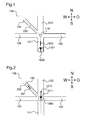
- FIG. 1, FIG. 2 and FIG. 3 each show a position of a user, an orientation of a user and a route to be followed in a road network according to an embodiment.
- FIG. 4 shows a representation of a waveform of the vibration intensity of the vibration signal according to an embodiment of the invention.
- FIG. 5 shows a control device according to the invention.
- FIG. 6 shows a destination guide device according to the invention.
- FIG. 1 shows an intersection 100 in a road network with five paths leaving the intersection 100.
- the intersection 100 has a first path 101 to the south, a path 102 to the east, a third path 103 to the north, a fourth path 104 to the west, and a fifth path 105 to the northwest.
- Shown further in the form of a dashed line is a route 200 which leads along the first, southern route 101 to the intersection 100 and then away from the intersection 100 along the fifth, north-western route 105.
- the user 1000 is located at a first position 1001 on the first, southern path 101 away from the intersection center 110. Its orientation 1002 points north, represented by an arrow. If the user 1000 approaches the intersection center 110, then it is preferably possible to display to the user by means of a vibration signal a navigation instruction on the basis of the route guidance device carried by him, so that the route 200 is complied with by him. Preferably, it is possible, by means of different vibration signals, to signal the user 1000, even before reaching the intersection center 110, a navigation instruction which should cause him to turn the northwest route 105 along the route 200.
- FIG. 2 also shows the intersection 100 together with the first path 101, the second path 102, the third path 103, the fourth path 104, and the fifth path 105
- FIG. 2 is the user 1000 at a position 1011, which with the crossing center 110 of the intersection 100 of Road network agrees.
- the orientation 1012 of the user 1000 points to the north.
- a position 1001, 1011 of the user 1000 in the road network is ascertained, and a direction of movement to be taken by the user 1000 at the determined position 1001, 1011 in the road network for maintaining a route.
- a spatial orientation of the user 1000 is determined according to the invention, so that a navigation instruction is output by a vibration signal to the user 1000 such that a variation of the vibration signal takes place as a function of a deviation of the orientation of the user 1000 from the movement direction to be taken by the user. This may preferably be done when the user is at a position 1011 where a change in his orientation is necessary.
- the user 1000 in order to comply with the route 200, it is necessary for the user 1000 to change its orientation 1012 so as to be aligned with the direction of travel 201 northwest, as shown in FIG FIG. 2 by an arrow, since the route 200 leads from the intersection center 110 along the fifth path 105 in a northwesterly direction.
- a navigation instruction is issued to the user 1000 by a vibration signal.
- the vibration signal varies depending on the deviation of the orientation 1012 of the user 1000 from the movement direction 201 to be taken by the user 1000. This makes it possible for the user 1000 to recognize whether he has to change his orientation 1012 in order to comply with the route 200.
- a navigation instruction is displayed to the user 1000 at position 1001 before reaching the intersection center 110 via a vibration signal such that it should turn in a northwesterly direction
- a vibration signal such that it should turn in a northwesterly direction
- This is indicated by the inventive method on reaching the crossing center 110 the user 1000 by a variation of the vibration signal.
- this can also be displayed to the user 1000 shortly before reaching the intersection center 110.
- FIG. 3 also shows the intersection 100 together with the first path 101, the second path 102, the third path 103, the fourth path 104, and the fifth path 105
- FIG. 3 is the user 1000 at the position 1011, which coincides with the crossing center 110 of the intersection 100 of the road network.
- the orientation 1022 of the user 1000 points in a northwesterly direction.
- the user 1000 at position 1011 which coincides with the intersection center 110, varies its northward orientation 1012 FIG. 2 in a northwestern direction 1022 as in FIG. 3 1, the user 1000 is preferably informed by a variation of the vibration signal as a function of its orientation 1012, 1022 of the movement direction 201 to be taken whether and to what extent its orientation 1012, 1022 coincides with the direction of movement to be assumed. If the user 1000 has changed his northbound orientation 1012 to a northwestern direction 1022 by a northwest turn 1030 that results in compliance with the route 200, then the user 1000 may then continue to travel along the route 200 leads.
- the variation of the vibration signal prefferably, it is possible for the variation of the vibration signal to take place on the basis of a varying intensity of the vibration signal.
- the user 1000 can easily determine, with a change of his orientation 1012, 1022, whether his orientation 1012, 1022 coincides with the direction of movement 201 to be assumed.
- the intensity of the vibration signal decreases.
- the user 1000 brings about an alignment 1022 that more closely matches the direction of travel 201 to be taken than its previous orientation 1012, it is indicated to it by a reduction in the intensity of the vibration signal.
- FIG. 4 shows an exemplary characteristic curve 2000 for the intensity profile of the vibration signal as a function of a deviation of the alignment 1012, 1022 from the direction of movement 201 to be assumed.
- FIG. 4 a Cartesian coordinate system is shown, on the abscissa 2001, the deviation of the orientation 1012, 1022 of the user 1000 is plotted by the direction of movement to be taken 201 201 in degrees.
- the intensity of the vibration signal is plotted.
- the characteristic 2000 of the vibration intensity 2002 is such that the vibration intensity in the range between -5 ° and + 5 ° is zero. Starting from + 5 ° with an increasing number of degrees, the vibration intensity also increases in 2002. Starting from -5 ° with a further decreasing number of degrees, the vibration intensity also increases in 2002.
- the characteristic 2000 is in FIG. 4 preferably for a range of values of the deviation from -90 ° to + 90 °.
- a characteristic which indicates the vibration intensity 2002 for a value range of the deviation of -180 ° to + 180 ° so that it is possible, for example, for the user 1000 in the course of a complete rotation around his own axis each show a deviation in the form of a vibration signal of different intensity.
- the variation of the vibration signal prefferably, it is possible for the variation of the vibration signal to take place on the basis of different vibration frequencies.
- the user 1000 can additionally be made aware of a deviation of his orientation 1012, 1022 from the direction of movement 201 to be taken by a variation of the frequency.
- the control device 2 is in FIG. 5 shown.
- the control device 2 has a first interface 11 to a position determination unit 3.
- the position determination unit 3 is suitable for determining a position of a user 1000 in a road network.
- the control device 2 also has a second interface 12 to a direction determination unit 4.
- the direction determination unit 4 is suitable for determining a spatial orientation 1002, 1012, 1022 of the user 1000.
- the control device 2 further has a computing unit 5 which is suitable for determining a direction of movement 201 to be taken by the user 1000 at the determined position 1011 in the road network for maintaining a route 200.
- the control device 2 is characterized in that the control device 2 has an interface 13 to a vibration unit 6. According to the invention, the control device 2 controls the vibration unit 6 to output a navigation instruction in the form of a vibration signal such that the vibration signal is output in response to a deviation of the orientation 1012, 1022 of the user 1000 with the direction of movement 201 to be taken by the user 1000.
- FIG. 6 shows a target guidance device 1 according to the invention, which has the control device 2 and the vibration unit 6.
- the position determination unit 3 is a GPS unit.
- it may preferably be a magnetic field sensor and / or a gyroscope.
- the use of multiple magnetic field sensors and a plurality of gyroscopes is also preferably possible.
- the interface 11 to the position determination unit 3 and the interface 12 to the direction determination unit 4 may preferably represent electrical connections. Likewise, these may preferably be data interfaces which are embodied, for example, in the form of a CAN bus, a USB connection, a serial interface, a wireless data interface or another form of data interface.
- the control device 2 has a computing unit 5 for detecting a movement direction 201 to be taken by the user 1000.
- the arithmetic unit 5 is preferably designed as a CPU. Furthermore, it is possible to form the arithmetic unit preferably as a microprocessor or as another form of a computing unit for data processing.
- the control device 2 has a third interface 13 via which the control device 2 is connected to the vibration unit 6.
- the control device 2 transmit energy to the vibration unit 6 via an electrical connection, so that the vibration unit 6 generates a vibration signal.
- the third interface 13 it is preferably possible for the third interface 13 to represent a data interface for connecting a control device 2 to the vibration unit 6. This third interface 13 may be preferably wired or wireless for data transmission, as already described for the first and the second interface.
- the vibration unit 6 preferably has its own energy source or access to a power source in order to generate the vibration signal.
- the route guidance device according to the invention is a device for pedestrian navigation. This can be done for example in the form of a mobile phone or a PDA.
- the destination guidance device is preferably a destination guidance device for a vehicle.
- the vibration unit is formed as a vibration unit on the steering wheel or as a vibration unit on the driver's seat.
Landscapes
- Engineering & Computer Science (AREA)
- Radar, Positioning & Navigation (AREA)
- Remote Sensing (AREA)
- Automation & Control Theory (AREA)
- Human Computer Interaction (AREA)
- Multimedia (AREA)
- Physics & Mathematics (AREA)
- General Physics & Mathematics (AREA)
- Navigation (AREA)
Applications Claiming Priority (1)
| Application Number | Priority Date | Filing Date | Title |
|---|---|---|---|
| DE102007046221A DE102007046221A1 (de) | 2007-09-26 | 2007-09-26 | Steuereinrichtung und Verfahren zur Ausgabe einer Navigationsanweisung durch ein Vibrationssignal an einen Nutzer zur Routenführung |
Publications (2)
| Publication Number | Publication Date |
|---|---|
| EP2042835A2 true EP2042835A2 (fr) | 2009-04-01 |
| EP2042835A3 EP2042835A3 (fr) | 2009-10-07 |
Family
ID=40147709
Family Applications (1)
| Application Number | Title | Priority Date | Filing Date |
|---|---|---|---|
| EP08105145A Withdrawn EP2042835A3 (fr) | 2007-09-26 | 2008-08-27 | Dispositif de commande et procédé de production d'une consigne de navigation à l'aide d'un signal de vibration vers un utilisateur pour le guidage d'un itinéraire |
Country Status (2)
| Country | Link |
|---|---|
| EP (1) | EP2042835A3 (fr) |
| DE (1) | DE102007046221A1 (fr) |
Cited By (4)
| Publication number | Priority date | Publication date | Assignee | Title |
|---|---|---|---|---|
| WO2012064988A3 (fr) * | 2010-11-10 | 2012-08-16 | Qualcomm Incorporated | Navigation personnelle sur une base haptique |
| EP2610835A1 (fr) * | 2011-12-29 | 2013-07-03 | Sony Mobile Communications Japan, Inc. | Assistant numérique personnel |
| EP2806249A3 (fr) * | 2011-01-12 | 2015-03-04 | Qualcomm Incorporated | Interface mobile non fondée sur des données cartographiques |
| IT201800006487A1 (it) * | 2018-06-20 | 2018-09-20 | Sistema di navigazione ed orientamento basato su tecnologia mista aptico-visuale e relativo metodo di navigazione |
Citations (1)
| Publication number | Priority date | Publication date | Assignee | Title |
|---|---|---|---|---|
| EP1614992A1 (fr) | 2003-04-17 | 2006-01-11 | Navitime Japan Co., Ltd. | Dispositif et systeme de navigation pietonniere, procede et programme de navigation pietonniere |
Family Cites Families (6)
| Publication number | Priority date | Publication date | Assignee | Title |
|---|---|---|---|---|
| US5144294A (en) * | 1990-10-17 | 1992-09-01 | Ldj Industries, Inc. | Radio frequency message apparatus for aiding ambulatory travel of visually impaired persons |
| GB2370353A (en) * | 2000-12-20 | 2002-06-26 | Nokia Mobile Phones Ltd | Navigation system |
| WO2005108926A1 (fr) * | 2004-05-12 | 2005-11-17 | Takashi Yoshimine | Processeur d'information, appareil portable et procédé de traitement de l'information |
| DE102005032528A1 (de) * | 2005-07-12 | 2007-01-18 | Siemens Ag | Manöverassistenzsystem und Verfahren zum Liefern von assistierenden Informationssignalen an einen Benutzer |
| US20070106457A1 (en) * | 2005-11-09 | 2007-05-10 | Outland Research | Portable computing with geospatial haptic compass |
| WO2007105937A1 (fr) * | 2006-03-10 | 2007-09-20 | Tomtom International B.V. | Dispositif tactile, dispositif et systeme de navigation comportant un tel dispositif tactile et dispositif de navigation |
-
2007
- 2007-09-26 DE DE102007046221A patent/DE102007046221A1/de not_active Ceased
-
2008
- 2008-08-27 EP EP08105145A patent/EP2042835A3/fr not_active Withdrawn
Patent Citations (1)
| Publication number | Priority date | Publication date | Assignee | Title |
|---|---|---|---|---|
| EP1614992A1 (fr) | 2003-04-17 | 2006-01-11 | Navitime Japan Co., Ltd. | Dispositif et systeme de navigation pietonniere, procede et programme de navigation pietonniere |
Cited By (8)
| Publication number | Priority date | Publication date | Assignee | Title |
|---|---|---|---|---|
| WO2012064988A3 (fr) * | 2010-11-10 | 2012-08-16 | Qualcomm Incorporated | Navigation personnelle sur une base haptique |
| US9335181B2 (en) | 2010-11-10 | 2016-05-10 | Qualcomm Incorporated | Haptic based personal navigation |
| US9733086B2 (en) | 2010-11-10 | 2017-08-15 | Qualcomm Incorporated | Haptic based personal navigation |
| EP2806249A3 (fr) * | 2011-01-12 | 2015-03-04 | Qualcomm Incorporated | Interface mobile non fondée sur des données cartographiques |
| EP2610835A1 (fr) * | 2011-12-29 | 2013-07-03 | Sony Mobile Communications Japan, Inc. | Assistant numérique personnel |
| US8977297B2 (en) | 2011-12-29 | 2015-03-10 | Sony Corporation | Providing navigation guidance by activating a plurality of active elements of an information processing apparatus |
| US9179262B2 (en) | 2011-12-29 | 2015-11-03 | Sony Corporation | Personal digital assistant with multiple active elements for guiding user to moving target |
| IT201800006487A1 (it) * | 2018-06-20 | 2018-09-20 | Sistema di navigazione ed orientamento basato su tecnologia mista aptico-visuale e relativo metodo di navigazione |
Also Published As
| Publication number | Publication date |
|---|---|
| DE102007046221A1 (de) | 2009-04-02 |
| EP2042835A3 (fr) | 2009-10-07 |
Similar Documents
| Publication | Publication Date | Title |
|---|---|---|
| DE102011004670B4 (de) | Strassengestaltlernvorrichtung | |
| EP1920268B1 (fr) | Procede de detection d'un espace de circulation | |
| EP2601480B1 (fr) | Procédé et dispositif pour déterminer la position d'un véhicule sur une chaussée de circulation et automobiles équipées d'un tel dispositif | |
| DE10022528B4 (de) | Fahrzeugnavigationssystem mit einer Fahrbahnkurveninformationsfunktion | |
| DE102016220583A1 (de) | Verfahren zur Überprüfung einer Überholmöglichkeitsbedingung | |
| DE102020210515A1 (de) | Verfahren zur Überprüfung von detektierten Veränderungen für ein Umfeldmodell einer digitalen Umgebungskarte | |
| WO2017202522A1 (fr) | Procédé pour fournir une information de trajectoire de véhicule et procédé pour localiser un nid de poule | |
| EP3631779B1 (fr) | Procédé, dispositifs et support d'enregistrement lisible par ordinateur comprenant des instructions pour déterminer des règles de circulation à appliquer pour un véhicule automobile | |
| DE102011078946A1 (de) | Verfahren und Anordnung zum Bestimmen eines am ehesten wahrscheinlichen Fahrpfads eines Fahrzeugs | |
| EP1775552A2 (fr) | Horizon electronique pour systèmes d'assistance à la conduite | |
| DE102010007240A1 (de) | Verfahren zur Ermittlung eines Spurverlaufes einer Fahrstrecke | |
| WO2006136476A1 (fr) | Dispositif pour assister la conduite d'un vehicule, et procede pour faire fonctionner le dispositif | |
| EP3188948B1 (fr) | Procédé de traitement de données de mesure d'un véhicule pour l'établissement du commencement d'une recherche d'une place de stationnement et produit-programme informatique | |
| EP1947421A1 (fr) | Procédé d'émissions de directives pour tourner et dispositif de navigation | |
| EP1927822A1 (fr) | Procédé de commande d'un composant de fonctionnement d'un véhicule automobile grâce à des données de positions transmises par un système de navigation | |
| DE102007046221A1 (de) | Steuereinrichtung und Verfahren zur Ausgabe einer Navigationsanweisung durch ein Vibrationssignal an einen Nutzer zur Routenführung | |
| DE102013220487A1 (de) | Fahrspurerkennungssystem umd Spurhaltesystem | |
| EP2153172B1 (fr) | Correspondance cartographique pour applications de sécurité | |
| EP3545330A1 (fr) | Procédé et dispositif de détermination d'une position précise d'un véhicule au moyen des signatures radar de l'environnement du véhicule | |
| EP0928410A1 (fr) | Procede et systeme d'aide a la navigation pour un conducteur de vehicule | |
| DE10159872B4 (de) | Verfahren und Anordnung sowie Computerprogramm mit Programmcode-Mitteln und Computerprogramm-Produkt zur Ermittlung einer Manöverinformation aus einem Satz von vorgebbaren Manöverinformationen für eine mobile Einheit unter Verwendung von Fuzzy-Logik | |
| DE102019213533A1 (de) | Vorrichtung zum Anpassen einer Fahrstrategie eines Fahrzeugs | |
| DE19544382A1 (de) | Verfahren und Zielführungseinheit zur sicheren Zielführung eines Fahrzeugs | |
| DE102023001648A1 (de) | Verfahren zur Fahrspurlokalisierung eines Fahrzeugs | |
| EP3969846B1 (fr) | Méthode de validation de l'actualité d'une carte |
Legal Events
| Date | Code | Title | Description |
|---|---|---|---|
| PUAI | Public reference made under article 153(3) epc to a published international application that has entered the european phase |
Free format text: ORIGINAL CODE: 0009012 |
|
| AK | Designated contracting states |
Kind code of ref document: A2 Designated state(s): AT BE BG CH CY CZ DE DK EE ES FI FR GB GR HR HU IE IS IT LI LT LU LV MC MT NL NO PL PT RO SE SI SK TR |
|
| AX | Request for extension of the european patent |
Extension state: AL BA MK RS |
|
| PUAL | Search report despatched |
Free format text: ORIGINAL CODE: 0009013 |
|
| AK | Designated contracting states |
Kind code of ref document: A3 Designated state(s): AT BE BG CH CY CZ DE DK EE ES FI FR GB GR HR HU IE IS IT LI LT LU LV MC MT NL NO PL PT RO SE SI SK TR |
|
| AX | Request for extension of the european patent |
Extension state: AL BA MK RS |
|
| AKX | Designation fees paid | ||
| STAA | Information on the status of an ep patent application or granted ep patent |
Free format text: STATUS: THE APPLICATION IS DEEMED TO BE WITHDRAWN |
|
| 18D | Application deemed to be withdrawn |
Effective date: 20100408 |
|
| REG | Reference to a national code |
Ref country code: DE Ref legal event code: 8566 |