EP2043101A1 - Vorrichtung und Verfahren zur Signalaufzeichnung und -wiedergabe - Google Patents
Vorrichtung und Verfahren zur Signalaufzeichnung und -wiedergabe Download PDFInfo
- Publication number
- EP2043101A1 EP2043101A1 EP08253048A EP08253048A EP2043101A1 EP 2043101 A1 EP2043101 A1 EP 2043101A1 EP 08253048 A EP08253048 A EP 08253048A EP 08253048 A EP08253048 A EP 08253048A EP 2043101 A1 EP2043101 A1 EP 2043101A1
- Authority
- EP
- European Patent Office
- Prior art keywords
- encoded data
- group
- signal
- recording
- data
- Prior art date
- Legal status (The legal status is an assumption and is not a legal conclusion. Google has not performed a legal analysis and makes no representation as to the accuracy of the status listed.)
- Ceased
Links
Images




Classifications
-
- G—PHYSICS
- G11—INFORMATION STORAGE
- G11B—INFORMATION STORAGE BASED ON RELATIVE MOVEMENT BETWEEN RECORD CARRIER AND TRANSDUCER
- G11B20/00—Signal processing not specific to the method of recording or reproducing; Circuits therefor
- G11B20/00007—Time or data compression or expansion
-
- G—PHYSICS
- G10—MUSICAL INSTRUMENTS; ACOUSTICS
- G10L—SPEECH ANALYSIS TECHNIQUES OR SPEECH SYNTHESIS; SPEECH RECOGNITION; SPEECH OR VOICE PROCESSING TECHNIQUES; SPEECH OR AUDIO CODING OR DECODING
- G10L19/00—Speech or audio signals analysis-synthesis techniques for redundancy reduction, e.g. in vocoders; Coding or decoding of speech or audio signals, using source filter models or psychoacoustic analysis
- G10L19/04—Speech or audio signals analysis-synthesis techniques for redundancy reduction, e.g. in vocoders; Coding or decoding of speech or audio signals, using source filter models or psychoacoustic analysis using predictive techniques
- G10L19/16—Vocoder architecture
- G10L19/18—Vocoders using multiple modes
- G10L19/24—Variable rate codecs, e.g. for generating different qualities using a scalable representation such as hierarchical encoding or layered encoding
-
- G—PHYSICS
- G11—INFORMATION STORAGE
- G11B—INFORMATION STORAGE BASED ON RELATIVE MOVEMENT BETWEEN RECORD CARRIER AND TRANSDUCER
- G11B20/00—Signal processing not specific to the method of recording or reproducing; Circuits therefor
- G11B20/10—Digital recording or reproducing
- G11B20/10527—Audio or video recording; Data buffering arrangements
-
- G—PHYSICS
- G11—INFORMATION STORAGE
- G11B—INFORMATION STORAGE BASED ON RELATIVE MOVEMENT BETWEEN RECORD CARRIER AND TRANSDUCER
- G11B20/00—Signal processing not specific to the method of recording or reproducing; Circuits therefor
- G11B20/10—Digital recording or reproducing
- G11B20/12—Formatting, e.g. arrangement of data block or words on the record carriers
- G11B20/1217—Formatting, e.g. arrangement of data block or words on the record carriers on discs
- G11B20/1251—Formatting, e.g. arrangement of data block or words on the record carriers on discs for continuous data, e.g. digitised analog information signals, pulse code modulated [PCM] data
-
- G—PHYSICS
- G11—INFORMATION STORAGE
- G11B—INFORMATION STORAGE BASED ON RELATIVE MOVEMENT BETWEEN RECORD CARRIER AND TRANSDUCER
- G11B20/00—Signal processing not specific to the method of recording or reproducing; Circuits therefor
- G11B20/00007—Time or data compression or expansion
- G11B2020/00014—Time or data compression or expansion the compressed signal being an audio signal
- G11B2020/00043—Adaptive transform acoustic coding [ATRAC]
-
- G—PHYSICS
- G11—INFORMATION STORAGE
- G11B—INFORMATION STORAGE BASED ON RELATIVE MOVEMENT BETWEEN RECORD CARRIER AND TRANSDUCER
- G11B20/00—Signal processing not specific to the method of recording or reproducing; Circuits therefor
- G11B20/10—Digital recording or reproducing
- G11B20/10527—Audio or video recording; Data buffering arrangements
- G11B2020/10537—Audio or video recording
- G11B2020/10546—Audio or video recording specifically adapted for audio data
- G11B2020/10555—Audio or video recording specifically adapted for audio data wherein the frequency, the amplitude, or other characteristics of the audio signal is taken into account
- G11B2020/10564—Audio or video recording specifically adapted for audio data wherein the frequency, the amplitude, or other characteristics of the audio signal is taken into account frequency
-
- G—PHYSICS
- G11—INFORMATION STORAGE
- G11B—INFORMATION STORAGE BASED ON RELATIVE MOVEMENT BETWEEN RECORD CARRIER AND TRANSDUCER
- G11B20/00—Signal processing not specific to the method of recording or reproducing; Circuits therefor
- G11B20/10—Digital recording or reproducing
- G11B20/12—Formatting, e.g. arrangement of data block or words on the record carriers
- G11B2020/1264—Formatting, e.g. arrangement of data block or words on the record carriers wherein the formatting concerns a specific kind of data
- G11B2020/1289—Formatting of user data
-
- G—PHYSICS
- G11—INFORMATION STORAGE
- G11B—INFORMATION STORAGE BASED ON RELATIVE MOVEMENT BETWEEN RECORD CARRIER AND TRANSDUCER
- G11B20/00—Signal processing not specific to the method of recording or reproducing; Circuits therefor
- G11B20/10—Digital recording or reproducing
- G11B20/12—Formatting, e.g. arrangement of data block or words on the record carriers
- G11B2020/1291—Formatting, e.g. arrangement of data block or words on the record carriers wherein the formatting serves a specific purpose
- G11B2020/1292—Enhancement of the total storage capacity
Definitions
- the present invention contains subject matter related to Japanese Patent Application JP 2007-255206 filed in the Japanese Patent Office on September 28th, 2007, the entire contents of which are incorporated herein by reference.
- the present invention relates to a signal recording and reproducing apparatus and method for encoding and recording an input signal into a recording medium, and reproducing a signal from the recording medium.
- lossless (reversible) encoding it is possible to retain a high quality of a signal resulting from decoding and reproducing of an encoded signal, however, in general, the amount of encoded data is large; whereas, in the case of lossy (non-reversible) encoding, it is possible to reduce the amount of encoded data to a small amount, however, the quality of the reproduced signal is inferior to that in the case of lossless (reversible) encoding.
- a voice encoding apparatus is disclosed in, for example, U.S. Patent Application Publication No. 2003/0171919 , in which a non-reversible (lossy) compression of an input voice signal is performed to produce a core (base layer) stream, and a reversible (lossless) compression of a residual-error signal is performed to produce an enhanced (enhancement layer) stream, and further, these streams are combined into one stream; and thereby, scalability between lossy compression and lossless compression can be achieved.
- a lossy decoded voice signal can be produced by decoding the core stream, and additionally, a lossless decoded signal can be produced by decoding the core stream and the enhanced stream, and by arithmetic addition of both the resultant decoded streams.
- the present inventors have recognized that it is desirable to provide a signal recording and reproducing apparatus and method, in which, in the case where a remaining amount of storage capacity of a recording medium becomes small, it becomes possible to increase the amount of free storage capacity of the recording medium without completely erasing certain pieces of music and so forth stored therein in the form of recorded data.
- an encoder for encoding an input signal to produce a first group of encoded data and a second group of encoded data used for reproducing a signal of higher quality than a signal resulting from decoding of the first group of encoded data
- recording means for recording record-data, including the first group of encoded data and the second group of encoded data from the encoder, into a recording medium
- reproducing means for reproducing the record-data from the recording medium
- a decoder for decoding at least the first group of encoded data out of the record-data from the reproducing means
- controlling means for controlling an operation of each part of the signal recording and reproducing apparatus, where the controlling means performs control so as to cause the recording means to erase the second group of encoded data in accordance with a command to increase a space capacity of the recording medium.
- the first group of encoded data is non-reversible encoded data and the second group of encoded data is reversible encoded data
- the second group of encoded data is data resulting from performing reversible encoding of a signal obtained by subtracting a signal resulting from decoding the first group of encoded data from the input signal.
- the encoder includes: first encoding means for producing the first group encoded data resulting from performing non-reversible encoding of spectrum signals obtained by frequency-band dividing the input audio signal into a plurality of frequency bands and performing time-to-frequency conversion of the input audio signal within each frequency band, decoding means for decoding only the spectrum signals within predetermined frequency bands out of the first group of encoded data, subtracting means for subtracting the decoded signal from the input audio signal to produce a residual-error signal, and second encoding means for producing the second group of encoded data by performing reversible encoding of the residual-error signal.
- a signal recording and reproducing method there are provided the steps of: encoding an input signal; recording a resultant record-data, including a first group of encoded data, and a second group of encoded data used for reproducing a signal of higher quality than a signal resulting from decoding of the first group of encoded data, into a recording medium; and reproducing at least the first group of encoded data from the recording medium, where the second group of encoded data is erased in accordance with a command to increase the amount of free storage capacity of the recording medium.
- Fig. 1 is a schematic block diagram depicting a signal recording and reproducing apparatus according to an embodiment of the present invention.
- a signal such as a digital audio-signal, resulting from analogue-to-digital conversion of an analogue signal, is inputted to an input terminal 101, is encoded in an encoder 102, and then, the resultant encoded data is recorded into a recording medium (or a storage medium) 104 by a recording unit 103.
- the recorded data in the recording medium 104 is reproduced in a reproducing unit 105, is decoded in a decoder 106, and then, the original signal, such as the digital audio signal, is outputted from an output terminal 107.
- a management information processing unit 18 is a unit for managing information used for recording and reproducing data into/from the recording medium 104, such as positions of recording and reproducing, an amount of recorded data, and a remaining amount of storage capacity of the recording medium. Moreover, the management information processing unit 18 causes the recording unit 103 to add header-information and meta-information to the encoded audio data, or the like, when recording thereof, and further, causes the reproducing unit 105 to perform separating and abstracting of the header-information and the meta-information from the encoded audio signal, or the like, when reproducing thereof.
- a controller 109 which is a so-called system controller using a CPU, controls each part of the signal recording and reproducing apparatus, and further, transmits and receives recording-management information to/from the management information processing unit 108, and performs control of recording and reproducing data to/from the recording medium 104.
- a semiconductor memory a so-called flash memory and so forth
- a disk, a tape, or the like can be used as the recording medium (or a storage medium) 104.
- Fig. 1 there are various embodiments associated with an encoding scheme embodied in the encoder 102, shown in Fig. 1 , and one of the embodiments having the functionality of encoding of information included an input signal without any losses (i.e., lossless encoding) is represented by way of an example shown in Fig. 2 .
- Fig. 2 In Fig.
- FIG. 2A there are shown two sections which are simply collocated and are able to be independently decoded, one being a lossy encoded section (lossy data X), defined as a first group of encoded data, resulting from performing non-reversible encoding of an input signal, the other one being a lossless encoded section (lossless data Y), defined as a second group of encoded data, resulting from performing reversible encoding of the same input signal.
- lossy data X lossy encoded section
- Y lossless encoded section
- FIG. 2B there are shown two sections, one of which is a lossy encoded section (lossy data X), defined as a first group of encoded data, the other one of which is a lossless encoded section (lossless additional data Z), defined as a second group of encoded data, and moreover, there is shown a configuration in which these two sections form a layered structure, and by using the lossless encoded section (lossless additional data Z) as a supplement of lost signal-elements resulting from lossy encoding, a lossless representation of an original signal can be achieved.
- lossy data X lossy encoded section
- Z lossless additional data
- the controller 109 in accordance with a command to increase the amount of free storage capacity of the recording medium 104, the controller 109, shown in Fig. 1 , enables reproducing of the lossy encoded section (lossy data X) retained in the recording medium 104 without being erased, as well as increasing the amount of free storage capacity of the recording medium 104, by erasing the lossless encoded section (i.e., the lossless data Y or the lossless additional data Z), defined as the second group of recoded data, recorded in the recording medium 104.
- the lossless encoded section i.e., the lossless data Y or the lossless additional data Z
- an embodiment of the present invention will be described mainly by way of an example in which an audio signal is inputted as the input signal in the case of encoding scheme shown in Fig. 2B .
- the present invention can be applied to the case shown in Fig. 2A and/or a case where the input signal is any signal other than the audio signal, such as a video signal.
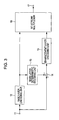
- Fig. 3 is a schematic block diagram illustrating an actual example of an encoding apparatus, as an example of the encoder 102 shown in Fig. 1 , in which the above-described lossy encoded section and the lossless encoded section form a layered structure, as shown in Fig. 2B , and also, illustrates, for example, a schematic block diagram of an audio signal encoding apparatus according to ATRAC Advanced Lossless TM , which is a reversible-codec technology and a standard of Adaptive Transform Acoustic Coding (ATRAC TM ).
- ATRAC Advanced Lossless TM which is a reversible-codec technology
- ATRAC TM Adaptive Transform Acoustic Coding
- the encoding scheme according to ATRAC Advanced Lossless TM which is different from usual reversible encoding schemes, realizes a reversible encoding scheme as a whole, by performing, as a first step, non-reversible encoding with high efficiency, and performing, as a second step, reversible encoding of a quantization-error signal resulting from performing the first step, and therefore, is a so-called lossless encoding with scalability.
- the non-reversible (lossy) encoded section and the reversible (lossless) encoded section are represented as Base Layer and Enhancement Layer, respectively.
- the audio signal encoding apparatus (i.e., an audio encoder), shown in Fig. 3 , includes an input terminal corresponding to the input terminal 101 shown in Fig. 1 , a Base Layer encoding unit 12, a Base Layer Deterministic decoding unit 13, a subtracter 14, an Enhancement Layer encoding unit 15 and a bit-stream multiplexer 16, and moreover, an encoded bit-stream from the bit-stream multiplexer 16 is outputted through an output terminal 17 and transmitted to the recording unit 103 shown in Fig. 1 .
- an input signal from the input terminal 11 is fed to the Base Layer encoding unit 12, and the Base Layer encoding unit 12 performs dividing of the input audio signal into a plurality of frequency bands, performs time-to-frequency conversion of the input audio signal within each of the frequency bands to obtain spectrum signals thereof, and subsequently, performs non-reversible encoding of the spectrum signals to produce non-reversible (lossy) encoded data (Base Layer), defined as a first group of encoded data.
- the non-reversible encoded data from the Base Layer encoding unit 12 is transmitted to the Base Layer Deterministic decoding unit 13 and the bit-stream multiplexer 16.
- the Base Layer Deterministic decoding unit 13 decodes only the spectrum signals within predetermined frequency bands out of the non-reversible encoded data from the Base Layer encoding unit 12 to produce a decoded signal.
- the decoded signal from the Base Layer Deterministic decoding unit 13 is transmitted to the subtracter 14, and then, is subtracted from the input audio signal from the input terminal 11, to produce a residual-error signal.
- the residual-error signal from the subtracter 14 is transmitted to the Enhancement Layer encoding unit 15.
- the Enhancement Layer encoding unit 15 performs reversible encoding of the residual-error signal from the subtracter 14 to produce reversible (lossless) encoded data (Enhancement Layer), defined as a second group of encoded data, and transmits the resultant reversible (lossless) encoded data to the bit-stream multiplexer 16.
- the bit-stream multiplexer 16 combines the non-reversible encoded data from the Base Layer encoding unit 12 and the reversible encoded data from the Enhancement Layer encoding unit 15 to produce an encoded bit-stream, and then, transmits the resultant encoded bit-stream to the output terminal 17.
- a header and so forth are added to the encoded bit-stream outputted from the output terminal 17, and the resultant encoded bit-stream is recorded into the recording medium 104 in accordance with a file format, such as that of ATRAC Advanced Lossless TM shown in Fig. 4 .
- audio data constituted of a plurality of audio frames AFs is located following a stream header SH which functions as a header of the whole bit-stream, and further, each of the audio frames AFs includes a frame header and both encoded data of the Base Layer BL and the Enhancement Layer EL. That is to say, owing to such a scalable structure, the input signal is represented as two data layers, one of which is the Base Layer BL having a compact data size, the other one of which is the Enhancement Layer EL enabling the decoded output signal to be completely conformed to the input signal.
- These two data layers can be managed in an integrated way by using one file, and it is possible to determine whether either of the data layers is appropriate for reproduction in accordance with the condition or purpose of utilization.
- an information source e.g., music
- a hard disk in which an information source (e.g., music) is retained in a hard disk in a file format including two kinds of formats for both the Base Layer BL and the Enhancement Layer EL, and by decoding all of the Base Layer BL and the Enhancement Layer EL, it is possible to reproduce a high quality signal, which completely conforms to the original sound source.
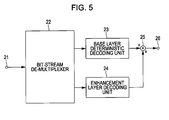
- Fig. 5 is a schematic diagram illustrating an audio signal decoding apparatus, as an actual example of the decoder 106 shown in Fig. 1 , which is configured to perform decoding, which is a reverse process of the above-described encoding, shown in Fig. 2B , performed by the audio signal encoding apparatus.
- the audio signal decoding apparatus includes a bit-stream de-multiplexer 22, into which the reproduced signal from the reproducing unit 105, shown in Fig. 1 , is fed through an input terminal 21; a Base Layer Deterministic decoding unit 23 for decoding the encoded data of the Base Layer separated in the bit-stream de-multiplexer 22; an Enhancement Layer decoding unit 24 for decoding the encoded data of the Enhancement Layer separated in the bit-stream de-multiplexer 22; and an adder 25 for arithmetic addition of both output signals from the Base Layer Deterministic decoding unit 23 and the Enhancement Layer decoding unit 24, and further, the decoded audio signal from the adder 25 is outputted through an output terminal 26 (i.e., the output terminal 107 in Fig. 1 ).
- an output terminal 26 i.e., the output terminal 107 in Fig. 1 .
- Base Layer Deterministic decoding units 13 and 23 which are used in both of the decoders and play an important role, will be described.
- lossless encoding is realized by breaking it down to multi-layers as described above
- respective layers in the decoders can perform deterministic operations regardless of differences in control systems.
- This condition can be relatively easily achieved with respect to the Enhancement Layer, however, with respect to the Base Layer having lots of elements, such as an orthogonal transformation, realized basically on the basis of floating point arithmetic, it is more likely to become difficult to implement the Base Layer due to reasons, such as an increase in the amount of arithmetic, unless other conditions are added to this condition.
- ATRAC Advanced Lossless TM in association with the Base Layer, which is the non-reversible (lossy) encoded section, an encoding scheme according to ATRAC TM is used.
- This encoding scheme is configured to perform orthogonal transformation after dividing an input signal into a plurality of frequency bands, and thus, it becomes possible to control so that the number of frequency bands to be decoded is determined from a balance between the amount of arithmetic and a compression ratio, and further, the decoding associated with frequency bands beyond a determined number of frequency bands is not performed, and a subsequent process is entrusted to the processing associated with the Enhancement Layer. That is to say, in the Base Layer Deterministic decoding units 13 and 23, shown in Fig. 3 and Fig.
- the data size thereof more specifically, the sum of the data size of the Base Layer and that of the Enhancement Layer is approximately 50% to 60% of that of the original signal, and thus, the maximum allowable length of a signal (or the number of pieces of music) to be stored in the recording medium (or the storage medium) having a limited storage capacity is significantly restricted.
- an audio encoding scheme with high efficiency in performing encoding associated with the lossy encoded section it becomes possible to suppress the data size thereof to approximately 1/10 to 1/3 of that of the Enhancement Layer, as well as to suppress the degradation of sound quality to a minimum level.
- the controller 109 determines that the space capacity of the recording medium becomes small by monitoring the management information, such as the space capacity of the recording medium from the management information processing unit 108, and then, issues a command so as to increase the space capacity, automatically or upon receipt of a confirmation by the user. Subsequently, the controller 109 performs record-controlling so as to cause the recording unit 103 to erase the certain portions of the Enhancement Layer, which is a second group of encoded data, as described above.
- the formula (3) can be represented as 1-(1-r)M/M, and further, since r is usually a small value (i.e., equal to approximately 1/10), this formula can be approximated to 1-M/N. Accordingly, it follows that it is possible to restore the storage capacity of the recording medium (or the storage medium) substantially in proportion to the number of frames having the Enhancement Layer erased.
- the encoding bit-rate can be selected from among ten kinds of bit-rates; 32, 48, 64, 96, 128, 160, 192, 256, 320 and 352 kbps.
- the bit-rate of the Enhancement Layer varies substantially from 600 kbps to 1500 kbps for each frame to be processed, according to the characteristics of the input signal.
- a user may monitor the amount of free storage capacity on the recording medium, and upon recognizing that it becomes small, the user selects certain pieces of music whose corresponding portions of the Enhancement Layer are going to be erased, and then, performs erasure of the selected pieces of music.
- a function of increasing the amount of free storage capacity in the recording medium performed by the recording and reproducing apparatus is provided, and on receipt of a command issued by the user to cause the function to operate, certain software, installed in the recording and reproducing apparatus, automatically performs erasure of certain portions of the Enhancement Layer.
- Pieces of music to be targeted for erasure there are various methods of selecting pieces of music to be targeted for erasure, one of which is a simple method in which the pieces of music are erased in an order in accordance with a directory structure thereof. Some methods are described hereafter as practical examples.
- a first method the pieces of music are arranged in accordance with the numbers of reproductions thereof performed in the recording and reproducing apparatus, and then, candidates for the erasure are sequentially selected in accordance with an order of priority, wherein the piece of music having the smallest number of reproductions is erased first.
- the pieces of music are arranged in accordance with the sizes of data thereof stored in the recording medium, and then, the candidates are sequentially selected in accordance with an order of priority, wherein the piece of music having the largest size of data is erased first.
- the pieces of music are arranged in accordance with latest access date-and-time thereof (i.e., the date-and-time when the recording or the reproducing of a piece of music was last performed), and then, the candidates are sequentially selected in accordance with an order of priority, wherein the piece of music having the oldest access date-and-time is erased first. Further, it is possible to combine these methods.
- certain pieces of software installed in the recording and reproducing apparatus can be configured to invoke a software task for periodically executing the erasure of certain portions of the Enhancement Layer.
- pieces of music as candidates for the erasure as in the above-described example, in accordance with an order of priority, wherein a piece of music having the smallest number of reproductions, the largest data size, or the oldest access date-and-time in a recent access history is erased first, and further, by erasing portions of the Enhancement Layer corresponding to the candidates, an increase in the amount of free storage capacity with efficiency can be achieved.
- FIG. 6 A series of processes, shown in this Fig. 6 , is performed, for example, by causing a CPU to execute system software, in the controller 109, shown in Fig. 1 .
- a remaining-amount-of-recording-medium monitoring routine monitors the remaining amount of free storage capacity, i.e., the amount of free storage capacity of a recording medium, and in step S32, it is determined whether the remaining amount is more than a predetermined threshold value, or not.
- the flow returns to step S31 and the monitoring is continued by the remaining-amount-of-recording-medium monitoring routine.
- the determination, in step S32, is "No" i.e., in the case where the remaining amount is less than or equal to the predetermined value
- the flow proceeds to step S33.
- step S33 it is determined whether the remaining amount of free storage capacity is to be increased, or not. Actually, this can be realized by displaying an alert to a user and waiting for a confirmation by the user.
- the determination, in step S32, is "No" i.e., in the case where it is decided not to increase the amount of free storage capacity
- the flow returns to step S31.
- step S32 when the determination is "Yes” (i.e., in the case where it is determined to increase the amount of free storage capacity), the flow proceeds to step S34, where listed pieces of music are arranged on the basis of the numbers of reproductions thereof.
- step S34 This is a process in which the numbers of reproductions associated with the pieces of music recorded in the recording medium are read out to produce a list including the pieces of music arranged in an ascending order from the piece of music having the smallest number of reproductions to that having the largest number of reproductions.
- step S35 certain pieces of music, such as predetermined N (a fixed value) pieces of music, are selected from among pieces of music having a small number of reproductions in the list produced on the basis of the above-described arrangement.
- a name i.e., a title
- the like of the n-th piece of music selected as a candidate for the erasure is displayed to a user so as to prompt the user to decide whether the erasure is to be performed, or not.
- step S37 When the determination, in step S37, is "Yes” (i.e., in the case where it is determined to execute erasure of certain portions of the Enhancement Layer), the flow proceeds to step S40, where the process of erasing the certain portions of the Enhancement Layer corresponding to the n-th candidate (i.e., n-th piece of music) for the erasure is performed, and subsequently, the flow proceeds to the above-described step S38.
- the process of erasing the certain portions of the Enhancement Layer corresponding to the n-th candidate i.e., n-th piece of music
- a data size of the Base Layer(a fixed value for every frame) is obtained from the prescribed information (i.e., ATRAC configuration) recorded in the stream header, disposed in the file format shown in Fig. 4 . Subsequently, the data size of the Base Layer, which was obtained in the foregoing process, is subtracted from a frame-data size (which varies for each frame) obtained from the frame-header disposed at the head of each frame, and thereby, the data size of the Enhancement Layer can be calculated and the calculated data size of the Enhancement Layer is deleted.
- this erasure process is performed in such a way that, for example, the controller 109, shown Fig. 1 , causes the recording unit 103 to erase the data recorded in the recording medium 104 on the basis of management-information from the management information processing unit 108.
- the erasure process is commonly performed by rewriting the management-information, such as information in Table Of Contents (TOC) and File Allocation Table (FAT) of the recording medium 104, and header information included in the data stream.
- TOC Table Of Contents
- FAT File Allocation Table
- the recording and reproducing apparatus including a method of lossless encoding, it becomes possible to increase the amount of free storage capacity of a recording medium to a large extent, as well as to retain a condition under which reproduction of pieces of music can be performed without complete erasure thereof.
Landscapes
- Engineering & Computer Science (AREA)
- Signal Processing (AREA)
- Multimedia (AREA)
- Quality & Reliability (AREA)
- Computational Linguistics (AREA)
- Health & Medical Sciences (AREA)
- Audiology, Speech & Language Pathology (AREA)
- Human Computer Interaction (AREA)
- Physics & Mathematics (AREA)
- Acoustics & Sound (AREA)
- Signal Processing For Digital Recording And Reproducing (AREA)
- Management Or Editing Of Information On Record Carriers (AREA)
Applications Claiming Priority (1)
| Application Number | Priority Date | Filing Date | Title |
|---|---|---|---|
| JP2007255206A JP4973422B2 (ja) | 2007-09-28 | 2007-09-28 | 信号記録再生装置及び方法 |
Publications (1)
| Publication Number | Publication Date |
|---|---|
| EP2043101A1 true EP2043101A1 (de) | 2009-04-01 |
Family
ID=40259995
Family Applications (1)
| Application Number | Title | Priority Date | Filing Date |
|---|---|---|---|
| EP08253048A Ceased EP2043101A1 (de) | 2007-09-28 | 2008-09-17 | Vorrichtung und Verfahren zur Signalaufzeichnung und -wiedergabe |
Country Status (4)
| Country | Link |
|---|---|
| US (1) | US8364496B2 (de) |
| EP (1) | EP2043101A1 (de) |
| JP (1) | JP4973422B2 (de) |
| CN (1) | CN101399042A (de) |
Families Citing this family (4)
| Publication number | Priority date | Publication date | Assignee | Title |
|---|---|---|---|---|
| EP2395505A1 (de) * | 2010-06-11 | 2011-12-14 | Thomson Licensing | Verfahren und Vorrichtung zum Suchen in einem geschichteten hierarchischen Bitstrom und darauffolgende Wiedergabe, besagter Bitstrom mit einer Basisschicht und mindestens einer Erweiterungsschicht |
| JP6724783B2 (ja) | 2014-09-12 | 2020-07-15 | ソニー株式会社 | 送信装置、送信方法、受信装置および受信方法 |
| WO2017003227A1 (ko) * | 2015-07-01 | 2017-01-05 | 한국전자통신연구원 | 복수의 동작 모드들을 지원하는 타임 인터리버에 상응하는 방송 신호 프레임 생성 장치 및 방송 신호 프레임 생성 방법 |
| CN106911698B (zh) * | 2017-03-03 | 2020-06-09 | 天津天地伟业信息系统集成有限公司 | 一种多路高清解码器集群的控制方法 |
Citations (13)
| Publication number | Priority date | Publication date | Assignee | Title |
|---|---|---|---|---|
| US5495552A (en) * | 1992-04-20 | 1996-02-27 | Mitsubishi Denki Kabushiki Kaisha | Methods of efficiently recording an audio signal in semiconductor memory |
| WO2001069939A1 (en) * | 2000-03-13 | 2001-09-20 | Koninklijke Philips Electronics N.V. | Storage of compressed data items |
| US20020072902A1 (en) * | 2000-11-29 | 2002-06-13 | Alcatel | Adoptive storage of audio signals |
| US20020101678A1 (en) * | 2001-01-30 | 2002-08-01 | Van Der Vleuten Renatus Josephus | Storing data items on a data carrier |
| EP1239480A2 (de) * | 2001-03-07 | 2002-09-11 | Pioneer Corporation | Informationswiedergabegerät und Verfahren zum Löschen von Programmdaten |
| US20030171919A1 (en) * | 2002-03-09 | 2003-09-11 | Samsung Electronics Co., Ltd. | Scalable lossless audio coding/decoding apparatus and method |
| US20040114183A1 (en) * | 2002-12-12 | 2004-06-17 | Wei-Jen Lee | Method and apparatus for image data storage management |
| US20050183123A1 (en) * | 2004-01-28 | 2005-08-18 | Samsung Electronics Co., Ltd. | Video contents recording apparatus and method of managing data storage medium included therein |
| EP1638344A2 (de) * | 2004-09-21 | 2006-03-22 | D & M Holdings, Inc. | Aufnahmegerät, Abspielgerät |
| US20070025438A1 (en) * | 2002-12-20 | 2007-02-01 | Koninklijke Philips Electronics N.V. | Elastic storage |
| JP2007034230A (ja) | 2005-07-29 | 2007-02-08 | Sony Corp | 音声符号化装置及び方法、並びに音声復号装置及び方法 |
| US20070101373A1 (en) * | 2003-03-27 | 2007-05-03 | Koninklijke Philips Electronics N.V. | Playlist synchronization |
| JP2007255206A (ja) | 2006-03-20 | 2007-10-04 | Nissan Motor Co Ltd | エンジンの残留ガス量測定装置 |
Family Cites Families (6)
| Publication number | Priority date | Publication date | Assignee | Title |
|---|---|---|---|---|
| US5341457A (en) * | 1988-12-30 | 1994-08-23 | At&T Bell Laboratories | Perceptual coding of audio signals |
| JPH03276263A (ja) * | 1990-03-26 | 1991-12-06 | Fuji Photo Film Co Ltd | 画像ファイリング装置 |
| US5285498A (en) * | 1992-03-02 | 1994-02-08 | At&T Bell Laboratories | Method and apparatus for coding audio signals based on perceptual model |
| JP3237374B2 (ja) * | 1994-03-15 | 2001-12-10 | 松下電器産業株式会社 | デジタル信号記録装置とデジタル信号再生装置及びデジタル信号記録再生装置 |
| JPH10161925A (ja) * | 1996-11-29 | 1998-06-19 | Matsushita Electric Ind Co Ltd | アドレス発生方法およびアドレス発生装置 |
| JP2006239148A (ja) * | 2005-03-03 | 2006-09-14 | Fuji Photo Film Co Ltd | 医用画像処理装置及び方法 |
-
2007
- 2007-09-28 JP JP2007255206A patent/JP4973422B2/ja not_active Expired - Fee Related
-
2008
- 2008-09-17 EP EP08253048A patent/EP2043101A1/de not_active Ceased
- 2008-09-22 US US12/234,768 patent/US8364496B2/en not_active Expired - Fee Related
- 2008-09-28 CN CNA2008101687805A patent/CN101399042A/zh active Pending
Patent Citations (14)
| Publication number | Priority date | Publication date | Assignee | Title |
|---|---|---|---|---|
| US5495552A (en) * | 1992-04-20 | 1996-02-27 | Mitsubishi Denki Kabushiki Kaisha | Methods of efficiently recording an audio signal in semiconductor memory |
| WO2001069939A1 (en) * | 2000-03-13 | 2001-09-20 | Koninklijke Philips Electronics N.V. | Storage of compressed data items |
| US20020072902A1 (en) * | 2000-11-29 | 2002-06-13 | Alcatel | Adoptive storage of audio signals |
| US20020101678A1 (en) * | 2001-01-30 | 2002-08-01 | Van Der Vleuten Renatus Josephus | Storing data items on a data carrier |
| EP1239480A2 (de) * | 2001-03-07 | 2002-09-11 | Pioneer Corporation | Informationswiedergabegerät und Verfahren zum Löschen von Programmdaten |
| US20030171919A1 (en) * | 2002-03-09 | 2003-09-11 | Samsung Electronics Co., Ltd. | Scalable lossless audio coding/decoding apparatus and method |
| US20040114183A1 (en) * | 2002-12-12 | 2004-06-17 | Wei-Jen Lee | Method and apparatus for image data storage management |
| US20070025438A1 (en) * | 2002-12-20 | 2007-02-01 | Koninklijke Philips Electronics N.V. | Elastic storage |
| US20070101373A1 (en) * | 2003-03-27 | 2007-05-03 | Koninklijke Philips Electronics N.V. | Playlist synchronization |
| US20050183123A1 (en) * | 2004-01-28 | 2005-08-18 | Samsung Electronics Co., Ltd. | Video contents recording apparatus and method of managing data storage medium included therein |
| EP1638344A2 (de) * | 2004-09-21 | 2006-03-22 | D & M Holdings, Inc. | Aufnahmegerät, Abspielgerät |
| JP2007034230A (ja) | 2005-07-29 | 2007-02-08 | Sony Corp | 音声符号化装置及び方法、並びに音声復号装置及び方法 |
| US20070043575A1 (en) * | 2005-07-29 | 2007-02-22 | Takashi Onuma | Apparatus and method for encoding audio data, and apparatus and method for decoding audio data |
| JP2007255206A (ja) | 2006-03-20 | 2007-10-04 | Nissan Motor Co Ltd | エンジンの残留ガス量測定装置 |
Non-Patent Citations (2)
| Title |
|---|
| GEIGER ET AL: "ISO/IEC MPEG-4 High-Definition Scalable Advanced Audio Coding", JOURNAL OF THE AUDIO ENGINEERING SOCIETY, vol. 55, no. 1/2, January 2007 (2007-01-01), pages 27 - 43, XP002512714 * |
| LOH, MIKE AND LING, NG KOON: "PRESS RELEASE: EXPLOIT TECHNOLOGIES PRESENTS HIGH-DEFINITION DIGITAL AUDIO STANDARDS WITH LOSSLESS AUDIO COMPRESSION TECHNOLOGIES", 4 October 2006, A*STAR / EXPLOIT TECHNOLOGIES PTE LTD, CHIBA, JAPAN, XP002512715 * |
Also Published As
| Publication number | Publication date |
|---|---|
| US20090089052A1 (en) | 2009-04-02 |
| US8364496B2 (en) | 2013-01-29 |
| CN101399042A (zh) | 2009-04-01 |
| JP2009086239A (ja) | 2009-04-23 |
| JP4973422B2 (ja) | 2012-07-11 |
Similar Documents
| Publication | Publication Date | Title |
|---|---|---|
| KR101401224B1 (ko) | 오디오 신호를 디코딩하기 위한 장치, 방법, 및 컴퓨터-판독가능 매체 | |
| CN1327619C (zh) | 声音编码方式及声音编码装置 | |
| US7634413B1 (en) | Bitrate constrained variable bitrate audio encoding | |
| KR100725236B1 (ko) | 데이터 기록재생장치 및 그 방법 | |
| US7689427B2 (en) | Methods and apparatus for implementing embedded scalable encoding and decoding of companded and vector quantized audio data | |
| JP2006031012A (ja) | マルチチャンネルオーディオデータ符号化方法、マルチチャンネルオーディオデータ復号化方法、マルチチャンネルオーディオデータ符号化装置、マルチチャンネルオーディオデータ復号化装置、マルチチャンネルオーディオデータを符号化するためのプログラムを記録した媒体及びマルチチャンネルオーディオデータを復号化するためのプログラムを記録した記録媒体 | |
| US5978757A (en) | Post storage message compaction | |
| JP2002014697A (ja) | ディジタルオーディオ装置 | |
| JP2006317972A (ja) | オーディオデータ編集方法とこれを適用した記録媒体及びデジタルオーディオプレーヤー | |
| CN100489964C (zh) | 音频解码 | |
| US8364496B2 (en) | Signal recording and reproducing apparatus and method | |
| US20070127580A1 (en) | Method, medium, and apparatus encoding and/or decoding an audio signal | |
| RU2702265C1 (ru) | Способ и устройство обработки сигналов | |
| JP2004199075A (ja) | ビット率調節可能なステレオオーディオ符号化・復号化方法及びその装置 | |
| KR20080071516A (ko) | 재생 장치, 재생 방법 및 재생 프로그램이 기록된 컴퓨터판독 가능한 기록 매체 | |
| JP4241839B2 (ja) | データ及びファイルシステム情報の記録装置及び記録方法 | |
| JP3371462B2 (ja) | オーディオ信号記録・再生装置 | |
| JP5331290B2 (ja) | 多チャンネル信号符号化/復号化方法及びその装置 | |
| HK1126029A (en) | Signal recording and reproducing apparatus and method | |
| JPH09102190A (ja) | 信号記録装置、及び信号読出装置、並びに信号記録・読出装置 | |
| JPH0793892A (ja) | 半導体メモリオーディオ記録再生装置 | |
| JP3481918B2 (ja) | オーディオ信号符号化・復号化装置 | |
| JPH11283332A (ja) | 圧縮データ記憶装置 | |
| JP7638083B2 (ja) | 音声符号化装置および音声復号装置、ならびにプログラム | |
| US7113113B2 (en) | Reproduction apparatus |
Legal Events
| Date | Code | Title | Description |
|---|---|---|---|
| PUAI | Public reference made under article 153(3) epc to a published international application that has entered the european phase |
Free format text: ORIGINAL CODE: 0009012 |
|
| 17P | Request for examination filed |
Effective date: 20081004 |
|
| AK | Designated contracting states |
Kind code of ref document: A1 Designated state(s): AT BE BG CH CY CZ DE DK EE ES FI FR GB GR HR HU IE IS IT LI LT LU LV MC MT NL NO PL PT RO SE SI SK TR |
|
| AX | Request for extension of the european patent |
Extension state: AL BA MK RS |
|
| 17Q | First examination report despatched |
Effective date: 20090616 |
|
| AKX | Designation fees paid |
Designated state(s): DE FR GB |
|
| STAA | Information on the status of an ep patent application or granted ep patent |
Free format text: STATUS: THE APPLICATION HAS BEEN REFUSED |
|
| 18R | Application refused |
Effective date: 20171124 |