EP2043348A2 - Telekommunikationsendpunkt zur Verwaltung einer Mehrfachkonferenzschaltung - Google Patents
Telekommunikationsendpunkt zur Verwaltung einer Mehrfachkonferenzschaltung Download PDFInfo
- Publication number
- EP2043348A2 EP2043348A2 EP08165220A EP08165220A EP2043348A2 EP 2043348 A2 EP2043348 A2 EP 2043348A2 EP 08165220 A EP08165220 A EP 08165220A EP 08165220 A EP08165220 A EP 08165220A EP 2043348 A2 EP2043348 A2 EP 2043348A2
- Authority
- EP
- European Patent Office
- Prior art keywords
- conference
- participant
- call
- endpoint device
- display
- Prior art date
- Legal status (The legal status is an assumption and is not a legal conclusion. Google has not performed a legal analysis and makes no representation as to the accuracy of the status listed.)
- Granted
Links
Images























Classifications
-
- H—ELECTRICITY
- H04—ELECTRIC COMMUNICATION TECHNIQUE
- H04M—TELEPHONIC COMMUNICATION
- H04M3/00—Automatic or semi-automatic exchanges
- H04M3/42—Systems providing special services or facilities to subscribers
- H04M3/56—Arrangements for connecting several subscribers to a common circuit, i.e. affording conference facilities
-
- H—ELECTRICITY
- H04—ELECTRIC COMMUNICATION TECHNIQUE
- H04M—TELEPHONIC COMMUNICATION
- H04M1/00—Substation equipment, e.g. for use by subscribers
- H04M1/247—Telephone sets including user guidance or feature selection means facilitating their use
-
- H—ELECTRICITY
- H04—ELECTRIC COMMUNICATION TECHNIQUE
- H04M—TELEPHONIC COMMUNICATION
- H04M3/00—Automatic or semi-automatic exchanges
- H04M3/42—Systems providing special services or facilities to subscribers
- H04M3/56—Arrangements for connecting several subscribers to a common circuit, i.e. affording conference facilities
- H04M3/563—User guidance or feature selection
-
- H—ELECTRICITY
- H04—ELECTRIC COMMUNICATION TECHNIQUE
- H04M—TELEPHONIC COMMUNICATION
- H04M1/00—Substation equipment, e.g. for use by subscribers
- H04M1/02—Constructional features of telephone sets
- H04M1/23—Construction or mounting of dials or of equivalent devices; Means for facilitating the use thereof
- H04M1/233—Construction or mounting of dials or of equivalent devices; Means for facilitating the use thereof including a pointing device, e.g. roller key, track ball, rocker switch or joystick
-
- H—ELECTRICITY
- H04—ELECTRIC COMMUNICATION TECHNIQUE
- H04M—TELEPHONIC COMMUNICATION
- H04M1/00—Substation equipment, e.g. for use by subscribers
- H04M1/26—Devices for calling a subscriber
- H04M1/27—Devices whereby a plurality of signals may be stored simultaneously
- H04M1/274—Devices whereby a plurality of signals may be stored simultaneously with provision for storing more than one subscriber number at a time, e.g. using toothed disc
- H04M1/2745—Devices whereby a plurality of signals may be stored simultaneously with provision for storing more than one subscriber number at a time, e.g. using toothed disc using static electronic memories, e.g. chips
- H04M1/27467—Methods of retrieving data
- H04M1/2747—Scrolling on a display
-
- H—ELECTRICITY
- H04—ELECTRIC COMMUNICATION TECHNIQUE
- H04M—TELEPHONIC COMMUNICATION
- H04M1/00—Substation equipment, e.g. for use by subscribers
- H04M1/26—Devices for calling a subscriber
- H04M1/27—Devices whereby a plurality of signals may be stored simultaneously
- H04M1/274—Devices whereby a plurality of signals may be stored simultaneously with provision for storing more than one subscriber number at a time, e.g. using toothed disc
- H04M1/2745—Devices whereby a plurality of signals may be stored simultaneously with provision for storing more than one subscriber number at a time, e.g. using toothed disc using static electronic memories, e.g. chips
- H04M1/27467—Methods of retrieving data
- H04M1/27475—Methods of retrieving data using interactive graphical means or pictorial representations
-
- H—ELECTRICITY
- H04—ELECTRIC COMMUNICATION TECHNIQUE
- H04M—TELEPHONIC COMMUNICATION
- H04M2201/00—Electronic components, circuits, software, systems or apparatus used in telephone systems
- H04M2201/42—Graphical user interfaces
-
- H—ELECTRICITY
- H04—ELECTRIC COMMUNICATION TECHNIQUE
- H04M—TELEPHONIC COMMUNICATION
- H04M2203/00—Aspects of automatic or semi-automatic exchanges
- H04M2203/50—Aspects of automatic or semi-automatic exchanges related to audio conference
- H04M2203/5018—Initiating a conference during a two-party conversation, i.e. three-party service or three-way call
-
- H—ELECTRICITY
- H04—ELECTRIC COMMUNICATION TECHNIQUE
- H04M—TELEPHONIC COMMUNICATION
- H04M2250/00—Details of telephonic subscriber devices
- H04M2250/62—Details of telephonic subscriber devices user interface aspects of conference calls
-
- H—ELECTRICITY
- H04—ELECTRIC COMMUNICATION TECHNIQUE
- H04M—TELEPHONIC COMMUNICATION
- H04M3/00—Automatic or semi-automatic exchanges
- H04M3/42—Systems providing special services or facilities to subscribers
- H04M3/56—Arrangements for connecting several subscribers to a common circuit, i.e. affording conference facilities
- H04M3/563—User guidance or feature selection
- H04M3/564—User guidance or feature selection whereby the feature is a sub-conference
Definitions
- the present invention generally relates to the field of teleconferencing and, more particularly, to an apparatus or endpoint device for permitting conference call participants to simultaneously manage multiple conference calls.
- a group of people individually call the conference bridge assigned to the specific conference for a particular time slot and add themselves to the initial conference call.
- a specific participant can remove themselves from the conference bridge, and new participants are able to join the conference call that is currently in progress.
- the new participant will not be informed about who is currently at the bridge, i.e., the new participant will not be provided with the identity of the participants in the conference call.
- the conference call participants will not be provided with automatic updates with respect to who is currently participating in the ongoing conference call, i.e., who has joined or left the conference.
- the only notification that is currently provided is a nondescript audible alert.
- each call has a well-defined "life cycle", which involves a number of steps.
- the conference call is scheduled by a specific person, who then distributes the dial-in information to others who wish to participate in the conference call.
- conference call participants call and add themselves to the conference bridge to participate in the conference call, and then add themselves to the conference call using the dial-in information provided in the distributed dial-in information.
- a caller is able to conference with several people by using his or her calling device as a local conference bridge.
- the number of participants in such a system is typically limited to no more than approximately six participants, where each participant must be added to the conference one after the other.
- the conference call itself is still "anchored" to a single, controlling calling device, i.e., the device being used as the bridge.
- the conference bridge paradigm is rigidly constrained to a situation in which people dial into the conference and from which people are "dropped" from the conference.
- An apparatus or endpoint device for providing the capability to simultaneously manage multiple conference calls, move participants in the conference calls from one conference call to another and subdivide or join multiple conference calls together.
- the proposed apparatus or endpoint device provides a multi-conferencing capability that allows one or more teleconferencing participants to manage multiple teleconferences simultaneously.
- each participant in the teleconference call manages their respective teleconference through their apparatus or endpoint device at their specific location by using it to adjust the teleconferencing topology, i.e., who should form what part of each specific teleconference call.
- a participant seeking to initiate a conference call does so at his or her endpoint device by selecting a conference call identifier, where the identifier identifies a conference call to be created.
- the initiating participant selects the participants to be associated with the particular call and confirms the selection.
- the conference call among the selected participants is established.
- the endpoint device is a graphical user interface (GUI) that comprises a telecommunications endpoint device that enables multi-conferencing in a desktop environment.
- GUI graphical user interface
- the endpoint device in accordance with one embodiment of the present invention provides symmetric control, in that any participant has at least some control over how the creation and evolution of the conference calls progress.
- each participant is permitted to move freely from one conference call to another. That is, each participant at his or her endpoint device has the ability to "shape" their conference calls to suit their changing needs during the calls.
- each participant may split, merge, add, and delete one or more conference calls that may be in progress.
- each participant may re-add, re-drop, and remove participants of conferences calls to suit the needs of each of the participants.
- the multi-conferencing capability of the present invention permits the management of multiple conferences simultaneously, as well as the splitting and merging of conference calls.
- symmetric control at the various participating endpoints is provided, as well as a smooth transition of conference participants from one call to another.
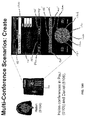
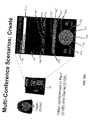
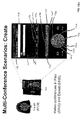
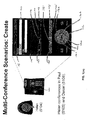
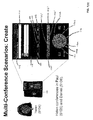
- FIG. 1 is an exemplary graphical diagram illustrating the implementation of the apparatus or endpoint device in accordance with an embodiment of the invention pursuant to creating a simultaneous management of multiple conference calls;
- FIGS. 1(a) thru 1 (r) are exemplary illustrations of the display area of the apparatus or endpoint device provided to a user for creating the multiple conference calls;
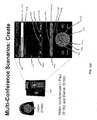
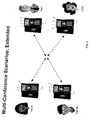
- FIG. 2 is an exemplary graphical illustration of a conference call between multiple users of the apparatus or endpoint device of the invention
- FIG. 2(a) is an exemplary illustration of the display area of the apparatus or endpoint device provided to the users pursuant to creation of the conference call;
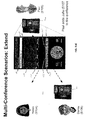
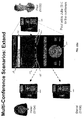
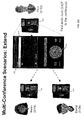
- FIG. 3 is an exemplary graphical illustration of the extension or addition of an additional participant to the conference call
- FIG. 3(a) thru 3(j) are exemplary illustrations of the display area of the apparatus or endpoint device provided to the users pursuant to the extension or addition of an additional participant to the conference call;
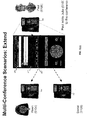
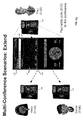
- FIG. 4 is an exemplary graphical illustration of the apparatus or endpoint device in the extended conference call
- FIG. 4(a) thru 4 is an exemplary illustration of the display area of the apparatus or endpoint device provided to the users during the extended conference call;
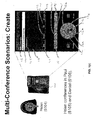
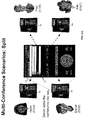
- FIG. 5 is an exemplary graphical illustration of the generation of a split of the conference call into multiple conference calls
- FIGS. 5(a) thru 5(p) are exemplary illustrations of the display area of the apparatus or endpoint device provided to the users pursuant to the split of the conference call into multiple conference calls;
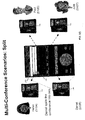
- FIG. 6 is a graphical illustration of multiple conference calls in accordance with an embodiment of the invention.
- FIG. 6(a) is an exemplary illustration of the display area of the apparatus or endpoint device provided to the users when the conference call is split into multiple conference calls;
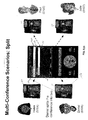
- FIG. 7 is a graphical illustration of the display area of the apparatus or endpoint device provided to the users pursuant to moving a participant into a new conference call that is created by dividing an existing conference call;
- FIG. 7(a) thru 7(k) are exemplary illustrations of the display area of the apparatus or endpoint device provided to the users pursuant to moving the participant into a new conference call that is created by dividing an existing conference call;
- FIG. 8 is an exemplary graphical illustration of the conference call into which the participant has been moved.
- FIG. 8(a) an exemplary illustration of the display area of the apparatus or endpoint device provided to the users in the conference call into which the participant has been moved.
- An apparatus or endpoint device for providing the capability to simultaneously manage multiple conference calls, move participants in the conference calls from one conference call to another and subdivide or join multiple conference calls together.
- the proposed inventive apparatus or endpoint device provides a multi-conferencing capability that allows one or more teleconferencing participants to manage multiple teleconferences simultaneously.
- each participant in the teleconference call manages their respective teleconference through their apparatus or endpoint device at their specific location by using it to adjust the teleconferencing topology, i.e., who should form what part of each specific teleconference call.
- the multi-conferencing capability provided by the apparatus or endpoint device in accordance with the invention departs from the rigid conference bridge paradigm associated with such conventional systems.
- the multi-conferencing provided by the apparatus or endpoint device enables conference call participants to manage multiple conferences simultaneously.
- a participant seeking to initiate a conference call does so at his or her endpoint device by selecting a conference call identifier, where the identifier identifies a conference call to be created.
- the initiating participant selects the participants to be associated with the particular call and confirms the selection. Upon confirmation of the selection, the conference call among the selected participants is established.
- the endpoint device is a graphical user interface (GUI) that comprises a telecommunications endpoint device which allows multi-conferencing in a desktop environment.
- GUI graphical user interface
- the endpoint device is alphanumeric based and implemented in a Spark-based environment, which is implemented in a peer-to-peer environment to provide interactive communication with the endpoint device or GUI.
- the endpoint device or GUI is icon based.
- the endpoint device of the present invention provides symmetric control, in that any participant has at least some control over how the creation and evolution of the conference calls progress.
- each participant is permitted to move freely from one conference call to another. That is, each participant at his or her endpoint device has the ability to "shape" their conference calls to suit their changing needs during the calls.
- each participant may split, merge, add, and delete one or more conference calls that may be in progress.
- each participant may re-add, re-drop, and remove participants of conferences calls to suit the needs of each of the participants.
- FIG. 1 is an exemplary graphical diagram illustrating implementation of the apparatus or endpoint device in accordance with an embodiment of the invention.
- a conference call is established among a team of employees of a company.
- Such a conference call can be established in the manner disclosed in co-pending U.S. Application Serial No. 11/XXX,XXX, titled Multi-Conferencing Capability, filed September 28, 2007 (Attorney Docket No. 5123-58), the contents of which are incorporated herein in its entirety.
- a first participant H at a first endpoint seeks to create a first conference call that involves a second participant P and a third participant D to discuss a new product, for example.
- participant H selects the first conference call and participants P and D, and creates the call.
- the apparatus or endpoint device comprises a Graphical User interface (GUI).
- GUI Graphical User interface
- the display 110 of the apparatus or endpoint device changes to provide an indication that the creation of a conference call is possible.
- the user or participant H begins establishment of the conference call by using a first input section that comprises a thumb-dial mechanism 112, or the like.
- the thumb-dial mechanism 112 comprises a central button 112a that permits a user to access selectable functions that are displayed on the display 110 of the apparatus or endpoint device 100.
- buttons 112b, 112c, 112d, 112e is also provided in the thumbdial mechanism 112 for permitting navigation between the indicated available functions, such as first function indicator 115 and a second function indicator 120 of the display.
- the first function indicator 115 and the second function indicator 120 are shown on display 110 of the apparatus or endpoint 100.
- the selection areas such as M-Conf 130 and Send All 140 that indicate the functions that may be currently selected.
- each of these functions are activated when the user engages any one of the keys 130' or 145', respectively.
- the selectable functions will vary based on the indication in each selection area 130, 135, 140, 145 shown in the lower section of the display 110 of the endpoint device 100.
- Each of the selectable functions are thus activated or selected when participant H engages any one of key 130', key 135', key 140' or key 145', respectively.
- the display 110 of the apparatus or endpoint device 100 changes or becomes updated, as shown in FIG. 1(b) .
- the first function indicator 115 and the second function indicator 120 respectively indicate that a multi-conference may be established and that the multi-conference is empty or there are no participants selected for the conference.
- the selection area 130, 135, 140, 145 shown in the lower section of the display 110 of the endpoint device 100 indicates the functions Add 130, Delete 135, OK 140 and Rename 145 . Each of these function are activated when participant H engages any one of key 130', key 135', key 140' or key 145', respectively.
- the display 110 of the apparatus or endpoint device 100 changes or becomes updated, as shown in FIG. 1(c) .
- the first conference is indicated by the Conference 1 section 125 of the display.
- the first function indicator 115 and the second function indicator 120 indicate that a multi-conference may be established and that the user should confirm the conference topology, respectively.
- the display 110 of the apparatus or endpoint device 100 changes or becomes updated, as shown in FIG. 1(d) .
- the first conference is indicated by the Conference 1 section 125 of the display.
- the first function indicator 115 and the second function indicator 120 indicate that a multi-conference is established and that the conference is empty, respectively.
- participant H indicates the desire to add another participant by using either keys 130' thru 145' or the thumb-dial mechanism 112 to add and/or select another participant, where the display 110 of the apparatus or endpoint device 100 changes or becomes updated, as shown in FIG. 1 (e) .
- the first function indicator 115 and the second function indicator 120 indicate that a list of contacts is available and that a contact from the list of contacts may be selected, respectively.
- the phone extensions of the contacts such as 5104 (H), 5105 (P), 5106 (D) and 5107 (J), are shown on the display.
- the thumb-dial mechanism 112 may be used to navigate and select each user associated with a particular phone extension from among the list presented on the display 110 of the apparatus or endpoint device 100 .
- the number of phone contacts could readily be more or less than what is currently shown.
- Participant H selects herself for addition to the conference, selects participants P and D, and confirms the desire to include each participant in the conference call, in accordance with the sequence illustrated by FIGS. 1 (f) thru 1 (r) , respectively.
- FIGS. 1 (f) thru 1 (r) respectively.
- the navigation and conformation is achieved when any combination of key 130', key 135', key 140' or key 145', as well as the thumb-dial mechanism 112 are used.
- FIG. 3 is an exemplary illustration of the display area of the apparatus or endpoint device provided to the users pursuant to the extension or addition of an additional participant to the conference call.
- the addition of a participant or extension of the conference call occurs when participant P, for example, engages the key 130' to activate the add function indicated by the selection area 130 of the display 110.
- participant H Upon addition of participant J to the conference call, the apparatus or endpoint device of participant H and participant D become updated to show that participant J is an additional participant in the conference call, as shown in FIG. 4 , where the available functions can be displayed in the display on the apparatus or endpoint device 100 of each of the conference call participants as shown in FIG. 4(a) .
- participant H could just as easily be the person to initiate the addition of participants to the conference call.
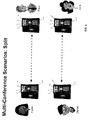
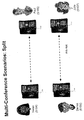
- participant D can split the first conference call into a pair of calls by using his endpoint device 100 when he wishes to conduct a "sidebar" conversation with participant J, as shown in FIG. 5 .
- the endpoint device 100 at the location of participant D shows that participants H and P are grouped together and that participants D and J are grouped together to indicate that a split of the first conference call between the participants has occurred, in accordance with the sequence illustrated by FIGS. 5(a) thru 5(p) .
- FIG. 5(p) is an exemplary illustration of the display area of the apparatus or endpoint device provided to the users pursuant to the split of the conference call into multiple conference calls.
- the screen of the apparatus or endpoint device of user D illustrates that another Conference section, i.e., Conference 2 section 125' can be selected. It should readily be appreciated that the selection of the specific conference occurs through use of the thumb-dial mechanism 112 in a conventional manner with respect to operation of the thumb-dial mechanism itself.
- the split of the conference call entails a first call involving participant H and participant P and a second call involving participant D and participant J.
- the apparatus or endpoint device 100 of all four participants will show the two conference calls with corresponding participants, where the available functions can be displayed in the display on the apparatus or endpoint device 100 of each of the conference call participants as shown in FIG. 6(a) .
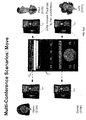
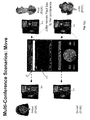
- the apparatus or endpoint device 100 of the invention makes it possible to move participant P, who is involved in the conference call with participant H, into the conference call that participant J is involved in by selecting the image of participant P shown on the apparatus or endpoint device 100 of participant J, as shown in FIG. 7 .
- the endpoint device 100 at the location of participant J shows that participant P has been moved back into the conference call involving participant J, in accordance with the sequence illustrated by FIGS. 7(a) thru 7(k) .
- FIG. 7(k) is an exemplary illustration of the display area of the apparatus or endpoint device 100 provided to the users pursuant to moving participant P into the conference call that is created pursuant to the conference call move.
- participant J navigates and selects the Conference 2 section 125' using the thumb-dial mechanism 112.
- participant P into her call e.g., the second conference call
- the movement of participant P into her call occurs without having to move participant H into this conference call, who is leaving the conference to attend a meeting, and does so, as indicated in FIG. 8 .
- the functions available to the participant in the second conference can be displayed in the display on the apparatus or endpoint device 100 of each of the conference call participants as shown in FIG. 8(a) .
- participant H was the original initiator of the conference call. However, it is possible for a conference call to continue even though the originator of the conference call may leave the group.
- Using the multi-conferencing capability of the present invention permits the management of multiple conferences simultaneously, as well as the splitting and merging of conference calls is permitted.
- symmetric control at the various participating endpoints and a smooth transition of conference participants from one call to another is achieved.
Landscapes
- Engineering & Computer Science (AREA)
- Signal Processing (AREA)
- Computer Vision & Pattern Recognition (AREA)
- Multimedia (AREA)
- Human Computer Interaction (AREA)
- Telephonic Communication Services (AREA)
- Two-Way Televisions, Distribution Of Moving Picture Or The Like (AREA)
- Data Exchanges In Wide-Area Networks (AREA)
Applications Claiming Priority (1)
| Application Number | Priority Date | Filing Date | Title |
|---|---|---|---|
| US11/904,666 US7995733B2 (en) | 2007-09-28 | 2007-09-28 | Telecommunications endpoint for managing multi-conferencing |
Publications (3)
| Publication Number | Publication Date |
|---|---|
| EP2043348A2 true EP2043348A2 (de) | 2009-04-01 |
| EP2043348A3 EP2043348A3 (de) | 2009-04-22 |
| EP2043348B1 EP2043348B1 (de) | 2019-03-27 |
Family
ID=40282772
Family Applications (1)
| Application Number | Title | Priority Date | Filing Date |
|---|---|---|---|
| EP08165220.8A Active EP2043348B1 (de) | 2007-09-28 | 2008-09-26 | Telekommunikationsendpunkt zur Verwaltung einer Mehrfachkonferenzschaltung |
Country Status (2)
| Country | Link |
|---|---|
| US (1) | US7995733B2 (de) |
| EP (1) | EP2043348B1 (de) |
Cited By (1)
| Publication number | Priority date | Publication date | Assignee | Title |
|---|---|---|---|---|
| CN104067603A (zh) * | 2012-01-30 | 2014-09-24 | 国际商业机器公司 | 可视化跨电话会议的对话 |
Families Citing this family (11)
| Publication number | Priority date | Publication date | Assignee | Title |
|---|---|---|---|---|
| US7381535B2 (en) * | 2002-07-10 | 2008-06-03 | The Board Of Trustees Of The Leland Stanford Junior | Methods and compositions for detecting receptor-ligand interactions in single cells |
| US9258181B1 (en) * | 2007-12-06 | 2016-02-09 | Alorica Business Solutions, Llc | Managing agent login to multiple conference call bridges |
| US8837465B2 (en) * | 2008-04-02 | 2014-09-16 | Twilio, Inc. | System and method for processing telephony sessions |
| EP2266269B1 (de) | 2008-04-02 | 2019-01-02 | Twilio Inc. | System und verfahren zum verarbeiten von telefoniesitzungen |
| US8660247B1 (en) * | 2009-04-06 | 2014-02-25 | Wendell Brown | Method and apparatus for content presentation in association with a telephone call |
| US8411599B2 (en) * | 2009-12-15 | 2013-04-02 | At&T Intellectual Property I, L.P. | Methods and apparatus for timeslot teleconferencing |
| US8300790B2 (en) * | 2010-12-27 | 2012-10-30 | Avaya Inc. | Method and system for automatic conference call session migration |
| US8605881B2 (en) | 2011-10-31 | 2013-12-10 | Blackberry Limited | Auto promotion and demotion of conference calls |
| US8611877B2 (en) | 2011-10-31 | 2013-12-17 | Blackberry Limited | Automatic management control of external resources |
| US9020119B2 (en) | 2011-10-31 | 2015-04-28 | Blackberry Limited | Moderation control method for participants in a heterogeneous conference call |
| US10148707B2 (en) | 2016-09-19 | 2018-12-04 | International Business Machines Corporation | System and method for maintaining a collaborative environment |
Family Cites Families (8)
| Publication number | Priority date | Publication date | Assignee | Title |
|---|---|---|---|---|
| US20020078153A1 (en) * | 2000-11-02 | 2002-06-20 | Chit Chung | Providing secure, instantaneous, directory-integrated, multiparty, communications services |
| ATE338424T1 (de) * | 2002-10-24 | 2006-09-15 | Hewlett Packard Co | Erkennung von ereignissen bei der kommunikation mit mehreren sprachkanälen |
| US7865180B2 (en) * | 2003-06-23 | 2011-01-04 | Palm, Inc. | Automated telephone conferencing method and system |
| US7492386B2 (en) * | 2004-11-05 | 2009-02-17 | Sony Ericsson Mobile Communications Ab | Display management during a multi-party conversation |
| US8285785B2 (en) * | 2004-11-19 | 2012-10-09 | Nokia Corporation | Method, apparatus and computer program product providing graphical user interface that facilitates management of multiple simultaneous communication sessions |
| KR100606803B1 (ko) * | 2005-05-16 | 2006-08-01 | 엘지전자 주식회사 | 스크롤 휠 장치를 이용한 기능 수행 기능을 갖는 이동통신단말기 및 이를 이용한 기능 수행 방법 |
| US20070133436A1 (en) * | 2005-12-09 | 2007-06-14 | Sun Microsystems, Inc. | Audio bridge for network conferencing |
| US7978216B2 (en) * | 2006-06-07 | 2011-07-12 | Cisco Technology, Inc. | Versatile conference adapter and method employing same |
-
2007
- 2007-09-28 US US11/904,666 patent/US7995733B2/en active Active
-
2008
- 2008-09-26 EP EP08165220.8A patent/EP2043348B1/de active Active
Non-Patent Citations (1)
| Title |
|---|
| None |
Cited By (4)
| Publication number | Priority date | Publication date | Assignee | Title |
|---|---|---|---|---|
| CN104067603A (zh) * | 2012-01-30 | 2014-09-24 | 国际商业机器公司 | 可视化跨电话会议的对话 |
| US10177926B2 (en) | 2012-01-30 | 2019-01-08 | International Business Machines Corporation | Visualizing conversations across conference calls |
| US10200205B2 (en) | 2012-01-30 | 2019-02-05 | International Business Machines Corporation | Visualizing conversations across conference calls |
| US10574473B2 (en) | 2012-01-30 | 2020-02-25 | International Business Machines Corporation | Visualizing conversations across conference calls |
Also Published As
| Publication number | Publication date |
|---|---|
| US7995733B2 (en) | 2011-08-09 |
| EP2043348B1 (de) | 2019-03-27 |
| EP2043348A3 (de) | 2009-04-22 |
| US20090086951A1 (en) | 2009-04-02 |
Similar Documents
| Publication | Publication Date | Title |
|---|---|---|
| EP2043348B1 (de) | Telekommunikationsendpunkt zur Verwaltung einer Mehrfachkonferenzschaltung | |
| US8204195B2 (en) | Multi-conferencing capability | |
| EP3466059B1 (de) | Kommunikationsereignis | |
| AU682509B2 (en) | Video view selection by a chairperson | |
| JP4231845B2 (ja) | 予約不要の即時グループ会議の方法 | |
| US8300078B2 (en) | Computer-processor based interface for telepresence system, method and computer program product | |
| US8223186B2 (en) | User interface for a video teleconference | |
| US9900554B2 (en) | Methods, systems, and computer readable media for automatically adding individuals and physical conference rooms to conferences in virtual conference rooms | |
| US20110271212A1 (en) | Managing multiple conferences via a conference user interface | |
| US20070067387A1 (en) | Conferencing system and method for temporary blocking / restoring of individual participants | |
| US20070047715A1 (en) | Methods, systems, and computer program products for automatically establishing a conference call having a plurality of different subscriber participation classes | |
| US20070037599A1 (en) | Broadcast dispatch chatroom | |
| WO2005114973A1 (en) | A communication system | |
| US8406405B2 (en) | Teleconferencing system for allowing one touch transfer from a facilitator LED discussion | |
| EP2091179A1 (de) | Verfahren und system zur konferenz-steuerung | |
| US9602558B2 (en) | System for managing multiple meetings using policy driven rules | |
| TWI248749B (en) | Method of controlling multiple calls of communication device | |
| JPH10200640A (ja) | 多地点テレビ会議システム | |
| JPH08167895A (ja) | 通信会議支援方法およびこれに用いる通信会議端末 | |
| KR19990025932A (ko) | 다자간화상회의시스템 | |
| JPH10243110A (ja) | 電話会議システム | |
| WO2011137284A2 (en) | Managing multiple conferences via a conference user interface | |
| JP4903477B2 (ja) | グループ通話用サーバ | |
| JP2007243864A (ja) | 通信端末装置、通信方法、及び、プログラム | |
| JP2003169149A (ja) | ネットワーク会議システム及びその割り込み制御方法並びにネットワーク会議システム用端末及びその割り込み制御方法 |
Legal Events
| Date | Code | Title | Description |
|---|---|---|---|
| PUAI | Public reference made under article 153(3) epc to a published international application that has entered the european phase |
Free format text: ORIGINAL CODE: 0009012 |
|
| PUAL | Search report despatched |
Free format text: ORIGINAL CODE: 0009013 |
|
| AK | Designated contracting states |
Kind code of ref document: A2 Designated state(s): AT BE BG CH CY CZ DE DK EE ES FI FR GB GR HR HU IE IS IT LI LT LU LV MC MT NL NO PL PT RO SE SI SK TR |
|
| AX | Request for extension of the european patent |
Extension state: AL BA MK RS |
|
| AK | Designated contracting states |
Kind code of ref document: A3 Designated state(s): AT BE BG CH CY CZ DE DK EE ES FI FR GB GR HR HU IE IS IT LI LT LU LV MC MT NL NO PL PT RO SE SI SK TR |
|
| AX | Request for extension of the european patent |
Extension state: AL BA MK RS |
|
| 17P | Request for examination filed |
Effective date: 20090914 |
|
| 17Q | First examination report despatched |
Effective date: 20091005 |
|
| AKX | Designation fees paid |
Designated state(s): DE FR GB |
|
| RIC1 | Information provided on ipc code assigned before grant |
Ipc: H04M 1/2745 20060101ALI20180124BHEP Ipc: H04M 3/56 20060101AFI20180124BHEP Ipc: H04M 1/247 20060101ALI20180124BHEP Ipc: H04M 1/23 20060101ALI20180124BHEP |
|
| GRAP | Despatch of communication of intention to grant a patent |
Free format text: ORIGINAL CODE: EPIDOSNIGR1 |
|
| STAA | Information on the status of an ep patent application or granted ep patent |
Free format text: STATUS: GRANT OF PATENT IS INTENDED |
|
| INTG | Intention to grant announced |
Effective date: 20180315 |
|
| GRAS | Grant fee paid |
Free format text: ORIGINAL CODE: EPIDOSNIGR3 |
|
| GRAJ | Information related to disapproval of communication of intention to grant by the applicant or resumption of examination proceedings by the epo deleted |
Free format text: ORIGINAL CODE: EPIDOSDIGR1 |
|
| GRAL | Information related to payment of fee for publishing/printing deleted |
Free format text: ORIGINAL CODE: EPIDOSDIGR3 |
|
| STAA | Information on the status of an ep patent application or granted ep patent |
Free format text: STATUS: EXAMINATION IS IN PROGRESS |
|
| INTC | Intention to grant announced (deleted) | ||
| GRAP | Despatch of communication of intention to grant a patent |
Free format text: ORIGINAL CODE: EPIDOSNIGR1 |
|
| STAA | Information on the status of an ep patent application or granted ep patent |
Free format text: STATUS: GRANT OF PATENT IS INTENDED |
|
| INTG | Intention to grant announced |
Effective date: 20181008 |
|
| GRAA | (expected) grant |
Free format text: ORIGINAL CODE: 0009210 |
|
| STAA | Information on the status of an ep patent application or granted ep patent |
Free format text: STATUS: THE PATENT HAS BEEN GRANTED |
|
| AK | Designated contracting states |
Kind code of ref document: B1 Designated state(s): DE FR GB |
|
| REG | Reference to a national code |
Ref country code: GB Ref legal event code: FG4D |
|
| REG | Reference to a national code |
Ref country code: DE Ref legal event code: R096 Ref document number: 602008059485 Country of ref document: DE |
|
| REG | Reference to a national code |
Ref country code: DE Ref legal event code: R097 Ref document number: 602008059485 Country of ref document: DE |
|
| PLBE | No opposition filed within time limit |
Free format text: ORIGINAL CODE: 0009261 |
|
| STAA | Information on the status of an ep patent application or granted ep patent |
Free format text: STATUS: NO OPPOSITION FILED WITHIN TIME LIMIT |
|
| 26N | No opposition filed |
Effective date: 20200103 |
|
| PG25 | Lapsed in a contracting state [announced via postgrant information from national office to epo] |
Ref country code: FR Free format text: LAPSE BECAUSE OF NON-PAYMENT OF DUE FEES Effective date: 20190930 |
|
| PGFP | Annual fee paid to national office [announced via postgrant information from national office to epo] |
Ref country code: DE Payment date: 20250929 Year of fee payment: 18 |
|
| PGFP | Annual fee paid to national office [announced via postgrant information from national office to epo] |
Ref country code: GB Payment date: 20250929 Year of fee payment: 18 |
|
| REG | Reference to a national code |
Ref country code: DE Ref legal event code: R082 Ref document number: 602008059485 Country of ref document: DE Representative=s name: WESTPHAL, MUSSGNUG & PARTNER PATENTANWAELTE MI, DE |