EP2044096B1 - Nouveaux derives de sucre, procede pour leur preparation et leur utilisation comme agents tensioactifs - Google Patents
Nouveaux derives de sucre, procede pour leur preparation et leur utilisation comme agents tensioactifs Download PDFInfo
- Publication number
- EP2044096B1 EP2044096B1 EP07803979A EP07803979A EP2044096B1 EP 2044096 B1 EP2044096 B1 EP 2044096B1 EP 07803979 A EP07803979 A EP 07803979A EP 07803979 A EP07803979 A EP 07803979A EP 2044096 B1 EP2044096 B1 EP 2044096B1
- Authority
- EP
- European Patent Office
- Prior art keywords
- formula
- composition
- radical
- radicals
- carbon atoms
- Prior art date
- Legal status (The legal status is an assumption and is not a legal conclusion. Google has not performed a legal analysis and makes no representation as to the accuracy of the status listed.)
- Not-in-force
Links
- 235000000346 sugar Nutrition 0.000 title claims abstract description 10
- 239000004094 surface-active agent Substances 0.000 title claims description 14
- 238000000034 method Methods 0.000 title claims description 8
- 238000002360 preparation method Methods 0.000 title claims description 4
- 239000000203 mixture Substances 0.000 claims abstract description 91
- 150000001875 compounds Chemical class 0.000 claims abstract description 31
- 125000004432 carbon atom Chemical group C* 0.000 claims abstract description 13
- 150000001298 alcohols Chemical class 0.000 claims abstract description 8
- 125000004435 hydrogen atom Chemical group [H]* 0.000 claims abstract description 3
- -1 2-ethylhexyl Chemical group 0.000 claims description 115
- 125000002887 hydroxy group Chemical group [H]O* 0.000 claims description 14
- 125000004079 stearyl group Chemical group [H]C([*])([H])C([H])([H])C([H])([H])C([H])([H])C([H])([H])C([H])([H])C([H])([H])C([H])([H])C([H])([H])C([H])([H])C([H])([H])C([H])([H])C([H])([H])C([H])([H])C([H])([H])C([H])([H])C([H])([H])C([H])([H])[H] 0.000 claims description 11
- LFQSCWFLJHTTHZ-UHFFFAOYSA-N Ethanol Chemical compound CCO LFQSCWFLJHTTHZ-UHFFFAOYSA-N 0.000 claims description 8
- 238000006243 chemical reaction Methods 0.000 claims description 8
- 125000001495 ethyl group Chemical group [H]C([H])([H])C([H])([H])* 0.000 claims description 7
- 229920006395 saturated elastomer Polymers 0.000 claims description 6
- 125000002496 methyl group Chemical group [H]C([H])([H])* 0.000 claims description 5
- 125000002347 octyl group Chemical group [H]C([*])([H])C([H])([H])C([H])([H])C([H])([H])C([H])([H])C([H])([H])C([H])([H])C([H])([H])[H] 0.000 claims description 5
- SNRUBQQJIBEYMU-UHFFFAOYSA-N Dodecane Natural products CCCCCCCCCCCC SNRUBQQJIBEYMU-UHFFFAOYSA-N 0.000 claims description 3
- 125000001204 arachidyl group Chemical group [H]C([*])([H])C([H])([H])C([H])([H])C([H])([H])C([H])([H])C([H])([H])C([H])([H])C([H])([H])C([H])([H])C([H])([H])C([H])([H])C([H])([H])C([H])([H])C([H])([H])C([H])([H])C([H])([H])C([H])([H])C([H])([H])C([H])([H])C([H])([H])[H] 0.000 claims description 3
- 125000000484 butyl group Chemical group [H]C([*])([H])C([H])([H])C([H])([H])C([H])([H])[H] 0.000 claims description 3
- 239000002537 cosmetic Substances 0.000 claims description 3
- 125000002704 decyl group Chemical group [H]C([H])([H])C([H])([H])C([H])([H])C([H])([H])C([H])([H])C([H])([H])C([H])([H])C([H])([H])C([H])([H])C([H])([H])* 0.000 claims description 3
- 125000003438 dodecyl group Chemical group [H]C([H])([H])C([H])([H])C([H])([H])C([H])([H])C([H])([H])C([H])([H])C([H])([H])C([H])([H])C([H])([H])C([H])([H])C([H])([H])C([H])([H])* 0.000 claims description 3
- 239000003995 emulsifying agent Substances 0.000 claims description 3
- 239000004088 foaming agent Substances 0.000 claims description 3
- 125000004051 hexyl group Chemical group [H]C([H])([H])C([H])([H])C([H])([H])C([H])([H])C([H])([H])C([H])([H])* 0.000 claims description 3
- 125000005644 linolenyl group Chemical group 0.000 claims description 3
- 125000001421 myristyl group Chemical group [H]C([*])([H])C([H])([H])C([H])([H])C([H])([H])C([H])([H])C([H])([H])C([H])([H])C([H])([H])C([H])([H])C([H])([H])C([H])([H])C([H])([H])C([H])([H])C([H])([H])[H] 0.000 claims description 3
- 125000001117 oleyl group Chemical group [H]C([*])([H])C([H])([H])C([H])([H])C([H])([H])C([H])([H])C([H])([H])C([H])([H])C([H])([H])/C([H])=C([H])\C([H])([H])C([H])([H])C([H])([H])C([H])([H])C([H])([H])C([H])([H])C([H])([H])C([H])([H])[H] 0.000 claims description 3
- 125000000913 palmityl group Chemical group [H]C([*])([H])C([H])([H])C([H])([H])C([H])([H])C([H])([H])C([H])([H])C([H])([H])C([H])([H])C([H])([H])C([H])([H])C([H])([H])C([H])([H])C([H])([H])C([H])([H])C([H])([H])C([H])([H])[H] 0.000 claims description 3
- 125000001147 pentyl group Chemical group C(CCCC)* 0.000 claims description 3
- 239000008194 pharmaceutical composition Substances 0.000 claims description 3
- 125000001436 propyl group Chemical group [H]C([*])([H])C([H])([H])C([H])([H])[H] 0.000 claims description 3
- 230000018044 dehydration Effects 0.000 claims description 2
- 238000006297 dehydration reaction Methods 0.000 claims description 2
- 239000003599 detergent Substances 0.000 claims description 2
- 239000002270 dispersing agent Substances 0.000 claims description 2
- 125000003187 heptyl group Chemical group [H]C([*])([H])C([H])([H])C([H])([H])C([H])([H])C([H])([H])C([H])([H])C([H])([H])[H] 0.000 claims description 2
- 125000005645 linoleyl group Chemical group 0.000 claims description 2
- 239000000080 wetting agent Substances 0.000 claims description 2
- 125000002791 glucosyl group Chemical group C1([C@H](O)[C@@H](O)[C@H](O)[C@H](O1)CO)* 0.000 claims 1
- 125000000969 xylosyl group Chemical group C1([C@H](O)[C@@H](O)[C@H](O)CO1)* 0.000 claims 1
- GLDOVTGHNKAZLK-UHFFFAOYSA-N octadecan-1-ol Chemical compound CCCCCCCCCCCCCCCCCCO GLDOVTGHNKAZLK-UHFFFAOYSA-N 0.000 description 28
- ZJCCRDAZUWHFQH-UHFFFAOYSA-N Trimethylolpropane Chemical compound CCC(CO)(CO)CO ZJCCRDAZUWHFQH-UHFFFAOYSA-N 0.000 description 21
- WQZGKKKJIJFFOK-VFUOTHLCSA-N beta-D-glucose Chemical compound OC[C@H]1O[C@@H](O)[C@H](O)[C@@H](O)[C@@H]1O WQZGKKKJIJFFOK-VFUOTHLCSA-N 0.000 description 18
- 229960001031 glucose Drugs 0.000 description 18
- WQZGKKKJIJFFOK-GASJEMHNSA-N Glucose Natural products OC[C@H]1OC(O)[C@H](O)[C@@H](O)[C@@H]1O WQZGKKKJIJFFOK-GASJEMHNSA-N 0.000 description 17
- 239000008103 glucose Substances 0.000 description 17
- AHHWIHXENZJRFG-UHFFFAOYSA-N oxetane Chemical compound C1COC1 AHHWIHXENZJRFG-UHFFFAOYSA-N 0.000 description 16
- 150000003254 radicals Chemical class 0.000 description 16
- 239000003921 oil Substances 0.000 description 15
- UFTFJSFQGQCHQW-UHFFFAOYSA-N triformin Chemical compound O=COCC(OC=O)COC=O UFTFJSFQGQCHQW-UHFFFAOYSA-N 0.000 description 14
- XLYOFNOQVPJJNP-UHFFFAOYSA-N water Substances O XLYOFNOQVPJJNP-UHFFFAOYSA-N 0.000 description 14
- CSNNHWWHGAXBCP-UHFFFAOYSA-L Magnesium sulfate Chemical compound [Mg+2].[O-][S+2]([O-])([O-])[O-] CSNNHWWHGAXBCP-UHFFFAOYSA-L 0.000 description 7
- 239000000839 emulsion Substances 0.000 description 7
- PEDCQBHIVMGVHV-UHFFFAOYSA-N Glycerine Chemical compound OCC(O)CO PEDCQBHIVMGVHV-UHFFFAOYSA-N 0.000 description 6
- 101000576910 Homo sapiens MARCO-like protein Proteins 0.000 description 6
- 102100025360 MARCO-like protein Human genes 0.000 description 6
- 239000012071 phase Substances 0.000 description 6
- 239000007787 solid Substances 0.000 description 6
- 125000004429 atom Chemical group 0.000 description 5
- 238000009472 formulation Methods 0.000 description 5
- 239000000047 product Substances 0.000 description 5
- SRBFZHDQGSBBOR-IOVATXLUSA-N D-xylopyranose Chemical compound O[C@@H]1COC(O)[C@H](O)[C@H]1O SRBFZHDQGSBBOR-IOVATXLUSA-N 0.000 description 4
- QAOWNCQODCNURD-UHFFFAOYSA-N Sulfuric acid Chemical compound OS(O)(=O)=O QAOWNCQODCNURD-UHFFFAOYSA-N 0.000 description 4
- 238000001816 cooling Methods 0.000 description 4
- 230000001804 emulsifying effect Effects 0.000 description 4
- RTZKZFJDLAIYFH-UHFFFAOYSA-N ether Substances CCOCC RTZKZFJDLAIYFH-UHFFFAOYSA-N 0.000 description 4
- QUPDWYMUPZLYJZ-UHFFFAOYSA-N ethyl Chemical compound C[CH2] QUPDWYMUPZLYJZ-UHFFFAOYSA-N 0.000 description 4
- 229930182478 glucoside Natural products 0.000 description 4
- 229910052943 magnesium sulfate Inorganic materials 0.000 description 4
- 238000002844 melting Methods 0.000 description 4
- 230000008018 melting Effects 0.000 description 4
- 238000002156 mixing Methods 0.000 description 4
- 230000010363 phase shift Effects 0.000 description 4
- 125000002914 sec-butyl group Chemical group [H]C([H])([H])C([H])([H])C([H])(*)C([H])([H])[H] 0.000 description 4
- 241000861223 Issus Species 0.000 description 3
- HEMHJVSKTPXQMS-UHFFFAOYSA-M Sodium hydroxide Chemical compound [OH-].[Na+] HEMHJVSKTPXQMS-UHFFFAOYSA-M 0.000 description 3
- 238000013019 agitation Methods 0.000 description 3
- PYMYPHUHKUWMLA-UHFFFAOYSA-N arabinose Natural products OCC(O)C(O)C(O)C=O PYMYPHUHKUWMLA-UHFFFAOYSA-N 0.000 description 3
- SRBFZHDQGSBBOR-UHFFFAOYSA-N beta-D-Pyranose-Lyxose Natural products OC1COC(O)C(O)C1O SRBFZHDQGSBBOR-UHFFFAOYSA-N 0.000 description 3
- 230000000717 retained effect Effects 0.000 description 3
- 238000003756 stirring Methods 0.000 description 3
- 239000008399 tap water Substances 0.000 description 3
- 235000020679 tap water Nutrition 0.000 description 3
- 230000000007 visual effect Effects 0.000 description 3
- UNMJLQGKEDTEKJ-UHFFFAOYSA-N (3-ethyloxetan-3-yl)methanol Chemical compound CCC1(CO)COC1 UNMJLQGKEDTEKJ-UHFFFAOYSA-N 0.000 description 2
- BVKZGUZCCUSVTD-UHFFFAOYSA-L Carbonate Chemical compound [O-]C([O-])=O BVKZGUZCCUSVTD-UHFFFAOYSA-L 0.000 description 2
- VEXZGXHMUGYJMC-UHFFFAOYSA-N Hydrochloric acid Chemical compound Cl VEXZGXHMUGYJMC-UHFFFAOYSA-N 0.000 description 2
- NBIIXXVUZAFLBC-UHFFFAOYSA-N Phosphoric acid Chemical compound OP(O)(O)=O NBIIXXVUZAFLBC-UHFFFAOYSA-N 0.000 description 2
- 238000006359 acetalization reaction Methods 0.000 description 2
- 239000002253 acid Substances 0.000 description 2
- 125000000217 alkyl group Chemical group 0.000 description 2
- WTEOIRVLGSZEPR-UHFFFAOYSA-N boron trifluoride Chemical compound FB(F)F WTEOIRVLGSZEPR-UHFFFAOYSA-N 0.000 description 2
- 229940081733 cetearyl alcohol Drugs 0.000 description 2
- 150000005676 cyclic carbonates Chemical class 0.000 description 2
- 238000004945 emulsification Methods 0.000 description 2
- 150000008131 glucosides Chemical class 0.000 description 2
- 238000010907 mechanical stirring Methods 0.000 description 2
- 239000012299 nitrogen atmosphere Substances 0.000 description 2
- 239000002736 nonionic surfactant Substances 0.000 description 2
- 150000002921 oxetanes Chemical class 0.000 description 2
- 239000010690 paraffinic oil Substances 0.000 description 2
- 238000006116 polymerization reaction Methods 0.000 description 2
- 230000000750 progressive effect Effects 0.000 description 2
- XTUSEBKMEQERQV-UHFFFAOYSA-N propan-2-ol;hydrate Chemical compound O.CC(C)O XTUSEBKMEQERQV-UHFFFAOYSA-N 0.000 description 2
- 230000009257 reactivity Effects 0.000 description 2
- 238000012360 testing method Methods 0.000 description 2
- OWEGMIWEEQEYGQ-UHFFFAOYSA-N 100676-05-9 Natural products OC1C(O)C(O)C(CO)OC1OCC1C(O)C(O)C(O)C(OC2C(OC(O)C(O)C2O)CO)O1 OWEGMIWEEQEYGQ-UHFFFAOYSA-N 0.000 description 1
- 125000000954 2-hydroxyethyl group Chemical group [H]C([*])([H])C([H])([H])O[H] 0.000 description 1
- DBTMGCOVALSLOR-UHFFFAOYSA-N 32-alpha-galactosyl-3-alpha-galactosyl-galactose Natural products OC1C(O)C(O)C(CO)OC1OC1C(O)C(OC2C(C(CO)OC(O)C2O)O)OC(CO)C1O DBTMGCOVALSLOR-UHFFFAOYSA-N 0.000 description 1
- GUBGYTABKSRVRQ-XLOQQCSPSA-N Alpha-Lactose Chemical compound O[C@@H]1[C@@H](O)[C@@H](O)[C@@H](CO)O[C@H]1O[C@@H]1[C@@H](CO)O[C@H](O)[C@H](O)[C@H]1O GUBGYTABKSRVRQ-XLOQQCSPSA-N 0.000 description 1
- 229910015900 BF3 Inorganic materials 0.000 description 1
- GUBGYTABKSRVRQ-CUHNMECISA-N D-Cellobiose Chemical compound O[C@@H]1[C@@H](O)[C@H](O)[C@@H](CO)O[C@H]1O[C@@H]1[C@@H](CO)OC(O)[C@H](O)[C@H]1O GUBGYTABKSRVRQ-CUHNMECISA-N 0.000 description 1
- RXVWSYJTUUKTEA-UHFFFAOYSA-N D-maltotriose Natural products OC1C(O)C(OC(C(O)CO)C(O)C(O)C=O)OC(CO)C1OC1C(O)C(O)C(O)C(CO)O1 RXVWSYJTUUKTEA-UHFFFAOYSA-N 0.000 description 1
- WQZGKKKJIJFFOK-QTVWNMPRSA-N D-mannopyranose Chemical compound OC[C@H]1OC(O)[C@@H](O)[C@@H](O)[C@@H]1O WQZGKKKJIJFFOK-QTVWNMPRSA-N 0.000 description 1
- HMFHBZSHGGEWLO-SOOFDHNKSA-N D-ribofuranose Chemical compound OC[C@H]1OC(O)[C@H](O)[C@@H]1O HMFHBZSHGGEWLO-SOOFDHNKSA-N 0.000 description 1
- 229920002307 Dextran Polymers 0.000 description 1
- OIFBSDVPJOWBCH-UHFFFAOYSA-N Diethyl carbonate Chemical compound CCOC(=O)OCC OIFBSDVPJOWBCH-UHFFFAOYSA-N 0.000 description 1
- 229930091371 Fructose Natural products 0.000 description 1
- RFSUNEUAIZKAJO-ARQDHWQXSA-N Fructose Chemical compound OC[C@H]1O[C@](O)(CO)[C@@H](O)[C@@H]1O RFSUNEUAIZKAJO-ARQDHWQXSA-N 0.000 description 1
- 239000005715 Fructose Substances 0.000 description 1
- GUBGYTABKSRVRQ-QKKXKWKRSA-N Lactose Natural products OC[C@H]1O[C@@H](O[C@H]2[C@H](O)[C@@H](O)C(O)O[C@@H]2CO)[C@H](O)[C@@H](O)[C@H]1O GUBGYTABKSRVRQ-QKKXKWKRSA-N 0.000 description 1
- 239000002841 Lewis acid Substances 0.000 description 1
- GUBGYTABKSRVRQ-PICCSMPSSA-N Maltose Natural products O[C@@H]1[C@@H](O)[C@H](O)[C@@H](CO)O[C@@H]1O[C@@H]1[C@@H](CO)OC(O)[C@H](O)[C@H]1O GUBGYTABKSRVRQ-PICCSMPSSA-N 0.000 description 1
- PYMYPHUHKUWMLA-LMVFSUKVSA-N Ribose Natural products OC[C@@H](O)[C@@H](O)[C@@H](O)C=O PYMYPHUHKUWMLA-LMVFSUKVSA-N 0.000 description 1
- 229910005644 SnTi Inorganic materials 0.000 description 1
- CZMRCDWAGMRECN-UGDNZRGBSA-N Sucrose Chemical compound O[C@H]1[C@H](O)[C@@H](CO)O[C@@]1(CO)O[C@@H]1[C@H](O)[C@@H](O)[C@H](O)[C@@H](CO)O1 CZMRCDWAGMRECN-UGDNZRGBSA-N 0.000 description 1
- 229930006000 Sucrose Natural products 0.000 description 1
- 229910021627 Tin(IV) chloride Inorganic materials 0.000 description 1
- 125000003342 alkenyl group Chemical group 0.000 description 1
- RMRFFCXPLWYOOY-UHFFFAOYSA-N allyl radical Chemical compound [CH2]C=C RMRFFCXPLWYOOY-UHFFFAOYSA-N 0.000 description 1
- HMFHBZSHGGEWLO-UHFFFAOYSA-N alpha-D-Furanose-Ribose Natural products OCC1OC(O)C(O)C1O HMFHBZSHGGEWLO-UHFFFAOYSA-N 0.000 description 1
- WQZGKKKJIJFFOK-PHYPRBDBSA-N alpha-D-galactose Chemical compound OC[C@H]1O[C@H](O)[C@H](O)[C@@H](O)[C@H]1O WQZGKKKJIJFFOK-PHYPRBDBSA-N 0.000 description 1
- 229910000147 aluminium phosphate Inorganic materials 0.000 description 1
- VSCWAEJMTAWNJL-UHFFFAOYSA-K aluminium trichloride Chemical compound Cl[Al](Cl)Cl VSCWAEJMTAWNJL-UHFFFAOYSA-K 0.000 description 1
- 239000008346 aqueous phase Substances 0.000 description 1
- PYMYPHUHKUWMLA-WDCZJNDASA-N arabinose Chemical compound OC[C@@H](O)[C@@H](O)[C@H](O)C=O PYMYPHUHKUWMLA-WDCZJNDASA-N 0.000 description 1
- 239000010692 aromatic oil Substances 0.000 description 1
- GUBGYTABKSRVRQ-QUYVBRFLSA-N beta-maltose Chemical compound OC[C@H]1O[C@H](O[C@H]2[C@H](O)[C@@H](O)[C@H](O)O[C@@H]2CO)[C@H](O)[C@@H](O)[C@@H]1O GUBGYTABKSRVRQ-QUYVBRFLSA-N 0.000 description 1
- 239000003054 catalyst Substances 0.000 description 1
- 230000003197 catalytic effect Effects 0.000 description 1
- 239000003153 chemical reaction reagent Substances 0.000 description 1
- 239000003795 chemical substances by application Substances 0.000 description 1
- 239000013065 commercial product Substances 0.000 description 1
- 230000003750 conditioning effect Effects 0.000 description 1
- 238000006114 decarboxylation reaction Methods 0.000 description 1
- 238000011161 development Methods 0.000 description 1
- IEJIGPNLZYLLBP-UHFFFAOYSA-N dimethyl carbonate Chemical compound COC(=O)OC IEJIGPNLZYLLBP-UHFFFAOYSA-N 0.000 description 1
- IDGUHHHQCWSQLU-UHFFFAOYSA-N ethanol;hydrate Chemical compound O.CCO IDGUHHHQCWSQLU-UHFFFAOYSA-N 0.000 description 1
- 150000002170 ethers Chemical class 0.000 description 1
- 238000011156 evaluation Methods 0.000 description 1
- 238000001914 filtration Methods 0.000 description 1
- 229930182830 galactose Natural products 0.000 description 1
- 238000004817 gas chromatography Methods 0.000 description 1
- 150000002338 glycosides Chemical group 0.000 description 1
- 150000004688 heptahydrates Chemical class 0.000 description 1
- BXWNKGSJHAJOGX-UHFFFAOYSA-N hexadecan-1-ol Chemical compound CCCCCCCCCCCCCCCCO BXWNKGSJHAJOGX-UHFFFAOYSA-N 0.000 description 1
- 238000000265 homogenisation Methods 0.000 description 1
- CBOIHMRHGLHBPB-UHFFFAOYSA-N hydroxymethyl Chemical compound O[CH2] CBOIHMRHGLHBPB-UHFFFAOYSA-N 0.000 description 1
- 125000004029 hydroxymethyl group Chemical group [H]OC([H])([H])* 0.000 description 1
- 150000002453 idose derivatives Chemical class 0.000 description 1
- 125000000959 isobutyl group Chemical group [H]C([H])([H])C([H])(C([H])([H])[H])C([H])([H])* 0.000 description 1
- 125000004491 isohexyl group Chemical group C(CCC(C)C)* 0.000 description 1
- FZWBNHMXJMCXLU-BLAUPYHCSA-N isomaltotriose Chemical compound O[C@@H]1[C@@H](O)[C@H](O)[C@@H](CO)O[C@@H]1OC[C@@H]1[C@@H](O)[C@H](O)[C@@H](O)[C@@H](OC[C@@H](O)[C@@H](O)[C@H](O)[C@@H](O)C=O)O1 FZWBNHMXJMCXLU-BLAUPYHCSA-N 0.000 description 1
- 125000001972 isopentyl group Chemical group [H]C([H])([H])C([H])(C([H])([H])[H])C([H])([H])C([H])([H])* 0.000 description 1
- 125000001449 isopropyl group Chemical group [H]C([H])([H])C([H])(*)C([H])([H])[H] 0.000 description 1
- 239000008101 lactose Substances 0.000 description 1
- 239000011968 lewis acid catalyst Substances 0.000 description 1
- 150000007517 lewis acids Chemical class 0.000 description 1
- FYGDTMLNYKFZSV-UHFFFAOYSA-N mannotriose Natural products OC1C(O)C(O)C(CO)OC1OC1C(CO)OC(OC2C(OC(O)C(O)C2O)CO)C(O)C1O FYGDTMLNYKFZSV-UHFFFAOYSA-N 0.000 description 1
- ULAHIHHGQVIRTO-UHFFFAOYSA-N methanesulfonic acid;4-methylbenzenesulfonic acid Chemical compound CS(O)(=O)=O.CC1=CC=C(S(O)(=O)=O)C=C1 ULAHIHHGQVIRTO-UHFFFAOYSA-N 0.000 description 1
- 238000006386 neutralization reaction Methods 0.000 description 1
- 238000010606 normalization Methods 0.000 description 1
- WDUMAPVMFPPSOU-UHFFFAOYSA-N octadecan-3-ol Chemical compound CCCCCCCCCCCCCCCC(O)CC WDUMAPVMFPPSOU-UHFFFAOYSA-N 0.000 description 1
- SSLLZDIAWKBKLB-UHFFFAOYSA-N octadecan-8-ol Chemical compound CCCCCCCCCCC(O)CCCCCCC SSLLZDIAWKBKLB-UHFFFAOYSA-N 0.000 description 1
- MDLWEBWGXACWGE-UHFFFAOYSA-N octadecane Chemical compound [CH2]CCCCCCCCCCCCCCCCC MDLWEBWGXACWGE-UHFFFAOYSA-N 0.000 description 1
- 125000005064 octadecenyl group Chemical group C(=CCCCCCCCCCCCCCCCC)* 0.000 description 1
- 125000004043 oxo group Chemical group O=* 0.000 description 1
- 101150093826 par1 gene Proteins 0.000 description 1
- WXZMFSXDPGVJKK-UHFFFAOYSA-N pentaerythritol Chemical compound OCC(CO)(CO)CO WXZMFSXDPGVJKK-UHFFFAOYSA-N 0.000 description 1
- ACVYVLVWPXVTIT-UHFFFAOYSA-N phosphinic acid Chemical compound O[PH2]=O ACVYVLVWPXVTIT-UHFFFAOYSA-N 0.000 description 1
- 229920000223 polyglycerol Polymers 0.000 description 1
- 238000012207 quantitative assay Methods 0.000 description 1
- 239000012429 reaction media Substances 0.000 description 1
- 238000011160 research Methods 0.000 description 1
- 239000002904 solvent Substances 0.000 description 1
- 239000005720 sucrose Substances 0.000 description 1
- 150000008163 sugars Chemical class 0.000 description 1
- 125000005063 tetradecenyl group Chemical group C(=CCCCCCCCCCCCC)* 0.000 description 1
- HPGGPRDJHPYFRM-UHFFFAOYSA-J tin(iv) chloride Chemical compound Cl[Sn](Cl)(Cl)Cl HPGGPRDJHPYFRM-UHFFFAOYSA-J 0.000 description 1
- XJDNKRIXUMDJCW-UHFFFAOYSA-J titanium tetrachloride Chemical compound Cl[Ti](Cl)(Cl)Cl XJDNKRIXUMDJCW-UHFFFAOYSA-J 0.000 description 1
- ITMCEJHCFYSIIV-UHFFFAOYSA-N triflic acid Chemical compound OS(=O)(=O)C(F)(F)F ITMCEJHCFYSIIV-UHFFFAOYSA-N 0.000 description 1
- 125000005065 undecenyl group Chemical group C(=CCCCCCCCCC)* 0.000 description 1
- FYGDTMLNYKFZSV-BYLHFPJWSA-N β-1,4-galactotrioside Chemical compound O[C@@H]1[C@@H](O)[C@H](O)[C@@H](CO)O[C@H]1O[C@@H]1[C@H](CO)O[C@@H](O[C@@H]2[C@@H](O[C@@H](O)[C@H](O)[C@H]2O)CO)[C@H](O)[C@H]1O FYGDTMLNYKFZSV-BYLHFPJWSA-N 0.000 description 1
Classifications
-
- C—CHEMISTRY; METALLURGY
- C11—ANIMAL OR VEGETABLE OILS, FATS, FATTY SUBSTANCES OR WAXES; FATTY ACIDS THEREFROM; DETERGENTS; CANDLES
- C11D—DETERGENT COMPOSITIONS; USE OF SINGLE SUBSTANCES AS DETERGENTS; SOAP OR SOAP-MAKING; RESIN SOAPS; RECOVERY OF GLYCEROL
- C11D3/00—Other compounding ingredients of detergent compositions covered in group C11D1/00
- C11D3/16—Organic compounds
- C11D3/20—Organic compounds containing oxygen
- C11D3/2003—Alcohols; Phenols
- C11D3/2006—Monohydric alcohols
- C11D3/201—Monohydric alcohols linear
- C11D3/2013—Monohydric alcohols linear fatty or with at least 8 carbon atoms in the alkyl chain
-
- A—HUMAN NECESSITIES
- A61—MEDICAL OR VETERINARY SCIENCE; HYGIENE
- A61K—PREPARATIONS FOR MEDICAL, DENTAL OR TOILETRY PURPOSES
- A61K8/00—Cosmetics or similar toiletry preparations
- A61K8/18—Cosmetics or similar toiletry preparations characterised by the composition
- A61K8/30—Cosmetics or similar toiletry preparations characterised by the composition containing organic compounds
- A61K8/60—Sugars; Derivatives thereof
- A61K8/602—Glycosides, e.g. rutin
-
- A—HUMAN NECESSITIES
- A61—MEDICAL OR VETERINARY SCIENCE; HYGIENE
- A61Q—SPECIFIC USE OF COSMETICS OR SIMILAR TOILETRY PREPARATIONS
- A61Q19/00—Preparations for care of the skin
-
- C—CHEMISTRY; METALLURGY
- C07—ORGANIC CHEMISTRY
- C07C—ACYCLIC OR CARBOCYCLIC COMPOUNDS
- C07C41/00—Preparation of ethers; Preparation of compounds having groups, groups or groups
- C07C41/01—Preparation of ethers
-
- C—CHEMISTRY; METALLURGY
- C07—ORGANIC CHEMISTRY
- C07C—ACYCLIC OR CARBOCYCLIC COMPOUNDS
- C07C43/00—Ethers; Compounds having groups, groups or groups
- C07C43/02—Ethers
- C07C43/03—Ethers having all ether-oxygen atoms bound to acyclic carbon atoms
- C07C43/04—Saturated ethers
- C07C43/13—Saturated ethers containing hydroxy or O-metal groups
- C07C43/135—Saturated ethers containing hydroxy or O-metal groups having more than one ether bond
-
- C—CHEMISTRY; METALLURGY
- C07—ORGANIC CHEMISTRY
- C07H—SUGARS; DERIVATIVES THEREOF; NUCLEOSIDES; NUCLEOTIDES; NUCLEIC ACIDS
- C07H15/00—Compounds containing hydrocarbon or substituted hydrocarbon radicals directly attached to hetero atoms of saccharide radicals
- C07H15/02—Acyclic radicals, not substituted by cyclic structures
- C07H15/04—Acyclic radicals, not substituted by cyclic structures attached to an oxygen atom of the saccharide radical
- C07H15/08—Polyoxyalkylene derivatives
-
- C—CHEMISTRY; METALLURGY
- C11—ANIMAL OR VEGETABLE OILS, FATS, FATTY SUBSTANCES OR WAXES; FATTY ACIDS THEREFROM; DETERGENTS; CANDLES
- C11D—DETERGENT COMPOSITIONS; USE OF SINGLE SUBSTANCES AS DETERGENTS; SOAP OR SOAP-MAKING; RESIN SOAPS; RECOVERY OF GLYCEROL
- C11D1/00—Detergent compositions based essentially on surface-active compounds; Use of these compounds as a detergent
- C11D1/66—Non-ionic compounds
- C11D1/662—Carbohydrates or derivatives
-
- C—CHEMISTRY; METALLURGY
- C11—ANIMAL OR VEGETABLE OILS, FATS, FATTY SUBSTANCES OR WAXES; FATTY ACIDS THEREFROM; DETERGENTS; CANDLES
- C11D—DETERGENT COMPOSITIONS; USE OF SINGLE SUBSTANCES AS DETERGENTS; SOAP OR SOAP-MAKING; RESIN SOAPS; RECOVERY OF GLYCEROL
- C11D3/00—Other compounding ingredients of detergent compositions covered in group C11D1/00
- C11D3/16—Organic compounds
- C11D3/20—Organic compounds containing oxygen
- C11D3/2003—Alcohols; Phenols
- C11D3/2006—Monohydric alcohols
- C11D3/2017—Monohydric alcohols branched
- C11D3/202—Monohydric alcohols branched fatty or with at least 8 carbon atoms in the alkyl chain
-
- C—CHEMISTRY; METALLURGY
- C11—ANIMAL OR VEGETABLE OILS, FATS, FATTY SUBSTANCES OR WAXES; FATTY ACIDS THEREFROM; DETERGENTS; CANDLES
- C11D—DETERGENT COMPOSITIONS; USE OF SINGLE SUBSTANCES AS DETERGENTS; SOAP OR SOAP-MAKING; RESIN SOAPS; RECOVERY OF GLYCEROL
- C11D3/00—Other compounding ingredients of detergent compositions covered in group C11D1/00
- C11D3/16—Organic compounds
- C11D3/20—Organic compounds containing oxygen
- C11D3/2003—Alcohols; Phenols
- C11D3/2006—Monohydric alcohols
- C11D3/2027—Monohydric alcohols unsaturated
- C11D3/2031—Monohydric alcohols unsaturated fatty or with at least 8 carbon atoms in the alkenyl chain
Definitions
- the subject of the invention is new surfactants derived from sugars.
- U.S. Patent No. 5,849,679 discloses nonionic surfactants comprising a mixture of anomeric ⁇ and ⁇ isomers of ethers of a glycosidic compound with a mono-ether of glycerol or polyglycerol and alcohol C 1 -C 22 and more particularly the following compounds: 1-on-decylglyceryl-D-glucopyranoside, 1-on-hexylglyceryl-D-glucopyranoside, 1-on-dodecyltriglyceryl-D-glucopyranoside, 1-On oleyltriglyceryl-D-glucopyranoside and stearyl polyglyceryl-D-glucopyranoside;
- German patent application published under the number DE 197 28 900 discloses the same type of nonionic surfactants derived from glycerol as those disclosed in the previous document and more particularly the following compounds: lauryl glyceryl glucoside and (2-ethyl hexyl) glyceryl glucoside.
- methyl or ethyl radicals By linear or branched allyl radical containing from one to eight carbon atoms optionally substituted by one or more hydroxyl radicals or one or more, for R in the formula (1) as defined above, the methyl or ethyl radicals are especially designated.
- residue of a reducing sugar the main terms for -S- in formula (I) as defined above are the residues of glucose, sucrose, fructose, idose, galactose, maltose, maltotriose, lactose, cellobiose, mannose, xylose, arabinose, ribose, dextran or tallose.
- p is a decimal number, which represents the average degree of polymerization of the remainder S.
- (S) p is the polymeric residue of rank p of the residue S.
- R 1 represents a radical chosen from octyl, decyl, dodecyl, tetradecyl, hexadecyl, octadecyl, eicosyl, 2-ethyl hexyl and 2-butyl octyl radicals.
- -S- represents a divalent residue of glucose or xylose.
- p is between 1.005 and 5 and more particularly between 1.05 and 2.
- R is chosen from methyl, ethyl, propyl, butyl, pentyl, hexyl, heptyl, octyl and hydroxymethyl radicals.
- step (a) is generally carried out in the presence of a Lewis acid catalyst; mention may be made, for example, of stabilized boron trifluoride in diethyl ether (BF 3 .Et 2 O), tin tetrachloride (SnCl 4 ), titanium tetrachloride (SnTi 4 ) or aluminum trichloride ( AlCl 3 )
- a Lewis acid catalyst for example, of stabilized boron trifluoride in diethyl ether (BF 3 .Et 2 O), tin tetrachloride (SnCl 4 ), titanium tetrachloride (SnTi 4 ) or aluminum trichloride ( AlCl 3 )
- 3-Ethyl-3- (hydroxymethyl) oxetane of formula (V) (or TMP oxetane) is a commercial product identified under numbers RN 3047-32-3 and EINECS 221- 54-0.
- step (b) is generally carried out in the presence of a strong acid as a catalyst, for example sulfuric acid, hydrochloric acid, phosphoric acid, methanesulfonic acid p-toluenesulfonic acid, trifluoro-methanesulfonic acid or hypophosphorous acid.
- a strong acid for example sulfuric acid, hydrochloric acid, phosphoric acid, methanesulfonic acid p-toluenesulfonic acid, trifluoro-methanesulfonic acid or hypophosphorous acid.
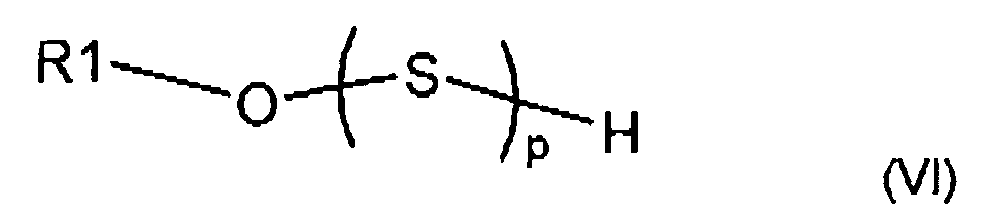
- composition (C) which is the subject of the present invention, when it is obtained by the process as defined above, may also comprise up to 5% of its mass of residual products, principally the reducing sugar of formula (III), the oxetane derivative of formula (V) and / or compounds of formula (VI): wherein R1, S and p are as defined above, and water.
- Step (c) as defined above generally consists of an initial reaction step of the compound of formula (VII) with a dialkyl carbonate, for example dimethyl carbonate, diethyl carbonate or carbonate dibutyl, to obtain a cyclic carbonate of the derivative of formula (VII), followed by decarboxylation of said cyclic carbonate to give the disubstituted oxetane of formula (V).
- a dialkyl carbonate for example dimethyl carbonate, diethyl carbonate or carbonate dibutyl
- TMP trimethylolpropane
- R representing an ethyl radical
- pentaerythritol R representing a hydroxymethyl radical
- composition (C) as defined above, as surfactant and more particularly as a foaming agent, an emulsifying agent, a wetting agent, a dispersing agent or a detergent agent.
- the invention finally relates to a cosmetic or pharmaceutical composition characterized in that it comprises as surfactant, a composition (C), as defined above.
- Example 1 Preparation of a composition C1 for which in the formulas (I) and (IV), R1 represents the octadecyl radical and in the formula (I) R represents the ethyl radical and S represents the rest of the glucose.
- TMP oxetane is the compound of formula (V) as defined above, in which R represents the ethyl radical.
- This first step is carried out at 120 ° C. in the presence of a catalytic amount of Lewis acid (BF 3 -Et 2 O).
- BF 3 -Et 2 O a catalytic amount of Lewis acid
- Two different stoichiometries in oxetane TMP were studied (tests 1 and 2), the first involving an equimolar amount relative to octadecanol and the second involving an excess of 3 molar equivalents still relative to octadecanol.
- the operating conditions are as follows: Cast octadecanol at ⁇ 120 ° C under a nitrogen atmosphere, add 0.5% BF 3 .Et 2 O (relative to the total mass of the reagents) with mechanical stirring, then progressive addition (in about 180 minutes) of the oxetane TMP, maintained at 120 ° C for 90 to 180 minutes, and then cooling.
- the characteristics of the mixtures (M1) and (M2) obtained are collated in Table 1a below (T A : room temperature, IA: acid number, IOH: hydroxyl number).
- the results show a good reactivity between octadecanol and TMP oxetane.
- the hydroxyl number of the reaction medium must not vary during the reaction and the final values measured are consistent with those calculated (Mixture M1: 285.6 mg KOH / g for a theoretical value of 289.2 mg KOH M2: 351.3 mg KOH / g for a theoretical value of 361.8 mg KOH / g).
- the quantitative dosages of residual octadecanol respectively show that in runs 1 and 2 respectively about 54% and 72% of the starting octadecanol was consumed in the reaction.
- the protocol adopted is the following: Melting of M1 and M2 mixtures at about 100 ° C. under atmospheric pressure and under a nitrogen atmosphere, then adding, with mechanical stirring, a molar equivalent of anhydrous glucose (the amount is calculated from of the number of moles of octadecanol introduced in the first stage), addition of 1% of 98% sulfuric acid (% by mass expressed relative to the mass of glucose introduced), placed under progressive vacuum [approximately 30 10 2 Pa ( 30 mbar) and acetalization with glucose for 6 hours at about 100 ° C; cooling to 80 ° C and neutralization by adding a 30% sodium hydroxide solution to reach a pH close to 7; hot filtration on a filter plate with porosity of 4 micrometers and conditioning.
- the observed stabilities show an emulsifying power of the compositions according to the invention at room temperature and at J1 for the fatty phases studied.
- C1 has a good emulsifying power to prepare water - oil emulsions with triglyceride 5545.
Landscapes
- Chemical & Material Sciences (AREA)
- Organic Chemistry (AREA)
- Health & Medical Sciences (AREA)
- Life Sciences & Earth Sciences (AREA)
- Engineering & Computer Science (AREA)
- Oil, Petroleum & Natural Gas (AREA)
- Chemical Kinetics & Catalysis (AREA)
- Wood Science & Technology (AREA)
- Emergency Medicine (AREA)
- General Health & Medical Sciences (AREA)
- Molecular Biology (AREA)
- Veterinary Medicine (AREA)
- Public Health (AREA)
- Animal Behavior & Ethology (AREA)
- Genetics & Genomics (AREA)
- Biotechnology (AREA)
- Biochemistry (AREA)
- Crystallography & Structural Chemistry (AREA)
- Birds (AREA)
- Epidemiology (AREA)
- Dermatology (AREA)
- Cosmetics (AREA)
- Emulsifying, Dispersing, Foam-Producing Or Wetting Agents (AREA)
- Detergent Compositions (AREA)
- Saccharide Compounds (AREA)
- Medicinal Preparation (AREA)
- Organic Low-Molecular-Weight Compounds And Preparation Thereof (AREA)
- Steroid Compounds (AREA)
Description
- L'invention a pour objet de nouveaux agents tensioactifs issus de sucres.
- Les agents de surface de la famille des alkyl polyglycosides et des alkényl polyglycosides sont largement utilisés aujourd'hui comme agents moussants, agents émulsionnants et/ou agents solubilisants, que ce soit dans des formulations cosmétiques ou pharmaceutiques ou dans des formulations à usage industriel.
- Le brevet des Etats-Unis d'Amérique N° 5,849,679 divulgue des agents tensioactifs non ioniques comprenant un mélange d'isomères α et β anomériques d'éthers d'un composé glycosidique avec un mono-éther de glycérol ou de polyglycérol et d'alcool en C1-C22 et plus particulièrement les composés suivants : le 1-O-n-décylglycéryl-D-glucopyranoside, le 1-O-n-hexylglycéryl-D-glucopyranoside, le 1-O-n-dodécyltriglycéryl-D-glucopyranoside, le 1-O-n-oléyltriglycéryl-D-glucopyranoside et le stéaryl polyglycéryl-D-glucopyranoside ;
- La demande de brevet allemand publiée sous le numéro
DE 197 28 900 divulgue le même type de tensioactifs non ioniques dérivés du glycérol que ceux divulgués dans le document précédent et plus particulièrement les composés suivants : le lauryl glycéryl glucoside et le (2-éthyl hexyl) glycéryl glucoside. - La demande de brevet français publiée sous le numéro
2 804 432 - Dans le cadre de leurs recherches sur la mise au point de nouveaux agents tensioactifs, les inventeurs ont développé de nouvelles structures glycosidiques qui ont des propriétés tensioactives.
- C'est pourquoi selon un premier aspect, l'invention a pour objet une composition (C) comprenant, pour 100% de sa masse :
- de 0,5% à 30% d'un ou de plusieurs alcools de formule (IV) :
R1-OH (IV)
dans laquelle R1 représente un radical aliphatique saturé ou insaturé, linéaire ou ramifié, comportant de 8 à 36 atomes de carbone, éventuellement substitué avec un ou plusieurs groupes hydroxyle,
et - de 70% à 99,5% d'un ou de plusieurs composés de formule (I) choisis parmi :


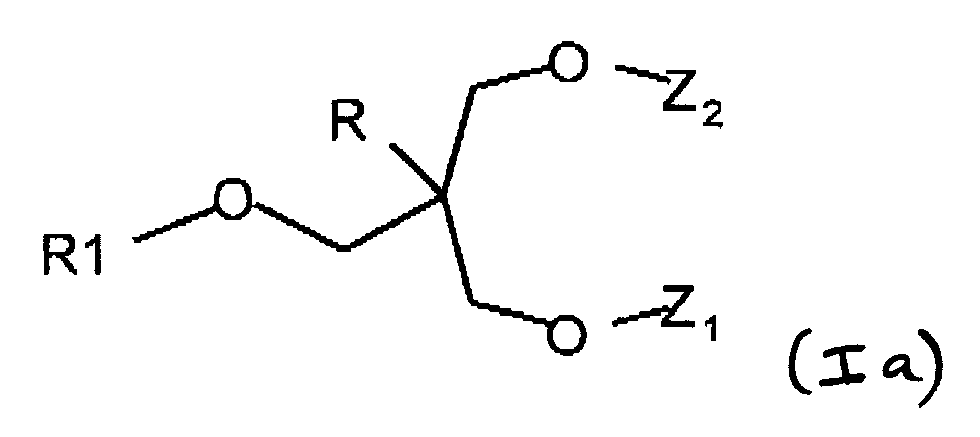
- Par radical aliphatique saturé ou insaturé, linéaire ou ramifié comportant de 8 à 36 atomes de carbone, éventuellement substitué avec un ou plusieurs groupes hydroxyle, et/ou un ou plusieurs groupes oxo, on désigne pour R1, dans les formules (I) et (IV) telles que définies ci-dessus :
- les radicaux alkyle linéaires, par exemple les radicaux octyle, décyle, dodécyle, tétradécyle, hexadécyle, octadécyle, eicosyle ou docosyle ;
- les radicaux issus des isoalcanols de formule (A) :
(CH3)(CH3)CH-(CH2)m-CH2-OH (A)
dans laquelle m représente un nombre entier compris entre 4 et 18, par exemple les radicaux isooctyle, isodécyle, isododécyle, isotétradécyle, isohexadécyle ou isooctadécyle ; - le radical 2-éthyl hexyle ou les radicaux alkyles ramifiés issus des alcools de Guerbet de formule (B) :
CH(CsH2s+1)(CtH2t+1)-CH2-OH (B)
dans laquelle t est un nombre entier compris entre 4 et 18, s est un nombre entier compris entre 2 et 16 et la somme s + t est supérieure ou égale à 8, par exemple les radicaux 2-éthyl décyle, 2-butyl octyle, 2-éthyl dodécyle, 2-butyl décyle, 2-hexyl octyle, 2-éthyl tétradécyle, 2-butyl décyle, 2-hexyl octyle, 2-éthyl hexadécyle, 2-butyl tétradécyle, 2-hexyl dodécyle, 2-octyl décyle, 2-hexyl décyle, 2-octyl dodécyle, 2-décyl tétradécyle, 2-dodécyl hexadécyle, 2-tétradécyl octadécyle, 2-tétradécyl eicosyle, 2-hexadécyl octadécyle ou 2-hexadécyl eicosyle ; ou les radicaux issus des homologues d'alcools de Guerbet, par exemple le radical 2-propyl heptyle. - les radicaux linéaires insaturés tels que les radicaux undécènyle, docécènyle, tétradécènyle, hexadécènyle, octadécènyle, octadécadiènyle, octadécatriényle, octadécatétraènyle, eicosènyle, eicosadiènyle ou docosènyle, par exemple les radicaux insaturés 10-undécènyle, 4-dodécènyle, 5-dodécènyle, oléyle, isooléyle, linoléyle, linolényle ou 10, 13-eicosadiènyle ;
- les radicaux aliphatiques saturés ou insaturés, linéaires ou ramifiés, comportant de 8 à 36 atomes de carbone substitués par 1 ou deux groupes hydroxy, tels que les radicaux hydroxy hexadécyle, hydroxy octadécyle, dihydroxy docosyle ou dihydroxy-octadécyle, par exemple, les radicaux 3-hydroxy hexadécyle, l'acide 4-hydroxy hexadécyle, l'acide 11-hydroxy hexadécyle, l'acide 16-hydroxy hexadécyle, 12-hydroxy stéaryle ou 8,9-dihydroxy stéaryle.
- Par radical allyle linéaire ou ramifié comportant de un à huit atomes de carbone éventuellement substitués par un ou plusieurs radicaux hydroxy ou un ou plusieurs, on désigne notamment pour R dans la formule (1) telle que définie ci-dessus, les radicaux méthyle, éthyle, propyle, isopropyle, butyle, isobutyle, pentyle, isopentyle, hexyle, isohexyle, heptyle isoheptyle, octyle, isooctyle, hydroxyméthyle ou 2-hydroxyéthyle.
- Par reste d'un sucre réducteur, on désigne principalement pour -S- dans la formule (I) telle que définie ci-dessus, les restes du glucose, du saccharose, du fructose, de l'idose, du galactose, du maltose, du maltotriose, du lactose, du cellobiose, du mannose, du xylose, de l'arabinose, du ribose, du dextrane ou du tallose.
- Dans la formule (I) telle que définie ci-dessus, p est un nombre décimal, qui représente le degré moyen de polymérisation du reste S.
- Lorsque p est un nombre entier, (S)p est le reste polymérique de rang p du reste S.
- Lorsque p est un nombre décimal, la formule (I) représente un mélange de composés a1 [(Q)(S)] + a2 [(Q)(S)2]+ a3 [(Q)(S)3] +...+ aq [(Q)(S)q] dans lesquels Q représente le groupe lié au(x) reste(s) de sucre S de la formule (I) avec q représentant un nombre entier compris entre 1 et 10 et dans les proportions molaires a1, a2, a3,... aq telles que :

- Selon un premier aspect particulier de la présente invention, dans la formule (IV), R1 représente un radical choisi parmi les radicaux octyle, décyle, dodécyle, tétradécyle, hexadécyle, octadécyle, eicosyle, 2-éthyl hexyle, 2-butyl octyle, 2-butyl décyle, 2-hexyl octyle, 2-hexyl décyle, 2-hexyl dodécyle, 2-octyl décyle, 2-octyl dodécyle, 2-décyl tétradécyle, isododécyle, isotétradécyle, isohexadécyle, isooctadécyle, 10-undécènyle, oléyle, isooléyle, linoléyle, linolényle ou 10,13-eicosadiènyle, 12-hydroxy stéaryle ou le 2-propyl heptyle.
- Selon un deuxième aspect particulier de la présente invention, dans la formule (I), -S- représente un reste divalent du glucose ou du xylose.
- Selon un troisième aspect particulier de la présente invention, dans la formule (I), p est compris entre 1,005 et 5 et plus particulièrement entre 1,05 et 2.
- Selon un quatrième aspect particulier de la présente invention, dans la formule (I), R est choisi parmi les radicaux méthyle, éthyle, propyle, butyle, pentyle, hexyle, heptyle, octyle et hydroxyméthyle.
- L'invention a aussi pour objet, un procédé de préparation d'une composition (C) telle que définie précédemment, comprenant les étapes successives suivantes :
- Une étape a) de réaction d'un alcool ou d'un mélange d'alcools de formule (IV)
R1-OH (IV)
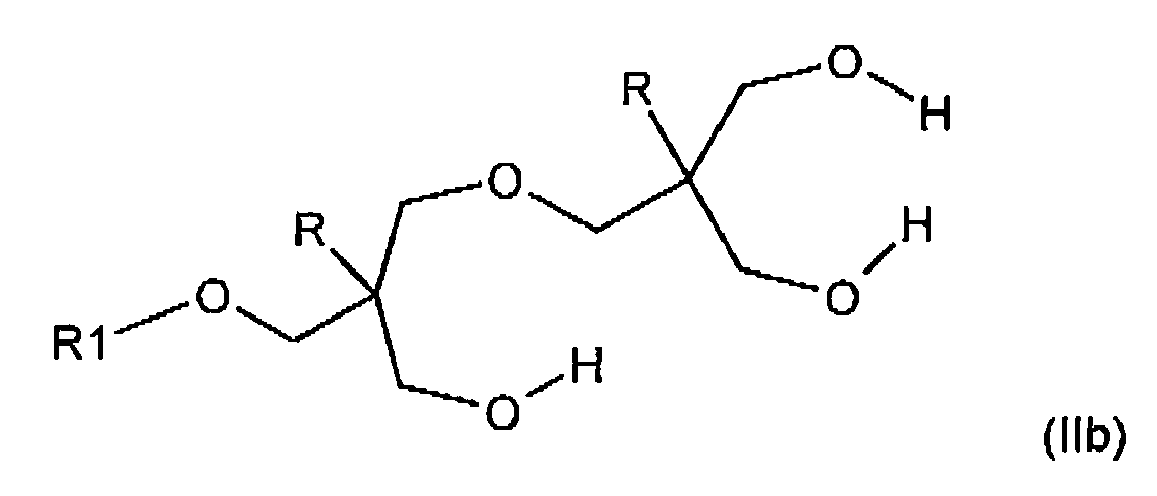
dans laquelle R1 représente un radical aliphatique saturé ou insaturé, linéaire ou ramifié, comportant de 8 à 36 atomes de carbone, éventuellement substitué avec un ou plusieurs groupes hydroxyle ou d'un mélange d'alcools de formule (IV), avec un oxétane- 3, 3 - disubstitué de formule (V) :



- Une étape b) de réaction dudit mélange (M) avec un sucre réducteur de formule (III) :
S-H (III)
- Dans le procédé tel que défini ci-dessus, l'étape (a) est généralement effectuée en présence d'un acide de Lewis comme catalyseur ; on peut citer par exemple, le trifluorure de bore stabilisé dans l'éther diéthylique (BF3.Et2O), le tétrachlorure d'étain (SnCl4), le tétrachlorure de titane (SnTi4) ou le trichlorure d'aluminium (AlCl3)
- Certains composés de formule (V) sont des composés connus, Le 3-éthyl 3-(hydroxyméthyl) oxétane de formule (V) (ou TMP oxétane) est un produit commercial identifié sous les numéros RN 3047-32-3 et EINECS 221-54-0.
- Dans le procédé tel que défini ci-dessus, l'étape (b) est généralement effectuée en présence d'un acide fort comme catalyseur, par exemple l'acide sulfurique, l'acide chlorhydrique, l'acide phosphorique, acide méthanesulfonique, l'acide p-toluènesulfonique, l'acide trifluoro-méthanesulfonique ou l'acide hypophosphoreux.
- La composition (C) objet de la présente invention, lorsqu'elle est obtenue par le procédé tel que défini précédemment, peut comprendre en outre jusqu'à 5% de sa masse de produits résiduels principalement le sucre réducteur de formule (III), le dérivé de l'oxétane de formule (V) et/ou des composés de formule (VI) :
- Selon un aspect particulier du procédé tel que défini ci-dessus, il comprend en outre une étape (c) de déshydratation d'un composé de formule (VII) :

- L'étape (c) telle que définie ci-dessus, se compose généralement d'une étape initiale de réaction du composé de formule (VII) avec un carbonate de dialkyle, par exemple le carbonate de diméthyle, le carbonate de diéthyle ou le carbonate du dibutyle, pour obtenir un carbonate cyclique du dérivé de formule (VII), suivie d'une décarboxylation dudit carbonate cyclique pour obtenir l'oxétane disubstitué de formule (V).
- Comme exemples de composés de formule (VII) connus, il y a le triméthylolpropane (TMP) (R représentant un radical éthyle) ou le pentaérythritol (R représentant un radical hydroxyméthyle).
- L'invention a aussi pour objet l'utilisation d'une composition (C) telle que définie précédemment, comme agent tensioactif et plus particulièrement, comme agent moussant, agent émulsionnant, agent mouillant, agent dispersant ou agent détergent.
- L'invention a enfin pour objet une composition cosmétique ou pharmaceutique caractérisée en ce qu'elle comprend comme agent tensioactif, une composition (C), telle que définie précédemment.
- La partie expérimentale suivante illustre l'invention sans toutefois la limiter.
- Le TMP oxétane est le composé de formule (V) tel que définie précédemment, dans laquelle R représente le radical éthyle. Cette première étape est réalisée à 120°C en présence d'une quantité catalytique d'acide de Lewis (BF3-Et2O). Deux stoechiométries différentes en TMP oxétane ont été étudiées (essais 1 et 2), la première impliquant une quantité équimolaire par rapport à l'octadécanol et la seconde impliquant un excès de 3 équivalents molaires toujours par rapport à l'octadécanol. Les conditions opératoires sont les suivantes : Fonte de l'octadécanol à ∼120°C sous atmosphère d'azote, ajout de 0,5% de BF3.Et2O (par rapport à la masse totale des réactifs) sous agitation mécanique, puis ajout progressif (en environ 180 minutes) du TMP oxétane, maintien à 120°C pendant 90 à 180 minutes, puis refroidissement. Les caractéristiques des mélanges (M1) et (M2) obtenus, sont rassemblées dans le tableau 1a ci-dessous (TA : Température ambiante ; IA : Indice d'acide ; IOH : Indice d'hydroxyle).
Tableau 1a Essai 1
(M1)Essai 2
(M2)Stoechiométrie TMP oxétane / C-18 OH 1 / 1 3 / 1 Aspect visuel à TA Solide blanc Solide blanc pH à1 % dans eau - isopropanol (50/50) 5,0 4,9 Eau (% massique) - Norme NFT 73201 0,01 0,03 Point de fusion (°C) - Banc Kofler < 44 < 44 IA (mg KOH/g) - Norme NFT 60-204 2,2 1,4 IOH (mg KOH/g) - Norme USP (XXI NF XVI January 1-1985) 285,6 351,3 Octadécanol - (% massique) 32,0 12,3 TMP oxétane - (% massique) 0,4 3,4 Monoadduit (composé de formule (IIa) avec R1 : octadécyle) (% massique) 27,8 18,2 Diadduit (composé de formule (IIb) avec R1 = octadécyle, R : éthyle) - (% massique) 15,9 15,5 Triadduit (composé de formule (IIc) avec R1 = : octadécyle, R : éthyle)- (% massique) 9,7 14,7 - D'une manière générale, les résultats mettent en évidence une bonne réactivité entre l'octadécanol et le TMP oxétane. Théoriquement, l'indice d'hydroxyle du milieu réactionnel ne doit pas varier lors de la réaction et les valeurs finales mesurées sont cohérentes avec celles calculées (Mélange M1 : 285,6 mg KOH/g pour une valeur théorique de 289,2 mg KOH/g ; Mélange M2 : 351,3 mg KOH/g pour une valeur théorique de 361,8 mg KOH/g). Les dosages quantitatifs d'octadécanol résiduel montrent respectivement que, dans les essais 1 et 2, respectivement environ 54% et 72% de l'octadécanol de départ a été consommé lors de la réaction. Les dosages quantitatifs du TMP oxétane résiduel montrent respectivement que, dans les essais 1 et 2, plus de 98 % et 94 % de TMP oxétane de départ a réagi. Finalement, la distribution des différents adduits, établie par chromatographie en phase gazeuse, après une normalisation à 100%, montre que l'introduction d'un excès de TMP oxétane entraîne une consommation plus importante en octadécanol et favorise le phénomène de polymérisation des motifs TMP (n plus élevé).
- Le protocole retenu est le suivant : Fonte des mélanges M1 et M2 à environ 100°C à pression atmosphérique et sous atmosphère d'azote, puis ajout, sous agitation mécanique, d'un équivalent molaire de glucose anhydre (la quantité est calculée à partir du nombre de mole d'octadécanol introduit à la première étape), ajout de 1% d'acide sulfurique à 98% (% massiques exprimés par rapport à la masse de glucose introduite), mise sous vide progressif [environ 30 102 Pa (30 mbars)] et acétalisation avec le glucose pendant 6 heures à environ 100°C ; refroidissement jusqu'à 80°C et neutralisation par ajout d'une solution de lessive de soude à 30% pour atteindre un pH proche de 7 ; filtration à chaud sur une plaque filtrante de porosité de 4 micromètres et conditionnement. Les caractéristiques analytiques des deux compositions (C1) et (C2) obtenues sont rassemblées dans le tableau 1b ci-dessous.
Tableau 1b Analyses Composition C1 Composition C2 Produit de départ Mélange M1 Mélange M2 Aspect visuel à TA Solide blanc Solide beige pH à 1 % dans eau - éthanol (50/50) 7,8 7,6 Eau (%) - NFT 73201 0,41 0,42 Couleur sur produit fondu - NFT 20-030 (vcs) 2,0 Non mesurable Point de fusion (°C) Banc Kofler ∼ 50°C 55 - 65°C IA (mg KOH/g) - NFT 60-204 2,0 1,0 IOH (mg KOH/g) - USP XXI NF XVI January 1-1985 393,9 412,8 Octadécanol (% massique) 24,2 % 9,0 % TMP oxétane (% massique) < 0,05 % < 0,05 Glucose (% massique) 0,2 % < 0,1 Composés de formule (VI) R1 : octadécyle ; S : glucose (% massique) 3,0 % 1,0 % Composés de formule (Ia) R1 octadécyle ; S : glucose ; R : éthyle (% massique) 3,6 % 1,6 % Composés de formule (Ib ou Ic) R1 : octadécyle ; S : glucose ; R : éthyle (% massique) > 65% > 85% - L'augmentation significative de l'indice d'hydroxyle au cours des réactions indique une réactivité satisfaisante entre le glucose et les adduits « octadécanol + TMP ».
- On met en oeuvre les deux étapes développées à l'exemple précédent en utilisant à la place de l'octadécanol, de l'alcool cétéarylique (mélange à 50/50 molaire d'hexadécanol et d'octadécanol) sur deux essais dans des rapports stoechiométriques glucose / alcool de formule (IV) TMP oxétane. Les caractéristiques analytiques des deux compositions (C3) et (C4) obtenues sont rassemblées dans le tableau 2 ci-dessous.
Tableau 2 Analyses Composition C3 Composition C4 Produit de départ
Stoechiométrie molaire alcool de formule (IV) / TMP oxétane (formule (V))Mélange M3
1 / 2,5Mélange M3
1 / 2,5Stoechiométrie molaire glucose / alcool de formule (IV) 0,5 / 1 1 / 1 Aspect visuel à TA Solide beige Solide jaune pH à 1 % dans eau - isopropanol 6,6 6,0 Eau (%)-NFT 73201 0,17 0,27 Couleur sur produit fondu - NFT 20-030 (VCS) 2,0 2 Point de fusion (°C) Banc Kofler < 44°C < 44°C IA (mg KOH/g) - NFT 60-204 1,3 1,3 IOH (mg KOH/g) - USP XXI NF XVI January 1-1985 395,1 427,5 Alcool cétéarylique (C16 / C18) (% massique) 10, 6% 9,8% TMP oxétane (% massique) < 0,01% < 0,01% Glucose (% massique) < 0,1% 0,4% Composés de formule (VI) R1 : cétéaryle ; S : glucose (% massique) 0,8% 1.0% Composés de formule (I) R1 : cétéaryle ; S : glucose ; R : éthyle, (% massique) > 85% > 85% - Trois types d'huile ont été utilisés : une huile paraffinique (MARCOL™ 52), une huile polaire (Triglycéride 5545 en C-8/10) et une huile aromatique (SOLVESSO™ 100). Les deux formulations retenues sont :
- 20% d'huile, 2% de composition tensioactive et 78% d'eau de ville + 1% MgSO4,
- 50% d'huile, 5% de composition tensioactive et 45% d'eau de ville + 1% de MgSO4.
- 1 - Mélange de l'huile et de la composition tensioactive, avec homogénéisation à la spatule, dans un bêcher de 400 ml forme haute, placé dans un bain-marie à 80°C ;
- 2 -Ajout de la phase aqueuse (eau de ville + 1% de MgSO4 sec (2% de MgSO4 heptahydrate)) à 80°C ;
- 3 - Cisaillement du mélange au Silverson™ (8000 tr/min pendant 4 min ; rotor/stator le plus bas possible dans le bécher et faire tourner doucement le bécher) et,
- 4 - Refroidissement jusqu'à température ambiante avec légère agitation pour obtenir 200 g d'émulsion.
- Les résultats de stabilité à température ambiante (TA) et à 40°C sont rassemblés dans le tableau 3 ci-dessous. Les cas où les mélanges ne restent pas totalement émulsionnés au bout de 24 heures à température ambiante n'ont pas été retenus.
Tableau 3. Composition Huile formulation : Composition Huile / (Eau+MgSO4) Observations t=1 jour t = 13 jours (mélange M1 et composition C2)
t = 42 jours (composition C1 et mélange M2)Température Ambiante Température Ambiante 40°C Mélange M1 Triglycéride 5545 5/50/45 Em.:100% Em.: 93% Em.: 71% Mélange M1 MARCOL™ 52 5/50/45 Em.: 100% Em.: 80% Em.: 51% Mélange M2 MARCOL™ 52 5/50/45 Em.: 100% Em.: 90% Em.:76% Composition C1 Triglycéride 5545 2/20/78 Em:100% Em.:100% Em.:47% Composition C1 Triglycéride 5545 5/50/45 Em.:100% Em.:100% Em.: 90% Composition C2 SOLVESSO™ 100 5/50/45 Em.:100% Em.:38% 3 phases Em. : correspond au volume de phases émulsionné par rapport à la masse initiale préparée ; en fait Em. 93% signifie qu'un volume représentant 7 % du volume initial d'émulsion a déphasé. - Les stabilités observées montrent un pouvoir émulsionnant des compositions selon l'invention à température ambiante et à J1 pour les phases grasses étudiées. C1 possède un bon pouvoir émulsionnant pour préparer des émulsions eau - huile avec le triglycéride 5545.
- Dans le cas des émulsions huile dans Eau, deux types d'huile ont été utilisés : une huile paraffinique (MARCOL™ 52) et une huile polaire (Triglycéride 5545 en C8/C10). Les formulations retenues sont identiques à celles précédemment décrites en utilisant de l'eau de ville exempte de MgSO4.
- Le protocole de mise en émulsion comprend les étapes suivantes :
- 1 - Mélange de l'eau de ville et de la composition tensioactive à 80°C,
- 2 - Ajout de l'huile et agitation à la spatule,
- 3 - Cisaillement du mélange au Silverson (8000 tr/min pendant 4 min ; rotor/stator le plus bas possible dans le bécher et faire tourner doucement le bécher) et,
- 4 - Refroidissement jusqu'à température ambiante avec légère agitation pour obtenir 200 g d'émulsion,
- Les résultats de stabilité à température ambiante et à 40°C sont rassemblés dans le tableau 4 ci-dessous. Les cas où les mélanges ne restent pas totalement émulsionnés au bout de 24 heures à température ambiante n'ont pas été retenus.
Tableau 4 Composition Huile Formulation : Composition / Huile / Eau Observations t = 1 jour t = 13 jours (composition C2)
t = 42 jours (composition C1 et MONTANOV™ 68)TA TA 40°C MONTANOV™ 68 Triglycéride 5545 2/20/78 Em.:100% Em.:100% Em.:100% MONTANOV™ 68 Triglycéride 5545 5/50/45 Em.:100% Em.:100% Em.:100% MONTANOV™ 68 Triglycéride 5545 0,8 / 21,2 / 78 Em.:66% Déphasage Déphasage MONTANOV™ 68 Triglycéride 5545 0,3 / 21,7 78 / Em.: 67% Déphasage Déphasage Composition C1 Triglycéride 5545 2/20/78 Em.:100% Em.:100% Em.:100% Composition C1 Triglycéride 5545 5/50/45 Em.: 100% Em.: 100% Em.: 100% Composition C1 MARCOL™ 52 2/20/78 Em.: 100% Em.: 100% Em.: 87% Composition C2 Triglycéride 5545 2/20/78 Em.:100% Em.: 100% Em.:100% Composition C2 Triglycéride 5545 5/50/45 Em.: 100% Em.:100% Em.:100% Composition C2 MARCOL™ 52 2/20/78 Em.: 100% Em.:100% Em.:88% Composition C2 MARCOL™ 52 5/50/45 Em.:100% Em.:79% 3 phases - Globalement, les glucosides d'adduit « octadécanol + TMP » présentent des pouvoirs émulsionnants huile dans eau H/E remarquables en comparaison avec le Montanov™ 68 (mélange de composés de formule (IV) et (VI) avec R1 en C16-C18).


Claims (10)
- Composition (C) comprenant pour 100% de sa masse :- de 0,5% à 30% d'un ou de plusieurs alcools de formule (IV) :
R1-OH (IV)
dans laquelle R1 représente un radical aliphatique saturé ou insaturé, linéaire ou ramifié, comportant de 8 à 36 atomes de carbone, éventuellement substitué avec un ou plusieurs groupes hydroxyle.
et- de 70% à 99,5% d'un ou de plusieurs composés de formule (I) choisis parmi :


- Composition (C) telle que définie à la revendication 1, pour laquelle R1 représente un radical choisi parmi les radicaux otyle, décyle, dodécyle, tétradécyle, hexadécyle, octadécyle, eicosyle, 2-éthyl hexyle, 2-butyl octyle, 2-butyl décyle, 2-hexyl octyle, 2-hexyl décyle, 2-hexyl dodécyle, 2-octyl décyle, 2-octyl dodécyle, 2-décyl tétradécyle, isododécyle, isotétradécyle, isohexadécyle, isooctadécyle, 10-undécènyle, oléyle, isooléyle, linoléyle, linolényle ou 10,13-eicosadiènyle, 12-hydroxy stéaryle et 2-propyl heptyle.
- Composition (C) telle que définie à l'une des revendications 1 ou 2, où -S- représente un reste divalent du glucose.
- Composition (C) telle que définie à l'une des revendications 1 ou 2, pour laquelle dans la formule (I), S représente un reste divalent du xylose.
- Composition (C) telle que définie à l'une des revendications 1 à 4, pour laquelle, p est compris entre 1,005 et 5 et plus particulièrement entre 1,05 et 2.
- Composition (C) telle que définie à l'une des revendications 1 à 4, pour laquelle, R est choisi parmi les radicaux méthyle, éthyle, propyle, butyle, pentyle, hexyle, heptyle, octyle et hydroxyméthyle.
- Procédé de préparation d'une composition (C) telle que définie à l'une des revendications 1 à 6, comprenant les étapes successives de réactions chimiques suivantes :une étape a) de réaction d'un alcool de formule (IV) :
R1-OH (IV)
dans laquelle R1 représente un radical aliphatique saturé ou insaturé, linéaire ou ramifié, comportant de 8 à 36 atomes de carbone, éventuellement substitué avec un ou plusieurs groupes hydroxyle ou d'un mélange d'alcools de formule (IV), avec un oxétane- 3, 3 - disubstitué de formule (V) :


 une étape b) de réaction dudit mélange (M) avec un sucre réducteur de formule (III) :
S-H (III)
pour obtenir ladite composition (C). - Procédé tel que défini à la revendication 7, comprenant en outre une étape c) de déshydratation d'un composé de formule (VII) :

- Utilisation d'une composition (C) telle que définie à l'une des revendications 1 à 6, comme agent tensioactif et plus particulièrement, comme agent moussant, agent émulsionnant, agent mouillant, agent dispersant ou agent détergent.
- Composition cosmétique ou pharmaceutique caractérisée en ce qu'elle comprend comme agent tensioactif, une composition (C) telle que définie à l'une des revendications 1 à 6.
Applications Claiming Priority (2)
| Application Number | Priority Date | Filing Date | Title |
|---|---|---|---|
| FR0652882A FR2903408B1 (fr) | 2006-07-10 | 2006-07-10 | Nouveaux derives de sucre, procede pour leur preparation, leur utilisation comme agents tensioactifs |
| PCT/FR2007/051600 WO2008007003A2 (fr) | 2006-07-10 | 2007-07-05 | Nouveaux derives de sucre, procede pour leur preparation et leur utilisation comme agents tensioactifs |
Publications (2)
| Publication Number | Publication Date |
|---|---|
| EP2044096A2 EP2044096A2 (fr) | 2009-04-08 |
| EP2044096B1 true EP2044096B1 (fr) | 2010-06-16 |
Family
ID=37950579
Family Applications (1)
| Application Number | Title | Priority Date | Filing Date |
|---|---|---|---|
| EP07803979A Not-in-force EP2044096B1 (fr) | 2006-07-10 | 2007-07-05 | Nouveaux derives de sucre, procede pour leur preparation et leur utilisation comme agents tensioactifs |
Country Status (8)
| Country | Link |
|---|---|
| US (2) | US20100168252A1 (fr) |
| EP (1) | EP2044096B1 (fr) |
| JP (1) | JP5313134B2 (fr) |
| CN (1) | CN101490072B (fr) |
| AT (1) | ATE471333T1 (fr) |
| DE (1) | DE602007007218D1 (fr) |
| FR (1) | FR2903408B1 (fr) |
| WO (1) | WO2008007003A2 (fr) |
Families Citing this family (3)
| Publication number | Priority date | Publication date | Assignee | Title |
|---|---|---|---|---|
| FR2959743B1 (fr) * | 2010-05-06 | 2012-06-15 | Soc Dexploitation De Produits Pour Les Industries Chimiques Seppic | Composition de derives polyalcoxyles de trimethylolpropane et d'alcools gras procede pour sa preparation et utilisation comme inverseur, dans les latex inverses auto-inversibles |
| GB201021822D0 (en) * | 2010-12-23 | 2011-02-02 | Reckitt & Colman Overseas | Cleaning composition and method |
| WO2012144132A1 (fr) * | 2011-04-20 | 2012-10-26 | 出光興産株式会社 | Dérivé d'adamantane contenant du fluor |
Family Cites Families (13)
| Publication number | Priority date | Publication date | Assignee | Title |
|---|---|---|---|---|
| CN1045261C (zh) * | 1992-04-12 | 1999-09-29 | 轻工业部日用化学工业科学研究所 | C8-c18烷基糖苷表面活性剂的制备方法 |
| JPH05326335A (ja) * | 1992-05-15 | 1993-12-10 | Nippon Chemicon Corp | 電解コンデンサ用電解液 |
| JP3190750B2 (ja) * | 1992-11-30 | 2001-07-23 | 花王株式会社 | ペンタエリスリトール分岐アルキルエーテルを含有する化粧料 |
| JPH07173486A (ja) * | 1993-12-17 | 1995-07-11 | Kao Corp | 亜鉛めっき鋼板用防錆潤滑剤 |
| EP0734762B1 (fr) * | 1994-10-17 | 2004-06-30 | Lion Corporation | Tensioactif non ionique, composition d'emulsion et dispersion |
| JPH08224458A (ja) * | 1994-10-25 | 1996-09-03 | Lion Corp | 水中油型の乳化組成物 |
| DE19728900A1 (de) * | 1997-07-07 | 1999-01-14 | Henkel Kgaa | Hydrophile Glykoside |
| JPH11217352A (ja) * | 1998-01-30 | 1999-08-10 | Lion Corp | 多価アルコールエーテルカルボン酸化合物、陰イオン界面活性剤及びそれを含む洗浄剤組成物 |
| DE19927172C1 (de) * | 1999-06-15 | 2001-08-09 | Cognis Deutschland Gmbh | Wäßrige Perlglanzkonzentrate |
| FR2804432B1 (fr) * | 2000-02-01 | 2002-03-29 | Seppic Sa | Composes derives de polyglyceryl glycosides, procede pour leur preparation, composition les contenant et utilisations comme agents tensioactifs |
| DE10102005A1 (de) * | 2001-01-18 | 2002-07-25 | Cognis Deutschland Gmbh | Perlglanzmittel |
| JP5013638B2 (ja) * | 2001-07-26 | 2012-08-29 | 学校法人神奈川大学 | エステル化合物の製造方法 |
| JP2003129031A (ja) * | 2001-10-22 | 2003-05-08 | Kawaken Fine Chem Co Ltd | 増粘剤組成物及びそれを含む高粘度液体洗浄剤組成物 |
-
2006
- 2006-07-10 FR FR0652882A patent/FR2903408B1/fr not_active Expired - Fee Related
-
2007
- 2007-07-05 AT AT07803979T patent/ATE471333T1/de not_active IP Right Cessation
- 2007-07-05 US US12/307,629 patent/US20100168252A1/en not_active Abandoned
- 2007-07-05 EP EP07803979A patent/EP2044096B1/fr not_active Not-in-force
- 2007-07-05 CN CN200780026158.4A patent/CN101490072B/zh not_active Expired - Fee Related
- 2007-07-05 JP JP2009518931A patent/JP5313134B2/ja not_active Expired - Fee Related
- 2007-07-05 WO PCT/FR2007/051600 patent/WO2008007003A2/fr not_active Ceased
- 2007-07-05 DE DE602007007218T patent/DE602007007218D1/de active Active
-
2012
- 2012-10-29 US US13/662,895 patent/US20130053331A1/en not_active Abandoned
Also Published As
| Publication number | Publication date |
|---|---|
| DE602007007218D1 (de) | 2010-07-29 |
| CN101490072B (zh) | 2014-02-26 |
| ATE471333T1 (de) | 2010-07-15 |
| JP2009542436A (ja) | 2009-12-03 |
| US20100168252A1 (en) | 2010-07-01 |
| CN101490072A (zh) | 2009-07-22 |
| FR2903408B1 (fr) | 2013-05-03 |
| JP5313134B2 (ja) | 2013-10-09 |
| FR2903408A1 (fr) | 2008-01-11 |
| WO2008007003A2 (fr) | 2008-01-17 |
| US20130053331A1 (en) | 2013-02-28 |
| EP2044096A2 (fr) | 2009-04-08 |
| WO2008007003A3 (fr) | 2008-10-02 |
Similar Documents
| Publication | Publication Date | Title |
|---|---|---|
| EP0939670B1 (fr) | Nouvelles compositions a base d'alkylglycosides et d'alcools gras | |
| EP0553241B2 (fr) | Utilisation de compositions a base d'alcools gras, pour la preparation d'emulsions; procede de preparation d'emulsions et emulsions ainsi obtenues | |
| US6667396B2 (en) | Polyxyloside derivatives, process for preparing them, composition containing them and use as surfactants | |
| EP0828554A1 (fr) | Composition emulsionnante a base d'alkylpolyglycosides, et ses utilisations | |
| EP0635516B1 (fr) | Dérivés de l'acide galacturonique, leurs procédés de préparation et leurs applications | |
| EP0092876A1 (fr) | Procédé de préparation d'alkylpolysaccharides | |
| EP0609391A1 (fr) | Nouveaux derives d'alkylpolyosides, compositions en contenant, leurs procede de preparation et applications comme agents de surface | |
| EP1211258B1 (fr) | Procédé de préparation d'adjuvants de solubilisation à partir d'huiles de fusel et d'oses | |
| EP2044096A2 (fr) | Nouveaux derives de sucre, procede pour leur preparation et leur utilisation comme agents tensioactifs | |
| FR2804432A1 (fr) | Composes derives de polyglyceryl glycosides, procede pour leur preparation, composition les contenant et utilisations comme agents tensioactifs | |
| EP1257351B1 (fr) | Nouvelle famille de compositions a base d'alkylpolyglycosides et de dimerdiol, notamment utiles pour la preparation d'emulsions huile-dans-eau vaporisables | |
| FR2754739A1 (fr) | Compositions anti-mousse et compositions anhydres intermediaires | |
| JPH0692600B2 (ja) | 高級アルキルグリコシド組成物 | |
| FR2697842A1 (fr) | Monoesters de 4-hydroxy-phényl-beta-D-glucose, leur procédé de préparation et leurs utilisations dans les domaines cosmétique, pharmaceutique, bucco-dentaire et alimentaire. | |
| EP4416162B1 (fr) | Procédé de préparation d'alkylpolyglycosides faiblement colorés avec neutralisation du milieu réactionnel après élimination du sucre | |
| EP4416160B1 (fr) | Procédé de préparation d'alkylpolyglycosides faiblement colorés avec neutralisation du milieu reactionnel avant élimination du sucre | |
| EP0895998A1 (fr) | N-(dialkylamino)alkyl glycosylamines et dérivés, procédé de préparation, et utilisations | |
| US5760258A (en) | Polyhydroxyalkyl-amidoamine oxides | |
| EP1357894B1 (fr) | Utilisation d'alkylpolyxylosides comme agents emulsionnants pour la preparation d'emulsions eau-dans-huile. | |
| EP0895979A1 (fr) | Ammonium Quaternaires d'alkylamido alditiols, procédé de préparation, compositions les contenant et utilisations | |
| JPH10121089A (ja) | 香料組成物 |
Legal Events
| Date | Code | Title | Description |
|---|---|---|---|
| PUAI | Public reference made under article 153(3) epc to a published international application that has entered the european phase |
Free format text: ORIGINAL CODE: 0009012 |
|
| AK | Designated contracting states |
Kind code of ref document: A2 Designated state(s): AT BE BG CH CY CZ DE DK EE ES FI FR GB GR HU IE IS IT LI LT LU LV MC MT NL PL PT RO SE SI SK TR |
|
| AX | Request for extension of the european patent |
Extension state: AL BA HR MK RS |
|
| 17P | Request for examination filed |
Effective date: 20090402 |
|
| RBV | Designated contracting states (corrected) |
Designated state(s): AT BE BG CH CY CZ DE DK EE ES FI FR GB GR HU IE IS IT LI LT LU LV MC MT NL PL PT RO SE SI SK TR |
|
| 17Q | First examination report despatched |
Effective date: 20090619 |
|
| DAX | Request for extension of the european patent (deleted) | ||
| GRAP | Despatch of communication of intention to grant a patent |
Free format text: ORIGINAL CODE: EPIDOSNIGR1 |
|
| GRAS | Grant fee paid |
Free format text: ORIGINAL CODE: EPIDOSNIGR3 |
|
| GRAA | (expected) grant |
Free format text: ORIGINAL CODE: 0009210 |
|
| AK | Designated contracting states |
Kind code of ref document: B1 Designated state(s): AT BE BG CH CY CZ DE DK EE ES FI FR GB GR HU IE IS IT LI LT LU LV MC MT NL PL PT RO SE SI SK TR |
|
| REG | Reference to a national code |
Ref country code: CH Ref legal event code: EP |
|
| REG | Reference to a national code |
Ref country code: IE Ref legal event code: FG4D Free format text: LANGUAGE OF EP DOCUMENT: FRENCH |
|
| REF | Corresponds to: |
Ref document number: 602007007218 Country of ref document: DE Date of ref document: 20100729 Kind code of ref document: P |
|
| REG | Reference to a national code |
Ref country code: SE Ref legal event code: TRGR |
|
| REG | Reference to a national code |
Ref country code: NL Ref legal event code: VDEP Effective date: 20100616 |
|
| PG25 | Lapsed in a contracting state [announced via postgrant information from national office to epo] |
Ref country code: LT Free format text: LAPSE BECAUSE OF FAILURE TO SUBMIT A TRANSLATION OF THE DESCRIPTION OR TO PAY THE FEE WITHIN THE PRESCRIBED TIME-LIMIT Effective date: 20100616 |
|
| LTIE | Lt: invalidation of european patent or patent extension |
Effective date: 20100616 |
|
| PG25 | Lapsed in a contracting state [announced via postgrant information from national office to epo] |
Ref country code: AT Free format text: LAPSE BECAUSE OF FAILURE TO SUBMIT A TRANSLATION OF THE DESCRIPTION OR TO PAY THE FEE WITHIN THE PRESCRIBED TIME-LIMIT Effective date: 20100616 Ref country code: FI Free format text: LAPSE BECAUSE OF FAILURE TO SUBMIT A TRANSLATION OF THE DESCRIPTION OR TO PAY THE FEE WITHIN THE PRESCRIBED TIME-LIMIT Effective date: 20100616 Ref country code: SI Free format text: LAPSE BECAUSE OF FAILURE TO SUBMIT A TRANSLATION OF THE DESCRIPTION OR TO PAY THE FEE WITHIN THE PRESCRIBED TIME-LIMIT Effective date: 20100616 Ref country code: LV Free format text: LAPSE BECAUSE OF FAILURE TO SUBMIT A TRANSLATION OF THE DESCRIPTION OR TO PAY THE FEE WITHIN THE PRESCRIBED TIME-LIMIT Effective date: 20100616 |
|
| PG25 | Lapsed in a contracting state [announced via postgrant information from national office to epo] |
Ref country code: PL Free format text: LAPSE BECAUSE OF FAILURE TO SUBMIT A TRANSLATION OF THE DESCRIPTION OR TO PAY THE FEE WITHIN THE PRESCRIBED TIME-LIMIT Effective date: 20100616 Ref country code: CY Free format text: LAPSE BECAUSE OF FAILURE TO SUBMIT A TRANSLATION OF THE DESCRIPTION OR TO PAY THE FEE WITHIN THE PRESCRIBED TIME-LIMIT Effective date: 20100616 |
|
| REG | Reference to a national code |
Ref country code: IE Ref legal event code: FD4D |
|
| BERE | Be: lapsed |
Owner name: SOC. D'EXPLOITATION DE PRODUITS POUR LES INDUSTRI Effective date: 20100731 |
|
| PG25 | Lapsed in a contracting state [announced via postgrant information from national office to epo] |
Ref country code: NL Free format text: LAPSE BECAUSE OF FAILURE TO SUBMIT A TRANSLATION OF THE DESCRIPTION OR TO PAY THE FEE WITHIN THE PRESCRIBED TIME-LIMIT Effective date: 20100616 Ref country code: IE Free format text: LAPSE BECAUSE OF FAILURE TO SUBMIT A TRANSLATION OF THE DESCRIPTION OR TO PAY THE FEE WITHIN THE PRESCRIBED TIME-LIMIT Effective date: 20100616 Ref country code: EE Free format text: LAPSE BECAUSE OF FAILURE TO SUBMIT A TRANSLATION OF THE DESCRIPTION OR TO PAY THE FEE WITHIN THE PRESCRIBED TIME-LIMIT Effective date: 20100616 |
|
| PG25 | Lapsed in a contracting state [announced via postgrant information from national office to epo] |
Ref country code: CZ Free format text: LAPSE BECAUSE OF FAILURE TO SUBMIT A TRANSLATION OF THE DESCRIPTION OR TO PAY THE FEE WITHIN THE PRESCRIBED TIME-LIMIT Effective date: 20100616 Ref country code: MC Free format text: LAPSE BECAUSE OF NON-PAYMENT OF DUE FEES Effective date: 20100731 Ref country code: PT Free format text: LAPSE BECAUSE OF FAILURE TO SUBMIT A TRANSLATION OF THE DESCRIPTION OR TO PAY THE FEE WITHIN THE PRESCRIBED TIME-LIMIT Effective date: 20101018 Ref country code: RO Free format text: LAPSE BECAUSE OF FAILURE TO SUBMIT A TRANSLATION OF THE DESCRIPTION OR TO PAY THE FEE WITHIN THE PRESCRIBED TIME-LIMIT Effective date: 20100616 Ref country code: SK Free format text: LAPSE BECAUSE OF FAILURE TO SUBMIT A TRANSLATION OF THE DESCRIPTION OR TO PAY THE FEE WITHIN THE PRESCRIBED TIME-LIMIT Effective date: 20100616 Ref country code: IS Free format text: LAPSE BECAUSE OF FAILURE TO SUBMIT A TRANSLATION OF THE DESCRIPTION OR TO PAY THE FEE WITHIN THE PRESCRIBED TIME-LIMIT Effective date: 20101016 |
|
| PLBE | No opposition filed within time limit |
Free format text: ORIGINAL CODE: 0009261 |
|
| STAA | Information on the status of an ep patent application or granted ep patent |
Free format text: STATUS: NO OPPOSITION FILED WITHIN TIME LIMIT |
|
| PG25 | Lapsed in a contracting state [announced via postgrant information from national office to epo] |
Ref country code: DK Free format text: LAPSE BECAUSE OF FAILURE TO SUBMIT A TRANSLATION OF THE DESCRIPTION OR TO PAY THE FEE WITHIN THE PRESCRIBED TIME-LIMIT Effective date: 20100616 |
|
| 26N | No opposition filed |
Effective date: 20110317 |
|
| PG25 | Lapsed in a contracting state [announced via postgrant information from national office to epo] |
Ref country code: GR Free format text: LAPSE BECAUSE OF FAILURE TO SUBMIT A TRANSLATION OF THE DESCRIPTION OR TO PAY THE FEE WITHIN THE PRESCRIBED TIME-LIMIT Effective date: 20100917 |
|
| PG25 | Lapsed in a contracting state [announced via postgrant information from national office to epo] |
Ref country code: BE Free format text: LAPSE BECAUSE OF NON-PAYMENT OF DUE FEES Effective date: 20100731 |
|
| REG | Reference to a national code |
Ref country code: DE Ref legal event code: R097 Ref document number: 602007007218 Country of ref document: DE Effective date: 20110316 |
|
| PG25 | Lapsed in a contracting state [announced via postgrant information from national office to epo] |
Ref country code: MT Free format text: LAPSE BECAUSE OF FAILURE TO SUBMIT A TRANSLATION OF THE DESCRIPTION OR TO PAY THE FEE WITHIN THE PRESCRIBED TIME-LIMIT Effective date: 20100616 |
|
| REG | Reference to a national code |
Ref country code: CH Ref legal event code: PL |
|
| PG25 | Lapsed in a contracting state [announced via postgrant information from national office to epo] |
Ref country code: CH Free format text: LAPSE BECAUSE OF NON-PAYMENT OF DUE FEES Effective date: 20110731 Ref country code: LI Free format text: LAPSE BECAUSE OF NON-PAYMENT OF DUE FEES Effective date: 20110731 |
|
| PG25 | Lapsed in a contracting state [announced via postgrant information from national office to epo] |
Ref country code: BG Free format text: LAPSE BECAUSE OF FAILURE TO SUBMIT A TRANSLATION OF THE DESCRIPTION OR TO PAY THE FEE WITHIN THE PRESCRIBED TIME-LIMIT Effective date: 20100616 Ref country code: LU Free format text: LAPSE BECAUSE OF NON-PAYMENT OF DUE FEES Effective date: 20100705 Ref country code: HU Free format text: LAPSE BECAUSE OF FAILURE TO SUBMIT A TRANSLATION OF THE DESCRIPTION OR TO PAY THE FEE WITHIN THE PRESCRIBED TIME-LIMIT Effective date: 20101217 |
|
| PG25 | Lapsed in a contracting state [announced via postgrant information from national office to epo] |
Ref country code: TR Free format text: LAPSE BECAUSE OF FAILURE TO SUBMIT A TRANSLATION OF THE DESCRIPTION OR TO PAY THE FEE WITHIN THE PRESCRIBED TIME-LIMIT Effective date: 20100616 |
|
| PG25 | Lapsed in a contracting state [announced via postgrant information from national office to epo] |
Ref country code: BG Free format text: LAPSE BECAUSE OF FAILURE TO SUBMIT A TRANSLATION OF THE DESCRIPTION OR TO PAY THE FEE WITHIN THE PRESCRIBED TIME-LIMIT Effective date: 20100916 |
|
| PG25 | Lapsed in a contracting state [announced via postgrant information from national office to epo] |
Ref country code: ES Free format text: LAPSE BECAUSE OF FAILURE TO SUBMIT A TRANSLATION OF THE DESCRIPTION OR TO PAY THE FEE WITHIN THE PRESCRIBED TIME-LIMIT Effective date: 20100927 |
|
| PGFP | Annual fee paid to national office [announced via postgrant information from national office to epo] |
Ref country code: GB Payment date: 20150721 Year of fee payment: 9 Ref country code: DE Payment date: 20150721 Year of fee payment: 9 |
|
| PGFP | Annual fee paid to national office [announced via postgrant information from national office to epo] |
Ref country code: SE Payment date: 20150721 Year of fee payment: 9 |
|
| PGFP | Annual fee paid to national office [announced via postgrant information from national office to epo] |
Ref country code: IT Payment date: 20150729 Year of fee payment: 9 |
|
| REG | Reference to a national code |
Ref country code: FR Ref legal event code: PLFP Year of fee payment: 10 |
|
| REG | Reference to a national code |
Ref country code: DE Ref legal event code: R119 Ref document number: 602007007218 Country of ref document: DE |
|
| REG | Reference to a national code |
Ref country code: SE Ref legal event code: EUG |
|
| GBPC | Gb: european patent ceased through non-payment of renewal fee |
Effective date: 20160705 |
|
| PG25 | Lapsed in a contracting state [announced via postgrant information from national office to epo] |
Ref country code: SE Free format text: LAPSE BECAUSE OF NON-PAYMENT OF DUE FEES Effective date: 20160706 Ref country code: DE Free format text: LAPSE BECAUSE OF NON-PAYMENT OF DUE FEES Effective date: 20170201 |
|
| PG25 | Lapsed in a contracting state [announced via postgrant information from national office to epo] |
Ref country code: GB Free format text: LAPSE BECAUSE OF NON-PAYMENT OF DUE FEES Effective date: 20160705 |
|
| REG | Reference to a national code |
Ref country code: FR Ref legal event code: PLFP Year of fee payment: 11 |
|
| PG25 | Lapsed in a contracting state [announced via postgrant information from national office to epo] |
Ref country code: IT Free format text: LAPSE BECAUSE OF NON-PAYMENT OF DUE FEES Effective date: 20160705 |
|
| REG | Reference to a national code |
Ref country code: FR Ref legal event code: PLFP Year of fee payment: 12 |
|
| PGFP | Annual fee paid to national office [announced via postgrant information from national office to epo] |
Ref country code: FR Payment date: 20190719 Year of fee payment: 13 |
|
| PG25 | Lapsed in a contracting state [announced via postgrant information from national office to epo] |
Ref country code: FR Free format text: LAPSE BECAUSE OF NON-PAYMENT OF DUE FEES Effective date: 20200731 |