EP2044931A2 - Compositions pharmaceutiques basées sur des zéolithes poreux en tant que supports de libération de molécules actives pharmacologiquement et utilisation associée - Google Patents
Compositions pharmaceutiques basées sur des zéolithes poreux en tant que supports de libération de molécules actives pharmacologiquement et utilisation associée Download PDFInfo
- Publication number
- EP2044931A2 EP2044931A2 EP08165800A EP08165800A EP2044931A2 EP 2044931 A2 EP2044931 A2 EP 2044931A2 EP 08165800 A EP08165800 A EP 08165800A EP 08165800 A EP08165800 A EP 08165800A EP 2044931 A2 EP2044931 A2 EP 2044931A2
- Authority
- EP
- European Patent Office
- Prior art keywords
- pharmacologically active
- zeolite
- active molecules
- molecules
- zeolites
- Prior art date
- Legal status (The legal status is an assumption and is not a legal conclusion. Google has not performed a legal analysis and makes no representation as to the accuracy of the status listed.)
- Withdrawn
Links
- 239000010457 zeolite Substances 0.000 title claims abstract description 150
- 239000008194 pharmaceutical composition Substances 0.000 title claims abstract description 39
- HNPSIPDUKPIQMN-UHFFFAOYSA-N dioxosilane;oxo(oxoalumanyloxy)alumane Chemical compound O=[Si]=O.O=[Al]O[Al]=O HNPSIPDUKPIQMN-UHFFFAOYSA-N 0.000 claims abstract description 88
- 229910021536 Zeolite Inorganic materials 0.000 claims abstract description 84
- 239000000203 mixture Substances 0.000 claims abstract description 55
- 239000011148 porous material Substances 0.000 claims abstract description 25
- 238000002360 preparation method Methods 0.000 claims abstract description 22
- 229940079593 drug Drugs 0.000 claims abstract description 20
- 239000003814 drug Substances 0.000 claims abstract description 20
- 239000000843 powder Substances 0.000 claims abstract description 15
- 230000007170 pathology Effects 0.000 claims abstract description 8
- 230000002757 inflammatory effect Effects 0.000 claims abstract description 6
- 230000000968 intestinal effect Effects 0.000 claims abstract description 4
- DKYWVDODHFEZIM-UHFFFAOYSA-N ketoprofen Chemical compound OC(=O)C(C)C1=CC=CC(C(=O)C=2C=CC=CC=2)=C1 DKYWVDODHFEZIM-UHFFFAOYSA-N 0.000 claims description 57
- 229960000991 ketoprofen Drugs 0.000 claims description 57
- 239000002904 solvent Substances 0.000 claims description 16
- 238000000034 method Methods 0.000 claims description 15
- RTZKZFJDLAIYFH-UHFFFAOYSA-N Diethyl ether Chemical compound CCOCC RTZKZFJDLAIYFH-UHFFFAOYSA-N 0.000 claims description 12
- LFQSCWFLJHTTHZ-UHFFFAOYSA-N Ethanol Chemical compound CCO LFQSCWFLJHTTHZ-UHFFFAOYSA-N 0.000 claims description 12
- 230000008569 process Effects 0.000 claims description 11
- 238000010438 heat treatment Methods 0.000 claims description 10
- 210000000936 intestine Anatomy 0.000 claims description 8
- CSCPPACGZOOCGX-UHFFFAOYSA-N Acetone Chemical compound CC(C)=O CSCPPACGZOOCGX-UHFFFAOYSA-N 0.000 claims description 6
- 241000124008 Mammalia Species 0.000 claims description 6
- 235000019441 ethanol Nutrition 0.000 claims description 6
- CGIGDMFJXJATDK-UHFFFAOYSA-N indomethacin Chemical compound CC1=C(CC(O)=O)C2=CC(OC)=CC=C2N1C(=O)C1=CC=C(Cl)C=C1 CGIGDMFJXJATDK-UHFFFAOYSA-N 0.000 claims description 6
- -1 pyroxicam Chemical compound 0.000 claims description 4
- 206010009900 Colitis ulcerative Diseases 0.000 claims description 3
- 208000011231 Crohn disease Diseases 0.000 claims description 3
- HEFNNWSXXWATRW-UHFFFAOYSA-N Ibuprofen Chemical compound CC(C)CC1=CC=C(C(C)C(O)=O)C=C1 HEFNNWSXXWATRW-UHFFFAOYSA-N 0.000 claims description 3
- SBDNJUWAMKYJOX-UHFFFAOYSA-N Meclofenamic Acid Chemical compound CC1=CC=C(Cl)C(NC=2C(=CC=CC=2)C(O)=O)=C1Cl SBDNJUWAMKYJOX-UHFFFAOYSA-N 0.000 claims description 3
- ZRVUJXDFFKFLMG-UHFFFAOYSA-N Meloxicam Chemical compound OC=1C2=CC=CC=C2S(=O)(=O)N(C)C=1C(=O)NC1=NC=C(C)S1 ZRVUJXDFFKFLMG-UHFFFAOYSA-N 0.000 claims description 3
- CMWTZPSULFXXJA-UHFFFAOYSA-N Naproxen Natural products C1=C(C(C)C(O)=O)C=CC2=CC(OC)=CC=C21 CMWTZPSULFXXJA-UHFFFAOYSA-N 0.000 claims description 3
- 201000006704 Ulcerative Colitis Diseases 0.000 claims description 3
- RZEKVGVHFLEQIL-UHFFFAOYSA-N celecoxib Chemical compound C1=CC(C)=CC=C1C1=CC(C(F)(F)F)=NN1C1=CC=C(S(N)(=O)=O)C=C1 RZEKVGVHFLEQIL-UHFFFAOYSA-N 0.000 claims description 3
- 229960000590 celecoxib Drugs 0.000 claims description 3
- GPUVGQIASQNZET-CCEZHUSRSA-N cinnoxicam Chemical compound C=1C=CC=CC=1/C=C/C(=O)OC=1C2=CC=CC=C2S(=O)(=O)N(C)C=1C(=O)NC1=CC=CC=N1 GPUVGQIASQNZET-CCEZHUSRSA-N 0.000 claims description 3
- 229950001983 cinnoxicam Drugs 0.000 claims description 3
- 229960001259 diclofenac Drugs 0.000 claims description 3
- DCOPUUMXTXDBNB-UHFFFAOYSA-N diclofenac Chemical compound OC(=O)CC1=CC=CC=C1NC1=C(Cl)C=CC=C1Cl DCOPUUMXTXDBNB-UHFFFAOYSA-N 0.000 claims description 3
- MNJVRJDLRVPLFE-UHFFFAOYSA-N etoricoxib Chemical compound C1=NC(C)=CC=C1C1=NC=C(Cl)C=C1C1=CC=C(S(C)(=O)=O)C=C1 MNJVRJDLRVPLFE-UHFFFAOYSA-N 0.000 claims description 3
- 229960004945 etoricoxib Drugs 0.000 claims description 3
- 238000001914 filtration Methods 0.000 claims description 3
- SYTBZMRGLBWNTM-UHFFFAOYSA-N flurbiprofen Chemical compound FC1=CC(C(C(O)=O)C)=CC=C1C1=CC=CC=C1 SYTBZMRGLBWNTM-UHFFFAOYSA-N 0.000 claims description 3
- 229960000905 indomethacin Drugs 0.000 claims description 3
- OZWKMVRBQXNZKK-UHFFFAOYSA-N ketorolac Chemical compound OC(=O)C1CCN2C1=CC=C2C(=O)C1=CC=CC=C1 OZWKMVRBQXNZKK-UHFFFAOYSA-N 0.000 claims description 3
- 229960004752 ketorolac Drugs 0.000 claims description 3
- 229960002202 lornoxicam Drugs 0.000 claims description 3
- OXROWJKCGCOJDO-JLHYYAGUSA-N lornoxicam Chemical compound O=C1C=2SC(Cl)=CC=2S(=O)(=O)N(C)\C1=C(\O)NC1=CC=CC=N1 OXROWJKCGCOJDO-JLHYYAGUSA-N 0.000 claims description 3
- 229940013798 meclofenamate Drugs 0.000 claims description 3
- HYYBABOKPJLUIN-UHFFFAOYSA-N mefenamic acid Chemical compound CC1=CC=CC(NC=2C(=CC=CC=2)C(O)=O)=C1C HYYBABOKPJLUIN-UHFFFAOYSA-N 0.000 claims description 3
- 229960003464 mefenamic acid Drugs 0.000 claims description 3
- 229960001929 meloxicam Drugs 0.000 claims description 3
- 229960002009 naproxen Drugs 0.000 claims description 3
- CMWTZPSULFXXJA-VIFPVBQESA-N naproxen Chemical compound C1=C([C@H](C)C(O)=O)C=CC2=CC(OC)=CC=C21 CMWTZPSULFXXJA-VIFPVBQESA-N 0.000 claims description 3
- HYWYRSMBCFDLJT-UHFFFAOYSA-N nimesulide Chemical compound CS(=O)(=O)NC1=CC=C([N+]([O-])=O)C=C1OC1=CC=CC=C1 HYWYRSMBCFDLJT-UHFFFAOYSA-N 0.000 claims description 3
- 229960000965 nimesulide Drugs 0.000 claims description 3
- 229940021182 non-steroidal anti-inflammatory drug Drugs 0.000 claims description 3
- RZJQGNCSTQAWON-UHFFFAOYSA-N rofecoxib Chemical compound C1=CC(S(=O)(=O)C)=CC=C1C1=C(C=2C=CC=CC=2)C(=O)OC1 RZJQGNCSTQAWON-UHFFFAOYSA-N 0.000 claims description 3
- 229960000371 rofecoxib Drugs 0.000 claims description 3
- 229960002871 tenoxicam Drugs 0.000 claims description 3
- WZWYJBNHTWCXIM-UHFFFAOYSA-N tenoxicam Chemical compound O=C1C=2SC=CC=2S(=O)(=O)N(C)C1=C(O)NC1=CC=CC=N1 WZWYJBNHTWCXIM-UHFFFAOYSA-N 0.000 claims description 3
- 239000000041 non-steroidal anti-inflammatory agent Substances 0.000 claims description 2
- 238000000926 separation method Methods 0.000 claims 1
- 239000000243 solution Substances 0.000 description 21
- 239000000969 carrier Substances 0.000 description 12
- 210000002784 stomach Anatomy 0.000 description 8
- 238000002441 X-ray diffraction Methods 0.000 description 7
- 159000000000 sodium salts Chemical class 0.000 description 7
- 238000001228 spectrum Methods 0.000 description 7
- 238000010521 absorption reaction Methods 0.000 description 6
- 230000009471 action Effects 0.000 description 6
- 239000006185 dispersion Substances 0.000 description 6
- 239000000126 substance Substances 0.000 description 6
- 230000004913 activation Effects 0.000 description 5
- 230000000694 effects Effects 0.000 description 5
- 238000000338 in vitro Methods 0.000 description 5
- 230000000144 pharmacologic effect Effects 0.000 description 5
- 238000012360 testing method Methods 0.000 description 5
- XLYOFNOQVPJJNP-UHFFFAOYSA-N water Substances O XLYOFNOQVPJJNP-UHFFFAOYSA-N 0.000 description 5
- ULGZDMOVFRHVEP-RWJQBGPGSA-N Erythromycin Chemical compound O([C@@H]1[C@@H](C)C(=O)O[C@@H]([C@@]([C@H](O)[C@@H](C)C(=O)[C@H](C)C[C@@](C)(O)[C@H](O[C@H]2[C@@H]([C@H](C[C@@H](C)O2)N(C)C)O)[C@H]1C)(C)O)CC)[C@H]1C[C@@](C)(OC)[C@@H](O)[C@H](C)O1 ULGZDMOVFRHVEP-RWJQBGPGSA-N 0.000 description 4
- 241000282414 Homo sapiens Species 0.000 description 4
- 239000007864 aqueous solution Substances 0.000 description 4
- 239000007853 buffer solution Substances 0.000 description 4
- 150000001768 cations Chemical class 0.000 description 4
- 230000002496 gastric effect Effects 0.000 description 4
- 238000005470 impregnation Methods 0.000 description 4
- 238000001179 sorption measurement Methods 0.000 description 4
- QTBSBXVTEAMEQO-UHFFFAOYSA-N Acetic acid Chemical compound CC(O)=O QTBSBXVTEAMEQO-UHFFFAOYSA-N 0.000 description 3
- WEVYAHXRMPXWCK-UHFFFAOYSA-N Acetonitrile Chemical compound CC#N WEVYAHXRMPXWCK-UHFFFAOYSA-N 0.000 description 3
- 102000004190 Enzymes Human genes 0.000 description 3
- 108090000790 Enzymes Proteins 0.000 description 3
- HEMHJVSKTPXQMS-UHFFFAOYSA-M Sodium hydroxide Chemical compound [OH-].[Na+] HEMHJVSKTPXQMS-UHFFFAOYSA-M 0.000 description 3
- 230000008901 benefit Effects 0.000 description 3
- 238000005259 measurement Methods 0.000 description 3
- 238000003756 stirring Methods 0.000 description 3
- 230000004580 weight loss Effects 0.000 description 3
- IJGRMHOSHXDMSA-UHFFFAOYSA-N Atomic nitrogen Chemical compound N#N IJGRMHOSHXDMSA-UHFFFAOYSA-N 0.000 description 2
- VYPSYNLAJGMNEJ-UHFFFAOYSA-N Silicium dioxide Chemical compound O=[Si]=O VYPSYNLAJGMNEJ-UHFFFAOYSA-N 0.000 description 2
- 229910052784 alkaline earth metal Inorganic materials 0.000 description 2
- 150000001342 alkaline earth metals Chemical class 0.000 description 2
- XAGFODPZIPBFFR-UHFFFAOYSA-N aluminium Chemical group [Al] XAGFODPZIPBFFR-UHFFFAOYSA-N 0.000 description 2
- 229910000323 aluminium silicate Inorganic materials 0.000 description 2
- 230000003115 biocidal effect Effects 0.000 description 2
- 239000011575 calcium Substances 0.000 description 2
- 238000012512 characterization method Methods 0.000 description 2
- 239000013078 crystal Substances 0.000 description 2
- 238000003795 desorption Methods 0.000 description 2
- 229960003276 erythromycin Drugs 0.000 description 2
- 238000001704 evaporation Methods 0.000 description 2
- 230000008020 evaporation Effects 0.000 description 2
- 235000011389 fruit/vegetable juice Nutrition 0.000 description 2
- 210000005095 gastrointestinal system Anatomy 0.000 description 2
- 238000004128 high performance liquid chromatography Methods 0.000 description 2
- 230000003993 interaction Effects 0.000 description 2
- 230000009467 reduction Effects 0.000 description 2
- 239000013557 residual solvent Substances 0.000 description 2
- 239000011701 zinc Substances 0.000 description 2
- 208000002874 Acne Vulgaris Diseases 0.000 description 1
- QGZKDVFQNNGYKY-UHFFFAOYSA-N Ammonia Chemical compound N QGZKDVFQNNGYKY-UHFFFAOYSA-N 0.000 description 1
- 101150071146 COX2 gene Proteins 0.000 description 1
- 101100114534 Caenorhabditis elegans ctc-2 gene Proteins 0.000 description 1
- OYPRJOBELJOOCE-UHFFFAOYSA-N Calcium Chemical compound [Ca] OYPRJOBELJOOCE-UHFFFAOYSA-N 0.000 description 1
- 238000001157 Fourier transform infrared spectrum Methods 0.000 description 1
- 208000032843 Hemorrhage Diseases 0.000 description 1
- 206010020751 Hypersensitivity Diseases 0.000 description 1
- DGAQECJNVWCQMB-PUAWFVPOSA-M Ilexoside XXIX Chemical group C[C@@H]1CC[C@@]2(CC[C@@]3(C(=CC[C@H]4[C@]3(CC[C@@H]5[C@@]4(CC[C@@H](C5(C)C)OS(=O)(=O)[O-])C)C)[C@@H]2[C@]1(C)O)C)C(=O)O[C@H]6[C@@H]([C@H]([C@@H]([C@H](O6)CO)O)O)O.[Na+] DGAQECJNVWCQMB-PUAWFVPOSA-M 0.000 description 1
- JLVVSXFLKOJNIY-UHFFFAOYSA-N Magnesium ion Chemical compound [Mg+2] JLVVSXFLKOJNIY-UHFFFAOYSA-N 0.000 description 1
- KKCBUQHMOMHUOY-UHFFFAOYSA-N Na2O Inorganic materials [O-2].[Na+].[Na+] KKCBUQHMOMHUOY-UHFFFAOYSA-N 0.000 description 1
- 101150000187 PTGS2 gene Proteins 0.000 description 1
- XUIMIQQOPSSXEZ-UHFFFAOYSA-N Silicon Chemical compound [Si] XUIMIQQOPSSXEZ-UHFFFAOYSA-N 0.000 description 1
- HCHKCACWOHOZIP-UHFFFAOYSA-N Zinc Chemical compound [Zn] HCHKCACWOHOZIP-UHFFFAOYSA-N 0.000 description 1
- 125000000218 acetic acid group Chemical class C(C)(=O)* 0.000 description 1
- 206010000496 acne Diseases 0.000 description 1
- 208000026935 allergic disease Diseases 0.000 description 1
- 229910052782 aluminium Inorganic materials 0.000 description 1
- PNEYBMLMFCGWSK-UHFFFAOYSA-N aluminium oxide Inorganic materials [O-2].[O-2].[O-2].[Al+3].[Al+3] PNEYBMLMFCGWSK-UHFFFAOYSA-N 0.000 description 1
- JYIBXUUINYLWLR-UHFFFAOYSA-N aluminum;calcium;potassium;silicon;sodium;trihydrate Chemical compound O.O.O.[Na].[Al].[Si].[K].[Ca] JYIBXUUINYLWLR-UHFFFAOYSA-N 0.000 description 1
- QZNJPJDUBTYMRS-UHFFFAOYSA-M amfenac sodium hydrate Chemical class O.[Na+].NC1=C(CC([O-])=O)C=CC=C1C(=O)C1=CC=CC=C1 QZNJPJDUBTYMRS-UHFFFAOYSA-M 0.000 description 1
- 125000000129 anionic group Chemical group 0.000 description 1
- 150000001450 anions Chemical class 0.000 description 1
- 229940111133 antiinflammatory and antirheumatic drug oxicams Drugs 0.000 description 1
- 230000001580 bacterial effect Effects 0.000 description 1
- 230000015572 biosynthetic process Effects 0.000 description 1
- 229910052792 caesium Inorganic materials 0.000 description 1
- 229910052791 calcium Inorganic materials 0.000 description 1
- 229910001424 calcium ion Inorganic materials 0.000 description 1
- 238000011088 calibration curve Methods 0.000 description 1
- 239000002775 capsule Substances 0.000 description 1
- 230000015556 catabolic process Effects 0.000 description 1
- 238000007385 chemical modification Methods 0.000 description 1
- 229910001603 clinoptilolite Inorganic materials 0.000 description 1
- 238000002288 cocrystallisation Methods 0.000 description 1
- 229910052681 coesite Inorganic materials 0.000 description 1
- 230000002301 combined effect Effects 0.000 description 1
- 229910052593 corundum Inorganic materials 0.000 description 1
- 229910052906 cristobalite Inorganic materials 0.000 description 1
- 238000006731 degradation reaction Methods 0.000 description 1
- 230000029087 digestion Effects 0.000 description 1
- BNIILDVGGAEEIG-UHFFFAOYSA-L disodium hydrogen phosphate Chemical compound [Na+].[Na+].OP([O-])([O-])=O BNIILDVGGAEEIG-UHFFFAOYSA-L 0.000 description 1
- 229910000397 disodium phosphate Inorganic materials 0.000 description 1
- 238000009826 distribution Methods 0.000 description 1
- 238000000921 elemental analysis Methods 0.000 description 1
- 238000010828 elution Methods 0.000 description 1
- 210000004051 gastric juice Anatomy 0.000 description 1
- 210000001035 gastrointestinal tract Anatomy 0.000 description 1
- 239000007903 gelatin capsule Substances 0.000 description 1
- 230000009610 hypersensitivity Effects 0.000 description 1
- 238000010348 incorporation Methods 0.000 description 1
- 238000002354 inductively-coupled plasma atomic emission spectroscopy Methods 0.000 description 1
- 238000002347 injection Methods 0.000 description 1
- 239000007924 injection Substances 0.000 description 1
- 238000005342 ion exchange Methods 0.000 description 1
- 150000002500 ions Chemical class 0.000 description 1
- 239000006193 liquid solution Substances 0.000 description 1
- 229910052744 lithium Inorganic materials 0.000 description 1
- 230000004807 localization Effects 0.000 description 1
- 229910052749 magnesium Inorganic materials 0.000 description 1
- 239000011777 magnesium Substances 0.000 description 1
- 229910001425 magnesium ion Inorganic materials 0.000 description 1
- 230000014759 maintenance of location Effects 0.000 description 1
- 230000007246 mechanism Effects 0.000 description 1
- 238000002844 melting Methods 0.000 description 1
- 230000008018 melting Effects 0.000 description 1
- 229910052751 metal Inorganic materials 0.000 description 1
- 239000002184 metal Substances 0.000 description 1
- 150000001455 metallic ions Chemical class 0.000 description 1
- 150000002739 metals Chemical class 0.000 description 1
- 238000002156 mixing Methods 0.000 description 1
- 229910052757 nitrogen Inorganic materials 0.000 description 1
- 238000002429 nitrogen sorption measurement Methods 0.000 description 1
- 125000004430 oxygen atom Chemical group O* 0.000 description 1
- 239000002245 particle Substances 0.000 description 1
- 239000008196 pharmacological composition Substances 0.000 description 1
- 239000006187 pill Substances 0.000 description 1
- 229910052700 potassium Inorganic materials 0.000 description 1
- 230000002035 prolonged effect Effects 0.000 description 1
- IUVKMZGDUIUOCP-BTNSXGMBSA-N quinbolone Chemical class O([C@H]1CC[C@H]2[C@H]3[C@@H]([C@]4(C=CC(=O)C=C4CC3)C)CC[C@@]21C)C1=CCCC1 IUVKMZGDUIUOCP-BTNSXGMBSA-N 0.000 description 1
- 230000005855 radiation Effects 0.000 description 1
- 229910052701 rubidium Inorganic materials 0.000 description 1
- 238000001878 scanning electron micrograph Methods 0.000 description 1
- 238000004626 scanning electron microscopy Methods 0.000 description 1
- 229910052710 silicon Inorganic materials 0.000 description 1
- 239000010703 silicon Substances 0.000 description 1
- 239000000377 silicon dioxide Substances 0.000 description 1
- 229910052708 sodium Inorganic materials 0.000 description 1
- 239000011734 sodium Substances 0.000 description 1
- 229910052682 stishovite Inorganic materials 0.000 description 1
- 238000012916 structural analysis Methods 0.000 description 1
- 238000003786 synthesis reaction Methods 0.000 description 1
- 239000003826 tablet Substances 0.000 description 1
- 238000002411 thermogravimetry Methods 0.000 description 1
- 230000000699 topical effect Effects 0.000 description 1
- 229910052905 tridymite Inorganic materials 0.000 description 1
- 229910001845 yogo sapphire Inorganic materials 0.000 description 1
- 229910052725 zinc Inorganic materials 0.000 description 1
Images




Classifications
-
- A—HUMAN NECESSITIES
- A61—MEDICAL OR VETERINARY SCIENCE; HYGIENE
- A61K—PREPARATIONS FOR MEDICAL, DENTAL OR TOILETRY PURPOSES
- A61K9/00—Medicinal preparations characterised by special physical form
- A61K9/20—Pills, tablets, discs, rods
- A61K9/2004—Excipients; Inactive ingredients
- A61K9/2009—Inorganic compounds
-
- A—HUMAN NECESSITIES
- A61—MEDICAL OR VETERINARY SCIENCE; HYGIENE
- A61P—SPECIFIC THERAPEUTIC ACTIVITY OF CHEMICAL COMPOUNDS OR MEDICINAL PREPARATIONS
- A61P1/00—Drugs for disorders of the alimentary tract or the digestive system
- A61P1/04—Drugs for disorders of the alimentary tract or the digestive system for ulcers, gastritis or reflux esophagitis, e.g. antacids, inhibitors of acid secretion, mucosal protectants
-
- A—HUMAN NECESSITIES
- A61—MEDICAL OR VETERINARY SCIENCE; HYGIENE
- A61P—SPECIFIC THERAPEUTIC ACTIVITY OF CHEMICAL COMPOUNDS OR MEDICINAL PREPARATIONS
- A61P29/00—Non-central analgesic, antipyretic or antiinflammatory agents, e.g. antirheumatic agents; Non-steroidal antiinflammatory drugs [NSAID]
Definitions
- the present invention relates to pharmaceutical compositions based on porous zeolites as release means of pharmacologically active molecules and the relative use thereof.
- the present invention falls within the technical field of release means of pharmacologically active molecules, i.e. of means or carriers for carrying pharmacologically active molecules inside the human body and/or mammals.
- the present invention relates to a means or carrier for the oral administration of non-steroidal anti-inflammatory drugs (FANS), said means being capable of carrying the pharmacologically active molecules of the above drugs as far as the absorption sites of the intestine, protecting them from the deactivating action of substances naturally present in the stomach.
- FANS non-steroidal anti-inflammatory drugs
- ketoprofene (2-(3-benzoylphenyl)propanoic acid
- one of the FANS most commonly used in the treatment of intestinal inflammatory pathologies is frequently accompanied by disturbances to the stomach, in some cases also quite serious (for example hemorrhages).
- means or carriers suitable for oral administration suitable for protecting the pharmacologically active molecules in their passage towards the intestine.
- These means generally consist of casings (for example gelatin capsules) containing the pharmacologically active molecules in their interior, said casings being capable of at least partially resisting the attack of juices and/or gastric enzymes.
- This type of means or carrier has the disadvantage that the patient not only takes the drug but also the other substances that form the casing with possible side-effects due, for example, to intolerance or hypersensitivity to these substances.
- New release means or carriers for the oral administration of drugs have recently been developed, essentially consisting of porous zeolites which incorporate molecules of active principle.
- the zeolites of both a natural and synthetic origin, are aluminosilicates of a porous crystalline nature consisting of a three-dimensional framework of TO 4 tetrahedra, wherein T can be a silicon or aluminum atom bound in tetrahedral coordination to 4 oxygen atoms.
- T can be a silicon or aluminum atom bound in tetrahedral coordination to 4 oxygen atoms.
- the presence of aluminum in tetrahedral coordination in the crystalline lattice causes an excess negative charge which is balanced by metallic ions, generally ions of alkaline metals (Na, K, Rb, Li and Cs), alkaline earth metals (Mg and Ca) and ammonium cations.
- the zeolites also contain water molecules, weakly bound, which can be easily removed by heating in order to release a wide surface area and make the pore volume accessible.
- the zeolites act as "carriers" of pharmacologically active molecules, transporting them as unaltered as possible to the absorption sites where they exert their action.
- zeolites as means or carriers for transporting and administering or releasing active principles is known in the preparation of pharmaceutical compositions for the treatment of pathologies of the skin.
- WO 02/100420 describes the use of a natural zeolite (clinoptilolite), containing zinc and erythromycin, for the treatment of acne.
- the technical problem which the above patent application attempts to solve is delaying or preventing the growth of bacterial strains resistant to the antibiotic erythromycin thanks to the combined release of Zn with the molecules of the antibiotic.
- This patent application exclusively describes the use of zeolites for the preparation of pharmaceutical compositions for topical application.
- the objective of the present invention is to find a release means or carrier for the oral administration of pharmacologically active molecules capable of overcoming the drawbacks described of the known art.
- An object of the present invention therefore relates to a pharmaceutical composition for the oral administration of pharmacologically active molecules, comprising a release means consisting of porous zeolite in powder form incorporating pharmacologically active molecules.
- An object of the present invention also relates to the use of the pharmacological composition
- a release means consisting of a porous zeolite in powder form incorporating pharmacologically active molecules inside the pores and/or on its surface, for the preparation of drugs for oral administration, in particular for the treatment of inflammatory intestinal pathologies.
- a further object of the present invention relates to the release means for the oral administration of pharmacologically active molecules consisting of a porous zeolite in powder form selected from zeolites belonging to the group of faujasites (type Y, X, ALSX) or to the group of A-type zeolites (LTA), even more preferably X-type zeolites and/or ALSX.
- a porous zeolite in powder form selected from zeolites belonging to the group of faujasites (type Y, X, ALSX) or to the group of A-type zeolites (LTA), even more preferably X-type zeolites and/or ALSX.
- Another object of the present invention relates to the process for the preparation of a pharmaceutical composition for the oral administration of pharmacologically active molecules, comprising a release means consisting of porous zeolite in powder form incorporating pharmacologically active molecules inside the pores and/or on its surface, said process comprising the following operational steps:
- the porous zeolite in powder form incorporates the pharmacologically active molecules inside the pores and/or on its surface.
- incorporating means that the zeolite is charged with pharmacologically active molecule inside the pores and/or on its surface, preferably both inside the pores and on its surface.
- the porous zeolites which can be used as release carriers or means of pharmacologically active molecules are generally those having pore dimensions which are sufficiently large as to house FANS molecules.
- the zeolites which can be used as carriers are preferably selected from zeolites belonging to the groups of faujasites (type Y, X, ALSX) or to the group of A-type zeolites (LTA), even more preferably X-type zeolites and/or ALSX.
- Zeolite X is a zeolite belonging to the group of faujasites, characterized by an Si/Al ratio in the framework within the range of 1 ⁇ Si/Al ⁇ 1.5 and a non-uniform pore system (areas with pores having an average diameter equal to 7.4 ⁇ and areas with pores having an average diameter equal to 2.2 ⁇ ).
- Zeolite ALSX is an aluminosilicate obtained according to a co-crystallization procedure of zeolite X and zeolite A. The synthesis procedure is described, for example, in a previous patent of the Applicant ( IT 1284078 ). Zeolite ALSX has an Si/Al ratio similar to that of zeolite A, within the range of 1.05-1.3 extremes included, and the same crystalline structure as zeolite X. It also has a high ion-exchange capacity and rate, in particular of calcium and magnesium ions, much higher than those which can be obtained, for example, by simple mechanical mixing of type A zeolites and type X zeolites.
- Zeolite ALSX has a porous structure consisting of a system of three-dimensional channels with pores having a non-uniform width similar to those of zeolite X.
- zeolite ALSX has an extremely high surface area due to its particular physical structure characterized by closely bound co-crystals of zeolite A and zeolite X.
- zeolites containing various types of balancing cations of the negative charge of the framework can be used as release carrier or means.
- Zeolites are preferably used in which the balancing cations are Na + and/or K + , even more preferably zeolites in sodium form in which the balancing cation is Na + .
- Zeolites with other cations of alkaline, alkaline earth metals, H + , NH 4 + can also be used, however.
- the zeolites In order to use the above zeolites as release means or carriers in the pharmaceutical compositions according to the present invention, it is necessary to charge the pharmacologically active molecules inside the pores and/or on the surface.
- the zeolites before charging, the zeolites must be subjected to phase a) of the process according to the present invention, i.e. to an activation treatment comprising heating the zeolite to a temperature ranging from 200 to 600°C, to remove the molecules of water normally adsorbed inside the pores and on the surface of the crystals.
- the heating is preferably prolonged for a time varying from 3 to 4 hours, to a temperature ranging from 300 to 400°C, even more preferably to a temperature of 350°C.
- the zeolites of the X and ALSX type used for preparing the pharmaceutical compositions according to the present invention were activated with heating in an oven to 350°C for about 4 hours.
- the Applicant has observed that the activation of the zeolite is an indispensable operation for the preparation of effective release means for the purposes of the present invention. Without this activation, in fact, the subsequent charging operation of the pharmacologically active molecules is ineffective as shown in the examples.
- the water molecules adsorbed on the zeolite prevent access to the pores on the part of the pharmacologically active molecules.
- the charging of the zeolite with the pharmacologically active molecules is effected by impregnation of the zeolite with liquid solutions of these molecules in one or more solvents (charging solutions) and subsequent evaporation of the solvent and/or solvents.
- the impregnation is effected by dispersing, at a temperature within a range varying from 25 to 30°C, the activated zeolite in a charging solution and keeping the dispersion under stirring for a time ranging from 36 to 48 hours.
- the zeolite impregnated with the pharmacologically active molecules is subsequently separated by filtration from the solvent or mixture of solvents. Once separated, the zeolite impregnated with the pharmacologically active molecules is further dried, under vacuum, in a rotating evaporator (Rotavapor).
- the pharmacologically active molecules which can be incorporated in the release means consisting of zeolites, in particular type X and ALSX are molecules of a non-steroidal anti-inflammatory drug (FANS).
- FANS non-steroidal anti-inflammatory drug
- the pharmacologically active molecules are preferably molecules selected from the group of derivatives of acetic acid (for example indomethacin, diclofenac, ketorolac, etc.), derivatives of propionic acid (for example ibuprofene, ketoprofene, naproxen, flurbiprofene, etc.), fenamate derivatives (for example mefenamic acid, meclofenamate, etc.), selective FANS Cox-2 (for example rofecoxib, celecoxib, etoricoxib, etc.) oxicams (for example, pyroxicam, meloxicam, tenoxicam, lornoxicam, cinnoxicam), nimesulide and/or mixtures thereof.
- acetic acid for example indomethacin, diclofenac, ketorolac, etc.
- derivatives of propionic acid for example ibuprofene, ketoprofene, naproxen, flu
- the molecules are selected from indomethacin, diclofenac, ketorolac, ibuprofene, ketoprofene, naproxen, flurbiprofene, mefenamic acid, meclofenamate, rofecoxib, celecoxib, etoricoxib, pyroxicam, meloxicam, tenoxicam, lornoxicam, cinnoxicam, nimesulide and/or mixtures thereof, and even more preferably they are molecules of ketoprofene.
- the pharmaceutical composition for the oral administration of pharmacologically active molecules comprises a release means consisting of porous zeolite in powder form of the X and ALSX type, incorporating pharmacologically active molecules of ketoprofene inside the pores and/or on its surface.
- the charging solutions for incorporating FANS molecules in the zeolites are prepared by dissolving the FANS molecules in a solvent selected from the group comprising ethyl ether, ethyl alcohol, acetone and/or mixtures thereof.
- the solvent used is preferably ethyl ether.
- the charging solutions can be prepared either starting directly from the FANS molecules or starting from the respective sodium salts. In the case of charging solutions prepared starting from sodium salts it is preferable to use ethyl alcohol as solvent.
- the quantity of FANS molecules which can be charged in the zeolites varies in relation to the type of solution used.
- the charging levels of the FANS in the zeolites, impregnated with charging solutions prepared starting from the corresponding sodium salts are extremely low (typically, lower than 3% by weight of the FANS with respect to the total weight of the activated zeolite subjected to impregnation).
- a possible reason for the low charging levels observed could be the repulsive interaction between the negative charges of the zeolite lattice and those of the anions of the sodium salt of the FANS.
- the charging solutions can have a varying concentration of the FANS to be incorporated in the pores of the zeolite and/or on its surface, said concentration varying in relation to the charging degree to be obtained.
- concentration of FANS of a charging solution typically varies from 10 g/l to 50 g/l, preferably from 20 to 30 g/l.
- compositions according to the present invention were subjected to tests in vitro to evaluate the effectiveness of the release means or carrier in releasing pharmacologically active molecules of FANS in relation to the pH conditions in the environment in which they are acting.
- the pharmaceutical compositions comprising X and ALSX zeolites charged with ketoprofene were dispersed in aqueous solutions at certain pH values.
- the pH values selected, together with the ionic composition of the aqueous solutions, intend to simulate the conditions present in the gastro-intestinal system of human beings and, in general, of mammals.
- the pharmaceutical compositions based on X and ALSX type zeolites proved to be extremely effective in releasing molecules of ketoprofene under specific conditions of acidity.
- the above release means showed a complete release of the molecules of ketoprofene for pH values higher than 6.5, whereas for pH values around 1 the release proved to be very limited (less than 10% by weight of the overall quantity of ketoprofene incorporated in the zeolite).
- compositions according to the present invention based on porous zeolites as release means of pharmacologically active molecules, by not releasing FANS molecules in solutions with low pH values, are capable of protecting these molecules during their passage through the stomach and transporting them unaltered as far as the intestine, where they are released and absorbed by the organism.
- the release capacity of FANS on the part of the release means according to the present invention can be favourably exploited for the preparation of pharmaceutical compositions containing these means.
- the above release means are used for the preparation of pharmaceutical compositions for the treatment of inflammatory pathologies, such as for example ulcerative colitis and Crohn's disease.
- the zeolite allows the pharmacologically active molecules to be carried directly to the absorption sites in the intestine, increasing the bioavailability in the action sites and thus allowing a reduction in the doses of drug to be administered, with the same pharmacological effectiveness.
- a second advantage is linked to the possibility of releasing the FANS molecules in a specific way and in a controlled quantity, which allows undesired interactions between the drugs and parts of the gastro-intestinal system not interested in the pharmacological action, to be eliminated or at least reduced.
- ketoprofene for example, troublesome stomach disturbances, which accompany the administration of this drug with the release means of the pharmaceutical compositions known in the state of the art, can thus be avoided.
- Synthetic zeolites also have the advantage of being able to be prepared with a high degree of purity and with a well-defined chemical composition. This makes the release means according to the present invention particularly suitable for use in the preparation of pharmaceutical compositions to be administered orally.
- release means also lies in the possibility of being synthesized and/or selected in relation to the geometrical characteristics and steric hindrance of the pharmacologically active molecules to be incorporated inside the pores and/or on the surface of the zeolite.
- Example A For the preparation of the release carriers or means of the pharmaceutical compositions according to the present invention, two different starting zeolites were used, one of the X type (Sample A) and one of the ALSX type (Sample B).
- the chemical composition of the starting zeolites was determined by means of elemental analysis with the ICP-AES technique.
- the compositions of the two zeolites are indicated in Table 1.
- Table 1 Chemical composition (weight % with respect to the total weight of the zeolite) Na 2 O K 2 O Al 2 O 3 SiO 2 H 2 O Sample A 14.6 0.0 24.0 35.4 26.0 Sample B 14.4 1.2 25.0 33.6 25.8
- the structural analysis of the zeolites was effected by means of X-ray diffraction, which allowed the structural parameters indicated in Table 2 to be determined.
- the Si/Al ratio in each zeolite was calculated using the D.W. Breck equation. Table 2 .
- the cell parameter indicated is that of zeolite X, from which the Si/Al ratio of zeolite X and X phase of zeolite ALSX, is obtained.
- the particle-size distribution of the zeolites was determined by laser diffraction with a Malvern Mastesizer 2000 instrument. The results of the determination are indicated in Figure 2 .
- the average particle diameter proved to be about 7.5 ⁇ m
- zeolite ALSX Sample B
- ketoprofene molecules Seven different pharmaceutical compositions containing ketoprofene molecules were prepared starting from samples A and B of Table 2.
- compositions 1-4 the charging of the zeolite was effected with a charging solution containing 800 mg of ketoprofene dissolved in 30 ml of ethyl ether.
- zeolite X (Sample A) and for the preparation of compositions 2 and 6, zeolite ALSX (Sample B), before the charging, were activated by heating in an oven to 350°C for 4 hours.
- composition 3 For the preparation of composition 3, zeolite X (Sample A) and for the preparation of compositions 4 and 7 zeolite ALSX (Sample B), on the other hand, were subjected directly to charging without any preliminary activation treatment.
- compositions 5-7 the charging of the zeolite was effected with a charging solution containing 800 mg of sodium salt of ketoprofene dissolved in 30 ml of ethyl alcohol.
- the dispersions containing the zeolites were kept under stirring for 48 hours, at room temperature. At the end of the charging, the solutions were filtered. After filtering, the zeolites charged with ketoprofene were subsequently treated, under vacuum, in a rotating evaporator (Rotavapor) to eliminate the residual solvent.
- Rotavapor rotating evaporator
- the gravimetric data show that the charging of the ketoprofene molecules takes place to a negligible degree on the non-activated zeolites, regardless of the type of solution used for the charging. This shows that the removal of the water molecules from the pores of the zeolite is essential for guaranteeing the subsequent charging of the pharmacologically active molecules.
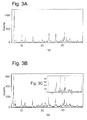
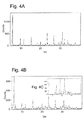
- ketoprofene molecules in the pharmaceutical compositions and in particular in the release means was confirmed by X-ray diffractometry (XRD).
- Figures 3a and 3b show the XRD spectra of zeolite ALSX respectively before (Sample B activated) and after charging with ketoprofene (composition Nr. 2).
- Figures 4a and 4b show the XRD spectra of Zeolite X, respectively before (Sample A activated) and after charging with ketoprofene (composition Nr. 1).
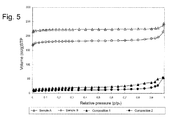
- the activated and charged zeolites (compositions 1 and 2), on the other hand, were subjected to heating treatment at 60°C before the adsorption of N 2 to avoid desorption of the ketoprofene molecules (the melting point of ketoprofene is about 94°C).
- Figure 5 shows the N 2 adsorption isotherms obtained for the zeolites before (Samples A and B) and after charging (compositions 1 and 2).
- the decrease in the surface accessible to gaseous nitrogen together with the reduction in the volume accessible of the pores (Table 4) show that the ketoprofene molecules are situated both inside the pores and on the surface of both zeolites.
- Table 4 N 2 adsorption measurements Sample Surface (BET) m 2 g -1 Pore volume Cm 3 g -1 A. 660 0.377 Composition 1* 60.3 0.083 B. 543 0.374 Composition 2* 36.4 0.077
- ketoprofene molecules are incorporated in the pores of zeolite ALSX were obtained from comparing the FTIR spectrum of ketoprofene with the spectra of the ALSX zeolites before (Sample B) and after charging (composition 2).
- the spectra were recorded with a Thermofinnigan NICOLET 380 spectrometer and are indicated in Figure 6 .
- the arrows in Figure 6b indicate the absorption peaks of the IR radiations characteristic of ketoprofene molecules which are visible in the spectrum of composition 2 ( Figure 6 , spectrum b).
- the spectra of zeolite X, before (Sample A) and after charging of ketoprofene (composition 1) are very similar to those shown in figure 6 with reference to zeolite ALSX and for this reason are not indicated.
- thermogravimetric measurements Shimadzu DTG60 instrument
- the thermogravimetric data confirm the complete charging of ketoprofene in the zeolites.
- the thermogravimetric plots of zeolite ALSX before (Sample B) and after charging (composition 2) are indicated in Figure 7 .
- the greatest weight loss by heating is observed between 25°C and 430°C, probably corresponding to a combined effect of evaporation of the residual solvent, degradation of the molecules of the drug and desorption of the fraction of water molecules and ketoprofene adsorbed on the surface.
- the remaining ketoprofene is totally removed from the composition within the temperature range of 430°C - 900°C.
- the weight loss within this temperature range indicates that the molecules of the drug are quite strongly adsorbed on the surface of the zeolite.
- thermogravimetric behaviour of zeolite X before (Sample A) and after charging with ketoprofene (composition 1) is very similar to that observed for zeolite ALSX (not shown).
- Table 5. - Thermogravimetric analysis (weight loss percentages referring to the total weight of the zeolite charged with ketoprofene). 25-430 431-513 514-900 25-900 (°C) (°C) (°C) (°C) Composition 1 -25.14% -4.6% -3.7% -33.4% Composition 2 -25.14% -4.8% -3.3% -33.2%
- compositions 1 and 2 were dispersed in a solution of HCl 0.1 N (pH 1.0 - to simulate conditions of gastric acidity). The dispersion was kept under continuous stirring, at 37°C for 90 minutes. 26.7 ml of a buffer solution consisting of an aqueous solution of Na 2 HPO 4 (0.2 M) and NaOH (0.1 N), were subsequently added to the dispersion, which raised the pH to a value of 5.0.
- the elution was monitored with the UV detector at a wave-length of 260 nm. Each chromatographic passage had a duration of 10 minutes. Under the above operating conditions, the ketoprofene showed a retention time of 5.4 minutes.
- the calibration curve was constructed using, as external standards, 4 solutions at a concentration of ketoprofene within the range of 10-50 ⁇ M, plus a blank.
- Figure 8 and Figure 9 show the graphs relating to the dependence of the released quantity of ketoprofene in relation to the time, under the in vitro test conditions, for zeolite X (composition 1) and for zeolite ALSX (composition 2).
- ketoprofene The completion of the release of ketoprofene is observed only with the subsequent addition of buffer solution, i.e. when a pH value of about 6.8 is reached.
Landscapes
- Health & Medical Sciences (AREA)
- Chemical & Material Sciences (AREA)
- Pharmacology & Pharmacy (AREA)
- Veterinary Medicine (AREA)
- Public Health (AREA)
- General Health & Medical Sciences (AREA)
- Medicinal Chemistry (AREA)
- Animal Behavior & Ethology (AREA)
- Life Sciences & Earth Sciences (AREA)
- General Chemical & Material Sciences (AREA)
- Organic Chemistry (AREA)
- Nuclear Medicine, Radiotherapy & Molecular Imaging (AREA)
- Chemical Kinetics & Catalysis (AREA)
- Inorganic Chemistry (AREA)
- Epidemiology (AREA)
- Rheumatology (AREA)
- Pain & Pain Management (AREA)
- Engineering & Computer Science (AREA)
- Bioinformatics & Cheminformatics (AREA)
- Medicinal Preparation (AREA)
- Acyclic And Carbocyclic Compounds In Medicinal Compositions (AREA)
- Pharmaceuticals Containing Other Organic And Inorganic Compounds (AREA)
Applications Claiming Priority (1)
| Application Number | Priority Date | Filing Date | Title |
|---|---|---|---|
| IT001930A ITMI20071930A1 (it) | 2007-10-05 | 2007-10-05 | Composizioni farmaceutiche a base di zeoliti porose quali mezzi di rilascio di molecole farmacologicamente attive e relativo uso |
Publications (2)
| Publication Number | Publication Date |
|---|---|
| EP2044931A2 true EP2044931A2 (fr) | 2009-04-08 |
| EP2044931A3 EP2044931A3 (fr) | 2010-05-05 |
Family
ID=40184896
Family Applications (1)
| Application Number | Title | Priority Date | Filing Date |
|---|---|---|---|
| EP08165800A Withdrawn EP2044931A3 (fr) | 2007-10-05 | 2008-10-03 | Compositions pharmaceutiques basées sur des zéolithes poreux en tant que supports de libération de molécules actives pharmacologiquement et utilisation associée |
Country Status (4)
| Country | Link |
|---|---|
| US (1) | US20090098208A1 (fr) |
| EP (1) | EP2044931A3 (fr) |
| JP (1) | JP2009102319A (fr) |
| IT (1) | ITMI20071930A1 (fr) |
Cited By (2)
| Publication number | Priority date | Publication date | Assignee | Title |
|---|---|---|---|---|
| WO2015100508A1 (fr) * | 2013-12-31 | 2015-07-09 | Universidad De Santiago De Chile | Dispositif sous-dermal pour le stockage et la libération continue d'un composé anticancéreux pour les chiens, contenu dans des nanoparticules et des microparticules de zéolites naturelles et dans un milieu huileux |
| WO2015157875A1 (fr) * | 2014-04-17 | 2015-10-22 | Universidad De Santiago De Chile | Dispositif de libération sous-cutané pour la prévention, le traitement et la surveillance de parasites chez des espèces animales |
Citations (1)
| Publication number | Priority date | Publication date | Assignee | Title |
|---|---|---|---|---|
| WO2002100420A2 (fr) | 2001-06-08 | 2002-12-19 | Universita' Degli Studi Di Napoli 'federico Ii' | Compositions pharmaceutiques a base de zeolite contenant du zinc et de l'erythromycine, destinees au traitement de l'acne |
Family Cites Families (2)
| Publication number | Priority date | Publication date | Assignee | Title |
|---|---|---|---|---|
| DE3228485A1 (de) * | 1982-07-30 | 1984-02-02 | Henkel KGaA, 4000 Düsseldorf | Antacida sowie verwendung von zeolithischen molekularsieben zur herstellung von antacida und bei der bekaempfung von hyperaciditaet |
| IT1216570B (it) * | 1988-04-08 | 1990-03-08 | Vectorpharma Int | Composizione farmaceutiche a rilascio controllato e procedimento per la loro preparazione. |
-
2007
- 2007-10-05 IT IT001930A patent/ITMI20071930A1/it unknown
-
2008
- 2008-10-03 JP JP2008280492A patent/JP2009102319A/ja active Pending
- 2008-10-03 EP EP08165800A patent/EP2044931A3/fr not_active Withdrawn
- 2008-10-06 US US12/246,341 patent/US20090098208A1/en not_active Abandoned
Patent Citations (1)
| Publication number | Priority date | Publication date | Assignee | Title |
|---|---|---|---|---|
| WO2002100420A2 (fr) | 2001-06-08 | 2002-12-19 | Universita' Degli Studi Di Napoli 'federico Ii' | Compositions pharmaceutiques a base de zeolite contenant du zinc et de l'erythromycine, destinees au traitement de l'acne |
Cited By (2)
| Publication number | Priority date | Publication date | Assignee | Title |
|---|---|---|---|---|
| WO2015100508A1 (fr) * | 2013-12-31 | 2015-07-09 | Universidad De Santiago De Chile | Dispositif sous-dermal pour le stockage et la libération continue d'un composé anticancéreux pour les chiens, contenu dans des nanoparticules et des microparticules de zéolites naturelles et dans un milieu huileux |
| WO2015157875A1 (fr) * | 2014-04-17 | 2015-10-22 | Universidad De Santiago De Chile | Dispositif de libération sous-cutané pour la prévention, le traitement et la surveillance de parasites chez des espèces animales |
Also Published As
| Publication number | Publication date |
|---|---|
| JP2009102319A (ja) | 2009-05-14 |
| ITMI20071930A1 (it) | 2009-04-06 |
| US20090098208A1 (en) | 2009-04-16 |
| EP2044931A3 (fr) | 2010-05-05 |
Similar Documents
| Publication | Publication Date | Title |
|---|---|---|
| Rimoli et al. | Synthetic zeolites as a new tool for drug delivery | |
| Suriyanon et al. | Selective adsorption mechanisms of antilipidemic and non-steroidal anti-inflammatory drug residues on functionalized silica-based porous materials in a mixed solute | |
| Ambrogi et al. | Improvement of dissolution rate of piroxicam by inclusion into MCM-41 mesoporous silicate | |
| CA2848006C (fr) | Adsorbant de phosphate nanoparticulaire a base de maghemite ou de maghemite/magnetite, production et utilisations de celui-ci | |
| CN1061348C (zh) | 一种喹啉羧酸盐酸盐的新结晶型体及其制法和药物制剂 | |
| Kevadiya et al. | Biopolymer–clay hydrogel composites as drug carrier: Host–guest intercalation and in vitro release study of lidocaine hydrochloride | |
| RS20060168A (sr) | Polimorfni oblici rifaksimina, postupci za njegovu proizvodnju i njegova upotreba u medicinskim preparatima | |
| da Rocha et al. | Understanding the effect of UV light in systems containing clay minerals and tetracycline | |
| Iliescu et al. | Hybrid materials based on montmorillonite and citostatic drugs: Preparation and characterization | |
| Panda et al. | In-vitro release kinetics and stability of anticardiovascular drugs-intercalated layered double hydroxide nanohybrids | |
| CN107771084A (zh) | 非晶金属‑有机框架 | |
| CA2516471A1 (fr) | Composes organiques ferriques, utilisations desdits composes et procedes de fabrication associes | |
| CZ302210B6 (cs) | Nesolvatovaná@krystalická@forma@@@@O@@@@hydroxyethyl@@rapamycinu@@zpusob@její@prípravy@a@farmaceutická@kompozice@obsahující@tuto@krystalickou@formu | |
| EP2603076A2 (fr) | Cadre de métal organique antibactérien | |
| JP2010516684A5 (fr) | ||
| EP2029148A2 (fr) | Carbone antimicrobien | |
| RS63411B1 (sr) | Organska anjonska litijum-jonska kokristalna jedinjenja i supstance | |
| Yang et al. | β-Cyclodextrin metal-organic framework as a green carrier to improve the dissolution, bioavailability, and liver protective effect of luteolin | |
| EP2044931A2 (fr) | Compositions pharmaceutiques basées sur des zéolithes poreux en tant que supports de libération de molécules actives pharmacologiquement et utilisation associée | |
| TW200815458A (en) | Process for purifying Tacrolimus | |
| Rajkumar et al. | Montmorillonite/Poly (L-Lactide) microcomposite spheres as reservoirs of antidepressant drugs and their controlled release property | |
| JPS63502663A (ja) | 獣医用治療組成物 | |
| Unuata et al. | Phyto-Fabrication of Zinc Oxide Nanoparticles Using Senna occidentalis: Comprehensive Characterization, Phytochemical Profiling, and Antimicrobial Assessment | |
| JPH08277216A (ja) | 粉末剤および薬物の放出速度制御方法 | |
| Huang et al. | Encapsulation of toxic liquid molecules and adsorption of water pollutants by a versatile pre-organized single crystalline coating material |
Legal Events
| Date | Code | Title | Description |
|---|---|---|---|
| PUAI | Public reference made under article 153(3) epc to a published international application that has entered the european phase |
Free format text: ORIGINAL CODE: 0009012 |
|
| AK | Designated contracting states |
Kind code of ref document: A2 Designated state(s): AT BE BG CH CY CZ DE DK EE ES FI FR GB GR HR HU IE IS IT LI LT LU LV MC MT NL NO PL PT RO SE SI SK TR |
|
| AX | Request for extension of the european patent |
Extension state: AL BA MK RS |
|
| PUAL | Search report despatched |
Free format text: ORIGINAL CODE: 0009013 |
|
| AK | Designated contracting states |
Kind code of ref document: A3 Designated state(s): AT BE BG CH CY CZ DE DK EE ES FI FR GB GR HR HU IE IS IT LI LT LU LV MC MT NL NO PL PT RO SE SI SK TR |
|
| AX | Request for extension of the european patent |
Extension state: AL BA MK RS |
|
| AKY | No designation fees paid | ||
| REG | Reference to a national code |
Ref country code: DE Ref legal event code: 8566 |
|
| STAA | Information on the status of an ep patent application or granted ep patent |
Free format text: STATUS: THE APPLICATION IS DEEMED TO BE WITHDRAWN |
|
| 18D | Application deemed to be withdrawn |
Effective date: 20101106 |