EP2046049A2 - Verfahren und System für Hochgeschwindigkeitsbildverarbeitung - Google Patents
Verfahren und System für Hochgeschwindigkeitsbildverarbeitung Download PDFInfo
- Publication number
- EP2046049A2 EP2046049A2 EP08159172A EP08159172A EP2046049A2 EP 2046049 A2 EP2046049 A2 EP 2046049A2 EP 08159172 A EP08159172 A EP 08159172A EP 08159172 A EP08159172 A EP 08159172A EP 2046049 A2 EP2046049 A2 EP 2046049A2
- Authority
- EP
- European Patent Office
- Prior art keywords
- image
- code table
- module
- coding
- pixel
- Prior art date
- Legal status (The legal status is an assumption and is not a legal conclusion. Google has not performed a legal analysis and makes no representation as to the accuracy of the status listed.)
- Ceased
Links
Images
Classifications
-
- H—ELECTRICITY
- H04—ELECTRIC COMMUNICATION TECHNIQUE
- H04N—PICTORIAL COMMUNICATION, e.g. TELEVISION
- H04N19/00—Methods or arrangements for coding, decoding, compressing or decompressing digital video signals
- H04N19/90—Methods or arrangements for coding, decoding, compressing or decompressing digital video signals using coding techniques not provided for in groups H04N19/10-H04N19/85, e.g. fractals
-
- H—ELECTRICITY
- H04—ELECTRIC COMMUNICATION TECHNIQUE
- H04N—PICTORIAL COMMUNICATION, e.g. TELEVISION
- H04N19/00—Methods or arrangements for coding, decoding, compressing or decompressing digital video signals
- H04N19/10—Methods or arrangements for coding, decoding, compressing or decompressing digital video signals using adaptive coding
- H04N19/102—Methods or arrangements for coding, decoding, compressing or decompressing digital video signals using adaptive coding characterised by the element, parameter or selection affected or controlled by the adaptive coding
- H04N19/13—Adaptive entropy coding, e.g. adaptive variable length coding [AVLC] or context adaptive binary arithmetic coding [CABAC]
-
- H—ELECTRICITY
- H04—ELECTRIC COMMUNICATION TECHNIQUE
- H04N—PICTORIAL COMMUNICATION, e.g. TELEVISION
- H04N19/00—Methods or arrangements for coding, decoding, compressing or decompressing digital video signals
- H04N19/10—Methods or arrangements for coding, decoding, compressing or decompressing digital video signals using adaptive coding
- H04N19/169—Methods or arrangements for coding, decoding, compressing or decompressing digital video signals using adaptive coding characterised by the coding unit, i.e. the structural portion or semantic portion of the video signal being the object or the subject of the adaptive coding
- H04N19/17—Methods or arrangements for coding, decoding, compressing or decompressing digital video signals using adaptive coding characterised by the coding unit, i.e. the structural portion or semantic portion of the video signal being the object or the subject of the adaptive coding the unit being an image region, e.g. an object
- H04N19/174—Methods or arrangements for coding, decoding, compressing or decompressing digital video signals using adaptive coding characterised by the coding unit, i.e. the structural portion or semantic portion of the video signal being the object or the subject of the adaptive coding the unit being an image region, e.g. an object the region being a slice, e.g. a line of blocks or a group of blocks
-
- H—ELECTRICITY
- H04—ELECTRIC COMMUNICATION TECHNIQUE
- H04N—PICTORIAL COMMUNICATION, e.g. TELEVISION
- H04N19/00—Methods or arrangements for coding, decoding, compressing or decompressing digital video signals
- H04N19/10—Methods or arrangements for coding, decoding, compressing or decompressing digital video signals using adaptive coding
- H04N19/169—Methods or arrangements for coding, decoding, compressing or decompressing digital video signals using adaptive coding characterised by the coding unit, i.e. the structural portion or semantic portion of the video signal being the object or the subject of the adaptive coding
- H04N19/186—Methods or arrangements for coding, decoding, compressing or decompressing digital video signals using adaptive coding characterised by the coding unit, i.e. the structural portion or semantic portion of the video signal being the object or the subject of the adaptive coding the unit being a colour or a chrominance component
-
- H—ELECTRICITY
- H04—ELECTRIC COMMUNICATION TECHNIQUE
- H04N—PICTORIAL COMMUNICATION, e.g. TELEVISION
- H04N19/00—Methods or arrangements for coding, decoding, compressing or decompressing digital video signals
- H04N19/42—Methods or arrangements for coding, decoding, compressing or decompressing digital video signals characterised by implementation details or hardware specially adapted for video compression or decompression, e.g. dedicated software implementation
- H04N19/436—Methods or arrangements for coding, decoding, compressing or decompressing digital video signals characterised by implementation details or hardware specially adapted for video compression or decompression, e.g. dedicated software implementation using parallelised computational arrangements
-
- H—ELECTRICITY
- H04—ELECTRIC COMMUNICATION TECHNIQUE
- H04N—PICTORIAL COMMUNICATION, e.g. TELEVISION
- H04N19/00—Methods or arrangements for coding, decoding, compressing or decompressing digital video signals
- H04N19/50—Methods or arrangements for coding, decoding, compressing or decompressing digital video signals using predictive coding
- H04N19/593—Methods or arrangements for coding, decoding, compressing or decompressing digital video signals using predictive coding involving spatial prediction techniques
Definitions
- the present invention relates to image compression/decoding technology, in particular to a method for processing image at high speed and a system using the same.
- Image transmission technology plays a role in a growing number of scenarios with the development of information technology.
- Raw image data must undergo compression so that the limited transmission bandwidth can transmit a large amount of image information.
- An image restored from compressed image data is required to be exactly the same as the original one in many application situations, which require that the compression methods must not cause loss of information. In other words, they must be lossless.
- a variety of lossless compression standards for image compression have been proposed, for example, GIF, JPEG, MPEG, JPEG2000, etc.
- GIF a LZW algorithm is mainly adopted in compression, which is suitable for compressing geometrical graphics, while the compression effect is poor for natural images.
- the JPEG lossless compression standard utilizes a 2D prediction model and fulfills a compression process by introducing context to adaptively correct predicted values and performing Golomb coding on residual
- MPEG is a compression algorithm suitable for video data. Although it takes into account similarity between frames of moving images, this algorithm results in blurring during a process of handling artificial graphics like text characters.
- JPEG2000 adopts a scheme of entropy coding after wavelet transformation and quantization.
- JPEG lossless compression uses a 2D prediction model, which implies that pixel information on the preceding row must be temporarily stored during image processing. It will cost considerable overhead resources if the algorithm is implemented in hardware. Further, the use of Hoffman coding or arithmetic coding complicates the realization in hardware. Since the compressed codes of image components are stored successively, it is impossible to processing the components in parallel from the perspective of hardware. This impairs the improvement in compression and decompression efficiency.
- An object of the present invention is to provide a method for processing image at high speed which can simplify algorithm and benefit hardware implementation.
- Another object of the present invention is to provide a system for processing image at high speed which can support image compression/decoding, simplify algorithm and benefit hardware implementation.
- an image compression method comprising steps of: Step A, performing color space transformation on an image to be compressed; Step B, performing intra-row differential pulse code modulation coding on image pixel values obtained at Step A; and Step C, determining whether each of numerical values obtain at Step B is within a preset range of numerical value or not; if it is, performing variable length coding on the numerical value obtained after the intra-row differential pulse code modulation by using a fixed code table; and if it is not, performing variable length coding on the numerical value after the intra-row differential pulse code modulation by using a dynamic code table.
- an image compression system comprising a color space transformation module for performing color space transformation on an image to be compressed, a coding module for performing intra-row differential pulse coding on image pixel component values obtained after the color space transformation, and a determination module for determining whether each of pixel component values obtained after the intra-row differential pulse coding by the coding module is within a preset range of numerical value or and sending a corresponding instruction to the coding module at the same time, the coding module performs variable length coding on the pixel component values obtained after the intra-row differential pulse coding by using a fixed code table or a dynamic code table, according to the instruction from the determination module.
- an image decoding method comprising steps of: Step a, determining whether each of pixel component values of an compressed image belongs to a fixed code table or a dynamic code table, and performing variable length decoding on the pixel component value if an answer is YES, Step b, performing intra-row differential pulse code modulation decoding on pixel component values obtained after the variable length decoding, and Step c, performing inverse color space transformation on the pixel values obtained at Step b.
- an image decoding system comprising a determination module for determining whether each of the pixel component values of an compressed image belongs to a fixed code table or a dynamic code table, and sending a corresponding instruction to a decoding module if it belongs, a decoding module for performing variable length decoding on the pixel component values of the image, and then performing differential pulse code modulation decoding, and a color space transformation module for performing color space transformation on the scaled-up pixel component values.
- the image processing method and system of the present invention have low algorithm complexity and fast compress/decoding process.
- the requirement of real-time video transmission can be met, since a variable length coding/decoding method is adopted, in which a fixed code table and a dynamic code table are combined. Meanwhile, result components of image pixels after the variable length coding are packaged so that these components can be processed in parallel and adjacent processing steps may be performed in the same clock frequency to reduce difficulty and cost in FPGA (Field Programmable Gate Array) or chip implementation.
- FPGA Field Programmable Gate Array
- the steps include first performing color space transformation on an image to be compressed, scaling down the pixel component values of the image to be compressed, performing intra-row differential pulse code modulation encoding, and then performing variable length coding on numerical values having undergone the intra-row differential pulse code modulation encoding in the manner of combining a fixed code table and a dynamic code table.
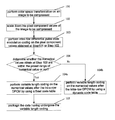
- Fig. 1 is a schematic flowchart of an image compression method of present invention. As shown in Fig. 1, the method comprises the following steps.
- Step 101 performing color space transformation on an image to be compressed.
- RGB image has a pixel format of 8:8:8, i.e., values of R, G and B are each represented with 8 bits, each pixel is subjected to a transformation from RGB to YUV in a row-by-row fashion.
- each of r,g,b is a value obtained by representing the corresponding one of the R, G, B components as an 8bit unsigned integer.
- Step 102 scaling down the pixel component values of the image to be compressed.
- each of the pixel components values is divided by a fixed constant.
- the constant is generally selected to be 1 or 2 for Y component and 1, 2 or 4 for U and V components.
- the algorithm is lossless when the constant is chosen as 1 for the three components.
- Step 103 performing intra-row differential pulse code modulation coding on the pixel component values obtained at Step101 or Step 102.
- DPCM Dynamic Pulse Code Modulation
- the details of the encoding process is, for the first pixel in each row, the Y, U, V values are used directly as encoded values, and for each subsequent pixel in each row, the Y, U, V values minus the corresponding values of the preceding pixel are used as encoded values.
- Step 104 determining whether the numerical values obtain at Step 103 are within the preset range of numerical value or not; if they are, performing variable length coding on the numerical values after the intra-row DPCM by using a fixed code table; and if they are not, performing variable length coding on the numerical values after the intra-row DPCM by using a dynamic code table.
- Variable length coding means assigning a shorter codeword to a value of higher appearance frequency and a longer codeword to a value of lower appearance frequency. It may be adapted to various types of images in a statistic sense.
- the present invention employs a combination of the fixed code table and the dynamic code table in the variable length coding.
- the used fixed code table is one type of exponential Golomb (Exp-Golomb) code and generated according to the following rule:
- the code is deleted from the code table, since 01010 has been used as a prefix for dynamic codes. According to the principle that "the shorter the code length is, the smaller the absolute value of the corresponding numerical value", the code table after the deletion is made corresponding to the post-DPCM numerical values, as shown in Table 1.
- the used dynamic code table is associated with the corresponding components of the preceding pixel and generated by attaching a prefix code 01010 to the head of the binary representation of I (i) DPCM + I i- 1 ,
- I (i) DPCM is the DPCM-coded value of some component of the current pixel
- I i-1 is the value of the corresponding component of the preceding pixel.
- a length of Exp-Golomb code is selected as 1-9, and 31 codes are thus obtained, in which 6 codes are deleted, and the remaining 25 codes correspond to the numerical values -12-+12, respectively.
- the numerical values beyond the range are coded using the dynamic code table.
- the value range for Y components is [0, 255], each of which may be represented as an 8-bit unsigned binary number and coded as a 13-bit binary number including the prefix code.
- the value range for each of U, V components is [-255, 255], each of which may be represented as a 9-bit signed binary number and coded as a 14-bit binary number including the prefix code.
- Step 105 packaging the data obtained by the variable length coding.
- the purpose of packaging the data is to facilitate transmission and processing in hardware.
- the minimum unit of package is CELL having a size of 32 bits.
- Codes carried in each CELL come from only one of Y, U, V components of a pixel. Codes for different components cannot be packaged in one CELL.
- the most significant two bits in a CELL labels the type of the data to indicate which component of the pixel the carried data is. Table 2 shows correspondence between the codes of the most significant two bits and the carried color components of the pixel.
- Table 2 Code (binary) Represented color component 00 Y 01 U 10 V 11 Invalid
- the filling of valid data begins with the third bit.
- the codes are filled in the order that the corresponding pixels are arranged in a row. If the rest bits of a CELL cannot accommodate a next binary code, the rest bits are all set to be 0, and the next binary code is placed in the next CELL. When one row of the image has been completely processed, the rest bits at the end of the last CELL are all set to be 0.
- the three color components may be processed in parallel during hardware implementation.
- the CELL which is first filled up is first transmitted no matter to which component the CELL belongs, regardless an order of the CELLs of the components.
- Respective components of one pixel may be arranged in a final code stream in a random order, while the corresponding components of different pixels may be arranged in the final code stream in the same order that the pixels are arranged in the image.
- the present invention also provides an image compression system comprising:
- the coding module performs variable length coding on the pixel component values obtained after the intra-row differential pulse coding by using a fixed code table or a dynamic code table, according to instruction from the determination module.
- the pixel compression module is optional, and the fixed code table is an Exp-Golomb code table.
- the present invention further provides the corresponding image decoding method and system, which will be particularly explained as follows.
- the image decoding method is actually an inverse operation of the above image compression method and thus comprises the following steps.
- Step 1 un-packaging the compressed image.
- a CELL is taken out of the compressed code stream, and determination is made as to which component of the pixel is represented by the data in the CELL according to the most significant two bits of the CELL with reference to Table 2.
- Step 2 determining whether the pixel component values obtained at Step 1 belong to the fixed code table/the dynamic code table or not, and perform variable length decoding on the unpackaged pixel component values if the answer is YES.
- the decoding is performed with reference to Table 1. If an identical codeword is found in Table 1, the numerical value corresponding to the codeword is the result of the decoding. If no identical codeword is found in Table 1, the first 5 bits of the code are checked to see whether they are 01010 or not. If they are, the value of the unsigned number represented by the following 8 bits minus the corresponding component value of the preceding pixel is taken as the decoded numerical value for Y component, and the value of the signed number represented by the following 9 bits minus the corresponding component value of the preceding pixel is taken as the decoded numerical value for U or V components. If the first 5 bits of the code are not 01010, there is error in the compressed code stream, and error processing is performed.
- Step 3 performing DPCM decoding on the pixel component values obtained after the variable length decoding.
- the value of the first pixel is obtained directly from the UVLC decoding, and the values of the rest pixels are each obtained by adding the UVLC-decoded value and the value of the preceding pixel.
- Step 4 scaling up the pixel component values obtained at Step 3.
- the decoded pixel values are each multiplied by the constant used in the scale-down to restore the original value.
- Step 5 performing an inverse color space transformation on the pixel values obtained at Step 4.
- Each of the pixels is subjected to the inverse transformation from YUV to RGB in a row-by-row fashion using the following formula of YUV to RGB transformation.
- the image decoding system for implementing the above image decoding method is similar to the image compression system, except that the packaging act in the image compression system is replaced with an un-packaging operation in the image decoding system, the coding act is replaced with an decoding act, and the scale-down act is replaced with a scale-up act.
- the image decoding system comprises:
- the fixed code table is the Epx-Golomb code table.
Landscapes
- Engineering & Computer Science (AREA)
- Multimedia (AREA)
- Signal Processing (AREA)
- Computing Systems (AREA)
- Theoretical Computer Science (AREA)
- Compression Or Coding Systems Of Tv Signals (AREA)
- Compression Of Band Width Or Redundancy In Fax (AREA)
- Compression, Expansion, Code Conversion, And Decoders (AREA)
- Color Television Systems (AREA)
Applications Claiming Priority (1)
| Application Number | Priority Date | Filing Date | Title |
|---|---|---|---|
| CN2007101180853A CN101335897B (zh) | 2007-06-28 | 2007-06-28 | 图像压缩/解码方法及系统 |
Publications (2)
| Publication Number | Publication Date |
|---|---|
| EP2046049A2 true EP2046049A2 (de) | 2009-04-08 |
| EP2046049A3 EP2046049A3 (de) | 2011-10-26 |
Family
ID=40160580
Family Applications (1)
| Application Number | Title | Priority Date | Filing Date |
|---|---|---|---|
| EP20080159172 Ceased EP2046049A3 (de) | 2007-06-28 | 2008-06-27 | Verfahren und System für Hochgeschwindigkeitsbildverarbeitung |
Country Status (4)
| Country | Link |
|---|---|
| US (1) | US8107752B2 (de) |
| EP (1) | EP2046049A3 (de) |
| JP (1) | JP2009010954A (de) |
| CN (1) | CN101335897B (de) |
Cited By (1)
| Publication number | Priority date | Publication date | Assignee | Title |
|---|---|---|---|---|
| WO2016022920A1 (en) * | 2014-08-07 | 2016-02-11 | Qualcomm Incorporated | System and method for reordering of prefixes and suffixes in variable length coding to increase throughput |
Families Citing this family (16)
| Publication number | Priority date | Publication date | Assignee | Title |
|---|---|---|---|---|
| EP2222224B1 (de) * | 2007-11-21 | 2017-06-28 | Edda Technology, Inc. | Verfahren und system zur interaktiven perkutanen operationsplanung vor der operation |
| CN101820549B (zh) * | 2010-03-19 | 2011-10-19 | 西安电子科技大学 | 基于jpeg2000标准的高速实时处理算术熵编码系统 |
| CN101917622B (zh) * | 2010-08-24 | 2012-09-05 | 中国科学院光电技术研究所 | 14bit位宽图像压缩硬件编码器 |
| JP5285682B2 (ja) * | 2010-11-29 | 2013-09-11 | シャープ株式会社 | 画像符号化装置、画像符号化方法 |
| CN102427524A (zh) * | 2011-10-10 | 2012-04-25 | 广东威创视讯科技股份有限公司 | 基于网络交换的多路ip视频编码卡 |
| CN102427523A (zh) * | 2011-10-10 | 2012-04-25 | 广东威创视讯科技股份有限公司 | 基于fpga芯片的多路ip视频编码卡 |
| CN103369312B (zh) * | 2012-03-27 | 2017-04-12 | 富士通株式会社 | 图像压缩方法和装置 |
| CN103237225B (zh) * | 2013-05-10 | 2016-04-20 | 上海国茂数字技术有限公司 | 利用yuv与rgb空间联合修正视频编解码误差的方法 |
| US9539005B2 (en) * | 2013-11-08 | 2017-01-10 | C.R. Bard, Inc. | Surgical fastener deployment system |
| CN106817584A (zh) * | 2016-12-23 | 2017-06-09 | 深圳市紫光同创电子有限公司 | 一种基于fpga的mjpeg压缩实现方法和fpga |
| US11412235B2 (en) * | 2019-10-10 | 2022-08-09 | Tencent America LLC | Color transform for video coding |
| KR20230117266A (ko) | 2019-10-11 | 2023-08-07 | 베이징 다지아 인터넷 인포메이션 테크놀로지 컴퍼니 리미티드 | 4:4:4 크로마 포맷의 비디오 코딩 방법 및 장치 |
| CN111726634B (zh) * | 2020-07-01 | 2022-08-05 | 成都傅立叶电子科技有限公司 | 基于fpga的高分辨率视频图像压缩传输方法及系统 |
| US11689743B2 (en) * | 2020-11-12 | 2023-06-27 | Tencent America LLC | Method and apparatus for video coding |
| CN113989398A (zh) * | 2021-10-29 | 2022-01-28 | 赛诺威盛科技(北京)股份有限公司 | Ct数据无损压缩、解压方法、系统、电子设备及存储介质 |
| CN116055750B (zh) * | 2023-04-03 | 2023-06-27 | 厦门视诚科技有限公司 | 一种减少视频传输带宽的无损编解码系统和方法 |
Family Cites Families (18)
| Publication number | Priority date | Publication date | Assignee | Title |
|---|---|---|---|---|
| JP3190755B2 (ja) * | 1993-01-22 | 2001-07-23 | 株式会社東芝 | 復号装置 |
| KR0155784B1 (ko) * | 1993-12-16 | 1998-12-15 | 김광호 | 영상데이타의 적응형 가변장 부호화/복호화방법 |
| US6031938A (en) | 1995-04-26 | 2000-02-29 | Canon Kabushiki Kaisha | Image encoding apparatus with selective Markov and predictive coding |
| JP3432039B2 (ja) * | 1995-04-26 | 2003-07-28 | キヤノン株式会社 | 画像符号化方法及びその装置 |
| JP3420389B2 (ja) * | 1995-06-05 | 2003-06-23 | キヤノン株式会社 | 画像符号化方法及びその装置 |
| JPH09116765A (ja) * | 1995-10-16 | 1997-05-02 | Matsushita Electric Ind Co Ltd | 画像データ符号化方法及び装置 |
| US6002438A (en) * | 1996-10-25 | 1999-12-14 | Texas Instruments Incorporated | Method and apparatus for storing decoded video information |
| US6285796B1 (en) * | 1997-11-03 | 2001-09-04 | Intel Corporation | Pseudo-fixed length image compression scheme |
| US6862278B1 (en) * | 1998-06-18 | 2005-03-01 | Microsoft Corporation | System and method using a packetized encoded bitstream for parallel compression and decompression |
| JP2000115782A (ja) * | 1998-10-06 | 2000-04-21 | Canon Inc | 符号化装置及び方法及び記憶媒体 |
| US6292114B1 (en) * | 1999-06-10 | 2001-09-18 | Intel Corporation | Efficient memory mapping of a huffman coded list suitable for bit-serial decoding |
| US6654419B1 (en) * | 2000-04-28 | 2003-11-25 | Sun Microsystems, Inc. | Block-based, adaptive, lossless video coder |
| JP3817135B2 (ja) * | 2000-12-27 | 2006-08-30 | 株式会社リコー | 画像データ符号化方法 |
| JP2002209111A (ja) * | 2001-01-04 | 2002-07-26 | Mitsubishi Electric Corp | 画像符号化装置、画像通信システムおよびプログラム記録媒体 |
| US6987807B2 (en) * | 2002-04-19 | 2006-01-17 | Seiko Epson Corporation | Frame compression using differential codes and an escape code |
| CN1214649C (zh) * | 2003-09-18 | 2005-08-10 | 中国科学院计算技术研究所 | 用于视频预测残差系数编码的熵编码方法 |
| CN1589023A (zh) * | 2004-08-06 | 2005-03-02 | 联合信源数字音视频技术(北京)有限公司 | 一种基于上下文的多码表变长编解码方法及编解码装置 |
| US20070025630A1 (en) * | 2005-07-27 | 2007-02-01 | Sung Chih-Ta S | Method and apparatus of image compression |
-
2007
- 2007-06-28 CN CN2007101180853A patent/CN101335897B/zh active Active
-
2008
- 2008-06-27 JP JP2008169268A patent/JP2009010954A/ja active Pending
- 2008-06-27 EP EP20080159172 patent/EP2046049A3/de not_active Ceased
- 2008-06-27 US US12/147,649 patent/US8107752B2/en active Active
Cited By (1)
| Publication number | Priority date | Publication date | Assignee | Title |
|---|---|---|---|---|
| WO2016022920A1 (en) * | 2014-08-07 | 2016-02-11 | Qualcomm Incorporated | System and method for reordering of prefixes and suffixes in variable length coding to increase throughput |
Also Published As
| Publication number | Publication date |
|---|---|
| CN101335897A (zh) | 2008-12-31 |
| US8107752B2 (en) | 2012-01-31 |
| US20090003690A1 (en) | 2009-01-01 |
| CN101335897B (zh) | 2010-08-25 |
| JP2009010954A (ja) | 2009-01-15 |
| EP2046049A3 (de) | 2011-10-26 |
Similar Documents
| Publication | Publication Date | Title |
|---|---|---|
| EP2046049A2 (de) | Verfahren und System für Hochgeschwindigkeitsbildverarbeitung | |
| US6285796B1 (en) | Pseudo-fixed length image compression scheme | |
| US7782960B2 (en) | DCT compression using Golomb-Rice coding | |
| CN100576195C (zh) | 以无损方式对数字图像和音频数据解码的系统和方法 | |
| US20030021485A1 (en) | Apparatus and method for encoding digital image data in a lossless manner | |
| US10531110B2 (en) | Encoder, decoder and method | |
| US20110033126A1 (en) | Method for improving the performance of embedded graphics coding | |
| CN107483850B (zh) | 一种低延迟的高清数字图像传输方法 | |
| CN101653004A (zh) | 从编码比特流选择性地解码预定数据单元的解码器 | |
| US20140112589A1 (en) | Encoder, decoder and method | |
| EP1461771A1 (de) | Kompression von transformationskoeffizienten mehrerer scanbereiche | |
| US5764357A (en) | Zero-run-length encoder with shift register | |
| KR102219133B1 (ko) | 컴팩트한 비트 평면(bit-plane) 데이터 압축을 위한 인코더, 디코더 및 부호화 방법 | |
| JP3957829B2 (ja) | 動画像情報の圧縮方法およびそのシステム | |
| JPH0487460A (ja) | 画像処理装置 | |
| JP3647899B2 (ja) | 画像伝送方法 | |
| AU2003287730A1 (en) | Run length encoded digital image | |
| JP3269186B2 (ja) | 画像符号化装置 | |
| KR100295802B1 (ko) | 복수의가변장부호화테이블을이용한영상데이터압축장치 | |
| JPH0822063B2 (ja) | 画像信号の符号化装置 | |
| JP4238408B2 (ja) | 画像圧縮装置 | |
| Argyriou | DNA based image coding | |
| KR20190091181A (ko) | 이미지 처리 장치 | |
| JPH0822062B2 (ja) | 画像信号の符号化装置 | |
| JP2012074898A (ja) | 画像符号化装置および画像復号装置及びそれらのその制御方法 |
Legal Events
| Date | Code | Title | Description |
|---|---|---|---|
| PUAI | Public reference made under article 153(3) epc to a published international application that has entered the european phase |
Free format text: ORIGINAL CODE: 0009012 |
|
| AK | Designated contracting states |
Kind code of ref document: A2 Designated state(s): AT BE BG CH CY CZ DE DK EE ES FI FR GB GR HR HU IE IS IT LI LT LU LV MC MT NL NO PL PT RO SE SI SK TR |
|
| AX | Request for extension of the european patent |
Extension state: AL BA MK RS |
|
| PUAL | Search report despatched |
Free format text: ORIGINAL CODE: 0009013 |
|
| AK | Designated contracting states |
Kind code of ref document: A3 Designated state(s): AT BE BG CH CY CZ DE DK EE ES FI FR GB GR HR HU IE IS IT LI LT LU LV MC MT NL NO PL PT RO SE SI SK TR |
|
| AX | Request for extension of the european patent |
Extension state: AL BA MK RS |
|
| RIC1 | Information provided on ipc code assigned before grant |
Ipc: H04N 7/34 20060101ALI20110922BHEP Ipc: H04N 11/04 20060101ALI20110922BHEP Ipc: H04N 7/26 20060101AFI20110922BHEP |
|
| 17P | Request for examination filed |
Effective date: 20120426 |
|
| AKX | Designation fees paid |
Designated state(s): AT BE BG CH CY CZ DE DK EE ES FI FR GB GR HR HU IE IS IT LI LT LU LV MC MT NL NO PL PT RO SE SI SK TR |
|
| 17Q | First examination report despatched |
Effective date: 20120612 |
|
| STAA | Information on the status of an ep patent application or granted ep patent |
Free format text: STATUS: THE APPLICATION HAS BEEN REFUSED |
|
| 18R | Application refused |
Effective date: 20150920 |