EP2046908B1 - Schmelzklebemittel mit metathesiertem ungesättigtem polyolesterwachs - Google Patents
Schmelzklebemittel mit metathesiertem ungesättigtem polyolesterwachs Download PDFInfo
- Publication number
- EP2046908B1 EP2046908B1 EP07796817.0A EP07796817A EP2046908B1 EP 2046908 B1 EP2046908 B1 EP 2046908B1 EP 07796817 A EP07796817 A EP 07796817A EP 2046908 B1 EP2046908 B1 EP 2046908B1
- Authority
- EP
- European Patent Office
- Prior art keywords
- metathesized
- wax
- composition
- polyol ester
- oil
- Prior art date
- Legal status (The legal status is an assumption and is not a legal conclusion. Google has not performed a legal analysis and makes no representation as to the accuracy of the status listed.)
- Not-in-force
Links
- GLRTXHQQPRSWGT-UHFFFAOYSA-N CC(C)C1=C(C)C(C(C)C)=CCC1 Chemical compound CC(C)C1=C(C)C(C(C)C)=CCC1 GLRTXHQQPRSWGT-UHFFFAOYSA-N 0.000 description 1
- MWWNHUVCHNJZPF-UHFFFAOYSA-N CC(C)c1c(C)c(C(C)C)ccc1 Chemical compound CC(C)c1c(C)c(C(C)C)ccc1 MWWNHUVCHNJZPF-UHFFFAOYSA-N 0.000 description 1
Images





Classifications
-
- C—CHEMISTRY; METALLURGY
- C09—DYES; PAINTS; POLISHES; NATURAL RESINS; ADHESIVES; COMPOSITIONS NOT OTHERWISE PROVIDED FOR; APPLICATIONS OF MATERIALS NOT OTHERWISE PROVIDED FOR
- C09J—ADHESIVES; NON-MECHANICAL ASPECTS OF ADHESIVE PROCESSES IN GENERAL; ADHESIVE PROCESSES NOT PROVIDED FOR ELSEWHERE; USE OF MATERIALS AS ADHESIVES
- C09J11/00—Features of adhesives not provided for in group C09J9/00, e.g. additives
- C09J11/08—Macromolecular additives
-
- C—CHEMISTRY; METALLURGY
- C09—DYES; PAINTS; POLISHES; NATURAL RESINS; ADHESIVES; COMPOSITIONS NOT OTHERWISE PROVIDED FOR; APPLICATIONS OF MATERIALS NOT OTHERWISE PROVIDED FOR
- C09J—ADHESIVES; NON-MECHANICAL ASPECTS OF ADHESIVE PROCESSES IN GENERAL; ADHESIVE PROCESSES NOT PROVIDED FOR ELSEWHERE; USE OF MATERIALS AS ADHESIVES
- C09J191/00—Adhesives based on oils, fats or waxes; Adhesives based on derivatives thereof
- C09J191/06—Waxes
-
- C—CHEMISTRY; METALLURGY
- C09—DYES; PAINTS; POLISHES; NATURAL RESINS; ADHESIVES; COMPOSITIONS NOT OTHERWISE PROVIDED FOR; APPLICATIONS OF MATERIALS NOT OTHERWISE PROVIDED FOR
- C09J—ADHESIVES; NON-MECHANICAL ASPECTS OF ADHESIVE PROCESSES IN GENERAL; ADHESIVE PROCESSES NOT PROVIDED FOR ELSEWHERE; USE OF MATERIALS AS ADHESIVES
- C09J193/00—Adhesives based on natural resins; Adhesives based on derivatives thereof
- C09J193/04—Rosin
-
- C—CHEMISTRY; METALLURGY
- C08—ORGANIC MACROMOLECULAR COMPOUNDS; THEIR PREPARATION OR CHEMICAL WORKING-UP; COMPOSITIONS BASED THEREON
- C08L—COMPOSITIONS OF MACROMOLECULAR COMPOUNDS
- C08L23/00—Compositions of homopolymers or copolymers of unsaturated aliphatic hydrocarbons having only one carbon-to-carbon double bond; Compositions of derivatives of such polymers
- C08L23/02—Compositions of homopolymers or copolymers of unsaturated aliphatic hydrocarbons having only one carbon-to-carbon double bond; Compositions of derivatives of such polymers not modified by chemical after-treatment
- C08L23/04—Homopolymers or copolymers of ethene
- C08L23/08—Copolymers of ethene
- C08L23/0846—Copolymers of ethene with unsaturated hydrocarbons containing atoms other than carbon or hydrogen
- C08L23/0853—Ethylene vinyl acetate copolymers
-
- C—CHEMISTRY; METALLURGY
- C08—ORGANIC MACROMOLECULAR COMPOUNDS; THEIR PREPARATION OR CHEMICAL WORKING-UP; COMPOSITIONS BASED THEREON
- C08L—COMPOSITIONS OF MACROMOLECULAR COMPOUNDS
- C08L2666/00—Composition of polymers characterized by a further compound in the blend, being organic macromolecular compounds, natural resins, waxes or and bituminous materials, non-macromolecular organic substances, inorganic substances or characterized by their function in the composition
- C08L2666/02—Organic macromolecular compounds, natural resins, waxes or and bituminous materials
-
- C—CHEMISTRY; METALLURGY
- C08—ORGANIC MACROMOLECULAR COMPOUNDS; THEIR PREPARATION OR CHEMICAL WORKING-UP; COMPOSITIONS BASED THEREON
- C08L—COMPOSITIONS OF MACROMOLECULAR COMPOUNDS
- C08L91/00—Compositions of oils, fats or waxes; Compositions of derivatives thereof
-
- C—CHEMISTRY; METALLURGY
- C08—ORGANIC MACROMOLECULAR COMPOUNDS; THEIR PREPARATION OR CHEMICAL WORKING-UP; COMPOSITIONS BASED THEREON
- C08L—COMPOSITIONS OF MACROMOLECULAR COMPOUNDS
- C08L91/00—Compositions of oils, fats or waxes; Compositions of derivatives thereof
- C08L91/06—Waxes
-
- C—CHEMISTRY; METALLURGY
- C08—ORGANIC MACROMOLECULAR COMPOUNDS; THEIR PREPARATION OR CHEMICAL WORKING-UP; COMPOSITIONS BASED THEREON
- C08L—COMPOSITIONS OF MACROMOLECULAR COMPOUNDS
- C08L93/00—Compositions of natural resins; Compositions of derivatives thereof
- C08L93/04—Rosin
-
- Y—GENERAL TAGGING OF NEW TECHNOLOGICAL DEVELOPMENTS; GENERAL TAGGING OF CROSS-SECTIONAL TECHNOLOGIES SPANNING OVER SEVERAL SECTIONS OF THE IPC; TECHNICAL SUBJECTS COVERED BY FORMER USPC CROSS-REFERENCE ART COLLECTIONS [XRACs] AND DIGESTS
- Y10—TECHNICAL SUBJECTS COVERED BY FORMER USPC
- Y10T—TECHNICAL SUBJECTS COVERED BY FORMER US CLASSIFICATION
- Y10T428/00—Stock material or miscellaneous articles
- Y10T428/14—Layer or component removable to expose adhesive
- Y10T428/1419—Wax containing
Definitions
- Hot melt adhesives are useful for bonding articles such as cardboard boxes, bottle labels, and the like.
- Hot melt adhesive compositions are thermoplastic materials that can be heated to a molten state and applied to one or more substrates for bonding.
- Conventional hot melt adhesives form a bond as the molten adhesive cools and solidifies while in contact with the substrates to be bonded.
- Pressure-sensitive hot melt adhesives are applied at elevated temperature, yet remain tacky after cooling and can be bonded to a substrate at room temperature using light pressure.
- Hot melt adhesives typically comprise a polymer resin, a tackifier, and a wax.
- the polymer resin provides the adhesive formulation with its strength and adhesive characteristics.
- Tackifying agents are added to give the adhesive tack and to adjust its viscosity.
- Wax is added to reduce the overall viscosity of the adhesive so that is liquefies upon heating. The wax also helps to control the open time and set speed of the adhesive.
- Waxes that are commonly used in hot melt adhesives include petroleum-derived waxes such as synthetic polyethylene waxes, Fischer-Tropsch waxes, microcrystalline wax, and paraffin waxes. Given that the world's supply of petroleum is finite, it is desirable to provide hot melt adhesive compositions comprising waxes that can be made from renewable starting materials. For example, the replacement of paraffin wax, microcrystalline wax, polyethylene wax, and Fisher-Tropsch wax in hot melt adhesives with waxes based on renewable starting materials is desired.
- the present invention relates to hot melt adhesive compositions comprising a metathesized unsaturated polyol ester wax.
- the metathesized unsaturated polyol ester wax is derived from renewable starting materials such as vegetable oils or animal fats.
- the metathesized unsaturated polyol ester wax replaces a portion or all of a petroleum-derived wax or synthetic wax in various hot melt adhesive compositions.
- Embodiments of the invention may be conventional hot melt adhesives or hot melt pressure-sensitive adhesives (i.e., hot melt PSAs).
- hot melt adhesives are thermoplastic compositions that can be (1) heated to a molten state, (2) applied to a one or more substrates to be bonded, and (3) cooled to form an adhesive bond between the substrates.
- Pressure-sensitive hot melt adhesives are compositions that can be (1) heated to a molten state, (2) applied to a substrate, and (3) cooled to room temperature to form a pressure sensitive adhesive. Due to their pressure sensitive nature, pressure sensitive hot melt adhesives may be bonded at (or near) room temperature using light pressure, for example, light finger pressure. Accordingly, as used herein, the term "pressure-sensitive" is used to designate adhesive materials that will stick to a surface when pressed with light pressure, for example, light finger pressure.
- Conventional and pressure-sensitive hot melt adhesives of the invention typically comprise a polymer resin, a tackifier, and a metathesized unsaturated polyol ester wax.
- the metathesized unsaturated polyol ester wax is hydrogenated.
- the adhesives further include a second wax material such as a synthetic or petroleum-derived wax such as paraffin wax, microcrystalline wax, polyethylene wax, Fischer-Tropsch wax, or a mixture thereof.
- the polymer resin comprises an ethylene vinyl acetate polymer or a styrene-isoprene block copolymer.
- adhesive-coated articles comprising a substrate having a surface that is at least partially coated with a hot melt pressure-sensitive adhesive comprising a metathesized unsaturated polyol ester wax.
- the article comprises: (a) a substrate at least partially coated with a layer of a pressure-sensitive adhesive comprising a hydrogenated metathesized unsaturated polyol ester; and (b) a release liner comprising uncoated polyester film, wherein an uncoated surface of the release liner is in direct contact with the layer of pressure-sensitive adhesive.
- Conventional and pressure-sensitive hot melt adhesives of the invention comprise a polymer resin, a tackifier, and a metathesized unsaturated polyol ester wax.
- the adhesives further include a second wax material such as a synthetic or petroleum-derived wax such as paraffin wax, microcrystalline wax, polyethylene wax, Fischer-Tropsch wax, or a mixture thereof.
- a second wax material such as a synthetic or petroleum-derived wax such as paraffin wax, microcrystalline wax, polyethylene wax, Fischer-Tropsch wax, or a mixture thereof.
- a metathesized unsaturated polyol ester refers to the product obtained when one or more unsaturated polyol ester ingredient(s) are subjected to a metathesis reaction.
- Metathesis is a catalytic reaction that involves the interchange of alkylidene units among compounds containing one or more double bonds (i.e., olefinic compounds) via the formation and cleavage of the carbon-carbon double bonds. Metathesis may occur between two of the same molecules (often referred to as self-metathesis) and/or it may occur between two different molecules (often referred to as cross-metathesis). Self-metathesis may be represented schematically as shown in Equation I.
- Cross-metathesis may be represented schematically as shown in Equation II.
- the unsaturated polyol ester comprises molecules that have more than one carbon-carbon double bond (i.e., a polyunsaturated polyol ester)
- self-metathesis results in oligomerization of the unsaturated polyol ester.
- the self-metathesis reaction results in the formation of metathesis dimers, metathesis trimers, and metathesis tetramers.
- Higher order metathesis oligomers such as metathesis pentamers and metathesis hexamers, may also be formed by continued self-metathesis.
- metathesized unsaturated polyol esters are prepared from one or more unsaturated polyol esters.
- unsaturated polyol ester refers to a compound having two or more hydroxyl groups wherein at least one of the hydroxyl groups is in the form of an ester and wherein the ester has an organic group including at least one carbon-carbon double bond.
- the unsaturated polyol ester can be represented by the general structure (I):
- the unsaturated polyol ester is an unsaturated polyol ester of glycerol.
- Unsaturated polyol esters of glycerol have the general structure (II): where -X, -Y, and -Z are independently selected from the group consisting of:
- R' is a straight or branched chain hydrocarbon having about 50 or less carbon atoms (e.g., about 36 or less carbon atoms or about 26 or less carbon atoms) and at least one carbon-carbon double bond in its chain. In some embodiments, R' is a straight or branched chain hydrocarbon having about 6 carbon atoms or greater (e.g., about 10 carbon atoms or greater or about 12 carbon atoms or greater) and at least one carbon-carbon double bond in its chain. In some embodiments, R' may have two or more carbon-carbon double bonds in its chain. In other embodiments, R' may have three or more double bonds in its chain.
- R' has 17 carbon atoms and 1 to 3 carbon-carbon double bonds in its chain.
- R" is a saturated straight or branched chain hydrocarbon having about 50 or less carbon atoms (e.g., about 36 or less carbon atoms or about 26 or less carbon atoms). In some embodiments, R" is a saturated straight or branched chain hydrocarbon having about 6 carbon atoms or greater (e.g., about 10 carbon atoms or greater or about 12 carbon atoms or greater. In exemplary embodiments, R" has 15 carbon atoms or 17 carbon atoms.
- Sources of unsaturated polyol esters of glycerol include synthesized oils, natural oils (e.g., vegetable oils, algae oils, and animal fats), combinations of these, and the like.
- vegetable oils include canola oil, rapeseed oil, coconut oil, corn oil, cottonseed oil, olive oil, palm oil, peanut oil, safflower oil, sesame oil, soybean oil, sunflower oil, linseed oil, palm kernel oil, tung oil, castor oil, combinations of these, and the like.
- animal fats include lard, tallow, chicken fat, yellow grease, fish oil, combinations of these, and the like.
- a representative example of a synthesized oil includes tall oil, which is a byproduct of wood pulp manufacture.
- the vegetable oil is soybean oil, for example, refined, bleached, and deodorized soybean oil (i.e., RBD soybean oil).
- Soybean oil is an unsaturated polyol ester of glycerol that typically comprises about 95% weight or greater (e.g., 99% weight or greater) triglycerides of fatty acids.
- Major fatty acids in the polyol esters of soybean oil include saturated fatty acids, for example, palmitic acid (hexadecanoic acid) and stearic acid (octadecanoic acid), and unsaturated fatty acids, for example, oleic acid (9-octadecenoic acid), linoleic acid (9, 12-octadecadienoic acid), and linolenic acid (9,12,15-octadecatrienoic acid).
- Soybean oil is a highly unsaturated vegetable oil with many of the triglyceride molecules having at least two unsaturated fatty acids (i.e., a polyunsaturated triglyceride).
- an unsaturated polyol ester is self-metathesized in the presence of a metathesis catalyst to form a metathesized composition.
- the metathesized composition comprises one or more of: metathesis monomers, metathesis dimers, metathesis trimers, metathesis tetramers, metathesis pentamers, and higher order metathesis oligomers (e.g., metathesis hexamers).
- a metathesis dimer refers to a compound formed when two unsaturated polyol ester molecules are covalently bonded to one another by a self-metathesis reaction.
- the molecular weight of the metathesis dimer is greater than the molecular weight of the individual unsaturated polyol ester molecules from which the dimer is formed.
- a metathesis trimer refers to a compound formed when three unsaturated polyol ester molecules are covalently bonded together by metathesis reactions.
- a metathesis trimer is formed by the cross-metathesis of a metathesis dimer with an unsaturated polyol ester.
- a metathesis tetramer refers to a compound formed when four unsaturated polyol ester molecules are covalently bonded together by metathesis reactions.
- a metathesis tetramer is formed by the cross-metathesis of a metathesis trimer with an unsaturated polyol ester.
- Metathesis tetramers may also be formed, for example, by the cross-metathesis of two metathesis dimers. Higher order metathesis products may also be formed. For example, metathesis pentamers and metathesis hexamers may also be formed.
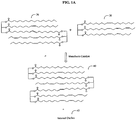
- FIGS. 1-1B An exemplary metathesis reaction scheme is shown in FIGS. 1-1B .
- triglyceride 30 and triglyceride 32 are self metathesized in the presence of a metathesis catalyst 34 to form metathesis dimer 36 and internal olefin 38.
- metathesis dimer 36 may further react with another triglyceride molecule 30 to form metathesis trimer 40 and internal olefin 42.
- metathesis trimer 40 may further react with another triglyceride molecule 30 to form metathesis tetramer 44 and internal olefin 46.
- the self-metathesis results in the formation of a distribution of metathesis monomers, metathesis dimers, metathesis trimers, metathesis tetramers, and higher order metathesis oligomers.
- metathesis monomers which may comprise unreacted triglyceride, or triglyceride that has reacted in the metathesis reaction but has not formed an oligomer.
- the self-metathesis reaction also results in the formation of intenal olefin compounds that may be linear or cyclic.
- FIG. 1C shows representative examples of certain linear and cyclic internal olefins 38, 42, 46 that may be formed during a self-metathesis reaction.
- the linear and cyclic olefins would typically be converted to the corresponding saturated linear and cyclic hydrocarbons.
- the linear/cyclic olefins and saturated linear/cyclic hydrocarbons may remain in the metathesized polyol ester or they may be removed or partially removed from the metathesized polyol ester using known stripping techniques. It should be understood that FIG. 1 provides merely exemplary embodiments of metathesis reaction schemes and compositions that may result therefrom.
- the relative amounts of monomers, dimers, trimers, tetramers, pentamers, and higher order oligomers may be determined by chemical analysis of the metathesized polyol ester including, for example, by liquid chromatography, specifically gel permeation chromatography (GPC).
- GPC gel permeation chromatography
- the relative amount of monomers, dimers, trimers, tetramers and higher unit oligomers may be characterized, for example, in terms of "area %" or wt.%. That is, an area percentage of a GPC chromatograph can be correlated to weight percentage.
- the metathesized unsaturated polyol ester comprises at least about 30 area % or wt.% tetramers and/or other higher unit oligomers or at least about 40 area % or wt.% tetramers and/or other higher unit oligomers. In some embodiments, the metathesized unsaturated polyol ester comprises no more than about 60 area % or wt.% tetramers and/or other higher unit oligomers or no more than about 50 area % or wt.% tetramers and/or other higher unit oligomers.
- the metathesized unsaturated polyol ester comprises no more than about 1 area % or wt.% tetramers and/or other higher unit oligomers. In some embodiments, the metathesized unsaturated polyol ester comprises at least about 5 area % or wt.% dimers or at least about 15 area % or wt.% dimers. In some embodiments, the metathesized unsaturated polyol ester comprises no more than about 25 area % or wt.% dimers. In some of these embodiments, the metathesized unsaturated polyol ester comprises no more than about 20 area % or wt.% dimers or no more than about 10 area % or wt.% dimers.
- the metathesized unsaturated polyol ester comprises at least 1 area % or wt.% trimers. In some of these embodiments, the metathesized unsaturated polyol ester comprises at least about 10 area % or wt.% trimers. In some embodiments, the metathesized unsaturated polyol ester comprises no more than about 20 area % or wt.% trimers or no more than about 10 area % or wt.% trimers. According to some of these embodiments, the metathesized unsaturated polyol ester comprises no more than 1 area % or wt.% trimers.
- the unsaturated polyol ester is partially hydrogenated before being metathesized.
- the soybean oil is partially hydrogenated to achieve an iodine value (IV) of about 120 or less before subjecting the partially hydrogenated soybean oil to metathesis.
- the hydrogenated metathesized polyol ester has an iodine value (IV) of about 100 or less, for example, about 90 or less, about 80 or less, about 70 or less, about 60 or less, about 50 or less, about 40 or less, about 30 or less, about 20 or less, about 10 or less or about 5 or less.
- IV iodine value
- the self-metathesis of unsaturated polyol esters is typically conducted in the presence of a catalytically effective amount of a metathesis catalyst.
- the term "metathesis catalyst” includes any catalyst or catalyst system that catalyzes a metathesis reaction. Any known or future-developed metathesis catalyst may be used, alone or in combination with one or more additional catalysts.
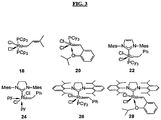
- Exemplary metathesis catalysts include metal carbene catalysts based upon transition metals, for example, ruthenium, molybdenum, osmium, chromium, rhenium, and tungsten. Referring to FIG. 2 , exemplary ruthenium-based metathesis catalysts include those represented by structures 12 (commonly known as Grubbs's catalyst), 14 and 16. Referring to FIG.
- structures 18, 20, 22, 24, 26, and 28 represent additional ruthenium-based metathesis catalysts.
- structures 60, 62, 64, 66, and 68 represent additional ruthenium-based metathesis catalysts.
- catalysts C627, C682, C697, C712, and C827 represent still additional ruthenium-based catalysts.
- general structures 50 and 52 represent additional ruthenium-based metathesis catalysts of the type reported in Chemical & Engineering News; February 12, 2007, at pages 37-47 . In the structures of FIGS.
- Ph is phenyl
- Mes is mesityl
- py is pyridine
- Cp is cyclopentyl
- Cy is cyclohexyl.
- Techniques for using the metathesis catalysts are known in the art (see, for example, U.S. Patent Nos. 7,102,047 ; 6,794,534 ; 6,696,597 ; 6,414,097 ; 6,306,988 ; 5,922,863 ; 5,750,815 ; and metathesis catalysts with ligands in U.S. Publication No. 2007/0004917 A1 ).
- Metathesis catalysts as shown, for example, in FIGS. 2-5 are manufactured by Materia, Inc. (Pasadena, CA).
- Additional exemplary metathesis catalysts include, without limitation, metal carbene complexes selected from the group consisting of molybdenum, osmium, chromium, rhenium, and tungsten.
- the term "complex" refers to a metal atom, such as a transition metal atom, with at least one ligand or complexing agent coordinated or bound thereto.
- a ligand typically is a Lewis base in metal carbene complexes useful for alkyne- or alkene-metathesis.
- Typical examples of such ligands include phosphines, halides and stabilized carbenes.
- Some metathesis catalysts may employ plural metals or metal co-catalysts (e.g., a catalyst comprising a tungsten halide, a tetraalkyl tin compound, and an organoaluminum compound).
- a catalyst comprising a tungsten halide, a tetraalkyl tin compound, and an organoaluminum compound.
- An immobilized catalyst can be used for the metathesis process.
- An immobilized catalyst is a system comprising a catalyst and a support, the catalyst associated with the support. Exemplary associations between the catalyst and the support may occur by way of chemical bonds or weak interactions (e.g. hydrogen bonds, donor acceptor interactions) between the catalyst, or any portions thereof, and the support or any portions thereof. Support is intended to include any material suitable to support the catalyst.
- immobilized catalysts are solid phase catalysts that act on liquid or gas phase reactants and products. Exemplary supports are polymers, silica or alumina. Such an immobilized catalyst may be used in a flow process. An immobilized catalyst can simplify purification of products and recovery of the catalyst so that recycling the catalyst may be more convenient.
- the metathesis process can be conducted under any conditions adequate to produce the desired metathesis products. For example, stoichiometry, atmosphere, solvent, temperature and pressure can be selected to produce a desired product and to minimize undesirable byproducts.
- the metathesis process may be conducted under an inert atmosphere.
- an inert gaseous diluent can be used.
- the inert atmosphere or inert gaseous diluent typically is an inert gas, meaning that the gas does not interact with the metathesis catalyst to substantially impede catalysis.
- particular inert gases are selected from the group consisting of helium, neon, argon, nitrogen and combinations thereof.
- substantially inert solvents include, without limitation, aromatic hydrocarbons, such as benzene, toluene, xylenes, etc.; halogenated aromatic hydrocarbons, such as chlorobenzene and dichlorobenzene; aliphatic solvents, including pentane, hexane, heptane, cyclohexane, etc.; and chlorinated alkanes, such as dichloromethane, chloroform, dichloroethane, etc.
- a ligand may be added to the metathesis reaction mixture.
- the ligand is selected to be a molecule that stabilizes the catalyst, and may thus provide an increased turnover number for the catalyst.
- the ligand can alter reaction selectivity and product distribution.
- ligands examples include Lewis base ligands, such as, without limitation, trialkylphosphines, for example tricyclohexylphosphine and tributyl phosphine; triarylphosphines, such as triphenylphosphine; diarylalkylphosphines, such as, diphenylcyclohexylphosphine; pyridines, such as 2,6-dimethylpyridine, 2,4,6-trimethylpyridine; as well as other Lewis basic ligands, such as phosphine oxides and phosphinites. Additives may also be present during metathesis that increase catalyst lifetime.
- Lewis base ligands such as, without limitation, trialkylphosphines, for example tricyclohexylphosphine and tributyl phosphine
- triarylphosphines such as triphenylphosphine
- diarylalkylphosphines such as, dipheny
- the molar ratio of the unsaturated polyol ester to catalyst may range from about 5:1 to about 10,000,000:1 or from about 50:1 to 500,000:1. In some embodiments, an amount of about 1 to about 10 ppm, or about 2 ppm to about 5 ppm, of the metathesis catalyst per double bond of the starting composition (i.e., on a mole/mole basis) is used.
- the metathesis reaction temperature may be a rate-controlling variable where the temperature is selected to provide a desired product at an acceptable rate.
- the metathesis temperature may be greater than -40°C, may be greater than about -20°C, and is typically greater than about 0°C or greater than about 20°C.
- the metathesis reaction temperature is less than about 150°C, typically less than about 120°C.
- An exemplary temperature range for the metathesis reaction ranges from about 20°C to about 120°C.
- the metathesis reaction can be run under any desired pressure. Typically, it will be desirable to maintain a total pressure that is high enough to keep the cross-metathesis reagent in solution. Therefore, as the molecular weight of the cross-metathesis reagent increases, the lower pressure range typically decreases since the boiling point of the cross-metathesis reagent increases.
- the total pressure may be selected to be greater than about 10 kPa, in some embodiments greater than about 30 kP, or greater than about 100 kPa. Typically, the reaction pressure is no more than about 7000 kPa, in some embodiments no more than about 3000 kPa. An exemplary pressure range for the metathesis reaction is from about 100 kPa to about 3000 kPa.
- the metathesis reaction is catalyzed by a system containing both a transition and a non-transition metal component.
- the most active and largest number of catalyst systems are derived from Group VI A transition metals, for example, tungsten and molybdenum.
- the unsaturated polyol ester is partially hydrogenated before it is subjected to the metathesis reaction. Partial hydrogenation of the unsaturated polyol ester reduces the number of double bonds that are available for in the subsequent metathesis reaction.
- the unsaturated polyol ester is metathesized to form a metathesized unsaturated polyol ester, and the metathesized unsaturated polyol ester is then hydrogenated (e.g., partially or fully hydrogenated) to form a hydrogenated metathesized unsaturated polyol ester.
- Hydrogenation may be conducted according to any known method for hydrogenating double bond-containing compounds such as vegetable oils.
- the unsaturated polyol ester or metathesized unsaturated polyol ester is hydrogenated in the presence of a nickel catalyst that has been chemically reduced with hydrogen to an active state.
- a nickel catalyst that has been chemically reduced with hydrogen to an active state.
- supported nickel hydrogenation catalysts include those available under the trade designations "NYSOFACT”, “NYSOSEL”, and “NI 5248 D” (from Englehard Corporation, Iselin, NH).
- Additional supported nickel hydrogenation catalysts include those commercially available under the trade designations "PRICAT 9910", “PRICAT 9920", “PRICAT 9908”, “PRICAT 9936” (from Johnson Matthey Catalysts, Ward Hill, MA).
- the hydrogenation catalyst comprising, for example, nickel, copper, palladium, platinum, molybdenum, iron, ruthenium, osmium, rhodium, or iridium. Combinations of metals may also be used. Useful catalyst may be heterogeneous or homogeneous. In some embodiments, the catalysts are supported nickel or sponge nickel type catalysts.
- the hydrogenation catalyst comprises nickel that has been chemically reduced with hydrogen to an active state (i.e., reduced nickel) provided on a support.
- the support comprises porous silica (e.g., kieselguhr, infusorial, diatomaceous, or siliceous earth) or alumina.
- the catalysts are characterized by a high nickel surface area per gram of nickel.
- the particles of supported nickel catalyst are dispersed in a protective medium comprising hardened triacylglyceride, edible oil, or tallow.
- the supported nickel catalyst is dispersed in the protective medium at a level of about 22 wt.% nickel.
- the supported nickel catalysts are of the type reported in U.S. Patent No. 3,351,566 (Taylor et al. ). These catalysts comprise solid nickel-silica having a stabilized high nickel surface area of 45 to 60 sq. meters per gram and a total surface area of 225 to 300 sq. meters per gram.
- the catalysts are prepared by precipitating the nickel and silicate ions from solution such as nickel hydrosilicate onto porous silica particles in such proportions that the activated catalyst contains 25 wt.% to 50 wt.% nickel and a total silica content of 30 wt.% to 90 wt%. The particles are activated by calcining in air at 600° F to 900° F, then reducing with hydrogen.
- catalysts having a high nickel content are described in EP 0 168 091 , wherein the catalyst is made by precipitation of a nickel compound. A soluble aluminum compound is added to the slurry of the precipitated nickel compound while the precipitate is maturing. After reduction of the resultant catalyst precursor, the reduced catalyst typically has a nickel surface area of the order of 90 to 150 sq. m per gram of total nickel.
- the catalysts have a nickel/aluminum atomic ratio in the range of 2 to 10 and have a total nickel content of more than about 66% by weight.
- Nickel/alumina/silica catalysts are described in EP 0 167 201 .
- the reduced catalysts have a high nickel surface area per gram of total nickel in the catalyst.
- Nickel/silica hydrogenation catalysts are described in U.S. Patent No. 6,846,772 .
- the catalysts are produced by heating a slurry of particulate silica (e.g. kieselguhr) in an aqueous nickel amine carbonate solution for a total period of at least 200 minutes at a pH above 7.5, followed by filtration, washing, drying, and optionally calcination.
- the nickel/silica hydrogenation catalysts are reported to have improved filtration properties.
- U.S. Patent No. 4,490,480 reports high surface area nickel/alumina hydrogenation catalysts having a total nickel content of 5% to 40% wt.
- supported nickel hydrogenation catalysts include those available under the trade designations "NYSOFACT”, “NYSOSEL”, and “NI 5248 D” (from Englehard Corporation, Iselin, NH). Additional supported nickel hydrogenation catalysts include those commercially available under the trade designations "PRICAT 9910”, “PRICAT 9920”, “PRICAT 9908”, “PRICAT 9936” (from Johnson Matthey Catalysts, Ward Hill, MA).
- Hydrogenation may be carried out in a batch or in a continuous process and may be partial hydrogenation or complete hydrogenation.
- a vacuum is pulled on the headspace of a stirred reaction vessel and the reaction vessel is charged with the material to be hydrogenated (e.g., RBD soybean oil or metathesized RBD soybean oil).
- the material is then heated to a desired temperature.
- the temperature ranges from about 50° C to 350° C, for example, about 100° C to 300° C or about 150° C to 250° C.
- the desired temperature may vary, for example, with hydrogen gas pressure. Typically, a higher gas pressure will require a lower temperature.
- the hydrogenation catalyst is weighed into a mixing vessel and is slurried in a small amount of the material to be hydrogenated (e.g., RBD soybean oil or metathesized RBD soybean oil).
- the material to be hydrogenated reaches the desired temperature
- the slurry of hydrogenation catalyst is added to the reaction vessel.
- Hydrogen gas is then pumped into the reaction vessel to achieve a desired pressure of H 2 gas.
- the H 2 gas pressure ranges from about 15 to 3000 psig, for example, about 15 psig to 90 psig. As the gas pressure increases, more specialized high-pressure processing equipment may be required.
- the hydrogenation reaction begins and the temperature is allowed to increase to the desired hydrogenation temperature (e.g., about 120° C to 200° C) where it is maintained by cooling the reaction mass, for example, with cooling coils.
- the reaction mass is cooled to the desired filtration temperature.
- the amount of hydrogenation catalysts is typically selected in view of a number of factors including, for example, the type of hydrogenation catalyst used, the amount of hydrogenation catalyst used, the degree of unsaturation in the material to be hydrogenated, the desired rate of hydrogenation, the desired degree of hydrogenation (e.g., as measure by iodine value (IV)), the purity of the reagent, and the H 2 gas pressure.
- the hydrogenation catalyst is used in an amount of about 10 wt.% or less, for example, about 5 wt.% or less or about 1 wt.% or less.
- the hydrogenation catalyst may be removed from the hydrogenated product using known techniques, for example, by filtration.
- the hydrogenation catalyst is removed using a plate and frame filter such as those commercially available from Sparkler Filters, Inc., Conroe TX.
- the filtration is performed with the assistance of pressure or a vacuum.
- a filter aid may be used.
- a filter aid may be added to the metathesized product directly or it may be applied to the filter.
- Representative examples of filtering aids include diatomaceous earth, silica, alumina, and carbon.
- the filtering aid is used in an amount of about 10 wt.% or less, for example, about 5 wt.% or less or about 1 wt.% or less.
- Other filtering techniques and filtering aids may also be employed to remove the used hydrogenation catalyst.
- the hydrogenation catalyst is removed using centrifugation followed by decantation of the product.
- the iodine value (IV), also referred to as the iodine number, provides a measure of the degree of unsaturation of a compound.
- the IV measures the amount of iodine absorbed in a given time by a compound or mixture.
- an unsaturated material such as an unsaturated polyol ester
- the IV is thus a measure of the unsaturation, or the number of double bonds, of that compound or mixture.
- Obtaining the IV for a compound or mixture is a well-known procedure.
- Representative unsaturated polyol esters are known to have an IV in the range indicated in parentheses as follows: soybean oil (125-138); canola oil (110-115); sunflower oil (122-139); corn oil (99-121); palm oil (45-56); and palm kernel oil (14-24).
- the unsaturated polyol ester is partially hydrogenated before being metathesized such that the number of double bonds that are available in the subsequent metathesis reaction is reduced.
- soybean oil is partially hydrogenated to achieve an iodine value (IV) of about 120 or less before subjecting the partially hydrogenated soybean oil to metathesis.
- the unsaturated polyol ester is metathesized to form a metathesized unsaturated polyol ester, and the resulting metathesized unsaturated polyol ester is then partially or fully hydrogenated.
- metathesized soybean oil is partially hydrogenated to achieve an iodine value (IV) of about 120 or less, about 100 or less, about 90 or less, about 80 or less, about 70 or less, about 60 or less, about 50 or less, about 40 or less, about 30 or less, about 20 or less, about 10 or less, or even about 5 or less.
- the hydrogenation catalyst may be removed from the hydrogenated product using known techniques, for example, by filtration.
- the hydrogenation catalyst is removed using a plate and frame filter such as those commercially available from Sparkle Filters, Inc., Conroe TX.
- the filtration is performed with the assistance of pressure or a vacuum.
- a filter aid may be used.
- a filter aid may be added to the metathesized product directly or it may be applied to the filter.
- Representative examples of filtering aids include diatomaceous earth, silica, alumina, and carbon.
- the filtering aid is used in an amount of about 10 wt.% or less, for example, about 5 wt.% or less or about 1 wt.% or less.
- Other filtering techniques and filtering aids may also be employed to remove the used hydrogenation catalyst.
- the hydrogenation catalyst is removed using centrifugation followed by decantation of the product.
- Hydrogenation of a metathesized unsaturated polyol ester can impart one or more desirable properties to the metathesized unsaturated polyol ester.
- hydrogenation can be used to increase the melting point of a metathesized unsaturated polyol ester.
- a hydrogenated metathesized unsaturated polyol has a melting point in the range of from about 120°F to about 180°F.
- a hydrogenated metathesized unsaturated polyol has a melting point in the range of from about 120°F to about 160°F.
- a hydrogenated metathesized unsaturated polyol has a melting point of 128°F or greater.
- a hydrogenated metathesized unsaturated polyol has a melting point of 145°F or greater.
- the hydrogenated metathesized polyol ester wax may be included in the hot melt adhesive in any useful amount. Many factors can influence the amount of hydrogenated metathesized polyol ester wax that is used in an adhesive composition of the invention, such as the melting point of the hydrogenated metathesized polyol ester wax, the viscosity of the hydrogenated metathesized polyol ester, the desired adhesive open time, the desired adhesive set time, the desired bond strength and adhesive, and the methodology used to apply the adhesive composition to a substrate.
- the hydrogenated metathesized polyol ester wax will be present in an amount of about 50% weight or less, for example, about 45% by weight or less, about 40% by weight or less, about 35% weight or less, about 30% weight or less, about 25% weight or less, about 20% weight or less, or about 10% weight or less of the adhesive composition.
- the hydrogenated metathesized polyol ester wax is present in an amount ranging from about 1% to about 30%, more typically from about 5% to about 25% by weight of the adhesive composition.
- Hot melt adhesives of the invention typically comprise a polymer resin.
- the polymer resin may be of any polymer type known to be useful in hot melt adhesive compositions.
- Various polymer types may be selected in order to provide adhesive properties including, for example, adhesive strength, flexibility, heat resistance, shear strength, and impact resistance.
- the hot melt adhesives of the invention comprise at least one ethylene polymer, and may comprise a blend of two or more polymer resins.
- ethylene polymer refers to homopolymers, copolymers and terpolymers of ethylene.
- copolymers of ethylene with one or more polar monomers such as vinyl acetate or other vinyl esters of monocarboxylic acids, or acrylic or methacrylic acid or their esters with methanol, ethanol or other alcohols. Included are ethylene vinyl acetate, ethylene methyl acrylate, ethylene n-butyl acrylate, ethylene acrylic acid, ethylene methacrylate, ethylene 2-ethylhexylacrylate, ethylene octene and mixtures and blends thereof. Mixtures of ethylene n-butyl acrylate and ethylene vinyl acetate are particularly preferred.
- polymers that may be useful include homopolymers or copolymers of propylene, octene, hexene, heptene, butene, and ethylene monomers. Preferably these polymers are synthesized by single site catalysis. Metallocene is one example of a single site catalyst suitable for synthesis of polymers utilized in this invention. Dow Chemical sells commercial metallocene catalyzed polymers under the trade name Insight.
- Useful ethylene vinyl acetate polymers typically have a vinyl acetate content from about 10% to about 45 % by weight.
- Ethylene vinyl acetate copolymers are available from Exxon/Mobil under the trade designation "ESCORENE 7510" (a 18.7% VA copolymer from Exxon/Mobil).
- Other examples include ethylene vinylacetate copolymers available under the trade designation “ULTRATHENE” (18% VA copolymer from Equistar Chemicals, Houston Tex.) and ULTRATHENE UE 646-04 (28% VA copolymer).
- ELVAX e.g., Elvax.RTM. 205W, which has a melt index of 800 and vinyl acetate content of about 28% by weight in the copolymer.
- the hot melt adhesives of the invention are pressure-sensitive adhesives.
- Suitable polymer resins for pressure-sensitive adhesives include, for example, styrene-isoprene block copolymers.
- styrene-isoprene block copolymers One useful styrene-isoprene block copolymer is commercially available under the trade designation "VECTOR 4230" from Dexco Polymers LP.
- the styrene-isoprene radial copolymer has a styrene content of about 20.5% weight and a diblock content of about 30% weight.
- SIBS block copolymers i.e., styrene-isoprene-butadiene-styrene block copolymers (e.g., commercially available under the trade designation "KRATON")
- SBS block copolymers i.e., styrene-butadienestyrene
- SIS block copolymers i.e., styrene-isoprene-styrene
- polystyrene resins include, for example, acrylates and alkylacrylates (e.g., ethylene ethyl acrylate (EEA) and ethylene methyl acrylate (EMA) copolymers), and natural or synthetic rubber-based resins (e.g., silicone, polyurethane, chloroprene, butyl, polybutadiene, isoprene, and neoprene).
- acrylates and alkylacrylates e.g., ethylene ethyl acrylate (EEA) and ethylene methyl acrylate (EMA) copolymers
- EOA ethylene ethyl acrylate
- EMA ethylene methyl acrylate
- the polymer resin component of the hot melt adhesive of the invention is typically present in an amount ranging from about 10% to about 60% weight, more typically from about 20% to about 40% weight, and most typically from about 25% to about 35% weight of the adhesive composition. Mixtures of two or more polymer resins may also be useful in some compositions.
- Hot melt adhesive compositions of the invention typically comprise a tackifying resin (also referred to as a "tackifier").
- the tackifier influences wetting, adhesion, and tack in the hot melt adhesive.
- the glass transition temperature (Tg) of the tackifier and its compatibility with the polymer resin influence the degree of tackification achieved.
- the tackifier is typically present in amount ranging from about 10% to about 70% weight, more typically from about 20% to about 60% weight, and most typically from about 30% to about 40% weight of the adhesive composition. Mixtures of two or more tackifying resins may be useful in some compositions.
- Useful tackifying resins may include any compatible resin or mixtures thereof such as natural and modified rosins including, for example, gum rosin, wood rosin, tall oil rosin, distilled rosin, hydrogenated rosin, dimerized rosin, resinates, and polymerized rosin; glycerol and pentaerythritol esters of natural and modified rosins, including, for example the glycerol ester of pale, wood rosin, the glycerol ester of hydrogenated rosin, the glycerol ester of polymerized rosin, the pentaerythritol ester of hydrogenated rosin, and the phenolic-modified pentaerythritol ester of rosin; copolymers and terpolymers of natured terpenes, including, for example, styrene/terpene and alpha methyl styrene/terpene; polyterpene resins having
- rosins and rosin derivatives examples include SYLVALITE RE 110L, SYLVARES RE 115, and SYLVARES RE 104 (available from Arizona Chemical); Dertocal 140 from DRT; Limed Rosin No.1,GB-120, and Pencel C from Arakawa Chemical.
- synthetic hydrocarbon tackifiers include aliphatic olefin derived resins such as those available from Sartomer under the trade designation "WINGTACK” and from Exxon under the trade designation "ESCOREZ 1300".
- a common C5 tackifying resin in this class is a diene-olefin copolymer of piperylene and 2-methyl-2-butene having a softening point of about 95C. This resin is available commercially under the trade designation "WINGTACK 95".
- aromatic hydrocarbon resins that are C9 aromatic/aliphatic olefin-derived.
- the hot melt adhesives of the invention may also comprise a synthetic wax or petroleum-derived wax, for example, paraffin wax, microcrystalline wax, polyethylene wax, Fischer-Tropsch wax, and the like. Selection of the particular wax and the amount of wax in the composition can be made by one of skill in the art with reference to the desired adhesive properties and adhesive application. In many embodiments, the hot melt adhesive comprise about 2:1 to about 3:1 weight ratio of synthetic or petroleum-derived wax to metathesized unsaturated polyol ester wax.
- the hot melt adhesives of the invention may optionally comprise other ingredients including those that are conventionally used in hot melt adhesives.
- additives such as stabilizers, plasticizers, fillers, pigments, and antioxidants may be included.
- small amounts of additional (secondary) tackifiers may also be incorporated in minor amounts into the adhesive compositions of the present invention.
- the hot melt adhesives of the invention are typically prepared by blending the components in the melt until a homogeneous blend is obtained.
- Various methods of blending are known to the art and any method that produces a homogeneous blend is satisfactory.
- the hot melt adhesives of the invention may be used in general bonding applications including, for example, packaging, bottle labeling, and bookbinding applications.
- Packaging formulations may be used to manufacture corrugated cartons, boxes and the like.
- Other applications include nonwoven bonding (e.g., disposable diapers), product assembly, graphic arts, automotive, and tapes and labels.
- the metathesized unsaturated polyol ester wax may partially or totally replace paraffin wax and may provide the formulation with one or more improved properties including increased open time and increased adhesion to coated carton stock.
- the metathesized unsaturated polyol ester wax may partially or totally replace microcrystalline wax and may provide one or more improved properties.
- hot melt PSAs of the invention have low adhesion to polyester film such as Mylar-brand polyester film.
- this property allows untreated polyester film (i.e., polyester film without a surface release layer, such as a silicone release layer) to be used as a release liner against hot melt PSAs of the invention.
- certain adhesive-coated articles such as label stock, which conventionally requires a silicone-coated release liner can now be manufactured using an untreated polyester liner.
- the use of an untreated polyester release liner reduces the cost of the product and additionally reduces the chance for contamination of the pressure-sensitive adhesive, for example, silicone contamination.
- Hot melt adhesives may be applied using numerous methods depending upon the application requirements. Representative techniques include application by nozzle, slot dies, extrusion, wheel, screen printing, melt blowing, and spiral spray. In some embodiments, the hot melt adhesives are extruded in bead form onto a substrate using piston pump or gear pump extrusion equipment. Wheel applicators may also be used for applying hot melt adhesives. Alternatively, the adhesive may be applied by the packaging converter prior to shipment to the packager, i.e., the container comprises a pre-applied adhesive. Following loading of the container, the container may be heat sealed by conventional means or subjected to any alternative source of energy that heats the hot melt adhesive to the desired bonding temperature.
- Metathesized unsaturated polyol ester wax was evaluated for use in certain hot melt adhesive applications.
- the applications were as follows.
- High melt point ( ⁇ 210° F) synthetic polyethylene waxes and Fischer-Tropsch waxes are the most commonly used waxes in hot melt packaging adhesives at levels of about 25% to 35%. These synthetic waxes are used to control the open and set time of the adhesive and contribute to the heat resistance of the adhesive bonds. They are relatively expensive and have been in short supply. As a result adhesive formulators commonly extend (i.e., dilute) the synthetic wax with a paraffin wax. Metathesized unsaturated polyol ester waxes may be used in packaging adhesives in order to replace at least a portion of the paraffin wax extender.
- low application temperature packaging adhesives include a low melt point (140° F to 155° F) paraffin wax as the crystalline component.
- High melt point synthetic waxes are not typically used because they cause the open time to be too short when the hot melt adhesive is applied at 250° F. Because these products do not contain any high melt point synthetic wax, their bonds typically have poor heat resistance and may fail at temperatures above about 120° F. Metathesized polyol ester waxes are inherently slow setting and are useful to extend the open time and set time and provide improved bond heat resistance. 3. As a replacement for a microcrystalline wax in bottle labeling adhesives.
- Metathesized polyol ester waxes may be used to replace microcrystalline waxes in bottle labeling adhesives.
- Comparative examples 4-88-1, 4-88-2, and 4-88-3 are typical packaging adhesive formulations having three different ratios of paraffin wax and synthetic wax.
- Examples 4-88-4, 4-88-5, and 4-88-6 are hot melt adhesive compositions of the invention where the paraffin wax has been replaced with a blend of 33% weight of a metathesized polyol ester wax and 66% weight of hydrogenated soybean oil (referred to herein as 64B wax).
- Comparative Examples 4-88-7, 4-88-8, and 4-88-9 replace the paraffin wax with a generic soybean oil wax.
- the adhesive compositions were tested as follows.
- the heat resistance test characterizes the temperature at which one square inch Kraft paper bonds fail when subjected to a constant 100g force in peel and 500 g force in shear. These are typically referred to as the “Peel Adhesion Failure Temperature” (PAFT), and “Shear Adhesion Failure Temperature” (SAFT).
- PAFT Peel Adhesion Failure Temperature
- SAFT Shear Adhesion Failure Temperature
- the PAFT values were largely unaffected by the amount of paraffin wax or 64B wax in the formulation.
- the PAFT values for soybean wax were observed to decrease with the amount of soybean wax that was added. As a general trend, it was observed that there was a decrease in PAFT when either 64B wax or soybean wax was used to replace the paraffin wax. This may indicate a decrease in bond heat resistance.
- Open time is a measure of the length of time an adhesive will be able to wet out and bond a second substrate after it has been applied to a first substrate. In other words, it measures the maximum amount of time that can elapse after applying the hot melt adhesive and before mating two substrates using the adhesive to form a bond.
- Open time depends on the initial application temperature, the amount of adhesive applied, the bead geometry, and the ambient temperature. In the open time test used herein, a 20 mil film of adhesive that was 2 inches wide and about 10 inches long was applied at a temperature of 350° F. One-half inch strips of paper were then laminated to the molten adhesive at 5 second intervals until the adhesive cooled to a point where it would no longer bond to the paper. The open time is maximum time at which the adhesive bond is capable of tearing fibers from the paper upon removal of the paper from the bond.
- the data shows that the open time of the paraffin wax adhesive does not change as the amount of paraffin wax in the formulation is varied.
- the open time of the adhesives prepared with 64B wax or soybean wax was observed to increase as the amount of the 64B wax or soybean wax increased.
- adhesives comprising 64B wax or soybean wax can have equivalent open time to adhesives comprising paraffin wax.
- Hot melt adhesives were applied in a molten state and were cooled to ambient temperature to form a bond. As the adhesives cool they pass through various stages with different characteristics that are important to bond formation. One way to view these stages is to lay a strip of adhesive on an aluminum plate that is heated on one end and cooled at the other end (i.e., a gradient heat bar) so that a heat gradient from one end to the other is formed. For this test, a bead of adhesive at 350° F was applied to the gradient heat bar and a strip of Kraft paper was immediately applied over the molten bead. Initially, the adhesive bead is molten and the adhesive wets out the entire length of the paper strip ( ⁇ 15 inches in length).
- the adhesive bead with paper attached is then allowed to reach equilibrium with the gradient heat bar. This causes the paper to be firmly bonded at the cold end of the bar and unbonded or lightly bonded at the hot end of the bar (i.e., where the adhesive is molten).
- the paper strip is then slowly peeled from the hot end to the cold end of the bar. Near the hot end, the molten adhesive adheres to both the paper and the heated bar with the adhesive stringing and legging between the two surfaces.
- This stage is called the "hot tack" stage and represents a temperature range where the molten adhesive is fully compatible, without any crystallite formation. Bonds that are disturbed while the adhesive is in the hot tack stage will reform.
- the adhesive cools and eventually enters the "waxy stage" where the adhesive is no longer fluid and most of the adhesive peels away from the paper leaving only a slight stain on the paper.
- the adhesive is less compatible at this temperature. If a bond is disturbed at this stage it will not reform.
- Adhesives with a long waxy stage are less robust but are observed to apply more cleanly than products with a lot of hot tack. As the paper strip continues to be peeled, the adhesive cools further and eventually the paper tears.
- the temperature at which the waxy stage started (also the temperature at which the hot tack stage ends) and the temperature at which the paper tore ("set temperature") were measured.
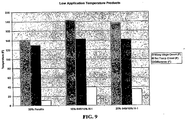
- the results of the gradient bar measurements are shown in FIGS. 7-8 .
- the set temperatures in FIG. 7 indicate that the 64B wax and soy wax adhesives set up slower than the paraffin wax control adhesive when equivalent amounts are used. It was also observed that adhesives with a lower ratio of 64B wax and synthetic wax should have equivalent set times to paraffin based products.
- the difference between the waxy stage onset and the set temperature is characteristic of the length of the waxy stage.
- FIG. 8 shows that the waxy stage increases for all of the products as the high melt point synthetic wax is diluted, but more so for the 64B wax and soybean waxes.
- the increased waxy stage of 64B wax and soybean wax adhesives has the effect of making the bond formation less robust, but the products should machine more cleanly.
- Adhesive bonds were made with a virgin high density corrugated stock from Inland Container Corp. This is a relatively difficult stock to bond to which is useful. to show differences between adhesives, particularly at low temperatures.
- the results in TABLE 1 show that none of the products tore fiber at either 35° F or 140° F, which is not unexpected for this particular formulation.
- the use of 64B wax, instead of paraffin wax, did not significantly improve low temperature performance.
- the bond results at 120° F indicate that both 64B wax and soybean wax based adhesives have less heat resistance than the paraffin products.
- the 64B wax products were noticeably better than soybean wax products and were equivalent to paraffin wax adhesives at lower ratios.
- Adhesive bonds were also made with Hormel Black Label Bacon carton stock. This is a lacquer coated carton stock that tends to show differences between various formulations of hot melt adhesives. The results indicated that the 64B wax-based adhesives have better adhesion to this carton stock at 35° F than either paraffin or soybean based products.
- Example 4-90-1 is a control based upon 100% paraffin wax (Sasol R07152).
- the paraffin wax was replaced by a blend of 64B wax and a high melt point synthetic wax (Sasol H-1) to determine whether open time and rate of set would be comparable.
- the set temperature (from the gradient heat bar test) of the 64B wax-containing adhesives is similar to the control.
- the 4-90-3 adhesive has a similar rate of set to the control using the tackdown test. The most noticeable difference in setting characteristics was the increased waxy stage which makes the bond formation less robust.
- Corrugated bonds were evaluated at 120° F and 140° F, and the two 64B wax-based adhesives were found to be similar to the control based on paraffin wax.
- a bottle labeling adhesive using 64B wax as a replacement for microcrystalline wax was prepared.
- the formula is provided in TABLE 3 along with a comparative formulation.
- Laboratory testing of bottle labeling adhesives is subjective; however, the testing indicated that the 64B wax-based formulation (Example 14-30-2) performed acceptably as a bottle labeling adhesive.
- TABLE 1 Ingredient Description of Ingredient Comp Ex. 4-88-1 Comp Ex. 4-88-2 Comp Ex. 4-88-3 Ex. 4-88-4 Ex. 4-88-5 Ex. 4-88-6 Comp Ex. 4-88-7 Comp Ex. 4-88-8 Comp Ex.
- Example 4-90-1 Example 4-90-2 Example 4-90-3 Metathesized Wax Blend (64B) 0 15 20 Sasol R-7152 wax (Sasol) 30 0 0 Sasol H-l wax (Sasol) 0 15 10 Sylvalite RE100 (rosin ester from Arizona Chemicals) 28 28 28 Sylvares TP2040 (terpene phenolic tackifying resin from Arizona Chemicals) 10 10 10 EVA (28VA-800MI) 32 32 32 Viscosity at 250°F 1070 cps Heat Resistance 100g peel failure temp.
- Example Description 14-30-1 14-30-2 Metathesized Wax Blend (64B) 7 Blend of 33% hydrogenated metathesized soybean oil and 67% hydrogenated soybean oil (Cargill) Microwax 180F 10 soft, microcrystalline wax (Sasol) AC-400 (EVA) 10 10 low viscosity, waxy, EVA polymer (Honeywell) Sylvalite RE100 39.8 39.8 rosin ester tackifier (Arizona Chemicals) Kraton G-1652 12 12 S(EB)S Block copolymer (Krayton Polymers) Polybutene 300 14 15.5 liquid polybutene NH-120 14 15.5 naphthenic oil Irganox 1010 0.2 0.2 Stabilizer (Ciba Specialty Chemicals) Viscosity @ 250°F 2470 2750 Viscosity @ 300°F 740 870 Heat Resistance 100g peel failure temp. (°F) 102 104 500 g shear failure temp (°F) 136 121
- Hot melt adhesive formulations were prepared in solvent and were hand-coated onto 2 mil Mylar-brand polyester (PET) film. It was observed that the adhesive containing metathesized soybean oil (Example 2-1) did not adhere to the Mylar PET film and had to be coated onto biaxially oriented polypropylene film (BOPP) in order to obtain peel and shear data. The dry adhesive coat weight for all samples was 25 grams/m 2 .
- SAFT Shear adhesion failure temperature
- PSTC-1 Pressure Sensitive Tape Council
- Brookfield Thermosel viscosity was tested at 300° F and 350° F using spindle SC4-27 and a DV-I + viscometer. The test data is set forth in TABLE 4.
- TABLE 4 Ingredient Description Example 2-1 Comp. Ex. A Comp. Ex.
- a removable PSA composition (Example 3-1) was prepared and tested as described below.
- the removable PSA formulation was prepared according to the formulation in TABLE 5. The adhesive was then dissolved in solvent at was hand-coated onto 2 mil BOPP film. The dry adhesive coat weight was 25 grams/m 2 .
Landscapes
- Chemical & Material Sciences (AREA)
- Organic Chemistry (AREA)
- Oil, Petroleum & Natural Gas (AREA)
- Adhesives Or Adhesive Processes (AREA)
- Organic Low-Molecular-Weight Compounds And Preparation Thereof (AREA)
Claims (23)
- Eine Stoffzusammensetzung, beinhaltend einen Schmelzkleber, der ein metathesiertes ungesättigtes Polyolesterwachs beinhaltet.
- Zusammensetzung gemäß Anspruch 1, wobei die Schmelzkleberzusammensetzung ein herkömmlicher Schmelzkleber ist.
- Zusammensetzung gemäß Anspruch 1, wobei die Schmelzkleberzusammensetzung ein Schmelzhaftkleber ist.
- Zusammensetzung gemäß Anspruch 1, wobei die Schmelzkleberzusammensetzung ein Kleber mit niedriger Anwendungstemperatur ist.
- Zusammensetzung gemäß Anspruch 1, wobei der Schmelzkleber ein Flaschenetikettierkleber ist.
- Zusammensetzung gemäß Anspruch 1, wobei das metathesierte ungesättigte Polyolesterwachs teilweise hydriert ist.
- Zusammensetzung gemäß Anspruch 1, wobei das metathesierte ungesättigte Polyolesterwachs vollständig hydriert ist.
- Zusammensetzung gemäß Anspruch 6, wobei das teilweise hydrierte, metathesierte ungesättigte Polyolesterwachs eine lodzahl von ungefähr 120 oder weniger aufweist.
- Zusammensetzung gemäß Anspruch 7, wobei das vollständig hydrierte, metathesierte ungesättigte Polyolesterwachs eine lodzahl von ungefähr 10 oder weniger aufweist.
- Zusammensetzung gemäß Anspruch 1, wobei das metathesierte ungesättigte Polyolesterwachs ein metathesiertes natürliches Öl beinhaltet.
- Zusammensetzung gemäß Anspruch 10, wobei das metathesierte natürliche Öl ein metathesiertes pflanzliches Öl oder ein metathesiertes tierisches Fett beinhaltet.
- Zusammensetzung gemäß Anspruch 11, wobei das metathesierte pflanzliche Öl aus der Gruppe, bestehend aus metathesiertem Sojabohnenöl, metathesiertem Canolaöl, metathesiertem Rapsöl, metathesiertem Kokosnussöl, metathesiertem Maisöl, metathesiertem Baumwollsamenöl, metathesiertem Olivenöl, metathesiertem Palmöl, metathesiertem Erdnussöl, metathesiertem Distelöl, metathesiertem Sesamöl, metathesiertem Sojabohnenöl oder metathesiertem Sonnenblumenöl, ausgewählt ist.
- Zusammensetzung gemäß Anspruch 1, wobei das metathesierte ungesättigte Polyolesterwachs Dimere, Trimere, Tetramere und Oligomere höherer Ordnung beinhaltet.
- Zusammensetzung gemäß Anspruch 2, wobei die Schmelzkleberzusammensetzung Folgendes beinhaltet:(a) ein Wachs, beinhaltend einen hydrierten, metathesierten ungesättigten Polyolester;(b) einen Klebrigmacher;(c) ein synthetisches oder aus Erdöl gewonnenes Wachs; und(d) ein Ethylvinylacetatpolymer.
- Zusammensetzung gemäß Anspruch 14, wobei das synthetische oder aus Erdöl gewonnene Wachs Paraffinwachs, mikrokristallines Wachs, Polyethylenwachs oder Fischer-Tropsch-Wachs beinhaltet.
- Zusammensetzung gemäß Anspruch 14, wobei der Klebrigmacher einen oder mehrere von einem Kolophoniumester-Klebrigmacher oder einem Terpen-Phenol-Klebrigmacher beinhaltet.
- Zusammensetzung gemäß Anspruch 3, wobei der Schmelzhaftkleber Folgendes beinhaltet:(a) ein Wachs, beinhaltend einen hydrierten, metathesierten ungesättigten Polyolester;(b) einen Klebrigmacher; und(c) ein Polymer.
- Zusammensetzung gemäß Anspruch 17, wobei das Polymer ein Styrol-Isopren-Blockcopolymer beinhaltet.
- Ein Artikel, beinhaltend ein Substrat mit einer Oberfläche, die mindestens zum Teil mit einem Schmelzhaftkleber beschichtet ist, der ein metathesiertes ungesättigtes Polyolesterwachs beinhaltet.
- Artikel gemäß Anspruch 19, wobei der Artikel Folgendes beinhaltet:(a) ein Substrat, das mindestens zum Teil mit einer Schicht eines Haftklebers beschichtet ist, der ein metathesiertes ungesättigtes Polyolesterwachs beinhaltet; und(b) ein Trennpapier, beinhaltend eine unbeschichtete Polyesterfolie, wobei eine unbeschichtete Oberfläche des Trennpapiers mit der Schicht des Haftklebers in direktem Kontakt steht.
- Artikel gemäß Anspruch 19, wobei das Substrat Papier oder Pappe beinhaltet.
- Artikel gemäß Anspruch 19, wobei der Artikel ein Papieretikett ist.
- Artikel gemäß Anspruch 19, wobei der Haftkleber entfernbar ist.
Applications Claiming Priority (2)
| Application Number | Priority Date | Filing Date | Title |
|---|---|---|---|
| US83023506P | 2006-07-12 | 2006-07-12 | |
| PCT/US2007/015866 WO2008008420A1 (en) | 2006-07-12 | 2007-07-12 | Hot melt adhesive compositions comprising metathesized unsaturated polyol ester wax |
Publications (2)
| Publication Number | Publication Date |
|---|---|
| EP2046908A1 EP2046908A1 (de) | 2009-04-15 |
| EP2046908B1 true EP2046908B1 (de) | 2017-01-11 |
Family
ID=38621960
Family Applications (1)
| Application Number | Title | Priority Date | Filing Date |
|---|---|---|---|
| EP07796817.0A Not-in-force EP2046908B1 (de) | 2006-07-12 | 2007-07-12 | Schmelzklebemittel mit metathesiertem ungesättigtem polyolesterwachs |
Country Status (4)
| Country | Link |
|---|---|
| US (1) | US8344052B2 (de) |
| EP (1) | EP2046908B1 (de) |
| CN (1) | CN101563434B (de) |
| WO (1) | WO2008008420A1 (de) |
Families Citing this family (62)
| Publication number | Priority date | Publication date | Assignee | Title |
|---|---|---|---|---|
| US6645261B2 (en) | 2000-03-06 | 2003-11-11 | Cargill, Inc. | Triacylglycerol-based alternative to paraffin wax |
| US7128766B2 (en) * | 2001-09-25 | 2006-10-31 | Cargill, Incorporated | Triacylglycerol based wax compositions |
| US7192457B2 (en) * | 2003-05-08 | 2007-03-20 | Cargill, Incorporated | Wax and wax-based products |
| CA2592786C (en) | 2005-01-10 | 2013-11-19 | Cargill, Incorporated | Candle and candle wax containing metathesis and metathesis-like products |
| WO2007081987A2 (en) * | 2006-01-10 | 2007-07-19 | Elevance Renewable Sciences, Inc. | Method of making hydrogenated metathesis products |
| BRPI0708675B1 (pt) | 2006-03-07 | 2017-04-04 | Elevance Renewable Sciences | composições compreendendo poliol ésteres insaturados que sofreram metátese e artigos para cuidados pessoais compreendendo as referidas composições |
| WO2008010961A2 (en) | 2006-07-13 | 2008-01-24 | Elevance Renewable Sciences, Inc. | Synthesis of terminal alkenes from internal alkenes and ethylene via olefin metathesis |
| ATE519725T1 (de) * | 2006-10-13 | 2011-08-15 | Elevance Renewable Sciences | Metatheseverfahren mit hydrierung, und damit in zusammenhang stehende zusammensetzungen |
| DK2121546T3 (en) | 2006-10-13 | 2018-03-12 | Elevance Renewable Sciences | Process for preparing omega-dicarboxylic acid olefin derivative by metathesis |
| EP2076484B1 (de) | 2006-10-13 | 2020-01-08 | Elevance Renewable Sciences, Inc. | Synthese von endständigen alkenen aus innenständigen alkenen durch olefin-metathese |
| WO2008048520A2 (en) | 2006-10-13 | 2008-04-24 | Elevance Renewable Sciences, Inc. | Methods of making organic compounds by metathesis and hydrocyanation |
| CA2681802C (en) | 2007-02-16 | 2015-12-08 | Elevance Renewable Sciences, Inc. | Wax compositions and methods of preparing wax compositions |
| US8362125B2 (en) | 2007-04-03 | 2013-01-29 | Henkel Ag & Co. Kgaa | Hot melt adhesive |
| MX2009013053A (es) * | 2007-05-30 | 2010-01-18 | Elevance Renewable Sciences | Ceras de perlas que comprenden particulas pequeñas y velas moldeadas por compresion de lados lisos elaboradas a partir de estas. |
| CA2690811C (en) | 2007-06-15 | 2017-02-28 | Elevance Renewable Sciences, Inc. | Hybrid wax compositions for use in compression molded wax articles such as candles |
| US20090078590A1 (en) | 2008-01-21 | 2009-03-26 | Smith Dennis R | Ultrasecure card package |
| GB0804763D0 (en) * | 2008-03-14 | 2008-04-16 | Givauden Sa | Candle |
| US9382502B2 (en) | 2009-10-12 | 2016-07-05 | Elevance Renewable Sciences, Inc. | Methods of refining and producing isomerized fatty acid esters and fatty acids from natural oil feedstocks |
| US9365487B2 (en) | 2009-10-12 | 2016-06-14 | Elevance Renewable Sciences, Inc. | Methods of refining and producing dibasic esters and acids from natural oil feedstocks |
| US9169447B2 (en) | 2009-10-12 | 2015-10-27 | Elevance Renewable Sciences, Inc. | Methods of refining natural oils, and methods of producing fuel compositions |
| US9051519B2 (en) | 2009-10-12 | 2015-06-09 | Elevance Renewable Sciences, Inc. | Diene-selective hydrogenation of metathesis derived olefins and unsaturated esters |
| US9222056B2 (en) | 2009-10-12 | 2015-12-29 | Elevance Renewable Sciences, Inc. | Methods of refining natural oils, and methods of producing fuel compositions |
| JP6224896B2 (ja) | 2009-10-12 | 2017-11-01 | エレバンス・リニューアブル・サイエンシズ,インコーポレーテッド | 天然油供給原料から燃料を精製および製造する方法 |
| US9000246B2 (en) | 2009-10-12 | 2015-04-07 | Elevance Renewable Sciences, Inc. | Methods of refining and producing dibasic esters and acids from natural oil feedstocks |
| US9175231B2 (en) | 2009-10-12 | 2015-11-03 | Elevance Renewable Sciences, Inc. | Methods of refining natural oils and methods of producing fuel compositions |
| US8735640B2 (en) | 2009-10-12 | 2014-05-27 | Elevance Renewable Sciences, Inc. | Methods of refining and producing fuel and specialty chemicals from natural oil feedstocks |
| WO2011053406A1 (en) * | 2009-10-29 | 2011-05-05 | Exxonmobil Chemical Patents Inc. | Pressure-sensitive hot melt adhesive compositions |
| US20110166370A1 (en) * | 2010-01-12 | 2011-07-07 | Charles Winston Saunders | Scattered Branched-Chain Fatty Acids And Biological Production Thereof |
| CN102906236B (zh) * | 2010-03-10 | 2015-02-25 | 艾勒旺斯可再生科学公司 | 基本不含有脂肪花白的脂类基蜡组合物及其制备方法 |
| EP2371919B1 (de) * | 2010-04-01 | 2012-06-20 | H.B. Fuller Company | Heißschmelzkleber mit einer Mischung aus Pflanzenwachs und Wachs mit hohem Molekulargewicht |
| WO2011135029A1 (en) * | 2010-04-28 | 2011-11-03 | Dsm Ip Assets B.V. | Metathesis crosslinkable coating compositions |
| TR201809108T4 (tr) | 2010-05-12 | 2018-07-23 | Elevance Renewable Sciences | Doğal yağ bazlı işaretleme bileşimleri ve bunların yapım yöntemleri. |
| BR112012031149B1 (pt) * | 2010-06-08 | 2021-01-12 | Oregon State University | construções de adesivos sensíveis a pressão com base em óleo vegetal, métodos para a preparação destas e composição adesiva sensível à pressão |
| WO2012006324A1 (en) | 2010-07-09 | 2012-01-12 | Elevance Renewable Sciences, Inc. | Waxes derived from metathesized natural oils and amines and methods of making |
| MX339493B (es) | 2010-10-25 | 2016-05-26 | Stepan Co | Esteraminas y derivados de la metatesis de aceite natural. |
| US9458411B2 (en) | 2010-11-23 | 2016-10-04 | Cargill, Incorporated | Lipid-based wax compositions substantially free of fat bloom and methods of making |
| BR112013019685A2 (pt) | 2011-02-17 | 2016-10-18 | Procter & Gamble | composições que compreendem misturas de alquil-fenil sulfonatos c10-c13 |
| US20120213956A1 (en) * | 2011-02-23 | 2012-08-23 | Adherent Laboratories, Inc. | Fugitive adhesive and method |
| WO2012128788A1 (en) | 2011-03-24 | 2012-09-27 | Elevance Renewable Sciences, Inc. | Functionalized monomers and polymers |
| US9315748B2 (en) | 2011-04-07 | 2016-04-19 | Elevance Renewable Sciences, Inc. | Cold flow additives |
| WO2013009605A1 (en) | 2011-07-10 | 2013-01-17 | Elevance Renewable Sciences, Inc. | Metallic soap compositions for various applications |
| US9593267B2 (en) | 2011-12-20 | 2017-03-14 | Shell Oil Company | Adhesive compositions and methods of using the same |
| WO2013091079A1 (en) * | 2011-12-24 | 2013-06-27 | Poudrier Hayden | Wax-infused adhesive friction tape |
| IN2014DN05640A (de) | 2012-01-10 | 2015-04-03 | Elevance Renewable Sciences | |
| US9012385B2 (en) | 2012-02-29 | 2015-04-21 | Elevance Renewable Sciences, Inc. | Terpene derived compounds |
| MX2014015460A (es) | 2012-06-20 | 2015-06-23 | Elevance Renewable Sciences | Metodos y composiciones de metatesis de aceites naturales. |
| US9120896B2 (en) | 2012-09-28 | 2015-09-01 | Elevance Renewable Sciences, Inc. | Polymers containing metathesized natural oil derivatives |
| US9388098B2 (en) | 2012-10-09 | 2016-07-12 | Elevance Renewable Sciences, Inc. | Methods of making high-weight esters, acids, and derivatives thereof |
| US20140274832A1 (en) | 2013-03-12 | 2014-09-18 | Elevance Renewable Sciences, Inc. | Maleinized ester derivatives |
| US20150057204A1 (en) | 2013-03-12 | 2015-02-26 | Elevance Renewable Sciences, Inc. | Maleanized Ester Derivatives |
| CN105189722A (zh) * | 2013-03-14 | 2015-12-23 | 埃莱万斯可再生能源科学股份有限公司 | 复分解得到的烯烃和不饱和酯的二烯选择性氢化 |
| EP2981245B1 (de) | 2013-04-05 | 2023-03-01 | The Procter & Gamble Company | Körperpflegezubereitung enthaltend eine pre-emulgierte formulierung |
| CA2937376A1 (en) * | 2014-02-26 | 2015-09-03 | Elevance Renewable Sciences, Inc. | Low-voc compositions and methods of making and using the same |
| JP6438222B2 (ja) * | 2014-06-30 | 2018-12-12 | ヘンケルジャパン株式会社 | ホットメルト接着剤 |
| US9636893B2 (en) * | 2014-08-15 | 2017-05-02 | Xamax Industries, Inc. | Composite thermoplastic laminate |
| US10806688B2 (en) | 2014-10-03 | 2020-10-20 | The Procter And Gamble Company | Method of achieving improved volume and combability using an anti-dandruff personal care composition comprising a pre-emulsified formulation |
| US9993404B2 (en) | 2015-01-15 | 2018-06-12 | The Procter & Gamble Company | Translucent hair conditioning composition |
| MX2017010934A (es) | 2015-02-25 | 2018-01-23 | Procter & Gamble | Estructuras fibrosas que comprenden una composicion suavizante de superficies. |
| AR105299A1 (es) | 2015-07-10 | 2017-09-20 | Procter & Gamble | Composición de cuidado de telas que comprende ésteres de poliol instaurados metatesizado |
| JP6970094B2 (ja) | 2016-01-20 | 2021-11-24 | ザ プロクター アンド ギャンブル カンパニーThe Procter & Gamble Company | モノアルキルグリセリルエーテルを含むヘアコンディショニング組成物 |
| WO2018013151A1 (en) * | 2016-07-11 | 2018-01-18 | The Procter & Gamble Company | Absorbent articles comprising metathesized unsaturated polyol esters |
| US10894932B2 (en) | 2016-08-18 | 2021-01-19 | The Procter & Gamble Company | Fabric care composition comprising glyceride copolymers |
Family Cites Families (169)
| Publication number | Priority date | Publication date | Assignee | Title |
|---|---|---|---|---|
| US1954659A (en) | 1931-08-06 | 1934-04-10 | Will & Baumer Candle Co Inc | Candle and method of making same |
| US1935946A (en) | 1932-04-20 | 1933-11-21 | Procter & Gamble | Candle manufacture |
| US2294229A (en) | 1939-12-12 | 1942-08-25 | George W Fiero | Cosmetic preparations |
| US2468799A (en) | 1943-10-20 | 1949-05-03 | Lever Brothers Ltd | Hydrogenating fat |
| US2784891A (en) | 1956-03-19 | 1957-03-12 | Harvey T Thielke | Coating composition |
| US3448178A (en) * | 1967-09-22 | 1969-06-03 | Nat Starch Chem Corp | Hot melt adhesives comprising ethylene/vinyl acetate copolymers and alpha-pinene/phenol condensation products |
| US3630697A (en) | 1969-07-09 | 1971-12-28 | Sun Oil Co | Wickless candles |
| US3645705A (en) | 1970-03-03 | 1972-02-29 | Kolar Lab Inc | Transparent combustible material suitable for candle bodies |
| DE2054206C3 (de) | 1970-11-04 | 1975-07-24 | Vollmar Ohg Creationen In Wachs, 5308 Rheinbach | Verfahren zum Herstellen von Kerzen |
| US3844706A (en) | 1973-10-30 | 1974-10-29 | E Tsaras | Candles and manufacture thereof |
| US4134718A (en) | 1976-12-10 | 1979-01-16 | Cma, Inc. | Oil-burning illuminating device |
| US4118203A (en) | 1977-05-18 | 1978-10-03 | Shell Oil Company | Wax composition |
| DE2964433D1 (en) | 1978-10-26 | 1983-02-03 | Akzo Nv | A wax composition for entirely or partly replacing carnauba wax or montan wax |
| DE2856277A1 (de) | 1978-12-27 | 1980-07-17 | Henkel Kgaa | Bienenwachsersatz |
| US4314915A (en) | 1979-08-03 | 1982-02-09 | International Flavors & Fragrances Inc. | Uses in perfumery of ether derivatives of indanes |
| JPS57102813A (en) | 1980-12-17 | 1982-06-26 | Takasago Corp | Perfume composition |
| DE3173535D1 (en) | 1981-01-13 | 1986-02-27 | Firmenich & Cie | Use of 2,6,6-trimethyl-cyclohex-2-ene-1-yl-carboxylic-acid methyl ester as a perfuming agent |
| US4390590A (en) | 1981-10-19 | 1983-06-28 | Essex Group, Inc. | Power insertable polyamide-imide coated magnet wire |
| US4507077A (en) | 1982-01-25 | 1985-03-26 | Sapper John M | Dripless candle |
| US4614625A (en) | 1983-02-28 | 1986-09-30 | Lumi-Lite Candle Company, Inc. | Method of imparting color and/or fragrance to candle wax and candle formed therefrom |
| US4545941A (en) | 1983-06-20 | 1985-10-08 | A. E. Staley Manufacturing Company | Co-metathesis of triglycerides and ethylene |
| JPS6023493A (ja) | 1983-07-18 | 1985-02-06 | 高尾 正保 | 精製魚油の製法 |
| DE3343595A1 (de) | 1983-12-02 | 1985-06-13 | Peter 7800 Freiburg Schneeberger | Kerzenfoermiger leuchtkoerper zur aufstellung in kirchen, kapellen oder sonstigen kultischen staetten |
| US4608011A (en) | 1984-04-27 | 1986-08-26 | Comstock Todd M | Candle apparatus |
| US4714496A (en) | 1986-02-18 | 1987-12-22 | National Distillers And Chemical Corporation | Wax compositions |
| US4759709A (en) | 1986-02-18 | 1988-07-26 | National Distillers And Chemical Corporation | Wax compositions |
| EP0265976B1 (de) | 1986-09-25 | 1990-03-14 | Unilever N.V. | Fettsäurezusammensetzung, geeignet zum Pressen von Kerzen |
| US4842648A (en) | 1987-10-22 | 1989-06-27 | Tajchai Phadoemchit | Paraffin wax replacer |
| US4855098A (en) | 1987-12-16 | 1989-08-08 | Ted Taylor | Method of forming candles and candle composition therefor |
| SU1565872A1 (ru) | 1988-07-18 | 1990-05-23 | Всесоюзный Заочный Институт Пищевой Промышленности | Способ получени масел, имитирующих пальмовые |
| US4923708A (en) | 1988-12-30 | 1990-05-08 | Nabisco Brands, Inc. | Method and composition for inhibiting fat bloom in fat based compositions and hard butter |
| US5380544A (en) | 1989-09-20 | 1995-01-10 | Nabisco, Inc. | Production of fat mixtures enriched with triglycerides bearing short, medium and long residues |
| US5258197A (en) | 1989-09-20 | 1993-11-02 | Nabisco, Inc. | Reduced calorie triglyceride mixtures |
| US6273993B1 (en) | 1992-07-01 | 2001-08-14 | Michelman, Inc. | Method of dispersing wax from a hot melt wax-coated paper |
| SI8912204A8 (en) | 1989-11-20 | 1997-08-31 | Do Helios Kemicna Ind Domzale | Process for hydrogenation of oils |
| US5142072A (en) | 1989-12-19 | 1992-08-25 | The Procter & Gamble Company | Selective esterification of long chain fatty acid monoglycerides with medium chain fatty acid anhydrides |
| DE4020483A1 (de) | 1990-06-27 | 1992-01-02 | Hoechst Ag | Mischester und seine verwendung als gleitmittel in kunststoff-formmassen |
| US5171329A (en) | 1991-10-09 | 1992-12-15 | Kuo-Lung Lin | Method for manufacturing a candle |
| DE4133716C1 (de) | 1991-10-11 | 1992-12-03 | Papier-Mettler Inh. Hans-Georg Mettler, 5552 Morbach, De | |
| US5176902A (en) | 1991-12-05 | 1993-01-05 | Elizabeth Arden Company, Division Of Conopco, Inc. | Colored cosmetic sticks of improved hardness |
| JP3067031B2 (ja) | 1992-04-03 | 2000-07-17 | カリフォルニア インスティチュート オブ テクノロジー | オレフィンメタセシス重合方法 |
| US6099877A (en) | 1992-04-10 | 2000-08-08 | Schuppan; Robert L. | Food product that maintains a flame |
| DK119092D0 (da) | 1992-09-25 | 1992-09-25 | Aarhus Oliefabrik As | Overfladebehandlingsmiddel |
| IL104344A (en) | 1992-10-08 | 2000-07-16 | Elharar Shimon | Candle |
| WO1994023836A1 (en) | 1993-04-08 | 1994-10-27 | E.I. Du Pont De Nemours And Company | Catalyst composition and process for the production of unsaturated diesters |
| CA2167814C (en) | 1993-07-22 | 2001-07-17 | Paul E. Sandvick | Repulpable hot melt polymer/wax compositions for fibrous products |
| DE4337030A1 (de) | 1993-10-29 | 1995-05-04 | Henkel Kgaa | Verfahren zur Herstellung von Wachsdispersionen |
| FR2715306B1 (fr) | 1994-01-25 | 1996-03-15 | Oreal | Composition cosmétique ou dermopharmaceutique sous forme de pâte souple et procédé de préparation de ladite composition. |
| EP0685554A1 (de) | 1994-05-29 | 1995-12-06 | CLILCO COSMETICS & PHARMACEUTICALS LTD. | Feste Kerzen auf Ölbasis |
| AUPM652494A0 (en) | 1994-06-28 | 1994-07-21 | Visy Board Properties Pty. Ltd. | Coating for paperboard |
| DE4439509A1 (de) | 1994-11-08 | 1996-05-09 | Beringer Schott Lamai | Gemisch zum Verbrennen |
| DE19511572C2 (de) | 1995-03-29 | 1998-02-26 | Henkel Kgaa | Niedrigviskose Trübungsmittelkonzentrate |
| US5578089A (en) | 1995-04-27 | 1996-11-26 | Lancaster Colony Corporation | Clear candle |
| JPH0914574A (ja) * | 1995-06-30 | 1997-01-17 | Furukawa Electric Co Ltd:The | 推進管の防食保護方法 |
| FR2749589B1 (fr) | 1996-06-07 | 1998-07-31 | Oleagineux Ind | Composition d'enrobage et utilisations dans l'industrie alimentaire et dans l'industrie pharmaceutique |
| CA2258678A1 (en) | 1996-06-19 | 1997-12-24 | Norbert Matzat | Process for producing a paraffin-based object and such an object |
| US5783657A (en) | 1996-10-18 | 1998-07-21 | Union Camp Corporation | Ester-terminated polyamides of polymerized fatty acids useful in formulating transparent gels in low polarity liquids |
| US5753015A (en) | 1996-11-15 | 1998-05-19 | Dixon Ticonderoga Company | Soybean oil marking compositions and methods of making the same |
| US5885600A (en) | 1997-04-01 | 1999-03-23 | Burlington Bio-Medical & Scientific Corp. | Natural insect repellent formula and method of making same |
| AUPO605097A0 (en) | 1997-04-07 | 1997-05-01 | James Cook University Of North Queensland | Food grade wax and process for preparing same |
| US20040076732A1 (en) | 1997-04-07 | 2004-04-22 | James Cook University | Food grade wax and process for preparing same |
| TW411348B (en) | 1997-05-28 | 2000-11-11 | Mitsui Chemicals Inc | Preparation of hydrogenated product of cyclic olefin ring-opening metathesis polymer |
| US5843194A (en) | 1997-07-28 | 1998-12-01 | The Noville Corporation | Clear gel formulation for use in transparent candles |
| US6001286A (en) | 1997-08-28 | 1999-12-14 | Archer Daniels Midland Company | Material for enhancing water tolerance of composite boards |
| US6238926B1 (en) | 1997-09-17 | 2001-05-29 | Cargilll, Incorporated | Partial interesterification of triacylglycerols |
| CA2249508A1 (en) | 1997-10-24 | 1999-04-24 | Unilever Plc | Wax ester compositions |
| US6019804A (en) | 1997-11-25 | 2000-02-01 | S. C. Johnson & Son, Inc. | Compression-molded candle product |
| US6103308A (en) | 1998-04-23 | 2000-08-15 | Gencorp Inc. | Paper coating lubricant |
| US6127326A (en) | 1998-07-31 | 2000-10-03 | American Ingredients Company | Partially saponified triglycerides, their methods of manufacture and use as polymer additives |
| US6258965B1 (en) | 1998-08-03 | 2001-07-10 | Fan Tech Ltd. | Reconstituted meadowfoam oil |
| US20030061760A1 (en) | 2001-03-08 | 2003-04-03 | Bernard Tao | Vegetable lipid-based composition and candle |
| US6284007B1 (en) | 1998-08-12 | 2001-09-04 | Indiana Soybean Board, Inc. | Vegetable lipid-based composition and candle |
| US6696597B2 (en) | 1998-09-01 | 2004-02-24 | Tilliechem, Inc. | Metathesis syntheses of pheromones or their components |
| US6900347B2 (en) | 1998-09-01 | 2005-05-31 | Tilliechem, Inc. | Impurity inhibition in olefin metathesis reactions |
| US6262153B1 (en) | 1998-10-12 | 2001-07-17 | Clariant Finance (Bvi) Limited | Colored wax articles |
| US20020095007A1 (en) | 1998-11-12 | 2002-07-18 | Larock Richard C. | Lewis acid-catalyzed polymerization of biological oils and resulting polymeric materials |
| US6211315B1 (en) | 1998-11-12 | 2001-04-03 | Iowa State University Research Foundation, Inc. | Lewis acid-catalyzed polymerization of biological oils and resulting polymeric materials |
| US6962729B2 (en) * | 1998-12-11 | 2005-11-08 | Lord Corporation | Contact metathesis polymerization |
| US6106597A (en) | 1998-12-18 | 2000-08-22 | Milliken & Company | Wax compositions comprising fatty ester poly(oxyalkylenated) colorants |
| US6022402A (en) | 1998-12-18 | 2000-02-08 | Stephenson; Eugene Kyle | Wax compositions comprising alkenyl succinic anhydride-capped poly (oxyalkylenated) colorants |
| US6503077B2 (en) | 1999-01-04 | 2003-01-07 | Arizona Chemical Company | Gelled articles containing tertiary amide-terminated polyamide |
| US6117476A (en) | 1999-01-04 | 2000-09-12 | Shaul Eger | Healthy food spreads |
| US6278006B1 (en) | 1999-01-19 | 2001-08-21 | Cargill, Incorporated | Transesterified oils |
| US6063144A (en) | 1999-02-23 | 2000-05-16 | Calzada; Jose Francisco | Non-paraffin candle composition |
| US6582748B1 (en) | 1999-05-18 | 2003-06-24 | Cargill Incorporated | Fat compositions containing waxes |
| EP2270063B1 (de) | 1999-05-31 | 2016-03-23 | Zeon Corporation | Verfahren zur herstellung eines hydrogenierten produkts eines durch ringöffnung-polymerisation hergestellten cyclischen olefin-polymers |
| US6544302B2 (en) | 1999-06-01 | 2003-04-08 | Bush Boake Allen | Composite candle compositions |
| US6673763B1 (en) | 1999-09-24 | 2004-01-06 | Novozymes A/S | Particles for liquid compositions |
| US6852140B1 (en) | 1999-09-24 | 2005-02-08 | Cleanwax, Llc | Low-soot, low-smoke renewable resource candle |
| EP1230207B1 (de) | 1999-11-18 | 2005-06-22 | Richard L. Pederson | Methathesesynthese von pheromonen oder ihrer bestandteile |
| DE19956226A1 (de) | 1999-11-23 | 2001-05-31 | Haarmann & Reimer Gmbh | Riechstoffhaltige Wachsformulierungen |
| US6758869B2 (en) | 2000-02-02 | 2004-07-06 | Cleanwax, Llp | Non sooting paraffin containing candle |
| US6645261B2 (en) | 2000-03-06 | 2003-11-11 | Cargill, Inc. | Triacylglycerol-based alternative to paraffin wax |
| US6214918B1 (en) | 2000-04-10 | 2001-04-10 | Eldon C. Johnson | Candle and the method of making the same |
| US6599334B1 (en) | 2000-04-25 | 2003-07-29 | Jill M. Anderson | Soybean wax candles |
| DE10034619A1 (de) | 2000-07-17 | 2002-01-31 | Cognis Deutschland Gmbh | Aniontensidfreie niedrigviskose Trübungsmittel |
| US6276925B1 (en) | 2000-08-11 | 2001-08-21 | Charles L. Varga | Candle and method of making the same |
| FR2815254B1 (fr) | 2000-10-13 | 2003-02-07 | Sophim | Formulation contenant un emollient non gras a base de cires-esters |
| US20030022121A1 (en) | 2000-11-02 | 2003-01-30 | Charles Biggs | Vegetable-based compositions and articles, and methods of making same |
| US20020144455A1 (en) | 2001-01-06 | 2002-10-10 | Bertrand Jerome C. | Non sooting candle composition |
| DE10104004A1 (de) | 2001-01-31 | 2002-08-08 | Walcher Ulrich | Umweltfreundliche Zusammensetzung zur Herstellung von Folienprodukten, als Verwendung in den Bereichen Verpackung, Agrarfolien und Einwegverpackungen |
| US20020108297A1 (en) | 2001-02-09 | 2002-08-15 | Rasmussen Johna L. | Shimmering candle cream |
| US20040250464A1 (en) | 2001-02-09 | 2004-12-16 | Rasmussen Johna L. | Candle composition and candle kit containing the composition |
| US6824572B2 (en) | 2001-03-06 | 2004-11-30 | Cargill, Incorporated | Vegetable oil based wax compositions |
| WO2002076920A1 (en) | 2001-03-26 | 2002-10-03 | Dow Global Technologies Inc. | Metathesis of unsaturated fatty acid esters or unsaturated fatty acids with lower olefins |
| US6503285B1 (en) | 2001-05-11 | 2003-01-07 | Cargill, Inc. | Triacylglycerol based candle wax |
| JP2002363263A (ja) | 2001-06-08 | 2002-12-18 | Nippon Zeon Co Ltd | 開環共重合体、開環共重合体水素化物、それらの製造方法および組成物 |
| US20050124839A1 (en) | 2001-06-13 | 2005-06-09 | Gartside Robert J. | Catalyst and process for the metathesis of ethylene and butene to produce propylene |
| CA2449562A1 (en) | 2001-08-02 | 2003-02-13 | Archer Daniels Midland Company | Vegetable fat-based candles |
| US7128766B2 (en) | 2001-09-25 | 2006-10-31 | Cargill, Incorporated | Triacylglycerol based wax compositions |
| US6730137B2 (en) | 2001-11-14 | 2004-05-04 | Bath & Body Works, Inc. | Vegetable oil candle |
| US6620955B1 (en) | 2001-11-15 | 2003-09-16 | Richard L. Pederson | Chelating carbene ligand precursors and their use in the synthesis of metathesis catalysts |
| US7037439B2 (en) | 2001-11-27 | 2006-05-02 | React-Nti, Llc | Emollient carrier gel |
| US20030207971A1 (en) | 2001-11-27 | 2003-11-06 | React Of Delafield Llc | Emollient gel |
| AU2002342919B2 (en) | 2001-12-19 | 2006-06-29 | Unilever Plc | Pourable fatty dispersions |
| US6811824B2 (en) | 2002-01-04 | 2004-11-02 | Marcus Oil And Chemical Corp. | Repulpable wax |
| US6769905B2 (en) | 2002-01-04 | 2004-08-03 | S.C. Johnson & Son, Inc. | Multilayered compressed candle and method for manufacture |
| JP2005517774A (ja) | 2002-02-19 | 2005-06-16 | カリフォルニア インスティテュート オブ テクノロジー | 非環式ジエンを用いるオレフィンメタセシス反応による、環式オレフィンの環拡大 |
| DE10207258B4 (de) | 2002-02-21 | 2005-12-22 | Tischendorf, Dieter, Dr. | Verfahren zur Herstellung von Kerzen, bestehend aus pflanzlichen oder tierischen Ölen oder Fetten |
| AU2003228467A1 (en) | 2002-04-19 | 2003-11-03 | Evco Research, Llc | Moisture resistant, repulpable paper products and method of making same |
| RU2352549C2 (ru) | 2002-04-29 | 2009-04-20 | Дау Глобал Текнолоджиз Инк. | Интегрированные химические способы промышленного применения растительных масел из семян |
| US7842746B2 (en) | 2002-05-02 | 2010-11-30 | Archer-Daniels-Midland Company | Hydrogenated and partially hydrogenated heat-bodied oils and uses thereof |
| US6890982B2 (en) | 2002-06-11 | 2005-05-10 | Marcus Oil And Chemical-Corp. | Wax for hot melt adhesive applications |
| US20040000088A1 (en) | 2002-07-01 | 2004-01-01 | Wesley John N. | Cleaner-burning liquid candle fuel and candle made therefrom |
| US6844706B2 (en) * | 2002-08-30 | 2005-01-18 | Active Power, Inc. | Multiple path variable speed constant frequency device having automatic power path selection capability |
| WO2004033388A1 (en) | 2002-10-10 | 2004-04-22 | Hrd Corp | An additive to render gypsum board moisture resistant |
| US7795336B2 (en) * | 2002-10-18 | 2010-09-14 | Henkel Ag & Co. Kgaa | Low application temperature hot melt adhesive |
| US6797020B2 (en) | 2002-11-12 | 2004-09-28 | Cargill, Incorporated | Triacylglycerol based wax for use in container candles |
| US6773469B2 (en) | 2002-11-12 | 2004-08-10 | Cargill, Incorporated | Triacylglycerol based wax for use in candles |
| EP1603857A4 (de) * | 2003-01-13 | 2006-05-17 | Cargill Inc | Verfahren zur herstellung von industriechemikalien |
| US7267743B2 (en) | 2003-03-17 | 2007-09-11 | Marcus Oil And Chemical | Wax emulsion coating applications |
| US7192457B2 (en) | 2003-05-08 | 2007-03-20 | Cargill, Incorporated | Wax and wax-based products |
| US7314904B2 (en) | 2003-06-18 | 2008-01-01 | Baker Hughes Incorporated | Functionalized polyalphaolefins |
| US7585990B2 (en) | 2003-07-31 | 2009-09-08 | Cargill, Incorporated | Low trans-fatty acid fat compositions; low-temperature hydrogenation, e.g., of edible oils |
| CN100588638C (zh) | 2003-10-09 | 2010-02-10 | 陶氏环球技术公司 | 合成不饱和醇的改进方法 |
| DE602004005746T2 (de) | 2003-10-27 | 2007-08-16 | HRD Corp., Houston | Neues wachs zur verminderung von kratz- und schleifspuren bei tinten und lacken |
| US20050158679A1 (en) | 2004-01-17 | 2005-07-21 | Qin Chen | Compression-molded vegetable wax-based candle |
| CA2462011A1 (en) | 2004-02-23 | 2005-08-23 | Bayer Inc. | Process for the preparation of low molecular weight nitrile rubber |
| US20050269728A1 (en) | 2004-05-24 | 2005-12-08 | Archer-Daniels-Midland Company | Triglyceride/wax replacement for conventional slack and emulsified waxes used in forest products based composites |
| AU2005252276B2 (en) | 2004-06-09 | 2010-10-14 | Uti Limited Partnership | Transition metal carbene complexes containing a cationic substituent as catalysts of olefin metathesis reactions |
| WO2006041011A1 (ja) | 2004-10-12 | 2006-04-20 | Taiyo Kagaku Co., Ltd. | ポリグリセリン脂肪酸エステルおよびこれを含有する組成物 |
| US7510584B2 (en) | 2004-10-13 | 2009-03-31 | Daniel S. Cap | Acetylated wax compositions and articles containing them |
| FR2878246B1 (fr) | 2004-11-23 | 2007-03-30 | Inst Francais Du Petrole | Procede de co-production d'olefines et d'esters par ethenolyse de corps gras insatures dans des liquides ioniques non-aqueux |
| CA2592786C (en) | 2005-01-10 | 2013-11-19 | Cargill, Incorporated | Candle and candle wax containing metathesis and metathesis-like products |
| EP1693436A1 (de) | 2005-02-21 | 2006-08-23 | Cargill Inc. | Verhärtete Pflanzenöle und deren Derivate |
| US7588607B1 (en) | 2005-03-16 | 2009-09-15 | Daniel S. Cap | Candlewax compositions with improved scent-throw |
| US20060236593A1 (en) | 2005-04-21 | 2006-10-26 | Cap Daniel S | Candle refill kit and method of use |
| US20100044924A1 (en) | 2005-04-21 | 2010-02-25 | Cap Daniel S | Candle refill kit and method of use |
| US20060272199A1 (en) | 2005-06-02 | 2006-12-07 | Bmc Manufacturing, Llc | Aqueous gel candle for use with a warming device |
| JP5437628B2 (ja) | 2005-06-06 | 2014-03-12 | ダウ グローバル テクノロジーズ エルエルシー | α,ω−官能基を有するオレフィンを調製する複分解法 |
| US8211989B2 (en) | 2005-07-01 | 2012-07-03 | Monash University | Crosslinking method |
| WO2007007190A1 (en) | 2005-07-11 | 2007-01-18 | Danisco A/S | Foodstuff |
| US20070006521A1 (en) | 2005-07-11 | 2007-01-11 | Bmc Manufacturing,Llc | Multi-phase candle |
| CN100393860C (zh) | 2005-08-08 | 2008-06-11 | 建德市嘉轩工艺品有限公司 | 彩焰蜡烛用烛体材料组合物及其应用 |
| WO2007081987A2 (en) | 2006-01-10 | 2007-07-19 | Elevance Renewable Sciences, Inc. | Method of making hydrogenated metathesis products |
| FR2896498B1 (fr) | 2006-01-24 | 2008-08-29 | Inst Francais Du Petrole | Procede de co-production d'olefines et de diesters ou de diacides a partir de corps gras insatures. |
| US8888908B2 (en) | 2006-03-07 | 2014-11-18 | Elevance Renewable Sciences, Inc. | Colorant compositions comprising metathesized unsaturated polyol esters |
| BRPI0708675B1 (pt) * | 2006-03-07 | 2017-04-04 | Elevance Renewable Sciences | composições compreendendo poliol ésteres insaturados que sofreram metátese e artigos para cuidados pessoais compreendendo as referidas composições |
| WO2008008440A2 (en) | 2006-07-12 | 2008-01-17 | Elevance Renewable Sciences, Inc. | Ring opening cross-metathesis reaction of cyclic olefins with seed oils and the like |
| WO2008010961A2 (en) | 2006-07-13 | 2008-01-24 | Elevance Renewable Sciences, Inc. | Synthesis of terminal alkenes from internal alkenes and ethylene via olefin metathesis |
| DK2121546T3 (en) | 2006-10-13 | 2018-03-12 | Elevance Renewable Sciences | Process for preparing omega-dicarboxylic acid olefin derivative by metathesis |
| EP2076484B1 (de) | 2006-10-13 | 2020-01-08 | Elevance Renewable Sciences, Inc. | Synthese von endständigen alkenen aus innenständigen alkenen durch olefin-metathese |
| WO2008048520A2 (en) | 2006-10-13 | 2008-04-24 | Elevance Renewable Sciences, Inc. | Methods of making organic compounds by metathesis and hydrocyanation |
| ATE519725T1 (de) | 2006-10-13 | 2011-08-15 | Elevance Renewable Sciences | Metatheseverfahren mit hydrierung, und damit in zusammenhang stehende zusammensetzungen |
| US20080145808A1 (en) | 2006-12-18 | 2008-06-19 | Chant Oil Co., Ltd. | Partial acyl glyceride based biowaxes, biocandles prepared therefrom and their preparation |
| CA2681802C (en) | 2007-02-16 | 2015-12-08 | Elevance Renewable Sciences, Inc. | Wax compositions and methods of preparing wax compositions |
| MX2009013053A (es) | 2007-05-30 | 2010-01-18 | Elevance Renewable Sciences | Ceras de perlas que comprenden particulas pequeñas y velas moldeadas por compresion de lados lisos elaboradas a partir de estas. |
| CA2690811C (en) | 2007-06-15 | 2017-02-28 | Elevance Renewable Sciences, Inc. | Hybrid wax compositions for use in compression molded wax articles such as candles |
| CA2593912A1 (en) | 2007-06-18 | 2008-12-18 | Premier Candle Corp. | Candle composition |
-
2007
- 2007-07-12 EP EP07796817.0A patent/EP2046908B1/de not_active Not-in-force
- 2007-07-12 WO PCT/US2007/015866 patent/WO2008008420A1/en not_active Ceased
- 2007-07-12 CN CN2007800338548A patent/CN101563434B/zh not_active Expired - Fee Related
- 2007-07-12 US US12/373,016 patent/US8344052B2/en not_active Expired - Fee Related
Also Published As
| Publication number | Publication date |
|---|---|
| CN101563434B (zh) | 2012-01-25 |
| CN101563434A (zh) | 2009-10-21 |
| US20100047499A1 (en) | 2010-02-25 |
| WO2008008420A1 (en) | 2008-01-17 |
| US8344052B2 (en) | 2013-01-01 |
| EP2046908A1 (de) | 2009-04-15 |
Similar Documents
| Publication | Publication Date | Title |
|---|---|---|
| EP2046908B1 (de) | Schmelzklebemittel mit metathesiertem ungesättigtem polyolesterwachs | |
| EP0910613B1 (de) | "hot-melt" mit hervorragender wärme- und kältebeständigkeit fur eine niedrige anwendungstemperatur | |
| CA2704960C (en) | Low application temperature hot melt adhesive composition and articles including the same | |
| EP1493792B1 (de) | Schmelzkleber | |
| WO2008097898A1 (en) | Hot melt adhesives | |
| EP0776955B1 (de) | Heisskleber | |
| JP2005538220A (ja) | ホットメルト接着剤及びその使用 | |
| JP6438222B2 (ja) | ホットメルト接着剤 | |
| EP3541887B1 (de) | Heissschmelzklebstoffzusammensetzung mit niedriger anwendungstemperatur und verfahren damit | |
| KR102494179B1 (ko) | 폴리올레핀 필름용 핫 멜트 접착제 | |
| CA1050675A (en) | Hot melt adhesives of improved melt viscosity stability | |
| AU720179B2 (en) | Polyamide adhesives having improved bookbinding characteristics | |
| CA3184490A1 (en) | Use of hydrotreated synthetic fischer-tropsch-waxes in polyolefin-based hot melt adhesives | |
| EP2867317A1 (de) | Schmelzhaftkleber | |
| HK1150058B (en) | Low application temperature hot melt adhesive composition and articles including the same |
Legal Events
| Date | Code | Title | Description |
|---|---|---|---|
| PUAI | Public reference made under article 153(3) epc to a published international application that has entered the european phase |
Free format text: ORIGINAL CODE: 0009012 |
|
| 17P | Request for examination filed |
Effective date: 20090212 |
|
| AK | Designated contracting states |
Kind code of ref document: A1 Designated state(s): AT BE BG CH CY CZ DE DK EE ES FI FR GB GR HU IE IS IT LI LT LU LV MC MT NL PL PT RO SE SI SK TR |
|
| AX | Request for extension of the european patent |
Extension state: AL BA HR MK RS |
|
| DAX | Request for extension of the european patent (deleted) | ||
| 17Q | First examination report despatched |
Effective date: 20130318 |
|
| GRAP | Despatch of communication of intention to grant a patent |
Free format text: ORIGINAL CODE: EPIDOSNIGR1 |
|
| INTG | Intention to grant announced |
Effective date: 20160811 |
|
| RAP1 | Party data changed (applicant data changed or rights of an application transferred) |
Owner name: ELEVANCE RENEWABLE SCIENCES, INC. |
|
| STAA | Information on the status of an ep patent application or granted ep patent |
Free format text: STATUS: GRANT OF PATENT IS INTENDED |
|
| GRAS | Grant fee paid |
Free format text: ORIGINAL CODE: EPIDOSNIGR3 |
|
| GRAA | (expected) grant |
Free format text: ORIGINAL CODE: 0009210 |
|
| STAA | Information on the status of an ep patent application or granted ep patent |
Free format text: STATUS: THE PATENT HAS BEEN GRANTED |
|
| AK | Designated contracting states |
Kind code of ref document: B1 Designated state(s): AT BE BG CH CY CZ DE DK EE ES FI FR GB GR HU IE IS IT LI LT LU LV MC MT NL PL PT RO SE SI SK TR |
|
| REG | Reference to a national code |
Ref country code: GB Ref legal event code: FG4D |
|
| REG | Reference to a national code |
Ref country code: CH Ref legal event code: EP |
|
| REG | Reference to a national code |
Ref country code: AT Ref legal event code: REF Ref document number: 861265 Country of ref document: AT Kind code of ref document: T Effective date: 20170115 |
|
| REG | Reference to a national code |
Ref country code: IE Ref legal event code: FG4D |
|
| REG | Reference to a national code |
Ref country code: CH Ref legal event code: NV Representative=s name: MURGITROYD AND COMPANY, CH |
|
| REG | Reference to a national code |
Ref country code: DE Ref legal event code: R096 Ref document number: 602007049507 Country of ref document: DE |
|
| REG | Reference to a national code |
Ref country code: LT Ref legal event code: MG4D |
|
| REG | Reference to a national code |
Ref country code: NL Ref legal event code: MP Effective date: 20170111 |
|
| REG | Reference to a national code |
Ref country code: AT Ref legal event code: MK05 Ref document number: 861265 Country of ref document: AT Kind code of ref document: T Effective date: 20170111 |
|
| PG25 | Lapsed in a contracting state [announced via postgrant information from national office to epo] |
Ref country code: NL Free format text: LAPSE BECAUSE OF FAILURE TO SUBMIT A TRANSLATION OF THE DESCRIPTION OR TO PAY THE FEE WITHIN THE PRESCRIBED TIME-LIMIT Effective date: 20170111 |
|
| PG25 | Lapsed in a contracting state [announced via postgrant information from national office to epo] |
Ref country code: FI Free format text: LAPSE BECAUSE OF FAILURE TO SUBMIT A TRANSLATION OF THE DESCRIPTION OR TO PAY THE FEE WITHIN THE PRESCRIBED TIME-LIMIT Effective date: 20170111 Ref country code: IS Free format text: LAPSE BECAUSE OF FAILURE TO SUBMIT A TRANSLATION OF THE DESCRIPTION OR TO PAY THE FEE WITHIN THE PRESCRIBED TIME-LIMIT Effective date: 20170511 Ref country code: GR Free format text: LAPSE BECAUSE OF FAILURE TO SUBMIT A TRANSLATION OF THE DESCRIPTION OR TO PAY THE FEE WITHIN THE PRESCRIBED TIME-LIMIT Effective date: 20170412 Ref country code: LT Free format text: LAPSE BECAUSE OF FAILURE TO SUBMIT A TRANSLATION OF THE DESCRIPTION OR TO PAY THE FEE WITHIN THE PRESCRIBED TIME-LIMIT Effective date: 20170111 |
|
| PG25 | Lapsed in a contracting state [announced via postgrant information from national office to epo] |
Ref country code: SE Free format text: LAPSE BECAUSE OF FAILURE TO SUBMIT A TRANSLATION OF THE DESCRIPTION OR TO PAY THE FEE WITHIN THE PRESCRIBED TIME-LIMIT Effective date: 20170111 Ref country code: PL Free format text: LAPSE BECAUSE OF FAILURE TO SUBMIT A TRANSLATION OF THE DESCRIPTION OR TO PAY THE FEE WITHIN THE PRESCRIBED TIME-LIMIT Effective date: 20170111 Ref country code: LV Free format text: LAPSE BECAUSE OF FAILURE TO SUBMIT A TRANSLATION OF THE DESCRIPTION OR TO PAY THE FEE WITHIN THE PRESCRIBED TIME-LIMIT Effective date: 20170111 Ref country code: AT Free format text: LAPSE BECAUSE OF FAILURE TO SUBMIT A TRANSLATION OF THE DESCRIPTION OR TO PAY THE FEE WITHIN THE PRESCRIBED TIME-LIMIT Effective date: 20170111 Ref country code: ES Free format text: LAPSE BECAUSE OF FAILURE TO SUBMIT A TRANSLATION OF THE DESCRIPTION OR TO PAY THE FEE WITHIN THE PRESCRIBED TIME-LIMIT Effective date: 20170111 Ref country code: PT Free format text: LAPSE BECAUSE OF FAILURE TO SUBMIT A TRANSLATION OF THE DESCRIPTION OR TO PAY THE FEE WITHIN THE PRESCRIBED TIME-LIMIT Effective date: 20170511 Ref country code: BG Free format text: LAPSE BECAUSE OF FAILURE TO SUBMIT A TRANSLATION OF THE DESCRIPTION OR TO PAY THE FEE WITHIN THE PRESCRIBED TIME-LIMIT Effective date: 20170411 |
|
| REG | Reference to a national code |
Ref country code: DE Ref legal event code: R097 Ref document number: 602007049507 Country of ref document: DE |
|
| PG25 | Lapsed in a contracting state [announced via postgrant information from national office to epo] |
Ref country code: EE Free format text: LAPSE BECAUSE OF FAILURE TO SUBMIT A TRANSLATION OF THE DESCRIPTION OR TO PAY THE FEE WITHIN THE PRESCRIBED TIME-LIMIT Effective date: 20170111 Ref country code: CZ Free format text: LAPSE BECAUSE OF FAILURE TO SUBMIT A TRANSLATION OF THE DESCRIPTION OR TO PAY THE FEE WITHIN THE PRESCRIBED TIME-LIMIT Effective date: 20170111 Ref country code: IT Free format text: LAPSE BECAUSE OF FAILURE TO SUBMIT A TRANSLATION OF THE DESCRIPTION OR TO PAY THE FEE WITHIN THE PRESCRIBED TIME-LIMIT Effective date: 20170111 Ref country code: SK Free format text: LAPSE BECAUSE OF FAILURE TO SUBMIT A TRANSLATION OF THE DESCRIPTION OR TO PAY THE FEE WITHIN THE PRESCRIBED TIME-LIMIT Effective date: 20170111 Ref country code: RO Free format text: LAPSE BECAUSE OF FAILURE TO SUBMIT A TRANSLATION OF THE DESCRIPTION OR TO PAY THE FEE WITHIN THE PRESCRIBED TIME-LIMIT Effective date: 20170111 |
|
| PLBE | No opposition filed within time limit |
Free format text: ORIGINAL CODE: 0009261 |
|
| STAA | Information on the status of an ep patent application or granted ep patent |
Free format text: STATUS: NO OPPOSITION FILED WITHIN TIME LIMIT |
|
| PG25 | Lapsed in a contracting state [announced via postgrant information from national office to epo] |
Ref country code: DK Free format text: LAPSE BECAUSE OF FAILURE TO SUBMIT A TRANSLATION OF THE DESCRIPTION OR TO PAY THE FEE WITHIN THE PRESCRIBED TIME-LIMIT Effective date: 20170111 |
|
| 26N | No opposition filed |
Effective date: 20171012 |
|
| REG | Reference to a national code |
Ref country code: DE Ref legal event code: R119 Ref document number: 602007049507 Country of ref document: DE |
|
| PG25 | Lapsed in a contracting state [announced via postgrant information from national office to epo] |
Ref country code: SI Free format text: LAPSE BECAUSE OF FAILURE TO SUBMIT A TRANSLATION OF THE DESCRIPTION OR TO PAY THE FEE WITHIN THE PRESCRIBED TIME-LIMIT Effective date: 20170111 |
|
| REG | Reference to a national code |
Ref country code: CH Ref legal event code: PL |
|
| GBPC | Gb: european patent ceased through non-payment of renewal fee |
Effective date: 20170712 |
|
| REG | Reference to a national code |
Ref country code: IE Ref legal event code: MM4A |
|
| REG | Reference to a national code |
Ref country code: FR Ref legal event code: ST Effective date: 20180330 |
|
| PG25 | Lapsed in a contracting state [announced via postgrant information from national office to epo] |
Ref country code: GB Free format text: LAPSE BECAUSE OF NON-PAYMENT OF DUE FEES Effective date: 20170712 Ref country code: LI Free format text: LAPSE BECAUSE OF NON-PAYMENT OF DUE FEES Effective date: 20170731 Ref country code: DE Free format text: LAPSE BECAUSE OF NON-PAYMENT OF DUE FEES Effective date: 20180201 Ref country code: IE Free format text: LAPSE BECAUSE OF NON-PAYMENT OF DUE FEES Effective date: 20170712 Ref country code: CH Free format text: LAPSE BECAUSE OF NON-PAYMENT OF DUE FEES Effective date: 20170731 |
|
| PG25 | Lapsed in a contracting state [announced via postgrant information from national office to epo] |
Ref country code: FR Free format text: LAPSE BECAUSE OF NON-PAYMENT OF DUE FEES Effective date: 20170731 |
|
| REG | Reference to a national code |
Ref country code: BE Ref legal event code: MM Effective date: 20170731 |
|
| PG25 | Lapsed in a contracting state [announced via postgrant information from national office to epo] |
Ref country code: LU Free format text: LAPSE BECAUSE OF NON-PAYMENT OF DUE FEES Effective date: 20170712 |
|
| PG25 | Lapsed in a contracting state [announced via postgrant information from national office to epo] |
Ref country code: BE Free format text: LAPSE BECAUSE OF NON-PAYMENT OF DUE FEES Effective date: 20170731 |
|
| PG25 | Lapsed in a contracting state [announced via postgrant information from national office to epo] |
Ref country code: MT Free format text: LAPSE BECAUSE OF NON-PAYMENT OF DUE FEES Effective date: 20170712 |
|
| PG25 | Lapsed in a contracting state [announced via postgrant information from national office to epo] |
Ref country code: HU Free format text: LAPSE BECAUSE OF FAILURE TO SUBMIT A TRANSLATION OF THE DESCRIPTION OR TO PAY THE FEE WITHIN THE PRESCRIBED TIME-LIMIT; INVALID AB INITIO Effective date: 20070712 Ref country code: MC Free format text: LAPSE BECAUSE OF FAILURE TO SUBMIT A TRANSLATION OF THE DESCRIPTION OR TO PAY THE FEE WITHIN THE PRESCRIBED TIME-LIMIT Effective date: 20170111 |
|
| PG25 | Lapsed in a contracting state [announced via postgrant information from national office to epo] |
Ref country code: CY Free format text: LAPSE BECAUSE OF NON-PAYMENT OF DUE FEES Effective date: 20170111 |
|
| PG25 | Lapsed in a contracting state [announced via postgrant information from national office to epo] |
Ref country code: TR Free format text: LAPSE BECAUSE OF FAILURE TO SUBMIT A TRANSLATION OF THE DESCRIPTION OR TO PAY THE FEE WITHIN THE PRESCRIBED TIME-LIMIT Effective date: 20170111 |
|
| P01 | Opt-out of the competence of the unified patent court (upc) registered |
Effective date: 20230527 |