EP2048257B1 - Acier inoxydable de decoupe libre et son procédé de fabrication - Google Patents
Acier inoxydable de decoupe libre et son procédé de fabrication Download PDFInfo
- Publication number
- EP2048257B1 EP2048257B1 EP07791987.6A EP07791987A EP2048257B1 EP 2048257 B1 EP2048257 B1 EP 2048257B1 EP 07791987 A EP07791987 A EP 07791987A EP 2048257 B1 EP2048257 B1 EP 2048257B1
- Authority
- EP
- European Patent Office
- Prior art keywords
- stainless steel
- free
- cutting
- particles
- cutting stainless
- Prior art date
- Legal status (The legal status is an assumption and is not a legal conclusion. Google has not performed a legal analysis and makes no representation as to the accuracy of the status listed.)
- Not-in-force
Links
Images

Classifications
-
- C—CHEMISTRY; METALLURGY
- C22—METALLURGY; FERROUS OR NON-FERROUS ALLOYS; TREATMENT OF ALLOYS OR NON-FERROUS METALS
- C22C—ALLOYS
- C22C38/00—Ferrous alloys, e.g. steel alloys
- C22C38/18—Ferrous alloys, e.g. steel alloys containing chromium
- C22C38/40—Ferrous alloys, e.g. steel alloys containing chromium with nickel
-
- C—CHEMISTRY; METALLURGY
- C21—METALLURGY OF IRON
- C21D—MODIFYING THE PHYSICAL STRUCTURE OF FERROUS METALS; GENERAL DEVICES FOR HEAT TREATMENT OF FERROUS OR NON-FERROUS METALS OR ALLOYS; MAKING METAL MALLEABLE, e.g. BY DECARBURISATION OR TEMPERING
- C21D6/00—Heat treatment of ferrous alloys
-
- C—CHEMISTRY; METALLURGY
- C22—METALLURGY; FERROUS OR NON-FERROUS ALLOYS; TREATMENT OF ALLOYS OR NON-FERROUS METALS
- C22C—ALLOYS
- C22C38/00—Ferrous alloys, e.g. steel alloys
- C22C38/02—Ferrous alloys, e.g. steel alloys containing silicon
-
- C—CHEMISTRY; METALLURGY
- C22—METALLURGY; FERROUS OR NON-FERROUS ALLOYS; TREATMENT OF ALLOYS OR NON-FERROUS METALS
- C22C—ALLOYS
- C22C38/00—Ferrous alloys, e.g. steel alloys
- C22C38/04—Ferrous alloys, e.g. steel alloys containing manganese
-
- C—CHEMISTRY; METALLURGY
- C21—METALLURGY OF IRON
- C21D—MODIFYING THE PHYSICAL STRUCTURE OF FERROUS METALS; GENERAL DEVICES FOR HEAT TREATMENT OF FERROUS OR NON-FERROUS METALS OR ALLOYS; MAKING METAL MALLEABLE, e.g. BY DECARBURISATION OR TEMPERING
- C21D2211/00—Microstructure comprising significant phases
- C21D2211/004—Dispersions; Precipitations
Definitions
- the present invention relates to free-cutting stainless steel produced by adding a free-cutting additive.
- Free-cutting steels by adding free-cutting additives such as S sulfur), Pb (lead) and/or Ca (calcium) for the purpose to improve the machinability of steel are known.
- Pb can give rise to earth environmental problems, therefore, the use thereof is being suppressed.
- S is known as an element that affects the corrosion resistance of steels, so a very little amount of addition of S is not preferable for corrosion resistant steels such as stainless steels. S is only used ignoring improved corrosion resistance where machinability is more significant than corrosion resistance. It is very difficult to add the chemically active elements that have both low melting point and high vapor pressure at the melting point, such as Ca, into molten steel. It is hard to control the content, dispersion and precipitation of Ca containing double oxide additives for improving machinability.
- austenitic stainless steels are known as unmachinable steels as these steels have the surface hardening property at cutting.
- the stainless steels added S itself or S combined with Se (selenium) or Te (tellurium) as free-cutting additives is marketed.
- SUS303 and SUS303Se are standardized as S, Se-added austenitic free-cutting stainless steels.
- SUS430F is standardized as S- or S+Pb-added ferritic free-cutting stainless steels and SUS410F2, 416, 420F, 420F2 and 440F are standardized as martensitic free-cutting stainless steels.
- stainless steel to which titanium carbosulfide is added to improve the machinability has been manufactured.
- MnS manganese sulfide
- MnS manganese sulfide
- a large amount of needle shape MnS elongated to the rolling direction shows anisotropy of mechanical property of steel and such sulfur free-cutting stainless steels have the defects of manufactured products.
- JP-2003-129 191 A discloses a free-cutting stainless steel containing hexagonal boron nitride (R-BN) particles.
- the problem to be solved by the present invention is to provide free-cutting stainless steel that can satisfy not only of excellent machinability but also environment-friendliness, corrosion resistance and excellent mechanical property, and a method of manufacturing free-cutting stainless steel.
- the inventors of the present invention found that the above problem is solved by utilizing the properties of h-BN (hexagonal boron nitride) particles having excellent solid-lubricating property and chemically stable characteristic for either acid and alkali.
- free-cutting stainless steel that is characterized in that the free-cutting additive is spherical h-BN (hexagonal boron nitride) particles dispersed and precipitated homogeneously in the stainless steel.
- the free-cutting additive is spherical h-BN (hexagonal boron nitride) particles dispersed and precipitated homogeneously in the stainless steel.
- the free-cutting stainless steel according to Invention 1 is characterized in that the particle diameter of the h-BN particles is 0.2 to 3 ⁇ m.
- Invention 3 there is provided a method of manufacturing free-cutting stainless steel produced by adding a free-cutting additive, characterized in that free-cutting stainless steel where h-BN particles are precipitated is heated to dissolve the h-BN particles into steel matrix, quenched and subsequently tempered to disperse and precipitate h-BN particles homogeneously again as free-cutting additive.
- Invention 4 there is provided a method of manufacturing free-cutting stainless steel produced by adding a free-cutting additive, characterized in that free-cutting stainless steel where h-BN particles are precipitated is heated to dissolve the h-BN particles into steel matrix and subsequently subjected to slow cooling to disperse and precipitate h-BN particles homogeneously again as free-cutting additive.
- the method of manufacturing free-cutting stainless steel according to Invention 3 or 4 is characterized in that the addition of B (boron) is not less than 3 ⁇ 10 -3 mass% and less than 2 ⁇ 10 -1 mass% and the content of N (nitrogen) is not less than 1.5 ⁇ 10 -2 mass%, while the relation between the content of B and that of N satisfies the formula 1 shown below:
- the method of manufacturing free-cutting stainless steel according to Invention 5 is characterized in that the relation between the content of B and that of N satisfies the formula 2 below:
- the method of manufacturing free-cutting stainless steel according to Invention 5 or 6 is characterized in that the addition of B (boron) is less than 1 ⁇ 10 -1 mass%.
- the method of manufacturing free-cutting stainless steel according to any of Inventions 3 through 7 is characterized in that B is added by adding ferroboron or metallic boron and N is added by atmospheric (argon + nitrogen) or by reduced atmospheric nitrogen, to molten stainless steel.
- the method of manufacturing free-cutting stainless steel according to any of Inventions 3 through 7 is characterized in that B is added by adding ferroboron or metallic boron and N is added by adding nitrogen-containing compounds, to molten stainless steel.
- the present invention provides free-cutting stainless steel and its manufacturing method by adding h-BN particles which have acid and alkali resistant and excellent solid-lubricating properties by dispersing and precipitating h-BN particles homogeneously into steel matrix without deterioration of corrosion resistance and mechanical anisotropy.
- Invention 1 satisfies not only the excellent machinability but also environment-friendliness and corrosion resistance.
- h-BN particles are sherical, thereby enables not to give mechanical anisotropy property to this steel.
- Inventions 3 and 4 make it possible to manufacture free-cutting stainless steel without using powder metallurgy process and manufacture large size structural material not having pores remain.
- a manufacturing method according to the present invention employs a conventional melting furnace that can control the melting atmosphere for conventional stainless steel making.
- ferroboron or metallic boron is used as B source material.
- the use of ferroboron for the source of melting charge is technically advantageous for its low melting point as source material to be molten and also economic because the cost per unit weight of B is lower than metallic B.
- Standard B concentration in stainless steel is not less than 3 ⁇ 10 -3 mass% and less than 2 ⁇ 10 -1 mass%, preferably not less than 0.003 mass% and less than 0.1 mass%, more preferably not less than 0.003 mass% and less than 0.05 mass%.
- N source material N in the melting atmosphere may be absorbed or N-containing compounds such as chromium nitride may be added.
- the N concentration in the molten stainless steel at 1,600°C in accordance with Sievert's low is proportional to the 1/2-th power of the N partial pressure in the atmosphere and is about 0.25 mass% in N atmosphere at the atmospheric pressure for SUS304 that is a typical austenitic stainless steel.
- Standard N concentration in stainless steel is not less than 1.5 ⁇ 10 -2 mass%, preferably not less than 5 ⁇ 10 -2 mass%.
- concentration ratio of N to B (N/B) in stainless steel is low, solid-soluted B in stainless steel increases and precipitated h-BN particles that are effective for machinability decrease. Therefore, the value of N/B is preferably as large as possible.
- Molten stainless steel manufactured in a process as described above so as to contain B and N is poured into molds to become ingots or is made into billets or slabs in the case of a continuous molding facility.
- the cast products are then heated to the forging temperature in an ordinary soaking furnace and then subjected to an ordinary forging/rolling process so as to produce rods, pipes and/or sheets.
- the forging temperature is 1,200 to 1,250°C for ordinary stainless steel.
- h-BN particles While 0.2 to 3 ⁇ m h-BN particles are preferable to be precipitated homogeneously in the stainless steel products, h-BN particles coarsely grown to about 20 to 30 ⁇ m can be dispersed irregularly in part of the product depending on the cooling rate after the forging/rolling process in the case of stainless steel rods, pipes and/or sheets. It is desirable to execute a heat treatment process as described below to avoid such a problem.
- the h-BN particles precipitated in stainless steel are decomposed to B and N in the stainless steel in a relatively short time (e.g., from 0.5 to 1 hour at 1,250°C) and dissolved in the matrix of stainless steel at temperature not lower than 1,250°C.
- the above-described condition can be obtained by quenching the stainless steel that contains supersaturated B and N.
- the stainless steel containing supersaturated B and N is tempered at 800°C to 1,150°C, h-BN is precipitated again.
- the stainless steel is tempered at or around 800°C, very fine h-BN particles are precipitated and dispersed homogeneously throughout the stainless steel product because the difference between the equilibrium solubility of B and N at this temperature and the supersaturated solubility thereof is large, the diffusion rate of B and N is low and the diffusion distance of these elements is so short, the precipitation of h-BN nuclei takes place prior to the growth of h-BN nuclei for these two reasons.
- tempering temperature is important for precipitation of h-BN particles with a preferable particle diameter and a preferable dispersion state.
- range of tempering temperature that provides a preferable particle diameter and a preferable dispersion state is from 950 to 1,100°C, preferably from 1,000 to 1,050°C.
- This tempering heat treatment temperature is very advantageous because the tempering heat treatment temperature is within the temperature range of heat treatment for solid solution that takes place after the hot working process and hence the solution heat treatment of stainless steel after the hot working process can be replaced by a heat treatment process for precipitating h-BN particles.
- the tempering holding time it can be very short when the temperature is high enough so the diffusion rates of B and N are high.
- the range of the tempering holding time is from 0.5 to 3 hours, preferably from 1 to 2 hours.
- the steel material is then quenched to stop any further growth of h-BN particles.
- h-BN can be re-precipitated for Inventions 1 and 2 by this method.
- the cooling rate necessary for re-precipitating h-BN particles is between 1 ⁇ 10 1 and 1 ⁇ 10 4 °C/hour, preferably between 1 ⁇ 10 2 and 1 ⁇ 10 3 °C/hour.
- the composition (mass%) of the source material was 0.07 %C, 0.33 %Si, 1.15 %Mn, 0.036 %P, 0.022 %S, 8.07 %Ni and 18.03 %Cr.
- N was introduced into the vacuum induction melting furnace to 0.07 MPa to adjust the N concentration.
- the ingot was cut to upper and lower halves, one of which was hot-worked to produce a rod and the other was hot-worked to sheet.
- the hot-working temperature was 1,250°C for both of them.
- the rod was forged to 55 mm diameter, and the sheet was forged to a rectangular bar of 50 mm ⁇ 90 mm and then rolled to 15 mm thickness and 100 mm width by a hot rolling mill.
- N Since the atmosphere of N maintained at the same pressure level, N was added to a constant quantity ratio.
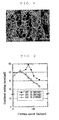
- FIG. 1 is picture of a fracture surface of a sample taken through SEM (scanning electron microscope), showing the precipitating behavior of dispersion of particles in the sample after the tempering process.
- the sample of the picture is Sample A33 listed in Table 1.
- the rod of 3 mm diameter was cut out from the sample and then the rod sample was bent and fractured.
- the fracture surface of the rod sample was observed through an SEM.
- the observed precipitates were analyzed EDS (energy dispersive X-ray spectroscopic analyzer) annexed to the SEM to identify the type of the precipitates.
- Ten of h-BN particles at the size of 1 to 3 ⁇ m were dispersed throughout at the 1,000 magnification sight.
- MnS that is known as free-cutting element and exist in sulfur free-cutting stainless steel such as commercially available SUS303
- six localized MnS particles were observed at the center part of this figure. Two MnS particles about 10 ⁇ m were observed coexisting with a BN particle. It seems that needle shape MnS particles at the length at about 20 ⁇ m elongated at hot working are destroyed into three pieces.
- MnS crystallizes during solidification process of ingot MnS particles are apt to be segregate and to be elongated toward the rolling direction easily, the steels containing MnS have the anisotropy characteristics.
- h-BN precipitates from supersaturated state of B and N h-BN particles precipitate and comparatively distribute homogeneously, therefore, the feature of anisotropy of steel cannot be observed.
- FIG. 2 shows the results of machinability test cutting by lathe conducted on round rod. This figure shows the relation between cutting speed and combined cutting force of the sample of different boron contents. The conditions of this test were depth of cut 1. 0 mm, feed of tool 0.1 mm/rev and tool material M30 without chip breaker.
- FIG. 3 shows the results of corrosion resistance test for B bearing stainless steel sheets.
- FIG. 3 shows the results of a corrosion test of the samples of different B contents by sulfuric acid solution test standardized by JIS G 0591. The condition of this test is continuous immersion into boiling 5% H 2 SO 4 solution continuously for 6 hours. The corrosion ratio of the samples is indicated as the ratio of weight loss by corrosion divided the samples obtained by dividing the quantity reduced by the initial surface area of the sample. There is scarcely increase of corrosion rate and addition of B has almost no influence on the corrosion.
- N may be added not only nitrogen gas but also nitrogen containing compounds selected from metal nitrides such as CrN (chromium nitride) and Ni 3 N (nickel nitride), inorganic nitrogen compounds such as NH 3 (ammonia), (NH 4 )NO 3 (ammonium nitrate) and Ca 3 N 2 (calcium nitride) and organic nitrogen compounds such as CO (NH 2 ) 2 (urea).
- metal nitrides such as CrN (chromium nitride) and Ni 3 N (nickel nitride)
- inorganic nitrogen compounds such as NH 3 (ammonia), (NH 4 )NO 3 (ammonium nitrate) and Ca 3 N 2 (calcium nitride) and organic nitrogen compounds such as CO (NH 2 ) 2 (urea).
- the composition (mass%) of the source material was 0.06 %C, 0.28 %Si, 1.33 %Mn, 0.035 %P, 0.025 %S, 8.05 %Ni and 18.39 %Cr.
- N was introduced into the levitation melting furnace to 0.075 MPa to adjust the N concentration.
- 0.73 g of commercially available ferroboton (19.2 mass%B) was added to the molten steel and the molten steel was held in a little reduced pressure N atmosphere for 1/6 hours. Then, the molten steel was solidified in the furnace to produce an ingot.
- FIG. 4 is an image of SEM (scanning electron microscope), showing the behavior of precipitation and dispersion of particles in the sample held to 1,250°C for 1/2 hours and subsequently cooled to the room temperature at a cooling rate of 100°C/hour. Comparing to Example 1, it was observed that spherical h-BN particles about 3 ⁇ m particle diameter had been dispersed and re-precipitated throughout the sample.
- the present invention can provide stainless steel which improve machinability without being inferior to corrosion resistance and environmental problems.
- Such stainless steels can be advantageous for applications in various fields of industry.
Landscapes
- Chemical & Material Sciences (AREA)
- Engineering & Computer Science (AREA)
- Materials Engineering (AREA)
- Mechanical Engineering (AREA)
- Metallurgy (AREA)
- Organic Chemistry (AREA)
- Physics & Mathematics (AREA)
- Thermal Sciences (AREA)
- Crystallography & Structural Chemistry (AREA)
- Heat Treatment Of Steel (AREA)
- Treatment Of Steel In Its Molten State (AREA)
Claims (9)
- Acier de décolletage inoxydable produit par ajout d'un additif pour décolletage, caractérisé en ce que l'additif pour décolletage est constitué de particules sphériques de h-BN (nitrure de bore hexagonal) dispersées et précipitées de manière homogène dans l'acier inoxydable.
- Acier de décolletage inoxydable selon la revendication 1, caractérisé en ce que le diamètre des particules de h-BN est compris entre 0,2 et 3 µm.
- Procédé de fabrication d'acier de décolletage inoxydable produit par ajout d'un additif pour décolletage, caractérisé en ce que l'acier de décolletage inoxydable où les particules de h-BN sont précipitées est chauffé pour dissoudre les particules de h-BN dans la matrice d'acier, trempé puis revenu pour à nouveau disperser et précipiter les particules sphériques de h-BN de manière homogène en tant qu'additif pour décolletage.
- Procédé de fabrication d'acier de décolletage inoxydable produit par ajout d'un additif pour décolletage, caractérisé en ce que l'acier de décolletage inoxydable où les particules de h-BN sont précipitées est chauffé pour dissoudre les particules de h-BN dans la matrice d'acier avant d'être soumis à un refroidissement lent pour à nouveau disperser et précipiter les particules sphériques de h-BN de manière homogène en tant qu'additif pour décolletage.
- Procédé de fabrication d'acier de décolletage inoxydable selon la revendication 3 ou la revendication 4, caractérisé en ce que l'ajout de B (bore) n'est pas inférieur à 3 × 10⁻³ % en masse, et inférieur à 2 × 10⁻¹ % en masse, et la teneur en N (azote) n'est pas inférieur à 1,5 × 10⁻² % en masse, la relation entre la teneur en B et celle en N satisfaisant à la formule 1 suivante :(formule 1)

- Procédé de fabrication d'acier de décolletage inoxydable selon la revendication 5, caractérisé en ce que la relation entre la teneur en B et celle en N satisfait à la formule 2 suivante :(formule 2)

- Procédé de fabrication d'acier de décolletage inoxydable selon la revendication 5, caractérisé en ce que l'ajout de B (bore) est inférieur à 1 × 10⁻¹ % en masse.
- Procédé de fabrication d'acier de décolletage inoxydable selon la revendication 3 ou la revendication 4, caractérisé en ce que B est ajouté par ajout de ferrobore ou de bore métallique, et N est ajouté au moyen d'azote atmosphérique (argon + azote) ou d'azote atmosphérique réduit pour fondre l'acier inoxydable.
- Procédé de fabrication d'acier de décolletage inoxydable selon la revendication 3 ou la revendication 4, caractérisé en ce que B est ajouté par ajout de ferrobore ou de bore métallique, et N est ajouté par ajout de composés à teneur en azote pour fondre l'acier inoxydable.
Applications Claiming Priority (2)
| Application Number | Priority Date | Filing Date | Title |
|---|---|---|---|
| JP2006208017 | 2006-07-31 | ||
| PCT/JP2007/065314 WO2008016158A1 (fr) | 2006-07-31 | 2007-07-30 | acier inoxydable de découpe libre ET SON PROCÉDÉ DE FABRICATION |
Publications (3)
| Publication Number | Publication Date |
|---|---|
| EP2048257A1 EP2048257A1 (fr) | 2009-04-15 |
| EP2048257A4 EP2048257A4 (fr) | 2012-11-28 |
| EP2048257B1 true EP2048257B1 (fr) | 2014-02-19 |
Family
ID=38997330
Family Applications (1)
| Application Number | Title | Priority Date | Filing Date |
|---|---|---|---|
| EP07791987.6A Not-in-force EP2048257B1 (fr) | 2006-07-31 | 2007-07-30 | Acier inoxydable de decoupe libre et son procédé de fabrication |
Country Status (3)
| Country | Link |
|---|---|
| EP (1) | EP2048257B1 (fr) |
| JP (1) | JP5142289B2 (fr) |
| WO (1) | WO2008016158A1 (fr) |
Families Citing this family (6)
| Publication number | Priority date | Publication date | Assignee | Title |
|---|---|---|---|---|
| WO2009126954A2 (fr) * | 2008-04-11 | 2009-10-15 | Questek Innovations Llc | Acier inoxydable martensitique renforcé par des précipités de nitrure nucléés au cuivre |
| JP6044037B2 (ja) * | 2010-04-30 | 2016-12-14 | 国立研究開発法人物質・材料研究機構 | 精密加工用快削ステンレス鋼素材及びその製造方法 |
| WO2012014541A1 (fr) * | 2010-07-27 | 2012-02-02 | 独立行政法人物質・材料研究機構 | Produit coulé en acier inoxydable de décolletage et procédé de fabrication |
| JP6103746B2 (ja) * | 2012-08-23 | 2017-03-29 | 国立研究開発法人物質・材料研究機構 | 快削鉄系形状記憶合金 |
| KR102570524B1 (ko) * | 2020-12-21 | 2023-08-24 | 주식회사 포스코 | 내식성과 절삭성이 향상된 오스테나이트계 스테인리스강 및 그 제조방법 |
| JP7719344B2 (ja) * | 2021-02-12 | 2025-08-06 | 日本製鉄株式会社 | 精密切削性に優れるマルテンサイト系快削ステンレス鋼 |
Family Cites Families (8)
| Publication number | Priority date | Publication date | Assignee | Title |
|---|---|---|---|---|
| JPH04365835A (ja) * | 1991-06-14 | 1992-12-17 | Nippon Steel Corp | 窒化ボロン含有快削鋼の製造方法 |
| JPH06145889A (ja) * | 1992-11-11 | 1994-05-27 | Daido Steel Co Ltd | 快削鋼 |
| JPH06235042A (ja) * | 1993-02-09 | 1994-08-23 | Nippon Steel Corp | 極低降伏強度鋼 |
| JPH07300656A (ja) * | 1994-04-30 | 1995-11-14 | Daido Metal Co Ltd | 高温用焼結軸受合金及びその製造方法 |
| JP2001329335A (ja) * | 2000-05-16 | 2001-11-27 | Kobe Steel Ltd | 熱間延性に優れた低炭素硫黄系bn快削鋼 |
| JP2003129191A (ja) * | 2001-10-24 | 2003-05-08 | Nisshin Steel Co Ltd | 窒化硼素含有快削性ステンレス鋼材およびその製造法 |
| FR2840969B1 (fr) * | 2002-06-14 | 2004-09-03 | Snecma Moteurs | Materiau dense autolubrifiant a sec; piece mecanique en ledit materiau; procede d'elaboration dudit materiau |
| JP2006291296A (ja) * | 2005-04-11 | 2006-10-26 | Nisshin Steel Co Ltd | 深絞り性に優れたオーステナイト系ステンレス鋼 |
-
2007
- 2007-07-30 JP JP2008527817A patent/JP5142289B2/ja not_active Expired - Fee Related
- 2007-07-30 EP EP07791987.6A patent/EP2048257B1/fr not_active Not-in-force
- 2007-07-30 WO PCT/JP2007/065314 patent/WO2008016158A1/fr not_active Ceased
Also Published As
| Publication number | Publication date |
|---|---|
| WO2008016158A1 (fr) | 2008-02-07 |
| EP2048257A4 (fr) | 2012-11-28 |
| EP2048257A1 (fr) | 2009-04-15 |
| JPWO2008016158A1 (ja) | 2009-12-24 |
| JP5142289B2 (ja) | 2013-02-13 |
Similar Documents
| Publication | Publication Date | Title |
|---|---|---|
| EP1403391B1 (fr) | Acier inoxydable martensitique | |
| EP1956100B1 (fr) | Procede d'écrouissage a chaud d'un acier et materiau d'acier obtenu avec le procede | |
| EP2725113B1 (fr) | Procédé de fabrication d'un acier inoxydable austénitique et matériau d'acier inoxydable austénitique | |
| CN102264921B (zh) | 钢的淬火方法 | |
| Sakuraya et al. | BN type inclusions formed in high Cr ferritic heat resistant steel | |
| EP2048257B1 (fr) | Acier inoxydable de decoupe libre et son procédé de fabrication | |
| CN114829636B (zh) | 冷加工性优异的高硬度-高耐蚀性用途的马氏体系不锈钢及其制造方法 | |
| JP2002256397A (ja) | 耐食性に優れた高硬度マルテンサイト系ステンレス鋼 | |
| JP6410515B2 (ja) | 耐摩耗性に優れた窒化粉末高速度工具鋼およびその製造方法 | |
| JP6881612B2 (ja) | 軸受鋼部品、および軸受鋼部品用棒鋼 | |
| RU2290452C9 (ru) | Сталь для холодной обработки | |
| Zou et al. | Combined contribution of Cu-rich precipitates and retained austenite on mechanical properties of a novel low-carbon medium-Mn steel plate | |
| CN101589168A (zh) | 无铅易切削钢及其用途 | |
| CN101942606A (zh) | 含氮奥氏体型热作模具钢及其制备方法 | |
| AU2004280023B2 (en) | Method for producing steel ingot | |
| EP2537952B1 (fr) | Produit coulé en acier inoxydable de décolletage et procédé de fabrication | |
| CA2934230C (fr) | Acier de cementation et composant cemente obtenu a partir de celui-ci | |
| Liang et al. | Effects of oxygen content, Mn/S ratio, Cu content, hot-rolling, and annealing on morphology/distribution of MnS inclusions and microstructure/mechanical properties of free-cutting stainless steel | |
| JP6044037B2 (ja) | 精密加工用快削ステンレス鋼素材及びその製造方法 | |
| JP5466897B2 (ja) | 低炭素マルテンサイト系ステンレス鋼とその製造方法 | |
| JP2019044254A (ja) | 金型 | |
| KR20250163913A (ko) | 저열팽창 합금 | |
| Shigesato et al. | Thermal aging during coating of X80 high strength steel for line pipe | |
| JPH0987807A (ja) | 高靭性精密鋳造用高速度工具鋼 | |
| Schade | Processing, microstructures and properties of a dual phase precipitation-hardening PM stainless steel |
Legal Events
| Date | Code | Title | Description |
|---|---|---|---|
| PUAI | Public reference made under article 153(3) epc to a published international application that has entered the european phase |
Free format text: ORIGINAL CODE: 0009012 |
|
| 17P | Request for examination filed |
Effective date: 20090224 |
|
| AK | Designated contracting states |
Kind code of ref document: A1 Designated state(s): AT BE BG CH CY CZ DE DK EE ES FI FR GB GR HU IE IS IT LI LT LU LV MC MT NL PL PT RO SE SI SK TR |
|
| AX | Request for extension of the european patent |
Extension state: AL BA HR MK RS |
|
| DAX | Request for extension of the european patent (deleted) | ||
| RBV | Designated contracting states (corrected) |
Designated state(s): DE FR SE |
|
| A4 | Supplementary search report drawn up and despatched |
Effective date: 20121024 |
|
| RIC1 | Information provided on ipc code assigned before grant |
Ipc: C22C 38/00 20060101AFI20121019BHEP Ipc: C21D 1/18 20060101ALI20121019BHEP Ipc: C21C 7/04 20060101ALI20121019BHEP Ipc: C21C 7/00 20060101ALI20121019BHEP Ipc: C21D 6/00 20060101ALI20121019BHEP Ipc: C21D 8/00 20060101ALI20121019BHEP |
|
| GRAP | Despatch of communication of intention to grant a patent |
Free format text: ORIGINAL CODE: EPIDOSNIGR1 |
|
| INTG | Intention to grant announced |
Effective date: 20130918 |
|
| GRAS | Grant fee paid |
Free format text: ORIGINAL CODE: EPIDOSNIGR3 |
|
| RIN1 | Information on inventor provided before grant (corrected) |
Inventor name: YAMAMOTO, SHIGEO Inventor name: SAKURAYA, KAZUYUKI |
|
| GRAA | (expected) grant |
Free format text: ORIGINAL CODE: 0009210 |
|
| AK | Designated contracting states |
Kind code of ref document: B1 Designated state(s): DE FR SE |
|
| REG | Reference to a national code |
Ref country code: DE Ref legal event code: R096 Ref document number: 602007035144 Country of ref document: DE Effective date: 20140403 |
|
| REG | Reference to a national code |
Ref country code: SE Ref legal event code: TRGR |
|
| REG | Reference to a national code |
Ref country code: DE Ref legal event code: R097 Ref document number: 602007035144 Country of ref document: DE |
|
| PLBE | No opposition filed within time limit |
Free format text: ORIGINAL CODE: 0009261 |
|
| STAA | Information on the status of an ep patent application or granted ep patent |
Free format text: STATUS: NO OPPOSITION FILED WITHIN TIME LIMIT |
|
| 26N | No opposition filed |
Effective date: 20141120 |
|
| REG | Reference to a national code |
Ref country code: DE Ref legal event code: R097 Ref document number: 602007035144 Country of ref document: DE Effective date: 20141120 |
|
| REG | Reference to a national code |
Ref country code: FR Ref legal event code: PLFP Year of fee payment: 9 |
|
| PGFP | Annual fee paid to national office [announced via postgrant information from national office to epo] |
Ref country code: SE Payment date: 20150723 Year of fee payment: 9 |
|
| REG | Reference to a national code |
Ref country code: FR Ref legal event code: PLFP Year of fee payment: 10 |
|
| REG | Reference to a national code |
Ref country code: SE Ref legal event code: EUG |
|
| PG25 | Lapsed in a contracting state [announced via postgrant information from national office to epo] |
Ref country code: SE Free format text: LAPSE BECAUSE OF NON-PAYMENT OF DUE FEES Effective date: 20160731 |
|
| REG | Reference to a national code |
Ref country code: FR Ref legal event code: PLFP Year of fee payment: 11 |
|
| PGFP | Annual fee paid to national office [announced via postgrant information from national office to epo] |
Ref country code: FR Payment date: 20170714 Year of fee payment: 11 Ref country code: DE Payment date: 20170731 Year of fee payment: 11 |
|
| REG | Reference to a national code |
Ref country code: DE Ref legal event code: R119 Ref document number: 602007035144 Country of ref document: DE |
|
| PG25 | Lapsed in a contracting state [announced via postgrant information from national office to epo] |
Ref country code: FR Free format text: LAPSE BECAUSE OF NON-PAYMENT OF DUE FEES Effective date: 20180731 Ref country code: DE Free format text: LAPSE BECAUSE OF NON-PAYMENT OF DUE FEES Effective date: 20190201 |