EP2048664A1 - Film mince pour film réfléchissant ou film réfléchissant semi-transparent, cible de pulvérisation et support d'enregistrement optique - Google Patents
Film mince pour film réfléchissant ou film réfléchissant semi-transparent, cible de pulvérisation et support d'enregistrement optique Download PDFInfo
- Publication number
- EP2048664A1 EP2048664A1 EP06832811A EP06832811A EP2048664A1 EP 2048664 A1 EP2048664 A1 EP 2048664A1 EP 06832811 A EP06832811 A EP 06832811A EP 06832811 A EP06832811 A EP 06832811A EP 2048664 A1 EP2048664 A1 EP 2048664A1
- Authority
- EP
- European Patent Office
- Prior art keywords
- reflection film
- thin film
- silver
- semi
- target
- Prior art date
- Legal status (The legal status is an assumption and is not a legal conclusion. Google has not performed a legal analysis and makes no representation as to the accuracy of the status listed.)
- Withdrawn
Links
- 239000010409 thin film Substances 0.000 title claims abstract description 121
- 239000010408 film Substances 0.000 title claims abstract description 75
- 230000003287 optical effect Effects 0.000 title claims abstract description 25
- 238000005477 sputtering target Methods 0.000 title claims description 18
- 150000001875 compounds Chemical class 0.000 claims abstract description 93
- BQCADISMDOOEFD-UHFFFAOYSA-N Silver Chemical compound [Ag] BQCADISMDOOEFD-UHFFFAOYSA-N 0.000 claims abstract description 72
- 229910001316 Ag alloy Inorganic materials 0.000 claims abstract description 61
- 229910052709 silver Inorganic materials 0.000 claims abstract description 56
- 239000004332 silver Substances 0.000 claims abstract description 56
- 239000011159 matrix material Substances 0.000 claims abstract description 40
- KDLHZDBZIXYQEI-UHFFFAOYSA-N Palladium Chemical compound [Pd] KDLHZDBZIXYQEI-UHFFFAOYSA-N 0.000 claims abstract description 28
- 150000004767 nitrides Chemical class 0.000 claims abstract description 16
- VEXZGXHMUGYJMC-UHFFFAOYSA-M Chloride anion Chemical compound [Cl-] VEXZGXHMUGYJMC-UHFFFAOYSA-M 0.000 claims abstract description 15
- KRHYYFGTRYWZRS-UHFFFAOYSA-M Fluoride anion Chemical compound [F-] KRHYYFGTRYWZRS-UHFFFAOYSA-M 0.000 claims abstract description 15
- UCKMPCXJQFINFW-UHFFFAOYSA-N Sulphide Chemical compound [S-2] UCKMPCXJQFINFW-UHFFFAOYSA-N 0.000 claims abstract description 15
- 239000010949 copper Substances 0.000 claims abstract description 15
- 150000003346 selenoethers Chemical class 0.000 claims abstract description 15
- 229910021332 silicide Inorganic materials 0.000 claims abstract description 15
- FVBUAEGBCNSCDD-UHFFFAOYSA-N silicide(4-) Chemical compound [Si-4] FVBUAEGBCNSCDD-UHFFFAOYSA-N 0.000 claims abstract description 15
- XSOKHXFFCGXDJZ-UHFFFAOYSA-N telluride(2-) Chemical compound [Te-2] XSOKHXFFCGXDJZ-UHFFFAOYSA-N 0.000 claims abstract description 15
- 229910052692 Dysprosium Inorganic materials 0.000 claims abstract description 14
- KBQHZAAAGSGFKK-UHFFFAOYSA-N dysprosium atom Chemical compound [Dy] KBQHZAAAGSGFKK-UHFFFAOYSA-N 0.000 claims abstract description 14
- 150000004678 hydrides Chemical class 0.000 claims abstract description 13
- AVXURJPOCDRRFD-UHFFFAOYSA-N Hydroxylamine Chemical class ON AVXURJPOCDRRFD-UHFFFAOYSA-N 0.000 claims abstract description 12
- 229910052733 gallium Inorganic materials 0.000 claims abstract description 11
- 229910052763 palladium Inorganic materials 0.000 claims abstract description 11
- 229910052777 Praseodymium Inorganic materials 0.000 claims abstract description 10
- 229910052691 Erbium Inorganic materials 0.000 claims abstract description 9
- 229910052688 Gadolinium Inorganic materials 0.000 claims abstract description 9
- 229910052772 Samarium Inorganic materials 0.000 claims abstract description 9
- 229910052802 copper Inorganic materials 0.000 claims abstract description 9
- UYAHIZSMUZPPFV-UHFFFAOYSA-N erbium Chemical compound [Er] UYAHIZSMUZPPFV-UHFFFAOYSA-N 0.000 claims abstract description 9
- UIWYJDYFSGRHKR-UHFFFAOYSA-N gadolinium atom Chemical compound [Gd] UIWYJDYFSGRHKR-UHFFFAOYSA-N 0.000 claims abstract description 9
- 229910052746 lanthanum Inorganic materials 0.000 claims abstract description 9
- FZLIPJUXYLNCLC-UHFFFAOYSA-N lanthanum atom Chemical compound [La] FZLIPJUXYLNCLC-UHFFFAOYSA-N 0.000 claims abstract description 9
- PUDIUYLPXJFUGB-UHFFFAOYSA-N praseodymium atom Chemical compound [Pr] PUDIUYLPXJFUGB-UHFFFAOYSA-N 0.000 claims abstract description 9
- KZUNJOHGWZRPMI-UHFFFAOYSA-N samarium atom Chemical compound [Sm] KZUNJOHGWZRPMI-UHFFFAOYSA-N 0.000 claims abstract description 9
- 229910052727 yttrium Inorganic materials 0.000 claims abstract description 9
- VWQVUPCCIRVNHF-UHFFFAOYSA-N yttrium atom Chemical compound [Y] VWQVUPCCIRVNHF-UHFFFAOYSA-N 0.000 claims abstract description 9
- RYGMFSIKBFXOCR-UHFFFAOYSA-N Copper Chemical compound [Cu] RYGMFSIKBFXOCR-UHFFFAOYSA-N 0.000 claims abstract description 8
- GYHNNYVSQQEPJS-UHFFFAOYSA-N Gallium Chemical compound [Ga] GYHNNYVSQQEPJS-UHFFFAOYSA-N 0.000 claims abstract description 8
- 238000005275 alloying Methods 0.000 claims description 13
- -1 phosphide Chemical class 0.000 claims description 3
- 238000000034 method Methods 0.000 description 46
- 239000000203 mixture Substances 0.000 description 40
- 238000004544 sputter deposition Methods 0.000 description 37
- 238000005546 reactive sputtering Methods 0.000 description 21
- 238000004519 manufacturing process Methods 0.000 description 18
- 238000005245 sintering Methods 0.000 description 15
- 229910052751 metal Inorganic materials 0.000 description 13
- 239000000758 substrate Substances 0.000 description 13
- 239000002184 metal Substances 0.000 description 11
- 230000005012 migration Effects 0.000 description 10
- 238000013508 migration Methods 0.000 description 10
- IJGRMHOSHXDMSA-UHFFFAOYSA-N Atomic nitrogen Chemical compound N#N IJGRMHOSHXDMSA-UHFFFAOYSA-N 0.000 description 9
- 230000007797 corrosion Effects 0.000 description 9
- 238000005260 corrosion Methods 0.000 description 9
- 239000007789 gas Substances 0.000 description 9
- 230000002401 inhibitory effect Effects 0.000 description 9
- 230000000694 effects Effects 0.000 description 8
- IBIOTXDDKRNYMC-UHFFFAOYSA-N azanylidynedysprosium Chemical compound [Dy]#N IBIOTXDDKRNYMC-UHFFFAOYSA-N 0.000 description 7
- 239000000843 powder Substances 0.000 description 7
- 229940100890 silver compound Drugs 0.000 description 7
- 150000003379 silver compounds Chemical class 0.000 description 7
- 229910045601 alloy Inorganic materials 0.000 description 6
- 239000000956 alloy Substances 0.000 description 6
- VZVZYLVXLCEAMR-UHFFFAOYSA-N azanylidyneerbium Chemical compound [Er]#N VZVZYLVXLCEAMR-UHFFFAOYSA-N 0.000 description 6
- SIWVEOZUMHYXCS-UHFFFAOYSA-N oxo(oxoyttriooxy)yttrium Chemical compound O=[Y]O[Y]=O SIWVEOZUMHYXCS-UHFFFAOYSA-N 0.000 description 6
- 229910018069 Cu3N Inorganic materials 0.000 description 5
- 229910001873 dinitrogen Inorganic materials 0.000 description 5
- 238000011156 evaluation Methods 0.000 description 5
- 239000002994 raw material Substances 0.000 description 5
- 239000010410 layer Substances 0.000 description 4
- 239000002245 particle Substances 0.000 description 4
- 238000012360 testing method Methods 0.000 description 4
- 230000003247 decreasing effect Effects 0.000 description 3
- 230000007613 environmental effect Effects 0.000 description 3
- CMIHHWBVHJVIGI-UHFFFAOYSA-N gadolinium(III) oxide Inorganic materials [O-2].[O-2].[O-2].[Gd+3].[Gd+3] CMIHHWBVHJVIGI-UHFFFAOYSA-N 0.000 description 3
- 239000004417 polycarbonate Substances 0.000 description 3
- 229920000515 polycarbonate Polymers 0.000 description 3
- MYMOFIZGZYHOMD-UHFFFAOYSA-N Dioxygen Chemical compound O=O MYMOFIZGZYHOMD-UHFFFAOYSA-N 0.000 description 2
- QVGXLLKOCUKJST-UHFFFAOYSA-N atomic oxygen Chemical compound [O] QVGXLLKOCUKJST-UHFFFAOYSA-N 0.000 description 2
- QCLQZCOGUCNIOC-UHFFFAOYSA-N azanylidynelanthanum Chemical compound [La]#N QCLQZCOGUCNIOC-UHFFFAOYSA-N 0.000 description 2
- 230000015556 catabolic process Effects 0.000 description 2
- 238000005520 cutting process Methods 0.000 description 2
- 238000006731 degradation reaction Methods 0.000 description 2
- 229910001882 dioxygen Inorganic materials 0.000 description 2
- 238000005242 forging Methods 0.000 description 2
- 239000008187 granular material Substances 0.000 description 2
- 230000006872 improvement Effects 0.000 description 2
- 238000002156 mixing Methods 0.000 description 2
- 238000005121 nitriding Methods 0.000 description 2
- 229910052757 nitrogen Inorganic materials 0.000 description 2
- 230000001590 oxidative effect Effects 0.000 description 2
- 239000001301 oxygen Substances 0.000 description 2
- 229910052760 oxygen Inorganic materials 0.000 description 2
- 230000036961 partial effect Effects 0.000 description 2
- 238000005096 rolling process Methods 0.000 description 2
- FKTOIHSPIPYAPE-UHFFFAOYSA-N samarium(III) oxide Inorganic materials [O-2].[O-2].[O-2].[Sm+3].[Sm+3] FKTOIHSPIPYAPE-UHFFFAOYSA-N 0.000 description 2
- 229910000108 silver(I,III) oxide Inorganic materials 0.000 description 2
- 229910002688 Ag2Te Inorganic materials 0.000 description 1
- 229910017743 AgSi Inorganic materials 0.000 description 1
- 229910017988 AgVO3 Inorganic materials 0.000 description 1
- OKTJSMMVPCPJKN-UHFFFAOYSA-N Carbon Chemical compound [C] OKTJSMMVPCPJKN-UHFFFAOYSA-N 0.000 description 1
- 229910021591 Copper(I) chloride Inorganic materials 0.000 description 1
- 229910021594 Copper(II) fluoride Inorganic materials 0.000 description 1
- 229910018139 Cu5Si Inorganic materials 0.000 description 1
- 229910002477 CuCr2O4 Inorganic materials 0.000 description 1
- 229910016516 CuFe2O4 Inorganic materials 0.000 description 1
- 229910002531 CuTe Inorganic materials 0.000 description 1
- 229910001279 Dy alloy Inorganic materials 0.000 description 1
- 229910016468 DyF3 Inorganic materials 0.000 description 1
- 229910016495 ErF3 Inorganic materials 0.000 description 1
- 229910000807 Ga alloy Inorganic materials 0.000 description 1
- 229910005267 GaCl3 Inorganic materials 0.000 description 1
- 229910005543 GaSe Inorganic materials 0.000 description 1
- 229910003317 GdCl3 Inorganic materials 0.000 description 1
- 229910005693 GdF3 Inorganic materials 0.000 description 1
- 229910005715 GdSi2 Inorganic materials 0.000 description 1
- 229910017586 La2S3 Inorganic materials 0.000 description 1
- 229910017582 La2Ti2O7 Inorganic materials 0.000 description 1
- 229910025794 LaB6 Inorganic materials 0.000 description 1
- 229910002249 LaCl3 Inorganic materials 0.000 description 1
- 229910002319 LaF3 Inorganic materials 0.000 description 1
- 229910017759 LaH3 Inorganic materials 0.000 description 1
- 229910018246 LaSi2 Inorganic materials 0.000 description 1
- 241001025261 Neoraja caerulea Species 0.000 description 1
- 229910002666 PdCl2 Inorganic materials 0.000 description 1
- 229910021140 PdSi Inorganic materials 0.000 description 1
- 229910001154 Pr alloy Inorganic materials 0.000 description 1
- 229910019328 PrCl3 Inorganic materials 0.000 description 1
- 229910019322 PrF3 Inorganic materials 0.000 description 1
- 229910019334 PrSi2 Inorganic materials 0.000 description 1
- KJTLSVCANCCWHF-UHFFFAOYSA-N Ruthenium Chemical compound [Ru] KJTLSVCANCCWHF-UHFFFAOYSA-N 0.000 description 1
- 229910021607 Silver chloride Inorganic materials 0.000 description 1
- 229910021175 SmF3 Inorganic materials 0.000 description 1
- 229910020825 SmSi2 Inorganic materials 0.000 description 1
- 229910009523 YCl3 Inorganic materials 0.000 description 1
- 229910009365 YSi2 Inorganic materials 0.000 description 1
- 229910052946 acanthite Inorganic materials 0.000 description 1
- 230000009471 action Effects 0.000 description 1
- 229910052782 aluminium Inorganic materials 0.000 description 1
- XAGFODPZIPBFFR-UHFFFAOYSA-N aluminium Chemical compound [Al] XAGFODPZIPBFFR-UHFFFAOYSA-N 0.000 description 1
- 230000003466 anti-cipated effect Effects 0.000 description 1
- JCWZBEIBQMTAIH-UHFFFAOYSA-N azanylidynepraseodymium Chemical compound [Pr]#N JCWZBEIBQMTAIH-UHFFFAOYSA-N 0.000 description 1
- 229910052799 carbon Inorganic materials 0.000 description 1
- 230000008859 change Effects 0.000 description 1
- 238000006243 chemical reaction Methods 0.000 description 1
- 239000013065 commercial product Substances 0.000 description 1
- 238000000748 compression moulding Methods 0.000 description 1
- 238000001816 cooling Methods 0.000 description 1
- OXBLHERUFWYNTN-UHFFFAOYSA-M copper(I) chloride Chemical compound [Cu]Cl OXBLHERUFWYNTN-UHFFFAOYSA-M 0.000 description 1
- BERDEBHAJNAUOM-UHFFFAOYSA-N copper(I) oxide Inorganic materials [Cu]O[Cu] BERDEBHAJNAUOM-UHFFFAOYSA-N 0.000 description 1
- GWFAVIIMQDUCRA-UHFFFAOYSA-L copper(ii) fluoride Chemical compound [F-].[F-].[Cu+2] GWFAVIIMQDUCRA-UHFFFAOYSA-L 0.000 description 1
- DXKGMXNZSJMWAF-UHFFFAOYSA-N copper;oxido(oxo)iron Chemical compound [Cu+2].[O-][Fe]=O.[O-][Fe]=O DXKGMXNZSJMWAF-UHFFFAOYSA-N 0.000 description 1
- KRFJLUBVMFXRPN-UHFFFAOYSA-N cuprous oxide Chemical compound [O-2].[Cu+].[Cu+] KRFJLUBVMFXRPN-UHFFFAOYSA-N 0.000 description 1
- 230000006866 deterioration Effects 0.000 description 1
- 230000002542 deteriorative effect Effects 0.000 description 1
- 238000011161 development Methods 0.000 description 1
- 238000009792 diffusion process Methods 0.000 description 1
- 239000002355 dual-layer Substances 0.000 description 1
- NLQFUUYNQFMIJW-UHFFFAOYSA-N dysprosium(III) oxide Inorganic materials O=[Dy]O[Dy]=O NLQFUUYNQFMIJW-UHFFFAOYSA-N 0.000 description 1
- 238000005516 engineering process Methods 0.000 description 1
- VQCBHWLJZDBHOS-UHFFFAOYSA-N erbium(III) oxide Inorganic materials O=[Er]O[Er]=O VQCBHWLJZDBHOS-UHFFFAOYSA-N 0.000 description 1
- HDGGAKOVUDZYES-UHFFFAOYSA-K erbium(iii) chloride Chemical compound Cl[Er](Cl)Cl HDGGAKOVUDZYES-UHFFFAOYSA-K 0.000 description 1
- MEANOSLIBWSCIT-UHFFFAOYSA-K gadolinium trichloride Chemical compound Cl[Gd](Cl)Cl MEANOSLIBWSCIT-UHFFFAOYSA-K 0.000 description 1
- UPWPDUACHOATKO-UHFFFAOYSA-K gallium trichloride Chemical compound Cl[Ga](Cl)Cl UPWPDUACHOATKO-UHFFFAOYSA-K 0.000 description 1
- QZQVBEXLDFYHSR-UHFFFAOYSA-N gallium(III) oxide Inorganic materials O=[Ga]O[Ga]=O QZQVBEXLDFYHSR-UHFFFAOYSA-N 0.000 description 1
- PCHJSUWPFVWCPO-UHFFFAOYSA-N gold Chemical compound [Au] PCHJSUWPFVWCPO-UHFFFAOYSA-N 0.000 description 1
- 229910052737 gold Inorganic materials 0.000 description 1
- 239000010931 gold Substances 0.000 description 1
- 238000001746 injection moulding Methods 0.000 description 1
- 230000001788 irregular Effects 0.000 description 1
- ZKEYULQFFYBZBG-UHFFFAOYSA-N lanthanum carbide Chemical compound [La].[C-]#[C] ZKEYULQFFYBZBG-UHFFFAOYSA-N 0.000 description 1
- MRELNEQAGSRDBK-UHFFFAOYSA-N lanthanum oxide Inorganic materials [O-2].[O-2].[O-2].[La+3].[La+3] MRELNEQAGSRDBK-UHFFFAOYSA-N 0.000 description 1
- ICAKDTKJOYSXGC-UHFFFAOYSA-K lanthanum(iii) chloride Chemical compound Cl[La](Cl)Cl ICAKDTKJOYSXGC-UHFFFAOYSA-K 0.000 description 1
- 239000004973 liquid crystal related substance Substances 0.000 description 1
- 230000007774 longterm Effects 0.000 description 1
- 239000000463 material Substances 0.000 description 1
- 230000007246 mechanism Effects 0.000 description 1
- 239000011812 mixed powder Substances 0.000 description 1
- 238000000465 moulding Methods 0.000 description 1
- 229910052758 niobium Inorganic materials 0.000 description 1
- KTUFCUMIWABKDW-UHFFFAOYSA-N oxo(oxolanthaniooxy)lanthanum Chemical compound O=[La]O[La]=O KTUFCUMIWABKDW-UHFFFAOYSA-N 0.000 description 1
- FULFYAFFAGNFJM-UHFFFAOYSA-N oxocopper;oxo(oxochromiooxy)chromium Chemical compound [Cu]=O.O=[Cr]O[Cr]=O FULFYAFFAGNFJM-UHFFFAOYSA-N 0.000 description 1
- PIBWKRNGBLPSSY-UHFFFAOYSA-L palladium(II) chloride Chemical compound Cl[Pd]Cl PIBWKRNGBLPSSY-UHFFFAOYSA-L 0.000 description 1
- LHBNLZDGIPPZLL-UHFFFAOYSA-K praseodymium(iii) chloride Chemical compound Cl[Pr](Cl)Cl LHBNLZDGIPPZLL-UHFFFAOYSA-K 0.000 description 1
- 238000003825 pressing Methods 0.000 description 1
- 239000011241 protective layer Substances 0.000 description 1
- 239000000376 reactant Substances 0.000 description 1
- 230000009467 reduction Effects 0.000 description 1
- 238000011160 research Methods 0.000 description 1
- 230000000284 resting effect Effects 0.000 description 1
- 229910052707 ruthenium Inorganic materials 0.000 description 1
- 229910001954 samarium oxide Inorganic materials 0.000 description 1
- 229940075630 samarium oxide Drugs 0.000 description 1
- BHXBZLPMVFUQBQ-UHFFFAOYSA-K samarium(iii) chloride Chemical compound Cl[Sm](Cl)Cl BHXBZLPMVFUQBQ-UHFFFAOYSA-K 0.000 description 1
- HKZLPVFGJNLROG-UHFFFAOYSA-M silver monochloride Chemical compound [Cl-].[Ag+] HKZLPVFGJNLROG-UHFFFAOYSA-M 0.000 description 1
- 229910000161 silver phosphate Inorganic materials 0.000 description 1
- FSJWWSXPIWGYKC-UHFFFAOYSA-M silver;silver;sulfanide Chemical compound [SH-].[Ag].[Ag+] FSJWWSXPIWGYKC-UHFFFAOYSA-M 0.000 description 1
- QGJSAGBHFTXOTM-UHFFFAOYSA-K trifluoroerbium Chemical compound F[Er](F)F QGJSAGBHFTXOTM-UHFFFAOYSA-K 0.000 description 1
- BYMUNNMMXKDFEZ-UHFFFAOYSA-K trifluorolanthanum Chemical compound F[La](F)F BYMUNNMMXKDFEZ-UHFFFAOYSA-K 0.000 description 1
- 238000005303 weighing Methods 0.000 description 1
- 229910019901 yttrium aluminum garnet Inorganic materials 0.000 description 1
- PCMOZDDGXKIOLL-UHFFFAOYSA-K yttrium chloride Chemical compound [Cl-].[Cl-].[Cl-].[Y+3] PCMOZDDGXKIOLL-UHFFFAOYSA-K 0.000 description 1
Images
Classifications
-
- C—CHEMISTRY; METALLURGY
- C23—COATING METALLIC MATERIAL; COATING MATERIAL WITH METALLIC MATERIAL; CHEMICAL SURFACE TREATMENT; DIFFUSION TREATMENT OF METALLIC MATERIAL; COATING BY VACUUM EVAPORATION, BY SPUTTERING, BY ION IMPLANTATION OR BY CHEMICAL VAPOUR DEPOSITION, IN GENERAL; INHIBITING CORROSION OF METALLIC MATERIAL OR INCRUSTATION IN GENERAL
- C23C—COATING METALLIC MATERIAL; COATING MATERIAL WITH METALLIC MATERIAL; SURFACE TREATMENT OF METALLIC MATERIAL BY DIFFUSION INTO THE SURFACE, BY CHEMICAL CONVERSION OR SUBSTITUTION; COATING BY VACUUM EVAPORATION, BY SPUTTERING, BY ION IMPLANTATION OR BY CHEMICAL VAPOUR DEPOSITION, IN GENERAL
- C23C14/00—Coating by vacuum evaporation, by sputtering or by ion implantation of the coating forming material
- C23C14/06—Coating by vacuum evaporation, by sputtering or by ion implantation of the coating forming material characterised by the coating material
- C23C14/0641—Nitrides
-
- G—PHYSICS
- G11—INFORMATION STORAGE
- G11B—INFORMATION STORAGE BASED ON RELATIVE MOVEMENT BETWEEN RECORD CARRIER AND TRANSDUCER
- G11B7/00—Recording or reproducing by optical means, e.g. recording using a thermal beam of optical radiation by modifying optical properties or the physical structure, reproducing using an optical beam at lower power by sensing optical properties; Record carriers therefor
- G11B7/24—Record carriers characterised by shape, structure or physical properties, or by the selection of the material
- G11B7/241—Record carriers characterised by shape, structure or physical properties, or by the selection of the material characterised by the selection of the material
- G11B7/252—Record carriers characterised by shape, structure or physical properties, or by the selection of the material characterised by the selection of the material of layers other than recording layers
- G11B7/258—Record carriers characterised by shape, structure or physical properties, or by the selection of the material characterised by the selection of the material of layers other than recording layers of reflective layers
- G11B7/259—Record carriers characterised by shape, structure or physical properties, or by the selection of the material characterised by the selection of the material of layers other than recording layers of reflective layers based on silver
-
- C—CHEMISTRY; METALLURGY
- C22—METALLURGY; FERROUS OR NON-FERROUS ALLOYS; TREATMENT OF ALLOYS OR NON-FERROUS METALS
- C22C—ALLOYS
- C22C5/00—Alloys based on noble metals
- C22C5/06—Alloys based on silver
-
- C—CHEMISTRY; METALLURGY
- C23—COATING METALLIC MATERIAL; COATING MATERIAL WITH METALLIC MATERIAL; CHEMICAL SURFACE TREATMENT; DIFFUSION TREATMENT OF METALLIC MATERIAL; COATING BY VACUUM EVAPORATION, BY SPUTTERING, BY ION IMPLANTATION OR BY CHEMICAL VAPOUR DEPOSITION, IN GENERAL; INHIBITING CORROSION OF METALLIC MATERIAL OR INCRUSTATION IN GENERAL
- C23C—COATING METALLIC MATERIAL; COATING MATERIAL WITH METALLIC MATERIAL; SURFACE TREATMENT OF METALLIC MATERIAL BY DIFFUSION INTO THE SURFACE, BY CHEMICAL CONVERSION OR SUBSTITUTION; COATING BY VACUUM EVAPORATION, BY SPUTTERING, BY ION IMPLANTATION OR BY CHEMICAL VAPOUR DEPOSITION, IN GENERAL
- C23C14/00—Coating by vacuum evaporation, by sputtering or by ion implantation of the coating forming material
- C23C14/0021—Reactive sputtering or evaporation
- C23C14/0036—Reactive sputtering
-
- C—CHEMISTRY; METALLURGY
- C23—COATING METALLIC MATERIAL; COATING MATERIAL WITH METALLIC MATERIAL; CHEMICAL SURFACE TREATMENT; DIFFUSION TREATMENT OF METALLIC MATERIAL; COATING BY VACUUM EVAPORATION, BY SPUTTERING, BY ION IMPLANTATION OR BY CHEMICAL VAPOUR DEPOSITION, IN GENERAL; INHIBITING CORROSION OF METALLIC MATERIAL OR INCRUSTATION IN GENERAL
- C23C—COATING METALLIC MATERIAL; COATING MATERIAL WITH METALLIC MATERIAL; SURFACE TREATMENT OF METALLIC MATERIAL BY DIFFUSION INTO THE SURFACE, BY CHEMICAL CONVERSION OR SUBSTITUTION; COATING BY VACUUM EVAPORATION, BY SPUTTERING, BY ION IMPLANTATION OR BY CHEMICAL VAPOUR DEPOSITION, IN GENERAL
- C23C14/00—Coating by vacuum evaporation, by sputtering or by ion implantation of the coating forming material
- C23C14/06—Coating by vacuum evaporation, by sputtering or by ion implantation of the coating forming material characterised by the coating material
- C23C14/08—Oxides
-
- C—CHEMISTRY; METALLURGY
- C23—COATING METALLIC MATERIAL; COATING MATERIAL WITH METALLIC MATERIAL; CHEMICAL SURFACE TREATMENT; DIFFUSION TREATMENT OF METALLIC MATERIAL; COATING BY VACUUM EVAPORATION, BY SPUTTERING, BY ION IMPLANTATION OR BY CHEMICAL VAPOUR DEPOSITION, IN GENERAL; INHIBITING CORROSION OF METALLIC MATERIAL OR INCRUSTATION IN GENERAL
- C23C—COATING METALLIC MATERIAL; COATING MATERIAL WITH METALLIC MATERIAL; SURFACE TREATMENT OF METALLIC MATERIAL BY DIFFUSION INTO THE SURFACE, BY CHEMICAL CONVERSION OR SUBSTITUTION; COATING BY VACUUM EVAPORATION, BY SPUTTERING, BY ION IMPLANTATION OR BY CHEMICAL VAPOUR DEPOSITION, IN GENERAL
- C23C14/00—Coating by vacuum evaporation, by sputtering or by ion implantation of the coating forming material
- C23C14/06—Coating by vacuum evaporation, by sputtering or by ion implantation of the coating forming material characterised by the coating material
- C23C14/14—Metallic material, boron or silicon
-
- C—CHEMISTRY; METALLURGY
- C23—COATING METALLIC MATERIAL; COATING MATERIAL WITH METALLIC MATERIAL; CHEMICAL SURFACE TREATMENT; DIFFUSION TREATMENT OF METALLIC MATERIAL; COATING BY VACUUM EVAPORATION, BY SPUTTERING, BY ION IMPLANTATION OR BY CHEMICAL VAPOUR DEPOSITION, IN GENERAL; INHIBITING CORROSION OF METALLIC MATERIAL OR INCRUSTATION IN GENERAL
- C23C—COATING METALLIC MATERIAL; COATING MATERIAL WITH METALLIC MATERIAL; SURFACE TREATMENT OF METALLIC MATERIAL BY DIFFUSION INTO THE SURFACE, BY CHEMICAL CONVERSION OR SUBSTITUTION; COATING BY VACUUM EVAPORATION, BY SPUTTERING, BY ION IMPLANTATION OR BY CHEMICAL VAPOUR DEPOSITION, IN GENERAL
- C23C14/00—Coating by vacuum evaporation, by sputtering or by ion implantation of the coating forming material
- C23C14/06—Coating by vacuum evaporation, by sputtering or by ion implantation of the coating forming material characterised by the coating material
- C23C14/14—Metallic material, boron or silicon
- C23C14/20—Metallic material, boron or silicon on organic substrates
-
- C—CHEMISTRY; METALLURGY
- C23—COATING METALLIC MATERIAL; COATING MATERIAL WITH METALLIC MATERIAL; CHEMICAL SURFACE TREATMENT; DIFFUSION TREATMENT OF METALLIC MATERIAL; COATING BY VACUUM EVAPORATION, BY SPUTTERING, BY ION IMPLANTATION OR BY CHEMICAL VAPOUR DEPOSITION, IN GENERAL; INHIBITING CORROSION OF METALLIC MATERIAL OR INCRUSTATION IN GENERAL
- C23C—COATING METALLIC MATERIAL; COATING MATERIAL WITH METALLIC MATERIAL; SURFACE TREATMENT OF METALLIC MATERIAL BY DIFFUSION INTO THE SURFACE, BY CHEMICAL CONVERSION OR SUBSTITUTION; COATING BY VACUUM EVAPORATION, BY SPUTTERING, BY ION IMPLANTATION OR BY CHEMICAL VAPOUR DEPOSITION, IN GENERAL
- C23C14/00—Coating by vacuum evaporation, by sputtering or by ion implantation of the coating forming material
- C23C14/22—Coating by vacuum evaporation, by sputtering or by ion implantation of the coating forming material characterised by the process of coating
- C23C14/34—Sputtering
-
- C—CHEMISTRY; METALLURGY
- C23—COATING METALLIC MATERIAL; COATING MATERIAL WITH METALLIC MATERIAL; CHEMICAL SURFACE TREATMENT; DIFFUSION TREATMENT OF METALLIC MATERIAL; COATING BY VACUUM EVAPORATION, BY SPUTTERING, BY ION IMPLANTATION OR BY CHEMICAL VAPOUR DEPOSITION, IN GENERAL; INHIBITING CORROSION OF METALLIC MATERIAL OR INCRUSTATION IN GENERAL
- C23C—COATING METALLIC MATERIAL; COATING MATERIAL WITH METALLIC MATERIAL; SURFACE TREATMENT OF METALLIC MATERIAL BY DIFFUSION INTO THE SURFACE, BY CHEMICAL CONVERSION OR SUBSTITUTION; COATING BY VACUUM EVAPORATION, BY SPUTTERING, BY ION IMPLANTATION OR BY CHEMICAL VAPOUR DEPOSITION, IN GENERAL
- C23C14/00—Coating by vacuum evaporation, by sputtering or by ion implantation of the coating forming material
- C23C14/22—Coating by vacuum evaporation, by sputtering or by ion implantation of the coating forming material characterised by the process of coating
- C23C14/34—Sputtering
- C23C14/3407—Cathode assembly for sputtering apparatus, e.g. Target
- C23C14/3414—Metallurgical or chemical aspects of target preparation, e.g. casting, powder metallurgy
-
- G—PHYSICS
- G02—OPTICS
- G02B—OPTICAL ELEMENTS, SYSTEMS OR APPARATUS
- G02B5/00—Optical elements other than lenses
- G02B5/08—Mirrors
- G02B5/0808—Mirrors having a single reflecting layer
-
- G—PHYSICS
- G11—INFORMATION STORAGE
- G11B—INFORMATION STORAGE BASED ON RELATIVE MOVEMENT BETWEEN RECORD CARRIER AND TRANSDUCER
- G11B7/00—Recording or reproducing by optical means, e.g. recording using a thermal beam of optical radiation by modifying optical properties or the physical structure, reproducing using an optical beam at lower power by sensing optical properties; Record carriers therefor
- G11B7/24—Record carriers characterised by shape, structure or physical properties, or by the selection of the material
- G11B7/2403—Layers; Shape, structure or physical properties thereof
- G11B7/24035—Recording layers
- G11B7/24038—Multiple laminated recording layers
-
- G—PHYSICS
- G11—INFORMATION STORAGE
- G11B—INFORMATION STORAGE BASED ON RELATIVE MOVEMENT BETWEEN RECORD CARRIER AND TRANSDUCER
- G11B7/00—Recording or reproducing by optical means, e.g. recording using a thermal beam of optical radiation by modifying optical properties or the physical structure, reproducing using an optical beam at lower power by sensing optical properties; Record carriers therefor
- G11B7/24—Record carriers characterised by shape, structure or physical properties, or by the selection of the material
- G11B7/26—Apparatus or processes specially adapted for the manufacture of record carriers
- G11B7/266—Sputtering or spin-coating layers
Definitions
- the present invention relates to a thin film useful as a reflection film or a semi-transparent reflection film used in an optical recording medium, a display and the like.
- the present invention particularly relates to the thin film which shows reflectance that does not decrease even after it is used for a long period of time, and the optical recording medium having the thin film as the reflection film or the semi-transparent reflection film.
- An optical recording medium such as a CD-R/RW, a DVD-R/RW/RAM and a Blue-Ray disk
- a display device such as a liquid crystal display and an organic luminescent display
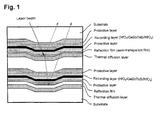
- Fig. 1 shows a structure of an HD-DVD (one-sided, dual-layer rewritable disk) which has been developed in recent years, as an example of the optical recording medium.
- the optical recording medium has a multilayer structure comprising the reflection film in addition to a recording layer which plays a predominant role of a function of the optical recording medium, a protective layer and a thermal diffusion layer.
- silver has a problem of undergoing a color change into black through being corroded to decrease its reflectance, because of being inferior in corrosion resistance.
- the factor of causing corrosion in a reflection film is, for instance, an organic dye applied in a recording layer of an optical recording medium, though it depends on an applied medium and device. Then, the reflection film shows lower reflectance since it is corroded by the organic dye after a long term of service.
- the reflection film in a display device may cause corrosion due to the atmospheric moisture. For this reason, a thin film made from a silver alloy has been developed which contains various elements in a silver matrix, so as to solve the problem of the corrosion resistance of silver.
- a thin film composed of the above described silver alloy shows a certain improvement effect on corrosion resistance. Then, the problem of corrosion should have been solved, but an optical recording medium using a thin film formed from the silver alloy still can not completely inhibit a recording error caused by the degradation of the reflection film. On the other hand, a material more excellent in reflectance-keeping characteristics than ever has been required along with requirement to a further improvement of a recording speed and recording density toward future.
- the present invention is directed at providing a thin film that is applied to a reflection film and to a semi-transparent reflection film, which compose an optical recording medium, a display and the like, and that can function without decreasing its reflectance even after a long period of use; and a production method therefor.
- the present inventors have made an extensive research on a mechanism how a silver thin film degrades its reflection characteristics, and found that the degradation is caused not only by simple corrosion (blackening) but also by a phenomenon that silver atoms migrate while the thin film is heated.
- the phenomenon of migration of silver atoms is a phenomenon that silver atoms composing a flat thin film right after it is formed migrate toward an energetically stable state through being driven by a given environmental condition. At this time, the silver atoms migrate not only in a planar direction but also in a three-dimensional direction in many cases, and as a result, cohere into a polygonal shape close to a sphere.
- an optical recording medium employing such a thin film for a reflection film reflects less light toward a sensor of an optical recording device in a sensor axis direction, and consequently causes an error in the recording medium.
- a conventional silver alloy has a little effect of inhibiting a migration phenomenon of silver atoms. This is because a metal atom alloyed with silver should have some function of inhibiting the migration of silver atoms.
- the conventional silver alloy mainly has aimed at improving corrosion resistance, and accordingly all the alloyed components have not been effective for inhibiting the migration of the silver atoms.
- the present inventors studied a technique for inhibiting silver atoms from migrating in a thin film; examined silver alloys having the effect; found that it is effective as a further improved remedy for inhibiting the silver atoms from migrating to disperse a silver compound phase in silver or a silver alloy, and thus formed thin film acquires superior reflectance-keeping characteristics; and attained the present invention.
- the present invention provides a thin film for a reflection film or a semi-transparent reflection film, which has a phase of at least one compound selected from the group consisting of a nitride, an oxide, a complex oxide, a nitroxide, a carbide, a sulfide, a chloride, a silicide, a fluoride, a boride, a hydride, a phosphide, a selenide and a telluride of dysprosium, gadolinium, erbium, praseodymium, samarium, lanthanum and yttrium, dispersed in a matrix formed of silver or a silver alloy.
- a nitride an oxide, a complex oxide, a nitroxide, a carbide, a sulfide, a chloride, a silicide, a fluoride, a boride, a hydride, a phosphide,
- the present invention it becomes possible to inhibit the migration of silver atoms composing a matrix formed of silver or a silver alloy and maintain the flatness of a thin film, by dispersing the phase formed of any of the above-described seven compounds in the matrix, and thereby to inhibit the reflectance from deteriorating even when the thin film has undergone heat.
- the thin film according to the present invention may include any of silver compounds among nitride, an oxide, a complex oxide, a nitroxide, carbide, sulfide, chloride, silicide, fluoride, boride, hydride, phosphide, selenide and telluride of silver, as a compound phase.
- Specific examples of the silver compound are shown in Table 2.
- the silver compounds include not only intentionally formed compounds but also the compounds which are concurrently produced when the above described compound phase of dysprosium or the like is formed, as will be described later in an item on a method for producing the thin film.
- the compound phase formed of the silver compound also acts to inhibit silver atoms in the thin film from migrating, similarly as the compound phase of dysprosium or the like does.
- this silver compound phase includes a compound in a stoichiometrically non-equilibrium state as well.
- the thin film according to the present invention may include a chemical compound of a particular metal other than the above described metal (dysprosium and the like, or silver), as a compound phase.
- the thin film may contain, in a dispersed state, at least one compound selected from the group consisting of a nitride, an oxide, a complex oxide, a nitroxide, a carbide, a sulfide, a chloride, a silicide, a fluoride, a boride, a hydride, a phosphide, a selenide and a telluride of gallium, palladium or copper.
- Specific examples of the compound phase of such a particular metal are shown in Table 3.
- the content of the above described compound phase is preferably 0.001 to 2.5 wt.%.
- the compound phase in an amount of 0.001 wt.% or more is necessary for sufficiently inhibiting the migration of silver atoms.
- the upper limit is set at 2.5 wt.% because the silver compound contained above the upper limit imparts an insufficient initial reflectance to the thin film.
- the content of the compound phase is preferably 0.001 to 1.0 wt.%, and further preferably is 0.001 to 0.5 wt.%. As the content of the compound phase increases, the effect of inhibiting reflectance reduction increases but the reflectance tends to decrease. It is preferable to control the content of the compound phase according to an application field within the above described range.
- the content of the compound phase is based on the total weight of the thin film (the total weight of the matrix and the compound phase).
- the content of the compound phase shall be the total content of those compounds.
- the compound phases are preferably dispersed in a particulate form composed of many molecules of the compound, but are not always limited to this form.
- the compound phase may be formed of molecules of at least one chemical compound.
- the size of the compound phase is preferably controlled into 1/10 or less of a thickness of a thin film. For instance, when the thickness of the thin film is set at 1,000 ⁇ the compound phase preferably has a size of 100 ⁇ or smaller, and when the thickness of the thin film is set at 120 ⁇ , the dispersing compound phase preferably has a size of 12 A or smaller.
- the matrix of the thin film according to the present invention is pure silver or silver alloy.
- the effect of inhibiting the migration of silver atoms is mainly made by a compound phase, but alloyed components also possess an effect to be reckoned with.
- the thin film acquires excellent reflectance-keeping characteristics due to the action of the compound phase. For this reason, in the present invention, any of pure silver and a silver alloy shall be used as the matrix.
- the alloy is preferably an alloy formed from silver and at least any one element of dysprosium, gadolinium, erbium, praseodymium, samarium, lanthanum and yttrium. These elements are metallic elements composing the compound phase shown at the beginning of the above description, but also form alloy components by being alloyed with silver to inhibit the migration phenomenon of silver atoms.
- a silver alloy as the matrix may include a metal other than dysprosium.
- a silver alloy as the matrix may employ at least one element among gallium, palladium, and copper, as an alloying element. This is because these metallic elements are those which compose the compound phase shown in the third group of the above description, and also shows not a little effect of inhibiting the migration phenomenon of silver atoms by being alloyed with silver.
- the concentration of a metal to be alloyed with silver is preferably 0.01 to 10 wt.%. This is because when the concentration is less than 0.01 wt.%, the alloying effect is negligible, and when the concentration exceeds 10 wt.%, the thin film aggravates its reflectance. Furthermore, the concentration is more preferably 0.01 to 5 wt.%, and further preferably is 0.01 to 3.5 wt.%. The above described concentration of the metal is based on a weight of the silver alloy of the matrix.
- a reflection film according to the present invention has preferably a thickness of 120 to 1,200 ⁇ when applied to an optical recording medium, a display and the like.
- a sputtering technique As a production method.
- the technique includes two directions which is described below.
- a first technique is a method of using a target having a structure and a composition similar to a thin film to be produced, specifically, is a method of using a sputtering target prepared by dispersing a phase of at least one compound selected from the group consisting of a nitride, an oxide, a complex oxide, a nitroxide, a carbide, a sulfide, a chloride, a silicide, a fluoride, a boride, a hydride, a phosphide, a selenide and a telluride of dysprosium, gadolinium, erbium, praseodymium, samarium, lanthanum and yttrium, in a matrix formed of silver or a silver alloy.
- the method can produce the thin film with the use of one plate of target, accordingly can produce the thin film by a sputtering technique with a form of arranging the target so as to face a substrate, which is ordinarily employed when producing a reflection film, and consequently produce the thin film with adequate productivity.
- a sputtering technique with a form of arranging the target so as to face a substrate, which is ordinarily employed when producing a reflection film, and consequently produce the thin film with adequate productivity.
- a first form is an internally chemically-combined type target.
- the internally chemically-combined type target is prepared by heat-treating a raw material made from silver (pure silver) or a silver alloy in an atmosphere of high-pressure oxygen gas, nitrogen gas or the like to chemically combine a metal to be alloyed with silver or the silver alloy in the interior partially with oxygen or nitrogen or the like into the oxide, the nitride or the like.
- the raw material described in the above may have a tabular shape close to the shape of the target, or may be prepared by employing a granular material, chemically combining the interior with other elements for the raw material, and then compression-molding the resultant granular material.
- a second form to be used is a sintered target.
- the sintered target is prepared by mixing a powder of silver (pure silver) or a silver alloy with a powder made from a compound to be dispersed in the target in accordance with a desired composition, compressing and molding the mixed powder, and sintering the compact.
- the sintered target is useful when the above described internally chemically-combined type target is difficult to produce such as in the case when the target can hardly contain a sufficient concentration of a compound phase, and is preferable for producing a thin film, for instance, in which lanthanum nitride, praseodymium nitride, or samarium oxide is dispersed as a compound phase.
- a third form is an embedded type target.
- the embedded type target is prepared by embedding a small piece (with a cylindrical shape, a spherical shape or the like though the shape is not limited) of a chemical compound to be dispersed, into a region to be consumed by sputtering in a target made from pure silver or a silver alloy.
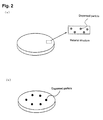
- the above described internally chemically-combined type target and sintered target have a composition and a structure microscopically close to those of a thin film to be produced, as is shown in Fig. 2(a) , whereas this target has those macroscopically close to the thin film to be produced, as is shown in Fig. 2(b) .
- the composition of the thin film to be produced can be controlled by changing a diameter of the small piece of the compound to be embedded, positions of the small pieces to be arranged, the number of the pieces and a sputtering rate.
- a content of a compound phase is preferably controlled so as to have the same composition as a thin film to be produced.
- the content of the chemical compound is preferably 0.001 to 2.5 wt.%, more preferably is 0.001 to 1.0 wt.%, and further preferably is 0.001 to 0.5 wt.%.
- the size of the compound phase in these targets is not limited in particular, and may be the same molecular level as in the thin film to be produced, or may be a millimeter order as in the embedded type target. This is because whatever the sizes of the compound phase, a compound is sputtered in a molecule unit when being sputtered, and the formed thin film acquires the desired composition.
- a silver alloy as the matrix is preferably an alloy which contains silver and at least any one element of dysprosium, gadolinium, erbium, praseodymium, samarium, lanthanum and yttrium, or further at least any one element of gallium, palladium and copper.
- concentration of a metal element to be alloyed is preferably 0.01 to 10 wt.%, more preferably is 0.01 to 5 wt.%, and further preferably is 0.01 to 3.5 wt.%.
- a second direction for producing a thin film according to the present invention is to improve a sputtering method.
- the method employs mainly a general target of pure silver or a silver alloy as a target, and does not employ a special target as is used in the above described first direction.
- a special target as is used in the above described first direction.
- a first technique is a co-sputtering technique with the use of a plurality of targets.
- the technique is a method of simultaneously sputtering a plurality of targets made from a chemical compound and a metal having the same composition as in a phase composing a thin film.
- the thin film having a compound phase formed of erbium nitride (ErN) dispersed in silver or a silver alloy can be produced by using two targets of a pure silver target or a silver alloy target, and an erbium nitride target, placing them together in a chamber, and simultaneously sputtering the two targets.
- the method is useful when it is difficult to prepare a special target such as the above described internally chemically-combined type target.
- the reactive sputtering is a technique of adding a reactive gas such as oxygen and nitrogen into an atmosphere for sputtering, sputtering the target, oxidizing or nitriding the whole or a part of a particle sputtered from a target, and forming a thin film from the oxidized or nitrided particle.
- the reactive sputtering technique is a useful method when a chemical compound to be dispersed in the thin film is expensive, is hardly available or is difficult to be chemically prepared.
- the reactive sputtering technique may be singly used, but may be used in combination with another technique.
- the above described special integral target specifically, using an internally chemically-combined target, a sintered target and an embedded type target
- it is possible to increase a content of a chemical compound in the thin film by introducing a reactive gas into an atmosphere in a sputtering apparatus.
- a target and a thin film were produced not only by using these targets, but also by using a co-sputtering technique and a reactive sputtering technique.
- compositions of a target and a thin film are expressed hereafter, they are expressed in the form of matrix/compound phase, and in the form, a front part of "/" represents a matrix and a rear part represents a compound phase.
- concentration of an alloying element is expressed by weight% with respect to the silver alloy of the matrix.
- Ag-2.0 wt.% Cu-1.5 wt.% Ga/2.5 wt.% Y 2 O 3 of sample No. 18, means that the thin film (target) has 2.5 wt.% Y 2 O 3 dispersed in the matrix of a silver alloy having a composition of Ag-2.0 wt.% Cu-1.5 wt.% Ga, with respect to a total weight of the thin film (target).
- An internally chemically-combined type target was prepared by the steps of: preparing 5.0 kg of a granular raw material of Ag-0.46 wt.% Dy alloy with a particle diameter of 1.0 to 3.0 mm; charging it into a high-pressure reaction pot; sufficiently replacing the air inside the pot with nitrogen gas; increasing a pressure and a temperature respectively to 0.5 MPa of a nitrogen gas pressure and 700°C; keeping the pot in the state for 12 hours for subjecting Dy to internal nitriding; then, slowly cooling the internally nitrided alloy grains; taking them out; charging them into a die; high-pressure-extruding them at 750°C into an integrated compact; forging the compact; rolling the forged compact into a plate (with dimension of 160 mm ⁇ 160 mm ⁇ 6 mm); and cutting the plate into a sputtering target having a standard size (with a diameter of 152 mm (6 inches) and a thickness of 5 mm).
- the target had a composition of Ag/0.5 w
- an Ag/ 0.2 wt.% Dy 2 O 3 -0.2 wt.% Pr 2 O 3 (sample No.5) target was prepared as an internally chemically-combined type target.
- the target of the sample No. 5 was produced by using an Ag-0.17wt.% Dy-0.17wt.% Pr alloy as a raw material, and oxidizing the interior with an oxygen gas pressure of 0.4 MPa and at 700°C for a holding period of 10 hours.
- targets corresponding to samples No. 1 to 3, and 6 to 9 were prepared by changing a silver alloy and an internally chemically-combining condition.
- a sintered type target was produced by the steps of: preparing a powder of silver and a powder of lanthanum nitride both with particle sizes of 50 to 100 ⁇ m; weighing the powders so as to form a desired composition; sufficiently mixing them; then charging the mixture into a die made from carbon; pressing the mixture to form a compact; then sintering the green compact in a vacuum sintering furnace at 750°C for 8 hours to form a sintered integral compact; forging and rolling the compact into a plate for further improving denseness; and then cutting the plate into a sputtering target with the same standard size as described previously.
- the target had a composition of Ag/2.5 wt.% LaN.
- the target corresponds to the sample No. 15 which is described later.
- targets corresponding to samples No. 10 to 16 were prepared as a sintered type target, by changing the types of a silver alloy powder and a compound powder.
- An embedded type target was produced by the steps of: preparing a disc with a standard size (with a diameter of 152 mm (6 inches) and a thickness of 5 mm) made from an Ag-2.0 wt.% Cu-1.5 wt.% Ga alloy; perforating 6 round holes with a diameter of 1.55 mm at regular spaces so as to form a circle with a diameter of 80 mm; inserting round bars made from yttrium oxide (Y 2 O 3 ) with a diameter of 1.5 mm and a length of 5 mm into the round holes; and calking perimeters of the round bars so that the round bars will not drop off and could be fixed.
- the target had a composition of Ag-2.0 wt.% Cu-1.5 wt.% Ga/ 2.5 wt.% Y 2 O 3 .
- the target corresponds to the sample No. 18 which is described later.
- targets corresponding to samples No. 17 to 30 were prepared as an embedded type target, by changing an alloy composition of a disc and a composition and the number of round bars to be embedded.
- a thin film was produced by using the above-described various targets, and by employing a co-sputtering technique and a reactive sputtering technique.
- the thin film was formed on a polycarbonate substrate for DVD.
- the substrate (with a diameter of 120 mm and a sheet thickness of 0.6 mm) was produced through an injection molding machine provided with a stamper, in which a pre-format pattern was formed.
- a reflection film was formed into a film thickness of 120 ⁇ with each method.
- a thin film was evaluated by evaluating characteristics of a DVD medium which was prepared by forming a thin film on a polycarbonate substrate in the above-described way.
- the evaluation was conducted by the steps of: measuring a jitter value, a PI error, a PO failure and a reflectance of the DVD medium in an initial state after it was prepared, with the use of an optical disc evaluation instrument (optical disc evaluation instrument ODU-1000 made by Pulstec Industrial Co., Ltd.); confirming whether they were within a range of DVD standards; subsequently subjecting the DVD medium to an accelerating environmental test of exposing the DVD medium to the environment of a temperature of 80°C and a relative humidity of 85% for 500 hours; and measuring the respective values of the DVD medium after it was subjected to the accelerating environmental test by using the evaluation instrument.
- optical disc evaluation instrument optical disc evaluation instrument ODU-1000 made by Pulstec Industrial Co., Ltd.
- a recording medium provided with a reflection film having a compound phase dispersed therein according to the present invention showed less occurrences of a PI error and a PO failure and further a lower decreasing rate of a reflectance than a DVD medium provided with a reflection film formed from pure silver.
- the DVD medium provided with the reflection film formed from pure silver was not recognized by a recording device after a humidification test, and became unusable.
- a thin film according to the present invention minimizes the deterioration of the reflectance even after a long period of use, and can prolong the life of various devices which use the thin film as a reflection film, such as an optical recording medium and a display.
- the reflection film according to the present invention has also reflectance-keeping characteristics which are less affected by a wavelength of incident light.
- the wavelength of light for a light source for recording is being shortened such as in the development of an HD-DVD using a blue laser beam, in a field of an optical recording medium.
- the present invention can cope with such a technology.
- the thin film according to the present invention provides merits of reducing the number of errors and extending the life, when applied to the optical recording medium, for instance.
- a reflection film has only to have a function of reflecting light, and includes a film having optical transparency. Accordingly, the thin film according to the present invention can be also applied to a semi-reflection/semi-transparent film used in an optical recording medium.
Landscapes
- Chemical & Material Sciences (AREA)
- Engineering & Computer Science (AREA)
- Materials Engineering (AREA)
- Mechanical Engineering (AREA)
- Metallurgy (AREA)
- Organic Chemistry (AREA)
- Chemical Kinetics & Catalysis (AREA)
- Physical Vapour Deposition (AREA)
- Manufacturing Optical Record Carriers (AREA)
- Optical Record Carriers And Manufacture Thereof (AREA)
Applications Claiming Priority (1)
| Application Number | Priority Date | Filing Date | Title |
|---|---|---|---|
| PCT/JP2006/322932 WO2008059581A1 (fr) | 2006-11-17 | 2006-11-17 | Film mince pour film réfléchissant ou film réfléchissant semi-transparent, cible de pulvérisation et support d'enregistrement optique |
Publications (1)
| Publication Number | Publication Date |
|---|---|
| EP2048664A1 true EP2048664A1 (fr) | 2009-04-15 |
Family
ID=39401395
Family Applications (1)
| Application Number | Title | Priority Date | Filing Date |
|---|---|---|---|
| EP06832811A Withdrawn EP2048664A1 (fr) | 2006-11-17 | 2006-11-17 | Film mince pour film réfléchissant ou film réfléchissant semi-transparent, cible de pulvérisation et support d'enregistrement optique |
Country Status (6)
| Country | Link |
|---|---|
| US (1) | US20100047502A1 (fr) |
| EP (1) | EP2048664A1 (fr) |
| JP (1) | JPWO2008059581A1 (fr) |
| KR (1) | KR20090079985A (fr) |
| CN (1) | CN101461002A (fr) |
| WO (1) | WO2008059581A1 (fr) |
Cited By (1)
| Publication number | Priority date | Publication date | Assignee | Title |
|---|---|---|---|---|
| EP2410368A1 (fr) * | 2010-07-23 | 2012-01-25 | Seiko Epson Corporation | Filtre d'interférences, module optique et dispositif d'analyse |
Families Citing this family (2)
| Publication number | Priority date | Publication date | Assignee | Title |
|---|---|---|---|---|
| JP2012042651A (ja) * | 2010-08-18 | 2012-03-01 | Seiko Epson Corp | 干渉フィルター、光モジュール、及び分析装置 |
| CN103214020B (zh) * | 2013-04-16 | 2014-10-22 | 宁波大学 | 纳米硫化铜钆粉体和含纳米硫化铜钆的薄膜的制备方法 |
Family Cites Families (11)
| Publication number | Priority date | Publication date | Assignee | Title |
|---|---|---|---|---|
| JPH06243509A (ja) | 1993-02-19 | 1994-09-02 | Ricoh Co Ltd | 光反射膜及び該膜を用いた光記録情報媒体 |
| JPH11134715A (ja) | 1997-10-28 | 1999-05-21 | Kao Corp | 光記録媒体 |
| JP4007702B2 (ja) | 1998-10-05 | 2007-11-14 | 株式会社フルヤ金属 | 薄膜形成用スパッタリングターゲット材およびそれを用いて形成されて成る薄膜、および光学記録媒体 |
| JP3365762B2 (ja) * | 2000-04-28 | 2003-01-14 | 株式会社神戸製鋼所 | 光情報記録媒体用の反射層または半透明反射層、光情報記録媒体及び光情報記録媒体用スパッタリングターゲット |
| JP2003006926A (ja) | 2001-06-19 | 2003-01-10 | Mitsubishi Materials Corp | 光記録媒体用反射膜 |
| JP4069660B2 (ja) * | 2001-11-26 | 2008-04-02 | 三菱マテリアル株式会社 | 光記録媒体の全反射層または半透明反射層形成用銀合金スパッタリングターゲット |
| KR100506474B1 (ko) * | 2002-03-25 | 2005-08-03 | 히타치 긴조쿠 가부시키가이샤 | Ag 합금막 및 Ag 합금막 형성용 스퍼터링 타겟재 |
| US7514037B2 (en) * | 2002-08-08 | 2009-04-07 | Kobe Steel, Ltd. | AG base alloy thin film and sputtering target for forming AG base alloy thin film |
| ATE379836T1 (de) * | 2004-06-29 | 2007-12-15 | Kobe Steel Ltd | Halbreflektierende und reflektierende schicht für ein optisches informationsaufzeichnungsmedium, informationsaufzeichnungsmedium, und sputter target |
| JP3924308B2 (ja) * | 2004-07-15 | 2007-06-06 | 株式会社神戸製鋼所 | レーザーマーキング用再生専用光情報記録媒体用Ag合金反射膜の形成用のAg合金スパッタリングターゲット |
| JP2006294195A (ja) * | 2005-04-14 | 2006-10-26 | Kobe Steel Ltd | 光情報記録用Ag合金反射膜、光情報記録媒体および光情報記録用Ag合金反射膜の形成用のAg合金スパッタリングターゲット |
-
2006
- 2006-11-17 CN CNA2006800548096A patent/CN101461002A/zh active Pending
- 2006-11-17 KR KR1020097011863A patent/KR20090079985A/ko not_active Withdrawn
- 2006-11-17 US US11/915,409 patent/US20100047502A1/en not_active Abandoned
- 2006-11-17 WO PCT/JP2006/322932 patent/WO2008059581A1/fr not_active Ceased
- 2006-11-17 EP EP06832811A patent/EP2048664A1/fr not_active Withdrawn
- 2006-11-17 JP JP2008544043A patent/JPWO2008059581A1/ja active Pending
Non-Patent Citations (1)
| Title |
|---|
| See references of WO2008059581A1 * |
Cited By (1)
| Publication number | Priority date | Publication date | Assignee | Title |
|---|---|---|---|---|
| EP2410368A1 (fr) * | 2010-07-23 | 2012-01-25 | Seiko Epson Corporation | Filtre d'interférences, module optique et dispositif d'analyse |
Also Published As
| Publication number | Publication date |
|---|---|
| KR20090079985A (ko) | 2009-07-22 |
| CN101461002A (zh) | 2009-06-17 |
| US20100047502A1 (en) | 2010-02-25 |
| JPWO2008059581A1 (ja) | 2010-02-25 |
| WO2008059581A1 (fr) | 2008-05-22 |
Similar Documents
| Publication | Publication Date | Title |
|---|---|---|
| US7833604B2 (en) | Ag alloy reflective layer for optical information recording medium, optical information recording medium, and sputtering target for forming Ag alloy reflective layer for optical information recording medium | |
| EP1736558A1 (fr) | Alliage en argent pour film reflechissant | |
| EP1746180A1 (fr) | Milieu d'enregistrement optique d'information ayant une couche d'argent réflecteur | |
| EP2221394A1 (fr) | Film mince composé principalement d'oxyde de titane, cible de pulvérisation frittée appropriée pour la fabrication d'un film mince composé principalement d'oxyde de titane, et procédé de fabrication d'un film mince composé principalement d'oxyde de titane | |
| EP2045631B1 (fr) | Film mince pour film de réflexion ou film semi-transparent de réflexion, cible de pulvérisation et support d'enregistrement optique | |
| JP3772972B2 (ja) | 光記録媒体の反射層形成用銀合金スパッタリングターゲット | |
| EP2048664A1 (fr) | Film mince pour film réfléchissant ou film réfléchissant semi-transparent, cible de pulvérisation et support d'enregistrement optique | |
| EP1734139A1 (fr) | Alliage d'argent aux performances excellentes en matiere d'entretien de la reflectance | |
| JP2005135568A (ja) | 情報記録媒体とその製造方法、およびスパッタリングターゲット | |
| US20120192763A1 (en) | Thin Film Comprising Titanium Oxide as Main Component and Sintered Compact Sputtering Target Comprising Titanium Oxide as Main Component | |
| EP2048524B1 (fr) | Film mince utilisé comme film réfléchissant ou film réfléchissant à transmission partielle, cible de pulvérisation et support d'enregistrement optique | |
| EP2045630A1 (fr) | Film mince pour film réfléchissant ou film réfléchissant à transmission partielle, cible de pulvérisation et support d'enregistrement optique | |
| US20090046566A1 (en) | Recording layer for optical information recording medium, optical information recording medium, and sputtering target for optical information recording medium | |
| JP4900993B2 (ja) | スパッタリングターゲットとそれを用いたGe系薄膜の製造方法 | |
| WO2004081929A1 (fr) | Cible de pulverisation d'alliage d'argent pour former une couche reflechissante d'un support d'enregistrement optique | |
| JP3772971B2 (ja) | 光記録媒体の反射層形成用銀合金スパッタリングターゲット | |
| WO2007074895A1 (fr) | FILM RÉFLÉCHISSANT TRANSLUCIDE ET FILM RÉFLÉCHISSANT POUR SUPPORT D’ENREGISTREMENT OPTIQUE, ET CIBLE DE PULVÉRISATION CATHODIQUE EN ALLIAGE Ag PERMETTANT DE FORMER UN TEL FILM RÉFLÉCHISSANT TRANSLUCIDE ET FILM RÉFLÉCHISSANT | |
| JP2006012318A (ja) | 光記録媒体用積層反射膜およびその製造方法 | |
| JPH04280960A (ja) | 組成均一性に優れる光学式記録媒体の反射膜用Al合金薄膜形成用溶製Al合金スパッタリングターゲット |
Legal Events
| Date | Code | Title | Description |
|---|---|---|---|
| PUAI | Public reference made under article 153(3) epc to a published international application that has entered the european phase |
Free format text: ORIGINAL CODE: 0009012 |
|
| 17P | Request for examination filed |
Effective date: 20090127 |
|
| AK | Designated contracting states |
Kind code of ref document: A1 Designated state(s): AT BE BG CH CY CZ DE DK EE ES FI FR GB GR HU IE IS IT LI LT LU LV MC NL PL PT RO SE SI SK TR |
|
| AX | Request for extension of the european patent |
Extension state: AL BA HR MK RS |
|
| STAA | Information on the status of an ep patent application or granted ep patent |
Free format text: STATUS: THE APPLICATION HAS BEEN WITHDRAWN |
|
| 18W | Application withdrawn |
Effective date: 20091021 |