EP2050563A2 - Matériau soudable à base d'aluminium - Google Patents
Matériau soudable à base d'aluminium Download PDFInfo
- Publication number
- EP2050563A2 EP2050563A2 EP08160577A EP08160577A EP2050563A2 EP 2050563 A2 EP2050563 A2 EP 2050563A2 EP 08160577 A EP08160577 A EP 08160577A EP 08160577 A EP08160577 A EP 08160577A EP 2050563 A2 EP2050563 A2 EP 2050563A2
- Authority
- EP
- European Patent Office
- Prior art keywords
- aluminum
- based material
- solderable
- electron donors
- material according
- Prior art date
- Legal status (The legal status is an assumption and is not a legal conclusion. Google has not performed a legal analysis and makes no representation as to the accuracy of the status listed.)
- Withdrawn
Links
Images
Classifications
-
- B—PERFORMING OPERATIONS; TRANSPORTING
- B32—LAYERED PRODUCTS
- B32B—LAYERED PRODUCTS, i.e. PRODUCTS BUILT-UP OF STRATA OF FLAT OR NON-FLAT, e.g. CELLULAR OR HONEYCOMB, FORM
- B32B15/00—Layered products comprising a layer of metal
- B32B15/01—Layered products comprising a layer of metal all layers being exclusively metallic
- B32B15/017—Layered products comprising a layer of metal all layers being exclusively metallic one layer being formed of aluminium or an aluminium alloy, another layer being formed of an alloy based on a non ferrous metal other than aluminium
-
- C—CHEMISTRY; METALLURGY
- C22—METALLURGY; FERROUS OR NON-FERROUS ALLOYS; TREATMENT OF ALLOYS OR NON-FERROUS METALS
- C22C—ALLOYS
- C22C21/00—Alloys based on aluminium
-
- Y—GENERAL TAGGING OF NEW TECHNOLOGICAL DEVELOPMENTS; GENERAL TAGGING OF CROSS-SECTIONAL TECHNOLOGIES SPANNING OVER SEVERAL SECTIONS OF THE IPC; TECHNICAL SUBJECTS COVERED BY FORMER USPC CROSS-REFERENCE ART COLLECTIONS [XRACs] AND DIGESTS
- Y10—TECHNICAL SUBJECTS COVERED BY FORMER USPC
- Y10T—TECHNICAL SUBJECTS COVERED BY FORMER US CLASSIFICATION
- Y10T428/00—Stock material or miscellaneous articles
- Y10T428/12—All metal or with adjacent metals
- Y10T428/12229—Intermediate article [e.g., blank, etc.]
Definitions
- the present invention relates to a solderable material, particularly to a solderable aluminum-based material which tin or other metals can be directly soldered on.
- the common base materials which are to be soldered, include: copper, tin, silver, gold, aluminum or the alloys thereof.
- silver and gold base materials are very expensive and hard to be used extensively.
- copper base materials is limited by their heaviness and aptness to oxidize.
- Tin base materials are usually used in plating.
- Aluminum base materials which are lightweight, cheap and with a good electric conductivity, have a very high potential availability.
- the surface of aluminum base materials exposed to air will form a very stable aluminum oxide layer, which considerably reduces the solderability thereof.
- the conventional technology removes the aluminum oxide layer, or removes the aluminum oxide layer chemically and electroplates a layer of nickel, zinc, or another metal, which is more solderable. Thereby, aluminum base materials can be soldered more easily.
- the nickel or zinc plated on the surface of an aluminum base material will affect the electric conductivity and reduce the adhesion after soldering. Therefore, some special welding technologies are used to overcome the abovementioned problems.
- the argon welding Tungsten Inert Gas
- TIG Tungsten Inert Gas
- the non-consumable electrode welding uses a tungsten rod as the electrode and replaces the welding flux with argon to protect the welded metal.
- the argon welding once arc occurs, the filler wire is fed into the weld seam manually.
- Such a welding technology can be used to join aluminum metal or aluminum alloys.
- GMAW gas shielded metal arc welding
- GMAW gas shielded metal arc welding
- the filler wire is automatically and continuously fed into the weld seam by a motor.
- Such a welding technology is specially used in joining thicker base materials of stainless steel, aluminum metal or aluminum alloys.
- the GMAW technology generates a high temperature in the welding process and has a higher cost. Thus, GMAW lacks economic efficiency.
- the present invention proposes a solderable aluminum-based material to effectively solve the conventional problems.
- the primary objective of the present invention is to provide a solderable aluminum-based material, wherein other metals can be easily soldered on the surface of the aluminum-based material under the action of electron donors.
- Another objective of the present invention is to provide a solderable aluminum-based material, which has lightweightness, a low price, a high electric conductivity and a high thermal conductivity, and can be soldered, total-face soldered or double-side soldered easily with a common soldering technology.
- the present invention proposes a solderable aluminum-based material, which comprises: an aluminum-based material and electron donors.
- the electron donors combine with the non-bonded atoms on the surface of the aluminum-based material to provide a protective film to prevent from the formation of an aluminum oxide layer on the surface of the aluminum-based material.
- the present invention makes an electron donor combine with the surface of an aluminum-based material to prevent from the oxidization of the surface of the aluminum-based material and then inhibit the formation of an aluminum oxide layer on the surface of the aluminum-based material.
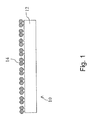
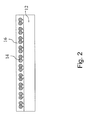
- the solderable aluminum-based material 10 of the present invention comprises: an aluminum-based material 12, which may be aluminum metal, an aluminum alloy, aluminum-magnesium alloy, or a magnesium-aluminum alloy.
- the surface of the aluminum-based material 12 has non-bonded atoms, and each non-bonded atom combines with an electron donor 14 to form a protective film.
- a double-atom unit is used to exemplify the electron donor.
- the electron donor may also be a single-atom unit or a triple-atom unit.
- solder materials can be easily soldered thereon, including: pure tin, lead-tin alloys, lead-free tin alloys and other tin alloys. Naturally, a soldering flux should be applied before soldering.
- the abovementioned electron donor may contain a V-group element, such as nitrogen, phosphorus, arsenic, antimony, or bismuth.
- the abovementioned electron donor may contain a VI-group element, such as sulfur, selenium, tellurium, or polonium.
- the abovementioned electron donor may contain a VII-group element, such as fluorine, chlorine, bromine, or iodine.
- the abovementioned electron donor may contain a double bond or a triple bond, such as an alkene, an alkyne, benzene, or an aromatic.
- the abovementioned electron donor may contain a carboxyl functional group, such as an aldehyde, or a ketone.
- the abovementioned electron donor may contain a hydroxyl functional group. Besides, the abovementioned electron donor may contain an organic complex, such as EDTA (ethylenediaminetetraacetic acid). Further, the electron donor may even be a mixture of the abovementioned various electron donors.
- EDTA ethylenediaminetetraacetic acid
- a protective film forms, and a large-area tin layer 16 can be directly formed on the solderable aluminum-based material 10 without the problem of adhesion.
- a total-face soldering or a double-side soldering can be performed on the solderable aluminum-based material 10.
- the present invention tin or other metals can be easily soldered on the surface of an aluminum-based material by a common soldering technology (i.e. by heating) under the action of the electron donors.
- a common soldering technology i.e. by heating
- the present invention has lightweightness, a low price, a high electric conductivity, a high thermal conductivity, and a superior solderability. Therefore, the present invention has a high economic value and can be widely used in the industry.
Landscapes
- Chemical & Material Sciences (AREA)
- Engineering & Computer Science (AREA)
- Materials Engineering (AREA)
- Mechanical Engineering (AREA)
- Metallurgy (AREA)
- Organic Chemistry (AREA)
- Other Surface Treatments For Metallic Materials (AREA)
- Laminated Bodies (AREA)
- Conductive Materials (AREA)
- Parts Printed On Printed Circuit Boards (AREA)
- Insulated Metal Substrates For Printed Circuits (AREA)
- Devices For Blowing Cold Air, Devices For Blowing Warm Air, And Means For Preventing Water Condensation In Air Conditioning Units (AREA)
- Preventing Corrosion Or Incrustation Of Metals (AREA)
Applications Claiming Priority (1)
| Application Number | Priority Date | Filing Date | Title |
|---|---|---|---|
| TW096217510U TWM337574U (en) | 2007-10-19 | 2007-10-19 | Aluminum substrate able to be subject to welding |
Publications (1)
| Publication Number | Publication Date |
|---|---|
| EP2050563A2 true EP2050563A2 (fr) | 2009-04-22 |
Family
ID=39736583
Family Applications (1)
| Application Number | Title | Priority Date | Filing Date |
|---|---|---|---|
| EP08160577A Withdrawn EP2050563A2 (fr) | 2007-10-19 | 2008-07-17 | Matériau soudable à base d'aluminium |
Country Status (8)
| Country | Link |
|---|---|
| US (1) | US20090104471A1 (fr) |
| EP (1) | EP2050563A2 (fr) |
| JP (1) | JP3142094U (fr) |
| BR (1) | BRMU8802030U2 (fr) |
| CA (1) | CA2630501A1 (fr) |
| DE (1) | DE202008005039U1 (fr) |
| SG (1) | SG152117A1 (fr) |
| TW (1) | TWM337574U (fr) |
Families Citing this family (1)
| Publication number | Priority date | Publication date | Assignee | Title |
|---|---|---|---|---|
| DE102015009944B4 (de) * | 2015-06-29 | 2019-03-14 | Diehl Metal Applications Gmbh | Steckverbinder hergestellt aus einem Band aus einer Aluminium-Legierung |
-
2007
- 2007-10-19 TW TW096217510U patent/TWM337574U/zh not_active IP Right Cessation
-
2008
- 2008-03-17 US US12/076,284 patent/US20090104471A1/en not_active Abandoned
- 2008-03-19 JP JP2008001614U patent/JP3142094U/ja not_active Expired - Fee Related
- 2008-04-11 DE DE202008005039U patent/DE202008005039U1/de not_active Expired - Lifetime
- 2008-04-29 CA CA002630501A patent/CA2630501A1/fr not_active Abandoned
- 2008-07-17 EP EP08160577A patent/EP2050563A2/fr not_active Withdrawn
- 2008-07-29 SG SG200805618-6A patent/SG152117A1/en unknown
- 2008-07-31 BR BRMU8802030-4U patent/BRMU8802030U2/pt not_active IP Right Cessation
Also Published As
| Publication number | Publication date |
|---|---|
| DE202008005039U1 (de) | 2008-09-04 |
| CA2630501A1 (fr) | 2009-04-19 |
| TWM337574U (en) | 2008-08-01 |
| BRMU8802030U2 (pt) | 2009-06-23 |
| SG152117A1 (en) | 2009-05-29 |
| US20090104471A1 (en) | 2009-04-23 |
| JP3142094U (ja) | 2008-06-05 |
Similar Documents
| Publication | Publication Date | Title |
|---|---|---|
| Lee | Getting ready for lead‐free solders | |
| EP3261798B1 (fr) | Fil de soudage à âme métallique en aluminium | |
| US7988908B2 (en) | Filler metal alloy compositions | |
| KR101231550B1 (ko) | 은납 브레이징 합금 | |
| JP5943066B2 (ja) | 接合方法および接合構造体の製造方法 | |
| KR101083122B1 (ko) | 브레이징 합금 | |
| Efzan et al. | A review of solder evolution in electronic application | |
| GB2302901A (en) | Metal laminate made by seam - welding | |
| JP5198528B2 (ja) | 異材接合用溶加材及び異材接合方法 | |
| CN103737195A (zh) | 用于铝铜软钎焊的Sn-Zn-Bi基无铅钎料合金 | |
| JP5279714B2 (ja) | 接合用組成物 | |
| US20070178007A1 (en) | Lead-free solder, solder joint product and electronic component | |
| JP4115979B2 (ja) | 非鉛系はんだ材 | |
| JP2010084228A (ja) | リードフレーム材、それを用いた半導体装置 | |
| EP2050563A2 (fr) | Matériau soudable à base d'aluminium | |
| CN103706962A (zh) | 一种用于铝铜软钎焊的Sn-Zn-Ni无铅钎料合金 | |
| EP0587307A1 (fr) | Alliages d'aluminium | |
| AU2008100374A4 (en) | Solderable Aluminum-based Material | |
| CN1902792A (zh) | 碳刷及其制造的方法和材料 | |
| JP2001287082A (ja) | はんだ合金 | |
| KR101161416B1 (ko) | 인동땜납 합금 | |
| JP5773444B2 (ja) | アルミニウム接合用はんだ合金 | |
| JP2575577B2 (ja) | アルミニウム合金のスポット溶接方法 | |
| KR20090003830U (ko) | 납땜 가능한 알루미늄 기반 물질 | |
| JP5131077B2 (ja) | Sn系めっき鋼板のスポット溶接方法 |
Legal Events
| Date | Code | Title | Description |
|---|---|---|---|
| PUAI | Public reference made under article 153(3) epc to a published international application that has entered the european phase |
Free format text: ORIGINAL CODE: 0009012 |
|
| AK | Designated contracting states |
Kind code of ref document: A2 Designated state(s): AT BE BG CH CY CZ DE DK EE ES FI FR GB GR HR HU IE IS IT LI LT LU LV MC MT NL NO PL PT RO SE SI SK TR |
|
| AX | Request for extension of the european patent |
Extension state: AL BA MK RS |
|
| STAA | Information on the status of an ep patent application or granted ep patent |
Free format text: STATUS: THE APPLICATION IS DEEMED TO BE WITHDRAWN |
|
| 18D | Application deemed to be withdrawn |
Effective date: 20110118 |