EP2050738B1 - Nouveau dérivé d'imidazolidinone, procédé de production de ce dérivé et procédé de production d'un acide aminé optiquement actif - Google Patents
Nouveau dérivé d'imidazolidinone, procédé de production de ce dérivé et procédé de production d'un acide aminé optiquement actif Download PDFInfo
- Publication number
- EP2050738B1 EP2050738B1 EP07743261.5A EP07743261A EP2050738B1 EP 2050738 B1 EP2050738 B1 EP 2050738B1 EP 07743261 A EP07743261 A EP 07743261A EP 2050738 B1 EP2050738 B1 EP 2050738B1
- Authority
- EP
- European Patent Office
- Prior art keywords
- carbon atoms
- optionally substituted
- group
- general formula
- optically active
- Prior art date
- Legal status (The legal status is an assumption and is not a legal conclusion. Google has not performed a legal analysis and makes no representation as to the accuracy of the status listed.)
- Active
Links
- 0 CCC(CC1C)C1C([C@](C1)C(C2)C2CC[C@@]1C1(C2C1CCC2)C1CC(C2)C2C1)=C* Chemical compound CCC(CC1C)C1C([C@](C1)C(C2)C2CC[C@@]1C1(C2C1CCC2)C1CC(C2)C2C1)=C* 0.000 description 9
- JAPMJSVZDUYFKL-UHFFFAOYSA-N C1C2C1CCC2 Chemical compound C1C2C1CCC2 JAPMJSVZDUYFKL-UHFFFAOYSA-N 0.000 description 1
Classifications
-
- C—CHEMISTRY; METALLURGY
- C07—ORGANIC CHEMISTRY
- C07D—HETEROCYCLIC COMPOUNDS
- C07D233/00—Heterocyclic compounds containing 1,3-diazole or hydrogenated 1,3-diazole rings, not condensed with other rings
- C07D233/04—Heterocyclic compounds containing 1,3-diazole or hydrogenated 1,3-diazole rings, not condensed with other rings having one double bond between ring members or between a ring member and a non-ring member
- C07D233/28—Heterocyclic compounds containing 1,3-diazole or hydrogenated 1,3-diazole rings, not condensed with other rings having one double bond between ring members or between a ring member and a non-ring member with hetero atoms or with carbon atoms having three bonds to hetero atoms with at the most one bond to halogen, e.g. ester or nitrile radicals, directly attached to ring carbon atoms
- C07D233/30—Oxygen or sulfur atoms
- C07D233/32—One oxygen atom
-
- C—CHEMISTRY; METALLURGY
- C07—ORGANIC CHEMISTRY
- C07C—ACYCLIC OR CARBOCYCLIC COMPOUNDS
- C07C227/00—Preparation of compounds containing amino and carboxyl groups bound to the same carbon skeleton
- C07C227/22—Preparation of compounds containing amino and carboxyl groups bound to the same carbon skeleton from lactams, cyclic ketones or cyclic oximes, e.g. by reactions involving Beckmann rearrangement
-
- C—CHEMISTRY; METALLURGY
- C07—ORGANIC CHEMISTRY
- C07C—ACYCLIC OR CARBOCYCLIC COMPOUNDS
- C07C231/00—Preparation of carboxylic acid amides
- C07C231/10—Preparation of carboxylic acid amides from compounds not provided for in groups C07C231/02 - C07C231/08
Definitions
- the present invention relates to an optically active imidazolidinone derivative which is a chiral glycine synthon useful for producing an optically active amino acid. Further, the present invention relates to a method of producing the derivative, and a method of producing an optically active amino acid using the derivative.
- An optically active amino acid is an important intermediate in terms of production of a pharmaceutical product, an agricultural agent, a chemical product or the like.
- optically active amino acid particularly an optically active unnatural amino acid which does not exist in nature, is an important constituent factor for a pharmaceutical product, an agricultural agent, a chemical product or the like.
- optically active imidazolidinone derivative as a chiral glycine synthon developed for synthesizing such an unnatural amino acid following synthetic methods are conventionally known.
- the method i) is difficult to be industrially carried out, since a salt production and salt dissolution process is inevitably required in the method i) in which the produced optical isomers are resolved as mandelate salts thereof. Further, the method ii) is also difficult to be industrially carried out, since in the method ii) an optically active serine is used and it is necessary to oxidize and decarbonate the hydroxymethyl group thereof after forming an imidazolidinone ring. Furthermore, the method iii) is also difficult to be industrially carried out, since cumbersome procedures are required for the method iii) because of a plurality of induction processes from optically active methionine similarly to the case of ii).
- the method iv) since optically active glycinamide is used, the produced imidazolidinone derivatives are obtained as an isomeric mixture. Accordingly, the method iv) is similarly difficult to be industrially carried out, since it is required to purify the isomeric mixture by a silica gel column to obtain a pure single isomer.
- pivalaldehyde used in common for the methods i) to iv) is an expensive compound and use of the compound in industrial scale is not preferred.
- Document 5 discloses the use of imidazolidinone glycine derivatives for use in the ⁇ -amino acid synthesis.
- an objective of the present invention is to provide an optically active imidazolidinone derivative widely usable for synthesizing an optically active amino acid without carrying out cumbersome procedures such as resolution of a salt of diastereomers, synthesis from an optically active amino acid and resolution of isomers by a silica gel column. Further, it is also an objective to provide a method of easily producing the derivative. Furthermore, it is also an objective to provide a method of easily producing an optically active amino acid using the derivative.
- the inventors having extensive investigations to solve the above problems, produced a mixture of novel imidazolidinone derivative isomers, and found that an optically active imidazolidinone derivative can be isolated by preferential crystallization from a solution of an isomeric mixture of the derivative. Further, the inventors found that a single isomer can be obtained by dynamic kinetic resolution, since isomerization takes place during preferential crystallization. Furthermore, the inventors found that an optically active amino acid can be synthesized by using the optically active derivative, and the findings led to completion of the present invention.
- the present invention relates to an imidazolidinone derivative represented by the general formula (1): or an optically active form thereof, wherein, n and m independently represents an integer of 0 to 5 representively indicating the numbers of substituent groups R 1 and R 2 on the benzene rings; R 1 and R 2 independently represent an optionally substituted alkyl group having 1 to 18 carbon atoms, an optionally substituted aralkyl group having 7 to 18 carbon atoms, an optionally substituted aryl group having 6 to 18 carbon atoms, a halogen atom, a hydroxyl group, an optionally substituted alkoxy group having 1 to 18 carbon atoms, or a nitro group; in case that there are a plurality of R 1 or R 2 , the plural R 1 or R 2 may be all the same or different; *1 and *2 indicate asymmetric carbon atoms.
- the present invention also relates to an imidazolidinone derivative represented by the general formula (2): or an optically active form thereof, wherein, n, m, R 1 , R 2 , *1 and *2 are the same as described above;
- R 3 represents an optionally substituted alkyl group having 1 to 18 carbon atoms, an optionally substituted alkenyl group having 2 to 18 carbon atoms, an optionally substituted alkynyl group having 2 to 18 carbon atoms, an optionally substituted aralkyl group having 7 to 18 carbon atoms, or an optionally substituted aryl group having 6 to 18 carbon atoms.
- the present invention also relates to an optically active imidazolidinone derivative represented by the general formula (3): wherein, n, m, R 1 , R 2 , R 3 *1 and *2 are the same as described above; R 4 and R 5 are different, and represent a hydrogen atom, an optionally substituted alkyl group having 1 to 30 carbon atoms, an optionally substituted alkenyl group having 2 to 18 carbon atoms, an optionally substituted alkynyl group having 2 to 18 carbon atoms, an optionally substituted aralkyl group having 7 to 18 carbon atoms, or an optionally substituted aryl group having 6 to 18 carbon atoms; and *3 indicates an asymmetric carbon atom.
- R 4 and R 5 are different, and represent a hydrogen atom, an optionally substituted alkyl group having 1 to 30 carbon atoms, an optionally substituted alkenyl group having 2 to 18 carbon atoms, an optionally substituted alkynyl group having 2 to 18 carbon atoms
- the present invention relates to a method of producing the imidazolidinone derivative represented by the general formula (1), characterized in comprising a step of condensating an optically active glycinamide derivative represented by the general formula (4): wherein, n, R 1 and *1 are the same as described above, with a substituted benzaldehyde represented by the general formula (5) : wherein, m and R 2 are the same as described above, in the presence of an acidic catalyst.
- the present invention also relates to a method of crystallizing an optically active imidazolidinone derivative, characterized in comprising a step of crystallizing the imidazolidinone derivative represented by the general formula (1) using an organic solvent.
- the present invention also relates to the method of crystallizing an optically active imidazolidinone derivative, characterized in that the optically active imidazolidinone derivative is crystallized while the imidazolidinone derivative is isomerized.
- the present invention also relates to the method of crystallizing an optically active imidazolidinone derivative, characterized in that an acidic catalyst is used in the isomerization.
- the present invention also relates to a method of producing the imidazolidinone derivative represented by the general formula (2), characterized in comprising a step of reacting the imidazolidinone derivative or optically active form thereof, represented by the general formula (1) with a halogenoformic acid ester represented by the general formula (6): R 3 OCOX (6) wherein, R 3 is the same as described above; and X represents a halogen atom, or a pyrocarbonic acid ester represented by the general formula (7): wherein, R 3 is the same as descried above and two R 3 are the same, in the presence of a base.
- the present invention also relates to a method of crystallizing an optically active imidazolidinone derivative, characterized in comprising a step of crystallizing the imidazolidinone derivative represented by the general formula (2) by using an organic solvent.
- the present invention also relates to a method of producing an optically active imidazolidinone derivative represented by the general formula (3), characterized in comprising a step of reacting the optically active imidazolidinone derivative represented by the general formula (2) with one or two kinds of electrophilic agents represented by the general formula (8): R 7 Y (8) wherein, R 7 represents an optionally substituted alkyl group having 1 to 30 carbon atoms, an optionally substituted alkenyl group having 2 to 18 carbon atoms, an optionally substituted alkynyl group having 2 to 18 carbon atoms, an optionally substituted aralkyl group having 7 to 18 carbon atoms, or an optionally substituted aryl group having 6 to 18 carbon atoms; and Y represents a leaving group, in the presence of a base.
- the present invention also relates to a method of producing the optically active imidazolidinone derivative represented by the above general formula (3), characterized in comprising a step of reacting an optically active imidazolidinone derivative represented by the general formula (11): wherein, n, m, R 1 , R 2 , R 3 , R 7 , *1, *2 and *3 are the same as described above, with an electrophilic agent represented by the general formula (8)' : R 7 'Y (8)' wherein, R 7 ' and Y are the same as described above, in the presence of a base.
- the present invention also relates to a method of producing an optically active N-(1-substituted phenylethyl)amino acid derivative represented by the general formula (9): wherein, n, R 1 , R 4 , R 5 , *1 and *3 are the same as described above, characterized in comprising a step of treating the optically active imidazolidinone derivative represented by the general formula (3) with an acid or a base in at least one of organic solvents and water.
- the present invention also relates to a method of producing an optically active amino acid represented by the general formula (10) : wherein, R 4 , R 5 and *3 are the same as described above, characterized in comprising a steps of removing the substituent group on the nitrogen of the optically active imidazolidinone derivative represented by the general formula (3) to obtain an optically active amino acid amide represented by the general formula (12): wherein, R 4 , R 5 and *3 are the same as described above, thereafter treating the amino acid amide with an acid or a base in at least one of organic solvents and water.
- the present invention also relates to a method of producing an optically active imidazolidinone derivative represented by the general formula (14): wherein, n, m, R 1 , R 2 , R 3 , R 8 , *1, *2 and *3 are the same as described above; and in case that R 8 is not a hydrogen atom, *4 indicates an asymmetric carbon atom, characterized in comprising a step of reacting the optically active imidazolidinone derivative represented by the general formula (2) with an aldehyde represented by the general formula (13): R 8 -CHO (13) wherein, R 8 represents a hydrogen atom, an optionally substituted alkyl group having 1 to 30 carbon atoms, an optionally substituted alkenyl group having 2 to 18 carbon atoms, an optionally substituted alkynyl group having 2 to 18 carbon atoms, an optionally substituted aralkyl group having 7 to 18 carbon atoms, or an optionally substituted aryl group having 6 to 18 carbon atoms, in
- the present invention also relates to a method of producing an optically active N-(1-substituted phenylethyl)hydroxyamino acid derivative represented by the general formula (15): wherein, n, R 1 , R 8 , *1, *3 and *4 are the same as described above, characterized in comprising a step of treating the optically active imidazolidinone derivative represented by the general formula (14) with an acid or a base in at least one of organic solvents and water.
- the present invention also relates to a method of producing an optically active hydroxyamino acid represented by the general formula (16): wherein, R 8 , *3 and *4 are the same as described above, characterized in comprising a step of removing the substituent group on the nitrogen of the hydroxyamino acid derivative represented by the general formula (15).
- the present invention also relates to a method of producing the optically active hydroxyamino acid represented by the general formula (16), characterized in comprising steps of removing the substituent group on the nitrogen of the optically active imidazolidinone derivative represented by the general formula (14) to synthesize an optically active hydroxyamino acid amide represented by the general formula (17): wherein, R 8 , *3 and *4 are the same as described above; thereafter treating the hydroxyamino acid amide with an acid or a base in at least one of organic solvents and water.
- the first present invention is an isomeric mixture of an imidazolidinone derivative or an optically active form of the derivative represented by the following general formula (1).
- R 1 and R 2 each independently represents an optionally substituted alkyl group having 1 to 18 carbon atoms, an optionally substituted aralkyl group having 7 to 18 carbon atoms, an optionally substituted aryl group having 6 to 18 carbon atoms, a halogen atom, a hydroxyl group, an optionally substituted alkoxy group having 1 to 18 carbon atoms, or a nitro group.
- the example of the optionally substituted alkyl group having 1 to 18 carbon atoms includes a methyl group, an ethyl group, an n-propyl group, an isopropyl group, an n-butyl group, a t-butyl group, an n-pentyl group, a neopentyl group, a t-amyl group, an n-hexyl group, an n-heptyl group, an n-octyl group, an n-nonyl group, an n-decyl group and the like.
- the example of the optionally substituted aralkyl group having 7 to 18 carbon atoms includes a benzyl group, a p-methoxyphenylmethyl group, a naphthylmethyl group and the like.
- the example of the optionally substituted aryl group having 6 to 18 carbon atoms includes a phenyl group, a p-methoxyphenyl group, a naphthyl group, a p-nitrophenyl group and the like.
- the example of the halogen atom includes a fluorine atom, a chlorine atom, a bromine atom and an iodine atom.
- the example of the optionally substituted alkoxy group having 1 to 18 carbon atoms includes a methoxy group, an ethoxy group, an n-propyloxy group, an isopropyloxy group, an n-butyloxy group, a t-butyloxy group, a methoxymethyloxy group, a benzyloxymethyloxy group, a methylthiomethyloxy group, a 2-chloroethyloxy group, a 2-bromoethyloxy group and the like.
- the above alkyl group, aralkyl group, aryl group and alkoxy group may be substituted with a halogen atom, an alkoxy group, a hydroxyl group, an aralkyloxy group, an alkylthio group, an alkylsilyloxy group, an arylalkylsilyloxy group and the like.
- R 1 and R 2 are preferably a chlorine atom, a methyl group, a methoxy group, an ethoxy group or a nitro group.
- the reference character n represents an integer of 0 to 5 indicating the number of substituent groups on the benzene ring; and the substituent is R 1 as described above and the substitution manner is not particularly limited.
- the reference character m represents an integer of 0 to 5 indicating the number of substituent groups on the benzene ring; and the substituent is R 2 as described above and the substitution manner is not particularly limited.
- all R 1 may be the same or different and all R 2 may be the same or different.
- the reference numeral *1 indicates an asymmetric carbon atom, and the absolute configuration may be R or S.
- the configuration is R means that the isomer with the R configuration exists in large excess than the isomer with the S configuration at the asymmetric carbon atom
- the configuration is S means that the isomer with the S configuration exists in large excess than the isomer with the R configuration.
- the second present invention is an isomeric mixture of an imidazolidinone derivative represented by the general formula (2) : or an optically active form thereof.
- R 1 , R 2 , n and m are the same as described above.
- R 3 represents an optionally substituted alkyl group having 1 to 18 carbon atoms, an optionally substituted alkenyl group having 2 to 18 carbon atoms, an optionally substituted alkynyl group having 2 to 18 carbon atoms, an optionally substituted aralkyl group having 7 to 18 carbon atoms, or an optionally substituted aryl group having 6 to 18 carbon atoms.
- the example of the optionally substituted alkyl group having 1 to 18 carbon atoms includes a methyl group, an ethyl group, an n-propyl group, an isopropyl group, an n-butyl group, a t-butyl group, a 2,2,2-trichloroethyl group, an isobutyl group, a 2-chloroethyl group, a 1,1-dimethyl-2,2,2-trichloroethyl group, a 1-adamantyl group, a 2-trimethylsilylethyl group and the like.
- the example of the optionally substituted alkenyl group having 2 to 18 carbon atoms includes an ally group, a vinyl group, a 3-butenyl group, a 2-methyl-2-propenyl group, a 3-phenyl-2-propenyl group, a 3-(p-nitrophenyl)-2-propenyl group and the like.
- the example of the optionally substituted alkynyl group having 2 to 18 carbon atoms includes a propynyl group, a 2-butynyl group, a 3-butynyl group, a 2-pentynyl group and the like.
- the example of the optionally substituted aralkyl group having 7 to 18 carbon atoms includes a benzyl group, a p-methoxyphenylmethyl group, a p-nitrophenylmethyl group, a p-bromophenylmethyl group, a p-chlorophenylmethyl group, a 2,4-dichlorophenylmethyl group, a naphthylmethyl group, a 9-fluorenylmethyl group and the like.
- the example of the optionally substituted aryl group having 6 to 18 carbon atoms includes a phenyl group, a p-methoxyphenyl group, a naphthyl group and the like.
- alkyl group, alkenyl group, alkynyl group, aralkyl group and aryl group may be substituted with a halogen atom, an alkoxy group, a hydroxyl group, an aralkyloxy group, an alkylthio group, an alkylsilyloxy group, an arylalkylsilyloxy group, a nitro group and the like.
- R 3 is preferably a methyl group, an ethyl group, an isopropyl group, an isobutyl group, a t-butyl group, an allyl group, a 2,2,2-trichloroethyl group, a benzyl group and a p-methoxyphenylmethyl group; more preferably a t-butyl group, a methyl group, an ethyl group, an allyl group and a benzyl group; and even more preferably a t-butyl group, an allyl group and a benzyl group.
- the carbon atom of 2-position in the imidazolidinone ring of a compound represented by the general formula (2) is an asymmetric carbon atom.
- the third present invention is an imidazolidinone derivative represented by a general formula (3):
- R 1 , R 2 , R 3 , n and m are same as described above.
- R 4 and R 5 are differently represent a hydrogen atom, an optionally substituted alkyl group having 1 to 30 carbon atoms, an optionally substituted alkenyl group having 2 to 18 carbon atoms, an optionally substituted alkynyl group having 2 to 18 carbon atoms, an optionally substituted aralkyl group having 7 to 18 carbon atoms, or an optionally substituted aryl group having 6 to 18 carbon atoms.
- the example of the carbon chain of the optionally substituted alkyl group having 1 to 30 carbon atoms includes a methyl group, an ethyl group, an n-propyl group, an isopropyl group, an n-butyl group, an isobutyl group, a 1-methyl-propyl group, a 2-methyl-propyl group, a pentyl group, a hexyl group, a heptyl group, an octyl group, a nonyl group, a decyl group, an undecyl group, a dodecyl group, a tridecyl group, a tetradecyl group, a pentadecyl group, a hexadecyl group, a heptadecyl group, an octadecyl group, a nonadecyl group and the like; and the carbon chain may have a substituent group at any arbitrary
- the kind of the substituent group includes a halogen atom, an alkoxy group, a hydroxyl group, an aralkyloxy group, an alkylthio group, an alkylsilyloxy group and an arylalkylsilyloxy group.
- the example thereof includes a 3-chloropropyl group, a 2-methoxyethyl group, a benzyloxymethyl group, a 2-benzyloxyethyl group, a 2-(mercaptomethyl)ethyl group, a 2-(t-butyldimethylsilyloxy)ethyl group, a 2-(t-butyldiphenylsilyloxy)ethyl group, a 2-trimethyhlsilyloxyethyl group and the like.
- the example of the optionally substituted alkenyl group having 2 to 18 carbon atoms includes an allyl group, a vinyl group, a 3-butenyl group, a 2-methyl-2-propenyl group, a 3-phenyl-2-propenyl group and the like.
- the example of the optionally substituted alkynyl group having 2 to 18 carbon atoms includes a propynyl group, a 2-butynyl group, a 3-butynyl group, a 2-pentynyl group and the like.
- the example of the optionally substituted aralkyl group having 7 to 18 carbon atoms includes a benzyl group, a p-methoxyphenylmethyl group, a p-nitrophenylmethyl group, a p-bromophenylmethyl group, a p-chlorophenylmethyl group, a 2,4-dichlorophenylmethyl group, a naphthylmethyl group, a 1-indanoyl group, a diphenylmethyl group and the like.
- the example of the optionally substituted aryl group having 6 to 18 carbon atoms includes a phenyl group, a p-methoxyphenyl group, a naphthyl group and the like.
- R 4 and R 5 are preferably a hydrogen atom, a methyl group, an ethyl group, a benzyl group, a propyl group, an allyl group, a propynyl group, a 1-methyl-propynyl group, a 2-methyl-propyl group, a benzyloxymethyl group, a 2-(mercaptomethyl)ethyl group, a p-methoxyphenylmethyl group, a 2-trimethylsilyloxyethyl group, a diphenylmethyl group.
- the compound is an optically active form having one of the absolute configurations.
- the imidazolidinone derivatives of the general formulae (1), (2) and (3) can be produced by the production method described below.
- the imidazolidinone derivative represented by the above general formula (1) can be produced, for example, by condensating an optically active glycinamide derivative represented by the general formula (4): wherein, n, R 1 and *1 are the same as described above, with a substituted benzaldehyde represented by the general formula (5) : wherein, m and R 2 are the same as described above, in the presence of an acidic catalyst.
- An optically active glycinamide represented by the general formula (4) can be easily produced by the method shown in Example 1 or the like.
- a substituted benzaldehyde represented by the general formula (5) is easily commercially available.
- the amount of an optically active glycinamide derivative represented by the general formula (4) is not particularly limited; however, the amount is generally in a range of 0.1 to 10.0 molar equivalents based on molar equivalent of the substituted benzaldehyde (5).
- the amount is preferably in a range of 0.1 to 5.0 molar equivalents, and more preferably in a range of 0.1 to 3.0 molar equivalents.
- the reaction is carried out in the presence of an acidic catalyst.
- the acidic catalyst is not particularly limited; however, the example includes mineral acids such as hydrochloric acid, hydrobromic acid, hydroiodic acid, sulfuric acid and nitric acid; sulfonic acids such as methanesulfonic acid, p-toluenesulfonic acid, camphorsulfonic acid and trifluoromethanesulfonic acid; and halogeno fatty acids such as trichloroacetic acid and trifluoroacetic acid; and the like.
- sulfonic acids are preferably used and p-toluenesulfonic acid is more preferable.
- the amount of the acidic catalyst is not particularly limited; however, the amount to be used is preferably between 0.001 and 1.0 molar equivalent, more preferably in a range of 0.001 to 0.5 molar equivalents, and even more preferably in a range of 0.001 to 0.1 molar equivalents, based on molar equivalent of the substituted benzaldehyde (5) to be used.
- an organic solvent is generally used for the reaction.
- the solvent to be used is not particularly limited; however, the example includes aliphatic hydrocarbons such as n-hexane, n-heptane, n-octane, n-nonane, cyclohexane and methylcyclohexane; aromatic hydrocarbons such as benzene, toluene, xylene, mesitylene, chlorobenzene and o-dichlorobenzene; acetic acid esters such as methyl acetate, ethyl acetate, n-butyl acetate, t-butyl acetate and isopropyl acetate; ethers such as tetrahydrofuran, 1,4-dioxane, diisopropyl ether, t-butyl methyl ether and cyclopentyl methyl ether; nitriles such as acetonitrile and propionit
- the solvent may be singly used, or two or more kinds of the solvents may be arbitrarily combined for use.
- aliphatic hydrocarbons and aromatic hydrocarbons are preferable, and n-heptane, n-octane, cyclohexane, methylcyclohexane, benzene, toluene and chlorobenzene are more preferable, and toluene is much more preferable.
- the amount of the solvent to be used is not particularly limited; however, the amount is generally in a range of 0. 5 to 50 times volume based on a weight of a compound represented by the above formula (5). The amount is much preferably in a range of 1.5 to 25 times volume.
- a reaction temperature is not particularly limited as long as condensation reaction of an optically active glycinamide derivative represented by the general formula (4) and a substituted benzaldehyde represented by the general formula (5) can be promoted; however, the temperature is preferably 0 to 150°C and more preferably in a range of 30 to 150°C.
- a reaction time is not particularly limited; however, the reaction time is preferably 0.1 to 50 hours and more preferably 2 to 30 hours.
- a thus produced imidazolidinone derivative represented by the general formula (1) has about 1 : 1 ratio of the isomers with respect to the carbon atom in 2-position of the imidazolidinone ring, i. e. the carbon atom positioned between the two nitrogen atoms.
- the obtained compound represented by the general formula (1) may be used for the next step directly, or any one of the optically active forms may be preferentially crystallized from a solution of the imidazolidinone derivative isomeric mixture containing two or more optical isomers represented by the above formula (1), of which the optically active form may be used for the next step.
- An organic solvent may be used for the crystallization.
- the solvent to be used is not particularly limited as long as the solubility of each isomer in the solvent is sufficiently different among a plurality of optical isomers, since the solubility difference of each optical isomer is utilized in the crystallization.
- Illustrative example includes aliphatic hydrocarbons such as n-hexane, n-heptane, n-octane, n-nonane, cyclohexane and methylcyclohexane; aromatic hydrocarbons such as benzene, toluene, xylene, chlorobenzene and o-dichlorobenzene; acetic acid esters such as methyl acetate, ethyl acetate, n-butyl acetate, t-butyl acetate and isopropyl acetate; ethers such as tetrahydrofuran, 1,4-dioxane, diisopropyl ether, t-butyl methyl ether and cyclopentyl methyl ether; nitriles such as acetonitrile and propionitrile; amides such as N,N-dimethylformamide, N,N-dimethylacet
- the solvent may be singly used, or two or more kinds of the solvents may be arbitrarily combined for use.
- the solvents nitriles are preferable, and acetonitrile is more preferable.
- the use amount of the solvent to be used is not particularly limited; however, the amount is generally in a range of 1 to 100 times volume based on the weight of the imidazolidinone derivative isomeric mixture.
- the amount is preferably 1 to 50 times volume and more preferably 1 to 20 times volume.
- the crystallization may be carried out with a proper combination of various methods such as commonly employed crystallization by cooling, crystallization by concentration and crystallization by solvent replacement.
- the temperature at the time of the crystallization is not also particularly limited; however, the temperature is preferably in a range of -25 to 80°C, more preferably -10 to 80°C, and even more preferably 0 to 50°C.
- the time to carry out the crystallization is not particularly limited; however, the time is preferably 0.1 to 50 hours and more preferably 0.1 to 24 hours.
- a crystal of the optically active imidazolidinone derivative containing any one of the optical isomers in an excess amount can be obtained by the preferential crystallization.
- the optical purity of the obtained derivative is generally in a range of 80 to 100% de.
- the optical purity is preferably 85% de or higher and particularly preferably 90% de or higher.
- the isomerization method of the imidazolidinone derivative is not particularly limited; however, for example, methods such as use of an acidic catalyst, use of a basic catalyst, use of an optically active acid or base, warming conditions, heating conditions and light irradiation can be exemplified.
- methods such as use of an acidic catalyst, use of a basic catalyst, use of an optically active acid or base, warming conditions, heating conditions and light irradiation can be exemplified.
- use of an acidic catalyst is preferable with respect to dynamic kinetic resolution of the imidazolidinone derivative.
- the acidic catalyst is not particularly limited as long as the catalyst can promote the isomerization with respect to the 2-position carbon atom of the imidazolidinone ring (the carbon atom opsitioned between the two nitrogen atoms); however, the example includes, for example, mineral acids such as hydrochloric acid, hydrobromic acid, hydroiodic acid, sulfuric acid and nitric acid; sulfonic acids such as methanesulfonic acid, p-toluenesulfonic acid, camphorsulfonic acid and trifluoromethanesulfonic acid; halogeno fatty acids such as trichloroacetic acid and trifluoroacetic acid; and the like. Among the examples, sulfonic acids and halogenoacetic acids are preferable to be used, and p-toluenesulfonic acid or trifluoroacetic acid is more preferable.
- mineral acids such as hydrochloric acid, hydrobromic acid, hydroiodic acid,
- the amount of the acidic catalyst is not particularly limited; however, the amount to be used is preferably between 0.001 and 1.0 molar equivalent, more preferably in a range of 0.001 to 0.5 molar equivalents, and even more preferably in a range of 0.001 to 0.4 molar equivalents, based on the molar equivalent of the imidazolidinone derivative to be used.
- An organic solvent is also used in the dynamic kinetic resolution, and the example of the solvent includes the solvents as described above as they are.
- the solvent may be singly used, or two or more kinds of the solvents may be used in combination.
- the solvent is preferably nitriles, acetic acid esters and aliphatic hydrocarbons, and more preferably acetonitrile, ethyl acetate and hexane.
- the amount of the solvent to be used is not also particularly limited; however, the amount is generally preferably in a range of 1 to 100 times volume based on the weight of the imidazolidinone derivative isomeric mixture. The amount is more preferably 1 to 50 times volume and even more preferably 1 to 20 times volume.
- reaction mixture may also be used directly for the dynamic kinetic resolution, since the imidazolidinone derivative isomeric mixture to be used for the dynamic kinetic resolution can be obtained in the presence of a acidic catalyst as described above.
- the temperature at the time of the dynamic kinetic resolution is not also particularly limited; however, the temperature is generally preferably in a range of -25 to 120°C, more preferably -10 to 100°C, and even more preferably in a range of 0 to 100°C.
- the time of crystallization is not particularly limited; however, the time is preferably 0.1 to 200 hours and more preferably 1 to 100 hours.
- the optical purity of the obtained derivative is generally in a range of 80 to 100% de.
- the optical purity is preferably 85% de or higher and particularly preferably 90% de or higher. Further, it is also possible to improve the optical purity of the optically active imidazolidinone derivative obtained by the dynamic kinetic resolution by repeated crystallization of the present invention described above.
- An imidazolidinone derivative represented by the general formula (2) can be produced by reacting an imidazolidinone derivative or an optically active form thereof, represented by the general formula (1) with a halogenoformic acid ester represented by the general formula (6): R 3 OCOX (6) or a pyrocarbonic acid ester represented by the general formula (7): in the presence of a base.
- a compound represented by the above formula (1) used for the step may also be treated to remarkably increase content of one optical isomer by the above preferential crystallization or dynamic kinetic resolution, or may not also be subjected to the improvement of the optical purity.
- the configuration of (*1, *2) may preferentially be any one of (R, R), (R,S), (S, R) and (S, S), or two or more diastereomers may be contained.
- R 3 is the same as described above, and X represents a halogen atom.
- the example of X includes a fluorine atom, a chlorine atom, a bromine atom and an iodine atom.
- X is preferably a chlorine atom.
- R 3 in the general formula (7) can also be exemplified by the same substituent group as descried above.
- the example of the compound to be used and represented by the general formulae (6) and (7) includes di-t-butyl dicarbonate, methyl chloroformate, ethyl chloroformate, isopropyl chloroformate, benzyloxycarbonyl chloride, 2,2,2-trichloroethyloxycarbonyl chloride, allyloxycarbonyl chloride and the like; and di-t-butyl dicarbonate, benzyloxycarbonyl chloride and allyloxycarbonyl chloride are preferable.
- the molar equivalent of a halogenoformic acid ester of the general formula (6) or a pyrocarbonic acid ester of the general formula (7) to be used is generally preferably 0.1 to 10 molar equivalents and more preferably 0.5 to 5 molar equivalents, based on the molar equivalent of an imidazolidinone derivative represented by the general formula (1).
- the reaction is carried out in the presence of a base.
- the base may be an organic base or an inorganic base, and preferably an organic base.
- the inorganic base to be used is not particularly limited as long as the base is commonly used by a person skilled in the art, and one or combined two or more kinds of the inorganic bases may be used.
- the organic base to be used is not particularly limited; however, the example includes aliphatic amines such as triethylamine, diisopropylethylamine and tri-n-butylamine; condensed ring amines such as [2.2.2]diazabicyclooctane, diazabicyclo[5.4.0]undecene and 1,5-diazabicyclo[4.3.0]nonene; pyridines such as pyridine, 2,6-lutidine and 2,4,6-colidine; alkylated aminopyridines such as 4-(N,N-dimethylamino)pyridine and 4-pyridinopyridine; and the like.
- aliphatic amines such as triethylamine, diisopropylethylamine and tri-n-butylamine
- condensed ring amines such as [2.2.2]diazabicyclooctane, diazabicyclo[5.4.0]undecene and 1,5
- the organic bases may be singly used, or two or more kinds of the organic bases may be used in combination.
- aliphatic amines, alkylated aminopyridines or combinations of the aliphatic amines and alkylaminopyridines are preferable, and triethylamine as the aliphatic amines and 4-(N,N-dimethylamino)pyridine as the alkylaminopyridines are preferable.
- the total molar equivalent of the base to be used in the case is generally in a range of 0.1 to 10.0 molar equivalents, preferably in a range of 0.1 to 5.0 molar equivalents, more preferably in a range of 0.5 to 5.0 molar equivalents, even more preferably in a range of 0.5 to 2.5 molar equivalents, and most preferably in a range of 1.0 to 1.5 molar equivalents, based on the molar equivalent of an imidazolidinone derivative represented by the general formula (1).
- the amount of the alkylated aminopyridines is generally in a range of 0.001 to 5.0 molar equivalents, preferably in a range of 0.001 to 2.5 molar equivalents, and more preferably in a range of 0.001 to 1.0 molar equivalent, based on the molar equivalent of an imidazolidinone derivative represented by the general formula (1).
- a solvent is used for the reaction.
- the solvent to be used is not particularly limited; however, the example includes aliphatic hydrocarbons such as n-hexane, n-heptane, n-octane, n-nonane, cyclohexane and methylcyclohexane; aromatic hydrocarbons such as benzene, toluene, xylene, chlorobenzene and o-dichlorobenzene; acetic acid esters such as methyl acetate, ethyl acetate, n-butyl acetate, t-butyl acetate and isopropyl acetate; ethers such as tetrahydrofuran, 1,4-dioxane, diisopropyl ether, t-butyl methyl ether and cyclopentyl methyl ether; nitriles such as acetonitrile and propionitrile; and amides
- the amount of the solvent to be used is not particularly limited; however, the amount is generally in a range of 1.5 to 50 times volume based on the weight of the imidazolidinone derivative.
- the amount is particularly preferably 1.5 to 25 times volume.
- a reaction temperature is not particularly limited; however, the temperature is preferably -50 to 100°C and more preferably in a range of -10 to 100°C and most preferably in a range of -10 to 50°C.
- a reaction time is not particularly limited; however, the time is preferably 0.1 to 50 hours and more preferably 0.1 to 25 hours.
- An imidazolidinone derivative represented by the general formula (2) and obtained by the above method may be used for the next step directly, or any one of the optically active forms may be preferentially crystallized by the following procedure.
- an organic solvent is generally used.
- the solvent to be used is not particularly limited as long as the solubility of the each isomer in the solvent is sufficiently different among a plurality of optical isomers, since the solubility difference of the optical isomers is utilized in the crystallization.
- the example includes aliphatic hydrocarbons such as n-hexane, n-heptane, n-octane, n-nonane, cyclohexane and methylcyclohexane; aromatic hydrocarbons such as benzene, toluene, xylene, chlorobenzene and o-dichlorobenzene; acetic acid esters such as methyl acetate, ethyl acetate, n-butyl acetate, t-butyl acetate and isopropyl acetate; ethers such as tetrahydrofuran, 1,4-dioxane, diisopropyl ether, t-butyl methyl ether and cyclopentyl methyl ether; nitriles such as acetonitrile and propionitrile; amides such as N,N-dimethylformamide, N,N-dimethylacetamide and 1-
- the solvent may be singly used, or two or more kinds of the solvents may be arbitrarily combined for use.
- hydrocarbons and esters are preferable to be used in combination, and combination of ethyl acetate and hexane or hexane alone is more preferable to be used.
- the amount of the solvent to be used is not particularly limited; however, the amount is generally in a range of 1 to 100 times volume based on the weight of the imidazolidinone derivative isomeric mixture.
- the amount is preferably 1 to 50 times volume, and more preferably 1 to 20 times volume.
- the ratio of the solvents to be used is not particularly limited; however, hexane may be used at a ratio in a range of 0 to 100 times volume based on the volume of ethyl acetate.
- the crystallization can be carried out by properly combining various methods such as commonly employed crystallization by cooling, crystallization by concentration and crystallization by solvent replacement.
- a crystallization temperature is not also particularly limited; however, the temperature is generally in a range of -30 to 80°C, preferably -20 to 80°C, and more preferably in a range of -15 to 50°C.
- a time to carry out the crystallization is not particularly limited; however, the time is preferably 0.1 to 80 hours and more preferably 0.1 to 65 hours.
- a crystal of the optically enriched imidazolidinone derivative containing any one of optical isomers in an excess amount can be obtained by the preferential crystallization.
- the optical purity of the obtained optically active form is not particularly limited unless the optical purity exerts a bad influence in the successive steps; however, the optical purity is generally in a range of 80 to 100% de, preferably 85% de or higher, and particularly preferably 90% de or higher.
- the optical purity of the optically active imidazolidinone derivative can be further improved by repeated crystallization of the present invention.
- a residual mother liquid after separation of the optically active imidazolidinone derivative containing, for example, S isomer in an excess amount by the preferential crystallization contains a large amount of R isomer.
- the mother liquid containing a large amount of R isomer is also subjected to the crystallization operation to obtain a crystal containing an excess amount of R isomer. In such a manner, both crystals of S isomer and R isomer can be obtained.
- An optically active imidazolidinone derivative represented by the above general formula (3) can be produced by reacting an optically active imidazolidinone derivative represented by the above formula (2) and obtained in the above manner with an electrophilic agent represented by the general formula (8): R 7 Y (8) in the presence of a base.
- a higher optical purity of a compound represented by the above formula (2) to be used in the step is preferable, since the resoluting compound (3) has higher optical purity; however, the optical purity is not particularly limited.
- R 7 represents an optionally substituted alkyl group having 1 to 30 carbon atoms, an optionally substituted alkenyl group having 2 to 18 carbon atoms, an optionally substituted alkynyl group having 2 to 18 carbon atoms, an optionally substituted aralkyl group having 7 to 18 carbon atoms, or an optionally substituted aryl group having 6 to 18 carbon atoms; and the specific example includes the same substituent groups as those for R 4 and R 5 .
- Y is a leaving group; and the example includes a halogen atom, a sulfonyloxy group and the like.
- the example of the halogen atom includes fluorine, chlorine, bromine, and iodine; and the example of the sulfonyloxy group includes a methanesulfonyloxy group, a p-toluenesulfonyloxy group, a trifluoromethanesulfonyloxy group, and the like.
- an electrophilic agent represented by the general formula (8) to be used includes iodides such as methyl iodide, ethyl iodide, n-propyl iodide, isopropyl iodide, n-butyl iodide, benzyl iodide and allyl iodide; bromides such as methyl bromide, ethyl bromide, n-propyl bromide, n-butyl bromide, 2-bromobutane, 1-bromo-2-methylpropane, 1-bromo-2-butyne, benzyl bromide, allyl bromide, propynyl bromide, p-methoxybenzyl bromide and benzyl 2-bromoethyl ether; chlorides such as benzyl chloride, benzyloxymethyl chloride, 2-chloroethyl methyl sulf
- the amount of an electrophilic agent represented by the general formula (8) is not particularly limited; however, the amount is generally preferably 0.1 to 5 equivalents and more preferably 0.5 to 2.5 equivalents, based on the molar equivalent of an optically active imidazolidinone derivative represented by the above formula (2). Needless to say, it is preferable to add 1 equivalent or more of a compound represented by the above formula (8) relative to a compound represented by the above formula (2) in order to obtain a compound represented by the above formula (3) with a high yield.
- reaction it is preferable to carry out the reaction in inert gas atmosphere. Particularly, the reaction is preferable to be carried out in nitrogen or argon atmosphere.
- a base is employed for the reaction.
- the base to be used is not particularly limited; however, an inorganic base or an organic base is preferable. Among them, an organic base is preferable and an organometallic base is particularly preferable.
- the example of the organometallic base includes lithium diisopropylamide, lithium dicyclohexylamide, lithium 2,2,6,6-tetramethylpiperazide, lithium hexamethyldisilazide, sodium hexamethyldisilazide, potassium hexamethyldisilazide, t-butyl magnesium chloride, lithium t-butoxide, sodium t-butoxide, potassium t-butoxide, lithium hydride, sodium hydride, potassium hydride, calcium hydride, and the like.
- lithium diisopropylamide, lithium hexamethyldisilazide, sodium hexamethyldisilazide, potassium hexamethyldisilazide, t-butyl magnesium chloride, potassium t-butoxide, sodium t-butoxide, lithium t-butoxide, lithium hydride, sodium hydride, potassium hydride and calcium hydroxide are preferable; and lithium amide bases and disilazide bases are more preferable; and lithium diisopropylamide, lithium disilazide, sodium disilazide and potassium disilazide are most preferable.
- the amount of the base is not particularly limited; however, the amount is generally in a range of 0.1 to 2.0 molar equivalents based on the molar equivalent of an optically active imidazolidinone derivative represented by the general formula (2).
- the amount is preferably in a range of 0.5 to 1.5 molar equivalents and more preferably in a range of 0.9 to 1.3 molar equivalents.
- a solvent is used for the reaction.
- the solvent to be used is not particularly limited; however, a solvent which does not react with the above base is generally preferable in order to avoid reaction with the base.
- the example includes aliphatic hydrocarbons such as n-hexane, n-heptane, n-octane, n-nonane, cyclohexane and methylcyclohexane; aromatic hydrocarbons such as benzene, toluene, xylene, chlorobenzene, o-dichlorobenzene and ethylbenzene; and ethers such as tetrahydrofuran, 1,2-dimethoxyethane, diethyl ether, diisopropyl ether, t-butyl methyl ether and cyclopentyl methyl ether; and the like.
- the amount of the solvent to be used is not particularly limited; however, the amount is generally in a range of 1.0 to 50 times volume based on the weight of the imidazolidinone derivative. The amount is preferably 2.5 to 25 times volume.
- a reaction temperature is not particularly; however, the reaction is generally carried out, for example, at 30°C or lower.
- the temperature is preferably in a range of -100 to 20°C, more preferably in a range of -50 to 20°C, even more preferably in a range of -40 to 20°C, and particularly preferably in a range of -30 to 20°C.
- a reaction time is not particularly limited; however, the time is preferably 0.1 to 48 hours and more preferably 0.1 to 24 hours.
- the two substituent groups in 4-position of the imidazolidinone ring of an optically active imidazolidinone derivative represented by the above general formula (2) are both hydrogen atoms. It is possible by the above reaction to introduce different two substituent groups successively by one-pot reaction, or to introduce only one substituent group, or to introduce only one substituent group to isolate the product once and then to introduce the second substituent group in steps.
- a compound represented by the above formula (3) in which one of R 4 and R 5 is a hydrogen atom and the other is the above R 7 i.e. a compound represented by the general formula (11): wherein, n, m, R 1 , R 2 , R 3 , R 7 , *1, *2 and *3 are the same as described, can be produced.
- R 7 'Y (8)' wherein, R 7' is different from R 7 and represents an optionally substituted alkyl group having 1 to 30 carbon atoms, an optionally substituted alkenyl group having 2 to 18 carbon atoms, an optionally substituted alkynyl group having 2 to 18 carbon atoms, an optionally substituted aralkyl group having 7 to 18 carbon atoms, or an optionally substituted aryl group having 6 to 18 carbon atoms; and Y represents a leaving group, are used, the different substituent groups R 4 and R 5 can simultaneously be introduced. In the case, one of R 4 and R 5 is R 7 and the other is R 7 '.
- the addition order of a base, a compound represented by the above formula (2), a compound (electrophilic agent) represented by the above formula (8) (general formula (8)') (hereinafter, the general formula (8) includes the general formula (8)') and a reaction solvent is not particularly limited.
- the addition order of a base, a compound represented by the above formula (2), two kinds of compounds represented by the above formula (8) and a reaction solvent is not particularly limited.
- a compound represented by the above formula (11) and obtained by reacting one kind of compound represented by the above formula (8) and a compound represented by the above formula (2) may be isolated once or may not be isolated. Further, one-pot reaction may be carried out without forming a compound represented by the above formula (11) or without confirming the production of a compound represented by the above formula (11).
- one of R 4 and R 5 becomes the same as R 7 in the compound represented by the general formula (3).
- one of R 4 and R 5 becomes R 7 and the other becomes R 7 '.
- the amount of a compound represented by the above formula (8) for producing a compound of the general formula (11) is not particularly limited; however, the amount is generally preferably 0.1 to 5 equivalents and more preferably 0.5 to 2.5 equivalents, based on the molar equivalent of a compound represented by the above formula (2). Needless to say, it is preferable to add 1 equivalent or more of a compound represented by the above formula (8) relative to a compound represented by the above formula (2) in order to obtain a compound represented by the above formula (11) with a high yield. When two or more kinds of compounds represented by the above formula (8) are used to introduce different substituent groups by one-pot, the respective compound represented by the above formula (8) may be added in the above equivalent amounts.
- an optically active imidazolidinone derivative represented by the above formula (3) in which both of R 4 and R 5 are not hydrogen atom by reacting a compound represented by the above formula (11) and obtained by the above method with an electrophilic agent represented by the above formula (8) in the presence of a base.
- a detailed reaction condition of the production method is the same as that of the method of carrying out the reaction using one kind of compound represented by the above formula (8) in the production method of a compound of the general formula (3) from a compound of the general formula (2).
- An optically active N-(1-substituted phenylethyl)amino acid derivative represented by the general formula (9): wherein, n, R 1 , R 4 , R 5 , *1 and *3 are the same as described above, can be produced by treating an optically active imidazolidinone derivative having a substituent group in 4-position of the imidazolidinone ring produced in the above manner and represented by the above formula (3) with an acid or a base in at least one of an organic solvent and water.
- one of R 4 and R 5 may be a hydrogen atom or both may be groups other than hydrogen atom.
- the order is not particularly concerned. The three reactions are as follows:
- An organic solvent and/or water is used for the reaction.
- the kind of the organic solvent to be used is not particularly limited, and the example includes aliphatic hydrocarbons such as n-hexane, n-heptane, n-octane, n-nonane, cyclohexane and methylcyclohexane; aromatic hydrocarbons such as benzene, toluene, xylene, chlorobenzene and o-dichlorobenzene; acetic acid esters such as methyl acetate, ethyl acetate, n-butyl acetate, t-butyl acetate and isopropyl acetate; ethers such as diisopropyl ether, t-butyl methyl ether, cyclopentyl methyl ether, tetrahydrofuran and 1,4-dioxane; nitriles such as acetonitrile and propion
- the organic solvent and water may be singly used. Alternatively, two or more kinds of the organic solvents may be used in combination at an arbitrary ratio. Further, the organic solvent and water may be used in combination; and the solvent may be mixed with water at an arbitrary ratio in the case.
- Non-mixable solvent mixture consisting of solvents which cannot be mixed from each other may be used. Among the example, use of water, alcohols and ethers are preferable, and water, methanol, ethanol, isopropanol and tetrahydrofuran are more preferable.
- the amount of the organic solvent and/or water to be used is not particularly limited; however, the amount is generally in a range of 1 to 100 times volume based on the weight of an optically active imidazolidinone derivative represented by the general formula (3).
- the amount is preferably 1 to 80 times volume, more preferably 1 to 50 times volume, and most preferably 1 to 30 times volume.
- the acid or base to be used is not particularly limited; however, the example of the acid includes mineral acids such as hydrochloric acid, hydrobromic acid, hydroiodic acid, sulfuric acid, nitric acid and fuming nitric acid; sulfonic acids such as methanesulfonic acid, benzenesulfonic acid, toluenesulfonic acid and trifluoromethanesulfonic acid; halogeno fatty acids such as trifluoroacetic acid and trichloroacetic acid; and the like.
- mineral acids such as hydrochloric acid, hydrobromic acid, hydroiodic acid, sulfuric acid, nitric acid and fuming nitric acid
- sulfonic acids such as methanesulfonic acid, benzenesulfonic acid, toluenesulfonic acid and trifluoromethanesulfonic acid
- halogeno fatty acids such as trifluoroacetic acid and trichloro
- the example of the base includes metal hydroxides such as lithium hydroxide, sodium hydroxide, potassium hydroxide, calcium hydroxide, cesium hydroxide, barium hydroxide and magnesium hydroxide; metal alkoxides such as lithium methoxide, sodium methoxide, potassium methoxide, calcium methoxide, lithium ethoxide, sodium ethoxide, potassium ethoxide, calcium ethoxide, lithium t-butoxide, sodium t-butoxide and potassium t-butoxide; and the like.
- metal hydroxides such as lithium hydroxide, sodium hydroxide, potassium hydroxide, calcium hydroxide, cesium hydroxide, barium hydroxide and magnesium hydroxide
- metal alkoxides such as lithium methoxide, sodium methoxide, potassium methoxide, calcium methoxide, lithium ethoxide, sodium ethoxide, potassium ethoxide, calcium ethoxide, lithium t-butoxide, sodium t
- mineral acids are preferable.
- hydrochloric acid and sulfuric acid are preferable.
- metal hydroxides are preferable.
- lithium hydroxide, sodium hydroxide, potassium hydroxide and calcium hydroxide are preferable.
- the use amount of the acid or base is not also particularly limited; however, the amount is generally in a range of 1 to 100 molar equivalents, preferably in a range of 1 to 80 molar equivalents, more preferably in a range of 1 to 50 molar equivalents, and most preferably in a range of 1 to 40 molar equivalents, based on molar equivalent of the optically active imidazolidinone derivative to be used.
- a temperature is not particularly limited.
- the temperature is generally in a range of 0 to 180°C, preferably in a range of 0 to 150°C, and more preferably in a range of 0 to 130°C.
- the temperature is generally in a range of -10 to 50°C, preferably in a range of -10 to 30°C.
- a time of the reaction is not particularly limited; however the time is preferably 0.1 to 72 hours and more preferably 0.1 to 60 hours.
- An optically active 2-(1-substituted phenylethyl)amino acid derivative represented by the general formula (9) can be synthesized in the above manner.
- the reaction solution of the amino acid derivative generally shows acidity or basicity. It is possible to directly obtain a salt of the amino acid derivative by crystallization from the reaction mixture. It is also possible to obtain the optically active 2-(1-substituted phenylethyl)amino acid derivative by addition of a proper base or acid to almost neutralize, causing crystallization.
- An optically active amino acid represented by the general formula (10) wherein, R 4 , R 5 and *3 are the same as described above, can be produced by removing a 1-(substituted phenyl)ethyl group as the substituent group on the amino group of an optically active 2-(1-substituted phenylethyl) amino acid derivative represented by the general formula (9) under a normal condition for removing a 1-(substituted phenyl) ethyl group for deprotection, such as an acid, an oxidizing agent or a hydrogenolysis.
- optically active amino acid derivative synthesized in the above manner can be obtained not only by various methods employed commonly for isolating an amino acid, such as ion exchange column, neutralization-induced crystallization, salt forming crystallization, and the like but also by conversion into an N-substituted amino acid, i.e. N-carbamoylation or N-acylation, directly from the reaction mixture.
- N-substituted amino acid i.e. N-carbamoylation or N-acylation
- the obtained N-substituted amino acid can also be isolated by procedure such as extraction, crystallization or the like.
- An optically active amino acid represented by the general formula (10) can be produced by removing the 1-(substituted phenyl)ethyl group as the protective substituent group on the nitrogen of an optically active imidazolidinone derivative represented by the general formula (3) and an N,N-crosslinking substituent group composing the imidazolidinone ring to synthesize an optically active amino acid amide represented by the general formula (12): wherein, R 4 , R 5 and *3 are the same as described above, thereafter treating the amino acid amide with an acid or a base in a solvent containing at least one kind of organic solvents and water.
- the 1-(substituted phenyl) ethyl group and the N,N-crosslinking substituent group composing the imidazolidinone ring can be removed by catalytic hydrogenolysis in one step. Further, it is naturally possible to open the ring by hydrolysis with respect to the N,N-crosslinking substituent group of the imidazolidinone ring.
- the 1-(substituted phenyl)ethyl group can be removed in one step by catalytic hydrogenolysis while the ring opening reaction is carried out.
- an imidazolidinone derivative represented by the above formula (3) is dissolved in at least one of organic solvents and water, and then a catalyst for hydrogenolysis is added, and the mixture is allowed to react the derivative with a hydrogen gas to give an optically active amino acid amide represented by the above formula (12).
- a catalyst for hydrogenolysis to be used in the case is not particularly limited as long as the catalyst is commonly used; however, the example includes palladium catalysts such as palladiumcarbon, palladium hydroxidecarbon, palladium oxide and palladium black; and platinum catalysts such as platinum oxide and platinum black.
- a palladium catalyst is preferable, and palladium-carbon and palladium hydroxide-carbon are more preferable.
- the amount of the catalyst is not also particularly limited; however, the amount is generally preferably in a range of 0.01 to 5.0 times by weight and more preferably in a range of 0.05 to 1.5 times by weight, based on the weight of the imidazolidinone derivative as a substrate.
- Hydrogen gas is used for the reaction.
- the use volume and pressure thereof are not particularly limited unless the conditions exert a bad influence on the reaction; however, the pressure is generally preferably in a range of 0.01 MPa to 100 MPa and more preferably in a range of 0.1 to 50 MPa.
- An organic solvent and/or water may generally used in the reaction.
- the kind and the amount of the organic solvent to be used can be exemplified by the same as the examples for the organic solvent to be used in the above conversion from the general formula (3) to the general formula (9), and the combination of the solvents and combination use with water are also the same as those described above.
- organic solvent hexane, heptane, toluene, methyl acetate, ethyl acetate, isopropyl acetate, butyl acetate, methanol, ethanol, isopropanol, n-butanol, isobutanol, 2-butanol, 2-methyl-2-propanol, diethyl ether, diisopropyl ether, tetrahydrofuran, t-butyl methyl ether, cyclopentyl methyl ether and the like are preferable, and tetrahydrofuran is more preferable.
- the reaction may also be carried out in the presence of an acid.
- the kind of the acid to be added is not also particularly limited; however, the example includes mineral acids such as hydrochloric acid, hydrobromic acid, hydroiodic acid, sulfuric acid, nitric acid and fuming nitric acid; sulfonic acids such as methanesulfonic acid, benzenesulfonic acid, toluenesulfonic acid and trifluoromethanesulfonic acid; halogeno fatty acids such as trifluoroacetic acid and trichloroacetic acid; formic acid; acetic acid; propionic acid; and the like; and among the examples, hydrochloric acid, sulfuric acid, formic acid and acetic acid are preferable.
- An optically active amino acid represented by the general formula (10) can be produced by removing the 1-(substituted phenyl)ethyl group and the N,N-crosslinking substituent group composing the imidazolidinone ring in the above manner to produce an optically active amino acid amide and thereafter carrying out the operation of the above step iii), that is, hydrogenolysis of a carboxylic acid amide to a carboxylic acid.
- the kind and the use amount of the acid or base to be used in the case can be exemplified by the same as those to be used for conversion to an optically active N-1-(phenylethyl-substituted)amino acid represented by the general formula (9) from an imidazolidinone derivative represented by the general formula (3).
- the imidazolidinone derivative is represented by the general formula (14): wherein, n, m, R 1 , R 2 , R 3 , R 8 , *1, *2 and *3 are the same as described above; and in case that R 8 is not a hydrogen atom, *4 indicates an asymmetric carbon atom.
- an optically active imidazolidinone derivative represented by the general formula (2) is reacted with an aldehyde represented by the general formula (13): R 8 -CHO (13) wherein, R 8 represents a hydrogen atom, an optionally substituted alkyl group having 1 to 30 carbon atoms, an optionally substituted alkenyl group having 2 to 18 carbon atoms, an optionally substituted alkynyl group having 2 to 18 carbon atoms, an optionally substituted aralkyl group having 7 to 18 carbon atoms, or an optionally substituted aryl group having 6 to 18 carbon atoms, in the presence of a base.
- R 8 represents a hydrogen atom, an optionally substituted alkyl group having 1 to 30 carbon atoms, an optionally substituted alkenyl group having 2 to 18 carbon atoms, an optionally substituted alkynyl group having 2 to 18 carbon atoms, an optionally substituted aralkyl group having 7 to 18 carbon atoms, or an optionally substituted
- a higher optical purity of a compound represented by the above formula (2) to be used in the step is more preferable, since the resulting compound (14) has higher optical purity with respect to the asymmetric carbon *3; however, the optical purity is not particularly limited.
- a compound represented by the general formula (13) is an aldehyde
- R 8 in the general formula (13) represents a hydrogen atom, an optionally substituted alkyl group having 1 to 30 carbon atoms, an optionally substituted alkenyl group having 2 to 18 carbon atoms, an optionally substituted alkynyl group having 2 to 18 carbon atoms, an optionally substituted aralkyl group having 7 to 18 carbon atoms, or an optionally substituted aryl group having 6 to 18 carbon atoms.
- R 8 is a hydrogen atom
- *4 is not an asymmetric carbon atom.
- the example of the alkyl group includes a methyl group, an ethyl group, an n-propyl group, an isopropyl group, an n-butyl group, an isobutyl group, a 1-methylpropyl group, a 2-methylpropyl group, a pentyl group, a hexyl group, a heptyl group, an octyl group, a nonyl group, a decyl group, an undecyl group, a dodecyl group, a tridecyl group, a tetradecyl group, a pentadecyl group, a hexadecyl group, a heptadecyl group, an octadecyl group, a nonadecyl group and the like, and the group may have a substituent group at any arbitrary site.
- the kind of the substituent group may includes a halogen atom, an alkoxy group, a hydroxyl group, an aralkyloxy group, an alkylthio group, an alkylsilyloxy group, an arylalkylsilyloxy group, and the like.
- the Example includes a 3-chloropropyl group, a 2-methoxyethyl group, a benzyloxymethyl group, a 2-benzyloxyethyl group, a 2-(mercaptomethyl)ethyl group, a 2-(t-butyldimethylsilyloxy)ethyl group, a 2-(t-butyldiphenylsilyloxy)ethyl group, a 2-trimethylsilyloxyethyl group, and the like.
- the example of the optionally substituted alkenyl group having 2 to 18 carbon atoms includes an ally group, a vinyl group, a 3-butenyl group, a 2-methyl-2-propenyl group, a 3-phenyl-2-propenyl group, and the like.
- the example of the optionally substituted alkynyl group having 2 to 18 carbon atoms includes a propynyl group, a 2-butynyl group, a 3-butynyl group, a 2-pentynyl group, and the like.
- the example of the optionally substituted aralkyl group having 7 to 18 carbon atoms includes a benzyl group, a p-methoxyphenylmethyl group, a p-nitrophenylmethyl group, a p-bromophenylmethyl group, a p-chlorophenylmethyl group, a 2,4-dichlorophenylmethyl group, a naphthylmethyl group, a 1-indanoyl group, and the like.
- the example of the optionally substituted aryl group having 6 to 18 carbon atoms includes a phenyl group, a p-methoxyphenyl group, a naphthyl group, and the like.
- the example of R 8 is preferably a hydrogen atom, a methyl group, an ethyl group, a benzyl group, a 2-phenylethyl group, a propyl group, an allyl group, a propynyl group, a 1-methylpropyl group, a 2-methylpropyl group, a benzyloxymethyl group, a 2-(mercaptomethyl)ethyl group, a p-methoxyphenylmethyl group and a 2-trimethylsilyloxyethyl group.
- an electrophilic agent represented by the general formula (13) to be used includes formaldehyde, acetaldehyde, propionaldehyde, phenylacetaldehyde, 3-phenylpropionaldehyde, butylaldehyde, acrolein, 3-butenylaldehyde, 3-butynylaldehyde, 2-methylbutylaldehyde, 3-methylbutylaldehyde, benzyloxyacetaldehyde, 2-(mercaptomethyl)-propionaldehyde, p-methoxyphenylacetaldehyde, 2-trimethylsilylpropionaldehyde, benzaldehyde, p-methoxybenzaldehyde, and the like.
- the amount of an electrophilic agent represented by the general formula (13) is not particularly limited; however, the amount is generally preferably 0.1 to 5 equivalents and more preferably 0.5 to 2.5 equivalents, relative to a compound represented by the above formula (14). Needless to say, it is preferable to add 1 equivalent or more of a compound represented by the above formula (13) relative to a compound represented by the above formula (2) in order to obtain a compound represented by the above formula (14) with a high yield.
- the reaction is preferably carried out under inert gas atmosphere. Particularly, the reaction is preferably carried out in nitrogen or argon atmosphere.
- a base is employed for the reaction.
- the base to be used is not particularly limited; however, an inorganic base or an organic base is preferable. Among them, an organic base is preferable, and an organometallic base is most preferable.
- an organometal base includes lithium diisopropylamide, lithium dicyclohexylamide, lithium 2,2,6,6-tetramethylpiperazide, lithium hexamethyldisilazide, sodium hexamethyldisilazide, potassium hexamethyldisilazide, t-butyl magnesium chloride, lithium t-butoxide, sodium t-butoxide, potassium t-butoxide, lithium hydride, sodium hydride, potassium hydride, calcium hydride, and the like.
- lithium diisopropylamide, lithium hexamethyldisilazide, sodium hexamethyldisilazide, potassium hexamethyldisilazide, t-butyl magnesium chloride, potassium t-butoxide, sodium t-butoxide, lithium t-butoxide, lithium hydride, sodium hydride, potassium hydride and calcium hydroxide are preferable; and lithium amide type bases and disilazide type bases are more preferable; and lithium diisopropylamide, lithium disilazide, sodium disilazide and potassium disilazide are most preferable.
- the amount of the base is not particularly limited; however, the amount is generally in a range of 0.1 to 2.0 molar equivalents based on the molar equivalent of an optically active imidazolidinone derivative represented by the general formula (2).
- the amount is preferably in a range of 0.5 to 1.5 molar equivalents and more preferably in a range of 0.9 to 1.3 molar equivalents.
- a solvent is used for the reaction.
- the solvent to be used is not particularly limited; however, a solvent which does not react with the above base is preferable in order to avoid reaction with the base.
- the example includes aliphatic hydrocarbons such as n-hexane, n-heptane, n-octane, n-nonane, cyclohexane and methylcyclohexane; aromatic hydrocarbons such as benzene, toluene, xylene, chlorobenzene, o-dichlorobenzene and ethylbenzene; and ethers such as tetrahydrofuran, 1,2-dimethoxyethane, diethyl ether, diisopropyl ether, t-butyl methyl ether and cyclopentyl methyl ether; and the like.
- tetrahydrofuran, toluene, ethylbenzene, 1,2-dimethoxyethane are preferable.
- the solvent may be singly used, or two or more kinds of the solvents may be used in combination.
- the amount of the solvent to be used is not particularly limited; however, the amount is generally preferably in a range of 1.0 to 50 times volume and more preferably 2.5 to 25 times volume, based on the weight of the imidazolidinone derivative.
- a reaction temperature is not particularly limited; however, for example, the reaction is generally carried out at 30°C or lower.
- the temperature is preferably in a range of -100 to 0°C, more preferably in a range of -100 to 0°C, particularly preferably in a range of -100 to -30°C.
- a reaction time is not particularly limited; however, the time is preferably 0.1 to 48 hours and more preferably 0.1 to 24 hours.
- R 8 is not a hydrogen atom in the reaction, another asymmetric carbon atom *4 is formed.
- the optical purity at *4 is not particularly limited; however, the purity is generally preferably 50% de or higher and more preferably 60% de or higher.
- optically active N-(1-substituted phenylethyl)hydroxyamino acid derivative is represented by the general formula (15): wherein, n, R 1 , R 8 , *1, *3 and *4 are the same as described above.
- an optically active imidazolidinone derivative represented by the general formula (14) is treated with an acid or a base in at least one of organic solvents and water.
- An organic solvent and/or water is used for the reaction.
- the kind of the organic solvent to be used is not particularly limited; however, the example includes aliphatic hydrocarbons such as n-hexane, n-heptane, n-octane, n-nonane, cyclohexane and methylcyclohexane; aromatic hydrocarbons such as benzene, toluene, xylene, chlorobenzene and o-dichlorobenzene; acetic acid esters such as methyl acetate, ethyl acetate, n-butyl acetate, t-butyl acetate and isopropyl acetate; ethers such as diisopropyl ether, t-butyl methyl ether, cyclopentyl methyl ether, tetrahydrofuran and 1,4-dioxane; nitriles such as acetonitrile and pro
- two or more kinds of the organic solvents may be used in combination at an arbitrary ratio.
- the organic solvent and water may be used in combination; and in the case, the solvent may be mixed with water at an arbitrary ratio.
- Non-mixable solvent mixture consisting of solvents which cannot intermix each other may be used.
- use of water, or alcohols and ethers is preferable; and single use of water, and methanol, ethanol, isopropanol and tetrahydrofuran are more preferable.
- the amount of the organic solvent and/or water to be used is not particularly limited; however, the amount is generally in a range of 1 to 500 times volume based on the weight of an optically active imidazolidinone derivative represented by the general formula (14).
- the amount is preferably 1 to 300 times volume and more preferably 1 to 200 times volume.
- An acid or a base is added to the solution of an optically active imidazolidinone derivative represented by the general formula (14), produced in the above manner, to carry out the reaction.
- the acid or base to be used is not particularly limited; however, the example of the acid includes mineral acids such as hydrochloric acid, hydrobromic acid, hydroiodic acid, sulfuric acid, nitric acid and fuming nitric acid; sulfonic acids such as methanesulfonic acid, benzenesulfonic acid, toluenesulfonic acid and trifluoromethanesulfonic acid; and halogeno fatty acids such as trifluoroacetic acid and trichloroacetic acid.
- the example of the base includes metal hydroxides such as lithium hydroxide, sodium hydroxide, potassium hydroxide, calcium hydroxide, cesium hydroxide, barium hydroxide and magnesium hydroxide; and metal alkoxides such as lithium methoxide, sodium methoxide, potassium methoxide, calcium methoxide, lithium ethoxide, sodium ethoxide, potassium ethoxide, calcium ethoxide, lithium t-butoxide, sodium t-butoxide and potassium t-butoxide.
- metal hydroxides such as lithium hydroxide, sodium hydroxide, potassium hydroxide, calcium hydroxide, cesium hydroxide, barium hydroxide and magnesium hydroxide
- metal alkoxides such as lithium methoxide, sodium methoxide, potassium methoxide, calcium methoxide, lithium ethoxide, sodium ethoxide, potassium ethoxide, calcium ethoxide, lithium t-butoxide, sodium t-butoxid
- mineral acids are preferable, and hydrochloric acid and sulfuric acid are particularly preferable.
- metal hydroxides are preferable, and lithium hydroxide, sodium hydroxide, potassium hydroxide and calcium hydroxide are particularly preferable.
- the amount of the acid and base is not also particularly limited; however, the amount is generally in a range of 1 to 200 molar equivalents, preferably 1 to 100 molar equivalents, and more preferably in a range of 1 to 60 molar equivalents, based on molar equivalent of the optically active imidazolidinone derivative.
- a temperature at the time of carrying out the reaction by the acid or base as the above manner is not particularly limited.
- the temperature is generally in a range of 0 to 180°C, preferably 0 to 150°C, and more preferably in a range of 0 to 130°C.
- the temperature is generally in a range of -10 to 50°C, preferably in a range of -10 to 30°C.
- a time of the reaction is not particularly limited; however, the time is preferably 0.1 to 72 hours and more preferably 0.1 to 60 hours.
- An optically active 2-(1-substituted phenylethyl)-3-hydroxyamino acid derivative represented by the general formula (15) can be synthesized in the above manner.
- the reaction mixture of the hydroxyamino acid derivative generally is acidic or basic. It is possible to directly obtain a salt of the hydroxyamino acid derivative by crystallization from the reaction mixture. It is also possible to obtain the optically active 2-(1-substituted phenylethyl) -3-hydroxyamino acid derivative by addition of a proper base or acid to almost neutralize the mixture and subsequent neutralization-induced crystallization.
- an optically active hydroxyamino acid represented by the general formula (16): wherein, R 8 , *3 and *4 are the same as described above, can be produced by removing the 1-(substituted phenyl) ethyl group as a ptorective substituent group on the amino group by a general method for removing a 1-(substituted phenyl)ethyl group for deprotection, such as an acid, an oxidizing agent and a catalytic hydrogenolysis.
- optically active hydroxyamino acid synthesized in the above manner can be obtained not only by various methods employed generally for isolating an amino acid, such as an ion exchange column, neutralization-induced crystallization, salt forming crystallization, and the like but also by conversion into an N-substituted amino acid by direct N-carbamoylation or N-acylation from the reaction mixture.
- the obtained N-substituted amino acid can also be isolated by procedure such as extraction, crystallization, or the like.
- an optically active amino acid derivative can be produced by removing the 1-(substituted phenyl)ethyl group as the protective substituent group on the nitrogen of an optically active hydroxyimidazolidinone derivative represented by the general formula (14) and the N,N-crosslinking substituent group composing the imidazolidinone ring to obtain an optically active hydroxyamino acid amide represented by the general formula (17): wherein, R 8 , *3 and *4 are the same as described above, thereafter treating the hydroxyamino acid amide with an acid or a base in at least one of an organic solvent and water.
- the 1- (substituted phenyl) ethyl group and the N, N-crosslinking substituent group composing the imidazolidinone ring can be removed in one step by catalytic hydrogenolysis. With respect to the N,N-crosslinking substituent group of the imidazolidinone ring, the ring can be naturally opened by hydrolysis. The 1-(substituted phenyl) ethyl group can be also removed in one step while the ring opening reaction is carried out.
- a method of dissolving an hydroxyimidazolidinone derivative represented by the general formula (14) in at least one of an organic solvent and/or water and thereafter adding a catalyst for hydrogen addition and further reacting with hydrogen gas is exemplified as the procedure.
- an optically active amino acid amide represented by the above general formula (17) can be synthesized.
- the catalyst for hydrogen addition to be used in the case is not particularly limited as long as the catalyst is generally used; however, the example includes palladium catalysts such as palladium-carbon, palladium hydroxide-carbon, palladium oxide and palladium black; and platinum catalysts such as platinum oxide and platinum black, and a palladium catalyst is preferable, and palladium-carbon and palladium hydroxide-carbon are more preferable.
- palladium catalysts such as palladium-carbon, palladium hydroxide-carbon, palladium oxide and palladium black
- platinum catalysts such as platinum oxide and platinum black
- the amount of the catalyst is not also particularly limited; however, the amount is generally preferably in a range of 0.01 to 5.0 times by weight and more preferably in a range of 0.05 to 1.5 times by weight, based on the weight of the imidazolidinone derivative as a substrate.
- Hydrogen gas is used for the reaction, and volume and pressure thereof are not particularly limited unless the conditions exert a bad influence on the reaction.
- the pressure is generally in a range of 0.01 MPa to 100 MPa and more preferably in a range of 0.1 to 50 MPa.
- An organic solvent and/or water may be used for the reaction.
- the example for the solvent to be used in the above conversion from the general formula (14) to the general formula (15) can be exemplified as it is, and the combination of the solvents and combination use are also the same as those described above.
- organic solvent hexane, heptane, toluene, methyl acetate, ethyl acetate, isopropyl acetate, butyl acetate, methanol, ethanol, isopropanol, n-butanol, isobutanol, 2-butanol, 2-methyl-2-propanol, diethyl ether, diisopropyl ether, tetrahydrofuran, t-butyl methyl ether, cyclopentyl methyl ether, and the like are preferable, and tetrahydrofuran is more preferable.
- An optically active hydroxyamino acid represented by the general formula (17) can be produced by removing the 1- (substituted phenyl)ethyl group and the N,N-crosslinking substituent group composing the imidazolidinone ring in the above manner to produce an optically active hydroxyamino acid amide and thereafter carrying out the operation of the above step iii), that is, hydrolysis of a carboxylic acid amide to a carboxylic acid.
- the conditions used for conversion to the optically active N-1-(phenylethyl-substituted)amino acid represented by the general formula (15) from the above imidazolidinone derivative represented by the general formula (14) can also be exemplified.
- the imidazolidinone derivative wherein R 3 is a t-butyl group, a benzyl group or an allyl group is preferably used.
- an optically active imidazolidinone derivative represented by the general formula (2) can be reacted with a substrate which has reactivity for condensation with an imidazolidinone derivative, though the reaction of an optically active imidazolidinone derivative represented by the general formula (2) with a compound represented by the general formula (8) or a compound represented by the general formula (13) is described in the above.
- the example includes Michel reaction, Mannich reaction, coupling reaction with arylic compound and Claisen condensation.
- optically active imidazolidinone derivative produced by the present invention can be widely used for synthesizing an optically active amino acid, and thereby an optically active amino acid that is important in a wide range of fields including pharmaceutical field in terms of production can easily be produced.
- potassium carbonate (140 g, 1.0 mol) and sodium iodide (15.2 g, 0.1 mol) were added to an anhydrous acetonitrile solution (570 ml) containing chloroacetamide (95 g, 1.0 mol) and (R)-phenylethylamine (123 g, 1.0 mol).
- the mixture was moderately heated; and after 4 hours, the mixture was refluxed. After the refluxing for 17 hours, the mixture was cooled to room temperature and an insoluble material was separated by filtration. The resulting cake was washed with 200 ml of acetonitrile. After the mother washing solution was concentrated, the residue was dissolved in 1000 ml of ethyl acetate.
- the mixture was cooled to 25°C over 9 hours. Further, after aging was carried out at 25°C for 15 hours, the precipitated crystal was filtered. The cake was washed with 10 ml of acetonitrile twice and 10 ml of hexane twice to obtain 6.2 g of the title compound as a wet crystal (yield: 70%, 88.4% de). The obtained crystal was washed successively with 10 ml and 5 ml of acetonitrile and further washed with 10 ml of hexane twice; and thereafter, dried in vacuum to obtain 5.0 g of the tile compound (56.1%, yield 99.7 %de).
- Example 2 To a suspension of acetonitrile (12.5 ml) containing (2,6-dichlorophenyl)-1-((1'R)-phenylethyl)tetrahydro-1H-4-imidazolone (8.8 g, 0.026 mol) obtained in Example 2, were added p-toluenesulfonic acid (100 mg, 0.5 mmol) and distilled water (31 mg, 1.72 mmol). The mixture was heated to 80°C to obtain a homogenous solution. After the solution was cooled to 65°C, about 50 mg of the title compound obtained in Example 3 was added as a seed crystal. The mixture was cooled to 60°C over 45 minutes, and then, was cooled to 50°C over 2.5 hours.
- Example 2 To a suspension of acetonitrile (12.5 ml) containing (2,6-dichlorophenyl)-1-((1'R)-phenylethyl)tetrahydro-1H-4-imidazolone (8.7 g, 0.026 mol) obtained in Example 2, was added trifluoroacetic acid (592 mg, 5.19 mmol). The mixture was heated to 80°C to obtain a homogenous solution. After the mixture was cooled to 60°C, about 50 mg of the title compound obtained in Example 3 was added as a seed crystal. After the mixture was heated to 65°C and stirred for 4 hours, the mixture was cooled to 60°C and aged for 16 hours.
- Example 2 To a suspension of 120 ml of ethyl acetate and 120 ml of hexane containing (2,6-dichlorophenyl)-1-((1'R)-phenylethyl)tetra-hydro-1H-4-imidazolone (137 g, 0.41 mol) obtained in Example 2, was added trifluoroacetic acid (9.3 mg, 0.08 mmol). The mixture was heated to 80 to 90°C and refluxed. After 1 hour, 120 ml of hexane was added dropwise over 2 hours; and thereafter, the resulting mixture was cooled to 60°C and aged for 12 hours. The mixture was again heated to 70°C and aged for 12 hours.
- the obtained slurry solution was cooled to 28°C over 54 hours, and the precipitated crystal was filtered.
- the cake was washed with 160 ml and 120 ml of ethyl acetate / hexane (2 / 1 by volume) respectively once and with 160 ml of hexane twice.
- the crystal was dried in vacuum to obtain 115.1 g of the title compound (yield: 84.1%, 98.5% de).
- di-t-butyl dicarbonate (20.5 g, 0.09 mol), triethylamine (9.5 g, 0.09 mo) and 4-(N,N-dimethyl amino)pyridine (0.3 g, 3 mmol) were added at 0°C to 105 ml of an acetonitrile solution containing (2R)-(2,6-dichlorophenyl)-1-((1'R)-phenylethyl)tetrahydro-1H-4-imidazolone (21 g, 0.06 mol) obtained in Example 8. The mixture was stirred at room temperature for 12 hours.
- the reaction mixture was concentrated, and then was diluted with ethyl acetate and subjected to treatment by a column tube filled with a small amount of silica gel to remove high polar substance. After the obtained filtrate was concentrated, the residue was dissolved in 15 ml of ethyl acetate. To the solution was added dropwise 150 ml of hexane, and crystallization was carried out to obtain 26.3 g of a wet crystal. The crystal was dried in vacuum at 40°C for 5 hours to obtain 23 g of the title compound as a white crystal (yield: 84%, 100% de).
- triethylamine (15.8 g, 0.16 mol) and 4-(N,N-dimethylamino)pyridine (0.45 g, 3.7 mmol) were added at 0°C to 200 ml of an ethyl acetate solution containing (2R)-(2,6-dichlorophenyl)-1-((1'R)-phenylethyl)tetrahydro-1H-4-imidazolo ne (50 g, 0. 15 mol) obtained in Example 8, and di-t-butyl dicarbonate (37.4 g, 0.17 mol) was furthermore added dropwise. The mixture was stirred at 0°C for 2 hours.
- the crystal was washed with 20 ml of a solution of ethyl acetate / hexane (1 / 8 by volume) twice and 25 ml of hexane once to obtain a wet crystal (secondary crystal).
- the obtained wet crystals were mixed and dried in vacuum at 40°C for 24 hours to obtain 58 g of the title compound as a white crystal (yield: 89%, 100% de).
- di-t-butyl dicarbonate 57.5 g, 0.26 mol
- triethylamine 26.8 g, 0.26ml
- 4-(N,N-dimethyl amino)pyridine 1.1 g, 9 mmol
- acetonitrile solution containing (2,6-dichlorophenyl)-1-((1'R)-phenylethyl)tetrahydro-1H-4-imidazolone (59 g, 0.18 mol) obtained in Example 3.
- the mixture was stirred at room temperature for 12 hours.
- n-butyllithium (4.5 ml, 1.6 mol/L; n-hexane solution, 7.2 mmol) was added dropwise at -20°C over 10 minutes to an anhydrous tetrahydrofuran solution (11.5 ml) containing a very small amount of 1,10-phenanthroline (5 mg or less) and diisopropylamine (1.15 ml, 8.2 mmol).
- Example 9 After 20 minutes, an anhydrous tetrahydrofuran solution (6 ml) containing 1,1-dimethylethyl-(2R)-(2,6-dichlorophenyl)-5-oxo-3-((1'R)-phe nylethyl)tetrahydro-1H-1-imidazolecarboxylate (3.0 g, 6.8 mmol) obtained in Example 9 was added dropwise over 10 minutes. After an equipment used for the dropwise addition was washed with 1.5 ml of anhydrous tetrahydrofuran, aging was carried out at -20°C for 20 minutes. To the mixture was added dropwise benzyl bromide (1.75 g, 10.2 mmol).
- the mixture was stirred at -20°C for 1 hour and thereafter at 0°C for 15.5 hours.
- the reaction mixture was diluted with ethyl acetate (100 ml) ; and then, the mixture was washed with an aqueous solution of ammonium chloride, and distilled water and saturated brine respectively twice; and anhydrous magnesium sulfate was added to the obtained organic layer for drying.
- the solvent was removed by distillation in reduced pressure to obtain 4. 51 g of a crude product.
- the product was made to be a slurry and washed with hexane to obtain 2.8 g of the title compound as a slight brownish crystal (yield: 77%).
- Step 1 Under nitrogen stream, n-butyllithium (4. 1 ml, 1. 6 mol/L; n-hexane solution, 6.5 mmol) was added dropwise at -15°C over 5 minutes to an anhydrous tetrahydrofuran solution (12 ml) containing a very small amount of 1,10-phenanthroline (5 mg or less) and diisopropylamine (1.01 ml, 7.1 mmol).
- anhydrous tetrahydrofuran solution (4 ml) containing 1,1-dimethylethyl-(2R)-(2,6-dichlorophenyl)-5-oxo-3-((1'R)-phenylethyl)tetrahydro-1H-1-imidazolecarboxylate (2.5 g, 5.7 mmol) obtained in Example 9 was added dropwise over 5 minutes. After an equipment used for the dropwise addition was washed with 2 ml of anhydrous tetrahydrofuran, aging was carried out at -15°C for 20 minutes.
- Step 2 After 1.6 g (1 / 2 weight obtained in Step 1) of the crude product of Step 1 was suspended in 8 ml of ethanol and 1 ml of distilled water, concentrated sulfuric acid (3.0 g, 30 mmol) was added and reaction was carried out at 60°C for 24 hours. After 3.2 ml of distilled water was added thereto, ethanol was removed in reduced pressure. The aqueous solution was washed with 20 ml of toluene 4 times and thereafter the organic solvent was again removed in reduced pressure.
- Step 3 After 12 ml of ethanol and 2 ml of distilled water were added to the aqueous solution of 3-phenyl-(2S)-[(1'R)-phenylethylamino]propionic acid obtained in Step 2, 20% palladium-carbon (200 mg, 50% wet) was added at room temperature under nitrogen stream. The atmosphere of the reaction vessel was replaced with hydrogen gas and reaction was carried out at 50°C for 2.5 hours (conversion ratio: 99.6%). After the catalyst was separated by filtration and washed with distilled water, the pH was adjusted to 3.5 with a 30% aqueous solution of sodium hydroxide.
- Step 1 Under nitrogen stream, n-butyllithium (8.5 ml, 1. 6 mol/L; n-hexane solution, 13.6 mmol) was added dropwise at -15°C over 5 minutes to an anhydrous tetrahydrofuran solution (20 ml) containing a very small amount of 1,10-phenanthroline (5 mg or less) and diisopropylamine (2.11 ml, 14.8 mmol).
- Example 11 After 30 minutes, an anhydrous tetrahydrofuran solution (10 ml) containing 1,1-dimethylethyl-(2S)-(2,6-dichlorophenyl)-5-oxo-3-((1'R)-phenylethyl)tetrahydro-1H-1-imidazolecarboxylate (5.2 g, 11.8 mmol) obtained in Example 11 was added dropwise over 5 minutes. After an equipment used for the dropwise addition was washed with 2.5 ml of anhydrous tetrahydrofuran, aging was carried out at -15°C for 25 minutes.
- Step 2 To the crude product (7.3 g) of Step 1 were added30 ml of methanol, 20 ml of concentrated hydrochloric acid and 5 ml of distilled water; and reaction was carried out at 50°C for 14 hours. After 20 ml of methanol was further added and reaction was carried our furthermore for 4 hours, the mixture was stirred at room temperature for 3.5 hours. After the reaction mixture was concentrated in reduced pressure, the water layer was washed with 20 ml of toluene 4 times. To the mixture was added6.4 g of concentrated sulfuric acid; and reaction was carried out at an outer temperature of 120 to 130°C for 3 hours (conversion ratio: 97%) and thereafter, the reaction mixture was cooled to room temperature.
- Step 3 Under nitrogen stream, 20% palladium-carbon (600 mg, 50% wet) was added at room temperature to an aqueous solution of 3-phenyl-(2R)-[(1'R)-phenylethylamino]propionic acid obtained in Step 2. The atmosphere of the reaction vessel was replaced with hydrogen gas and reaction was carried out at 50°C for 20 hours (conversion ratio: 65.6%). After the catalyst was separated by filtration and washed with distilled water, 20% palladium-carbon (500 mg, 50% wet) was newly added under nitrogen stream. The atmosphere of the reaction vessel was replaced with hydrogen gas and reaction was carried out at 50°C for 5 hours (conversion ratio: 95%). After the catalyst was separated by filtration and washed with distilled water, the pH was adjusted to 3.
- Step 1 Under nitrogen stream, n-butyllithium (8.2 ml, 1.6 mol/L; n-hexane solution, 13.1 mmol) was added dropwise at -15°C over 10 minutes to an anhydrous tetrahydrofuran solution (20 ml) containing a very small amount of 1,10-phenanthroline (5 mg or less) and diisopropylamine (2.0 ml, 14.2 mmol).
- the mixture was stirred at -15°C for 1 hour and thereafter at 0°C for 19 hours.
- the reaction mixture was diluted with ethyl acetate (100 ml), and then, washed with an aqueous solution of ammonium chloride, distilled water and saturated brine respectively twice.
- To the obtained organic layer was added anhydrous magnesium sulfate for drying.
- the solvent was removed by distillation in reduced pressure to obtain 5.8 g of a crude product. The crude product was led to the next step without further purification.
- Step 2 After 28 ml of methanol, 11.5 ml of concentrated hydrochloric acid and 11.5 ml of distilled water were added to the crude product of Step 1, reaction was carried out at 50°C for 18 hours. The reaction mixture was concentrated in reduced pressure to remove methanol; and thereafter, the water layer was washed with 25 ml of toluene 4 times. To the aqueous layer was added 2.3 g of concentrated sulfuric acid, and reaction was carried out at an outer temperature of 120 to 130°C for 4 hours (conversion ratio: 100%). Then, the reaction mixture was cooled to room temperature. After 300 mg of activated carbon was added to the reaction mixture and the mixture was stirred for 0.5 hours, the solid material was separated by filtration. The residue was washed with distilled water to obtain a solution containing (2S)-[(1'R)-phenylethylamino]-4-pentenoic acid. The compound was led to the next step without further purification.
- Step 3 Under nitrogen stream, 20% palladium-carbon (600 mg, 50% wet) was added to the aqueous solution of (2S)-[(1'R)-phenylethylamino]-4-pentenoic acid obtained in Step 2 at room temperature. The atmosphere of the reaction vessel was replaced with hydrogen gas, and reaction was carried out at 50°C for 27 hours. After the catalyst was separated by filtration and washed with distilled water, 20% palladium-carbon (500 mg, 50% wet) was newly added under nitrogen stream. The atmosphere of the reaction vessel was replaced with hydrogen gas, and reaction was carried out at 50°C for 20 hours under 2.2 MPa of hydrogen pressure.
- Step 1 Under nitrogen stream, n-butyllithium (8.5 ml, 1. 6 mol/L; n-hexane solution, 13.6 mmol) was added dropwise at -15°C over 5 minutes to an anhydrous tetrahydrofuran solution (20 ml) containing a very small amount of 1,10-phenanthroline (5 mg or less) and diisopropylamine (2.1 ml, 14.8 mmol).
- Example 11 After 30 minutes, an anhydrous tetrahydrofuran solution (10 ml) containing 1,1-dimethylethyl-(2S)-(2,6-dichlorophenyl)-5-oxo-3-((1'R)-phenylethyl)tetrahydro-1H-1-imidazolecarboxylate (5.2 g, 11.8 mmol) obtained in Example 11 was added dropwise over 10 minutes. After an equipment used for the dropwise addition was washed with 2.5 ml of anhydrous tetrahydrofuran, aging was carried out at -15°C for 25 minutes.
- Step 2 To the crude product of Step 1 were added, 30 ml of methanol, 15 ml of concentrated hydrochloric acid and 11.5 ml of distilled water; and reaction was carried out at 50°C for 15 hours. To the mixture was added 2.3 g of concentrated sulfuric acid; and reaction was carried out at an outer temperature of 120 to 130°C for 4.5 hours (conversion ratio: 92%). Then, the reaction mixture was cooled to room temperature. After 300 mg of activated carbon was added to the reaction mixture and the mixture was stirred for 0.5 hours, the solid material was separated by filtration. The residue was washed with distilled water to obtain a solution containing (2R)-((1'R)-phenylethylamino]-4-pentenoic acid. The compound was led to the next step without further purification.
- Step 3 Under nitrogen stream, methanol and 20% palladium-carbon (500 mg, 50% wet) were added to the aqueous solution of (2R)-[(1'R)-phenylethylamino]-4-pentenoic acid obtained in Step 2 at room temperature. The atmosphere of the reaction vessel was replaced with hydrogen gas, and reaction was carried out at 50°C for 20 hours. After the catalyst was separated by filtration and washed with distilled water, methanol was removed in reduced pressure. After isopropanol and 20% palladium-carbon (250 mg, 50% wet) were newly added under nitrogen stream, the atmosphere of the reaction vessel was replaced with hydrogen gas and reaction was carried out at 50°C for 20 hours under 2.2 MPa of hydrogen pressure.
- Example 17 1,1-Dimethylethyl-(2S)-(3,4-dichlorophenyl)-5-oxo-3-((1'R)-phenylethyl)tetrahydro-1H-1-imidazolecarboxylate and 1,1-dimethylethyl-(2R)-(3,4-dichlorophenyl)-5-oxo-3-((1'R)-phenylethyl)tetrahydro-1H-1-imidazolecarboxylate
- Step 1 Under nitrogen stream, a toluene solution (50 ml) containing (R)-2-[(1-phenylethyl)amino]-ethanamide (5.0 g, 28 mmol), 3,4-dichlorobenzaldehyde (4.9 g, 28 mmol) and p-toluenesulfonic acid (265 mg, 1.4 mmol) was refluxed at an outer temperature of 120 to 130°C for 18 hours. The reaction mixture was cooled to room temperature, and then was concentrated to obtain a crude product.
- Step 2 Under nitrogen stream, triethylamine (2.1 g, 14 mmol), di-t-butyl dicarbonate (3.9 g, 16.8 mmol) and 4-(N,N-dimethyl amino)pyridine (170 mg, 1.4 mmol) were added to an anhydrous acetonitrile solution (50 ml) containing the isomeric mixture (4.96 g, 14 mmol) obtained in Step 1, and the mixture was stirred at room temperature for 16 hours.
- Step 3 To the isomeric mixture obtained in Step 2, 30 ml of ethyl acetate / hexane (1 / 3 by volume) was added, and the mixture was stirred at room temperature. The crystal of the (2S) isomer obtained in Step 2 was added to the obtained solution as a seed, and further 50 ml of hexane was added thereto. Thereafter, the resulting mixture was stirred at room temperature for 1 hour. The precipitated crystal was filtered and washed successively with an ethyl acetate / hexane (1 / 7 by volume) solution and hexane, and then dried at 40°C in reduced pressure.
- Step 4 The mother liquid obtaine from the (2S) isomer being separated in Step 3 was concentrated; and thereafter, the crystallization operation was carried out in 100 ml of hexane to obtain 1.23 g of 1,1-dimethylethyl-(2R)-(3,4-dichlorophenyl)-5-oxo-3-((1'R)-phenylethyl)tetrahydro-1H-1-imidazolecarboxylate as a white crystal (yield: 20%).
- Step 1 Under nitrogen stream, lithium diisopropylamide (3.2 ml, 2.0 mol/L; heptane / tetrahydrofuran / ethylbenzene solution, 6.3 mmol) was added dropwise at -15°C over 10 minutes to an anhydrous tetrahydrofuran solution (20 ml) containing a very small amount of 1,10-phenanthroline (5 mg or less) and 1,1-dimethylethyl-(2S)-(3,4-dichlorophenyl)-5-oxo-3-((1'R)-phenylethyl)tetrahydro-1H-1-imidazolecarboxylate (2.5 g, 5.7 mmol) obtained in Example 17.
- 1,10-phenanthroline 5 mg or less
- Step 2 Under nitrogen stream, 18 ml of tetrahydrofuran, 6 ml of distilled water and lithium hydroxide monohydrate (168 mg, 4 mmol) were added at 0°C to 1.0 g of the crude product (84%, content: 840 mg, 1.6 mmol) obtained in Step 1, and reaction was carried out at 0°C for 22.5 hours. Tetrahydrofuran was removed in reduced pressure. The mixture was washed by added ethyl acetate, and the organic layer was discarded. The pH of the aqueous layer was adjusted to 2.5 with a 6 M hydrochloric acid. The aqueous layer was washed by added ethyl acetate, and the organic layer was discarded.
- Step 1 Under nitrogen stream, n-butyllithium (1.3 ml, 1. 6 mol/L; n-hexane solution, 2.0 mmol) was added dropwise at -20°C over 10 minutes to an anhydrous tetrahydrofuran solution (5 ml) containing a very small amount of 1,10-phenanthroline (5 mg or less) and diisopropylamine (0.32 ml, 2.3 mmol).
- Example 9 After 20 minutes, an anhydrous tetrahydrofuran solution (3.5 ml) containing 1,1-dimethylethyl-(2R)-(2,6-dichlorophenyl)-5-oxo-3-((1'R)-phenylethyl)-(4S)-(phenylmethyl)tetrahydro-1H-1-imidazolecarbo xylate (1.0 g, 1.9 mmol) obtained in Example 9 was added dropwise over 10 minutes. After an equipment used for the dropwise addition was washed with 0.5 ml of anhydrous tetrahydrofuran, aging was carried out at -20°C for 20 minutes.
- Step 2 After 35 ml of methanol and 10 ml of concentrated hydrochloric acid were added to 0.9 g of the crude product of Step 1, reaction was carried out at 50°C for 2 hours. After methanol was removed in reduced pressure for concentration, 20 ml of distilled water was added and further 0.75 g of concentrated sulfuric acid was added thereto, and reaction was carried out at an outer temperature of 120 to 130°C for 7 hours (conversion ratio: 100%). The reaction mixture was cooled to room temperature. After 200 mg of activated carbon was added to the reaction mixture and the mixture was stirred for 0.5 hours, the solid material was separated by filtration.
- Step 3 After isopropanol was added to an aqueous solution of (2R)-methyl-3-phenyl-[(1'R)-phenylethylamino]propionic acid obtained in Step 2, 20% palladium-carbon (200 mg, 50% wet) was added under nitrogen stream. The atmosphere of the reaction vessel was replaced with hydrogen gas, and reaction was carried out at 50°C for 20 hours (conversion ratio: 100%). After the catalyst was separated by filtration and washed with distilled water, the pH was adjusted to 4.0 by a 30% aqueous solution of sodium hydroxide.
- di-t-butyl dicarbonate 56.2 g, 0.26 mmol
- triethylamine 26 g, 0.26 mol
- 4-(N,N-dimethylamino) pyridine 520 mg, 4.3 mmol
- ethyl acetate solution containing (2,4,6-trimethylphenyl)-1-((1'R)-phenylethyl)tetrahydro-1H-4-i midazolone (53 g, 0.17 mmol) obtained in Example 20.
- the mixture was stirred at room temperature for 17 hours.
- Step 1 Under nitrogen stream, n-butyllithium (16.1 ml, 1.6 mol/L; n-hexane solution, 25.7 mmol) was added dropwise at -20°C over 10 minutes to an anhydrous tetrahydrofuran solution (30 ml) containing a very small amount of 1, 10-phenanthroline (5 mg or less) and of diisopropylamine (4.1 ml, 29.4 mmol).
- anhydrous tetrahydrofuran solution (20 ml) containing 1,1-dimethylethyl-(2S)-(2,4,6-trimethylphenyl)-5-oxo-3-((1'R)-phenylethyl)tetrahydro-1H-1-imidazolecarboxylate (10 g, 24.5 mmol) obtained by the method in Example 21 was added dropwise thereto over 10 minutes. After an equipment used for the dropwise addition was washed with 2 ml of anhydrous tetrahydrofuran, aging was carried out at -20°C for 20 minutes.
- Step 2 After 125 ml of tetrahydrofuran and 25 ml of 2M hydrochloric acid were added to the crude product (12.5 g) of Step 1, the pressure of the reaction vessel was reduced and the atmosphere was replaced with nitrogen. To the mixture was added 20% palladium hydroxide-carbon (1.25 g, 50% wet); and the atmosphere of the reaction vessel was replaced with hydrogen gas; and reaction was carried out at 50°C for 48 hours. The catalyst was separated by filtration, and the cake was washed with 100 ml of tetrahydrofuran and 10 ml of distilled water. Thereafter, the organic solvent was removed in reduced pressure. To the residue was added 10 ml of concentrated hydrochloric acid; and refluxing was carried out for 3.5 hours.
- reaction mixture was diluted with 50 ml of ethyl acetate, and then washed with water and saturated brine. After the organic layer was dried over anhydrous magnesium sulfate, the solvent was removed in reduced pressure to obtain 4. 9 g of the title compound as a colorless oily material (yield: 70%).
- sodium hexamethyldisilazide (1.9 M tetrahydrofuran solution: 6.7 ml, 12.6 mmol) was added dropwise at -35°C over about 15 minutes to an anhydrous tetrahydrofuran solution (20 ml) containing a very small amount of 1,10-phenanthroline (5 mg or less), 2-propenyl-(2R)-(2,6-dichlorophenyl)-5-oxo-3-((1'R)-phenylethyl)tetrahydro-1H-1-imidazolecarboxylate (4.6 g, 11 mmol) obtained in Example 24 and benzyl bromide (2.2 g, 12. 6 mmol).
- the reaction mixture was stirred at -35°C for 3 hours; and then, was diluted with 50 ml of ethyl acetate and successively washed with a 1M hydrochloric acid, distilled water and saturated brine. After the organic layer was dried over anhydrous magnesium sulfate, the solvent was removed in reduced pressure to obtain a crude product.
- Step 1 Under nitrogen stream, sodium disilazide (1.9 mol/L; tetrahydrofuran solution, 10.6 mmol) was added dropwise at -20°C over 20 minutes to an anhydrous tetrahydrofuran solution (25 ml) containing a very small amount of 1,10-phenanthroline (5 mg or less), 1-dimethylethyl-(2R)-(2,6-dichlorophenyl)-5-oxo-3-((1'R)-phenylethyl)tetrahydro-1H-1-imidazolecarboxylate (4.0 g, 9.2 mmol) obtained in Example 10 and benzhydryl chloride (3.1 g, 15.3 mmol); and then, reaction was carried out at -20°C for 15 hours and further at -10°C for 1 hour and at 0°C for 4 hours.
- sodium disilazide 1.9 mol/L; tetrahydrofuran solution, 10.6 mmol
- reaction mixture 6.5 ml of a 4 M acetic acid / tetrahydrofuran solution was added to stop the reaction.
- the reaction mixture was diluted with 100 ml of ethyl acetate, and then successively washed with distilled water and saturated brine. After the organic layer was dried over anhydrous magnesium sulfate, the solvent was removed in reduced pressure to obtain 7.0 g of a crude product.
- Step 2 After 1,1-dimethylethyl-(2R)-(2,6-dichlorophenyl)-(4S)-(diphenylmethyl)-5-oxo-3-((1'R)-phenylethyl)tetrahydro-1H -1-imidazolecarboxylate (188 mg, 0.31 mmol) was dissolved in a mixed solvent of 7.5 ml of tetrahydrofuran and 1 ml of a 1M hydrochloric acid, the atmosphere of the reaction vessel was replaced with nitrogen. To the mixture was added 90 mg of 20% palladium hydroxide-carbon; and the atmosphere was replaced with nitrogen gas again, and then the atmosphere was replaced with hydrogen gas.
- Step 1 Under nitrogen stream, n-butyllithium (5.0 ml, 1. 6 mol/L; n-hexane solution, 7.9 mmol) was added dropwise at -0°C over 5 minutes to an anhydrous tetrahydrofuran solution (10 ml) containing a very small amount of 1,10-phenanthroline (5 mg or less) and diisopropylamine (1.2 ml, 8.6 mmol). The mixture was stirred at 0°C for 5 minutes, and then was cooled to -78°C and stirred for 10 minutes.
- n-butyllithium 5.0 ml, 1. 6 mol/L; n-hexane solution, 7.9 mmol
- Step 2 A 6 M hydrochloric acid (9.6 ml) was mixed with 1,1-dimethylethyl (2R)-(2,6-dichlorophenyl)-(4S)-((1R)-hydroxy-3-phenylpropyl)-5-oxo-3-((1'R)-phenylethyl)tetrahydro-1H-1-imi dazolecarboxylate (477.5 mg, HPLC: 91.5 area%, 434 mg, 0.767 mmol), and the mixture was refluxed at an outer temperature of 120 to 130°C for 4 hours. The mixture was cooled to 50°C, and then was washed with 20 ml of toluene twice and 10 ml once.
- the mixture was cooled to outer temperature of 0°C, and the pH was adjusted to 6 to 7 by adding a 30% aqueous solution of sodium hydroxide and a 1 M hydrochloric acid.
- a 30% aqueous solution of sodium hydroxide and a 1 M hydrochloric acid was added 20 ml of ethyl acetate; and the mixture was stirred at 0°C for 1 hour.
- the precipitated crystal was filtered; and successively washed with 5 ml of ethyl acetate, 10 ml of ice-cooled water and 5 ml of hexane.
- Step 3 After (3R)-hydroxy-5-phenyl-(2S)-[((1'R)-phenylethyl)amino]pentanoic acid (150 mg, 0.48 mmol) was dissolved in a mixed solvent of tetrahydrofuran (10 ml) and a 1 M hydrochloric acid (1.4 ml), the pressure of the reaction vessel was reduced and the atmosphere was replaced with nitrogen. After 20% palladium-carbon (75 mg, 50% wet) was added thereto, the atmosphere was further replaced with nitrogen and then was replaced with hydrogen gas. Reaction was carried out at room temperature under 2.2 MPa of hydrogen pressure for 50 hours.
- Step 1 Under nitrogen stream, n-butyllithium (4. 7 ml, 1. 6 mol/L; n-hexane solution, 7.5 mmol) was added dropwise at -0°C over 8 minutes to an anhydrous tetrahydrofuran solution (10 ml) containing a very small amount of 1,10-phenanthroline (5 mg or less) and diisopropylamine (1.2 ml, 8.6 mmol). The mixture was stirred at 0°C for 10 minutes; and then, was cooled to -78°C and stirred for 20 minutes.
- Step 2 Mixed were 1,1-dimethylethyl (2S)-(2,6-dichloro phenyl)-(4R)-((1S)-hydroxy-3-phenylpropyl)-5-oxo-3-((1'R)-phenylethyl)tetrahydro-1H-1-imidazolecarboxylate (500 mg, purity 92.2 wt%, content 461 mg, 0.81 mmol) and 7.5 ml of a 6 M hydrochloric acid; and the mixture was refluxed at an outer temperature of 120 to 130°C for 4 hours. The mixture was cooled at an outer temperature of 50°C; and then, was washed with respectively 10 ml of toluene three times.
- the mixture was cooled at an outer temperature of 0°C; and then, the pH was adjusted to 7.2 by adding a 30% aqueous solution of sodium hydroxide.
- To the mixture was added 15 ml of ethyl acetate; and aging was carried out at 0°C for 1 hour.
- the precipitated crystal was separated by filtration, and successively washed with 15 ml of ethyl acetate, 5 ml of distilled water and 10 ml of hexane.
- Step 3 After (3S)-hydroxy-5-phenyl-(2R)-[((1'R)-phenylethyl)amino]pentanoic acid (100 mg, 0.32 mmol) was dissolved in a mixed solvent of tetrahydrofuran (10 ml) and a 1 M hydrochloric acid (0.6 ml), the atmosphere was replaced with nitrogen. After 59 mg of 20% palladium-carbon was added thereto and the atmosphere was replaced with nitrogen again, the atmosphere was replaced with hydrogen gas and the mixture was stirred at room temperature under 2.2 MPa of hydrogen pressure for 70 hours.
- the catalyst was separated by filtration and washed with respectively 5 ml of tetrahydrofuran three time and 1 ml of distilled water once; and then, the solvent was removed in reduced pressure. Further, the residue was dried in vacuum at 40°C to quantitatively obtain (2R,3S)-2-amino-3-hydroxy-5-phenylpentanoic acid as a white solid (80 mg, 100% ee).
- the optical purity analysis was carried out in the same conditions as those of Example 27. As a result, (2S, 3S) isomer was not obserbed.
- Step 1 Under nitrogen stream, n-butyllithium (5. 0 ml, 1. 6 mol/L; n-hexane solution) was added dropwise at -0°C over 10 minutes to an anhydrous tetrahydrofuran solution (10 ml) containing a very small amount of 1,10-phenanthroline (5 mg or less) and diisopropylamine (1.2 ml, 8.6 mmol).
- anhydrous tetrahydrofuran solution (6 ml) containing 1-dimethylethyl-(2R)-(2,6-dichlorophenyl)-5-oxo-3-((1'R)-phenylethyl)tetrahydro-1H-1-imidazolecarboxylate (3.0 g, 6.9 mmol) obtained by the method of Example 10 was added dropwise over 10 minutes to the mixture. After an equipment used for the dropwise addition was washed with 2 ml of anhydrous tetrahydrofuran, aging was carried out at -78°C for 25 minutes.
- Step 2 Mixed were 1,1-dimethylethyl-(2R)-(2,6-dichlorophenyl)-(4S)-((1R)-hydroxy-3-phenylethyl)-5-oxo-3-((1' R)-phenylethyl)tetrahydro-1H-1-imidazolecarboxylate (1.3 g, content: 85. 3%; 1.1 g, 1. 98 mmol) and 12.9 ml of a 6 M aqueous solution of hydrogen chloride, the mixture was refluxed at an outer temperature of 120 to 130°C for 4.5 hours.
- the mixture was cooled to an outer temperature of 80°C; and then, was washed with respectively 20 ml of toluene three times, and cooled to an outer temperature of 0°C.
- pH was adjusted to 6 to 7 by adding a 30% aqueous solution of sodium hydroxide thereto, aging was carried out at 0°C for 2 hours.
- the precipitated crystal was separated by filtration, and successively washed with 5 ml of ice-cooled water and 5 ml of ethyl acetate.
- Step 3 After 300 mg of (3R)-hydroxy-4-phenyl-(2S)-[(1'R)-(phenylethyl)amino]butanoic acid was dissolved in a mixed solvent of 10 ml of tetrahydrofuran and 3 ml of a 1 M aqueous solution of hydrogen chloride, the atmosphere was replaced with nitrogen. After 100 mg of 20% palladium-carbon was added thereto and the atmosphere was replaced with nitrogen again, the atmosphere was replaced with hydrogen gas. Reaction was carried out at room temperature under 2.2 MPa of hydrogen pressure for 24 hours. Thereafter, the catalyst was separated by filtration, and washed with respectively 5 ml of tetrahydrofuran three time and 1 ml of distilled water once.
- An optically active imidazolidinone derivative produced by the present invention can be widely used for synthesizing an optically active amino acid; and accordingly, an optically active amino acid that is important in various fields such as pharmaceutical field in terms of production can easily be produced.
Landscapes
- Chemical & Material Sciences (AREA)
- Organic Chemistry (AREA)
- Chemical Kinetics & Catalysis (AREA)
- Organic Low-Molecular-Weight Compounds And Preparation Thereof (AREA)
- Pyrrole Compounds (AREA)
- Low-Molecular Organic Synthesis Reactions Using Catalysts (AREA)
Claims (23)
- Dérivé d'imidazolidinone représenté par la formule générale (1) :

dans laquelle n et m représentent indépendamment un nombre entier de 0 à 5, indiquant de manière représentative les nombres de groupes substituants R1 et R2 sur les cycles benzènes ; R1 et R2 représentent indépendamment un groupe alkyle facultativement substitué comprenant de 1 à 18 atomes de carbone, un groupe aralkyle facultativement substitué comprenant de 7 à 18 atomes de carbone, un groupe aryle facultativement substitué comprenant de 6 à 18 atomes de carbone, un atome d'halogène, un groupe hydroxyle, un groupe alcoxy facultativement substitué comprenant de 1 à 18 atomes de carbone, ou un groupe nitro ; dans le cas où il y a une pluralité de R1 ou R2, les multiples R1 ou R2 peuvent être tous identiques ou différents ; *1 et *2 indiquent des atomes de carbone asymétriques. - Dérivé d'imidazolidinone représenté par la formule générale (2) :

dans laquelle n et m représentent indépendamment un nombre entier de 0 à 5, indiquant de manière représentative les nombres de groupes substituants R1 et R2 sur les cycles benzènes ; R1 et R2 représentent indépendamment un groupe alkyle facultativement substitué comprenant de 1 à 18 atomes de carbone, un groupe aralkyle facultativement substitué comprenant de 7 à 18 atomes de carbone, un groupe aryle facultativement substitué comprenant de 6 à 18 atomes de carbone, un atome d'halogène, un groupe hydroxyle, un groupe alcoxy facultativement substitué comprenant de 1 à 18 atomes de carbone, ou un groupe nitro ; dans le cas où il y a une pluralité de R1 ou R2, les multiples R1 ou R2 peuvent être tous identiques ou différents; *1 et *2 indiquent des atomes de carbone asymétriques ; R3 représente un groupe alkyle facultativement substitué comprenant de 1 à 18 atomes de carbone, un groupe alcényle facultativement substitué comprenant de 2 à 18 atomes de carbone, un groupe alcynyle facultativement substitué comprenant de 2 à 18 atomes de carbone, un groupe aralkyle facultativement substitué comprenant de 7 à 18 atomes de carbone, ou un groupe aryle facultativement substitué comprenant de 6 à 18 atomes de carbone. - Dérivé d'imidazolidinone optiquement actif représenté par la formule générale (3) :

- Procédé de production d'un dérivé d'imidazolidinone comprenant une étape de condensation d'un dérivé de glycinamide optiquement actif représenté par la formule générale (4) :

avec un benzaldéhyde substitué représenté par la formule générale (5) :
en présence d'un catalyseur acide,
dans lequel le dérivé d'imidazolidinone est représenté par la formule générale (1) :
- Procédé de production d'un dérivé d'imidazolidinone selon la revendication 4, dans lequel le catalyseur acide est l'acide sulfonique.
- Procédé de cristallisation d'un dérivé d'imidazolidinone optiquement actif, comprenant une étape de cristallisation du dérivé d'imidazolidinone représenté par la formule générale (1) en utilisant un solvant organique,
dans lequel le dérivé d'imidazolidinone optiquement actif est cristallisé pendant l'isomérisation du dérivé d'imidazolidinone. - Procédé de cristallisation selon la revendication 6, dans lequel un catalyseur acide est utilisé dans l'isomérisation.
- Procédé de production d'un dérivé d'imidazolidinone représenté par la formule générale (2) :
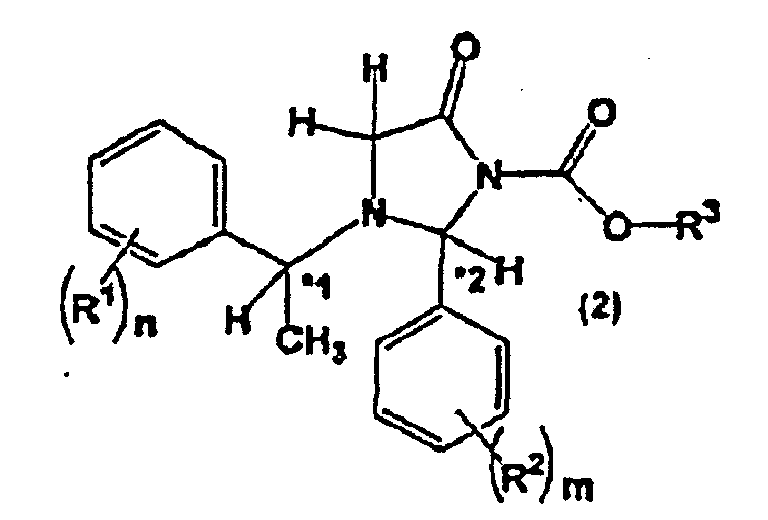
comprenant une étape de mise en réaction d'un dérivé d'imidazolidinone ou d'une forme optiquement active de celui-ci, représenté par la formule générale (1) :
avec un ester d'acide halogénoformique représenté par la formule générale (6) :
R3OCOX (6)
dans laquelle R3 est tel que décrit ci-dessus ; et X représente un atome d'halogène, ou un ester d'acide pyrocarbonique représenté par la formule générale (7) :
en présence d'une base. - Procédé de production selon la revendication 8,
comprenant en outre une étape de condensation d'un dérivé de glycinamide optiquement actif représenté par la formule générale (4) :

en présence d'un catalyseur acide,
pour obtenir le dérivé d'imidazolidinone représenté par la formule générale (1). - Procédé de production d'un dérivé d'imidazolidinone optiquement actif représenté par la formule générale (3) :

comprenant une étape de mise en réaction d'un dérivé d'imidazolidinone optiquement actif représenté par la formule générale (2) :
avec un ou deux types d'agents électrophiles représentés par la formule générale (8) :
R7Y (8)
dans laquelle R7 représente un groupe alkyle facultativement substitué comprenant de 1 à 30 atomes de carbone, un groupe alcényle facultativement substitué comprenant de 2 à 18 atomes de carbone, un groupe alcynyle facultativement substitué comprenant de 2 à 18 atomes de carbone, un groupe aralkyle facultativement substitué comprenant de 7 à 18 atomes de carbone, ou un groupe aryle facultativement substitué comprenant de 6 à 18 atomes de carbone ; et Y représente un groupe partant,
en présence d'une base. - Procédé de production selon la revendication 10, dans lequel le composé représenté par la formule générale (2) est obtenu par la mise en réaction d'un dérivé d'imidazolidinone ou d'une forme optiquement active de celui-ci, représenté par la formule générale (1) :

avec un ester d'acide halogénoformique représenté par la formule générale (6) :
R3OCOX (6)
dans laquelle R3 est tel que décrit ci-dessus ; et X représente un atome d'halogène, ou un ester d'acide pyrocarbonique représenté par la formule générale (7) :
en présence d'une base. - Procédé de production d'un dérivé d'imidazolidinone optiquement actif selon la revendication 10 ou 11, dans lequel la base à utiliser est au moins choisie parmi le diisopropylamide de lithium, l'hexaméthyldisilazide de lithium, l'hexaméthyldisilazide de sodium, l'hexaméthyldisilazide de potassium, le chlorure de t-butyle de magnésium, le t-butoxyde de potassium, le t-butoxyde de sodium, le t-butoxyde de lithium, l'hydrure de lithium, l'hydrure de sodium, l'hydrure de potassium et l'hydrure de calcium.
- Procédé de production d'un dérivé d'acide N-(1-phényléthyle substitué)aminé optiquement actif représenté par la formule générale (9) :

comprenant une étape de traitement d'un dérivé d'imidazolidinone optiquement actif représenté par la formule générale (3) :
avec un acide ou une base dans un solvant contenant au moins un solvant choisi parmi les solvants organiques et l'eau. - Procédé de production d'un acide aminé optiquement actif représenté par la formule générale (10) :
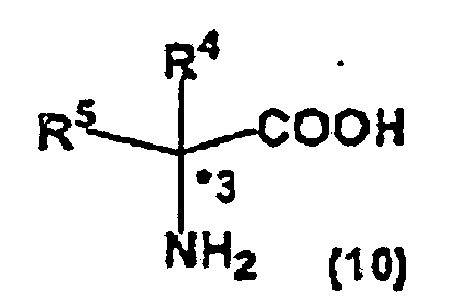
comprenant une étape d'élimination du groupe substituant protecteur sur l'atome d'azote du dérivé d'acide aminé représenté par la formule générale (9) et obtenu par le procédé selon la revendication 13. - Procédé de production d'un acide aminé optiquement actif représenté par la formule générale (10) :

comprenant des étapes d'élimination du groupe substituant sur l'atome d'azote du dérivé d'imidazolidinone optiquement actif représenté par la formule générale (3) pour obtenir un amide d'acide aminé optiquement actif représenté par la formule générale (12) :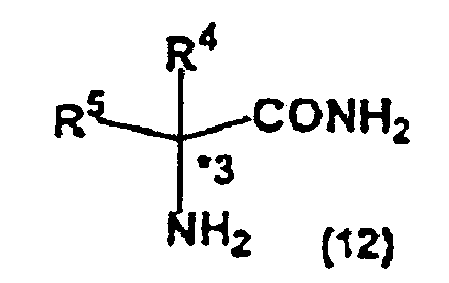
puis de traitement de l'amide d'acide aminé avec un acide ou une base dans au moins un solvant choisi parmi les solvants organiques et l'eau. - Procédé de production d'un dérivé d'acide N-(1-phényléthyle substitué)aminé optiquement actif représenté par la formule générale (9) :
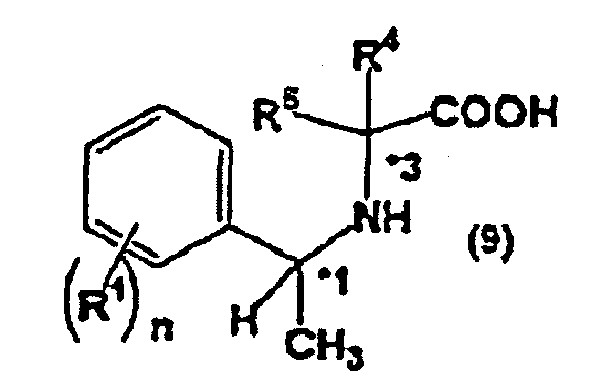
comprenant une étape de traitement d'un dérivé d'imidazolidinone optiquement actif représenté par la formule générale (3) :
avec un acide ou une base dans un solvant contenant au moins un solvant choisi parmi les solvants organiques et l'eau,
dans lequel le dérivé d'imidazolidinone optiquement actif représenté par la formule générale (3) est produit par le procédé selon l'une quelconque des revendications 10 à 12. - Procédé de production d'un dérivé d'imidazolidinone optiquement actif représenté par la formule générale (14) :

comprenant une étape de mise en réaction d'un dérivé d'imidazolidinone optiquement actif représenté par la formule générale (2) :
avec un aldéhyde représenté par la formule générale (13) :
R8-CHO (13)
dans laquelle R8 est tel que décrit ci-dessus,
en présence d'une base. - Procédé de production d'un dérivé d'imidazolidinone optiquement actif selon la revendication 17, dans lequel la base à utiliser est choisie parmi le diisopropylamide de lithium, l'hexaméthyldisilazide de lithium, l'hexaméthyldisilazide de sodium, l'hexaméthyldisilazide de potassium, le chlorure de t-butyle de magnésium, le t-butoxyde de potassium, le t-butoxyde de sodium, le t-butoxyde de lithium, l'hydrure de lithium, l'hydrure de sodium, l'hydrure de potassium et l'hydrure de calcium.
- Procédé de production selon la revendication 17 ou 18, dans lequel un composé représenté par la formule générale (2) :

est obtenu par la mise en réaction d'un dérivé d'imidazolidinone ou d'une forme optiquement active de celui-ci, représenté par la formule générale (1) :
avec un ester d'acide halogénoformique représenté par la formule générale (6) :
R3OCOX (6)
dans laquelle R3 est tel que décrit ci-dessus ; et X représente un atome d'halogène, ou un ester d'acide pyrocarbonique représenté par la formule générale (7) :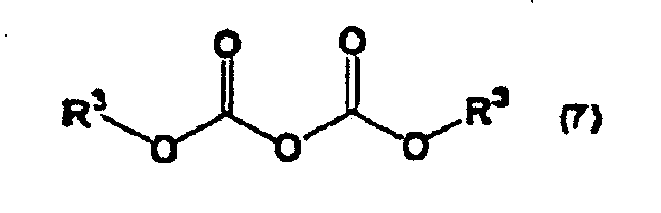
en présence d'une base. - Procédé de production d'un dérivé d'acide N-(1-phényléthyle substitué)hydroxyaminé optiquement actif représenté par la formule générale (15) :

comprenant une étape de traitement d'un dérivé d'imidazolidinone optiquement actif représenté par la formule générale (14) :
avec un acide ou une base dans au moins un solvant choisi parmi les solvants organiques et l'eau. - Procédé de production d'un acide hydroxyaminé optiquement actif représenté par la formule générale (16) :

comprenant une étape d'élimination du groupe substituant sur l'atome d'azote du dérivé d'acide hydroxyaminé représenté par la formule générale (15) et obtenu selon la revendication 20. - Procédé de production d'un acide hydroxyaminé optiquement actif représenté par la formule générale (16) :

comprenant les étapes d'élimination du groupe substituant protecteur sur l'atome d'azote d'un dérivé d'imidazolidinone optiquement actif représenté par la formule générale (14) :
pour synthétiser un amide d'acide hydroxyaminé optiquement actif représenté par la formule générale (17) :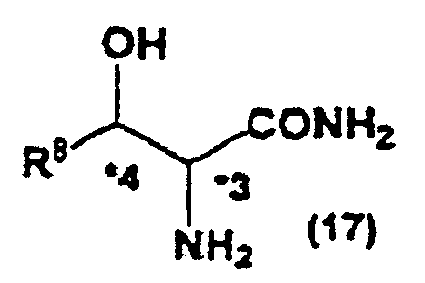
puis de traitement de l'amide d'acide hydroxyaminé avec un acide ou une base dans au moins un solvant choisi parmi les solvants organiques et l'eau. - Procédé de production d'un dérivé d'acide N-(1-phényléthyle substitué)hydroxyaminé optiquement actif représenté par la formule générale (15) :

comprenant une étape de traitement d'un dérivé d'imidazolidinone optiquement actif représenté par la formule générale (14) :
avec un acide ou une base dans au moins un solvant choisi parmi les solvants organiques et l'eau,
dans lequel le dérivé d'imidazolidinone optiquement actif représenté par la formule générale (14) est obtenu par le procédé selon la revendication 17 ou 18.
Applications Claiming Priority (2)
| Application Number | Priority Date | Filing Date | Title |
|---|---|---|---|
| JP2006206431 | 2006-07-28 | ||
| PCT/JP2007/059826 WO2008012974A1 (fr) | 2006-07-28 | 2007-05-14 | Nouveau dérivé d'imidazolidinone, procédé de production de ce dérivé et procédé de production d'un acide aminé optiquement actif |
Publications (3)
| Publication Number | Publication Date |
|---|---|
| EP2050738A1 EP2050738A1 (fr) | 2009-04-22 |
| EP2050738A4 EP2050738A4 (fr) | 2010-09-22 |
| EP2050738B1 true EP2050738B1 (fr) | 2013-07-10 |
Family
ID=38981289
Family Applications (1)
| Application Number | Title | Priority Date | Filing Date |
|---|---|---|---|
| EP07743261.5A Active EP2050738B1 (fr) | 2006-07-28 | 2007-05-14 | Nouveau dérivé d'imidazolidinone, procédé de production de ce dérivé et procédé de production d'un acide aminé optiquement actif |
Country Status (4)
| Country | Link |
|---|---|
| US (1) | US7947722B2 (fr) |
| EP (1) | EP2050738B1 (fr) |
| JP (1) | JP5153631B2 (fr) |
| WO (1) | WO2008012974A1 (fr) |
Families Citing this family (1)
| Publication number | Priority date | Publication date | Assignee | Title |
|---|---|---|---|---|
| CN114176084B (zh) * | 2021-12-06 | 2022-09-20 | 南京天秾生物技术有限公司 | 2-氨基-3-羟基-3-甲基丁酸和/或2-氨基-3-(4-羟基苯基)丁酸的应用 |
Family Cites Families (2)
| Publication number | Priority date | Publication date | Assignee | Title |
|---|---|---|---|---|
| US4280008A (en) | 1976-12-24 | 1981-07-21 | Basf Aktiengesellschaft | Chirally substituted 2-imidazolin-5-ones |
| US4772694A (en) | 1986-07-24 | 1988-09-20 | Eli Lilly And Company | Chiral 3-(1,2,5-trisubstituted imidazolidinone) azetidinone antibiotic intermediates |
-
2007
- 2007-05-14 US US12/309,729 patent/US7947722B2/en active Active
- 2007-05-14 JP JP2008526694A patent/JP5153631B2/ja active Active
- 2007-05-14 WO PCT/JP2007/059826 patent/WO2008012974A1/fr not_active Ceased
- 2007-05-14 EP EP07743261.5A patent/EP2050738B1/fr active Active
Also Published As
| Publication number | Publication date |
|---|---|
| EP2050738A1 (fr) | 2009-04-22 |
| WO2008012974A1 (fr) | 2008-01-31 |
| US7947722B2 (en) | 2011-05-24 |
| JP5153631B2 (ja) | 2013-02-27 |
| EP2050738A4 (fr) | 2010-09-22 |
| JPWO2008012974A1 (ja) | 2009-12-17 |
| US20090209768A1 (en) | 2009-08-20 |
Similar Documents
| Publication | Publication Date | Title |
|---|---|---|
| RU2564024C2 (ru) | Промежуточные продукты для получения ингибиторов нейтральной эндопептидазы и способ их получения | |
| JP5275971B2 (ja) | テトラヒドロキノリン誘導体の製造方法 | |
| JP5687205B2 (ja) | 2−アシルアミノ−3−ジフェニルプロパン酸の製造および分割のためのプロセス | |
| CZ374297A3 (cs) | Způsoby přípravy kyseliny (S)-3-(aminomethyl)-5-methylhexanové | |
| US11472770B2 (en) | Process for the preparation of enantiomerically enriched 3-aminopiperidine | |
| EP2046728A1 (fr) | Procédé de préparation de la prégabaline et de son énantiomère opposé | |
| WO2015145467A1 (fr) | Procédé amélioré de préparation de vildagliptine | |
| JP2006500407A (ja) | チュブリン阻害剤の合成に有用な中間体の合成方法 | |
| TW201718462A (zh) | 用於製備有機化合物及中間物的方法 | |
| EP2050738B1 (fr) | Nouveau dérivé d'imidazolidinone, procédé de production de ce dérivé et procédé de production d'un acide aminé optiquement actif | |
| JP2009543815A (ja) | キラルなアミノカルボニル化合物の製造方法 | |
| US20080293965A1 (en) | Process for the Dynamic Resolution of (Substituted) (R)- or (S)- Mandelic Acid | |
| EP1611084A1 (fr) | Procede de fabrication de n-alkoxalyl-alaninates | |
| US10131624B2 (en) | Process for the preparation of (1S,2R)-Milnacipran | |
| JP4143787B2 (ja) | α−アミノハロメチルケトン誘導体の製造方法 | |
| EP1918275A1 (fr) | Procédé de production de complexe de diphenylalanine - NI(II) | |
| US20140343322A1 (en) | Process for preparing levomilnacipran hcl | |
| US20100184996A1 (en) | Process of amide formation | |
| JP2014031327A (ja) | 光学活性シス−2−アミノ−シクロヘキサンカルボン酸誘導体およびその前駆体の製造法 | |
| KR20040047870A (ko) | 키랄 아미노 니트릴의 제조 방법 및 조성물 | |
| WO2008037433A1 (fr) | Procédé de fabrication de carbamates d'aminoalkylphényle et intermédiaires de cette fabrication | |
| JP5080050B2 (ja) | 光学活性なピペラジン化合物の製造方法 | |
| US20240270689A1 (en) | Process for producing brivaracetam and intermediates thereof | |
| US8383833B2 (en) | Method for producing optically active amino acid derivative | |
| JP2009508961A (ja) | アミノ酸誘導体の製法 |
Legal Events
| Date | Code | Title | Description |
|---|---|---|---|
| PUAI | Public reference made under article 153(3) epc to a published international application that has entered the european phase |
Free format text: ORIGINAL CODE: 0009012 |
|
| 17P | Request for examination filed |
Effective date: 20090217 |
|
| AK | Designated contracting states |
Kind code of ref document: A1 Designated state(s): AT BE BG CH CY CZ DE DK EE ES FI FR GB GR HU IE IS IT LI LT LU LV MC MT NL PL PT RO SE SI SK TR |
|
| AX | Request for extension of the european patent |
Extension state: AL BA HR MK RS |
|
| A4 | Supplementary search report drawn up and despatched |
Effective date: 20100823 |
|
| GRAJ | Information related to disapproval of communication of intention to grant by the applicant or resumption of examination proceedings by the epo deleted |
Free format text: ORIGINAL CODE: EPIDOSDIGR1 |
|
| GRAP | Despatch of communication of intention to grant a patent |
Free format text: ORIGINAL CODE: EPIDOSNIGR1 |
|
| DAX | Request for extension of the european patent (deleted) | ||
| GRAP | Despatch of communication of intention to grant a patent |
Free format text: ORIGINAL CODE: EPIDOSNIGR1 |
|
| GRAS | Grant fee paid |
Free format text: ORIGINAL CODE: EPIDOSNIGR3 |
|
| GRAP | Despatch of communication of intention to grant a patent |
Free format text: ORIGINAL CODE: EPIDOSNIGR1 |
|
| RAP1 | Party data changed (applicant data changed or rights of an application transferred) |
Owner name: KANEKA CORPORATION |
|
| GRAA | (expected) grant |
Free format text: ORIGINAL CODE: 0009210 |
|
| AK | Designated contracting states |
Kind code of ref document: B1 Designated state(s): AT BE BG CH CY CZ DE DK EE ES FI FR GB GR HU IE IS IT LI LT LU LV MC MT NL PL PT RO SE SI SK TR |
|
| REG | Reference to a national code |
Ref country code: GB Ref legal event code: FG4D |
|
| REG | Reference to a national code |
Ref country code: CH Ref legal event code: EP Ref country code: AT Ref legal event code: REF Ref document number: 620917 Country of ref document: AT Kind code of ref document: T Effective date: 20130715 |
|
| REG | Reference to a national code |
Ref country code: IE Ref legal event code: FG4D |
|
| REG | Reference to a national code |
Ref country code: DE Ref legal event code: R096 Ref document number: 602007031549 Country of ref document: DE Effective date: 20130905 |
|
| PG25 | Lapsed in a contracting state [announced via postgrant information from national office to epo] |
Ref country code: SI Free format text: LAPSE BECAUSE OF FAILURE TO SUBMIT A TRANSLATION OF THE DESCRIPTION OR TO PAY THE FEE WITHIN THE PRESCRIBED TIME-LIMIT Effective date: 20130710 |
|
| REG | Reference to a national code |
Ref country code: AT Ref legal event code: MK05 Ref document number: 620917 Country of ref document: AT Kind code of ref document: T Effective date: 20130710 |
|
| REG | Reference to a national code |
Ref country code: NL Ref legal event code: VDEP Effective date: 20130710 |
|
| REG | Reference to a national code |
Ref country code: LT Ref legal event code: MG4D |
|
| PG25 | Lapsed in a contracting state [announced via postgrant information from national office to epo] |
Ref country code: PT Free format text: LAPSE BECAUSE OF FAILURE TO SUBMIT A TRANSLATION OF THE DESCRIPTION OR TO PAY THE FEE WITHIN THE PRESCRIBED TIME-LIMIT Effective date: 20131111 Ref country code: LT Free format text: LAPSE BECAUSE OF FAILURE TO SUBMIT A TRANSLATION OF THE DESCRIPTION OR TO PAY THE FEE WITHIN THE PRESCRIBED TIME-LIMIT Effective date: 20130710 Ref country code: SE Free format text: LAPSE BECAUSE OF FAILURE TO SUBMIT A TRANSLATION OF THE DESCRIPTION OR TO PAY THE FEE WITHIN THE PRESCRIBED TIME-LIMIT Effective date: 20130710 Ref country code: CY Free format text: LAPSE BECAUSE OF FAILURE TO SUBMIT A TRANSLATION OF THE DESCRIPTION OR TO PAY THE FEE WITHIN THE PRESCRIBED TIME-LIMIT Effective date: 20130731 Ref country code: IS Free format text: LAPSE BECAUSE OF FAILURE TO SUBMIT A TRANSLATION OF THE DESCRIPTION OR TO PAY THE FEE WITHIN THE PRESCRIBED TIME-LIMIT Effective date: 20131110 Ref country code: AT Free format text: LAPSE BECAUSE OF FAILURE TO SUBMIT A TRANSLATION OF THE DESCRIPTION OR TO PAY THE FEE WITHIN THE PRESCRIBED TIME-LIMIT Effective date: 20130710 Ref country code: BE Free format text: LAPSE BECAUSE OF FAILURE TO SUBMIT A TRANSLATION OF THE DESCRIPTION OR TO PAY THE FEE WITHIN THE PRESCRIBED TIME-LIMIT Effective date: 20130710 |
|
| PG25 | Lapsed in a contracting state [announced via postgrant information from national office to epo] |
Ref country code: PL Free format text: LAPSE BECAUSE OF FAILURE TO SUBMIT A TRANSLATION OF THE DESCRIPTION OR TO PAY THE FEE WITHIN THE PRESCRIBED TIME-LIMIT Effective date: 20130710 Ref country code: GR Free format text: LAPSE BECAUSE OF FAILURE TO SUBMIT A TRANSLATION OF THE DESCRIPTION OR TO PAY THE FEE WITHIN THE PRESCRIBED TIME-LIMIT Effective date: 20131011 Ref country code: FI Free format text: LAPSE BECAUSE OF FAILURE TO SUBMIT A TRANSLATION OF THE DESCRIPTION OR TO PAY THE FEE WITHIN THE PRESCRIBED TIME-LIMIT Effective date: 20130710 Ref country code: LV Free format text: LAPSE BECAUSE OF FAILURE TO SUBMIT A TRANSLATION OF THE DESCRIPTION OR TO PAY THE FEE WITHIN THE PRESCRIBED TIME-LIMIT Effective date: 20130710 Ref country code: NL Free format text: LAPSE BECAUSE OF FAILURE TO SUBMIT A TRANSLATION OF THE DESCRIPTION OR TO PAY THE FEE WITHIN THE PRESCRIBED TIME-LIMIT Effective date: 20130710 Ref country code: ES Free format text: LAPSE BECAUSE OF FAILURE TO SUBMIT A TRANSLATION OF THE DESCRIPTION OR TO PAY THE FEE WITHIN THE PRESCRIBED TIME-LIMIT Effective date: 20131021 |
|
| PG25 | Lapsed in a contracting state [announced via postgrant information from national office to epo] |
Ref country code: CY Free format text: LAPSE BECAUSE OF FAILURE TO SUBMIT A TRANSLATION OF THE DESCRIPTION OR TO PAY THE FEE WITHIN THE PRESCRIBED TIME-LIMIT Effective date: 20130710 |
|
| PG25 | Lapsed in a contracting state [announced via postgrant information from national office to epo] |
Ref country code: RO Free format text: LAPSE BECAUSE OF FAILURE TO SUBMIT A TRANSLATION OF THE DESCRIPTION OR TO PAY THE FEE WITHIN THE PRESCRIBED TIME-LIMIT Effective date: 20130710 Ref country code: SK Free format text: LAPSE BECAUSE OF FAILURE TO SUBMIT A TRANSLATION OF THE DESCRIPTION OR TO PAY THE FEE WITHIN THE PRESCRIBED TIME-LIMIT Effective date: 20130710 Ref country code: CZ Free format text: LAPSE BECAUSE OF FAILURE TO SUBMIT A TRANSLATION OF THE DESCRIPTION OR TO PAY THE FEE WITHIN THE PRESCRIBED TIME-LIMIT Effective date: 20130710 Ref country code: DK Free format text: LAPSE BECAUSE OF FAILURE TO SUBMIT A TRANSLATION OF THE DESCRIPTION OR TO PAY THE FEE WITHIN THE PRESCRIBED TIME-LIMIT Effective date: 20130710 Ref country code: EE Free format text: LAPSE BECAUSE OF FAILURE TO SUBMIT A TRANSLATION OF THE DESCRIPTION OR TO PAY THE FEE WITHIN THE PRESCRIBED TIME-LIMIT Effective date: 20130710 |
|
| PLBE | No opposition filed within time limit |
Free format text: ORIGINAL CODE: 0009261 |
|
| STAA | Information on the status of an ep patent application or granted ep patent |
Free format text: STATUS: NO OPPOSITION FILED WITHIN TIME LIMIT |
|
| PG25 | Lapsed in a contracting state [announced via postgrant information from national office to epo] |
Ref country code: IT Free format text: LAPSE BECAUSE OF FAILURE TO SUBMIT A TRANSLATION OF THE DESCRIPTION OR TO PAY THE FEE WITHIN THE PRESCRIBED TIME-LIMIT Effective date: 20130710 |
|
| REG | Reference to a national code |
Ref country code: CH Ref legal event code: NV Representative=s name: VOSSIUS AND PARTNER, CH |
|
| 26N | No opposition filed |
Effective date: 20140411 |
|
| REG | Reference to a national code |
Ref country code: DE Ref legal event code: R097 Ref document number: 602007031549 Country of ref document: DE Effective date: 20140411 |
|
| PG25 | Lapsed in a contracting state [announced via postgrant information from national office to epo] |
Ref country code: LU Free format text: LAPSE BECAUSE OF FAILURE TO SUBMIT A TRANSLATION OF THE DESCRIPTION OR TO PAY THE FEE WITHIN THE PRESCRIBED TIME-LIMIT Effective date: 20140514 |
|
| PG25 | Lapsed in a contracting state [announced via postgrant information from national office to epo] |
Ref country code: MC Free format text: LAPSE BECAUSE OF FAILURE TO SUBMIT A TRANSLATION OF THE DESCRIPTION OR TO PAY THE FEE WITHIN THE PRESCRIBED TIME-LIMIT Effective date: 20130710 |
|
| REG | Reference to a national code |
Ref country code: IE Ref legal event code: MM4A |
|
| PG25 | Lapsed in a contracting state [announced via postgrant information from national office to epo] |
Ref country code: IE Free format text: LAPSE BECAUSE OF NON-PAYMENT OF DUE FEES Effective date: 20140514 |
|
| PG25 | Lapsed in a contracting state [announced via postgrant information from national office to epo] |
Ref country code: MT Free format text: LAPSE BECAUSE OF FAILURE TO SUBMIT A TRANSLATION OF THE DESCRIPTION OR TO PAY THE FEE WITHIN THE PRESCRIBED TIME-LIMIT Effective date: 20130710 |
|
| REG | Reference to a national code |
Ref country code: FR Ref legal event code: PLFP Year of fee payment: 10 |
|
| PG25 | Lapsed in a contracting state [announced via postgrant information from national office to epo] |
Ref country code: BG Free format text: LAPSE BECAUSE OF FAILURE TO SUBMIT A TRANSLATION OF THE DESCRIPTION OR TO PAY THE FEE WITHIN THE PRESCRIBED TIME-LIMIT Effective date: 20130710 |
|
| REG | Reference to a national code |
Ref country code: CH Ref legal event code: PFA Owner name: KANEKA CORPORATION, JP Free format text: FORMER OWNER: KANEKA CORPORATION, JP |
|
| PG25 | Lapsed in a contracting state [announced via postgrant information from national office to epo] |
Ref country code: HU Free format text: LAPSE BECAUSE OF FAILURE TO SUBMIT A TRANSLATION OF THE DESCRIPTION OR TO PAY THE FEE WITHIN THE PRESCRIBED TIME-LIMIT; INVALID AB INITIO Effective date: 20070514 Ref country code: TR Free format text: LAPSE BECAUSE OF FAILURE TO SUBMIT A TRANSLATION OF THE DESCRIPTION OR TO PAY THE FEE WITHIN THE PRESCRIBED TIME-LIMIT Effective date: 20130710 |
|
| REG | Reference to a national code |
Ref country code: FR Ref legal event code: PLFP Year of fee payment: 11 |
|
| REG | Reference to a national code |
Ref country code: FR Ref legal event code: PLFP Year of fee payment: 12 |
|
| REG | Reference to a national code |
Ref country code: FR Ref legal event code: PLFP Year of fee payment: 17 |
|
| PGFP | Annual fee paid to national office [announced via postgrant information from national office to epo] |
Ref country code: GB Payment date: 20250327 Year of fee payment: 19 |
|
| PGFP | Annual fee paid to national office [announced via postgrant information from national office to epo] |
Ref country code: DE Payment date: 20250402 Year of fee payment: 19 |
|
| PGFP | Annual fee paid to national office [announced via postgrant information from national office to epo] |
Ref country code: FR Payment date: 20250401 Year of fee payment: 19 |
|
| PGFP | Annual fee paid to national office [announced via postgrant information from national office to epo] |
Ref country code: CH Payment date: 20250601 Year of fee payment: 19 |