EP2050794A1 - Hydrazidchelat-komplexverbindung, optisches aufzeichnungsmedium mit der verbindung und aufzeichnungsverfahren dafür - Google Patents
Hydrazidchelat-komplexverbindung, optisches aufzeichnungsmedium mit der verbindung und aufzeichnungsverfahren dafür Download PDFInfo
- Publication number
- EP2050794A1 EP2050794A1 EP07791740A EP07791740A EP2050794A1 EP 2050794 A1 EP2050794 A1 EP 2050794A1 EP 07791740 A EP07791740 A EP 07791740A EP 07791740 A EP07791740 A EP 07791740A EP 2050794 A1 EP2050794 A1 EP 2050794A1
- Authority
- EP
- European Patent Office
- Prior art keywords
- group
- compound
- recording medium
- optical recording
- layer
- Prior art date
- Legal status (The legal status is an assumption and is not a legal conclusion. Google has not performed a legal analysis and makes no representation as to the accuracy of the status listed.)
- Withdrawn
Links
- 0 CCCC(CCC1)=CC1C(O*[N+]=CC=C(C1(C)Cc2ccc(CCl)cc2)N(CC)C2C1=CC(OC)=CC2)=N Chemical compound CCCC(CCC1)=CC1C(O*[N+]=CC=C(C1(C)Cc2ccc(CCl)cc2)N(CC)C2C1=CC(OC)=CC2)=N 0.000 description 34
- GCFDCYGNYIAXHS-UHFFFAOYSA-N CC(CNC1C=CCC=CC1NC)C=O Chemical compound CC(CNC1C=CCC=CC1NC)C=O GCFDCYGNYIAXHS-UHFFFAOYSA-N 0.000 description 1
- MCZAMSZFMVJKAG-QNGOZBTKSA-N CCC(CCC1N2C)CC1C(C)(CC(C1)CC=CC1F)/C2=C(\C)/C=O Chemical compound CCC(CCC1N2C)CC1C(C)(CC(C1)CC=CC1F)/C2=C(\C)/C=O MCZAMSZFMVJKAG-QNGOZBTKSA-N 0.000 description 1
- RFHCPEJKYXWBJR-QFEZKATASA-N CCN(/C(/C(C)(CC1C(C)=CC(C)=CC1C)C1=C2)=C\C3CC3)C1=CCC2OC Chemical compound CCN(/C(/C(C)(CC1C(C)=CC(C)=CC1C)C1=C2)=C\C3CC3)C1=CCC2OC RFHCPEJKYXWBJR-QFEZKATASA-N 0.000 description 1
- AMALHZNUCWZGSI-XKZIYDEJSA-N CCN(/C(/C1(C)C)=C\CNNC(C(C2)CC=CCC2OC)O)c(cc2)c1cc2OC Chemical compound CCN(/C(/C1(C)C)=C\CNNC(C(C2)CC=CCC2OC)O)c(cc2)c1cc2OC AMALHZNUCWZGSI-XKZIYDEJSA-N 0.000 description 1
- UENJOPDWHIVBAD-UHFFFAOYSA-N CNC(C=C1)=CCC1C(NNCC1=NC(CCCC2)C2N1C)=O Chemical compound CNC(C=C1)=CCC1C(NNCC1=NC(CCCC2)C2N1C)=O UENJOPDWHIVBAD-UHFFFAOYSA-N 0.000 description 1
- OYPXMEJWIGTWNX-UHFFFAOYSA-N COC(CC1)CCC1C(N)O Chemical compound COC(CC1)CCC1C(N)O OYPXMEJWIGTWNX-UHFFFAOYSA-N 0.000 description 1
Images
Classifications
-
- C—CHEMISTRY; METALLURGY
- C09—DYES; PAINTS; POLISHES; NATURAL RESINS; ADHESIVES; COMPOSITIONS NOT OTHERWISE PROVIDED FOR; APPLICATIONS OF MATERIALS NOT OTHERWISE PROVIDED FOR
- C09B—ORGANIC DYES OR CLOSELY-RELATED COMPOUNDS FOR PRODUCING DYES, e.g. PIGMENTS; MORDANTS; LAKES
- C09B26/00—Hydrazone dyes; Triazene dyes
- C09B26/02—Hydrazone dyes
-
- C—CHEMISTRY; METALLURGY
- C09—DYES; PAINTS; POLISHES; NATURAL RESINS; ADHESIVES; COMPOSITIONS NOT OTHERWISE PROVIDED FOR; APPLICATIONS OF MATERIALS NOT OTHERWISE PROVIDED FOR
- C09B—ORGANIC DYES OR CLOSELY-RELATED COMPOUNDS FOR PRODUCING DYES, e.g. PIGMENTS; MORDANTS; LAKES
- C09B57/00—Other synthetic dyes of known constitution
- C09B57/10—Metal complexes of organic compounds not being dyes in uncomplexed form
-
- G—PHYSICS
- G11—INFORMATION STORAGE
- G11B—INFORMATION STORAGE BASED ON RELATIVE MOVEMENT BETWEEN RECORD CARRIER AND TRANSDUCER
- G11B7/00—Recording or reproducing by optical means, e.g. recording using a thermal beam of optical radiation by modifying optical properties or the physical structure, reproducing using an optical beam at lower power by sensing optical properties; Record carriers therefor
- G11B7/24—Record carriers characterised by shape, structure or physical properties, or by the selection of the material
- G11B7/241—Record carriers characterised by shape, structure or physical properties, or by the selection of the material characterised by the selection of the material
- G11B7/242—Record carriers characterised by shape, structure or physical properties, or by the selection of the material characterised by the selection of the material of recording layers
- G11B7/244—Record carriers characterised by shape, structure or physical properties, or by the selection of the material characterised by the selection of the material of recording layers comprising organic materials only
- G11B7/246—Record carriers characterised by shape, structure or physical properties, or by the selection of the material characterised by the selection of the material of recording layers comprising organic materials only containing dyes
- G11B7/2467—Record carriers characterised by shape, structure or physical properties, or by the selection of the material characterised by the selection of the material of recording layers comprising organic materials only containing dyes azo-dyes
-
- G—PHYSICS
- G11—INFORMATION STORAGE
- G11B—INFORMATION STORAGE BASED ON RELATIVE MOVEMENT BETWEEN RECORD CARRIER AND TRANSDUCER
- G11B7/00—Recording or reproducing by optical means, e.g. recording using a thermal beam of optical radiation by modifying optical properties or the physical structure, reproducing using an optical beam at lower power by sensing optical properties; Record carriers therefor
- G11B7/24—Record carriers characterised by shape, structure or physical properties, or by the selection of the material
- G11B7/241—Record carriers characterised by shape, structure or physical properties, or by the selection of the material characterised by the selection of the material
- G11B7/242—Record carriers characterised by shape, structure or physical properties, or by the selection of the material characterised by the selection of the material of recording layers
- G11B7/244—Record carriers characterised by shape, structure or physical properties, or by the selection of the material characterised by the selection of the material of recording layers comprising organic materials only
- G11B7/249—Record carriers characterised by shape, structure or physical properties, or by the selection of the material characterised by the selection of the material of recording layers comprising organic materials only containing organometallic compounds
- G11B7/2492—Record carriers characterised by shape, structure or physical properties, or by the selection of the material characterised by the selection of the material of recording layers comprising organic materials only containing organometallic compounds neutral compounds
-
- G—PHYSICS
- G11—INFORMATION STORAGE
- G11B—INFORMATION STORAGE BASED ON RELATIVE MOVEMENT BETWEEN RECORD CARRIER AND TRANSDUCER
- G11B7/00—Recording or reproducing by optical means, e.g. recording using a thermal beam of optical radiation by modifying optical properties or the physical structure, reproducing using an optical beam at lower power by sensing optical properties; Record carriers therefor
- G11B7/24—Record carriers characterised by shape, structure or physical properties, or by the selection of the material
- G11B7/241—Record carriers characterised by shape, structure or physical properties, or by the selection of the material characterised by the selection of the material
- G11B7/242—Record carriers characterised by shape, structure or physical properties, or by the selection of the material characterised by the selection of the material of recording layers
- G11B7/244—Record carriers characterised by shape, structure or physical properties, or by the selection of the material characterised by the selection of the material of recording layers comprising organic materials only
- G11B7/246—Record carriers characterised by shape, structure or physical properties, or by the selection of the material characterised by the selection of the material of recording layers comprising organic materials only containing dyes
- G11B7/2463—Record carriers characterised by shape, structure or physical properties, or by the selection of the material characterised by the selection of the material of recording layers comprising organic materials only containing dyes azulene
Definitions
- a recording layer is formed using a dye
- coating of a substrate using spin-coating is more advantageous in terms of cost than vacuum deposition. Consequently, dyes for optical recording media are essentially required to exhibit high solubility in a coating solvent.
- a fluorocarbon alcohol solvent such as 2,2,3,3-tetrafluoropropanol (TFP) or 2,2,3,3,4,4,5,5-octafluoropentanol (OFP)
- the present invention has been achieved under these circumstances, and it is an object of the present invention to provide an imine dye which is excellent in terms of both solubility in a coating solvent and light fastness and which can be used for optical recording using a blue laser beam.
- a dye for forming a recording layer of an optical recording medium is characterized by including the hydrazide chelate complex compound according to the first aspect.
- an optical recording medium is characterized by including at least a substrate and a recording layer disposed on the substrate, wherein the recording layer is formed using the dye for forming a recording layer of an optical recording medium according to the second aspect.
- a novel hydrazide chelate complex compound of the present invention is excellent in terms of solubility in a solvent, light fastness, and sensitivity to recording by blue laser. Consequently, by using a dye containing the hydrazide chelate complex compound for a recording layer of an optical recording medium, it is possible to provide a high-density optical recording medium which has excellent recording characteristics with respect to a blue laser beam and good light fastness, with good film properties and at low cost.
- Embodiments of the present invention will be specifically described below. However, it is to be understood that the present invention is not limited to the embodiments described below, but various alterations can be made within the gist of the invention.
- aromatic ring means a ring having aromaticity, i.e., a ring having a (4m+2) ⁇ electron system (wherein m is a natural number).
- the skeleton structure thereof usually includes a 5- or 6-membered monocyclic aromatic ring or 2 to 6 fused aromatic rings.
- the aromatic ring include, in addition to an aromatic hydrocarbon ring and an aromatic heterocycle, a fused ring, such as an anthracene ring, a carbazole ring, or an azulene ring.
- ring group in "aromatic ring group” or the like is defined as a monovalent substituent obtained by removing a hydrogen atom from a ring, such as an aromatic ring.
- Examples of the substituent that may be possessed by the aromatic ring as the ring A include those which have 20 or less carbon atoms, and specifically include a chain alkyl group, a chain alkenyl group, a chain alkynyl group, a hydrocarbon ring group, a heterocyclic group, an alkoxy group, an alkylcarbonyl group, a (hetero)aryloxycarbonyl group, a (hetero)aralkyloxy group, an amino group which may have a substituent, a nitro group, a cyano group, an alkoxycarbonyl group, a (hetero)aryloxycarbonyl group, a carbamoyl group which may have a substituent, a halogen atom, and a hydroxyl group.
- chain alkynyl group examples include those which are straight-chained or branched and which generally have 2 to 20 carbon atoms, and preferably 2 to 10 carbon atoms, such as an ethynyl group, a propynyl group, a butynyl group, a 2-methyl-1-propynyl group, a hexynyl group, and an octynyl group.
- heterocyclic group examples include heteroaryl groups having a 5- or 6-membered monocycle or 2 to 6 fused rings, and heterocycloalkyl groups having a 5- or 6-membered monocycle or 2 to 6 fused rings.
- heteroatom examples include a nitrogen atom, an oxygen atom, and a sulfur atom.
- 5-membered rings such as a thienyl group
- 6-membered rings such as a pyridyl group, a 2-piperidinyl group, and a 2-piperadinyl group
- 5- or 6-membered groups derived from 2 to 6 fused rings such as a benzothienyl group, a carbazolyl group, a quinolinyl group, and an octahydroquinolinyl group.
- R 2 to R 5 each independently represent a hydrogen atom, an aromatic ring group which may have a substituent, or a monovalent nonaromatic ring substituent having 20 or less carbon atoms.
- Specific examples of the aromatic ring group which may have a substituent include the specific examples of ring A described above.
- Specific examples of the monovalent nonaromatic ring substituent having 20 or less carbon atoms include the examples of the substituent which may be possessed by ring A described above except for the aromatic ring groups.
- R 2 to R 5 each represent a hydrogen atom in view of synthesis.
- Y 1 and Y 2 each independently represent an aromatic ring group which may have a substituent or a monovalent nonaromatic ring substituent having 20 or less carbon atoms.
- aromatic ring group which may have a substituent include the specific examples of the ring A derived from an aromatic ring in general formula (1) described above.
- monovalent nonaromatic ring substituent having 20 or less carbon atoms include the examples of the substituent which may be possessed by ring A in general formula (1) described above except for the aromatic ring groups.
- the hydrazide chelate complex compound of the present invention can be obtained by treating, with a base, the hydrazide ligand synthesized by the technique described above, and then subjecting the resulting product to reaction under heating at a temperature from room temperature to about a refluxing temperature of the solvent.
- a reaction solvent such as water, methanol, ethanol, acetonitrile, tetrahydrofuran, dioxane, dimethoxyethane, dichloroethane, or chloroform
- a nonpolar solvent such as toluene or xylene
- hydrazide chelate complex compounds of the present invention preferred ones are characterized by being excellent in terms of light fastness and solubility in a coating solvent, and being excellent in terms of film properties and recording sensitivity when used for forming a recording layer of an optical recording medium.
- the phrase "excellent in terms of light fastness” means that even if a light fastness test is performed under conditions at a temperature of 58°C and a humidity of 50%, with irradiation of a xenon lamp (intensity 0.55 W/m 2 ) for 40 hours on a thin film formed of a hydrazide chelate complex compound with a thickness of about 50 nm, usually 70% or more, preferably 80% or more, and particularly preferably 90% or more of the hydrazide chelate complex compound in the thin film remains without being degraded.
- the degree of degradation is determined by the rate of decrease in the absorption maximum at 300 to 500 nm.
- a dye for forming a recording layer of an optical recording medium according to the present invention contains the hydrazide chelate complex compound of the present invention described above.
- the dye for forming a recording layer of an optical recording medium according to the present invention only one hydrazide chelate complex compound of the present invention may be used, or two or more hydrazide chelate complex compounds of the present invention may be used in any combination and at any ratio.
- one or two or more other dyes may be used together.
- a recording layer included in an optical recording medium of the present invention is formed using a dye for forming a recording layer of an optical recording medium according to the present invention (hereinafter, may be simply referred to as "dye of the present invention"), the dye containing at least one hydrazide chelate complex compound of the present invention represented by the general formula (1), preferably by the general formula (2), described above. That is, the recording layer of the optical recording medium of the present invention contains one or two or more hydrazide chelate complex compounds of the present invention.
- the singlet oxygen quencher is used in an amount of usually about 5% to 30% by weight relative to the dye
- the recording sensitivity-improving agent is used in an amount of usually about 10% to 30% by weight relative to the dye.
- a commonly used thin-film deposition method such as vacuum deposition, sputtering, a doctor blade method, casting, spin coating, or a dipping method, can be used.
- spin coating is preferable.
- vacuum deposition or the like is preferable from the standpoint that a recording layer with a uniform thickness can be obtained.
- the number of revolutions is preferably 500 to 5,000 rpm. After spin coating, as necessary, the resulting recording layer may be subjected to treatment, such as heating or exposure to a solvent vapor.
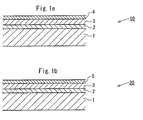
- a pregroove or pit for recording/reproducing beams may be formed on the upper surface.
- the shape of the pregroove may be, for example, a concentric circular shape or spiral shape, based on the center of the optical recording medium 10.
- the groove pitch is preferably about 0.2 to 1.2 ⁇ m.
- the groove width W satisfies the relationship 100 nm ⁇ W ⁇ 400 nm
- the groove depth d satisfies the relationship 20 nm ⁇ d ⁇ 200 nm.
- the compound (A-1) at a concentration of each of 0.7% by weight and 1.0% by weight was subjected to supersonic treatment at 20°C, at normal pressure, for 30 minutes. Then, the solution was dropped to filter paper ("No. 5C" quantitative filter paper manufactured by Toyo Roshi Kaisha), and dried at room temperature for 24 hours. It was visually observed whether or not crystal residues of undissolved components were present on the filter paper.
- a recording layer was irradiated with a xenon lamp at an irradiation intensity of 0.55 W/m 2 for 40 hours. Then, the dye residual ratio in the recording layer was determined on the basis of the absorbances before and after irradiation at the absorption maximum wavelength.
- Example 3 With respect to the following compound (B-1) described in Patent Document 1, an optical recording medium was produced as in Example 3. With respect to the resulting optical recording medium, light fastness was tested by the method shown in Example 3. As a result, the dye residual ratio was less than 10%.
- the resulting compound (A-86) was dissolved in 2,2,3,3-tetrafluoropropanol at a concentration of 1.0% by weight, and minute foreign particles were removed by filtration. Then, the resulting solution was dropped to an injection-molded polycarbonate substrate with a diameter of 120 mm, a thickness of 0.6 mm, a track pitch of 0.4 ⁇ m, a groove width of 260 nm, and a groove depth of 60 nm, and coating was performed by spin coating (the number of revolutions was 100 rpm when the solution was dropped to the inner periphery of the disk, then was smoothly increased, and 10 seconds after beginning of coating, reached a maximum number of revolutions of 6,000 rpm, and the maximum number of revolutions was retained for 5 seconds), followed by drying at 70°C for 25 minutes.
- a transparent dye film (recording layer) was formed.
- a AgBi 0.2 Nd 0.5 reflective film was disposed by sputtering on the recording layer at a thickness of 120 nm.
- a backboard made of polycarbonate with a thickness of 0.6 mm was bonded using an ultraviolet-curable resin (SK7100 manufactured by Sony Chemicals Corporation). Thereby, an optical recording medium was produced (optical recording medium of Example 5).
- the resulting optical recording medium of Example 5 characteristics evaluation as the optical recording medium was performed by the method described below.
- the recording mechanism was Low-To-High type, and the optimum recording power was 10.0 mW.
- the PRSNR Partial Response SNR: partial response SN ratio
- the SbER bit error rate
- the light yellow target compound (L-3) (1.3 g, yield 80%) was obtained as in the synthesis of the hydrazide ligand (L-4) of Example 5 except that 3-methoxybenzhydrazide (0.83 g) and 2-(1-ethyl-3,3-dimethyl-5-methoxyindoline-2-ylidene)acetaldehyde (1.2 g) were used as the starting materials.
- the resulting compound was identified by DEI-MS.
- an optical recording medium (optical recording medium of Example 6) was produced under the same conditions as in Example 5 except that the above-described compound (A-87) was used as the dye, and evaluation was performed under the same conditions.
- the recording mechanism was Low-to-High type, and the optimum recording power was 10.5 mW.
- the PRSNR of the optical recording medium was 15.0, which was equivalent to the standard of 15.
- the SbER was 1.50 ⁇ 10 -5 , which was within the standard of 5.0 ⁇ 10 -5 and satisfactory.
- the light yellow target compound (L-6) (1.0 g, yield 48%) was obtained as in the synthesis of the hydrazide ligand (L-4) of Example 5 except that 2-ethoxybenzhydrazide (0.90 g) and 2-(1-ethyl-3,3-dimethyl-5-methoxyindoline-2-ylidene)acetaldehyde (1.3 g) were used as the starting materials.
- the light yellow target compound (L-7) (1.2 g, yield 53%) was obtained as in the synthesis of the hydrazide ligand (L-4) of Example 5 except that 2-methoxybenzhydrazide (0.83 g) and 2-(1-ethyl-3-benzyl-3-methylindoline-2-ylidene)acetaldehyde (1.5 g) were used as the starting materials.
- an optical recording medium (optical recording medium of Example 8) was produced under the same conditions as in Example 5 except that the above-described exemplified compound (A-150) was used as the dye, and evaluation was performed under the same conditions.
- the recording mechanism was Low-to-High type, and the optimum recording power was 7.5 mW.
- the PRSNR of the optical recording medium was 15.7, which exceeded the standard of 15.
- the SbER was 2.60 ⁇ 10 -5 , which was within the standard of 5.0 ⁇ 10 -5 and satisfactory.
- the light yellow target compound (L-8) (1.6 g, yield 63%) was obtained as in the synthesis of the hydrazide ligand (L-4) of Example 5 except that 3-(methoxyethoxy)benzhydrazide (1.1 g) and 2-(1-ethyl-3-benzyl-3-methyl-5-methoxyindoline-2-ylidene)acetaldehyde (1.6 g) were used as the starting materials.
- the light yellow target compound (L-11) (1.5 g, yield 56%) was obtained as in the synthesis of the hydrazide ligand (L-4) of Example 5 except that 4-(N,N-diethylcarbamoyl)benzhydrazide (1.2 g) and 2-(1-ethyl-3-benzyl-3-methyl-5-methoxyindoline-2-ylidene)acetaldehyde (1.6 g) were used as the starting materials.
- an optical recording medium (optical recording medium of Example 12) was produced under the same conditions as in Example 5 except that the above-described exemplified compound (A-159) was used as the dye, and evaluation was performed under the same conditions.
- the recording mechanism was Low-to-High type, and the optimum recording power was 6.0 mW.
- the PRSNR of the optical recording medium was 31.7, which exceeded the standard of 15.
- the SbER was 3.90 ⁇ 10 -12 , which was within the standard of 5.0 ⁇ 10 -5 and satisfactory.
Landscapes
- Chemical & Material Sciences (AREA)
- Organic Chemistry (AREA)
- Optical Record Carriers And Manufacture Thereof (AREA)
- Thermal Transfer Or Thermal Recording In General (AREA)
Applications Claiming Priority (3)
| Application Number | Priority Date | Filing Date | Title |
|---|---|---|---|
| JP2006215920 | 2006-08-08 | ||
| JP2007010449 | 2007-01-19 | ||
| PCT/JP2007/065056 WO2008018337A1 (en) | 2006-08-08 | 2007-08-01 | Hydrazide chelate complex compound, optical recording medium using the compound and recording method thereof |
Publications (1)
| Publication Number | Publication Date |
|---|---|
| EP2050794A1 true EP2050794A1 (de) | 2009-04-22 |
Family
ID=39032870
Family Applications (1)
| Application Number | Title | Priority Date | Filing Date |
|---|---|---|---|
| EP07791740A Withdrawn EP2050794A1 (de) | 2006-08-08 | 2007-08-01 | Hydrazidchelat-komplexverbindung, optisches aufzeichnungsmedium mit der verbindung und aufzeichnungsverfahren dafür |
Country Status (5)
| Country | Link |
|---|---|
| US (1) | US20090252013A1 (de) |
| EP (1) | EP2050794A1 (de) |
| JP (1) | JP2008195915A (de) |
| TW (1) | TW200817326A (de) |
| WO (1) | WO2008018337A1 (de) |
Families Citing this family (7)
| Publication number | Priority date | Publication date | Assignee | Title |
|---|---|---|---|---|
| JP5160330B2 (ja) * | 2008-07-25 | 2013-03-13 | 太陽誘電株式会社 | 光情報記録媒体用色素及び光情報記録媒体 |
| JPWO2010047341A1 (ja) * | 2008-10-21 | 2012-03-22 | 協和発酵ケミカル株式会社 | スクアリリウム化合物の金属錯体およびそれを含有する光記録媒体 |
| JP4961458B2 (ja) * | 2009-06-10 | 2012-06-27 | 協立化学産業株式会社 | ヒドラジド化合物及びその製造方法、並びにそれを用いた硬化剤、樹脂組成物及び硬化体 |
| JP2011190433A (ja) * | 2010-02-16 | 2011-09-29 | Mitsubishi Kagaku Media Co Ltd | ヒドラジドキレート錯体化合物およびこれを用いた光学記録媒体 |
| TW201331936A (zh) | 2012-01-24 | 2013-08-01 | Taiyo Yuden Kk | 光記錄媒體 |
| TW201340102A (zh) | 2012-01-24 | 2013-10-01 | Taiyo Yuden Kk | 光記錄媒體 |
| TW201342372A (zh) | 2012-01-24 | 2013-10-16 | Taiyo Yuden Kk | 光記錄媒體 |
Family Cites Families (5)
| Publication number | Priority date | Publication date | Assignee | Title |
|---|---|---|---|---|
| JPS5824146A (ja) * | 1981-08-06 | 1983-02-14 | Canon Inc | 電子写真感光体 |
| JP2001301333A (ja) | 2000-02-16 | 2001-10-31 | Fuji Photo Film Co Ltd | 情報記録媒体および記録方法 |
| DE102004002758A1 (de) * | 2004-01-20 | 2005-08-04 | Bayer Chemicals Ag | Metallkomplexe als lichtabsorbierende Verbindungen in der Informationsschicht von optischen Datenträgern |
| JP2006215920A (ja) | 2005-02-04 | 2006-08-17 | Tokyo Electric Power Co Inc:The | 線下補償契約支援システム |
| JP5002917B2 (ja) | 2005-06-30 | 2012-08-15 | 株式会社デンソー | 回転角検出装置 |
-
2007
- 2007-08-01 US US12/278,309 patent/US20090252013A1/en not_active Abandoned
- 2007-08-01 JP JP2007200994A patent/JP2008195915A/ja active Pending
- 2007-08-01 EP EP07791740A patent/EP2050794A1/de not_active Withdrawn
- 2007-08-01 WO PCT/JP2007/065056 patent/WO2008018337A1/ja not_active Ceased
- 2007-08-08 TW TW096129137A patent/TW200817326A/zh unknown
Non-Patent Citations (1)
| Title |
|---|
| See references of WO2008018337A1 * |
Also Published As
| Publication number | Publication date |
|---|---|
| WO2008018337A1 (en) | 2008-02-14 |
| JP2008195915A (ja) | 2008-08-28 |
| US20090252013A1 (en) | 2009-10-08 |
| TW200817326A (en) | 2008-04-16 |
Similar Documents
| Publication | Publication Date | Title |
|---|---|---|
| JP3633279B2 (ja) | 光学記録媒体 | |
| JP2000043423A (ja) | 光学記録媒体 | |
| US20090252013A1 (en) | Hydrazide chelate complex compound, optical recording medium using the compound and recording method thereof | |
| US8049018B2 (en) | Methine dyes and uses of the same | |
| JP2003127542A (ja) | 光学記録媒体 | |
| EP1967378A1 (de) | Optisches aufzeichnungsmedium und azazyanin-farbstoff | |
| JP4961789B2 (ja) | 光学記録媒体及びその記録層形成用色素 | |
| EP1930172A1 (de) | Optisches aufzeichnungsmedium, azo-metallchelat-färbematerial und zusatz für azo-metallchelat-färbematerial | |
| CN101356241A (zh) | 酰肼螯形配位化合物和使用了该化合物的光学记录介质及其记录方法 | |
| JP4145529B2 (ja) | 光学記録媒体及び記録方法 | |
| JP4120340B2 (ja) | 光学記録媒体および光学記録方法 | |
| JP2006142666A (ja) | 光学記録媒体用色素 | |
| HK1125665A (en) | Hydrazide chelate complex compound, optical recording medium using the compound and recording method thereof | |
| JP2003019867A (ja) | 光記録媒体 | |
| JP5352986B2 (ja) | 金属錯体化合物、光学記録媒体及び光記録材料 | |
| JP2008045092A (ja) | ヒドラジド化合物、金属キレート錯体化合物および該化合物を用いた光学記録媒体の記録層形成用色素 | |
| JP2003103935A (ja) | 光学記録媒体 | |
| JP2010194870A (ja) | 光学記録媒体の記録層形成用色素および該色素を用いた光学記録媒体およびその記録方法 | |
| EP2116577A1 (de) | Cyaninfärbemittel und optisches aufzeichnungsmedium | |
| JP2014058478A (ja) | ヒドラジドキレート錯体化合物およびこれを用いた光学記録媒体 | |
| WO2010041691A1 (ja) | スクアリリウム化合物の金属錯体を含有する光記録媒体 | |
| JP2006110955A (ja) | 光学記録媒体の記録層形成用色素 | |
| JP2007216439A (ja) | 光学記録媒体の記録層形成用色素、光学記録媒体及びその記録方法 | |
| WO2011102348A1 (ja) | ヒドラジドキレート錯体化合物およびこれを用いた光学記録媒体 | |
| JP2006218695A (ja) | 光学記録媒体用色素 |
Legal Events
| Date | Code | Title | Description |
|---|---|---|---|
| PUAI | Public reference made under article 153(3) epc to a published international application that has entered the european phase |
Free format text: ORIGINAL CODE: 0009012 |
|
| 17P | Request for examination filed |
Effective date: 20080722 |
|
| AK | Designated contracting states |
Kind code of ref document: A1 Designated state(s): AT BE BG CH CY CZ DE DK EE ES FI FR GB GR HU IE IS IT LI LT LU LV MC MT NL PL PT RO SE SI SK TR |
|
| AX | Request for extension of the european patent |
Extension state: AL BA HR MK RS |
|
| STAA | Information on the status of an ep patent application or granted ep patent |
Free format text: STATUS: THE APPLICATION HAS BEEN WITHDRAWN |
|
| 18W | Application withdrawn |
Effective date: 20090715 |