EP2052814A1 - Verfahren zur Bestimmung einer Schliffkurve, Verfahren zur Bestimmung eines Schliffpunktes, Verfahren zur Bearbeitung einer Linse und Vorrichtung zur Bearbeitung einer Linse - Google Patents
Verfahren zur Bestimmung einer Schliffkurve, Verfahren zur Bestimmung eines Schliffpunktes, Verfahren zur Bearbeitung einer Linse und Vorrichtung zur Bearbeitung einer Linse Download PDFInfo
- Publication number
- EP2052814A1 EP2052814A1 EP08006394A EP08006394A EP2052814A1 EP 2052814 A1 EP2052814 A1 EP 2052814A1 EP 08006394 A EP08006394 A EP 08006394A EP 08006394 A EP08006394 A EP 08006394A EP 2052814 A1 EP2052814 A1 EP 2052814A1
- Authority
- EP
- European Patent Office
- Prior art keywords
- bevel
- curve
- deciding
- lens
- value
- Prior art date
- Legal status (The legal status is an assumption and is not a legal conclusion. Google has not performed a legal analysis and makes no representation as to the accuracy of the status listed.)
- Granted
Links
- 238000012545 processing Methods 0.000 title claims description 85
- 238000000034 method Methods 0.000 title claims description 46
- 238000012937 correction Methods 0.000 claims abstract description 52
- 230000002093 peripheral effect Effects 0.000 claims abstract description 45
- 230000015572 biosynthetic process Effects 0.000 abstract description 3
- 238000010586 diagram Methods 0.000 description 13
- 238000004364 calculation method Methods 0.000 description 6
- 239000000700 radioactive tracer Substances 0.000 description 6
- 230000001747 exhibiting effect Effects 0.000 description 5
- 239000011521 glass Substances 0.000 description 4
- 239000000463 material Substances 0.000 description 4
- 230000003287 optical effect Effects 0.000 description 4
- 241001422033 Thestylus Species 0.000 description 3
- 238000004891 communication Methods 0.000 description 3
- 238000010276 construction Methods 0.000 description 3
- 230000006870 function Effects 0.000 description 3
- 238000005498 polishing Methods 0.000 description 3
- 238000005259 measurement Methods 0.000 description 2
- 230000003247 decreasing effect Effects 0.000 description 1
- 238000005516 engineering process Methods 0.000 description 1
- 238000012986 modification Methods 0.000 description 1
- 230000004048 modification Effects 0.000 description 1
- 230000001179 pupillary effect Effects 0.000 description 1
- 238000004088 simulation Methods 0.000 description 1
Images



Classifications
-
- B—PERFORMING OPERATIONS; TRANSPORTING
- B24—GRINDING; POLISHING
- B24B—MACHINES, DEVICES, OR PROCESSES FOR GRINDING OR POLISHING; DRESSING OR CONDITIONING OF ABRADING SURFACES; FEEDING OF GRINDING, POLISHING, OR LAPPING AGENTS
- B24B13/00—Machines or devices designed for grinding or polishing optical surfaces on lenses or surfaces of similar shape on other work; Accessories therefor
-
- B—PERFORMING OPERATIONS; TRANSPORTING
- B24—GRINDING; POLISHING
- B24B—MACHINES, DEVICES, OR PROCESSES FOR GRINDING OR POLISHING; DRESSING OR CONDITIONING OF ABRADING SURFACES; FEEDING OF GRINDING, POLISHING, OR LAPPING AGENTS
- B24B1/00—Processes of grinding or polishing; Use of auxiliary equipment in connection with such processes
-
- B—PERFORMING OPERATIONS; TRANSPORTING
- B24—GRINDING; POLISHING
- B24B—MACHINES, DEVICES, OR PROCESSES FOR GRINDING OR POLISHING; DRESSING OR CONDITIONING OF ABRADING SURFACES; FEEDING OF GRINDING, POLISHING, OR LAPPING AGENTS
- B24B19/00—Single-purpose machines or devices for particular grinding operations not covered by any other main group
- B24B19/02—Single-purpose machines or devices for particular grinding operations not covered by any other main group for grinding grooves, e.g. on shafts, in casings, in tubes, homokinetic joint elements
- B24B19/03—Single-purpose machines or devices for particular grinding operations not covered by any other main group for grinding grooves, e.g. on shafts, in casings, in tubes, homokinetic joint elements for grinding grooves in glass workpieces, e.g. decorative grooves
-
- B—PERFORMING OPERATIONS; TRANSPORTING
- B24—GRINDING; POLISHING
- B24B—MACHINES, DEVICES, OR PROCESSES FOR GRINDING OR POLISHING; DRESSING OR CONDITIONING OF ABRADING SURFACES; FEEDING OF GRINDING, POLISHING, OR LAPPING AGENTS
- B24B47/00—Drives or gearings; Equipment therefor
- B24B47/22—Equipment for exact control of the position of the grinding tool or work at the start of the grinding operation
- B24B47/225—Equipment for exact control of the position of the grinding tool or work at the start of the grinding operation for bevelling optical work, e.g. lenses
-
- B—PERFORMING OPERATIONS; TRANSPORTING
- B24—GRINDING; POLISHING
- B24B—MACHINES, DEVICES, OR PROCESSES FOR GRINDING OR POLISHING; DRESSING OR CONDITIONING OF ABRADING SURFACES; FEEDING OF GRINDING, POLISHING, OR LAPPING AGENTS
- B24B9/00—Machines or devices designed for grinding edges or bevels on work or for removing burrs; Accessories therefor
- B24B9/02—Machines or devices designed for grinding edges or bevels on work or for removing burrs; Accessories therefor characterised by a special design with respect to properties of materials specific to articles to be ground
- B24B9/06—Machines or devices designed for grinding edges or bevels on work or for removing burrs; Accessories therefor characterised by a special design with respect to properties of materials specific to articles to be ground of non-metallic inorganic material, e.g. stone, ceramics, porcelain
- B24B9/08—Machines or devices designed for grinding edges or bevels on work or for removing burrs; Accessories therefor characterised by a special design with respect to properties of materials specific to articles to be ground of non-metallic inorganic material, e.g. stone, ceramics, porcelain of glass
- B24B9/14—Machines or devices designed for grinding edges or bevels on work or for removing burrs; Accessories therefor characterised by a special design with respect to properties of materials specific to articles to be ground of non-metallic inorganic material, e.g. stone, ceramics, porcelain of glass of optical work, e.g. lenses, prisms
- B24B9/148—Machines or devices designed for grinding edges or bevels on work or for removing burrs; Accessories therefor characterised by a special design with respect to properties of materials specific to articles to be ground of non-metallic inorganic material, e.g. stone, ceramics, porcelain of glass of optical work, e.g. lenses, prisms electrically, e.g. numerically, controlled
-
- G—PHYSICS
- G05—CONTROLLING; REGULATING
- G05B—CONTROL OR REGULATING SYSTEMS IN GENERAL; FUNCTIONAL ELEMENTS OF SUCH SYSTEMS; MONITORING OR TESTING ARRANGEMENTS FOR SUCH SYSTEMS OR ELEMENTS
- G05B2219/00—Program-control systems
- G05B2219/30—Nc systems
- G05B2219/36—Nc in input of data, input key till input tape
- G05B2219/36221—Entry of chamfer, beveling, rounding of corner shape
-
- G—PHYSICS
- G05—CONTROLLING; REGULATING
- G05B—CONTROL OR REGULATING SYSTEMS IN GENERAL; FUNCTIONAL ELEMENTS OF SUCH SYSTEMS; MONITORING OR TESTING ARRANGEMENTS FOR SUCH SYSTEMS OR ELEMENTS
- G05B2219/00—Program-control systems
- G05B2219/30—Nc systems
- G05B2219/45—Nc applications
- G05B2219/45157—Grind optical lens
Definitions
- the present invention relates to a method for deciding a bevel curve, a method for deciding a locus of a bevel, a method for processing a lens and an apparatus for processing a lens which is used for conducting these methods.
- apparatuses for processing a lens for processing an uncut lens into a shape fitting a shape of a lens frame of a spectacle frame.
- apparatuses for processing a lens As the apparatus for processing a lens, apparatuses having the so-called function of automatic beveled processing have also been provided.
- a regular lens is used as the uncut lens in the processing using this type of the apparatus for processing a lens, after the information necessary for processing the uncut lens including data of the shape of the frame is provided to the apparatus, a locus of a bevel most suitable for the lens is automatically calculated by the apparatus and the bevel is formed along the obtained locus.
- the most suitable bevel is formed with an excellent balance in special lenses such as a high power minus lens, a high power plus lens, an EX lens and a lenticular lens.
- special lenses such as a high power minus lens, a high power plus lens, an EX lens and a lenticular lens.
- the present invention has an object of enabling formation of a suitable bevel in special lenses even by a person not skilled in the art.
- the present invention provides a method for deciding a locus of a bevel in an EX lens which comprises: in a step of deciding a value of a bevel curve, deciding the value of the bevel curve based on a value of a curve of a concave face of the EX lens; in a step of deciding a first reference position, deciding the first reference position on a peripheral edge in a portion having a minimum thickness at a lower side in a vertical direction of the EX lens based on a thickness of the portion having a minimum thickness; in a step of deciding a second reference position, deciding the second reference position on a peripheral edge in a portion having a maximum thickness at an upper side in a vertical direction of the EX lens based on a ratio of a thickness of the portion having a maximum thickness to the thickness of the portion having a minimum thickness and data of a shape of the EX lens to be obtained by the processing; and, in a step of deciding the locus of the bevel,
- the present invention provides a method for deciding a locus of a bevel in an EX lens which comprises: in a step of deciding a value of a bevel curve, deciding the value of the bevel curve based on a value of a curve of a concave face of the EX lens; in a step of deciding an initial reference axis of the bevel curve, deciding the initial reference axis of the bevel curve in a same direction as a direction of a curvature of the concave face of the EX lens; in a step of deciding a reference position of the bevel, deciding the reference position of the bevel on a peripheral edge in a portion having a minimum thickness at a lower side in a vertical direction of the EX lens based on a thickness of the portion having a minimum thickness; in a step of calculating a value of correction for an initial reference axis of the bevel curve, deriving the value of correction for the initial reference axis of the bevel curve based
- the present invention provides a method for deciding a locus of a bevel in a high power minus lens which comprises: in a step of deciding a value of a bevel curve, deciding the value of the bevel curve based on a value of a curve of a convex face of the high power minus lens; in a step of deciding a first reference position, deciding the first reference position on a peripheral edge in a portion having a minimum thickness of the high power minus lens at a side of a nose of a person wearing the high power minus lens based on a thickness of the portion having a minimum thickness; in a step of deciding a second reference position, deciding the second reference position on a peripheral edge in a portion having a maximum thickness of the high power minus lens at a side of an ear of a person wearing the high power minus lens based on a ratio of a thickness of the portion having a maximum thickness to the thickness of the portion having a minimum thickness and data of a shape of
- the present invention provides a method for deciding a locus of a bevel in a high power minus lens which comprises: in a step of deciding a value of a bevel curve, deciding the value of the bevel curve based on a value of a curve of a convex face of the high power minus lens; in a step of deciding an initial reference axis of the bevel curve, deciding the initial reference axis of a bevel curve in a same direction as a direction of a curvature of the convex face of the high power minus lens; in a step of deciding a reference position of the bevel, deciding the reference position of the bevel on a peripheral edge in a portion having a minimum thickness of the high power minus lens at a side of a nose of a person wearing the high power minus lens based on a thickness of the portion having a minimum thickness; in a step of calculating a value of correction for an initial reference axis of the bevel curve, deriv
- the present invention provides a method for deciding a locus of a bevel in a lenticular lens which comprises: in a step of deciding a value of a bevel curve, deciding the value of the bevel curve based on a value of a curve of a concave face of the lenticular lens; in a step of deciding a reference position of the bevel, deciding the reference position of the bevel on a peripheral edge in a portion having a minimum thickness at a side of a nose or a ear of a person wearing the lenticular lens based on a thickness of the portion having a minimum thickness; in a step of deciding a correction for a value of a curve, deciding the correction for a value of a curve based on a ratio of the thickness of the portion having a minimum thickness of the lenticular lens at a side of a nose or an ear to a thickness of a portion having a maximum thickness of the lenticular lens in a vertical
- the present invention provides a method for deciding a locus of a bevel in a high power plus lens which comprises: in a step of deciding a value of a bevel curve, deciding the value of the bevel curve based on a value of a curve of a concave face of the high power plus lens; in a step of deciding a reference position of the bevel, deciding the reference position of the bevel on a peripheral edge in a portion having a minimum thickness of the high power plus lens based on a thickness of the portion having a minimum thickness; in a step of deciding a correction for a value of a curve, deciding the correction for a value of a curve based on a ratio of the value of a curve of the concave face to a value of a curve of a convex face of the high power plus lens or based on the value of a curve of a convex face alone of the high power plus lens; and, in a step of deciding the locus of the be
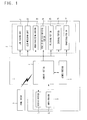
- Fig. 1 shows a block diagram schematically exhibiting the function of the apparatus for processing a lens as an embodiment of the present invention.
- the apparatus for processing a lens 1 comprises a lens-processing portion 2 in which an uncut lens is processed to provide a shape fitting the lens frame of the spectacle frame, an operation panel 3, a control portion 4 and a memory portion 5.
- the lens-processing portion 2 comprises a lens-holding unit 21, a lens-measuring portion 22, a rough processing portion 23, a beveled and flat grinding portion 24, a polishing portion 25, a grooving portion 26 and a chamfering portion 27.
- the lens-holding unit 21 comprises, as shown in Fig. 2 , a pair of lens-holding shafts 211 and 212 extending in the direction of the light axis of an uncut lens L.
- the uncut lens is held between the two lens-holding shafts 211 and 212 at both faces of the uncut lens L.
- the uncut lens L is rotated around the lens center by the lens-holding shafts so that the position of the processing and the position of the measurement in the circumferential direction are moved. Due to this construction, procedures from the measurement to the processing can be conducted in a singe chuck operation without releasing chucking after the uncut lens L is held by the lens-holding unit 21.
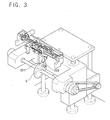
- the lens-measuring portion 22 comprises, as shown in Fig. 3 , a pair of styluses 221 and 222 which are disposed at opposite sides of the uncut lens L and face to each other.
- the rough processing portion 23 comprises, as shown in Fig. 2 , a rough grinder for a plastic lens 231 and a rough grinder for a glass lens 232.
- the bevel and flat grinding portion 24 comprises a grinder for beveled processing and flat processing 241 which comprises a beveled grinding portion having a groove corresponding to the bevel on the grinding face and a flat grinding portion having a flat grinding face.
- the polishing portion 25 comprises a polishing grinder 251.
- These grinders 231, 232, 241 and 251 are disposed at the same rotating shaft.
- the uncut lens L held by the lens-holding unit 21 is pressed against one of these grinders which are rotated by the rotation of the rotating shaft and the processing is conducted in accordance with the selected grinder.
- the grooving portion 26 comprises a grooving tool having an end mill although the grooving tool is not shown in the Fig..
- the peripheral face of the lens L which has been processed to a prescribed peripheral shape is cut into the prescribed depth by the end mill while the lens L is continuously rotated and a groove can be formed.
- the chamfering portion 27 comprises a chamfering tool having a grinding portion having an approximately hemispherical shape although the chamfering tool is not shown in the Fig..
- the edge at the boundary of the peripheral face and the face of the lens L which has been processed by the flat grinding or the beveled grinding is ground by the grinding portion having the approximately hemispherical shape while the lens L is continuously rotated and the chamfering can be conducted.
- the operation panel 3 comprises a display portion 31 for displaying an estimated shape of the lens to be obtained after the processing and various values set for the processing and an input portion 32 for inputting information necessary for processing the uncut lens L and for directing a desired processing.
- the control portion 4 comprises CPU and other devices and controls operations of the apparatus for processing a lens 1 by execution of the control program stored in the memory portion 5.
- the memory portion 4 comprises ROM, RAM and other devices and memorizes the control program of the apparatus for processing a lens 1, data of the image of the lens and other information.
- the mark F indicates a frame tracer which is attached at the outside of the apparatus for processing a lens 1 and can communicate with the apparatus.
- the frame tracer F measures the desired spectacle frame set at the frame tracer and transfers data of the shape of the lens frame expressing the three-dimensional shape of the lens frame to the apparatus for processing a lens 1. Therefore, the apparatus for processing a lens 1 is equipped with an interface of communication therefor.
- the frame tracer F is not a component constituting the apparatus for processing a lens 1 in the Fig., the apparatus for processing a lens 1 may have the frame tracer F as a constituting component.
- a layout display 91 such as that shown in Fig. 9 is displayed in the display portion 31.
- the operator indicates whether the lens to be processed is a lens for the right eye or for the left eye and also indicates in a column 911 that the type of the processing is the bevel processing.
- the operator inputs the data of prescription for the person wearing the spectacle glasses and information of the layout including data of the distance between geometrical centers into a column 912 using the input portion 32.
- the control portion 3 obtains the data of the shape of processing expressing the shape of the lens formed after the rough grinding of the uncut lens L by the calculation based on the input data.
- the operator may indicate the chamfering and/or the grooving as an option for the finishing using the input portion 32.
- Examples of the data of prescription include the pupillary distance (PD), information on the eye point including the height of the eye point relative to the geometrical center of the frame and data expressing the cylinder axis (AX).
- Examples of the data of the distance between geometrical centers include the frame PD (FPD) expressing the distance between the geometrical centers of the lens frames and the distance between lenses (DBL) expressing the distance between lenses (so-called the nose width).
- Examples of the lens data include the value of a curve or the value of a curve for every axial direction of the convex face of the uncut lens, the value of a curve or the value of a curve for every axial direction of the concave face of the uncut lens, the thickness of the center (the optical center or the geometrical center) of the uncut lens, the diameter of the lens (including A size and B size), the shape of the lens (the shape of the near optical center) and the distance between the optical center and the geometrical center.
- the above values of a curve may be approximate values. As the lens data, all these data are not always necessary. The necessary data may be selected and included.
- the lens data may be provided to the apparatus for processing a lens 1 not by the manual input by the operator but through a data communication.
- the operator then indicates the lens type of the uncut lens L in column 913 of the input display 91 using the input portion 32. More specifically, the input portion 32 has a button for selection of the lens type and any one of EX, minus-power, lenticular, plus-power and regular lenses can be selected as the lens type by pushing the button for selection of the lens type.
- the EX lens is selected as an example.
- the control portion 4 obtains the information of the lens type expressing the lens type (the step of obtaining the information of the lens type).
- the information of the lens type may be provided to the apparatus for processing a lens 1 not by the manual input by the operator but from the outside by another means such as communication.
- the high power minus lens and the high power plus lens mean lenses having the maximum thickness of the peripheral edge of about 5 mm or greater after the lens is processed. Since the size of the protruded portion is great in these lenses when the lenses are fitted into frames, it is desired that the bevel is formed at a suitable position.
- the operator then pushes the starting switch of the input portion 32.
- the control portion 3 directs measuring the shape of the uncut lens L based on the data of the shape of processing obtained in step S3.
- the styluses 221 and 222 are moved relative to the uncut lens L held by the holding shaft 211 and 212 in a manner such that the positions of contact of the styluses 221 and 222 on both faces of the uncut lens form loci about the same as that of the position of the peripheral edge of the lens after the processing and the positions of the contact (the positions on the faces of the lens) and the thickness of the lens at the positions of the contact are measured.
- the control portion 4 calculates the locus of the bevel in accordance with the lens type based on the information of the lens type obtained in S5 (the step of calculating the locus of a bevel) and creates the data of the locus of the bevel ( data of the automatically set bevel curve).
- Step S7 is conducted specifically for each lens type selected from “EX" (step S71), “high power minus” (step S72), “lenticular” (step S73), “high power plus” (step S74) and “regular” (step S75).
- the step specific for each lens type will be described later more specifically.
- “regular” is selected (step S75), more specific description will be omitted since the procedures are well known.
- the control portion 4 directs displaying a sample of the condition set for the bevel in the display portion 31 based on the data of the locus of the bevel obtained by the calculation.
- the operator can modify or adjust the condition of the automatically set bevel (including the position and the angle of the bevel) using the input portion 32. When such a modification is made, the data of the locus of the bevel is modified.
- the operator directs starting the processing using the input portion 32.
- the control portion 4 detects the direction of starting the processing, the control portion 4 obtains the data of the rough processing based on the data of the shape of processing obtained in S3.
- the data of the rough processing include data showing margins for grinding in the rough processing.
- the control portion 4 then controls the lens-processing portion 2 so that the rough processing of the uncut lens is conducted in accordance with the obtained data of the rough processing.
- the peripheral portion of the uncut lens L is ground by the rough grinder for a plastic lens 231 or the rough grinder for a glass lens 232.
- the control portion 4 then obtains data of the bevel processing based on the data of the locus of the bevel obtained in step S7 (the modified data of the locus of the bevel when the data have been modified in step S8) and the data of the shape of processing obtained in step S3.
- the control portion 4 forms the bevel based on the data of the bevel processing thus obtained. In this manner, the peripheral edge of the roughly processed lens is processed and the bevel is formed by the finishing grinder of the grinder for beveled processing and flat processing 241 and the bevel groove formed on the finishing grinder.
- the operation returns to step 2.
- the uncut lens for the lens for the left eye is held by chucking and the lens for the left eye is obtained in accordance with the same procedures.
- Step S7 will be described more specifically in the following.
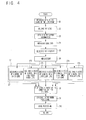
- step S71 In the case where an EX lens is indicated (step S71), the procedures will be described in accordance with the flow chart shown in Fig. 5 with reference to the diagram shown in Fig. 10 .
- the value of the bevel curve K1 is decided based on the value of the curve of the concave face of the EX lens contained in the lens data obtained in step S4 described above (the step of deciding the value of the bevel curve). Specifically, the calculation is different depending on whether the EX lens is a minus-power lens or a plus-power lens.
- the value of the bevel curve K1 is obtained in accordance with one of the following equations:
- e + represents a number of 1 or greater and e - represents a number of 1 or smaller.
- the obtained value of the bevel curve K1 and the radius of curvature of the bevel curve r1 satisfy the following equation: K ⁇ 1 ⁇ 523 / r ⁇ 1 wherein the refractive index of the air is set at 1.0.
- the reference axis of the bevel curve (hereinafter, referred to as the initial reference axis of the bevel curve) is decided in the same direction as the direction of the curvature of the concave face of the EX lens (the step of deciding the initial reference axis of the bevel curve).
- the first reference position m on the peripheral edge in the portion having the minimum thickness at the lower side in the vertical direction of the EX lens (the reference position of the bevel) is decided based on the thickness t1 of the portion having the minimum thickness (the step of deciding the first reference position).
- the first reference position m is expressed by the distance P1 from the end of the peripheral edge at the side of the convex face in the portion having the minimum thickness to the first reference position m.
- P1 is different depending on the thickness t1 of the portion having the minimum thickness and decided as shown in the following:
- the second reference position n on the peripheral edge in the portion having the maximum thickness at the upper side in the vertical direction of the EX lens is decided based on the ratio ( t 2/ t 1) of the thickness t 2 of the portion having the maximum thickness to the thickness t 1 of the portion having the minimum thickness (the step of deciding the second reference position).
- the second reference position n is expressed by the distance H from the position m' corresponding to the first reference position on the peripheral edge in the portion having the maximum thickness to the second reference position n (hereinafter, the distance H being referred to as the value of correction for the reference axis of a curve).
- H a ⁇ t ⁇ 2 / t ⁇ 1 ⁇ t ⁇ 1 - P ⁇ 1 - t ⁇ 1 - P ⁇ 1
- a represents an adjusting coefficient.
- (t2/t1) is 1 or greater.
- the locus of the bevel is decided based on the value of the bevel curve K1, the first reference position m and the angle of inclination of the axis ⁇ (the step of deciding the locus of the bevel). Specifically, the locus of the bevel which has the value of the bevel curve K1 and an axis obtained by inclination of the initial reference axis of the bevel curve by the angle ⁇ in the anti-clockwise direction in Fig. 10 as the reference axis of the curve, is decided. The decided locus of the bevel has the value of the bevel curve K1 and passes through the first reference position m and the second reference position n .
- a suitable locus of the bevel having an excellent balance can be obtained without marked protrusion of the front face of the EX lens from the rim when the EX lens is fitted into the frame.
- step S72 In the case where a high power minus lens is indicated (step S72), the procedures will be described in accordance with the flow chart shown in Fig. 6 with reference to the diagram shown in Fig. 11 .
- the value of the bevel curve K1 is decided based on the value of the curve of the convex face of the high power minus lens contained in the lens data obtained in step S4 described above (the step of deciding the value of the bevel curve). Specifically, the calculation is different depending on the value of the curve C of the convex face of the high power minus lens.
- the value of the bevel curve K1 is obtained in accordance with one of the following equations:
- the reference axis of the bevel curve (hereinafter, referred to as the initial reference axis of the bevel curve) is decided in the same direction as the direction of the curvature of the convex face of the high power minus lens (the step of deciding the initial reference axis of the bevel curve).
- the first reference position m on the peripheral edge in the portion having the minimum thickness at the side of the nose of the person wearing the high power minus lens (the reference position of the bevel) is decided based on the thickness t1 of the portion having the minimum thickness (the step of deciding the first reference position).
- the first reference position m is expressed by the distance P1 from the end of the peripheral edge at the side of the convex face in the portion having the minimum thickness to the first reference position m.
- P1 is different depending on the thickness t 1 of the portion having the minimum thickness and decided as shown in the following:
- the second reference position n on the peripheral edge in the portion having the maximum thickness is decided based on the ratio (t2/t1) of the thickness t 2 of the portion of the high power minus lens having the maximum thickness of the high power minus lens at the side of the ear of the person wearing the high power minus lens to the thickness t 1 of the portion having the minimum thickness (the step of deciding the second reference position).
- the second reference position n is expressed by the distance H from the position m' corresponding to the first reference position on the peripheral edge in the portion having the maximum thickness to the second reference position n (hereinafter, referred to as the value of correction for the reference axis of a curve).
- H P ⁇ 1 ⁇ a ⁇ t ⁇ 2 / t ⁇ 1 - P ⁇ 1
- a represents an adjusting coefficient.
- ( t 2/ t 1) is 1 or greater.
- the locus of the bevel is decided based on the value of the bevel curve K1, the first reference position m and the angle of inclination of the axis ⁇ (the step of deciding the locus of the bevel). Specifically, the locus of the bevel which has the value of the bevel curve K1 and an axis obtained by inclination of the initial reference axis of the bevel curve by an angle ⁇ in the clockwise direction in Fig. 11 as the reference axis of the curve the axis, is decided. The decided locus of the bevel has the value of the bevel curve K1 and passes through the first reference position m and the second reference position n .
- a suitable locus of the bevel having an excellent balance can be obtained without marked protrusion of the back face of the high power minus lens from the rim when the high power minus lens is fitted into the frame.
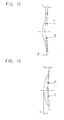
- step S73 In the case where a lenticular lens is indicated (step S73), the procedures will be described in accordance with the flow chart shown in Fig. 7 with reference to the diagram shown in Fig. 12 .
- the obtained value of the bevel curve K1 and the radius of curvature of the curve r 1 satisfy the following equation: K ⁇ 1 ⁇ 523 / r ⁇ 1 wherein the refractive index of the air is set at 1.0.
- the reference position of the bevel m on the peripheral edge in the portion having the minimum thickness at the side of the nose or the ear of the person wearing the lenticular lens is decided based on the thickness t 1 of the portion having the minimum thickness (the step of deciding the first reference position).
- the reference position of the bevel m is expressed by the distance P1 from the end of the peripheral edge at the side of the convex face in the portion having the minimum thickness to the first reference position m.
- P1 is different depending on the thickness t 1 of the portion having the minimum thickness and decided as shown in the following:
- the correction for the value of the curve S is decided based on the ratio ( t 2/ t 1) between the thickness t 1 of the portion of the lenticular lens having the minimum thickness at the side of the nose or the ear of the person wearing the lenticular lens and the thickness t 2 of the portion having the maximum thickness in the vertical direction of the lenticular lens (the step of deciding the correction for the value of the curve).
- a suitable locus of the bevel having an excellent balance can be obtained without marked protrusion of the segment in front of the lens when the lenticular lens is fitted into the frame.
- step S74 the procedures will be described in accordance with the flow chart shown in Fig. 8 with reference to the diagram shown in Fig. 13 .
- the obtained value of the bevel curve K1 and the radius of curvature of the curve r 1 satisfy the following equation: K ⁇ 1 ⁇ 523 / r ⁇ 1 wherein the refractive index of the air is set at 1.0.
- the reference position of the bevel m on the peripheral edge in the portion having the minimum thickness of the high power plus lens is decided based on the thickness t1 of the portion having the minimum thickness (the step of deciding the first reference position).
- the reference position of the bevel m is expressed by the distance P1 from the end of the peripheral edge at the side of the convex face in the portion having the minimum thickness to the first reference position m.
- P1 is different depending on the thickness t 1 of the portion having the minimum thickness and decided as shown in the following:
- the correction for the value of the curve S is decided based on the ratio (C2/C1) of the value of the curve C1 of the concave face to the value of the curve C2 of the convex face of the high power plus lens or based on the value of the curve C2 of the convex face alone (the step of deciding the correction for the value of the curve).
- a suitable locus of the bevel having an excellent balance can be obtained without marked protrusion of the convex face of the high power plus lens in front of the lens when the high power plus lens is fitted into the frame.
- an EX lens is well known to a person skilled in the arts and sometimes called “an E line multifocal lens”
- the locus of the bevel which has heretofore been obtained by the skill and the experience of a skilled operator can be obtained in accordance with the prescribed procedures. Therefore, the suitable bevel can be formed even by a person not skilled in the art.
Landscapes
- Engineering & Computer Science (AREA)
- Mechanical Engineering (AREA)
- Chemical & Material Sciences (AREA)
- Ceramic Engineering (AREA)
- Inorganic Chemistry (AREA)
- Eyeglasses (AREA)
- Grinding And Polishing Of Tertiary Curved Surfaces And Surfaces With Complex Shapes (AREA)
Applications Claiming Priority (2)
| Application Number | Priority Date | Filing Date | Title |
|---|---|---|---|
| JP2002105229A JP4562343B2 (ja) | 2002-04-08 | 2002-04-08 | Ex形多焦点レンズのヤゲン軌跡決定方法及びex形多焦点レンズ加工装置 |
| EP03007793A EP1352712B1 (de) | 2002-04-08 | 2003-04-04 | Methode zur Bestimmung einer Abschrägungskurve und deren Positionierung, sowie Methode und Vorrichtung zur Bearbeitung einer Linse |
Related Parent Applications (3)
| Application Number | Title | Priority Date | Filing Date |
|---|---|---|---|
| EP03007793.7 Division | 2003-04-04 | ||
| EP03007793 Previously-Filed-Application | 2003-04-04 | ||
| EP03007793A Division EP1352712B1 (de) | 2002-04-08 | 2003-04-04 | Methode zur Bestimmung einer Abschrägungskurve und deren Positionierung, sowie Methode und Vorrichtung zur Bearbeitung einer Linse |
Publications (2)
| Publication Number | Publication Date |
|---|---|
| EP2052814A1 true EP2052814A1 (de) | 2009-04-29 |
| EP2052814B1 EP2052814B1 (de) | 2013-09-11 |
Family
ID=28449899
Family Applications (2)
| Application Number | Title | Priority Date | Filing Date |
|---|---|---|---|
| EP03007793A Expired - Lifetime EP1352712B1 (de) | 2002-04-08 | 2003-04-04 | Methode zur Bestimmung einer Abschrägungskurve und deren Positionierung, sowie Methode und Vorrichtung zur Bearbeitung einer Linse |
| EP08006394.4A Expired - Lifetime EP2052814B1 (de) | 2002-04-08 | 2003-04-04 | Verfahren zur Bestimmung einer Schliffkurve, Verfahren zur Bestimmung eines Schliffpunktes, Verfahren zur Bearbeitung einer Linse und Vorrichtung zur Bearbeitung einer Linse |
Family Applications Before (1)
| Application Number | Title | Priority Date | Filing Date |
|---|---|---|---|
| EP03007793A Expired - Lifetime EP1352712B1 (de) | 2002-04-08 | 2003-04-04 | Methode zur Bestimmung einer Abschrägungskurve und deren Positionierung, sowie Methode und Vorrichtung zur Bearbeitung einer Linse |
Country Status (6)
| Country | Link |
|---|---|
| US (5) | US6935924B2 (de) |
| EP (2) | EP1352712B1 (de) |
| JP (1) | JP4562343B2 (de) |
| KR (1) | KR100496561B1 (de) |
| CN (1) | CN1283416C (de) |
| AT (1) | ATE535347T1 (de) |
Cited By (1)
| Publication number | Priority date | Publication date | Assignee | Title |
|---|---|---|---|---|
| EP3575033A1 (de) * | 2018-05-31 | 2019-12-04 | Nidek Co., Ltd. | Verarbeitungssteuerungsdatenerfassungsvorrichtung, verarbeitungssteuerungsdatenerfassungsverfahren und verarbeitungssteuerungsdatenerfassungsprogramm |
Families Citing this family (17)
| Publication number | Priority date | Publication date | Assignee | Title |
|---|---|---|---|---|
| JP4774203B2 (ja) * | 2004-10-01 | 2011-09-14 | 株式会社ニデック | 眼鏡レンズ加工装置 |
| FR2878971B1 (fr) * | 2004-12-03 | 2007-04-20 | Essilor Int | Procede et dispositif de preparation automatique au montage d'une lentille ophtalmique |
| FR2878972B1 (fr) * | 2004-12-03 | 2007-02-16 | Essilor Int | Procede et dispositif de preparation automatique au montage d'une lentille ophtalmique |
| FR2878970B1 (fr) * | 2004-12-03 | 2007-04-06 | Essilor Int | Dispositif de preparation automatique au montage de lentilles ophtalmiques permettant la prise en charge de plusieurs lentilles simultanement |
| FR2878975B1 (fr) * | 2004-12-03 | 2007-02-16 | Essilor Int | Procede et dispositif de preparation au montage d'un job de deux lentilles ophtalmiques d'une meme paire de lunettes |
| JP4446934B2 (ja) * | 2005-06-30 | 2010-04-07 | 株式会社ニデック | 眼鏡レンズ加工装置 |
| JP2007203423A (ja) * | 2006-02-03 | 2007-08-16 | Nidek Co Ltd | 眼鏡レンズ周縁加工装置 |
| FR2904703B1 (fr) * | 2006-08-04 | 2008-12-12 | Essilor Int | Paire de lunettes ophtalmiques et procede de formation d'une nervure peripherique d'emboitement sur le chant d'une lentille |
| JP4988823B2 (ja) * | 2007-03-16 | 2012-08-01 | Hoya株式会社 | 眼鏡レンズの縁摺り加工方法 |
| JP5073345B2 (ja) * | 2007-03-30 | 2012-11-14 | 株式会社ニデック | 眼鏡レンズ加工装置 |
| JP5134346B2 (ja) * | 2007-11-30 | 2013-01-30 | 株式会社ニデック | 眼鏡レンズ周縁加工装置 |
| JP5209358B2 (ja) * | 2008-03-31 | 2013-06-12 | 株式会社ニデック | ヤゲン軌跡設定方法及び眼鏡レンズ加工装置 |
| WO2012045412A1 (de) * | 2010-10-04 | 2012-04-12 | Schneider Gmbh & Co. Kg | Vorrichtung und verfahren zum bearbeiten einer optischen linse sowie transportbehältnis für optische linsen |
| BR112014013687B1 (pt) * | 2011-12-08 | 2021-12-21 | Hoya Corporation | Sistema de corte de lente, e, método para fabricar uma lente de óculos |
| JP6127530B2 (ja) | 2013-01-17 | 2017-05-17 | 株式会社ニデック | 眼鏡レンズ加工装置および加工制御データ作成プログラム |
| US12000739B2 (en) | 2021-04-22 | 2024-06-04 | Analog Devices, Inc. | Lever based differential capacitive strain gauge with acceleration rejection |
| CN116984958B (zh) * | 2023-09-26 | 2023-12-22 | 南通蓬盛机械有限公司 | 一种光学瞄准镜精磨工艺控制方法及系统 |
Citations (5)
| Publication number | Priority date | Publication date | Assignee | Title |
|---|---|---|---|---|
| EP0432078A2 (de) * | 1989-10-27 | 1991-06-12 | Indo Internacional S.A. | Linsenrandschleifmaschine |
| EP0479683A2 (de) * | 1990-10-05 | 1992-04-08 | Kabushiki Kaisha TOPCON | Linsen-Schleifgerät |
| EP0899059A2 (de) * | 1997-08-29 | 1999-03-03 | Nidek Co., Ltd. | Brillenglas-Schleifmaschine |
| EP0953405A2 (de) * | 1998-04-30 | 1999-11-03 | Nidek Co., Ltd. | Schleifmaschine für optische Linsen |
| US20010035933A1 (en) * | 2000-02-01 | 2001-11-01 | Toshihiro Iwai | Apparatus for displaying lens contour, apparatus for processing lens contour data, and apparatus for grinding edge of eyeglass lens with the same |
Family Cites Families (10)
| Publication number | Priority date | Publication date | Assignee | Title |
|---|---|---|---|---|
| US35933A (en) * | 1862-07-22 | Improved can for preserving fruits, sgc | ||
| JP4046789B2 (ja) * | 1996-10-31 | 2008-02-13 | 株式会社ニデック | 眼鏡レンズ研削加工機及び眼鏡レンズ研削加工方法 |
| JPH10277903A (ja) * | 1997-03-31 | 1998-10-20 | Nidek Co Ltd | 眼鏡レンズレイアウト入力装置及びレンズ研削加工装置 |
| EP1938923B1 (de) * | 1997-08-01 | 2012-06-13 | Nidek Co., Ltd. | Verfahren zum Schleifen einer Brillenglaslinse und Vorrichtung zum Schleifen einer Brillenglaslinse |
| DE19804542C5 (de) * | 1998-02-05 | 2009-04-30 | Wernicke & Co Gmbh | Verfahren und Vorrichtung zum Bearbeiten von Brillengläsern |
| US6328630B1 (en) * | 1998-10-05 | 2001-12-11 | Hoya Corporation | Eyeglass lens end face machining method |
| JP4087526B2 (ja) * | 1999-03-08 | 2008-05-21 | 株式会社トプコン | 眼鏡レンズのヤゲン形状表示装置及びその表示装置によるレンズ周縁加工方法及びそのレンズ周縁加工装置 |
| ATE390233T1 (de) * | 1999-08-06 | 2008-04-15 | Hoya Corp | Brillenglaslinsen bearbeitungsverfahren und vorrichtung |
| JP2001277086A (ja) * | 2000-03-31 | 2001-10-09 | Topcon Corp | レンズ周縁加工装置 |
| JP3961196B2 (ja) * | 2000-06-15 | 2007-08-22 | 株式会社ニデック | 眼鏡レンズ加工装置 |
-
2002
- 2002-04-08 JP JP2002105229A patent/JP4562343B2/ja not_active Expired - Fee Related
-
2003
- 2003-03-14 KR KR10-2003-0016107A patent/KR100496561B1/ko not_active Expired - Fee Related
- 2003-04-04 EP EP03007793A patent/EP1352712B1/de not_active Expired - Lifetime
- 2003-04-04 AT AT03007793T patent/ATE535347T1/de active
- 2003-04-04 EP EP08006394.4A patent/EP2052814B1/de not_active Expired - Lifetime
- 2003-04-04 US US10/406,580 patent/US6935924B2/en not_active Expired - Fee Related
- 2003-04-08 CN CNB031095259A patent/CN1283416C/zh not_active Expired - Fee Related
-
2004
- 2004-07-27 US US10/899,080 patent/US6887134B2/en not_active Expired - Lifetime
-
2005
- 2005-06-30 US US11/170,095 patent/US7083499B2/en not_active Expired - Fee Related
- 2005-06-30 US US11/170,094 patent/US7083498B2/en not_active Expired - Fee Related
- 2005-06-30 US US11/170,147 patent/US7125315B2/en not_active Expired - Fee Related
Patent Citations (5)
| Publication number | Priority date | Publication date | Assignee | Title |
|---|---|---|---|---|
| EP0432078A2 (de) * | 1989-10-27 | 1991-06-12 | Indo Internacional S.A. | Linsenrandschleifmaschine |
| EP0479683A2 (de) * | 1990-10-05 | 1992-04-08 | Kabushiki Kaisha TOPCON | Linsen-Schleifgerät |
| EP0899059A2 (de) * | 1997-08-29 | 1999-03-03 | Nidek Co., Ltd. | Brillenglas-Schleifmaschine |
| EP0953405A2 (de) * | 1998-04-30 | 1999-11-03 | Nidek Co., Ltd. | Schleifmaschine für optische Linsen |
| US20010035933A1 (en) * | 2000-02-01 | 2001-11-01 | Toshihiro Iwai | Apparatus for displaying lens contour, apparatus for processing lens contour data, and apparatus for grinding edge of eyeglass lens with the same |
Cited By (1)
| Publication number | Priority date | Publication date | Assignee | Title |
|---|---|---|---|---|
| EP3575033A1 (de) * | 2018-05-31 | 2019-12-04 | Nidek Co., Ltd. | Verarbeitungssteuerungsdatenerfassungsvorrichtung, verarbeitungssteuerungsdatenerfassungsverfahren und verarbeitungssteuerungsdatenerfassungsprogramm |
Also Published As
| Publication number | Publication date |
|---|---|
| JP4562343B2 (ja) | 2010-10-13 |
| US7083499B2 (en) | 2006-08-01 |
| EP1352712A2 (de) | 2003-10-15 |
| KR20030081026A (ko) | 2003-10-17 |
| KR100496561B1 (ko) | 2005-06-22 |
| CN1449892A (zh) | 2003-10-22 |
| EP1352712A3 (de) | 2003-10-22 |
| EP1352712B1 (de) | 2011-11-30 |
| US7083498B2 (en) | 2006-08-01 |
| US20050009455A1 (en) | 2005-01-13 |
| US20050239374A1 (en) | 2005-10-27 |
| US20050239373A1 (en) | 2005-10-27 |
| CN1283416C (zh) | 2006-11-08 |
| US7125315B2 (en) | 2006-10-24 |
| JP2003295133A (ja) | 2003-10-15 |
| ATE535347T1 (de) | 2011-12-15 |
| US6935924B2 (en) | 2005-08-30 |
| US6887134B2 (en) | 2005-05-03 |
| EP2052814B1 (de) | 2013-09-11 |
| US20030227690A1 (en) | 2003-12-11 |
| US20050239375A1 (en) | 2005-10-27 |
Similar Documents
| Publication | Publication Date | Title |
|---|---|---|
| EP2052814B1 (de) | Verfahren zur Bestimmung einer Schliffkurve, Verfahren zur Bestimmung eines Schliffpunktes, Verfahren zur Bearbeitung einer Linse und Vorrichtung zur Bearbeitung einer Linse | |
| US7840294B2 (en) | Layout setting device for processing eyeglass lens, eyeglass lens processing apparatus, eyeglass frame measuring device and cup attaching device, each having the same | |
| US7740520B2 (en) | Apparatus for processing chamfering of eyeglass lens | |
| US20100184356A1 (en) | Device for machining an ophthalmic lens | |
| JPH0634923A (ja) | 眼鏡レンズの供給システム | |
| EP2147743A1 (de) | Verfahren und vorrichtung zur bearbeitung von linsen | |
| JP2003295134A (ja) | レンズ加工方法、レンズ加工装置、及び情報記録媒体 | |
| JP4656538B2 (ja) | プラス強度眼鏡レンズのヤゲン軌跡決定方法及びプラス強度眼鏡レンズ加工装置 | |
| JP4656537B2 (ja) | マイナス強度眼鏡レンズのヤゲン軌跡決定方法及びマイナス強度の眼鏡レンズ加工装置 | |
| JP4651654B2 (ja) | レンチキュラーレンズのヤゲン軌跡決定方法及びレンチキュラーレンズ加工装置 | |
| JP2021159998A (ja) | 眼鏡レンズ加工装置、及びヤゲン又は溝の形成データ設定プログラム | |
| EP4382249A1 (de) | Verfahren zur erzeugung eines bearbeitungssollwerts zum abschrägen einer ophthalmischen linse | |
| EP3480639B1 (de) | Brillenglasverarbeitungsvorrichtungen und programmen zur verarbeitungssteuerungsdatenerzeugung | |
| JP2003300142A (ja) | レンズ加工装置、及びレンズ加工方法 | |
| JPH0647656A (ja) | レンズ研削装置 | |
| JP4688352B2 (ja) | 眼鏡レンズ加工情報表示方法およびレンズ研削加工装置 | |
| JP2003300138A (ja) | レンズ加工方法及びレンズ加工装置並びに眼鏡レンズ | |
| JP2000089174A (ja) | 眼鏡レンズの供給システム | |
| JP2000089175A (ja) | 眼鏡レンズの供給システム | |
| JP2000047152A (ja) | 眼鏡レンズの供給システム |
Legal Events
| Date | Code | Title | Description |
|---|---|---|---|
| PUAI | Public reference made under article 153(3) epc to a published international application that has entered the european phase |
Free format text: ORIGINAL CODE: 0009012 |
|
| 17P | Request for examination filed |
Effective date: 20080331 |
|
| AC | Divisional application: reference to earlier application |
Ref document number: 1352712 Country of ref document: EP Kind code of ref document: P |
|
| AK | Designated contracting states |
Kind code of ref document: A1 Designated state(s): AT BE BG CH CY CZ DE DK EE ES FI FR GB GR HU IE IT LI LU MC NL PT RO SE SI SK TR |
|
| AKX | Designation fees paid |
Designated state(s): AT BE BG CH CY CZ DE DK EE ES FI FR GB GR HU IE IT LI LU MC NL PT RO SE SI SK TR |
|
| 17Q | First examination report despatched |
Effective date: 20110412 |
|
| GRAP | Despatch of communication of intention to grant a patent |
Free format text: ORIGINAL CODE: EPIDOSNIGR1 |
|
| REG | Reference to a national code |
Ref country code: DE Ref legal event code: R079 Ref document number: 60344924 Country of ref document: DE Free format text: PREVIOUS MAIN CLASS: B24B0047220000 Ipc: B24B0019030000 |
|
| GRAS | Grant fee paid |
Free format text: ORIGINAL CODE: EPIDOSNIGR3 |
|
| GRAP | Despatch of communication of intention to grant a patent |
Free format text: ORIGINAL CODE: EPIDOSNIGR1 |
|
| GRAA | (expected) grant |
Free format text: ORIGINAL CODE: 0009210 |
|
| INTG | Intention to grant announced |
Effective date: 20130719 |
|
| RIC1 | Information provided on ipc code assigned before grant |
Ipc: B24B 1/00 20060101ALI20130709BHEP Ipc: B24B 19/03 20060101AFI20130709BHEP |
|
| AC | Divisional application: reference to earlier application |
Ref document number: 1352712 Country of ref document: EP Kind code of ref document: P |
|
| AK | Designated contracting states |
Kind code of ref document: B1 Designated state(s): AT BE BG CH CY CZ DE DK EE ES FI FR GB GR HU IE IT LI LU MC NL PT RO SE SI SK TR |
|
| REG | Reference to a national code |
Ref country code: GB Ref legal event code: FG4D |
|
| REG | Reference to a national code |
Ref country code: CH Ref legal event code: EP |
|
| REG | Reference to a national code |
Ref country code: AT Ref legal event code: REF Ref document number: 631347 Country of ref document: AT Kind code of ref document: T Effective date: 20130915 |
|
| REG | Reference to a national code |
Ref country code: IE Ref legal event code: FG4D |
|
| REG | Reference to a national code |
Ref country code: DE Ref legal event code: R096 Ref document number: 60344924 Country of ref document: DE Effective date: 20131107 |
|
| PG25 | Lapsed in a contracting state [announced via postgrant information from national office to epo] |
Ref country code: SE Free format text: LAPSE BECAUSE OF FAILURE TO SUBMIT A TRANSLATION OF THE DESCRIPTION OR TO PAY THE FEE WITHIN THE PRESCRIBED TIME-LIMIT Effective date: 20130911 Ref country code: CY Free format text: LAPSE BECAUSE OF FAILURE TO SUBMIT A TRANSLATION OF THE DESCRIPTION OR TO PAY THE FEE WITHIN THE PRESCRIBED TIME-LIMIT Effective date: 20130731 |
|
| REG | Reference to a national code |
Ref country code: NL Ref legal event code: VDEP Effective date: 20130911 |
|
| REG | Reference to a national code |
Ref country code: AT Ref legal event code: MK05 Ref document number: 631347 Country of ref document: AT Kind code of ref document: T Effective date: 20130911 |
|
| PG25 | Lapsed in a contracting state [announced via postgrant information from national office to epo] |
Ref country code: FI Free format text: LAPSE BECAUSE OF FAILURE TO SUBMIT A TRANSLATION OF THE DESCRIPTION OR TO PAY THE FEE WITHIN THE PRESCRIBED TIME-LIMIT Effective date: 20130911 Ref country code: ES Free format text: LAPSE BECAUSE OF FAILURE TO SUBMIT A TRANSLATION OF THE DESCRIPTION OR TO PAY THE FEE WITHIN THE PRESCRIBED TIME-LIMIT Effective date: 20130911 Ref country code: GR Free format text: LAPSE BECAUSE OF FAILURE TO SUBMIT A TRANSLATION OF THE DESCRIPTION OR TO PAY THE FEE WITHIN THE PRESCRIBED TIME-LIMIT Effective date: 20131212 Ref country code: SI Free format text: LAPSE BECAUSE OF FAILURE TO SUBMIT A TRANSLATION OF THE DESCRIPTION OR TO PAY THE FEE WITHIN THE PRESCRIBED TIME-LIMIT Effective date: 20130911 |
|
| PG25 | Lapsed in a contracting state [announced via postgrant information from national office to epo] |
Ref country code: BE Free format text: LAPSE BECAUSE OF FAILURE TO SUBMIT A TRANSLATION OF THE DESCRIPTION OR TO PAY THE FEE WITHIN THE PRESCRIBED TIME-LIMIT Effective date: 20130911 Ref country code: CY Free format text: LAPSE BECAUSE OF FAILURE TO SUBMIT A TRANSLATION OF THE DESCRIPTION OR TO PAY THE FEE WITHIN THE PRESCRIBED TIME-LIMIT Effective date: 20130911 |
|
| PG25 | Lapsed in a contracting state [announced via postgrant information from national office to epo] |
Ref country code: CZ Free format text: LAPSE BECAUSE OF FAILURE TO SUBMIT A TRANSLATION OF THE DESCRIPTION OR TO PAY THE FEE WITHIN THE PRESCRIBED TIME-LIMIT Effective date: 20130911 Ref country code: EE Free format text: LAPSE BECAUSE OF FAILURE TO SUBMIT A TRANSLATION OF THE DESCRIPTION OR TO PAY THE FEE WITHIN THE PRESCRIBED TIME-LIMIT Effective date: 20130911 Ref country code: NL Free format text: LAPSE BECAUSE OF FAILURE TO SUBMIT A TRANSLATION OF THE DESCRIPTION OR TO PAY THE FEE WITHIN THE PRESCRIBED TIME-LIMIT Effective date: 20130911 Ref country code: RO Free format text: LAPSE BECAUSE OF FAILURE TO SUBMIT A TRANSLATION OF THE DESCRIPTION OR TO PAY THE FEE WITHIN THE PRESCRIBED TIME-LIMIT Effective date: 20130911 Ref country code: SK Free format text: LAPSE BECAUSE OF FAILURE TO SUBMIT A TRANSLATION OF THE DESCRIPTION OR TO PAY THE FEE WITHIN THE PRESCRIBED TIME-LIMIT Effective date: 20130911 |
|
| PG25 | Lapsed in a contracting state [announced via postgrant information from national office to epo] |
Ref country code: AT Free format text: LAPSE BECAUSE OF FAILURE TO SUBMIT A TRANSLATION OF THE DESCRIPTION OR TO PAY THE FEE WITHIN THE PRESCRIBED TIME-LIMIT Effective date: 20130911 |
|
| REG | Reference to a national code |
Ref country code: DE Ref legal event code: R097 Ref document number: 60344924 Country of ref document: DE |
|
| PG25 | Lapsed in a contracting state [announced via postgrant information from national office to epo] |
Ref country code: PT Free format text: LAPSE BECAUSE OF FAILURE TO SUBMIT A TRANSLATION OF THE DESCRIPTION OR TO PAY THE FEE WITHIN THE PRESCRIBED TIME-LIMIT Effective date: 20140113 |
|
| PLBE | No opposition filed within time limit |
Free format text: ORIGINAL CODE: 0009261 |
|
| STAA | Information on the status of an ep patent application or granted ep patent |
Free format text: STATUS: NO OPPOSITION FILED WITHIN TIME LIMIT |
|
| 26N | No opposition filed |
Effective date: 20140612 |
|
| PG25 | Lapsed in a contracting state [announced via postgrant information from national office to epo] |
Ref country code: IT Free format text: LAPSE BECAUSE OF FAILURE TO SUBMIT A TRANSLATION OF THE DESCRIPTION OR TO PAY THE FEE WITHIN THE PRESCRIBED TIME-LIMIT Effective date: 20130911 |
|
| REG | Reference to a national code |
Ref country code: DE Ref legal event code: R097 Ref document number: 60344924 Country of ref document: DE Effective date: 20140612 |
|
| PG25 | Lapsed in a contracting state [announced via postgrant information from national office to epo] |
Ref country code: DK Free format text: LAPSE BECAUSE OF FAILURE TO SUBMIT A TRANSLATION OF THE DESCRIPTION OR TO PAY THE FEE WITHIN THE PRESCRIBED TIME-LIMIT Effective date: 20130911 |
|
| REG | Reference to a national code |
Ref country code: DE Ref legal event code: R119 Ref document number: 60344924 Country of ref document: DE |
|
| PG25 | Lapsed in a contracting state [announced via postgrant information from national office to epo] |
Ref country code: LU Free format text: LAPSE BECAUSE OF FAILURE TO SUBMIT A TRANSLATION OF THE DESCRIPTION OR TO PAY THE FEE WITHIN THE PRESCRIBED TIME-LIMIT Effective date: 20140404 Ref country code: MC Free format text: LAPSE BECAUSE OF FAILURE TO SUBMIT A TRANSLATION OF THE DESCRIPTION OR TO PAY THE FEE WITHIN THE PRESCRIBED TIME-LIMIT Effective date: 20130911 |
|
| REG | Reference to a national code |
Ref country code: CH Ref legal event code: PL |
|
| GBPC | Gb: european patent ceased through non-payment of renewal fee |
Effective date: 20140404 |
|
| REG | Reference to a national code |
Ref country code: DE Ref legal event code: R119 Ref document number: 60344924 Country of ref document: DE Effective date: 20141101 |
|
| REG | Reference to a national code |
Ref country code: FR Ref legal event code: ST Effective date: 20141231 |
|
| REG | Reference to a national code |
Ref country code: IE Ref legal event code: MM4A |
|
| PG25 | Lapsed in a contracting state [announced via postgrant information from national office to epo] |
Ref country code: CH Free format text: LAPSE BECAUSE OF NON-PAYMENT OF DUE FEES Effective date: 20140430 Ref country code: GB Free format text: LAPSE BECAUSE OF NON-PAYMENT OF DUE FEES Effective date: 20140404 Ref country code: DE Free format text: LAPSE BECAUSE OF NON-PAYMENT OF DUE FEES Effective date: 20141101 Ref country code: LI Free format text: LAPSE BECAUSE OF NON-PAYMENT OF DUE FEES Effective date: 20140430 |
|
| PG25 | Lapsed in a contracting state [announced via postgrant information from national office to epo] |
Ref country code: FR Free format text: LAPSE BECAUSE OF NON-PAYMENT OF DUE FEES Effective date: 20140430 |
|
| PG25 | Lapsed in a contracting state [announced via postgrant information from national office to epo] |
Ref country code: IE Free format text: LAPSE BECAUSE OF NON-PAYMENT OF DUE FEES Effective date: 20140404 |
|
| PG25 | Lapsed in a contracting state [announced via postgrant information from national office to epo] |
Ref country code: BG Free format text: LAPSE BECAUSE OF FAILURE TO SUBMIT A TRANSLATION OF THE DESCRIPTION OR TO PAY THE FEE WITHIN THE PRESCRIBED TIME-LIMIT Effective date: 20130911 |
|
| PG25 | Lapsed in a contracting state [announced via postgrant information from national office to epo] |
Ref country code: HU Free format text: LAPSE BECAUSE OF FAILURE TO SUBMIT A TRANSLATION OF THE DESCRIPTION OR TO PAY THE FEE WITHIN THE PRESCRIBED TIME-LIMIT; INVALID AB INITIO Effective date: 20030404 Ref country code: TR Free format text: LAPSE BECAUSE OF FAILURE TO SUBMIT A TRANSLATION OF THE DESCRIPTION OR TO PAY THE FEE WITHIN THE PRESCRIBED TIME-LIMIT Effective date: 20130911 |