EP2055797A1 - Alliage à base de fer et son procédé de fabrication - Google Patents
Alliage à base de fer et son procédé de fabrication Download PDFInfo
- Publication number
- EP2055797A1 EP2055797A1 EP07792874A EP07792874A EP2055797A1 EP 2055797 A1 EP2055797 A1 EP 2055797A1 EP 07792874 A EP07792874 A EP 07792874A EP 07792874 A EP07792874 A EP 07792874A EP 2055797 A1 EP2055797 A1 EP 2055797A1
- Authority
- EP
- European Patent Office
- Prior art keywords
- mass
- based alloy
- alloy
- twin crystal
- area ratio
- Prior art date
- Legal status (The legal status is an assumption and is not a legal conclusion. Google has not performed a legal analysis and makes no representation as to the accuracy of the status listed.)
- Withdrawn
Links
Images


Classifications
-
- C—CHEMISTRY; METALLURGY
- C22—METALLURGY; FERROUS OR NON-FERROUS ALLOYS; TREATMENT OF ALLOYS OR NON-FERROUS METALS
- C22C—ALLOYS
- C22C38/00—Ferrous alloys, e.g. steel alloys
- C22C38/06—Ferrous alloys, e.g. steel alloys containing aluminium
-
- C—CHEMISTRY; METALLURGY
- C21—METALLURGY OF IRON
- C21D—MODIFYING THE PHYSICAL STRUCTURE OF FERROUS METALS; GENERAL DEVICES FOR HEAT TREATMENT OF FERROUS OR NON-FERROUS METALS OR ALLOYS; MAKING METAL MALLEABLE, e.g. BY DECARBURISATION OR TEMPERING
- C21D8/00—Modifying the physical properties of ferrous metals or ferrous alloys by deformation combined with, or followed by, heat treatment
- C21D8/12—Modifying the physical properties of ferrous metals or ferrous alloys by deformation combined with, or followed by, heat treatment during manufacturing of articles with special electromagnetic properties
-
- C—CHEMISTRY; METALLURGY
- C21—METALLURGY OF IRON
- C21D—MODIFYING THE PHYSICAL STRUCTURE OF FERROUS METALS; GENERAL DEVICES FOR HEAT TREATMENT OF FERROUS OR NON-FERROUS METALS OR ALLOYS; MAKING METAL MALLEABLE, e.g. BY DECARBURISATION OR TEMPERING
- C21D10/00—Modifying the physical properties by methods other than heat treatment or deformation
-
- C—CHEMISTRY; METALLURGY
- C21—METALLURGY OF IRON
- C21D—MODIFYING THE PHYSICAL STRUCTURE OF FERROUS METALS; GENERAL DEVICES FOR HEAT TREATMENT OF FERROUS OR NON-FERROUS METALS OR ALLOYS; MAKING METAL MALLEABLE, e.g. BY DECARBURISATION OR TEMPERING
- C21D6/00—Heat treatment of ferrous alloys
-
- C—CHEMISTRY; METALLURGY
- C21—METALLURGY OF IRON
- C21D—MODIFYING THE PHYSICAL STRUCTURE OF FERROUS METALS; GENERAL DEVICES FOR HEAT TREATMENT OF FERROUS OR NON-FERROUS METALS OR ALLOYS; MAKING METAL MALLEABLE, e.g. BY DECARBURISATION OR TEMPERING
- C21D7/00—Modifying the physical properties of iron or steel by deformation
- C21D7/02—Modifying the physical properties of iron or steel by deformation by cold working
-
- C—CHEMISTRY; METALLURGY
- C22—METALLURGY; FERROUS OR NON-FERROUS ALLOYS; TREATMENT OF ALLOYS OR NON-FERROUS METALS
- C22C—ALLOYS
- C22C38/00—Ferrous alloys, e.g. steel alloys
-
- C—CHEMISTRY; METALLURGY
- C22—METALLURGY; FERROUS OR NON-FERROUS ALLOYS; TREATMENT OF ALLOYS OR NON-FERROUS METALS
- C22C—ALLOYS
- C22C38/00—Ferrous alloys, e.g. steel alloys
- C22C38/18—Ferrous alloys, e.g. steel alloys containing chromium
-
- H—ELECTRICITY
- H01—ELECTRIC ELEMENTS
- H01F—MAGNETS; INDUCTANCES; TRANSFORMERS; SELECTION OF MATERIALS FOR THEIR MAGNETIC PROPERTIES
- H01F1/00—Magnets or magnetic bodies characterised by the magnetic materials therefor; Selection of materials for their magnetic properties
- H01F1/01—Magnets or magnetic bodies characterised by the magnetic materials therefor; Selection of materials for their magnetic properties of inorganic materials
- H01F1/03—Magnets or magnetic bodies characterised by the magnetic materials therefor; Selection of materials for their magnetic properties of inorganic materials characterised by their coercivity
- H01F1/12—Magnets or magnetic bodies characterised by the magnetic materials therefor; Selection of materials for their magnetic properties of inorganic materials characterised by their coercivity of soft-magnetic materials
- H01F1/14—Magnets or magnetic bodies characterised by the magnetic materials therefor; Selection of materials for their magnetic properties of inorganic materials characterised by their coercivity of soft-magnetic materials metals or alloys
- H01F1/147—Alloys characterised by their composition
-
- H—ELECTRICITY
- H01—ELECTRIC ELEMENTS
- H01F—MAGNETS; INDUCTANCES; TRANSFORMERS; SELECTION OF MATERIALS FOR THEIR MAGNETIC PROPERTIES
- H01F1/00—Magnets or magnetic bodies characterised by the magnetic materials therefor; Selection of materials for their magnetic properties
- H01F1/01—Magnets or magnetic bodies characterised by the magnetic materials therefor; Selection of materials for their magnetic properties of inorganic materials
- H01F1/03—Magnets or magnetic bodies characterised by the magnetic materials therefor; Selection of materials for their magnetic properties of inorganic materials characterised by their coercivity
- H01F1/12—Magnets or magnetic bodies characterised by the magnetic materials therefor; Selection of materials for their magnetic properties of inorganic materials characterised by their coercivity of soft-magnetic materials
- H01F1/14—Magnets or magnetic bodies characterised by the magnetic materials therefor; Selection of materials for their magnetic properties of inorganic materials characterised by their coercivity of soft-magnetic materials metals or alloys
- H01F1/147—Alloys characterised by their composition
- H01F1/14766—Fe-Si based alloys
- H01F1/14791—Fe-Si-Al based alloys, e.g. Sendust
Definitions
- the present invention relates to a ferromagnetic Fe-based alloy having a large reversible strain obtained by application and removal of a magnetic field gradient, the Fe-based alloy capable of being displaced, and a method for producing the same.
- a titanium alloy as a material having a low Young's modulus and exhibiting high elastic deformability.
- the titanium alloy is used for an artificial tooth root, an artificial bone and a glass frame or the like.
- a titanium alloy containing a IVa group or Va group element is a material having a low Young's modulus and exhibiting high elastic deformability (Patent Documents 1 and 2).
- Patent Documents 1 and 2 describe the deformation behavior of the titanium alloy to external stress. Examples of external factors which cause a deformation include a temperature and a magnetic field in addition to the stress.
- a shape-memory alloy displacably controlled by a temperature is known, and has a dimension change of a level of several %.
- a shape memory effect is a phenomenon in which an original shape of a deformed material is restored using martensitic reverse transformation produced when the deformed material is heated at a certain temperature or more.
- the shape-memory alloy can be used as a thermally driven actuator.
- the shape-memory alloy requires temperature control and further has a poor response since the shape change of the shape-memory alloy in being cooled is rate-controlled by thermal diffusion.
- the ferromagnetic shape-memory alloy which has a dimension change of several % exceeding that of a conventional magnetrostriction material when an external magnetic field is applied to the ferromagnetic shape-memory alloy, also eliminate a low response as a fault of a thermally driven shape-memory alloy.
- Examples of the ferromagnetic shape-memory alloys include an Ni-Mn-Ga based material.
- an actuator material having a shape change caused by applying a magnetic field has been known (Patent Document 3).
- the Ni-Mn-Ga based material has inferior ductility, and it is difficult to apply a complicated and precise shape required for machine parts to the Ni-Mn-Ga based alloy.
- the present inventors have researched and examined various ferromagnetic materials capable of being magnetically driven while maintaining high elastic deformability, the materials having good ductility, in view of the faults of the conventional titanium alloy or Ni-Mn-Ga based alloy. As a result, the inventors found that a ferromagnetic Fe-based alloy having a large reversible strain exhibited by application and removal of a magnetic field gradient is obtained by the suitable selection of alloy components and compositions, and the proper management of producing conditions, using Fe which is an inexpensive material as a base.
- An Fe-based alloy of the present invention contains one or two or more types selected from Al: 0.01 to 11% by mass, Si: 0.01 to 7% by mass and Cr: 0.01 to 26% by mass.
- the Fe-based alloy can further contain one or two or more types selected from Ti: 0.01 to 5% by mass, V: 0.01 to 10% by mass, Mn: 0.01 to 5% by mass, Co: 0.01 to 30% by mass, Ni: 0.01 to 10% by mass, Cu: 0.01 to 5% by mass, Zr: 0.01 to 5% by mass, Nb: 0.01 to 5% by mass, Mo: 0.01 to 5% by mass, Hf: 0.01 to 5% by mass, Ta: 0.01 to 5% by mass, W: 0.01 to 5% by mass, B: 0.001 to 1% by mass, C: 0.001 to 1% by mass, P: 0.001 to 1% by mass and S: 0.001 to 1% by mass.
- An Fe-based alloy of the present invention can contain one or two or more types selected from Al: 0.01 to 11% by mass, Si: 0.01 to 7% by mass, Cr: 0.01 to 26% by mass and Ni: 35 to 50% by mass.
- the Fe-based alloy can further contain one or two or more types selected from Ti: 0.01 to 5% by mass, V: 0.01 to 10% by mass, Mn: 0.01 to 5% by mass, Co: 0.01 to 30% by mass, Cu: 0.01 to 5% by mass, Zr: 0.01 to 5% by mass, Nb: 0.01 to 5% by mass, Mo: 0.01 to 5% by mass, Hf: 0.01 to 5% by mass, Ta: 0.01 to 5% by mass, W: 0.01 to 5% by mass, B: 0.001 to 1% by mass, C: 0.001 to 1% by mass, P: 0.001 to 1% by mass and S: 0.001 to 1% by mass.
- This Fe-based alloy which is ferromagnetic at least at an ordinary temperature, has an existing deformed twin crystal generated by working.
- the existing amount of the twin crystal is adjusted to 0.2 or more as an area ratio of a twin crystal interface to an area of a crystal grain boundary (hereinafter, merely referred to as "an area ratio of a twin crystal interface").
- a metal structure having the existing twin crystal is formed by solution-treating an Fe-based alloy having a predetermined composition at 600 to 1350°C and then working the Fe-based alloy at a working rate: 10% or more.
- the Fe-based alloy may be aging-treated at 200 to 800°C.
- the present inventors have added various alloy elements to Fe which is a ferromagnetic element in order to provide a material having a large reversible strain obtained by application and removal of a magnetic field gradient, the material displacably controlled.
- the present inventors have researched and examined the relationship between a composition and a working rate, and an elastic deformation amount and magnetic property. As a result, there could be obtained a ferromagnetic alloy having high elastic deformation, the alloy having the large reversible strain obtained by the application and removal of the magnetic field gradient by the Fe-based alloy containing a proper amount of Al, Si, Cr and Ni and good ductility.
- the deformation amount caused by a magnetic field is reduced when stress required for deforming the material is high, and thereby a Young' s modulus is desirably low.
- a strain is allowed to remain by removing the magnetic field gradient. Therefore, large elastic deformability is required in order to obtain a large reversible strain by the application and removal of the magnetic field gradient.
- ⁇ Fe having a b.c.c. structure is a ferromagnetic element having a large magnetic moment.
- pure Fe which is plastically deformed immediately, has a small elastic deformation amount.
- Various alloy elements are added into Fe, and the obtained Fe-based alloy is cold-worked.
- the magnetic property and elastic deformation amount of the Fe-based alloy are researched.
- Al, Si, Cr and Ni or the like are added into Fe, the Fe-based alloy can be confirmed to have an enhanced elastic deformation amount while exhibiting high magnetic property.
- strong magnetization ability to a comparatively low magnetic field is preferably shown.
- the magnetization curve of an Fe alloy of the present invention the Fe alloy has a magnetization intensity of 100 emu/g or more to an external magnetic field of 0.5 tesla (hereinafter, referred to as T).
- An elastic limit strain of a metal material such as annealed Fe is usually about 0.3%.
- the metal material is work-hardened to suppress slip deformation to increase a hardness and a tension strength and heighten a yield stress and an elastic limit.
- a strain of 0.4% or more exceeding a usual elastic deformation amount to bending deformation of 1% is restored, for example.
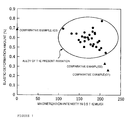
- Fig. 1 collectively shows the relationship between the magnetization intensity to the external magnetic field of 0. 5 T and the elastic deformation amount to the bending deformation of 1%.
- Any of alloys of the present invention has a magnetization intensity of 100 emu/g or more and an elastic deformation amount of 0.4% or more. Such properties can be applied in a wide temperature range of a liquid nitrogen temperature (-196°C) to 400°C.
- the Fe alloy of the present invention has a comparatively small Young's modulus and exhibits a large elastic deformation amount.
- examples of each of factors thereof include ⁇ E effect and reversible movement of the twin crystal.
- the Young's modulus which is a property value involved in an interatomic cohesive force, is believed to be difficult to be controlled in working or heat treatment.
- ⁇ E effect reducing the Young's modulus is caused by the rotation of the magnetic moment when the stress is applied. It has been known that a deformed twin crystal existing in large quantity in the worked structure moves reversibly to deformation and unloading after being deformed.
- the reversible move phenomenon of the twin crystal exhibits shows a larger elastic deformation amount than that of a material having no twin crystal.
- the existing amount of the twin crystal can be represented as an area ratio of an interface from the ratio of the lengths a twin crystal interface and crystal grain boundary by measuring the length of the twin crystal interface and the length of the crystal grain boundary based on a metal structure observed by an optical microscope or the like.
- a difference between high elastic deformation which is obtained in the present invention and superelasticity in shape-memory alloy will be described.
- the relation of the crystallographic direction of two areas bordering on the twin crystal interface merely becomes a twin crystal relation by working.
- the Fe-based alloy of the present invention is based on an Fe alloy containing one or two or more types selected from Al: 0.01 to 11% by mass, Si: 0.01 to 7% by mass, Cr: 0.01 to 26% by mass or Al: 0.01 to 11% by mass, Si: 0.01 to 7% by mass, Cr: 0.01 to 26% by mass and Ni: 35 to 50% by mass.
- Al, Si, Cr and Ni have effects for increasing the elastic deformation amount after being cold-worked and permeability while having a high magnetization intensity.
- the addition of Al, Si or Cr of 0.01% by mass ormore attains the effects remarkably.
- the excess addition causes remarkable deterioration of workability or magnetic property, and thereby Al: 11% by mass, Si: 7% by mass and Cr: 26% by mass are set as the upper limit.
- the addition of Ni of 35% by mass or more has effects for increasing an elastic deformation amount after being cold-worked while having a high magnetization intensity.
- the excess addition causes remarkable deterioration of workability or magnetic property, and thereby Ni: 50% by mass is set as the upper limit.
- Ti, V, Zr, Nb, Mo, Hf, Ta and W are components effective for forming a carbide and a sulfide or the like to miniaturize a crystal grain to enhance a toughness.
- the excess addition thereof causes remarkable deterioration of the magnetic property, and thereby the content thereof is selected in the range of Ti: 0.01 to 5% by mass, V: 0.01 to 10% by mass, Zr: 0.01 to 5% by mass, Nb: 0.01 to 5% by mass, Mo: 0.01 to 5% by mass, Hf: 0.01 to 5% by mass, Ta: 0.01 to 5% by mass and W: 0.01 to 5% by mass in being added.
- Mn is a component effective for acting as a deoxidizing agent, and generating a sulfide to enhance machinability.
- the excess addition thereof causes remarkable deterioration of the magnetic property, and thereby the content thereof is selected in the range of Mn: 0.01 to 5% by mass in being added.
- Cu is a component effective for enhancing weatherability.
- the excess addition thereof causes remarkable deterioration of the magnetic property, and thereby the content thereof is selected in the range of Cu: 0.01 to 5% by mass in being added.
- Co is a component effective for raising a Curie temperature.
- the excess addition thereof causes deterioration of ductility, and thereby the content thereof is selected in the range of Co: 0.01 to 30% by mass in being added.
- Ni is a component effective for enhancing a corrosion resistance even when the amount of Ni is less than 35% by mass, and thereby Ni can be added as an optional component in a range in which remarkable deterioration of the magnetic property is not caused.
- the content thereof is preferably selected in the range of Ni: 0.01 to 10% by mass.
- B, C and P are components effective for miniaturizing the crystal grain. However, the excess addition thereof causes remarkable deterioration of ductility.
- the Fe-based alloy having a composition adjusted to a predetermined value is melted, the melted alloy is cast, forged and hot-rolled.
- the melted alloy is formed into a plate material, a wire material and a pipe material or the like which have an obj ective size by working such as cold-rolling and drawing.
- the cold-worked Fe-based alloy is solution-treated at a temperature: 600 to 1350°C to remove a strain introduced in a process until cold working to homogenize the alloy. Since a recrystallization temperature or more required, a solution temperature is made to be 600°C or more.
- the solution temperature is preferably set to the range of 700 to 1100°C.
- the solution temperature is made to be 0.1 hours or more since diffusion for recrystallization and solution is required.
- the solution temperature of 6 hours or less is required in order to prevent remarkable oxidization of the alloy, and the solution temperature is preferably set to the range of 0.2 to 2 hours.
- the solution-treated Fe-based alloy may be heat-treated at 200 to 600°C if needed.
- This heat treatment has an effect of the tempering of hard and brittle martensite. A temperature of 200°C or more is required in order to obtain this effect.
- the Fe-based alloy may transform into a martensite phase again during cooling at a temperature exceeding 600°C, and thereby the temperature is set to 600°C or less.
- This heat treatment time is made to be 0.01 hours or more since diffusion required for tempering is required.
- the heat treatment time of 24 or less hours is required since the heat treatment for a long time reduces the elastic deformability.
- the heat treatment time is set to the range of 0.1 to 4 hours.
- the solution-treated Fe-based alloy is subjected to rolling, forging, bending and reducing works or the like at room temperature or a temperature of 700°C or less.
- the working at the room temperature or the temperature of 700°C or less is effective for increasing the amount of the twin crystal and an elastic region.
- hot working which may cause dynamic recrystallization is not preferable.
- a working temperature is set to 0.6 T M or less, specifically, 700°C or less.
- a working rate of 10% or more is required since a ratio of the area of the twin crystal interface to that of the crystal grain boundary is 0.2 or more.
- the working rate of 95% or less is required in order to avoid large burden to equipment.
- the influence of the twin crystal on the enhancement in the elastic deformability becomes remarkable when a ratio of the area of the twin crystal interface to that of the crystal grain boundary is made to be 0.2 or more in the whole metal structure.
- the Fe-based alloy may be solution-treated at 600°C to 1350°C for 0.1 to 6 hours, subjected to working of 10% or more at room temperature or a temperature of 700°C or less, and then ageing-treated at 200°C to 800°C for 0.1 to 24 hours.
- the strength of the Fe-based alloy can be adjusted by a strain aging effect or restoration/recrystallization. Therefore, an aging temperature of 200°C or more is required in order to promote at least atomic short distance diffusion, however, a sufficient elastic strain is not obtained at a high temperature heat exceeding 800°C.
- the aging time needs to be 0.1 hours or more since diffusion for generating the strain aging effect and restoration/recrystallization is required.
- the aging time needs to be 24 hours or less in order to prevent the reduction of an elastic strain.
- the aging time is preferably set to the range of 0.2 to 6 hours.
- Examples of magnetic drive actuators include a piston type pump.
- the principle of the piston type pump using the magnetic drive actuator is that the volume of a chamber used in order to feed a fluid, usually liquid is changed by the shape change of magnetic field gradient induction of an actuator element.
- the motion of a piston is generated by wide range shape change of the actuator element.
- a magnetic field generation source may be placed outside the chamber.
- Fe-based alloys having compositions of Table 1 were melted, cast, hot-rolled and cold-rolled to a plate thickness: 0.5 mm. Further, the Fe-based alloys were solution-treated at 1000°C for 60 minutes.
- alloys A1 to A5 are based on an Fe-Al-based alloy; alloys S1 to S4 based on an Fe-Si-based alloy; alloys C1 to C4 based on an Fe-Cr-based alloy; and alloys N1 to N4 based on an Fe-Ni-based alloy. Alloys A5, A6, S5, S 6, C5, C6, N5 and N6 are obtained by combining a plurality of fundamental Fe-based alloys.
- Table 1 Prepared Fe-based alloy alloy No. alloy component, content (% by mass) alloy No. alloy component, content (% by mass) Al Si Cr Ni Fe Al Si Cr Ni Fe A1 2 - - - balance C1 - - 5 - balance A2 5 - - - balance C2 - - 12 - balance A3 7 - - - balance C3 - - 18 - balance A4 10 - - - balance C4 - - 22 - balance A5 5 3 - - balance C5 - - 12 45 balance A6 5 - 12 - balance C6 2 - 12 - balance S1 - 0.5 - - balance N1 - - - 36 balance S2 - 1.5 - - balance N2 - - - 40 balance S3 - 3 - - balance N3 - - - 45 balance S4 - 6 - - balance N4 - - - 50 balance S5 - 3 12 - balance N5
- Table 2 shows results obtained by investigating the elastic deformation amount and magnetization intensity of each of the solution-treated Fe-based alloys at room temperature when the Fe-based alloy is subjected to cold-rolling of 40% at room temperature.
- the elastic deformation amount was made to be a shape strain amount restored by applying a bending strain amount of 1% in a three-point bending test and then unloading the amount.
- the magnetization intensity is obtained by applying a magnetic field of 0.5 T using a vibrating sample magnetometer.
- the area ratio of a twin crystal interface was determined based on the average value of crystal grain boundaries and twin crystal interfaces obtained from optical microscope photographs of five views.
- the area ratio of the twin crystal interfaces is 0.6 or more.
- the area ratio of the twin crystal interface tends to increase according to the weight increase of Al, Si, Cr and Ni.
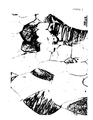
- the Fe-Al-based alloy A2 of Al: 5% by mass has a large number of existing deformed twin crystals ( Fig. 2 ).
- the elastic deformation amount also tends to increase when the area ratio of the twin crystal interface is larger. As shown in the stress-strain diagrammatic view ( Fig. 3 ) of the alloy A2, the elastic deformation amount of 0.55% to the strain application of 1% is shown in being unloaded. Even in the other alloys, the elastic deformation amount of 0.4% or more is obtained.
- the alloy A2 also has a characteristic that a stress-strain diagrammatic view is more linear than that of a hyperelastic material.
- any Fe-based alloy has a high magnetization intensity of 100 emu/g or more.
- Comparative Examples O1 (Fe) and 02 (Fe-Co) have a large magnetization intensity, however, have hardly existing twin crystals.
- Comparative Examples O1 (Fe) and 02 (Fe-Co) have an elastic deformation amount lower than the material of the present invention.
- Comparative Example 03 (SUS316L) exhibits a high area ratio of a twin crystal interface and a high elastic deformation amount. However, the magnetization intensity in 0.5 T is about 0.
- Table 2 Area ratio of twin crystal interface, elastic deformation amount and magnetization intensity of cold-rolled material (cold-rolling rate: 40%) alloy No. area ratio of twin crystal interface elastic deformation amount (%) magnetization intensity (emu/g) alloy No.
- the relationship between producing conditions and property values is shown in Table 3.
- test No.1 cold rolling was not carried out after being solution-treated, and twin crystals did not exist.
- Test No.2 is obtained by applying cold-rolling of 40% to the test No.1, and the elastic deformation amount was also large.
- Test No.3 was rolled at a cold working rate of 80%, and the area ratio of the twin crystal interface and the elastic deformation amount increased with the increase in the working rate. However, the magnetization intensity had no change and magnetic property was well maintained.
- Test Nos. 7 to 12 are aging-treated after being solution-treated and cold-rolled.
- the area ratio of the twin crystal interface is 0.2 or more, and the suitable elastic deformation amount was obtained.
- an aging temperature was high, and the material was annealed to reduce the elastic deformation amount. In any case, the magnetic property was good.
- the above results show that the elastic deformation amount can be adjusted by suitable aging treatment.
- the solution temperature was changed in test Nos. 4 to 6.
- the area ratio of the twin crystal interface, the elastic deformation amount and the magnetization intensity were good.
- the solution temperature was high, and thereby a liquid phase appeared to partially melt the material.
- Table 3 Influence of producing condition on physical properties test No. alloy No. solution-treatme nt cold working rate (%) aging treatment area ratio of twin crystal interface elastic deformation amount (%) magnetization intensity (emu/g) (°C) (minutes) (°C) (times) 1 A2 1000 60 0 no aging treatment 0 0.25 192.3 2 A2 1000 60 40 no aging treatment 0.79 0.55 193.6 3 A2 1000 60 80 no aging treatment 1.24 0.63 194.2 4 S3 1000 60 40 no aging treatment 1.87 0.56 197.2 5 S3 1200 60 40 no aging treatment 2.04 0.54 197.8 6 S3 1500 60 40 partially melted sample 7 C2 1000 60 40 500 2 0.59 0.46 177.1 8 C2 1000 60 40 600 2 0.21 0.43 177.2 9 C2 1000 60 40 900 2 0 0.32 177.5 10 N3 1000 60 40 500 2 1.65 0.66 174.5 11 N3 1000 60 40 600 2 0.46 0.55 174.7 12 N3 1000 60 40 900 2 0 0.37 175.0
- Alloys A3, S2, C3 and N3 of Table 1 respectively have a Fe-Al-based, Fe-Si-based, Fe-Cr-based and Fe-Ni-based fundamental compositions.
- Various Fe-based alloys were prepared by adding a third component of claim 2 or 4. The Fe-based alloys were cast, hot-rolled and cold-rolled to a plate thickness: 0.5 mm in the same manner as in Example 1 after being melted. The Fe-based alloys were cold-rolled and aging-treated after being solution-treated.
- Table 4 (Fe-Al-based), Table 5 (Fe-Si-based), Table 6 (Fe-Cr-based) and Table 7 (Fe-Ni-based) show results obtained by measuring the elastic deformation amount and magnetization intensity of each of the obtained Fe-based alloys.
- each of Fe-based alloys having enhanced magnetism, a corrosion resistance, strength and ductility or the like obtained adding a third element exhibited an area ratio of a twin crystal interface of 0.6 or more.
- the Fe-based alloy had an elastic deformation amount of 0. 4% or more to the strain application of 1%.
- the Fe-based alloys had a high magnetization intensity of 100 emu/g or more to the magnetic field application of 0.5 T.
- the elastic deformation amount could be adjusted by aging-treating after cold-rolling.
- Table 4 Influence of addition of third component on physical properties of Fe-7% by mass Al alloy test No. amount of third component to be added (% by mass) cold-rolled material (working rate: 40%) aging-treated material (500°C times 2 hours) area ratio of twin crystal interface elastic deformation amount (%) magnetization intensity (emu/g) area ratio of twin crystal interface elastic deformation amount (%) magnetization intensity (emu/g) A-1 Ti: 2 0.91 0.66 169.4 0.77 0.58 169.5 A-2 V: 3 0.93 0.67 166.2 0.78 0.59 166.4 A-3 Mn: 1 0.84 0.64 176.1 0.69 0.57 176.1 A-4 Co: 8 1.02 0.68 190.5 0.87 0.61 190.6 A-5 Ni: 2 0.84 0.63 174.5 0.71 0.56 174.8 A-6 Cu: 2 0.85 0.64 175.8 0.73 0.57 175.9 A-7 Zr: 1 0.87 0.65 173.9 0.75 0.58 174.0 A-8 Nb: 1 0.86 0.66 177.2 0.73 0.60 177.3 A-9 Mo: 2
- Table 5 Influence of addition of third component on physical properties of Fe-1.5% by mass Si alloy test No. amount of third component to be added (% by mass) cold-rolled material (working rate: 40%) aging-treated material (500°C times 2 hours) area ratio of twin crystal interface elastic deformation amount (%) magnetization intensity (emu/g) area ratio of twin crystal interface elastic deformation amount (%) magnetization intensity (emu/g) S-1 Ti: 2 1.07 0.50 183.4 0.91 0.43 183.5 S-2 V: 3 1.06 0.51 182.3 0.88 0.45 182.3 S-3 Mn: 1 1.02 0.49 189.7 0.83 0.47 189.7 S-4 Co: 8 1.16 0.56 202.5 0.99 0.48 202.7 S-5 Ni: 2 1.06 0.49 187.6 0.90 0.47 187.6 S-6 Cu: 2 1.04 0.50 187.9 0.86 0.43 188.0 S-7 Zr: 1 1.08 0.50 188.0 0.92 0.42 188.1 S-8 Nb: 1 1.03 0.49 191.2 0.84 0.41
- Table 6 Influence of addition of third component on physical properties of Fe-18% by mass Cr alloy test No. amount of third component to be added (% by mass) cold-rolled material (working rate: 40%) aging-treated material (500°C times 2 hours) area ratio of twin crystal interface elastic deformation amount (%) magnetization intensity (emu/g) area ratio of twin crystal interface elastic deformation amount (%) magnetization intensity (emu/g) C-1 Ti: 2 0.83 0.59 156.2 0.71 0.53 156.5 C-2 V: 3 0.88 0.62 153.8 0.75 0.52 153.9 C-3 Mn: 1 0.80 0.59 160.5 0.69 0.57 160.7 C-4 Co: 8 0.91 0.63 174.3 0.77 0.56 174.6 C-5 Ni: 2 0.79 0.58 156.9 0.68 0.55 157.1 C-6 Cu: 2 0.81 0.59 155.4 0.70 0.52 155.6 C-7 Zr: 1 0.82 0.58 157.4 0.72 0.50 157.5 C-8 Nb: 1 0.85 0.59 162.1 0.74 0.51 162.2 C-9 Mo: 2
- Table 7 Influence of addition of third component on physical properties of Fe-45% by mass Ni alloy test No. amount of third component to be added (% by mass) cold-rolled material (workinq rate: 40%) aging-treated material (500°C times 2 hours) area ratio of twin crystal interface elastic deformation amount (%) magnetization intensity (emu/g) area ratio of twin crystal interface elastic deformation amount (%) magnetization intensity (emu/g) N-1 Ti: 2 2.05 0.65 158.9 1.70 0.67 158.9 N-2 V: 3 2.13 0.67 156.2 1.72 0.68 156.3 N-3 Mn: 1 1.99 0.64 163.6 1.63 0.67 163.7 N-4 Co: 8 2.25 0.68 175.1 1.81 0.70 175.1 N-5 Cu: 2 1.95 0.63 159.9 1.64 0.64 156.2 N-6 Zr: 1 2.01 0.65 165.7 1.74 0.66 166.0 N-7 Nb: 1 2.09 0.66 163.2 1.79 0.68 163.4 N-8 Mo: 2 2.00 0.64 162.8 1.67 0.65 162.9 N
- the area ratio of the twin crystal interface, the elastic deformation amount and the magnetization intensity were determined at each of temperatures of -50°C, 25°C, 100°C and 200°C.
- the elastic deformation amount was made to be a shape strain amount restored by applying a strain amount of 1% in a tensile test at each of the temperatures and unloading the amount.
- the area ratio of the twin crystal interface and the magnetization intensity were determined in the same manner as in Example 1 at each of the temperatures.
- the area ratio of the twin crystal interface and the elastic deformation amount showed large values as before even at 200°C without heavily depending on the change of a test temperature.
- the deformation stress of a shape-memory alloy is greatly changed to the temperature.
- the temperature dependence of the apparent yield stress of a Ti-Ni shape-memory alloy is about 5 MPa/°C.
- the change of stress of the Fe alloy of the present invention to the temperature is small.
- the change of the present invention which is about 0.5 MPa/°C, is about 1/10 of that of the Ti-Ni alloy. Therefore, the Fe alloy of the present invention is also suitable for the use in a wide temperature range from room temperature or less to high temperature. Since the Fe alloy has a sufficiently high Curie temperature, the Fe alloy exhibited a high magnetization intensity even at 200°C.
- Table 8 Influence of test temperature on physical properties test No. test temperature (°C) area ratio of twin crystal interface elastic deformation amount (%) magnetization intensity (emu/g) 1 -50 0.80 0.59 188.3 2 25 0.79 0.58 187.2 3 100 0.76 0.57 185.4 4 200 0.75 0.57 182.9
- the alloys A2 and S3 of Table 1 and an alloy O1 (Fe) as Comparative Example were selected, cast, hot-rolled and cold-rolled to a plate thickness: 0.83 mm. Furthermore, they were solution-treated at 1000°C for 60 minutes, and finally cold-rolled at a depressing rate: 40%.
- a magnetic field gradient was applied to the obtained Fe-based alloy in an electromagnetic coil to apply an initial displacement of 2.8 mm. Then, the elastic deformation amount and restoration rate of the Fe-based alloy when the magnetic field was removed were determined.
- the restoration rate (%) is defined by the formula: (elastic deformation amount/initial displacement) times 100.
- Table 9 Elastic deformation amount produced in accordance with application and removal of magnetic field gradient, and restoration rate alloy No. elastic deformation amount (mm) restoration rate (%) A2 2.8 100 S3 2.8 100 O1 2.4 84
Landscapes
- Chemical & Material Sciences (AREA)
- Engineering & Computer Science (AREA)
- Materials Engineering (AREA)
- Mechanical Engineering (AREA)
- Physics & Mathematics (AREA)
- Metallurgy (AREA)
- Organic Chemistry (AREA)
- Crystallography & Structural Chemistry (AREA)
- Thermal Sciences (AREA)
- Electromagnetism (AREA)
- Dispersion Chemistry (AREA)
- Power Engineering (AREA)
- Manufacturing & Machinery (AREA)
- Soft Magnetic Materials (AREA)
- Hard Magnetic Materials (AREA)
Applications Claiming Priority (2)
| Application Number | Priority Date | Filing Date | Title |
|---|---|---|---|
| JP2006226410 | 2006-08-23 | ||
| PCT/JP2007/066284 WO2008023734A1 (fr) | 2006-08-23 | 2007-08-22 | Alliage à base de fer et son procédé de fabrication |
Publications (2)
| Publication Number | Publication Date |
|---|---|
| EP2055797A1 true EP2055797A1 (fr) | 2009-05-06 |
| EP2055797A4 EP2055797A4 (fr) | 2014-12-17 |
Family
ID=39106819
Family Applications (1)
| Application Number | Title | Priority Date | Filing Date |
|---|---|---|---|
| EP07792874.5A Withdrawn EP2055797A4 (fr) | 2006-08-23 | 2007-08-22 | Alliage à base de fer et son procédé de fabrication |
Country Status (5)
| Country | Link |
|---|---|
| US (1) | US20090178739A1 (fr) |
| EP (1) | EP2055797A4 (fr) |
| JP (1) | JP5215855B2 (fr) |
| KR (1) | KR20090038016A (fr) |
| WO (1) | WO2008023734A1 (fr) |
Cited By (10)
| Publication number | Priority date | Publication date | Assignee | Title |
|---|---|---|---|---|
| CN102505097A (zh) * | 2011-12-15 | 2012-06-20 | 中南大学 | 一种混凝土泵车用耐磨耐蚀衬套材料及其制备方法 |
| CN103310936A (zh) * | 2013-07-05 | 2013-09-18 | 浙江大学 | 一种低损耗Fe基纳米晶磁粉芯及其制备方法 |
| US20140345752A1 (en) * | 2013-05-21 | 2014-11-27 | Daido Steel Co., Ltd. | Precipitation hardened fe-ni alloy |
| US20150368765A1 (en) * | 2014-06-24 | 2015-12-24 | Yanshan University | Nano-Pearlite Rail and Process for Manufacturing Same |
| DE102014010600A1 (de) * | 2014-07-18 | 2016-01-21 | DST Defence Service Tracks GmbH | Legierung zur Herstellung eines dünnwandigen Stahlbauteils |
| WO2018083035A1 (fr) | 2016-11-02 | 2018-05-11 | Salzgitter Flachstahl Gmbh | Produit en acier au manganèse moyen pour utilisation à basse température et son procédé de fabrication |
| CN108292549A (zh) * | 2015-11-06 | 2018-07-17 | Lg伊诺特有限公司 | 软磁合金 |
| WO2018213556A1 (fr) * | 2017-05-17 | 2018-11-22 | Crs Holdings, Inc. | Alliage à base de fe-si et son procédé de fabrication |
| DE102017216461A1 (de) * | 2017-09-18 | 2019-03-21 | Siemens Aktiengesellschaft | Martensitischer Stahl mit Z-Phase, Pulver und Bauteil |
| CN115821155A (zh) * | 2021-10-20 | 2023-03-21 | 广东德纳斯金属制品有限公司 | 一种新型磁控恒温抗菌耐腐蚀合金及其制备方法和应用 |
Families Citing this family (18)
| Publication number | Priority date | Publication date | Assignee | Title |
|---|---|---|---|---|
| CN102459680B (zh) | 2009-05-19 | 2015-04-01 | 加州理工学院 | 韧性的铁基块体金属玻璃合金 |
| AU2011312524B2 (en) * | 2010-09-27 | 2015-10-29 | California Institute Of Technology | Tough iron-based metallic glass alloys |
| US20120107603A1 (en) * | 2010-10-29 | 2012-05-03 | General Electric Company | Article formed using nanostructured ferritic alloy |
| PL2574684T3 (pl) * | 2011-09-29 | 2014-12-31 | Sandvik Intellectual Property | Austenityczna stal nierdzewna z efektem TWIP i NANO-bliźniakowana mechanicznie oraz sposób jej wytwarzania |
| CN103943321B (zh) * | 2013-01-23 | 2017-04-12 | Tdk株式会社 | 磁芯和线圈型电子部件 |
| CN103436819B (zh) * | 2013-07-11 | 2016-08-10 | 张信群 | 一种铆接头用合金冷镦钢材料的制备方法 |
| US9708699B2 (en) | 2013-07-18 | 2017-07-18 | Glassimetal Technology, Inc. | Bulk glass steel with high glass forming ability |
| US9982330B2 (en) | 2013-11-27 | 2018-05-29 | University Of Florida Research Foundation, Inc. | Nickel titanium alloys, methods of manufacture thereof and article comprising the same |
| JP6369749B2 (ja) * | 2014-06-25 | 2018-08-08 | 日立金属株式会社 | 磁心およびそれを用いたコイル部品 |
| RU2650938C1 (ru) * | 2017-11-20 | 2018-04-18 | Юлия Алексеевна Щепочкина | Сплав на основе железа |
| RU2651062C1 (ru) * | 2017-11-27 | 2018-04-18 | Юлия Алексеевна Щепочкина | Сплав на основе железа |
| RU2652919C1 (ru) * | 2017-12-05 | 2018-05-03 | Юлия Алексеевна Щепочкина | Сплав на основе железа |
| RU2653374C1 (ru) * | 2017-12-05 | 2018-05-08 | Юлия Алексеевна Щепочкина | Сплав на основе железа |
| RU2652923C1 (ru) * | 2017-12-05 | 2018-05-03 | Юлия Алексеевна Щепочкина | Сплав на основе железа |
| RU2653375C1 (ru) * | 2017-12-05 | 2018-05-08 | Юлия Алексеевна Щепочкина | Сплав на основе железа |
| RU2660789C1 (ru) * | 2017-12-19 | 2018-07-09 | Юлия Алексеевна Щепочкина | Сплав на основе железа |
| RU2669256C1 (ru) * | 2018-03-30 | 2018-10-09 | Юлия Алексеевна Щепочкина | Сталь |
| US11371108B2 (en) | 2019-02-14 | 2022-06-28 | Glassimetal Technology, Inc. | Tough iron-based glasses with high glass forming ability and high thermal stability |
Family Cites Families (19)
| Publication number | Priority date | Publication date | Assignee | Title |
|---|---|---|---|---|
| GB1558621A (en) * | 1975-07-05 | 1980-01-09 | Zaidan Hojin Denki Jiki Zairyo | High dumping capacity alloy |
| JPS5210820A (en) * | 1975-07-16 | 1977-01-27 | Res Inst Electric Magnetic Alloys | Vibration absorbing alloy and its production process |
| JP2646277B2 (ja) * | 1990-03-27 | 1997-08-27 | 日新製鋼株式会社 | 鉄心部材用Ni―Fe―Cr軟質磁性合金 |
| JP2867639B2 (ja) * | 1990-07-02 | 1999-03-08 | 三井造船株式会社 | 制振合金 |
| JP2867640B2 (ja) * | 1990-07-02 | 1999-03-08 | 三井造船株式会社 | 制振合金 |
| JP2867641B2 (ja) * | 1990-07-02 | 1999-03-08 | 三井造船株式会社 | 制振合金 |
| JP3237138B2 (ja) * | 1991-08-13 | 2001-12-10 | カヤバ工業株式会社 | 磁気目盛り鋼棒 |
| JP3868019B2 (ja) * | 1995-12-07 | 2007-01-17 | 日立金属株式会社 | 複合磁性部材およびその製造方法 |
| DE69729219T2 (de) | 1996-08-19 | 2005-05-25 | Massachusetts Institute Of Technology, Cambridge | Materialien mit hoher mechanischer spannung für magnetfeld-kontrolierten aktor |
| JP4055872B2 (ja) * | 1998-03-25 | 2008-03-05 | 泰文 古屋 | 鉄基磁性形状記憶合金およびその製造方法 |
| US6245441B1 (en) * | 1998-06-22 | 2001-06-12 | Hitachi Metals, Ltd. | Composite magnetic member excellent in corrosion resistance and method of producing the same |
| JP2002332531A (ja) | 1999-06-11 | 2002-11-22 | Toyota Central Res & Dev Lab Inc | チタン合金およびその製造方法 |
| JP3907359B2 (ja) * | 1999-11-08 | 2007-04-18 | 日本パーカライジング株式会社 | エンジンバルブ用素線 |
| JP4304897B2 (ja) | 2000-12-20 | 2009-07-29 | 株式会社豊田中央研究所 | 高弾性変形能を有するチタン合金およびその製造方法 |
| JP3964360B2 (ja) * | 2002-07-16 | 2007-08-22 | 清仁 石田 | 磁場応答アクチュエーターあるいは磁性利用センサーに用いる強磁性形状記憶合金 |
| US6803846B2 (en) * | 2002-10-23 | 2004-10-12 | Honda Motor Co., Ltd. | Actuator |
| JP2004162703A (ja) * | 2002-10-23 | 2004-06-10 | Honda Motor Co Ltd | アクチュエータ |
| JP4059156B2 (ja) * | 2003-06-27 | 2008-03-12 | 住友金属工業株式会社 | 原子力用ステンレス鋼 |
| JPWO2007066555A1 (ja) * | 2005-12-05 | 2009-05-14 | 独立行政法人科学技術振興機構 | Co基合金及びその製造方法 |
-
2007
- 2007-08-22 KR KR1020097003467A patent/KR20090038016A/ko not_active Ceased
- 2007-08-22 WO PCT/JP2007/066284 patent/WO2008023734A1/fr not_active Ceased
- 2007-08-22 JP JP2008530943A patent/JP5215855B2/ja not_active Expired - Fee Related
- 2007-08-22 EP EP07792874.5A patent/EP2055797A4/fr not_active Withdrawn
-
2009
- 2009-02-20 US US12/389,971 patent/US20090178739A1/en not_active Abandoned
Cited By (17)
| Publication number | Priority date | Publication date | Assignee | Title |
|---|---|---|---|---|
| CN102505097A (zh) * | 2011-12-15 | 2012-06-20 | 中南大学 | 一种混凝土泵车用耐磨耐蚀衬套材料及其制备方法 |
| CN102505097B (zh) * | 2011-12-15 | 2013-12-04 | 中南大学 | 一种混凝土泵车用耐磨耐蚀衬套材料 |
| US20140345752A1 (en) * | 2013-05-21 | 2014-11-27 | Daido Steel Co., Ltd. | Precipitation hardened fe-ni alloy |
| CN103310936A (zh) * | 2013-07-05 | 2013-09-18 | 浙江大学 | 一种低损耗Fe基纳米晶磁粉芯及其制备方法 |
| CN103310936B (zh) * | 2013-07-05 | 2016-01-13 | 浙江大学 | 一种低损耗Fe基纳米晶磁粉芯及其制备方法 |
| US20150368765A1 (en) * | 2014-06-24 | 2015-12-24 | Yanshan University | Nano-Pearlite Rail and Process for Manufacturing Same |
| US10113219B2 (en) * | 2014-06-24 | 2018-10-30 | Yanshan University | Nano-pearlite rail and process for manufacturing same |
| DE102014010600A1 (de) * | 2014-07-18 | 2016-01-21 | DST Defence Service Tracks GmbH | Legierung zur Herstellung eines dünnwandigen Stahlbauteils |
| CN108292549A (zh) * | 2015-11-06 | 2018-07-17 | Lg伊诺特有限公司 | 软磁合金 |
| CN108292549B (zh) * | 2015-11-06 | 2021-02-23 | Lg伊诺特有限公司 | 软磁合金 |
| WO2018083035A1 (fr) | 2016-11-02 | 2018-05-11 | Salzgitter Flachstahl Gmbh | Produit en acier au manganèse moyen pour utilisation à basse température et son procédé de fabrication |
| US11352679B2 (en) | 2016-11-02 | 2022-06-07 | Salzgitter Flachstahl Gmbh | Medium-manganese steel product for low-temperature use and method for the production thereof |
| WO2018213556A1 (fr) * | 2017-05-17 | 2018-11-22 | Crs Holdings, Inc. | Alliage à base de fe-si et son procédé de fabrication |
| CN110720130A (zh) * | 2017-05-17 | 2020-01-21 | Crs 控股公司 | Fe-Si基合金及其制造方法 |
| DE102017216461A1 (de) * | 2017-09-18 | 2019-03-21 | Siemens Aktiengesellschaft | Martensitischer Stahl mit Z-Phase, Pulver und Bauteil |
| US11492686B2 (en) | 2017-09-18 | 2022-11-08 | Siemens Energy Global GmbH & Co. KG | Martensitic steel having a Z-phase, powder and component |
| CN115821155A (zh) * | 2021-10-20 | 2023-03-21 | 广东德纳斯金属制品有限公司 | 一种新型磁控恒温抗菌耐腐蚀合金及其制备方法和应用 |
Also Published As
| Publication number | Publication date |
|---|---|
| US20090178739A1 (en) | 2009-07-16 |
| WO2008023734A1 (fr) | 2008-02-28 |
| JP5215855B2 (ja) | 2013-06-19 |
| KR20090038016A (ko) | 2009-04-17 |
| JPWO2008023734A1 (ja) | 2010-01-14 |
| EP2055797A4 (fr) | 2014-12-17 |
Similar Documents
| Publication | Publication Date | Title |
|---|---|---|
| EP2055797A1 (fr) | Alliage à base de fer et son procédé de fabrication | |
| KR101004051B1 (ko) | 형상 기억성 및 초탄성을 가지는 철계 합금 및 그 제조방법 | |
| EP2995694A1 (fr) | MATÉRIAU DE BARRE ET MATÉRIAU DE PLAQUE À BASE DE Cu-Al-Mn PRÉSENTANT UNE SUPERÉLASTICITÉ STABLE, PROCÉDÉ DE FABRICATION DESDITS MATÉRIAU DE BARRE ET MATÉRIAU DE PLAQUE, ÉLÉMENT DE CONTRÔLE SISMIQUE DANS LEQUEL LESDITS MATÉRIAU DE BARRE ET MATÉRIAU DE PLAQUE SONT UTILISÉS, ET STRUCTURE DE CONTRÔLE SISMIQUE DANS LAQUELLE LEDIT ÉLÉMENT DE CONTRÔLE SISMIQUE EST UTILISÉ | |
| EP2896705B1 (fr) | Alliage à base de cu-al-mn présentant une superélasticité stable, et son processus de fabrication | |
| US10400311B2 (en) | Wrought material comprising Cu—Al—Mn-based alloy excellent in stress corrosion resistance and use thereof | |
| US8529710B2 (en) | High-strength co-based alloy with enhanced workability and process for producing the same | |
| CN112639144B (zh) | 铜系合金材料及其制造方法以及由铜系合金材料构成的构件或部件 | |
| US20080289730A1 (en) | Material having a high elastic deformation and process for producing the same | |
| EP3865600A1 (fr) | Acier inoxydable austénitique non magnétique à haute résistance et son procédé de fabrication | |
| EP3511435B1 (fr) | Matériau d'alliage à mémoire de forme à base de fe et son procédé de production | |
| JP2010156041A (ja) | 双方向形状回復合金 | |
| JP5156943B2 (ja) | 塑性加工性に優れる生体用Co基合金の製造方法 | |
| US20040168751A1 (en) | Beta titanium compositions and methods of manufacture thereof | |
| JP2003268501A (ja) | Fe基形状記憶合金及びその製造方法 | |
| JP4654440B2 (ja) | 低加工硬化型鉄合金 | |
| EP2993243B1 (fr) | Alliage à base de ni à haute résistance | |
| Otsuka et al. | Superelastic behavior of Fe–Mn–Si–Cr shape memory alloy coil | |
| JPH1180906A (ja) | 降伏応力を高めた高強度ステンレス鋼帯およびその製造方法 | |
| RU2625376C1 (ru) | Способ термомеханической обработки прутков из двухфазных титановых сплавов для получения низких значений термического коэффициента линейного расширения в направлении оси прутка | |
| EP2634277A1 (fr) | Alliage à base de co pour corps vivant et endoprothèse | |
| JP2007302972A (ja) | 時効硬化特性に優れた高強度非磁性ステンレス鋼板及びその製造方法 |
Legal Events
| Date | Code | Title | Description |
|---|---|---|---|
| PUAI | Public reference made under article 153(3) epc to a published international application that has entered the european phase |
Free format text: ORIGINAL CODE: 0009012 |
|
| 17P | Request for examination filed |
Effective date: 20090311 |
|
| AK | Designated contracting states |
Kind code of ref document: A1 Designated state(s): AT BE BG CH CY CZ DE DK EE ES FI FR GB GR HU IE IS IT LI LT LU LV MC MT NL PL PT RO SE SI SK TR |
|
| AX | Request for extension of the european patent |
Extension state: AL BA HR MK RS |
|
| RIN1 | Information on inventor provided before grant (corrected) |
Inventor name: ANDO, KEISUKE Inventor name: OHMORI, TOSHIHIRO Inventor name: SUTOU, YUJI Inventor name: OIKAWA, KATSUNARI Inventor name: KAINUMA, RYOSUKE Inventor name: ISHIDA, KIYOHITO |
|
| DAX | Request for extension of the european patent (deleted) | ||
| A4 | Supplementary search report drawn up and despatched |
Effective date: 20141113 |
|
| RIC1 | Information provided on ipc code assigned before grant |
Ipc: C22C 38/00 20060101AFI20141107BHEP Ipc: H01F 1/147 20060101ALI20141107BHEP Ipc: C22C 19/03 20060101ALI20141107BHEP Ipc: C21D 8/12 20060101ALI20141107BHEP |
|
| STAA | Information on the status of an ep patent application or granted ep patent |
Free format text: STATUS: THE APPLICATION IS DEEMED TO BE WITHDRAWN |
|
| 18D | Application deemed to be withdrawn |
Effective date: 20150613 |
|
| R18D | Application deemed to be withdrawn (corrected) |
Effective date: 20150613 |