EP2056128A2 - Vorrichtung, System und Verfahren zum Empfangen einer vertikalen Komponente eines Signals zur Bestimmung eines Widerstands eines Bereichs unter einer geologischen Oberfläche zur Kohlenwasserstoff-Erkundung - Google Patents
Vorrichtung, System und Verfahren zum Empfangen einer vertikalen Komponente eines Signals zur Bestimmung eines Widerstands eines Bereichs unter einer geologischen Oberfläche zur Kohlenwasserstoff-Erkundung Download PDFInfo
- Publication number
- EP2056128A2 EP2056128A2 EP08168157A EP08168157A EP2056128A2 EP 2056128 A2 EP2056128 A2 EP 2056128A2 EP 08168157 A EP08168157 A EP 08168157A EP 08168157 A EP08168157 A EP 08168157A EP 2056128 A2 EP2056128 A2 EP 2056128A2
- Authority
- EP
- European Patent Office
- Prior art keywords
- conductor
- sea floor
- operative
- receiver
- conductor structure
- Prior art date
- Legal status (The legal status is an assumption and is not a legal conclusion. Google has not performed a legal analysis and makes no representation as to the accuracy of the status listed.)
- Withdrawn
Links
- 238000000034 method Methods 0.000 title abstract description 10
- 229930195733 hydrocarbon Natural products 0.000 title description 11
- 150000002430 hydrocarbons Chemical class 0.000 title description 11
- 239000004215 Carbon black (E152) Substances 0.000 title description 10
- 239000004020 conductor Substances 0.000 claims abstract description 115
- 239000000463 material Substances 0.000 claims description 18
- 239000013535 sea water Substances 0.000 claims description 14
- OKTJSMMVPCPJKN-UHFFFAOYSA-N Carbon Chemical compound [C] OKTJSMMVPCPJKN-UHFFFAOYSA-N 0.000 claims description 3
- 229910052799 carbon Inorganic materials 0.000 claims description 3
- 230000005684 electric field Effects 0.000 claims 1
- 230000003213 activating effect Effects 0.000 abstract description 2
- 230000004044 response Effects 0.000 description 20
- 230000007246 mechanism Effects 0.000 description 17
- 238000000151 deposition Methods 0.000 description 8
- 230000010287 polarization Effects 0.000 description 6
- 230000005540 biological transmission Effects 0.000 description 5
- 238000005553 drilling Methods 0.000 description 5
- 230000033001 locomotion Effects 0.000 description 3
- 239000002184 metal Substances 0.000 description 3
- 150000003839 salts Chemical class 0.000 description 3
- XLYOFNOQVPJJNP-UHFFFAOYSA-N water Substances O XLYOFNOQVPJJNP-UHFFFAOYSA-N 0.000 description 3
- 230000000694 effects Effects 0.000 description 2
- 229910052500 inorganic mineral Inorganic materials 0.000 description 2
- 239000011707 mineral Substances 0.000 description 2
- 239000012811 non-conductive material Substances 0.000 description 2
- 230000035945 sensitivity Effects 0.000 description 2
- 230000007704 transition Effects 0.000 description 2
- 230000001960 triggered effect Effects 0.000 description 2
- 230000002745 absorbent Effects 0.000 description 1
- 239000002250 absorbent Substances 0.000 description 1
- 230000002457 bidirectional effect Effects 0.000 description 1
- 238000004891 communication Methods 0.000 description 1
- 230000008878 coupling Effects 0.000 description 1
- 238000010168 coupling process Methods 0.000 description 1
- 238000005859 coupling reaction Methods 0.000 description 1
- 230000007340 echolocation Effects 0.000 description 1
- 230000007613 environmental effect Effects 0.000 description 1
- 230000003287 optical effect Effects 0.000 description 1
- 239000011236 particulate material Substances 0.000 description 1
- 230000035515 penetration Effects 0.000 description 1
- 230000000644 propagated effect Effects 0.000 description 1
- 238000011084 recovery Methods 0.000 description 1
- 239000004576 sand Substances 0.000 description 1
- 230000007480 spreading Effects 0.000 description 1
Images


Classifications
-
- G—PHYSICS
- G01—MEASURING; TESTING
- G01V—GEOPHYSICS; GRAVITATIONAL MEASUREMENTS; DETECTING MASSES OR OBJECTS; TAGS
- G01V3/00—Electric or magnetic prospecting or detecting; Measuring magnetic field characteristics of the earth, e.g. declination, deviation
- G01V3/12—Electric or magnetic prospecting or detecting; Measuring magnetic field characteristics of the earth, e.g. declination, deviation operating with electromagnetic waves
-
- G—PHYSICS
- G01—MEASURING; TESTING
- G01V—GEOPHYSICS; GRAVITATIONAL MEASUREMENTS; DETECTING MASSES OR OBJECTS; TAGS
- G01V3/00—Electric or magnetic prospecting or detecting; Measuring magnetic field characteristics of the earth, e.g. declination, deviation
- G01V3/08—Electric or magnetic prospecting or detecting; Measuring magnetic field characteristics of the earth, e.g. declination, deviation operating with magnetic or electric fields produced or modified by objects or geological structures or by detecting devices
- G01V3/083—Controlled source electromagnetic [CSEM] surveying
Definitions
- the present disclosure relates to an apparatus, system and method for receiving an electromagnetic signal, for determining the resistivity of a region below a geologic surface and for delineating a hydrocarbon reservoir.
- Controlled-source offshore electromagnetic surveying has typically involved transmitting electromagnetic signals from an underwater antenna of a vessel, causing electromagnetic propagation through air, seawater, and subterranean strata below the sea floor.
- a remote receiver having antenna spreading out across the sea floor has traditionally been used to receive the electromagnetic signals.
- vertical antennas have also been used, but movement of the seawater and other factors have limited the usefulness of such antennas.
- a data logger has been used to store data relevant to electromagnetic signals received from the electromagnetic propagation.
- a system that includes some of the teachings of the present invention may be used to determine the resistivity of a region below a geologic surface by transmitting a signal from a marine location above the sea floor.
- a receiver having a vertical dipole and/or a vertical coil, including a first conductor disposed below the sea floor and a second conductor disposed above the first conductor, may receive the signal at the sea floor.
- a method that includes some of the teachings of the present invention may be used to dispose a remote reader at a location on a sea floor.
- the method may include releasing the remote reader overboard from a surface vessel, activating a drive head on the remote reader, creating a hole in the sea floor, and disposing a first conductor structure within the hole.
- Figure 1 depicts an operational environment in which a receiver is operative to receive a signal at a sea floor, in accordance with an embodiment implementing some of the teachings of the present invention
- Figure 2 depicts a remote receiver, in accordance with the embodiment of Figure 1 ;
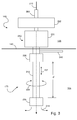
- Figure 3 depicts a remote receiver depositing system that includes a drive head for depositing the remote receiver below the sea floor, in accordance with the embodiment of Figure 1 and Figure 2 ;
- Figure 4 depicts a system for determining a resistivity of a region below a geologic surface, in accordance with an embodiment implementing some of the teachings of the present invention
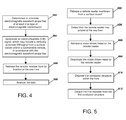
- Figure 5 depicts a flowchart of a method that may be used to determine a resistivity of a region below a geologic surface, in accordance with an embodiment implementing some of the teachings of the present invention.
- Figure 6 depicts a flowchart of a method that may be used to dispose a remote reader at a location on a sea floor, in accordance with an embodiment implementing some of the teachings of the present invention.
- a receiver is operative to receive a signal at a sea floor.
- a system is operative to determine a resistivity of a region below a geologic surface.
- FIG. 1 depicts an operational environment in which a receiver is operative to receive a signal at a sea floor, in accordance with an embodiment implementing some of the teachings of the present invention.
- a surface vessel 100 may float on the surface 120 of the sea 125, and may tow and may provide electrical power to a submersible vehicle 130 by means of an on-board power supply 150 and an umbilical cable 135. It will be appreciated, of course, that surface vessel 100 may be replaced or supplemented with a submarine, remote operated vehicle, or other vehicle.
- the umbilical cable 135 may maintain submersible vehicle 130 consistently close to the sea floor 140, may provide an electrical, optical, and/or mechanical connection between submersible vehicle 130 and surface vessel 100, and may allow an echo-location package 145 to provide information about the height of submersible vehicle 130 above the sea floor 140 to the surface vessel 100.
- the subterranean strata may include an overburden layer 105, an underburden layer 110, and a zone 115 containing hydrocarbon minerals in a hydrocarbon reservoir.
- a signal generator 155 may generate a selected waveform for a direct (DC) or for an alternating current (AC) drive current.
- the drive current may be supplied to a horizontal electric dipole (HED) transmitter 160 and/or to a vertical electric dipole (VED) transmitter (not shown), both of which may be towed by submersible vehicle 130.
- HED horizontal electric dipole
- VED vertical electric dipole
- any waveform generator capable of generating a suitable output signal may be employed.
- the waveform generator may be aboard surface vessel 100, in other examples the waveform generator may be on the submersible vehicle 130. In such cases, the waveform generator may be supplied with electrical power from on-board power supply 150 via umbilical cable 135. The supply of the drive current to the transmitter(s) may cause the transmitter(s) to broadcast an HED electromagnetic (EM) signal and a VED EM signal, respectively, into the sea.
- EM HED electromagnetic
- an AC drive current may be replaced with a DC drive current, or may be omitted altogether. If the AC drive current is omitted, the VED EM signal may be generated by magneto-telluric fields.
- At least one remote receiver 165 may be located on the sea floor 140.
- Each remote receiver may comprise an instrument package 170, an antenna 175, a floatation device 180, and a ballast weight 185.
- the antenna 175 may comprise a vertical electric dipole (VED) detector disposed at least partially below the sea floor 140 and, optionally, two mutually orthogonal horizontal electric dipole (HED) detectors disposed on and/or just under the sea floor 140.
- VED vertical electric dipole
- HED horizontal electric dipole
- a coil may also or alternatively be used.
- An orientation device such as (for example, but not limited to) a standard marine compass or a gyroscopically-stabilized reference direction device may be included in instrument package 170 to record the verticality of the HED and the orientation of the HED detectors, if any are present.
- a remote receiver 165 in accordance with the embodiment of Figure 1 comprises an antenna 175, which includes the VED detector disposed at least partially below the sea floor 140.
- Antenna 175 preferably comprises a first conductor structure 235 and a second conductor structure 236, which may collectively create a vertical dipole. As mentioned previously, the vertical dipole may be replaced or supplemented by a vertical coil. Accordingly, antenna 175 may be sensitive to vertical electric components of the EM fields induced by HED transmitter 160 in the vicinity of remote receiver 165.
- Antenna 175 comprising the VED detector may produce detector signals forming VED response data.
- Instrument package 170 may record the VED response data for later analysis.
- a remotely operable release system may allow instrument package 170 to be detached from ballast weight 185 so that floatation device 180 can carry instrument package 170 to the surface 120 of the sea 125 for recovery and retrieval of the VED response data for analysis.
- Instrument package 170 may be retrieved by winch or similar mechanism drawing on a retrieval line that is attached to a buoy.
- Remote receiver 165 may receive the VED EM signal (mentioned with respect to Figure 1 ) at the sea floor 140.
- Remote receiver 165 may include a first conductor 235, operative to be disposed below the sea floor 140, and a second conductor 236, operative to be disposed above the first conductor structure 235.
- the second conductor structure 236 may be implemented below the sea floor 140, or may be implemented above the sea floor 140.
- Each of first conductor structure 235 and second conductor structure 236 may comprise, for example, a metal electrode or a carbon plate or other a nonpolarizable conductive material, or may comprise a chamber operative to receive seawater to connect to a conducting receiving contact.
- first conductor structure 235 and second conductor structure 236 may be implemented using a naturally occurring or human-made conductive material.
- a naturally occurring deposit of conductive material such as a metal
- the naturally occurring deposit of conductive material may be used as the conductor structure 235.
- a human-made conductive material such as a seismic sensor, buoy anchor, or other structure were known to have been buried at a particular location, such human-made conductive material may be used as at least one of first conductor structure 235 and second conductor structure 236.
- remote receiver 165 may include any number of conductor structures.
- a third conductor structure (not shown) may also be added to remote receiver 165 such that remote receiver 165 includes more than one conductor structure below the sea floor 140.
- a first dipole i.e., the first conductor structure 235 and the second conductor structure 236
- a second dipole i.e., first conductor structure 235 and a third conductor structure, which is not shown
- a third dipole i.e., second conductor structure 236 and the third conductor structure
- a response from each dipole to the VED EM signal can provide information relevant to electric properties at multiple depths below the sea floor 140.
- each dipole e.g., the vertical dipole
- a coil e.g., a vertical coil
- first conductor structure 235 and second conductor structure 236 may be combined into a single conductive structure having a low conductivity.
- the VED EM fields may induce an electric signal in the single conductive structure having a low conductivity.
- a first support member 210 may be included, onto which first conductor structure 235 and second conductor structure 236 may be mounted or coupled, although first member 210 may be omitted.
- the first member may be implemented, for example, as a rod, and may be nonconductive and/or may include nonconductive material or any material having a low conductivity.
- First member 210 may therefore help establish a vertical distance between first conductor structure 235 and second conductor structure 236. If desired, the vertical distance between first conductor structure 235 and second conductor structure 236 may be in a range of from about 50 cm to about 100 m, although other distances may be used.
- first member 210 is nonconductive or if first member 210 has a sufficiently low conductivity, then first member 210 can establish a vertical electric dipole (VED) that is sensitive to the vertical VED EM.
- VED vertical electric dipole
- a vertical coil may be used.
- Receiver 165 may optionally comprise a data logger 250 housed in a substantially waterproof housing 255.
- Data logger 250 may be used to record a predetermined amount of data.
- data logger 250 can detach itself from the other components of remote receiver 165 in response to a transmitted command from surface vessel 100 and/or submersible vehicle 130, in response to reaching capacity, and/or in response to an elapsed time.
- the data logger 250 may be implemented to detach itself from the other components of remote receiver 165 in response to a transmitted command from surface vessel 100 only if at least 75% full of data, and may further be implemented to ignore the transmitted command from surface vessel 100 if less than 75% full of data; data logger 250 can wait for a subsequent pass of surface vessel 100 if not at least 75% full.
- data logger 250 may be constructed of, or attached to, a buoyant material or object that can cause the data logger 250 to float when detached.
- the buoyant material may be a floatation device (e.g., floatation device 180 ), or may include a deflated balloon coupled to be inflated by a canister of compressed air.
- Data logger 250 may also comprise a radio transponder that (before reaching the surface and/or after reaching the surface) can transmit a radio signal to surface vessel 100 facilitating retrieval of data logger 250.
- remote receiver 165 may also or alternatively comprise a data telemetry element 260 and a telemetry antenna 270 for communication between surface vessel 100 and remote receiver 165 while data logger 250 remains submerged. Accordingly, remote receiver 165 need not be retrieved from the sea floor 140 to provide data to the surface vehicle 100. Remote receiver 165 may transmit data electromagnetically, optically, and/or acoustically to surface vessel 100.
- the vertical dipole antenna may be firmly anchored in the sea floor.
- a greater fraction of electromagnetic energy received at the remote receiver may have passed through the subterranean strata when a greater portion of the dipole antenna is deep below the sea floor than when the entire remote receiver is seated on the sea floor.
- the vertical dipole antenna may be replaced with, or supplemented with, a vertical coil.
- remote receiver 165 may be disposed below the sea floor 140 by drilling a hole in the sea floor 140 and depositing first conductor structure 235 within the hole, although in some marine environments drilling the hole may be prohibitively expensive or difficult. If desired, a remote receiver depositing system, such as described with respect to Figure 3 , may be used to obviate any need to drill.
- Figure 3 schematically depicts a remote receiver depositing system that includes a drive head 202 for depositing remote receiver 165 below the sea floor 140, in accordance with the embodiments of Figure 1 and Figure 2 .
- Head 202 may be used to apply a vertical pressure to the first member 210 onto which the first conductor structure 235 may be mounted.
- the remote receiver depositing system may be implemented in environments other than below a sea surface.
- the remote receiver depositing system may be implemented on land, e.g. at a desert or seashore.
- Head 202 may be, for example, a vibration head operative to apply a vibration to first member 21, as indicated by arrow 207. If the sea floor 140 is covered with loose gravel, sand, or other particulate material, the vibration may be sufficient to drive first member 210 vertically into sea floor 140. If first conductor structure 235 is mounted on first member 210, driving the first member 210 vertically into the sea floor 140 can dispose first conductor structure 235 below the sea floor 140.
- the drive head 202 may alternatively be a torsion head operative to apply a torsional (i.e., twisting) force to the vibration to first member 210.
- the drive head 202 may be implemented to twist first member 210 to drive first member 210 into the sea floor 140.
- the drive head 202 may operate in only one direction, or may alternate directions, as indicated by arrow 207.
- drive head 202 may be implemented as a propeller rotationally mounted on a propeller casing; oriented in a vertical direction, the propeller can impel the propeller casing (and therefore first member 210 ) into the sea floor 140.
- the drive head 202 may alternatively and/or additionally be a pump operative to impel seawater, gravel or other material taken from the sea floor 140, or other material that may be available into the sea floor 140.
- first member 210 is implemented as a hollow rod maintained in a vertical orientation with the drive head 202 mounted at the upper end, then the drive head 202 may be used to impel seawater, for example, through first member 210 to drive material of the sea floor 140 from beneath the lower end of first member 210 such that material of the sea floor 140 is flushed from beneath remote receiver 165, as indicated by arrows 211.
- Head 202 may be mounted permanently to first member 210, or may be detachable. If drive head 202 is detachable, then drive head 202 may be triggered to detach from the drive head 202 in response to the first conductor structure 235 reaching a desired depth.
- the drive head 202 may be coupled to a buoyant floatation device (e.g. the buoyant floatation device to which data logger 250 may be attached, which may be the floatation device 180 ).
- the buoyant floatation device may cause the drive head 202 to float to the surface in response to being detached from first member 210.
- the drive head 202 may be retrieved by a boat.
- the drive head 202 may then be used with respect to another remote receiver. Accordingly, one drive head 202 may suffice to implement several remote receivers.
- the drive head 202 may be mounted on the first member 210. If the first member 210 is implemented such that the first member 210 can become detached from first conductor structure 235 in response to first conductor structure 235 achieving a predetermined desired depth, then first member 210 and drive head 202 may be implemented to float to the surface together.
- first member 210 may be removable separately from first conductor structure 235 while not being detachable from second conductor structure 236. If desired, after disposing first conductor structure 235 at a depth approximately equal to the length of first member 210 below the sea floor 140, first member 210 may become detached from first conductor structure 235; first member 210 may be implemented then to slide upward, e.g. either buoyantly or as pulled by drive head 202, and (if anchored properly) first member 210 may then maintain the second conductor structure 236 at a height equal to the length of first member 210 above the sea floor 140.
- first member 210 and drive head 202 may collectively be used merely to drive the first conductor structure 235 below the sea floor 140, and may then collectively become detached from remote receiver 165 and may float to the surface, allowing a second member (not shown) to extend upward from first conductor structure 235.
- the second member may be a telescoping rod fabricated of a nonconductive or slightly-conductive material having an upper end onto which second conductor structure 236 is coupled. Second member may, for example, be drawn by first member 210 as first member 210 floats upward.
- first member 210 may be detached from first conductor structure 235; first member 210 may be caused then to slide upward, e.g. either buoyantly or as pulled by drive head 202, and (if anchored properly) first member 210 may then maintain second conductor structure 236 at a height equal to the length of the first member 210 above the sea floor 140.
- head 202 may be replaced by a spring-release mechanism.
- a high-tension spring capable of applying enough force to drive first member 210 into the sea floor 140 may be included.
- the high-tension spring may be stretched or compressed with a large force, and then restrained by a restraint mechanism, before remote receiver 165 is lowered from the surface; the restraint mechanism may be include a release mechanism that can be actuated, e.g. by contact with the sea floor 140. When remote receiver 165 reaches and comes into physical contact with the sea floor 140, release of the high-tension spring may drive first member 210 into the sea floor 140.
- Adjunct member 240 may extend horizontally from remote receiver 165, and may be responsive to the HED EM signal. With a full set of antennas oriented to detect horizontal as well as vertical components of the electromagnetic signal, remote receiver 165 may be able to address individual dipoles among the remote antennas. Other combinations or polarizations may also be implemented. If remote antennas are implemented at small distances from one another, more complex polarizations, including diagonal polarizations, may be achieved.
- Adjunct member 240 may be hingeably coupled to first member 210; that is, adjunct member 240 may unfold, slide, or extend from remote receiver 165. Adjunct member 240 may be timed to unfold, slide, or extend at a predetermined time after remote receiver 165 may be expected to come to rest on the sea floor 140, or may be implemented to unfold, slide, or extend mechanically in response to a movement of first member 210 disposing first conductor below the sea floor. Adjunct member 240 may then extend horizontally.
- adjunct member 240 may be pivoted into position by head 202 via a gear system.
- first member 210 may include a serration or gear teeth along its length, and a gear may be positioned such that as the first member 210 slides downward along a shaft, the gear is made to rotate approximately 90°.
- the gear may be coupled to adjunct member 240, which may be mechanically rotated into position.
- the gear system may be replaced with a pulley system, wherein first member 210 may draw a pulley line downward as first member 210 is driven into the sea floor 140. The pulley line may pass over a pulley, and may draw adjunct member 240 into position.
- adjunct member 240 may be pivoted into position by a spring-release mechanism, similar or identical to the spring-release mechanism described above.
- Adjunct member 240 may be spring-loaded when released from surface vessel 100, and may extend into position when released.
- a high-tension spring capable of applying enough force to rotate the adjunct member 240 into position, may be included.
- the high-tension spring may be stretched or compressed with a large force, and then restrained by a restraint mechanism, before remote receiver 165 is lowered from the surface.
- the restraint mechanism may include a release mechanism that can be actuated by physical contact with the sea floor 140. When remote receiver 165 comes into physical contact with the sea floor 140, the high-tension spring may rotate adjunct member 240 into position in response to a trigger of the release mechanism.
- Adjunct member 240 may alternatively be moved into position by a weight located at or near a distal end of the adjunct member 240. After remote receiver 165 has come to rest on the sea floor 140, the adjunct member 240 may fall into position due to the weight. If desired, the weight may be replaced by an absorbent material, such as a sponge, that may become a weight when submerged in the seawater.
- an absorbent material such as a sponge
- second conductor structure 236 need not be located below the see flow and may be located above data logger 250.
- FIG. 4 depicts a flowchart of a method that may be used to determine a resistivity of a region below a geologic surface, in accordance with an embodiment implementing some of the teachings of the present invention.
- Electromagnetic waveform properties of at least one type of electromagnetic transmission may be determined or calculated 502.
- the electromagnetic transmission may be of a type that can be detected and measured by a remote receiver when transmitted from a surface vessel or submersible vehicle, and may include one or more component of any orientation.
- the electromagnetic transmission may include a vertically polarized electromagnetic polarization component.
- Some electromagnetic waveform properties may be based upon environmental factors; geometric factors such as sea depth and/or geographical location of the surface vessel, the submersible vehicle, and/or the remote receiver; underwater terrain features; acoustic and electromagnetic sensitivities of (and possible interference caused by) nearby activities and equipment, including human activity such as drilling or surveying equipment; and electromagnetic properties of the air, the water (including thermal layers within the water), and the subterranean strata (which may include an overburden layer, an underburden layer, and/or a zone containing hydrocarbon minerals in a hydrocarbon reservoir, among other possible layers).
- An electromagnetic (EM) signal which may include a vertical component, may then be generated 504 from a surface vessel and/or a submersible vehicle, in accordance with the electromagnetic waveform properties.
- EM electromagnetic
- a vertical EM signal or component may be generated from a submersible vehicle, while a horizontal EM signal or component may be generated from a surface vehicle, or both a vertical and a horizontal EM signal or component may be generated from a surface vehicle. Any other combination of components or polarizations may also or alternatively be used.
- the EM signal may then be detected at the remote receiver, which can store data accordingly. If more than one remote receiver is located with range of the transmission, the EM signal may then be detected and data stored at each of the remote receivers. Each remote receiver may be tuned or oriented to a different EM signal, which may be generated simultaneously or in sequence.
- each remote receiver may be responsive to a different wavelength or penetration depth of the EM signal. All such wavelengths may be transmitted simultaneously, from a single source or from different surface vessels and/or submersible vehicles located in different locations and directions if desired, and yet each remote receiver can distinguish and respond to only the wavelengths and polarizations for which it is designed.
- the remote receiver may be retrieved 506 from its location at the sea floor, and the data may then be analyzed 508. Alternatively, time and frequency components of the stored data, for example, may be examined, and electromagnetic properties of each channel through which the EM signal has propagated to the remote receiver may be separately recovered. From the electromagnetic properties signal, a resistivity of a region below a geologic surface may be determined by means of inversion 510. From the resistivity of the region of the sea floor, a determination may then be made as to the likelihood or chance that a hydrocarbon reserve may be found in the region of the sea floor. If desired, the remote receiver may transmit the data from its location at or near the sea floor, obviating any need to retrieve the receiver; in other words, remote reading may be used, such that the receiver is read remotely without having to be retrieved.
- different signal components may have different propagation properties as well as different sensitivities to subsurface properties. Determining the signal components may be useful in determining the resistivity of a region below a geological surface for hydrocarbon exploration.
- the subterranean resistivity e.g., the resistivity of a region below a geologic surface.
- the region below the geologic surface includes hydrocarbons having a high resistivity
- determining the subterranean resistivity may directly help in hydrocarbon exploration.
- the region below the geologic surface includes salts and/or basalts having a low resistivity
- determining the subterranean resistivity may help in locating the salts and/or basalts, which are often obstacles to drilling operations. Attempting to drill through salts and/or basalts can be difficult, and can damage drilling equipment. Therefore, determining the subterranean resistivity can indirectly help in hydrocarbon exploration.
- FIG. 5 depicts a flowchart of a method that may be used to dispose a remote reader at a location on a sea floor, in accordance with an embodiment implementing some of the teachings of the present invention.
- the remote reader may be released 602 overboard from a surface vessel.
- the remote reader may have a weight, such as concrete base, that can cause the remote reader to sink to the sea floor in response to being released overboard.
- the remote reader may also have a floater or other buoyant component, or a component have a high hydrodynamic drag, which in combination with the weight can cause the remote reader to arrive at the sea floor in a substantially vertical orientation.
- the remote reader may be coupled to one end of a retrieval line, the other end of which may be coupled to a buoy; the remote reader may then be lowered to the sea floor by a winch mechanism.
- the buoy is, of course, optional, and the winch mechanism may simply drop the retrieval line to the sea floor when the remote reader arrives at a desired location on the sea floor.
- the remote reader may be released from a submersible vehicle that has been pre-loaded with one or more remote readers. Because the submersible vehicle can move at a depth that is very close to the sea floor, the submersible vehicle may be able to dispose the remote reader with high accuracy.
- the remote reader may detect 604 that the remote reader has arrived at the sea floor.
- the remote reader may have a pressure sensor, button, or other mechanism that can be activated by the sea floor coming into contact with the remote reader, or with the weight.
- the remote reader may have a motion detector, barometer, or other mechanism that can detect that the remote reader is no longer moving through the water, or that the remote reader has reached a depth approximately equal to the depth of the sea floor.
- the remote reader may also or alternatively be equipped with a timer that can transition the remote reader from a latency mode into an operational mode. If desired, and the remote reader is attached to a retrieval line, the remote reader may detach itself from the retrieval line so that the retrieval line may be used to place another remote reader.
- the remote reader may be notified by a transmitted control signal from the surface vessel, or from a submersible vehicle, that the remote reader should transition from a latency mode into the operational mode.
- the transmitted control signal can be specific to one remote reader, or to a group of remote readers, or may be unicast to all remote readers within a predetermined range.
- a drive head on the remote reader may be activated 606.
- the remote reader may have a pump or other drive head operative to impel seawater, gravel or other material taken from or near the sea floor, or other material that may be available, into the sea floor. If the remote reader also has a first member that has been implemented as a hollow rod maintained in a vertical orientation, with the drive head mounted at the upper end, then the drive head may be used to impel sea water, for example, through the first member to drive material of the sea floor from beneath the lower end of the first member such that material of the sea floor is flushed from beneath the remote receiver.
- the drive head on the remote reader may have a vibration motor, a torsion motor (unidirectional or bidirectional), linear motor, or other mechanism operative to create a hole in the sea floor, as well as a first member that can be a rod. If the sea floor is sufficiently penetrable, the drive head can drive the first member linearly (that is, vertically) into the sea floor. If the drive head is a vibration motor, and if the sea floor has sandy or gravelly material, then drive head may be able to vibrate the first member into the sea floor.
- the drive head may be able to twist the first member into the sea floor, either by twisting the first member in one direction only or by agitating the first member from one direction to the other. If the drive head is a linear motor, then the drive head may be able to hammer the first member into the sea floor by repeatedly striking the upper end of the first member. Other types of motors and mechanisms for driving the first member into the sea floor may also or alternatively be used.
- the drive head on the remote reader may then be deactivated 608. If desired, and if a separate power source is included, the drive head may be deactivated in response to local power exhaustion. Accordingly, the drive head may produce a hole in the sea floor.
- a first conductor structure may be disposed 610 within the hole.
- the first conductor structure may be integrally formed with the first member, either by coupling a conductive material to the first member or by recessing the first member such that seawater can enter a portion of the first member, or the first conductor structure may be permanently or detachably mounted on the first member.
- the first conductor structure may, for example, be an end cap that can be unscrewed from the first member by a rotation applied by the drive head.
- the conductive material may include a metal electrode fabricated of a nonpolarizable conductive material such as carbon plate, or the first conductor structure may comprise a chamber operative to receive seawater.
- the first member may be, but in some implementations need not be, detached 612 from the first conductor structure. If the first member comprises or is attached to a buoyant component, then the first member may float upward, either to the surface of the sea, or (if anchored properly) to a position above the first conductor structure. If desired, the first member may comprise a telescoping shaft that can extend upward above the sea floor.
- the drive head may be mounted permanently to the first member, or may be detachable. If the drive head is detachable, then the drive head may be triggered to detach from the drive head in response to the first conductor structure reaching a desired depth.
- the drive head may be coupled to a buoyant floatation device that can cause the drive head to float to the surface in response to being detached from the first member, where the drive head may be retrieved by a boat. The drive head may then be used with respect to another remote receiver.
- the first member can be fabricated of a nonconductive material onto which one or more additional conductive structures may be coupled.
- a second conductor structure may be coupled to the first member at a distance from the first conductor structure.
- the first conductor structure and the second conductor structure may comprise a vertical electric dipole, which may be used as a vertical electric dipole antenna.
- a vertical coil may be used instead of, or in addition to, the vertical electric dipole antenna.
- a telemetry unit of the remote reader may begin transmitting data to the surface vessel immediately, or may begin transmitting data in response to a command subsequently received from a surface vessel, or may begin transmitting data in response to an expiration of a time delay, or may store data (for subsequent retrieval) without transmitting.
Landscapes
- Physics & Mathematics (AREA)
- Engineering & Computer Science (AREA)
- Remote Sensing (AREA)
- Life Sciences & Earth Sciences (AREA)
- Electromagnetism (AREA)
- Environmental & Geological Engineering (AREA)
- Geology (AREA)
- General Life Sciences & Earth Sciences (AREA)
- General Physics & Mathematics (AREA)
- Geophysics (AREA)
- Geophysics And Detection Of Objects (AREA)
Applications Claiming Priority (1)
| Application Number | Priority Date | Filing Date | Title |
|---|---|---|---|
| US98550107P | 2007-11-05 | 2007-11-05 |
Publications (2)
| Publication Number | Publication Date |
|---|---|
| EP2056128A2 true EP2056128A2 (de) | 2009-05-06 |
| EP2056128A3 EP2056128A3 (de) | 2017-08-23 |
Family
ID=40512261
Family Applications (1)
| Application Number | Title | Priority Date | Filing Date |
|---|---|---|---|
| EP08168157.9A Withdrawn EP2056128A3 (de) | 2007-11-05 | 2008-11-03 | Vorrichtung, System und Verfahren zum Empfangen einer vertikalen Komponente eines Signals zur Bestimmung eines Widerstands eines Bereichs unter einer geologischen Oberfläche zur Kohlenwasserstoff-Erkundung |
Country Status (2)
| Country | Link |
|---|---|
| US (1) | US20090195251A1 (de) |
| EP (1) | EP2056128A3 (de) |
Cited By (1)
| Publication number | Priority date | Publication date | Assignee | Title |
|---|---|---|---|---|
| CN109596901A (zh) * | 2018-12-24 | 2019-04-09 | 电子科技大学 | 基于传感器电极竖直排布的水下主动电场探测系统 |
Families Citing this family (8)
| Publication number | Priority date | Publication date | Assignee | Title |
|---|---|---|---|---|
| GB2435693A (en) * | 2006-02-09 | 2007-09-05 | Electromagnetic Geoservices As | Seabed electromagnetic surveying |
| GB2439378B (en) | 2006-06-09 | 2011-03-16 | Electromagnetic Geoservices As | Instrument for measuring electromagnetic signals |
| GB2442749B (en) * | 2006-10-12 | 2010-05-19 | Electromagnetic Geoservices As | Positioning system |
| GB2445582A (en) * | 2007-01-09 | 2008-07-16 | Statoil Asa | Method for analysing data from an electromagnetic survey |
| US8994527B2 (en) * | 2009-03-19 | 2015-03-31 | Galen G. Verhulst | Sea floor sampling device and method |
| WO2010123696A2 (en) * | 2009-04-10 | 2010-10-28 | Schlumberger Canada Limited | Marine source to borehole electromagnetic mapping of sub-bottom electrical resistivity |
| US8896313B2 (en) * | 2012-03-15 | 2014-11-25 | Pgs Geophyiscal As | Electromagnetic receiver assembly for marine electromagnetic surveying |
| US10132947B2 (en) | 2015-10-19 | 2018-11-20 | Pgs Geophysical As | Marine data acquisition node |
Family Cites Families (6)
| Publication number | Priority date | Publication date | Assignee | Title |
|---|---|---|---|---|
| BE1011274A6 (fr) * | 1997-07-11 | 1999-07-06 | Univ Liege Cerm | Procede de fabrication de materiaux composites. |
| US6100700A (en) * | 1998-02-05 | 2000-08-08 | U.S. Army Corps Of Engineers, As Represented By The Secretary Of The Army | Bridge scour detection and monitoring apparatus using time domain reflectometry (TDR) |
| KR100327337B1 (ko) * | 1999-08-17 | 2002-03-06 | 윤종용 | 반도체 장치 제조에서 사용되는 플라즈마에 의해서 유기되는전하 대전 정도를 판별하는 방법 및 이에 이용되는 판별장치 |
| RU2323456C2 (ru) * | 2002-06-11 | 2008-04-27 | Дзе Риджентс Оф Дзе Юниверсити Оф Калифорния | Способ и система для геологических исследований дна моря с использованием измерения вертикального электрического поля |
| US20040194963A1 (en) * | 2003-03-05 | 2004-10-07 | Torres Carlos A. | Subsea well workover system and method |
| US7872477B2 (en) * | 2007-04-30 | 2011-01-18 | Kjt Enterprises, Inc. | Multi-component marine electromagnetic signal acquisition cable and system |
-
2008
- 2008-11-03 EP EP08168157.9A patent/EP2056128A3/de not_active Withdrawn
- 2008-11-03 US US12/264,054 patent/US20090195251A1/en not_active Abandoned
Cited By (2)
| Publication number | Priority date | Publication date | Assignee | Title |
|---|---|---|---|---|
| CN109596901A (zh) * | 2018-12-24 | 2019-04-09 | 电子科技大学 | 基于传感器电极竖直排布的水下主动电场探测系统 |
| CN109596901B (zh) * | 2018-12-24 | 2021-01-26 | 电子科技大学 | 基于传感器电极竖直排布的水下主动电场探测系统 |
Also Published As
| Publication number | Publication date |
|---|---|
| EP2056128A3 (de) | 2017-08-23 |
| US20090195251A1 (en) | 2009-08-06 |
Similar Documents
| Publication | Publication Date | Title |
|---|---|---|
| EP2056128A2 (de) | Vorrichtung, System und Verfahren zum Empfangen einer vertikalen Komponente eines Signals zur Bestimmung eines Widerstands eines Bereichs unter einer geologischen Oberfläche zur Kohlenwasserstoff-Erkundung | |
| US7924014B2 (en) | Electromagnetic surveying for hydrocarbon reservoirs | |
| CN101487900B (zh) | 用于海洋地震勘测操作的系统和方法 | |
| CN100339724C (zh) | 利用受控源电磁场监测碳氢化合物储藏层的系统和方法 | |
| US7483792B2 (en) | Electromagnetic surveying for hydrocarbon reservoirs | |
| US4516227A (en) | Subocean bottom explosive seismic system | |
| CA2649370C (en) | Integrated earth formation evaluation method using controlled source electromagnetic survey data and seismic data | |
| US20070294036A1 (en) | Method for acquiring and interpreting seismoelectric and eletroseismic data | |
| RU2394256C2 (ru) | Электромагнитная разведка углеводородов в мелком море | |
| MXPA06011329A (es) | Sistema electromagnetico de sondeo con multiples fuentes. | |
| NO342030B1 (no) | Elektromagnetisk resistivitetsloggingsverktøy og fremgangsmåte | |
| US20080225643A1 (en) | Water submersible electronics assembly and methods of use | |
| US9304224B2 (en) | Stationary star-shaped antenna method for manipulating focused beamformed, shaped fields and beamsteered electromagnetic signal from subtel sedimentary stratigraphic formations deep in the earth | |
| US7339852B2 (en) | Seismic acquisition system | |
| EP1504292A1 (de) | Verfahren zum verwenden von meeresgrundgeräten | |
| RU2639728C1 (ru) | Системы сбора данных для морской модификации с косой и приемным модулем | |
| WO2006052145A1 (en) | Method for identification of hydrocarbon reservoirs | |
| US20240353585A1 (en) | Adaptive aquatic seismic while drilling acquisition methods and systems | |
| AU2009300496A1 (en) | Subsea, vertical, electromagnetic signal receiver for a vertical field component and also a method of placing the signal receiver in uncompacted material | |
| Constable | Natural Resource Exploration Using Marine Controlled-Source Electromagnetic Sounding | |
| WO2008150748A1 (en) | Method for determining the absolute orientation of subsea electromagnetic sensor arrays |
Legal Events
| Date | Code | Title | Description |
|---|---|---|---|
| PUAI | Public reference made under article 153(3) epc to a published international application that has entered the european phase |
Free format text: ORIGINAL CODE: 0009012 |
|
| AK | Designated contracting states |
Kind code of ref document: A2 Designated state(s): AT BE BG CH CY CZ DE DK EE ES FI FR GB GR HR HU IE IS IT LI LT LU LV MC MT NL NO PL PT RO SE SI SK TR |
|
| AX | Request for extension of the european patent |
Extension state: AL BA MK RS |
|
| RIC1 | Information provided on ipc code assigned before grant |
Ipc: G01V 3/12 20060101AFI20090427BHEP |
|
| 17P | Request for examination filed |
Effective date: 20091113 |
|
| PUAL | Search report despatched |
Free format text: ORIGINAL CODE: 0009013 |
|
| AK | Designated contracting states |
Kind code of ref document: A3 Designated state(s): AT BE BG CH CY CZ DE DK EE ES FI FR GB GR HR HU IE IS IT LI LT LU LV MC MT NL NO PL PT RO SE SI SK TR |
|
| AX | Request for extension of the european patent |
Extension state: AL BA MK RS |
|
| RIC1 | Information provided on ipc code assigned before grant |
Ipc: G01V 3/12 20060101AFI20170717BHEP |
|
| RAP1 | Party data changed (applicant data changed or rights of an application transferred) |
Owner name: SHELL INTERNATIONALE RESEARCH MAATSCHAPPIJ B.V. |
|
| AKX | Designation fees paid |
Designated state(s): DE FR GB |
|
| AXX | Extension fees paid |
Extension state: MK Extension state: BA Extension state: RS Extension state: AL |
|
| STAA | Information on the status of an ep patent application or granted ep patent |
Free format text: STATUS: THE APPLICATION IS DEEMED TO BE WITHDRAWN |
|
| 18D | Application deemed to be withdrawn |
Effective date: 20180224 |