EP2057223B1 - Polyamidformmassen mit verbesserter wärmealterungs- und hydrolysebeständigkeit - Google Patents
Polyamidformmassen mit verbesserter wärmealterungs- und hydrolysebeständigkeit Download PDFInfo
- Publication number
- EP2057223B1 EP2057223B1 EP07802518A EP07802518A EP2057223B1 EP 2057223 B1 EP2057223 B1 EP 2057223B1 EP 07802518 A EP07802518 A EP 07802518A EP 07802518 A EP07802518 A EP 07802518A EP 2057223 B1 EP2057223 B1 EP 2057223B1
- Authority
- EP
- European Patent Office
- Prior art keywords
- weight
- polyamide
- acid
- molding composition
- composition according
- Prior art date
- Legal status (The legal status is an assumption and is not a legal conclusion. Google has not performed a legal analysis and makes no representation as to the accuracy of the status listed.)
- Revoked
Links
- 239000004952 Polyamide Substances 0.000 title claims abstract description 55
- 229920002647 polyamide Polymers 0.000 title claims abstract description 55
- 230000007062 hydrolysis Effects 0.000 title description 15
- 239000012778 molding material Substances 0.000 title description 2
- 238000003878 thermal aging Methods 0.000 title 1
- 238000009283 thermal hydrolysis Methods 0.000 title 1
- 239000000203 mixture Substances 0.000 claims abstract description 74
- 238000009757 thermoplastic moulding Methods 0.000 claims abstract description 30
- 239000003365 glass fiber Substances 0.000 claims abstract description 19
- 125000002924 primary amino group Chemical group [H]N([H])* 0.000 claims abstract description 11
- 239000000654 additive Substances 0.000 claims abstract description 10
- 239000012760 heat stabilizer Substances 0.000 claims abstract description 10
- 239000006082 mold release agent Substances 0.000 claims abstract description 5
- NAQMVNRVTILPCV-UHFFFAOYSA-N hexane-1,6-diamine Chemical compound NCCCCCCN NAQMVNRVTILPCV-UHFFFAOYSA-N 0.000 claims description 24
- 238000000465 moulding Methods 0.000 claims description 24
- WNLRTRBMVRJNCN-UHFFFAOYSA-N adipic acid Chemical compound OC(=O)CCCCC(O)=O WNLRTRBMVRJNCN-UHFFFAOYSA-N 0.000 claims description 21
- 229920002292 Nylon 6 Polymers 0.000 claims description 16
- 229920002302 Nylon 6,6 Polymers 0.000 claims description 15
- 239000010949 copper Substances 0.000 claims description 13
- 150000004985 diamines Chemical class 0.000 claims description 12
- 239000001361 adipic acid Substances 0.000 claims description 10
- 235000011037 adipic acid Nutrition 0.000 claims description 10
- 239000003381 stabilizer Substances 0.000 claims description 10
- RYGMFSIKBFXOCR-UHFFFAOYSA-N Copper Chemical compound [Cu] RYGMFSIKBFXOCR-UHFFFAOYSA-N 0.000 claims description 9
- 150000001875 compounds Chemical class 0.000 claims description 7
- 229910052802 copper Inorganic materials 0.000 claims description 7
- 230000001105 regulatory effect Effects 0.000 claims description 6
- 229920003231 aliphatic polyamide Polymers 0.000 claims description 5
- 150000002989 phenols Chemical class 0.000 claims description 5
- 239000004953 Aliphatic polyamide Substances 0.000 claims description 4
- 238000004519 manufacturing process Methods 0.000 claims description 3
- 150000003336 secondary aromatic amines Chemical class 0.000 claims description 3
- FCSHMCFRCYZTRQ-UHFFFAOYSA-N N,N'-diphenylthiourea Chemical compound C=1C=CC=CC=1NC(=S)NC1=CC=CC=C1 FCSHMCFRCYZTRQ-UHFFFAOYSA-N 0.000 claims 1
- 239000000835 fiber Substances 0.000 claims 1
- 239000011888 foil Substances 0.000 claims 1
- -1 polypropylene Polymers 0.000 description 34
- 239000000178 monomer Substances 0.000 description 28
- 229920001971 elastomer Polymers 0.000 description 14
- 238000006460 hydrolysis reaction Methods 0.000 description 13
- OKKJLVBELUTLKV-UHFFFAOYSA-N Methanol Chemical compound OC OKKJLVBELUTLKV-UHFFFAOYSA-N 0.000 description 12
- KKEYFWRCBNTPAC-UHFFFAOYSA-N Terephthalic acid Chemical compound OC(=O)C1=CC=C(C(O)=O)C=C1 KKEYFWRCBNTPAC-UHFFFAOYSA-N 0.000 description 12
- 239000002253 acid Substances 0.000 description 12
- JBKVHLHDHHXQEQ-UHFFFAOYSA-N epsilon-caprolactam Chemical compound O=C1CCCCCN1 JBKVHLHDHHXQEQ-UHFFFAOYSA-N 0.000 description 12
- 229920000642 polymer Polymers 0.000 description 12
- 239000005060 rubber Substances 0.000 description 12
- 125000004432 carbon atom Chemical group C* 0.000 description 11
- 238000000034 method Methods 0.000 description 11
- 229920001577 copolymer Polymers 0.000 description 10
- 239000000049 pigment Substances 0.000 description 10
- 239000000243 solution Substances 0.000 description 10
- PPBRXRYQALVLMV-UHFFFAOYSA-N Styrene Chemical compound C=CC1=CC=CC=C1 PPBRXRYQALVLMV-UHFFFAOYSA-N 0.000 description 8
- 150000001991 dicarboxylic acids Chemical class 0.000 description 8
- 150000002148 esters Chemical class 0.000 description 8
- 150000003951 lactams Chemical class 0.000 description 8
- 238000002360 preparation method Methods 0.000 description 8
- SMZOUWXMTYCWNB-UHFFFAOYSA-N 2-(2-methoxy-5-methylphenyl)ethanamine Chemical compound COC1=CC=C(C)C=C1CCN SMZOUWXMTYCWNB-UHFFFAOYSA-N 0.000 description 7
- NIXOWILDQLNWCW-UHFFFAOYSA-N 2-Propenoic acid Natural products OC(=O)C=C NIXOWILDQLNWCW-UHFFFAOYSA-N 0.000 description 7
- KWYUFKZDYYNOTN-UHFFFAOYSA-M Potassium hydroxide Chemical compound [OH-].[K+] KWYUFKZDYYNOTN-UHFFFAOYSA-M 0.000 description 7
- 125000000524 functional group Chemical group 0.000 description 7
- 230000008569 process Effects 0.000 description 7
- 239000005749 Copper compound Substances 0.000 description 6
- LYCAIKOWRPUZTN-UHFFFAOYSA-N Ethylene glycol Chemical compound OCCO LYCAIKOWRPUZTN-UHFFFAOYSA-N 0.000 description 6
- VYPSYNLAJGMNEJ-UHFFFAOYSA-N Silicium dioxide Chemical compound O=[Si]=O VYPSYNLAJGMNEJ-UHFFFAOYSA-N 0.000 description 6
- GWEVSGVZZGPLCZ-UHFFFAOYSA-N Titan oxide Chemical compound O=[Ti]=O GWEVSGVZZGPLCZ-UHFFFAOYSA-N 0.000 description 6
- 150000001880 copper compounds Chemical class 0.000 description 6
- 239000003063 flame retardant Substances 0.000 description 6
- QQVIHTHCMHWDBS-UHFFFAOYSA-N isophthalic acid Chemical compound OC(=O)C1=CC=CC(C(O)=O)=C1 QQVIHTHCMHWDBS-UHFFFAOYSA-N 0.000 description 6
- FPYJFEHAWHCUMM-UHFFFAOYSA-N maleic anhydride Chemical compound O=C1OC(=O)C=C1 FPYJFEHAWHCUMM-UHFFFAOYSA-N 0.000 description 6
- VLTRZXGMWDSKGL-UHFFFAOYSA-N perchloric acid Chemical compound OCl(=O)(=O)=O VLTRZXGMWDSKGL-UHFFFAOYSA-N 0.000 description 6
- 229920001169 thermoplastic Polymers 0.000 description 6
- OFOBLEOULBTSOW-UHFFFAOYSA-N Malonic acid Chemical compound OC(=O)CC(O)=O OFOBLEOULBTSOW-UHFFFAOYSA-N 0.000 description 5
- CERQOIWHTDAKMF-UHFFFAOYSA-N Methacrylic acid Chemical compound CC(=C)C(O)=O CERQOIWHTDAKMF-UHFFFAOYSA-N 0.000 description 5
- QAOWNCQODCNURD-UHFFFAOYSA-N Sulfuric acid Chemical compound OS(O)(=O)=O QAOWNCQODCNURD-UHFFFAOYSA-N 0.000 description 5
- 125000003118 aryl group Chemical group 0.000 description 5
- 150000001732 carboxylic acid derivatives Chemical class 0.000 description 5
- 150000001993 dienes Chemical class 0.000 description 5
- 230000002209 hydrophobic effect Effects 0.000 description 5
- 238000010348 incorporation Methods 0.000 description 5
- 238000006116 polymerization reaction Methods 0.000 description 5
- 229920000098 polyolefin Polymers 0.000 description 5
- 238000004448 titration Methods 0.000 description 5
- 239000005995 Aluminium silicate Substances 0.000 description 4
- WVDDGKGOMKODPV-UHFFFAOYSA-N Benzyl alcohol Chemical compound OCC1=CC=CC=C1 WVDDGKGOMKODPV-UHFFFAOYSA-N 0.000 description 4
- KAKZBPTYRLMSJV-UHFFFAOYSA-N Butadiene Chemical compound C=CC=C KAKZBPTYRLMSJV-UHFFFAOYSA-N 0.000 description 4
- KXDHJXZQYSOELW-UHFFFAOYSA-N Carbamic acid Chemical class NC(O)=O KXDHJXZQYSOELW-UHFFFAOYSA-N 0.000 description 4
- RRHGJUQNOFWUDK-UHFFFAOYSA-N Isoprene Chemical compound CC(=C)C=C RRHGJUQNOFWUDK-UHFFFAOYSA-N 0.000 description 4
- 229920000305 Nylon 6,10 Polymers 0.000 description 4
- 229910019142 PO4 Inorganic materials 0.000 description 4
- OAICVXFJPJFONN-UHFFFAOYSA-N Phosphorus Chemical compound [P] OAICVXFJPJFONN-UHFFFAOYSA-N 0.000 description 4
- 150000007513 acids Chemical class 0.000 description 4
- 235000012211 aluminium silicate Nutrition 0.000 description 4
- ADCOVFLJGNWWNZ-UHFFFAOYSA-N antimony trioxide Chemical compound O=[Sb]O[Sb]=O ADCOVFLJGNWWNZ-UHFFFAOYSA-N 0.000 description 4
- 239000012141 concentrate Substances 0.000 description 4
- 230000009477 glass transition Effects 0.000 description 4
- NLYAJNPCOHFWQQ-UHFFFAOYSA-N kaolin Chemical compound O.O.O=[Al]O[Si](=O)O[Si](=O)O[Al]=O NLYAJNPCOHFWQQ-UHFFFAOYSA-N 0.000 description 4
- 229910052757 nitrogen Inorganic materials 0.000 description 4
- 235000021317 phosphate Nutrition 0.000 description 4
- BDERNNFJNOPAEC-UHFFFAOYSA-N propan-1-ol Chemical compound CCCO BDERNNFJNOPAEC-UHFFFAOYSA-N 0.000 description 4
- KIDHWZJUCRJVML-UHFFFAOYSA-N putrescine Chemical compound NCCCCN KIDHWZJUCRJVML-UHFFFAOYSA-N 0.000 description 4
- 239000004416 thermosoftening plastic Substances 0.000 description 4
- VZCYOOQTPOCHFL-UHFFFAOYSA-N trans-butenedioic acid Natural products OC(=O)C=CC(O)=O VZCYOOQTPOCHFL-UHFFFAOYSA-N 0.000 description 4
- XZZNDPSIHUTMOC-UHFFFAOYSA-N triphenyl phosphate Chemical compound C=1C=CC=CC=1OP(OC=1C=CC=CC=1)(=O)OC1=CC=CC=C1 XZZNDPSIHUTMOC-UHFFFAOYSA-N 0.000 description 4
- 125000004178 (C1-C4) alkyl group Chemical group 0.000 description 3
- DZIHTWJGPDVSGE-UHFFFAOYSA-N 4-[(4-aminocyclohexyl)methyl]cyclohexan-1-amine Chemical compound C1CC(N)CCC1CC1CCC(N)CC1 DZIHTWJGPDVSGE-UHFFFAOYSA-N 0.000 description 3
- QGZKDVFQNNGYKY-UHFFFAOYSA-N Ammonia Chemical compound N QGZKDVFQNNGYKY-UHFFFAOYSA-N 0.000 description 3
- QPLDLSVMHZLSFG-UHFFFAOYSA-N Copper oxide Chemical compound [Cu]=O QPLDLSVMHZLSFG-UHFFFAOYSA-N 0.000 description 3
- 229910021591 Copper(I) chloride Inorganic materials 0.000 description 3
- 239000004609 Impact Modifier Substances 0.000 description 3
- ISWSIDIOOBJBQZ-UHFFFAOYSA-N Phenol Chemical compound OC1=CC=CC=C1 ISWSIDIOOBJBQZ-UHFFFAOYSA-N 0.000 description 3
- XBDQKXXYIPTUBI-UHFFFAOYSA-N Propionic acid Chemical compound CCC(O)=O XBDQKXXYIPTUBI-UHFFFAOYSA-N 0.000 description 3
- HEMHJVSKTPXQMS-UHFFFAOYSA-M Sodium hydroxide Chemical compound [OH-].[Na+] HEMHJVSKTPXQMS-UHFFFAOYSA-M 0.000 description 3
- 125000001931 aliphatic group Chemical group 0.000 description 3
- 125000005907 alkyl ester group Chemical group 0.000 description 3
- 150000001408 amides Chemical class 0.000 description 3
- 150000001412 amines Chemical class 0.000 description 3
- 125000003178 carboxy group Chemical group [H]OC(*)=O 0.000 description 3
- 150000001244 carboxylic acid anhydrides Chemical group 0.000 description 3
- 150000001879 copper Chemical class 0.000 description 3
- OXBLHERUFWYNTN-UHFFFAOYSA-M copper(I) chloride Chemical compound [Cu]Cl OXBLHERUFWYNTN-UHFFFAOYSA-M 0.000 description 3
- 239000011258 core-shell material Substances 0.000 description 3
- 239000000945 filler Substances 0.000 description 3
- 238000010438 heat treatment Methods 0.000 description 3
- CAYGQBVSOZLICD-UHFFFAOYSA-N hexabromobenzene Chemical compound BrC1=C(Br)C(Br)=C(Br)C(Br)=C1Br CAYGQBVSOZLICD-UHFFFAOYSA-N 0.000 description 3
- 239000001257 hydrogen Substances 0.000 description 3
- 229910052739 hydrogen Inorganic materials 0.000 description 3
- 230000003301 hydrolyzing effect Effects 0.000 description 3
- 239000007788 liquid Substances 0.000 description 3
- VZCYOOQTPOCHFL-UPHRSURJSA-N maleic acid Chemical compound OC(=O)\C=C/C(O)=O VZCYOOQTPOCHFL-UPHRSURJSA-N 0.000 description 3
- 239000011976 maleic acid Substances 0.000 description 3
- 238000002844 melting Methods 0.000 description 3
- 230000008018 melting Effects 0.000 description 3
- 229910052698 phosphorus Inorganic materials 0.000 description 3
- 239000011574 phosphorus Substances 0.000 description 3
- 239000000454 talc Substances 0.000 description 3
- 229910052623 talc Inorganic materials 0.000 description 3
- 239000004711 α-olefin Substances 0.000 description 3
- MYRTYDVEIRVNKP-UHFFFAOYSA-N 1,2-Divinylbenzene Chemical compound C=CC1=CC=CC=C1C=C MYRTYDVEIRVNKP-UHFFFAOYSA-N 0.000 description 2
- GEYOCULIXLDCMW-UHFFFAOYSA-N 1,2-phenylenediamine Chemical compound NC1=CC=CC=C1N GEYOCULIXLDCMW-UHFFFAOYSA-N 0.000 description 2
- ZRMMVODKVLXCBB-UHFFFAOYSA-N 1-n-cyclohexyl-4-n-phenylbenzene-1,4-diamine Chemical compound C1CCCCC1NC(C=C1)=CC=C1NC1=CC=CC=C1 ZRMMVODKVLXCBB-UHFFFAOYSA-N 0.000 description 2
- HECLRDQVFMWTQS-RGOKHQFPSA-N 1755-01-7 Chemical compound C1[C@H]2[C@@H]3CC=C[C@@H]3[C@@H]1C=C2 HECLRDQVFMWTQS-RGOKHQFPSA-N 0.000 description 2
- GOXQRTZXKQZDDN-UHFFFAOYSA-N 2-Ethylhexyl acrylate Chemical group CCCCC(CC)COC(=O)C=C GOXQRTZXKQZDDN-UHFFFAOYSA-N 0.000 description 2
- XOUQAVYLRNOXDO-UHFFFAOYSA-N 2-tert-butyl-5-methylphenol Chemical compound CC1=CC=C(C(C)(C)C)C(O)=C1 XOUQAVYLRNOXDO-UHFFFAOYSA-N 0.000 description 2
- CSCPPACGZOOCGX-UHFFFAOYSA-N Acetone Chemical compound CC(C)=O CSCPPACGZOOCGX-UHFFFAOYSA-N 0.000 description 2
- NIXOWILDQLNWCW-UHFFFAOYSA-M Acrylate Chemical compound [O-]C(=O)C=C NIXOWILDQLNWCW-UHFFFAOYSA-M 0.000 description 2
- NLHHRLWOUZZQLW-UHFFFAOYSA-N Acrylonitrile Chemical compound C=CC#N NLHHRLWOUZZQLW-UHFFFAOYSA-N 0.000 description 2
- VTYYLEPIZMXCLO-UHFFFAOYSA-L Calcium carbonate Chemical compound [Ca+2].[O-]C([O-])=O VTYYLEPIZMXCLO-UHFFFAOYSA-L 0.000 description 2
- OKTJSMMVPCPJKN-UHFFFAOYSA-N Carbon Chemical compound [C] OKTJSMMVPCPJKN-UHFFFAOYSA-N 0.000 description 2
- 229910021589 Copper(I) bromide Inorganic materials 0.000 description 2
- VGGSQFUCUMXWEO-UHFFFAOYSA-N Ethene Chemical compound C=C VGGSQFUCUMXWEO-UHFFFAOYSA-N 0.000 description 2
- JOYRKODLDBILNP-UHFFFAOYSA-N Ethyl urethane Chemical compound CCOC(N)=O JOYRKODLDBILNP-UHFFFAOYSA-N 0.000 description 2
- 239000005977 Ethylene Substances 0.000 description 2
- VZCYOOQTPOCHFL-OWOJBTEDSA-N Fumaric acid Chemical compound OC(=O)\C=C\C(O)=O VZCYOOQTPOCHFL-OWOJBTEDSA-N 0.000 description 2
- UFHFLCQGNIYNRP-UHFFFAOYSA-N Hydrogen Chemical compound [H][H] UFHFLCQGNIYNRP-UHFFFAOYSA-N 0.000 description 2
- UQSXHKLRYXJYBZ-UHFFFAOYSA-N Iron oxide Chemical compound [Fe]=O UQSXHKLRYXJYBZ-UHFFFAOYSA-N 0.000 description 2
- 239000004677 Nylon Substances 0.000 description 2
- 229920003189 Nylon 4,6 Polymers 0.000 description 2
- 229920000572 Nylon 6/12 Polymers 0.000 description 2
- GLUUGHFHXGJENI-UHFFFAOYSA-N Piperazine Chemical compound C1CNCCN1 GLUUGHFHXGJENI-UHFFFAOYSA-N 0.000 description 2
- 239000004743 Polypropylene Substances 0.000 description 2
- 235000021355 Stearic acid Nutrition 0.000 description 2
- XLOMVQKBTHCTTD-UHFFFAOYSA-N Zinc monoxide Chemical compound [Zn]=O XLOMVQKBTHCTTD-UHFFFAOYSA-N 0.000 description 2
- 230000002411 adverse Effects 0.000 description 2
- 239000003513 alkali Substances 0.000 description 2
- 239000004760 aramid Substances 0.000 description 2
- 229920003235 aromatic polyamide Polymers 0.000 description 2
- 229960004217 benzyl alcohol Drugs 0.000 description 2
- 235000019445 benzyl alcohol Nutrition 0.000 description 2
- 238000009835 boiling Methods 0.000 description 2
- VHRGRCVQAFMJIZ-UHFFFAOYSA-N cadaverine Chemical compound NCCCCCN VHRGRCVQAFMJIZ-UHFFFAOYSA-N 0.000 description 2
- 239000006229 carbon black Substances 0.000 description 2
- 150000001733 carboxylic acid esters Chemical class 0.000 description 2
- 230000015556 catabolic process Effects 0.000 description 2
- 239000003795 chemical substances by application Substances 0.000 description 2
- 238000009833 condensation Methods 0.000 description 2
- 230000005494 condensation Effects 0.000 description 2
- DOBRDRYODQBAMW-UHFFFAOYSA-N copper(i) cyanide Chemical compound [Cu+].N#[C-] DOBRDRYODQBAMW-UHFFFAOYSA-N 0.000 description 2
- OPQARKPSCNTWTJ-UHFFFAOYSA-L copper(ii) acetate Chemical compound [Cu+2].CC([O-])=O.CC([O-])=O OPQARKPSCNTWTJ-UHFFFAOYSA-L 0.000 description 2
- PEVZEFCZINKUCG-UHFFFAOYSA-L copper;octadecanoate Chemical compound [Cu+2].CCCCCCCCCCCCCCCCCC([O-])=O.CCCCCCCCCCCCCCCCCC([O-])=O PEVZEFCZINKUCG-UHFFFAOYSA-L 0.000 description 2
- 238000004132 cross linking Methods 0.000 description 2
- ZSWFCLXCOIISFI-UHFFFAOYSA-N cyclopentadiene Chemical compound C1C=CC=C1 ZSWFCLXCOIISFI-UHFFFAOYSA-N 0.000 description 2
- 238000006731 degradation reaction Methods 0.000 description 2
- 235000014113 dietary fatty acids Nutrition 0.000 description 2
- UKMSUNONTOPOIO-UHFFFAOYSA-N docosanoic acid Chemical compound CCCCCCCCCCCCCCCCCCCCCC(O)=O UKMSUNONTOPOIO-UHFFFAOYSA-N 0.000 description 2
- 239000000806 elastomer Substances 0.000 description 2
- 125000001495 ethyl group Chemical group [H]C([H])([H])C([H])([H])* 0.000 description 2
- 238000001125 extrusion Methods 0.000 description 2
- 239000000194 fatty acid Substances 0.000 description 2
- 229930195729 fatty acid Natural products 0.000 description 2
- 150000004665 fatty acids Chemical class 0.000 description 2
- 239000011521 glass Substances 0.000 description 2
- 229910052736 halogen Inorganic materials 0.000 description 2
- 150000002367 halogens Chemical group 0.000 description 2
- PYGSKMBEVAICCR-UHFFFAOYSA-N hexa-1,5-diene Chemical compound C=CCCC=C PYGSKMBEVAICCR-UHFFFAOYSA-N 0.000 description 2
- ZSIAUFGUXNUGDI-UHFFFAOYSA-N hexan-1-ol Chemical compound CCCCCCO ZSIAUFGUXNUGDI-UHFFFAOYSA-N 0.000 description 2
- WGCNASOHLSPBMP-UHFFFAOYSA-N hydroxyacetaldehyde Natural products OCC=O WGCNASOHLSPBMP-UHFFFAOYSA-N 0.000 description 2
- 150000003949 imides Chemical class 0.000 description 2
- XEEYBQQBJWHFJM-UHFFFAOYSA-N iron Substances [Fe] XEEYBQQBJWHFJM-UHFFFAOYSA-N 0.000 description 2
- NUJOXMJBOLGQSY-UHFFFAOYSA-N manganese dioxide Chemical compound O=[Mn]=O NUJOXMJBOLGQSY-UHFFFAOYSA-N 0.000 description 2
- 239000000155 melt Substances 0.000 description 2
- 229910001507 metal halide Inorganic materials 0.000 description 2
- 150000005309 metal halides Chemical class 0.000 description 2
- OETHQSJEHLVLGH-UHFFFAOYSA-N metformin hydrochloride Chemical compound Cl.CN(C)C(=N)N=C(N)N OETHQSJEHLVLGH-UHFFFAOYSA-N 0.000 description 2
- 125000002496 methyl group Chemical group [H]C([H])([H])* 0.000 description 2
- 150000002763 monocarboxylic acids Chemical class 0.000 description 2
- 125000004108 n-butyl group Chemical group [H]C([H])([H])C([H])([H])C([H])([H])C([H])([H])* 0.000 description 2
- BDJRBEYXGGNYIS-UHFFFAOYSA-N nonanedioic acid Chemical compound OC(=O)CCCCCCCC(O)=O BDJRBEYXGGNYIS-UHFFFAOYSA-N 0.000 description 2
- 229920001778 nylon Polymers 0.000 description 2
- GLDOVTGHNKAZLK-UHFFFAOYSA-N octadecan-1-ol Chemical compound CCCCCCCCCCCCCCCCCCO GLDOVTGHNKAZLK-UHFFFAOYSA-N 0.000 description 2
- OQCDKBAXFALNLD-UHFFFAOYSA-N octadecanoic acid Natural products CCCCCCCC(C)CCCCCCCCC(O)=O OQCDKBAXFALNLD-UHFFFAOYSA-N 0.000 description 2
- NBIIXXVUZAFLBC-UHFFFAOYSA-K phosphate Chemical compound [O-]P([O-])([O-])=O NBIIXXVUZAFLBC-UHFFFAOYSA-K 0.000 description 2
- 239000010452 phosphate Substances 0.000 description 2
- 150000003003 phosphines Chemical class 0.000 description 2
- 150000003013 phosphoric acid derivatives Chemical class 0.000 description 2
- 229920001155 polypropylene Polymers 0.000 description 2
- 239000001294 propane Substances 0.000 description 2
- 125000001436 propyl group Chemical group [H]C([*])([H])C([H])([H])C([H])([H])[H] 0.000 description 2
- 238000007142 ring opening reaction Methods 0.000 description 2
- 150000003839 salts Chemical class 0.000 description 2
- 229920006395 saturated elastomer Polymers 0.000 description 2
- CXMXRPHRNRROMY-UHFFFAOYSA-N sebacic acid Chemical compound OC(=O)CCCCCCCCC(O)=O CXMXRPHRNRROMY-UHFFFAOYSA-N 0.000 description 2
- 229920006024 semi-aromatic copolyamide Polymers 0.000 description 2
- 229920006012 semi-aromatic polyamide Polymers 0.000 description 2
- 150000004756 silanes Chemical class 0.000 description 2
- 239000000377 silicon dioxide Substances 0.000 description 2
- 235000012239 silicon dioxide Nutrition 0.000 description 2
- JHJLBTNAGRQEKS-UHFFFAOYSA-M sodium bromide Chemical compound [Na+].[Br-] JHJLBTNAGRQEKS-UHFFFAOYSA-M 0.000 description 2
- 239000008117 stearic acid Substances 0.000 description 2
- TYFQFVWCELRYAO-UHFFFAOYSA-N suberic acid Chemical compound OC(=O)CCCCCCC(O)=O TYFQFVWCELRYAO-UHFFFAOYSA-N 0.000 description 2
- 239000000126 substance Substances 0.000 description 2
- ISXSCDLOGDJUNJ-UHFFFAOYSA-N tert-butyl prop-2-enoate Chemical compound CC(C)(C)OC(=O)C=C ISXSCDLOGDJUNJ-UHFFFAOYSA-N 0.000 description 2
- 125000000383 tetramethylene group Chemical group [H]C([H])([*:1])C([H])([H])C([H])([H])C([H])([H])[*:2] 0.000 description 2
- 239000004408 titanium dioxide Substances 0.000 description 2
- ZDPHROOEEOARMN-UHFFFAOYSA-N undecanoic acid Chemical compound CCCCCCCCCCC(O)=O ZDPHROOEEOARMN-UHFFFAOYSA-N 0.000 description 2
- 239000010456 wollastonite Substances 0.000 description 2
- 229910052882 wollastonite Inorganic materials 0.000 description 2
- OJOWICOBYCXEKR-APPZFPTMSA-N (1S,4R)-5-ethylidenebicyclo[2.2.1]hept-2-ene Chemical compound CC=C1C[C@@H]2C[C@@H]1C=C2 OJOWICOBYCXEKR-APPZFPTMSA-N 0.000 description 1
- RRKODOZNUZCUBN-CCAGOZQPSA-N (1z,3z)-cycloocta-1,3-diene Chemical class C1CC\C=C/C=C\C1 RRKODOZNUZCUBN-CCAGOZQPSA-N 0.000 description 1
- IWOVRVDLJBOUCW-UHFFFAOYSA-N (2,3-didodecyl-4-methylphenyl) dihydrogen phosphate Chemical compound CCCCCCCCCCCCC1=C(C)C=CC(OP(O)(O)=O)=C1CCCCCCCCCCCC IWOVRVDLJBOUCW-UHFFFAOYSA-N 0.000 description 1
- JNUCNIFVQZYOCP-UHFFFAOYSA-N (4-methylphenyl) dihydrogen phosphate Chemical compound CC1=CC=C(OP(O)(O)=O)C=C1 JNUCNIFVQZYOCP-UHFFFAOYSA-N 0.000 description 1
- PRBHEGAFLDMLAL-GQCTYLIASA-N (4e)-hexa-1,4-diene Chemical compound C\C=C\CC=C PRBHEGAFLDMLAL-GQCTYLIASA-N 0.000 description 1
- 0 *C(CC(CC1)C(*)(*)C(CC2)CC(*)CC2N)CC1N Chemical compound *C(CC(CC1)C(*)(*)C(CC2)CC(*)CC2N)CC1N 0.000 description 1
- QRFALSDGOMLVIR-UHFFFAOYSA-N 1,2,3,4-tetrabromobenzene Chemical compound BrC1=CC=C(Br)C(Br)=C1Br QRFALSDGOMLVIR-UHFFFAOYSA-N 0.000 description 1
- VBICKXHEKHSIBG-UHFFFAOYSA-N 1-monostearoylglycerol Chemical compound CCCCCCCCCCCCCCCCCC(=O)OCC(O)CO VBICKXHEKHSIBG-UHFFFAOYSA-N 0.000 description 1
- AOGDNNLIBAUIIX-UHFFFAOYSA-N 1-n,4-n-dinaphthalen-1-ylbenzene-1,4-diamine Chemical compound C1=CC=C2C(NC=3C=CC(NC=4C5=CC=CC=C5C=CC=4)=CC=3)=CC=CC2=C1 AOGDNNLIBAUIIX-UHFFFAOYSA-N 0.000 description 1
- KWKAKUADMBZCLK-UHFFFAOYSA-N 1-octene Chemical group CCCCCCC=C KWKAKUADMBZCLK-UHFFFAOYSA-N 0.000 description 1
- LTEMFFJEDCQUBR-UHFFFAOYSA-N 1-tert-butylcyclohexa-3,5-diene-1,3-dicarboxylic acid Chemical compound CC(C)(C)C1(C(O)=O)CC(C(O)=O)=CC=C1 LTEMFFJEDCQUBR-UHFFFAOYSA-N 0.000 description 1
- GUOSQNAUYHMCRU-UHFFFAOYSA-N 11-Aminoundecanoic acid Chemical compound NCCCCCCCCCCC(O)=O GUOSQNAUYHMCRU-UHFFFAOYSA-N 0.000 description 1
- QFGCFKJIPBRJGM-UHFFFAOYSA-N 12-[(2-methylpropan-2-yl)oxy]-12-oxododecanoic acid Chemical compound CC(C)(C)OC(=O)CCCCCCCCCCC(O)=O QFGCFKJIPBRJGM-UHFFFAOYSA-N 0.000 description 1
- RNFJDJUURJAICM-UHFFFAOYSA-N 2,2,4,4,6,6-hexaphenoxy-1,3,5-triaza-2$l^{5},4$l^{5},6$l^{5}-triphosphacyclohexa-1,3,5-triene Chemical compound N=1P(OC=2C=CC=CC=2)(OC=2C=CC=CC=2)=NP(OC=2C=CC=CC=2)(OC=2C=CC=CC=2)=NP=1(OC=1C=CC=CC=1)OC1=CC=CC=C1 RNFJDJUURJAICM-UHFFFAOYSA-N 0.000 description 1
- DSAYAFZWRDYBQY-UHFFFAOYSA-N 2,5-dimethylhexa-1,5-diene Chemical compound CC(=C)CCC(C)=C DSAYAFZWRDYBQY-UHFFFAOYSA-N 0.000 description 1
- IMSODMZESSGVBE-UHFFFAOYSA-N 2-Oxazoline Chemical compound C1CN=CO1 IMSODMZESSGVBE-UHFFFAOYSA-N 0.000 description 1
- YTVQIZRDLKWECQ-UHFFFAOYSA-N 2-benzoylcyclohexan-1-one Chemical compound C=1C=CC=CC=1C(=O)C1CCCCC1=O YTVQIZRDLKWECQ-UHFFFAOYSA-N 0.000 description 1
- BQBSIHIZDSHADD-UHFFFAOYSA-N 2-ethenyl-4,5-dihydro-1,3-oxazole Chemical compound C=CC1=NCCO1 BQBSIHIZDSHADD-UHFFFAOYSA-N 0.000 description 1
- 125000004810 2-methylpropylene group Chemical group [H]C([H])([H])C([H])(C([H])([H])[*:2])C([H])([H])[*:1] 0.000 description 1
- 125000003504 2-oxazolinyl group Chemical group O1C(=NCC1)* 0.000 description 1
- VQIKAPKIEUECEL-UHFFFAOYSA-N 2-phenoxyterephthalic acid Chemical compound OC(=O)C1=CC=C(C(O)=O)C(OC=2C=CC=CC=2)=C1 VQIKAPKIEUECEL-UHFFFAOYSA-N 0.000 description 1
- ZZMQTTUJZFEWMD-UHFFFAOYSA-N 2-phenylethyl dihydrogen phosphate Chemical compound OP(O)(=O)OCCC1=CC=CC=C1 ZZMQTTUJZFEWMD-UHFFFAOYSA-N 0.000 description 1
- BCHZICNRHXRCHY-UHFFFAOYSA-N 2h-oxazine Chemical group N1OC=CC=C1 BCHZICNRHXRCHY-UHFFFAOYSA-N 0.000 description 1
- ZLFHNCHMEGLFKL-UHFFFAOYSA-N 3,3-bis(3-tert-butyl-4-hydroxyphenyl)butanoic acid Chemical compound C1=C(O)C(C(C)(C)C)=CC(C(C)(CC(O)=O)C=2C=C(C(O)=CC=2)C(C)(C)C)=C1 ZLFHNCHMEGLFKL-UHFFFAOYSA-N 0.000 description 1
- WPMYUUITDBHVQZ-UHFFFAOYSA-M 3-(3,5-ditert-butyl-4-hydroxyphenyl)propanoate Chemical compound CC(C)(C)C1=CC(CCC([O-])=O)=CC(C(C)(C)C)=C1O WPMYUUITDBHVQZ-UHFFFAOYSA-M 0.000 description 1
- RNLHGQLZWXBQNY-UHFFFAOYSA-N 3-(aminomethyl)-3,5,5-trimethylcyclohexan-1-amine Chemical compound CC1(C)CC(N)CC(C)(CN)C1 RNLHGQLZWXBQNY-UHFFFAOYSA-N 0.000 description 1
- IKYAJDOSWUATPI-UHFFFAOYSA-N 3-[dimethoxy(methyl)silyl]propane-1-thiol Chemical compound CO[Si](C)(OC)CCCS IKYAJDOSWUATPI-UHFFFAOYSA-N 0.000 description 1
- UJAWGGOCYUPCPS-UHFFFAOYSA-N 4-(2-phenylpropan-2-yl)-n-[4-(2-phenylpropan-2-yl)phenyl]aniline Chemical compound C=1C=C(NC=2C=CC(=CC=2)C(C)(C)C=2C=CC=CC=2)C=CC=1C(C)(C)C1=CC=CC=C1 UJAWGGOCYUPCPS-UHFFFAOYSA-N 0.000 description 1
- IGSBHTZEJMPDSZ-UHFFFAOYSA-N 4-[(4-amino-3-methylcyclohexyl)methyl]-2-methylcyclohexan-1-amine Chemical compound C1CC(N)C(C)CC1CC1CC(C)C(N)CC1 IGSBHTZEJMPDSZ-UHFFFAOYSA-N 0.000 description 1
- JHWGFJBTMHEZME-UHFFFAOYSA-N 4-prop-2-enoyloxybutyl prop-2-enoate Chemical compound C=CC(=O)OCCCCOC(=O)C=C JHWGFJBTMHEZME-UHFFFAOYSA-N 0.000 description 1
- KWSLGOVYXMQPPX-UHFFFAOYSA-N 5-[3-(trifluoromethyl)phenyl]-2h-tetrazole Chemical compound FC(F)(F)C1=CC=CC(C2=NNN=N2)=C1 KWSLGOVYXMQPPX-UHFFFAOYSA-N 0.000 description 1
- NWPQAENAYWENSD-UHFFFAOYSA-N 5-butylidenebicyclo[2.2.1]hept-2-ene Chemical compound C1C2C(=CCCC)CC1C=C2 NWPQAENAYWENSD-UHFFFAOYSA-N 0.000 description 1
- OJOWICOBYCXEKR-UHFFFAOYSA-N 5-ethylidenebicyclo[2.2.1]hept-2-ene Chemical compound C1C2C(=CC)CC1C=C2 OJOWICOBYCXEKR-UHFFFAOYSA-N 0.000 description 1
- DMGCMUYMJFRQSK-UHFFFAOYSA-N 5-prop-1-en-2-ylbicyclo[2.2.1]hept-2-ene Chemical compound C1C2C(C(=C)C)CC1C=C2 DMGCMUYMJFRQSK-UHFFFAOYSA-N 0.000 description 1
- SLXKOJJOQWFEFD-UHFFFAOYSA-N 6-aminohexanoic acid Chemical compound NCCCCCC(O)=O SLXKOJJOQWFEFD-UHFFFAOYSA-N 0.000 description 1
- QTBSBXVTEAMEQO-UHFFFAOYSA-M Acetate Chemical compound CC([O-])=O QTBSBXVTEAMEQO-UHFFFAOYSA-M 0.000 description 1
- IJGRMHOSHXDMSA-UHFFFAOYSA-N Atomic nitrogen Chemical compound N#N IJGRMHOSHXDMSA-UHFFFAOYSA-N 0.000 description 1
- 235000021357 Behenic acid Nutrition 0.000 description 1
- 229910021592 Copper(II) chloride Inorganic materials 0.000 description 1
- MQIUGAXCHLFZKX-UHFFFAOYSA-N Di-n-octyl phthalate Natural products CCCCCCCCOC(=O)C1=CC=CC=C1C(=O)OCCCCCCCC MQIUGAXCHLFZKX-UHFFFAOYSA-N 0.000 description 1
- 239000004641 Diallyl-phthalate Substances 0.000 description 1
- ASMQGLCHMVWBQR-UHFFFAOYSA-N Diphenyl phosphate Chemical compound C=1C=CC=CC=1OP(=O)(O)OC1=CC=CC=C1 ASMQGLCHMVWBQR-UHFFFAOYSA-N 0.000 description 1
- 239000004593 Epoxy Substances 0.000 description 1
- DCXXMTOCNZCJGO-UHFFFAOYSA-N Glycerol trioctadecanoate Natural products CCCCCCCCCCCCCCCCCC(=O)OCC(OC(=O)CCCCCCCCCCCCCCCCC)COC(=O)CCCCCCCCCCCCCCCCC DCXXMTOCNZCJGO-UHFFFAOYSA-N 0.000 description 1
- JHWNWJKBPDFINM-UHFFFAOYSA-N Laurolactam Chemical compound O=C1CCCCCCCCCCCN1 JHWNWJKBPDFINM-UHFFFAOYSA-N 0.000 description 1
- FYYHWMGAXLPEAU-UHFFFAOYSA-N Magnesium Chemical compound [Mg] FYYHWMGAXLPEAU-UHFFFAOYSA-N 0.000 description 1
- PWHULOQIROXLJO-UHFFFAOYSA-N Manganese Chemical compound [Mn] PWHULOQIROXLJO-UHFFFAOYSA-N 0.000 description 1
- 229920000877 Melamine resin Polymers 0.000 description 1
- CERQOIWHTDAKMF-UHFFFAOYSA-M Methacrylate Chemical compound CC(=C)C([O-])=O CERQOIWHTDAKMF-UHFFFAOYSA-M 0.000 description 1
- VVQNEPGJFQJSBK-UHFFFAOYSA-N Methyl methacrylate Chemical compound COC(=O)C(C)=C VVQNEPGJFQJSBK-UHFFFAOYSA-N 0.000 description 1
- GYCMBHHDWRMZGG-UHFFFAOYSA-N Methylacrylonitrile Chemical compound CC(=C)C#N GYCMBHHDWRMZGG-UHFFFAOYSA-N 0.000 description 1
- 241000238367 Mya arenaria Species 0.000 description 1
- BVMWIXWOIGJRGE-UHFFFAOYSA-N NP(O)=O Chemical class NP(O)=O BVMWIXWOIGJRGE-UHFFFAOYSA-N 0.000 description 1
- ABLZXFCXXLZCGV-UHFFFAOYSA-N Phosphorous acid Chemical class OP(O)=O ABLZXFCXXLZCGV-UHFFFAOYSA-N 0.000 description 1
- 229920000388 Polyphosphate Polymers 0.000 description 1
- 239000004793 Polystyrene Substances 0.000 description 1
- 239000005700 Putrescine Substances 0.000 description 1
- 241000872198 Serjania polyphylla Species 0.000 description 1
- YSMRWXYRXBRSND-UHFFFAOYSA-N TOTP Chemical compound CC1=CC=CC=C1OP(=O)(OC=1C(=CC=CC=1)C)OC1=CC=CC=C1C YSMRWXYRXBRSND-UHFFFAOYSA-N 0.000 description 1
- BOTDANWDWHJENH-UHFFFAOYSA-N Tetraethyl orthosilicate Chemical group CCO[Si](OCC)(OCC)OCC BOTDANWDWHJENH-UHFFFAOYSA-N 0.000 description 1
- WGLPBDUCMAPZCE-UHFFFAOYSA-N Trioxochromium Chemical compound O=[Cr](=O)=O WGLPBDUCMAPZCE-UHFFFAOYSA-N 0.000 description 1
- FYAMXEPQQLNQDM-UHFFFAOYSA-N Tris(1-aziridinyl)phosphine oxide Chemical compound C1CN1P(N1CC1)(=O)N1CC1 FYAMXEPQQLNQDM-UHFFFAOYSA-N 0.000 description 1
- XSQUKJJJFZCRTK-UHFFFAOYSA-N Urea Chemical compound NC(N)=O XSQUKJJJFZCRTK-UHFFFAOYSA-N 0.000 description 1
- QYKIQEUNHZKYBP-UHFFFAOYSA-N Vinyl ether Chemical class C=COC=C QYKIQEUNHZKYBP-UHFFFAOYSA-N 0.000 description 1
- NRTJGTSOTDBPDE-UHFFFAOYSA-N [dimethyl(methylsilyloxy)silyl]oxy-dimethyl-trimethylsilyloxysilane Chemical compound C[SiH2]O[Si](C)(C)O[Si](C)(C)O[Si](C)(C)C NRTJGTSOTDBPDE-UHFFFAOYSA-N 0.000 description 1
- 150000008065 acid anhydrides Chemical group 0.000 description 1
- 230000009471 action Effects 0.000 description 1
- 230000000996 additive effect Effects 0.000 description 1
- 230000032683 aging Effects 0.000 description 1
- 230000001476 alcoholic effect Effects 0.000 description 1
- 150000007933 aliphatic carboxylic acids Chemical class 0.000 description 1
- 150000001338 aliphatic hydrocarbons Chemical class 0.000 description 1
- 125000003545 alkoxy group Chemical group 0.000 description 1
- 125000005250 alkyl acrylate group Chemical group 0.000 description 1
- 125000005263 alkylenediamine group Chemical group 0.000 description 1
- XYLMUPLGERFSHI-UHFFFAOYSA-N alpha-Methylstyrene Chemical compound CC(=C)C1=CC=CC=C1 XYLMUPLGERFSHI-UHFFFAOYSA-N 0.000 description 1
- 229910052782 aluminium Inorganic materials 0.000 description 1
- PNEYBMLMFCGWSK-UHFFFAOYSA-N aluminium oxide Inorganic materials [O-2].[O-2].[O-2].[Al+3].[Al+3] PNEYBMLMFCGWSK-UHFFFAOYSA-N 0.000 description 1
- 229920003180 amino resin Polymers 0.000 description 1
- 229960002684 aminocaproic acid Drugs 0.000 description 1
- 229910021529 ammonia Inorganic materials 0.000 description 1
- 150000008064 anhydrides Chemical class 0.000 description 1
- 230000002528 anti-freeze Effects 0.000 description 1
- 229910000410 antimony oxide Inorganic materials 0.000 description 1
- FAWGZAFXDJGWBB-UHFFFAOYSA-N antimony(3+) Chemical compound [Sb+3] FAWGZAFXDJGWBB-UHFFFAOYSA-N 0.000 description 1
- GHPGOEFPKIHBNM-UHFFFAOYSA-N antimony(3+);oxygen(2-) Chemical compound [O-2].[O-2].[O-2].[Sb+3].[Sb+3] GHPGOEFPKIHBNM-UHFFFAOYSA-N 0.000 description 1
- 238000013459 approach Methods 0.000 description 1
- 150000004984 aromatic diamines Chemical class 0.000 description 1
- UXJHQBVRZUANLK-UHFFFAOYSA-N azanylidyne(dichloro)-$l^{5}-phosphane Chemical compound ClP(Cl)#N UXJHQBVRZUANLK-UHFFFAOYSA-N 0.000 description 1
- YDLSUFFXJYEVHW-UHFFFAOYSA-N azonan-2-one Chemical compound O=C1CCCCCCCN1 YDLSUFFXJYEVHW-UHFFFAOYSA-N 0.000 description 1
- 239000011324 bead Substances 0.000 description 1
- 229940116226 behenic acid Drugs 0.000 description 1
- 238000005452 bending Methods 0.000 description 1
- YTFJQDNGSQJFNA-UHFFFAOYSA-N benzyl dihydrogen phosphate Chemical compound OP(O)(=O)OCC1=CC=CC=C1 YTFJQDNGSQJFNA-UHFFFAOYSA-N 0.000 description 1
- 229910052626 biotite Inorganic materials 0.000 description 1
- ZXZYMQCBRZBVIC-UHFFFAOYSA-N bis(2-ethylhexyl) phenyl phosphate Chemical compound CCCCC(CC)COP(=O)(OCC(CC)CCCC)OC1=CC=CC=C1 ZXZYMQCBRZBVIC-UHFFFAOYSA-N 0.000 description 1
- BJQHLKABXJIVAM-UHFFFAOYSA-N bis(2-ethylhexyl) phthalate Chemical compound CCCCC(CC)COC(=O)C1=CC=CC=C1C(=O)OCC(CC)CCCC BJQHLKABXJIVAM-UHFFFAOYSA-N 0.000 description 1
- QUDWYFHPNIMBFC-UHFFFAOYSA-N bis(prop-2-enyl) benzene-1,2-dicarboxylate Chemical compound C=CCOC(=O)C1=CC=CC=C1C(=O)OCC=C QUDWYFHPNIMBFC-UHFFFAOYSA-N 0.000 description 1
- 229910000019 calcium carbonate Inorganic materials 0.000 description 1
- 235000012241 calcium silicate Nutrition 0.000 description 1
- CJZGTCYPCWQAJB-UHFFFAOYSA-L calcium stearate Chemical compound [Ca+2].CCCCCCCCCCCCCCCCCC([O-])=O.CCCCCCCCCCCCCCCCCC([O-])=O CJZGTCYPCWQAJB-UHFFFAOYSA-L 0.000 description 1
- 235000013539 calcium stearate Nutrition 0.000 description 1
- 239000008116 calcium stearate Substances 0.000 description 1
- FIASKJZPIYCESA-UHFFFAOYSA-L calcium;octacosanoate Chemical compound [Ca+2].CCCCCCCCCCCCCCCCCCCCCCCCCCCC([O-])=O.CCCCCCCCCCCCCCCCCCCCCCCCCCCC([O-])=O FIASKJZPIYCESA-UHFFFAOYSA-L 0.000 description 1
- 239000004202 carbamide Substances 0.000 description 1
- 150000004649 carbonic acid derivatives Chemical class 0.000 description 1
- 125000002915 carbonyl group Chemical group [*:2]C([*:1])=O 0.000 description 1
- 150000003857 carboxamides Chemical class 0.000 description 1
- 238000010538 cationic polymerization reaction Methods 0.000 description 1
- 230000008859 change Effects 0.000 description 1
- 238000006243 chemical reaction Methods 0.000 description 1
- 229910001919 chlorite Inorganic materials 0.000 description 1
- 229910052619 chlorite group Inorganic materials 0.000 description 1
- QBWCMBCROVPCKQ-UHFFFAOYSA-N chlorous acid Chemical compound OCl=O QBWCMBCROVPCKQ-UHFFFAOYSA-N 0.000 description 1
- 229910052804 chromium Inorganic materials 0.000 description 1
- 239000011651 chromium Substances 0.000 description 1
- 229910000423 chromium oxide Inorganic materials 0.000 description 1
- IVMYJDGYRUAWML-UHFFFAOYSA-N cobalt(ii) oxide Chemical compound [Co]=O IVMYJDGYRUAWML-UHFFFAOYSA-N 0.000 description 1
- 238000004040 coloring Methods 0.000 description 1
- 239000000470 constituent Substances 0.000 description 1
- 239000004035 construction material Substances 0.000 description 1
- 239000000498 cooling water Substances 0.000 description 1
- 238000007334 copolymerization reaction Methods 0.000 description 1
- BERDEBHAJNAUOM-UHFFFAOYSA-N copper(I) oxide Inorganic materials [Cu]O[Cu] BERDEBHAJNAUOM-UHFFFAOYSA-N 0.000 description 1
- ORTQZVOHEJQUHG-UHFFFAOYSA-L copper(II) chloride Chemical compound Cl[Cu]Cl ORTQZVOHEJQUHG-UHFFFAOYSA-L 0.000 description 1
- ARUVKPQLZAKDPS-UHFFFAOYSA-L copper(II) sulfate Chemical compound [Cu+2].[O-][S+2]([O-])([O-])[O-] ARUVKPQLZAKDPS-UHFFFAOYSA-L 0.000 description 1
- 229910000366 copper(II) sulfate Inorganic materials 0.000 description 1
- OBRMNDMBJQTZHV-UHFFFAOYSA-N cresol red Chemical compound C1=C(O)C(C)=CC(C2(C3=CC=CC=C3S(=O)(=O)O2)C=2C=C(C)C(O)=CC=2)=C1 OBRMNDMBJQTZHV-UHFFFAOYSA-N 0.000 description 1
- 239000013078 crystal Substances 0.000 description 1
- KRFJLUBVMFXRPN-UHFFFAOYSA-N cuprous oxide Chemical compound [O-2].[Cu+].[Cu+] KRFJLUBVMFXRPN-UHFFFAOYSA-N 0.000 description 1
- 125000004122 cyclic group Chemical group 0.000 description 1
- MGNZXYYWBUKAII-UHFFFAOYSA-N cyclohexa-1,3-diene Chemical class C1CC=CC=C1 MGNZXYYWBUKAII-UHFFFAOYSA-N 0.000 description 1
- VKIRRGRTJUUZHS-UHFFFAOYSA-N cyclohexane-1,4-diamine Chemical compound NC1CCC(N)CC1 VKIRRGRTJUUZHS-UHFFFAOYSA-N 0.000 description 1
- 239000004914 cyclooctane Substances 0.000 description 1
- FWLDHHJLVGRRHD-UHFFFAOYSA-N decyl prop-2-enoate Chemical compound CCCCCCCCCCOC(=O)C=C FWLDHHJLVGRRHD-UHFFFAOYSA-N 0.000 description 1
- 230000001419 dependent effect Effects 0.000 description 1
- 150000001470 diamides Chemical class 0.000 description 1
- YICSVBJRVMLQNS-UHFFFAOYSA-N dibutyl phenyl phosphate Chemical compound CCCCOP(=O)(OCCCC)OC1=CC=CC=C1 YICSVBJRVMLQNS-UHFFFAOYSA-N 0.000 description 1
- 150000005690 diesters Chemical class 0.000 description 1
- 229910001873 dinitrogen Inorganic materials 0.000 description 1
- 150000002009 diols Chemical class 0.000 description 1
- ZUOUZKKEUPVFJK-UHFFFAOYSA-N diphenyl Chemical group C1=CC=CC=C1C1=CC=CC=C1 ZUOUZKKEUPVFJK-UHFFFAOYSA-N 0.000 description 1
- YGANSGVIUGARFR-UHFFFAOYSA-N dipotassium dioxosilane oxo(oxoalumanyloxy)alumane oxygen(2-) Chemical compound [O--].[K+].[K+].O=[Si]=O.O=[Al]O[Al]=O YGANSGVIUGARFR-UHFFFAOYSA-N 0.000 description 1
- 239000006185 dispersion Substances 0.000 description 1
- 239000000975 dye Substances 0.000 description 1
- 239000000839 emulsion Substances 0.000 description 1
- 238000005516 engineering process Methods 0.000 description 1
- 125000003700 epoxy group Chemical group 0.000 description 1
- RTZKZFJDLAIYFH-UHFFFAOYSA-N ether Substances CCOCC RTZKZFJDLAIYFH-UHFFFAOYSA-N 0.000 description 1
- JSPBAVGTJNAVBJ-UHFFFAOYSA-N ethyl diphenyl phosphate Chemical compound C=1C=CC=CC=1OP(=O)(OCC)OC1=CC=CC=C1 JSPBAVGTJNAVBJ-UHFFFAOYSA-N 0.000 description 1
- 239000010433 feldspar Substances 0.000 description 1
- SZVJSHCCFOBDDC-UHFFFAOYSA-N ferrosoferric oxide Chemical compound O=[Fe]O[Fe]O[Fe]=O SZVJSHCCFOBDDC-UHFFFAOYSA-N 0.000 description 1
- 239000001530 fumaric acid Substances 0.000 description 1
- 238000007306 functionalization reaction Methods 0.000 description 1
- 125000003055 glycidyl group Chemical group C(C1CO1)* 0.000 description 1
- VOZRXNHHFUQHIL-UHFFFAOYSA-N glycidyl methacrylate Chemical compound CC(=C)C(=O)OCC1CO1 VOZRXNHHFUQHIL-UHFFFAOYSA-N 0.000 description 1
- 150000004820 halides Chemical class 0.000 description 1
- 125000006277 halobenzyl group Chemical group 0.000 description 1
- 229910001385 heavy metal Inorganic materials 0.000 description 1
- CKAPSXZOOQJIBF-UHFFFAOYSA-N hexachlorobenzene Chemical compound ClC1=C(Cl)C(Cl)=C(Cl)C(Cl)=C1Cl CKAPSXZOOQJIBF-UHFFFAOYSA-N 0.000 description 1
- 150000002431 hydrogen Chemical class 0.000 description 1
- LELOWRISYMNNSU-UHFFFAOYSA-N hydrogen cyanide Chemical class N#C LELOWRISYMNNSU-UHFFFAOYSA-N 0.000 description 1
- 150000004679 hydroxides Chemical class 0.000 description 1
- 229910052742 iron Inorganic materials 0.000 description 1
- 125000000959 isobutyl group Chemical group [H]C([H])([H])C([H])(C([H])([H])[H])C([H])([H])* 0.000 description 1
- ZFSLODLOARCGLH-UHFFFAOYSA-N isocyanuric acid Chemical compound OC1=NC(O)=NC(O)=N1 ZFSLODLOARCGLH-UHFFFAOYSA-N 0.000 description 1
- 150000002531 isophthalic acids Chemical class 0.000 description 1
- 150000004668 long chain fatty acids Chemical class 0.000 description 1
- 239000011777 magnesium Substances 0.000 description 1
- 229910052749 magnesium Inorganic materials 0.000 description 1
- 229910052748 manganese Inorganic materials 0.000 description 1
- 239000011572 manganese Substances 0.000 description 1
- 239000000463 material Substances 0.000 description 1
- 239000011159 matrix material Substances 0.000 description 1
- JDSHMPZPIAZGSV-UHFFFAOYSA-N melamine Chemical compound NC1=NC(N)=NC(N)=N1 JDSHMPZPIAZGSV-UHFFFAOYSA-N 0.000 description 1
- ZQKXQUJXLSSJCH-UHFFFAOYSA-N melamine cyanurate Chemical compound NC1=NC(N)=NC(N)=N1.O=C1NC(=O)NC(=O)N1 ZQKXQUJXLSSJCH-UHFFFAOYSA-N 0.000 description 1
- 229910001092 metal group alloy Inorganic materials 0.000 description 1
- CXKWCBBOMKCUKX-UHFFFAOYSA-M methylene blue Chemical compound [Cl-].C1=CC(N(C)C)=CC2=[S+]C3=CC(N(C)C)=CC=C3N=C21 CXKWCBBOMKCUKX-UHFFFAOYSA-M 0.000 description 1
- 229960000907 methylthioninium chloride Drugs 0.000 description 1
- BFXIKLCIZHOAAZ-UHFFFAOYSA-N methyltrimethoxysilane Chemical compound CO[Si](C)(OC)OC BFXIKLCIZHOAAZ-UHFFFAOYSA-N 0.000 description 1
- 239000010445 mica Substances 0.000 description 1
- 229910052618 mica group Inorganic materials 0.000 description 1
- 239000012764 mineral filler Substances 0.000 description 1
- 150000007522 mineralic acids Chemical class 0.000 description 1
- GVYLCNUFSHDAAW-UHFFFAOYSA-N mirex Chemical compound ClC12C(Cl)(Cl)C3(Cl)C4(Cl)C1(Cl)C1(Cl)C2(Cl)C3(Cl)C4(Cl)C1(Cl)Cl GVYLCNUFSHDAAW-UHFFFAOYSA-N 0.000 description 1
- 238000002156 mixing Methods 0.000 description 1
- 238000012986 modification Methods 0.000 description 1
- 230000004048 modification Effects 0.000 description 1
- 229910052627 muscovite Inorganic materials 0.000 description 1
- GOQYKNQRPGWPLP-UHFFFAOYSA-N n-heptadecyl alcohol Natural products CCCCCCCCCCCCCCCCCO GOQYKNQRPGWPLP-UHFFFAOYSA-N 0.000 description 1
- RXOHFPCZGPKIRD-UHFFFAOYSA-N naphthalene-2,6-dicarboxylic acid Chemical compound C1=C(C(O)=O)C=CC2=CC(C(=O)O)=CC=C21 RXOHFPCZGPKIRD-UHFFFAOYSA-N 0.000 description 1
- 150000002825 nitriles Chemical class 0.000 description 1
- 229910017464 nitrogen compound Inorganic materials 0.000 description 1
- 150000002830 nitrogen compounds Chemical class 0.000 description 1
- 239000002667 nucleating agent Substances 0.000 description 1
- HYBLFDUGSBOMPI-UHFFFAOYSA-N octa-1,4-diene Chemical compound CCCC=CCC=C HYBLFDUGSBOMPI-UHFFFAOYSA-N 0.000 description 1
- QIQXTHQIDYTFRH-UHFFFAOYSA-N octadecanoic acid Chemical compound CCCCCCCCCCCCCCCCCC(O)=O QIQXTHQIDYTFRH-UHFFFAOYSA-N 0.000 description 1
- 125000002347 octyl group Chemical group [H]C([*])([H])C([H])([H])C([H])([H])C([H])([H])C([H])([H])C([H])([H])C([H])([H])C([H])([H])[H] 0.000 description 1
- 150000007524 organic acids Chemical class 0.000 description 1
- 235000005985 organic acids Nutrition 0.000 description 1
- 238000010525 oxidative degradation reaction Methods 0.000 description 1
- 238000006400 oxidative hydrolysis reaction Methods 0.000 description 1
- MPQXHAGKBWFSNV-UHFFFAOYSA-N oxidophosphanium Chemical class [PH3]=O MPQXHAGKBWFSNV-UHFFFAOYSA-N 0.000 description 1
- RPQRDASANLAFCM-UHFFFAOYSA-N oxiran-2-ylmethyl prop-2-enoate Chemical compound C=CC(=O)OCC1CO1 RPQRDASANLAFCM-UHFFFAOYSA-N 0.000 description 1
- 150000002924 oxiranes Chemical class 0.000 description 1
- VTRUBDSFZJNXHI-UHFFFAOYSA-N oxoantimony Chemical compound [Sb]=O VTRUBDSFZJNXHI-UHFFFAOYSA-N 0.000 description 1
- QYZLKGVUSQXAMU-UHFFFAOYSA-N penta-1,4-diene Chemical compound C=CCC=C QYZLKGVUSQXAMU-UHFFFAOYSA-N 0.000 description 1
- WXZMFSXDPGVJKK-UHFFFAOYSA-N pentaerythritol Chemical compound OCC(CO)(CO)CO WXZMFSXDPGVJKK-UHFFFAOYSA-N 0.000 description 1
- YWAKXRMUMFPDSH-UHFFFAOYSA-N pentene Chemical group CCCC=C YWAKXRMUMFPDSH-UHFFFAOYSA-N 0.000 description 1
- WVDDGKGOMKODPV-ZQBYOMGUSA-N phenyl(114C)methanol Chemical compound O[14CH2]C1=CC=CC=C1 WVDDGKGOMKODPV-ZQBYOMGUSA-N 0.000 description 1
- AQSJGOWTSHOLKH-UHFFFAOYSA-N phosphite(3-) Chemical class [O-]P([O-])[O-] AQSJGOWTSHOLKH-UHFFFAOYSA-N 0.000 description 1
- 150000003012 phosphoric acid amides Chemical class 0.000 description 1
- 150000003018 phosphorus compounds Chemical class 0.000 description 1
- 125000005498 phthalate group Chemical class 0.000 description 1
- XKJCHHZQLQNZHY-UHFFFAOYSA-N phthalimide Chemical class C1=CC=C2C(=O)NC(=O)C2=C1 XKJCHHZQLQNZHY-UHFFFAOYSA-N 0.000 description 1
- 239000004597 plastic additive Substances 0.000 description 1
- 229920001484 poly(alkylene) Polymers 0.000 description 1
- 229920000058 polyacrylate Polymers 0.000 description 1
- 238000006068 polycondensation reaction Methods 0.000 description 1
- 229920000728 polyester Polymers 0.000 description 1
- 229920002959 polymer blend Polymers 0.000 description 1
- 229920006124 polyolefin elastomer Polymers 0.000 description 1
- 229920001955 polyphenylene ether Polymers 0.000 description 1
- 239000001205 polyphosphate Substances 0.000 description 1
- 235000011176 polyphosphates Nutrition 0.000 description 1
- 229920002223 polystyrene Polymers 0.000 description 1
- 229920002635 polyurethane Polymers 0.000 description 1
- 239000004814 polyurethane Substances 0.000 description 1
- 238000012545 processing Methods 0.000 description 1
- 235000019260 propionic acid Nutrition 0.000 description 1
- QQONPFPTGQHPMA-UHFFFAOYSA-N propylene Natural products CC=C QQONPFPTGQHPMA-UHFFFAOYSA-N 0.000 description 1
- 125000004805 propylene group Chemical group [H]C([H])([H])C([H])([*:1])C([H])([H])[*:2] 0.000 description 1
- 239000010453 quartz Substances 0.000 description 1
- IUVKMZGDUIUOCP-BTNSXGMBSA-N quinbolone Chemical compound O([C@H]1CC[C@H]2[C@H]3[C@@H]([C@]4(C=CC(=O)C=C4CC3)C)CC[C@@]21C)C1=CCCC1 IUVKMZGDUIUOCP-BTNSXGMBSA-N 0.000 description 1
- 230000005855 radiation Effects 0.000 description 1
- 230000002787 reinforcement Effects 0.000 description 1
- 239000012744 reinforcing agent Substances 0.000 description 1
- 150000003335 secondary amines Chemical class 0.000 description 1
- 150000004760 silicates Chemical class 0.000 description 1
- JGCBNZLRTUKUAQ-UHFFFAOYSA-M sodium 4-[[4-(benzylamino)phenyl]diazenyl]benzenesulfonate Chemical compound [Na+].C1=CC(S(=O)(=O)[O-])=CC=C1N=NC(C=C1)=CC=C1NCC1=CC=CC=C1 JGCBNZLRTUKUAQ-UHFFFAOYSA-M 0.000 description 1
- 229910001379 sodium hypophosphite Inorganic materials 0.000 description 1
- HHJJPFYGIRKQOM-UHFFFAOYSA-N sodium;oxido-oxo-phenylphosphanium Chemical compound [Na+].[O-][P+](=O)C1=CC=CC=C1 HHJJPFYGIRKQOM-UHFFFAOYSA-N 0.000 description 1
- 229910052596 spinel Inorganic materials 0.000 description 1
- 239000011029 spinel Substances 0.000 description 1
- 238000003860 storage Methods 0.000 description 1
- 230000035882 stress Effects 0.000 description 1
- 150000003460 sulfonic acids Chemical class 0.000 description 1
- 239000001117 sulphuric acid Substances 0.000 description 1
- 238000009864 tensile test Methods 0.000 description 1
- 150000003504 terephthalic acids Chemical class 0.000 description 1
- SJMYWORNLPSJQO-UHFFFAOYSA-N tert-butyl 2-methylprop-2-enoate Chemical compound CC(=C)C(=O)OC(C)(C)C SJMYWORNLPSJQO-UHFFFAOYSA-N 0.000 description 1
- 125000000999 tert-butyl group Chemical group [H]C([H])([H])C(*)(C([H])([H])[H])C([H])([H])[H] 0.000 description 1
- 238000012360 testing method Methods 0.000 description 1
- 229920006346 thermoplastic polyester elastomer Polymers 0.000 description 1
- ZNOCGWVLWPVKAO-UHFFFAOYSA-N trimethoxy(phenyl)silane Chemical compound CO[Si](OC)(OC)C1=CC=CC=C1 ZNOCGWVLWPVKAO-UHFFFAOYSA-N 0.000 description 1
- FIQMHBFVRAXMOP-UHFFFAOYSA-N triphenylphosphane oxide Chemical compound C=1C=CC=CC=1P(C=1C=CC=CC=1)(=O)C1=CC=CC=C1 FIQMHBFVRAXMOP-UHFFFAOYSA-N 0.000 description 1
- OOZBTDPWFHJVEK-UHFFFAOYSA-N tris(2-nonylphenyl) phosphate Chemical compound CCCCCCCCCC1=CC=CC=C1OP(=O)(OC=1C(=CC=CC=1)CCCCCCCCC)OC1=CC=CC=C1CCCCCCCCC OOZBTDPWFHJVEK-UHFFFAOYSA-N 0.000 description 1
- 229920001567 vinyl ester resin Polymers 0.000 description 1
- 125000000391 vinyl group Chemical group [H]C([*])=C([H])[H] 0.000 description 1
- XLYOFNOQVPJJNP-UHFFFAOYSA-N water Substances O XLYOFNOQVPJJNP-UHFFFAOYSA-N 0.000 description 1
- 230000002087 whitening effect Effects 0.000 description 1
- 150000003751 zinc Chemical class 0.000 description 1
- 239000011787 zinc oxide Substances 0.000 description 1
- XOOUIPVCVHRTMJ-UHFFFAOYSA-L zinc stearate Chemical compound [Zn+2].CCCCCCCCCCCCCCCCCC([O-])=O.CCCCCCCCCCCCCCCCCC([O-])=O XOOUIPVCVHRTMJ-UHFFFAOYSA-L 0.000 description 1
Classifications
-
- C—CHEMISTRY; METALLURGY
- C08—ORGANIC MACROMOLECULAR COMPOUNDS; THEIR PREPARATION OR CHEMICAL WORKING-UP; COMPOSITIONS BASED THEREON
- C08K—Use of inorganic or non-macromolecular organic substances as compounding ingredients
- C08K7/00—Use of ingredients characterised by shape
- C08K7/02—Fibres or whiskers
- C08K7/04—Fibres or whiskers inorganic
- C08K7/14—Glass
-
- C—CHEMISTRY; METALLURGY
- C08—ORGANIC MACROMOLECULAR COMPOUNDS; THEIR PREPARATION OR CHEMICAL WORKING-UP; COMPOSITIONS BASED THEREON
- C08J—WORKING-UP; GENERAL PROCESSES OF COMPOUNDING; AFTER-TREATMENT NOT COVERED BY SUBCLASSES C08B, C08C, C08F, C08G or C08H
- C08J5/00—Manufacture of articles or shaped materials containing macromolecular substances
-
- C—CHEMISTRY; METALLURGY
- C08—ORGANIC MACROMOLECULAR COMPOUNDS; THEIR PREPARATION OR CHEMICAL WORKING-UP; COMPOSITIONS BASED THEREON
- C08K—Use of inorganic or non-macromolecular organic substances as compounding ingredients
- C08K13/00—Use of mixtures of ingredients not covered by one single of the preceding main groups, each of these compounds being essential
- C08K13/04—Ingredients characterised by their shape and organic or inorganic ingredients
-
- C—CHEMISTRY; METALLURGY
- C08—ORGANIC MACROMOLECULAR COMPOUNDS; THEIR PREPARATION OR CHEMICAL WORKING-UP; COMPOSITIONS BASED THEREON
- C08L—COMPOSITIONS OF MACROMOLECULAR COMPOUNDS
- C08L77/00—Compositions of polyamides obtained by reactions forming a carboxylic amide link in the main chain; Compositions of derivatives of such polymers
- C08L77/06—Polyamides derived from polyamines and polycarboxylic acids
-
- C—CHEMISTRY; METALLURGY
- C08—ORGANIC MACROMOLECULAR COMPOUNDS; THEIR PREPARATION OR CHEMICAL WORKING-UP; COMPOSITIONS BASED THEREON
- C08J—WORKING-UP; GENERAL PROCESSES OF COMPOUNDING; AFTER-TREATMENT NOT COVERED BY SUBCLASSES C08B, C08C, C08F, C08G or C08H
- C08J2300/00—Characterised by the use of unspecified polymers
- C08J2300/22—Thermoplastic resins
-
- C—CHEMISTRY; METALLURGY
- C08—ORGANIC MACROMOLECULAR COMPOUNDS; THEIR PREPARATION OR CHEMICAL WORKING-UP; COMPOSITIONS BASED THEREON
- C08L—COMPOSITIONS OF MACROMOLECULAR COMPOUNDS
- C08L2201/00—Properties
- C08L2201/08—Stabilised against heat, light or radiation or oxydation
-
- C—CHEMISTRY; METALLURGY
- C08—ORGANIC MACROMOLECULAR COMPOUNDS; THEIR PREPARATION OR CHEMICAL WORKING-UP; COMPOSITIONS BASED THEREON
- C08L—COMPOSITIONS OF MACROMOLECULAR COMPOUNDS
- C08L2203/00—Applications
- C08L2203/12—Applications used for fibers
Definitions
- Thermoplastic polymers such as polyamides are often used in the form of glass fiber reinforced molding compositions as a construction material for components that are exposed to elevated temperatures during their use and / or come into contact with liquids. This can lead to thermo-oxidative damage and / or hydrolytic degradation of the polymer. Both processes can adversely affect the life of these materials.
- heat stabilizers can delay the occurrence of the thermo-oxidative damage, it can not permanently prevent the properties of the polyamides from being adversely affected by the action of heat.
- a negative change in the properties of the polyamides manifests itself, for example, in a drop in the mechanical characteristics. Improving the heat aging and / or hydrolysis resistance of polyamides is highly desirable because it allows longer operating times to be achieved for components that contact liquids and / or are exposed to elevated temperature.
- thermoplastic polymers in particular of polyamides.
- Stabilizers which can be used are compounds selected from sterically hindered phenols and secondary amines.
- WO 97/08222 relates to a process for the preparation of polyamides by polymerization of dicarboxylic acids with diamines, aminocarboxylic acids or lactams, wherein either the acid or the amine is present in excess such that the ratio of carboxylic acid to amino end groups in the polymer is at least 2.0: 1.0.
- the polyamides prepared by the process according to WO 97/08222 characterized by an improved melt viscosity and flowability.
- EP 0 129 974 A2 discloses components which are resistant to warm antifreeze and which contain, in addition to polyamides selected from polyamide 66, polyamide 6 and polyamide 610, from 0.1 to 10% by weight of a copolymer of monomers which are ethylenically unsaturated. These copolymers have functional groups on the polymer backbone which can undergo reactions with the end groups of the polyamide.
- the functional groups are preferably carboxylic acid or carboxylic anhydride groups. For example, acrylic acid or maleic anhydride is used.
- EP 1 424 361 A1 discloses molding compositions containing a thermoplastic polycondensate, reinforcing agents, crosslinkable additives and other polymeric components. This molding material is irradiated after the thermoplastic molding with beta, gamma, X-ray, UV or electron radiation, and thereby at least partially crosslinked. Due to the at least partial crosslinking, the thermoplastic molding compositions according to EP 1 424 361 A1 increased resistance to hydrolytic degradation.
- JP 3200868 discloses polymer blends of polyamides with non-polar, hydrophobic blend components selected, for example, from copolymers of styrene and maleic anhydride, and modified polypropylene. The presence of these non-polar, hydrophobic blend partners significantly increases the resistance to hydrolysis.
- thermoplastic molding compositions It is known from the prior art to be able to influence the heat stability of polyamides by adding heat stabilizers and the melt viscosity and flowability of polyamides by a certain end group ratio positive. Furthermore, it is known from the prior art to increase the hydrolysis resistance of polyamides by adding to the polyamides non-polar, hydrophobic copolymers containing monomers selected from styrene, maleic anhydride, modified polypropylene or acrylic acid. The resulting lowered polarity of the thermoplastic molding composition results in increased hydrolysis resistance. Another method proposed in the prior art, the hydrolysis resistance of thermoplastic molding compositions is to add crosslinkable additives and to crosslink them by irradiation.
- the disadvantage is that it has not been possible to increase the thermal stability of thermoplastic molding compositions containing glass fibers for reinforcement, or to increase the hydrolysis resistance of glass fiber reinforced thermoplastic molding compositions without the use of hydrophobic comonomers or copolymers.
- the object of the present invention is therefore to provide glass-fiber-reinforced thermoplastic molding compositions which are distinguished by improved heat stability and improved hydrolysis resistance. This should be done in particular without the use of hydrophobic comonomers or copolymers.
- Another object of the present invention is to provide heat and hydrolysis stable components obtainable from the thermoplastic molding compositions of the invention.
- thermoplastic molding compositions according to the invention are described below.
- thermoplastic molding compositions according to the invention contain from 20 to 85% by weight, preferably from 40 to 75% by weight, of at least one polyamide.
- the polyamide has a number of primary amino end groups of ⁇ 50 mmol / kg, preferably ⁇ 60 mmol / kg.
- the number of primary amino end groups of the inventively employable polyamides can be adjusted in their preparation by an appropriate ratio of present in the monomers amino to carboxylic acid end groups. The presence of this particular number of primary amino end groups helps increase the thermal and / or hydrolytic stability of the thermoplastic molding compositions of this invention.
- the determination of the amino end groups can be carried out for example by means of titration of a solution of the polyamide in the presence of an indicator.
- the polyamide is dissolved in a mixture of phenol and methanol (eg, 75% by weight of phenol and 25% by weight of methanol) with heating.
- the mixture may be refluxed at the boiling point until the polymer is dissolved.
- the cooled solution is mixed with a suitable indicator or an indicator mixture (eg methanolic solution of benzyl orange and methylene blue) and with a methanol-containing Perchloric acid solution in glycol, titrated until color changes. From the perchloric acid consumption, the amino end group concentration is calculated.
- the titration without indicator can also be carried out potentiometrically with a perchloric acid solution in ethylene glycol, as described in US Pat WO 92/26865 on page 11.
- the determination of the carboxyl end groups can be carried out e.g. also by titrating a solution of the polyamide using an indicator.
- the polyamide is dissolved in benzyl alcohol (phenylmethanol) under heating, e.g. to boiling, dissolved, putting on a riser and introducing nitrogen gas.
- the still hot solution is added with an appropriate indicator (e.g., cresol red propanol solution) and immediately titrated with an alcoholic potassium hydroxide solution (KOH dissolved in a mixture of methanol, 1-propanol and 1-hexanol) until color changes. From the KOH consumption, the carboxyl end group concentration is calculated.
- the titration without indicator can also conduct conductometrically with a NaOH solution in benzyl alcohol, as in WO 02/26865 on page 11 - 12.
- the polyamide has a molar fraction of diamine-controlled chains of ⁇ 30 mol%, preferably ⁇ 40 mol%, particularly preferably ⁇ 50 mol%.
- the presence of at least 30 mol% of polymer chains, which are controlled with a diamine, helps to significantly increase the stability against thermo-oxidative degradation and hydrolysis resistance.
- the diamine is added to the monomer mixture at the beginning of the polymerization.
- the diamine is metered in the preparation of the polyamide subsequently to the polymer melt.
- the polyamide has a viscosity number of 100 to 250 ml / g, preferably 120 to 200 ml / g, particularly preferably 140 to 170 ml / g.
- the viscosity number of the polyamides of the invention also contributes to increase the thermal stability and / or the hydrolysis resistance of the thermoplastic molding compositions.
- Suitable polyamides are, for example in the U.S. Patents 2,071,250 . 2,071,251 . 2,130,523 . 2,130,948 . 2,241,322 . 2,312,966 . 2,512,606 and 3,393,210 described.
- Aliphatic, partially aromatic or aromatic polyamides may be used, with aliphatic polyamides being preferred.
- aliphatic polyamides means that the polyamides are composed exclusively of aliphatic monomers.
- partially aromatic polyamides means that the polyamides are composed of both aliphatic and aromatic monomers.
- aromatic polyamides means that the polyamides are composed exclusively of aromatic monomers.
- suitable polyamides may be e.g. by condensing appropriate amounts of a saturated or an aromatic dicarboxylic acid having 4 to 12 carbon atoms, with a saturated or aromatic diamine having 2 to 14 carbon atoms or by condensation of aminocarboxylic acids or polyaddition of corresponding lactams having 3 to 12 carbon atoms.
- polyamides prepared by copolycondensation of two or more of the above monomers e.g. Copolymers of adipic acid, isophthalic acid or terephthalic acid and hexamethylenediamine or copolymers of caprolactam, terephthalic acid and hexamethylenediamine.
- Such partially aromatic copolyamides contain from 40 to 90% by weight of units derived from terephthalic acid and hexamethylenediamine.
- a small proportion of the terephthalic acid, preferably not more than 10% by weight, of the total aromatic dicarboxylic acids employed may be replaced by isophthalic acid or other aromatic dicarboxylic acids, preferably those in which the carboxyl groups are in the para position.
- cyclic diamines such as those of the general formula (I) in which R 1 is hydrogen or a C 1 -C 4 -alkyl group, R 2 is a C 1 -C 4 -alkyl group or hydrogen and R 3 is a C 1 -C 4 -alkyl group or hydrogen, into consideration.
- Particularly preferred diamines (I) are bis (4-aminocyclohexyl) methane, bis (4-amino-3-methylcyclohexyl) methane, bis (4-aminocyclohexyl) -2,2-propane or bis (4-aminocyclohexyl) methane. amino-3-methylcyclohexyl) -2,2-propane.
- Further diamines (I) are 1,3- or 1,4-cyclohexanediamine or isophoronediamine.
- the partly aromatic copolyamides contain units derived from ⁇ -caprolactam and / or units derived from adipic acid and hexamethylenediamine.
- the proportion of units derived from ⁇ -caprolactam can be up to 50% by weight, preferably 20 to 50% by weight, in particular 25 to 40% by weight, while the proportion of units derived from Adipic acid and hexamethylenediamine, up to 60 wt .-%, preferably 30 to 60 wt .-% and in particular 35 to 55 wt .-% may be.
- the copolyamides may contain both units of ⁇ -caprolactam and units of adipic acid and hexamethylenediamine, in which case it should be ensured that the proportion of units which are free of aromatic groups is at least 10% by weight, preferably at least 20 wt .-%.
- the ratio of the units derived from ⁇ -caprolactam and from adipic acid and hexamethylenediamine is subject to no particular restriction.
- the preparation of partially aromatic copolyamides can, for example, according to the in the EP-A-0 129 195 and EP-A-0 129 196 described method.
- copolyamides are essentially composed of 30 to 44 mol%, preferably 32 to 40 mol% and in particular 32 to 38 mol% of units which are derived from terephthalic acid, 6 to 20 mol%, preferably 10 to 18 mol % and in particular 12 to 18 mol% of units derived from isophthalic acid, 43 to 49.5 mol%, preferably 46 to 48.5 mol% and in particular 46.3 to 48.2 mol% units, which are derived from hexamethylenediamine, 0.5 to 7 mol%, preferably 1.5 to 4 mol% and especially 1.8 to 3.7 mol% of units derived from aliphatic cyclic diamines having 6 to 30, preferably 13 to 29 and in particular 13 to 17 carbon atoms, preferably the above general formula (I), 0 to 4 mol% of other polyamide-forming monomers other than the aforementioned monomers, the molar percentages of the components together amounting to 100 mol%.
- terephthalic acid 6 to 20 mol
- aromatic dicarboxylic acids for example, substituted terephthalic and isophthalic acids such as 3-t-butylisophthalic acid, polynuclear dicarboxylic acids, e.g. 4,4'- and 3,3'-diphenyldicarboxylic acid, 4,4'- and 3,3'-diphenylmethanedicarboxylic acid, 4,4'- and 3,3'-diphenylsulfonedicarboxylic acid, 1,4- or 2,6-naphthalenedicarboxylic acid and Phenoxyterephthalklare, are used.
- aromatic dicarboxylic acids for example, substituted terephthalic and isophthalic acids such as 3-t-butylisophthalic acid
- polynuclear dicarboxylic acids e.g. 4,4'- and 3,3'-diphenyldicarboxylic acid, 4,4'- and 3,3'-diphenylmethanedicarboxylic acid, 4,4'-
- polyamide-forming monomers may be, for example, dicarboxylic acids having 4 to 16 carbon atoms and aliphatic diamines having 4 to 16 carbon atoms and derived from aminocarboxylic acids or corresponding lactams having 7 to 12 carbon atoms.
- Suitable monomers of these types are here only suberic acid, azelaic acid or sebacic acid as representatives of the aliphatic dicarboxylic acids, 1,4-butanediamine, 1,5-pentanediamine or piperazine, as representatives of diamines and caprolactam, capryllactam, enanthlactam, laurolactam and a-amino called undecanoic acid as a representative of lactams or aminocarboxylic acids.
- “derivable from” or “derived from” means that the stated monomers themselves or monomers resulting from the said monomers are added by adding identical or different, aliphatic or aromatic hydrocarbon radicals.
- the melting points of these copolyamides are generally in the range from 290 to 340 ° C., preferably from 292 to 330 ° C., this melting point having a high glass transition temperature of generally> 100 ° C., in particular> 120 ° C., in each case in the dry state State is connected.
- mixtures of these copolyamides can be used, wherein the mixing ratio is arbitrary.
- At least one linear, aliphatic polyamide is preferably used in the thermoplastic molding compositions according to the invention. These polyamides have a melting point above 200 ° C in a preferred embodiment.
- polyamides selected from the group consisting of polyhexamethylene adipamide (nylon 66, polyamide 66), a mixture of polyamides having a polyamide 66 content of at least 80% by weight or a copolyamide whose components are at least 80% Polyhexamethyleneacelamide (nylon 69, polyamide 69), polyhexamethylenesebacamide (nylon 610, polyamide 610), polyhexamethylenedodecanediamide (nylon 612, polyamide 612), the polyamides obtained by ring opening of lactams, such as polycaprolactam (nylon 6), are derivable from adipic acid and hexamethylenediamine , Polyamide 6), polylauric acid lactam, poly-11-aminoundecanoic acid and a polyamide of di (p-aminocyclohexyl) methane and dodecanedioic acid, polyamides which are obtainable
- Polycaprolactam (nylon 6, polyamide 6) can also be obtained by a polycondensation reaction of 6-amino-hexanoic acid.
- thermoplastic molding compositions which are selected from the group consisting of Polyhexamethylenadipinklamid (nylon 66, nylon 66), a mixture of polyamides having a polyamide 66 content of at least 80 wt .-% or a copolyamide whose Building blocks to at least 80 wt .-% of adipic acid and hexamethylenediamine are derivable, polycaprolactam (nylon 6, polyamide 6) or mixtures thereof.
- thermoplastic molding compositions of the invention contain as component (B) 14.9 to 60 wt .-%, preferably 20 to 49 wt .-% glass fibers.
- thermoplastic molding compositions it is possible for all glass fibers known to the person skilled in the art and suitable for use in thermoplastic molding compositions to be present. These glass fibers can be prepared by methods known to the person skilled in the art and, if appropriate, surface-treated. For better compatibility with the matrix material, the glass fibers can be provided with a size such as, for example, .alpha DE 10117715 described.
- glass fibers having a diameter of 5 to 15 .mu.m, preferably 7 to 13 .mu.m, more preferably 9 to 11 microns are used.
- the incorporation of the glass fibers can take place both in the form of chopped glass fibers and in the form of endless strands (rovings).
- the length of the usable glass fibers is usually before incorporation as chopped glass fibers into the thermoplastic molding compositions 4 to 5 mm.
- the glass fibers are usually present in an average length of 100 to 400 .mu.m, preferably 200 to 350 .mu.m.
- thermoplastic molding compositions of the invention contain 0.01 to 2 wt .-%, preferably 0.05 to 1.5 wt .-%, particularly preferably 0.1 to 1.5 wt .-% of at least one heat stabilizer.
- stabilizers based on secondary aromatic amines which can be used according to the invention are adducts of phenylenediamine with acetone (Naugard A), adducts of phenylenediamine with linoles, Naugard 445 (II), N, N'-dinaphthyl-p-phenylenediamine (III), N Phenyl-N'-cyclohexyl-p-phenylenediamine (IV) or mixtures of two or more thereof
- Preferred examples of stabilizers based on sterically hindered phenols which can be used according to the invention are N, N'-hexamethylene-bis-3- (3,5-di-tert-butyl-4-hydroxyphenyl) -propionamide (V), bis (3,3 bis (4'-hydroxy-3'-tert-butylphenyl) butanoic acid) glycol ester (VI), 2,1'-thioethyl bis (3- (3,5-di-tert-butyl-4-hydroxyphenyl) propionate (VII), 4-4'-butylidene-bis (3-methyl-6-tert-butylphenol) (VIII), triethylene glycol-3- (3-tert-butyl-4-hydroxy-5-methylphenyl) Propionate (IX) or mixtures of two or more thereof
- the novel thermoplastic molding compositions may contain from 0 to 1.5% by weight, preferably from 0.05 to 1.5% by weight, particularly preferably from 0.1 to 1% by weight, of a mold release agent.
- Release agents are added to the molding compound to facilitate demoulding of the product produced, i. the detachment of the molding from the mold, to facilitate.
- the mold release agents are selected from the group consisting of fatty acids and their alkali or alkaline earth or zinc salts, diamides of alkylenediamine and fatty acids. Particular preference is given to using mold release agents selected from the group consisting of calcium montanate, stearic acid, behenic acid, stearyl alcohol, stearic acid alkyl esters and amides, and esters of pentaerythritol with long-chain fatty acids, such as stearin, ca- or zn-stearate.
- novel thermoplastic molding compositions may contain from 0 to 30% by weight, preferably from 0 to 20% by weight, of further additives (additives).
- thermoplastic molding compositions containing polyamides or copolyamides are preferably selected from the group consisting of pigments, mineral fillers, impact modifiers, flame retardants, nucleating agents, sodium hypophosphite and mixtures thereof.
- thermoplastics are well known, see, for example R. Gumbleter and H. Müller, Paperback of the plastic additives, Carl Hanser Verlag, 1983, pages 494 to 510 ,
- the first preferred group of pigments are white pigments such as zinc oxide, lead white (2 PbCO 3 Pb (OH) 2 ), lithopone, antimony white and titanium dioxide.
- white pigments such as zinc oxide, lead white (2 PbCO 3 Pb (OH) 2 ), lithopone, antimony white and titanium dioxide.
- rutile and anatase-type are used for the whitening of the molding compositions according to the invention.
- Black color pigments which can be used according to the invention are iron oxide black (Fe 3 O 4 ), spinel black (Cu (Cr, Fe) 2 O 4 ), manganese black (mixture of manganese dioxide, silicon dioxide and iron oxide), cobalt black and antimony black, and particularly preferably carbon black, which is usually used in the form of furnace or gas black.
- inorganic color pigments such as chromium oxide green or organic colored pigments such as azo pigments and phthalocyanines can be used according to the invention to adjust certain hues.
- organic colored pigments such as azo pigments and phthalocyanines
- Such pigments are generally commercially available.
- pigments or dyes in mixtures, for example carbon black with copper phthalocyanines, since in general the color dispersion in the thermoplastic is facilitated.
- particulate fillers are glass beads, glass flakes, amorphous silica, carbonates such as calcium carbonate (chalk), powdered quartz, mica, various silicates such as clays, muscovite, biotite, suzoite, Zinnmaletit, talc, chlorite, phlogophite, feldspar, calcium silicates such as wollastonite or aluminum silicates like kaolin, especially calcined kaolin.
- carbonates such as calcium carbonate (chalk), powdered quartz, mica, various silicates such as clays, muscovite, biotite, suzoite, Zinnmaletit, talc, chlorite, phlogophite, feldspar, calcium silicates such as wollastonite or aluminum silicates like kaolin, especially calcined kaolin.
- Particularly preferred particulate fillers are talc, kaolin, such as calcined kaolin or wollastonite, or mixtures of the above fillers.
- impact modifiers are rubbers which may have functional groups. It is also possible to use mixtures of two or more different impact-modifying rubbers.
- Rubbers which increase the toughness of the molding compositions generally contain an elastomeric moiety which has a glass transition temperature of less than -10 ° C, preferably less than -30 ° C, and contain at least one functional group capable of reacting with the polyamide , Suitable functional groups are, for example, carboxylic acid, carboxylic acid anhydride, carboxylic ester, carboxamide, carboxylic imide, amino, hydroxyl, epoxide, urethane or oxazoline groups, preferably carboxylic anhydride groups.
- alpha-olefins there can be mentioned ethylene, propylene, 1-butylene, 1-pentylene, 1-hexylene, 1-heptylene, 1-octylene, 2-methylpropylene, 3-methyl-1-butylene and 3-ethyl-1. butylene, with ethylene and propylene being preferred.
- Suitable diene monomers are conjugated dienes having 4 to 8 C atoms, such as isoprene and butadiene, non-conjugated dienes having 5 to 25 C atoms, such as penta-1,4-diene, hexa-1,4-diene , Hexa-1,5-diene, 2,5-dimethylhexa-1,5-diene and octa-1,4-diene, cyclic dienes such as cyclopentadiene, cyclohexadienes, cyclooctadienes and dicyclopentadiene, as well as alkenylnorbornene such as 5-ethylidene-2 norbornene, 5-butylidene-2-norbornene, 2-methallyl-5-norbornene, 2-isopropenyl-5-norbornene and tricyclodienes, such as 3-methyltricyclo- (5.2.1.0.2.6) -3,8-decadiene
- the diene content is preferably 0.5 to 50, in particular 2 to 20 and particularly preferably 3 to 15 wt .-%, based on the total weight of the olefin polymer.
- suitable esters are methyl, ethyl, propyl, n-butyl, i-butyl and 2-ethylhexyl, octyl and Decylacrylate or the corresponding esters of methacrylic acid. Of these, methyl, ethyl, propyl, n-butyl and 2-ethylhexyl acrylate or methacrylate are particularly preferred.
- acid-functional and / or latent acid-functional monomers of ethylenically unsaturated mono- or dicarboxylic acids may also be present in the olefin polymers.
- ethylenically unsaturated mono- or dicarboxylic acids are acrylic acid, methacrylic acid, tertiary alkyl esters of these acids, in particular tert-butyl acrylate and dicarboxylic acids, such as maleic acid and fumaric acid, or derivatives of these acids and their monoesters.
- Suitable latent acid-functional monomers are those compounds which form free acid groups under the polymerization conditions or during the incorporation of the olefin polymers into the molding compositions.
- Examples of these are anhydrides of dicarboxylic acids having 2 to 20 carbon atoms, in particular maleic anhydride and tertiary C 1 -C 12 alkyl esters of the abovementioned acids, in particular tert-butyl acrylate and tert-butyl methacrylate.
- olefin polymers from 50 to 98.9, in particular 60 to 94.85 wt .-% of ethylene, and 1 to 50, in particular 5 to 40 wt .-% of an ester of acrylic or methacrylic acid 0.1 to 20.0 , in particular 0.15 to 15 wt .-% glycidyl acrylate and / or glycidyl methacrylate, acrylic acid and / or maleic anhydride.
- Particularly suitable functionalized rubbers are ethylene-methyl methacrylate-glycidyl methacrylate, ethylene-methyl acrylate-glycidyl methacrylate, ethylene-methyl acrylate-glycidyl acrylate and ethylene-methyl methacrylate-glycidyl acrylate polymers.
- the preparation of the polymers described above can be carried out by processes known per se, preferably by random copolymerization under high pressure and elevated temperature.
- the melt index of these copolymers is generally in the range of 1 to 80 g / 10 min (measured at 190 ° C and 2.16 kg load).
- Suitable rubbers are core-shell graft rubbers. These are graft rubbers made in emulsion, which consist of at least one hard and one soft component.
- a hard component is usually understood to mean a polymer having a glass transition temperature of at least 25 ° C., and a polymer having a glass transition temperature of at most 0 ° C. under a soft component.
- These products have a structure of a core and at least one shell, the structure resulting from the order of monomer addition.
- the soft components are generally derived from butadiene, isoprene, alkyl acrylates, alkyl methacrylates or siloxanes and optionally further comonomers.
- Suitable siloxane cores can be prepared, for example, starting from cyclic oligomeric octamethyltetrasiloxane or tetravinyltetramethyltetrasiloxane. These can be reacted, for example, with gamma-mercaptopropylmethyldimethoxysilane in a ring-opening cationic polymerization, preferably in the presence of sulfonic acids, to the soft siloxane cores.
- the siloxanes can also be crosslinked by e.g.
- the polymerization reaction is carried out in the presence of silanes having hydrolyzable groups such as halogen or alkoxy groups such as tetraethoxysilane, methyltrimethoxysilane or phenyltrimethoxysilane.
- Suitable comonomers here are e.g. Styrene, acrylonitrile and crosslinking or grafting monomers having more than one polymerizable double bond such as diallyl phthalate, divinylbenzene, butanediol diacrylate or triallyl (iso) cyanurate.
- the hard constituents are generally derived from styrene, alpha-methylstyrene and their copolymers, in which case comonomers are preferably acrylonitrile, methacrylonitrile and methyl methacrylate.
- Preferred core-shell graft rubbers include a soft core and a hard shell or hard core, a first soft shell and at least one other hard shell.
- the incorporation of functional groups such as carbonyl, carboxylic acid, acid anhydride, acid amide, acid imide, carboxylic acid ester, amino, hydroxyl, epoxy, oxazoline, urethane, urea, lactam or halobenzyl, is preferably carried out here by the addition of suitably functionalized monomers in the polymerization of the last shell.
- Suitable functionalized monomers are, for example, maleic acid, maleic anhydride, mono- or diesters of maleic acid, tert-butyl (meth) acrylate, acrylic acid, glycidyl (meth) acrylate and vinyloxazoline.
- the proportion of monomers having functional groups is generally from 0.1 to 25 wt .-%, preferably 0.25 to 15 wt .-%, based on the total weight of the core-shell graft rubber.
- the weight ratio of soft to hard components is generally 1: 9 to 9: 1, preferably 3: 7 to 8: 2.
- Such rubbers are known per se and for example in the EP-A-0 208 187 described.
- the incorporation of oxazine groups for functionalization can, for example according to EP-A-0 791 606 respectively.
- polyester elastomers are understood as meaning segmented copolyether esters which contain long-chain segments which are generally derived from poly (alkylene) ether glycols and short-chain segments which are derived from low molecular weight diols and dicarboxylic acids. Such products are known per se and in the literature, for example in the US 3,651,014 , described. Also commercially available are corresponding products under the names Hytrel TM (Du Pont), Arnitel TM (Akzo) and Pelprene TM (Toyobo Co. Ltd.).
- flame retardants is, for example, elemental phosphorus.
- the elemental phosphorus can be reacted with, for example, polyurethanes or aminoplasts or dialkyl phthalates, e.g. Dioctyl phthalate, phlegmatized or coated.
- red phosphorus concentrates are useful in, for example, a polyamide, elastomers or polyolefins.
- Phosphorus compounds such as organic phosphates, phosphonates, phosphinates, phosphine oxides, phosphines or phosphites are also preferred.
- triphenylphosphine oxide and triphenyl phosphate may be mentioned. This may be used alone or mixed with hexabromobenzene or a chlorinated biphenyl and, optionally, antimony oxide.
- Suitable phosphates are the following:
- the most preferred phosphate is triphenyl phosphate. Further, the combination of triphenyl phosphate with hexabromobenzene and antimony trioxide is preferred.
- Suitable flame retardants are also compounds which contain phosphorus-nitrogen bonds, such as phosphonitrile chloride, phosphoric ester amides, phosphoric ester amines, phosphoric acid amides, phosphonic acid amides, tris (aziridinyl) phosphine oxide or tetrakis (hydroxymethyl) phosphonium chloride. These flame retardant additives are mostly commercially available.
- Suitable flame retardants are hydroxides of magnesium, which are optionally coated with silane compounds or nitrogen compounds such as melamine cyanurate.
- halogen-containing flame retardants are tetrabromobenzene, hexachlorobenzene and hexabromobenzene, as well as halogenated polystyrenes and polyphenylene ethers.
- halogenated phthalimides can be used. Of these, in particular, N, N'-ethylenebistetrabromophthalimide has gained importance.
- the nucleant may be sodium phenylphosphinate, alumina, silica, nylon 22, and preferably talc.
- the present invention also relates to a process for the preparation of the molding compositions according to the invention, wherein components (A), (B), (C) and optionally (D) and (E) are mixed in the appropriate amounts, preferably by extrusion.
- Commercially available twin-screw extruders of different sizes (shaft diameter) can be used in this process.
- the temperature during extrusion is 200 to 400 ° C, preferably 250 to 350 ° C, more preferably 250 to 320 ° C.
- the present invention also relates to moldings obtainable from the thermoplastic molding compositions according to the invention.
- These are preferably components for the heating industry, for outdoor applications, the lighting technology, the electrical and electronics sector or the motor vehicle sector, e.g. Automotive radiators, engine covers, heater linings, covers, lampholders, intake manifolds, cylinder head covers, cooling water boxes, valves, pump housings, pipelines and intercoolers (end caps).
- Automotive radiators engine covers, heater linings, covers, lampholders, intake manifolds, cylinder head covers, cooling water boxes, valves, pump housings, pipelines and intercoolers (end caps).
- thermoplastic molding compositions of the invention are characterized by a high stability to heat and hydrolysis. From these components can be manufactured, which are used in places or in situations where it depends on a high stability against heat and exposure to liquids. These components are characterized by the fact that they are much less susceptible to heat and / or hydrolysis damage, and thus the risk of failure of the components can be limited. Furthermore, the components according to the invention can also be used at higher temperatures, in which hitherto the use of polymers was not possible, and more expensive heavy metals or metal alloys had to be used.
- the molding compositions were prepared on a ZSK 40 at a throughput of 30 kg / h (150 rpm) and about 280 ° C flat temperature profile.
Landscapes
- Chemical & Material Sciences (AREA)
- Health & Medical Sciences (AREA)
- Chemical Kinetics & Catalysis (AREA)
- Medicinal Chemistry (AREA)
- Polymers & Plastics (AREA)
- Organic Chemistry (AREA)
- Engineering & Computer Science (AREA)
- Manufacturing & Machinery (AREA)
- Materials Engineering (AREA)
- Compositions Of Macromolecular Compounds (AREA)
- Polyamides (AREA)
- Treatments Of Macromolecular Shaped Articles (AREA)
Description
- Die vorliegende Erfindung betrifft thermoplastische Formmassen, enthaltend:
- (A) 20 - 85 Gew.-% mindestens eines Polyamids mit einer Zahl an Aminoendgruppen von ≥ 50 mmol/kg,
- (B) 14,9 - 60 Gew.-% Glasfasern,
- (C) 0,01 - 2 Gew.-% mindestens eines Wärmestabilisators,
- (D) 0 - 1,5 Gew.-% mindestens eines Entformungshilfsmittels und
- (E) 0 - 30 Gew.-% mindestens eines Zusatzstoffes,
- Thermoplastische Polymere wie Polyamide werden häufig in Form von glasfaserverstärkten Formmassen als Konstruktionswerkstoff für Bauteile eingesetzt, die während ihres Einsatzes erhöhten Temperaturen ausgesetzt sind und/oder in Kontakt mit Flüssigkeiten treten. Dadurch kann es zu thermooxidativen Schädigungen und/oder hydrolytischem Abbau des Polymers kommen. Beide Vorgänge können die Lebensdauer dieser Materialien negativ beeinflussen. Durch Zusatz von Wärmestabilisatoren kann das Auftreten der thermooxidativen Schädigung zwar hinausgezögert werden, es kann aber dadurch nicht dauerhaft verhindert werden, dass sich die Eigenschaften der Polyamide durch Wärmeeinwirkung nachteilig verändern. Eine negative Veränderung der Eigenschaften der Polyamide äußert sich beispielsweise in einem Abfallen der mechanischen Kennwerte. Eine Verbesserung der Wärmealterungs- und/oder Hydrolysebeständigkeit von Polyamiden ist überaus wünschenswert, da dadurch längere Betriebszeiten für Bauteile erreicht werden können, die mit Flüssigkeiten in Kontakt treten und/oder einer erhöhten Temperatur ausgesetzt sind.
- Im Stand der Technik sind verschiedene Vorgehensweisen beschrieben, die Wärmestabilität und/oder die Hydrolysebeständigkeit von thermoplastischen Polymeren, insbesondere von Polyamiden, zu erhöhen.
- Aus Kunststoff Handbuch, 3. Technische Thermoplaste, 4. Polyamide, S. 77 bis 84, 1998 Carl Hanser Verlag München Wien ist der Einsatz von verschiedenen Wärmestabilisatoren in Polyamiden bekannt. Als Stabilisatoren können Verbindungen ausgewählt aus sterisch gehinderten Phenolen und sekundären Aminen eingesetzt werden.
-
WO 97/08222 WO 97/08222 -
EP 0 129 974 A2 offenbart Bauteile, die gegen warmes Frostschutzmittel resistent sind, und die neben Polyamiden ausgewählt aus Polyamid 66, Polyamid 6 und Polyamid 610, 0.1 bis 10 Gew.-% eines Copolymers aus Monomeren, die ethylenisch ungesättigt sind, enthalten. Diese Copolymere weisen funktionelle Gruppen an der Polymerhauptkette auf, welche Reaktionen mit den Endgruppen des Polyamids eingehen können. Die funktionellen Gruppen sind bevorzugt Carbonsäure- oder Carbonsäureanhydridgruppen. Es wird beispielsweise Acrylsäure oder Maleinsäureanhydrid eingesetzt. -
EP 1 424 361 A1 offenbart Formmassen enthaltend ein thermoplastisches Polykondensat, Verstärkungsstoffe, vernetzungsfähige Additive und weitere polymere Komponenten. Diese Formmasse wird im Anschluss an die thermoplastische Formgebung mit beta-, gamma-, Röntgen-, UV- oder Elektronenstrahlung bestrahlt, und dadurch zumindest teilweise vernetzt. Durch die zumindest teilweise Vernetzung weisen die thermoplastischen Formmassen gemäßEP 1 424 361 A1 eine erhöhte Beständigkeit gegen hydrolytischen Abbau auf. -
JP 3200868 - Aus dem Stand der Technik ist es bekannt, die Wärmestabilität von Polyamiden durch Zusatz von Wärmestabilisatoren und die Schmelzviskosität und Fließfähigkeit von Polyamiden durch ein bestimmtes Endgruppenverhältnis positiv beeinflussen zu können. Des Weiteren ist es aus dem Stand der Technik bekannt, die Hydrolysebeständigkeit von Polyamiden dadurch zu erhöhen, dass die Polyamide mit unpolaren, hydrophoben Copolymeren enthaltend Monomere ausgewählt aus Styrol, Maleinsäureanhydrid, modifiziertem Polypropylen oder Acrylsäure versetzt werden. Die daraus resultierende gesenkte Polarität der thermoplastischen Formmasse ergibt eine erhöhte Hydrolysebeständigkeit. Eine weitere im Stand der Technik vorgeschlagene Methode, die Hydrolysebeständigkeit von thermoplastischen Formmassen zu erhöhen, besteht darin, vernetzbare Additive hinzuzufügen und diese durch Bestrahlung zu vernetzen.
- Nachteilig ist, dass es bislang nicht gelungen ist, die Wärmestabilität von thermoplastischen Formmassen, die zur Verstärkung Glasfasern enthalten, zu erhöhen, oder die Hydrolysebeständigkeit von glasfaserverstärkten thermoplastischen Formmassen ohne den Einsatz von hydrophoben Comonomeren oder Copolymeren zu erhöhen.
- Aufgabe der vorliegenden Erfindung ist es daher, glasfaserverstärkte thermoplastische Formmassen bereitzustellen, die sich durch eine verbesserte Wärmestabilität und eine verbesserte Hydrolysebeständigkeit auszeichnen. Dies soll insbesondere ohne den Einsatz hydrophober Comonomere oder Copolymere geschehen. Eine weitere Aufgabe der vorliegenden Erfindung ist es, wärme- und hydrolysestabile Bauteile bereitzustellen, die aus den erfindungsgemäßen thermoplastischen Formmassen erhältlich sind.
- Demgemäß wurden die eingangs definierten Formmassen gefunden. Bevorzugte Ausführungsformen sind den Unteransprüchen zu entnehmen.
- Die einzelnen Komponenten der erfindungsgemäßen thermoplastischen Formmassen werden im Folgenden beschrieben.
- Als Komponente (A) enthalten die erfindungsgemäßen thermoplastischen Formmassen 20 bis 85 Gew.-%, bevorzugt 40 bis 75 Gew.-% mindestens eines Polyamides.
- Das Polyamid weist eine Zahl der primären Aminoendgruppen von ≥ 50 mmol/kg, bevorzugt ≥ 60 mmol/kg auf. Die Anzahl der primären Aminoendgruppen der erfindungsgemäß einsetzbaren Polyamide kann bei ihrer Herstellung durch ein passendes Verhältnis von in den Monomeren vorliegenden Amino- zu Carbonsäureendgruppen eingestellt werden. Das Vorliegen dieser speziellen Zahl an primären Aminoendgruppen trägt dazu bei, die Wärme- und/oder die Hydrolysestabilität der erfindungsgemäßen thermoplastischen Formmassen zu erhöhen.
- Die Bestimmung der Aminoendgruppen kann man beispielsweise mittels Titration einer Lösung des Polyamids in Gegenwart eines Indikators durchführen. Dazu wird das Polyamid in einem Gemisch aus Phenol und Methanol (z.B. 75 Gew.-% Phenol und 25 Gew.-% Methanol) unter Erwärmen gelöst. Beispielsweise kann man die Mischung unter Rückfluss am Siedepunkt halten, bis das Polymer gelöst ist. Die abgekühlte Lösung wird mit einem geeigneten Indikator bzw. einer Indikatormischung (z.B. methanolische Lösung aus Benzylorange und Methylenblau) versetzt und mit einer methanolhaltigen Perchlorsäurelösung in Glycol, bis zum Farbumschlag titriert. Aus dem Perchlorsäureverbrauch wird die Aminoendgruppenkonzentration berechnet.
- Alternativ kann man die Titration ohne Indikator auch potentiometrisch mit einer Perchlorsäurelösung in Ethylenglycol durchführen, wie in der
WO 92/26865 - Die Bestimmung der Carboxylendgruppen kann man z.B. ebenfalls durch Titration einer Lösung des Polyamids unter Verwendung eines Indikators vornehmen. Dazu wird das Polyamid in Benzylalkohol (Phenylmethanol) unter Erwärmen, z.B. bis zum Sieden, gelöst, wobei man ein Steigrohr aufsetzt und Stickstoffgas einleitet. Die noch heiße Lösung wird mit einem geeigneten Indikator (z.B. propanolische Lösung von Kresolrot) versetzt und sofort mit einer alkoholischen Kaliumhydroxidlösung (KOH gelöst in einer Mischung aus Methanol, 1-Propanol und 1-Hexanol) bis zum Farbumschlag titriert. Aus dem KOH-Verbrauch wird die Carboxylendgruppenkonzentration berechnet.
- Alternativ kann man die Titration ohne Indikator auch konduktometrisch mit einer NaOH-Lösung in Benzylalkohol durchführen, wie in der
WO 02/26865 - In einer weiteren bevorzugten Ausführungsform weist das Polyamid einen molaren Anteil an mit einem Diamin geregelten Ketten von ≥ 30 mol-%, bevorzugt ≥ 40 mol-%, besonders bevorzugt ≥ 50 mol-% auf. Das Vorliegen von wenigstens 30 mol-% an Polymerketten, die mit einem Diamin geregelt sind, trägt mit dazu bei, die Stabilität gegen thermooxidativen Abbau und die Hydrolysebeständigkeit signifikant zu erhöhen. In einer bevorzugten Ausführungsform wird das Diamin zu Beginn der Polymerisation zu der Monomermischung hinzu gegeben. In einer weiteren bevorzugten Ausführungsform wird das Diamin bei der Herstellung des Polyamids nachträglich zu der Polymerschmelze dosiert.
- In einer weiteren bevorzugten Ausführungsform weist das Polyamid eine Viskositätszahl von 100 bis 250 ml/g, bevorzugt 120 bis 200 ml/g, besonders bevorzugt 140 bis 170 ml/g auf. Die Viskositätszahl der erfindungsgemäßen Polyamide trägt ebenfalls dazu bei, die Wärmestabilität und/oder die Hydrolysebeständigkeit der thermoplastischen Formmassen zu erhöhen. Die Viskositätszahl VZ wird gemessen an einer Lösung in 96 %iger Schwefelsäure der Konzentration c = 5 g/l, entsprechend der ISO307.
- Geeignete Polyamide sind z.B. in den
US-Patentschriften 2,071,250 ,2,071,251 ,2,130,523 ,2,130,948 ,2,241,322 ,2,312,966 ,2,512,606 und3,393,210 beschrieben. Es können aliphatische, teilaromatische oder aromatische Polyamide eingesetzt werden, wobei aliphatische Polyamide bevorzugt sind. Der Begriff "aliphatische Polyamide" bedeutet, dass die Polyamide ausschließlich aus aliphatischen Monomeren aufgebaut sind. Der Begriff "teilaromatische Polyamide" bedeutet, dass die Polyamide sowohl aus aliphatischen als auch aus aromatischen Monomeren aufgebaut sind. Der Begriff "aromatische Polyamide" bedeutet, dass die Polyamide ausschließlich aus aromatischen Monomeren aufgebaut sind. - Beispielsweise können geeignete Polyamide z.B. durch Kondensation entsprechender Mengen einer gesättigten oder einer aromatischen Dicarbonsäure mit 4 bis 12 Kohlenstoffatomen, mit einem gesättigten oder aromatischen Diamin, welches 2 bis 14 Kohlenstoffatome aufweist oder durch Kondensation von Aminocarbonsäuren bzw. Polyaddition von entsprechenden Lactamen mit 3 bis 12 Kohlenstoffatomen hergestellt werden.
- Es ist auch möglich, Polyamide zu verwenden, die durch Copolykondensation von zwei oder mehr der oben genannten Monomeren hergestellt worden sind, z.B. Copolymere aus Adipinsäure, Isophthalsäure oder Terephthalsäure und Hexamethylendiamin oder Copolymere aus Caprolactam, Terephthalsäure und Hexamethylendiamin. Derartige teilaromatische Copolyamide enthalten 40 bis 90 Gew.-% Einheiten, die sich von Terephthalsäure und Hexamethylendiamin ableiten. Ein geringer Anteil der Terephthalsäure, vorzugsweise nicht mehr als 10 Gew.-%, der gesamten eingesetzten aromatischen Dicarbonsäuren kann durch Isophthalsäure oder andere aromatische Dicarbonsäuren, vorzugsweise solche, in denen die Carboxylgruppen in para-Stellung stehen, ersetzt werden.
- Als Monomere kommen auch cyclische Diamine wie die der allgemeinen Formel (I)

- Besonders bevorzugte Diamine (I) sind Bis-(4-aminocyclohexyl)-methan, Bis-(4-amino-3-methylcyclohexyl)-methan, Bis-(4-aminocyclohexyl)-2,2-propan oder Bis-(4-amino-3-methylcyclohexyl)-2,2-propan. Als weitere Diamine (I) sind 1,3- oder 1,4-Cyclohexandiamin oder Isophorondiamin genannt.
- Neben den Einheiten, die sich von Terephthalsäure und Hexamethylendiamin ableiten, enthalten die teilaromatischen Copolyamide Einheiten, die sich von ε-Caprolactam ableiten und/oder Einheiten, die sich von Adipinsäure und Hexamethylendiamin ableiten.
- Der Anteil an Einheiten, die sich von ε-Caprolactam ableiten, kann bis zu 50 Gew.-%, vorzugsweise 20 bis 50 Gew.-%, insbesondere 25 bis 40 Gew.-% betragen, während der Anteil an Einheiten, die sich von Adipinsäure und Hexamethylendiamin ableiten, bis zu 60 Gew.-%, vorzugsweise 30 bis 60 Gew.-% und insbesondere 35 bis 55 Gew.-% betragen kann.
- Die Copolyamide können sowohl Einheiten von ε-Caprolactam als auch Einheiten von Adipinsäure und Hexamethylendiamin enthalten, in diesem Fall ist darauf zu achten, dass der Anteil an Einheiten, die frei von aromatischen Gruppen sind, mindestens 10 Gew.-% beträgt, vorzugsweise mindestens 20 Gew.-%. Das Verhältnis der Einheiten, die sich von ε-Caprolactam und von Adipinsäure und Hexamethylendiamin ableiten, unterliegt dabei keiner besonderen Beschränkung.
- Die Herstellung der teilaromatischen Copolyamide kann z.B. nach dem in den
EP-A-0 129 195 undEP-A-0 129 196 beschriebenen Verfahren erfolgen. - Weitere geeignete Copolyamide sind im wesentlichen aufgebaut aus 30 bis 44 mol-%, vorzugsweise 32 bis 40 mol-% und insbesondere 32 bis 38 mol-% Einheiten, welche sich von Terephthalsäure ableiten, 6 bis 20 mol-%, vorzugsweise 10 bis 18 mol-% und insbesondere 12 bis 18 mol-% Einheiten, welche sich von Isophthalsäure ableiten, 43 bis 49,5 mol-%, vorzugsweise 46 bis 48,5 mol-% und insbesondere 46,3 bis 48,2 mol-% Einheiten, welche sich von Hexamethylendiamin ableiten, 0,5 bis 7 mol-%, vorzugsweise 1,5 bis 4 mol-% und insbesondere 1,8 bis 3,7 mol-% Einheiten, welche sich von aliphatischen cyclischen Diaminen mit 6 bis 30, vorzugsweise 13 bis 29 und insbesondere 13 bis 17 C-Atomen ableiten, vorzugsweise der vorstehenden allgemeinen Formel (I), 0 bis 4 mol-% weiteren von den vorgenannten Monomeren verschiedenen polyamidbildenden Monomeren, wobei die Molprozente der Komponenten zusammen 100 mol-% ergeben.
- Als weitere polyamidbildende Monomere können aromatische Dicarbonsäuren, beispielsweise substituierte Terephthal- und Isophthalsäuren wie 3-t-Butylisophthalsäure, mehrkernige Dicarbonsäuren, z.B. 4,4'- und 3,3'-Diphenyldicarbonsäure, 4,4'- und 3,3'-Diphenylmethandicarbonsäure, 4,4'- und 3,3'- Diphenylsulfondicarbonsäure, 1,4- oder 2,6-Naphthalindicarbonsäure und Phenoxyterephthalsäure, eingesetzt werden.
- Weitere polyamidbildende Monomere können sich z.B. von Dicarbonsäuren mit 4 bis 16 Kohlenstoffatomen und aliphatischen Diaminen mit 4 bis 16 Kohlenstoffatomen sowie von Aminocarbonsäuren bzw. entsprechenden Lactamen mit 7 bis 12 Kohlenstoffatomen ableiten. Als geeignete Monomere dieser Typen seien hier nur Suberinsäure, Azelainsäure oder Sebacinsäure als Vertreter der aliphatischen Dicarbonsäuren, 1,4-Butandiamin, 1,5-Pentandiamin oder Piperazin, als Vertreter der Diamine und Caprolactam, Capryllactam, Önanthlactam, Laurinlactam und a-Amino-undecansäure als Vertreter von Lactamen bzw. Aminocarbonsäuren genannt.
- "Ableitbar von" oder "ableiten von" bedeuten im Rahmen der vorliegenden Erfindung, dass die genannten Monomere selbst oder Monomere, die sich aus den genannten Monomeren durch Hinzufügen gleicher oder verschiedener, aliphatischer oder aromatischer Kohlenwasserstoffreste ergeben, eingesetzt werden.
- Die Schmelzpunkte dieser Copolyamide liegen in der Regel im Bereich von 290 bis 340°C, bevorzugt von 292 bis 330°C, wobei dieser Schmelzpunkt mit einer hohen Glasübergangstemperatur von in der Regel > 100°C, insbesondere > 120°C, jeweils im trockenen Zustand verbunden ist.
- Selbstverständlich können auch Mischungen dieser Copolyamide eingesetzt werden, wobei das Mischungsverhältnis beliebig ist.
- Geeignete Verfahren zur Herstellung der Copolyamide sind dem Fachmann bekannt, siehe auch
EP-A-0 702 058 . - Bevorzugt wird in den erfindungsgemäßen thermoplastischen Formmassen mindestens ein lineares, aliphatisches Polyamid eingesetzt. Diese Polyamide weisen in einer bevorzugten Ausführungsform einen Schmelzpunkt über 200°C auf.
- Besonders bevorzugt werden in den thermoplastischen Formmassen Polyamide eingesetzt ausgewählt aus der Gruppe bestehend aus Polyhexamethylenadipinsäureamid (Nylon 66, Polyamid 66), einer Mischung von Polyamiden mit einem Polyamid 66-Anteil von wenigstens 80 Gew.-% oder einem Copolyamid, dessen Bausteine zu wenigstens 80 Gew.-% von Adipinsäure und Hexamethylendiamin ableitbar sind, Polyhexamethylenazelainsäureamid (Nylon 69, Polyamid 69), Polyhexamethylensebacinsäureamid (Nylon 610, Polyamid 610), Polyhexamethylendodecandisäureamid (Nylon 612, Polyamid 612), die durch Ringöffnung von Lactamen erhaltenen Polyamide wie Polycaprolactam (Nylon 6, Polyamid 6), Polylaurinsäurelactam, Poly-11-aminoundecansäure und ein Polyamid aus Di(p-aminocyclohexyl)-methan und Dodecandisäure, Polyamide, die z.B. durch Kondensation von 1,4-Diaminobutan mit Adipinsäure unter erhöhter Temperatur erhältlich sind (Nylon 46, Polyamid 46) und Mischungen davon. Herstellungsverfahren für Polyamide dieser Struktur sind z. B. in den
EP-A-0038 094 ,EP A-0 038 582 undEP-A-0 039 524 beschrieben. - Polycaprolactam (Nylon 6, Polyamid 6) kann auch erhalten werden durch eine Polykondensationsreaktion von 6-Amino-hexansäure.
- Ganz besonders bevorzugt sind in den erfindungsgemäßen thermoplastischen Formmassen Polyamide, welche ausgewählt sind aus der Gruppe bestehend aus Polyhexamethylenadipinsäureamid (Nylon 66, Polyamid 66), einer Mischung von Polyamiden mit einem Polyamid 66-Anteil von wenigstens 80 Gew.-% oder einem Copolyamid, dessen Bausteine zu wenigstens 80 Gew.-% von Adipinsäure und Hexamethylendiamin ableitbar sind, Polycaprolactam (Nylon 6, Polyamid 6) oder deren Mischungen.
- Die erfindungsgemäßen thermoplastischen Formmassen enthalten als Komponente (B) 14,9 bis 60 Gew.-%, bevorzugt 20 bis 49 Gew.-% Glasfasern.
- In den erfindungsgemäßen thermoplastischen Formmassen können alle dem Fachmann bekannten und für den Einsatz in thermoplastischen Formmassen geeigneten Glasfasern vorliegen. Diese Glasfasern können nach dem Fachmann bekannten Verfahren hergestellt und, gegebenenfalls, oberflächenbehandelt werden. Die Glasfasern können zur besseren Verträglichkeit mit dem Matrixmaterial mit einer Schlichte, ausgerüstet sein, wie sie z.B. in
DE 10117715 beschrieben. - In einer bevorzugten Ausführungsform werden Glasfasern mit einem Durchmesser von 5 bis 15 µm, bevorzugt 7 bis 13 µm, besonders bevorzugt 9 bis 11 µm eingesetzt.
- Die Einarbeitung der Glasfasern kann sowohl in Form von Schnittglasfasern als auch in Form von Endlossträngen (Rovings) erfolgen. Die Länge der einsetzbaren Glasfasern beträgt in der Regel vor Einarbeitung als Schnittglasfasern in die thermoplastischen Formmassen typischerweise 4 bis 5 mm. Nach der Verarbeitung der Glasfasern, beispielsweise durch Co-Extrusion, mit den anderen Komponenten liegen die Glasfasern üblicherweise in einer mittleren Länge von 100 bis 400 µm, bevorzugt 200 bis 350 µm vor.
- Als Komponente C enthalten die erfindungsgemäßen thermoplastischen Formmassen 0,01 bis 2 Gew.-%, bevorzugt 0,05 bis 1,5 Gew.-%, besonders bevorzugt 0,1 bis 1,5 Gew.-% mindestens eines Wärmestabilisators.
- In einer bevorzugten Ausführungsform sind die Wärmestabilisatoren ausgewählt aus der Gruppe bestehend aus
- Verbindungen des ein- oder zweiwertigen Kupfers, z.B. Salze des ein- oder zweiwertigen Kupfers mit anorganischen oder organischen Säuren oder ein- oder zweiwertigen Phenolen, die Oxide des ein- oder zweiwertigen Kupfers, oder die Komplexverbindungen von Kupfersalzen mit Ammoniak, Aminen, Amiden, Lactamen, Cyaniden oder Phosphinen, bevorzugt Cu(I)- oder Cu(II)-Salze der Halogenwasserstoffsäuren, der Cyanwasserstoffsäuren oder die Kupfersalze der aliphatischen Carbonsäuren. Besonders bevorzugt sind die einwertigen Kupferverbindungen CuCl, CuBr, Cul, CuCN und Cu2O, sowie die zweiwertigen Kupferverbindungen CuCl2, CuSO4, CuO, Kupfer(II)acetat oder Kupfer(II)stearat. Sofern eine Kupferverbindung verwendet wird, beträgt vorzugsweise die Menge an Kupfer 0,005 bis 0,5, insbesondere 0,005 bis 0,3 und besonders bevorzugt 0,01 bis 0,2 Gew.-%, bezogen auf die Summe der Komponenten A) bis E).
- Die Kupferverbindungen sind handelsüblich bzw. ihre Herstellung ist dem Fachmann bekannt. Die Kupferverbindung kann als solche oder in Form von Konzentraten eingesetzt werden. Unter Konzentrat ist dabei ein Polymer, vorzugsweise gleicher chemischer Natur wie Komponente (A), zu verstehen, welches das Kupfersalz in hoher Konzentration enthält. Der Einsatz von Konzentraten ist ein übliches Verfahren und wird besonders häufig dann angewandt, wenn sehr geringe Mengen eines Einsatzstoffes zu dosieren sind. Vorteilhafterweise werden die Kupferverbindungen in Kombination mit weiteren Metallhalogeniden, insbesondere Alkalihalogenide wie Nal, Kl, NaBr, KBr eingesetzt, wobei das molare Verhältnis von Metallhalogenid zu Kupfer 0,5 bis 20, bevorzugt 1 bis 10 und besonders bevorzugt 2 bis 5 beträgt.
- Stabilisatoren auf Basis sekundärer aromatischer Amine, wobei diese Stabilisatoren vorzugsweise in einer Menge von 0,2 bis 2, bevorzugt 0,5 bis 1,5 Gew.-% vorliegen,
- Stabilisatoren auf Basis sterisch gehinderter Phenole, wobei diese Stabilisatoren vorzugsweise in einer Menge von 0,05 bis 1,5, bevorzugt 0,1 bis 1 Gew.-% vorliegen, und
- Mischungen der vorstehend genannten Stabilisatoren.
- Besonders bevorzugte Beispiele für erfindungsgemäß einsetzbare Stabilisatoren auf Basis sekundärer aromatischer Amine sind Addukte aus Phenylendiamin mit Aceton (Naugard A), Addukte aus Phenylendiamin mit Linolen, Naugard 445 (II), N,N'-Dinaphthyl-p-phenylendiamin (III), N-Phenyl-N'-cyclohexyl-p-phenylendiamin (IV) oder Mischungen von zwei oder mehreren davon


- Bevorzugte Beispiele für erfindungsgemäß einsetzbare Stabilisatoren auf Basis sterisch gehinderter Phenole sind N,N'-Hexamethylen-bis-3-(3,5-di-tert-butyl-4-hydroxyphenyl)-propionamid (V), Bis-(3,3-bis-(4'-hydroxy-3'-tert-butylphenyl)-butansäure)-glykolester (VI), 2,1'-Thioethylbis-(3-(3,5-di.tert-butyl-4-hydroxyphenyl)-propionat (VII), 4-4'-Butyliden-bis-(3-methyl-6-tert.-butylphenol) (VIII), Triethylenglykol-3-(3-tert-butyl-4-hydroxy-5-methylphenyl)-propionat (IX) oder Mischungen von zwei oder mehr davon


- Die erfindungsgemäßen thermoplastischen Formmassen können 0 bis 1,5 Gew.-%, bevorzugt 0,05 bis 1,5 Gew.-%, besonders bevorzugt 0,1 bis 1 Gew.-% eines Entformungshilfsmittel enthalten.
- Entformungshilfsmittel werden der Formmasse zugegeben, um das Entformen des hergestellten Produkts, d.h. das Ablösen des Formteils aus der Form, zu erleichtern.
- In einer bevorzugten Ausführungsform sind die Entformungsmittel ausgewählt aus der Gruppe bestehend aus Fettsäuren und deren Alkali- oder Erdalkali- oder Zinksalzen, Diamiden aus Alkylendiamin und Fettsäuren. Besonders bevorzugt werden Entformungsmittel eingesetzt, ausgewählt aus der Gruppe bestehend aus Calciummontanat, Stearinsäure, Behensäure, Stearylalkohol, Stearinsäurealkylester und -amide sowie Ester des Pentaerythrits mit langkettigen Fettsäuren wie Stearin, Ca- oder Zn-stearat.
- Die erfindungsgemäßen thermoplastischen Formmassen können 0 bis 30 Gew.-%, bevorzugt 0 bis 20 Gew.-% weitere Zusatzstoffe (Additive) enthalten.
- Als Additive können alle dem Fachmann bekannten Additive für thermoplastische Formmassen enthaltend Polyamide oder Copolyamide eingesetzt werden. Diese sind bevorzugt ausgewählt aus der Gruppe bestehend aus Pigmenten, mineralischen Füllstoffen, Schlagzähmodifier, Flammschutzmittel, Nukleierungsmittel, Natriumhypophosphit und Mischungen davon.
- Die Pigmente zur Einfärbung von Thermoplasten sind allgemein bekannt, siehe z.B. R. Gächter und H. Müller, Taschenbuch der Kunststoffadditive, Carl Hanser-Verlag, 1983, Seite 494 bis 510.
- Als erste bevorzugte Gruppe von Pigmenten sind Weißpigmente zu nennen wie Zinkoxid, Bleiweiß (2 PbCO3 Pb(OH)2), Lithopone, Antimonweiß und Titandioxid. Von den beiden gebräuchlichsten Kristallmodifikationen (Rutil- und Anatas-Typ) des Titandioxids wird insbesondere die Rutilform zur Weißfärbung der erfindungsgemäßen Formmassen verwendet.
- Schwarze Farbpigmente, die erfindungsgemäß eingesetzt werden können, sind Eisenoxidschwarz (Fe3O4), Spinellschwarz (Cu(Cr,Fe)2O4), Manganschwarz (Mischung aus Mangandioxid, Siliciumdioxid und Eisenoxid), Kobaltschwarz und Antimonschwarz sowie besonders bevorzugt Russ, der meist in Form von Furnace- oder Gasruß eingesetzt wird.
- Selbstverständlich können zur Einstellung bestimmter Farbtöne anorganische Buntpigmente wie Chromoxidgrün oder organische Buntpigmente wie Azopigmente und Phthalocyanine erfindungsgemäß eingesetzt werden. Derartige Pigmente sind allgemein im Handel üblich.
- Weiterhin kann es von Vorteil sein, die genannten Pigmente beziehungsweise Farbstoffe in Mischungen einzusetzen, zum Beispiel Russ mit Kupferphthalocyaninen, da allgemein die Farbdispergierung im Thermoplasten erleichtert wird.
- Als teilchenförmige Füllstoffe eignen sich Glaskugeln, Glasplättchen, amorphe Kieselsäure, Carbonate wie Calciumcarbonat (Kreide), gepulverter Quarz, Glimmer, unterschiedlichste Silikate wie Tone, Muskovit, Biotit, Suzoit, Zinnmaletit, Talkum, Chlorit, Phlogophit, Feldspat, Calciumsilikate wie Wollastonit oder Aluminiumsilikate wie Kaolin, besonders kalzinierter Kaolin.
- Besonders bevorzugt werden als teilchenförmige Füllstoffe Talkum, Kaolin, wie calcinierter Kaolin oder Wollastonit oder Mischungen aus vorstehenden Füllstoffen.
- Beispiele für Schlagzähmodifier sind Kautschuke, welche funktionelle Gruppen aufweisen können. Es können auch Mischungen aus zwei oder mehreren unterschiedlichen schlagzähmodifizierenden Kautschuken eingesetzt werden.
- Kautschuke, die die Zähigkeit der Formmassen erhöhen enthalten im allgemeinen einen elastomeren Anteil, der eine Glasübergangstemperatur von weniger als -10°C, vorzugsweise von weniger als -30°C aufweist, und sie enthalten mindestens eine funktionelle Gruppe, die mit dem Polyamid reagieren kann. Geeignete funktionelle Gruppen sind beispielsweise Carbonsäure-, Carbonsäureanhydrid-, Carbonsäureester-, Carbonsäureamid-, Carbonsäureimid-, Amino-, Hydroxyl-, Epoxid-, Urethan- oder Oxazolingruppen, bevorzugt Carbonsäureanhydridgruppen.
- Zu den bevorzugten funktionalisierten Kautschuken zählen funktionalisierte Polyolefinkautschuke, die aus folgenden Komponenten aufgebaut sind:
- 1. 40 bis 99 Gew.-% mindestens eines alpha-Olefins mit 2 bis 8 C-Atomen,
- 2. 0 bis 50 Gew.-% eines Diens,
- 3. 0 bis 45 Gew.-% eines C1-C12-Alkylesters der Acrylsäure oder Methacrylsäure oder Mischungen derartiger Ester,
- 4. 0 bis 40 Gew.-% einer ethylenisch ungesättigten C2-C20-Mono- oder Dicarbonsäure oder eines funktionellen Derivates einer solchen Säure,
- 5. 0 bis 40 Gew.-% eines Epoxygruppen enthaltenden Monomeren, und
- 6. 0 bis 5 Gew.-% sonstiger radikalisch polymerisierbarer Monomerer,
- Als Beispiele für geeignete alpha -Olefine können Ethylen, Propylen, 1-Butylen, 1-Pentylen, 1-Hexylen, 1-Heptylen, 1-Octylen, 2-Methylpropylen, 3-Methyl-1-butylen und 3-Ethyl-1-butylen genannt werden, wobei Ethylen und Propylen bevorzugt sind.
- Als geeignete Dien-Monomere seien beispielsweise konjugierte Diene mit 4 bis 8 C-Atomen, wie Isopren und Butadien, nicht-konjugierte Diene mit 5 bis 25 C-Atomen, wie Penta-1,4-dien, Hexa-1,4-dien, Hexa-1,5-dien, 2,5-Dimethylhexa-1,5-dien und Octa-1,4-dien, cyclische Diene, wie Cyclopentadien, Cyclohexadiene, Cyclooctadiene und Dicyclopentadien, sowie Alkenylnorbornen, wie 5-Ethyliden-2-norbornen, 5-Butyliden-2-norbornen, 2- Methallyl-5-norbornen, 2-Isopropenyl-5-norbornen und Tricyclodiene, wie 3- Methyltricyclo-(5.2.1.0.2.6)-3,8-decadien, oder deren Mischungen genannt. Bevorzugt werden Hexa-1,5-dien, 5-Ethyliden-norbornen und Dicyclopentadien.
- Der Diengehalt beträgt vorzugsweise 0,5 bis 50, insbesondere 2 bis 20 und besonders bevorzugt 3 bis 15 Gew.-%, bezogen auf das Gesamtgewicht des Olefinpolymerisats. Beispiele für geeignete Ester sind Methyl-, Ethyl-, Propyl-, n-Butyl, i-Butyl- und 2-Ethylhexyl-, Octyl- und Decylacrylate bzw. die entsprechenden Ester der Methacrylsäure. Von diesen werden Methyl-, Ethyl-, Propyl-, n-Butyl- und 2- Ethylhexylacrylat bzw. -methacrylat besonders bevorzugt.
- Anstelle der Ester oder zusätzlich zu diesen können in den Olefinpolymerisaten auch säurefunktionelle und/oder latent säurefunktionelle Monomere ethylenisch ungesättigter Mono- oder Dicarbonsäuren enthalten sein.
- Beispiele für ethylenisch ungesättigte Mono- oder Dicarbonsäuren sind Acrylsäure, Methacrylsäure, tertiäre Alkylester dieser Säuren, insbesondere tert.-Butylacrylat und Dicarbonsäuren, wie Maleinsäure und Fumarsäure, oder Derivate dieser Säuren sowie deren Monoester.
- Als latent säurefunktionelle Monomere sollen solche Verbindungen verstanden werden, die unter den Polymerisationsbedingungen bzw. bei der Einarbeitung der Olefinpolymerisate in die Formmassen freie Säuregruppen bilden. Als Beispiele hierfür seien Anhydride von Dicarbonsäuren mit 2 bis 20 C-Atomen, insbesondere Maleinsäureanhydrid und tertiäre C1-C12-Alkylester der vorstehend genannten Säuren, insbesondere tert.-Butylacrylat und tert.-Butylmethacrylat angeführt.
- Als sonstige Monomere kommen z. B. Vinylester und Vinylether in Betracht.
- Besonders bevorzugt sind Olefinpolymerisate aus 50 bis 98,9, insbesondere 60 bis 94,85 Gew.-% Ethylen, und 1 bis 50, insbesondere 5 bis 40 Gew.-% eines Esters der Acryl- oder Methacrylsäure 0,1 bis 20,0, insbesondere 0,15 bis 15 Gew.-% Glycidylacrylat und/oder Glycidylmethacrylat, Acrylsäure und/oder Maleinsäureanhydrid.
- Besonders geeignete funktionalisierte Kautschuke sind Ethylen-Methylmethacrylat-Glycidylmethacrylat-, Ethylen-Methylacrylat-Glycidylmethacrylat-, Ethylen-Methylacrylat-Glycidylacrylat- und Ethylen-Methylmethacrylat-Glycidylacrylat-Polymere.
- Die Herstellung der vorstehend beschriebenen Polymere kann nach an sich bekannten Verfahren erfolgen, vorzugsweise durch statistische Copolymerisation unter hohem Druck und erhöhter Temperatur.
- Der Schmelzindex dieser Copolymere liegt im Allgemeinen im Bereich von 1 bis 80 g/10 min (gemessen bei 190°C und 2,16 kg Belastung).
- Als weitere Gruppe von geeigneten Kautschuken sind Kern-Schale-Pfropfkautschuke zu nennen. Hierbei handelt es sich um in Emulsion hergestellte Pfropfkautschuke, die aus mindestens einem harten und einem weichen Bestandteil bestehen. Unter einem harten Bestandteil versteht man üblicherweise ein Polymerisat mit einer Glasübergangstemperatur von mindestens 25°C, unter einem weichen Bestandteil ein Polymerisat mit einer Glasübergangstemperatur von höchstens 0°C. Diese Produkte weisen eine Struktur aus einem Kern und mindestens einer Schale auf, wobei sich die Struktur durch die Reihenfolge der Monomerenzugabe ergibt. Die weichen Bestandteile leiten sich im Allgemeinen von Butadien, Isopren, Alkylacrylaten, Alkylmethacrylaten oder Siloxanen und gegebenenfalls weiteren Comonomeren ab. Geeignete Siloxankerne können beispielsweise ausgehend von cyclischem oligomerem Octamethyltetrasiloxan oder Tetravinyltetramethyltetrasiloxan hergestellt werden. Diese können beispielsweise mit gamma-Mercaptopropylmethyldimethoxysilan in einer ringöffnenden kationischen Polymerisation, vorzugsweise in Gegenwart von Sulfonsäuren, zu den weichen Siloxankernen umgesetzt werden. Die Siloxane können auch vernetzt werden, indem z.B. die Polymerisationsreaktion in Gegenwart von Silanen mit hydrolysierbaren Gruppen wie Halogen oder Alkoxygruppen wie Tetraethoxysilan, Methyltrimethoxysilan oder Phenyltrimethoxysilan durchgeführt wird. Als geeignete Comonomere sind hier z.B. Styrol, Acrylnitril und vernetzende oder pfropfaktive Monomere mit mehr als einer polymerisierbaren Doppelbindung wie Diallylphthalat, Divinylbenzol, Butandioldiacrylat oder Triallyl(iso)cyanurat zu nennen. Die harten Bestandteile leiten sich im Allgemeinen von Styrol, alpha-Methylstyrol und deren Copolymerisaten ab, wobei hier als Comonomere vorzugsweise Acrylnitril, Methacrylnitril und Methylmethacrylat aufzuführen sind.
- Bevorzugte Kern-Schale-Pfropfkautschuke enthalten einen weichen Kern und eine harte Schale oder einen harten Kern, eine erste weiche Schale und mindestens eine weitere harte Schale. Der Einbau von funktionellen Gruppen wie Carbonyl-, Carbonsäure-, Säureanhydrid-, Säureamid-, Säureimid-, Carbonsäureester-, Amino-, Hydroxyl-, Epoxi-, Oxazolin-, Urethan-, Harnstoff-, Lactam- oder Halogenbenzylgruppen, erfolgt hierbei vorzugsweise durch den Zusatz geeignet funktionalisierter Monomere bei der Polymerisation der letzten Schale. Geeignete funktionalisierte Monomere sind beispielsweise Maleinsäure, Maleinsäureanhydrid, Mono- oder Diester der Maleinsäure, tertiär-Butyl-(meth)acrylat, Acrylsäure, Glycidyl(meth)acrylat und Vinyloxazolin. Der Anteil an Monomeren mit funktionellen Gruppen beträgt im Allgemeinen 0,1 bis 25 Gew.-%, vorzugsweise 0,25 bis 15 Gew.-%, bezogen auf das Gesamtgewicht des Kern-Schale-Pfropfkautschuks. Das Gewichtsverhältnis von weichen zu harten Bestandteilen beträgt im Allgemeinen 1 : 9 bis 9 : 1, bevorzugt 3 : 7 bis 8 : 2.
- Derartige Kautschuke sind an sich bekannt und beispielsweise in der
EP-A-0 208 187 beschrieben. Der Einbau von Oxazingruppen zur Funktionalisierung kann z.B. gemäßEP-A-0 791 606 erfolgen. - Eine weitere Gruppe von geeigneten Schlagzähmodifiern sind thermoplastische Polyester-Elastomere. Unter Polyester-Elastomeren werden dabei segmentierte Copolyetherester verstanden, die langkettige Segmente, die sich in der Regel von Poly-(alkylen)etherglykolen und kurzkettige Segmente, die sich von niedermolekularen Diolen und Dicarbonsäuren ableiten, enthalten. Derartige Produkte sind an sich bekannt und in der Literatur, z.B. in der
US 3,651,014 , beschrieben. Auch im Handel sind entsprechende Produkte unter den Bezeichnungen Hytrel TM (Du Pont), Arnitel TM (Akzo) und Pelprene TM (Toyobo Co. Ltd.) erhältlich. - Selbstverständlich können auch Mischungen verschiedener Kautschuke eingesetzt werden.
- Ein Beispiel für Flammschutzmittel ist beispielsweise elementarer Phosphor. In der Regel kann der elementare Phosphor mit zum Beispiel Polyurethanen oder Aminoplasten oder Dialkylphthalaten, wie z.B. Dioctylphthalat, phlegmatisiert oder gecoated werden. Außerdem sind Konzentrate von rotem Phosphor zum Beispiel in einem Polyamid, Elastomeren oder Polyolefinen geeignet. Besonders bevorzugt sind Kombinationen von elementarem Phosphor mit 1,2,3,4,7,8,9,10,13,13,14,14-Dodecachloro-1,4,4a,5,6,6a,7,10,10a,11,12,12a-dodecahydro-1,4,7,10-dimethanodibenzoe(a,e)-cyclooctan (Dechlorane® TM Plus, Occidental Chemical Corp.) und gegebenenfalls einem Synergisten, wie Antimontrioxid. Phosphorverbindungen, wie organische Phosphate, Phosphonate, Phosphinate, Phosphinoxide, Phosphine oder Phosphite sind ebenfalls bevorzugt. Als Beispiel seien Triphenylphosphinoxid und Triphenylphosphat genannt. Dieses kann allein oder vermischt mit Hexabrombenzol oder einem chlorierten Biphenyl und, wahlweise, Antimonoxid verwendet werden.
- Beispiele geeigneter Phosphate sind die folgenden:
- Phenylbisdodocylphosphat, Phenylbisneopentylphosphat, Phenylethylhydrogenphosphat, Phenyl-bis-(3-5,5'-trimethylhexyl)phosphat, Ethyldiphenylphosphat, 2- Ethylhexyldi(p-tolyl)phosphat, Bis-(2-ethylhexyl)phenylphosphat, Tri(nonylphenyl)phosphat, Phenylmethylhydrogenphosphat, Di(dodecyl)-p-tolylphosphat, Tri-cresylphosphat, Triphenylphosphat, Dibutylphenylphosphat, Diphenylhydrogenphosphat und Melaminpolyphosphat. Das am meisten bevorzugte Phosphat ist Triphenylphosphat. Weiter ist die Kombination von Triphenylphosphat mit Hexabrombenzol und Antimontrioxid bevorzugt.
- Als Flammschutzmittel sind auch solche Verbindungen geeignet, die Phosphor-Stickstoff-Bindungen enthalten, wie Phosphornitrilchlorid, Phosphorsäureesteramide, Phosphorsäureesteramine, Phosphorsäureamide, Phosphonsäuramide, Tris(aziridinyl)-phosphinoxid oder Tetrakis(hydroxymethyl)phosphoniumchlorid. Diese entflammungshemmenden Additive sind größtenteils im Handel erhältlich.
- Weitere geeignete Flammschutzmittel sind Hydroxide des Magnesiums, welche gegebenenfalls mit Silanverbindungen beschichtet sind oder Stickstoffverbindungen wie Melamincyanurat.
- Weitere halogenhaltige Flammschutzmittel sind Tetrabrombenzol, Hexachlorbenzol und Hexabrombenzol sowie halogenierte Polystyrole und Polyphenylenether.
- Auch die in der
DE-A-19 46 924 beschriebenen halogenierten Phthalimide können verwendet werden. Von diesen hat insbesondere N,N'-Ethylenbistetrabromphthalimid Bedeutung erlangt. - Als Nukleierungsmittel können Natriumphenylphosphinat, Aluminiumoxid, Siliciumdioxid, Nylon 22 sowie bevorzugt Talkum eingesetzt werden.
- Die vorliegende Erfindung betrifft auch ein Verfahren zur Herstellung der erfindungsgemäßen Formmassen, wobei die Komponenten (A), (B), (C) und gegebenenfalls (D) und (E) in den entsprechenden Mengen vermischt, bevorzugt durch Extrusion, werden. Bei diesem Verfahren können handelsübliche Zweiwellenextruder unterschiedlicher Größe (Wellendurchmesser) eingesetzt werden. Die Temperatur beträgt bei der Extrusion 200 bis 400°C, bevorzugt 250 bis 350°C, besonders bevorzugt 250 bis 320°C.
- Die vorliegende Erfindung betrifft auch Formkörper, erhältlich aus den erfindungsgemäßen thermoplastischen Formmassen.
- Bevorzugt handelt es sich bei diesen um Bauteile für den Heizungsbau, für Außenanwendungen, der Beleuchtungstechnik, dem Elektro- und Elektroniksektor oder dem KFZ-Bereich, z.B. KFZ-Kühler, Motorabdeckungen, Heizungsverkleidungen, - abdeckungen, Lampenfassungen, Saugrohre, Zylinderkopfhauben, Kühlwasserkästen, Ventile, Pumpengehäuse, Rohrleitungen und Ladeluftkühler (-endkappen).
- Die erfindungsgemäßen thermoplastischen Formmassen zeichnen sich durch eine hohe Stabilität gegen Wärmeeinwirkung und Hydrolyse aus. Aus diesen können Bauteile hergestellt werden, die an Stellen oder in Situationen eingesetzt werden, bei denen es auf eine hohe Stabilität gegen Wärme und Einwirkung von Flüssigkeiten ankommt. Diese Bauteile zeichnen sich dadurch aus, dass sie wesentlich unanfälliger gegen wärme- und/oder hydrolysebedingte Schäden sind, und somit das Risiko eines Ausfalls der Bauteile begrenzt werden kann. Des Weiteren können die erfindungsgemäßen Bauteile auch unter höheren Temperaturen eingesetzt werden, bei denen bislang der Einsatz von Polymeren nicht möglich war, und kostenintensivere schwere Metalle oder Metalllegierungen eingesetzt werden mussten.
- Es wurden folgende Komponenten eingesetzt:
- A1) PA66: VZ = 149 ml/g, AEG = 46 mmol/kg, CEG = 65 mmol/kg (Adipinsäure geregelt)
- A2) PA66: VZ = 150 ml/g, AEG = 84 mmol/kg, CEG = 19 mmol/kg (HMD geregelt) A3) PA6: VZ = 150 ml/g, AEG = 36 mmol/kg, CEG = 51 mmol/kg (Propionsäure geregelt)
- A4) PA6: VZ = 150 ml/g, AEG = 84 mmol/kg, CEG = 19 mmol/kg (HMD geregelt)
- B) Schnittglasfaser für PA, 10 µm Durchmesser
- C) Wärmestabilisator: Cul/KJ-Mischung (Molverhältnis 1/4)
- D) Entformungshilfsmittel: Calciumstearat
- Zusammensetzungen der Formmassen:
A1 [%] A2 [%] A3 [%] A4 [%] B [%] C [%] D [%] VZ [ml/g] Vgl.1 69,6 30 0,3 0,3 148 Vgl.2 69,6 30 0,3 0,3 147 Bsp. 1 69,6 30 0,3 0,3 149 Bsp.2 69,6 30 0,3 0,3 148 - VZ: c = 5 g/l in 96 %iger Schwefelsäure, nach ISO 307
- AEG und CEG wurden bestimmt gemäß Titration (s. S. 3/4)
- Die Molprozente der Diamin geregelten Ketten betrug für
- A1: 17 %
- A2: 66 %
- A3: 0 % (kein Diamin vorhanden)
- A4: 63 %
- und wurden für A1 und A2, sowie für A4 wie folgt berechnet:
- Für A1 und A2:
- Molprozent (XAA) Diamin geregelter Ketten:
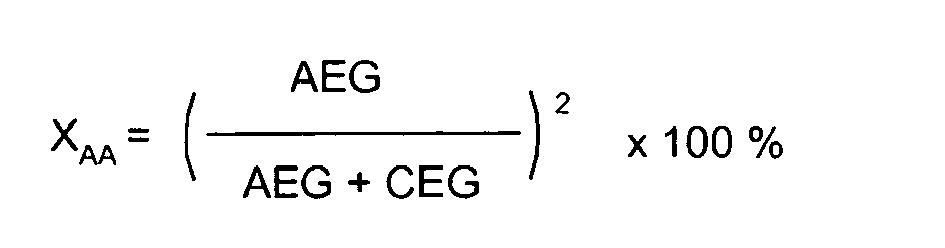
- Für A4:

- Die Formmassen wurden auf einem ZSK 40 bei einem Durchsatz von 30 kg/h (150 rpm) und ca. 280°C flachem Temperaturprofil hergestellt.
- Mechanikkennwerte vor und nach Hydrolyselagerung in Glysantin G48/Wasser (1/1) bei 130°C (V1, B1) oder 120°C (V2, B2) im Autoklav:
-
E-Modul [MPa] Bruchspannung [MPa] 0 h 250 h 500 h 750 h 1000 h 0 h 250 h 500 h 750 h 1000 h V1 9900 4250 4700 4250 4240 193 78 78 37 35 V2 9600 3700 3970 3950 3940 181 82 73 66 42 B1 9800 4250 4750 4350 4320 196 81 85 47 43 B2 9400 3680 3920 3910 3940 179 83 75 68 47 Bruchdehnung [%] 0 h 250 h 500 h 750 h 1000 h V1 3,3 3,7 2,8 1,1 1,0 V2 3,5 6,1 4,8 3,1 1,5 B1 3,2 3,8 3,2 1,6 1,3 B2 3,6 6,5 5,1 3,4 1,8 -
Schlagzähigkeit [kJ/m2] 0 h 250 h 500 h 750 h 1000 h V1 91 67 51 25 23 V2 101 82 38 14 8 B1 79 73 59 28 27 B2 100 89 45 15 9
Claims (10)
- Thermoplastische Formmassen, enthaltend:(A) 20 - 85 Gew.-% mindestens eines Polyamids mit einer Zahl an Aminoendgruppen von ≥ 50 mmol/kg,(B) 14,9 - 60 Gew.-% Glasfasern,(C) 0,01 - 2 Gew.-% mindestens eines Wärmestabilisators,(D) 0 - 1,5 Gew.-% mindestens eines Entformungshilfsmittels und(E) 0 - 30 Gew.-% weiterer Zusatzstoffe,wobei die Summe der Gewichtsprozente von (A) - (E) 100 beträgt.
- Formmassen nach Anspruch 1, in welchen ein lineares, aliphatisches Polyamid A) eingesetzt wird.
- Formmassen nach den Ansprüchen 1 oder 2, wobei das Polyamid A) eine Zahl der primären Aminoendgruppen ≥ 60 mmol/kg aufweist.
- Formmassen nach einem der Ansprüche 1 bis 3, in denen das Polyamid A) einen molaren Anteil an mit einem Diamin geregelten Ketten von ≥ 30 mol-% aufweist.
- Formmassen nach einem der Ansprüche 1 bis 4, wobei das Polyamid A) eine Viskositätszahl von 100 bis 250 ml/g aufweist.
- Formmassen nach einem der Ansprüche 1 bis 5, in welchen die Glasfasern einen Durchmesser von 5 - 15 µm aufweisen.
- Formmassen nach einem der Ansprüche 1 bis 6, in denen der Wärmestabilisator C) ausgewählt ist aus der Gruppe bestehend aus Verbindungen des ein- und zweiwertigen Kupfers, Stabilisatoren auf Basis sekundärer aromatischer Aminen, Stabilisatoren auf Basis sterisch gehinderter Phenole oder deren Mischungen.
- Formmassen nach einem der Ansprüche 1 bis 7, wobei das Polyamid A) ausgewählt ist aus der Gruppe bestehend aus Polyhexamethylenadipinsäureamid (Nylon 66, Polyamid 66), einer Mischung von Polyamiden mit einem Polyamid 66-Anteil von wenigstens 80 Gew.-% oder einem Copolyamid, dessen Bausteine zu wenigstens 80 Gew.-% von Adipinsäure und Hexamethylendiamin ableitbar sind, Polycaprolactam (Nylon 6, Polyamid 6) oder deren Mischungen.
- Verwendung der thermoplastischen Formmassen nach einem der Ansprüche 1 bis 8 zur Herstellung von Fasern, Folien, Formkörpern.
- Formkörper jeglicher Art, erhältlich aus den thermoplastischen Formmassen gemäß den Ansprüchen 1 bis 8.
Priority Applications (1)
| Application Number | Priority Date | Filing Date | Title |
|---|---|---|---|
| EP07802518A EP2057223B1 (de) | 2006-08-23 | 2007-08-07 | Polyamidformmassen mit verbesserter wärmealterungs- und hydrolysebeständigkeit |
Applications Claiming Priority (3)
| Application Number | Priority Date | Filing Date | Title |
|---|---|---|---|
| EP06119377 | 2006-08-23 | ||
| EP07802518A EP2057223B1 (de) | 2006-08-23 | 2007-08-07 | Polyamidformmassen mit verbesserter wärmealterungs- und hydrolysebeständigkeit |
| PCT/EP2007/058165 WO2008022910A1 (de) | 2006-08-23 | 2007-08-07 | Polyamidformmassen mit verbesserter wärmealterungs- und hydrolysebeständigkeit |
Publications (2)
| Publication Number | Publication Date |
|---|---|
| EP2057223A1 EP2057223A1 (de) | 2009-05-13 |
| EP2057223B1 true EP2057223B1 (de) | 2011-01-19 |
Family
ID=38692100
Family Applications (1)
| Application Number | Title | Priority Date | Filing Date |
|---|---|---|---|
| EP07802518A Revoked EP2057223B1 (de) | 2006-08-23 | 2007-08-07 | Polyamidformmassen mit verbesserter wärmealterungs- und hydrolysebeständigkeit |
Country Status (11)
| Country | Link |
|---|---|
| US (1) | US9505912B2 (de) |
| EP (1) | EP2057223B1 (de) |
| JP (1) | JP5645405B2 (de) |
| KR (1) | KR101464782B1 (de) |
| CN (1) | CN101506286B (de) |
| AT (1) | ATE496090T1 (de) |
| BR (1) | BRPI0716056A2 (de) |
| DE (1) | DE502007006322D1 (de) |
| ES (1) | ES2358852T3 (de) |
| MY (1) | MY149345A (de) |
| WO (1) | WO2008022910A1 (de) |
Cited By (2)
| Publication number | Priority date | Publication date | Assignee | Title |
|---|---|---|---|---|
| EP2644647A1 (de) | 2012-03-26 | 2013-10-02 | LANXESS Deutschland GmbH | Thermoplastische Formmassen mit erhöhter Hydrolyse-Beständigkeit |
| WO2020173866A1 (de) | 2019-02-25 | 2020-09-03 | Basf Se | Polyamid-formmassen mit erhöhter hydrolysebeständigkeit |
Families Citing this family (39)
| Publication number | Priority date | Publication date | Assignee | Title |
|---|---|---|---|---|
| EP2121820B1 (de) | 2007-03-19 | 2010-11-17 | E. I. Du Pont de Nemours and Company | Polyamidharzzusammensetzungen |
| US20110290209A1 (en) * | 2008-11-11 | 2011-12-01 | Basf Se | Stabilized polyamides |
| DE102008044225A1 (de) * | 2008-12-01 | 2010-06-02 | Evonik Degussa Gmbh | Verfahren zur Herstellung einer Formmasse oder eines Formteils mit erhöhter Schmelzesteifigkeit |
| WO2011000816A1 (de) | 2009-07-03 | 2011-01-06 | Basf Se | Nanokompositblends enthaltend polyamide und polyolefine |
| EP2456816A1 (de) | 2009-07-21 | 2012-05-30 | Basf Se | Nanokompositblends auf basis von polyamiden und polyarylenethersulfonen |
| KR101063227B1 (ko) * | 2009-10-12 | 2011-09-07 | 현대자동차주식회사 | 나일론-4 복합재료 조성물 |
| KR101282710B1 (ko) * | 2009-12-30 | 2013-07-05 | 제일모직주식회사 | 폴리아미드계 수지 조성물 |
| WO2011134930A1 (de) | 2010-04-30 | 2011-11-03 | Basf Se | Langfaserverstärkte polyamide mit polyolefinen |
| KR101333579B1 (ko) * | 2010-12-15 | 2013-11-28 | 제일모직주식회사 | 반사성, 내열성 및 내습성이 우수한 폴리아마이드 수지 조성물. |
| CN102311638B (zh) * | 2010-12-21 | 2012-12-19 | 深圳市科聚新材料有限公司 | 一种耐水解耐醇解玻纤增强ppa材料及其制备方法 |
| JP5718089B2 (ja) * | 2011-02-22 | 2015-05-13 | 旭化成ケミカルズ株式会社 | 長繊維強化ポリアミド樹脂組成物及び成形体 |
| CN102199347A (zh) * | 2011-03-31 | 2011-09-28 | 上海金玺实验室有限公司 | 一种耐水煮高强度超韧性的改性pa/abs复合材料及其制备方法 |
| FR2980207B1 (fr) * | 2011-09-21 | 2013-08-30 | Rhodia Operations | Composition comprenant du polyamide 66 et du polyamide 610 |
| SG11201403550YA (en) * | 2012-01-16 | 2014-09-26 | Promerus Llc | Thermo-oxidatively stable, side chain polyether functionalized polynorbornenes for microelectronic and optoelectronic devices and assemblies thereof |
| JP5220934B1 (ja) * | 2012-04-10 | 2013-06-26 | マグ・イゾベール株式会社 | 複合形成材料、表面処理したガラス短繊維及び複合形成材料の製造方法 |
| CN102643536A (zh) * | 2012-04-27 | 2012-08-22 | 常熟市发东塑业有限公司 | 耐寒的高阻燃尼龙复合材料的制备方法 |
| EP2669076A1 (de) | 2012-05-31 | 2013-12-04 | Basf Se | Verfahren zum Verbinden zweier Kunststoffteile zur Bildung einer einzigen Komponente |
| WO2013188302A1 (en) * | 2012-06-13 | 2013-12-19 | E. I. Du Pont De Nemours And Company | Thermoplastic melt-mixed composition with amino acid heat stabilizer |
| ES2621053T3 (es) * | 2012-08-28 | 2017-06-30 | Ems-Patent Ag | Masa de moldeo de poliamida y su uso |
| JP5733871B2 (ja) * | 2013-01-11 | 2015-06-10 | 旭化成ケミカルズ株式会社 | ポリアミド組成物及び成形品 |
| HUE036129T2 (hu) * | 2013-06-12 | 2018-06-28 | Basf Se | Magas üvegesedési hõmérsékletû és nagy kristályossági fokú részlegesen aromás kopoliamidok |
| ES2568054T3 (es) | 2014-04-01 | 2016-04-27 | Ems-Patent Ag | Masas de moldeo de poliamida, especialmente para la fabricación de piezas moldeadas en el sector del agua potable |
| US20160108205A1 (en) * | 2014-10-15 | 2016-04-21 | Asahi Kasei Chemicals Corporation | Polyamide resin composition and molded article |
| DE202014008607U1 (de) * | 2014-10-31 | 2014-11-24 | Lanxess Deutschland Gmbh | Polyamidzusammensetzungen |
| WO2016091668A1 (en) * | 2014-12-12 | 2016-06-16 | Rhodia Operations | Polyamide compositions comprising a polyamide 6,6 and a blend of high chain-length polyamides, use thereof, and articles obtained therefrom |
| CN105778493B (zh) * | 2014-12-18 | 2018-10-12 | 旭化成株式会社 | 聚酰胺树脂组合物及成型体 |
| US9892845B2 (en) * | 2016-01-13 | 2018-02-13 | Martin Weinberg | Polyamide electrical insulation for use in liquid filled transformers |
| CN109661554B (zh) | 2016-08-08 | 2021-05-11 | 提克纳有限责任公司 | 用于散热器的导热聚合物组合物 |
| WO2020016371A1 (en) * | 2018-07-19 | 2020-01-23 | Basf Se | Black-colored polyamide composition, production thereof and use |
| KR102170778B1 (ko) * | 2018-12-12 | 2020-10-28 | 주식회사 삼양사 | 우수한 장기 내열성, 내마모성 및 신율을 갖는 폴리아미드 수지 조성물 |
| US11459458B2 (en) | 2019-02-12 | 2022-10-04 | Ascend Performance Materials Operations Llc | Hydrolysis resistant polyamides |
| US12312467B2 (en) * | 2019-03-06 | 2025-05-27 | Basf Se | Polyamide molding composition for high-gloss applications |
| CN109943067B (zh) * | 2019-03-28 | 2021-07-13 | 江苏晋伦塑料科技有限公司 | 一种纯净耐水解聚酰胺组合物及其制备方法 |
| WO2021112609A1 (ko) * | 2019-12-06 | 2021-06-10 | (주) 엘지화학 | 열가소성 성형 조성물 및 이의 성형물을 포함하는 자동차 부품 |
| KR102602710B1 (ko) * | 2019-12-06 | 2023-11-14 | 주식회사 엘지화학 | 열가소성 성형 조성물 및 이의 성형물을 포함하는 자동차 부품 |
| JP7786367B2 (ja) | 2020-03-19 | 2025-12-16 | Ube株式会社 | ポリアミド樹脂組成物 |
| US12227644B2 (en) | 2020-03-19 | 2025-02-18 | Ube Corporation | Polyamide resin composition |
| FR3113058B1 (fr) | 2020-07-29 | 2023-05-12 | Arkema France | Polyamide pour une application textile |
| CN116554679B (zh) * | 2023-06-05 | 2025-06-03 | 江苏杜为新材料科技有限公司 | 一种用于单丝成型的阻燃pa66复合材料及其制备方法和应用 |
Family Cites Families (53)
| Publication number | Priority date | Publication date | Assignee | Title |
|---|---|---|---|---|
| GB890437A (en) | 1958-02-20 | 1962-02-28 | Du Pont | Polycarbonamides |
| DE3169961D1 (en) | 1980-07-14 | 1985-05-23 | Ici Plc | Filled compositions of thermoplastic polyamide and polyester |
| GB8317223D0 (en) | 1983-06-24 | 1983-07-27 | Ici Plc | Polyamide articles |
| JPS6032847A (ja) | 1983-08-03 | 1985-02-20 | Asahi Chem Ind Co Ltd | 反り変形を改良した強化ポリアミド樹脂組成物 |
| JPH0686568B2 (ja) | 1985-02-15 | 1994-11-02 | 旭化成工業株式会社 | ポリテトラメチレンアジパミド組成物 |
| JPS62548A (ja) | 1985-06-26 | 1987-01-06 | Ube Ind Ltd | ポリアミド組成物 |
| JPS62252424A (ja) * | 1986-04-24 | 1987-11-04 | Ube Ind Ltd | 末端変性ポリアミドおよびその製法 |
| US5112908A (en) | 1986-12-23 | 1992-05-12 | E. I. Du Pont De Nemours And Company | Tough polyamide compositions having high melt flow for complex moldings |
| DE3717218A1 (de) | 1987-05-22 | 1989-03-23 | Bayer Ag | Glasfaserverstaerkte stabilisierte polyamidformmasse |
| DE3726125A1 (de) | 1987-08-06 | 1989-02-16 | Basf Ag | Feststoffmischung aus nukleierten und nicht nukleierten polyamiden |
| NL8900278A (de) | 1989-02-04 | 1990-09-03 | Stamicarbon | |
| JPH03108534A (ja) * | 1989-09-22 | 1991-05-08 | Tosoh Corp | 大型容器 |
| DE29511606U1 (de) | 1995-07-18 | 1995-09-21 | Ems-Inventa AG, Zürich | Kühlflüssigkeitsleitung |
| JP3140471B2 (ja) * | 1990-12-20 | 2001-03-05 | 旭化成株式会社 | ブロー成形用樹脂組成物 |
| JP3300392B2 (ja) * | 1991-10-24 | 2002-07-08 | 三井化学株式会社 | 熱可塑性樹脂組成物およびその用途 |
| DE4137434A1 (de) | 1991-11-14 | 1993-05-19 | Huels Chemische Werke Ag | Thermoplastische mehrschichtverbunde |
| US5708245A (en) | 1992-07-14 | 1998-01-13 | Texas Instruments Incorporated | Normally open pressure responsive switch |
| DE4239909C1 (de) | 1992-11-27 | 1994-05-05 | Rasmussen Gmbh | Rohrartiger Stutzen |
| JPH06192568A (ja) | 1992-12-22 | 1994-07-12 | Asahi Chem Ind Co Ltd | 高信頼性難燃性ポリアミド樹脂組成物 |
| JP3181753B2 (ja) * | 1993-04-21 | 2001-07-03 | 旭化成株式会社 | ポリアミド樹脂組成物及びそれを用いた外装用構造部品 |
| CN1035771C (zh) * | 1993-12-23 | 1997-09-03 | 旭化成工业株式会社 | 聚酰胺树脂组合物 |
| DE4410148A1 (de) | 1994-03-24 | 1995-09-28 | Huels Chemische Werke Ag | Mehrschichtiges Kunststoffrohr |
| JPH08319385A (ja) * | 1995-05-26 | 1996-12-03 | Idemitsu Petrochem Co Ltd | ポリスチレン系樹脂組成物及びその成形品 |
| DE69616351T2 (de) | 1995-08-25 | 2002-07-04 | E.I. Du Pont De Nemours And Co., Wilmington | Verfahren zur herstellung von nylonzusammensetzungen mit verbessertem schmelzfluss |
| DE19533920A1 (de) | 1995-09-13 | 1997-03-20 | Rasmussen Gmbh | Vorrichtung zum lösbaren Verbinden der Enden eines Verbindungsschlauches mit jeweils einem Bauteil aus Kunststoff |
| DE19535413C1 (de) | 1995-09-23 | 1996-10-02 | Rasmussen Gmbh | Rohrartiger Stutzen |
| DE19543318A1 (de) | 1995-11-21 | 1997-05-22 | Rasmussen Gmbh | Verbindung einer Fluidleitung aus Kunststoff mit einem rohrförmigen Kupplungselement aus Kunststoff |
| US5763561A (en) | 1996-09-06 | 1998-06-09 | Amoco Corporation | Polyamide compositions having improved thermal stability |
| DE19731230A1 (de) * | 1997-07-21 | 1999-01-28 | Basf Ag | Statistische Copolyamide enthaltende Formmassen, Verfahren zu ihrer Herstellung und ihre Verwendung |
| DE19821719C2 (de) | 1998-05-14 | 2001-07-19 | Inventa Ag | Polyamidformmassen, Verfahren zu deren Herstellung und deren Verwendung |
| US6181230B1 (en) | 1998-09-21 | 2001-01-30 | Abb Power T&D Company Inc. | Voltage coil and method and making same |
| CN1112407C (zh) * | 1998-12-18 | 2003-06-25 | 旭化成株式会社 | 聚酰胺树脂组合物及其模制制品 |
| EP1198520B1 (de) | 1999-06-18 | 2003-12-03 | Solvay Advanced Polymers, LLC | Verfahren zur verringerung der bildung von formablagerungen während des formens von polyamiden und deren zusammensetzungen |
| JP4754077B2 (ja) | 2000-02-21 | 2011-08-24 | 三井化学株式会社 | 電気・電子部品用成形材料 |
| CN1312222C (zh) | 2000-02-21 | 2007-04-25 | 三井化学株式会社 | 电气或电子元件的成型材料 |
| JP4678979B2 (ja) | 2000-04-14 | 2011-04-27 | 旭化成ケミカルズ株式会社 | ガラス繊維強化ポリアミド樹脂組成物 |
| DE10030716A1 (de) * | 2000-06-23 | 2002-01-03 | Degussa | Tieftemperaturschlagzähe Polymerlegierung |
| WO2002038662A1 (en) | 2000-11-13 | 2002-05-16 | E.I. Dupont De Nemours And Company | Colored thermoplastic resin compositions for laser welding, specific neutral anthraquinone dyes as colorants therefor, and molded product therefrom |
| DE60118787T2 (de) | 2000-11-13 | 2006-12-28 | E.I. Dupont De Nemours And Co., Wilmington | Gefärbte thermoplastische harzzusammensetzungen zum laserschweissen, anthrachinon-farbmittel dafür und formteil daraus |
| JP2002173171A (ja) * | 2000-12-05 | 2002-06-18 | Mitsubishi Engineering Plastics Corp | 積層フィルム製の医療溶液用袋 |
| US7089952B2 (en) | 2001-03-16 | 2006-08-15 | Ube Industries, Ltd. | Fuel parts and process for producing the same |
| JP2002294069A (ja) * | 2001-03-30 | 2002-10-09 | Asahi Kasei Corp | ポリアミド樹脂組成物 |
| JP2003277605A (ja) * | 2002-03-27 | 2003-10-02 | Asahi Kasei Corp | 水に接触する成形品用樹脂組成物 |
| US7138454B2 (en) | 2002-09-06 | 2006-11-21 | E. I. Du Pont De Nemours And Company | Toughened, glass filled polyamide compositions and blends having improved stiffness, and articles made therefrom |
| DE10255043A1 (de) | 2002-11-26 | 2004-06-03 | Bayer Ag | Verwendung von Polykondensatmischungen zur Herstellung von Formteilen mit verbesserter Hydrolysebeständigkeit |
| US7166243B2 (en) | 2003-08-16 | 2007-01-23 | General Electric Company | Reinforced poly(arylene ether)/polyamide composition |
| DE102004022963A1 (de) | 2004-05-10 | 2005-12-08 | Ems-Chemie Ag | Thermoplastische Polyamid-Formmassen |
| DE102004036199A1 (de) | 2004-07-26 | 2006-03-23 | Basf Ag | Wärmestabilisierte Polyamide |
| DE102005006400A1 (de) | 2005-02-11 | 2006-08-24 | Siemens Ag | Verfahren zum Zuführen von Bauelementen und Bestückautomat |
| EP1860134B1 (de) | 2005-03-18 | 2015-05-27 | Kuraray Co., Ltd. | Halbaromatisches polyamidharz |
| US8299160B2 (en) | 2006-04-27 | 2012-10-30 | Asahi Kasei Chemicals Corporation | Resin composition and automobile under-hood parts thereof |
| US7858172B2 (en) | 2006-05-25 | 2010-12-28 | Mitsubishi Engineering-Plastics Corporation | Fiber-reinforced thermoplastic resin molded article |
| US7798698B2 (en) * | 2007-03-23 | 2010-09-21 | Victor Company Of Japan, Limited | Lighting device and display device |
-
2007
- 2007-08-07 BR BRPI0716056-9A patent/BRPI0716056A2/pt not_active Application Discontinuation
- 2007-08-07 ES ES07802518T patent/ES2358852T3/es active Active
- 2007-08-07 US US12/377,450 patent/US9505912B2/en active Active
- 2007-08-07 DE DE502007006322T patent/DE502007006322D1/de active Active
- 2007-08-07 MY MYPI20090697A patent/MY149345A/en unknown
- 2007-08-07 AT AT07802518T patent/ATE496090T1/de active
- 2007-08-07 CN CN2007800313432A patent/CN101506286B/zh active Active
- 2007-08-07 KR KR1020097005729A patent/KR101464782B1/ko active Active
- 2007-08-07 JP JP2009525004A patent/JP5645405B2/ja active Active
- 2007-08-07 WO PCT/EP2007/058165 patent/WO2008022910A1/de not_active Ceased
- 2007-08-07 EP EP07802518A patent/EP2057223B1/de not_active Revoked
Cited By (2)
| Publication number | Priority date | Publication date | Assignee | Title |
|---|---|---|---|---|
| EP2644647A1 (de) | 2012-03-26 | 2013-10-02 | LANXESS Deutschland GmbH | Thermoplastische Formmassen mit erhöhter Hydrolyse-Beständigkeit |
| WO2020173866A1 (de) | 2019-02-25 | 2020-09-03 | Basf Se | Polyamid-formmassen mit erhöhter hydrolysebeständigkeit |
Also Published As
| Publication number | Publication date |
|---|---|
| BRPI0716056A2 (pt) | 2013-08-06 |
| ES2358852T3 (es) | 2011-05-16 |
| MY149345A (en) | 2013-08-30 |
| US20110224346A1 (en) | 2011-09-15 |
| KR101464782B1 (ko) | 2014-11-26 |
| DE502007006322D1 (de) | 2011-03-03 |
| WO2008022910A1 (de) | 2008-02-28 |
| JP5645405B2 (ja) | 2014-12-24 |
| CN101506286B (zh) | 2011-09-21 |
| KR20090040393A (ko) | 2009-04-23 |
| EP2057223A1 (de) | 2009-05-13 |
| JP2010501653A (ja) | 2010-01-21 |
| CN101506286A (zh) | 2009-08-12 |
| US9505912B2 (en) | 2016-11-29 |
| ATE496090T1 (de) | 2011-02-15 |
Similar Documents
| Publication | Publication Date | Title |
|---|---|---|
| EP2057223A1 (de) | Polyamidformmassen mit verbesserter wärmealterungs- und hydrolysebeständigkeit | |
| DE69326532T2 (de) | Verstärkte Polyamidharz-Zusammensetzung und Verfahren für ihre Herstellung | |
| EP1670862B1 (de) | Flammgeschützte polyamidformmassen und deren verwendung | |
| EP1276816B1 (de) | Polyarylethersulfon/polyamid-blends mit verbesserter zähigkeit und fliessfähigkeit | |
| EP2828336A1 (de) | Hellgefärbte flammgeschützte polyamide | |
| WO2014170148A1 (de) | Glühdrahtbeständige polyamide | |
| EP3589696B1 (de) | Flammgeschuetzte polyamide mit pvp | |
| EP3526283B1 (de) | Flammgeschützte polyamide | |
| WO2004048452A1 (de) | Schlagzähmodifizierte polymer-zusammensetzungen | |
| EP3652242B1 (de) | Flammhemmende polyamidzusammensetzungen mit hoher wärmeformbeständigkeit und deren verwendung | |
| WO2015140016A1 (de) | Vernetzte polyamide | |
| WO2001090241A1 (de) | Schlagzähmodifizierte polymer-zusammensetzungen | |
| WO2007042446A1 (de) | Flammgeschütze formmassen | |
| EP3642265B1 (de) | Polyamide mit phosphor und al-phosphonaten | |
| DE102015209451A1 (de) | Flammgeschützte Polyamide | |
| DE102017215775A1 (de) | Flammhemmende Polyamidzusammensetzungen mit hoher Wärmeformbeständigkeit und deren Verwendung | |
| WO1998036022A1 (de) | Flammgeschützte thermoplastische formmassen | |
| EP2641932A1 (de) | Thermoplastische Formmassen | |
| EP2702102A1 (de) | Flammgeschütze formmassen | |
| EP0348759B1 (de) | Schwerentflammbare Polyamide | |
| EP0894116B1 (de) | Oxidationsstabilisierte polyamidformmassen | |
| DE102017214051A1 (de) | Flammhemmende Polyamidzusammensetzungen mit hoher Wärmeformbeständigkeit und deren Verwendung | |
| EP2415827A1 (de) | Flammgeschützte Polyamide mit Schichtsilikaten | |
| EP3135730A1 (de) | Polyamide mit niedrigem kristallisationspunkt und geringer schwindung | |
| DE10257077A1 (de) | Schlagzähmodifizierte Polymer-Zusammensetzungen |
Legal Events
| Date | Code | Title | Description |
|---|---|---|---|
| PUAI | Public reference made under article 153(3) epc to a published international application that has entered the european phase |
Free format text: ORIGINAL CODE: 0009012 |
|
| 17P | Request for examination filed |
Effective date: 20090323 |
|
| AK | Designated contracting states |
Kind code of ref document: A1 Designated state(s): AT BE BG CH CY CZ DE DK EE ES FI FR GB GR HU IE IS IT LI LT LU LV MC MT NL PL PT RO SE SI SK TR |
|
| AX | Request for extension of the european patent |
Extension state: AL BA HR MK RS |
|
| GRAC | Information related to communication of intention to grant a patent modified |
Free format text: ORIGINAL CODE: EPIDOSCIGR1 |
|
| GRAP | Despatch of communication of intention to grant a patent |
Free format text: ORIGINAL CODE: EPIDOSNIGR1 |
|
| DAX | Request for extension of the european patent (deleted) | ||
| GRAS | Grant fee paid |
Free format text: ORIGINAL CODE: EPIDOSNIGR3 |
|
| GRAA | (expected) grant |
Free format text: ORIGINAL CODE: 0009210 |
|
| AK | Designated contracting states |
Kind code of ref document: B1 Designated state(s): AT BE BG CH CY CZ DE DK EE ES FI FR GB GR HU IE IS IT LI LT LU LV MC MT NL PL PT RO SE SI SK TR |
|
| REG | Reference to a national code |
Ref country code: GB Ref legal event code: FG4D Free format text: NOT ENGLISH |
|
| REG | Reference to a national code |
Ref country code: CH Ref legal event code: EP |
|
| REG | Reference to a national code |
Ref country code: IE Ref legal event code: FG4D Free format text: LANGUAGE OF EP DOCUMENT: GERMAN |
|
| REF | Corresponds to: |
Ref document number: 502007006322 Country of ref document: DE Date of ref document: 20110303 Kind code of ref document: P |
|
| REG | Reference to a national code |
Ref country code: DE Ref legal event code: R096 Ref document number: 502007006322 Country of ref document: DE Effective date: 20110303 |
|
| REG | Reference to a national code |
Ref country code: ES Ref legal event code: FG2A Ref document number: 2358852 Country of ref document: ES Kind code of ref document: T3 Effective date: 20110504 |
|
| REG | Reference to a national code |
Ref country code: NL Ref legal event code: VDEP Effective date: 20110119 |
|
| LTIE | Lt: invalidation of european patent or patent extension |
Effective date: 20110119 |
|
| PG25 | Lapsed in a contracting state [announced via postgrant information from national office to epo] |
Ref country code: LT Free format text: LAPSE BECAUSE OF FAILURE TO SUBMIT A TRANSLATION OF THE DESCRIPTION OR TO PAY THE FEE WITHIN THE PRESCRIBED TIME-LIMIT Effective date: 20110119 Ref country code: LV Free format text: LAPSE BECAUSE OF FAILURE TO SUBMIT A TRANSLATION OF THE DESCRIPTION OR TO PAY THE FEE WITHIN THE PRESCRIBED TIME-LIMIT Effective date: 20110119 Ref country code: PT Free format text: LAPSE BECAUSE OF FAILURE TO SUBMIT A TRANSLATION OF THE DESCRIPTION OR TO PAY THE FEE WITHIN THE PRESCRIBED TIME-LIMIT Effective date: 20110519 Ref country code: GR Free format text: LAPSE BECAUSE OF FAILURE TO SUBMIT A TRANSLATION OF THE DESCRIPTION OR TO PAY THE FEE WITHIN THE PRESCRIBED TIME-LIMIT Effective date: 20110420 Ref country code: IS Free format text: LAPSE BECAUSE OF FAILURE TO SUBMIT A TRANSLATION OF THE DESCRIPTION OR TO PAY THE FEE WITHIN THE PRESCRIBED TIME-LIMIT Effective date: 20110519 Ref country code: SE Free format text: LAPSE BECAUSE OF FAILURE TO SUBMIT A TRANSLATION OF THE DESCRIPTION OR TO PAY THE FEE WITHIN THE PRESCRIBED TIME-LIMIT Effective date: 20110119 |
|
| REG | Reference to a national code |
Ref country code: IE Ref legal event code: FD4D |
|
| PG25 | Lapsed in a contracting state [announced via postgrant information from national office to epo] |
Ref country code: CY Free format text: LAPSE BECAUSE OF FAILURE TO SUBMIT A TRANSLATION OF THE DESCRIPTION OR TO PAY THE FEE WITHIN THE PRESCRIBED TIME-LIMIT Effective date: 20110119 Ref country code: FI Free format text: LAPSE BECAUSE OF FAILURE TO SUBMIT A TRANSLATION OF THE DESCRIPTION OR TO PAY THE FEE WITHIN THE PRESCRIBED TIME-LIMIT Effective date: 20110119 Ref country code: NL Free format text: LAPSE BECAUSE OF FAILURE TO SUBMIT A TRANSLATION OF THE DESCRIPTION OR TO PAY THE FEE WITHIN THE PRESCRIBED TIME-LIMIT Effective date: 20110119 Ref country code: PL Free format text: LAPSE BECAUSE OF FAILURE TO SUBMIT A TRANSLATION OF THE DESCRIPTION OR TO PAY THE FEE WITHIN THE PRESCRIBED TIME-LIMIT Effective date: 20110119 Ref country code: SI Free format text: LAPSE BECAUSE OF FAILURE TO SUBMIT A TRANSLATION OF THE DESCRIPTION OR TO PAY THE FEE WITHIN THE PRESCRIBED TIME-LIMIT Effective date: 20110119 Ref country code: BG Free format text: LAPSE BECAUSE OF FAILURE TO SUBMIT A TRANSLATION OF THE DESCRIPTION OR TO PAY THE FEE WITHIN THE PRESCRIBED TIME-LIMIT Effective date: 20110419 |
|
| PLBI | Opposition filed |
Free format text: ORIGINAL CODE: 0009260 |
|
| PG25 | Lapsed in a contracting state [announced via postgrant information from national office to epo] |
Ref country code: IE Free format text: LAPSE BECAUSE OF FAILURE TO SUBMIT A TRANSLATION OF THE DESCRIPTION OR TO PAY THE FEE WITHIN THE PRESCRIBED TIME-LIMIT Effective date: 20110119 Ref country code: EE Free format text: LAPSE BECAUSE OF FAILURE TO SUBMIT A TRANSLATION OF THE DESCRIPTION OR TO PAY THE FEE WITHIN THE PRESCRIBED TIME-LIMIT Effective date: 20110119 Ref country code: DK Free format text: LAPSE BECAUSE OF FAILURE TO SUBMIT A TRANSLATION OF THE DESCRIPTION OR TO PAY THE FEE WITHIN THE PRESCRIBED TIME-LIMIT Effective date: 20110119 |
|
| PLAX | Notice of opposition and request to file observation + time limit sent |
Free format text: ORIGINAL CODE: EPIDOSNOBS2 |
|
| 26 | Opposition filed |
Opponent name: INVISTA TECHNOLOGIES S.A.R.L. Effective date: 20111019 Opponent name: EVONIK DEGUSSA GMBH Effective date: 20111019 Opponent name: ASAHI KASEI CHEMICALS CORPORATION Effective date: 20111017 Opponent name: SOLVAY SPECIALTY POLYMERS USA, LLC Effective date: 20111018 Opponent name: EMS-PATENT AG Effective date: 20111014 Opponent name: RHODIA OPERATIONS Effective date: 20111017 Opponent name: KURARAY CO., LTD. Effective date: 20111014 |
|
| PG25 | Lapsed in a contracting state [announced via postgrant information from national office to epo] |
Ref country code: CZ Free format text: LAPSE BECAUSE OF FAILURE TO SUBMIT A TRANSLATION OF THE DESCRIPTION OR TO PAY THE FEE WITHIN THE PRESCRIBED TIME-LIMIT Effective date: 20110119 Ref country code: SK Free format text: LAPSE BECAUSE OF FAILURE TO SUBMIT A TRANSLATION OF THE DESCRIPTION OR TO PAY THE FEE WITHIN THE PRESCRIBED TIME-LIMIT Effective date: 20110119 Ref country code: RO Free format text: LAPSE BECAUSE OF FAILURE TO SUBMIT A TRANSLATION OF THE DESCRIPTION OR TO PAY THE FEE WITHIN THE PRESCRIBED TIME-LIMIT Effective date: 20110119 |
|
| PG25 | Lapsed in a contracting state [announced via postgrant information from national office to epo] |
Ref country code: MT Free format text: LAPSE BECAUSE OF FAILURE TO SUBMIT A TRANSLATION OF THE DESCRIPTION OR TO PAY THE FEE WITHIN THE PRESCRIBED TIME-LIMIT Effective date: 20110119 |
|
| REG | Reference to a national code |
Ref country code: DE Ref legal event code: R026 Ref document number: 502007006322 Country of ref document: DE Effective date: 20111014 |
|
| PLBB | Reply of patent proprietor to notice(s) of opposition received |
Free format text: ORIGINAL CODE: EPIDOSNOBS3 |
|
| BERE | Be: lapsed |
Owner name: BASF SE Effective date: 20110831 |
|
| PG25 | Lapsed in a contracting state [announced via postgrant information from national office to epo] |
Ref country code: MC Free format text: LAPSE BECAUSE OF NON-PAYMENT OF DUE FEES Effective date: 20110831 |
|
| REG | Reference to a national code |
Ref country code: CH Ref legal event code: PL |
|
| PG25 | Lapsed in a contracting state [announced via postgrant information from national office to epo] |
Ref country code: LI Free format text: LAPSE BECAUSE OF NON-PAYMENT OF DUE FEES Effective date: 20110831 Ref country code: CH Free format text: LAPSE BECAUSE OF NON-PAYMENT OF DUE FEES Effective date: 20110831 |
|
| PG25 | Lapsed in a contracting state [announced via postgrant information from national office to epo] |
Ref country code: BE Free format text: LAPSE BECAUSE OF NON-PAYMENT OF DUE FEES Effective date: 20110831 |
|
| PLAB | Opposition data, opponent's data or that of the opponent's representative modified |
Free format text: ORIGINAL CODE: 0009299OPPO |
|
| R26 | Opposition filed (corrected) |
Opponent name: SOLVAY SPECIALTY POLYMERS USA, LLC Effective date: 20111018 Opponent name: EVONIK DEGUSSA GMBH Effective date: 20111019 Opponent name: INVISTA TECHNOLOGIES S.A.R.L. Effective date: 20111019 Opponent name: ASAHI KASEI CHEMICALS CORPORATION Effective date: 20111017 Opponent name: RHODIA OPERATIONS Effective date: 20111017 Opponent name: EMS-PATENT AG Effective date: 20111014 Opponent name: KURARAY CO., LTD. Effective date: 20111014 |
|
| PG25 | Lapsed in a contracting state [announced via postgrant information from national office to epo] |
Ref country code: LU Free format text: LAPSE BECAUSE OF NON-PAYMENT OF DUE FEES Effective date: 20110807 |
|
| PLAB | Opposition data, opponent's data or that of the opponent's representative modified |
Free format text: ORIGINAL CODE: 0009299OPPO |
|
| R26 | Opposition filed (corrected) |
Opponent name: RHODIA OPERATIONS Effective date: 20111017 |
|
| PG25 | Lapsed in a contracting state [announced via postgrant information from national office to epo] |
Ref country code: TR Free format text: LAPSE BECAUSE OF FAILURE TO SUBMIT A TRANSLATION OF THE DESCRIPTION OR TO PAY THE FEE WITHIN THE PRESCRIBED TIME-LIMIT Effective date: 20110119 |
|
| REG | Reference to a national code |
Ref country code: AT Ref legal event code: MM01 Ref document number: 496090 Country of ref document: AT Kind code of ref document: T Effective date: 20120831 |
|
| PG25 | Lapsed in a contracting state [announced via postgrant information from national office to epo] |
Ref country code: AT Free format text: LAPSE BECAUSE OF NON-PAYMENT OF DUE FEES Effective date: 20120831 Ref country code: HU Free format text: LAPSE BECAUSE OF FAILURE TO SUBMIT A TRANSLATION OF THE DESCRIPTION OR TO PAY THE FEE WITHIN THE PRESCRIBED TIME-LIMIT Effective date: 20110119 |
|
| PLAB | Opposition data, opponent's data or that of the opponent's representative modified |
Free format text: ORIGINAL CODE: 0009299OPPO |
|
| R26 | Opposition filed (corrected) |
Opponent name: EVONIK DEGUSSA GMBH Effective date: 20111019 |
|
| PLAB | Opposition data, opponent's data or that of the opponent's representative modified |
Free format text: ORIGINAL CODE: 0009299OPPO |
|
| R26 | Opposition filed (corrected) |
Opponent name: KURARAY CO., LTD. Effective date: 20111014 |
|
| PLBP | Opposition withdrawn |
Free format text: ORIGINAL CODE: 0009264 |
|
| PGFP | Annual fee paid to national office [announced via postgrant information from national office to epo] |
Ref country code: DE Payment date: 20141031 Year of fee payment: 8 |
|
| PLAB | Opposition data, opponent's data or that of the opponent's representative modified |
Free format text: ORIGINAL CODE: 0009299OPPO |
|
| R26 | Opposition filed (corrected) |
Opponent name: INVISTA TECHNOLOGIES S.A.R.L. Effective date: 20111019 |
|
| REG | Reference to a national code |
Ref country code: DE Ref legal event code: R100 Ref document number: 502007006322 Country of ref document: DE |
|
| REG | Reference to a national code |
Ref country code: DE Ref legal event code: R103 Ref document number: 502007006322 Country of ref document: DE Ref country code: DE Ref legal event code: R064 Ref document number: 502007006322 Country of ref document: DE |
|
| PLCK | Communication despatched that opposition was rejected |
Free format text: ORIGINAL CODE: EPIDOSNREJ1 |
|
| REG | Reference to a national code |
Ref country code: FR Ref legal event code: PLFP Year of fee payment: 9 |
|
| PLAB | Opposition data, opponent's data or that of the opponent's representative modified |
Free format text: ORIGINAL CODE: 0009299OPPO |
|
| R26 | Opposition filed (corrected) |
Opponent name: ASAHI KASEI CHEMICALS CORPORATION Effective date: 20111017 |
|
| PGFP | Annual fee paid to national office [announced via postgrant information from national office to epo] |
Ref country code: GB Payment date: 20150901 Year of fee payment: 9 Ref country code: ES Payment date: 20150923 Year of fee payment: 9 |
|
| PLBN | Opposition rejected |
Free format text: ORIGINAL CODE: 0009273 |
|
| RDAF | Communication despatched that patent is revoked |
Free format text: ORIGINAL CODE: EPIDOSNREV1 |
|
| PLAE | Information related to rejection of opposition modified |
Free format text: ORIGINAL CODE: 0009299REJO |
|
| RDAG | Patent revoked |
Free format text: ORIGINAL CODE: 0009271 |
|
| STAA | Information on the status of an ep patent application or granted ep patent |
Free format text: STATUS: PATENT REVOKED |
|
| PGFP | Annual fee paid to national office [announced via postgrant information from national office to epo] |
Ref country code: FR Payment date: 20150831 Year of fee payment: 9 |
|
| 27O | Opposition rejected |
Effective date: 20150624 |
|
| 27W | Patent revoked |
Effective date: 20150625 |
|
| D27O | Information related to the rejection of opposition deleted | ||
| GBPR | Gb: patent revoked under art. 102 of the ep convention designating the uk as contracting state |
Effective date: 20150625 |
|
| PGFP | Annual fee paid to national office [announced via postgrant information from national office to epo] |
Ref country code: IT Payment date: 20150825 Year of fee payment: 9 |
|
| REG | Reference to a national code |
Ref country code: CH Ref legal event code: PK Free format text: ES WURDE NUR EIN EINSPRUCH ZURUECKGEWIESEN. ES GIBT NOCH WEITERE EINSPRUECHE |
|
| REG | Reference to a national code |
Ref country code: AT Ref legal event code: MA03 Ref document number: 496090 Country of ref document: AT Kind code of ref document: T Effective date: 20150625 |