EP2059617B1 - Zweiphasenverfahren für die rasche herstellung von presslingen - Google Patents
Zweiphasenverfahren für die rasche herstellung von presslingen Download PDFInfo
- Publication number
- EP2059617B1 EP2059617B1 EP07826021A EP07826021A EP2059617B1 EP 2059617 B1 EP2059617 B1 EP 2059617B1 EP 07826021 A EP07826021 A EP 07826021A EP 07826021 A EP07826021 A EP 07826021A EP 2059617 B1 EP2059617 B1 EP 2059617B1
- Authority
- EP
- European Patent Office
- Prior art keywords
- pellets
- process according
- metal
- diamond
- ceramic powder
- Prior art date
- Legal status (The legal status is an assumption and is not a legal conclusion. Google has not performed a legal analysis and makes no representation as to the accuracy of the status listed.)
- Active
Links
Images

Classifications
-
- C—CHEMISTRY; METALLURGY
- C22—METALLURGY; FERROUS OR NON-FERROUS ALLOYS; TREATMENT OF ALLOYS OR NON-FERROUS METALS
- C22B—PRODUCTION AND REFINING OF METALS; PRETREATMENT OF RAW MATERIALS
- C22B1/00—Preliminary treatment of ores or scrap
- C22B1/14—Agglomerating; Briquetting; Binding; Granulating
- C22B1/24—Binding; Briquetting ; Granulating
- C22B1/2406—Binding; Briquetting ; Granulating pelletizing
-
- C—CHEMISTRY; METALLURGY
- C22—METALLURGY; FERROUS OR NON-FERROUS ALLOYS; TREATMENT OF ALLOYS OR NON-FERROUS METALS
- C22B—PRODUCTION AND REFINING OF METALS; PRETREATMENT OF RAW MATERIALS
- C22B1/00—Preliminary treatment of ores or scrap
- C22B1/14—Agglomerating; Briquetting; Binding; Granulating
-
- C—CHEMISTRY; METALLURGY
- C22—METALLURGY; FERROUS OR NON-FERROUS ALLOYS; TREATMENT OF ALLOYS OR NON-FERROUS METALS
- C22B—PRODUCTION AND REFINING OF METALS; PRETREATMENT OF RAW MATERIALS
- C22B1/00—Preliminary treatment of ores or scrap
- C22B1/14—Agglomerating; Briquetting; Binding; Granulating
- C22B1/24—Binding; Briquetting ; Granulating
-
- C—CHEMISTRY; METALLURGY
- C22—METALLURGY; FERROUS OR NON-FERROUS ALLOYS; TREATMENT OF ALLOYS OR NON-FERROUS METALS
- C22B—PRODUCTION AND REFINING OF METALS; PRETREATMENT OF RAW MATERIALS
- C22B1/00—Preliminary treatment of ores or scrap
- C22B1/14—Agglomerating; Briquetting; Binding; Granulating
- C22B1/24—Binding; Briquetting ; Granulating
- C22B1/242—Binding; Briquetting ; Granulating with binders
- C22B1/244—Binding; Briquetting ; Granulating with binders organic
-
- C—CHEMISTRY; METALLURGY
- C22—METALLURGY; FERROUS OR NON-FERROUS ALLOYS; TREATMENT OF ALLOYS OR NON-FERROUS METALS
- C22C—ALLOYS
- C22C26/00—Alloys containing diamond or cubic or wurtzitic boron nitride, fullerenes or carbon nanotubes
-
- B—PERFORMING OPERATIONS; TRANSPORTING
- B22—CASTING; POWDER METALLURGY
- B22F—WORKING METALLIC POWDER; MANUFACTURE OF ARTICLES FROM METALLIC POWDER; MAKING METALLIC POWDER; APPARATUS OR DEVICES SPECIALLY ADAPTED FOR METALLIC POWDER
- B22F2998/00—Supplementary information concerning processes or compositions relating to powder metallurgy
-
- Y—GENERAL TAGGING OF NEW TECHNOLOGICAL DEVELOPMENTS; GENERAL TAGGING OF CROSS-SECTIONAL TECHNOLOGIES SPANNING OVER SEVERAL SECTIONS OF THE IPC; TECHNICAL SUBJECTS COVERED BY FORMER USPC CROSS-REFERENCE ART COLLECTIONS [XRACs] AND DIGESTS
- Y10—TECHNICAL SUBJECTS COVERED BY FORMER USPC
- Y10T—TECHNICAL SUBJECTS COVERED BY FORMER US CLASSIFICATION
- Y10T428/00—Stock material or miscellaneous articles
- Y10T428/29—Coated or structually defined flake, particle, cell, strand, strand portion, rod, filament, macroscopic fiber or mass thereof
- Y10T428/2982—Particulate matter [e.g., sphere, flake, etc.]
Definitions
- This invention relates to a process for the formation of pellets.
- this application relates to a dual stage process for the formation of pellets by coating a central core with a powder material.
- the process has a broad range of applications ranging from pelletising diamond seeds for High Pressure High Temperature diamond synthesis to using pelletised ultra hard materials in cutting or abrading tools.
- Many high technology cutting and abrading tools are conventionally manufactured from a suitable metal with grains of ultra hard material such as diamond or cubic boron nitride embedded in the metal forming the cutting or abrading components of the tools.
- One option in manufacturing such tools is to initially pelletise the ultra hard material in a layer of the metal and subsequently press or sinter a plurality of these pellets into the tool components.
- the first "rotating pan” method involves introducing the ultra hard core material, e.g. diamond seeds, into either a rotating inclined pan, a drum or any other rotating vessel, where the pellet can be built up by 1) spraying a slurry containing metal powder, binder and solvent (encapsulating or coating material) over the rotating diamond seeds or 2) the binder and solvent is/are sprayed separately and the metal powder then "sprinkled” over the rotating diamond seeds.
- Rotation of the pan separates the coated diamond seeds (emergent pellets) and allows time for removal of the solvent from the sprayed material to form a concentric jacket of encapsulating material which increases in volume as the process proceeds. This technique is efficient in terms of depositing encapsulating material and thus building up the pellet mass quickly.
- the difficulty with this method is that it is susceptible to agglomeration of the cores and/or early pellets in the initial stages of the process. Deposition rates must be very slow to avoid agglomeration. This increases the overall processing time and reduces the throughput of the process. Agglomeration reduces in severity after the emergent pellet has attained a critical size.
- the final pellets may have significant size distribution and may contain more than one core per pellet. This contributes to increased process time and cost.
- the second method involves using a fluidised bed technique.
- the ultra hard cores e.g. diamond seeds
- the ultra hard cores are suspended in a flow of gas within a chamber, into which a fine suspension of binder, solvent and particulate material (e.g. metal powder) (the encapsulating material) is sprayed.
- the binder-solvent may be sprayed with separate powder addition.
- the emergent pellets are built up in volume proportional (non-linearly) to the residence time spent in the chamber.
- the advantage of this process is that the fluid bed allows a good separation of the core seeds and thereby ensures that a single core (diamond seed) is contained in each pellet while depositing encapsulating material at a reasonable rate.
- the encapsulating material used in the gas flow arrangement may be the same or different to the encapsulating material used in the rotating vessel.
- the rotating vessel is a pan or a drum.
- the solution to the problems described above is to combine the two techniques known in the art into a single process design.
- the initial stages of the process involve a fluid bed approach to maximise the yield of pellets containing one core particle only e.g. diamond seeds.
- the pellets may be built up to a critical size volume (Vcrit) whilst remaining in a fluid suspension.
- Vcrit critical size volume
- the pellets are transferred to a rotating pan where the pellets form the (sub) core of the final pellet process.
- the pellets so produced have a volume significantly greater than the pellets as introduced and the risk of agglomeration is much reduced as the layer on the surface absorbs the spray more quickly and thus deposition rates may be increased.
- the weightier particles are less likely to be held together by surface tension of the spray.
- pellet containing a core coated with an encapsulating material whenever produced by a process as hereinbefore described.
- the process for the formation of pellets containing an ultra hard core coated with an encapsulating material includes the steps of:
- the core is preferably comprised of hard core material, most preferably ultra hard core material.
- the ultra hard core material may be selected from material comprising cubic boron nitride and diamond including natural and synthetic diamond, synthetic diamond including both High Pressure High Temperature (HPHT) and Chemical Vapour Deposition (CVD) synthetic diamond, coated or cladded diamond, boron carbide, boron suboxide or combinations thereof.
- the ultra hard core material is preferably suspended in a chamber or work vessel which is preferably a fluidised bed granulating/encapsulating apparatus.
- the work vessel may be a fluidised bed granulating/encapsulating apparatus of the type having a material work area, a rotatable plate disposed immediately beneath the work area and means for conveying a gaseous fluid through the work area for fluidised circulation of charge material therewithin, the granulating apparatus being operated to generally individually fluidise the ultra hard core material within the work area. It will be appreciated, however, that such a particular arrangement does not lie central to the present invention.
- the encapsulating material may be comprised of metal and/or ceramic powder, binder and/or solvent.
- the metal powder may be cobalt, copper, iron, bronze, tungsten carbide, nickel, tungsten metal, molybdenum, zinc, brass, silver, or a mixture of two or more thereof.
- the particle size is preferably greater than approximately 0.01 micrometers, preferably greater than 0.1 micrometer, more preferably greater than 0.2 micrometers, more preferably greater than 0.5 micrometers, more preferably greater than 1 micrometers, more preferably greater than 2 micrometers, more preferably greater than 4 micrometers and most preferably greater than 8 micrometers.
- the particle size of the metal and/or ceramic powder is less than approximately 500 micrometers, more preferably less than 450 micrometers, more preferably less than 350 micrometers, more preferably less than 300 micrometers and most preferably less than 250 micrometers.
- the core material is preferably greater than 10 micrometers, more preferably greater than 20 micrometers, more preferably greater than 50 micrometers, more preferably greater than 100 micrometers, more preferably greater than 200 micrometers, more preferably greater than 400 micrometers and most preferably greater than 800 micrometers.
- the particle size of the ultra hard core material is less than approximately 5000 micrometers, more preferably less than 4500 micrometers, more preferably less than 3500 micrometers, more preferably less than 3000 micrometers and most preferably less than 2500 micrometers
- Polyethylene glycol, liquid paraffin, glycerol, shelac, polyvinyl alcohol (PVA), polyvinyl butyral(PVB), cellulose or stearic acid are preferred as the binding agent and the solvent may be water and/or an organic solvent, preferably ethyl alcohol or trichloro-ethylene or isopropyl alcohol (IPA).
- PVA polyvinyl alcohol
- PVB polyvinyl butyral(PVB)
- cellulose or stearic acid are preferred as the binding agent and the solvent may be water and/or an organic solvent, preferably ethyl alcohol or trichloro-ethylene or isopropyl alcohol (IPA).
- IPA isopropyl alcohol
- the metal powder should comprise no greater than approximately 80%, preferably no greater than approximately 70%, preferably no greater than approximately 60%, preferably no greater than approximately 50%, by weight of a slurry and the binder should comprise no greater than approximately 30%, preferably no greater than approximately 25%, preferably no greater than approximately 20%, preferably no greater than approximately 15%, preferably no greater than approximately 10%, preferably no greater than approximately 5% of the weight of the metal powder in the slurry.
- a hard phase may be added to the metal and/or ceramic powder to improve the wear resistance of the encapsulating material itself.
- This hard phase could be tungsten carbide (WC), particles of WC-cobalt cermet or any conventional ceramic hard phase such as silicon carbide (SiC), silicon nitride (SiN), alumina (Al 2 O 3 ) etc. or mixture of any of these.
- the size of these hard phases could range from 0.01 microns to 500 microns (micrometers).
- the spraying of the encapsulating material is continued for a sufficient time to build the coating on each core to achieve a predetermined critical size (Vcrit).
- Vcrit critical size
- the average diametric dimension of each pellet may range up to, but no greater than, approximately 5, preferably no greater than 4, more preferably no greater than 2 times the average diametric dimension of the ultra hard cores.
- the plate of the fluidised bed granulating apparatus is preferably rotated throughout the course of the granulating operation to circulate the ultra hard cores within the material work area during fluidisation of the cores.
- the pellets as produced are thereafter introduced into a rotating, preferably inclined pan, where the pellet can be built further up by 1) spraying a slurry containing metal and/or ceramic powder, binder and solvent (encapsulating material) over the rotating diamond seeds and/or 2) the binder and solvent is/are sprayed separately and the metal and/or ceramic powder then "sprinkled" over the rotating diamond seeds.
- Rotation of the pan allows time for reduction and possible removal of the solvent from the sprayed encapsulating material to form a concentric jacket of encapsulating material which increases in volume as the process proceeds.
- the pellets are preferably always wet to a degree; while additional solvent is removed as it is put on. For the avoidance of doubt, the material from the bed is first allowed to be slightly wet before adding powder, then as more solvent/binder is added there is a constant replenishment - hence removal of solvent.
- the diameter of the pellets can increase by 10 microns per hour, preferably 20 microns per hour, more preferably 50 microns per hour, more preferably 100 microns per hour, more preferably 150 microns per hour, more preferably 200 microns per hour, more preferably 300 microns per hour, more preferably 400 microns per hour, most preferably 450 microns per hour. This results in a much reduced process time in the pan coater and subsequent reduction in process costs.
- the pelletised material has a broad range of applications including the pelletising of diamond seeds, preferably in the range 200 -1500 microns, with particulate metal including but not limited to Co, Fe, Ni, W, Mn, Cu and Sn, ceramic, tungsten carbide powders and/or aggregates thereof.
- the process according to the present invention provides a significant advantage in terms of cost of production of pellets and enables dense metal powders to be used in a commercially viable production process.
- Diamond was encapsulated with a metal bond on a Dim-Net CT-3000D fluidised bed type diamond coating machine.
- a slurry was prepared by mixing equal weights (400g) of bond powder (Umicore Cobalite-CNF) and water With 4 weight% (wt%) of the bond powder in PVA. 2,000cts (400g) of SDA100+TC 40/50# diamond was loaded in the coating machine.
- Spray rate for this test was further increased by 40% (that is 130% above the first test). At these settings, the weight of the diamond was increased by 40g in 90 minutes, this is a rate of 26.7g/hr. More agglomeration was seen than before, this was separated and by weight was almost 30% of the total weight of the charge.
- a Kalweka Pelletizer (Type-PLZ by Karnavati Engineering) rotating pan was used to build up more metal powder on partially encapsulated diamond.
- 873g of partially encapsulated diamond was placed on the rotating pan. The pan was angled at 45° ⁇ 3° and rotated at 30 rpm which brought the partially encapsulated diamond up the pan, allowing it to fall back down again without it being held to the wall by centrifugal forces.
- metal powder was added to the charge by using a vibrating dispenser and at the same time spraying a binder solution onto the moving charge.
- the metal powder added is the same as already on the charge, i.e 60wt% w/, 40wt% Mo mixture.
- the binder which was sprayed was a 10 wt% PVA in water. A 5wt% PVA solution, was tried previously but this was not sufficient to allow continuous build-up. The rates at which the powder and binder are added will determine the overall build-up rate. If excess binder solution is sprayed, then the system will appear wet. Oppositely, if less binder is sprayed then it will appear dry. For this example, the system was purposely allowed to appear wet which reduced dust creation.
- Encapsulation was continued for 165 minutes. In this time the weight of the charge was increased to 1432g, that is a rate of 203.3g per hour. In addition, this weight of charge could not be fluidised by the fluid bed machine. In the final product, very little in agglomeration could be seen.
- the rotating pan which was used in the Example 3 was again utilised: 874g of partially encapsulated diamond was placed on the rotating pan. The pan was angled at 45° ⁇ 3° and rotated at 30 rpm. While the pan was rotating, metal powder (as Example 3) was added to the charge by using a vibrating dispenser and at the same time spraying a binder solution (as Example 3) onto the moving charge. For this example, the system was purposely allowed to appear dry, which did create dust. Encapsulation was continued for 205 minutes. In this time the weight of the charge was increased to 1450g, that is a rate of 168.6g per hour. In addition, this weight of charge could not be fluidised by the fluid bed machine.
- This example was to increase 1200cts (240g) of 40/45# and 800cts (160g) 45/50# TiC coated E6 SDB diamond in weight by 10.9 times with an iron powder.
- the individual half sizes were encapsulated separately.
- the iron was built-up in the fluid bed machine as described in Example 1. This was subsequently transferred to the rotating pan (as described in Example 3) to continue encapsulation. The following settings were used for this test.
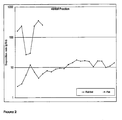
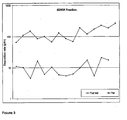
- Example 3 350g of the same W/Mo partially encapsulated diamond was loaded onto the pan coater as described in Example 3. The pan was angled at 45° and rotated at 32rpm. Onto the moving charge, iron powder, the same as used in Example 6 was added in a controlled manner while spraying a 15wt% binder solution at the same time. As this was a test, the rates at which the powder and binder were added were conservative. Encapsulation was continued for about 1 hour which resulted in the weight increasing to 515g. This is a rate of 165g per hour. The median sizing of the initial W/Mo partially encapsulated was 640um, this was increased to a median of 900um. The size distribution of the original charge and the resulting Fe encapsulated material is shown in the graph of Figure 4 below. This example shows that it is possible to encapsulate more than one material on diamond.
Landscapes
- Chemical & Material Sciences (AREA)
- Engineering & Computer Science (AREA)
- Materials Engineering (AREA)
- Organic Chemistry (AREA)
- Metallurgy (AREA)
- Mechanical Engineering (AREA)
- Geology (AREA)
- Manufacturing & Machinery (AREA)
- Life Sciences & Earth Sciences (AREA)
- Geochemistry & Mineralogy (AREA)
- General Life Sciences & Earth Sciences (AREA)
- Environmental & Geological Engineering (AREA)
- Glanulating (AREA)
- Powder Metallurgy (AREA)
- Chemical Vapour Deposition (AREA)
- Crystals, And After-Treatments Of Crystals (AREA)
- Press Drives And Press Lines (AREA)
Claims (14)
- Verfahren zur Herstellung von Pellets, die einen mit einkapselndem Material beschichteten Kern enthalten, wobei das Verfahren die Schritte umfasst, dass:- Kemmaterial in einem Gasstrom suspendiert wird;- das Kemmaterial mit einkapselndem Material in Kontakt gebracht wird, um Pellets herzustellen,- die Pellets in ein rotierendes Gefäß eingebracht werden,- die Pellets mit einkapselndem Material in Kontakt gebracht werden, um Pellets größerer Masse als die Pellets, die in das rotierende Gefäß eingebracht wurden, herzustellen.
- Verfahren nach Anspruch 1, wobei das rotierende Gefäß eine Wanne oder eine Trommel ist.
- Verfahren nach einem der Ansprüche 1 und 2, wobei das Kernmaterial ein ultrahartes Kemmaterial ist, wobei das ultraharte Kemmaterial vorzugsweise ausgewählt ist aus Material umfassend kubisches Bornitrid, Diamant einschließlich natürlichem und synthetischem Diamant, synthetischer Diamant einschließlich durch Hochdruck-Hochtemperatursynthese (HPHT) und chemische Gasphasenabscheidung (CVD) hergestellten synthetischen Diamant, und beschichteten oder plattierten Diamant, Borkarbid, Borsuboxid oder Kombinationen daraus.
- Verfahren nach einem der vorhergehenden Ansprüche, wobei das Kemmaterial in einer Kammer oder einem Arbeilsgefäß suspendiert wird, welche/s eine Wirbelschicht-Granulier-/Verkapselvorrichtung ist.
- Verfahren nach Anspruch 4, wobei das Arbeitsgefäß eine Wirbelschicht-Granulier-/Verkapselvorrichtung von dem Typ mit einem Materialarbeitsbereich, einer unmittelbar unterhalb des Arbeitsbereichs angeordneten drehbaren Platte und Mittel zur Förderung eines gasförmigen Fluids durch den Arbeitsbereich für die fluidisierte Zirkulation von Chargenmaterial innerhalb desselben ist, wobei die Granuliervorrichtung betrieben wird, um das Kemmaterial innerhalb des Arbeitsbereichs im Allgemeinen einzeln zu fluidisieren.
- Verfahren nach einem der vorhergehenden Ansprüche, wobei das einkapselnde Material aus Metall- und/oder Keramikpulver, Bindemittel und/oder Lösemittel besteht.
- Verfahren nach Anspruch 6, wobei das Metall- und/oder Keramikpulver Kobalt, Kupfer, Eisen, Bronze, Wolframkarbid, Nickel, Wolframmetall, Molybdän, Zink, Messing, Silber, oder ein Gemisch aus zwei oder mehr derselben ist, und/oder wobei die Partikelgröße des Metall- und/oder Keramikpulvers größer als 0,1 Mikrometer beträgt, und/oder wobei die Partikelgröße des Metall- und/oder Keramikpulvers kleiner als 300 Mikrometer ist, und/oder wobei das Bindemittel ausgewählt ist aus Polyethylenglykol, flüssiges Paraffin, Glycerin, Schellack, Polyvinylalkohol (PVA), Polyvinylbutyral (PVB), Zellulose und/oder Stearinsäure, und/oder wobei das Lösemittel Wasser und/oder ein organisches Lösemittel ist, und/oder wobei das Metall- und/oder Keramikpulver nicht mehr als 80 Gew.% einer Aufschlämmung umfasst, und/oder wobei eine Hartphase zu dem Metallpulver hinzugefügt wird.
- Verfahren nach Anspruch 7, wobei das Lösemittel Ethylalkohol und/oder Trichlorethylen oder Isopropylalkohol (IPA) ist.
- Verfahren nach Anspruch 7, wobei das Bindemittel nicht mehr als ungefähr 30 % des Gewichts des Metall- und/oder Keramikpulvers in der Aufschlämmung umfasst.
- Verfahren nach Anspruch 7, wobei die Hartphase ausgewählt ist aus Wolframkarbid (WC), Partikel aus WC-Kobalt-Cermet oder einer herkömmlichen Keramikhartphase wie Siliziumkarbid (SiC), Siliziumnitrid (SiN), Aluminiumoxid (Al2O3) oder einem beliebigen Gemisch aus diesen.
- Verfahren nach Anspruch 7, wobei die Größe der Hartphase von 0,1 Mikrometer bis 500 Mikrometer reicht.
- Verfahren nach einem der vorhergehenden Ansprüche, wobei das Versprühen des einkapselnden Materials für eine Zeit fortgesetzt wird, die ausreicht, um die Beschichtung auf jedem Kem so aufzubauen, dass eine zuvor festgelegte kritische Größe (Vcrit) erreicht wird, wobei eine mittlere Durchmessergröße jedes Pellets bis zum Fünffachen, aber nicht mehr, der mittleren Durchmessergröße der ultraharten Kerne reicht.
- Verfahren nach einem der vorhergehenden Ansprüche, wobei die Pellets in eine rotierende Wanne eingebracht werden, wo die Pellets weiter aufgebaut werden können durch:- Versprühen einer Metall- und/oder Keramikpulver, Bindemittel und Lösemittel (einkapselndes Material) enthaltenden Aufschlämmung über die rotierenden Diamantkeime; und/oder- das Bindemittel und das Lösemittel werden separat versprüht und das Metall- und/oder Keramikpulver wird dann über die rotierenden Diamantkeime "gestreut".
- Verfahren nach einem der vorhergehenden Ansprüche, wobei der Durchmesser der Pellets um zumindest 10 Mikrometer pro Stunde zunimmt.
Applications Claiming Priority (2)
| Application Number | Priority Date | Filing Date | Title |
|---|---|---|---|
| ZA200606674 | 2006-08-11 | ||
| PCT/IB2007/053204 WO2008018048A2 (en) | 2006-08-11 | 2007-08-13 | Dual stage process for the rapid formation of pellets |
Publications (2)
| Publication Number | Publication Date |
|---|---|
| EP2059617A2 EP2059617A2 (de) | 2009-05-20 |
| EP2059617B1 true EP2059617B1 (de) | 2010-05-05 |
Family
ID=38913086
Family Applications (1)
| Application Number | Title | Priority Date | Filing Date |
|---|---|---|---|
| EP07826021A Active EP2059617B1 (de) | 2006-08-11 | 2007-08-13 | Zweiphasenverfahren für die rasche herstellung von presslingen |
Country Status (8)
| Country | Link |
|---|---|
| US (1) | US20100062253A1 (de) |
| EP (1) | EP2059617B1 (de) |
| KR (1) | KR20090080937A (de) |
| CN (1) | CN101517102B (de) |
| AT (1) | ATE466963T1 (de) |
| DE (1) | DE602007006325D1 (de) |
| WO (1) | WO2008018048A2 (de) |
| ZA (1) | ZA200901394B (de) |
Families Citing this family (12)
| Publication number | Priority date | Publication date | Assignee | Title |
|---|---|---|---|---|
| US9004199B2 (en) * | 2009-06-22 | 2015-04-14 | Smith International, Inc. | Drill bits and methods of manufacturing such drill bits |
| CA2770308C (en) * | 2009-08-07 | 2017-11-28 | Smith International, Inc. | Diamond transition layer construction with improved thickness ratio |
| US20110036643A1 (en) * | 2009-08-07 | 2011-02-17 | Belnap J Daniel | Thermally stable polycrystalline diamond constructions |
| CN102648328B (zh) * | 2009-08-07 | 2015-02-18 | 史密斯国际有限公司 | 具有高的韧度和高的耐磨性的多晶金刚石材料 |
| WO2011017625A2 (en) | 2009-08-07 | 2011-02-10 | Smith International, Inc. | Method of forming a thermally stable diamond cutting element |
| WO2011017607A2 (en) | 2009-08-07 | 2011-02-10 | Smith International, Inc. | Highly wear resistant diamond insert with improved transition structure |
| CA2770306A1 (en) * | 2009-08-07 | 2011-02-10 | Smith International, Inc. | Functionally graded polycrystalline diamond insert |
| CN102059663B (zh) * | 2009-11-13 | 2014-08-13 | 沈阳中科超硬磨具磨削研究所 | 一种用于汽车喷油嘴磨削的cbn微型陶瓷砂轮制备方法 |
| GB201119329D0 (en) | 2011-11-09 | 2011-12-21 | Element Six Ltd | Method of making cutter elements,cutter element and tools comprising same |
| CN103011828A (zh) * | 2012-12-27 | 2013-04-03 | 北京工业大学 | 一种含硼化物陶瓷的团聚型复合热喷涂粉末的制备方法 |
| CN104801806A (zh) * | 2015-05-14 | 2015-07-29 | 桂林特邦新材料有限公司 | 钎焊金刚石工具制造方法 |
| CN108689726B (zh) * | 2018-05-25 | 2020-08-18 | 中国科学院过程工程研究所 | 一种镍包覆陶瓷复合粉体的制备方法 |
Family Cites Families (5)
| Publication number | Priority date | Publication date | Assignee | Title |
|---|---|---|---|---|
| US3316073A (en) * | 1961-08-02 | 1967-04-25 | Norton Co | Process for making metal bonded diamond tools employing spherical pellets of metallic powder-coated diamond grits |
| DE2323194A1 (de) * | 1973-05-08 | 1974-11-28 | Driam Metallprodukt Gmbh & Co | Vorrichtung zum kontinuierlichen herstellen von dragees |
| US4639383A (en) * | 1983-09-20 | 1987-01-27 | Thomas Engineering, Inc. | Method and apparatus for coating particulate granules |
| DE19844397A1 (de) * | 1998-09-28 | 2000-03-30 | Hilti Ag | Abrasive Schneidkörper enthaltend Diamantpartikel und Verfahren zur Herstellung der Schneidkörper |
| US9555387B2 (en) * | 2008-02-14 | 2017-01-31 | Element Six Limited | Method for manufacturing encapsulated superhard material |
-
2007
- 2007-08-13 ZA ZA200901394A patent/ZA200901394B/xx unknown
- 2007-08-13 KR KR1020097004950A patent/KR20090080937A/ko not_active Ceased
- 2007-08-13 CN CN2007800355651A patent/CN101517102B/zh active Active
- 2007-08-13 AT AT07826021T patent/ATE466963T1/de active
- 2007-08-13 DE DE602007006325T patent/DE602007006325D1/de active Active
- 2007-08-13 WO PCT/IB2007/053204 patent/WO2008018048A2/en not_active Ceased
- 2007-08-13 EP EP07826021A patent/EP2059617B1/de active Active
- 2007-08-13 US US12/377,960 patent/US20100062253A1/en not_active Abandoned
Also Published As
| Publication number | Publication date |
|---|---|
| CN101517102A (zh) | 2009-08-26 |
| EP2059617A2 (de) | 2009-05-20 |
| DE602007006325D1 (de) | 2010-06-17 |
| KR20090080937A (ko) | 2009-07-27 |
| CN101517102B (zh) | 2013-01-23 |
| US20100062253A1 (en) | 2010-03-11 |
| WO2008018048A3 (en) | 2008-04-03 |
| ATE466963T1 (de) | 2010-05-15 |
| ZA200901394B (en) | 2010-08-25 |
| WO2008018048A2 (en) | 2008-02-14 |
Similar Documents
| Publication | Publication Date | Title |
|---|---|---|
| EP2059617B1 (de) | Zweiphasenverfahren für die rasche herstellung von presslingen | |
| US4770907A (en) | Method for forming metal-coated abrasive grain granules | |
| EP2596911B1 (de) | Verfahren und Vorrichtung zum Bilden aggregierter Schleifkörner zur Verwendung bei der Herstellung von Schleif- und Schneidwerkzeugen | |
| US3316073A (en) | Process for making metal bonded diamond tools employing spherical pellets of metallic powder-coated diamond grits | |
| EP2176372B1 (de) | Verfahren zur herstellung von verkapseltem superhartem material | |
| CN101910354B (zh) | 制造包封的超硬材料的方法 | |
| CN102918130B (zh) | 用于研磨或切割工具生产的聚集磨料 | |
| US9555387B2 (en) | Method for manufacturing encapsulated superhard material | |
| EP1894983A1 (de) | Granulate zur Herstellung von Schleif- oder Schneidewerkzeugen | |
| WO2008025836A1 (en) | Granules for use in abrading or cutting tools production | |
| US4476071A (en) | Process for rounding off granular particles of solid material | |
| US9567506B2 (en) | Method for manufacturing encapsulated superhard material | |
| JP3477582B2 (ja) | 造粒方法 | |
| JPH0790307A (ja) | 粉末の製造方法及び装置 | |
| JPH05155608A (ja) | 窒化ホウ素複合粉末の製造方法 | |
| JP2026058437A (ja) | セラミックス球体の製造方法 | |
| JPH06170206A (ja) | 球状造粒方法 |
Legal Events
| Date | Code | Title | Description |
|---|---|---|---|
| PUAI | Public reference made under article 153(3) epc to a published international application that has entered the european phase |
Free format text: ORIGINAL CODE: 0009012 |
|
| 17P | Request for examination filed |
Effective date: 20090303 |
|
| AK | Designated contracting states |
Kind code of ref document: A2 Designated state(s): AT BE BG CH CY CZ DE DK EE ES FI FR GB GR HU IE IS IT LI LT LU LV MC MT NL PL PT RO SE SI SK TR |
|
| AX | Request for extension of the european patent |
Extension state: AL BA HR MK RS |
|
| 17Q | First examination report despatched |
Effective date: 20090507 |
|
| RIN1 | Information on inventor provided before grant (corrected) |
Inventor name: WRIGHT, DEREK NORMAN Inventor name: FLYNN, GERALD F Inventor name: EGAN, DAVID |
|
| GRAP | Despatch of communication of intention to grant a patent |
Free format text: ORIGINAL CODE: EPIDOSNIGR1 |
|
| DAX | Request for extension of the european patent (deleted) | ||
| GRAS | Grant fee paid |
Free format text: ORIGINAL CODE: EPIDOSNIGR3 |
|
| GRAA | (expected) grant |
Free format text: ORIGINAL CODE: 0009210 |
|
| AK | Designated contracting states |
Kind code of ref document: B1 Designated state(s): AT BE BG CH CY CZ DE DK EE ES FI FR GB GR HU IE IS IT LI LT LU LV MC MT NL PL PT RO SE SI SK TR |
|
| REG | Reference to a national code |
Ref country code: GB Ref legal event code: FG4D |
|
| REG | Reference to a national code |
Ref country code: CH Ref legal event code: EP |
|
| REG | Reference to a national code |
Ref country code: IE Ref legal event code: FG4D |
|
| REF | Corresponds to: |
Ref document number: 602007006325 Country of ref document: DE Date of ref document: 20100617 Kind code of ref document: P |
|
| REG | Reference to a national code |
Ref country code: NL Ref legal event code: VDEP Effective date: 20100505 |
|
| LTIE | Lt: invalidation of european patent or patent extension |
Effective date: 20100505 |
|
| PG25 | Lapsed in a contracting state [announced via postgrant information from national office to epo] |
Ref country code: ES Free format text: LAPSE BECAUSE OF FAILURE TO SUBMIT A TRANSLATION OF THE DESCRIPTION OR TO PAY THE FEE WITHIN THE PRESCRIBED TIME-LIMIT Effective date: 20100816 Ref country code: LT Free format text: LAPSE BECAUSE OF FAILURE TO SUBMIT A TRANSLATION OF THE DESCRIPTION OR TO PAY THE FEE WITHIN THE PRESCRIBED TIME-LIMIT Effective date: 20100505 Ref country code: SE Free format text: LAPSE BECAUSE OF FAILURE TO SUBMIT A TRANSLATION OF THE DESCRIPTION OR TO PAY THE FEE WITHIN THE PRESCRIBED TIME-LIMIT Effective date: 20100505 Ref country code: NL Free format text: LAPSE BECAUSE OF FAILURE TO SUBMIT A TRANSLATION OF THE DESCRIPTION OR TO PAY THE FEE WITHIN THE PRESCRIBED TIME-LIMIT Effective date: 20100505 |
|
| PG25 | Lapsed in a contracting state [announced via postgrant information from national office to epo] |
Ref country code: FI Free format text: LAPSE BECAUSE OF FAILURE TO SUBMIT A TRANSLATION OF THE DESCRIPTION OR TO PAY THE FEE WITHIN THE PRESCRIBED TIME-LIMIT Effective date: 20100505 Ref country code: IS Free format text: LAPSE BECAUSE OF FAILURE TO SUBMIT A TRANSLATION OF THE DESCRIPTION OR TO PAY THE FEE WITHIN THE PRESCRIBED TIME-LIMIT Effective date: 20100905 Ref country code: LV Free format text: LAPSE BECAUSE OF FAILURE TO SUBMIT A TRANSLATION OF THE DESCRIPTION OR TO PAY THE FEE WITHIN THE PRESCRIBED TIME-LIMIT Effective date: 20100505 Ref country code: SI Free format text: LAPSE BECAUSE OF FAILURE TO SUBMIT A TRANSLATION OF THE DESCRIPTION OR TO PAY THE FEE WITHIN THE PRESCRIBED TIME-LIMIT Effective date: 20100505 |
|
| PG25 | Lapsed in a contracting state [announced via postgrant information from national office to epo] |
Ref country code: PL Free format text: LAPSE BECAUSE OF FAILURE TO SUBMIT A TRANSLATION OF THE DESCRIPTION OR TO PAY THE FEE WITHIN THE PRESCRIBED TIME-LIMIT Effective date: 20100505 Ref country code: CY Free format text: LAPSE BECAUSE OF FAILURE TO SUBMIT A TRANSLATION OF THE DESCRIPTION OR TO PAY THE FEE WITHIN THE PRESCRIBED TIME-LIMIT Effective date: 20100609 |
|
| PG25 | Lapsed in a contracting state [announced via postgrant information from national office to epo] |
Ref country code: EE Free format text: LAPSE BECAUSE OF FAILURE TO SUBMIT A TRANSLATION OF THE DESCRIPTION OR TO PAY THE FEE WITHIN THE PRESCRIBED TIME-LIMIT Effective date: 20100505 Ref country code: DK Free format text: LAPSE BECAUSE OF FAILURE TO SUBMIT A TRANSLATION OF THE DESCRIPTION OR TO PAY THE FEE WITHIN THE PRESCRIBED TIME-LIMIT Effective date: 20100505 Ref country code: PT Free format text: LAPSE BECAUSE OF FAILURE TO SUBMIT A TRANSLATION OF THE DESCRIPTION OR TO PAY THE FEE WITHIN THE PRESCRIBED TIME-LIMIT Effective date: 20100906 |
|
| PG25 | Lapsed in a contracting state [announced via postgrant information from national office to epo] |
Ref country code: SK Free format text: LAPSE BECAUSE OF FAILURE TO SUBMIT A TRANSLATION OF THE DESCRIPTION OR TO PAY THE FEE WITHIN THE PRESCRIBED TIME-LIMIT Effective date: 20100505 Ref country code: RO Free format text: LAPSE BECAUSE OF FAILURE TO SUBMIT A TRANSLATION OF THE DESCRIPTION OR TO PAY THE FEE WITHIN THE PRESCRIBED TIME-LIMIT Effective date: 20100505 Ref country code: CZ Free format text: LAPSE BECAUSE OF FAILURE TO SUBMIT A TRANSLATION OF THE DESCRIPTION OR TO PAY THE FEE WITHIN THE PRESCRIBED TIME-LIMIT Effective date: 20100505 |
|
| PLBE | No opposition filed within time limit |
Free format text: ORIGINAL CODE: 0009261 |
|
| STAA | Information on the status of an ep patent application or granted ep patent |
Free format text: STATUS: NO OPPOSITION FILED WITHIN TIME LIMIT |
|
| PG25 | Lapsed in a contracting state [announced via postgrant information from national office to epo] |
Ref country code: MC Free format text: LAPSE BECAUSE OF NON-PAYMENT OF DUE FEES Effective date: 20100831 |
|
| 26N | No opposition filed |
Effective date: 20110208 |
|
| REG | Reference to a national code |
Ref country code: DE Ref legal event code: R097 Ref document number: 602007006325 Country of ref document: DE Effective date: 20110207 |
|
| PG25 | Lapsed in a contracting state [announced via postgrant information from national office to epo] |
Ref country code: GR Free format text: LAPSE BECAUSE OF FAILURE TO SUBMIT A TRANSLATION OF THE DESCRIPTION OR TO PAY THE FEE WITHIN THE PRESCRIBED TIME-LIMIT Effective date: 20100806 |
|
| PG25 | Lapsed in a contracting state [announced via postgrant information from national office to epo] |
Ref country code: MT Free format text: LAPSE BECAUSE OF FAILURE TO SUBMIT A TRANSLATION OF THE DESCRIPTION OR TO PAY THE FEE WITHIN THE PRESCRIBED TIME-LIMIT Effective date: 20100505 |
|
| REG | Reference to a national code |
Ref country code: CH Ref legal event code: PL |
|
| PG25 | Lapsed in a contracting state [announced via postgrant information from national office to epo] |
Ref country code: LI Free format text: LAPSE BECAUSE OF NON-PAYMENT OF DUE FEES Effective date: 20110831 Ref country code: CH Free format text: LAPSE BECAUSE OF NON-PAYMENT OF DUE FEES Effective date: 20110831 |
|
| PG25 | Lapsed in a contracting state [announced via postgrant information from national office to epo] |
Ref country code: LU Free format text: LAPSE BECAUSE OF NON-PAYMENT OF DUE FEES Effective date: 20100813 Ref country code: HU Free format text: LAPSE BECAUSE OF FAILURE TO SUBMIT A TRANSLATION OF THE DESCRIPTION OR TO PAY THE FEE WITHIN THE PRESCRIBED TIME-LIMIT Effective date: 20101106 Ref country code: BG Free format text: LAPSE BECAUSE OF FAILURE TO SUBMIT A TRANSLATION OF THE DESCRIPTION OR TO PAY THE FEE WITHIN THE PRESCRIBED TIME-LIMIT Effective date: 20100505 |
|
| PG25 | Lapsed in a contracting state [announced via postgrant information from national office to epo] |
Ref country code: TR Free format text: LAPSE BECAUSE OF FAILURE TO SUBMIT A TRANSLATION OF THE DESCRIPTION OR TO PAY THE FEE WITHIN THE PRESCRIBED TIME-LIMIT Effective date: 20100505 |
|
| PG25 | Lapsed in a contracting state [announced via postgrant information from national office to epo] |
Ref country code: BG Free format text: LAPSE BECAUSE OF FAILURE TO SUBMIT A TRANSLATION OF THE DESCRIPTION OR TO PAY THE FEE WITHIN THE PRESCRIBED TIME-LIMIT Effective date: 20100805 |
|
| REG | Reference to a national code |
Ref country code: FR Ref legal event code: PLFP Year of fee payment: 10 |
|
| REG | Reference to a national code |
Ref country code: FR Ref legal event code: PLFP Year of fee payment: 11 |
|
| REG | Reference to a national code |
Ref country code: FR Ref legal event code: PLFP Year of fee payment: 12 |
|
| P01 | Opt-out of the competence of the unified patent court (upc) registered |
Effective date: 20230524 |
|
| PGFP | Annual fee paid to national office [announced via postgrant information from national office to epo] |
Ref country code: DE Payment date: 20240828 Year of fee payment: 18 Ref country code: IE Payment date: 20240827 Year of fee payment: 18 |
|
| PGFP | Annual fee paid to national office [announced via postgrant information from national office to epo] |
Ref country code: GB Payment date: 20240827 Year of fee payment: 18 |
|
| PGFP | Annual fee paid to national office [announced via postgrant information from national office to epo] |
Ref country code: BE Payment date: 20240827 Year of fee payment: 18 |
|
| PGFP | Annual fee paid to national office [announced via postgrant information from national office to epo] |
Ref country code: FR Payment date: 20240826 Year of fee payment: 18 |
|
| PGFP | Annual fee paid to national office [announced via postgrant information from national office to epo] |
Ref country code: AT Payment date: 20240719 Year of fee payment: 18 |
|
| PGFP | Annual fee paid to national office [announced via postgrant information from national office to epo] |
Ref country code: IT Payment date: 20240822 Year of fee payment: 18 |
|
| REG | Reference to a national code |
Ref country code: DE Ref legal event code: R119 Ref document number: 602007006325 Country of ref document: DE |
|
| PG25 | Lapsed in a contracting state [announced via postgrant information from national office to epo] |
Ref country code: AT Free format text: LAPSE BECAUSE OF NON-PAYMENT OF DUE FEES Effective date: 20250813 |
|
| REG | Reference to a national code |
Ref country code: AT Ref legal event code: MM01 Ref document number: 466963 Country of ref document: AT Kind code of ref document: T Effective date: 20250813 |