EP2060177A2 - Verbesserte Lichtquelle zum Anlocken von Insekten - Google Patents
Verbesserte Lichtquelle zum Anlocken von Insekten Download PDFInfo
- Publication number
- EP2060177A2 EP2060177A2 EP08168543A EP08168543A EP2060177A2 EP 2060177 A2 EP2060177 A2 EP 2060177A2 EP 08168543 A EP08168543 A EP 08168543A EP 08168543 A EP08168543 A EP 08168543A EP 2060177 A2 EP2060177 A2 EP 2060177A2
- Authority
- EP
- European Patent Office
- Prior art keywords
- lamp
- phosphor
- envelope
- light
- cerium
- Prior art date
- Legal status (The legal status is an assumption and is not a legal conclusion. Google has not performed a legal analysis and makes no representation as to the accuracy of the status listed.)
- Withdrawn
Links
Images




Classifications
-
- A—HUMAN NECESSITIES
- A01—AGRICULTURE; FORESTRY; ANIMAL HUSBANDRY; HUNTING; TRAPPING; FISHING
- A01M—CATCHING, TRAPPING OR SCARING OF ANIMALS; APPARATUS FOR THE DESTRUCTION OF NOXIOUS ANIMALS OR NOXIOUS PLANTS
- A01M1/00—Stationary means for catching or killing insects
- A01M1/02—Stationary means for catching or killing insects with devices or substances, e.g. food, pheronones attracting the insects
- A01M1/04—Attracting insects by using illumination or colours
-
- H—ELECTRICITY
- H01—ELECTRIC ELEMENTS
- H01J—ELECTRIC DISCHARGE TUBES OR DISCHARGE LAMPS
- H01J61/00—Gas-discharge or vapour-discharge lamps
- H01J61/02—Details
- H01J61/30—Vessels; Containers
- H01J61/302—Vessels; Containers characterised by the material of the vessel
-
- H—ELECTRICITY
- H01—ELECTRIC ELEMENTS
- H01J—ELECTRIC DISCHARGE TUBES OR DISCHARGE LAMPS
- H01J61/00—Gas-discharge or vapour-discharge lamps
- H01J61/02—Details
- H01J61/38—Devices for influencing the colour or wavelength of the light
- H01J61/40—Devices for influencing the colour or wavelength of the light by light filters; by coloured coatings in or on the envelope
-
- H—ELECTRICITY
- H01—ELECTRIC ELEMENTS
- H01J—ELECTRIC DISCHARGE TUBES OR DISCHARGE LAMPS
- H01J61/00—Gas-discharge or vapour-discharge lamps
- H01J61/02—Details
- H01J61/38—Devices for influencing the colour or wavelength of the light
- H01J61/42—Devices for influencing the colour or wavelength of the light by transforming the wavelength of the light by luminescence
- H01J61/44—Devices characterised by the luminescent material
-
- H—ELECTRICITY
- H01—ELECTRIC ELEMENTS
- H01J—ELECTRIC DISCHARGE TUBES OR DISCHARGE LAMPS
- H01J61/00—Gas-discharge or vapour-discharge lamps
- H01J61/70—Lamps with low-pressure unconstricted discharge having a cold pressure < 400 Torr
- H01J61/72—Lamps with low-pressure unconstricted discharge having a cold pressure < 400 Torr having a main light-emitting filling of easily vaporisable metal vapour, e.g. mercury
Definitions
- the present invention relates generally to a lamp, and more particularly to a fluorescent lamp having improved insect attraction.
- Insect attraction lamps emit energy in the form of light at select wavelengths.
- insects can only see ultraviolet and short wavelength visible light because insects have a photopic response curve that is sensitive to light having wavelengths in the ranges of 300-400 nm (ultraviolet) and 600-650 nm (orange).
- Ultraviolet radiation is composed of three ranges, UVA, which is from 320 to 400 nm, UVB, which is from 280 to 320 nm, and UVC, which is from 100 to 280 nm.
- Man-made light sources generally produce some amount of ultraviolet radiation. In particular, fluorescent lighting generates minimal light in the UVA range.
- Fluorescent lighting emitting light in the UVA region near a wavelength of 350 nm often contains lead-doped phosphors to generate light.
- Use of lead-doped phosphors creates environmental concerns and thus it is desirable to eliminate such phosphors.
- a common solution has been to employ non-lead-doped phosphors having a peak wavelength at about 368 nm.
- lamps emitting UVA light at about 368 nm are not as effective at attracting insects as lamps emitting light at about 350 nm. That is, UVA light having a wavelength near 350 nm more closely matches an insect's eye sensitivity curve. Accordingly, there is a need in the industry for a lamp that utilizes lead-free phosphors and provides effective insect attraction by more closely matching an insect's eye sensitivity curve.
- a lamp's ability to maintain a sufficient level of UVA light output over time can significantly increase the useful life of a lamp and affect its insect attraction efficiency.
- UVA phosphors emitting light close to an insect's eye sensitivity can degrade over time and reduce the overall UVA light output of a lamp over its useful life.
- a lamp having improved insect attraction comprising a light-transmissive glass envelope having an inner surface; a discharge-sustaining fill gas sealed inside the envelope; and a phosphor layer comprising at least one phosphor having an emission band in the UVA wavelength range of 320 to 400 nm, wherein said emission band has a maximum between 325 to 365 nm.
- the light-transmissive glass envelope preferably contains less than 1 weight percent of cerium or a cerium compound.
- a lamp having improved insect attraction comprising a light-transmissive glass envelope having an inner surface; a discharge-sustaining fill gas sealed inside the envelope; and a phosphor layer comprising at least one phosphor having an emission band in the UVA wavelength range of 320 to 400 nm, wherein said emission band has a maximum between 325 to 370 nm.
- the light-transmissive glass envelope preferably has a UV transmission greater than 40 percent in the wavelength range of 320 to 370 nm.
- a lamp having improved insect attraction comprising a light-transmissive glass envelope having an inner surface; a discharge-sustaining fill gas sealed inside the envelope; and a phosphor layer comprising at least one phosphor having an emission band in the UVA wavelength range of 320 to 400 nm, wherein said emission band has a maximum between 325 to 365 nm.
- the light-transmissive glass envelope preferably being colored glass.
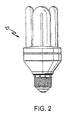
- a low pressure mercury vapor discharge lamp 10 according to the invention, which is generally well known in the art.
- the lamp 10 has a light-transmissive, preferably linear and cylindrical, glass tube or envelope 12 that preferably has a circular cross section.
- Lamp 10 can be a fluorescent lamp, such as a T12, T10 or T8 lamp, which is generally known in the art, nominally 48 inches or 4 feet in length, a cylindrical tube, and having a nominal outer diameter of at least 1 inch or an outer diameter of 1 inch or about 1 inch.
- the lamp 10 can also be nominally 1.5, 2, 3, 5, 6 or 8 feet long.
- the lamp 10 can be nonlinear, for example circular or otherwise curvilinear in shape, or have a nominal outer diameter less than one inch such as a T5, T4 or T3 lamp having nominal outer diameters of about 0.625 (5 ⁇ 8) inch, 0.5 (1 ⁇ 2) inch and 0.375 (3 ⁇ 8) inch, respectively.
- the lamp 10 can also be nominally 1.5, 2, 3, 4, 5, 6 or 8 feet long, or it may be a compact fluorescent lamp (CFL) having a spiral, multi-finger, folded or wrapped topology so that the overall length of the lamp is much shorter than the unfolded length of the glass tube.
- CFL compact fluorescent lamp
- the lamp 10 is hermetically sealed by bases 20 attached at both ends and electrodes or electrode structures 18 (to provide an arc discharge) are respectively mounted on the bases 20.
- a discharge-sustaining fill 22 is provided inside the sealed glass envelope, the fill comprising or being an inert gas or inert gas mixture at a low pressure in combination with a small quantity of mercury to provide the low vapor pressure manner of lamp operation.
- the inert gas in the fill comprises at least one rare gas such as, but not limited to, argon, krypton, xenon and neon or combinations thereof.
- the total pressure of the fill 22 is preferably 0.4-5, preferably 1-3, preferably 1.6-2.8, torr at the conventional fill temperature as known in the art, for example 25° C.
- the light-transmissive envelope 12 can be a clear and colorless glass.
- the light-transmissive envelope 12 is substantially free of a material including cerium (Ce) or cerium compounds, such as cerium oxide (CeO 2 ) or combinations thereof and the like.
- the glass envelope might comprise less than 1, preferably 0.5, or about 0.4, 0.3, 0.2, 0.15 or 0.1 weight percent cerium or cerium compounds, based on total weight of the envelope 12.
- An example of transparent glass that can be used as the light-transmissive envelope 12 is a cerium-free Type 360 glass supplied by EMGO Industriezone Balendijik 1050, 3920 Lommel, Belgium.
- Figure 6 illustrates a UV transmission curve for a cerium-free Type 360 glass envelope supplied by EMGO.
- the light-transmissive envelope 12 can be colored or tinted glass instead of a clear and colorless glass.
- the colored or tinted glass can be, for example, cobalt blue glass or a deep-bluish-purple glass such as Wood's glass.
- the colored glass preferably blocks or filters substantially all visible light having wavelengths above 400 nanometers ("nm").
- the colored glass can be doped with nickel oxides, such as NiO, Ni 2 O 3 and NiO 2 and/or cobalt oxides, such as CoO, Co 2 O 3 and Co 3 O 4 .
- An example of colored glass that can be used as the light-transmissive envelope 12 is Mengshi UV 3650A BLB glass supplied by Kun Shan Mengshi Glass Ltd.
- the product 3650A BLB glass is a cobalt oxide- and nickel oxide-doped glass having a deep blue color.
- the product 3650A BLB glass includes the following components in minimum compositional weight percents: 65 wt. % SiO 2 , 0.5 wt. % Al 2 O 3 , 8 wt. % Na 2 O, 2 wt. % K 2 O, 0.5 wt. % B 2 O 3 , 6 wt. % PbO, 1 wt. % BaO, 1 wt. % CaO and 1.5 wt. % CoO and NiO.
- the light-transmissive envelope 12 substantially free of cerium as described above provides improved transmission of UVA light. It is desirable that the envelope 12 have improved UV transmission of UVA light having a wavelength in the range of 320-400, preferably 320-375, preferably 320-365, preferably 320-360, more preferably 320-355 or about 320 to 354 nm. Improved UVA transmission at the above wavelengths provides intense light within the eye sensitivity curve of an insect as shown in Figure 5 discussed below. Improved UV transmission within the eye sensitivity curve on an insect allows a lamp 10 to have improved insect attraction.
- insects can see ultraviolet light having a wavelength in the range of 300-380 nm, with a peak sensitivity in the range of 320 to 360 nm.
- An envelope 12 having improved UVA transmission at wavelengths in the range of 320 to 360 nm can increase the intensity of the UVA light-emitting phosphor or blend of phosphors of the phosphor layer 16 described below. Increased UVA intensity over the life of a lamp 10 extends the useful life of a lamp 10. Such a lamp 10 can improve insect attraction initially and over its useful life.
- the inner surface of the envelope 12 is preferably provided with a barrier coating or layer 14 for improved light softness and/or brightness maintenance with age.
- the inner surface of the barrier layer 14 is preferably provided with a phosphor layer 16, the barrier layer 14 being between the envelope 12 and the phosphor layer 16.
- Phosphor layer 16 is preferably a rare earth phosphor layer, such as a rare earth triphosphor or multi-phosphor layer, or other phosphor layer.
- the barrier layer 14 can comprise a blend of alumina particles.
- the barrier layer 14 can comprise entirely gamma alumina particles or a blend of gamma- and alpha- alumina particles that are preferably 5-80 or 10-65 or 20-40 weight percent gamma alumina and 20-95 or 35-90 or 60-80 weight percent alpha alumina.
- the barrier layer 14 might include Degussa-C colloidal alumina particles which can result in better lumen irradiance of the lamp 10.
- the phosphor layer 16 is coated on the inner surface of the barrier layer 14 and preferably has a coating weight of 1-5, preferably 2-5, preferably 2.5-5, more preferably 3-4.5 or about 3, 3.1, 3.2, 3.3, 3.4, 3.5, 3.6, 3.7, 3.8, 3.9, 4, 4.1, 4.2, 4.3, 4.4 or 4.5 mg/cm 2 .
- the phosphor layer 16 comprises at least one rare earth phosphor layer, but it may also be any other phosphor layer as known in the art.
- the phosphor layer 16 is substantially free of lead or lead-doped phosphors.
- the phosphor layer 16 preferably emits light in UVA region in the range of 320 to 400 nm.
- the phosphor layer 16 preferably comprises at least one phosphor having an emission band with a maximum between 320-400, preferably 325-375, preferably 325-370, preferably 325-365, preferably 340-360, more preferably 345-355 or about 350 or 354 nm.
- a single phosphor can be used in the phosphor layer 16.
- the phosphor or phosphor blend of the phosphor layer 16 emits substantially no light in the UVB and UVC regions, such as in the wavelength range of 100 to 300 and more preferably 100 to 320 nm.
- the phosphor layer 16 can further comprise alumina particles, such as Degussa-C colloidal alumina particles.
- the phosphor layer 16 might include 0.1 to 10, preferably 1 to 8, preferably 2-6 or about 3, 3.5, 4, 4.5 or 5 weight percent alumina particles. It is thought that alumina particles can promote improved adhesion characteristics and support higher light output or intensity to the phosphor layer 16.
- the phosphor layer 16 can include, for example, a yttrium phosphate cerium doped phosphor such as YPO 4 :Ce having product code NP-805 supplied by Nichia Corporation, 491 Oka, Kaminada-cho, Anan-shi, Tokushima 774-8601 Japan.
- An emission spectrum for the YPO4:Ce phosphor is shown in Figure 3 .
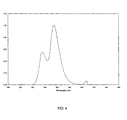
- An emission spectrum for a lamp 10 having a phosphor layer including the YPO 4 :Ce phosphor is shown in Figure 4 .
- the YPO 4 :Ce phosphor has dual emission peaks and a wide emission band in the UVA wavelength range of 320 to 400 nm.
- the YPO 4 :Ce phosphor has an emission spectrum in the UVA region with maximum peak at about 354 nm.
- the phosphor also has a strong peak at about 335 nm.
- the peak at about 354 nm is more intense than the peak at about 335 nm.
- the wide emission band of the yttrium phosphate in the UVA region closely matches the eye sensitivity curve of a common insect, which has a peak sensitivity in the wavelength range of 325 to 340 nm.
- a representative eye sensitivity curve for an insect is shown in Figure 5 .
- the eye of an insect is sensitive to light having a wavelength range of about 300 to 380 nm.
- the eye sensitivity of an insect is more intense at a wavelength range of about 320 to 360 nm, and more intense at 325 to 340 nm.
- the dual-peak emission spectrum of the YPO 4 :Ce phosphor provides intense insect attracting UVA light in the eye sensitivity range of an insect, and preferably in the more intense sensitivity range of about 325 nm to 360 nm.
- the dual emission peaks at 335 and 354 nm of the YPO 4 :Ce phosphor are within the intense eye sensitivity region of the insect eye sensitivity curve of Figure 5 .
- the 335 nm emission peak of the YPO 4 :Ce phosphor is within the peak sensitivity range of the eye of an insect at a wavelength range of 325 to 340 nm.
- a lamp 10 having a phosphor layer 16 comprising a yttrium phosphate cerium doped phosphor can have improved insect attraction characteristics.
- Other phosphors of the phosphor layer 16 can include europium-doped strontium fluoroborate (SrB 4 O 7 F:Eu 2+ ), europium-doped strontium borate (SrB 4 O 7 :Eu 2+ ) or combinations thereof and the like. Multiple phosphor layers may also be provided.
- the UVA light transmission of various light-transmissive glass envelopes was measured and compared as is conventional in the art.
- Table I below shows the UV transmission percentage for substantially cerium-free glass and conventional soda-lime glass for a range of UVA light wavelengths.
- the UV transmission data represents the UV transmission of the glass envelopes per 1 mm of glass thickness.
- the UV transmission percentage for the broader UV light wavelength range of about 250 to 450 nm is shown in Figure 6 .
- the cerium-free glass envelope was composed of cerium-free Type 360 glass supplied by EMGO Industriezone Balendijik 1050, 3920 Lommel, Belgium.
- the cerium-free glass used contains less than 0.2 weight percent CeO 2 .
- the soda-lime glass used is conventional and known in the art.
- UVA Transmission for Glass Envelopes (per 1 mm glass thickness) Glass Envelope Material Cerium-Free Glass Conventional Soda-Lime Glass Lamp Type Linear Fluorescent T4 Linear Fluorescent T8 Wavelength (nm) Percent (%) UV Transmission 320 64 40 328 75 57 334 81 68 340 85 76 344 87 80 350 89 84 354 89 86 360 90 87 364 90 88 370 91 89
- the cerium-free glass envelope has increased UVA transmission in the eye sensitivity curve for an insect as compared to a convention soda-lime glass envelope.
- the cerium-free glass had 24, 18, 13, 9, 7, 5, 3, 3, 2 and 2 percent greater light transmission through the glass envelope than the conventional soda-lime glass envelope at wavelengths of 322, 328, 334, 340, 344, 350, 354, 360, 364 and 370 nm, respectively.
- the cerium-free glass envelope has improved UVA transmission in an insect's eye sensitivity range.
- the cerium-free glass of this example provides improved UVA transmission in the peak region of the eye sensitivity curve at a wavelength range of 320 to 360 nm, and more preferably at a range of 325 to 340 nm, as shown in Figure 6 .
- the cerium-free glass preferably has a UV transmission greater than 40, preferably 45, preferably 50, preferably 52, preferably 55, or preferably about 56, 57, 58, 59, 60, 61, 62, 63 or about 63.5 percent in the wavelength range of 320 nm to 370 nm.
Landscapes
- Life Sciences & Earth Sciences (AREA)
- Pest Control & Pesticides (AREA)
- Engineering & Computer Science (AREA)
- Insects & Arthropods (AREA)
- Wood Science & Technology (AREA)
- Zoology (AREA)
- Environmental Sciences (AREA)
- Vessels And Coating Films For Discharge Lamps (AREA)
Applications Claiming Priority (1)
| Application Number | Priority Date | Filing Date | Title |
|---|---|---|---|
| US11/942,245 US20090128000A1 (en) | 2007-11-19 | 2007-11-19 | Insect attraction light source |
Publications (2)
| Publication Number | Publication Date |
|---|---|
| EP2060177A2 true EP2060177A2 (de) | 2009-05-20 |
| EP2060177A3 EP2060177A3 (de) | 2012-05-02 |
Family
ID=40417629
Family Applications (1)
| Application Number | Title | Priority Date | Filing Date |
|---|---|---|---|
| EP08168543A Withdrawn EP2060177A3 (de) | 2007-11-19 | 2008-11-07 | Verbesserte Lichtquelle zum Anlocken von Insekten |
Country Status (3)
| Country | Link |
|---|---|
| US (1) | US20090128000A1 (de) |
| EP (1) | EP2060177A3 (de) |
| CN (1) | CN101447389A (de) |
Cited By (4)
| Publication number | Priority date | Publication date | Assignee | Title |
|---|---|---|---|---|
| US20080229652A1 (en) * | 2007-03-24 | 2008-09-25 | John Cadman Willcox | Insect Trap |
| EP2319302A3 (de) * | 2009-11-04 | 2013-01-09 | P & L Systems Limited | Insektenfalle |
| CN103039429A (zh) * | 2012-12-28 | 2013-04-17 | 青岛润鑫伟业科贸有限公司 | 一种高效驱蚊灯 |
| RU174664U1 (ru) * | 2016-07-26 | 2017-10-24 | Федеральное государственное бюджетное образовательное учреждение высшего образования "Астраханский государственный университет" | Устройство на основе материалов с переизлучающими свойствами для привлечения насекомых |
Families Citing this family (4)
| Publication number | Priority date | Publication date | Assignee | Title |
|---|---|---|---|---|
| WO2016196215A1 (en) | 2015-05-29 | 2016-12-08 | Ecolab Usa Inc. | Device and method for attracting and trapping flying insects |
| USD818559S1 (en) | 2016-05-20 | 2018-05-22 | Ecolab Usa Inc. | Insect trap |
| CN108184790B (zh) * | 2018-01-19 | 2024-05-17 | 张成美 | 一种无源多光谱高效杀虫装置 |
| CN119908261A (zh) * | 2025-01-16 | 2025-05-02 | 上海辰山植物园 | 一种用光谱周期防治月季虫害的方法 |
Citations (1)
| Publication number | Priority date | Publication date | Assignee | Title |
|---|---|---|---|---|
| US5602444A (en) | 1995-08-28 | 1997-02-11 | General Electric Company | Fluorescent lamp having ultraviolet reflecting layer |
Family Cites Families (13)
| Publication number | Priority date | Publication date | Assignee | Title |
|---|---|---|---|---|
| US4490937A (en) * | 1981-12-07 | 1985-01-01 | Amcor Ltd. | Insect electrocution device |
| US5021710A (en) * | 1990-05-02 | 1991-06-04 | Nolan James D | Insect attraction lamp |
| GB2266649B (en) * | 1992-05-09 | 1996-01-03 | Peter Cox Group Limited | A flying insect control device |
| JP2511393B2 (ja) * | 1992-09-15 | 1996-06-26 | パテント−トロイハント−ゲゼルシヤフト フユア エレクトリツシエ グリユーランペン ミツト ベシユレンクテル ハフツング | メタルハライドランプ |
| CA2185957A1 (en) * | 1995-10-11 | 1997-04-12 | Jon Bennett Jansma | Fluorescent lamp having phosphor layer with additive |
| US6841494B2 (en) * | 1998-06-17 | 2005-01-11 | Nippon Sheet Glass Co., Ltd. | Ultraviolet/infrared absorbent green glass with medium light transmittance |
| JP2001332216A (ja) * | 2000-03-14 | 2001-11-30 | Toshiba Lighting & Technology Corp | 放電ランプ、光照射装置、殺菌装置、液体処理装置および空気清浄装置 |
| US6906475B2 (en) * | 2000-07-07 | 2005-06-14 | Matsushita Electric Industrial Co., Ltd. | Fluorescent lamp and high intensity discharge lamp with improved luminous efficiency |
| US6984931B2 (en) * | 2003-01-21 | 2006-01-10 | Osram Sylvania Inc. | UV-emitting phosphor blend and tanning lamp containing same |
| US7591962B2 (en) * | 2004-05-27 | 2009-09-22 | Koninklijke Philips Electronics N.V. | Low-pressure mercury vapor discharge lamp comprising UV-A phosphor |
| US7388219B2 (en) * | 2005-04-15 | 2008-06-17 | Lightsources, Inc. | Fluorescent lamp with optimized UVA/UVB transmission |
| US7497974B2 (en) * | 2006-08-01 | 2009-03-03 | Osram Sylvania Inc. | Ce,Pr-coactivated yttrium phosphate phosphor and lamp containing same |
| US20080096754A1 (en) * | 2006-10-19 | 2008-04-24 | Thomsen Scott V | UV transmissive soda-lime-silica glass |
-
2007
- 2007-11-19 US US11/942,245 patent/US20090128000A1/en not_active Abandoned
-
2008
- 2008-11-07 EP EP08168543A patent/EP2060177A3/de not_active Withdrawn
- 2008-11-19 CN CNA2008101762810A patent/CN101447389A/zh active Pending
Patent Citations (1)
| Publication number | Priority date | Publication date | Assignee | Title |
|---|---|---|---|---|
| US5602444A (en) | 1995-08-28 | 1997-02-11 | General Electric Company | Fluorescent lamp having ultraviolet reflecting layer |
Cited By (4)
| Publication number | Priority date | Publication date | Assignee | Title |
|---|---|---|---|---|
| US20080229652A1 (en) * | 2007-03-24 | 2008-09-25 | John Cadman Willcox | Insect Trap |
| EP2319302A3 (de) * | 2009-11-04 | 2013-01-09 | P & L Systems Limited | Insektenfalle |
| CN103039429A (zh) * | 2012-12-28 | 2013-04-17 | 青岛润鑫伟业科贸有限公司 | 一种高效驱蚊灯 |
| RU174664U1 (ru) * | 2016-07-26 | 2017-10-24 | Федеральное государственное бюджетное образовательное учреждение высшего образования "Астраханский государственный университет" | Устройство на основе материалов с переизлучающими свойствами для привлечения насекомых |
Also Published As
| Publication number | Publication date |
|---|---|
| US20090128000A1 (en) | 2009-05-21 |
| CN101447389A (zh) | 2009-06-03 |
| EP2060177A3 (de) | 2012-05-02 |
Similar Documents
| Publication | Publication Date | Title |
|---|---|---|
| EP2060177A2 (de) | Verbesserte Lichtquelle zum Anlocken von Insekten | |
| JP3837189B2 (ja) | 水銀蒸気放電ランプ | |
| US6787979B2 (en) | Rare-gas low-pressure discharge lamp, method of manufacturing a rare-gas low-pressure discharge lamp, and application of a gas discharge lamp | |
| KR20010051972A (ko) | 도핑 처리된 인광물질 피복을 가진 저압 수은 증기 방전램프 | |
| US3707641A (en) | Discharge device which utilizes a mixture of two fluorescent materials | |
| EP0188211B1 (de) | Fluoreszenzlampe mit Spektrum, das dem ultravioletten Spektrum des natürlichen Sonnenlichts im hohen Masse angenähert ist | |
| US4500810A (en) | Fluorescent lamp having integral light-filtering means and starting aid | |
| US7550910B2 (en) | Fluorescent lamp with barrier layer containing pigment particles | |
| US4371810A (en) | Plant growth type fluorescent lamp | |
| JP2003109541A (ja) | 紫外線蛍光ランプ | |
| JP5311506B2 (ja) | 放電ランプ | |
| EP1587132A3 (de) | Im sichtbaren Licht emittierende fluoreszente Lampe | |
| JP2003272559A (ja) | 蛍光ランプ | |
| US2213796A (en) | Gaseous electric discharge lamp device | |
| JP2006012766A (ja) | 蛍光ランプおよび植物栽培用照明器具 | |
| US6777867B2 (en) | Highly loaded fluorescent lamp | |
| JP2001250507A (ja) | 蛍光ランプおよび照明装置 | |
| KR20110010059A (ko) | 자외선 방전 램프 | |
| US8446085B2 (en) | Fluorescent lamp with zinc silicate phosphor and protective phosphor layer | |
| JPH10241631A (ja) | 蛍光ランプ | |
| US8004170B2 (en) | Tanning lamp | |
| JPH11283571A (ja) | 植物育成用蛍光ランプ | |
| DE19737280A1 (de) | Elektrodenlose Mehrfachentladungs-Fluoreszenzlampe | |
| JPS6329930B2 (de) | ||
| KR100319899B1 (ko) | 외부환경용 조명장치 |
Legal Events
| Date | Code | Title | Description |
|---|---|---|---|
| PUAI | Public reference made under article 153(3) epc to a published international application that has entered the european phase |
Free format text: ORIGINAL CODE: 0009012 |
|
| AK | Designated contracting states |
Kind code of ref document: A2 Designated state(s): AT BE BG CH CY CZ DE DK EE ES FI FR GB GR HR HU IE IS IT LI LT LU LV MC MT NL NO PL PT RO SE SI SK TR |
|
| AX | Request for extension of the european patent |
Extension state: AL BA MK RS |
|
| PUAL | Search report despatched |
Free format text: ORIGINAL CODE: 0009013 |
|
| AK | Designated contracting states |
Kind code of ref document: A3 Designated state(s): AT BE BG CH CY CZ DE DK EE ES FI FR GB GR HR HU IE IS IT LI LT LU LV MC MT NL NO PL PT RO SE SI SK TR |
|
| AX | Request for extension of the european patent |
Extension state: AL BA MK RS |
|
| RIC1 | Information provided on ipc code assigned before grant |
Ipc: C03C 4/00 20060101ALI20120323BHEP Ipc: H01J 61/72 20060101ALI20120323BHEP Ipc: H01J 61/44 20060101ALI20120323BHEP Ipc: H01J 61/40 20060101ALI20120323BHEP Ipc: H01J 61/30 20060101ALI20120323BHEP Ipc: A01M 1/04 20060101AFI20120323BHEP |
|
| AKY | No designation fees paid | ||
| REG | Reference to a national code |
Ref country code: DE Ref legal event code: R108 |
|
| REG | Reference to a national code |
Ref country code: DE Ref legal event code: R108 Effective date: 20130109 |
|
| STAA | Information on the status of an ep patent application or granted ep patent |
Free format text: STATUS: THE APPLICATION IS DEEMED TO BE WITHDRAWN |
|
| 18D | Application deemed to be withdrawn |
Effective date: 20121103 |