EP2061277A2 - Prothèse auditive avec connecteur contrôlé de programmation - Google Patents
Prothèse auditive avec connecteur contrôlé de programmation Download PDFInfo
- Publication number
- EP2061277A2 EP2061277A2 EP08165919A EP08165919A EP2061277A2 EP 2061277 A2 EP2061277 A2 EP 2061277A2 EP 08165919 A EP08165919 A EP 08165919A EP 08165919 A EP08165919 A EP 08165919A EP 2061277 A2 EP2061277 A2 EP 2061277A2
- Authority
- EP
- European Patent Office
- Prior art keywords
- terminal
- programming
- hearing
- potential
- signal processing
- Prior art date
- Legal status (The legal status is an assumption and is not a legal conclusion. Google has not performed a legal analysis and makes no representation as to the accuracy of the status listed.)
- Withdrawn
Links
Images


Classifications
-
- H—ELECTRICITY
- H04—ELECTRIC COMMUNICATION TECHNIQUE
- H04R—LOUDSPEAKERS, MICROPHONES, GRAMOPHONE PICK-UPS OR LIKE ACOUSTIC ELECTROMECHANICAL TRANSDUCERS; ELECTRIC HEARING AIDS; PUBLIC ADDRESS SYSTEMS
- H04R25/00—Electric hearing aids
- H04R25/55—Electric hearing aids using an external connection, either wireless or wired
- H04R25/556—External connectors, e.g. plugs or modules
-
- H—ELECTRICITY
- H04—ELECTRIC COMMUNICATION TECHNIQUE
- H04R—LOUDSPEAKERS, MICROPHONES, GRAMOPHONE PICK-UPS OR LIKE ACOUSTIC ELECTROMECHANICAL TRANSDUCERS; ELECTRIC HEARING AIDS; PUBLIC ADDRESS SYSTEMS
- H04R1/00—Details of transducers, loudspeakers or microphones
- H04R1/10—Earpieces; Attachments therefor ; Earphones; Monophonic headphones
- H04R1/1041—Mechanical or electronic switches, or control elements
-
- H—ELECTRICITY
- H04—ELECTRIC COMMUNICATION TECHNIQUE
- H04R—LOUDSPEAKERS, MICROPHONES, GRAMOPHONE PICK-UPS OR LIKE ACOUSTIC ELECTROMECHANICAL TRANSDUCERS; ELECTRIC HEARING AIDS; PUBLIC ADDRESS SYSTEMS
- H04R2225/00—Details of deaf aids covered by H04R25/00, not provided for in any of its subgroups
- H04R2225/61—Aspects relating to mechanical or electronic switches or control elements, e.g. functioning
-
- H—ELECTRICITY
- H04—ELECTRIC COMMUNICATION TECHNIQUE
- H04R—LOUDSPEAKERS, MICROPHONES, GRAMOPHONE PICK-UPS OR LIKE ACOUSTIC ELECTROMECHANICAL TRANSDUCERS; ELECTRIC HEARING AIDS; PUBLIC ADDRESS SYSTEMS
- H04R25/00—Electric hearing aids
- H04R25/60—Mounting or interconnection of hearing aid parts, e.g. inside tips, housings or to ossicles
- H04R25/603—Mounting or interconnection of hearing aid parts, e.g. inside tips, housings or to ossicles of mechanical or electronic switches or control elements
Definitions
- Hearing aids are portable hearing aids that are used to care for the hearing impaired.
- different types of hearing aids such as behind-the-ear hearing aids (BTE), hearing aid with external receiver (RIC: receiver in the canal) and in-the-ear hearing aids (IDO), e.g. Concha hearing aids or canal hearing aids (ITE, CIC).
- BTE behind-the-ear hearing aids
- RIC hearing aid with external receiver
- IDO in-the-ear hearing aids
- ITE canal hearing aids
- the hearing aids listed by way of example are worn on the outer ear or in the ear canal.
- bone conduction hearing aids, implantable or vibrotactile hearing aids are also available on the market. The stimulation of the damaged hearing takes place either mechanically or electrically.
- Hearing aids have in principle as essential components an input transducer, an amplifier and an output transducer.
- the input transducer is usually a sound receiver, z. As a microphone, and / or an electromagnetic receiver, for. B. an induction coil.
- the output transducer is usually used as an electroacoustic transducer, z. As miniature speaker, or as an electromechanical transducer, z. B. bone conduction, realized.
- the amplifier is usually integrated in a signal processing unit. This basic structure is in FIG. 1 shown using the example of a behind-the-ear hearing aid. In a hearing aid housing 1 for carrying behind the ear are one or more microphones 2 to Built-in sound recording from the environment.
- a signal processing unit 3 which is also integrated in the hearing aid housing 1, processes the microphone signals and amplifies them.
- the output signal of the signal processing unit 3 is transmitted to a loudspeaker or earpiece 4, which outputs an acoustic signal.
- the sound is optionally transmitted via a sound tube, which is fixed with an earmold in the ear canal, to the eardrum of the device carrier.
- the power supply of the hearing device and in particular the signal processing unit 3 is effected by a likewise integrated into the hearing aid housing 1 battery. 5
- the object of the present invention is to make the best possible use of the space available in a hearing device or to correspondingly reduce the hearing device.
- this object is achieved by a hearing device with a programming socket which has at least one first connection and one second connection, a signal processing device which is connected to the second connection, and a control device, wherein the control device taps off the potential of the first connection and the control device the signal processing means switches to a first function when the first terminal is at the predetermined potential and switches to a second function when the potential of the first terminal deviates from the predetermined potential.
- the programming socket has a third terminal which is connected to a fixed internal potential of the hearing device, wherein a coupling element is releasably connected on the one hand to the third terminal and on the other hand to the first terminal, whereby the predetermined potential is formed by the fixed internal potential.
- a coupling element is releasably connected on the one hand to the third terminal and on the other hand to the first terminal, whereby the predetermined potential is formed by the fixed internal potential.
- the fixed internal potential can be, for example, ground or a supply voltage. Both potentials are typically applied to each terminal of the programming socket, so that one of them can be transmitted to the third terminal as a coupling element, for example with the aid of a simple electrical conductor.
- the third connection can also be coupled, for example, by means of an ohmic resistance as a coupling element to ground or the supply voltage in the programming socket.
- a characteristic voltage can be applied to the third terminal which unequivocally indicates a specific function of the second port.
- a push-button is connected to the second connection.
- the programming input can also be used for a so-called user interface.
- a stylus device can be plugged onto the programming socket, which include the stylus and the coupling element, with which the first terminal is set to a specific potential. The stylus does not require a special place on the surface of the hearing and serves as a protection of the programming socket.
- the first connection for synchronization and the second connection for data input can serve in programming the hearing device.
- the synchronization terminal is used for terminal coding and the data input terminal is used for analog signal input, for example.
- FIG. 2 a programming jack shown in plan view. It usually has four contacts 11 to 14. In the plan view, the corresponding Lötfahen can be seen. In the example chosen, the first contact 11 serves as a VCC terminal, the second contact 12 as a ground terminal, the third contact 13 for data transfer (NData) and the fourth contact 14 for synchronization (NClock).
- NData data transfer
- NClock synchronization
- connection NData In order to be able to use the contacts or connections of a programming socket several times, one of the connections, in this case the connection NData or the contact 13 of the programming socket, is coded with a signal which is characteristic for the respective use (function). The further signal processing then takes place according to the characteristic signal.
- FIG. 3 For this purpose, an exemplary circuit diagram for the wiring of the programming socket is shown. Due to the multiple use of an analog / digital converter 15 samples the NData input of the programming socket cyclically. This is done symbolically by means of a switch 16. At certain time intervals, the digital / analog converter 15 thus detects the voltage applied to the input NData. The voltage value is digitally converted and supplied to a controller 17. This decides which function the inputs NClock and NData or their downstream signal processing should have.
- controller 17 controls a second switch 19 in the case of programming so that the synchronization input NClock is switched through to the programming interface 18. This results in the customary use of the programming inputs NClock and NData for programming the hearing device or the hearing device.
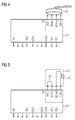
- a typical signal processing chip 21 is shown schematically. It has four signal inputs or outputs TR1 to TR4, four user interface inputs USI1 to USI4 and two voltage inputs VC1 and VC2.
- a programming interface PI is integrated in it, which has the inputs VCC, NData, NClock and GND.
- a programming plug 22 on the programming socket 10 not shown (see. FIG. 2 ) and thus uses the inputs of the programming interface PI for programming.
- the inputs of the signal processing chip are now also used to receive user signals.
- a probe device 23 (not shown) plugged into the programming socket 10 and connected to the programming interface PI.
- the feeler device 23 includes a coupling element 24, with which the two inputs VCC and NData are short-circuited.
- the input NData (first connection) is at the potential of the input VCC (third connection).
- the further input NClock (second connection) acquires a new function, namely that of the signal input from the feeler device 23.
- the feeler device 23 has a pushbutton 25 which is here between the connections or inputs NClock and GND is switched. Upon actuation of the button 25 so the input NClock is at ground potential. With this button 25 can thus be realized, for example, a program switching function on a hearing aid.
- the input NClock of the programming interface PI thus serves as user signal input.
- the coupling element 24 may be provided, for example, with an ohmic resistance, which optionally forms a voltage divider with a further resistor in the signal processing chip 21 '.
- an ohmic resistance which optionally forms a voltage divider with a further resistor in the signal processing chip 21 '.
- the input NData can thus be set to different potentials.
- a corresponding number of different functions in the signal processing can then be provided.
- the programming jack for a variety of Use user interfaces or user interfaces that independently recognizes the hearing device or the hearing device.
Landscapes
- Engineering & Computer Science (AREA)
- Computer Networks & Wireless Communication (AREA)
- Health & Medical Sciences (AREA)
- General Health & Medical Sciences (AREA)
- Neurosurgery (AREA)
- Otolaryngology (AREA)
- Physics & Mathematics (AREA)
- Acoustics & Sound (AREA)
- Signal Processing (AREA)
- Headphones And Earphones (AREA)
Applications Claiming Priority (1)
| Application Number | Priority Date | Filing Date | Title |
|---|---|---|---|
| DE102007054603.5A DE102007054603B4 (de) | 2007-11-15 | 2007-11-15 | Hörvorrichtung mit gesteuerter Programmierbuchse |
Publications (2)
| Publication Number | Publication Date |
|---|---|
| EP2061277A2 true EP2061277A2 (fr) | 2009-05-20 |
| EP2061277A3 EP2061277A3 (fr) | 2013-06-05 |
Family
ID=40352068
Family Applications (1)
| Application Number | Title | Priority Date | Filing Date |
|---|---|---|---|
| EP08165919.5A Withdrawn EP2061277A3 (fr) | 2007-11-15 | 2008-10-06 | Prothèse auditive avec connecteur contrôlé de programmation |
Country Status (3)
| Country | Link |
|---|---|
| US (1) | US8259971B2 (fr) |
| EP (1) | EP2061277A3 (fr) |
| DE (1) | DE102007054603B4 (fr) |
Families Citing this family (3)
| Publication number | Priority date | Publication date | Assignee | Title |
|---|---|---|---|---|
| US9497554B2 (en) * | 2014-05-07 | 2016-11-15 | Starkey Laboratories, Inc. | Flex-based connector for hearing aid |
| DK3139634T3 (da) * | 2015-08-24 | 2019-12-16 | Oticon As | Høreanordningsgrænseflade |
| AU2017318955B2 (en) * | 2016-08-29 | 2020-06-25 | 3M Innovative Properties Company | Electronic hearing protector with switchable electrical contacts |
Family Cites Families (34)
| Publication number | Priority date | Publication date | Assignee | Title |
|---|---|---|---|---|
| US4049930A (en) * | 1976-11-08 | 1977-09-20 | Nasa | Hearing aid malfunction detection system |
| DE3734946A1 (de) * | 1987-10-15 | 1989-05-03 | Siemens Ag | Hoergeraet mit moeglichkeit zum telefonieren |
| US4972487A (en) * | 1988-03-30 | 1990-11-20 | Diphon Development Ab | Auditory prosthesis with datalogging capability |
| CH679966A5 (fr) | 1989-11-29 | 1992-05-15 | Ascom Audiosys Ag | |
| DE4233813C1 (de) | 1992-10-07 | 1993-11-04 | Siemens Audiologische Technik | Programmierbares hoerhilfegeraet |
| US5659621A (en) * | 1994-08-31 | 1997-08-19 | Argosy Electronics, Inc. | Magnetically controllable hearing aid |
| US5581747A (en) * | 1994-11-25 | 1996-12-03 | Starkey Labs., Inc. | Communication system for programmable devices employing a circuit shift register |
| US5600728A (en) * | 1994-12-12 | 1997-02-04 | Satre; Scot R. | Miniaturized hearing aid circuit |
| US5602925A (en) * | 1995-01-31 | 1997-02-11 | Etymotic Research, Inc. | Hearing aid with programmable resistor |
| US6424722B1 (en) * | 1997-01-13 | 2002-07-23 | Micro Ear Technology, Inc. | Portable system for programming hearing aids |
| US7787647B2 (en) * | 1997-01-13 | 2010-08-31 | Micro Ear Technology, Inc. | Portable system for programming hearing aids |
| US6144748A (en) * | 1997-03-31 | 2000-11-07 | Resound Corporation | Standard-compatible, power efficient digital audio interface |
| US6546110B1 (en) * | 1999-06-16 | 2003-04-08 | Phonak Ag | Behind-the-ear hearing aid and attachment module for same |
| US6456199B1 (en) * | 2000-02-18 | 2002-09-24 | Dosebusters Usa | Continuous noise monitoring and reduction system and method |
| US20010033664A1 (en) * | 2000-03-13 | 2001-10-25 | Songbird Hearing, Inc. | Hearing aid format selector |
| US6970752B1 (en) * | 2000-05-17 | 2005-11-29 | Hewlett-Packard Development Company, L.P. | Method and apparatus for detecting switch closures |
| US6785394B1 (en) * | 2000-06-20 | 2004-08-31 | Gn Resound A/S | Time controlled hearing aid |
| JP4939722B2 (ja) * | 2000-07-14 | 2012-05-30 | ジーエヌ リザウンド エー/エス | 同期式ステレオ聴覚システム |
| DE10115896C2 (de) * | 2001-03-30 | 2003-12-24 | Siemens Audiologische Technik | Lösbar mit einem Hörgerät verbindbare Sende- und/oder Empfangseinheit sowie programmierbares Hörgerät |
| US6931141B2 (en) * | 2001-10-12 | 2005-08-16 | Gn Resound A/S | Hearing aid and a method for operating a hearing aid |
| US7292876B2 (en) * | 2002-10-08 | 2007-11-06 | Sonion Nederland B.V. | Digital system bus for use in low power instruments such as hearing aids and listening devices |
| US7430299B2 (en) * | 2003-04-10 | 2008-09-30 | Sound Design Technologies, Ltd. | System and method for transmitting audio via a serial data port in a hearing instrument |
| DE10344367B4 (de) * | 2003-09-24 | 2010-01-14 | Siemens Audiologische Technik Gmbh | Hörhilfegerät mit magnetfeldgesteuertem Schalter und entsprechendes Verfahren zum Betreiben eines Hörhilfegeräts |
| DE102005041355A1 (de) * | 2005-08-31 | 2007-03-01 | Siemens Audiologische Technik Gmbh | Hörvorrichtung mit Transpondereinrichtung und entsprechendes Datenübertragungsverfahren |
| US20100260363A1 (en) * | 2005-10-12 | 2010-10-14 | Phonak Ag | Midi-compatible hearing device and reproduction of speech sound in a hearing device |
| WO2007042043A2 (fr) * | 2005-10-14 | 2007-04-19 | Gn Resound A/S | Optimisation de parametres de prothese auditive |
| EP2005791A1 (fr) * | 2006-03-24 | 2008-12-24 | GN Resound A/S | Commande autodidacte de reglages de parametres d'aide auditive |
| DE102006024713B3 (de) | 2006-05-26 | 2007-08-30 | Siemens Audiologische Technik Gmbh | Hörvorrichtung mit einer Schwingkreisschaltung und entsprechendes Verfahren |
| US20100020992A1 (en) * | 2006-09-27 | 2010-01-28 | Oticon A/S | Hearing aid with memory space for functional settings and learned settings, and programming method thereof |
| EP2098097B1 (fr) * | 2006-12-21 | 2019-06-26 | GN Hearing A/S | Appareil auditif avec interface utilisateur |
| US8284968B2 (en) * | 2007-04-25 | 2012-10-09 | Schumaier Daniel R | Preprogrammed hearing assistance device with user selection of program |
| US7974716B2 (en) * | 2007-04-25 | 2011-07-05 | Schumaier Daniel R | Preprogrammed hearing assistance device with program selection based on patient usage |
| WO2009076949A1 (fr) * | 2007-12-19 | 2009-06-25 | Widex A/S | Dispositif d'aide auditive et un procédé pour utiliser l'aide auditive |
| US8600080B2 (en) * | 2008-01-14 | 2013-12-03 | Apple Inc. | Methods for communicating with electronic device accessories |
-
2007
- 2007-11-15 DE DE102007054603.5A patent/DE102007054603B4/de not_active Expired - Fee Related
-
2008
- 2008-10-06 EP EP08165919.5A patent/EP2061277A3/fr not_active Withdrawn
- 2008-11-12 US US12/291,686 patent/US8259971B2/en active Active
Also Published As
| Publication number | Publication date |
|---|---|
| DE102007054603A1 (de) | 2009-05-28 |
| US20090129614A1 (en) | 2009-05-21 |
| EP2061277A3 (fr) | 2013-06-05 |
| DE102007054603B4 (de) | 2018-10-18 |
| US8259971B2 (en) | 2012-09-04 |
Similar Documents
| Publication | Publication Date | Title |
|---|---|---|
| EP2053876B1 (fr) | Dispositif auditif doté d'un raccordement commun pour le blindage et l'identification d'un récepteur | |
| EP0591791B1 (fr) | Prothèse auditive programmable | |
| DE102009056916B4 (de) | Hörgerät mit einer platzsparenden Anordnung von Mikrofonen und Schallöffnungen | |
| EP2389015A2 (fr) | Prothèse auditive avec unité passive placée au fond du conduit auditif | |
| EP1962553A2 (fr) | Dispositif auditif doté d'un dispositif de support de batterie fixé magnétiquement | |
| EP1973375A2 (fr) | Appareil auditif doté d'une commutation de charge spéciale | |
| EP1933593B1 (fr) | Procédé de définition latérale pour l'adaptation d'aides auditives | |
| DE10145994A1 (de) | Steuerung eines Hörgeräts durch Klopfen | |
| DE102008030551A1 (de) | Hörgerät zur Aufnahme von zumindest einer austauschbaren Komponente, austauschbare Komponente und Hörgerätesystem aus dem Hörgerät und der Komponente | |
| DE102007007800B3 (de) | Hörvorrichtung mit Hörerkompensationsspule | |
| DE102008054087A1 (de) | Hörhilfegerät mit mindestens einem kapazitiven Näherungssensor | |
| DE102007054603B4 (de) | Hörvorrichtung mit gesteuerter Programmierbuchse | |
| DE3840393C3 (de) | Im Ohr zu tragendes elektroakustisches Gerät | |
| EP3197180B1 (fr) | Appareil auditif | |
| EP2373061A1 (fr) | Dispositif auditif doté d'un élément de guidage, notamment un canal acoustique | |
| EP2180725A2 (fr) | Dispositif d'écouteur doté d'un écouteur à oscillations découplées | |
| EP1973376B1 (fr) | Dispositif d'écoute doté d'un module de réglage du volume sonore amovible | |
| EP2091271A2 (fr) | Prothèse auditive intra-auriculaire avec élément de prise mobile | |
| DE102006049470B4 (de) | Hörgerät mit einer Montagevorrichtung für eine Komponente einer Hörvorrichtung und entsprechendes Verfahren | |
| DE102007033876B4 (de) | Hörvorrichtung mit linearem Schalter | |
| EP3697103B1 (fr) | Système d'appareil auditif avec connecteur de chargement de batterie peu encombrant | |
| EP2028878A2 (fr) | Procédé de définition latérale pour l'adaptation d'aides auditives | |
| WO2014049455A1 (fr) | Système auditif ainsi que procédé de transmission | |
| DE102009008456B4 (de) | Automatische Hörerkennung bei Hörhilfegeräten | |
| DE102010014213A1 (de) | Hörvorrichtung mit einer Hörhilfeeinheit und einer separaten Schnittstelleneinheit |
Legal Events
| Date | Code | Title | Description |
|---|---|---|---|
| PUAI | Public reference made under article 153(3) epc to a published international application that has entered the european phase |
Free format text: ORIGINAL CODE: 0009012 |
|
| AK | Designated contracting states |
Kind code of ref document: A2 Designated state(s): AT BE BG CH CY CZ DE DK EE ES FI FR GB GR HR HU IE IS IT LI LT LU LV MC MT NL NO PL PT RO SE SI SK TR |
|
| AX | Request for extension of the european patent |
Extension state: AL BA MK RS |
|
| PUAL | Search report despatched |
Free format text: ORIGINAL CODE: 0009013 |
|
| AK | Designated contracting states |
Kind code of ref document: A3 Designated state(s): AT BE BG CH CY CZ DE DK EE ES FI FR GB GR HR HU IE IS IT LI LT LU LV MC MT NL NO PL PT RO SE SI SK TR |
|
| AX | Request for extension of the european patent |
Extension state: AL BA MK RS |
|
| RIC1 | Information provided on ipc code assigned before grant |
Ipc: H04R 25/00 20060101AFI20130426BHEP Ipc: H04R 1/10 20060101ALI20130426BHEP Ipc: G06F 9/00 20060101ALI20130426BHEP Ipc: G06F 3/02 20060101ALI20130426BHEP |
|
| 17P | Request for examination filed |
Effective date: 20131205 |
|
| RBV | Designated contracting states (corrected) |
Designated state(s): AT BE BG CH CY CZ DE DK EE ES FI FR GB GR HR HU IE IS IT LI LT LU LV MC MT NL NO PL PT RO SE SI SK TR |
|
| AKX | Designation fees paid |
Designated state(s): AT BE BG CH CY CZ DE DK EE ES FI FR GB GR HR HU IE IS IT LI LT LU LV MC MT NL NO PL PT RO SE SI SK TR |
|
| RIC1 | Information provided on ipc code assigned before grant |
Ipc: G06F 3/02 20060101ALI20140103BHEP Ipc: H04R 25/00 20060101AFI20140103BHEP Ipc: G06F 9/00 20060101ALI20140103BHEP Ipc: H04R 1/10 20060101ALI20140103BHEP |
|
| 17Q | First examination report despatched |
Effective date: 20140207 |
|
| STAA | Information on the status of an ep patent application or granted ep patent |
Free format text: STATUS: THE APPLICATION IS DEEMED TO BE WITHDRAWN |
|
| 18D | Application deemed to be withdrawn |
Effective date: 20140618 |