EP2063343A1 - Tragbares endgerät, anzeigverfahren, programm zur bestimmung des anzeigemodus und computerlesbares aufzeichnungsmedium - Google Patents
Tragbares endgerät, anzeigverfahren, programm zur bestimmung des anzeigemodus und computerlesbares aufzeichnungsmedium Download PDFInfo
- Publication number
- EP2063343A1 EP2063343A1 EP07767565A EP07767565A EP2063343A1 EP 2063343 A1 EP2063343 A1 EP 2063343A1 EP 07767565 A EP07767565 A EP 07767565A EP 07767565 A EP07767565 A EP 07767565A EP 2063343 A1 EP2063343 A1 EP 2063343A1
- Authority
- EP
- European Patent Office
- Prior art keywords
- function
- displayed
- display
- distinguishing marks
- function distinguishing
- Prior art date
- Legal status (The legal status is an assumption and is not a legal conclusion. Google has not performed a legal analysis and makes no representation as to the accuracy of the status listed.)
- Withdrawn
Links
Images




Classifications
-
- G—PHYSICS
- G06—COMPUTING OR CALCULATING; COUNTING
- G06F—ELECTRIC DIGITAL DATA PROCESSING
- G06F3/00—Input arrangements for transferring data to be processed into a form capable of being handled by the computer; Output arrangements for transferring data from processing unit to output unit, e.g. interface arrangements
- G06F3/01—Input arrangements or combined input and output arrangements for interaction between user and computer
- G06F3/048—Interaction techniques based on graphical user interfaces [GUI]
- G06F3/0487—Interaction techniques based on graphical user interfaces [GUI] using specific features provided by the input device, e.g. functions controlled by the rotation of a mouse with dual sensing arrangements, or of the nature of the input device, e.g. tap gestures based on pressure sensed by a digitiser
- G06F3/0489—Interaction techniques based on graphical user interfaces [GUI] using specific features provided by the input device, e.g. functions controlled by the rotation of a mouse with dual sensing arrangements, or of the nature of the input device, e.g. tap gestures based on pressure sensed by a digitiser using dedicated keyboard keys or combinations thereof
-
- G—PHYSICS
- G06—COMPUTING OR CALCULATING; COUNTING
- G06F—ELECTRIC DIGITAL DATA PROCESSING
- G06F3/00—Input arrangements for transferring data to be processed into a form capable of being handled by the computer; Output arrangements for transferring data from processing unit to output unit, e.g. interface arrangements
- G06F3/01—Input arrangements or combined input and output arrangements for interaction between user and computer
- G06F3/02—Input arrangements using manually operated switches, e.g. using keyboards or dials
- G06F3/023—Arrangements for converting discrete items of information into a coded form, e.g. arrangements for interpreting keyboard generated codes as alphanumeric codes, operand codes or instruction codes
- G06F3/0233—Character input methods
- G06F3/0236—Character input methods using selection techniques to select from displayed items
-
- G—PHYSICS
- G06—COMPUTING OR CALCULATING; COUNTING
- G06F—ELECTRIC DIGITAL DATA PROCESSING
- G06F3/00—Input arrangements for transferring data to be processed into a form capable of being handled by the computer; Output arrangements for transferring data from processing unit to output unit, e.g. interface arrangements
- G06F3/01—Input arrangements or combined input and output arrangements for interaction between user and computer
- G06F3/02—Input arrangements using manually operated switches, e.g. using keyboards or dials
- G06F3/023—Arrangements for converting discrete items of information into a coded form, e.g. arrangements for interpreting keyboard generated codes as alphanumeric codes, operand codes or instruction codes
- G06F3/0238—Programmable keyboards
-
- H—ELECTRICITY
- H04—ELECTRIC COMMUNICATION TECHNIQUE
- H04M—TELEPHONIC COMMUNICATION
- H04M1/00—Substation equipment, e.g. for use by subscribers
- H04M1/72—Mobile telephones; Cordless telephones, i.e. devices for establishing wireless links to base stations without route selection
- H04M1/724—User interfaces specially adapted for cordless or mobile telephones
- H04M1/72466—User interfaces specially adapted for cordless or mobile telephones with selection means, e.g. keys, having functions defined by the mode or the status of the device
Definitions
- the present invention relates to a mobile terminal that displays function distinguishing marks indicating functions assigned to an operation key, and a method for displaying the function distinguishing marks.
- Patent Document 1 realizes an arrangement in which two different functions are assigned to a single operation key and the single operation key is pushed down long or short, so that either one of the two different functions is selected. This arrangement makes it possible to call a target function instead of increasing the number of operations.
- Portable phones having such an arrangement have been available commercially. It is possible to take a portable phone SH705 (Sharp Corporation) as an example of such portable phones.
- the portable phone SH705 is arranged such that a first function is called in a case where an operation key for calling functions (hereinafter, referred to as function calling key) is pushed down short, whereas a second function is called in a case where the function calling key is pushed down long.
- a function distinguishing mark indicating the first function is displayed on a display section of the portable phone but a function distinguishing mark indicating the second function is not displayed.
- a user cannot know, by merely looking at a display section, what a second function to be called in a case where a function calling key is pushed down long is.
- the portable phone SH705 displays on the display section only a function distinguishing mark indicating a first function to be called in a case where the function calling key is pushed down short. That is, the second function is a kind of hidden function. Therefore, in consideration of usability, it is difficult to employ an arrangement in which the second function is varied according to an application to be used in the portable phone. Therefore, a same function is always assigned to the second function.
- An object of the present invention is to provide a mobile terminal capable of efficiently displaying function distinguishing marks corresponding respectively to a plurality of functions assigned to a single operation key.
- a mobile terminal is a mobile terminal capable of executing a plurality of functions in response to different operations to be performed with respect to a single operation key, including display means for displaying a plurality of function distinguishing marks indicating the plurality of functions, the number of the function distinguishing marks to be displayed being changed in accordance with the number of the functions assigned to the single operation key.
- a display method is a display method for displaying a plurality of function distinguishing marks in a mobile terminal, said mobile terminal capable of executing a plurality of functions in response to different operations to be performed with respect to a single operation key, the mobile terminal including display means for displaying the plurality of function distinguishing marks indicating the plurality of functions, said method including the step of changing the number of the function distinguishing marks to be displayed in accordance with the number of the functions assigned to the single operation key.
- the mobile terminal changes the number of the function distinguishing marks to be displayed on the screen of the display means, in accordance with the number of the functions assigned to the single operation key. For example, the mobile terminal displays one function distinguishing mark corresponding to one function in a case where the one function is assigned to an operation key. On the other hand, the mobile terminal displays two function distinguishing marks corresponding respectively to two functions in a case where the two functions are assigned to the operation key.
- the mobile terminal can notify a user that a plurality of functions are assigned to a single operation key, by displaying via the display means function distinguishing marks corresponding to the plurality of functions, in a case where the plurality of functions are assigned to the a single operation key.
- the number of the function distinguishing marks to be displayed can be changed in accordance with the number of functions assigned to the operation key. This makes it possible to efficiently use the display space of the display means.
- the mobile terminal according to the present invention is arranged such that the number of the function distinguishing marks to be displayed, which indicate functions assigned to a single operation key, is changed in accordance with the number of the functions.
- the display method according to the present invention includes a step of changing, in accordance with the number of the functions assigned to the single operation key, the number of the function distinguishing marks, indicating the functions, to be displayed.
- this makes it possible to efficiently display the unction distinguishing marks corresponding respectively to a plurality of functions assigned to a single operation key.
- a portable phone 1 is exemplified by an example of a mobile terminal according to the present invention.
- the present invention is, however, not limited to a portable phone. That is, the present invention can be applied to any kinds of mobile terminals, provided that (i) a plurality of functions can be assigned to a single operation key and (ii) the mobile terminal includes a display section for displaying function distinguishing marks indicating the plurality of functions.
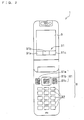
- Fig. 2 is a schematic diagram schematically illustrating the portable phone 1.
- the portable phone 1 is a mobile terminal having a plurality of functional modes.
- the portable phone 1 includes a plurality of operation keys 8 to be used for input operations, and a display section 9 (display means) for displaying a result processed by the portable phone 1.
- the display section 9 is exemplified by a liquid crystal display.
- the operation keys 8 include function calling keys 81 and a numeric keypad 82.
- the numeric keypad 82 is provided for entering characters, numerals, signs, etc.
- the function calling keys 81 are provided for calling predetermined functions of the portable phone 1. According to the function calling keys 81, it is possible to call a plurality of functions in response to different operations (a short push or a long push) with respect to a single function calling key. That is, the different operations with respect to a single function calling key 81 indicate that a period during which the single function calling key 81 is pushed down varies depending on a function to be called.
- a left soft key 81 a, a central soft key 81b, and a right soft key 81c are provided as the function calling keys 81.
- Names of functions assigned to the left soft key 81a, the central soft key 81 b, and the right soft key 81 c are indicated by function distinguishing marks to be displayed in a left-side display area 91a, a central display area 91b, and a right-side display area 91c, respectively, in a function name display area 91 of the display section 9.
- Fig. 1 is a schematic diagram schematically illustrating an arrangement of the portable phone 1 of the present embodiment.
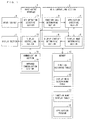
- the portable phone 1 includes a main controlling section 2, an input-output interface 7, operation keys 8, a display section 9, a memory 10, and a communication section 15.
- the portable phone 1 includes members, such as a speaker and a microphone, for functioning as a portable phone, the members are omitted in Fig. 1 .
- the input-output interface 7 includes a key operation detecting section 71 and a display controlling section 72.
- the key operation detecting section 71 detects an operation performed by a user with respect to an operation key 8, and supplies to the main controlling section 2 a detected result indicative of which key has been pushed down. In a case where a function calling key 81 is pushed down, the key operation detecting section 71 determines whether or not such a function calling key 81 is pushed down for predetermined time or longer, and then, supplies the result thus determined to the main controlling section 2. That is, the key operation detecting section 71 determines whether a function calling key 81 is pushed down short or long.
- the predetermined time is two seconds, for example.
- the display controlling section 72 controls the display section 9 so as to cause the display section 9 to display information supplied from the main controlling section 2.
- the memory 10 stores a function assigning table 11, a display mode determining table 12, a function name display table 13, and an application program 14. The details of each of the tables are described later.
- the memory 10 also stores various kinds of data (not illustrated) such as image data collected by a user.
- the main controlling section 2 includes a function call determining section 3, an application executing section 4, a display mode determining section 5, and a display content determining section 6.
- the function call determining section 3 determines, based on information supplied from the key operation detecting section 71, what operation is performed by a user and which function is called by the user, and then supplies the results thus determined to the application executing section 4. Particularly, in a case where a function calling key 81 is pushed down, the function call determining section 3 determines which function has been called, based on (i) information indicative of which function calling key has been pushed down and (ii) a period during which the function calling key has been pushed down.
- the function is determined with reference to a function assigning table 11 corresponding to an application which is being executed by the application executing section 4 (i.e., corresponding to a functional mode selected by a user). It is possible to obtain information indicative of which function assigning table 11 should be referred to moment to moment, by checking and seeing the display mode determining section 5.
- the application executing section 4 boots an application program 14 corresponding to a function determined by the function call determining section 3, and carries out various processes in response to instructions from a user. A user is notified of what is executed by an application, via the display section 9 or the speaker (not illustrated).
- the display mode determining section 5 determines a display mode of a function distinguishing mark to be displayed on the function name display area 91, in accordance with information supplied from the application executing section 4. Then, the display mode determining section 5 supplies the result thus determined to the display content determining section 6. In other words, the display mode determining section 5 changes, in accordance with the number of functions assigned to a function calling key 81, the number of the function distinguishing marks, indicative of such functions, to be displayed on the screen of the display section 9. This is determined with reference to the display mode determining table 12.
- the display content determining section 6 determines a display content, i.e., which function distinguishing mark should be displayed in the function name display area 91, in accordance with the determination result supplied from the display mode determining section 5.
- the display content determining section 6 changes the sizes of the function distinguishing marks to be displayed on the screen of the display section 9, in accordance with the number of the function distinguishing marks to be displayed, the number being determined by the display mode determining section 5.
- the determination of the display content is made with reference to the function name display table 13.
- the display content determining section 6 supplies information on the display content of the function distinguishing marks to the display controlling section 72.
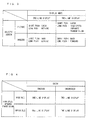
- Fig. 3 is a diagram illustrating an example of the function assigning table 11. Which function is assigned to a function calling key 81 varies depending on a screen to be displayed by an application which is selected by a user.
- Fig. 3 shows function names to be assigned to, for example, the right soft key 81 c of the function calling keys 81, (i) in a case where a picture screen is selected for browsing, editing, or transferring image data (not illustrated) stored in the memory 10, and (ii) in a case where a screen for displaying a browser for browsing web pages on the Internet.
- “Check” is assigned to the short push of the right soft key 81c and "high-speed infrared communication” is assigned to the long push of the right soft key 81c, in a case where function names are displayed in two lines.
- the "high-speed infrared communication” indicates a function of transmitting a selected image to an external device with the use of the high-speed infrared communication.
- the description above has dealt with a case where the picture screen is being selected and a case where the screen for displaying the browser is being selected.
- the function assigning table 11 can be further provided for other screens.
- a function assigning table 11 can be provided for each application. Alternatively, a single comprehensive function assigning table 11 can be provided.
- Display which indicates a function of zooming in an image
- "high-speed infrared communication” can be assigned to the long push of the central soft key 81b, in a case where the picture screen is displayed.
- "Cancel” can be assigned to the short push of the right soft key 81c
- "Undo” can be assigned to the long push of the right soft key 81c, in a case where a screen of a text editor is displayed.
- a function to be assigned to the long push be a function which (i) is used relatively often and (ii) is convenient if accessible without calling an option menu key.
- a further example of a function to be assigned to the long push encompass switching between a memory card and an internal memory while a data folder is operated.
- Fig. 4 shows the display mode determining table 12 to be used for determining whether to display on a picture screen the function distinguishing marks in a line or in two lines, i.e., the display mode determining table 12 to be used for determining whether the number of the function distinguishing marks to be displayed should be one (1) or two (2).
- a function distinguishing mark is displayed in a line on the picture screen, in a case where there is an image selected by placing a checkmark (the number of the function distinguishing marks to be displayed is one (1)).
- function distinguishing marks are displayed in two lines in a case where there is no image selected by placing a checkmark and a selected image is a file transmittable with the use of the high-speed infrared communication (the number of the function distinguishing marks to be displayed is two (2)).
- a function distinguishing marks is displayed in a line (the number of the function distinguishing marks to be displayed: one (1)).
- the display mode determining section 5 determines the number of the function distinguishing marks to be displayed, by comparing the display mode determining table 12 with a state of a process being executed by the application executing section 4, i.e., what operation is being carried out by a user.
- a display mode determining table 12 is provided for each application, or, for each process (subroutine) of an application. It is possible to suitably alter, according to the application, how the display mode determining table 12 is to be prepared.
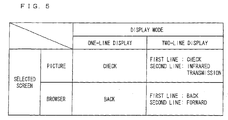
- Fig. 5 is a diagram illustrating an example of the function name display table 13 showing how to display function distinguishing marks on a picture screen and on a browser screen.
- a function distinguishing mark indicating "Check” is displayed in a line, in a case where the picture screen is being selected and a function name is displayed in a line.
- the function distinguishing mark indicating "Check” is displayed in a first line, and a function distinguishing mark indicating "infrared communication" is displayed in a second line.
- a function distinguishing mark indicating "Back” is displayed in a line.
- the function distinguishing mark indicating "Back” is displayed in the first line, and a function distinguishing mark indicating "Forward” is displayed in the second line.
- the display content determining section 6 (i) refers to the function name display table 13 in accordance with the determination result (the number of the function distinguishing marks to be displayed) supplied from the display mode determining section 5, and (ii) determines which function distinguishing mark should be displayed in the function name display area 91.
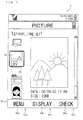
- FIG. 6 through 8 is a diagram illustrating an example of the picture screen.
- FIGs. 6 and 7 illustrates a state in which a function distinguishing mark 92c is displayed in a line in the right-side display area 91c.
- Fig. 8 illustrates a state in which function distinguishing marks 92d and 92e are displayed in two lines in the right-side display area 91c, respectively.
- a function distinguishing mark 92a indicating a function of calling a menu is displayed in the left-side display area 91a.
- a function distinguishing mark 92b indicating a function of zooming in a selected image is displayed in the central display area 91b.
- the high-speed infrared communication cannot be carried out in a case where there is an image selected by placing a checkmark (an image 22 in Fig. 6 ).
- the function distinguishing mark 92c indicating "Check” is displayed in a line in the right-side display area 91c.
- the function distinguishing mark 92c indicating "Check” is displayed in a line in the right-side display area 91c, in a case where a selected image (an image 23 in Fig. 7 ) is an image which cannot be transmitted with the use of the high-speed infrared communication (e.g., a GIF (Graphic Interchange Format) image).
- a selected image an image 23 in Fig. 7
- the high-speed infrared communication e.g., a GIF (Graphic Interchange Format) image
- the function distinguishing mark 92d indicating "Check” is displayed in the first line (in the upper line) in the right-side display area 91c
- the function distinguishing mark 92e indicating "infrared communication” is displayed in the second line (in the lower line) in the right-side display area 91c, in a case where (i) there is no image selected by placing a checkmark and (ii) a selected image (the image 21 in Fig. 8 ) is an image transmittable with the use of the high-speed infrared communication (e.g., a JPEG (Joint Photographic Experts Group) image).
- the portable phone 1 concurrently displays on the display section 9 a plurality of functions assigned to a single function calling key 81.
- the portable phone 1 displays, in a line in the right-side display area 91c, the function distinguishing mark 92c corresponding to the function of "Check.”
- the portable phone 1 displays, in upper and lower lines in the right-side display area 91c, the function distinguishing marks 92d and 92e corresponding respectively to the function of "Check” and the function of "high-speed infrared communication.”
- the function distinguishing marks 92d and 92e are substantially half as high as a function distinguishing mark to be displayed in a line.
- the portable phone 1 displays a function distinguishing mark in a line on the screen of the display section 9, in a case where the number of the function distinguishing marks to be displayed is one (1).
- the portable phone 1 displays a plurality of function distinguishing marks in lines on the screen. The number of the lines varies in accordance with the number of the plurality of function distinguishing marks to be displayed, in a case where the number is plural.
- the portable phone 1 divides the right-side display area 91c into two display areas where the function distinguishing marks 92d and 92e are displayed, respectively, in a case where two functions are assigned to the right soft key 81c.
- the portable phone 1 (particularly, the display mode determining section 5) changes the number of the display areas in accordance with the number of functions assigned to the right soft key 81c.
- the display mode and the display content are determined by the display mode determining section 5 and the display content determining section 6, respectively.
- a mark e.g., a character string "Long push”
- a function distinguishing mark indicating a function which can be called by carrying out an operation (e.g., a long push), other than a normal operation (e.g., a short push), with respect to a function calling key.
- a color distinguishing mark indicating a function which can be called by carrying out an operation e.g., a long push
- a normal operation e.g., a short push
- Figs. 6 and 7 deal with picture screens, and the function distinguishing marks indicated by "Menu,” “Display,” and “Check” are displayed in the function name display area 91. As to another screen, function distinguishing marks are displayed in the function name display area 91 in accordance with said another screen.
- the function distinguishing marks are displayed in the upper and lower lines in the right-side display area 91c.
- the function distinguishing marks can be displayed in the upper and lower lines in the left-side display area 91a, in a case where "Check" is assigned to the left soft key 81a.
- the function distinguishing marks can be displayed in the upper and lower lines in the central display area 91b. That is, the function distinguishing marks can be displayed in the upper and lower lines in a display area which is in the vicinity of a function calling key to which a plurality of functions are assigned.
- Figs. 6 through 8 illustrates screens of the display section 9 and the screens are merely examples.
- the present invention is not limited to the design of the screens of the display section 9.
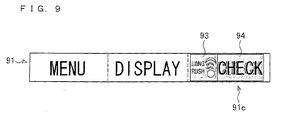
- Fig. 9 is a view illustrating the modification of the display method for displaying the function distinguishing marks.
- two function distinguishing marks 93 and 94 can be displayed so as to be transversely adjacent to each other, in a case where the two function distinguishing marks are displayed in a single function name display area 91 (e.g., in the right-side display area 91c). According to the display method, it is difficult to display a character string. In view of this, an icon (the function distinguishing mark 93 in Fig. 9 ) is displayed as a function distinguishing mark.
- character strings it is preferable to display character strings in two lines. This is because (i) a user can recognize more easily functions indicated by character strings, as compared to a case where the functions are indicated by icons, and (ii) a user can intuitively recognize the functions indicated by the character strings displayed in the upper and lower lines.
- Fig. 10 is a flow chart illustrating an example of the process flow of the portable phone 1. The following description deals with a process to be carried out by the portable phone 1 in a case where an operation for calling a picture screen is performed by a user.
- the key operation detecting section 71 supplies detected information to the function call determining section 3 (S1).
- the function call determining section 3 determines which function should be called, with reference to a function assigning table 11 corresponding to the standby screen (S2). Upon determining that an operation for calling the picture screen is performed, the function call determining section 3 supplies a determination result to the application executing section 4.
- the application executing section 4 boots an application for the picture screen.
- the application executing section 4 causes the display section 9 to display the picture screen, via the display controlling section 72 (S3).
- the application executing section 4 determines whether or not the selected image is a file transmittable with the use of the high-speed infrared communication (S4).
- the application executing section 4 supplies communication impossible information indicating as such to the display mode determining section 5.
- the display mode determining section 5 Upon receiving the communication impossible information, the display mode determining section 5 supplies to the display content determining section 6 an instruction (i.e., information indicating that the number of function distinguishing marks to be displayed is 1) to cause a function distinguishing mark to be displayed in a line, with reference to a display mode determining table 12 corresponding to the picture screen (S8) (display mode determining step).
- an instruction i.e., information indicating that the number of function distinguishing marks to be displayed is 1
- a function distinguishing mark to be displayed in a line with reference to a display mode determining table 12 corresponding to the picture screen (S8) (display mode determining step).
- the display content determining section 6 supplies to the display section 9, via the display controlling section 72, an instruction to cause the function distinguishing mark indicating "Check" to be displayed in a line in the right-side display area 91c, with reference to a function name display table 13 corresponding to the picture screen.
- the display section 9 Upon receiving the instruction, the display section 9 displays the function distinguishing mark indicating "Check” in a line in the right-side display area 91c (S9).
- the application executing section 4 determines whether or not there is an image selected by placing a checkmark (S5). If the user places a checkmark to an image, then information indicating that the image is selected by placing a checkmark is stored in a temporary memory provided in the application executing section 4. The application executing section 4 determines presence or absence of an image selected by placing a checkmark, with reference to the information stored in the temporary memory.
- step S5 If there is an image selected by placing a checkmark (YES in step S5), then the application executing section 4 supplies the communication impossible information to the display mode determining section 5. Descriptions of subsequent processes are omitted since they are the same as those described above.
- step S5 the application executing section 4 supplies to the display mode determining section 5 communication possible information indicating that the high-speed infrared communication is possible.
- the display mode determining section 5 Upon receiving the communication possible information, the display mode determining section 5 supplies to the display content determining section 6 an instruction (i.e., information indicating that the number of function distinguishing marks to be displayed is two (2)) to cause function distinguishing marks to be displayed in two lines, with reference to a display mode determining table 12 corresponding to the picture screen (S6) (display mode determining step).
- an instruction i.e., information indicating that the number of function distinguishing marks to be displayed is two (2)
- S6 display mode determining step
- the display content determining section 6 supplies to the display section 9 via the display controlling section 72 an instruction to cause (i) the function distinguishing mark indicating "Check” to be displayed in the first line in the right-side display area 91c, and (ii) the function distinguishing mark indicating "infrared communication" to be displayed in the second line in the right-side display area 91c, with reference to a function name display table 13 corresponding to the picture screen.
- the display section 9 Upon receiving the instruction, the display section 9 displays the function distinguishing mark indicating "Check” and the function distinguishing mark indicating "infrared communication" in the first line and the second line in the right-side display area 91c, respectively (S7).
- a checkmark is placed to a selected image.
- the selected image is transmitted by an infrared communication section 16 with the use of the high-speed infrared communication (not illustrated).
- the application executing section 4 Upon completion of the user operation performed while the picture screen is displayed, the application executing section 4 exits the application for the picture screen, and causes the screen of the display section 9 to return to the standby screen.
- the portable phone 1 is a mobile terminal capable of (i) accepting a plurality of different operations to be performed with respect to a single operation key and (ii) executing a plurality of functions corresponding to the plurality of different operations, respectively.
- the portable phone 1 changes, in accordance with the number of functions assigned to a single function calling key 81, the number of the function distinguishing marks, indicating the functions, to be displayed on the display section 9.
- the portable phone 1 displays on the display section all the function distinguishing marks of a plurality of functions, in a case where the plurality of functions are assigned to a single function calling key 81. This makes it possible to notify a user that the plurality of functions are assigned to the single function calling key 81.
- the portable phone 1 can change the number of the function distinguishing marks to be displayed, in accordance with the number of the functions assigned to a single function calling key 81. This makes it possible to efficiently use the function name display area 91 of the display section 9.
- the portable phone 1 changes the sizes of the function distinguishing marks on the screen of the display section 9 in accordance with the number of the functions assigned to a single function calling key 81 (i.e., in accordance with the determined number of the function distinguishing marks to be displayed).
- the portable phone 1 reduces the sizes of the function distinguishing marks in a case where the number of the function distinguishing marks to be displayed is large, whereas the portable phone 1 increases the sizes of the function distinguishing marks in a case where the number of the function distinguishing marks to be displayed is small. This makes it possible to use the function name display area 91 more efficiently, and improve the viewability of the function distinguishing marks.
- the short push and the long push of a function calling key 81 allow a plurality of functions to be called. As such, a function can be called by a single operation. This makes it possible to reduce the number of operations, as compared to an arrangement in which a user is required to call a menu in order to select a function.
- Function distinguishing marks are displayed in accordance with the functions assigned to a function calling key 81. This makes it possible to notify what is a next operation that the user can perform. That is, this allows each of the function distinguishing marks to fulfill a role as an operation guide.
- the function name display area 91 has a fixed height. Instead, the function name display area 91 can have a height which varies in accordance with the number of the function distinguishing marks to be displayed.
- a function distinguishing mark to be displayed in the second line can be displayed so as to be outside and adjacent to the function name display area 91.
- a function distinguishing mark represented by a font in a case where the function distinguishing mark is displayed in a line, and to display an image in which function distinguishing marks are displayed in upper and lower lines in a case where the function distinguishing marks are displayed in two lines.
- This is suitable in a case where (i) the function name display area 91 has a limited height and (ii) there is no small font which allows the function distinguishing marks to be displayed in upper and lower rows.
- a ratio between the heights of upper and lower lines can be set to about 6:4 in a case where the function distinguishing marks are displayed in two lines.
- a function to be used frequently is usually assigned to the upper line.
- the display mode above gives rise to an advantage of the prominence of the upper line.
- the three function calling keys i.e., the left soft key 81a, the central soft key 81b, and the right soft key 81c are provided. This makes it possible to assign a maximum of six kinds of functions to the three function calling keys, thereby enhancing the convenience.
- the number and the layout of the function calling keys 81 are not limited to those described above.
- the method for pushing down a function calling key 81 is not limited to the short push and the long push. Instead, it is possible to adopt different plural push-down methods. For example, it is possible to realize different calling functions by adopting the short push and double clicking.
- the blocks of the portable phone 1, in particular, the display mode determining section 5 may be realized by way of hardware or software as executed by a CPU as follows:
- the portable phone 1 includes a CPU (central processing unit) and memory devices (memory media).
- the CPU central processing unit
- the memory devices include a ROM (read only memory) which contains programs, a RAM (random access memory) to which the programs are loaded, and a memory containing the programs and various data.
- the objective of the present invention can also be achieved by mounting to the portable phone 1 a computer-readable storage medium containing control program (display mode determining program) code (executable program, intermediate code program, or source program) for the portable phone 1, which is software realizing the aforementioned functions, in order for the computer (or CPU, MPU) to retrieve and execute the program code contained in the storage medium.
- the storage medium may be, for example, a tape, such as a magnetic tape or a cassette tape; a magnetic disk, such as a floppy (Registered Trademark) disk or a hard disk, or an optical disk, such as CD-ROM/MO/MD/DVD/CD-R; a card, such as an IC card (memory card) or an optical card; or a semiconductor memory, such as a mask ROM/EPROM/EEPROM/flash ROM.
- a tape such as a magnetic tape or a cassette tape
- a magnetic disk such as a floppy (Registered Trademark) disk or a hard disk
- an optical disk such as CD-ROM/MO/MD/DVD/CD-R
- a card such as an IC card (memory card) or an optical card
- semiconductor memory such as a mask ROM/EPROM/EEPROM/flash ROM.
- the portable phone 1 may be arranged to be connectable to a communications network so that the program code may be delivered over the communications network.
- the communications network is not limited in any particular manner, and may be, for example, the Internet, an intranet, extranet, LAN, ISDN, VAN, CATV communications network, virtual dedicated network (virtual private network), telephone line network, mobile communications network, or satellite communications network.
- the transfer medium which makes up the communications network is not limited in any particular manner, and may be, for example, wired line, such as IEEE 1394, USB, electric power line, cable TV line, telephone line, or ADSL line; or wireless, such as infrared radiation (IrDA, remote control), Bluetooth®, 802.11 wireless, HDR, mobile telephone network, satellite line, or terrestrial digital network.
- the present invention encompasses computer data signals embedded in a carrier wave, which computer data signals are the program code embodied through electronic transmission.
- the mobile terminal preferably changes sizes of the function distinguishing marks to be displayed on a screen of the display means, in accordance with the number of the function distinguishing marks to be displayed.
- the mobile terminal changes the sizes of the function distinguishing marks to be displayed on the screen, in accordance with the determined number of the function distinguishing marks to be displayed.
- the mobile terminal (i) reduces the sizes of the function distinguishing marks in a case where the number of the function distinguishing marks to be displayed is large and a display area for the function distinguishing marks is fixed, or, (ii) increases the sizes of the function distinguishing marks in a case where the number of the function distinguishing marks to be displayed is small and the display area for the function distinguishing marks is fixed. This makes it possible to use the display area for the function distinguishing marks more efficiently, and improve the viewability of the function distinguishing marks.
- the mobile terminal preferably displays one function distinguishing mark in a line on the screen; and in a case where the number of the function distinguishing marks to be displayed is plural, the mobile terminal preferably displays the function distinguishing marks in plural lines on the screen in accordance with the number of the function distinguishing marks to be displayed.
- the mobile terminal displays, in a case where the number of the function distinguishing marks to be displayed is one (i.e., in a case where one function is assigned to an operation key), a function distinguishing mark corresponding to the function in one row on the screen of the display means;
- the mobile terminal displays, in a case where the number of the function distinguishing marks to be displayed is plural (i.e., a plurality of functions are assigned to an operation key), function distinguishing marks corresponding respectively to the plurality of functions in plural rows on the screen.
- the different operations are preferably operations causing a period during which the single operation key is pushed down to vary.
- different functions can be executed depending on whether time during which a single operation key is pushed down is long or short. That is, the different functions can be executed depending on whether the single operation key is pushed down shorter than a predetermined time or pushed down for the predetermined time or longer.
- the different functions can be executed in accordance with an entry through a simple operation of switching the time for pushing down an operation key between long time and short time.
- the technical scope of the present invention also encompasses (i) the display mode determining program for causing a computer to realize a function of changing in accordance with the number of functions assigned to a single operation key the number of the function distinguishing marks to be displayed which indicate the functions, and (ii) a computer-readable storage medium storing the display mode determining program.
- the present invention can display, with high viewability, a plurality of functions assigned to a single operation key. Therefore, the present invention is suitably applicable to a mobile terminal, in particular, a mobile terminal, having limited operation keys, which is supposed to be operated by one hand.
Landscapes
- Engineering & Computer Science (AREA)
- General Engineering & Computer Science (AREA)
- Theoretical Computer Science (AREA)
- Human Computer Interaction (AREA)
- Physics & Mathematics (AREA)
- General Physics & Mathematics (AREA)
- Computer Networks & Wireless Communication (AREA)
- Signal Processing (AREA)
- Telephone Function (AREA)
- Input From Keyboards Or The Like (AREA)
- Mobile Radio Communication Systems (AREA)
- User Interface Of Digital Computer (AREA)
Applications Claiming Priority (2)
| Application Number | Priority Date | Filing Date | Title |
|---|---|---|---|
| JP2006247307 | 2006-09-12 | ||
| PCT/JP2007/062759 WO2008032486A1 (en) | 2006-09-12 | 2007-06-26 | Portable terminal, display method, display mode determining program and computer readable recording medium |
Publications (2)
| Publication Number | Publication Date |
|---|---|
| EP2063343A1 true EP2063343A1 (de) | 2009-05-27 |
| EP2063343A4 EP2063343A4 (de) | 2015-09-02 |
Family
ID=39183555
Family Applications (1)
| Application Number | Title | Priority Date | Filing Date |
|---|---|---|---|
| EP07767565.0A Withdrawn EP2063343A4 (de) | 2006-09-12 | 2007-06-26 | Tragbares endgerät, anzeigeverfahren, programm zur bestimmung des anzeigemodus und computerlesbares aufzeichnungsmedium |
Country Status (6)
| Country | Link |
|---|---|
| US (1) | US8150472B2 (de) |
| EP (1) | EP2063343A4 (de) |
| JP (1) | JP4813561B2 (de) |
| CN (1) | CN101512465A (de) |
| TW (1) | TWI360343B (de) |
| WO (1) | WO2008032486A1 (de) |
Families Citing this family (8)
| Publication number | Priority date | Publication date | Assignee | Title |
|---|---|---|---|---|
| US9122396B2 (en) * | 2007-03-30 | 2015-09-01 | Qualcomm Incorporated | Application quick launch extension |
| US20090312062A1 (en) * | 2008-06-16 | 2009-12-17 | Horodezky Samuel Jacob | Method for indicating soft key change using animation |
| JP2010124380A (ja) * | 2008-11-21 | 2010-06-03 | Ntt Docomo Inc | 携帯電話装置及びその制御方法 |
| JP2010268384A (ja) * | 2009-05-18 | 2010-11-25 | Sharp Corp | 携帯通信端末および携帯通信端末に画面を表示するための方法 |
| TWI402745B (zh) * | 2009-08-11 | 2013-07-21 | Mitac Int Corp | 具有照片瀏覽功能的筆記型電腦 |
| US9076091B2 (en) * | 2010-03-10 | 2015-07-07 | Apple Inc. | RFID circuitry and methods of using the same to provide information of events pertaining to an electronic device |
| US20150193011A1 (en) * | 2014-01-08 | 2015-07-09 | Microsoft Corporation | Determining Input Associated With One-to-Many Key Mappings |
| JP2025079911A (ja) * | 2023-11-13 | 2025-05-23 | キヤノン株式会社 | 電子機器、及び電子機器の制御方法 |
Family Cites Families (11)
| Publication number | Priority date | Publication date | Assignee | Title |
|---|---|---|---|---|
| JPS62206620A (ja) * | 1986-03-07 | 1987-09-11 | Yokogawa Electric Corp | エデイタ中における文字列入力方法 |
| JPH04326414A (ja) * | 1991-04-26 | 1992-11-16 | Sharp Corp | 情報処理装置 |
| MY118477A (en) * | 1994-04-20 | 2004-11-30 | Sony Corp | Communication terminal apparatus and control method thereof |
| KR0144390B1 (ko) * | 1995-08-16 | 1998-08-01 | 김광호 | 무선전화기에서 휴대장치의 통화키를 이용한 다기능 구현방법 |
| CN1282186A (zh) * | 1999-07-23 | 2001-01-31 | 电话通有限公司 | 为精简了数量的软键渐进地配置软键功能的方法和装置 |
| KR100391769B1 (ko) * | 2000-09-02 | 2003-07-16 | 삼성전자주식회사 | 이동통신 단말기의 키입력 방법 |
| JP2003174497A (ja) * | 2001-12-05 | 2003-06-20 | Nec Saitama Ltd | 携帯電話機及びその操作方法 |
| US7092495B2 (en) * | 2001-12-13 | 2006-08-15 | Nokia Corporation | Communication terminal |
| JP3933955B2 (ja) * | 2002-02-19 | 2007-06-20 | 株式会社日立製作所 | 車載装置 |
| JP2003298716A (ja) | 2002-04-05 | 2003-10-17 | Nec Commun Syst Ltd | 携帯電話機 |
| JP2005045580A (ja) * | 2003-07-23 | 2005-02-17 | Matsushita Electric Ind Co Ltd | 折り畳み式情報処理装置 |
-
2007
- 2007-06-26 JP JP2008534265A patent/JP4813561B2/ja not_active Expired - Fee Related
- 2007-06-26 EP EP07767565.0A patent/EP2063343A4/de not_active Withdrawn
- 2007-06-26 US US12/439,976 patent/US8150472B2/en not_active Expired - Fee Related
- 2007-06-26 CN CNA2007800336699A patent/CN101512465A/zh active Pending
- 2007-06-26 WO PCT/JP2007/062759 patent/WO2008032486A1/ja not_active Ceased
- 2007-07-17 TW TW096126058A patent/TWI360343B/zh not_active IP Right Cessation
Non-Patent Citations (1)
| Title |
|---|
| See references of WO2008032486A1 * |
Also Published As
| Publication number | Publication date |
|---|---|
| WO2008032486A1 (en) | 2008-03-20 |
| TWI360343B (en) | 2012-03-11 |
| JPWO2008032486A1 (ja) | 2010-01-21 |
| US8150472B2 (en) | 2012-04-03 |
| TW200826623A (en) | 2008-06-16 |
| US20090253464A1 (en) | 2009-10-08 |
| EP2063343A4 (de) | 2015-09-02 |
| JP4813561B2 (ja) | 2011-11-09 |
| CN101512465A (zh) | 2009-08-19 |
Similar Documents
| Publication | Publication Date | Title |
|---|---|---|
| EP1803057B1 (de) | Mobilkommunikations-endgerät mit verbesserter benutzeroberfläche und verfahren dafür | |
| US8150472B2 (en) | Mobile terminal, display method, display mode determining program, and computer-readable storage medium | |
| CN1922896B (zh) | 用于自动选择窗体进行显示的方法和设备 | |
| US9116615B2 (en) | User interface for a touchscreen display | |
| KR101763130B1 (ko) | 사용자 인터페이스 제공 방법 및 장치 | |
| EP2040146B1 (de) | Mobiles Endgerät und Betriebssteuerungsverfahren dafür | |
| CN101002166B (zh) | 改进的移动通信终端和方法 | |
| EP4231774A1 (de) | Kontextsuche mithilfe einer mobilkommunikationsvorrichtung | |
| US20120131500A1 (en) | Communication apparatus, portable electronic apparatus, and control method for portable electronic apparatus | |
| US7865215B2 (en) | Magnification of currently selected menu item | |
| US20090187840A1 (en) | Side-bar menu and menu on a display screen of a handheld electronic device | |
| KR20090111826A (ko) | 문서 내 링크들을 표시하기 위한 방법 및 시스템 | |
| JP2005267049A (ja) | 携帯情報機器、その制御方法、および、その制御プログラム | |
| US20060248447A1 (en) | Indicating loading status of information from a computer network | |
| EP3457672B1 (de) | Tragbare elektronische vorrichtung, berührungsbetriebsverarbeitungsverfahren sowie programm | |
| US20120089895A1 (en) | Mobile terminal device and recording medium | |
| JP2005190389A (ja) | 文字処理装置、文字処理方法及びプログラム | |
| JP2014059736A (ja) | 情報処理装置、方法、およびプログラム | |
| US20080163132A1 (en) | Streamlined navigation of a handheld elecronic device | |
| JP4757785B2 (ja) | 選択装置、制御方法、選択装置制御プログラム、および記録媒体 | |
| JP2017130084A (ja) | 電子機器および表示プログラム | |
| JP4399238B2 (ja) | 入力案内装置及びこれを備えた携帯端末と、それらのためのコンピュータの制御方法及びプログラム | |
| EP1679582B1 (de) | Vergrösserung von einem aktuell ausgewählten Menüelement | |
| JP2011191917A (ja) | 表示装置及び画面表示方法 | |
| EP2204728A2 (de) | Informationsprodukt und Verfahren zur Interaktion mit Benutzern |
Legal Events
| Date | Code | Title | Description |
|---|---|---|---|
| PUAI | Public reference made under article 153(3) epc to a published international application that has entered the european phase |
Free format text: ORIGINAL CODE: 0009012 |
|
| 17P | Request for examination filed |
Effective date: 20090304 |
|
| AK | Designated contracting states |
Kind code of ref document: A1 Designated state(s): AT BE BG CH CY CZ DE DK EE ES FI FR GB GR HU IE IS IT LI LT LU LV MC MT NL PL PT RO SE SI SK TR |
|
| AX | Request for extension of the european patent |
Extension state: AL BA HR MK RS |
|
| DAX | Request for extension of the european patent (deleted) | ||
| RBV | Designated contracting states (corrected) |
Designated state(s): DE FR GB IT |
|
| RA4 | Supplementary search report drawn up and despatched (corrected) |
Effective date: 20150805 |
|
| RIC1 | Information provided on ipc code assigned before grant |
Ipc: G06F 3/023 20060101AFI20150730BHEP Ipc: H04M 1/247 20060101ALI20150730BHEP Ipc: H03M 11/12 20060101ALI20150730BHEP Ipc: H03M 11/14 20060101ALI20150730BHEP Ipc: H03M 11/10 20060101ALI20150730BHEP |
|
| STAA | Information on the status of an ep patent application or granted ep patent |
Free format text: STATUS: THE APPLICATION HAS BEEN WITHDRAWN |
|
| 18W | Application withdrawn |
Effective date: 20151029 |