EP2065352A1 - Sic-faser-gebundene keramik und herstellungsverfahren dafür - Google Patents
Sic-faser-gebundene keramik und herstellungsverfahren dafür Download PDFInfo
- Publication number
- EP2065352A1 EP2065352A1 EP07807068A EP07807068A EP2065352A1 EP 2065352 A1 EP2065352 A1 EP 2065352A1 EP 07807068 A EP07807068 A EP 07807068A EP 07807068 A EP07807068 A EP 07807068A EP 2065352 A1 EP2065352 A1 EP 2065352A1
- Authority
- EP
- European Patent Office
- Prior art keywords
- fibers
- sic
- preform
- matrix
- fiber
- Prior art date
- Legal status (The legal status is an assumption and is not a legal conclusion. Google has not performed a legal analysis and makes no representation as to the accuracy of the status listed.)
- Withdrawn
Links
Images
Classifications
-
- D—TEXTILES; PAPER
- D01—NATURAL OR MAN-MADE THREADS OR FIBRES; SPINNING
- D01F—CHEMICAL FEATURES IN THE MANUFACTURE OF ARTIFICIAL FILAMENTS, THREADS, FIBRES, BRISTLES OR RIBBONS; APPARATUS SPECIALLY ADAPTED FOR THE MANUFACTURE OF CARBON FILAMENTS
- D01F6/00—Monocomponent artificial filaments or the like of synthetic polymers; Manufacture thereof
- D01F6/58—Monocomponent artificial filaments or the like of synthetic polymers; Manufacture thereof from homopolycondensation products
- D01F6/76—Monocomponent artificial filaments or the like of synthetic polymers; Manufacture thereof from homopolycondensation products from other polycondensation products
-
- C—CHEMISTRY; METALLURGY
- C04—CEMENTS; CONCRETE; ARTIFICIAL STONE; CERAMICS; REFRACTORIES
- C04B—LIME, MAGNESIA; SLAG; CEMENTS; COMPOSITIONS THEREOF, e.g. MORTARS, CONCRETE OR LIKE BUILDING MATERIALS; ARTIFICIAL STONE; CERAMICS; REFRACTORIES; TREATMENT OF NATURAL STONE
- C04B35/00—Shaped ceramic products characterised by their composition; Ceramics compositions; Processing powders of inorganic compounds preparatory to the manufacturing of ceramic products
- C04B35/515—Shaped ceramic products characterised by their composition; Ceramics compositions; Processing powders of inorganic compounds preparatory to the manufacturing of ceramic products based on non-oxide ceramics
- C04B35/56—Shaped ceramic products characterised by their composition; Ceramics compositions; Processing powders of inorganic compounds preparatory to the manufacturing of ceramic products based on non-oxide ceramics based on carbides or oxycarbides
- C04B35/565—Shaped ceramic products characterised by their composition; Ceramics compositions; Processing powders of inorganic compounds preparatory to the manufacturing of ceramic products based on non-oxide ceramics based on carbides or oxycarbides based on silicon carbide
- C04B35/571—Shaped ceramic products characterised by their composition; Ceramics compositions; Processing powders of inorganic compounds preparatory to the manufacturing of ceramic products based on non-oxide ceramics based on carbides or oxycarbides based on silicon carbide obtained from Si-containing polymer precursors or organosilicon monomers
-
- C—CHEMISTRY; METALLURGY
- C04—CEMENTS; CONCRETE; ARTIFICIAL STONE; CERAMICS; REFRACTORIES
- C04B—LIME, MAGNESIA; SLAG; CEMENTS; COMPOSITIONS THEREOF, e.g. MORTARS, CONCRETE OR LIKE BUILDING MATERIALS; ARTIFICIAL STONE; CERAMICS; REFRACTORIES; TREATMENT OF NATURAL STONE
- C04B35/00—Shaped ceramic products characterised by their composition; Ceramics compositions; Processing powders of inorganic compounds preparatory to the manufacturing of ceramic products
- C04B35/515—Shaped ceramic products characterised by their composition; Ceramics compositions; Processing powders of inorganic compounds preparatory to the manufacturing of ceramic products based on non-oxide ceramics
- C04B35/56—Shaped ceramic products characterised by their composition; Ceramics compositions; Processing powders of inorganic compounds preparatory to the manufacturing of ceramic products based on non-oxide ceramics based on carbides or oxycarbides
- C04B35/565—Shaped ceramic products characterised by their composition; Ceramics compositions; Processing powders of inorganic compounds preparatory to the manufacturing of ceramic products based on non-oxide ceramics based on carbides or oxycarbides based on silicon carbide
- C04B35/575—Shaped ceramic products characterised by their composition; Ceramics compositions; Processing powders of inorganic compounds preparatory to the manufacturing of ceramic products based on non-oxide ceramics based on carbides or oxycarbides based on silicon carbide obtained by pressure sintering
-
- C—CHEMISTRY; METALLURGY
- C04—CEMENTS; CONCRETE; ARTIFICIAL STONE; CERAMICS; REFRACTORIES
- C04B—LIME, MAGNESIA; SLAG; CEMENTS; COMPOSITIONS THEREOF, e.g. MORTARS, CONCRETE OR LIKE BUILDING MATERIALS; ARTIFICIAL STONE; CERAMICS; REFRACTORIES; TREATMENT OF NATURAL STONE
- C04B35/00—Shaped ceramic products characterised by their composition; Ceramics compositions; Processing powders of inorganic compounds preparatory to the manufacturing of ceramic products
- C04B35/622—Forming processes; Processing powders of inorganic compounds preparatory to the manufacturing of ceramic products
- C04B35/62227—Forming processes; Processing powders of inorganic compounds preparatory to the manufacturing of ceramic products obtaining fibres
- C04B35/62272—Forming processes; Processing powders of inorganic compounds preparatory to the manufacturing of ceramic products obtaining fibres based on non-oxide ceramics
- C04B35/62277—Fibres based on carbides
- C04B35/62281—Fibres based on carbides based on silicon carbide
-
- C—CHEMISTRY; METALLURGY
- C04—CEMENTS; CONCRETE; ARTIFICIAL STONE; CERAMICS; REFRACTORIES
- C04B—LIME, MAGNESIA; SLAG; CEMENTS; COMPOSITIONS THEREOF, e.g. MORTARS, CONCRETE OR LIKE BUILDING MATERIALS; ARTIFICIAL STONE; CERAMICS; REFRACTORIES; TREATMENT OF NATURAL STONE
- C04B35/00—Shaped ceramic products characterised by their composition; Ceramics compositions; Processing powders of inorganic compounds preparatory to the manufacturing of ceramic products
- C04B35/622—Forming processes; Processing powders of inorganic compounds preparatory to the manufacturing of ceramic products
- C04B35/626—Preparing or treating the powders individually or as batches ; preparing or treating macroscopic reinforcing agents for ceramic products, e.g. fibres; mechanical aspects section B
- C04B35/628—Coating the powders or the macroscopic reinforcing agents
- C04B35/62844—Coating fibres
- C04B35/62857—Coating fibres with non-oxide ceramics
- C04B35/62873—Carbon
-
- C—CHEMISTRY; METALLURGY
- C04—CEMENTS; CONCRETE; ARTIFICIAL STONE; CERAMICS; REFRACTORIES
- C04B—LIME, MAGNESIA; SLAG; CEMENTS; COMPOSITIONS THEREOF, e.g. MORTARS, CONCRETE OR LIKE BUILDING MATERIALS; ARTIFICIAL STONE; CERAMICS; REFRACTORIES; TREATMENT OF NATURAL STONE
- C04B35/00—Shaped ceramic products characterised by their composition; Ceramics compositions; Processing powders of inorganic compounds preparatory to the manufacturing of ceramic products
- C04B35/71—Ceramic products containing macroscopic reinforcing agents
- C04B35/78—Ceramic products containing macroscopic reinforcing agents containing non-metallic materials
- C04B35/80—Fibres, filaments, whiskers, platelets, or the like
-
- D—TEXTILES; PAPER
- D01—NATURAL OR MAN-MADE THREADS OR FIBRES; SPINNING
- D01F—CHEMICAL FEATURES IN THE MANUFACTURE OF ARTIFICIAL FILAMENTS, THREADS, FIBRES, BRISTLES OR RIBBONS; APPARATUS SPECIALLY ADAPTED FOR THE MANUFACTURE OF CARBON FILAMENTS
- D01F1/00—General methods for the manufacture of artificial filaments or the like
- D01F1/02—Addition of substances to the spinning solution or to the melt
-
- D—TEXTILES; PAPER
- D01—NATURAL OR MAN-MADE THREADS OR FIBRES; SPINNING
- D01F—CHEMICAL FEATURES IN THE MANUFACTURE OF ARTIFICIAL FILAMENTS, THREADS, FIBRES, BRISTLES OR RIBBONS; APPARATUS SPECIALLY ADAPTED FOR THE MANUFACTURE OF CARBON FILAMENTS
- D01F9/00—Artificial filaments or the like of other substances; Manufacture thereof; Apparatus specially adapted for the manufacture of carbon filaments
- D01F9/08—Artificial filaments or the like of other substances; Manufacture thereof; Apparatus specially adapted for the manufacture of carbon filaments of inorganic material
- D01F9/10—Artificial filaments or the like of other substances; Manufacture thereof; Apparatus specially adapted for the manufacture of carbon filaments of inorganic material by decomposition of organic substances
-
- C—CHEMISTRY; METALLURGY
- C04—CEMENTS; CONCRETE; ARTIFICIAL STONE; CERAMICS; REFRACTORIES
- C04B—LIME, MAGNESIA; SLAG; CEMENTS; COMPOSITIONS THEREOF, e.g. MORTARS, CONCRETE OR LIKE BUILDING MATERIALS; ARTIFICIAL STONE; CERAMICS; REFRACTORIES; TREATMENT OF NATURAL STONE
- C04B2235/00—Aspects relating to ceramic starting mixtures or sintered ceramic products
- C04B2235/02—Composition of constituents of the starting material or of secondary phases of the final product
- C04B2235/30—Constituents and secondary phases not being of a fibrous nature
- C04B2235/32—Metal oxides, mixed metal oxides, or oxide-forming salts thereof, e.g. carbonates, nitrates, (oxy)hydroxides, chlorides
- C04B2235/3205—Alkaline earth oxides or oxide forming salts thereof, e.g. beryllium oxide
-
- C—CHEMISTRY; METALLURGY
- C04—CEMENTS; CONCRETE; ARTIFICIAL STONE; CERAMICS; REFRACTORIES
- C04B—LIME, MAGNESIA; SLAG; CEMENTS; COMPOSITIONS THEREOF, e.g. MORTARS, CONCRETE OR LIKE BUILDING MATERIALS; ARTIFICIAL STONE; CERAMICS; REFRACTORIES; TREATMENT OF NATURAL STONE
- C04B2235/00—Aspects relating to ceramic starting mixtures or sintered ceramic products
- C04B2235/02—Composition of constituents of the starting material or of secondary phases of the final product
- C04B2235/30—Constituents and secondary phases not being of a fibrous nature
- C04B2235/32—Metal oxides, mixed metal oxides, or oxide-forming salts thereof, e.g. carbonates, nitrates, (oxy)hydroxides, chlorides
- C04B2235/3205—Alkaline earth oxides or oxide forming salts thereof, e.g. beryllium oxide
- C04B2235/3206—Magnesium oxides or oxide-forming salts thereof
-
- C—CHEMISTRY; METALLURGY
- C04—CEMENTS; CONCRETE; ARTIFICIAL STONE; CERAMICS; REFRACTORIES
- C04B—LIME, MAGNESIA; SLAG; CEMENTS; COMPOSITIONS THEREOF, e.g. MORTARS, CONCRETE OR LIKE BUILDING MATERIALS; ARTIFICIAL STONE; CERAMICS; REFRACTORIES; TREATMENT OF NATURAL STONE
- C04B2235/00—Aspects relating to ceramic starting mixtures or sintered ceramic products
- C04B2235/02—Composition of constituents of the starting material or of secondary phases of the final product
- C04B2235/30—Constituents and secondary phases not being of a fibrous nature
- C04B2235/32—Metal oxides, mixed metal oxides, or oxide-forming salts thereof, e.g. carbonates, nitrates, (oxy)hydroxides, chlorides
- C04B2235/3217—Aluminum oxide or oxide forming salts thereof, e.g. bauxite, alpha-alumina
-
- C—CHEMISTRY; METALLURGY
- C04—CEMENTS; CONCRETE; ARTIFICIAL STONE; CERAMICS; REFRACTORIES
- C04B—LIME, MAGNESIA; SLAG; CEMENTS; COMPOSITIONS THEREOF, e.g. MORTARS, CONCRETE OR LIKE BUILDING MATERIALS; ARTIFICIAL STONE; CERAMICS; REFRACTORIES; TREATMENT OF NATURAL STONE
- C04B2235/00—Aspects relating to ceramic starting mixtures or sintered ceramic products
- C04B2235/02—Composition of constituents of the starting material or of secondary phases of the final product
- C04B2235/30—Constituents and secondary phases not being of a fibrous nature
- C04B2235/32—Metal oxides, mixed metal oxides, or oxide-forming salts thereof, e.g. carbonates, nitrates, (oxy)hydroxides, chlorides
- C04B2235/3224—Rare earth oxide or oxide forming salts thereof, e.g. scandium oxide
- C04B2235/3225—Yttrium oxide or oxide-forming salts thereof
-
- C—CHEMISTRY; METALLURGY
- C04—CEMENTS; CONCRETE; ARTIFICIAL STONE; CERAMICS; REFRACTORIES
- C04B—LIME, MAGNESIA; SLAG; CEMENTS; COMPOSITIONS THEREOF, e.g. MORTARS, CONCRETE OR LIKE BUILDING MATERIALS; ARTIFICIAL STONE; CERAMICS; REFRACTORIES; TREATMENT OF NATURAL STONE
- C04B2235/00—Aspects relating to ceramic starting mixtures or sintered ceramic products
- C04B2235/02—Composition of constituents of the starting material or of secondary phases of the final product
- C04B2235/30—Constituents and secondary phases not being of a fibrous nature
- C04B2235/32—Metal oxides, mixed metal oxides, or oxide-forming salts thereof, e.g. carbonates, nitrates, (oxy)hydroxides, chlorides
- C04B2235/3224—Rare earth oxide or oxide forming salts thereof, e.g. scandium oxide
- C04B2235/3229—Cerium oxides or oxide-forming salts thereof
-
- C—CHEMISTRY; METALLURGY
- C04—CEMENTS; CONCRETE; ARTIFICIAL STONE; CERAMICS; REFRACTORIES
- C04B—LIME, MAGNESIA; SLAG; CEMENTS; COMPOSITIONS THEREOF, e.g. MORTARS, CONCRETE OR LIKE BUILDING MATERIALS; ARTIFICIAL STONE; CERAMICS; REFRACTORIES; TREATMENT OF NATURAL STONE
- C04B2235/00—Aspects relating to ceramic starting mixtures or sintered ceramic products
- C04B2235/02—Composition of constituents of the starting material or of secondary phases of the final product
- C04B2235/30—Constituents and secondary phases not being of a fibrous nature
- C04B2235/34—Non-metal oxides, non-metal mixed oxides, or salts thereof that form the non-metal oxides upon heating, e.g. carbonates, nitrates, (oxy)hydroxides, chlorides
- C04B2235/3409—Boron oxide, borates, boric acids, or oxide forming salts thereof, e.g. borax
-
- C—CHEMISTRY; METALLURGY
- C04—CEMENTS; CONCRETE; ARTIFICIAL STONE; CERAMICS; REFRACTORIES
- C04B—LIME, MAGNESIA; SLAG; CEMENTS; COMPOSITIONS THEREOF, e.g. MORTARS, CONCRETE OR LIKE BUILDING MATERIALS; ARTIFICIAL STONE; CERAMICS; REFRACTORIES; TREATMENT OF NATURAL STONE
- C04B2235/00—Aspects relating to ceramic starting mixtures or sintered ceramic products
- C04B2235/02—Composition of constituents of the starting material or of secondary phases of the final product
- C04B2235/30—Constituents and secondary phases not being of a fibrous nature
- C04B2235/38—Non-oxide ceramic constituents or additives
- C04B2235/3817—Carbides
- C04B2235/3826—Silicon carbides
- C04B2235/3834—Beta silicon carbide
-
- C—CHEMISTRY; METALLURGY
- C04—CEMENTS; CONCRETE; ARTIFICIAL STONE; CERAMICS; REFRACTORIES
- C04B—LIME, MAGNESIA; SLAG; CEMENTS; COMPOSITIONS THEREOF, e.g. MORTARS, CONCRETE OR LIKE BUILDING MATERIALS; ARTIFICIAL STONE; CERAMICS; REFRACTORIES; TREATMENT OF NATURAL STONE
- C04B2235/00—Aspects relating to ceramic starting mixtures or sintered ceramic products
- C04B2235/02—Composition of constituents of the starting material or of secondary phases of the final product
- C04B2235/30—Constituents and secondary phases not being of a fibrous nature
- C04B2235/42—Non metallic elements added as constituents or additives, e.g. sulfur, phosphor, selenium or tellurium
- C04B2235/422—Carbon
-
- C—CHEMISTRY; METALLURGY
- C04—CEMENTS; CONCRETE; ARTIFICIAL STONE; CERAMICS; REFRACTORIES
- C04B—LIME, MAGNESIA; SLAG; CEMENTS; COMPOSITIONS THEREOF, e.g. MORTARS, CONCRETE OR LIKE BUILDING MATERIALS; ARTIFICIAL STONE; CERAMICS; REFRACTORIES; TREATMENT OF NATURAL STONE
- C04B2235/00—Aspects relating to ceramic starting mixtures or sintered ceramic products
- C04B2235/02—Composition of constituents of the starting material or of secondary phases of the final product
- C04B2235/30—Constituents and secondary phases not being of a fibrous nature
- C04B2235/44—Metal salt constituents or additives chosen for the nature of the anions, e.g. hydrides or acetylacetonate
- C04B2235/441—Alkoxides, e.g. methoxide, tert-butoxide
-
- C—CHEMISTRY; METALLURGY
- C04—CEMENTS; CONCRETE; ARTIFICIAL STONE; CERAMICS; REFRACTORIES
- C04B—LIME, MAGNESIA; SLAG; CEMENTS; COMPOSITIONS THEREOF, e.g. MORTARS, CONCRETE OR LIKE BUILDING MATERIALS; ARTIFICIAL STONE; CERAMICS; REFRACTORIES; TREATMENT OF NATURAL STONE
- C04B2235/00—Aspects relating to ceramic starting mixtures or sintered ceramic products
- C04B2235/02—Composition of constituents of the starting material or of secondary phases of the final product
- C04B2235/30—Constituents and secondary phases not being of a fibrous nature
- C04B2235/48—Organic compounds becoming part of a ceramic after heat treatment, e.g. carbonising phenol resins
- C04B2235/483—Si-containing organic compounds, e.g. silicone resins, (poly)silanes, (poly)siloxanes or (poly)silazanes
-
- C—CHEMISTRY; METALLURGY
- C04—CEMENTS; CONCRETE; ARTIFICIAL STONE; CERAMICS; REFRACTORIES
- C04B—LIME, MAGNESIA; SLAG; CEMENTS; COMPOSITIONS THEREOF, e.g. MORTARS, CONCRETE OR LIKE BUILDING MATERIALS; ARTIFICIAL STONE; CERAMICS; REFRACTORIES; TREATMENT OF NATURAL STONE
- C04B2235/00—Aspects relating to ceramic starting mixtures or sintered ceramic products
- C04B2235/02—Composition of constituents of the starting material or of secondary phases of the final product
- C04B2235/30—Constituents and secondary phases not being of a fibrous nature
- C04B2235/48—Organic compounds becoming part of a ceramic after heat treatment, e.g. carbonising phenol resins
- C04B2235/486—Boron containing organic compounds, e.g. borazine, borane or boranyl
-
- C—CHEMISTRY; METALLURGY
- C04—CEMENTS; CONCRETE; ARTIFICIAL STONE; CERAMICS; REFRACTORIES
- C04B—LIME, MAGNESIA; SLAG; CEMENTS; COMPOSITIONS THEREOF, e.g. MORTARS, CONCRETE OR LIKE BUILDING MATERIALS; ARTIFICIAL STONE; CERAMICS; REFRACTORIES; TREATMENT OF NATURAL STONE
- C04B2235/00—Aspects relating to ceramic starting mixtures or sintered ceramic products
- C04B2235/02—Composition of constituents of the starting material or of secondary phases of the final product
- C04B2235/50—Constituents or additives of the starting mixture chosen for their shape or used because of their shape or their physical appearance
- C04B2235/52—Constituents or additives characterised by their shapes
- C04B2235/5208—Fibers
- C04B2235/5252—Fibers having a specific pre-form
-
- C—CHEMISTRY; METALLURGY
- C04—CEMENTS; CONCRETE; ARTIFICIAL STONE; CERAMICS; REFRACTORIES
- C04B—LIME, MAGNESIA; SLAG; CEMENTS; COMPOSITIONS THEREOF, e.g. MORTARS, CONCRETE OR LIKE BUILDING MATERIALS; ARTIFICIAL STONE; CERAMICS; REFRACTORIES; TREATMENT OF NATURAL STONE
- C04B2235/00—Aspects relating to ceramic starting mixtures or sintered ceramic products
- C04B2235/02—Composition of constituents of the starting material or of secondary phases of the final product
- C04B2235/50—Constituents or additives of the starting mixture chosen for their shape or used because of their shape or their physical appearance
- C04B2235/52—Constituents or additives characterised by their shapes
- C04B2235/5208—Fibers
- C04B2235/5252—Fibers having a specific pre-form
- C04B2235/5256—Two-dimensional, e.g. woven structures
-
- C—CHEMISTRY; METALLURGY
- C04—CEMENTS; CONCRETE; ARTIFICIAL STONE; CERAMICS; REFRACTORIES
- C04B—LIME, MAGNESIA; SLAG; CEMENTS; COMPOSITIONS THEREOF, e.g. MORTARS, CONCRETE OR LIKE BUILDING MATERIALS; ARTIFICIAL STONE; CERAMICS; REFRACTORIES; TREATMENT OF NATURAL STONE
- C04B2235/00—Aspects relating to ceramic starting mixtures or sintered ceramic products
- C04B2235/65—Aspects relating to heat treatments of ceramic bodies such as green ceramics or pre-sintered ceramics, e.g. burning, sintering or melting processes
- C04B2235/658—Atmosphere during thermal treatment
- C04B2235/6587—Influencing the atmosphere by vaporising a solid material, e.g. by using a burying of sacrificial powder
-
- C—CHEMISTRY; METALLURGY
- C04—CEMENTS; CONCRETE; ARTIFICIAL STONE; CERAMICS; REFRACTORIES
- C04B—LIME, MAGNESIA; SLAG; CEMENTS; COMPOSITIONS THEREOF, e.g. MORTARS, CONCRETE OR LIKE BUILDING MATERIALS; ARTIFICIAL STONE; CERAMICS; REFRACTORIES; TREATMENT OF NATURAL STONE
- C04B2235/00—Aspects relating to ceramic starting mixtures or sintered ceramic products
- C04B2235/70—Aspects relating to sintered or melt-casted ceramic products
- C04B2235/72—Products characterised by the absence or the low content of specific components, e.g. alkali metal free alumina ceramics
- C04B2235/723—Oxygen content
-
- C—CHEMISTRY; METALLURGY
- C04—CEMENTS; CONCRETE; ARTIFICIAL STONE; CERAMICS; REFRACTORIES
- C04B—LIME, MAGNESIA; SLAG; CEMENTS; COMPOSITIONS THEREOF, e.g. MORTARS, CONCRETE OR LIKE BUILDING MATERIALS; ARTIFICIAL STONE; CERAMICS; REFRACTORIES; TREATMENT OF NATURAL STONE
- C04B2235/00—Aspects relating to ceramic starting mixtures or sintered ceramic products
- C04B2235/70—Aspects relating to sintered or melt-casted ceramic products
- C04B2235/74—Physical characteristics
- C04B2235/75—Products with a concentration gradient
-
- C—CHEMISTRY; METALLURGY
- C04—CEMENTS; CONCRETE; ARTIFICIAL STONE; CERAMICS; REFRACTORIES
- C04B—LIME, MAGNESIA; SLAG; CEMENTS; COMPOSITIONS THEREOF, e.g. MORTARS, CONCRETE OR LIKE BUILDING MATERIALS; ARTIFICIAL STONE; CERAMICS; REFRACTORIES; TREATMENT OF NATURAL STONE
- C04B2235/00—Aspects relating to ceramic starting mixtures or sintered ceramic products
- C04B2235/70—Aspects relating to sintered or melt-casted ceramic products
- C04B2235/96—Properties of ceramic products, e.g. mechanical properties such as strength, toughness, wear resistance
Definitions
- the present invention relates to an SiC fiber-bonded ceramic, which is dense, excellent in heat resistance and large in fracture resistance, and a process for production of the same.
- it relates to an SiC fiber-bonded ceramic applicable to abrasion resistance-required members, such as guide parts, bearing/sliding parts, roller parts and power-train parts.
- SiC and Si 3 N 4 have both excellent abrasion resistance and high-temperature characteristic and accordingly have been developed progressively for the use as abrasion-resistive materials at high temperatures. These materials, however, have brittleness, which is the drawback inherent in monolithic ceramic, and are very sensitive to intrinsic small pores or cracks. Therefore, even if quality control is executed thoroughly to produce ceramic parts with no defect, minute defects such as microcracks in use caused greatly lower the material strength as a problem. For example, when ceramic parts are exposed to an environment with a sharp variation in temperature, a thermal expansion difference between the surface and the interior yields an internal stress, which causes microcracks in the surface and fractures these defect-sensitive ceramics. Therefore, it is required to replace the parts with new parts frequently before fracture of the parts.
- a ceramic fiber-reinforced, ceramic matrix composite (hereinafter referred to as CMC) has a higher fracture resistance than the above monolithic ceramics.
- the higher fracture resistance is resulted from a sliding layer on the fiber surface, which is formed to prevent cracks from developing to adjacent fibers.
- the sliding layer has no abrasion resistance function and accordingly the fiber and the matrix fall out in accordance with abrasion of the sliding layer in the fiber surface as a problem.
- Patent Document 1 a coating of ceramic material excellent in abrasion resistance is applied.
- Patent Document 1 JP 2006-143553A
- the present invention therefore has an object to provide an SiC fiber-bonded ceramic excellent in high-temperature characteristic and toughness and also excellent in abrasion resistance even without any surface coating, and a method of producing the same.
- the present invention provides an SiC fiber-bonded ceramic, comprising: a matrix, the matrix comprising inorganic fibers mainly having a sintered structure of SiC containing 0.01-1 wt. % of oxygen (O) and at least one metal atom of metal atoms in Groups 2A, 3A and 3B, and a 1-100 nm interfacial layer formed between the fibers and composed mainly of carbon (C) ; a surface portion having a ceramic structure composed mainly of SiC and formed on at least part of the surface of the matrix; and a boundary portion interposed between the surface portion and the matrix and having a graded structure that changes from the structure of the matrix to the structure of the surface portion gradually and continuously.
- a matrix comprising inorganic fibers mainly having a sintered structure of SiC containing 0.01-1 wt. % of oxygen (O) and at least one metal atom of metal atoms in Groups 2A, 3A and 3B, and a 1-100 nm interfacial layer formed between
- the SiC fiber-bonded ceramic according to the present invention includes a boundary portion, which is interposed between the surface portion excellent in abrasion resistance and the matrix excellent in high-temperature characteristic and toughness and has a graded structure that changes from the structure of the matrix to the structure of the surface portion gradually and continuously. Accordingly, the ceramic is excellent in high-temperature characteristic and toughness and also excellent in abrasion resistance even without any surface coating.
- the present invention also provides a method of producing SiC fiber-bonded ceramic, comprising: a first step of adding a compound containing at least one metal element of metal elements in Groups 2A, 3A and 3B to polysilane having a proportion of 1.5 or higher in molar ratio of carbon atom to silicon atom, or a heated reactant thereof, followed by heating reaction in an inert gas to prepare a metal element-containing organosilicon polymer; a second step of melt spinning the metal element-containing organosilicon polymer to obtain spun fibers; a third step of heating the spun fibers in an oxygen-containing atmosphere at 50-170 °C to prepare cured fibers; and a fourth step of forming the cured fibers, or pyrolyzed fibers of the cured fibers pyrolyzed in an inert gas, into a certain-shaped preform, arranging the perform in a certain shaped carbon die such that at least part of the surface of the preform contacts an inorganic substance shaped at least one of powdery and
- the matrix comprises inorganic fibers mainly having a sintered structure of SiC containing 0.01-1 wt. % of oxygen (O) and at least one metal atom of metal atoms in Groups 2A, 3A and 3B, and a 1-100 nm interfacial layer formed between the fibers and composed mainly of carbon (C).
- O oxygen
- C carbon
- the inorganic fibers contained in the matrix are inorganic fibers mainly having a sintered structure of SiC, which contain 0.01-1 wt. % of oxygen (O) and at least one metal atom of metal atoms in Groups 2A, 3A and 3B.
- the inorganic fibers having the sintered structure of SiC mainly comprise a polycrystalline sintered structure of ⁇ -SiC, or crystalline particulates of ⁇ -SiC and C.
- ⁇ -SiC crystal grains containing at least one of a microcrystal of C and an extremely small amount of oxygen (O) sinter together with no grain boundary second phase interposed therebetween a strong bond between SiC crystals can be obtained. If fracture occurs in the fiber, it proceeds within a crystal grain of SiC in at least 30 % or more of the region. Depending on the case, a intergranular fracture region between SiC crystals and a transgranular fracture region may be present in mixture.
- the elements contained in the inorganic fibers are normally present in the proportion of Si: 55-70 wt. %, C: 30-45 wt. %, O: 0.01-1 wt. %, and M (a metal element in Groups 2A, 3A and 3B): 0.05-4.0 wt. %, preferably 0.1-2.0 wt. %.
- M a metal element in Groups 2A, 3A and 3B
- Those particularly preferable among the metal elements in Groups 2A, 3A and 3B are Be, Mg, Y, Ce, B, Al. These are all known as sintering aids for SiC and present in the form of chelate compounds and alxide compounds capable of reacting with an Si-H bond in an organosilicon polymer. If the proportion of the metal is excessively low, the fiber material can not obtain sufficient crystallinity. If the proportion is excessively high, the intergranular fracture increases, resulting in a reduction in mechanical properties.
- the inorganic fibers are deformed in the shape of polygons and bonded together in a structure extremely proximate to the closest packing.
- a 1-100 nm interfacial layer mainly composed of carbon (C) is formed in a interfacial area between the fibers.
- the structure shown above provides an extremely higher mechanical properties of which strength at 1600 °C is 80 % or more of the room temperature strength.
- the inorganic fibers are formed in an orientated state similar to the stacked state of sheets paralleled in uni-direction, an orientated state similar to the stacked state of three-dimensional fabrics, an orientated state similar to the state of three-dimensional fabrics or a random orientated state, or a mixed-structure thereof. These are selected for a while in accordance with the mechanical properties required for the target shape.
- the ceramic-structured surface portion mainly composed of SiC in the SiC fiber-bonded ceramic according to the present invention has a monolithic ceramic structure mainly comprising the sintered structure of SiC and contains 0.01-1 wt. % of oxygen (O) and at least one metal atom of metal atoms in Groups 2A, 3A and 3B.
- SiC in the surface portion mainly comprises a polycrystalline sintered structure of ⁇ -SiC, or crystalline particulates of ⁇ -SiC and C.
- ⁇ -SiC crystal grains containing at least one of a microcrystal of carbon (C) and an extremely small amount of oxygen (O) sinter together with no grain boundary second phase interposed therebetween, a strong bond between SiC crystals can be obtained. If fracture occurs, it proceeds within a crystal grain of SiC in at least 30 % or more of the region. Depending on the case, a intergranular fracture region between SiC crystals and a trans granular fracture region may be present in mixture.
- the SiC fiber-bonded ceramic according to the present invention comprises a surface portion having a ceramic structure composed mainly of SiC, and a matrix structured of the closest packing by inorganic fibers deformed in the shape of polygons.
- it includes a graded structural portion that changes from the structure of the matrix to the structure of the surface portion gradually and continuously.
- the graded structural portion is referred to as a boundaryportion. Boundaries between the matrix, the boundary portion and the surface portion are not clear and configured such that the interfacial layer composed mainly of carbon between inorganic fibers can be identified gradually from the surface portion toward the matrix.
- the SiC fiber-bonded ceramic according to the present invention can be produced through the following first through fourth steps.
- the first step is provided to prepare a prepolymer or a metal-containing or ganosilicon polymer.
- Polysilaneused in the first step is a chain or cyclic polymer, which can be obtained through dechlorination reaction of one or more dichlorosilanes using sodium in accordance with the method described in " Chemistry of Organosilicon Compounds", Kagaku-Dojin (1972 ).
- the polymer usually has a number average molecular weight of 300-1000.
- Polysilane may have a hydrogen atom, a lower alkyl group, a phenyl group or a silyl group as a side chain of silicon.
- the proportion of carbon atom to silicon atom is required to have a value of 1.5 or higher in molar ratio. If this condition is not satisfied, all of carbon in the fiber is eliminated as a carbon dioxide together with oxygen induced on curing during the stage of temperature elevation before sintering. This is not preferable because a interfacial carbon layer can not be formed between the fibers.
- a heated reactant thereof may be used as polysilane for use in the first step.
- the heated reactant of polysilane involves a polysilane bond unit obtained by heating the above chain or cyclic polysilane, and an organosilicon polymer containing a carbosilane bond in part.
- Such the organosilicon polymer can be prepared in accordance with a publicly known method. Examples of the preparation include a method comprising subjecting a chain or cyclic polysilane to heating reaction at a relatively high temperature of 400-700 °C, and a method comprising adding a phenyl group-containing polyborosiloxane to the polysilane obtained by the above method, followed by heating reaction at a relatively low temperature of 250-500 °C.
- the organosilicon polymer thus obtained usually has a number average molecular weight of 1000-5000.
- the phenyl-containing polyborosiloxane can be prepared in accordance with the methods described in JP 53-42300A and JP 53-50299A .
- a phenyl-containing polyborosiloxane can be prepared through a dehydrochlorination condensation reaction of a boric acid with one or more diorganochlorosilanes. It usually has a number average molecular weight of 500-10000.
- the amount of the phenyl-containing polyborosiloxane added is usually 15 parts by weight or below on the basis of 100 parts by weight of polysilane.
- a certain amount of a compound containing a metal element in Groups 2A, 3A and 3B is added to polysilane, followed by reaction in an inert gas usually at a temperature of 250-350 °C for 1-10 hours, thereby preparing the material or the metal element-containing organosilicon polymer.
- the metal element is used in a proportion such that the proportion of the metal element contained in the finally produced, sintered SiC fiber-bonded body falls within 0.05-4.0 wt. %.
- a specific proportion can be determined appropriately by the ordinary person in the art in accordance with the teaching of the present invention.
- the metal element-containing organosilicon polymer is a bridged polymer having a structure in which at least part of silicon atoms in polysilane is bonded to the metal atom via or not via an oxygen atom.
- the compound containing a metal element in Groups 2A, 3A and 3B added in the first step include alcoxides, acetylacetoxide compounds, carbonyl compounds and cyclopentadienyl compounds of the metal element, for example, beryllium acetylacetonato, magnesium acetylacetonato, yttrium acetylacetonato, cerium acetylacetonato, boric butoxide, and aluminum acetylacetonato. These are all capable of reacting with an Si-H bond in an organosilicon polymer produced on reaction with polysilane or a heated reactant thereof, thereby producing a structure in which metal elements bond to Si directly or via other elements.
- the second step is provided to obtain spun fibers of the metal element-containing organosilicon polymer.
- the prepolymer or the metal element-containing organosilicon polymer is spun through a publicly known method, such as melt spinning or dry spinning, to obtain the spun fibers.
- the third step is provided to heat the spun fibers in an oxygen-containing atmosphere at 50-170 °C toprepare cured fibers.
- the purpose of curing is to form a bridge point by an oxygen atom between polymers contained in the fibers to prevent the cured fibers from melting and adjacent fibers from adhering to each other at the following pyrolyzing step .
- the curing time depends on the curing temperature and usually extends from several minutes to 30 hours. Desirably, the cured fiber is controlled to contain 8-16 wt. % oxygen.
- the cured fiber is further preheated in an inert gas atmosphere.
- the gas contained in the inert gas atmosphere may include nitrogen and argon.
- the heating temperature is usually 150-800 °C and the heating time extends from several minutes to 20 hours.
- Preheating the cured fiber in the inert gas atmosphere prevents oxygen from being taken into the fiber, and further develops the bridging reaction of the polymer contained in the fiber. It also retains excellent extension of the cured fiber from the prepolymer, and further improves the strength, thereby executing the next step of pyrolysis with workability and stability.
- the fourth step it is possible to use the cured fiber obtained in the third step, or use the pyrolyzed fiber, which is obtained by heating the cured fiber in a continuous system or a batch system for pyrolysis in an inert gas atmosphere such as argon at a temperature of 1000-1700 °C.
- the cured fibers obtained at the third step or the pyrolyzed fibers resulted through pyrolysis of the cured fibers are formed in a preform in a certain shape, for example, at least one of shapes of fabrics, sheets made of fibers oriented in uni-direction, fiber bundles, and chopped short fibers.
- the preform is then arranged in a certain shaped carbon die such that at least part of the surface of the preform adjoins an inorganic substance shaped at least one of powdery and porous, and the preform is heated in an atomsphere composed of at least one of vacuum, an inert gas, a reduction gas and a hydrocarbon at 1700-2200 °C.
- the preform After heating, the preform is pressurized under pressure of 100-1000 kg/cm 2 to produce the SiC fiber-bonded ceramic according to the present invention.
- the preform is held at that temperature for a certain period of time and then pressurized.
- the holding time may be determined in accordance with the size and type of the preform, the temperature elevation rate and so forth.
- the powdery or porous inorganic substance is not limited particularly if it exerts no effect on the part performance after molding though major examples thereof may include carbon and BN.
- the shape and size of the inorganic substance are appropriately selected in accordance with the part shape and the state of the SiC ceramic formed in the target surface. For example, if it is intended to make deeper the surface SiC ceramic-formed layer, a powder having a larger average particle diameter is selected.
- the portion where the preform contacts the inorganic substance becomes the surface portion composed mainly of the SiC ceramic and, from the surface portion toward the interior, a boundary portion having a graded structure varying with a gradient is formed in the structure of the matrix.
- the surface layer was removed and the tensile strength was measured on a notched specimen and a smooth specimen in the portion composed of the SiC fiber and the carbon layer formed on the surface thereof.
- the tensile strength of the notched specimen from the SiC fiber-bonded ceramic is hardly susceptible to the stress concentration due to the notch and accordingly follows the net sectional stress standard as can be found. In other words, the tensile strength of the notched specimen is almost equal to the tensile strength of the smooth specimen having the same cross-sectional area as the net cross-sectional area excluding the notch.
- the toughness inside the SiC fiber-bonded ceramic according to the present example is equal to an SiC fiber-bonded body having no ceramic-structured surface portion, and the hardness is higher in the surface than in the interior, the abrasion resistance of the SiC fiber-bonded ceramic according to the present example can be improved. Methods for testing hardness and tension are shown below.
- a Vickers hardness tester (MODEL MV-1 available from MATSUZAWA SEIKI) was used for testing under the conditions with a load weight of 9.8 N, a load time of 20 sec and a loading rate of 40 ⁇ m/sec to measure lengths of two diagonal lines of a indentation.
- the hardness (unit: Hv) was calculated in accordance with the following expression 1.
- Expression 1 Hv 0.1891 F / d 2 where F indicates a load weight (N), and d indicates an average (mm) of two diagonal lines of a indentation.
- the tensile tests for the notched specimen and the smooth specimen were performed as follows.
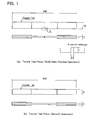
- the tensile test pieces of the notched specimen and the smooth specimen were as shown in Fig. 1 .
- the tests were performed at a crosshead rate of 0.5 mm/min using a Tensilon universal tester (RTC-1310A available from Orientec Inc.).
- the real fracture strength of the notched specimen was derived from the fracture load divided by the cross-sectional area (10 mm width ⁇ 2 mm thickness).
- Thefracture strength of the smooth specimen was also derived from the fracture load divided by the cross-sectional area (10 mm width ⁇ 2 mm thickness) similar to the notched specimen.
- the SiC fiber-bonded ceramic according to the present example was produced as follows. First, 1L of a dimethyldichlorosilane was dropped into an anhydrous xylene containing 400 g of sodium while heating and refluxing xylene under nitrogen gas current, followed by heating and refluxing for 10 hours to yield a precipitate. This precipitate was filtered and washed with methanol and then with water to obtain 420 g of white polydimethylsilane.
- the cured fibers were continuously fired in nitrogen at 1500 °C to synthesize silicon carbide-based continuous inorganic fibers.
- a satin fabric sheet of the inorganic fibers was formed and then cut into pieces of 89 mm ⁇ 89 mm, of which 150 pieces were stacked and set in a carbon die of 90 mm ⁇ 90 mm.
- 200 g of carbon powder were fed onto the stacked fabric and, under an argon atmosphere, the temperature was elevated up to 1900 °C in 4 hours. The temperature was held for 30 minutes, followed by hot press molding under pressure of 50 MPa to obtain the SiC fiber-bonded ceramic according to the present example.
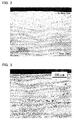
- the cross section of the SiC fiber-bonded ceramic according to the present example was observed with an optical microscope.
- a typical photo is shown in Fig. 2 .
- the near-surface portion on the side adjacent to the carbon powder mainly has an SiC sintered structure (ceramic structure), which exhibits no fiber form obviously.
- a carbon layer (interfacial layer) was formed on the surface of the SiC fiber having a polycrystalline sintered structure.
- Fig. 3 shows an SiC fiber-bonded body having no ceramic-structured surface portion.
- Hardness of the near-surface portion and that of the interior were measured.
- the surface layer was removed, and the tensile strength was measured for the notched specimen from the structured portion including the carbon layer formed on the surface of the SiC fiber having the sintered structure.
- the average hardness of the near-surface portion (430 Hv) was obviously improved higher than the average hardness of the interior (280 Hv). This suggests that the abrasion resistance of the near-surface portion was improved better than that of the interior.
- the tensile strengths of the smooth specimen and the notched specimen were 205 MPa and 160 MPa on average, respectively.
- the strength of the notched specimen is not susceptible to the stress concentration on the notch tip but follows the net sectional standard, it can be represented by the following expression 2 where ⁇ f indicates the tensile strength (205 MPa) of the smooth specimen; a indicates the one-side notch length (1 mm); and W indicates the test piece width (10 mm). From the expression 2, the fracture strength of the notched specimen is 164 MPa. The actually measured fracture strength of the notched specimen is 160 MPa, which is almost equal to the value derived from the expression 2. Thus, the interior of the SiC fiber-bonded ceramic according to the present example is found not lowered in strength by the stress concentration due to the notch and so forth but excellent in toughness.
Landscapes
- Engineering & Computer Science (AREA)
- Chemical & Material Sciences (AREA)
- Ceramic Engineering (AREA)
- Manufacturing & Machinery (AREA)
- Materials Engineering (AREA)
- Organic Chemistry (AREA)
- Structural Engineering (AREA)
- Chemical Kinetics & Catalysis (AREA)
- General Chemical & Material Sciences (AREA)
- Textile Engineering (AREA)
- Inorganic Chemistry (AREA)
- Nanotechnology (AREA)
- Ceramic Products (AREA)
- Inorganic Fibers (AREA)
Applications Claiming Priority (2)
| Application Number | Priority Date | Filing Date | Title |
|---|---|---|---|
| JP2006253987 | 2006-09-20 | ||
| PCT/JP2007/067659 WO2008035590A1 (fr) | 2006-09-20 | 2007-09-11 | CÉRAMIQUE LIÉE PAR DES FIBRES SiC ET SON PROCÉDÉ DE FABRICATION |
Publications (2)
| Publication Number | Publication Date |
|---|---|
| EP2065352A1 true EP2065352A1 (de) | 2009-06-03 |
| EP2065352A4 EP2065352A4 (de) | 2011-11-30 |
Family
ID=39200417
Family Applications (1)
| Application Number | Title | Priority Date | Filing Date |
|---|---|---|---|
| EP07807068A Withdrawn EP2065352A4 (de) | 2006-09-20 | 2007-09-11 | Sic-faser-gebundene keramik und herstellungsverfahren dafür |
Country Status (4)
| Country | Link |
|---|---|
| US (1) | US7951736B2 (de) |
| EP (1) | EP2065352A4 (de) |
| JP (1) | JP4458192B2 (de) |
| WO (1) | WO2008035590A1 (de) |
Cited By (3)
| Publication number | Priority date | Publication date | Assignee | Title |
|---|---|---|---|---|
| CN109851363A (zh) * | 2019-01-31 | 2019-06-07 | 中南大学 | 一种带梯度界面层的含异质元素SiC纤维及其制备方法和设备 |
| CN110382186A (zh) * | 2017-03-09 | 2019-10-25 | 琳得科株式会社 | 生片形成用剥离膜 |
| CN116289225A (zh) * | 2021-12-20 | 2023-06-23 | 四川大学 | 一种基于聚联硼硅氧烷改性的纤维及其制备方法 |
Families Citing this family (5)
| Publication number | Priority date | Publication date | Assignee | Title |
|---|---|---|---|---|
| DE102007044783A1 (de) * | 2007-09-19 | 2009-04-09 | Audi Ag | Verfahren und Vorrichtung zur Silicierung von kohlenstoffhaltigen Werkstoffen |
| JP5267729B2 (ja) * | 2010-03-31 | 2013-08-21 | 宇部興産株式会社 | SiC被覆SiC繊維結合型セラミックス |
| CN107082641B (zh) * | 2017-05-24 | 2023-04-25 | 广西碧清源环保科技有限公司 | 一种陶瓷膜材料组件 |
| CN108055711A (zh) * | 2017-12-23 | 2018-05-18 | 安徽国电能源设备工程有限公司 | 一种高强度蓄热式电锅炉用电热元件的制备方法 |
| CN108893639A (zh) * | 2018-07-27 | 2018-11-27 | 常州泰格尔电子材料科技有限公司 | 一种短流程真空热挤压制备大锭型SiCP/Al复合材料坯料方法 |
Family Cites Families (7)
| Publication number | Priority date | Publication date | Assignee | Title |
|---|---|---|---|---|
| JPS584732B2 (ja) | 1976-09-30 | 1983-01-27 | 財団法人特殊無機材料研究所 | 耐加水分解性、耐熱性に優れたボロシロキサンポリマ−の製造方法 |
| JPS5350299A (en) | 1976-10-18 | 1978-05-08 | Tokushiyu Muki Zairiyou Kenkiy | Process for preparing inorganic polymer whose main chain contains si b and o as elemental component |
| JP3767170B2 (ja) | 1997-07-22 | 2006-04-19 | 宇部興産株式会社 | 焼結SiC繊維結合体及びその製造方法 |
| EP0893420B1 (de) * | 1997-07-22 | 2003-10-22 | Ube Industries, Ltd. | Gesinterter Werkstoff aus verbundenen Siliciumcarbidfasern |
| JP4239684B2 (ja) | 2002-08-09 | 2009-03-18 | 宇部興産株式会社 | 高耐熱性無機繊維結合型セラミックス部材及びその製造方法 |
| JP4122891B2 (ja) | 2002-08-09 | 2008-07-23 | 宇部興産株式会社 | 傾斜組成を有するセラミックス薄膜被覆材料及びその製造方法 |
| JP4753568B2 (ja) | 2004-11-24 | 2011-08-24 | 川崎重工業株式会社 | SiC系繊維強化セラミックス複合材料耐環境コーティングおよびその製造方法 |
-
2007
- 2007-09-11 US US12/440,882 patent/US7951736B2/en not_active Expired - Fee Related
- 2007-09-11 JP JP2008535326A patent/JP4458192B2/ja not_active Expired - Fee Related
- 2007-09-11 WO PCT/JP2007/067659 patent/WO2008035590A1/ja not_active Ceased
- 2007-09-11 EP EP07807068A patent/EP2065352A4/de not_active Withdrawn
Cited By (5)
| Publication number | Priority date | Publication date | Assignee | Title |
|---|---|---|---|---|
| CN110382186A (zh) * | 2017-03-09 | 2019-10-25 | 琳得科株式会社 | 生片形成用剥离膜 |
| CN109851363A (zh) * | 2019-01-31 | 2019-06-07 | 中南大学 | 一种带梯度界面层的含异质元素SiC纤维及其制备方法和设备 |
| CN109851363B (zh) * | 2019-01-31 | 2021-08-27 | 中南大学 | 一种带梯度界面层的含异质元素SiC纤维及其制备方法和设备 |
| CN116289225A (zh) * | 2021-12-20 | 2023-06-23 | 四川大学 | 一种基于聚联硼硅氧烷改性的纤维及其制备方法 |
| CN116289225B (zh) * | 2021-12-20 | 2024-04-02 | 四川大学 | 一种基于聚联硼硅氧烷改性的纤维及其制备方法 |
Also Published As
| Publication number | Publication date |
|---|---|
| US7951736B2 (en) | 2011-05-31 |
| US20100041541A1 (en) | 2010-02-18 |
| JP4458192B2 (ja) | 2010-04-28 |
| WO2008035590A1 (fr) | 2008-03-27 |
| EP2065352A4 (de) | 2011-11-30 |
| JPWO2008035590A1 (ja) | 2010-01-28 |
Similar Documents
| Publication | Publication Date | Title |
|---|---|---|
| US7951736B2 (en) | SiC fiber-bonded ceramic and process for production of the same | |
| DiCarlo et al. | Non-oxide (silicon carbide) fibers | |
| CA2275130C (en) | Composite material with ceramic matrix and sic fiber reinforcement, method for making same | |
| JP4334790B2 (ja) | SiC系複合材料用SiC強化繊維の製造 | |
| US8906288B2 (en) | Process for producing SiC fiber-bonded ceramics | |
| Shyin et al. | Fabrication and property evaluation of titanium silicide active filler incorporated ceramic matrix composite | |
| JP5267729B2 (ja) | SiC被覆SiC繊維結合型セラミックス | |
| EP3835466B1 (de) | Kristalline siliziumkarbidfaser und verfahren zu ihrer herstellung und keramisches verbundsubstrat | |
| Cinibulk et al. | Constituent development for higher-temperature capable ceramic matrix composites | |
| JP4784533B2 (ja) | SiC繊維結合型セラミックスの製造方法 | |
| Tian et al. | Fracture strength of melt-infiltrated SiC-mullite composite | |
| JP3767170B2 (ja) | 焼結SiC繊維結合体及びその製造方法 | |
| EP0893420B1 (de) | Gesinterter Werkstoff aus verbundenen Siliciumcarbidfasern | |
| JP2001181046A (ja) | 無機繊維結合セラミックス及びその製造方法並びにそれを用いた高表面精度部材 | |
| Bunsell | Small-diameter silicon carbide fibers | |
| Kajii et al. | A new type of fiber-bonded-ceramic material synthesized from pre-oxidized Si-Ti-CO fiber | |
| JP2001261470A (ja) | 耐酸化性炭素質材料およびその製造方法 | |
| DiCarlo et al. | Non-oxide (Silicon Carbide) Fibers | |
| JP2000007453A (ja) | 高耐熱性繊維強化セラミックス複合材料 | |
| JP2002154883A (ja) | ムライト系材料を基材とする複合材料、およびその製造方法 | |
| Bunsell | The mechanical behaviour of small diameter silicon carbide fibres | |
| JP4238620B2 (ja) | 表面剥離を抑制した無機繊維結合セラミックスの製造方法 | |
| KR101931668B1 (ko) | 이종 결정에 의한 다중 결합구조를 갖는 강화 세라믹 섬유 | |
| JP2004067481A (ja) | 高耐熱性無機繊維結合セラミックス及びその製造方法 | |
| JP2002316879A (ja) | 高耐熱性無機繊維結合セラミックス接合体及びその接合方法 |
Legal Events
| Date | Code | Title | Description |
|---|---|---|---|
| PUAI | Public reference made under article 153(3) epc to a published international application that has entered the european phase |
Free format text: ORIGINAL CODE: 0009012 |
|
| 17P | Request for examination filed |
Effective date: 20090327 |
|
| AK | Designated contracting states |
Kind code of ref document: A1 Designated state(s): AT BE BG CH CY CZ DE DK EE ES FI FR GB GR HU IE IS IT LI LT LU LV MC MT NL PL PT RO SE SI SK TR |
|
| AX | Request for extension of the european patent |
Extension state: AL BA HR MK RS |
|
| DAX | Request for extension of the european patent (deleted) | ||
| RBV | Designated contracting states (corrected) |
Designated state(s): DE FR GB |
|
| A4 | Supplementary search report drawn up and despatched |
Effective date: 20111102 |
|
| RIC1 | Information provided on ipc code assigned before grant |
Ipc: C04B 35/575 20060101ALI20111026BHEP Ipc: C04B 35/571 20060101ALI20111026BHEP Ipc: D06M 101/00 20060101ALI20111026BHEP Ipc: D06M 11/74 20060101ALI20111026BHEP Ipc: D06M 11/34 20060101ALI20111026BHEP Ipc: C04B 35/565 20060101ALI20111026BHEP Ipc: C04B 35/80 20060101AFI20111026BHEP |
|
| 17Q | First examination report despatched |
Effective date: 20120725 |
|
| GRAP | Despatch of communication of intention to grant a patent |
Free format text: ORIGINAL CODE: EPIDOSNIGR1 |
|
| INTG | Intention to grant announced |
Effective date: 20141124 |
|
| STAA | Information on the status of an ep patent application or granted ep patent |
Free format text: STATUS: THE APPLICATION IS DEEMED TO BE WITHDRAWN |
|
| 18D | Application deemed to be withdrawn |
Effective date: 20150408 |