EP2067546A1 - Systèmes pour mouler de manière centrifuge des métaux en titane hautement réactif - Google Patents
Systèmes pour mouler de manière centrifuge des métaux en titane hautement réactif Download PDFInfo
- Publication number
- EP2067546A1 EP2067546A1 EP08169706A EP08169706A EP2067546A1 EP 2067546 A1 EP2067546 A1 EP 2067546A1 EP 08169706 A EP08169706 A EP 08169706A EP 08169706 A EP08169706 A EP 08169706A EP 2067546 A1 EP2067546 A1 EP 2067546A1
- Authority
- EP
- European Patent Office
- Prior art keywords
- crucible
- induction
- metal
- molten metal
- titanium
- Prior art date
- Legal status (The legal status is an assumption and is not a legal conclusion. Google has not performed a legal analysis and makes no representation as to the accuracy of the status listed.)
- Ceased
Links
- 229910052751 metal Inorganic materials 0.000 title claims abstract description 114
- 239000002184 metal Substances 0.000 title claims abstract description 114
- 238000005266 casting Methods 0.000 title claims abstract description 41
- 239000010936 titanium Substances 0.000 title claims abstract description 34
- 229910052719 titanium Inorganic materials 0.000 title claims abstract description 34
- -1 titanium metals Chemical class 0.000 title description 4
- 230000006698 induction Effects 0.000 claims abstract description 90
- RTAQQCXQSZGOHL-UHFFFAOYSA-N Titanium Chemical compound [Ti] RTAQQCXQSZGOHL-UHFFFAOYSA-N 0.000 claims abstract description 33
- 238000009750 centrifugal casting Methods 0.000 claims abstract description 20
- OQPDWFJSZHWILH-UHFFFAOYSA-N [Al].[Al].[Al].[Ti] Chemical compound [Al].[Al].[Al].[Ti] OQPDWFJSZHWILH-UHFFFAOYSA-N 0.000 claims description 29
- 229910021324 titanium aluminide Inorganic materials 0.000 claims description 29
- 229910045601 alloy Inorganic materials 0.000 claims description 18
- 239000000956 alloy Substances 0.000 claims description 18
- 239000000919 ceramic Substances 0.000 claims description 12
- 229910052758 niobium Inorganic materials 0.000 claims description 11
- 239000010955 niobium Substances 0.000 claims description 11
- GUCVJGMIXFAOAE-UHFFFAOYSA-N niobium atom Chemical compound [Nb] GUCVJGMIXFAOAE-UHFFFAOYSA-N 0.000 claims description 11
- 238000000034 method Methods 0.000 claims description 9
- 238000002844 melting Methods 0.000 description 21
- 230000008018 melting Effects 0.000 description 20
- RYGMFSIKBFXOCR-UHFFFAOYSA-N Copper Chemical compound [Cu] RYGMFSIKBFXOCR-UHFFFAOYSA-N 0.000 description 14
- 229910052802 copper Inorganic materials 0.000 description 14
- 239000010949 copper Substances 0.000 description 14
- 229910001069 Ti alloy Inorganic materials 0.000 description 13
- OKTJSMMVPCPJKN-UHFFFAOYSA-N Carbon Chemical compound [C] OKTJSMMVPCPJKN-UHFFFAOYSA-N 0.000 description 6
- 238000011109 contamination Methods 0.000 description 6
- 239000000463 material Substances 0.000 description 6
- 229910010038 TiAl Inorganic materials 0.000 description 5
- 229910002804 graphite Inorganic materials 0.000 description 5
- 239000010439 graphite Substances 0.000 description 5
- 238000005336 cracking Methods 0.000 description 4
- VYPSYNLAJGMNEJ-UHFFFAOYSA-N Silicium dioxide Chemical compound O=[Si]=O VYPSYNLAJGMNEJ-UHFFFAOYSA-N 0.000 description 3
- 238000010438 heat treatment Methods 0.000 description 3
- 239000007788 liquid Substances 0.000 description 3
- 239000000155 melt Substances 0.000 description 3
- 150000002739 metals Chemical class 0.000 description 3
- 239000000203 mixture Substances 0.000 description 3
- 210000003625 skull Anatomy 0.000 description 3
- 239000007787 solid Substances 0.000 description 3
- PXHVJJICTQNCMI-UHFFFAOYSA-N Nickel Chemical compound [Ni] PXHVJJICTQNCMI-UHFFFAOYSA-N 0.000 description 2
- 230000015572 biosynthetic process Effects 0.000 description 2
- 238000001816 cooling Methods 0.000 description 2
- 230000005672 electromagnetic field Effects 0.000 description 2
- VQCBHWLJZDBHOS-UHFFFAOYSA-N erbium(iii) oxide Chemical compound O=[Er]O[Er]=O VQCBHWLJZDBHOS-UHFFFAOYSA-N 0.000 description 2
- 229910052747 lanthanoid Inorganic materials 0.000 description 2
- 150000002602 lanthanoids Chemical class 0.000 description 2
- MRELNEQAGSRDBK-UHFFFAOYSA-N lanthanum(3+);oxygen(2-) Chemical compound [O-2].[O-2].[O-2].[La+3].[La+3] MRELNEQAGSRDBK-UHFFFAOYSA-N 0.000 description 2
- 238000005339 levitation Methods 0.000 description 2
- 229910001092 metal group alloy Inorganic materials 0.000 description 2
- PLDDOISOJJCEMH-UHFFFAOYSA-N neodymium(3+);oxygen(2-) Chemical compound [O-2].[O-2].[O-2].[Nd+3].[Nd+3] PLDDOISOJJCEMH-UHFFFAOYSA-N 0.000 description 2
- 229910000753 refractory alloy Inorganic materials 0.000 description 2
- 239000000725 suspension Substances 0.000 description 2
- 230000008646 thermal stress Effects 0.000 description 2
- 229910001369 Brass Inorganic materials 0.000 description 1
- UPEMFLOMQVFMCZ-UHFFFAOYSA-N [O--].[O--].[O--].[Pm+3].[Pm+3] Chemical compound [O--].[O--].[O--].[Pm+3].[Pm+3] UPEMFLOMQVFMCZ-UHFFFAOYSA-N 0.000 description 1
- BSKYZPFGRDAVEN-UHFFFAOYSA-N [O-2].[Ho+3].[O-2].[Dy+3] Chemical compound [O-2].[Ho+3].[O-2].[Dy+3] BSKYZPFGRDAVEN-UHFFFAOYSA-N 0.000 description 1
- 229910052782 aluminium Inorganic materials 0.000 description 1
- XAGFODPZIPBFFR-UHFFFAOYSA-N aluminium Chemical compound [Al] XAGFODPZIPBFFR-UHFFFAOYSA-N 0.000 description 1
- QVGXLLKOCUKJST-UHFFFAOYSA-N atomic oxygen Chemical compound [O] QVGXLLKOCUKJST-UHFFFAOYSA-N 0.000 description 1
- 239000010951 brass Substances 0.000 description 1
- 229910052799 carbon Inorganic materials 0.000 description 1
- 230000015556 catabolic process Effects 0.000 description 1
- 229910000420 cerium oxide Inorganic materials 0.000 description 1
- 239000008119 colloidal silica Substances 0.000 description 1
- 239000004020 conductor Substances 0.000 description 1
- 239000000498 cooling water Substances 0.000 description 1
- 239000003989 dielectric material Substances 0.000 description 1
- 230000003628 erosive effect Effects 0.000 description 1
- 229910001940 europium oxide Inorganic materials 0.000 description 1
- 229940075616 europium oxide Drugs 0.000 description 1
- AEBZCFFCDTZXHP-UHFFFAOYSA-N europium(3+);oxygen(2-) Chemical compound [O-2].[O-2].[O-2].[Eu+3].[Eu+3] AEBZCFFCDTZXHP-UHFFFAOYSA-N 0.000 description 1
- 230000005496 eutectics Effects 0.000 description 1
- 238000005242 forging Methods 0.000 description 1
- 229910001938 gadolinium oxide Inorganic materials 0.000 description 1
- 229940075613 gadolinium oxide Drugs 0.000 description 1
- CMIHHWBVHJVIGI-UHFFFAOYSA-N gadolinium(iii) oxide Chemical compound [O-2].[O-2].[O-2].[Gd+3].[Gd+3] CMIHHWBVHJVIGI-UHFFFAOYSA-N 0.000 description 1
- 239000008187 granular material Substances 0.000 description 1
- 229910000449 hafnium oxide Inorganic materials 0.000 description 1
- WIHZLLGSGQNAGK-UHFFFAOYSA-N hafnium(4+);oxygen(2-) Chemical compound [O-2].[O-2].[Hf+4] WIHZLLGSGQNAGK-UHFFFAOYSA-N 0.000 description 1
- 239000011810 insulating material Substances 0.000 description 1
- 238000005495 investment casting Methods 0.000 description 1
- 229910003443 lutetium oxide Inorganic materials 0.000 description 1
- 238000010309 melting process Methods 0.000 description 1
- 229910052759 nickel Inorganic materials 0.000 description 1
- TWNQGVIAIRXVLR-UHFFFAOYSA-N oxo(oxoalumanyloxy)alumane Chemical compound O=[Al]O[Al]=O TWNQGVIAIRXVLR-UHFFFAOYSA-N 0.000 description 1
- BMMGVYCKOGBVEV-UHFFFAOYSA-N oxo(oxoceriooxy)cerium Chemical compound [Ce]=O.O=[Ce]=O BMMGVYCKOGBVEV-UHFFFAOYSA-N 0.000 description 1
- MPARYNQUYZOBJM-UHFFFAOYSA-N oxo(oxolutetiooxy)lutetium Chemical compound O=[Lu]O[Lu]=O MPARYNQUYZOBJM-UHFFFAOYSA-N 0.000 description 1
- SIWVEOZUMHYXCS-UHFFFAOYSA-N oxo(oxoyttriooxy)yttrium Chemical compound O=[Y]O[Y]=O SIWVEOZUMHYXCS-UHFFFAOYSA-N 0.000 description 1
- 229910052760 oxygen Inorganic materials 0.000 description 1
- 239000001301 oxygen Substances 0.000 description 1
- MMKQUGHLEMYQSG-UHFFFAOYSA-N oxygen(2-);praseodymium(3+) Chemical compound [O-2].[O-2].[O-2].[Pr+3].[Pr+3] MMKQUGHLEMYQSG-UHFFFAOYSA-N 0.000 description 1
- UZLYXNNZYFBAQO-UHFFFAOYSA-N oxygen(2-);ytterbium(3+) Chemical compound [O-2].[O-2].[O-2].[Yb+3].[Yb+3] UZLYXNNZYFBAQO-UHFFFAOYSA-N 0.000 description 1
- 239000000843 powder Substances 0.000 description 1
- 229910003447 praseodymium oxide Inorganic materials 0.000 description 1
- 229910052761 rare earth metal Inorganic materials 0.000 description 1
- 150000002910 rare earth metals Chemical class 0.000 description 1
- 239000011819 refractory material Substances 0.000 description 1
- 229910001954 samarium oxide Inorganic materials 0.000 description 1
- 229940075630 samarium oxide Drugs 0.000 description 1
- FKTOIHSPIPYAPE-UHFFFAOYSA-N samarium(iii) oxide Chemical compound [O-2].[O-2].[O-2].[Sm+3].[Sm+3] FKTOIHSPIPYAPE-UHFFFAOYSA-N 0.000 description 1
- HYXGAEYDKFCVMU-UHFFFAOYSA-N scandium oxide Chemical compound O=[Sc]O[Sc]=O HYXGAEYDKFCVMU-UHFFFAOYSA-N 0.000 description 1
- 230000035939 shock Effects 0.000 description 1
- 239000000377 silicon dioxide Substances 0.000 description 1
- 235000012239 silicon dioxide Nutrition 0.000 description 1
- 229910000601 superalloy Inorganic materials 0.000 description 1
- 229910003451 terbium oxide Inorganic materials 0.000 description 1
- SCRZPWWVSXWCMC-UHFFFAOYSA-N terbium(iii) oxide Chemical compound [O-2].[O-2].[O-2].[Tb+3].[Tb+3] SCRZPWWVSXWCMC-UHFFFAOYSA-N 0.000 description 1
- 229910003454 ytterbium oxide Inorganic materials 0.000 description 1
- 229940075624 ytterbium oxide Drugs 0.000 description 1
- GFQYVLUOOAAOGM-UHFFFAOYSA-N zirconium(iv) silicate Chemical compound [Zr+4].[O-][Si]([O-])([O-])[O-] GFQYVLUOOAAOGM-UHFFFAOYSA-N 0.000 description 1
Images
Classifications
-
- B—PERFORMING OPERATIONS; TRANSPORTING
- B22—CASTING; POWDER METALLURGY
- B22D—CASTING OF METALS; CASTING OF OTHER SUBSTANCES BY THE SAME PROCESSES OR DEVICES
- B22D13/00—Centrifugal casting; Casting by using centrifugal force
Definitions
- Embodiments described herein generally relate to systems for centrifugally casting highly reactive metals. More particularly, embodiments herein generally describe systems for centrifugally casting highly reactive titanium alloys, and in particular, titanium aluminide alloys.
- Titanium alloys Ti alloys
- TiAl alloys titanium aluminide based alloys
- TiAl alloys possess a promising combination of low-temperature mechanical properties, such as room temperature ductility and toughness, as well as high intermediate temperature strength and creep resistance.
- TiAl alloys have the potential to replace nickel-based superalloys, which are currently used to make numerous turbine engine components.
- Vacuum Arc Re-melting is one technique commonly used to melt Ti alloys.
- VAR generally involves striking an arc between a titanium alloy electrode and pieces of the same alloy (electrode ends, for example) placed in a water-cooled copper crucible. A molten pool is established and the electrode progressively melts. When sufficient molten metal is available, the electrode can be withdrawn and the crucible tilted to pour the metal into a mold for casting components.
- Titanium electrodes used in the VAR process can be expensive because of the high cost of titanium billets/forgings, and the high cost of labor involved in creating an electrode from certified scrap or revert material. Also, the requirement for a pre-alloyed electrode can make it difficult and expensive to produce non-standard alloys. Furthermore, the need to use a water-cooled crucible can limit the degree of superheat achievable in the metal, which in turn can affect fluidity, leading to difficulty in filling thin-wall castings. Moreover, the highest temperature exists where the arc strikes the metal, and high temperature gradients exist in the molten metal. This can also affect the filling of molds and sets up poor temperature gradients in the solidifying casting.
- VIM Vacuum Induction Melting
- Vacuum induction melting generally involves heating a metal in a crucible made from a non-conductive refractory alloy oxide until the charge of metal within the crucible is melted down to liquid form.
- pieces of solid titanium alloy are placed in a cooled metal hearth, usually made of copper, and melted in an inert atmosphere using a very intense heat source, such as an arc or plasma.
- a molten pool will form initially on the interior and top surface of the charge of titanium while the titanium adjacent to the confining wall of the copper hearth remains solid.
- This "skull" of solid titanium that develops contains the liquid titanium metal free of contamination. See U.S. Patent No. 4,654,858, issued to Rowe for a general discussion of cold wall induction melting.
- copper crucibles are most often employed in cold wall induction melting of highly reactive alloys for a number of reasons.
- melting and casting from ceramic crucibles can introduce significant thermal stress on the crucible, which can result in the crucible cracking.
- Such cracking can reduce crucible life and cause inclusions in the component being cast.
- the highly reactive TiAl alloys can break down the ceramic crucible and contaminate the titanium alloy with both oxygen and the refractory alloy from the oxide.
- the titanium aluminide can dissolve large quantities of carbon from the crucible into the titanium alloy, thereby resulting in contamination. Such contamination can result in a loss of mechanical properties of the titanium alloy.
- Copper is less likely to exhibit the previously described problems associated with ceramic and graphite crucibles, which is why copper crucibles are typically employed when using cold wall induction melting to melt highly reactive metal alloys.
- cold crucible melting in copper crucibles can offer metallurgical advantages for the processing of the highly reactive alloys described previously, it can also have a number of technical and economic limitations including low superheat, yield losses due to skull formation and high power requirements.
- the cold wall induction crucible suffers heat loss when the power to the crucible is terminated and the metal is allowed to slump against the water-cooled copper sides of the mold.
- nozzles can provide many benefits over other common practices, the use of nozzles is not entirely without the potential for complications. For example, cold hearth melting and bottom pouring of reactive metals like titanium can result in undesirable melt freeze-off in the nozzle. In addition, many crucible/nozzle systems can struggle to provide the requisite control of liquid flow rate, minimize erosion of the nozzle, and minimize melt contamination.
- levitation melting Another development that has been employed to address the previously described issues with vacuum induction melting is levitation melting, which generally involves using energy from induction coils to electromagnetically suspend the metal being melted. See U.S. Patent 5,275,229, issued to Fishman et al . for a general discussion of levitation melting.
- the magnetic induction field can both heat the metal and hold the molten metal suspended in space within the crucible, once the power source for the system is turned off, the metal can slip back into the water-cooled crucible and chill again before it can be poured. This can result in incomplete filling of the mold.
- Embodiments herein generally relate to systems for centrifugally casting a highly reactive titanium metal comprising a cold wall induction crucible for containing a titanium metal charge, the induction crucible having a plurality of induction coils and a removable bottom plate, a power source to heat the titanium metal charge in the induction crucible to obtain a molten metal, a preheated secondary crucible for catching the molten metal as it falls from the induction crucible after the removable bottom plate has been withdrawn and the power source turned off, and a centrifugal casting machine for holding and accelerating the secondary crucible to centrifugally force the molten metal into a casting mold and produce a cast component.
- Embodiments herein also generally relate to systems for centrifugally casting a highly reactive titanium metal comprising a cold wall induction crucible for containing a titanium metal charge, the induction crucible having a plurality of induction coils and a removable bottom plate, a power source to heat the titanium metal charge in the induction crucible to obtain a molten metal, a preheated secondary crucible for catching the molten metal as it falls from the induction crucible after the removable bottom plate has been withdrawn and the power source turned off, a funnel for transferring the molten metal from the induction crucible to the secondary crucible, and a centrifugal casting machine for holding and accelerating the secondary crucible to centrifugally force the molten metal into a casting mold and produce a cast component.
- Embodiments also generally relate to systems for centrifugally casting a highly reactive titanium metal comprising a cold wall induction crucible for containing a titanium aluminide charge, the induction crucible having a plurality of induction coils and a slidably removable bottom plate, a power source to heat the titanium aluminide charge in the induction crucible to obtain a molten titanium aluminide, a preheated secondary crucible for catching the molten titanium aluminide as it falls from the induction crucible after the removable bottom plate has been withdrawn and the power source turned off, a niobium funnel for transferring the molten titanium aluminide from the induction crucible to the secondary crucible, and a centrifugal casting machine for holding the secondary crucible stationary for from about 0.5 to about 2 seconds after the molten titanium aluminide falls into the secondary crucible and, thereafter, accelerating the secondary crucible to from about 100 rpm to about
- Embodiments described herein generally relate to systems for centrifugally casting highly reactive metals, and in particular titanium alloys and titanium aluminide alloys, into net shape components, though the description that follows should not be limited to such.
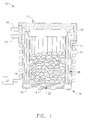
- a cold wall induction crucible 10 having a body 12 can be provided, as shown in FIG. 1 .
- Body 12 can be made from any metal having good thermal and electrical conductivity, such as, for example copper.
- Body 12 may be water-cooled to prevent the copper from melting during the heating of the crucible. More particularly, copper generally melts at about 1900°F (about 1038°C) and TiAl melts at about 2600°F (about 1427°C), and the copper in the crucible can form a low melting eutectic with the titanium. Water-cooling the crucible can prevent this from occurring. Water-cooling inlet 24 and outlet 26 may be used to circulate the cooling water through a plurality of channels 28 positioned about body 12.
- body 12 may have any shape desired and acceptable for use in induction melting, in one embodiment, body 12 may be generally shaped as a hollow cylinder. Body 12 may have a plurality of induction coils 14 positioned thereabout, which can be heated using a power source 21. Coils 14 can serve as a heat source to melt a metal charge placed within the crucible and maintain its molten state, as described herein below.
- Crucible 10 may also have a removable bottom plate 16 as shown in FIG.1 .
- bottom plate 16 may comprise any metal having good thermal and electrical conductivity, and in one embodiment, may comprise copper.
- Bottom plate 16 may also be water-cooled and have a plurality of induction coils 14 positioned thereunder, again, to help melt the metal charge placed with crucible 10 and maintain its molten state.
- an electric insulator plate 19 may circumscribe bottom plate 16 to help maintain heat in the bottom of crucible 10.
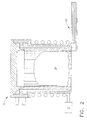
- bottom plate 16 may be removed from body 12 in a variety of manners, including, but not limited to, sliding (as shown in FIGS. 2 and 3 ), rotating, dropping and the like.
- metal charge 18 comprising a highly reactive alloy may be placed inside body 12 of crucible 10 as shown in FIG. 1 .
- metal charge 18 may comprise a titanium alloy, and more specifically a titanium aluminide alloy, and may take any acceptable form, which may include, but should not be limited to, lumps, ingots, granules, plates, powders, and mixtures thereof.
- the amount of metal charge 18 placed into crucible 10 can vary depending on intended use, however, in one embodiment, from about 1 pound (about 454 grams) to about 3.5 pounds (about 1588 grams), and in another embodiment from about 1.25 pounds (about 567 grams) to about 3.3 pounds (about 1497 grams) of metal charge 18 can be used to make net shaped low-pressure turbine blades as described herein below.
- a cover 20 which in one embodiment, may be made from the same material as crucible 10, may be positioned on top of body 12 and held in place with a cover ring 22, to ensure crucible 10 is sealed.
- Power source 21 may be turned on and metal charge 18 can melt when the appropriate temperature is attained, which in one embodiment may be from about 2700°F to about 2835°F (about 1480°C to about 1557 °C).
- the electromagnetic field generated by the induction coils causes the metal charge to heat itself internally due to resistance heating caused by current flow within the metal charge.
- the resulting molten metal 30 may become suspended within body 12 of crucible 10 such that molten metal 30 does not come into contact with the inside of body 12 as long as the power is being supplied to crucible 10. This suspension of molten metal 30 can prevent the formation of a skull.
- a secondary crucible 32 Concurrent with melting the metal charge in induction crucible 10, a secondary crucible 32, or other like holding device, may be preheated using any acceptable means, such as, but not limited to, microwave or radiant energy.
- Secondary crucible may be made from graphite or ceramic, and may optionally have a metal liner, such as for example, niobium.
- Secondary crucible 32 can aid in the transfer of the molten metal to a casting mold without losing any of the superheat in the molten metal generated during induction melting in the induction crucible 10.
- secondary crucible 32 can be preheated to at least about 1832°F (about 1000 °C), and in one embodiment from about 1832°F to about 2200°F (1000°C to about 1200°C), when secondary crucible 32 comprises niobium, and to at least about 1980°F (about 1082 °C), and in one embodiment from about 1980°F to about 2400°F (1082°C to about 1316°C), when secondary crucible comprises ceramic. Preheating can help prevent thermal shock and cracking of secondary crucible 32, which would allow for reuse thereof.
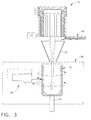
- Preheated secondary crucible 32 may then be placed in the rotating arm 34 of a centrifugal casting machine 36 and positioned below induction crucible 10, as shown generally in FIG. 3 . Any conventional centrifugal casting machine is acceptable for use herein, such as for example, the Linn High-Therm Titancast 700 (Germany) or the SEIT Supercast (Italy).
- Removable bottom plate 16 may then be withdrawn from body 12 of crucible 10, as previously described.
- bottom plate 16 may be slidably removed from crucible 10 using any acceptable mechanism, such as, but not limited to, tracks or guides.
- the electromagnetic field generated by induction coils 14 can maintain molten metal 30 in a suspended state within body 12 of crucible 10 as shown in FIG. 2 , until further processing.
- molten metal 30 is allowed to fall from induction crucible 10 through a niobium funnel 33 and into preheated secondary crucible 32, which can remain stationary within casting machine 36 just long enough for molten metal 30 to complete its transfer into secondary crucible 32, which in one embodiment may be from about 0.5 to about 2 seconds.
- secondary crucible 32 can be rapidly (about 1 to about 2 seconds) accelerated to full speed, which may be from about 100 rpm to about 600 rpm.
- Casting machine 36 can centrifugally force molten metal 30 out of secondary crucible 32 and into casting mold 38 through port 40, which may comprise at least one of a slit, hole, tube, or combination thereof.
- This quick transfer from secondary crucible 32 to casting mold 38 results in a contact time between the two of less than about 5 seconds.
- This brief contact time not only significantly reduces heat loss, but also helps ensure that there is no undesirable reaction between the molten metal and the graphite or ceramic used to construct secondary crucible 32.
- Casting mold 38 may comprise any ceramic investment casting system that provides an inert face coat and thermal insulating backing materials.
- casting mold 38 may comprise a face coat including an oxide.
- oxide refers to a composition selected from the group consisting of scandium oxide, yttrium oxide, hafnium oxide, a lanthanide series oxide, and combinations thereof.
- the lanthanide series oxide (also known as "rare earth” compositions) may comprise an oxide selected from the group consisting of lanthanum oxide, cerium oxide, praseodymium oxide, neodymium oxide, promethium oxide, samarium oxide, europium oxide, gadolinium oxide, terbium oxide, dysprosium oxide holmium oxide, erbium oxide, ytterbium oxide, lutetium oxide, and combinations thereof.
- Casting mold 38 may comprise a backing including a refractory material selected from the group consisting of aluminum oxide, zirconium silicate, silicon dioxide, and combinations thereof, in a colloidal silica suspension.
- centrifugal casting machine 36 can be turned off.
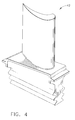
- the resulting component which in one embodiment may be a low pressure turbine blade 42, as shown in FIG. 4 , can be removed from casting mold 38 using conventional practices. Because of the use of centrifugal casting, blade 42 needs little post-cast processing.
- the centrifugal forces generated by casting machine 36 provides for the optimized filling of casting mold 38 by improving the filling of thin sections of the mold, thereby providing a net shape component.
Landscapes
- Engineering & Computer Science (AREA)
- Mechanical Engineering (AREA)
- Crucibles And Fluidized-Bed Furnaces (AREA)
- Manufacture And Refinement Of Metals (AREA)
- Turbine Rotor Nozzle Sealing (AREA)
Applications Claiming Priority (1)
| Application Number | Priority Date | Filing Date | Title |
|---|---|---|---|
| US11/945,388 US20090133850A1 (en) | 2007-11-27 | 2007-11-27 | Systems for centrifugally casting highly reactive titanium metals |
Publications (1)
| Publication Number | Publication Date |
|---|---|
| EP2067546A1 true EP2067546A1 (fr) | 2009-06-10 |
Family
ID=40316895
Family Applications (1)
| Application Number | Title | Priority Date | Filing Date |
|---|---|---|---|
| EP08169706A Ceased EP2067546A1 (fr) | 2007-11-27 | 2008-11-21 | Systèmes pour mouler de manière centrifuge des métaux en titane hautement réactif |
Country Status (5)
| Country | Link |
|---|---|
| US (1) | US20090133850A1 (fr) |
| EP (1) | EP2067546A1 (fr) |
| JP (1) | JP2009125810A (fr) |
| KR (1) | KR20090054921A (fr) |
| TW (1) | TW200940208A (fr) |
Cited By (4)
| Publication number | Priority date | Publication date | Assignee | Title |
|---|---|---|---|---|
| WO2011048423A1 (fr) * | 2009-10-21 | 2011-04-28 | Societe Europeene Des Technologies Du Titane Et Des Alliages Speciaux Sa. | Moulage de produits longs |
| WO2015092220A1 (fr) * | 2013-12-20 | 2015-06-25 | Snecma | Procédé de fabrication d'une pièce de turbomachine, ébauche intermédiaire et moule obtenus |
| WO2015092239A1 (fr) * | 2013-12-20 | 2015-06-25 | Snecma | Procédé de fabrication de pièces de turbomachine, ébauche à pièces superposées et moule obtenus |
| WO2015092218A1 (fr) * | 2013-12-20 | 2015-06-25 | Snecma | Procédé de fabrication de pièces de turbomachine, ébauche et moule obtenus |
Families Citing this family (16)
| Publication number | Priority date | Publication date | Assignee | Title |
|---|---|---|---|---|
| US8858697B2 (en) | 2011-10-28 | 2014-10-14 | General Electric Company | Mold compositions |
| US9011205B2 (en) | 2012-02-15 | 2015-04-21 | General Electric Company | Titanium aluminide article with improved surface finish |
| US8932518B2 (en) | 2012-02-29 | 2015-01-13 | General Electric Company | Mold and facecoat compositions |
| US10597756B2 (en) | 2012-03-24 | 2020-03-24 | General Electric Company | Titanium aluminide intermetallic compositions |
| US8906292B2 (en) | 2012-07-27 | 2014-12-09 | General Electric Company | Crucible and facecoat compositions |
| US8708033B2 (en) | 2012-08-29 | 2014-04-29 | General Electric Company | Calcium titanate containing mold compositions and methods for casting titanium and titanium aluminide alloys |
| CN103008634B (zh) * | 2012-11-16 | 2015-04-08 | 云南钛业股份有限公司 | 一种利用海绵钛保护容器进行熔炼的方法 |
| US8992824B2 (en) | 2012-12-04 | 2015-03-31 | General Electric Company | Crucible and extrinsic facecoat compositions |
| EP2931458B1 (fr) * | 2012-12-14 | 2019-02-06 | United Technologies Corporation | Coulage à multiples injections |
| US9592548B2 (en) | 2013-01-29 | 2017-03-14 | General Electric Company | Calcium hexaluminate-containing mold and facecoat compositions and methods for casting titanium and titanium aluminide alloys |
| US9511417B2 (en) | 2013-11-26 | 2016-12-06 | General Electric Company | Silicon carbide-containing mold and facecoat compositions and methods for casting titanium and titanium aluminide alloys |
| US9192983B2 (en) | 2013-11-26 | 2015-11-24 | General Electric Company | Silicon carbide-containing mold and facecoat compositions and methods for casting titanium and titanium aluminide alloys |
| US10391547B2 (en) | 2014-06-04 | 2019-08-27 | General Electric Company | Casting mold of grading with silicon carbide |
| CN110317967A (zh) * | 2019-06-19 | 2019-10-11 | 西部超导材料科技股份有限公司 | 一种改善大规格tc4钛合金铸锭凝固组织的方法 |
| CN113275541B (zh) * | 2021-05-25 | 2022-06-14 | 哈尔滨工业大学 | 大尺寸复杂非晶合金构件逆重力充填成形装置 |
| KR102704965B1 (ko) * | 2021-06-15 | 2024-09-09 | (주)동아특수금속 | 유도 스컬 용해법을 적용한 Zircaloy 스크랩 재 주조공정 |
Citations (7)
| Publication number | Priority date | Publication date | Assignee | Title |
|---|---|---|---|---|
| US4546858A (en) | 1982-11-06 | 1985-10-15 | Shimano Industrial Company Limited | Bicycle brake having an improved adjustment mechanism for adjusting the position of a brake shoe relative to a wheel rim |
| US4654858A (en) | 1985-04-19 | 1987-03-31 | General Electric Company | Cold hearth melting configuration and method |
| US5164097A (en) | 1991-02-01 | 1992-11-17 | General Electric Company | Nozzle assembly design for a continuous alloy production process and method for making said nozzle |
| US5275229A (en) | 1992-03-25 | 1994-01-04 | Inductotherm Corp. | Magnetic suspension melting apparatus |
| EP0686443A1 (fr) * | 1994-06-09 | 1995-12-13 | ALD Vacuum Technologies GmbH | Procédé de fabrication de pièces coulées d'un métal réactif et moule réutilisable pour la mise en oeuvre de la méthode |
| US20010045267A1 (en) * | 1996-09-26 | 2001-11-29 | Ald Vacuum Technologies Ag | Method and apparatus for the production of precision castings by centrifugal casting with controlled solidification |
| US20040040690A1 (en) * | 2001-06-11 | 2004-03-04 | Ranjan Ray | Centrifugal casting of titanium alloys with improved surface quality, structural integrity and mechanical properties in isotropic graphite molds under vacuum |
Family Cites Families (6)
| Publication number | Priority date | Publication date | Assignee | Title |
|---|---|---|---|---|
| US2789152A (en) * | 1955-06-01 | 1957-04-16 | Nat Res Corp | Electric furnace for production of metals |
| US4040845A (en) * | 1976-03-04 | 1977-08-09 | The Garrett Corporation | Ceramic composition and crucibles and molds formed therefrom |
| US5221336A (en) * | 1989-11-08 | 1993-06-22 | Pcc Airfoils, Inc. | Method of casting a reactive metal against a surface formed from an improved slurry containing yttria |
| US5060914A (en) * | 1990-07-16 | 1991-10-29 | General Electric Company | Method for control of process conditions in a continuous alloy production process |
| US5643350A (en) * | 1994-11-08 | 1997-07-01 | Vectra Technologies, Inc. | Waste vitrification melter |
| US20060291529A1 (en) * | 2005-05-26 | 2006-12-28 | Haun Robert E | Cold wall induction nozzle |
-
2007
- 2007-11-27 US US11/945,388 patent/US20090133850A1/en not_active Abandoned
-
2008
- 2008-11-14 TW TW097144151A patent/TW200940208A/zh unknown
- 2008-11-21 EP EP08169706A patent/EP2067546A1/fr not_active Ceased
- 2008-11-25 JP JP2008299046A patent/JP2009125810A/ja not_active Withdrawn
- 2008-11-26 KR KR1020080118018A patent/KR20090054921A/ko not_active Withdrawn
Patent Citations (7)
| Publication number | Priority date | Publication date | Assignee | Title |
|---|---|---|---|---|
| US4546858A (en) | 1982-11-06 | 1985-10-15 | Shimano Industrial Company Limited | Bicycle brake having an improved adjustment mechanism for adjusting the position of a brake shoe relative to a wheel rim |
| US4654858A (en) | 1985-04-19 | 1987-03-31 | General Electric Company | Cold hearth melting configuration and method |
| US5164097A (en) | 1991-02-01 | 1992-11-17 | General Electric Company | Nozzle assembly design for a continuous alloy production process and method for making said nozzle |
| US5275229A (en) | 1992-03-25 | 1994-01-04 | Inductotherm Corp. | Magnetic suspension melting apparatus |
| EP0686443A1 (fr) * | 1994-06-09 | 1995-12-13 | ALD Vacuum Technologies GmbH | Procédé de fabrication de pièces coulées d'un métal réactif et moule réutilisable pour la mise en oeuvre de la méthode |
| US20010045267A1 (en) * | 1996-09-26 | 2001-11-29 | Ald Vacuum Technologies Ag | Method and apparatus for the production of precision castings by centrifugal casting with controlled solidification |
| US20040040690A1 (en) * | 2001-06-11 | 2004-03-04 | Ranjan Ray | Centrifugal casting of titanium alloys with improved surface quality, structural integrity and mechanical properties in isotropic graphite molds under vacuum |
Non-Patent Citations (1)
| Title |
|---|
| CHOUDHURY A ET AL: "LOW COST PRODUCTION OF TIAL AUTOMOTIVE VALVES USING COLD WALL INDUCTION MELTING AND PERMANENT MOLD CENTRIFUGAL CASTING", CONFERENCE. ISATA. MATERIALS FOR ENERGY-EFFICIENT VEHICLES. PAINT AND POWDER COATING APPLICATIONS IN THE AUTOMOTIVE INDUSTRIES, XX, XX, 1 January 1997 (1997-01-01), pages 473 - 480, XP000882536 * |
Cited By (11)
| Publication number | Priority date | Publication date | Assignee | Title |
|---|---|---|---|---|
| WO2011048423A1 (fr) * | 2009-10-21 | 2011-04-28 | Societe Europeene Des Technologies Du Titane Et Des Alliages Speciaux Sa. | Moulage de produits longs |
| CN102869465A (zh) * | 2009-10-21 | 2013-01-09 | 钛合金特殊技术欧洲股份公司 | 铸造长材产品 |
| WO2015092220A1 (fr) * | 2013-12-20 | 2015-06-25 | Snecma | Procédé de fabrication d'une pièce de turbomachine, ébauche intermédiaire et moule obtenus |
| WO2015092239A1 (fr) * | 2013-12-20 | 2015-06-25 | Snecma | Procédé de fabrication de pièces de turbomachine, ébauche à pièces superposées et moule obtenus |
| WO2015092218A1 (fr) * | 2013-12-20 | 2015-06-25 | Snecma | Procédé de fabrication de pièces de turbomachine, ébauche et moule obtenus |
| FR3015327A1 (fr) * | 2013-12-20 | 2015-06-26 | Snecma | Procede de fabrication de pieces de turbomachine, ebauche et moule obtenus |
| FR3015326A1 (fr) * | 2013-12-20 | 2015-06-26 | Snecma | Procede de fabrication de pieces de turbomachine, ebauche a pieces superposees et moule obtenus |
| FR3015325A1 (fr) * | 2013-12-20 | 2015-06-26 | Snecma | Procede de fabrication d'une piece de turbomachine, ebauche intermediaire et moule obtenus |
| US9796058B2 (en) | 2013-12-20 | 2017-10-24 | Snecma | Method for producing turbine engine parts, and resulting mould and blank compromising stacked parts |
| US9844843B2 (en) | 2013-12-20 | 2017-12-19 | Snecma | Method for producing turbine engine parts, and resulting blank and mould |
| US9969035B2 (en) | 2013-12-20 | 2018-05-15 | Snecma | Method for producing a turbine engine part, and resulting mould and intermediate blank |
Also Published As
| Publication number | Publication date |
|---|---|
| JP2009125810A (ja) | 2009-06-11 |
| KR20090054921A (ko) | 2009-06-01 |
| TW200940208A (en) | 2009-10-01 |
| US20090133850A1 (en) | 2009-05-28 |
Similar Documents
| Publication | Publication Date | Title |
|---|---|---|
| EP2067547A1 (fr) | Procédés pour mouler de manière centrifuge des métaux en titane hautement réactif | |
| US20090133850A1 (en) | Systems for centrifugally casting highly reactive titanium metals | |
| CN101829770A (zh) | 用于离心铸造高活性钛金属的系统 | |
| US7169350B2 (en) | Method and apparatus for making a thixotropic metal slurry | |
| EP0218536B1 (fr) | Procédé de coulage d'une pièce de coulée équiaxiale à grains fins | |
| EP2067548B1 (fr) | Creusets réfractaires capables de gérer les contraintes thermiques et adaptés au mélange des alliages hautement réactifs | |
| EP1200217B1 (fr) | Procede de solidification directionnelle et appareil associe | |
| AU2001264749A1 (en) | Method and apparatus for making a thixotropic metal slurry | |
| US8075713B2 (en) | Method for production of precision castings by centrifugal casting | |
| EP1292411B1 (fr) | Production de materiau semi-solide a la demande pour pieces de fonderie | |
| WO2008073141A2 (fr) | Procédé de fusion utilisant un récipient de fusion en graphite | |
| EP1259348B1 (fr) | Systeme et procede de moulage de pieces coulees de metal a grain fin et de grande purete | |
| US6059015A (en) | Method for directional solidification of a molten material and apparatus therefor | |
| JPH04504981A (ja) | 反応性合金の誘導スカル紡糸 | |
| CN117259739A (zh) | 一种金属材料的真空感应熔炼浇注装置及成形方法 | |
| US6264717B1 (en) | Clean melt nucleated cast article | |
| JP3571212B2 (ja) | 金属・合金の溶解方法及び溶解鋳造方法 | |
| CN105358723B (zh) | 生产包含锂的铝合金的方法 | |
| JP2002122386A (ja) | 浮揚溶解用の水冷銅るつぼ | |
| CN117845068B (zh) | 一种电子束熔炼脱除镍基高温合金返回料杂质元素的方法 | |
| CN105033200A (zh) | 一种真空冶炼铸造设备及工艺 | |
| CN213841734U (zh) | 一种真空悬浮熔炼炉自动翻锭装置 | |
| JPH10246578A (ja) | スカル溶解炉およびそれを用いた高純度合金の製造方法 | |
| JPH0531571A (ja) | 鋳物の製造方法および製造装置 | |
| Jarczyk et al. | Vacuum melting equipment and technologies for advanced materials |
Legal Events
| Date | Code | Title | Description |
|---|---|---|---|
| PUAI | Public reference made under article 153(3) epc to a published international application that has entered the european phase |
Free format text: ORIGINAL CODE: 0009012 |
|
| AK | Designated contracting states |
Kind code of ref document: A1 Designated state(s): AT BE BG CH CY CZ DE DK EE ES FI FR GB GR HR HU IE IS IT LI LT LU LV MC MT NL NO PL PT RO SE SI SK TR |
|
| AX | Request for extension of the european patent |
Extension state: AL BA MK RS |
|
| RIN1 | Information on inventor provided before grant (corrected) |
Inventor name: WEIMER, MICHAEL JAMES Inventor name: KELLY, THOMAS JOSEPH |
|
| 17P | Request for examination filed |
Effective date: 20091210 |
|
| 17Q | First examination report despatched |
Effective date: 20100107 |
|
| AKX | Designation fees paid |
Designated state(s): AT DE FR GB IT |
|
| STAA | Information on the status of an ep patent application or granted ep patent |
Free format text: STATUS: THE APPLICATION HAS BEEN REFUSED |
|
| 18R | Application refused |
Effective date: 20120329 |