EP2067883A2 - Glasartiger Quarztiegel - Google Patents
Glasartiger Quarztiegel Download PDFInfo
- Publication number
- EP2067883A2 EP2067883A2 EP08020717A EP08020717A EP2067883A2 EP 2067883 A2 EP2067883 A2 EP 2067883A2 EP 08020717 A EP08020717 A EP 08020717A EP 08020717 A EP08020717 A EP 08020717A EP 2067883 A2 EP2067883 A2 EP 2067883A2
- Authority
- EP
- European Patent Office
- Prior art keywords
- stage
- pulling
- crucible
- bubbles
- layer
- Prior art date
- Legal status (The legal status is an assumption and is not a legal conclusion. Google has not performed a legal analysis and makes no representation as to the accuracy of the status listed.)
- Granted
Links
Images


Classifications
-
- C—CHEMISTRY; METALLURGY
- C30—CRYSTAL GROWTH
- C30B—SINGLE-CRYSTAL GROWTH; UNIDIRECTIONAL SOLIDIFICATION OF EUTECTIC MATERIAL OR UNIDIRECTIONAL DEMIXING OF EUTECTOID MATERIAL; REFINING BY ZONE-MELTING OF MATERIAL; PRODUCTION OF A HOMOGENEOUS POLYCRYSTALLINE MATERIAL WITH DEFINED STRUCTURE; SINGLE CRYSTALS OR HOMOGENEOUS POLYCRYSTALLINE MATERIAL WITH DEFINED STRUCTURE; AFTER-TREATMENT OF SINGLE CRYSTALS OR A HOMOGENEOUS POLYCRYSTALLINE MATERIAL WITH DEFINED STRUCTURE; APPARATUS THEREFOR
- C30B15/00—Single-crystal growth by pulling from a melt, e.g. Czochralski method
- C30B15/10—Crucibles or containers for supporting the melt
-
- C—CHEMISTRY; METALLURGY
- C30—CRYSTAL GROWTH
- C30B—SINGLE-CRYSTAL GROWTH; UNIDIRECTIONAL SOLIDIFICATION OF EUTECTIC MATERIAL OR UNIDIRECTIONAL DEMIXING OF EUTECTOID MATERIAL; REFINING BY ZONE-MELTING OF MATERIAL; PRODUCTION OF A HOMOGENEOUS POLYCRYSTALLINE MATERIAL WITH DEFINED STRUCTURE; SINGLE CRYSTALS OR HOMOGENEOUS POLYCRYSTALLINE MATERIAL WITH DEFINED STRUCTURE; AFTER-TREATMENT OF SINGLE CRYSTALS OR A HOMOGENEOUS POLYCRYSTALLINE MATERIAL WITH DEFINED STRUCTURE; APPARATUS THEREFOR
- C30B29/00—Single crystals or homogeneous polycrystalline material with defined structure characterised by the material or by their shape
- C30B29/02—Elements
- C30B29/06—Silicon
-
- Y—GENERAL TAGGING OF NEW TECHNOLOGICAL DEVELOPMENTS; GENERAL TAGGING OF CROSS-SECTIONAL TECHNOLOGIES SPANNING OVER SEVERAL SECTIONS OF THE IPC; TECHNICAL SUBJECTS COVERED BY FORMER USPC CROSS-REFERENCE ART COLLECTIONS [XRACs] AND DIGESTS
- Y10—TECHNICAL SUBJECTS COVERED BY FORMER USPC
- Y10T—TECHNICAL SUBJECTS COVERED BY FORMER US CLASSIFICATION
- Y10T117/00—Single-crystal, oriented-crystal, and epitaxy growth processes; non-coating apparatus therefor
- Y10T117/10—Apparatus
- Y10T117/1024—Apparatus for crystallization from liquid or supercritical state
- Y10T117/1032—Seed pulling
Definitions
- the present invention relates to a vitreous silica crucible used to pull up silicon single crystal, and the vitreous silica crucible can control the expansion coefficient of bubbles in the crucible at a high temperature during pulling-up process. More particularly, the present invention relates to a vitreous silica crucible in which the second stage expansion coefficient of the bubbles in the crucible in the second stage of pulling-up process is smaller than the first expansion coefficient of the bubbles in the first stage of pulling-up process, and that can suppress the influence of the expansion of bubbles in the crucible during the pulling-up process to obtain a high single crystallization rate.
- Priority is claimed on Japanese Patent Application No. 2007-310194, filed November 30, 2007 , the content of which is incorporated herein by reference.
- Silicon single crystal is mainly manufactured by a method of pulling up the silicon single crystal from a silicon melt.
- a vitreous silica crucible is filled with polycrystalline silicon as a raw material, a seed crystal is immersed in the silicon melt, and the seed crystal is slowly pulled up to single-crystallize the silicon, thereby producing a silicon single crystal rod.
- brown ring-like crystals of cristbalite may be formed on the inner surface of the crucible and may be spread to an area of the crucible inner surface contacting with the silicon melt.
- brown ring may be formed on the inner surface of the crucible and may be spread to an area of the crucible inner surface contacting with the silicon melt.
- JP-A-2005-231986 discloses a vitreous silica crucible which can reduce the generation of brown rings by restricting the average aluminum concentration and the average OH-group concentration of a transparent glass layer in the inner surface of the crucible to be within a predetermined range.
- JP-A-2005-320241 discloses a vitreous silica crucible which can suppress vibration of a melt surface lower than an initial melt surface by setting the number of brown rings within a predetermined range from the initial melt surface to be greater than the number of brown rings within a predetermined range from a residual melt surface.
- the present invention is achieved to solve the above-mentioned problems with the occurrence of brown rings in a vitreous silica crucible.
- the present invention provides a vitreous silica crucible in which a second stage expansion rate of bubbles, which cause the peeling of the brown rings in a pulling-up step, is lowered in comparison with a first stage expansion rate of bubbles before starting pulling up of silicon single crystal.
- This vitreous silica crucible can suppress expansion of bubbles in the pulling-up step to make it difficult to generate the peeling of brown rings, deterioration in the strength of the crucible is suppressed, and it is possible to enhance the yield of single crystal silicon.
- the present invention provides a vitreous silica crucible having the following configurations.
- a vitreous silica crucible for pulling up silicon single crystals by a pulling-up process having a first stage and a second stage after the first stage, comprising a transparent inner layer containing inner layer bubbles, and an outer layer containing outer layer bubbles.
- the second stage expansion coefficient X2 of the inner-layer bubbles during the second stage is set to 1 /3 or less of a first stage expansion coefficient X1 of the inner-layer bubbles during the first stage.
- a vitreous silica crucible for pulling up silicon single crystal wherein a second stage expansion coefficient Y2 of the outer-layer bubbles during the second stage is set to 1/2 or less of a first stage expansion coefficient Y1 of the outer-layer bubbles during the first stage.
- the second aspect can be combined with the first aspect, and alternatively, the second aspect can be achieved without the first aspect.
- the first stage may comprises a temperature rising step of heating silicon filled in the crucible for 5 to 25 hours from an atmospheric temperature to a pulling-up temperature ranging from 1,400°C to 1,550°C, and a melting step of maintaining the polycrystalline silicon in an inert gas atmosphere in the pulling-up temperature for a predetermined time.
- the first stage may comprise a temperature rising step of heating silicon filled in the crucible from an atmospheric temperature to a pulling-up temperature ranging from 1,400°C to 1,550°C, and a melting step of maintaining the polycrystalline silicon for 20 hours in an inert gas atmosphere in the pulling-up temperature, and the second stage may start after the melting step and may end when 100 hours has passed after the melting step.
- the first stage may start from the beginning of heating silicon filled in the crucible and may end when a necking step of forming a necking portion is finished, and the second stage may start from the end of the necking step and may end at the end of the pulling-up process.
- the transparent inner layer may have a thickness of 2 mm or less from the inner surface of the crucible, and the outer layer may be the remainder of the crucible excluding the transparent inner layer.
- the second stage expansion coefficient X2 of the inner-layer bubbles during the second stage is set to 1/3 or less of a first stage expansion coefficient X1 of the inner-layer bubbles during the first stage, the expansion of the inner-layer bubbles mainly occurs in the first stage of the pulling-up process, and the expansion of the bubbles in the second stage of the pulling-up process is suppressed.
- the second stage expansion coefficient Y2 of the outer-layer bubbles during the second stage is set to 1/2 or less of the first stage expansion coefficient Y1 of the outer-layer bubbles during the first stage, the expansion of the outer-layer bubbles is suppressed in the second stage. Accordingly, the deterioration in strength of the vitreous silica crucible can be suppressed in the second stage of the pulling-up process, the shape of the crucible can be excellently maintained at a high temperature, and the silicon melt can be stabilized, thereby enhancing the yield of silicon single crystal.
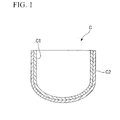
- FIG. 1 is a front sectional view illustrating a vitreous silica crucible according to an embodiment of the present invention, where reference sign C represents a vitreous silica crucible.
- the vitreous silica crucible C can be used for pulling up silicon single crystal.
- the crucible C consists of an inner-layer portion C1 for contacting with a silicon melt S as a raw material at the time of pulling up the silicon single crystal, and an outer-layer portion C2 which is an outer portion in a thickness direction.
- the pulling-up process of single crystal silicon has a first stage (S2 and S31) and a second stage (S32 and S33) after the first stage.
- the inner-layer portion C1 is substantially transparent, and contains very small amount of inner layer bubbles.
- the second stage expansion coefficient X2 of the inner-layer bubbles during the second stage (S32 and S33) is set to 1 /3 or less of the first stage expansion coefficient X1 of the inner-layer bubbles during the first stage (S2 and S31). The smaller the ratio X2/X1 is, the more the effects of the present invention are improved.
- the ratio X2/X1 may be 1 /3 to 1/20, 1 /3 to 1/10, 1/3 to 1/5, 1/4 to 1/20, 1/4 to 1 /10, or 1/4 to 1/7.
- the inner-layer portion C1 may be formed of synthetic fused silica or fused quarts (quarts glass).
- the outer-layer portion C2 may be translucent or opaque, and contain outer layer bubbles of a predetermined amount which is greater than the amount of the inner layer bubbles in the inner layer portion C1.
- the second stage expansion coefficient Y2 of the outer-layer bubbles during the second stage (S32 and S33) is set to 1/2 or less of a first stage expansion coefficient Y1 of the outer-layer bubbles during the first stage (S2 and S31).
- the ratio Y2/Y1 may be 1/2 to 1/20, 1/2 to 1/10, 1/2 to 1/5, 1 /3 to 1/20, 1/3 to 1/10, or 1 /3 to 1/6.
- the outer-layer portion C2 may be formed of fused quarts (quarts glass) or synthetic fused silica.
- the inner-layer portion C1 and the outer-layer portion C2 using the same fused quarts (quarts glass) or synthetic fused silica; however, it is more preferable to form the inner-layer portion C1 using a synthetic fused silica of a high purity and to form the outer-layer portion C2 using a fused quarts (quarts glass) of a relatively low cost.
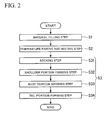
- FIG 2 is a flowchart illustrating a method of pulling up silicon single crystal using the vitreous silica crucible according to this embodiment.
- FIG. 3 is a front view illustrating the method of pulling up silicon single crystal using the vitreous silica crucible according to this embodiment.
- the pulling-up of silicon single crystal using the vitreous silica crucible C according to this embodiment is performed, for example, by the use of a Czochralski (CZ) method.
- CZ Czochralski
- the silicon single crystal pulling-up process includes a material (polycrystalline silicon) filling step S1, a temperature raising and melting step S2, and a pulling-up step S3.
- the pulling-up step S3 has a necking step S31, a shoulder portion forming step S32, a body portion growing step S33, and a tail portion forming step S34.
- the first stage includes of the temperature raising and melting step S2 and the necking step S31.
- the first stage may include the material filling step S1 because the addition of the material filling step S1 does not provide substantial change in the values of X1 or Y1.
- the vitreous silica crucible C is filled with lumps of polycrystalline silicon as a raw material.
- the vitreous silica crucible C filled with the raw material is put into a single crystal pulling-up furnace P shown in FIG 3 .
- the condition in the single crystal pulling-up furnace P is maintained under a melting pressure in the range of 1.33 to 26.66 kPa (10 torr to 200 torr) and in a melting process atmospheric of the inert gas atmosphere, such as an argon gas atmosphere.
- the crucible C is heated from a room temperature to a pulling-up temperature ranging from 1,400°C to 1,550°C for 5 to 25 hours by a electromagnetic heater H arranged around a susceptor supporting the crucible C as shown in FIG. 3 .
- the crucible C is maintained in the pulling-up temperature range, for example, for 10 hours to melt the lumps of polycrystalline silicon, thereby forming a silicon melt S.
- seed crystal (silicon single crystal) 10 is immersed in the center of the silicon melt S, the seed crystal 10 is slowly pulled up while rotating the crucible C, silicon single crystal 1 is made to grow using the seed crystal 10 as a nucleus, as shown in FIG. 3 .
- a necking portion 11 is formed in the necking step S31 for excluding dislocations due to thermal impact from the single crystal surface, the diameter of the single crystal is enlarged to form a shoulder portion 12 in the shoulder portion forming step S32, the silicon single crystal 1 having a cylindrical body portion 13 from which silicon wafers are obtained are grown in the body portion growing step S33, and the diameter is reduced and the single crystal is separated from the melt in the tail portion forming step S34.
- the first stage expansion coefficient X of the inner-layer bubbles included in the inner-layer portion C1 under the high temperature condition corresponding to the pulling-up temperature and the melting pressure condition is set so that the expansion coefficient X2 in the second stage (S32 and S33) is 1/3 or less of the expansion coefficient X1 in the first stage (S2 and S31), that is, so that X2/X ⁇ 1/3 is satisfied.
- the expansion coefficient Y of the outer-layer bubbles included in the outer-layer portion C2 is set so that the expansion coefficient Y2 in the second stage is 1/2 or less of the expansion coefficient Y1 in the first stage, that is, so that Y2/Y1 ⁇ 1/2 is satisfied.
- the pressure condition and the gas atmosphere may be individually set in the melting process and the pulling-up process.
- the temperature in the temperature raising and melting step S2 may be set to be higher than that in the pulling-up step S3.
- the pressure condition and the gas atmosphere are hardly different to be negligible. Accordingly, these are described as the pulling-up condition.
- the first stage is a step from the temperature raising and melting step S2 of melting the lump of polycrystalline silicon as a raw material to the necking step S31.
- the first stage is specifically a step from the start of maintenance under the pulling-up temperature condition to 20 hours thereafter.
- the second stage is a stage from the end of the necking step S31 to the end of the body portion growing step S33 of the pulling-up step S3, that is, the start of the tail portion forming step S34.
- the second stage is, for example, a stage from 20 hours after the start of maintenance step under the pulling-up temperature condition to 100 hours after the 20 hours.
- the expansion coefficient X2 from the end of the necking step S31 to the end of the body portion growing step S33 of the pulling-up step S3 is smaller than the expansion coefficient X1 of the inner-layer bubbles included in the inner-layer portion C1 from the temperature raising and melting step S2 to the end of the necking step S31 and is 1/3 or less of X1. Accordingly, the expansion of bubbles in the inner-layer portion C1 of the crucible is made in the first stage and the expansion of bubbles is suppressed in the second stage.
- the expansion coefficient Y2 from the end of the necking step S31 to the end of the body portion growing step S33 of the pulling-up step S3, that is, the start of the tail portion forming step S34 is smaller than the expansion coefficient Y1 of the outer-layer bubbles included in the outer-layer portion C2 from the temperature raising and melting step S2 to the end of the necking step S31 and is 1/2 or less of Y1. Accordingly, since the decrease in strength of the crucible C is small during pulling up the body portion 13 necessary to manufacture silicon wafers and thus the silicon melt is stable, it is possible to enhance the yield of single crystal silicon.
- An average expansion coefficient from the start of the maintenance step under the pulling-up temperature condition to 20 hours thereafter can be used as the expansion coefficients X1 and Y1 in the first stage.
- An average expansion coefficient from 20 hours after the start of maintenance step under the pulling-up temperature condition to 100 hours thereafter can be used as the expansion coefficients X2 and Y2 in the second stage.
- the bubbles included in the transparent inner layer C1 of the crucible C are bubbles included in a thickness range from the inner surface of the crucible to a thickness of 2 mm by observation with a microscope.
- the inner surface of the crucible before use is observed with a microscope and the total area (amount of bubbles) B1 of the bubbles included in a unit area (for example, 1 cm 2 ) of the transparent inner layer is measured. Then, the inner surface of the crucible C in the first stage is observed with a microscope and the total area (corresponding to the amount of bubbles) B2 of the bubbles included in a unit area of the transparent inner layer C1.
- the inner surface of the crucible in the second stage is observed with a microscope and the total area (amount of bubbles) B3 of the bubbles included in a unit area of the transparent layer is measured.
- the amount of bubbles included in the transparent inner layer C1 of the crucible can be measured by the use of a base pattern matching method.
- base patterns based on outline information of bubbles of images observed with a microscope are established in advance and a corresponding base pattern is selected to measure the amount of bubbles from a degree of matching thereof.
- the bubble outline information includes information such as outline data of the bubbles.
- the amount of bubbles is measured from the total area of bubbles calculated by the use of the degree of matching (the number corresponding to the base pattern) in consideration of the size of bubbles.
- the base pattern matching method is suitable for measuring the bubbles included in the range within 0.3 mm from the inner surface of the crucible (referred to as polar surface).
- polar surface the inner surface of the crucible
- the base pattern matching method does not have such disadvantages and has an advantage that the amount of bubbles in the polar surface having a great influence on the surface peeling can be measured with high precision.
- the base pattern matching method since the amount of bubbles can be measured using a piece of processing information of the degree of matching, the processing time is short and thus the measurement result can be obtained rapidly.
- the bubbles in the crucible expand due to a difference between the gas pressure in the bubbles and the pulling-up atmospheric pressure and the expansion is continued until the contraction due to the surface tension is balanced.
- the expansion of bubbles is made in the first stage and the bubbles expand before the brown rings are diffused in the inner surface of the crucible. Accordingly, even when the brown rings generates in the inner surface of the crucible, the expansion of bubbles is small and thus the peeling of the brown rings is hardly made. As a result, the yield of silicon single crystal is enhanced.
- the expansion coefficients X2 and Y2 in the second stage may be an expansion coefficient from the end of the necking process to the end of the tail portion forming step S34 of the pulling-up step S3.
- the vitreous silica crucible manufacturing apparatus 101 In the method of manufacturing the vitreous silica crucible according to this embodiment, as shown in FIG. 4 , a crucible manufacturing apparatus 1 having a rotating mold 10 performing a vacuuming operation is used. As shown in FIG. 4 , the vitreous silica crucible manufacturing apparatus 101 roughly includes a mold 110 having a melting space for melting quartz powder to form the vitreous silica crucible therein, a driving mechanism rotating the mold 110 in the axis direction, and plural carbon electrodes 113 serving as arc discharge unit heating the inside of the mold 110.
- the mold 110 is formed of, for example, carbon and has plural depressurizing passages 112 opened on the surface inside the mold 110.
- a depressurizing mechanism is connected to the depressurizing passages 112 and can suck the gas from the inner surface through the depressurizing passages 112 with the rotation of the mold 110.
- the inside of the mold 110 can be depressurized or pressurized in an atmospheric pressure by an atmospheric pressure control unit not shown.
- Plural electrodes 113 as the arc discharge unit are disposed above the mold 110 in the vitreous silica crucible manufacturing apparatus 101.
- the electrodes 113 are formed by a three-electrode combination.
- the electrodes 113 are mounted on a supporting member 122 in the upside of the furnace and a mechanism (not shown) vertically moving the electrode 121 is disposed in the supporting member 122.
- the supporting member 122 includes a supporting portion 121 supporting the carbon electrodes 113 to set an inter-electrode distance D, a horizontal moving mechanism moving the supporting portion 121 in a horizontal direction T2, and a vertical moving mechanism moving the plural supporting portions 121 and the horizontal moving mechanism together in a vertical direction T.
- the supporting portion 21 includes a rotating mechanism supporting the carbon electrodes 113 to be rotatable about an angle setting axis 122 and controlling a rotation angle of the angle setting axis 122.
- the angle direction T3 of the respective carbon electrodes 113 is controlled by the rotating mechanism
- the horizontal position of the respective supporting portions 121 is controlled by the horizontal moving mechanism
- the vertical position of the respective supporting portions 121 is controlled by the vertical moving mechanism.
- the supporting portion 121 and the like are shown in only the left carbon electrode 113 in the drawing, but the other electrodes have the same configuration and the heights of the carbon electrodes 113 can be controlled individually.
- the quartz powder layer 111 is heated, melted, and vitrified by the arc electrodes 113 disposed above the molding space and the mold is vacuumed at the time of melting by the depressurizing mechanism including the depressurizing passages 112 to suck the bubbles in the inner layer, thereby forming a transparent inner layer C1.
- the resultant structure is cooled and taken out of the mold to obtain the vitreous silica crucible C.
- outer-layer quartz powder is supplied to the inner surface of the rotating mold 110 and is deposited with a predetermined thickness.
- Inner-layer quartz powder is supplied onto the outer-layer quartz powder 111 and is deposited with a predetermined thickness. As a result, a quartz powder compact 111 is formed.
- the crucible manufacturing condition including the supply power to the arc electrodes 113, the vertical position and the horizontal position of the arc electrodes 113 and the mold 110, and the depressurized state using the depressurizing mechanism is controlled, and the expansion coefficients X1 and Y1 in the first stage and the expansion coefficients X2 and Y2 in the second stage are determined.
- the crucible manufacturing condition for setting the expansion coefficients to the above-mentioned range by melting the quartz powder compact 111 up to a predetermined thickness and elongating the heating time of the arc electrodes 113 in a state where the depressurization using the depressurizing passages 112 is not made, it is possible to reduce the bubble density of the inner layer and to control the expansion coefficients as described above.
- the pressure inside the mold 110 is set to the range of 50 kPa to 200 kPa by the atmospheric pressure control unit not shown.
- the depressurizing condition using the depressurizing passages 12 is preferably set to the range of 40 kPa to 100 kPa.
- the power supplied to the arc electrodes is preferably in the output range of 300 kVA to 12,000 kVA.
- the electrode length consumed per unit time of arc discharge is about 2 mm per minute and the arc melting is made in a state where the center position of the electrode and the rotation center of the mold are matched with each other.
- a vitreous silica crucible (with an aperture size of 32 inches) was raised in temperature from the room temperature (20°C) to 1,400°C for 5 hours and was maintained at the temperature for a predetermined time.
- the bubbles inner-layer bubbles included in the transparent inner layer (up to the depth of 2 mm from the inner surface) of the crucible, the first stage expansion coefficient X1 from the start of maintenance to 20 hours therefrom and the second stage expansion coefficient X2 up to 100 hours after the 20 hours elapsed were measured.
- the ratios X1/X2 are shown in Table 1.
- the expansion coefficient Y1 from the start of maintenance to 20 hours therefrom and the expansion coefficient Y2 up to 100 hours after the 20 hours elapsed were measured.
- the ratios Y1/Y2 are also shown in Table 1.
- Table 1 Sample Test A Test B X1/X2 Y1/Y2 X1/X2 Y1/Y2 Yield of single crystal (%) A1 4 3 4 3 89 A2 4 3 4 1 87 A3 4 3 3 3 86 A4 3 2 4 2 84 A5 3 2 3 2 83 B1 4 3 2 1 56 B2 4 1 2 1 52 B3 1 3 2 1 50 B4 2 1 1 1 34 (Note) A1 to A5 are examples and B1 to B4 are comparative examples.
- a lump of polycrystalline silicon was put into the same vitreous silica crucible as Test A, the inside of the crucible was maintained in an argon gas atmosphere of 4.0 kPa (30 torr), the temperature was raised from the room temperature (20°C) to 1,400°C for 3 hours, and the temperature was maintained for a predetermined time to melt the lump of silicon, thereby forming a silicon melt.
- a seed crystal was immersed in the silicon melt (necking process) and was slowly pulled up with the rotation of the crucible, thereby growing silicon single crystal.
- the expansion coefficient X1 from the melting of silicon to the end of the necking process and the expansion coefficient X2 from the end of the necking process to the end of the pulling-up were measured.
- the ratio X1/X2 was shown in Table 1.
- the expansion coefficient Y1 from the melting of silicon to the end of the necking process and the expansion coefficient Y2 from the end of the necking process to the end of the pulling-up were measured.
- the ratio Y1/Y2 was shown in Table 1.
- the yields of single crystal were also shown in Table 1.
- the yields of single crystal are high.
- some of the bubble expansion coefficients of Test A and the bubble expansion coefficients of Test B depart from the scope of the present invention and thus the yields of single crystal are low.
- the yield of silicon single crystal is obtained by the weight of the trunk from which silicon single crystalline wafers having no crystal dislocation can be taken/the total weight of polysilicon put into the crucible.
Landscapes
- Chemical & Material Sciences (AREA)
- Engineering & Computer Science (AREA)
- Crystallography & Structural Chemistry (AREA)
- Materials Engineering (AREA)
- Metallurgy (AREA)
- Organic Chemistry (AREA)
- Crystals, And After-Treatments Of Crystals (AREA)
- Glass Melting And Manufacturing (AREA)
Applications Claiming Priority (1)
| Application Number | Priority Date | Filing Date | Title |
|---|---|---|---|
| JP2007310194A JP4671999B2 (ja) | 2007-11-30 | 2007-11-30 | 石英ガラスルツボの試験方法 |
Publications (3)
| Publication Number | Publication Date |
|---|---|
| EP2067883A2 true EP2067883A2 (de) | 2009-06-10 |
| EP2067883A3 EP2067883A3 (de) | 2010-08-11 |
| EP2067883B1 EP2067883B1 (de) | 2016-01-27 |
Family
ID=40139196
Family Applications (1)
| Application Number | Title | Priority Date | Filing Date |
|---|---|---|---|
| EP08020717.8A Not-in-force EP2067883B1 (de) | 2007-11-30 | 2008-11-28 | Verfahren zur Herstellung eines glasartigen Quarztiegels |
Country Status (3)
| Country | Link |
|---|---|
| US (1) | US20090145351A1 (de) |
| EP (1) | EP2067883B1 (de) |
| JP (1) | JP4671999B2 (de) |
Families Citing this family (8)
| Publication number | Priority date | Publication date | Assignee | Title |
|---|---|---|---|---|
| WO2009069773A1 (ja) * | 2007-11-30 | 2009-06-04 | Japan Super Quartz Corporation | 石英ガラスルツボの製造方法および製造装置 |
| JP4995068B2 (ja) * | 2007-12-28 | 2012-08-08 | ジャパンスーパークォーツ株式会社 | シリコン単結晶引上げ用石英ガラスルツボ |
| JP4879220B2 (ja) * | 2008-05-28 | 2012-02-22 | ジャパンスーパークォーツ株式会社 | 石英ガラスルツボとその製造方法 |
| KR101154931B1 (ko) * | 2009-01-08 | 2012-06-13 | 쟈판 스파 쿼츠 가부시키가이샤 | 석영 유리 도가니 제조 장치 |
| KR101331181B1 (ko) * | 2009-08-12 | 2013-11-20 | 쟈판 스파 쿼츠 가부시키가이샤 | 실리카 유리 도가니의 제조 장치 및 실리카 유리 도가니의 제조 방법 |
| EP2385156B1 (de) * | 2009-12-11 | 2013-11-13 | Japan Super Quartz Corporation | Siliciumglastiegel |
| US8281620B1 (en) * | 2011-04-27 | 2012-10-09 | Japan Super Quartz Corporation | Apparatus for manufacturing vitreous silica crucible |
| US9816917B2 (en) * | 2013-12-28 | 2017-11-14 | Sumco Corporation | Vitreous silica crucible and distortion-measuring apparatus for the same |
Citations (3)
| Publication number | Priority date | Publication date | Assignee | Title |
|---|---|---|---|---|
| JP2005231986A (ja) | 2004-06-30 | 2005-09-02 | Shinetsu Quartz Prod Co Ltd | シリコン単結晶引上げ用石英ガラスルツボ及びその製造方法 |
| JP2005320241A (ja) | 2003-05-01 | 2005-11-17 | Shinetsu Quartz Prod Co Ltd | シリコン単結晶引上げ用石英ガラスルツボ及びその製造方法 |
| JP2007310194A (ja) | 2006-05-19 | 2007-11-29 | Ricoh Co Ltd | 画像投影装置および可搬型画像投影装置 |
Family Cites Families (8)
| Publication number | Priority date | Publication date | Assignee | Title |
|---|---|---|---|---|
| US4935046A (en) * | 1987-12-03 | 1990-06-19 | Shin-Etsu Handotai Company, Limited | Manufacture of a quartz glass vessel for the growth of single crystal semiconductor |
| US5306473A (en) * | 1992-01-31 | 1994-04-26 | Toshiba Ceramics Co., Ltd. | Quartz glass crucible for pulling a single crystal |
| JP2923720B2 (ja) * | 1992-12-26 | 1999-07-26 | 三菱マテリアルクォーツ株式会社 | シリコン単結晶引上げ用石英ルツボ |
| DE19541372A1 (de) * | 1994-11-15 | 1996-05-23 | Gen Electric | Tiegel aus geschmolzenem Quarz sowie Verfahren zu dessen Herstellung |
| JP4398527B2 (ja) * | 1998-05-25 | 2010-01-13 | 信越石英株式会社 | シリコン単結晶引き上げ用石英ガラスるつぼ |
| WO2000059837A1 (fr) * | 1999-04-06 | 2000-10-12 | Nanwa Quartz, Inc. | Procede de fabrication d'un creuset en verre de quartz |
| JP4548682B2 (ja) * | 1999-04-06 | 2010-09-22 | 株式会社ワコム製作所 | 石英ガラスるつぼの製造方法 |
| JP4781020B2 (ja) * | 2005-06-29 | 2011-09-28 | 信越半導体株式会社 | シリコン単結晶引き上げ用石英ガラスルツボおよびシリコン単結晶引き上げ用石英ガラスルツボの製造方法 |
-
2007
- 2007-11-30 JP JP2007310194A patent/JP4671999B2/ja active Active
-
2008
- 2008-11-28 US US12/325,047 patent/US20090145351A1/en not_active Abandoned
- 2008-11-28 EP EP08020717.8A patent/EP2067883B1/de not_active Not-in-force
Patent Citations (3)
| Publication number | Priority date | Publication date | Assignee | Title |
|---|---|---|---|---|
| JP2005320241A (ja) | 2003-05-01 | 2005-11-17 | Shinetsu Quartz Prod Co Ltd | シリコン単結晶引上げ用石英ガラスルツボ及びその製造方法 |
| JP2005231986A (ja) | 2004-06-30 | 2005-09-02 | Shinetsu Quartz Prod Co Ltd | シリコン単結晶引上げ用石英ガラスルツボ及びその製造方法 |
| JP2007310194A (ja) | 2006-05-19 | 2007-11-29 | Ricoh Co Ltd | 画像投影装置および可搬型画像投影装置 |
Also Published As
| Publication number | Publication date |
|---|---|
| EP2067883B1 (de) | 2016-01-27 |
| JP2009132567A (ja) | 2009-06-18 |
| JP4671999B2 (ja) | 2011-04-20 |
| US20090145351A1 (en) | 2009-06-11 |
| EP2067883A3 (de) | 2010-08-11 |
Similar Documents
| Publication | Publication Date | Title |
|---|---|---|
| EP2067883B1 (de) | Verfahren zur Herstellung eines glasartigen Quarztiegels | |
| EP2075355B1 (de) | Innerer Kristallisierungstiegel und Ziehverfahren unter Verwendung des Tiegels | |
| JP4166241B2 (ja) | シリコン単結晶引上げ用石英ガラスルツボ及びその製造方法 | |
| US8172945B2 (en) | High-purity vitreous silica crucible for pulling large-diameter single-crystal silicon ingot | |
| JP6973554B2 (ja) | 石英ガラスルツボ | |
| JP4702898B2 (ja) | シリコン単結晶引上げ用石英ガラスルツボの製造方法 | |
| EP2075354B1 (de) | Glasartiger Quarztiegel und Verfahren zum Ziehen von Einkristall-Silicium | |
| WO2004106247A1 (ja) | シリコン単結晶引上げ用石英ガラスルツボ | |
| US8163083B2 (en) | Silica glass crucible and method for pulling up silicon single crystal using the same | |
| JP4803784B2 (ja) | シリコン単結晶引上げ用石英ガラスルツボの製造方法 | |
| JP7150250B2 (ja) | 石英ガラスルツボおよび石英ガラスルツボの製造方法 | |
| EP1905872A1 (de) | Quarzglastiegel zum hochziehen eines siliciumeinkristalls und verfahren zur herstellung des quarzglastiegels | |
| JP4233059B2 (ja) | シリコン単結晶引上げ用石英ガラスルツボ及びその製造方法 | |
| JP5051033B2 (ja) | シリコン単結晶の製造方法 | |
| KR101835412B1 (ko) | 석영 유리 도가니 및 그 제조방법, 그리고 실리콘 단결정의 제조방법 | |
| KR101703691B1 (ko) | 석영 유리 도가니 및 그 제조 방법, 및 실리콘 단결정의 제조 방법 | |
| JP4549008B2 (ja) | 水素ドープシリカ粉及びそれを用いたシリコン単結晶引上げ用石英ガラスルツボ | |
| JP4958203B2 (ja) | シリコン単結晶引上げ用石英ルツボ | |
| JP2020097512A (ja) | シリカガラスルツボ | |
| JP2007091532A (ja) | シリカガラスルツボ | |
| EP2143831B1 (de) | Verfahren zum Hochziehen von Siliziumeinkristallen unter Verwendung von Quarzglastiegeln. | |
| JP2022103702A (ja) | 石英ガラスルツボ及びその製造方法 | |
| KR20230163459A (ko) | 석영 유리 도가니 및 그 제조 방법 및 실리콘 단결정의 제조 방법 |
Legal Events
| Date | Code | Title | Description |
|---|---|---|---|
| PUAI | Public reference made under article 153(3) epc to a published international application that has entered the european phase |
Free format text: ORIGINAL CODE: 0009012 |
|
| AK | Designated contracting states |
Kind code of ref document: A2 Designated state(s): AT BE BG CH CY CZ DE DK EE ES FI FR GB GR HR HU IE IS IT LI LT LU LV MC MT NL NO PL PT RO SE SI SK TR |
|
| AX | Request for extension of the european patent |
Extension state: AL BA MK RS |
|
| PUAL | Search report despatched |
Free format text: ORIGINAL CODE: 0009013 |
|
| AK | Designated contracting states |
Kind code of ref document: A3 Designated state(s): AT BE BG CH CY CZ DE DK EE ES FI FR GB GR HR HU IE IS IT LI LT LU LV MC MT NL NO PL PT RO SE SI SK TR |
|
| AX | Request for extension of the european patent |
Extension state: AL BA MK RS |
|
| 17P | Request for examination filed |
Effective date: 20110210 |
|
| AKX | Designation fees paid |
Designated state(s): AT BE BG CH CY CZ DE DK EE ES FI FR GB GR HR HU IE IS IT LI LT LU LV MC MT NL NO PL PT RO SE SI SK TR |
|
| 17Q | First examination report despatched |
Effective date: 20111021 |
|
| GRAP | Despatch of communication of intention to grant a patent |
Free format text: ORIGINAL CODE: EPIDOSNIGR1 |
|
| INTG | Intention to grant announced |
Effective date: 20150701 |
|
| GRAS | Grant fee paid |
Free format text: ORIGINAL CODE: EPIDOSNIGR3 |
|
| GRAA | (expected) grant |
Free format text: ORIGINAL CODE: 0009210 |
|
| AK | Designated contracting states |
Kind code of ref document: B1 Designated state(s): AT BE BG CH CY CZ DE DK EE ES FI FR GB GR HR HU IE IS IT LI LT LU LV MC MT NL NO PL PT RO SE SI SK TR |
|
| REG | Reference to a national code |
Ref country code: GB Ref legal event code: FG4D |
|
| REG | Reference to a national code |
Ref country code: CH Ref legal event code: EP |
|
| REG | Reference to a national code |
Ref country code: AT Ref legal event code: REF Ref document number: 772770 Country of ref document: AT Kind code of ref document: T Effective date: 20160215 |
|
| REG | Reference to a national code |
Ref country code: IE Ref legal event code: FG4D |
|
| REG | Reference to a national code |
Ref country code: DE Ref legal event code: R096 Ref document number: 602008042128 Country of ref document: DE |
|
| REG | Reference to a national code |
Ref country code: LT Ref legal event code: MG4D |
|
| REG | Reference to a national code |
Ref country code: NL Ref legal event code: MP Effective date: 20160127 |
|
| REG | Reference to a national code |
Ref country code: AT Ref legal event code: MK05 Ref document number: 772770 Country of ref document: AT Kind code of ref document: T Effective date: 20160127 |
|
| PG25 | Lapsed in a contracting state [announced via postgrant information from national office to epo] |
Ref country code: NL Free format text: LAPSE BECAUSE OF FAILURE TO SUBMIT A TRANSLATION OF THE DESCRIPTION OR TO PAY THE FEE WITHIN THE PRESCRIBED TIME-LIMIT Effective date: 20160127 |
|
| PG25 | Lapsed in a contracting state [announced via postgrant information from national office to epo] |
Ref country code: NO Free format text: LAPSE BECAUSE OF FAILURE TO SUBMIT A TRANSLATION OF THE DESCRIPTION OR TO PAY THE FEE WITHIN THE PRESCRIBED TIME-LIMIT Effective date: 20160427 Ref country code: HR Free format text: LAPSE BECAUSE OF FAILURE TO SUBMIT A TRANSLATION OF THE DESCRIPTION OR TO PAY THE FEE WITHIN THE PRESCRIBED TIME-LIMIT Effective date: 20160127 Ref country code: GR Free format text: LAPSE BECAUSE OF FAILURE TO SUBMIT A TRANSLATION OF THE DESCRIPTION OR TO PAY THE FEE WITHIN THE PRESCRIBED TIME-LIMIT Effective date: 20160428 Ref country code: IT Free format text: LAPSE BECAUSE OF FAILURE TO SUBMIT A TRANSLATION OF THE DESCRIPTION OR TO PAY THE FEE WITHIN THE PRESCRIBED TIME-LIMIT Effective date: 20160127 Ref country code: ES Free format text: LAPSE BECAUSE OF FAILURE TO SUBMIT A TRANSLATION OF THE DESCRIPTION OR TO PAY THE FEE WITHIN THE PRESCRIBED TIME-LIMIT Effective date: 20160127 Ref country code: FI Free format text: LAPSE BECAUSE OF FAILURE TO SUBMIT A TRANSLATION OF THE DESCRIPTION OR TO PAY THE FEE WITHIN THE PRESCRIBED TIME-LIMIT Effective date: 20160127 |
|
| PG25 | Lapsed in a contracting state [announced via postgrant information from national office to epo] |
Ref country code: IS Free format text: LAPSE BECAUSE OF FAILURE TO SUBMIT A TRANSLATION OF THE DESCRIPTION OR TO PAY THE FEE WITHIN THE PRESCRIBED TIME-LIMIT Effective date: 20160527 Ref country code: LV Free format text: LAPSE BECAUSE OF FAILURE TO SUBMIT A TRANSLATION OF THE DESCRIPTION OR TO PAY THE FEE WITHIN THE PRESCRIBED TIME-LIMIT Effective date: 20160127 Ref country code: SE Free format text: LAPSE BECAUSE OF FAILURE TO SUBMIT A TRANSLATION OF THE DESCRIPTION OR TO PAY THE FEE WITHIN THE PRESCRIBED TIME-LIMIT Effective date: 20160127 Ref country code: PT Free format text: LAPSE BECAUSE OF FAILURE TO SUBMIT A TRANSLATION OF THE DESCRIPTION OR TO PAY THE FEE WITHIN THE PRESCRIBED TIME-LIMIT Effective date: 20160527 Ref country code: AT Free format text: LAPSE BECAUSE OF FAILURE TO SUBMIT A TRANSLATION OF THE DESCRIPTION OR TO PAY THE FEE WITHIN THE PRESCRIBED TIME-LIMIT Effective date: 20160127 Ref country code: LT Free format text: LAPSE BECAUSE OF FAILURE TO SUBMIT A TRANSLATION OF THE DESCRIPTION OR TO PAY THE FEE WITHIN THE PRESCRIBED TIME-LIMIT Effective date: 20160127 Ref country code: PL Free format text: LAPSE BECAUSE OF FAILURE TO SUBMIT A TRANSLATION OF THE DESCRIPTION OR TO PAY THE FEE WITHIN THE PRESCRIBED TIME-LIMIT Effective date: 20160127 |
|
| REG | Reference to a national code |
Ref country code: DE Ref legal event code: R097 Ref document number: 602008042128 Country of ref document: DE |
|
| PG25 | Lapsed in a contracting state [announced via postgrant information from national office to epo] |
Ref country code: DK Free format text: LAPSE BECAUSE OF FAILURE TO SUBMIT A TRANSLATION OF THE DESCRIPTION OR TO PAY THE FEE WITHIN THE PRESCRIBED TIME-LIMIT Effective date: 20160127 Ref country code: EE Free format text: LAPSE BECAUSE OF FAILURE TO SUBMIT A TRANSLATION OF THE DESCRIPTION OR TO PAY THE FEE WITHIN THE PRESCRIBED TIME-LIMIT Effective date: 20160127 |
|
| PG25 | Lapsed in a contracting state [announced via postgrant information from national office to epo] |
Ref country code: RO Free format text: LAPSE BECAUSE OF FAILURE TO SUBMIT A TRANSLATION OF THE DESCRIPTION OR TO PAY THE FEE WITHIN THE PRESCRIBED TIME-LIMIT Effective date: 20160127 Ref country code: SK Free format text: LAPSE BECAUSE OF FAILURE TO SUBMIT A TRANSLATION OF THE DESCRIPTION OR TO PAY THE FEE WITHIN THE PRESCRIBED TIME-LIMIT Effective date: 20160127 Ref country code: CZ Free format text: LAPSE BECAUSE OF FAILURE TO SUBMIT A TRANSLATION OF THE DESCRIPTION OR TO PAY THE FEE WITHIN THE PRESCRIBED TIME-LIMIT Effective date: 20160127 |
|
| PLBE | No opposition filed within time limit |
Free format text: ORIGINAL CODE: 0009261 |
|
| STAA | Information on the status of an ep patent application or granted ep patent |
Free format text: STATUS: NO OPPOSITION FILED WITHIN TIME LIMIT |
|
| PG25 | Lapsed in a contracting state [announced via postgrant information from national office to epo] |
Ref country code: BE Free format text: LAPSE BECAUSE OF FAILURE TO SUBMIT A TRANSLATION OF THE DESCRIPTION OR TO PAY THE FEE WITHIN THE PRESCRIBED TIME-LIMIT Effective date: 20160127 |
|
| 26N | No opposition filed |
Effective date: 20161028 |
|
| PG25 | Lapsed in a contracting state [announced via postgrant information from national office to epo] |
Ref country code: SI Free format text: LAPSE BECAUSE OF FAILURE TO SUBMIT A TRANSLATION OF THE DESCRIPTION OR TO PAY THE FEE WITHIN THE PRESCRIBED TIME-LIMIT Effective date: 20160127 Ref country code: BG Free format text: LAPSE BECAUSE OF FAILURE TO SUBMIT A TRANSLATION OF THE DESCRIPTION OR TO PAY THE FEE WITHIN THE PRESCRIBED TIME-LIMIT Effective date: 20160427 |
|
| REG | Reference to a national code |
Ref country code: CH Ref legal event code: PL |
|
| GBPC | Gb: european patent ceased through non-payment of renewal fee |
Effective date: 20161128 |
|
| PG25 | Lapsed in a contracting state [announced via postgrant information from national office to epo] |
Ref country code: LI Free format text: LAPSE BECAUSE OF NON-PAYMENT OF DUE FEES Effective date: 20161130 Ref country code: CH Free format text: LAPSE BECAUSE OF NON-PAYMENT OF DUE FEES Effective date: 20161130 |
|
| REG | Reference to a national code |
Ref country code: IE Ref legal event code: MM4A |
|
| REG | Reference to a national code |
Ref country code: FR Ref legal event code: ST Effective date: 20170731 |
|
| PG25 | Lapsed in a contracting state [announced via postgrant information from national office to epo] |
Ref country code: LU Free format text: LAPSE BECAUSE OF NON-PAYMENT OF DUE FEES Effective date: 20161130 |
|
| PG25 | Lapsed in a contracting state [announced via postgrant information from national office to epo] |
Ref country code: FR Free format text: LAPSE BECAUSE OF NON-PAYMENT OF DUE FEES Effective date: 20161130 |
|
| PG25 | Lapsed in a contracting state [announced via postgrant information from national office to epo] |
Ref country code: GB Free format text: LAPSE BECAUSE OF NON-PAYMENT OF DUE FEES Effective date: 20161128 Ref country code: IE Free format text: LAPSE BECAUSE OF NON-PAYMENT OF DUE FEES Effective date: 20161128 |
|
| PG25 | Lapsed in a contracting state [announced via postgrant information from national office to epo] |
Ref country code: CY Free format text: LAPSE BECAUSE OF FAILURE TO SUBMIT A TRANSLATION OF THE DESCRIPTION OR TO PAY THE FEE WITHIN THE PRESCRIBED TIME-LIMIT Effective date: 20160127 Ref country code: HU Free format text: LAPSE BECAUSE OF FAILURE TO SUBMIT A TRANSLATION OF THE DESCRIPTION OR TO PAY THE FEE WITHIN THE PRESCRIBED TIME-LIMIT; INVALID AB INITIO Effective date: 20081128 |
|
| PG25 | Lapsed in a contracting state [announced via postgrant information from national office to epo] |
Ref country code: MC Free format text: LAPSE BECAUSE OF FAILURE TO SUBMIT A TRANSLATION OF THE DESCRIPTION OR TO PAY THE FEE WITHIN THE PRESCRIBED TIME-LIMIT Effective date: 20160127 Ref country code: TR Free format text: LAPSE BECAUSE OF FAILURE TO SUBMIT A TRANSLATION OF THE DESCRIPTION OR TO PAY THE FEE WITHIN THE PRESCRIBED TIME-LIMIT Effective date: 20160127 |
|
| PG25 | Lapsed in a contracting state [announced via postgrant information from national office to epo] |
Ref country code: MT Free format text: LAPSE BECAUSE OF NON-PAYMENT OF DUE FEES Effective date: 20161128 |
|
| REG | Reference to a national code |
Ref country code: DE Ref legal event code: R082 Ref document number: 602008042128 Country of ref document: DE Representative=s name: KRAUS & LEDERER PARTGMBB, DE Ref country code: DE Ref legal event code: R081 Ref document number: 602008042128 Country of ref document: DE Owner name: SUMCO CORPORATION, JP Free format text: FORMER OWNER: JAPAN SUPER QUARTZ CORPORATION, AKITA-SHI, JP Ref country code: DE Ref legal event code: R082 Ref document number: 602008042128 Country of ref document: DE Representative=s name: KRAUS & WEISERT PATENTANWAELTE PARTGMBB, DE |
|
| PGFP | Annual fee paid to national office [announced via postgrant information from national office to epo] |
Ref country code: DE Payment date: 20231121 Year of fee payment: 16 |
|
| REG | Reference to a national code |
Ref country code: DE Ref legal event code: R119 Ref document number: 602008042128 Country of ref document: DE |
|
| PG25 | Lapsed in a contracting state [announced via postgrant information from national office to epo] |
Ref country code: DE Free format text: LAPSE BECAUSE OF NON-PAYMENT OF DUE FEES Effective date: 20250603 |