EP2067985A2 - Starter mit kompakter Struktur - Google Patents
Starter mit kompakter Struktur Download PDFInfo
- Publication number
- EP2067985A2 EP2067985A2 EP08021091A EP08021091A EP2067985A2 EP 2067985 A2 EP2067985 A2 EP 2067985A2 EP 08021091 A EP08021091 A EP 08021091A EP 08021091 A EP08021091 A EP 08021091A EP 2067985 A2 EP2067985 A2 EP 2067985A2
- Authority
- EP
- European Patent Office
- Prior art keywords
- pinion
- shielding member
- gear
- ring gear
- starter
- Prior art date
- Legal status (The legal status is an assumption and is not a legal conclusion. Google has not performed a legal analysis and makes no representation as to the accuracy of the status listed.)
- Granted
Links
Images


Classifications
-
- F—MECHANICAL ENGINEERING; LIGHTING; HEATING; WEAPONS; BLASTING
- F02—COMBUSTION ENGINES; HOT-GAS OR COMBUSTION-PRODUCT ENGINE PLANTS
- F02N—STARTING OF COMBUSTION ENGINES; STARTING AIDS FOR SUCH ENGINES, NOT OTHERWISE PROVIDED FOR
- F02N15/00—Other power-operated starting apparatus; Component parts, details, or accessories, not provided for in, or of interest apart from groups F02N5/00 - F02N13/00
- F02N15/02—Gearing between starting-engines and started engines; Engagement or disengagement thereof
- F02N15/04—Gearing between starting-engines and started engines; Engagement or disengagement thereof the gearing including disengaging toothed gears
- F02N15/06—Gearing between starting-engines and started engines; Engagement or disengagement thereof the gearing including disengaging toothed gears the toothed gears being moved by axial displacement
-
- F—MECHANICAL ENGINEERING; LIGHTING; HEATING; WEAPONS; BLASTING
- F02—COMBUSTION ENGINES; HOT-GAS OR COMBUSTION-PRODUCT ENGINE PLANTS
- F02N—STARTING OF COMBUSTION ENGINES; STARTING AIDS FOR SUCH ENGINES, NOT OTHERWISE PROVIDED FOR
- F02N11/00—Starting of engines by means of electric motors
-
- F—MECHANICAL ENGINEERING; LIGHTING; HEATING; WEAPONS; BLASTING
- F02—COMBUSTION ENGINES; HOT-GAS OR COMBUSTION-PRODUCT ENGINE PLANTS
- F02N—STARTING OF COMBUSTION ENGINES; STARTING AIDS FOR SUCH ENGINES, NOT OTHERWISE PROVIDED FOR
- F02N2250/00—Problems related to engine starting or engine's starting apparatus
- F02N2250/08—Lubrication of starters; Sealing means for starters
-
- Y—GENERAL TAGGING OF NEW TECHNOLOGICAL DEVELOPMENTS; GENERAL TAGGING OF CROSS-SECTIONAL TECHNOLOGIES SPANNING OVER SEVERAL SECTIONS OF THE IPC; TECHNICAL SUBJECTS COVERED BY FORMER USPC CROSS-REFERENCE ART COLLECTIONS [XRACs] AND DIGESTS
- Y10—TECHNICAL SUBJECTS COVERED BY FORMER USPC
- Y10T—TECHNICAL SUBJECTS COVERED BY FORMER US CLASSIFICATION
- Y10T74/00—Machine element or mechanism
- Y10T74/13—Machine starters
Definitions
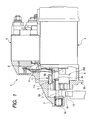
- the starter device is of the type including a housing 100 having a nose portion 101 protruding toward an engine and internally formed with an opening portion 102, and a motor 110 fixedly mounted on the housing 100.
- the motor 110 has an armature 111 provided with an armature shaft 111a, to which an output shaft 150 is connected via a speed reduction gear unit 120 and a clutch 130.
- the output shaft 150 has one axial end, placed in opposition to the motor 110, which is rotatably supported with the nose portion 101 at a distal end thereof via a bearing 140.
- the output shaft 150 has an outer circumferential periphery formed with a spline 102, to which a spline tube 160 is held in spline coupling engagement.
- the spline tube 160 has one axial end integrally formed with a pinion gear 170.
- a shift lever 190 is drivably actuated to push the spline tube 160 toward the engine (rightward as viewed in FIG. 4 ). This causes the pinion gear 170 to be brought into meshing engagement with the ring gear 200 of the engine.
- the present invention has been completed with a view to addressing the above issues and has an object to provide a starter that can suppress grit and dust or water droplets from intruding from an opening portion of a nose portion to an inside of a housing to prevent the occurrence of degraded performance and defective operation of the starter.
- the present invention provides a starter comprising a housing having an engine mounting surface adapted to rest on an engine having a ring gear, and a nose portion extending from the engine mounting portion toward the engine and having an opening portion, a motor fixedly mounted on the housing and having an armature generating a rotational force and an armature shaft on which the armature is supported, an output shaft disposed in a coaxial relationship with the armature shaft and having axial ends one end of which is rotatably supported with the nose portion by means of a bearing at a position opposite to the motor, and a pinion moving body having a pinion gear operative to mesh with the ring gear to transfer the rotational force to the ring gear and fitted on the output shaft at an outer periphery thereof in helical spline engagement.
- the pinion moving body comprises a pinion shielding member connected to the pinion gear at one end axially placed in opposition to the ring gear.
- the pinion shielding member has an outer circumferential periphery, having an outer diameter greater than a diameter of an addendum circle of the pinion gear, and a bottomed cylindrical configuration formed with a hollow portion having one axial end facing the ring gear and opened and the other axial end directed in opposition to the ring gear and closed.
- the pinion shielding member has the outer circumferential periphery with the outer diameter greater than the diameter of the addendum circle of the pinion gear.
- the starter can have a clearance between an inner circumferential portion of the nose portion and the outer circumferential periphery of the pinion shielding member that is made less than a clearance between the inner circumferential portion of the nose portion and the diameter of the addendum circle of the pinion gear.
- the pinion shielding member has a function to serve as water proofing wall. This suppresses foreign materials such as grit and dust or water droplets, collected up by the ring gear, from intruding to the inside of the housing.
- the pinion shielding member has the hollow portion having one axial end facing the ring gear and opened and the other axial end directed in opposition to the ring gear and closed. Therefore, even if the water droplets, collected up by the ring gear, intrude from the opening portion of the nose portion into the hollow portion, the hollow portion can block the intrusion of the water droplets. Thus, no risk takes place for the water droplets intrude into a further inside area of the starter.
- a water flow, intruded from the opening portion of the nose portion has a momentum that is weakened with the hollow portion, providing improved effect of preventing the intrusion of water.
- the nose portion of the housing and the pinion shielding member may preferably have a relationship in that a clearance, defined between an inner circumferential periphery of the nose portion and the outer circumferential periphery of the pinion shielding member, is kept constant in an area starting from a stop position, in which the pinion disengages from the ring gear to be halted, to a meshing position in which the pinion meshes with the ring gear.
- the pinion shielding member may preferably have a plurality of ribs radially extending between an inner periphery and an outer periphery of the hollow portion.
- the hollow portion provided with the plural ribs compensates for the drop in strength of the pinion shielding member caused by the formation of the hollow portion.
- the hollow portion is divided with the ribs into a plurality of compartments, which can minimize the momentum of a water stream intruded into the hollow portion, thereby providing an increased effect of preventing water from intruding to the inside of the housing.
- the pinion shielding member may be preferably made of resin separately from the pinion gear and assembled to the pinion gear by snap fitting with elasticity.
- Providing the pinion shielding member independently of the pinion gear enables the pinion shielding member to be easily formed by resin molding, while enabling the pinion gear and the pinion shielding member to be easily assembled in a snap fitting fashion.
- an electromagnetic switch may be further preferably provided to be operative to form an electromagnet providing an attraction force to drive a shift lever for moving the pinion moving body toward the ring gear of the engine, wherein the pinion shielding member is integrally formed with a lever engaging portion held in engagement with the shift lever.
- the term "front” refers to a front portion of a component part at a position axially closer to an engine or a ring gear of the engine, i.e., an area oriented in a direction opposite to a motor incorporated in a starter to which the present invention is related.
- the term “rear” refers to a rear portion of the component part closer to the motor incorporated in the starter, i.e., the other area oriented in a direction opposite to the engine.
- FIG. 1 is a cross sectional view showing the starter 1 of the present embodiment implementing the present invention.
- the starter 1 of the present embodiment includes a motor 2 having an armature (not shown) for generating a rotational force, an output shaft 3 to which the rotational force is transferred from the armature through a clutch (not shown), a pinion moving body PM (described later) located on the output shaft 3 at its outer circumferential periphery, an electromagnetic switch 5 having not only a function to open or close a main contact (not shown) disposed in an energization circuit (motor circuit) of the motor 2 but also a function to move the pinion moving body PM via a shift lever 4 in an axial direction, and a housing 6 to which the motor 2 and the electromagnetic switch 5 are fixedly mounted.
- the motor 2 is a well-known DC electric motor operative such that with the main contact being closed upon energization of the electromagnetic switch 5, the DC electric motor is supplied with electric power from an on-vehicle battery (not shown) to cause the armature to generate the rotational force.
- the clutch takes the form of a one-way clutch that is operative to transfer drive torque from the motor 2 to the output shaft 3 during a startup of an engine whereas when an engine rotation is transferred to the starter 1 due to the startup of the engine, a power transfer path between an input and an output (on a side of the output shaft) is disconnected to interrupt a transfer of torque for preventing the engine rotation from being transferred to the input (on the side of the motor) of the clutch.
- a speed reduction gear unit may be disposed between the motor 2 and the clutch.
- the speed reduction gear unit may preferably include a planetary gear type speed reduction gear device that can achieve a speed reduction on, for instance, the same axis as that of the armature shaft of the motor 2.
- the output shaft 3 placed on the same axis as that of the armature shaft in a coaxial relation, has an axial front end 3a, axially placed in opposition to the motor 2 and rotatably supported with a bearing 7 mounted on a distal end of the housing 6 at a nose portion 6a thereof, and an axial rear end that is closer to the motor 2 and connected to the clutch.
- the electromagnetic switch device 5 is comprised of an electromagnetic coil (not shown) operative to be energized with electric power delivered from the one-vehicle battery due to a starter switch (not shown) being closed in operation, and a plunger 8 disposed in the electromagnetic coil to be movable therethrough.
- an electromagnetic coil (not shown) operative to be energized with electric power delivered from the one-vehicle battery due to a starter switch (not shown) being closed in operation
- a plunger 8 disposed in the electromagnetic coil to be movable therethrough.
- the housing 6 has the nose portion 6a that protrudes from a mounting surface 6b, operative to rest on the engine, in a front direction (rightward as viewed in FIG. 1 ) opposite to the motor 2.
- the nose portion 6a is internally formed with an opening portion 6c to accommodate therein a pinion gear 9 and a ring gear 10 of the engine that are operative to be brought into meshing engagement with each other in a manner as described below in detail.
- the pinion moving body PM is comprised of the pinion gear 9 and a pinion shielding member 11.
- the pinion gear 9 is coupled to an outer circumferential periphery of the output shaft 3 in a helical spline engagement to be rotatable unitarily with the output shaft 3 to have a function to transfer the rotational force of the motor 2 to the ring gear 10.
- the pinion gear 9 is made of, for instance, iron, and has an axial rear end, placed in opposition to the ring gear 10, which is unitarily formed with a trunk portion 9a (see FIG 1 ) having an outer circumferential periphery formed with an annular circumferential recess 9b.
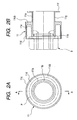
- the pinion shielding member 11 made of, for instance, resin separately from the pinion gear 9, is fitted to the trunk portion 9a of the pinion gear 9 in assembly by means of a snap fitting fashion utilizing elasticity to be rotatable relative to the pinion gear 9. That is, the pinion shielding member 11 has a cylindrical portion 11a which can be fitted to the trunk portion 9a of the pinion gear 9 as shown in FIGS. 2A and 2B .
- the cylindrical portion 11 a has a front end axial internally formed with a radially inwardly protruding a ring-shaped claw portion 11b, which is fitted to the annular circumferential recess 9b formed on the trunk portion 9a of the pinion gear 9. This allows the cylindrical portion 11a to be easily assembled to the pinion gear 9.
- the pinion shielding member 11 has an outer circumferential cylindrical portion 11c having an outer diameter larger than that of an addendum circle of the pinion gear 9.
- the outer circumferential cylindrical portion 11c is formed in a bottomed ring-shaped configuration, having a radially extending bottom wall 11cb connected to the cylindrical portion 11a at a rear end thereof, which is internally formed with an annular hollow portion 11d defined between the cylindrical portion 11 a and the outer circumferential portion 11c.
- the annular hollow portion 11d has a front axial end that is opened and a rear end closed with the bottom wall 11cb.
- the annular hollow portion 11d of the pinion shielding member 11 is opened in an area radially outward of the diameter (indicated by a phantom line P in FIG. 2A ) of the addendum circle of the pinion gear 9 as viewed the pinion shielding member 11 in an axial direction from the pinion gear 9 as shown in FIG 2A .
- the clearance between the inner peripheral surface of the opening portion 6c of the nose portion 6a and the outer circumferential periphery of the outer cylindrical portion 11c of the pinion shielding member 11 is set to an extent as small as possible to ensure the pinion moving body PM is prevented from conflicting the inner circumferential periphery of the opening portion 6c of the nose portion 6a during movement of the pinion moving body PM in the axial direction.
- the clearance between the inner peripheral surface of the opening portion 6c of the nose portion 6a and the outer circumferential periphery of the outer cylindrical portion 11 c of the pinion shielding member 11 is formed to have an approximately constant value in an area from a stop position of the pinion gear 9 to a meshing position at which the pinion gear 9 meshes with the ring gear 10. That is, between the stop position and the meshing position of the pinion gear 9, no remarkable variation takes place in the clearance between the outer circumferential periphery of the outer cylindrical portion 11c and the inner peripheral surface of the opening portion 6c of the nose portion 6a, which is kept nearly constant.
- the pinion shielding member 11 has a barrel portion 11e formed integrally with a rear end of the cylindrical portion 11a at a position opposite to the pinion gear in a coaxial relationship.
- the barrel portion 11e has a rear end formed with an annular flange portion 11f with an annular recess 11g being defined between the bottom wall 11cb and the annular flange 11f.
- the annular recess 11g of the barrel portion 11e accommodates therein the shift lever 4.
- the electromagnetic coil is energized to form the electromagnet. Then, the electromagnet attracts the plunger 8 with the movement of the plunger 8 being transferred to the pinion shielding member 11 via the shift lever 4. This causes the pinion shielding member 11 to rotate on the output shaft 3 due to an action of the helical spline to be axially pushed toward the ring gear 10 of the engine (leftward as viewed in FIG. 1 ) such that the pinion gear 9 is brought into meshing engagement with the ring gear 10.
- the movement of the plunger 8 results in a consequence of closing the main contact of the motor circuit, thereby permitting the battery to apply the motor 2 with electric power to cause the armature to generate the rotational force.
- the rotation of the armature is transferred to the output shaft 3 via the clutch, causing the pinion gear 9 to rotate unitarily with the output shaft 3.
- drive torque of the motor 2 is transferred from the pinion gear 9 to the ring gear 10, thereby cranking up the engine.
- the electromagnetic coil is de-energized to diminish the electromagnet. This causes the plunger 8 to be pushed back to its original position due to the reactive force stored in the return spring. As a result, the main contact is opened and no electric power is supplied from the battery to the motor 2. Thus, the armature gradually decelerates to halt in operation.
- the pinion shielding member 11 formed on the pinion moving body PM, has the outer circumferential periphery with an outer diameter greater than that of the addendum circle of the pinion gear 9. This enables the clearance between the inner peripheral surface of the opening portion 6c of the nose portion 6a and the outer circumferential periphery of the outer cylindrical portion 11c to be less than the clearance between the inner peripheral surface of the opening portion 6c of the nose portion 6a and the outer diameter of the addendum circle of the pinion gear 9.
- the pinion shielding member 11 has a function to serve as a water-proofing wall. This avoids foreign materials such as grit and dust or water droplets or the like collected by the ring gear 10 from intruding from the opening portion 6c of the nose portion 6a into the inside of the housing 6.
- the pinion shielding member 11 is formed with the annular hollow portion 11d having the front end being opened in the axial direction and the rear end closed with the radially extending bottom wall 11cb. Therefore, even if the water droplets, collected by the ring gear 10, intrude from the opening portion 6c of the nose portion 6a of the housing 6 into the annular hollow portion 11d, the annular hollow portion 11d blocks the entry of the water droplets. This blocks the water droplets from further intruding to the inside of the starter 1. In addition, the annular hollow portion 11d weakens the momentum of any water stream intruding from the opening portion 6c of the nose portion 6a of the housing 6, thereby improving an effect of preventing the water intrusion.
- the clearance between the inner peripheral surface of the opening portion 6c of the nose portion 6a and the outer circumferential periphery of the pinion shielding member 11 is kept approximately constant. This suppresses foreign materials and water droplets or the like from intruding into the inside of the housing 6 regardless of the positions (stop position and the meshing position) of the pinion gear 9.
- the pinion shielding member 11 can be easily formed by resin-molding and the pinion gear 9 and the pinion shielding member 11 can be readily assembled to each other with snap fitting action.
- the barrel portion 11e can be easily formed integrally with the pinion shielding member 11 to engage with the shift lever 4, resulting in an effect of achieving a reduction in the number of component parts.
- the pinion moving body PM is comprised of the pinion gear 9 and the pinion shielding member 11 formed in separate bodies and the pinion gear 9 is made of iron while the pinion shielding member 11 is made of resin with lower density than that of the pinion gear 9, enabling a reduction in mass of the pinion shielding member 11.
- a pinion shielding member of a modified form is described below with reference to FIGS. 3A and 3B .
- FIG. 3A shows a front view of the pinion shielding member 11A of the modified form
- FIG. 3B is a cross sectional view of the pinion shielding member 11A of the modified form shown in FIG. 3A .
- the pinion shielding member 11A has a plurality of ribs 11h axially extending through the annular hollow portion 11d at circumferentially spaced positions and having rear ends formed integrally with the bottom wall 11cb of the pinion shielding member 11A.
- the pinion shielding member 11A includes the cylindrical portion 11a, serving as an inner circumferential wall of the annular hollow portion 11d, and the outer cylindrical portion, serving as an outer circumferential wall of the annular hollow portion 11d, with the plurality of ribs 11h radially interconnecting the inner and outer circumferential walls of the inner and outer cylindrical portions 11a and 11c, respectively.
- the plurality of ribs 11h are placed at circumferentially equidistantly spaced intervals, thereby partitioning the annular hollow portion 11d into a plurality of small compartments 11i.
- the ribs 11h formed in the annular hollow portion 11d compensates for a drop in rigidity of the pinion shielding member 11 A caused by the formation of the annular hollow portion 11d.
- the annular hollow portion 11d is divided into the plurality of small compartments 11i defined with the plurality of ribs 11h. This suppresses the momentum of the water stream intruding to the annular hollow portion 11d, thereby providing an increased effect of suppressing the intrusion of water to the inside of the housing 6.
- both of these component parts may be formed of the same material in a unitary structure.
- the pinion shielding member 11 may be possibly formed by, for instance, cutting and forging or the like.
Landscapes
- Engineering & Computer Science (AREA)
- Chemical & Material Sciences (AREA)
- Combustion & Propulsion (AREA)
- Mechanical Engineering (AREA)
- General Engineering & Computer Science (AREA)
- Connection Of Motors, Electrical Generators, Mechanical Devices, And The Like (AREA)
- Sealing Using Fluids, Sealing Without Contact, And Removal Of Oil (AREA)
- Sealing Of Bearings (AREA)
Applications Claiming Priority (1)
| Application Number | Priority Date | Filing Date | Title |
|---|---|---|---|
| JP2007317543A JP4992692B2 (ja) | 2007-12-07 | 2007-12-07 | スタータ |
Publications (3)
| Publication Number | Publication Date |
|---|---|
| EP2067985A2 true EP2067985A2 (de) | 2009-06-10 |
| EP2067985A3 EP2067985A3 (de) | 2010-07-14 |
| EP2067985B1 EP2067985B1 (de) | 2015-04-15 |
Family
ID=40427683
Family Applications (1)
| Application Number | Title | Priority Date | Filing Date |
|---|---|---|---|
| EP08021091.7A Ceased EP2067985B1 (de) | 2007-12-07 | 2008-12-04 | Starter mit kompakter Struktur |
Country Status (4)
| Country | Link |
|---|---|
| US (1) | US8601887B2 (de) |
| EP (1) | EP2067985B1 (de) |
| JP (1) | JP4992692B2 (de) |
| CN (1) | CN101451483B (de) |
Cited By (1)
| Publication number | Priority date | Publication date | Assignee | Title |
|---|---|---|---|---|
| FR3010457A1 (fr) * | 2013-09-12 | 2015-03-13 | Valeo Equip Electr Moteur | Machine electrique tournante, notamment demarreur de vehicule automobile |
Families Citing this family (7)
| Publication number | Priority date | Publication date | Assignee | Title |
|---|---|---|---|---|
| JP5195535B2 (ja) * | 2009-03-06 | 2013-05-08 | 株式会社デンソー | スタータ |
| CN103423058B (zh) * | 2012-05-24 | 2017-02-08 | 博世汽车部件(长沙)有限公司 | 车辆起动机及其驱动齿轮组件 |
| JP5966844B2 (ja) * | 2012-10-18 | 2016-08-10 | 株式会社デンソー | スタータ |
| JP2015137602A (ja) * | 2014-01-23 | 2015-07-30 | 株式会社デンソー | スタータ |
| JP2015165114A (ja) * | 2014-03-03 | 2015-09-17 | 株式会社デンソー | スタータ |
| CN106837651B (zh) * | 2017-02-28 | 2018-07-24 | 上海法雷奥汽车电器系统有限公司 | 一种起动机的小齿轮定位机构及起动机 |
| CN107859585B (zh) * | 2017-12-11 | 2023-10-20 | 辽宁壮龙无人机科技有限公司 | 飞行器及其发动机启动装置 |
Citations (2)
| Publication number | Priority date | Publication date | Assignee | Title |
|---|---|---|---|---|
| JP2006207573A (ja) | 2004-12-27 | 2006-08-10 | Denso Corp | スタータ |
| JP2007317543A (ja) | 2006-05-26 | 2007-12-06 | Toyota Motor Corp | 燃料電池システム |
Family Cites Families (15)
| Publication number | Priority date | Publication date | Assignee | Title |
|---|---|---|---|---|
| JPS5324610Y2 (de) | 1973-08-28 | 1978-06-23 | ||
| GB1547766A (en) * | 1975-08-21 | 1979-06-27 | Lucas Industries Ltd | Starter motors |
| ZA783651B (en) * | 1977-07-01 | 1979-06-27 | Lucas Industries Ltd | Starter motor |
| US5054329A (en) * | 1989-01-19 | 1991-10-08 | Mitsubishi Denki Kabushiki Kaisha | Starter motor pinion shaft oil seal |
| US5142923A (en) * | 1989-07-27 | 1992-09-01 | United Technologies Motor Systems, Inc. | Starter motor with a pinion seal |
| US4958530A (en) * | 1989-08-31 | 1990-09-25 | Ford Motor Company | Moisture seal for a translatable pinion gear assembly in a starter motor |
| JPH0744811B2 (ja) * | 1989-08-31 | 1995-05-15 | 三菱電機株式会社 | スタータ |
| US5101114A (en) * | 1989-09-01 | 1992-03-31 | Mitsubishi Denki K.K. | Starter motor |
| JPH09133066A (ja) * | 1995-11-10 | 1997-05-20 | Hitachi Ltd | スタータ |
| JPH1037831A (ja) * | 1996-07-22 | 1998-02-13 | Hitachi Ltd | スタータ |
| JPH1182251A (ja) * | 1997-09-11 | 1999-03-26 | Hitachi Ltd | スタータ |
| JP3838868B2 (ja) * | 2000-12-05 | 2006-10-25 | 株式会社デンソー | エンジン始動装置 |
| US6612191B2 (en) * | 2000-12-08 | 2003-09-02 | Denso Corporation | Starter with driving lever having lever pin |
| JP3702780B2 (ja) | 2000-12-08 | 2005-10-05 | 株式会社デンソー | スタータ |
| JP2004211673A (ja) * | 2003-01-09 | 2004-07-29 | Denso Corp | スタータ |
-
2007
- 2007-12-07 JP JP2007317543A patent/JP4992692B2/ja not_active Expired - Fee Related
-
2008
- 2008-12-02 US US12/314,002 patent/US8601887B2/en active Active
- 2008-12-04 CN CN2008101827586A patent/CN101451483B/zh active Active
- 2008-12-04 EP EP08021091.7A patent/EP2067985B1/de not_active Ceased
Patent Citations (2)
| Publication number | Priority date | Publication date | Assignee | Title |
|---|---|---|---|---|
| JP2006207573A (ja) | 2004-12-27 | 2006-08-10 | Denso Corp | スタータ |
| JP2007317543A (ja) | 2006-05-26 | 2007-12-06 | Toyota Motor Corp | 燃料電池システム |
Cited By (2)
| Publication number | Priority date | Publication date | Assignee | Title |
|---|---|---|---|---|
| FR3010457A1 (fr) * | 2013-09-12 | 2015-03-13 | Valeo Equip Electr Moteur | Machine electrique tournante, notamment demarreur de vehicule automobile |
| WO2015036672A3 (fr) * | 2013-09-12 | 2015-06-11 | Valeo Equipements Electriques Moteur | Machine electrique tournante, notamment demarreur de vehicule automobile |
Also Published As
| Publication number | Publication date |
|---|---|
| EP2067985A3 (de) | 2010-07-14 |
| US20090145250A1 (en) | 2009-06-11 |
| JP4992692B2 (ja) | 2012-08-08 |
| EP2067985B1 (de) | 2015-04-15 |
| US8601887B2 (en) | 2013-12-10 |
| CN101451483A (zh) | 2009-06-10 |
| CN101451483B (zh) | 2012-07-04 |
| JP2009138678A (ja) | 2009-06-25 |
Similar Documents
| Publication | Publication Date | Title |
|---|---|---|
| EP2067985B1 (de) | Starter mit kompakter Struktur | |
| US8610296B2 (en) | Starter adapted to absorb engine-oscillation | |
| JP3815446B2 (ja) | スタータ | |
| US20100251853A1 (en) | Starter mounted on vehicle having idle-stop apparatus | |
| JP5267300B2 (ja) | スタータ | |
| JP4552924B2 (ja) | スタータ | |
| KR920003824B1 (ko) | 동축형 시동기 | |
| US5905310A (en) | Starter with shock absorbing device | |
| CA2177301C (en) | Engine starter system having an improved pinion assembly | |
| EP2048356B1 (de) | Drehzahlreduktionsstarter für Motoren | |
| JP2013083176A (ja) | スタータ | |
| US5494010A (en) | Magnet switch and a starter using same | |
| US20020069710A1 (en) | Starter having small diameter front housing for installation from transmission side | |
| JP3823841B2 (ja) | 中間歯車付スタータ | |
| US8215194B2 (en) | Starter | |
| US7165468B2 (en) | Starter | |
| US20030102737A1 (en) | Coaxial starter motor assembly having a return spring spaced from the pinion shaft | |
| JP2009068389A (ja) | スタータ | |
| JP2003214304A (ja) | スタータ | |
| JP5874288B2 (ja) | スタータ | |
| US20080004147A1 (en) | Starter | |
| JP2009180211A (ja) | スタータ | |
| JP2013083178A (ja) | スタータ | |
| JP2009036071A (ja) | エンジン始動装置 | |
| JP2008014196A (ja) | スタータ |
Legal Events
| Date | Code | Title | Description |
|---|---|---|---|
| PUAI | Public reference made under article 153(3) epc to a published international application that has entered the european phase |
Free format text: ORIGINAL CODE: 0009012 |
|
| AK | Designated contracting states |
Kind code of ref document: A2 Designated state(s): AT BE BG CH CY CZ DE DK EE ES FI FR GB GR HR HU IE IS IT LI LT LU LV MC MT NL NO PL PT RO SE SI SK TR |
|
| AX | Request for extension of the european patent |
Extension state: AL BA MK RS |
|
| PUAL | Search report despatched |
Free format text: ORIGINAL CODE: 0009013 |
|
| AK | Designated contracting states |
Kind code of ref document: A3 Designated state(s): AT BE BG CH CY CZ DE DK EE ES FI FR GB GR HR HU IE IS IT LI LT LU LV MC MT NL NO PL PT RO SE SI SK TR |
|
| AX | Request for extension of the european patent |
Extension state: AL BA MK RS |
|
| 17P | Request for examination filed |
Effective date: 20110114 |
|
| AKX | Designation fees paid |
Designated state(s): DE FR |
|
| 17Q | First examination report despatched |
Effective date: 20120925 |
|
| GRAP | Despatch of communication of intention to grant a patent |
Free format text: ORIGINAL CODE: EPIDOSNIGR1 |
|
| INTG | Intention to grant announced |
Effective date: 20141218 |
|
| GRAS | Grant fee paid |
Free format text: ORIGINAL CODE: EPIDOSNIGR3 |
|
| GRAA | (expected) grant |
Free format text: ORIGINAL CODE: 0009210 |
|
| AK | Designated contracting states |
Kind code of ref document: B1 Designated state(s): DE FR |
|
| REG | Reference to a national code |
Ref country code: DE Ref legal event code: R096 Ref document number: 602008037649 Country of ref document: DE Effective date: 20150528 |
|
| REG | Reference to a national code |
Ref country code: FR Ref legal event code: PLFP Year of fee payment: 8 |
|
| REG | Reference to a national code |
Ref country code: DE Ref legal event code: R097 Ref document number: 602008037649 Country of ref document: DE |
|
| PLBE | No opposition filed within time limit |
Free format text: ORIGINAL CODE: 0009261 |
|
| STAA | Information on the status of an ep patent application or granted ep patent |
Free format text: STATUS: NO OPPOSITION FILED WITHIN TIME LIMIT |
|
| 26N | No opposition filed |
Effective date: 20160118 |
|
| REG | Reference to a national code |
Ref country code: FR Ref legal event code: PLFP Year of fee payment: 9 |
|
| REG | Reference to a national code |
Ref country code: FR Ref legal event code: PLFP Year of fee payment: 10 |
|
| PGFP | Annual fee paid to national office [announced via postgrant information from national office to epo] |
Ref country code: FR Payment date: 20211224 Year of fee payment: 14 Ref country code: DE Payment date: 20211210 Year of fee payment: 14 |
|
| REG | Reference to a national code |
Ref country code: DE Ref legal event code: R119 Ref document number: 602008037649 Country of ref document: DE |
|
| PG25 | Lapsed in a contracting state [announced via postgrant information from national office to epo] |
Ref country code: DE Free format text: LAPSE BECAUSE OF NON-PAYMENT OF DUE FEES Effective date: 20230701 |
|
| PG25 | Lapsed in a contracting state [announced via postgrant information from national office to epo] |
Ref country code: FR Free format text: LAPSE BECAUSE OF NON-PAYMENT OF DUE FEES Effective date: 20221231 |