EP2068040B1 - Zahnrad und das zahnrad verwendende verbindungsvorrichtung - Google Patents
Zahnrad und das zahnrad verwendende verbindungsvorrichtung Download PDFInfo
- Publication number
- EP2068040B1 EP2068040B1 EP07745269A EP07745269A EP2068040B1 EP 2068040 B1 EP2068040 B1 EP 2068040B1 EP 07745269 A EP07745269 A EP 07745269A EP 07745269 A EP07745269 A EP 07745269A EP 2068040 B1 EP2068040 B1 EP 2068040B1
- Authority
- EP
- European Patent Office
- Prior art keywords
- gear
- tooth
- shape
- tooth member
- face
- Prior art date
- Legal status (The legal status is an assumption and is not a legal conclusion. Google has not performed a legal analysis and makes no representation as to the accuracy of the status listed.)
- Not-in-force
Links
- 230000002093 peripheral effect Effects 0.000 claims description 46
- 238000000034 method Methods 0.000 claims description 18
- 230000008878 coupling Effects 0.000 claims description 10
- 238000010168 coupling process Methods 0.000 claims description 10
- 238000005859 coupling reaction Methods 0.000 claims description 10
- 238000010276 construction Methods 0.000 description 6
- 238000005304 joining Methods 0.000 description 3
- 238000003825 pressing Methods 0.000 description 2
- 238000005452 bending Methods 0.000 description 1
- 230000005540 biological transmission Effects 0.000 description 1
- 239000006227 byproduct Substances 0.000 description 1
- 230000007423 decrease Effects 0.000 description 1
- 238000009826 distribution Methods 0.000 description 1
- 230000000694 effects Effects 0.000 description 1
- 238000003754 machining Methods 0.000 description 1
- 239000002184 metal Substances 0.000 description 1
- 238000000465 moulding Methods 0.000 description 1
- 230000000149 penetrating effect Effects 0.000 description 1
- 238000003466 welding Methods 0.000 description 1
Images




Classifications
-
- F—MECHANICAL ENGINEERING; LIGHTING; HEATING; WEAPONS; BLASTING
- F16—ENGINEERING ELEMENTS AND UNITS; GENERAL MEASURES FOR PRODUCING AND MAINTAINING EFFECTIVE FUNCTIONING OF MACHINES OR INSTALLATIONS; THERMAL INSULATION IN GENERAL
- F16H—GEARING
- F16H55/00—Elements with teeth or friction surfaces for conveying motion; Worms, pulleys or sheaves for gearing mechanisms
- F16H55/02—Toothed members; Worms
- F16H55/08—Profiling
-
- B—PERFORMING OPERATIONS; TRANSPORTING
- B60—VEHICLES IN GENERAL
- B60N—SEATS SPECIALLY ADAPTED FOR VEHICLES; VEHICLE PASSENGER ACCOMMODATION NOT OTHERWISE PROVIDED FOR
- B60N2/00—Seats specially adapted for vehicles; Arrangement or mounting of seats in vehicles
- B60N2/02—Seats specially adapted for vehicles; Arrangement or mounting of seats in vehicles the seat or part thereof being movable, e.g. adjustable
- B60N2/22—Seats specially adapted for vehicles; Arrangement or mounting of seats in vehicles the seat or part thereof being movable, e.g. adjustable the back-rest being adjustable
- B60N2/225—Seats specially adapted for vehicles; Arrangement or mounting of seats in vehicles the seat or part thereof being movable, e.g. adjustable the back-rest being adjustable by cycloidal or planetary mechanisms
- B60N2/2252—Seats specially adapted for vehicles; Arrangement or mounting of seats in vehicles the seat or part thereof being movable, e.g. adjustable the back-rest being adjustable by cycloidal or planetary mechanisms in which the central axis of the gearing lies inside the periphery of an orbital gear, e.g. one gear without sun gear
-
- B—PERFORMING OPERATIONS; TRANSPORTING
- B60—VEHICLES IN GENERAL
- B60N—SEATS SPECIALLY ADAPTED FOR VEHICLES; VEHICLE PASSENGER ACCOMMODATION NOT OTHERWISE PROVIDED FOR
- B60N2/00—Seats specially adapted for vehicles; Arrangement or mounting of seats in vehicles
- B60N2/02—Seats specially adapted for vehicles; Arrangement or mounting of seats in vehicles the seat or part thereof being movable, e.g. adjustable
- B60N2/22—Seats specially adapted for vehicles; Arrangement or mounting of seats in vehicles the seat or part thereof being movable, e.g. adjustable the back-rest being adjustable
- B60N2/225—Seats specially adapted for vehicles; Arrangement or mounting of seats in vehicles the seat or part thereof being movable, e.g. adjustable the back-rest being adjustable by cycloidal or planetary mechanisms
- B60N2/2254—Seats specially adapted for vehicles; Arrangement or mounting of seats in vehicles the seat or part thereof being movable, e.g. adjustable the back-rest being adjustable by cycloidal or planetary mechanisms provided with braking systems
-
- F—MECHANICAL ENGINEERING; LIGHTING; HEATING; WEAPONS; BLASTING
- F16—ENGINEERING ELEMENTS AND UNITS; GENERAL MEASURES FOR PRODUCING AND MAINTAINING EFFECTIVE FUNCTIONING OF MACHINES OR INSTALLATIONS; THERMAL INSULATION IN GENERAL
- F16H—GEARING
- F16H1/00—Toothed gearings for conveying rotary motion
- F16H1/28—Toothed gearings for conveying rotary motion with gears having orbital motion
- F16H1/32—Toothed gearings for conveying rotary motion with gears having orbital motion in which the central axis of the gearing lies inside the periphery of an orbital gear
-
- Y—GENERAL TAGGING OF NEW TECHNOLOGICAL DEVELOPMENTS; GENERAL TAGGING OF CROSS-SECTIONAL TECHNOLOGIES SPANNING OVER SEVERAL SECTIONS OF THE IPC; TECHNICAL SUBJECTS COVERED BY FORMER USPC CROSS-REFERENCE ART COLLECTIONS [XRACs] AND DIGESTS
- Y10—TECHNICAL SUBJECTS COVERED BY FORMER USPC
- Y10T—TECHNICAL SUBJECTS COVERED BY FORMER US CLASSIFICATION
- Y10T74/00—Machine element or mechanism
- Y10T74/19—Gearing
- Y10T74/19949—Teeth
- Y10T74/19963—Spur
- Y10T74/19972—Spur form
- Y10T74/19986—Twisted
Definitions
- the present invention relates to gears and a coupling apparatus using the gears. More specifically, the present invention relates to gears constituting a gear train provided in a state of meshing with each other for enabling transmission of a power.
- JP-A-2005-83535 discloses a specific constitution of the above-described reclining apparatus corresponding to the preamble of claim 1.
- an outer gear is disposed in a state of meshing with an inner gear, and the backrest angle of the seat back is varied by a relative revolving movement of the outer gear along an inner peripheral tooth face of the inner gear.
- a tooth shape of the above-described inner gear or outer gear is formed to have a shape of a cycloid curve or a trochoid curve.
- a meshing line of the two gears is set to a shape of a circular arc, and therefore, in comparison with a gear train of a publicly-known tooth shape having an involute curve resulting a linear meshing line, a meshing strength can be increased by the increase in the meshing rate.
- the meshing line of the gear train can be set to the shape of the circular arc, the meshing rate can be adjusted only within a limited narrow range.
- the invention has been created in order to solve the above-described problem and a problem to be solved by the invention resides in increasing a meshing rate of a gear train.
- US-A-5913744 discloses a gear train comprising an inner gear within an outer gear, and having a few teeth in engagement at any time. The gears have a conical mesh line.
- US-2002/170373A discloses a gear tooth having a variable face width with respect to tooth height, in order to give an altered tooth stiffness. The load distribution on the tooth is changed to reduce gear noise and increase power density.
- US-A-3982445 discloses a gear tooth profile of changing radius of curvature, so as to avoid overloading of any single tooth profile. Greater machining errors can be accommodated, surface stress is reduced, and torque capacity is increased.
- a coupling apparatus comprising a reclining apparatus coupling a seat back and a seat cushion of a vehicle seat; the reclining apparatus including:
- the reclining apparatus is operated to adjust the backrest angle of the seat back by the relative circulating movement of the outer gear on an inner tooth face of the inner gear. Because the meshing line given by the gear train of the outer gear and the inner gear is configured as a spiral mesh line, a length of the meshing line existing inside of a predetermined region in a circumferential direction is set to be longer.
- the meshing line given by the meshing of the gear train is drawn by the Archimedean spiral having a constant circumferential interval.
- the inner gear is formed to project in a circular cylinder shape from the inner gear member by a half blanking process.
- the outer gear is formed to project in a circular cylinder shape from the outer gear member by a half blanking process.
- the inner tooth member is formed with a cylinder portion in a circular cylinder shape projecting from a center portion of the inner gear.
- the outer tooth member is formed with a through hole in a circular shape at a center portion of the outer gear for receiving therein and surrounding the cylinder portion formed on the inner tooth member.
- the cylinder portion and the through hole have a positional relationship in which their center portions are offset from each other.
- a pair of eccentric members each having a shape of filling a portion of a shape of the gap are disposed.
- the pair of eccentric members normally wedge into narrowed portions of the gap shape in an inserted manner by being urged and are maintained in a state where the outer gear is pressed against the inner peripheral tooth face of the inner gear.
- either one of the eccentric members is operated to be pushed in a circumferential direction by a rotational operation of a shaft pin inserted into a cylinder of the cylinder portion, the either one of the eccentric members is released from the wedging state and presses against an inner peripheral face of the through hole of the outer tooth member to cause circulating movement of the outer gear.
- the pair of eccentric members wedge into narrowed portions of the gap shape in an inserted manner by being urged and are maintained in the state where the outer gear is pressed against the inner peripheral tooth face of the inner gear, the two gears are maintained in the state where they are prevented from rotation relative to each other without a backlash.
- either one of the eccentric members is operated to be pushed in the circumferential direction by the rotational operation of the shaft pin inserted into the cylinder of the cylinder portion, the either one of the eccentric members is released from the wedging state and presses against the inner peripheral face of the through hole of the outer tooth member to cause circulating movement of the outer gear.
- the invention can achieve the following effect by adopting the above-described means.
- the meshing line of the gear train as the Archimedean spiral having the constant circumferential interval, the tooth shapes can highly accurately be finished by a numerical control.
- the construction in which the pair of eccentric members press the outer gear against the inner peripheral tooth face of the inner gear to maintain the state where their positional condition is maintained without a backlash or in which the outer gear is pushed to cause revolution the operation for maintaining or adjusting the backrest angle of the seat back can further excellently be carried out.
- Fig. 2 schematically shows in a perspective view the construction of a vehicular seat 1 including reclining apparatus 4, 4 that correspond to a coupling apparatus of the invention.
- the vehicular seat 1 is constructed to include a seat back 2 constituting a back rest and a seat cushion 3 constituting a seating portion and to connect these elements by a pair of the reclining apparatus 4, 4 provided on both left and right sides thereof. Therefore, the seat back 2 is configured to be operable to adjust a backrest angle relative to the seat cushion 3 in accordance with a cooperative operation of the respective reclining apparatus 4, 4.
- the reclining apparatus 4, 4 are configured to be operated in synchronism with each other and to be switched to a state of enabling to adjust the backrest angle of the seat back 2 and a state of enabling to maintain the head rest angle as described later.
- the detailed constitution of the reclining apparatus 4, 4 will be explained as follows.
- the reclining apparatus 4, 4 have the same basic construction, in the following explanation, an explanation will be given to only one reclining apparatus 4 shown on the right side of the drawings as a representative of them.
- Fig. 1 shows an exploded perspective view of the reclining apparatus 4.
- the reclining apparatus 4 is configured to operate as a shaft pin 60 inserted into a center position thereof is operated to rotate in accordance with driving for rotation of an electric motor, not illustrated.
- the electric motor is configured to be operated for switching to ON/OFF and normal rotation/reverse rotation by the switching operating of switch a switch, not illustrated, arranged, for example, at a position of a side portion or the like of the vehicular seat 1.
- the reclining apparatus 4 is under the state of maintaining the backrest angle of the seat back 2 normally before the shaft pin 60 is operated to rotate.
- the reclining apparatus 4 is configured to perform the operation for adjusting the backrest angle of the seat back 2 by the rotational movement of the shaft pin 60 as the shaft pin is operated to be driven.
- the reclining apparatus 4 is constituted by an assembly of an inner tooth member 10, an outer tooth member 20, a pair of eccentric members 30A, 30B, a spring member 40, a pushing member 50, the shaft pin 60, and an outer peripheral ring 70. These members are formed of metal members. The detailed constructions of these members will be explained in detail successively as follows.
- the inner tooth member 10 is formed in a shape of a circular disk and is formed to have an outer peripheral edge of the circular disk shape projecting in a shape of a circular cylinder toward the outer tooth member 20 by a half blanking process in an axial direction. Further, inner teeth 11a are formed on an inner peripheral face of the projected portion having a circular cylinder shape. Therefore, the projected portion having the circular cylinder shape is formed as an inner gear 11.
- an inserting hole 12a capable of inserting the shaft pin 60 in the axial direction is formed in a center portion of the inner tooth member 10.
- the inserting hole 12a is formed to penetrate in a plate thickness direction of the inner tooth member 10 and its center is coaxial with a center 11r of the inner gear 11.
- the inner tooth member 10 is formed with a cylinder portion 12 in a shape of projecting in a circular cylinder shape toward the outer tooth member 20 by a half blanking process of a peripheral edge portion of the inserting hole 12a in the axial direction.
- Fig. 3 shows a structure for attaching the reclining apparatus 4 to the seat back 2 or the seat cushion 3.
- an outer side circular disk face of the inner tooth member 10 is formed with dowels 13a and a D dowel 13b at positions spaced from the inserting hole 12a in a radial direction and aligned in a circumferential direction.
- the dowels 13a and the D dowel 13b are formed to project in the axial direction from the outer side circular disk face by a half blanking process of the inner tooth member 10 in the axial direction.
- the dowels 13a and the D dowel 13b are configured to be fitted into corresponding dowel holes 2a and a corresponding D dowel hole 2b formed in a back frame 2f constituting a skeleton of the seat back 2.
- the back frame 2f is also formed with an inserting hole 2c, into which the shaft pin 60 (refer to Fig. 1 ) can be inserted, on the same axis line as that of the inserting hole 12a formed in the inner tooth member 10.
- the D dowel 13b is formed to have a shape of the circular cylinder, a part of which is notched to have a D-like cross section, and the shape is differentiated from that of the dowel 13a having the circular cylinder shape. Therefore, the inner tooth member 10 can be fitted to the back frame 2f so as to be integrally joined thereto, while it is always oriented in a predetermined direction.
- the joining between the inner tooth member 10 and the back frame 2f is carried out by arc-welding portions of fitting the dowels 13a and the D dowel 13b in a state where the outer side circular disk face of the inner tooth member 10 and a plate face of the back frame 2f are in a face contact relationship with each other.
- the state of joining between the inner tooth member 10 and the back frame 2f is shown in detail in Fig. 4 .
- the outer tooth member 20 is formed in a circular disk shape and is formed to have a central portion other than an outer peripheral edge of the circular disk shape projecting in a circular cylinder shape toward the inner tooth member 10 by a half blanking process in the axial direction. Further, an outer peripheral face of the projected portion in the circular disk shape is formed with outer teeth 21a. Therefore, the portion projected in the circular cylinder shape is formed as an outer gear 21.
- a center portion of the outer tooth member 20 is formed with a through hole 22 penetrating in a plate thickness direction.
- An inner diameter of the through hole 22 is formed to be larger than an outer diameter of the cylinder portion 12 formed on the inner tooth member 10.
- the through hole 22 is arranged in a state of surrounding an outer peripheral edge of the cylinder portion 12 at inside thereof in a state where the outer tooth member 20 and the inner tooth member 10 are assembled to be overlapped at their circular disk faces.
- the center of the through hole 22 is coaxial with a center 21r of the outer gear 21 to have a relationship in arrangement therewith such that the through hole 22 and the cylinder portion 12 are offset from each other.
- An outer peripheral edge of the outer side circular disk face of the outer tooth member 20 is formed with dowels 23a and a D dowel 23b projecting in the axial direction and aligned in a circumferential direction.
- the dowels 23a and the D dowel 23b function in the same manner as the dowels 13a and the D dowel 13a explained in the inner tooth member 10. That is, as shown in Fig. 3 , the dowels 23a and the D dowel 23b are constituted as fitting portions that are fitted into corresponding dowel holes 3a and a corresponding D dowel hole 3b formed in a cushion frame 3f constituting a skeleton of the seat cushion 3.
- the cushion frame 3f is also formed with an inserting hole 3c, into which the shaft pin 60 (refer to Fig. 1 ) can be inserted on the same axis line as that of the inserting hole 12a formed in the inner tooth member 10. Therefore, the outer tooth member 20 is integrally joined with the cushion frame 3f in a state where it is fitted always in a predetermined direction. The state of joining between the outer tooth member 20 and the cushion frame 3f is shown in detail in Fig. 4 .
- Fig. 5 shows an internal structure of the reclining apparatus 4.
- the outer gear 21 is formed to have a diameter smaller than that of the inner gear 11 and to have a number of teeth smaller than that of the inner gear 11.
- the number of teeth of the outer tooth 21a of the outer gear 21 is 33 and the number of teeth of the inner tooth 11a of the inner gear 11 is 34. Therefore, by circulating the outer tooth member 20 to perform a revolving movement along and relative to a tooth face on an inner peripheral side in a state where the outer gear 21 is in meshing with the inner gear 11, a positional relationship relative to the inner tooth member 10 in the rotational direction is shifted at each revolution due to the different in number of teeth mentioned above.
- the positional relationship in the rotational direction is shifted in the same direction as the direction of rotation of the outer gear 21. That is, in Fig. 5 , for example, when the outer gear 21 is moved relative to (relatively revolved) and along the inner peripheral face of the inner gear in the clockwise direction while the outer gear 21 circulates in the counterclockwise direction along the inner peripheral face of the inner gear 11, the outer tooth member 20 is moved to rotate in the counterclockwise direction relative to and along the inner tooth member 10. Further, actually, the outer tooth member 20 is attached to the cushion frame 3f, and the inner tooth member 10 is attached to the back frame 2f, and therefore, the inner tooth member 10 acts to rotate in the clockwise direction relative to the outer tooth member 20. Further, tooth shapes of the inner gear 11 and the outer gear 21 will be explained later in detail.
- the eccentric members 30A, 30B are formed as frame-like members bent along circular arcs and having configurations symmetrical with each other in a left and right direction.
- the eccentric members 30A, 30B are disposed within a gap formed between the inner peripheral face of the through hole 22 formed in the outer tooth member 20 and the outer peripheral face of the cylinder portion 12 formed in the inner tooth member 10. Therefore, portions of the gap are filled by the arrangement of the eccentric members 30A, 30B.
- the eccentric members 30A, 30B are arranged to be opposed to each other at positions on left and right sides to surround the outer peripheral face of the cylinder portion 12.
- each of the eccentric members 30A, 30B is formed to have a tapered shape in which the thickness decreases in a radial direction from a portion on an upper side to a portion on a lower side in the paper sheet face of the figure. Further, portions proximal to upper ends of the eccentric members 30A, 30B are formed with projected portions 31 A, 31 B protruding in the axial direction on the side opposed to the side of facing to the inner tooth member 10 in the drawings. As shown in Fig.
- faces of the projected portions 31 A, 31 B on the lower side in the paper sheet face are configured as contact faces 32A, 32B that are adapted to be contacted with and pressed by pushing face portions 52A, 52B of the pushing member 50 mentioned later.
- the contact faces 32A, 32B are formed to be inclined so as to be oriented radially inwardly with respect o the direction of rotation of the pushing member 50.
- the spring member 40 is formed to be bent in an open ring shape and to have latching portions 41 A, 41 B that are formed at opposite ends and latched with upper end portions of the respective eccentric members 30A, 30B.
- the spring member 40 urges the upper end portions of the respective eccentric members 30A, 30B in directions of separating the upper end portions from each other. Therefore, the eccentric members 30A, 30B are urged in directions of movement of the lower end portions toward each other under the guide of the gap shape between the outer peripheral face of the cylinder portion 12 and the inner peripheral face of the through hole 22.
- the outer tooth member 20 receives pressing forces by the wedging two eccentric members 30A, 30B from the inner peripheral face of the through hole 22 and is maintained in the state where the outer gear 21 is pressed against the inner peripheral face (inner tooth face) of the inner gear 11, so that its revolving movement is stopped.
- the eccentric members 30A, 30B applies wedging forces between the outer peripheral face on an upper side (two shoulder sides) as viewed in the drawings of the cylinder portion 12 and the inner peripheral face of the through hole 22 as they wedge into the gap shapes.
- the outer gear 21 is brought to the state where it is pushed upwardly as viewed in the drawings relative to the cylinder portion 12 (inner gear 11), and the outer tooth 21 a is maintained at a state where the inner tooth 11a is meshed with the inner tooth 11a without rattling (backlash).
- the pushing member 50 is integrally formed with a fitting portion 51 in a circular cylinder shape, into which the shaft pin 60 can be inserted, and a fin portion 52 extending radially outward in a manner like a fin at one end in an axial direction of the fitting portion 51.
- the fitting portion 51 of the former is formed with a serration-like groove face at an inner peripheral face of the cylinder shape and is integrally fitted with the shaft pin 60 in the rotational direction by inserting the shaft pin 60 into the cylinder.
- the fitting portion 51 is inserted into the inserting hole 12a of the cylinder portion 12 formed at the inner tooth member 10 so as to be assembled therewith in a state of being loosely fitted thereto. Therefore, the pushing member 50 is assembled in a state where it is rotatably supported by the cylinder portion 12. End face portions on the side of two shoulders of the fin shape as viewed in the drawings of the blade portion 52 of the latter are formed as pushing face portions 52A, 52B for pushing and moving the projected portions 31A, 31B of the respective eccentric members 30A, 30B. As shown in Fig.
- the pushing face portions 52A, 52B are formed to be inclined in such a manner that they are oriented toward radially outer sides relative to the direction of rotation of the pushing member 50 to cause contact in face with the contact faces 32A, 32B of the respective projected portions 31A, 31B.
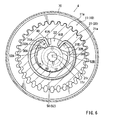
- the fin portion 52 is arranged to take a position where it is pinched at a position between the projected portions 31 A, 31 B formed at the respective eccentric members 30A, 30B. Therefore, when, for example, the shaft pin 60 is operated to rotate in the clockwise direction in the paper sheet face from the illustrated state, also the pushing member 50 is operated to rotate in the clockwise direction integrally therewith. Therefore, as shown in Fig. 6 , the pushing face portion 52A on the left shoulder side of the paper sheet face of the blade portion 52 pushes to move the projected portion 31A of the eccentric member 30A arranged on the left side and pushes to move the eccentric member 30A in a direction opposite to the urged wedging direction.
- the pushing face portion 52A pushes to move the eccentric member 30A in the clockwise direction as viewed in the drawings while pushing the eccentric member 30A toward the radially outer side by the contact face structures inclined to each other. Therefore, the wedging state of the eccentric member 30A on the left side is released.
- the eccentric member 30A rotates in the clockwise direction as viewed in the drawings
- the eccentric member 30B on the right side is operated to rotate in the clockwise direction as viewed in the drawings as it receives the urging force of the spring member 40. Therefore, the inner peripheral face of the through hole 22 formed at the outer gear 21 is pushed by the eccentric clockwise rotation of the two eccentric members 30A, 30B so as to be pressed successively in the clockwise direction as viewed in the drawings while being pushed radially outward.
- the outer tooth member 20 rotates to revolve in the clockwise direction along the inner peripheral face of the inner gear 11 while the outer tooth member 20 per se is rotates in the counterclockwise direction as viewed in the drawings in the state where the outer gear 21 is meshed with the inner gear 11.
- the eccentric members 30A, 30B enter the narrowed gaps between the outer peripheral face of the cylinder portion 12 and the inner peripheral face of the through hole 22 so as to be again brought to the wedging state therebetween and are maintained in this state.
- the outer peripheral ring 70 is formed in a shape of a stepped circular cylinder by a half blanking process of a member in a shape of a thin hollow circular disk in a plate thickness direction (axial direction).
- a face of a portion of the outer peripheral ring 70 on an inner peripheral edge side is formed as an inner tooth side holding face 71 that is adapted to contact with a face of a portion on an outer peripheral edge side of the outer side circular disk face of the inner tooth member 10. Further, as shown in Fig.
- a face of a portion on an outer peripheral edge side of the outer ring 70 is formed as an outer tooth side holding face 72 that is crimped in such a manner that it contacts with a face of a portion on an outer peripheral edge side of an outer side circular disk face of the outer tooth member 20.
- the outer peripheral ring 70 is configured to be able to maintain always a state where at least a portion of the outer side circular disk face of the inner tooth member 10 contacts by the outer tooth side holding face 72 when the inner tooth member 10 is moved to revolve relative to the outer tooth member 20. Therefore, the inner tooth member 10 and the outer tooth member 20 are maintained in a state where they are pinched by the outer peripheral ring 70 so as not to move for separating in the plate thickness direction
- Fig. 7 shows pitch circles 11p, 21p of the inner gear 11 and the outer gear 21 and their contact point locus line Tr.
- the tooth shapes of the inner gear 11 and the outer gear 21 are determined such that a meshing line between them, that is, the contact point locus line Tr passing a point where the inner teeth 11a and the outer teeth 21a contact with each other is drawn to have a spiral shape.
- the tooth shapes of the inner gear 11 and the outer gear 21 are determined respectively by the following procedure.
- Two circles indicated by solid lines in Fig. 7 are pitch circles 11p, 21p of the inner gear 11 and the outer gear 21, respectively.
- Diameters of the pitch circles 11p, 21p are respectively given by products of tooth numbers of the respective gears (tooth number of inner gear 11: 34, tooth number of outer gear 21: 33) by a module (2.6).
- the diameter of the pitch circle 11p is given as 88.4mm
- the diameter of the pitch circle 21p is given as 85.8mm.
- the pitch circles 11p, 21p contact with each other at an intersection P in the drawing, and a distance between centers 11r, 21r of them is given as 1.3mm from the above-described geometrical relationship.
- the contact point locus line Tr representing the meshing line of the inner gear 11 and the outer gear 21 is arbitrarily given by an Archimedean spiral.
- a region (meshing region Ge) where the contact point locus line Tr is drawn is determined as a region between intersections a, b of an effective addendum circle 11h of the inner gear 11 and an effective addendum circle 21h of the outer gear 21 that will be described later.
- a point O is arbitrarily determined at a position on the contact point locus line Tr, and points B1, B2, B3... are further arbitrarily determined at positions successively remote from the point O little by little.
- the contact point locus line Tr is indicated to be longer than its actual length.
- a normal line Ve1 to a line segment P-O passing through point O is drawn.
- point B1 and point P are rotated in the clockwise direction in the paper sheet face about center 11r without changing a relative positional relationship between center 11r of the inner gear 11, point B1 and point P.
- an intersecting point between point B1 and normal line Ve1 is determined as A1, and a position of point P after the movement by the rotation is determined as point P1.
- a normal line Ve2 to a line segment P1-A1 passing through point A1 is drawn.
- point B2 and point P are rotated in the clockwise direction in the paper sheet face about center 11r without changing a relative positional relationship between center 11r of the inner gear 11, point B2 and point P.
- an intersecting point between point B2 and normal line Ve2 is determined as A2 and a position of point P after the movement by the rotation is determined as point P2.
- the tooth shape of the outer gear 21 can be given by successively moving points determined on the contact point locus line Tr about the center 21r of the outer gear 21.
- the method of determining the tooth shape from the geometrical relationship between the two pitch circles 11p, 21p and the contact point locus line Tr is a publicly-known method and is described in a document, such as a publication ("Illustrated Mechanism", edited by FUKUNAGA setuo et al, first edition, Rikogaku-sha, April 10, 1972, Figs. 10 .2) or the like.
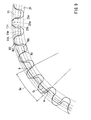
- the tooth shapes of the inner gear 11 and the outer gear 21 are given as shown in Fig. 9 by using the above-described method.
- addendums and deddendums of the inner gear 11 and the outer gear 21 are respectively provided with R shape portions (rounded shape portions) R1 through R4 that are necessary when press-molding.
- R shape portion R1 constituting the addendum of the inner gear 11 is formed to extend from an addendum circle 11m to the effective addendum circle 11h set to the inner gear 11.
- an R shape portion R3 constituting an addendum of the outer gear 21 is formed to extend from an addendum circle 21m to an effective addendum circle 21h set to the outer gear 21.
- an R shape portion R2 constituting a deddendum of the inner gear 11 is formed to extend from a deddendum circle 11n to an effective deddendum circle, not illustrated, set to the inner gear 11.
- an R shape portion R4 constituting a deddendum of the outer gear 21 is formed to extend from a deddendum circle 21n to an effective deddendum circle, not illustrated, set to the outer gear 21. Further, in the reclining apparatus 4 on a large shape side, sizes of its portions are determined such that a diameter of the deddendum circle 11n of the inner gear 11 becomes to be 61.6mm.
- the contact point locus line Tr constituting the Archimedean spiral is adopted, and therefore, a meshing line having a long line length is given in the meshing region Ge between the effective addendum circle 11h and the effective addendum circle 21h. Therefore, a meshing rate of the two gears in the reclining apparatus 4 on the large shape side is set between 2 and 3.
- the meshing rate is a numerical value given by dividing a line length of the contact point locus line Tr by a normal line pitch.
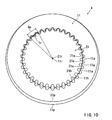
- Fig. 10 shows entire tooth shapes of the inner gear 11 and the outer gear 21 of the reclining apparatus 4 formed by the above-described method. Therefore, the operation of adjusting the backrest angle (pivoting operation) of the seat back 2 can be carried out on the left and on the right with an excellent balance in synchronism with each other by cooperative operations of the two reclining apparatus 4,4.
- a method of using the embodiment is omitted because this method is explained by the operating structures the reclining apparatus 4, 4 described above.
- the tooth shapes are formed such that the meshing line for meshing of the gear trains of the inner gear 11 and the outer gear 21 arranged as the reclining apparatus 4 of the vehicular seat is defined as a spiral mesh line, so that the meshing rate of the gear train can be improved. Therefore, the operation of adjusting the backrest angle of the seat back 2 can excellently be carried out. Further, by setting the mesh line of the gear train to the Archimedean spiral having a constant circumferential interval, the shapes of the inner gear 11 and the outer gear 21 can highly accurately be finished by a numerical control.
- the operation for maintaining or adjusting the backrest angle of the seat back 2 can further excellently be carried out.
- the tooth number of the outer gear may be larger than that of the inner gear.
- the outer tooth member rotates relative to the inner tooth member in a direction opposite to the direction shown in the embodiment in accordance with the relative revolution of the outer gear.
- the spirals are not limited to spirals drawn by bent curves but may be spirals drawn by bending a linear line little by little.
- the spring member is illustrated as the urge member for urging the pair of eccentric members in directions toward each other, other urge member, such as a rubber member or the like, is also applicable.
Landscapes
- Engineering & Computer Science (AREA)
- General Engineering & Computer Science (AREA)
- Mechanical Engineering (AREA)
- Aviation & Aerospace Engineering (AREA)
- Transportation (AREA)
- Chairs For Special Purposes, Such As Reclining Chairs (AREA)
- Retarders (AREA)
- Gears, Cams (AREA)
- Seats For Vehicles (AREA)
Claims (2)
- Kopplungsvorrichtung mit einer Rückenlehnenvorrichtung (4), die eine Rückenlehne (2) und ein Sitzpolster (3) eines Fahrzeugsitzes (1) koppelt;
wobei die Rückenlehnenvorrichtung (4) Folgendes aufweist:ein Innenzahnteil (10), das ein Innenzahnrad (11) aufweist, das mit entweder der Rückenlehne oder dem Sitzkissen (2, 3) gekoppelt ist; undein Außenzahnteil (20), das ein Außenzahnrad aufweist, das kämmend mit dem Innenzahnrad des Innenzahnteils (10) montiert und mit dem anderen aus der Rückenlehne und dem Sitzkissen (23) gekoppelt ist;wobei das Außenzahnrad (21) einen kleineren Durchmesser als das Innenzahnrad (11) aufweist und so geformt ist, dass sich seinen Zahnzahl von einer Zahnzahl des Innenzahnrads (11) unterscheidet; undein Rückenlehnenwinkel der Rückenlehne (2) durch eine relative Umlaufbewegung des Außenzahnrads (21) auf einer Innenzahnfläche des Innenzahnrads (11) in einem Zustand verändert wird, in dem das Außenzahnrad (21) mit dem Innenzahnrad (11) kämmt, dadurch gekennzeichnet, dass die durch das Getriebe aus Außenzahnrad (21) und Innenzahnrad (11) gebildete Eingriffslinie als eine archimedische Spirale (Tr) aufgebaut ist. - Kopplungsvorrichtung nach Anspruch 1, dadurch gekennzeichnet, dass
das Innenzahnrad (11) durch einen Stanzumformvorgang so gebildet ist, dass es in einer kreiszylindrischen Form aus dem Innenzahnteil vorsteht, und auch das Außenzahnrad (21) durch einen Stanzumformvorgang so gebildet ist, dass es in einer kreiszylindrischen Form aus dem Außenzahnteil vorsteht;
das Innenzahnteil (10) mit einem zylindrischen Abschnitt in einer Kreiszylinderform gebildet ist, die aus einem mittleren Abschnitt des Innenzahnrads vorsteht, das Außenzahnteil (20) mit einem Durchgangsloch in einer Kreisform in einem mittleren Abschnitt des Außenzahnrads zur Aufnahme und zum Umfassen des Zylinderabschnitts gebildet ist, der an dem Innenzahnteil gebildet ist, und wobei der Zylinderabschnitt und das Durchgangsloch so zueinander angeordnet sind, dass ihre Mittelpositionen gegeneinander versetzt sind; und
wobei innerhalb eines Abschnitts in einer Form eines Spalts zwischen dem Zylinderabschnitt des Innenzahnteils (10) und dem Durchgangsloch des Außenzahnteils (20), das den Zylinderabschnitt umgibt, ein Paar von exzentrischen Teilen (30A, 30B) angeordnet ist, die jeweils eine Form aufweisen, die einen Teil einer Form des Spalts ausfüllen, wobei das Paar von exzentrischen Teilen normalerweise in verengten Abschnitten der Spaltform in einer eingefügten Weise verkeilt sind, indem sie in einem Zustand eingespannt und gehalten werden, in dem das Außenzahnrad (20) gegen die Innenumfangsverzahnung des Innenzahnrads (11) gedrückt wird, und wobei eines der exzentrischen Teile aus dem Klemmzustand gelöst wird und gegen einen Innenumfangsfläche des Durchgangslochs des Außenteils (20) drückt, um eine umlaufende Bewegung des Außenzahnrads zu verursachen, wenn das eine der exzentrischen Teile durch einen Drehvorgang eines in einen Zylinder des Zylinderabschnitts eingefügten Wellenstifts (60) so betätigt wird, dass es in einer Umfangsrichtung gedrückt wird.
Applications Claiming Priority (2)
| Application Number | Priority Date | Filing Date | Title |
|---|---|---|---|
| JP2006208331 | 2006-07-31 | ||
| PCT/JP2007/062012 WO2008015845A1 (fr) | 2006-07-31 | 2007-06-14 | Engrenage et dispositif de liaison utilisant l'engrenage |
Publications (3)
| Publication Number | Publication Date |
|---|---|
| EP2068040A1 EP2068040A1 (de) | 2009-06-10 |
| EP2068040A4 EP2068040A4 (de) | 2011-01-05 |
| EP2068040B1 true EP2068040B1 (de) | 2012-02-22 |
Family
ID=38997029
Family Applications (1)
| Application Number | Title | Priority Date | Filing Date |
|---|---|---|---|
| EP07745269A Not-in-force EP2068040B1 (de) | 2006-07-31 | 2007-06-14 | Zahnrad und das zahnrad verwendende verbindungsvorrichtung |
Country Status (5)
| Country | Link |
|---|---|
| US (1) | US8016356B2 (de) |
| EP (1) | EP2068040B1 (de) |
| JP (1) | JP4992901B2 (de) |
| CN (1) | CN101495779B (de) |
| WO (1) | WO2008015845A1 (de) |
Cited By (1)
| Publication number | Priority date | Publication date | Assignee | Title |
|---|---|---|---|---|
| KR20180060400A (ko) * | 2016-11-29 | 2018-06-07 | 주식회사다스 | 자동차 시트의 리클라이너와 그 조립방법 |
Families Citing this family (18)
| Publication number | Priority date | Publication date | Assignee | Title |
|---|---|---|---|---|
| JP5177134B2 (ja) * | 2007-05-08 | 2013-04-03 | トヨタ紡織株式会社 | 連結装置 |
| US8460145B2 (en) * | 2007-06-11 | 2013-06-11 | Toyota Boshoku Kabushiki Kaisha | Rotation mechanism |
| JP5338165B2 (ja) | 2008-07-15 | 2013-11-13 | トヨタ紡織株式会社 | 歯車及びこの歯車を用いた連結装置 |
| JP5077115B2 (ja) * | 2008-07-15 | 2012-11-21 | トヨタ紡織株式会社 | 歯車及びこの歯車を用いた連結装置 |
| DE102009039648B3 (de) * | 2009-08-28 | 2011-02-24 | Keiper Gmbh & Co. Kg | Beschlag für einen Fahrzeugsitz und Fahrzeugsitz |
| DE102009040453A1 (de) | 2009-08-28 | 2011-03-03 | Keiper Gmbh & Co. Kg | Beschlag für einen Fahrzeugsitz |
| DE102009052512A1 (de) * | 2009-11-11 | 2011-05-12 | Johnson Controls Gmbh | Neigungsversteller für Fahrzeuge |
| DE102011016656B3 (de) * | 2011-04-06 | 2012-08-30 | Keiper Gmbh & Co. Kg | Beschlag für einen Fahrzeugsitz sowie Fahrzeugsitz |
| JP5691793B2 (ja) * | 2011-04-22 | 2015-04-01 | アイシン精機株式会社 | シートリクライニング装置 |
| JP5809014B2 (ja) * | 2011-05-13 | 2015-11-10 | シロキ工業株式会社 | 減速歯車機構 |
| JP5872853B2 (ja) * | 2011-11-08 | 2016-03-01 | シロキ工業株式会社 | リクライニング装置 |
| JP5692819B2 (ja) * | 2012-10-24 | 2015-04-01 | シロキ工業株式会社 | リクライニング装置 |
| JP6232983B2 (ja) | 2013-12-03 | 2017-11-22 | アイシン精機株式会社 | 減速装置及びシート駆動装置 |
| JP6443118B2 (ja) * | 2015-02-20 | 2018-12-26 | アイシン精機株式会社 | 内歯歯車およびその転造用のダイス |
| US10415672B2 (en) * | 2015-04-24 | 2019-09-17 | Sri International | Drives with partial cycloid teeth profile |
| JP2021159962A (ja) * | 2020-03-31 | 2021-10-11 | 株式会社ミクニ | 内歯車の製造方法、内歯車及び波動歯車装置 |
| CN115320459B (zh) * | 2022-07-21 | 2024-03-22 | 恺博座椅机械部件有限公司 | 一种高强度连续式座椅偏心调角器 |
| JP7839060B2 (ja) * | 2022-09-08 | 2026-04-01 | 住友重機械工業株式会社 | 内接噛合い型歯車装置 |
Family Cites Families (16)
| Publication number | Priority date | Publication date | Assignee | Title |
|---|---|---|---|---|
| US32332A (en) * | 1861-05-14 | Improvement in electro-magnetic bathing apparatus | ||
| US3826152A (en) * | 1973-05-11 | 1974-07-30 | K Alexeev | Variable-ratio gear transmission |
| US3946621A (en) * | 1975-01-15 | 1976-03-30 | Rouverol William S | Internal gearing |
| US3982445A (en) | 1975-09-02 | 1976-09-28 | Rouverol William S | High torque gearing |
| JPS56128247A (en) * | 1980-03-08 | 1981-10-07 | Fuji Kiko Co Ltd | Seat belt retractor |
| US4379976A (en) * | 1981-07-20 | 1983-04-12 | Rain Bird Sprinkler Mfg. Corp. | Planocentric gear drive |
| ES2129564T3 (es) * | 1993-12-17 | 1999-06-16 | J M Voith Gmbh & Co Beteiligun | Bomba de engranaje interior sin hoz. |
| SE9402701L (sv) | 1994-08-12 | 1995-09-18 | Gustav Rennerfelt | Excenterväxel |
| CN2223213Y (zh) * | 1994-10-09 | 1996-03-27 | 江苏省溧阳市汽车座椅调角器总厂 | 新型调角器 |
| DE19750834C1 (de) * | 1997-11-17 | 1998-10-29 | Gkn Viscodrive Gmbh | Mechanisches Sperrdifferential |
| US6248993B1 (en) * | 1998-08-05 | 2001-06-19 | Leopold Kostal Gmbh & Co. Kg | Steering angle sensor |
| DE19942477C2 (de) * | 1999-09-06 | 2001-07-12 | Kostal Leopold Gmbh & Co Kg | Lenkwinkelsensor |
| US20020170373A1 (en) | 2001-05-15 | 2002-11-21 | Kim Hanjoon Alex | Variable face width gearing |
| TWI249482B (en) | 2003-09-10 | 2006-02-21 | Aisin Seiki | Angular position adjusting mechanism |
| JP4120542B2 (ja) * | 2003-09-10 | 2008-07-16 | アイシン精機株式会社 | 角度位置調整機構 |
| JP4029847B2 (ja) | 2004-02-17 | 2008-01-09 | アイシン精機株式会社 | 角度位置調整機構 |
-
2007
- 2007-06-14 CN CN200780028785.1A patent/CN101495779B/zh not_active Expired - Fee Related
- 2007-06-14 EP EP07745269A patent/EP2068040B1/de not_active Not-in-force
- 2007-06-14 JP JP2008527683A patent/JP4992901B2/ja not_active Expired - Fee Related
- 2007-06-14 US US12/375,588 patent/US8016356B2/en not_active Expired - Fee Related
- 2007-06-14 WO PCT/JP2007/062012 patent/WO2008015845A1/ja not_active Ceased
Cited By (1)
| Publication number | Priority date | Publication date | Assignee | Title |
|---|---|---|---|---|
| KR20180060400A (ko) * | 2016-11-29 | 2018-06-07 | 주식회사다스 | 자동차 시트의 리클라이너와 그 조립방법 |
Also Published As
| Publication number | Publication date |
|---|---|
| CN101495779A (zh) | 2009-07-29 |
| US8016356B2 (en) | 2011-09-13 |
| CN101495779B (zh) | 2013-01-02 |
| JPWO2008015845A1 (ja) | 2009-12-17 |
| EP2068040A4 (de) | 2011-01-05 |
| US20090301247A1 (en) | 2009-12-10 |
| JP4992901B2 (ja) | 2012-08-08 |
| WO2008015845A1 (fr) | 2008-02-07 |
| EP2068040A1 (de) | 2009-06-10 |
Similar Documents
| Publication | Publication Date | Title |
|---|---|---|
| EP2068040B1 (de) | Zahnrad und das zahnrad verwendende verbindungsvorrichtung | |
| JP5223863B2 (ja) | 回動機構 | |
| JP5338165B2 (ja) | 歯車及びこの歯車を用いた連結装置 | |
| EP1731353B1 (de) | Neigungsverstellvorrichtung für einen Sitz | |
| US8033606B2 (en) | Connecting devices | |
| EP2586650A2 (de) | Sitzneigungsvorrichtung | |
| CN205780617U (zh) | 减速装置以及座椅驱动装置 | |
| JP2007521894A (ja) | 車両座席用取り付け具 | |
| KR102047092B1 (ko) | 기어감속기 및 이를 이용한 전자식 주차 브레이크용 액츄에이터 | |
| EP1806072A1 (de) | Rücklehnvorrichtung | |
| KR20130088865A (ko) | 출력 부재 및 다축구동장치 | |
| JPS62101210A (ja) | 回動自在取付け具 | |
| KR20060076201A (ko) | 브래킷의 각도조정장치 | |
| EP3939826B1 (de) | Sitzrücklehnenverstellvorrichtung | |
| US7284798B2 (en) | Vehicle-seat reclining device and production method therefor | |
| KR102047087B1 (ko) | 전자식 주차 브레이크용 액츄에이터 | |
| CN110884396B (zh) | 斜倚器机构 | |
| JP2025517236A (ja) | 小型連続式リクライナ | |
| CN103813936A (zh) | 车辆座椅装配件的制造方法 | |
| JPH0719653U (ja) | 減速装置 | |
| CN115854002B (zh) | 一种组合式二级减速装置 | |
| JPH06165715A (ja) | シートリクライニング装置 |
Legal Events
| Date | Code | Title | Description |
|---|---|---|---|
| PUAI | Public reference made under article 153(3) epc to a published international application that has entered the european phase |
Free format text: ORIGINAL CODE: 0009012 |
|
| 17P | Request for examination filed |
Effective date: 20090130 |
|
| AK | Designated contracting states |
Kind code of ref document: A1 Designated state(s): AT BE BG CH CY CZ DE DK EE ES FI FR GB GR HU IE IS IT LI LT LU LV MC MT NL PL PT RO SE SI SK TR |
|
| AX | Request for extension of the european patent |
Extension state: AL BA HR MK RS |
|
| DAX | Request for extension of the european patent (deleted) | ||
| RBV | Designated contracting states (corrected) |
Designated state(s): DE FR GB |
|
| A4 | Supplementary search report drawn up and despatched |
Effective date: 20101202 |
|
| REG | Reference to a national code |
Ref country code: DE Ref legal event code: R079 Ref document number: 602007020864 Country of ref document: DE Free format text: PREVIOUS MAIN CLASS: F16H0055080000 Ipc: B60N0002225000 |
|
| GRAP | Despatch of communication of intention to grant a patent |
Free format text: ORIGINAL CODE: EPIDOSNIGR1 |
|
| RIC1 | Information provided on ipc code assigned before grant |
Ipc: B60N 2/225 20060101AFI20110831BHEP Ipc: F16H 1/32 20060101ALI20110831BHEP Ipc: F16H 55/08 20060101ALI20110831BHEP |
|
| GRAS | Grant fee paid |
Free format text: ORIGINAL CODE: EPIDOSNIGR3 |
|
| GRAA | (expected) grant |
Free format text: ORIGINAL CODE: 0009210 |
|
| AK | Designated contracting states |
Kind code of ref document: B1 Designated state(s): DE FR GB |
|
| REG | Reference to a national code |
Ref country code: GB Ref legal event code: FG4D |
|
| REG | Reference to a national code |
Ref country code: DE Ref legal event code: R096 Ref document number: 602007020864 Country of ref document: DE Effective date: 20120419 |
|
| PLBE | No opposition filed within time limit |
Free format text: ORIGINAL CODE: 0009261 |
|
| STAA | Information on the status of an ep patent application or granted ep patent |
Free format text: STATUS: NO OPPOSITION FILED WITHIN TIME LIMIT |
|
| 26N | No opposition filed |
Effective date: 20121123 |
|
| GBPC | Gb: european patent ceased through non-payment of renewal fee |
Effective date: 20120614 |
|
| REG | Reference to a national code |
Ref country code: DE Ref legal event code: R097 Ref document number: 602007020864 Country of ref document: DE Effective date: 20121123 |
|
| REG | Reference to a national code |
Ref country code: FR Ref legal event code: ST Effective date: 20130228 |
|
| PG25 | Lapsed in a contracting state [announced via postgrant information from national office to epo] |
Ref country code: FR Free format text: LAPSE BECAUSE OF NON-PAYMENT OF DUE FEES Effective date: 20120702 Ref country code: GB Free format text: LAPSE BECAUSE OF NON-PAYMENT OF DUE FEES Effective date: 20120614 |
|
| PGFP | Annual fee paid to national office [announced via postgrant information from national office to epo] |
Ref country code: DE Payment date: 20200602 Year of fee payment: 14 |
|
| REG | Reference to a national code |
Ref country code: DE Ref legal event code: R119 Ref document number: 602007020864 Country of ref document: DE |
|
| PG25 | Lapsed in a contracting state [announced via postgrant information from national office to epo] |
Ref country code: DE Free format text: LAPSE BECAUSE OF NON-PAYMENT OF DUE FEES Effective date: 20220101 |