EP2068604A2 - Encapsulants pouvant être imprimés à l'écran basés sur des polybenzoxazoles - Google Patents
Encapsulants pouvant être imprimés à l'écran basés sur des polybenzoxazoles Download PDFInfo
- Publication number
- EP2068604A2 EP2068604A2 EP08169280A EP08169280A EP2068604A2 EP 2068604 A2 EP2068604 A2 EP 2068604A2 EP 08169280 A EP08169280 A EP 08169280A EP 08169280 A EP08169280 A EP 08169280A EP 2068604 A2 EP2068604 A2 EP 2068604A2
- Authority
- EP
- European Patent Office
- Prior art keywords
- polybenzoxazole
- capacitor
- electronic component
- encapsulant
- embedded
- Prior art date
- Legal status (The legal status is an assumption and is not a legal conclusion. Google has not performed a legal analysis and makes no representation as to the accuracy of the status listed.)
- Withdrawn
Links
- 0 CC(*)CC(C)C(*(C)(C)*=*)=N Chemical compound CC(*)CC(C)C(*(C)(C)*=*)=N 0.000 description 1
Images

Classifications
-
- H—ELECTRICITY
- H05—ELECTRIC TECHNIQUES NOT OTHERWISE PROVIDED FOR
- H05K—PRINTED CIRCUITS; CASINGS OR CONSTRUCTIONAL DETAILS OF ELECTRIC APPARATUS; MANUFACTURE OF ASSEMBLAGES OF ELECTRICAL COMPONENTS
- H05K1/00—Printed circuits
- H05K1/16—Printed circuits incorporating printed electric components, e.g. printed resistors, capacitors or inductors
- H05K1/162—Printed circuits incorporating printed electric components, e.g. printed resistors, capacitors or inductors incorporating printed capacitors
-
- C—CHEMISTRY; METALLURGY
- C09—DYES; PAINTS; POLISHES; NATURAL RESINS; ADHESIVES; COMPOSITIONS NOT OTHERWISE PROVIDED FOR; APPLICATIONS OF MATERIALS NOT OTHERWISE PROVIDED FOR
- C09D—COATING COMPOSITIONS, e.g. PAINTS, VARNISHES OR LACQUERS; FILLING PASTES; CHEMICAL PAINT OR INK REMOVERS; INKS; CORRECTING FLUIDS; WOODSTAINS; PASTES OR SOLIDS FOR COLOURING OR PRINTING; USE OF MATERIALS THEREFOR
- C09D11/00—Inks
- C09D11/02—Printing inks
- C09D11/10—Printing inks based on artificial resins
- C09D11/101—Inks specially adapted for printing processes involving curing by wave energy or particle radiation, e.g. with UV-curing following the printing
-
- C—CHEMISTRY; METALLURGY
- C08—ORGANIC MACROMOLECULAR COMPOUNDS; THEIR PREPARATION OR CHEMICAL WORKING-UP; COMPOSITIONS BASED THEREON
- C08G—MACROMOLECULAR COMPOUNDS OBTAINED OTHERWISE THAN BY REACTIONS ONLY INVOLVING UNSATURATED CARBON-TO-CARBON BONDS
- C08G73/00—Macromolecular compounds obtained by reactions forming a linkage containing nitrogen with or without oxygen or carbon in the main chain of the macromolecule, not provided for in groups C08G12/00 - C08G71/00
- C08G73/06—Polycondensates having nitrogen-containing heterocyclic rings in the main chain of the macromolecule
- C08G73/22—Polybenzoxazoles
-
- C—CHEMISTRY; METALLURGY
- C08—ORGANIC MACROMOLECULAR COMPOUNDS; THEIR PREPARATION OR CHEMICAL WORKING-UP; COMPOSITIONS BASED THEREON
- C08L—COMPOSITIONS OF MACROMOLECULAR COMPOUNDS
- C08L79/00—Compositions of macromolecular compounds obtained by reactions forming in the main chain of the macromolecule a linkage containing nitrogen with or without oxygen or carbon only, not provided for in groups C08L61/00 - C08L77/00
- C08L79/04—Polycondensates having nitrogen-containing heterocyclic rings in the main chain; Polyhydrazides; Polyamide acids or similar polyimide precursors
-
- C—CHEMISTRY; METALLURGY
- C09—DYES; PAINTS; POLISHES; NATURAL RESINS; ADHESIVES; COMPOSITIONS NOT OTHERWISE PROVIDED FOR; APPLICATIONS OF MATERIALS NOT OTHERWISE PROVIDED FOR
- C09D—COATING COMPOSITIONS, e.g. PAINTS, VARNISHES OR LACQUERS; FILLING PASTES; CHEMICAL PAINT OR INK REMOVERS; INKS; CORRECTING FLUIDS; WOODSTAINS; PASTES OR SOLIDS FOR COLOURING OR PRINTING; USE OF MATERIALS THEREFOR
- C09D11/00—Inks
- C09D11/02—Printing inks
- C09D11/03—Printing inks characterised by features other than the chemical nature of the binder
- C09D11/033—Printing inks characterised by features other than the chemical nature of the binder characterised by the solvent
-
- C—CHEMISTRY; METALLURGY
- C09—DYES; PAINTS; POLISHES; NATURAL RESINS; ADHESIVES; COMPOSITIONS NOT OTHERWISE PROVIDED FOR; APPLICATIONS OF MATERIALS NOT OTHERWISE PROVIDED FOR
- C09D—COATING COMPOSITIONS, e.g. PAINTS, VARNISHES OR LACQUERS; FILLING PASTES; CHEMICAL PAINT OR INK REMOVERS; INKS; CORRECTING FLUIDS; WOODSTAINS; PASTES OR SOLIDS FOR COLOURING OR PRINTING; USE OF MATERIALS THEREFOR
- C09D11/00—Inks
- C09D11/02—Printing inks
- C09D11/10—Printing inks based on artificial resins
- C09D11/102—Printing inks based on artificial resins containing macromolecular compounds obtained by reactions other than those only involving unsaturated carbon-to-carbon bonds
-
- C—CHEMISTRY; METALLURGY
- C09—DYES; PAINTS; POLISHES; NATURAL RESINS; ADHESIVES; COMPOSITIONS NOT OTHERWISE PROVIDED FOR; APPLICATIONS OF MATERIALS NOT OTHERWISE PROVIDED FOR
- C09D—COATING COMPOSITIONS, e.g. PAINTS, VARNISHES OR LACQUERS; FILLING PASTES; CHEMICAL PAINT OR INK REMOVERS; INKS; CORRECTING FLUIDS; WOODSTAINS; PASTES OR SOLIDS FOR COLOURING OR PRINTING; USE OF MATERIALS THEREFOR
- C09D179/00—Coating compositions based on macromolecular compounds obtained by reactions forming in the main chain of the macromolecule a linkage containing nitrogen, with or without oxygen, or carbon only, not provided for in groups C09D161/00 - C09D177/00
- C09D179/04—Polycondensates having nitrogen-containing heterocyclic rings in the main chain; Polyhydrazides; Polyamide acids or similar polyimide precursors
-
- H—ELECTRICITY
- H05—ELECTRIC TECHNIQUES NOT OTHERWISE PROVIDED FOR
- H05K—PRINTED CIRCUITS; CASINGS OR CONSTRUCTIONAL DETAILS OF ELECTRIC APPARATUS; MANUFACTURE OF ASSEMBLAGES OF ELECTRICAL COMPONENTS
- H05K1/00—Printed circuits
- H05K1/16—Printed circuits incorporating printed electric components, e.g. printed resistors, capacitors or inductors
-
- H—ELECTRICITY
- H05—ELECTRIC TECHNIQUES NOT OTHERWISE PROVIDED FOR
- H05K—PRINTED CIRCUITS; CASINGS OR CONSTRUCTIONAL DETAILS OF ELECTRIC APPARATUS; MANUFACTURE OF ASSEMBLAGES OF ELECTRICAL COMPONENTS
- H05K3/00—Apparatus or processes for manufacturing printed circuits
- H05K3/22—Secondary treatment of printed circuits
- H05K3/28—Applying non-metallic protective coatings
-
- H—ELECTRICITY
- H05—ELECTRIC TECHNIQUES NOT OTHERWISE PROVIDED FOR
- H05K—PRINTED CIRCUITS; CASINGS OR CONSTRUCTIONAL DETAILS OF ELECTRIC APPARATUS; MANUFACTURE OF ASSEMBLAGES OF ELECTRICAL COMPONENTS
- H05K3/00—Apparatus or processes for manufacturing printed circuits
- H05K3/22—Secondary treatment of printed circuits
- H05K3/28—Applying non-metallic protective coatings
- H05K3/285—Permanent coating compositions
-
- H—ELECTRICITY
- H10—SEMICONDUCTOR DEVICES; ELECTRIC SOLID-STATE DEVICES NOT OTHERWISE PROVIDED FOR
- H10W—GENERIC PACKAGES, INTERCONNECTIONS, CONNECTORS OR OTHER CONSTRUCTIONAL DETAILS OF DEVICES COVERED BY CLASS H10
- H10W70/00—Package substrates; Interposers; Redistribution layers [RDL]
- H10W70/60—Insulating or insulated package substrates; Interposers; Redistribution layers
- H10W70/67—Insulating or insulated package substrates; Interposers; Redistribution layers characterised by their insulating layers or insulating parts
- H10W70/69—Insulating materials thereof
-
- H—ELECTRICITY
- H05—ELECTRIC TECHNIQUES NOT OTHERWISE PROVIDED FOR
- H05K—PRINTED CIRCUITS; CASINGS OR CONSTRUCTIONAL DETAILS OF ELECTRIC APPARATUS; MANUFACTURE OF ASSEMBLAGES OF ELECTRICAL COMPONENTS
- H05K2201/00—Indexing scheme relating to printed circuits covered by H05K1/00
- H05K2201/01—Dielectrics
- H05K2201/0183—Dielectric layers
- H05K2201/0187—Dielectric layers with regions of different dielectrics in the same layer, e.g. in a printed capacitor for locally changing the dielectric properties
-
- H—ELECTRICITY
- H05—ELECTRIC TECHNIQUES NOT OTHERWISE PROVIDED FOR
- H05K—PRINTED CIRCUITS; CASINGS OR CONSTRUCTIONAL DETAILS OF ELECTRIC APPARATUS; MANUFACTURE OF ASSEMBLAGES OF ELECTRICAL COMPONENTS
- H05K2201/00—Indexing scheme relating to printed circuits covered by H05K1/00
- H05K2201/03—Conductive materials
- H05K2201/0332—Structure of the conductor
- H05K2201/0335—Layered conductors or foils
- H05K2201/0355—Metal foils
-
- H—ELECTRICITY
- H05—ELECTRIC TECHNIQUES NOT OTHERWISE PROVIDED FOR
- H05K—PRINTED CIRCUITS; CASINGS OR CONSTRUCTIONAL DETAILS OF ELECTRIC APPARATUS; MANUFACTURE OF ASSEMBLAGES OF ELECTRICAL COMPONENTS
- H05K2201/00—Indexing scheme relating to printed circuits covered by H05K1/00
- H05K2201/09—Shape and layout
- H05K2201/09209—Shape and layout details of conductors
- H05K2201/09654—Shape and layout details of conductors covering at least two types of conductors provided for in H05K2201/09218 - H05K2201/095
- H05K2201/09763—Printed component having superposed conductors, but integrated in one circuit layer
-
- Y—GENERAL TAGGING OF NEW TECHNOLOGICAL DEVELOPMENTS; GENERAL TAGGING OF CROSS-SECTIONAL TECHNOLOGIES SPANNING OVER SEVERAL SECTIONS OF THE IPC; TECHNICAL SUBJECTS COVERED BY FORMER USPC CROSS-REFERENCE ART COLLECTIONS [XRACs] AND DIGESTS
- Y10—TECHNICAL SUBJECTS COVERED BY FORMER USPC
- Y10T—TECHNICAL SUBJECTS COVERED BY FORMER US CLASSIFICATION
- Y10T29/00—Metal working
- Y10T29/49—Method of mechanical manufacture
- Y10T29/49002—Electrical device making
- Y10T29/49117—Conductor or circuit manufacturing
- Y10T29/49124—On flat or curved insulated base, e.g., printed circuit, etc.
- Y10T29/4913—Assembling to base an electrical component, e.g., capacitor, etc.
- Y10T29/49146—Assembling to base an electrical component, e.g., capacitor, etc. with encapsulating, e.g., potting, etc.
Definitions
- compositions relate to compositions, and the use of such compositions for protective coatings.
- the compositions are used to protect electronic device structures, particularly embedded fired-on-foil ceramic capacitors, from exposure to printed wiring board processing chemicals and for environmental protection.
- High capacitance ceramic capacitors embedded in printed circuit boards are particularly useful for decoupling applications.
- High capacitance ceramic capacitors may be formed by "fired-on-foil" technology. Fired-on-foil capacitors may be formed from thick-film processes as disclosed in U.S. Patent Number 6,317,023B1 to Felten or thin-film processes as disclosed in U.S. Patent Application 20050011857 A1 to Borland et. al.
- Thick-film fired-on-foil ceramic capacitors are formed by depositing a thick-film capacitor dielectric material layer onto a metallic foil substrate, followed by depositing a top copper electrode material over the thick-film capacitor dielectric layer and a subsequent firing under copper thick-film firing conditions, such as 900-950°C for a peak period of 10 minutes in a nitrogen atmosphere.
- the glass component of the dielectric material softens and flows before the peak firing temperature is reached, coalesces, encapsulates the functional phase, and finally forms a monolithic ceramic/copper electrode film.
- the foil containing the fired-on-foil capacitors is then laminated to a prepreg dielectric layer, capacitor component face down to form an inner layer and the metallic foil may be etched to form the foil electrodes of the capacitor and any associated circuitry.
- the inner layer containing the fired-on-foil capacitors may now be incorporated into a multilayer printed wiring board by conventional printing wiring board methods.
- the fired ceramic capacitor layer may contain some porosity and, if subjected to bending forces due to poor handling, may sustain some microcracks. Such porosity and microcracks may allow moisture to penetrate the ceramic structure and when exposed to bias and temperature in accelerated life tests may result in low insulation resistance and failure.
- the foil containing the fired-on-foil capacitors may also be exposed to caustic stripping photoresist chemicals and a brown or black oxide treatment.
- This treatment is often used to improve the adhesion of copper foil to prepreg. It consists of multiple exposures of the copper foil to caustic and acid solutions at elevated temperatures. These chemicals may attack and partially dissolve the capacitor dielectric glass and dopants. Such damage often results in ionic surface deposits on the dielectric that results in low insulation resistance when the capacitor is exposed to humidity. Such degradation also compromises the accelerated life test of the capacitor.
- the encapsulated capacitor maintain its integrity during downstream processing steps such as the thermal excursions associated with solder reflow cycles or baking cycles. Delaminations and/or cracks occurring at any of the various interfaces of the construction or within the layers themselves could undermine the integrity of the embedded capacitor by providing an avenue for moisture penetration into the assembly.
- Polybenzoxazoles may have utility as encapsulants since they generally possess low diffusion coefficients to moisture and gases, a high degree of dimensional stability, high toughness, high Tg, low to moderate coefficient of thermal expansion, low water uptake, and good adhesion.
- PBOs Polybenzoxazoles
- a sulfone-containing PBO that has high solubility in solvents, but the solvents described are not acceptable paste screen print solvents.
- NMP is one of the solvents listed. A number of the solvents listed do not dissolve all the polybenzoxazoles of the present disclosure such as N,N-dimethylacetamide, gamma-butyrolactone, acetone and toluene.
- a screen-printable composition for coating an electronic component that may be embedded in a printed wiring board comprising a polybenzoxazole polymer and an organic solvent is disclosed.
- the polybenzoxazole polymer comprises repeating units represented by the formula wherein m is the number of repeating units in the polybenzoxazole and Ar is independently selected from:
- the organic solvent has a melting point no greater than about 5°C, and is selected from the group of alpha, beta-unsaturated cycloalkanones; isopropenyl or exocyclic double bond-substituted cycloalkanones; alpha-acetyl cycloalkanones; alpha-acetyl cycloalkenes; butenone substituted cycloalkenes; greater than five member ring lactams; bicyclic ketones; and mixtures thereof.
- the invention is also directed to a method of encapsulating an electronic component that may be embedded in a printed wiring board or an IC package substrate.
- the method includes the steps of screen-printing the electronic component with a composition comprising a polybenzoxazole and an organic solvent, and removing the organic solvent by baking the printed electronic component at a temperature of less than about 300°C to form a polybenzoxazole encapsulant on the electronic component.
- Preferred polybenzoxazoles and organic solvents are described in the paragraph above.
- inventive compositions can be applied as an encapsulant to fired-on-foil ceramic capacitors that may be embedded in printed wiring boards as well as other electronic components.
- inventive compositions may include inorganic electrically insulating fillers, defoamers, and colorants.
- a “component” used herein refers to an ingredient in a composition, whereas an “electronic component” refers to an electronic device such as a capacitor.
- a “coating” is used herein to refer to a composition that has been applied over an electronic component and dried with heating to remove the solvent.
- a “prepreg” is a glass epoxy or a bis-maleimide-triazole resin composition that adheres the encapsulated capacitor to a printed wiring board during a hot press lamination.
- Embedded herein refers to laminating an electronic part into a printed wiring board.
- a “defoamer” is a material that suppresses bubble formation during screen printing of an encapsulant paste.
- Consolidated herein refers to a coating obtained after removal of solvent from a screen printed paste.
- compositions described herein provide an unexpected, novel, superior encapsulant composition that allows for direct screen-printing of a polybenzoxazole encapsulant material on an electronic component.
- a superior encapsulant and encapsulated electronic components having superior properties are also described.
- the present disclosure provides a thick film encapsulant composition
- a thick film encapsulant composition comprising (1) one or more soluble polybenzoxazoles and (2) a select organic solvent.
- a fired-on-foil ceramic capacitor coated with one or more polybenzoxazole encapsulants, thermally dried and embedded in a printed wiring board is disclosed.
- the application and processing of the encapsulant is designed to be compatible with printed wiring board and integrated circuit (IC) package processes.
- the PBO encapsulants also provide protection to the fired-on-foil capacitor from moisture, printed wiring board fabrication chemicals prior to and after embedding into a printed wiring board and integrated circuit (IC) package, and accommodates mechanical stresses generated by localized differences in relative thermal expansion coefficients of the capacitor element and organic components without delaminating.
- Application of the encapsulant compositions to the fired-on-foil ceramic capacitor allows the capacitor embedded inside the printed wiring board to pass 1000 hours of accelerated life testing conducted at 85°C, 85% relative humidity under 5 volts of DC bias.
- Encapsulant compositions comprising: a soluble polybenzoxazole or a mixture of polybenzoxazoles, a select organic solvent or mixture of such solvents, and optionally one or more of an inorganic electrically insulating filler, a defoamer and/or a colorant dye.
- polybenzoxazole component of the present disclosure can be represented by the formula:
- m is the number of repeating units in the polybenzoxazole and Ar is independently selected from:
- the polybenzoxazoles of the present disclosure are chosen such that they are soluble in select screen printing solvents.
- the solvents have a melting point no greater than about 5°C, and are selected from the group of alpha, beta-unsaturated cycloalkanones; isopropenyl or exocyclic double bond-substituted cycloalkanones; alpha-acetyl cycloalkanones; alpha-acetyl cycloalkenes; butenone substituted cycloalkenes; greater than five member ring lactams; bicyclic ketones; and mixtures thereof.
- These solvents are represented by the formulas:
- Polybenzoxazoles are not easily formulated into screen-printable thick film compositions due to their limited solubility characteristics in acceptable screen print solvents. While some polybenzoxazoles are known to be soluble in methanesulfonic acid, sulfuric acid, chloroform, THF and meta-cresol, their solubility in traditional screen printing solvent families such as extended alcohols, ethers and acetates has not been fully explored. Furthermore, the solvents that are known to dissolve these polybenzoxazoles are not acceptable screen printing solvents and therefore polybenzoxazoles have not been generally regarded as potential candidates for thick film paste formulations.
- Chloroform and THF are low boiling point solvents that are unacceptable for screen printing since the polybenzoxazole must remain in solution for an hour or more on the screen for screen printing operations, which requires boiling points above typically 190°C.
- Methanesulfonic acid is too high boiling and is a corrosive solvent that would be unacceptable for application to electronic components.
- Meta-cresol another solvent indicated in the literature for polybenzoxazoles, has a boiling point in the correct range, but it is highly poisonous and is malodorous. Therefore, this would be an unacceptable screen print solvent, because screen printing is often done in mostly open environments in clean rooms.
- the polybenzoxazoles of the present disclosure are prepared by reacting a suitable diacid (or mixture of suitable diacids) with one or more selected diamines.
- the mole ratio of diacid component to diamine component is preferably from between 0.9 to 1.1.
- an end capping agent such as benzoic acid or aniline, can be added to control chain length of the polybenzoxazole, and to assure that there are no amine or carboxylic acid terminated end groups in the polybenzoxazole.
- Diacids useful in the practice of the present disclosure are, isophthalic acid, 5-tert-butylisophthalic acid, 4,4'-oxybis(benzoic acid), 3,4'- oxybis(benzoic acid), 2,2-bis(4-benzoic acid)hexafluoropropane, 1,1,3-trimethyl-5-carboxy-3(p-carboxyphenyl)indan, 4,4'-sulfonyldibenzoic acid, 2,2'-bis(trifluoromethyl)-4,4'-biscarboxybiphenyl, (4,4'-p-phenylenedioxy)dibenzoic acid, 4,4'-methane-bis(benzoic acid), and 2,2-bis(4-benzoic acid)propane.
- An o-hydroxyphenyl diamine of choice is 2,2-bis(3-amino-4-hydroxy)hexafluoropropane (6F-AP).
- 6F-AP 2,2-bis(3-amino-4-hydroxy)hexafluoropropane
- a less soluble hydroxy diamine, 3,3'-dihydroxy-4,4'-diaminobiphenyl, can be used in combination with 6F-AP with the ratio determined by the solubility of the polybenzoxazole in the desired select screen printing solvent of the present disclosure.
- the corresponding diacid chlorides can be used to prepare poly(o-hydroxyamides) by reaction with o-hydroxyphenyl diamines at sub-ambient temperatures in a suitable solvent and in the presence of an acid acceptor.
- the poly(o-hydroxyamide) intermediates can then be cyclodehydrated chemically or thermally to produce the corresponding soluble polybenzoxazole.
- the thick film compositions contain a select organic solvent of the present disclosure.
- the screen-printable compositions are sufficiently viscous for use in screen printing and therefore may be referred to as screen-printable pastes.
- the choice of solvent or mixtures of solvents will depend in part on the polybenzoxazole used in the composition.
- the solvent or solvent mixture must dissolve the particular polybenzoxazole.
- the different polybenzoxazoles of the present disclosure have different solubilities in the select solvents of the present disclosure.
- the solvent should not have a high affinity for moisture absorption because the encapsulant paste may be in contact with ambient air for an hour or more. If too much water is absorbed into the encapsulant paste, the polybenzoxazole could loose solubility causing the screen or stencil to become blocked.
- the polybenzoxazoles of the present disclosure were found not to be soluble in common screen print solvents. Most common screen print solvents are acyclic, but no acyclic solvent was found to dissolve the polybenzoxazoles. A screen print solvent, terpineol, which has an alicylic or also called a cyclic structure, was found not to dissolve the polybenzoxazoles.
- cyclic select solvents of the present disclosure that were found to be useful in accordance with the practice of the present disclosure are in the categories of alpha, beta-unsaturated cycloalkanones, isopropenyl-substituted cycloalkanones, alpha-acetyl cycloalkanones, alpha-acetyl cycloalkenes, butenone substituted cycloalkenes, greater than five member ring lactams and bicyclic ketones.
- organic liquids such as chloroform or tetrahydrofuran (THF).
- Polybenzoxazole will dissolve in meta-cresol, which has a high hydrogen bonding solubility parameter of around 7.0, but will not dissolve in any common screen print solvents which generally have hydrogen bonding solubility parameters above 4.0. As a result of these results, solubility parameters were found to be ineffective in predicting usable screen print solvents for the polybenzoxazoles of the present disclosure.
- the special, select classes of solvents of the present disclosure were found to be needed in order to dissolve the polybenzoxazoles to prepare screen-printable pastes. Slight modifications of the structure of the select solvents were found to have a large effect on the modified solvent being able to dissolve the polybenzoxazoles.
- An example is 3,5,5-trimethyl-2-cyclohexen-1-one (isophorone), which is an effective solvent for the polybenzoxazoles, but a close comparative structure, 3,5,5-trimethylcyclohexanone, which is the same structure without the double bond in the cyclohexanone ring, does not dissolve the polybenzoxazoles.
- the select solvent for screen printing application has a normal boiling point ranging from between and including any two of the following numbers 190, 200, 210, 220, 230, 240, 250 and 260.
- a useful solvent is carvone, which is (R)-5-isopropenyl-2-methyl-2-cyclohexenone.
- Cosolvents may be added provided that the polybenzoxazole is still soluble, performance in screen-printing is not adversely affected, and lifetime storage is also not adversely affected.
- Examples of common screen printing solvents that the polybenzoxazoles of the present disclosure are not soluble in are: Texanol, Dowanol PPh (propylene glycol phenyl ether), Dowanol Eph (ethylene glycol phenyl ether), DBE solvents, butyl Cellosolve acetate, Carbitol, hexyl Carbitol, butyl Carbitol, Carbitol acetate, butyl Carbitol acetate, dibutyl Carbitol, dipropylene glycol butyl ether, dipropylene glycol methyl ether acetate, triethylene glycol methyl ether, triethylene glycol dimethyl ether, triethylene glycol diacetate, tripropylene glycol methyl ether. These are all acyclic structure solvents.
- a common screen print solvent, which is cyclic and which the polybenzoxazoles are not soluble in is terpineol.
- polybenzoxazoles of the present disclosure are prepared from aromatic diacids and aromatic diamines, it was thought that phenyl-substituted, also called aromatic substituted, solvents would dissolve the polybenzoxazoles. However none were found. Examples of these phenyl substituted solvents are acetophenone, phenoxy-2-propanone, 4-phenyl-2-butanone and 1-phenoxy-2-propanol.
- Dowanol® PPh phenoxy-2-propanone
- Dowanol® PPh was found to be a good screen print solvent for the poly(o-hydroxyamide) precursors to the polybenzoxazoles of the present disclosure, and because some ketone solvents of the present disclosure were found to be useful solvents.
- the solution of polybenzoxazole in the select solvents described herein must be stable to high humidity. Otherwise the polymer could precipitate or oil out of solution, which is a description of a low viscosity solvent layer forming on top of a viscous polymer layer. It is important that the polybenzoxazole remains in solution while on the screen during printing in high % RH conditions.
- a test to verify that the select solvents of the present disclosure do not allow the polybenzoxazoles to separate from the solvent in high humidity conditions was needed.
- a test procedure that gave a good assessment of stability involved placing a small amount of polybenzoxazole solution in a closed glass container that contained water at room temperature. Polybenzoxazole dissolved in NMP oiled out after only one hour with this test.
- Solutions of polybenzoxazole in most of the select solvents of the present disclosure were stable for at least 24 hours and usually for more than one week in the presence of high % RH. Although the solutions became slightly hazy, the polybenzoxazoles stayed in solution without the viscosity of the solutions changing appreciably and with no separation of a top solvent layer. There was a difference in the performance of the different select solvents of the present disclosure. Solutions of polybenzoxazole in lactam solvents, except for NMP were stable long enough for screen printing operations that can require stability for up to1 hour.
- Solutions of polybenzoxazole in 1,3-dimethyl-2-piperidone and 1,5-dimethyl-2-piperidone were stable to high % RH up to 3 hours before a slight oiling out of polymer occurred.
- Solutions of polybenzoxazole in N-methylcaprolactam were stable to high % RH for 2 days before the polymer started oiling out.
- thick-film compositions that contain filler are mixed and then blended on a three-roll mill.
- Pastes are typically roll-milled for three or more passes at increasing levels of pressure until a suitable dispersion has been reached. After roll milling, the pastes may be formulated to printing viscosity requirements by addition of solvent.
- a defoamer may be added as needed to reduce bubble formation during screen printing.
- a colorant may be added to give the paste a desired color.
- Drying of the paste or liquid composition is accomplished by any number of standard drying methods including convection heating, forced air convection heating, vapor phase condensation heating, conduction heating, infrared heating, induction heating, or other techniques known to those skilled in the art.
- a significant benefit of the compositions described herein is that these compositions can be dried at temperatures below 300°C, and even at baking temperatures below 250°C, or even below 200°C. High temperatures above 350°C are not required as is the case with poly(o-hydroxyamides) because the polymers are already fully converted to the polybenzoxazole structure.
- the solid was Soxhlet-extracted with ammonium hydroxide solution for 48 hours to remove any acidic impurities, rinsed out of the thimble with DI water and filtered.
- the solid was resuspended in DI water and filtered and washed with DI water until the filtrate was neutral.
- the filtered solid was vacuum oven dried at 140°C for 16 hours to yield 23.4 grams of polybenzoxazole with M n of 40,300 and M w of 151,000.
- Example 1 The procedure of Example 1 was followed with 15.0014 grams of 4,4'-(hexafluoroisopropylidene)bis(benzoic acid), 14.0450 grams of 6F-AP, 150 grams of 1,2-dichlorobenzene and 91.67 grams of trimethylsilyl polyphosphate.
- the reaction mixture was stirred and heated as in Example 1, and worked up in the same way with overnight Soxhlet extraction in ammonium hydroxide solution to yield, after rinsing and vacuum oven drying for 18 hours at 140°C, 20.47 grams of polybenzoxazole of Mn 29,600 and Mw of 85,800.
- Example 1 The procedure of Example 1 was followed with 5.0134 grams of 1,1,3-trimethyl-5-carboxy-3-(p-carboxyphenyl)indan, 5.6606 grams of 6F-AP, 60 grams of 1,2-dichlorobenzene and 37.07 grams of trimethylsilyl polyphosphate.
- the reaction mixture was stirred and heated as in Example 1, and worked up in the same way as in Example 1. Instead of Soxhlet extraction, the solid product was stirred in 15% aqueous ammonium hydroxide solution at 80°C for 2 hours, filtered and the solid washed with DI water until the filtrate was neutral. The filtered solid was vacuum oven dried for 18 hours at 140°C to yield 7.8 grams of polybenzoxazole of Mn of 24,500 and Mw of 98,700.
- Example 1 The procedure of Example 1 was followed with 5.000 grams of 5-tert-butylisophthalic acid, 8.241 grams of 6F-AP, 97 grams of 1,2-dichlorobenzene and 54.08 grams of trimethylsilyl polyphosphate.
- the reaction mixture was stirred and heated as in Example 1, and worked up in the same way as in Example 1.
- the solid product was stirred in 50/50 DI water/ammonium hydroxide solution at 80°C for 2 hours, filtered and the solid washed with DI water until the filtrate was neutral.
- the filtered solid was vacuum oven dried for 18 hours at 145°C to yield 8.0 grams of polybenzoxazole of a bimodal distribution with Mn of 16,200 and 198,800 and Mw of 206,300 and 418,000.
- Example 1 The procedure of Example 1 was followed with 3.737 grams of isophthalic acid, 8.2402 grams of 6F-AP, 88 grams of 1,2-dichlorobenzene and 54.13 grams of trimethylsilyl polyphosphate.
- the reaction mixture was stirred and heated as in Example 1. A mostly solid mass was obtained, which was cut in pieces in the workup procedure prior to blending with methanol but was otherwise worked up in the same way as in Example 1. Instead of Soxhlet extraction, the solid product was stirred in ammonium hydroxide solution at reflux for 2 hours, filtered and the solid washed with DI water until the filtrate was neutral. The filtered solid was vacuum oven dried for 18 hours at 140 to150°C to yield 9.6 grams of polybenzoxazole of Mn of 10,900 and Mw of 65,700.
- Example 1 The procedure of Example 1 was followed with 6.128 grams of 4,4'-sulfonyl dibenzoic acid, 7.324 grams of 6F-AP, 98 grams of 1,2-dichlorobenzene and 48.09 grams of trimethylsilyl polyphosphate.
- the reaction mixture was stirred and heated as in Example 1, and worked up in the same way as in Example 1. Instead of Soxhlet extraction, the solid product was stirred in 50/50 DI water/ammonium hydroxide solution at 80°C for 2 hours, filtered and the solid washed with DI water until the filtrate was neutral. The filtered solid was vacuum oven dried for 18 hours at 145°C to yield 9.8 grams of polybenzoxazole of Mn of 14,800 and Mw of 40,700.
- a solution of 20% solids of the polybenzoxazole of Example 1 in carvone was prepared with mechanical stirring at 80°C for 5 hours.
- the solution was filtered with applied pressure through a 0.2 micron filter.
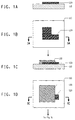
- an electrode material paste of copper powder, glass frit, ethyl cellulose polymeric binder, solvent and surfactants (EP 320 obtainable from E. I. du Pont de Nemours and Company) was screen-printed onto the alumina substrate 110 to form electrode pattern 120.
- the area of the electrode was 0.3 inch by 0.3 inch and contained a protruding "finger" to allow connections to the electrode at a later stage.
- the electrode pattern was dried at 120°C for 10 minutes and fired at 930°C under copper thick-film nitrogen atmosphere firing conditions.
- a dielectric material containing barium titanate powder, glass frit, ethyl cellulose polymeric binder, solvent, processing aids and surfactants (EP 312 obtainable from E.I. du Pont de Nemours and Company) was screen-printed onto the electrode to form dielectric layer 130.
- the area of the dielectric layer was approximately 0.33 inch by 0.33 inch and covered the entirety of the electrode except for the protruding finger.
- the first dielectric layer was dried at 120°C for 10 minutes.
- a second dielectric layer was then applied, and also dried using the same conditions.
- a plan view of the dielectric pattern is shown in FIG. 1D .
- electrode material paste of copper powder, glass frit, ethyl cellulose polymeric binder, solvent and surfactants (EP 320 obtainable from E. I. du Pont de Nemours and Company) was screen-printed over the second dielectric layer to form electrode pattern 140.
- the electrode was 0.3 inch by 0.3 inch but included a protruding finger that extended over the alumina substrate.
- the copper paste was dried at 120°C for 10 minutes.
- the first dielectric layer, the second dielectric layer, and the copper paste electrode were then co-fired at 930°C under copper thick-film firing conditions.
- the encapsulant composition of Example 7 was screen printed through a 180 mesh screen over the entirety of the capacitor electrode and dielectric except for the two fingers using the pattern shown in FIG. 1F to form a 0.4 inch by 0.4 inch encapsulant layer.
- the encapsulant layer was dried for 10 minutes at 120°C.
- Another layer of encapsulant was printed with the formulation prepared in Example 7 through a 180-mesh screen directly over the first encapsulant layer and dried for 10 minutes at 120°C.
- a side view of the final stack is shown in FIG. 1G .
- the encapsulant 150 was then baked under nitrogen in a forced draft oven at 190°C for 30 minutes. The final thickness of the encapsulant 150 was approximately 10 microns.
- the average capacitance of the twenty capacitors was 63.3 nF/cm 2 , the average loss factor was 2.1 %, the average insulation resistance was 3.9 Gohms.
- the capacitors were then subjected to the Brown Oxide Test described previously. After the Brown Oxide Test treatment, the average capacitance, loss factor, and insulation resistance of the twenty capacitors were 65.3 nF/cm 2 , 2.0%, and 3.7 Gohm, respectively. Unencapsulated coupons did not survive the Brown Oxide Test exposure.
- the twenty encapsulated capacitors that were subjected to the Brown Oxide Test were next tested according to the Temperature Humidity Bias Test described above.
- the twenty capacitors were subjected to a 5V DC bias and placed in an 85°C/85% RH oven for 1000 hours after which time the capacitance, loss and insulation resistance were measured again.
- the twenty capacitors survived the 1000 hours of THB testing.
- the average capacitance, loss factor, and insulation resistance of the twenty capacitors were 62.0 nF/cm 2 , 2.2%, and 1.2 Gohm respectively. Two out of the twenty capacitors tested exhibited insulation resistance values below 10 Meg-ohm.
- Example 9 Preparation of Encapsulated Fired-On Foil Capacitors, Lamination with Prepreg and Core to Determine Adhesive Stren gth and Delamination Tendency
- Fired-on-foil capacitors were fabricated for use as a test structure according to the following process.
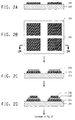
- a 1 ounce copper foil 210 was pretreated by screen-printing a paste of copper powder, glass frit, ethyl cellulose polymeric binder, solvent and surfactants (EP 320 obtainable from E. I. du Pont de Nemours and Company) as a preprint to the foil to form the pattern 215.
- the copper foil and powder were fired at 930°C under copper thick-film firing conditions. Each preprint pattern was approximately 1.67 cm by 1.67 cm.
- a plan view of four of the preprints is shown in FIG. 2B . While FIG. 2A - 2G shows a process in which four fired-on-foil capacitors are produced on the copper foil, in this example, two sets of 16 fired-on-foil capacitors were produced and tested.
- a dielectric material containing barium titanate powder, glass frit, ethyl cellulose polymeric binder, solvent, processing aids and surfactants (EP 312 obtainable from E.I. du Pont de Nemours and Company) was screen-printed onto the preprint of the pretreated foil to form a patterned first dielectric layer.
- the area of the dielectric layer was 1.22 cm by 1.22 cm and within the pattern of the preprint.
- the first dielectric layer was dried at 120°C for 10 minutes.
- a second dielectric layer was then applied on the first dielectric layer, and also dried using the same conditions.
- the first and second patterned dielectric layers form the dielectric 220.
- a paste of copper powder, glass frit, ethyl cellulose polymeric binder, solvent and surfactants (EP 320 obtainable from E. I. du Pont de Nemours and Company) was screen-printed over the dielectric 220 and within the area of the dielectric to form electrode pattern 230 and dried at 120°C for 10 minutes.
- the area of the electrode was 0.9 cm by 0.9 cm.
- the first dielectric layer, the second dielectric layer, and the copper paste electrode were then co-fired at 930°C under copper thick-film firing conditions.
- the encapsulant composition as described in Example 7 was printed through a 180-mesh screen over the capacitors to form an encapsulant layer.
- the encapsulant layer was dried at 120°C for ten minutes.
- a second encapsulant layer was then printed directly over the first layer using the paste prepared in Example 7 with a 180-mesh screen.
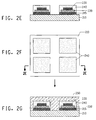
- the two-layer structure was then dried for 10 min at 120°C and then baked at 190°C under nitrogen for 30 minutes to yield a consolidated two-layer composite encapsulant 240 having the pattern as shown in FIG. 2E .
- the final thickness of the baked encapsulant 240 was approximately 10 microns.
- a plan view of the structure is shown in FIG. 2F .
- the component side of the foil 210 was laminated to 1080 BT resin prepreg 250 at 190°C and 400 psi for 90 minutes to form the structure shown in FIG. 2G .
- one set of 16 fired-on-foil capacitors was produced on one piece of copper foil to be used for peel strength testing, and a second set of 16 fired-on-foil capacitors was produced on another piece of copper foil to be used for delamination testing.
- the adhesion of the prepreg to the encapsulant was tested using the IPC - TM - 650 adhesion test number 2.4.9. The adhesion results are shown below.
- the average peel strength of the encapsulant from the 16 capacitors was greater than 3.3 Ibs/linear inch.
- the failure mode was within the capacitor structure, not the encapsulant interface.
- the second set of 16 fired-on-foil capacitors was laminated with 1080 BT resin prepreg and BT core in place of copper foil. These capacitors were subjected to 5 successive solder floats at 260°C, each exposure lasting two minutes, to determine the tendency for the structure to delaminate during thermal cycling. Ultrasonic inspection was used to determine if delamination occurred. No delamination was observed after the five cycles.
- Dry polybenzoxazole particles of Examples 1-6 were placed in various solvents (10 wt% PBO/ 90 wt% solvent) and were heated at 80°C to 100°C and were observed until the PBO dissolved in the solvent or four hours had elapsed. The solutions were cooled to room temperature and observed for two days. If the PBO remained in solution after two days, the solvent is listed below as being a solvent for the PBO.
- Example 1 To the composition of Example 1 was added 5.000 grams of diphenic acid, 7.544 grams of 6F-AP, 92 grams of 1,2-dichlorobenzene and 49.55 grams of trimethylsilyl polyphosphate. The reaction mixture was stirred and heated as in Example 1, and worked up in the same way as in Example 1. Instead of Soxhlet extraction, the solid product was stirred in 50/50 DI water/ammonium hydroxide solution at 80°C for 2 hours, filtered and the solid washed with DI water until the filtrate was neutral. The filtered solid was vacuum oven dried for 18 hours at 140°C to yield 6.8 grams of polybenzoxazole.
- Comparative Example 1 Dry polybenzoxazole particles of Comparative Example 1 were placed in various solvents (10 wt% PBO/ 90 wt% solvent) and the samples were heated at 80°C to 100°C for four hours. The PBO did not dissolve in the solvents listed below. Comparative Example Solvent Result 2 Dowanol® PPh Not soluble 3 N-methylcaprolactam Not soluble 4 Isophorone Not soluble 5 Carvone Not soluble 6 Dihydrocarvone Not soluble 7 Verbenone Not soluble
- This polybenzoxazole did not dissolve in the solvents above or in any other solvents investigated.
- This comparative example indicates that not all polybenzoxazoles prepared from diacids and 6F-AP are soluble.
- Dry polybenzoxazole particles of Examples 1-6 were placed in common screen-printing solvents or in other solvents that one skilled in the art might expect to dissolve the polybenzoxazole of the composition of the invention.
- the compositions (10 wt% PBO/ 90 wt% solvent) were heated at 80°C to 100 °C for four hours to see if the PBOs dissolved in the solvents. The PBOs did not dissolve in the solvents listed below.
- High performance soluble polyimides of low moisture absorption have been shown to have good encapsulant properties, especially adhesion during IR solder reflow and good THB resistant results. These polyimides can withstand selected oxide treatment processing especially if the contact time in high pH solution is controlled. However, if the exposure time is longer than desired, the high pH oxide treatment process will attack the polyimide. As a result of this, it is evident that even very high performance polymers may not provide all of the protection that is required for conventional processing of encapsulated ceramic capacitors.
- the following comparative example illustrates the performance of a polyimide based encapsulant.
- a polyimide was prepared by conversion of a polyamic acid to polyimide with chemical imidization.
- DMAC 3,3'-bis-(trifluoromethyl)benzidine
- TFMB 3,3'-bis-(trifluoromethyl)benzidine
- 6F-AP 2,2'-bis(3-amino-4-hydroxyphenyl)hexafluoropropane
- the solution was cooled to room temperature, and the solution added to an excess of methanol in a blender to precipitate the product polyimide.
- the solid was collected by filtration and was washed 2 times by re-blending the solid in methanol.
- the product was dried in a vacuum oven with a nitrogen purge at 150°C for 16 hrs to yield 165.6 grams of product having a number average molecular weight of 54,600 and a weight average molecular weight of 151,400.
- a screen printable paste was prepared by dissolving 20g of the isolated polyimide powder in 80g DBE-3. After the polymer dissolved, 1.8g RSS-1407 epoxy resin (diglycidyl ether of tetramethyl biphenyl) and 0.2g benzotriazole were added to the polymer solution. After these ingredients were dissolved, the crude paste was filtered under pressure through 0.2 micron cartridge filter to yield the final product.
- a set of 20 capacitors prepared as described in Example 8 were used to evaluate the performance of encapsulant paste prepared in comparative Example 25.
- the encapsulant composition of Comparative Example 25 was screen printed through a 180 mesh screen over the entirety of each capacitor electrode and dielectric except for the two fingers using the pattern shown in FIG. 1F to form a 0.4 inch by 0.4 inch encapsulant layer.
- the encapsulant layer was dried for 10 minutes at 120°C.
- Another layer of encapsulant was printed with the formulation prepared in Example 7 through a 180-mesh screen directly over the first encapsulant layer and dried for 10 minutes at 120°C.
- the encapsulant was then baked under nitrogen in a forced draft oven at 190°C for 30 minutes.
- the final thickness of the encapsulant was approximately 10 microns.
- the average capacitance of the twenty capacitors was 66.1 nF/cm 2 , the average loss factor was 2.2%, and the average insulation resistance was 2.9 Gohms.
- the coupon of twenty capacitors was then subjected to the Brown Oxide Test described previously.
- the average capacitance, loss factor, and insulation resistance were 68.1 nF/cm 2 , 2.3%, 3.1 Gohm respectively after the treatment.
- the twenty capacitors that had been subjected to the Brown Oxide Test were subsequently subjected to a 5V DC bias and placed in an 85°C/85% RH oven for 1000 hours, according to the THB Test, after which time the capacitance, loss and insulation resistance were measured again. Only seven out of 20 capacitors survived 1000 hours of testing. The average values capacitance, loss factor, and insulation resistance for the surviving capacitors were 62.7nF/cm 2 , 2.4%, and 0.8 Gohm, respectively. Thirteen capacitors out of 20 tested exhibited insulation resistance values below 10 Meg-ohm after 1000 hours exposure under 5V bias according to the THB Test.
- the improved performance of the polybenzoxazole encapsulants of Example 7 in the Brown Oxide Test indicates the performance advantage of PBO over high performance polyimide encapsulants. This was a surprising result. Both polyimides and PBOs are considered to have good stability to different chemicals, but the PBO encapsulants have an unexpected advantage when high pH processing is required.
Landscapes
- Chemical & Material Sciences (AREA)
- Engineering & Computer Science (AREA)
- Organic Chemistry (AREA)
- Chemical Kinetics & Catalysis (AREA)
- Life Sciences & Earth Sciences (AREA)
- Materials Engineering (AREA)
- Wood Science & Technology (AREA)
- Microelectronics & Electronic Packaging (AREA)
- Health & Medical Sciences (AREA)
- Manufacturing & Machinery (AREA)
- Medicinal Chemistry (AREA)
- Polymers & Plastics (AREA)
- General Chemical & Material Sciences (AREA)
- Macromolecular Compounds Obtained By Forming Nitrogen-Containing Linkages In General (AREA)
- Compositions Of Macromolecular Compounds (AREA)
- Paints Or Removers (AREA)
- Non-Metallic Protective Coatings For Printed Circuits (AREA)
- Inks, Pencil-Leads, Or Crayons (AREA)
- Production Of Multi-Layered Print Wiring Board (AREA)
- Parts Printed On Printed Circuit Boards (AREA)
- Structures For Mounting Electric Components On Printed Circuit Boards (AREA)
Applications Claiming Priority (1)
| Application Number | Priority Date | Filing Date | Title |
|---|---|---|---|
| US11/949,914 US8270145B2 (en) | 2007-12-04 | 2007-12-04 | Screen-printable encapsulants based on soluble polybenzoxazoles |
Publications (2)
| Publication Number | Publication Date |
|---|---|
| EP2068604A2 true EP2068604A2 (fr) | 2009-06-10 |
| EP2068604A3 EP2068604A3 (fr) | 2010-01-27 |
Family
ID=40407924
Family Applications (1)
| Application Number | Title | Priority Date | Filing Date |
|---|---|---|---|
| EP08169280A Withdrawn EP2068604A3 (fr) | 2007-12-04 | 2008-11-17 | Encapsulants pouvant être imprimés à l'écran basés sur des polybenzoxazoles |
Country Status (5)
| Country | Link |
|---|---|
| US (1) | US8270145B2 (fr) |
| EP (1) | EP2068604A3 (fr) |
| JP (1) | JP2009161736A (fr) |
| KR (1) | KR20090058461A (fr) |
| TW (1) | TW200932846A (fr) |
Families Citing this family (6)
| Publication number | Priority date | Publication date | Assignee | Title |
|---|---|---|---|---|
| JP2010512449A (ja) * | 2006-12-12 | 2010-04-22 | イー・アイ・デュポン・ドウ・ヌムール・アンド・カンパニー | 結晶性封入剤 |
| EP2695906B1 (fr) * | 2011-04-08 | 2018-12-26 | Mitsubishi Gas Chemical Company, Inc. | Résine de polybenzoxazole et son précurseur |
| CA2869988A1 (fr) | 2012-04-11 | 2014-01-16 | Battelle Memorial Institute | Fibres de pbo presentant des proprietes mecaniques ameliorees lorsqu'elles sont exposees a des temperatures elevees et une humidite relative elevee |
| US9649730B2 (en) | 2015-08-12 | 2017-05-16 | E I Du Pont De Nemours And Company | Paste and process for forming a solderable polyimide-based polymer thick film conductor |
| JP2020121275A (ja) * | 2019-01-30 | 2020-08-13 | 日東電工株式会社 | クリーニングシートおよびクリーニング機能付搬送部材 |
| US12568854B2 (en) * | 2022-02-17 | 2026-03-03 | Taiwan Semiconductor Manufacturing Company, Ltd. | Semiconductor packages having semiconductor blocks surrounding semiconductor device |
Citations (5)
| Publication number | Priority date | Publication date | Assignee | Title |
|---|---|---|---|---|
| US6317023B1 (en) | 1999-10-15 | 2001-11-13 | E. I. Du Pont De Nemours And Company | Method to embed passive components |
| US20050011857A1 (en) | 2003-07-17 | 2005-01-20 | Borland William J. | Thin film dielectrics for capacitors and methods of making thereof |
| US6860000B2 (en) | 2002-02-15 | 2005-03-01 | E.I. Du Pont De Nemours And Company | Method to embed thick film components |
| US7064176B2 (en) | 2001-03-30 | 2006-06-20 | Infineon Technologies Ag | Coating material for electronic components |
| WO2007034716A1 (fr) | 2005-09-20 | 2007-03-29 | Nippon Kayaku Kabushiki Kaisha | Précurseur de polybenzoxazole transparent soluble, polybenzoxasole et procédés servant à produire ceux-ci |
Family Cites Families (20)
| Publication number | Priority date | Publication date | Assignee | Title |
|---|---|---|---|---|
| GB2188936B (en) | 1986-03-06 | 1988-12-21 | Central Glass Co Ltd | Aromatic polyamides and polybenoxazoles having diphenylhexafluoropropane units |
| JPS62226987A (ja) | 1986-03-27 | 1987-10-05 | Central Glass Co Ltd | 芳香族ジアミンおよびその製造法 |
| GB2191496A (en) * | 1986-05-30 | 1987-12-16 | Central Glass Co Ltd | Method of preparing aromatic polyamides and polybenzoxazoles |
| US5011753A (en) * | 1987-11-24 | 1991-04-30 | Hoechst Celanese Corporation | Photoresist compositions containing polyamides polybenzoxa from bis((aminohydroxyphenyl)hexafluoroisopropyl)diphenyl ethers |
| US4931532A (en) * | 1988-09-08 | 1990-06-05 | The United States Of America As Represented By The Secretary Of The Air Force | Method of synthesis of thermoplastic aromatic benzoxazole polymers |
| US4978734A (en) * | 1989-03-09 | 1990-12-18 | Hoechst Celanese Corp. | Polyamide-polyamide and polybenzoxazole-polyamide polymer |
| DE59711315D1 (de) * | 1996-12-11 | 2004-03-25 | Infineon Technologies Ag | Herstellung von Polybenzoxazol- und Polybenzothiazol-Vorstufen |
| SG104255A1 (en) * | 1998-09-29 | 2004-06-21 | Sumitomo Bakelite Co | Polybenzoxazole resin and precursor thereof |
| JP2000290374A (ja) * | 1999-04-09 | 2000-10-17 | Central Glass Co Ltd | 含フッ素ポリベンゾオキサゾール |
| US6423815B1 (en) * | 1999-08-30 | 2002-07-23 | Sumitomo Bakelite Company, Limited | Layer insulating film for multilayer interconnection, resin used therefor and process for producing the same |
| JP3442049B2 (ja) * | 2000-03-29 | 2003-09-02 | 住友ベークライト株式会社 | 耐熱性樹脂前駆体、耐熱性樹脂及び絶縁膜並びに半導体装置 |
| WO2002024785A1 (fr) | 2000-09-21 | 2002-03-28 | Sumitomo Bakelite Company, Ltd. | Precurseur de resine resistant a la chaleur, resine resistante a la chaleur, couche isolante isolant et dispositif semiconducteur |
| JPWO2003010223A1 (ja) * | 2001-07-27 | 2004-11-18 | 日立化成工業株式会社 | 光学用樹脂およびその用途 |
| KR20030043702A (ko) * | 2001-11-26 | 2003-06-02 | 간사이 페인트 가부시키가이샤 | 폴리벤족사졸 전구체 및 그것을 이용하는 피복용 조성물 |
| JP4317870B2 (ja) | 2003-03-11 | 2009-08-19 | フジフィルム・エレクトロニック・マテリアルズ・ユーエスエイ・インコーポレイテッド | 新規な感光性樹脂組成物 |
| US20050154105A1 (en) * | 2004-01-09 | 2005-07-14 | Summers John D. | Compositions with polymers for advanced materials |
| US20070236859A1 (en) * | 2006-04-10 | 2007-10-11 | Borland William J | Organic encapsulant compositions for protection of electronic components |
| US20070244267A1 (en) * | 2006-04-10 | 2007-10-18 | Dueber Thomas E | Hydrophobic crosslinkable compositions for electronic applications |
| US20070290379A1 (en) * | 2006-06-15 | 2007-12-20 | Dueber Thomas E | Hydrophobic compositions for electronic applications |
| US20070291440A1 (en) | 2006-06-15 | 2007-12-20 | Dueber Thomas E | Organic encapsulant compositions based on heterocyclic polymers for protection of electronic components |
-
2007
- 2007-12-04 US US11/949,914 patent/US8270145B2/en active Active
-
2008
- 2008-11-17 EP EP08169280A patent/EP2068604A3/fr not_active Withdrawn
- 2008-11-21 TW TW097145250A patent/TW200932846A/zh unknown
- 2008-12-03 JP JP2008308826A patent/JP2009161736A/ja active Pending
- 2008-12-03 KR KR1020080121636A patent/KR20090058461A/ko not_active Ceased
Patent Citations (5)
| Publication number | Priority date | Publication date | Assignee | Title |
|---|---|---|---|---|
| US6317023B1 (en) | 1999-10-15 | 2001-11-13 | E. I. Du Pont De Nemours And Company | Method to embed passive components |
| US7064176B2 (en) | 2001-03-30 | 2006-06-20 | Infineon Technologies Ag | Coating material for electronic components |
| US6860000B2 (en) | 2002-02-15 | 2005-03-01 | E.I. Du Pont De Nemours And Company | Method to embed thick film components |
| US20050011857A1 (en) | 2003-07-17 | 2005-01-20 | Borland William J. | Thin film dielectrics for capacitors and methods of making thereof |
| WO2007034716A1 (fr) | 2005-09-20 | 2007-03-29 | Nippon Kayaku Kabushiki Kaisha | Précurseur de polybenzoxazole transparent soluble, polybenzoxasole et procédés servant à produire ceux-ci |
Non-Patent Citations (3)
| Title |
|---|
| HOUTZ, POLYMER PREPRINTS, vol. 35, no. 1, 1994, pages 437 - 8 |
| L. R. DENNY, 22ND INTERNATIONAL SAMPE TECHNICAL CONFERENCE, 6 November 1990 (1990-11-06) |
| P. J. WALSH, JOURNAL OF APPLIED POLYMER SCIENCE, vol. 102, 2006, pages 3819 - 3829 |
Also Published As
| Publication number | Publication date |
|---|---|
| KR20090058461A (ko) | 2009-06-09 |
| EP2068604A3 (fr) | 2010-01-27 |
| JP2009161736A (ja) | 2009-07-23 |
| US8270145B2 (en) | 2012-09-18 |
| TW200932846A (en) | 2009-08-01 |
| US20090141425A1 (en) | 2009-06-04 |
Similar Documents
| Publication | Publication Date | Title |
|---|---|---|
| KR20090028769A (ko) | 전자 적용을 위한 소수성 조성물 | |
| US8270145B2 (en) | Screen-printable encapsulants based on soluble polybenzoxazoles | |
| CN101473706A (zh) | 用于保护电子元件的基于杂环聚合物的有机密封剂组合物 | |
| JP2008004921A (ja) | 電子部品保護用の有機封止材組成物 | |
| US8233261B2 (en) | Composite organic encapsulants | |
| JP2007327035A (ja) | 電子用途用の架橋性疎水性組成物 | |
| US20100085680A1 (en) | Crystalline encapsulants | |
| US8357753B2 (en) | Screen-printable encapsulants based on polyhydroxyamides that thermally convert to polybenzoxazoles | |
| JP3079740B2 (ja) | ポリイミド及びそれを用いた配線構造体 | |
| EP1845130A2 (fr) | Compositions réticulables hydrophobes pour des applications électroniques |
Legal Events
| Date | Code | Title | Description |
|---|---|---|---|
| PUAI | Public reference made under article 153(3) epc to a published international application that has entered the european phase |
Free format text: ORIGINAL CODE: 0009012 |
|
| AK | Designated contracting states |
Kind code of ref document: A2 Designated state(s): AT BE BG CH CY CZ DE DK EE ES FI FR GB GR HR HU IE IS IT LI LT LU LV MC MT NL NO PL PT RO SE SI SK TR |
|
| AX | Request for extension of the european patent |
Extension state: AL BA MK RS |
|
| RIC1 | Information provided on ipc code assigned before grant |
Ipc: H05B 33/14 20060101ALI20090929BHEP Ipc: H01L 51/00 20060101ALI20090929BHEP Ipc: H01L 21/00 20060101ALI20090929BHEP Ipc: H01B 3/00 20060101ALI20090929BHEP Ipc: C09D 177/00 20060101ALI20090929BHEP Ipc: C08G 73/22 20060101ALI20090929BHEP Ipc: C08G 73/00 20060101ALI20090929BHEP Ipc: H05K 3/28 20060101AFI20090312BHEP |
|
| PUAL | Search report despatched |
Free format text: ORIGINAL CODE: 0009013 |
|
| AK | Designated contracting states |
Kind code of ref document: A3 Designated state(s): AT BE BG CH CY CZ DE DK EE ES FI FR GB GR HR HU IE IS IT LI LT LU LV MC MT NL NO PL PT RO SE SI SK TR |
|
| AX | Request for extension of the european patent |
Extension state: AL BA MK RS |
|
| 17P | Request for examination filed |
Effective date: 20100329 |
|
| 17Q | First examination report despatched |
Effective date: 20100503 |
|
| AKX | Designation fees paid |
Designated state(s): DE FR GB |
|
| RAP1 | Party data changed (applicant data changed or rights of an application transferred) |
Owner name: CDA PROCESSING LIMITED LIABILITY COMPANY |
|
| STAA | Information on the status of an ep patent application or granted ep patent |
Free format text: STATUS: THE APPLICATION IS DEEMED TO BE WITHDRAWN |
|
| 18D | Application deemed to be withdrawn |
Effective date: 20150602 |