EP2070892B1 - Procédé de fabrication d'une structure de céramique en nid d'abeilles - Google Patents
Procédé de fabrication d'une structure de céramique en nid d'abeilles Download PDFInfo
- Publication number
- EP2070892B1 EP2070892B1 EP07828365.2A EP07828365A EP2070892B1 EP 2070892 B1 EP2070892 B1 EP 2070892B1 EP 07828365 A EP07828365 A EP 07828365A EP 2070892 B1 EP2070892 B1 EP 2070892B1
- Authority
- EP
- European Patent Office
- Prior art keywords
- microcapsules
- honeycomb structure
- bulk density
- packed bulk
- pore volume
- Prior art date
- Legal status (The legal status is an assumption and is not a legal conclusion. Google has not performed a legal analysis and makes no representation as to the accuracy of the status listed.)
- Ceased
Links
- 239000000919 ceramic Substances 0.000 title claims description 26
- 238000004519 manufacturing process Methods 0.000 title claims description 26
- 239000003094 microcapsule Substances 0.000 claims description 173
- 239000011148 porous material Substances 0.000 claims description 100
- 239000000463 material Substances 0.000 claims description 48
- 239000000843 powder Substances 0.000 claims description 24
- 238000000034 method Methods 0.000 claims description 16
- 229910010293 ceramic material Inorganic materials 0.000 claims description 13
- 238000002156 mixing Methods 0.000 claims description 13
- 238000001125 extrusion Methods 0.000 claims description 11
- 239000011347 resin Substances 0.000 claims description 9
- 229920005989 resin Polymers 0.000 claims description 9
- 238000005245 sintering Methods 0.000 claims description 8
- 230000006835 compression Effects 0.000 claims description 7
- 238000007906 compression Methods 0.000 claims description 7
- 238000001035 drying Methods 0.000 claims description 4
- 239000000203 mixture Substances 0.000 claims description 4
- 238000012360 testing method Methods 0.000 description 21
- 239000002245 particle Substances 0.000 description 13
- 210000002421 cell wall Anatomy 0.000 description 9
- 229910052878 cordierite Inorganic materials 0.000 description 6
- JSKIRARMQDRGJZ-UHFFFAOYSA-N dimagnesium dioxido-bis[(1-oxido-3-oxo-2,4,6,8,9-pentaoxa-1,3-disila-5,7-dialuminabicyclo[3.3.1]nonan-7-yl)oxy]silane Chemical compound [Mg++].[Mg++].[O-][Si]([O-])(O[Al]1O[Al]2O[Si](=O)O[Si]([O-])(O1)O2)O[Al]1O[Al]2O[Si](=O)O[Si]([O-])(O1)O2 JSKIRARMQDRGJZ-UHFFFAOYSA-N 0.000 description 6
- 238000007796 conventional method Methods 0.000 description 5
- 238000010304 firing Methods 0.000 description 5
- VYPSYNLAJGMNEJ-UHFFFAOYSA-N Silicium dioxide Chemical compound O=[Si]=O VYPSYNLAJGMNEJ-UHFFFAOYSA-N 0.000 description 4
- XLYOFNOQVPJJNP-UHFFFAOYSA-N water Substances O XLYOFNOQVPJJNP-UHFFFAOYSA-N 0.000 description 4
- OKTJSMMVPCPJKN-UHFFFAOYSA-N Carbon Chemical compound [C] OKTJSMMVPCPJKN-UHFFFAOYSA-N 0.000 description 3
- 241000209140 Triticum Species 0.000 description 3
- 235000021307 Triticum Nutrition 0.000 description 3
- 238000009826 distribution Methods 0.000 description 3
- 239000010954 inorganic particle Substances 0.000 description 3
- 239000000178 monomer Substances 0.000 description 3
- 229920000620 organic polymer Polymers 0.000 description 3
- 239000013618 particulate matter Substances 0.000 description 3
- PNEYBMLMFCGWSK-UHFFFAOYSA-N aluminium oxide Inorganic materials [O-2].[O-2].[O-2].[Al+3].[Al+3] PNEYBMLMFCGWSK-UHFFFAOYSA-N 0.000 description 2
- 229910052799 carbon Inorganic materials 0.000 description 2
- 239000003245 coal Substances 0.000 description 2
- 238000005516 engineering process Methods 0.000 description 2
- 238000013213 extrapolation Methods 0.000 description 2
- 238000005259 measurement Methods 0.000 description 2
- QSHDDOUJBYECFT-UHFFFAOYSA-N mercury Chemical compound [Hg] QSHDDOUJBYECFT-UHFFFAOYSA-N 0.000 description 2
- 229910052753 mercury Inorganic materials 0.000 description 2
- 238000000465 moulding Methods 0.000 description 2
- 238000002459 porosimetry Methods 0.000 description 2
- 230000001105 regulatory effect Effects 0.000 description 2
- -1 sialon Chemical compound 0.000 description 2
- 239000000377 silicon dioxide Substances 0.000 description 2
- 229910000505 Al2TiO5 Inorganic materials 0.000 description 1
- 239000005995 Aluminium silicate Substances 0.000 description 1
- 229920002261 Corn starch Polymers 0.000 description 1
- 241000282414 Homo sapiens Species 0.000 description 1
- BQSLGJHIAGOZCD-CIUDSAMLSA-N Leu-Ala-Ser Chemical compound CC(C)C[C@H](N)C(=O)N[C@@H](C)C(=O)N[C@@H](CO)C(O)=O BQSLGJHIAGOZCD-CIUDSAMLSA-N 0.000 description 1
- 229910052581 Si3N4 Inorganic materials 0.000 description 1
- 229920002472 Starch Polymers 0.000 description 1
- NIXOWILDQLNWCW-UHFFFAOYSA-N acrylic acid group Chemical group C(C=C)(=O)O NIXOWILDQLNWCW-UHFFFAOYSA-N 0.000 description 1
- 230000002411 adverse Effects 0.000 description 1
- WNROFYMDJYEPJX-UHFFFAOYSA-K aluminium hydroxide Chemical compound [OH-].[OH-].[OH-].[Al+3] WNROFYMDJYEPJX-UHFFFAOYSA-K 0.000 description 1
- 235000012211 aluminium silicate Nutrition 0.000 description 1
- 239000011230 binding agent Substances 0.000 description 1
- 230000015572 biosynthetic process Effects 0.000 description 1
- 150000001735 carboxylic acids Chemical class 0.000 description 1
- 238000004140 cleaning Methods 0.000 description 1
- 229910052681 coesite Inorganic materials 0.000 description 1
- 238000004891 communication Methods 0.000 description 1
- 230000000052 comparative effect Effects 0.000 description 1
- 229920001577 copolymer Polymers 0.000 description 1
- PMHQVHHXPFUNSP-UHFFFAOYSA-M copper(1+);methylsulfanylmethane;bromide Chemical compound Br[Cu].CSC PMHQVHHXPFUNSP-UHFFFAOYSA-M 0.000 description 1
- 239000008120 corn starch Substances 0.000 description 1
- 229910052593 corundum Inorganic materials 0.000 description 1
- 229910052906 cristobalite Inorganic materials 0.000 description 1
- 239000013078 crystal Substances 0.000 description 1
- 230000007547 defect Effects 0.000 description 1
- KZHJGOXRZJKJNY-UHFFFAOYSA-N dioxosilane;oxo(oxoalumanyloxy)alumane Chemical compound O=[Si]=O.O=[Si]=O.O=[Al]O[Al]=O.O=[Al]O[Al]=O.O=[Al]O[Al]=O KZHJGOXRZJKJNY-UHFFFAOYSA-N 0.000 description 1
- 230000000694 effects Effects 0.000 description 1
- 238000011156 evaluation Methods 0.000 description 1
- 238000002474 experimental method Methods 0.000 description 1
- 239000010419 fine particle Substances 0.000 description 1
- 239000012530 fluid Substances 0.000 description 1
- 230000005484 gravity Effects 0.000 description 1
- 238000010438 heat treatment Methods 0.000 description 1
- 229920001519 homopolymer Polymers 0.000 description 1
- 229930195733 hydrocarbon Natural products 0.000 description 1
- 150000002430 hydrocarbons Chemical class 0.000 description 1
- 238000011835 investigation Methods 0.000 description 1
- NLYAJNPCOHFWQQ-UHFFFAOYSA-N kaolin Chemical compound O.O.O=[Al]O[Si](=O)O[Si](=O)O[Al]=O NLYAJNPCOHFWQQ-UHFFFAOYSA-N 0.000 description 1
- 239000007788 liquid Substances 0.000 description 1
- 125000005395 methacrylic acid group Chemical group 0.000 description 1
- 229920000609 methyl cellulose Polymers 0.000 description 1
- 239000001923 methylcellulose Substances 0.000 description 1
- 229910052863 mullite Inorganic materials 0.000 description 1
- 229910052574 oxide ceramic Inorganic materials 0.000 description 1
- 239000011224 oxide ceramic Substances 0.000 description 1
- TWNQGVIAIRXVLR-UHFFFAOYSA-N oxo(oxoalumanyloxy)alumane Chemical compound O=[Al]O[Al]=O TWNQGVIAIRXVLR-UHFFFAOYSA-N 0.000 description 1
- 230000002093 peripheral effect Effects 0.000 description 1
- 229920003229 poly(methyl methacrylate) Polymers 0.000 description 1
- 229920000139 polyethylene terephthalate Polymers 0.000 description 1
- 239000005020 polyethylene terephthalate Substances 0.000 description 1
- 239000004926 polymethyl methacrylate Substances 0.000 description 1
- AABBHSMFGKYLKE-SNAWJCMRSA-N propan-2-yl (e)-but-2-enoate Chemical compound C\C=C\C(=O)OC(C)C AABBHSMFGKYLKE-SNAWJCMRSA-N 0.000 description 1
- 238000007789 sealing Methods 0.000 description 1
- 230000035939 shock Effects 0.000 description 1
- HBMJWWWQQXIZIP-UHFFFAOYSA-N silicon carbide Chemical compound [Si+]#[C-] HBMJWWWQQXIZIP-UHFFFAOYSA-N 0.000 description 1
- 229910010271 silicon carbide Inorganic materials 0.000 description 1
- 235000012239 silicon dioxide Nutrition 0.000 description 1
- HQVNEWCFYHHQES-UHFFFAOYSA-N silicon nitride Chemical compound N12[Si]34N5[Si]62N3[Si]51N64 HQVNEWCFYHHQES-UHFFFAOYSA-N 0.000 description 1
- 239000004071 soot Substances 0.000 description 1
- 230000000087 stabilizing effect Effects 0.000 description 1
- 235000019698 starch Nutrition 0.000 description 1
- 239000008107 starch Substances 0.000 description 1
- 229910052682 stishovite Inorganic materials 0.000 description 1
- 239000000454 talc Substances 0.000 description 1
- 229910052623 talc Inorganic materials 0.000 description 1
- 229910052905 tridymite Inorganic materials 0.000 description 1
- 229910001845 yogo sapphire Inorganic materials 0.000 description 1
Images

Classifications
-
- C—CHEMISTRY; METALLURGY
- C04—CEMENTS; CONCRETE; ARTIFICIAL STONE; CERAMICS; REFRACTORIES
- C04B—LIME, MAGNESIA; SLAG; CEMENTS; COMPOSITIONS THEREOF, e.g. MORTARS, CONCRETE OR LIKE BUILDING MATERIALS; ARTIFICIAL STONE; CERAMICS; REFRACTORIES; TREATMENT OF NATURAL STONE
- C04B38/00—Porous mortars, concrete, artificial stone or ceramic ware; Preparation thereof
- C04B38/0006—Honeycomb structures
-
- C—CHEMISTRY; METALLURGY
- C04—CEMENTS; CONCRETE; ARTIFICIAL STONE; CERAMICS; REFRACTORIES
- C04B—LIME, MAGNESIA; SLAG; CEMENTS; COMPOSITIONS THEREOF, e.g. MORTARS, CONCRETE OR LIKE BUILDING MATERIALS; ARTIFICIAL STONE; CERAMICS; REFRACTORIES; TREATMENT OF NATURAL STONE
- C04B38/00—Porous mortars, concrete, artificial stone or ceramic ware; Preparation thereof
- C04B38/06—Porous mortars, concrete, artificial stone or ceramic ware; Preparation thereof by burning-out added substances by burning natural expanding materials or by sublimating or melting out added substances
-
- B—PERFORMING OPERATIONS; TRANSPORTING
- B01—PHYSICAL OR CHEMICAL PROCESSES OR APPARATUS IN GENERAL
- B01D—SEPARATION
- B01D39/00—Filtering material for liquid or gaseous fluids
-
- B—PERFORMING OPERATIONS; TRANSPORTING
- B01—PHYSICAL OR CHEMICAL PROCESSES OR APPARATUS IN GENERAL
- B01D—SEPARATION
- B01D39/00—Filtering material for liquid or gaseous fluids
- B01D39/14—Other self-supporting filtering material ; Other filtering material
- B01D39/20—Other self-supporting filtering material ; Other filtering material of inorganic material, e.g. asbestos paper, metallic filtering material of non-woven wires
-
- B—PERFORMING OPERATIONS; TRANSPORTING
- B28—WORKING CEMENT, CLAY, OR STONE
- B28B—SHAPING CLAY OR OTHER CERAMIC COMPOSITIONS; SHAPING SLAG; SHAPING MIXTURES CONTAINING CEMENTITIOUS MATERIAL, e.g. PLASTER
- B28B3/00—Producing shaped articles from the material by using presses; Presses specially adapted therefor
- B28B3/20—Producing shaped articles from the material by using presses; Presses specially adapted therefor wherein the material is extruded
-
- C—CHEMISTRY; METALLURGY
- C04—CEMENTS; CONCRETE; ARTIFICIAL STONE; CERAMICS; REFRACTORIES
- C04B—LIME, MAGNESIA; SLAG; CEMENTS; COMPOSITIONS THEREOF, e.g. MORTARS, CONCRETE OR LIKE BUILDING MATERIALS; ARTIFICIAL STONE; CERAMICS; REFRACTORIES; TREATMENT OF NATURAL STONE
- C04B35/00—Shaped ceramic products characterised by their composition; Ceramics compositions; Processing powders of inorganic compounds preparatory to the manufacturing of ceramic products
- C04B35/01—Shaped ceramic products characterised by their composition; Ceramics compositions; Processing powders of inorganic compounds preparatory to the manufacturing of ceramic products based on oxide ceramics
- C04B35/10—Shaped ceramic products characterised by their composition; Ceramics compositions; Processing powders of inorganic compounds preparatory to the manufacturing of ceramic products based on oxide ceramics based on aluminium oxide
-
- C—CHEMISTRY; METALLURGY
- C04—CEMENTS; CONCRETE; ARTIFICIAL STONE; CERAMICS; REFRACTORIES
- C04B—LIME, MAGNESIA; SLAG; CEMENTS; COMPOSITIONS THEREOF, e.g. MORTARS, CONCRETE OR LIKE BUILDING MATERIALS; ARTIFICIAL STONE; CERAMICS; REFRACTORIES; TREATMENT OF NATURAL STONE
- C04B35/00—Shaped ceramic products characterised by their composition; Ceramics compositions; Processing powders of inorganic compounds preparatory to the manufacturing of ceramic products
- C04B35/01—Shaped ceramic products characterised by their composition; Ceramics compositions; Processing powders of inorganic compounds preparatory to the manufacturing of ceramic products based on oxide ceramics
- C04B35/16—Shaped ceramic products characterised by their composition; Ceramics compositions; Processing powders of inorganic compounds preparatory to the manufacturing of ceramic products based on oxide ceramics based on silicates other than clay
- C04B35/18—Shaped ceramic products characterised by their composition; Ceramics compositions; Processing powders of inorganic compounds preparatory to the manufacturing of ceramic products based on oxide ceramics based on silicates other than clay rich in aluminium oxide
- C04B35/185—Mullite 3Al2O3-2SiO2
-
- C—CHEMISTRY; METALLURGY
- C04—CEMENTS; CONCRETE; ARTIFICIAL STONE; CERAMICS; REFRACTORIES
- C04B—LIME, MAGNESIA; SLAG; CEMENTS; COMPOSITIONS THEREOF, e.g. MORTARS, CONCRETE OR LIKE BUILDING MATERIALS; ARTIFICIAL STONE; CERAMICS; REFRACTORIES; TREATMENT OF NATURAL STONE
- C04B35/00—Shaped ceramic products characterised by their composition; Ceramics compositions; Processing powders of inorganic compounds preparatory to the manufacturing of ceramic products
- C04B35/01—Shaped ceramic products characterised by their composition; Ceramics compositions; Processing powders of inorganic compounds preparatory to the manufacturing of ceramic products based on oxide ceramics
- C04B35/16—Shaped ceramic products characterised by their composition; Ceramics compositions; Processing powders of inorganic compounds preparatory to the manufacturing of ceramic products based on oxide ceramics based on silicates other than clay
- C04B35/18—Shaped ceramic products characterised by their composition; Ceramics compositions; Processing powders of inorganic compounds preparatory to the manufacturing of ceramic products based on oxide ceramics based on silicates other than clay rich in aluminium oxide
- C04B35/195—Alkaline earth aluminosilicates, e.g. cordierite or anorthite
-
- C—CHEMISTRY; METALLURGY
- C04—CEMENTS; CONCRETE; ARTIFICIAL STONE; CERAMICS; REFRACTORIES
- C04B—LIME, MAGNESIA; SLAG; CEMENTS; COMPOSITIONS THEREOF, e.g. MORTARS, CONCRETE OR LIKE BUILDING MATERIALS; ARTIFICIAL STONE; CERAMICS; REFRACTORIES; TREATMENT OF NATURAL STONE
- C04B35/00—Shaped ceramic products characterised by their composition; Ceramics compositions; Processing powders of inorganic compounds preparatory to the manufacturing of ceramic products
- C04B35/01—Shaped ceramic products characterised by their composition; Ceramics compositions; Processing powders of inorganic compounds preparatory to the manufacturing of ceramic products based on oxide ceramics
- C04B35/46—Shaped ceramic products characterised by their composition; Ceramics compositions; Processing powders of inorganic compounds preparatory to the manufacturing of ceramic products based on oxide ceramics based on titanium oxides or titanates
- C04B35/462—Shaped ceramic products characterised by their composition; Ceramics compositions; Processing powders of inorganic compounds preparatory to the manufacturing of ceramic products based on oxide ceramics based on titanium oxides or titanates based on titanates
- C04B35/478—Shaped ceramic products characterised by their composition; Ceramics compositions; Processing powders of inorganic compounds preparatory to the manufacturing of ceramic products based on oxide ceramics based on titanium oxides or titanates based on titanates based on aluminium titanates
-
- C—CHEMISTRY; METALLURGY
- C04—CEMENTS; CONCRETE; ARTIFICIAL STONE; CERAMICS; REFRACTORIES
- C04B—LIME, MAGNESIA; SLAG; CEMENTS; COMPOSITIONS THEREOF, e.g. MORTARS, CONCRETE OR LIKE BUILDING MATERIALS; ARTIFICIAL STONE; CERAMICS; REFRACTORIES; TREATMENT OF NATURAL STONE
- C04B35/00—Shaped ceramic products characterised by their composition; Ceramics compositions; Processing powders of inorganic compounds preparatory to the manufacturing of ceramic products
- C04B35/515—Shaped ceramic products characterised by their composition; Ceramics compositions; Processing powders of inorganic compounds preparatory to the manufacturing of ceramic products based on non-oxide ceramics
- C04B35/56—Shaped ceramic products characterised by their composition; Ceramics compositions; Processing powders of inorganic compounds preparatory to the manufacturing of ceramic products based on non-oxide ceramics based on carbides or oxycarbides
- C04B35/565—Shaped ceramic products characterised by their composition; Ceramics compositions; Processing powders of inorganic compounds preparatory to the manufacturing of ceramic products based on non-oxide ceramics based on carbides or oxycarbides based on silicon carbide
-
- C—CHEMISTRY; METALLURGY
- C04—CEMENTS; CONCRETE; ARTIFICIAL STONE; CERAMICS; REFRACTORIES
- C04B—LIME, MAGNESIA; SLAG; CEMENTS; COMPOSITIONS THEREOF, e.g. MORTARS, CONCRETE OR LIKE BUILDING MATERIALS; ARTIFICIAL STONE; CERAMICS; REFRACTORIES; TREATMENT OF NATURAL STONE
- C04B35/00—Shaped ceramic products characterised by their composition; Ceramics compositions; Processing powders of inorganic compounds preparatory to the manufacturing of ceramic products
- C04B35/515—Shaped ceramic products characterised by their composition; Ceramics compositions; Processing powders of inorganic compounds preparatory to the manufacturing of ceramic products based on non-oxide ceramics
- C04B35/58—Shaped ceramic products characterised by their composition; Ceramics compositions; Processing powders of inorganic compounds preparatory to the manufacturing of ceramic products based on non-oxide ceramics based on borides, nitrides, i.e. nitrides, oxynitrides, carbonitrides or oxycarbonitrides or silicides
- C04B35/581—Shaped ceramic products characterised by their composition; Ceramics compositions; Processing powders of inorganic compounds preparatory to the manufacturing of ceramic products based on non-oxide ceramics based on borides, nitrides, i.e. nitrides, oxynitrides, carbonitrides or oxycarbonitrides or silicides based on aluminium nitride
-
- C—CHEMISTRY; METALLURGY
- C04—CEMENTS; CONCRETE; ARTIFICIAL STONE; CERAMICS; REFRACTORIES
- C04B—LIME, MAGNESIA; SLAG; CEMENTS; COMPOSITIONS THEREOF, e.g. MORTARS, CONCRETE OR LIKE BUILDING MATERIALS; ARTIFICIAL STONE; CERAMICS; REFRACTORIES; TREATMENT OF NATURAL STONE
- C04B2111/00—Mortars, concrete or artificial stone or mixtures to prepare them, characterised by specific function, property or use
- C04B2111/00034—Physico-chemical characteristics of the mixtures
- C04B2111/00129—Extrudable mixtures
-
- C—CHEMISTRY; METALLURGY
- C04—CEMENTS; CONCRETE; ARTIFICIAL STONE; CERAMICS; REFRACTORIES
- C04B—LIME, MAGNESIA; SLAG; CEMENTS; COMPOSITIONS THEREOF, e.g. MORTARS, CONCRETE OR LIKE BUILDING MATERIALS; ARTIFICIAL STONE; CERAMICS; REFRACTORIES; TREATMENT OF NATURAL STONE
- C04B2111/00—Mortars, concrete or artificial stone or mixtures to prepare them, characterised by specific function, property or use
- C04B2111/00034—Physico-chemical characteristics of the mixtures
- C04B2111/00198—Characterisation or quantities of the compositions or their ingredients expressed as mathematical formulae or equations
-
- C—CHEMISTRY; METALLURGY
- C04—CEMENTS; CONCRETE; ARTIFICIAL STONE; CERAMICS; REFRACTORIES
- C04B—LIME, MAGNESIA; SLAG; CEMENTS; COMPOSITIONS THEREOF, e.g. MORTARS, CONCRETE OR LIKE BUILDING MATERIALS; ARTIFICIAL STONE; CERAMICS; REFRACTORIES; TREATMENT OF NATURAL STONE
- C04B2111/00—Mortars, concrete or artificial stone or mixtures to prepare them, characterised by specific function, property or use
- C04B2111/00474—Uses not provided for elsewhere in C04B2111/00
- C04B2111/00793—Uses not provided for elsewhere in C04B2111/00 as filters or diaphragms
Definitions
- the present invention relates to a method for producing a ceramic honeycomb structure for constituting an exhaust-gas-cleaning honeycomb filter, etc.
- a honeycomb filter 10 comprises a ceramic honeycomb structure 11 comprising porous cell walls 2 forming a lot of flow paths 3, 4, and an outer peripheral wall 1, and plugs 6a, 6b alternately sealing both ends 8, 9 of the flow paths 3, 4 in a checkerboard pattern.
- a large pore size reduces pressure loss while the exhaust gas passes through the honeycomb filter, but lowers a particulate-matter-capturing ratio. On the contrary, a small pore size increases the capturing ratio as well as the pressure loss. Too small a total pore volume increases the pressure loss, while too large a total pore volume lowers the strength of the honeycomb filter.
- the pore size and the pore volume are controlled depending on applications, by adjusting the amount of a pore-forming material such as coal powder and wheat powder added to a material powder.
- a pore-forming material such as coal powder and wheat powder added to a material powder.
- the gas-containing, hollow resin microcapsules described in JP 2003-38919 A have come to be used in place of the coal powder and the wheat powder as a pore-forming material.
- microcapsules in different production lots may provide sintered honeycomb structures with different pore volumes, even if they are added in the same amount to ceramic powder.
- the pore volume of the sintered honeycomb structure may be called simply "pore volume” below.
- WO 2005/068398 discloses a method for producing a honeycomb structure stably having a constant pore volume even if microcapsules stored for a long period of time are used, by regulating the weight of a gas contained in the microcapsules stored at 40°C for 4 weeks.
- the method described in WO 2005/068398 needs a preliminary test of storing microcapsules at 40°C for 4 weeks, making it difficult to know a proper amount of the pore-forming material to be added in a short period of time if the production lots of microcapsules are changed. Accordingly, this method fails to cope with a rapid production change, and needs high cost in storing microcapsules.
- JP 2005-314218 A discloses a method for producing a porous structure having stable pore properties comprising extrusion-molding part of an extrusion material for honeycomb structures whenever material lots are changed, measuring the pore properties of its molded article after sintering to have information about the unevenness of the extrusion material, and adjusting the amounts of a pore-forming material and water added to the material based on the information.
- the method described in JP 2005-314218 A needs a lot of time in molding, sintering and evaluation, making it difficult to know a proper amount of a pore-forming material in a short period of time. It also suffers a high production cost.
- the conventional technologies need a lot test of a pore-forming material over a long period of time. Accordingly, a technology capable of easily stabilizing the pore volume of the honeycomb structure in a short period of time has been demanded.
- US 2005/101479 A1 discloses a method of manufacturing a cordierite porous body by using a cordierite forming material including an A1 source, an Si source, and an Mg source and forming cordierite by firing, characterized in that an inorganic micro balloon containing SiO2 and Al2O3 is used as a part or all of the A1 source and the Si source, so that a high-open-porosity cordierite porous body having an extremely low possibility of generating defects causing leakage of a fluid, such as cuts can be manufactured
- US2006/154021 A1 discloses a pore forming material for a porous body comprising organic polymer particles and inorganic particles.
- a body comprising a structure in which the inorganic particles are contained in the organic polymer particles, and an aggregate body of the organic polymer particles and the inorganic particles.
- US 2004/ops 1196 A1 discloses a methof allowing the production of a porous ceramic article which is suppressed in the deformation during drying and is excellent in dimensional accuracy.
- US 2005/253311 A1 discloses a method for firing of ceramic honeycomb structure according to the present invention, when a formed honeycomb material having an apparent volume of 5 liters or more is fired in a firing atmosphere, the heating of the firing atmosphere from a temperature (180 to 300 °C.) at which the organic binder contained in the formed honeycomb material begins to burn, to 300 °C. is conducted at a temperature elevation rate of +25 ( °C./hr) or more and also at such a temperature elevation rate that the difference of the temperature of the central portion of the formed honeycomb material from the temperature of the firing atmosphere is kept in a given temperature range.
- an object of the present invention is to provide a method for producing a honeycomb structure having a stable pore volume at a low cost, which can adjust the amount of a pore-forming material to a proper value in a short period of time even when the conditions of microcapsules are changed.
- the inventors have found that by utilizing a strong correlation between the packed bulk density of microcapsules and the pore volume of the resultant honeycomb structure, it is possible to determine a proper amount of the microcapsules added to provide a honeycomb structure with a desired pore volume.
- the present invention has been completed based on such finding.
- the method of the present invention for producing a ceramic honeycomb structure comprises mixing and blending ceramic material powder with a pore-forming material composed of microcapsules to form a moldable material, extrusion-molding the moldable material, and drying and sintering the resultant molded honeycomb article, the amount of the microcapsules added being adjusted depending on the packed bulk density of the microcapsules.
- the present invention provides a method for producing a ceramic honeycomb structure comprising adjusting the amount of microcapsules added depending on the packed bulk density of the microcapsules, which has a strong correlation with the pore volume.
- This method provides a ceramic honeycomb structure with smaller pore volume variations among production lots, as compared with conventional methods of adding microcapsules in a constant amount to ceramic powder.
- the method of the present invention can adjust the amount of microcapsules to a proper value in a short period of time, thereby obtaining a honeycomb structure with a stable pore volume.
- the resultant honeycomb structures may have different pore volumes because the true volumes of the microcapsules per a unit mass vary
- the inventor has come to an idea of measuring a packed bulk density to know the true volume of microcapsules. The inventor first considered that with respect to the microcapsules, a larger true volume provides a smaller packed bulk density, resulting in a honeycomb structure with a larger pore volume. However, experiment has surprisingly revealed that a larger packed bulk density provides a larger pore volume.
- microcapsules with a smaller packed bulk density provides a honeycomb structure with a smaller pore volume
- those with a larger packed bulk density provides a honeycomb structure with a larger pore volume, not with a desired pore volume.
- increase in their amount makes it possible to obtain a honeycomb structure with a desired pore volume.
- microcapsules with a larger packed bulk density decrease in their amount makes it possible to obtain a honeycomb structure with a desired pore volume.
- microcapsules with a larger packed bulk density provides the resultant honeycomb structure with a larger pore volume
- the large packed bulk density means that the microcapsules has a wide particle size distribution range, with a lot of microcapsules having relatively small particle sizes.
- the existence of microcapsules having small particle sizes in a moldable material makes distances between microcapsules smaller, resulting in increased communications of pores and thus an improved pore volume.
- the pore volume is measured by mercury porosimetry.
- microcapsules with small particle sizes (30 ⁇ m or less) are resistant to breakage by ceramic material particles when blended therewith, resulting in an increased amount of an effective pore-forming material and thus an increased pore volume.
- the relation between the amount of microcapsules added and the pore volume of the ceramic honeycomb structure is determined by the production of ceramic honeycomb structures with varied amounts of microcapsules having the same packed bulk density. Accordingly, the measurement of the packed bulk density of the microcapsules used makes it possible to predict the pore volume of the resultant honeycomb structure from the above-described relation between the packed bulk density of the microcapsules and the pore volume of the ceramic honeycomb structure, and then to determine the amount of microcapsules added for obtaining the desired pore volume from the relation between the amount of microcapsules added and the pore volume of the ceramic honeycomb structure.
- the packed bulk density means a bulk density of microcapsules under a predetermined compression force.
- a method for measuring the packed bulk density of microcapsules will be explained.
- microcapsules 30 are charged into a tubular container 20 of 30 mm in inner diameter and 100 mm in depth [as shown in (a)], and a bulk of microcapsules 30 in the container 20 is compressed with a rod 40 of about 30 mm in outer diameter at a predetermined compression force (for instance, 0.13 MPa) [as shown in (b)].
- a predetermined compression force for instance, 0.13 MPa
- the compression force is more preferably 0.12 to 0.13 MPa, most preferably 0.13 MPa.
- the amount M2 (% by mass) of microcapsules B having a packed bulk density Q2 (g/cm 3 ) added to the ceramic material should be adjusted to meet M2 > M1 when Q1 > Q2, and M2 ⁇ M1 when Q1 ⁇ Q2.
- This provides a honeycomb structure with less pore volume variations among production lots, than when a constant percentage of microcapsules are added to the ceramic powder as in the conventional methods.
- This also makes it possible to adjust the amount of microcapsules to a proper value in a short period of time, without knowing pore properties after sintering and the unevenness of an extrusion material for every lot as in the conventional methods.
- a honeycomb structure having a stable pore volume can be obtained.
- Microcapsules having the targeted packed bulk density Q are obtained by mixing microcapsules having a packed bulk density Q1 larger than the packed bulk density Q with microcapsules having a packed bulk density Q2 smaller than the packed bulk density Q in an appropriate proportion. With adjustment such that the microcapsules has a constant packed bulk density, the variations of the pore volume of the honeycomb structure among production lots can be minimized.
- Such production method provides a honeycomb structure with a stable pore volume even though there are variations in properties among microcapsule lots.
- honeycomb structures with little pore volume variations among production lots can be obtained.
- honeycomb structures having a stable pore volume can be obtained.
- the more preferable packed bulk density of microcapsules is 0.14 to 0.16 g/cm 3 .
- a moldable material obtained by mixing a ceramic material and microcapsules, etc. and then adding water may have different hardness depending on the specific surface area of the microcapsules, even if the amount of water added is constant, so that its extrusion moldability is affected.
- the microcapsules preferably have a specific surface area of 0.058 to 0.218 m 2 /ml. When the microcapsules have a specific surface area of more than 0.218, the moldable material has such high hardness that it does not smoothly flow in an extrusion die. When the microcapsules have a specific surface area of less than 0.058, the extrusion-molded article is likely deformed by its own weight.
- the specific surface area of the microcapsules is more preferably 0.13 to 0.18 m 2 /ml, most preferably 0.14 to 0.17 m 2 /ml.
- the specific surface area of the microcapsules is measured by a particle size distribution analyzer of Microtrac.
- the production method of the present invention may comprise the steps of determining the correlation between the packed bulk density of the microcapsules (pore-forming material) and the pore volume, and adjusting the amount of microcapsules added depending on the packed bulk density of the microcapsules used.
- Another production method of the present invention may comprise the steps of determining the correlation between the packed bulk density of the microcapsules (pore-forming material) and the pore volume, determining the correlation between the amount of microcapsules added and the pore volume, and adjusting the amount of microcapsules added depending on the packed bulk density of the microcapsules used.
- Each microcapsule used in the present invention is a foamed resin constituted by a resin shell containing a gas, which is mixed as a pore-forming material with a ceramic material.
- Resins are not particularly restricted, but preferably homopolymers or copolymers of acrylic monomers, methacrylic monomers, carboxylic acid monomers, etc.
- the shell thickness is preferably 0.1 to 0.8 ⁇ m.
- the moisture content of the above microcapsules is preferably 70 to 95%. Because the average particle size of the microcapsules affects the average pore size of the honeycomb structure, it is appropriately selected depending on the average pore size target.
- the average particle size of 38 to 60 ⁇ m preferably provides a strong correlation between the packed bulk density of the microcapsules and the pore volume.
- microcapsules may be microballoons described in JP 2003-38919 A , etc.
- the amount of microcapsules added is preferably 4 to 12 % by mass, more preferably 6 to 10 % by mass, based on the ceramic material.
- a liquid-containing, pore-forming resin is also called "microcapsule,” the term “microcapsules” used herein means a foamed resin containing a gas.
- the ceramic materials are not particularly restricted, but may have any compositions as long as they are usable for honeycomb structures.
- the ceramic material preferably comprises at least one of cordierite, alumina, mullite, silicon nitride, sialon, silicon carbide, aluminum titanate, aluminum nitride, LAS, etc.
- a ceramic honeycomb structure made of cordierite as a main crystal is preferable, because it has good heat resistance, a low thermal expansion coefficient, and excellent heat shock resistance, and because it can be produced at a low cost.
- the pore-forming material may contain, in addition to the microcapsules, one or more types of powder including carbon-based powder such as graphite powder, wheat powder, starch powder such as corn starch, and resin powder such as polyethylene terephthalate powder and polymethyl methacrylate powder.
- carbon-based powder such as graphite powder, wheat powder, starch powder such as corn starch
- resin powder such as polyethylene terephthalate powder and polymethyl methacrylate powder.
- each type of microcapsules 30 were charged into a tubular container 20 of 30 mm in inner diameter and 100 mm in depth.
- the microcapsules 30 in the container 20 was compressed by a rod 40 having an outer diameter of about 30 mm at 0.13 MPa. In this state, the distance L between an opening end 21 of the container 20 and an upper surface 31 of a bulk of the microcapsules 30 was measured to determine the volume of the compressed bulk of microcapsules 30.
- the mass of the microcapsules 30 obtained by subtracting the mass of the container 20 from the total mass of the microcapsules 30 and the container 20 was divided by the volume of the compressed bulk of microcapsules 30 to determine the packed bulk density of the microcapsules.
- the specific surface areas and particle sizes of the microcapsules A to J were measured by a particle size distribution analyzer of Microtrac. The results are shown in Table 1.
- the above 10 types of molded honeycomb articles were dried and sintered to obtain 10 types of honeycomb structures (Test Nos. 1 to 10) each having a cell wall thickness of 0.3 mm, a cell wall pitch of 1.5 mm, an outer diameter of 267 mm and a length of 304 mm.
- the pore volume of each honeycomb structure was measured by mercury porosimetry. The results are shown in Table 1.
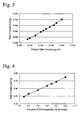
- the graph of Fig. 3 shows the relation between the packed bulk densities of the microcapsules A to J of Test Nos. 1 to 10 and the pore volumes of the honeycomb structures. Fig. 3 indicates that the packed bulk density of the microcapsules was proportional to the pore volume of the honeycomb structure.
- a honeycomb structure obtained by adding 8 % by mass of the microcapsules C (Test No. 3) having a packed bulk density of 0.150 g/cm 3 to the cordierite-forming material powder had a pore volume of 0.657 cm 3 /g.
- the amount of the microcapsules G should be more than 8 % by mass. Specifically, it can be determined as follows.
- the graph of Fig. 4 shows the relation between the amount of the microcapsules G shown in Table 2 and the pore volume of the honeycomb structure.
- the relation between the amount of the microcapsules B and the pore volume of the honeycomb structure should also be obtained to determine the amount of the microcapsules B added.
- microcapsules D having a packed bulk density of 0.165 g/cm 3 and the microcapsules G having a packed bulk density of 0.14 g/cm 3 were mixed in equal amounts to obtain the mixed microcapsules C' having a packed bulk density of 0.149 g/cm 3 , substantially the same as that of the microcapsules C.
- a honeycomb structure produced by using the microcapsules C' in the same manner as in Test No. 3 had a pore volume of 0.655 cm 3 /g.
- the mixing of the microcapsules D and G to have an adjusted packed bulk density provided a honeycomb structure with substantially the same pore volume as that of the honeycomb structure (Test No. 3) obtained by using the microcapsules C.
- honeycomb structures produced by using the microcapsules B to H having packed bulk densities of 0.13 to 0.17 g/cm 3 among those used in Test Nos. 1 to 10 pore volume variations among the samples were stably as narrow as in a range of 0.611 to 0.698 cm 3 /g as shown in Table 1.
- pore volume variations were stably as narrower as 0.636 to 0.670 cm 3 /g.
- the pore volume of a honeycomb structure produced by adding a constant amount (8 % by mass) of microcapsules to a cordierite-forming material powder varied in a range of 0.585 to 0.722 cm 3 /g depending on the packed bulk density, failing to provide the honeycomb structure with a stable performance.
- the pore volumes were less than 0.6 cm 3 /g when the microcapsules I and J (Test Nos. 9 and 10) having packed bulk densities of less than 0.13 g/cm 3 were used, and more than 0.7 cm 3 /g when the microcapsules A (Test No. 1) having a packed bulk density of more than 0.17 g/cm 3 were used.
- Example 4 produced 7 types of honeycomb structures by changing the amount of microcapsules G having a packed bulk density of 0.14 g/cm 3 to determine the correlation between the amount of the microcapsules and the pore volume of the honeycomb structure, and this correlation can be approximated by a straight line as shown in Fig. 4 .
- the determination of the relation between the amount of microcapsules and the pore volume of the honeycomb structure for every lot of microcapsules having different packed bulk densities makes it possible to calculate the amount of microcapsules necessary to achieve the pore volume target depending on the packed bulk density of the microcapsules used.
- the relation between the amount of microcapsules added and the pore volume of the resultant honeycomb structure can be obtained accurately by interpolation or extrapolation from known results. For instance, if there is a line B approximating the relation between the amount of microcapsules having a packed bulk density of 0.18 g/cm 3 and the pore volume, in addition to a line A approximating the relation between the amount of microcapsules having a packed bulk density of 0.14 g/cm 3 shown in Fig. 4 and the pore volume, the relation between the amount of microcapsules having any packed bulk density and the pore volume can be obtained by interpolation or extrapolation from the lines A and B.
- honeycomb structures can be produced with smaller pore volume variations among production lots, as compared with conventional methods adding a constant amount of microcapsules to ceramic powder. Also, a proper amount of microcapsules can be determined in a short period of time without evaluating pore properties after sintering and the unevenness of an extrusion material for every lot, unlike the conventional methods.
Landscapes
- Chemical & Material Sciences (AREA)
- Engineering & Computer Science (AREA)
- Ceramic Engineering (AREA)
- Organic Chemistry (AREA)
- Materials Engineering (AREA)
- Structural Engineering (AREA)
- Manufacturing & Machinery (AREA)
- Chemical Kinetics & Catalysis (AREA)
- Mechanical Engineering (AREA)
- Life Sciences & Earth Sciences (AREA)
- Geology (AREA)
- Filtering Materials (AREA)
- Press-Shaping Or Shaping Using Conveyers (AREA)
Claims (4)
- Procédé de production d'une structure céramique en nid d'abeilles ayant un volume de pores, comprenant les étapes de :malaxage et mélange d'une poudre de matériau céramique avec un matériau porogène composé de microcapsules A pour former un matériau moulable, moulage par extrusion du matériau moulable pour former un article céramique en nid d'abeilles, et séchage et frittage de l'article en nid d'abeilles moulé résultant pour former une structure en nid d'abeilles A,malaxage et mélange d'une poudre de matériau céramique avec un matériau porogène composé de microcapsules B pour former un second matériau moulable, moulage par extrusion du second matériau moulable pour former un second article céramique en nid d'abeilles, et séchage et frittage du second article en nid d'abeilles moulé résultant pour former une structure en nid d'abeilles B,dans lequel ledit matériau porogène consiste essentiellement en des microcapsules de résine mousse constituées par une enveloppe en résine contenant un gaz, etdans lequel lesdites microcapsules A sont ajoutées pour produire ladite structure en nid d'abeilles A en une quantité M1 (% en masse) et lesdites microcapsules B sont ajoutées pour produire ladite structure en nid d'abeilles B en une quantité M2 (% en masse),dans lequel ladite structure en nid d'abeilles B a le même volume de pores que ladite structure en nid d'abeilles A,dans lequel lesdites microcapsules A ont une masse volumique tassée Q1 (g/cm3) et lesdites microcapsules B ont une masse volumique tassée Q2 (g/cm3), dans lequelM2 > M1, lorsque Q1 > Q2, etM2 < M1, lorsque Q1 < Q2.
- Procédé selon la revendication 1, dans lequel les microcapsules comprennent un mélange d'au moins deux types de microcapsules ayant des masses volumiques tassées différentes, dans lequel le mélange d'au moins deux types de microcapsules a une masse volumique tassée ajustée.
- Procédé selon la revendication 1, dans lequel les microcapsules ont une masse volumique tassée de 0,13 à 0,17 g/cm3 à une force de compression de 0,13 MPa.
- Procédé selon la revendication 1, dans lequel les microcapsules ont une surface spécifique de 0,058 à 0,218 m2/mL.
Applications Claiming Priority (2)
| Application Number | Priority Date | Filing Date | Title |
|---|---|---|---|
| JP2006258594 | 2006-09-25 | ||
| PCT/JP2007/068548 WO2008041548A1 (fr) | 2006-09-25 | 2007-09-25 | Procédé de fabrication d'une structure de céramique en nid d'abeilles |
Publications (3)
| Publication Number | Publication Date |
|---|---|
| EP2070892A1 EP2070892A1 (fr) | 2009-06-17 |
| EP2070892A4 EP2070892A4 (fr) | 2013-12-11 |
| EP2070892B1 true EP2070892B1 (fr) | 2015-02-25 |
Family
ID=39268409
Family Applications (1)
| Application Number | Title | Priority Date | Filing Date |
|---|---|---|---|
| EP07828365.2A Ceased EP2070892B1 (fr) | 2006-09-25 | 2007-09-25 | Procédé de fabrication d'une structure de céramique en nid d'abeilles |
Country Status (6)
| Country | Link |
|---|---|
| US (1) | US8309012B2 (fr) |
| EP (1) | EP2070892B1 (fr) |
| JP (1) | JP5304246B2 (fr) |
| KR (1) | KR101425497B1 (fr) |
| CN (1) | CN101395102B (fr) |
| WO (1) | WO2008041548A1 (fr) |
Families Citing this family (7)
| Publication number | Priority date | Publication date | Assignee | Title |
|---|---|---|---|---|
| JP4769978B2 (ja) * | 2009-10-01 | 2011-09-07 | 住友化学株式会社 | チタン酸アルミニウム系セラミックス焼成体の製造方法 |
| CN102834158B (zh) * | 2010-04-01 | 2015-07-15 | 日立金属株式会社 | 陶瓷蜂窝过滤器及其制造方法 |
| CN104876637A (zh) * | 2015-05-25 | 2015-09-02 | 中航复合材料有限责任公司 | 一种纤维增强纯无机阻燃泡沫复合材料及其制备方法 |
| JP6583971B2 (ja) * | 2015-11-13 | 2019-10-02 | 旭化成株式会社 | セラミックス坏土成形体及びセラミックス成形体の製造方法 |
| CN105665692B (zh) * | 2016-03-24 | 2018-05-11 | 洛阳理工学院 | 一种长水口用抗热震内衬复合体及其制备工艺 |
| CN109070384A (zh) * | 2016-03-30 | 2018-12-21 | 日本碍子株式会社 | 蜂窝成型体的干燥方法及蜂窝结构体的制造方法 |
| CN107935618B (zh) * | 2017-12-08 | 2020-08-25 | 温岭市腾锋鞋业有限公司 | 一种生态装饰硅藻泥-人造砂岩复合板及制备方法 |
Family Cites Families (12)
| Publication number | Priority date | Publication date | Assignee | Title |
|---|---|---|---|---|
| US3176054A (en) * | 1962-04-09 | 1965-03-30 | Harbison Walker Refractories | Insulating refractories |
| JP4927268B2 (ja) | 2001-07-27 | 2012-05-09 | 積水化学工業株式会社 | 多孔質セラミックフィルタの製造方法 |
| JP4266103B2 (ja) * | 2001-12-07 | 2009-05-20 | 日本碍子株式会社 | 多孔質セラミック体の製造方法 |
| JP4227347B2 (ja) | 2002-03-29 | 2009-02-18 | 日本碍子株式会社 | 多孔質材料及びその製造方法 |
| JP4476631B2 (ja) * | 2002-03-29 | 2010-06-09 | 日本碍子株式会社 | コーディエライト質多孔体の製造方法 |
| JP4222600B2 (ja) * | 2003-01-07 | 2009-02-12 | 日本碍子株式会社 | セラミックハニカム構造体の焼成方法 |
| US7179316B2 (en) * | 2003-06-25 | 2007-02-20 | Corning Incorporated | Cordierite filters with reduced pressure drop |
| JPWO2005068398A1 (ja) | 2004-01-13 | 2007-12-27 | 日本碍子株式会社 | セラミック構造体の製造方法 |
| US7387829B2 (en) * | 2004-01-13 | 2008-06-17 | Ibiden Co., Ltd. | Honeycomb structure, porous body, pore forming material for the porous body, and methods for manufacturing the pore forming material, the porous body and the honeycomb structure |
| JP2005230782A (ja) * | 2004-02-23 | 2005-09-02 | Ngk Insulators Ltd | 多孔質ハニカム構造体の製造方法 |
| JP2005314218A (ja) | 2004-03-31 | 2005-11-10 | Ngk Insulators Ltd | 多孔質構造体の細孔特性の制御方法 |
| EP1785408A1 (fr) * | 2005-11-15 | 2007-05-16 | L'AIR LIQUIDE, Société Anonyme pour l'Etude et l'Exploitation des Procédés Georges Claude | Procédé d'élaboration de supports poreux céramiques de microstructure contrôlée |
-
2007
- 2007-09-25 EP EP07828365.2A patent/EP2070892B1/fr not_active Ceased
- 2007-09-25 JP JP2008537472A patent/JP5304246B2/ja active Active
- 2007-09-25 WO PCT/JP2007/068548 patent/WO2008041548A1/fr not_active Ceased
- 2007-09-25 US US12/281,669 patent/US8309012B2/en active Active
- 2007-09-25 CN CN2007800071024A patent/CN101395102B/zh not_active Expired - Fee Related
- 2007-09-25 KR KR1020087021095A patent/KR101425497B1/ko not_active Expired - Fee Related
Also Published As
| Publication number | Publication date |
|---|---|
| KR101425497B1 (ko) | 2014-08-01 |
| KR20090054944A (ko) | 2009-06-01 |
| EP2070892A4 (fr) | 2013-12-11 |
| CN101395102B (zh) | 2013-02-27 |
| JPWO2008041548A1 (ja) | 2010-02-04 |
| EP2070892A1 (fr) | 2009-06-17 |
| US20090008811A1 (en) | 2009-01-08 |
| CN101395102A (zh) | 2009-03-25 |
| JP5304246B2 (ja) | 2013-10-02 |
| US8309012B2 (en) | 2012-11-13 |
| WO2008041548A1 (fr) | 2008-04-10 |
Similar Documents
| Publication | Publication Date | Title |
|---|---|---|
| EP2070892B1 (fr) | Procédé de fabrication d'une structure de céramique en nid d'abeilles | |
| JP5178715B2 (ja) | コージェライトチタン酸アルミニウムマグネシウム組成物及びこの組成物を含むセラミック製品 | |
| EP2228115B1 (fr) | Filtre céramique en nid d'abeilles en cordiérite et son procédé de production | |
| EP1968913B1 (fr) | Articles ceramiques de cordierite en nids d'abeille a repartition volumetrique des pores etroite et procedes de fabrication afferents | |
| EP1733780B1 (fr) | Filtre céramique en nid d'abeille | |
| US7648550B2 (en) | Narrow pore size distribution cordierite ceramic honeycomb articles and methods for manufacturing same | |
| EP2188228B1 (fr) | Article en nid d'abeilles à base de cordiérite et son procédé de fabrication | |
| CN1674972A (zh) | 用于柴油机颗粒过滤器应用的硅酸铝镁结构 | |
| EP2070576A1 (fr) | Structure céramique en nid d'abeille et son procédé de fabrication | |
| JP2010501467A (ja) | 低背圧の多孔質コージエライトセラミックハニカム物品およびその製造方法 | |
| JP2009536603A (ja) | 高孔隙率のコージエライト組成物 | |
| EP2918565B1 (fr) | Structure en nid d'abeille obturée | |
| JP2020054985A (ja) | 排ガス浄化フィルタ及び排ガス浄化フィルタの製造方法 | |
| EP2918567B1 (fr) | Structure en nid d'abeille obturée | |
| US20240261715A1 (en) | Ceramic honeycomb filter | |
| JP2004148308A (ja) | セラミックハニカムフィルタ及びその製造方法 | |
| JP7229192B2 (ja) | ハニカムフィルタ | |
| JP7198789B2 (ja) | ハニカムフィルタの製造方法 | |
| JP7202324B2 (ja) | ハニカムフィルタの製造方法 |
Legal Events
| Date | Code | Title | Description |
|---|---|---|---|
| PUAI | Public reference made under article 153(3) epc to a published international application that has entered the european phase |
Free format text: ORIGINAL CODE: 0009012 |
|
| 17P | Request for examination filed |
Effective date: 20090326 |
|
| AK | Designated contracting states |
Kind code of ref document: A1 Designated state(s): AT BE BG CH CY CZ DE DK EE ES FI FR GB GR HU IE IS IT LI LT LU LV MC MT NL PL PT RO SE SI SK TR |
|
| AX | Request for extension of the european patent |
Extension state: AL BA HR MK RS |
|
| RBV | Designated contracting states (corrected) |
Designated state(s): DE FR |
|
| DAX | Request for extension of the european patent (deleted) | ||
| A4 | Supplementary search report drawn up and despatched |
Effective date: 20131108 |
|
| RIC1 | Information provided on ipc code assigned before grant |
Ipc: C04B 38/00 20060101ALI20131104BHEP Ipc: B01D 39/20 20060101ALI20131104BHEP Ipc: C04B 35/478 20060101ALI20131104BHEP Ipc: C04B 35/10 20060101ALI20131104BHEP Ipc: C04B 35/565 20060101ALI20131104BHEP Ipc: B28B 3/20 20060101ALI20131104BHEP Ipc: C04B 38/06 20060101AFI20131104BHEP Ipc: C04B 35/581 20060101ALI20131104BHEP Ipc: C04B 35/195 20060101ALI20131104BHEP Ipc: C04B 35/185 20060101ALI20131104BHEP Ipc: B01D 39/00 20060101ALI20131104BHEP |
|
| GRAP | Despatch of communication of intention to grant a patent |
Free format text: ORIGINAL CODE: EPIDOSNIGR1 |
|
| INTG | Intention to grant announced |
Effective date: 20140904 |
|
| GRAS | Grant fee paid |
Free format text: ORIGINAL CODE: EPIDOSNIGR3 |
|
| GRAA | (expected) grant |
Free format text: ORIGINAL CODE: 0009210 |
|
| AK | Designated contracting states |
Kind code of ref document: B1 Designated state(s): DE FR |
|
| REG | Reference to a national code |
Ref country code: DE Ref legal event code: R096 Ref document number: 602007040394 Country of ref document: DE Effective date: 20150409 |
|
| REG | Reference to a national code |
Ref country code: DE Ref legal event code: R097 Ref document number: 602007040394 Country of ref document: DE |
|
| PLBE | No opposition filed within time limit |
Free format text: ORIGINAL CODE: 0009261 |
|
| STAA | Information on the status of an ep patent application or granted ep patent |
Free format text: STATUS: NO OPPOSITION FILED WITHIN TIME LIMIT |
|
| 26N | No opposition filed |
Effective date: 20151126 |
|
| REG | Reference to a national code |
Ref country code: FR Ref legal event code: PLFP Year of fee payment: 10 |
|
| REG | Reference to a national code |
Ref country code: FR Ref legal event code: PLFP Year of fee payment: 11 |
|
| REG | Reference to a national code |
Ref country code: FR Ref legal event code: PLFP Year of fee payment: 12 |
|
| PGFP | Annual fee paid to national office [announced via postgrant information from national office to epo] |
Ref country code: FR Payment date: 20190815 Year of fee payment: 13 Ref country code: DE Payment date: 20190910 Year of fee payment: 13 |
|
| REG | Reference to a national code |
Ref country code: DE Ref legal event code: R119 Ref document number: 602007040394 Country of ref document: DE |
|
| PG25 | Lapsed in a contracting state [announced via postgrant information from national office to epo] |
Ref country code: FR Free format text: LAPSE BECAUSE OF NON-PAYMENT OF DUE FEES Effective date: 20200930 Ref country code: DE Free format text: LAPSE BECAUSE OF NON-PAYMENT OF DUE FEES Effective date: 20210401 |