EP2071321A2 - Biocapteur à résonance à plasmons de surface - Google Patents
Biocapteur à résonance à plasmons de surface Download PDFInfo
- Publication number
- EP2071321A2 EP2071321A2 EP20080021622 EP08021622A EP2071321A2 EP 2071321 A2 EP2071321 A2 EP 2071321A2 EP 20080021622 EP20080021622 EP 20080021622 EP 08021622 A EP08021622 A EP 08021622A EP 2071321 A2 EP2071321 A2 EP 2071321A2
- Authority
- EP
- European Patent Office
- Prior art keywords
- substance
- sample
- metal film
- metal
- biosensor
- Prior art date
- Legal status (The legal status is an assumption and is not a legal conclusion. Google has not performed a legal analysis and makes no representation as to the accuracy of the status listed.)
- Granted
Links
- 238000002198 surface plasmon resonance spectroscopy Methods 0.000 title claims abstract description 22
- 229910052751 metal Inorganic materials 0.000 claims abstract description 109
- 239000002184 metal Substances 0.000 claims abstract description 109
- 239000000126 substance Substances 0.000 claims abstract description 77
- 239000000758 substrate Substances 0.000 claims abstract description 48
- 229910052737 gold Inorganic materials 0.000 claims abstract description 21
- 229910052697 platinum Inorganic materials 0.000 claims abstract description 16
- 229910052802 copper Inorganic materials 0.000 claims abstract description 15
- 229910052719 titanium Inorganic materials 0.000 claims abstract description 15
- 229910052787 antimony Inorganic materials 0.000 claims abstract description 14
- 229910052779 Neodymium Inorganic materials 0.000 claims abstract description 13
- 229910052797 bismuth Inorganic materials 0.000 claims abstract description 13
- 230000003993 interaction Effects 0.000 claims abstract description 10
- 239000010410 layer Substances 0.000 claims description 44
- 239000013543 active substance Substances 0.000 claims description 40
- 125000003277 amino group Chemical group 0.000 claims description 16
- 238000001514 detection method Methods 0.000 claims description 13
- 229920001477 hydrophilic polymer Polymers 0.000 claims description 13
- 125000002887 hydroxy group Chemical group [H]O* 0.000 claims description 13
- 238000012216 screening Methods 0.000 claims description 12
- 238000011156 evaluation Methods 0.000 claims description 9
- 239000011241 protective layer Substances 0.000 claims description 6
- 229910044991 metal oxide Inorganic materials 0.000 claims description 4
- 150000004706 metal oxides Chemical class 0.000 claims description 4
- 150000004767 nitrides Chemical class 0.000 claims description 4
- 229920003023 plastic Polymers 0.000 claims description 2
- 239000004033 plastic Substances 0.000 claims description 2
- 239000010408 film Substances 0.000 description 75
- 239000000523 sample Substances 0.000 description 69
- 238000000034 method Methods 0.000 description 40
- 238000005259 measurement Methods 0.000 description 38
- 239000010931 gold Substances 0.000 description 23
- VYPSYNLAJGMNEJ-UHFFFAOYSA-N Silicium dioxide Chemical compound O=[Si]=O VYPSYNLAJGMNEJ-UHFFFAOYSA-N 0.000 description 22
- 125000003178 carboxy group Chemical group [H]OC(*)=O 0.000 description 20
- 238000000576 coating method Methods 0.000 description 16
- 229920000642 polymer Polymers 0.000 description 16
- 239000000243 solution Substances 0.000 description 16
- HEMHJVSKTPXQMS-UHFFFAOYSA-M Sodium hydroxide Chemical compound [OH-].[Na+] HEMHJVSKTPXQMS-UHFFFAOYSA-M 0.000 description 15
- 238000009739 binding Methods 0.000 description 15
- 108090000623 proteins and genes Proteins 0.000 description 15
- 230000027455 binding Effects 0.000 description 14
- 230000000052 comparative effect Effects 0.000 description 14
- 102000004169 proteins and genes Human genes 0.000 description 14
- 239000010949 copper Substances 0.000 description 13
- BASFCYQUMIYNBI-UHFFFAOYSA-N platinum Chemical compound [Pt] BASFCYQUMIYNBI-UHFFFAOYSA-N 0.000 description 13
- 239000013545 self-assembled monolayer Substances 0.000 description 13
- 238000010521 absorption reaction Methods 0.000 description 12
- 238000005102 attenuated total reflection Methods 0.000 description 12
- 229910052709 silver Inorganic materials 0.000 description 12
- 238000012360 testing method Methods 0.000 description 12
- 230000008859 change Effects 0.000 description 11
- 229910052681 coesite Inorganic materials 0.000 description 11
- 150000001875 compounds Chemical class 0.000 description 11
- 229910052906 cristobalite Inorganic materials 0.000 description 11
- 230000035945 sensitivity Effects 0.000 description 11
- 239000000377 silicon dioxide Substances 0.000 description 11
- 229910052682 stishovite Inorganic materials 0.000 description 11
- 229910052905 tridymite Inorganic materials 0.000 description 11
- XLYOFNOQVPJJNP-UHFFFAOYSA-N water Substances O XLYOFNOQVPJJNP-UHFFFAOYSA-N 0.000 description 11
- LFQSCWFLJHTTHZ-UHFFFAOYSA-N Ethanol Chemical compound CCO LFQSCWFLJHTTHZ-UHFFFAOYSA-N 0.000 description 10
- 239000010409 thin film Substances 0.000 description 10
- BQCADISMDOOEFD-UHFFFAOYSA-N Silver Chemical compound [Ag] BQCADISMDOOEFD-UHFFFAOYSA-N 0.000 description 9
- 239000011248 coating agent Substances 0.000 description 9
- 239000002094 self assembled monolayer Substances 0.000 description 9
- 239000004332 silver Substances 0.000 description 9
- 102000004190 Enzymes Human genes 0.000 description 8
- 108090000790 Enzymes Proteins 0.000 description 8
- 229940088598 enzyme Drugs 0.000 description 8
- 230000003100 immobilizing effect Effects 0.000 description 8
- -1 polyethylene terephthalate Polymers 0.000 description 8
- 229920002307 Dextran Polymers 0.000 description 7
- PCHJSUWPFVWCPO-UHFFFAOYSA-N gold Chemical compound [Au] PCHJSUWPFVWCPO-UHFFFAOYSA-N 0.000 description 7
- 238000004519 manufacturing process Methods 0.000 description 7
- 239000000203 mixture Substances 0.000 description 7
- 235000000346 sugar Nutrition 0.000 description 7
- 239000013076 target substance Substances 0.000 description 7
- 235000014113 dietary fatty acids Nutrition 0.000 description 6
- 239000000194 fatty acid Substances 0.000 description 6
- 229930195729 fatty acid Natural products 0.000 description 6
- 229920001282 polysaccharide Polymers 0.000 description 6
- 239000005017 polysaccharide Substances 0.000 description 6
- 150000004804 polysaccharides Chemical class 0.000 description 6
- 239000012488 sample solution Substances 0.000 description 6
- 238000004544 sputter deposition Methods 0.000 description 6
- 239000010936 titanium Substances 0.000 description 6
- 229910021642 ultra pure water Inorganic materials 0.000 description 6
- 239000012498 ultrapure water Substances 0.000 description 6
- QDZOEBFLNHCSSF-PFFBOGFISA-N (2S)-2-[[(2R)-2-[[(2S)-1-[(2S)-6-amino-2-[[(2S)-1-[(2R)-2-amino-5-carbamimidamidopentanoyl]pyrrolidine-2-carbonyl]amino]hexanoyl]pyrrolidine-2-carbonyl]amino]-3-(1H-indol-3-yl)propanoyl]amino]-N-[(2R)-1-[[(2S)-1-[[(2R)-1-[[(2S)-1-[[(2S)-1-amino-4-methyl-1-oxopentan-2-yl]amino]-4-methyl-1-oxopentan-2-yl]amino]-3-(1H-indol-3-yl)-1-oxopropan-2-yl]amino]-1-oxo-3-phenylpropan-2-yl]amino]-3-(1H-indol-3-yl)-1-oxopropan-2-yl]pentanediamide Chemical compound C([C@@H](C(=O)N[C@H](CC=1C2=CC=CC=C2NC=1)C(=O)N[C@@H](CC(C)C)C(=O)N[C@@H](CC(C)C)C(N)=O)NC(=O)[C@@H](CC=1C2=CC=CC=C2NC=1)NC(=O)[C@H](CCC(N)=O)NC(=O)[C@@H](CC=1C2=CC=CC=C2NC=1)NC(=O)[C@H]1N(CCC1)C(=O)[C@H](CCCCN)NC(=O)[C@H]1N(CCC1)C(=O)[C@H](N)CCCNC(N)=N)C1=CC=CC=C1 QDZOEBFLNHCSSF-PFFBOGFISA-N 0.000 description 5
- NQTADLQHYWFPDB-UHFFFAOYSA-N N-Hydroxysuccinimide Chemical compound ON1C(=O)CCC1=O NQTADLQHYWFPDB-UHFFFAOYSA-N 0.000 description 5
- 102400000096 Substance P Human genes 0.000 description 5
- 101800003906 Substance P Proteins 0.000 description 5
- 239000000427 antigen Substances 0.000 description 5
- 102000036639 antigens Human genes 0.000 description 5
- 108091007433 antigens Proteins 0.000 description 5
- 229920001577 copolymer Polymers 0.000 description 5
- 238000005516 engineering process Methods 0.000 description 5
- 238000000691 measurement method Methods 0.000 description 5
- 244000005700 microbiome Species 0.000 description 5
- 108020004707 nucleic acids Proteins 0.000 description 5
- 102000039446 nucleic acids Human genes 0.000 description 5
- 150000007523 nucleic acids Chemical class 0.000 description 5
- 238000002360 preparation method Methods 0.000 description 5
- 108020004414 DNA Proteins 0.000 description 4
- 108090000371 Esterases Proteins 0.000 description 4
- FAPWRFPIFSIZLT-UHFFFAOYSA-M Sodium chloride Chemical compound [Na+].[Cl-] FAPWRFPIFSIZLT-UHFFFAOYSA-M 0.000 description 4
- 125000002057 carboxymethyl group Chemical group [H]OC(=O)C([H])([H])[*] 0.000 description 4
- ZPUCINDJVBIVPJ-LJISPDSOSA-N cocaine Chemical compound O([C@H]1C[C@@H]2CC[C@@H](N2C)[C@H]1C(=O)OC)C(=O)C1=CC=CC=C1 ZPUCINDJVBIVPJ-LJISPDSOSA-N 0.000 description 4
- 239000012299 nitrogen atmosphere Substances 0.000 description 4
- 150000002894 organic compounds Chemical class 0.000 description 4
- 238000001179 sorption measurement Methods 0.000 description 4
- 238000004528 spin coating Methods 0.000 description 4
- 229920000089 Cyclic olefin copolymer Polymers 0.000 description 3
- 229910052782 aluminium Inorganic materials 0.000 description 3
- QVGXLLKOCUKJST-UHFFFAOYSA-N atomic oxygen Chemical compound [O] QVGXLLKOCUKJST-UHFFFAOYSA-N 0.000 description 3
- 102000023732 binding proteins Human genes 0.000 description 3
- 108091008324 binding proteins Proteins 0.000 description 3
- 239000000872 buffer Substances 0.000 description 3
- 230000000694 effects Effects 0.000 description 3
- WBJINCZRORDGAQ-UHFFFAOYSA-N ethyl formate Chemical compound CCOC=O WBJINCZRORDGAQ-UHFFFAOYSA-N 0.000 description 3
- 150000004665 fatty acids Chemical class 0.000 description 3
- 125000000524 functional group Chemical group 0.000 description 3
- 102000028557 immunoglobulin binding proteins Human genes 0.000 description 3
- 108091009323 immunoglobulin binding proteins Proteins 0.000 description 3
- 230000003647 oxidation Effects 0.000 description 3
- 238000007254 oxidation reaction Methods 0.000 description 3
- 239000001301 oxygen Substances 0.000 description 3
- 229910052760 oxygen Inorganic materials 0.000 description 3
- 238000003860 storage Methods 0.000 description 3
- YBJHBAHKTGYVGT-ZKWXMUAHSA-N (+)-Biotin Chemical compound N1C(=O)N[C@@H]2[C@H](CCCCC(=O)O)SC[C@@H]21 YBJHBAHKTGYVGT-ZKWXMUAHSA-N 0.000 description 2
- HZAXFHJVJLSVMW-UHFFFAOYSA-N 2-Aminoethan-1-ol Chemical compound NCCO HZAXFHJVJLSVMW-UHFFFAOYSA-N 0.000 description 2
- JKMHFZQWWAIEOD-UHFFFAOYSA-N 2-[4-(2-hydroxyethyl)piperazin-1-yl]ethanesulfonic acid Chemical compound OCC[NH+]1CCN(CCS([O-])(=O)=O)CC1 JKMHFZQWWAIEOD-UHFFFAOYSA-N 0.000 description 2
- XKRFYHLGVUSROY-UHFFFAOYSA-N Argon Chemical compound [Ar] XKRFYHLGVUSROY-UHFFFAOYSA-N 0.000 description 2
- KXDHJXZQYSOELW-UHFFFAOYSA-N Carbamic acid Chemical group NC(O)=O KXDHJXZQYSOELW-UHFFFAOYSA-N 0.000 description 2
- 229920002134 Carboxymethyl cellulose Polymers 0.000 description 2
- VYZAMTAEIAYCRO-UHFFFAOYSA-N Chromium Chemical compound [Cr] VYZAMTAEIAYCRO-UHFFFAOYSA-N 0.000 description 2
- RYGMFSIKBFXOCR-UHFFFAOYSA-N Copper Chemical compound [Cu] RYGMFSIKBFXOCR-UHFFFAOYSA-N 0.000 description 2
- BRLQWZUYTZBJKN-UHFFFAOYSA-N Epichlorohydrin Chemical compound ClCC1CO1 BRLQWZUYTZBJKN-UHFFFAOYSA-N 0.000 description 2
- 241000588724 Escherichia coli Species 0.000 description 2
- 239000007995 HEPES buffer Substances 0.000 description 2
- GVGLGOZIDCSQPN-PVHGPHFFSA-N Heroin Chemical compound O([C@H]1[C@H](C=C[C@H]23)OC(C)=O)C4=C5[C@@]12CCN(C)[C@@H]3CC5=CC=C4OC(C)=O GVGLGOZIDCSQPN-PVHGPHFFSA-N 0.000 description 2
- RJQXTJLFIWVMTO-TYNCELHUSA-N Methicillin Chemical compound COC1=CC=CC(OC)=C1C(=O)N[C@@H]1C(=O)N2[C@@H](C(O)=O)C(C)(C)S[C@@H]21 RJQXTJLFIWVMTO-TYNCELHUSA-N 0.000 description 2
- 102000015636 Oligopeptides Human genes 0.000 description 2
- 108010038807 Oligopeptides Proteins 0.000 description 2
- CBENFWSGALASAD-UHFFFAOYSA-N Ozone Chemical compound [O-][O+]=O CBENFWSGALASAD-UHFFFAOYSA-N 0.000 description 2
- OFOBLEOULBTSOW-UHFFFAOYSA-N Propanedioic acid Natural products OC(=O)CC(O)=O OFOBLEOULBTSOW-UHFFFAOYSA-N 0.000 description 2
- 229920002125 Sokalan® Polymers 0.000 description 2
- 241000191967 Staphylococcus aureus Species 0.000 description 2
- 229920002472 Starch Polymers 0.000 description 2
- 239000008351 acetate buffer Substances 0.000 description 2
- 230000003213 activating effect Effects 0.000 description 2
- 239000003905 agrochemical Substances 0.000 description 2
- 239000000956 alloy Substances 0.000 description 2
- 229910045601 alloy Inorganic materials 0.000 description 2
- XAGFODPZIPBFFR-UHFFFAOYSA-N aluminium Chemical compound [Al] XAGFODPZIPBFFR-UHFFFAOYSA-N 0.000 description 2
- 239000012298 atmosphere Substances 0.000 description 2
- 230000003115 biocidal effect Effects 0.000 description 2
- 235000010948 carboxy methyl cellulose Nutrition 0.000 description 2
- 238000006243 chemical reaction Methods 0.000 description 2
- HVYWMOMLDIMFJA-DPAQBDIFSA-N cholesterol Chemical compound C1C=C2C[C@@H](O)CC[C@]2(C)[C@@H]2[C@@H]1[C@@H]1CC[C@H]([C@H](C)CCCC(C)C)[C@@]1(C)CC2 HVYWMOMLDIMFJA-DPAQBDIFSA-N 0.000 description 2
- 229910052804 chromium Inorganic materials 0.000 description 2
- 239000011651 chromium Substances 0.000 description 2
- 229960003920 cocaine Drugs 0.000 description 2
- 230000007423 decrease Effects 0.000 description 2
- 229960002069 diamorphine Drugs 0.000 description 2
- UKMSUNONTOPOIO-UHFFFAOYSA-N docosanoic acid Chemical compound CCCCCCCCCCCCCCCCCCCCCC(O)=O UKMSUNONTOPOIO-UHFFFAOYSA-N 0.000 description 2
- VYFYYTLLBUKUHU-UHFFFAOYSA-N dopamine Chemical compound NCCC1=CC=C(O)C(O)=C1 VYFYYTLLBUKUHU-UHFFFAOYSA-N 0.000 description 2
- 238000001962 electrophoresis Methods 0.000 description 2
- JIZCYLOUIAIZHQ-UHFFFAOYSA-N ethyl docosenyl Chemical compound CCCCCCCCCCCCCCCCCCCCCC(=O)OCC JIZCYLOUIAIZHQ-UHFFFAOYSA-N 0.000 description 2
- MVLVMROFTAUDAG-UHFFFAOYSA-N ethyl octadecanoate Chemical compound CCCCCCCCCCCCCCCCCC(=O)OCC MVLVMROFTAUDAG-UHFFFAOYSA-N 0.000 description 2
- 238000002474 experimental method Methods 0.000 description 2
- 239000003574 free electron Substances 0.000 description 2
- 239000011521 glass Substances 0.000 description 2
- 239000000017 hydrogel Substances 0.000 description 2
- 229920001600 hydrophobic polymer Polymers 0.000 description 2
- VKOBVWXKNCXXDE-UHFFFAOYSA-N icosanoic acid Chemical compound CCCCCCCCCCCCCCCCCCCC(O)=O VKOBVWXKNCXXDE-UHFFFAOYSA-N 0.000 description 2
- 239000003446 ligand Substances 0.000 description 2
- 239000011976 maleic acid Substances 0.000 description 2
- 239000000463 material Substances 0.000 description 2
- 150000002739 metals Chemical class 0.000 description 2
- 229960003085 meticillin Drugs 0.000 description 2
- 239000004081 narcotic agent Substances 0.000 description 2
- 230000003287 optical effect Effects 0.000 description 2
- 230000035699 permeability Effects 0.000 description 2
- 239000000575 pesticide Substances 0.000 description 2
- 239000004584 polyacrylic acid Substances 0.000 description 2
- 229920001184 polypeptide Polymers 0.000 description 2
- 238000004094 preconcentration Methods 0.000 description 2
- 102000004196 processed proteins & peptides Human genes 0.000 description 2
- 108090000765 processed proteins & peptides Proteins 0.000 description 2
- 238000003380 quartz crystal microbalance Methods 0.000 description 2
- 239000011780 sodium chloride Substances 0.000 description 2
- 239000002904 solvent Substances 0.000 description 2
- 238000005507 spraying Methods 0.000 description 2
- 239000008107 starch Substances 0.000 description 2
- 235000019698 starch Nutrition 0.000 description 2
- 229920001059 synthetic polymer Polymers 0.000 description 2
- VZCYOOQTPOCHFL-UHFFFAOYSA-N trans-butenedioic acid Natural products OC(=O)C=CC(O)=O VZCYOOQTPOCHFL-UHFFFAOYSA-N 0.000 description 2
- SFLSHLFXELFNJZ-QMMMGPOBSA-N (-)-norepinephrine Chemical compound NC[C@H](O)C1=CC=C(O)C(O)=C1 SFLSHLFXELFNJZ-QMMMGPOBSA-N 0.000 description 1
- KIUKXJAPPMFGSW-DNGZLQJQSA-N (2S,3S,4S,5R,6R)-6-[(2S,3R,4R,5S,6R)-3-Acetamido-2-[(2S,3S,4R,5R,6R)-6-[(2R,3R,4R,5S,6R)-3-acetamido-2,5-dihydroxy-6-(hydroxymethyl)oxan-4-yl]oxy-2-carboxy-4,5-dihydroxyoxan-3-yl]oxy-5-hydroxy-6-(hydroxymethyl)oxan-4-yl]oxy-3,4,5-trihydroxyoxane-2-carboxylic acid Chemical compound CC(=O)N[C@H]1[C@H](O)O[C@H](CO)[C@@H](O)[C@@H]1O[C@H]1[C@H](O)[C@@H](O)[C@H](O[C@H]2[C@@H]([C@@H](O[C@H]3[C@@H]([C@@H](O)[C@H](O)[C@H](O3)C(O)=O)O)[C@H](O)[C@@H](CO)O2)NC(C)=O)[C@@H](C(O)=O)O1 KIUKXJAPPMFGSW-DNGZLQJQSA-N 0.000 description 1
- LMDZBCPBFSXMTL-UHFFFAOYSA-N 1-ethyl-3-(3-dimethylaminopropyl)carbodiimide Chemical compound CCN=C=NCCCN(C)C LMDZBCPBFSXMTL-UHFFFAOYSA-N 0.000 description 1
- IXPNQXFRVYWDDI-UHFFFAOYSA-N 1-methyl-2,4-dioxo-1,3-diazinane-5-carboximidamide Chemical compound CN1CC(C(N)=N)C(=O)NC1=O IXPNQXFRVYWDDI-UHFFFAOYSA-N 0.000 description 1
- ULGGZAVAARQJCS-UHFFFAOYSA-N 11-sulfanylundecan-1-ol Chemical compound OCCCCCCCCCCCS ULGGZAVAARQJCS-UHFFFAOYSA-N 0.000 description 1
- GRUQGBJWKWOITP-UHFFFAOYSA-N 16-sulfanylhexadecan-1-ol Chemical compound OCCCCCCCCCCCCCCCCS GRUQGBJWKWOITP-UHFFFAOYSA-N 0.000 description 1
- INOAASCWQMFJQA-UHFFFAOYSA-N 16-sulfanylhexadecanoic acid Chemical compound OC(=O)CCCCCCCCCCCCCCCS INOAASCWQMFJQA-UHFFFAOYSA-N 0.000 description 1
- FPQQSJJWHUJYPU-UHFFFAOYSA-N 3-(dimethylamino)propyliminomethylidene-ethylazanium;chloride Chemical compound Cl.CCN=C=NCCCN(C)C FPQQSJJWHUJYPU-UHFFFAOYSA-N 0.000 description 1
- 229920002126 Acrylic acid copolymer Polymers 0.000 description 1
- 229920000936 Agarose Polymers 0.000 description 1
- 229910002699 Ag–S Inorganic materials 0.000 description 1
- 108090001008 Avidin Proteins 0.000 description 1
- 235000021357 Behenic acid Nutrition 0.000 description 1
- 108091003079 Bovine Serum Albumin Proteins 0.000 description 1
- 102000003846 Carbonic anhydrases Human genes 0.000 description 1
- 108090000209 Carbonic anhydrases Proteins 0.000 description 1
- 229920002101 Chitin Polymers 0.000 description 1
- 229920001661 Chitosan Polymers 0.000 description 1
- 108010089254 Cholesterol oxidase Proteins 0.000 description 1
- 229920000045 Dermatan sulfate Polymers 0.000 description 1
- KCXVZYZYPLLWCC-UHFFFAOYSA-N EDTA Chemical compound OC(=O)CN(CC(O)=O)CCN(CC(O)=O)CC(O)=O KCXVZYZYPLLWCC-UHFFFAOYSA-N 0.000 description 1
- 229910000678 Elektron (alloy) Inorganic materials 0.000 description 1
- 108010010803 Gelatin Proteins 0.000 description 1
- WQZGKKKJIJFFOK-GASJEMHNSA-N Glucose Natural products OC[C@H]1OC(O)[C@H](O)[C@@H](O)[C@@H]1O WQZGKKKJIJFFOK-GASJEMHNSA-N 0.000 description 1
- 108010015776 Glucose oxidase Proteins 0.000 description 1
- 239000004366 Glucose oxidase Substances 0.000 description 1
- HTTJABKRGRZYRN-UHFFFAOYSA-N Heparin Chemical compound OC1C(NC(=O)C)C(O)OC(COS(O)(=O)=O)C1OC1C(OS(O)(=O)=O)C(O)C(OC2C(C(OS(O)(=O)=O)C(OC3C(C(O)C(O)C(O3)C(O)=O)OS(O)(=O)=O)C(CO)O2)NS(O)(=O)=O)C(C(O)=O)O1 HTTJABKRGRZYRN-UHFFFAOYSA-N 0.000 description 1
- 108091006905 Human Serum Albumin Proteins 0.000 description 1
- 102000008100 Human Serum Albumin Human genes 0.000 description 1
- 108090000604 Hydrolases Proteins 0.000 description 1
- 102000004157 Hydrolases Human genes 0.000 description 1
- 108060003951 Immunoglobulin Proteins 0.000 description 1
- 102000004195 Isomerases Human genes 0.000 description 1
- 108090000769 Isomerases Proteins 0.000 description 1
- 102000004856 Lectins Human genes 0.000 description 1
- 108090001090 Lectins Proteins 0.000 description 1
- 102000003960 Ligases Human genes 0.000 description 1
- 108090000364 Ligases Proteins 0.000 description 1
- 102000004317 Lyases Human genes 0.000 description 1
- 108090000856 Lyases Proteins 0.000 description 1
- 241000283973 Oryctolagus cuniculus Species 0.000 description 1
- 108090000854 Oxidoreductases Proteins 0.000 description 1
- 102000004316 Oxidoreductases Human genes 0.000 description 1
- 229920002845 Poly(methacrylic acid) Polymers 0.000 description 1
- 239000002202 Polyethylene glycol Substances 0.000 description 1
- 239000004372 Polyvinyl alcohol Substances 0.000 description 1
- 108020004511 Recombinant DNA Proteins 0.000 description 1
- 108010071390 Serum Albumin Proteins 0.000 description 1
- 102000007562 Serum Albumin Human genes 0.000 description 1
- 235000021355 Stearic acid Nutrition 0.000 description 1
- 101710120037 Toxin CcdB Proteins 0.000 description 1
- 238000005411 Van der Waals force Methods 0.000 description 1
- DPXJVFZANSGRMM-UHFFFAOYSA-N acetic acid;2,3,4,5,6-pentahydroxyhexanal;sodium Chemical compound [Na].CC(O)=O.OCC(O)C(O)C(O)C(O)C=O DPXJVFZANSGRMM-UHFFFAOYSA-N 0.000 description 1
- OIPILFWXSMYKGL-UHFFFAOYSA-N acetylcholine Chemical compound CC(=O)OCC[N+](C)(C)C OIPILFWXSMYKGL-UHFFFAOYSA-N 0.000 description 1
- 229960004373 acetylcholine Drugs 0.000 description 1
- 239000002253 acid Substances 0.000 description 1
- 150000008065 acid anhydrides Chemical class 0.000 description 1
- 230000004913 activation Effects 0.000 description 1
- 239000008186 active pharmaceutical agent Substances 0.000 description 1
- 235000010443 alginic acid Nutrition 0.000 description 1
- 229920000615 alginic acid Polymers 0.000 description 1
- 239000000783 alginic acid Substances 0.000 description 1
- 229960001126 alginic acid Drugs 0.000 description 1
- 150000004781 alginic acids Chemical class 0.000 description 1
- 125000000217 alkyl group Chemical group 0.000 description 1
- AVJBPWGFOQAPRH-FWMKGIEWSA-N alpha-L-IdopA-(1->3)-beta-D-GalpNAc4S Chemical compound CC(=O)N[C@H]1[C@H](O)O[C@H](CO)[C@H](OS(O)(=O)=O)[C@@H]1O[C@H]1[C@H](O)[C@@H](O)[C@H](O)[C@H](C(O)=O)O1 AVJBPWGFOQAPRH-FWMKGIEWSA-N 0.000 description 1
- 150000001412 amines Chemical class 0.000 description 1
- 238000004458 analytical method Methods 0.000 description 1
- 239000007864 aqueous solution Substances 0.000 description 1
- 229910052786 argon Inorganic materials 0.000 description 1
- 150000001491 aromatic compounds Chemical class 0.000 description 1
- 238000007611 bar coating method Methods 0.000 description 1
- 239000011324 bead Substances 0.000 description 1
- 229940116226 behenic acid Drugs 0.000 description 1
- 230000005540 biological transmission Effects 0.000 description 1
- 229940088623 biologically active substance Drugs 0.000 description 1
- 230000015572 biosynthetic process Effects 0.000 description 1
- 229960002685 biotin Drugs 0.000 description 1
- 235000020958 biotin Nutrition 0.000 description 1
- 239000011616 biotin Substances 0.000 description 1
- 229940098773 bovine serum albumin Drugs 0.000 description 1
- 150000001718 carbodiimides Chemical class 0.000 description 1
- 239000001768 carboxy methyl cellulose Substances 0.000 description 1
- 229920003064 carboxyethyl cellulose Polymers 0.000 description 1
- 150000001732 carboxylic acid derivatives Chemical class 0.000 description 1
- 229920003123 carboxymethyl cellulose sodium Polymers 0.000 description 1
- 239000008112 carboxymethyl-cellulose Substances 0.000 description 1
- 229940105329 carboxymethylcellulose Drugs 0.000 description 1
- 229940063834 carboxymethylcellulose sodium Drugs 0.000 description 1
- 235000010418 carrageenan Nutrition 0.000 description 1
- 239000000679 carrageenan Substances 0.000 description 1
- 229920001525 carrageenan Polymers 0.000 description 1
- 229940113118 carrageenan Drugs 0.000 description 1
- 238000005266 casting Methods 0.000 description 1
- 230000015556 catabolic process Effects 0.000 description 1
- 150000003943 catecholamines Chemical class 0.000 description 1
- 239000001913 cellulose Substances 0.000 description 1
- 229920002678 cellulose Polymers 0.000 description 1
- 235000010980 cellulose Nutrition 0.000 description 1
- 229940045110 chitosan Drugs 0.000 description 1
- 235000012000 cholesterol Nutrition 0.000 description 1
- 239000005515 coenzyme Substances 0.000 description 1
- 239000002299 complementary DNA Substances 0.000 description 1
- 230000007797 corrosion Effects 0.000 description 1
- 238000005260 corrosion Methods 0.000 description 1
- 238000004132 cross linking Methods 0.000 description 1
- 238000007766 curtain coating Methods 0.000 description 1
- 238000006731 degradation reaction Methods 0.000 description 1
- 238000000151 deposition Methods 0.000 description 1
- 230000008021 deposition Effects 0.000 description 1
- AVJBPWGFOQAPRH-FWMKGIEWSA-L dermatan sulfate Chemical compound CC(=O)N[C@H]1[C@H](O)O[C@H](CO)[C@H](OS([O-])(=O)=O)[C@@H]1O[C@H]1[C@H](O)[C@@H](O)[C@H](O)[C@H](C([O-])=O)O1 AVJBPWGFOQAPRH-FWMKGIEWSA-L 0.000 description 1
- 229940051593 dermatan sulfate Drugs 0.000 description 1
- 238000003795 desorption Methods 0.000 description 1
- 238000011161 development Methods 0.000 description 1
- 229960002086 dextran Drugs 0.000 description 1
- SBZXBUIDTXKZTM-UHFFFAOYSA-N diglyme Chemical compound COCCOCCOC SBZXBUIDTXKZTM-UHFFFAOYSA-N 0.000 description 1
- 238000003618 dip coating Methods 0.000 description 1
- 229960003638 dopamine Drugs 0.000 description 1
- 229940079593 drug Drugs 0.000 description 1
- 238000007876 drug discovery Methods 0.000 description 1
- 238000007877 drug screening Methods 0.000 description 1
- 238000009713 electroplating Methods 0.000 description 1
- 230000000369 enteropathogenic effect Effects 0.000 description 1
- 230000032050 esterification Effects 0.000 description 1
- 238000005886 esterification reaction Methods 0.000 description 1
- YBKSMWBLSBAFBQ-UHFFFAOYSA-N ethyl arachidate Chemical compound CCCCCCCCCCCCCCCCCCCC(=O)OCC YBKSMWBLSBAFBQ-UHFFFAOYSA-N 0.000 description 1
- IWBOPFCKHIJFMS-UHFFFAOYSA-N ethylene glycol bis(2-aminoethyl) ether Chemical compound NCCOCCOCCN IWBOPFCKHIJFMS-UHFFFAOYSA-N 0.000 description 1
- 238000001704 evaporation Methods 0.000 description 1
- 230000001747 exhibiting effect Effects 0.000 description 1
- 239000000284 extract Substances 0.000 description 1
- 238000001125 extrusion Methods 0.000 description 1
- 238000007765 extrusion coating Methods 0.000 description 1
- 230000002349 favourable effect Effects 0.000 description 1
- 238000000855 fermentation Methods 0.000 description 1
- 230000004151 fermentation Effects 0.000 description 1
- 229910052733 gallium Inorganic materials 0.000 description 1
- 229920000159 gelatin Polymers 0.000 description 1
- 239000008273 gelatin Substances 0.000 description 1
- 235000019322 gelatine Nutrition 0.000 description 1
- 235000011852 gelatine desserts Nutrition 0.000 description 1
- 229910052732 germanium Inorganic materials 0.000 description 1
- 239000008103 glucose Substances 0.000 description 1
- 229940116332 glucose oxidase Drugs 0.000 description 1
- 235000019420 glucose oxidase Nutrition 0.000 description 1
- 125000002791 glucosyl group Chemical group C1([C@H](O)[C@@H](O)[C@H](O)[C@H](O1)CO)* 0.000 description 1
- 229920000669 heparin Polymers 0.000 description 1
- 229960002897 heparin Drugs 0.000 description 1
- 239000005556 hormone Substances 0.000 description 1
- 229940088597 hormone Drugs 0.000 description 1
- 229920002674 hyaluronan Polymers 0.000 description 1
- 229960003160 hyaluronic acid Drugs 0.000 description 1
- 230000028993 immune response Effects 0.000 description 1
- 102000018358 immunoglobulin Human genes 0.000 description 1
- 229940072221 immunoglobulins Drugs 0.000 description 1
- 230000006872 improvement Effects 0.000 description 1
- 238000001727 in vivo Methods 0.000 description 1
- 229910052738 indium Inorganic materials 0.000 description 1
- 230000009878 intermolecular interaction Effects 0.000 description 1
- 238000007733 ion plating Methods 0.000 description 1
- 229910052742 iron Inorganic materials 0.000 description 1
- FZWBNHMXJMCXLU-BLAUPYHCSA-N isomaltotriose Chemical compound O[C@@H]1[C@@H](O)[C@H](O)[C@@H](CO)O[C@@H]1OC[C@@H]1[C@@H](O)[C@H](O)[C@@H](O)[C@@H](OC[C@@H](O)[C@@H](O)[C@H](O)[C@@H](O)C=O)O1 FZWBNHMXJMCXLU-BLAUPYHCSA-N 0.000 description 1
- 229960000318 kanamycin Drugs 0.000 description 1
- 239000002523 lectin Substances 0.000 description 1
- 230000031700 light absorption Effects 0.000 description 1
- 239000007788 liquid Substances 0.000 description 1
- 238000012423 maintenance Methods 0.000 description 1
- 239000007769 metal material Substances 0.000 description 1
- 229920003145 methacrylic acid copolymer Polymers 0.000 description 1
- 229940117841 methacrylic acid copolymer Drugs 0.000 description 1
- LVHBHZANLOWSRM-UHFFFAOYSA-N methylenebutanedioic acid Natural products OC(=O)CC(=C)C(O)=O LVHBHZANLOWSRM-UHFFFAOYSA-N 0.000 description 1
- 238000002156 mixing Methods 0.000 description 1
- 239000000178 monomer Substances 0.000 description 1
- 238000000465 moulding Methods 0.000 description 1
- 239000002547 new drug Substances 0.000 description 1
- 229910052758 niobium Inorganic materials 0.000 description 1
- QIQXTHQIDYTFRH-UHFFFAOYSA-N octadecanoic acid Chemical compound CCCCCCCCCCCCCCCCCC(O)=O QIQXTHQIDYTFRH-UHFFFAOYSA-N 0.000 description 1
- OQCDKBAXFALNLD-UHFFFAOYSA-N octadecanoic acid Natural products CCCCCCCC(C)CCCCCCCCC(O)=O OQCDKBAXFALNLD-UHFFFAOYSA-N 0.000 description 1
- 239000005304 optical glass Substances 0.000 description 1
- 229920000620 organic polymer Polymers 0.000 description 1
- 239000002245 particle Substances 0.000 description 1
- 150000002989 phenols Chemical class 0.000 description 1
- 150000004714 phosphonium salts Chemical class 0.000 description 1
- 230000035790 physiological processes and functions Effects 0.000 description 1
- 238000007747 plating Methods 0.000 description 1
- 229920003229 poly(methyl methacrylate) Polymers 0.000 description 1
- 229920002401 polyacrylamide Polymers 0.000 description 1
- 229920000515 polycarbonate Polymers 0.000 description 1
- 239000004417 polycarbonate Substances 0.000 description 1
- 229920001223 polyethylene glycol Polymers 0.000 description 1
- 229920000139 polyethylene terephthalate Polymers 0.000 description 1
- 239000005020 polyethylene terephthalate Substances 0.000 description 1
- 239000004926 polymethyl methacrylate Substances 0.000 description 1
- 229920002451 polyvinyl alcohol Polymers 0.000 description 1
- 238000012545 processing Methods 0.000 description 1
- 230000001681 protective effect Effects 0.000 description 1
- 230000006798 recombination Effects 0.000 description 1
- 238000005215 recombination Methods 0.000 description 1
- 230000009467 reduction Effects 0.000 description 1
- 230000001105 regulatory effect Effects 0.000 description 1
- 238000011160 research Methods 0.000 description 1
- 239000011369 resultant mixture Substances 0.000 description 1
- 238000012552 review Methods 0.000 description 1
- 239000012146 running buffer Substances 0.000 description 1
- 150000003839 salts Chemical class 0.000 description 1
- 238000007650 screen-printing Methods 0.000 description 1
- 229910052710 silicon Inorganic materials 0.000 description 1
- 235000010413 sodium alginate Nutrition 0.000 description 1
- 239000000661 sodium alginate Substances 0.000 description 1
- 229940005550 sodium alginate Drugs 0.000 description 1
- 230000009870 specific binding Effects 0.000 description 1
- 230000006641 stabilisation Effects 0.000 description 1
- 238000011105 stabilization Methods 0.000 description 1
- 229940032147 starch Drugs 0.000 description 1
- 239000008117 stearic acid Substances 0.000 description 1
- 230000001629 suppression Effects 0.000 description 1
- 239000004094 surface-active agent Substances 0.000 description 1
- 230000002194 synthesizing effect Effects 0.000 description 1
- 229920003002 synthetic resin Polymers 0.000 description 1
- 239000000057 synthetic resin Substances 0.000 description 1
- 238000010345 tape casting Methods 0.000 description 1
- 125000003396 thiol group Chemical group [H]S* 0.000 description 1
- 229910052718 tin Inorganic materials 0.000 description 1
- 229910021654 trace metal Inorganic materials 0.000 description 1
- LDHQCZJRKDOVOX-UHFFFAOYSA-N trans-crotonic acid Natural products CC=CC(O)=O LDHQCZJRKDOVOX-UHFFFAOYSA-N 0.000 description 1
- 238000010023 transfer printing Methods 0.000 description 1
- 150000003918 triazines Chemical class 0.000 description 1
- 239000011882 ultra-fine particle Substances 0.000 description 1
- 125000005500 uronium group Chemical group 0.000 description 1
- 238000007740 vapor deposition Methods 0.000 description 1
- 229910052725 zinc Inorganic materials 0.000 description 1
- UHVMMEOXYDMDKI-JKYCWFKZSA-L zinc;1-(5-cyanopyridin-2-yl)-3-[(1s,2s)-2-(6-fluoro-2-hydroxy-3-propanoylphenyl)cyclopropyl]urea;diacetate Chemical compound [Zn+2].CC([O-])=O.CC([O-])=O.CCC(=O)C1=CC=C(F)C([C@H]2[C@H](C2)NC(=O)NC=2N=CC(=CC=2)C#N)=C1O UHVMMEOXYDMDKI-JKYCWFKZSA-L 0.000 description 1
Images

Classifications
-
- G—PHYSICS
- G01—MEASURING; TESTING
- G01N—INVESTIGATING OR ANALYSING MATERIALS BY DETERMINING THEIR CHEMICAL OR PHYSICAL PROPERTIES
- G01N21/00—Investigating or analysing materials by the use of optical means, i.e. using sub-millimetre waves, infrared, visible or ultraviolet light
- G01N21/17—Systems in which incident light is modified in accordance with the properties of the material investigated
- G01N21/55—Specular reflectivity
- G01N21/552—Attenuated total reflection
- G01N21/553—Attenuated total reflection and using surface plasmons
-
- G—PHYSICS
- G01—MEASURING; TESTING
- G01N—INVESTIGATING OR ANALYSING MATERIALS BY DETERMINING THEIR CHEMICAL OR PHYSICAL PROPERTIES
- G01N33/00—Investigating or analysing materials by specific methods not covered by groups G01N1/00 - G01N31/00
- G01N33/48—Biological material, e.g. blood, urine; Haemocytometers
- G01N33/50—Chemical analysis of biological material, e.g. blood, urine; Testing involving biospecific ligand binding methods; Immunological testing
- G01N33/53—Immunoassay; Biospecific binding assay; Materials therefor
- G01N33/543—Immunoassay; Biospecific binding assay; Materials therefor with an insoluble carrier for immobilising immunochemicals
- G01N33/54366—Apparatus specially adapted for solid-phase testing
- G01N33/54373—Apparatus specially adapted for solid-phase testing involving physiochemical end-point determination, e.g. wave-guides, FETS, gratings
-
- G—PHYSICS
- G01—MEASURING; TESTING
- G01N—INVESTIGATING OR ANALYSING MATERIALS BY DETERMINING THEIR CHEMICAL OR PHYSICAL PROPERTIES
- G01N33/00—Investigating or analysing materials by specific methods not covered by groups G01N1/00 - G01N31/00
- G01N33/48—Biological material, e.g. blood, urine; Haemocytometers
- G01N33/50—Chemical analysis of biological material, e.g. blood, urine; Testing involving biospecific ligand binding methods; Immunological testing
- G01N33/53—Immunoassay; Biospecific binding assay; Materials therefor
- G01N33/543—Immunoassay; Biospecific binding assay; Materials therefor with an insoluble carrier for immobilising immunochemicals
- G01N33/54393—Improving reaction conditions or stability, e.g. by coating or irradiation of surface, by reduction of non-specific binding, by promotion of specific binding
Definitions
- the present invention relates to a biosensor.
- SPR surface plasmon resonance
- QCM quartz crystal microbalance
- a measurement technique o using functional surfaces ranging from gold colloid particles to ultra-fine particles may include a surface plasmon resonance (SPR) measurement technique, a quartz crystal microbalance (QCM) measurement technique, and a measurement technique o using functional surfaces ranging from gold colloid particles to ultra-fine particles.
- the SPR measurement technique utilizes the phenomenon that, in the light entering a metal film of a chip under total reflection conditions, near-filed light leaking in the metal film and the outside thereof is absorbed by a surface plasmon generated on the metal film and thus an absorption peak assignable to it appears.
- the SPR measurement technique is a method in which such a shift or change as described above is measured and determined to thereby detect the absorption and desorption occurring in the vicinity of the surface. It is known as a method of highly sensitively detecting a specific interaction (binding) between a physiologically active substance immobilized on a gold film and another test substance.
- a commonly used measurement chip comprises a transparent substrate (e.g., glass), an evaporated metal film, and a thin film having thereon a functional group capable of immobilizing a physiologically active substance.
- the measurement chip immobilizes the physiologically active substance on the metal surface via the functional group.
- a specific binding reaction between the physiological active substance and a test substance is measured, so as to analyze an interaction between biomolecules.
- Examples of such a measurement chip include those having a film of a free-electron metal selected from the group consisting of copper, silver, aluminum and gold with a hydrogel such as carboxymethyl-denatured dextran and the like (see, for example, Japanese Patent No. 2815120 ).
- a measurement chip allows the three-dimensional immobilization of a physiologically active substance having amino group thereon, which makes it highly useful as detection surface of a biosensor.
- a metal film having a high electrical conductivity i.e., having a high free electron concentration is preferably used therein.
- the light component from the light entering at a specific angle transmitted on the metal film surface under the boundary conditions appears as a larger and sharper resonance absorption line in the reflected light due to the absorption by the surface plasmon at the higher electrical conductivity of the film.
- the half-width of absorption line is usable.
- Gold, silver, copper, platinum, aluminum, and the like have been known as metals having a high electrical conductivity.
- silver has been known as the metal having the highest electrical conductivity.
- silver is active to atmospheric oxygen and moisture. Because of these properties, it is easily oxidized and cannot maintain a high stability. Therefore, it has been considered that silver is merely usable in the laboratory but unsuitable for the application to industrial purposes such as drug discovery and screening. Thus, it has been a common practice to use films made of gold that is relatively stable against oxidation though being inferior in sensitivity to silver because of the lower electrical conductivity.
- the present invention has been made in view of the above circumstances and provides a biosensor.
- a first aspect of the invention provides A biosensor for detecting the interaction of a physiologically active substance on a substrate based on surface plasmon resonance, wherein the substrate has a metal film comprising: approximately 90% by mol or more and less than approximately 99.95% by mol of a first metal element which is Ag; and approximately 0.05% by mol or more and less than approximately 10% by mol of a second metal element, which is at least one of Au, Pt, Cu, Bi, Nd, Ti or Sb.
- a second aspect of the invention provides a biosensor according to the first aspect, comprising: a detection unit comprising the metal film and the physiologically active substance which is provided on the metal film surface as a sensing substance; a supply unit for supplying a candidate substance to the detection unit; and a screening evaluation unit that evaluates whether the candidate substance is a target substrate to be screened or not based on whether or not the sensing substance and the candidate substance bind together.
- Fig. 1 is an exploded perspective view schematically showing the constitution of a measurement chip according to an embodiment of the present invention.
- Fig. 2 is an exploded perspective view schematically showing the constitution of a biosensor according to an embodiment of the invention.
- the biosensor according to the present invention is a biosensor for detecting the interaction of substances on a substrate based on surface plasmon resonance, the substrate having a metal film including approximately 90% by mol or more and less than approximately 99.95% by mol ofAg as a first metal element, and approximately 0.05% by mol or more and less than approximately 10% by mol of at lease one of Au, Pt, Cu, Bi, Nd, Ti or Sb as a second metal element.
- a biosensor using a metal film comprising Ag that has a high electrical conductivity as the first metal element, together with a trace amount of at least one of Au, Pt, Cu, Bi, Nd, Ti or Sb as the second metal element can detect interaction between substances with high sensitivity, has improved stability and can be repeatedly used compared with a biosensor that uses Ag alone. According to the invention, it is possible to provide a biosensor which can detect the interaction between substances with high sensitivity and can be stably and repeatedly used.
- step indicates not only an independent step but may also indicate a step which cannot be discriminated clearly from other steps, as long as the intended effects of the step may be obtained.
- any notation for expressing numerical ranges in the invention indicates a range defined by the minimum and maximum values and includes the minimum and maximum values.
- biologically active substance indicates a substance which relates to a living organism and indicates any substance that may exhibit physiological functions in vivo. The invention will be described below.
- the biosensor of the present invention has as broad a meaning as possible, and the term "biosensor” is used herein to mean a sensor, which converts an interaction between biomolecules into a signal such as an electric signal, so as to measure or detect a target substance.
- a conventional biosensor is comprised of a receptor site for recognizing a chemical substance as a detection target and a transducer site for converting a physical change or chemical change generated at the site into an electric signal.
- substances having an affinity with each other such as enzyme/substrate, enzyme/coenzyme, antigen/antibody, and hormone/receptor.
- a biosensor operates on the principle that a substance having an affinity with another substance, as described above, is immobilized on a substrate to be used as a molecule-recognizing substance, so that the corresponding substance can be selectively measured.
- the metal film which is provided on the substrate, comprises approximately 90% by mol or more and less than approximately 99.95% by mol of Ag as a first metal element, and approximately 0.05% by mol or more and less than approximately 10% by mol of at least one of Au, Pt, Cu, Bi, Nd, Ti or Sb as a second metal element.
- the first metal element is the main component of the metal film and can contribute mainly to an improvement in sensitivity.
- the second metal element which is one of Au, Pt, Cu, Bi, Nd, Ti or Sb, is a trace metal component contained in the metal film of the invention. When combined with the first metal element, the second metal element contributes to the stabilization and maintenance of the effect due to Ag. Provided the content of the second metal element falls within the range as defined above, degradation of the first metal element caused by oxidation and the like can be effectively prevented without lowering sensitivity.
- the metal film comprises approximately 95% by mol or more and less than approximately 99.9% by mol of the first metal element and approximately 0.1 % by mol or more and less than approximately 5.0% by mol of the second metal element.
- the second metal element comprises at least two of Au, Pt, Cu, Ti, Bi, Nd or Sb. It is particularly preferable that the second metal element comprises a combination of at least one selected from the first group consisting of Au, Cu, Pt and Ti with at least one selected from the second group consisting of Bi, Nd and Sb.
- Au, Cu, Pt and Ti are each highly conductive metallic materials exhibiting high electrical conductivity and excellent corrosion resistance. If Au, Pt, Ti or a combination of two or more of the same are used, the oxygen-resisting properties of the metal film can be further improved.
- the content thereof is preferably from approximately 0.5% by mol to approximately 5.0% by mol.
- a metal element of a second group including Bi, Nd and Sb is employed alone, the content thereof is preferably from approximately 0.1 % by mol to approximately 2% by mol.
- the total combined amount thereof is adjusted to be within the preferable ranges of the second metal element as described above.
- the metals of the first group Au is particularly preferable.
- the second group when mixed with Ag, Bi, Nd or Sb frequently localizes around the surface and, as a result, lowers surface energy and effectively prevents Ag from oxidation. From the second group, Nd or Bi are particularly preferred.
- an intermediate layer made of, for example, chromium may be provided by taking the adhesiveness to the substrate into consideration.
- the thickness of the metal film is not limited, it is preferably approximately 0.1 nm or more and approximately 500 nm or less, more preferably approximately 1 nm or more and approximately 200 nm or less. When the film thickness is approximately 500 nm or less, the surface plasmon phenomenon of a medium can be sufficiently detected.
- the thickness of the layer comprising the first metal element alone may be appropriately adjusted so that the total metal film thickness falls within the range as defined above.
- it may be coated as a protective film on the surface of the film comprising the first metal.
- the thickness of the second metal element layer may range from approximately 1 nm to approximately 50 nm.
- the thickness of the intermediate layer is preferably approximately 0.1 nm or more and approximately 10 nm or less.
- the biosensor according to the invention may have at least one of a metal oxide protective layer and a metal nitride protective layer on the metal film as described above.
- a metal oxide protective layer and a metal nitride protective layer on the metal film as described above.
- the metal to be used in the metal oxide layer or the metal nitride layer include Al, Si, Ge, In, Sn, Nb, Fe, Zn, Ga and so on. Among all, Si is particularly preferred.
- the thickness of the metal oxide layer or the metal nitride layer is not limited, it is preferably approximately 1 nm or more and approximately 50 nm or less, more preferably approximately 1 nm or more and approximately 20 nm or less.
- Formation of a metal film may be carried out by common methods, and examples of such a method may include sputtering method, evaporation method, ion plating method, electroplating method, and nonelectrolytic plating method, for example, the sputtering method of metal under oxygen atmosphere may be preferably used.
- a metal film is preferably placed on a substrate.
- placed on a substrate is used herein to mean a case where a metal film is placed on a substrate such that it directly comes into contact with the substrate, as well as a case where a metal film is placed via another layer without directly coming into contact with the substrate.
- examples of such a substrate may include, generally, optical glasses such as BK7, and synthetic resins. More specifically, materials transparent to laser beams, such as polymethyl methacrylate, polyethylene terephthalate, polycarbonate or a cycloolefin polymer, may be used.
- the base unit should act as an optical unit such as a prism and has a low cost.
- a plastic substrate is preferred. It is still preferred that the substrate is made of a material which shows no anisotropy for polarized light and has an excellent workability. More specifically, it is preferably used a cycloolefin polymer or the like.
- the biosensor according to the invention has a layer for immobilizing a physiologically active substance on the metal film.
- the layer for immobilizing a physiologically active substance comprises at least one layer selected from among a self-assembled monolayer and a hydrophilic polymer layer. It is more preferable that the layer comprises both of these layers.
- the self-assembled monolayer may include an organic alkanethiol layer having at least one of an amino group and a hydroxyl group.
- the hydrophilic polymer layer a hydrophilic polymer having an activated carboxyl group is preferable from the viewpoint of the ability to immobilize the physiologically active substance.
- the metal film may be coated with the organic alkanethiol layer having at least one of an amino group and a hydroxyl group and then the organic alkanethiol layer may be reacted with the hydrophilic polymer having an activated carboxyl group.
- a hydrogel as a polymer layer capable of immobilizing the physiologically active substance may be conveniently prepared.
- the method of coating the metal film with the organic alkanethiol layer having at least one of an amino group and a hydroxyl group a method known in the art may be employed, in view of convenience of the procedures, a coating method using self-assembled monolayers (SAMs) is preferred.
- SAMs self-assembled monolayers
- a method of coating metal films with self-assembled monolayers (SAMs) has been intensively studied by Professor Whitesides at Harvard University, and the details thereof are described in Chemical Review, 105, 1103-1169 (2005 ), for example.
- an alkanethiol derivative represented by formula (1) (wherein n represents an integer from 3 to 20, and X represents a functional group) is used as an organic layer-forming compound, so that a monomolecular film having orientation is formed in a self-assemble manner, based on an Ag-S bond and the van der Waals force between alkyl chains.
- a self-assembled monolayer can be formed by an extremely convenient procedure of immersing a metal substrate in a solution of an alkanethiol derivative.
- Alkanethiol having at least one of an amino group and a hydroxyl group can also form a self-assembled monolayer by itself. Otherwise, such alkanethiol can be mixed with another alkanethiol, so as to form a self-assembled monolayer.
- a compound capable of suppressing non-specific adsorption of a physiologically active substance is preferably used as another alkanethiol.
- Such a self-assembled monolayer capable of suppressing non-specific adsorption of a physiologically active substance has been studied in detail by the aforementioned Professor Whitesides et al. Professor Whitesides et al.
- alkanethiol having a hydrophilic group is effective for suppression of non-specific adsorption ( Langrnuir, 17, 2841-2850, 5605-5620, 6336-6343 (2001 )).
- alkanethiol forming a mixed monomolecular film together with alkanethiol having at least one of an amino group and a hydroxyl group a compound described in the aforementioned article may preferably used.
- the alkanethiol having at least one of an amino group and a hydroxyl group is mixed at an any ratio.
- the mixing ratio of the alkanethiol having at least one of an amino group and a hydroxyl group with the alkanethiol having a hydrophilic group preferably ranges from 1/1 to 1/1,000,000, more preferably from 1 to 1 to 1/1,000 and still more preferably from 1 to 1/10.
- the molecular length of alkanethiol having an amino group is preferably longer than that of alkanethiol having a hydrophilic group.
- alkanethiol As alkanethiol described above, a compound synthesized based on the summary of Professor Grzybowski at Northwestern University ( Curr. Org. Chem., 8, 1763-1797 (2004 )) and the cited documents thereof may be used, or a commercially available compound may also be used. Such compounds are available from Dojindo Laboratories, Aldrich, SensoPath Technologies, Frontier Scientific Inc., etc.
- hydrophilic polymers which can be used in the invention may include, gelatin, agarose, chitosan, dextran, carrageenan, alginic acid, starch, cellulose or the derivatives thereof such as carboxymethyl derivative, water-swellable organic polymers such as polyvinyl alcohol, polyacrylic acid, polyacrylamide, polyethylene glycol and the derivatives thereof.
- hydrophilic polymer usable in the invention include a synthetic polymer having a carboxyl group and a polysaccharide having a carboxyl group.
- the synthetic polymer having a carboxyl group include polyacrylic acid, polymethacrylic acid and copolymers thereof, a methacrylic acid copolymer, an acrylic acid copolymer, an itaconic acid copolymer, a crotonic acid copolymer, a maleic acid copolymer, a partially esterified maleic acid copolymer and a hydroxyl group-containing polymer having an acid anhydride added thereto which are disclosed, for example, in JP-B No.
- Such a carboxyl group-containing polysaccharide may be any one selected from an extract from natural plants, a product obtained by fermentation by microorganisms, a synthetic product obtained by enzymes, and a chemically synthetic product.
- Specific examples of such a carboxyl group-containing polysaccharide may include hyaluronic acid, chondroitin sulfuric acid, heparin, dermatan sulfate, carboxymethyl cellulose, carboxyethyl cellulose, cellouronic acid, carboxymethyl chitin, carboxymethyl dextran, and carboxymethyl starch, and the like.
- a carboxyl group-containing polysaccharide a commercially available product can be used as a carboxyl group-containing polysaccharide.
- carboxyl group-containing polysaccharide may include CMD, CMD-L and CMD-D40 (manufactured by Meito Sangyo Co., Ltd.), which are carboxymethyl dextrans, carboxymethylcellulose sodium (manufactured by Wako Pure Chemical Industries, Ltd.), and sodium alginate (manufactured by Wako Pure Chemical Industries, Ltd.), and the like.
- polysaccharide having a carboxyl group a polysaccharide having a carboxyl group is preferred and carboxymethyl dextran is more preferable.
- the molecular weight of the polymer containing a carboxyl group used in the present invention is not particularly limited.
- the weight average molecular weight is preferably from 1,000 to 5,000,000, more preferably from 10,000 to 2,000,000, and further more preferably from 100,000 to 1,000,000.
- the weight average molecular weight is smaller than the above described range, the amount of a physiologically active substance immobilized becomes small.
- the weight average molecular weight is larger than the above described range, it causes a high solution viscosity, and it thereby becomes hard to deal with it.
- the hydrophilic polymer as described above may be immobilized to the substrate via the self-assembled monolayer or the hydrophobic polymer as described in this specification, or may directly be formed on the substrate from a monomer-containing solution.
- the hydrophilic polymer may be cross-linked. Cross-linking of the hydrophilic polymer is obvious to those skilled in the art.
- the polymer having a carboxyl group is activated by a publicly known method using, for example, 1-(3-dimethxylaminopropyl)-3-ethylcarbodiimide (EDC) which is a water-soluble carbodiimide and N-hydroxysuccinimide (NHS) and thus the physiologically active substance having an amino group may be immobilized.
- EDC 1-(3-dimethxylaminopropyl)-3-ethylcarbodiimide
- NHS N-hydroxysuccinimide
- paragraphs [0011] to [0022] i.e., a method in which a carboxyl group present on the surface of a substrate is activated by using a compound having a specific structure selected from among an uronium salt, a phosphonium salt and a triazine derivative to thereby form a carboxylamide group
- the polymer having a carboxyl group having been activated by such a method is reacted with a substrate having an amino group.
- the biosensor according to the invention may be produced.
- a method of activating the polymer having a carboxyl group there has been known a method wherein a nitrogen-containing compound is used.
- the polymer having a carboxyl group having been activated and esterified is used in the form of a film to react with the substrate.
- a method for forming a thin film on a substrate known methods can be used. Specific examples of such methods that can be used include an extrusion coating method, a curtain coating method, a casting method, a screen printing method, a spin coating method, a spray coating method, a slide bead coating method, a slit and spin method, a slit coating method, a dye coating method, a dip coating method, a knife coating method, a blade coating method, a flow coating method, a roll coating method, a wire-bar coating method, and a transfer printing method, and the like.
- a spray coating method or a spin coating method is preferable. Further, a spin coating method is more preferable. This is because it allows a coating film having a controlled film thickness to be readily produced.
- the physiologically active substance is immobilized to the substrate having the metal film to detect the interaction between the physiologically active substance on the substrate and a target substance to be measured in a sample.
- a physiologically active substance immobilized on the surface for the biosensor of the present invention is not particularly limited, as long as it interacts with a measurement target. Examples of such a substance may include an immune protein, an enzyme, a microorganism, nucleic acid, a low molecular weight organic compound, a nonimmune protein, an immunoglobulin-binding protein, a sugar-binding protein, a sugar chain recognizing sugar, fatty acid or fatty acid ester, and polypeptide or oligopeptide having a ligand-binding ability.
- a physiologically active substance immobilized is not particularly limited, as long as it interacts with a measurement target.
- a substance may include an immune protein, an enzyme, a microorganism, a nucleic acid, a low molecular weight organic compound, a non-immune protein, an immunoglobulin-binding protein, a sugar-binding protein, a sugar chain recognizing sugar, fatty acid or fatty acid ester, and polypeptide or oligopeptide having a ligand-binding ability.
- an immune protein may include an antibody whose antigen is a measurement target, and a hapten.
- examples of such an antibody may include various immunoglobulins such as IgG, IgM, IgA, IgE or IgD. More specifically, when a measurement target is human serum albumin, an anti-human serum albumin antibody can be used as an antibody.
- an antigen is an agricultural chemical, pesticide, methicillin-resistant Staphylococcus aureus, antibiotic, narcotic drug, cocaine, heroin, crack or the like
- an anti-atrazine antibody anti-kanamycin antibody, anti-metamphetamine antibody, or antibodies against O antigens 26, 86, 55, 111 or 157 among enteropathogenic Escherichia coli.
- An enzyme used as a physiologically active substance herein is not particularly limited, as long as it exhibits an activity to a measurement target or substance metabolized from the measurement target.
- Various enzymes such as oxidoreductase, hydrolase, isomerase, lyase or synthetase can be used. More specifically, when a measurement target is glucose, glucose oxidase may be used, and when a measurement target is cholesterol, cholesterol oxidase may be used.
- a measurement target is an agricultural chemical, pesticide, methicillin-resistant Staphylococcus aureus, antibiotic, narcotic drug, cocaine, heroin, crack or the like
- enzymes such as acetylcholine esterase, catecholamine esterase, noradrenalin esterase or dopamine esterase, which show a specific reaction with a substance metabolized from the above measurement target, can be used.
- a microorganism used as a physiologically active substance herein is not particularly limited, and various microorganisms such as Escherichia coli can be used.
- nucleic acid those complementarily hybridizing with nucleic acid as a measurement target can be used.
- Either DNA (including cDNA) or RNA can be used as nucleic acid.
- the type of DNA is not particularly limited, and any of native DNA, recombinant DNA produced by gene recombination and chemically synthesized DNA may be used.
- As a low molecular weight organic compound any given compound that can be synthesized by a common method of synthesizing an organic compound can be used.
- a nonimmune protein used herein is not particularly limited, and examples of such a nonimmune protein may include avidin (streptoavidin), biotin, and a receptor.
- examples of an immunoglobulin-binding protein used herein may include protein A, protein G, and a rheumatoid factor (RF).
- RF rheumatoid factor
- lectin is used as a sugar-binding protein.
- fatty acid or fatty acid ester may include stearic acid, arachidic acid, behenic acid, ethyl stearate, ethyl arachidate, and ethyl behenate.
- the physiologically active substance is supplied to the substrate as a physiologically active substance-containing solution prepared by dissolving in an appropriate dissolving liquid.
- concentration of the physiologically active substance-containing solution may properly be changed depending upon kind or molecular weight of the target physiologically active substance and the like, but may be generally from 0.001 mg/ml to 10 mg/ml.
- the biosensor wherein the physiologically active substance is immobilized as described above can be used for detecting and/or measuring a substance which interact with the physiologically active substance.
- a biosensor for surface plasmon resonance is a biosensor used for a surface plasmon resonance biosensor, meaning a member comprising a portion for transmitting and reflecting light emitted from the sensor and a portion for immobilizing a physiologically active substance. It may be fixed to the main body of the sensor or may be detachable.
- the surface plasmon resonance phenomenon occurs due to the fact that the intensity of monochromatic light reflected from the border between an optically transparent substance such as glass and a metal thin film layer depends on the refractive index of a sample located on the outgoing side of the metal. Accordingly, the sample can be analyzed by measuring the intensity of reflected monochromatic light.
- a device using a system known as the Kretschmann configuration is an example of a surface plasmon measurement device for analyzing the properties of a substance to be measured using a phenomenon whereby a surface plasmon is excited with a lightwave (for example, Japanese Patent Laid-Open No. 6-167443 ).
- the surface plasmon measurement device using the above system basically comprises a dielectric block formed in a prism state, a metal film that is formed on a face of the dielectric block and comes into contact with a measured substance such as a sample solution, a light source for generating a light beam, an optical system for allowing the above light beam to enter the dielectric block at various angles so that total reflection conditions can be obtained at the interface between the dielectric block and the metal film, and a light-detecting means for detecting the state of surface plasmon resonance, that is, the state of attenuated total reflection, by measuring the intensity of the light beam totally reflected at the above interface.
- a relatively thin light beam may be caused to enter the above interface while changing an incident angle.
- a relatively thick light beam may be caused to enter the above interface in a state of convergent light or divergent light, so that the light beam contains components that have entered therein at various angles.
- the light beam whose reflection angle changes depending on the change of the incident angle of the entered light beam can be detected with a small photodetector moving in synchronization with the change of the above reflection angle, or it can also be detected with an area sensor extending along the direction in which the reflection angle is changed. In the latter case, the light beam can be detected with an area sensor extending to a direction capable of receiving all the light beams reflected at various reflection angles.
- a light-detecting means in the form of an array is considered to be used for the above type of surface plasmon measurement device in order to measure the attenuated total reflection angle ( ⁇ SP) with high precision and in a large dynamic range.
- This light-detecting means comprises multiple photo acceptance units that are arranged in a certain direction, that is, a direction in which different photo acceptance units receive the components of light beams that are totally reflected at various reflection angles at the above interface.
- the above-described surface plasmon measurement device may be used in random screening to discover a specific substance (a target substance) binding to a desired sensing substance (a physiologically active substance) in the field of research for development of new drugs or the like.
- a sensing substance is immobilized as the above-described measured substance on the above metal thin film layer according to the invention, and a sample solution obtained by dissolving various types of test substance in a solvent is added to the sensing substance. Thereafter, the above-described attenuated total reflection angle ( ⁇ SP) is measured periodically when a certain period of time has elapsed.
- the above attenuated total reflection angle ( ⁇ SP) is measured periodically after the elapse of a certain time, and it is determined whether or not a change has occurred in the above attenuated total reflection angle ( ⁇ SP), so that a binding state between the test substance and the sensing substance is measured. Based on the results, it can be evaluated whether or not the candidate substance is a specific substance binding to the sensing substance.
- a specific substance and a sensing substance may include an antigen and an antibody, and an antibody and an antibody. More specifically, a rabbit anti-human IgG antibody is immobilized as a sensing substance on the surface of a thin film layer, and a human IgG antibody is used as a specific substance.
- ⁇ SP attenuated total reflection angle
- a binding state between a sensing substance and a test substance can be measured (Japanese Patent Application No. 2003-17694 filed by the present applicant).
- a sample solution consisting of a solvent and a test substance is added dropwise to a cup- or petri dish-shaped measurement chip wherein a sensing substance is immobilized on a thin film layer previously formed at the bottom, and then, the above-described amount by which an attenuated total reflection angle ( ⁇ SP) has changed is measured.
- ⁇ SP attenuated total reflection angle
- the biosensor according to the invention in the screening as described above, it may be a biosensor that comprises, for example, a detection unit comprising the metal film as described above and the physiologically active substance which is provided on the metal film surface as a sensing substance, a supply unit for supplying a candidate substance to the detection unit, and a screening evaluation unit that evaluates whether the candidate substrate is a target substrate to be screened or whether or not of the binding of the sensing substance and the candidate substance bind together.
- the screening evaluation unit evaluates whether or not the candidate substance is the target substance to be screened based on, for example, a change in refractive index.
- the biosensor may be used as part of a surface plasmon measurement apparatus known in the art.
- the biosensor according to the invention is quickly enclosed in, for example, a nitrogen atmosphere before using.
- a nitrogen atmosphere To enclose it in the nitrogen atmosphere, it may be preferably stored in a moisture proof film having a moisture proof performance with a water permeability of 10 -2 g/m 2 at 40°C 90%RH, or less.
- Fig. 1 is an exploded perspective view of a measurement chip 15 for use in measurement utilizing SPR.
- the measurement chip 15 is constituted by the total reflecting prism 20 which is a transparent dielectric body and the flow channel member 30 attached onto the total reflecting prism 20.
- On the flow channel member 30 are provided plural flow channels 31 in the longitudinal direction.
- the bottom shape of each flow channel 31 is not particularly limited as long as each of the flow channels 31 has a cross-section as definite as possible.
- the bottom shape may be a straight linear shape, a meandering shape, or an arc shape, and the like.
- the total reflecting prism 20 is constituted by the prism body 21 formed in a long, trapezoidal pillar form, a gripper part 22 provided on one end of the prism body 21, and a projecting part 23 provided on the other end of the prism body 21.
- This total reflecting prism 20 is formed by, for example, molding according to the extrusion method, wherein the prism body 21, the gripper part 22, and the projecting portion 23 are molded in an integrated manner.
- the prism body 21 has an almost trapezoidal cross-section wherein the upper side is longer than the lower side, and collects light irradiated from the side of the bottom surface on a upper surface 21 a.
- the metal film 25 for exciting SPR is provided on the upper surface 21 a of the prism body 21, the metal film 25 for exciting SPR is provided.
- the metal film 25 has a rectangular shape in such a way that it faces each flow channel 31 of the flow channel member 30, and is formed by, for example, vapor deposition.
- the polymer layer 26 On the metal film 25, the polymer layer 26 is provided.
- the polymer layer 26 has a binding group for immobilizing a physiologically active substance.
- the physiologically active substance is immobilized to the metal film 25 via the polymer layer 26.
- the polymer layer 26 is a layer for immobilizing the physiologically active substance and can be constituted by self-assembled monolayer-forming molecules, a hydrophilic polymer, a hydrophobic polymer or a combination thereof.
- the hydrophilic polymer is preferably used for the polymer layer 26. According to a particularly preferred embodiment, it may be constituted by a combination of self-assembled monolayer-forming molecules and a hydrophilic polymer.
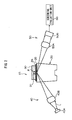
- Fig. 2 is a schematic view showing a biosensor 10 for screening which is an example of a biosensor having the measurement chip 15 as described above.
- the biosensor 10 comprises a measurement chip 15 on which a physiologically active substance P as a sensing substance on a metal film 25, a light emitting unit 40 which emits light toward the measurement chip 15, a light receiving unit 50 which receives reflected light from the measurement chip 15, and a screening evaluation unit 60 which conducts screening based on the light data obtained from the light receiving unit 50.
- the light emitting unit 40 comprises a light source 40A emitting light beams L and a lens unit 40B which allows the light beams L to enter a total reflecting prism 20 at various angles so that the total reflection conditions can be established at the interface between the total reflecting prism 20 and the metal film 25.
- a channel 31 as a supply unit is formed by a channel member 30 so as to supply a candidate substance to be screened in a sample to the physiologically active substance P having been immobilized on the metal film 25 as described above.
- the supply unit may be provided with a liquid-feeding system (not shown in the drawing) for supplying the sample solution to the channel 31.
- the light receiving unit 50 comprises a lens unit 50A and a light detection unit 50B.
- the lens unit 50A converts the light beams L totally reflected at the above-described interface between the total reflecting prism 20 and the metal film 25 of the measurement chip 15 into parallel light.
- the light detection unit 50B detects the light beams L having been parallelized by the lens unit 50A.
- a phtodiode array, a CCD and the like may be used.
- the screening evaluation unit 60 is connected to the light receiving unit 50 and calculates the refractive index based on the light detected by the light receiving unit 50 as described above and, based on this refractive index, determines the interacting properties of the physiologically active substance P on the metal film 25 in the measurement chip 15 and the candidate substance in the sample, thereby judging whether the candidate substance is the target substance to be screened or not.
- the judgment may be altered depending on the purpose of the screen. For example, a substance interacting with the physiologically active substance P may be extracted as a target substance from candidate substances. Alternatively, a substance not interacting with the physiologically active substance P may be extracted as a target substance from candidate substances.
- the biosensor of the present invention may be used as a biosensor, which has a waveguide structure on the surface of a substrate, for example, and which detects refractive index changes using such a waveguide.
- the waveguide structure on the substrate surface has a diffraction grating, and in some cases, an additional layer.
- This waveguide structure is a planar waveguide body comprising a thin dielectric layer. Light gathered to the waveguide body form is introduced into such a thin layer by total internal reflection.
- the transmission velocity of the thus introduced light wave (hereinafter referred to as "mode") is indicated as a C/N value where C indicates the velocity of light in a vacuum, and N indicates an effective refractive index of the mode introduced into the waveguide body.
- An effective refractive index N is determined based on the structure of the waveguide body on one face, and is determined based on the refractive index of a medium adjacent to the thin waveguide layer on the other face. Conduction of a light wave is carried out not only in a thin planar layer, but also by another waveguide structure, and in particular, by a stripped waveguide body. In such a case, the waveguide structure is processed into the shape of a stripped film. It is an important factor for a biosensor that changes in effective refractive indexes N are generated as a result of changes in the medium adjacent to the waveguide layer, and changes in the refractive index and thickness of the waveguide layer itself or an additional layer adjacent to the waveguide layer.
- This Example relates to the production of sensor chips for immobilizing a protein.
- a metal film having a thickness of 50 nm was formed by using an argon sputter deposition device.
- a silver film having a thickness of 50 nm was formed in the same manner as in sample 1 except that only silver was used as the target in the sputter deposition.
- Alloy films each having a thickness of 50 nm were formed in the same manner as in samples 1 and 2 except that the alloys listed in Table 1 was used as the targets in the sputter deposition.
- the film thickness was controlled by checking up the sputter conditions with the use of an ellipsometer.
- Si was sputter deposited under an oxygen atmosphere without breaking the vacuum to form SiO 2 films each having a thickness of 20 nm.
- sensor stick samples 9 to 16 having the SiO 2 films as a protective layer were obtained.
- the above-described sensor stick samples 1 to 16 having the metal films and SiO 2 films were surface-treated in the following manner. Each sensor stick was treated with UV ozone for 12 minutes and then immersed in an ethanol/water mixture (80/20) containing 5.0 mM 16-hydroxyhexadecanethiol (manufactured by Frontier Scientific) dissolved therein. After incubating in a shaking incubator at 40°C for 20 minutes, the sample was washed 5 times with water, 5 times with 50 ml of ethanol/water (80/20) and 5 times with 50 ml of water.
- the sample treated as described above was immersed in a mixture of 20 ml of 4 M sodium hydroxide, 20 ml of diethylene glycol dimethyl ether and 2.0 ml of epichlorohydrin. After reacting in a shaking incubator at 25°C for 4 hours, the sample was washed twice with 50 ml of ethanol and 5 times with 50 ml of water.
- the sample treated as described above was immersed in a mixture of 40.5 ml of water, 13.5 g of dextran (T500, manufactured by Pharmacia) and 4.5 ml of 1 M sodium hydroxide. After reacting in a shaking incubator at 25°C for 20 hours, the sample was washed 15 times with 50 ml of water at 50°C.
- the sample treated as described above was immersed in a mixture of 3.5 g of bromoacetic acid and 27 g of a 2M sodium hydroxide solution. After reacting in a shaking incubator at 28°C for 16 hours, the sample was washed with water. After reacting with the bromoacetic acid solution again for 16 hours, the sample was washed with water.
- a sensor stick having a metal film formed thereon was treated with UV ozone for 12 minutes and then reacted in a solution prepared by dissolving 45 ⁇ mol of 11-hydroxy-1-undecanethiol (manufactured by Aldrich) and 4 ⁇ mol of 16-mercaptohexadecanoic acid (manufactured by Aldrich) in 8 ml of ethanol and 2 ml of ultrapure water at 40°C for 1 hour. Then, the stick was washed once with ethanol and once with ultrapure water. To the sample treated as described above, 100 ⁇ l of a mixture of EDC (0.4 M) with NHS (0.1 M) was added dropwise and then the sample was reacted at room temperature for 15 minutes.
- the sample was washed once with ultrapure water.
- 50 ⁇ l of 1,2-bis(aminoethoxy)ethane was added dropwise and the sample was reacted at room temperature for 1 hour. Then, the sample was washed once with ultrapure water.
- Example 1 On the next day of the production, the samples 1 to 16 produced in Example 1 were mounted to AP3000 (i.e., a system using surface plasmon resonance manufactured by FUJIFILM Corporation that had been partly modified) and the half widths of resonance absorption lines were relatively evaluated. Table 2 shows the obtained results. The half-widths are expressed in relative values calculated by referring the value of sample 1 using a gold film as to 100.
- the light source employed in the evaluation was a super luminescent diode of 830 nm in wavelength.
- Example 1 The sensor sticks produced in Example 1 were stored in an environment of 30°C 60% for 3 days. Then, the same experiment as in Example 2 was conducted. Comparative samples 2 and 10 showed remarkable decreases in the resonance absorption line intensity and, therefore, could not be used in the measurement. Samples 3 to 8 and 11 to 16 according to the invention maintained narrow resonance absorption line half widths and extremely regulated decreases in the peak intensity. This tendency was particularly remarkable in samples 11 to 16.
- This Example relates to the immobilization of a protein to sensor stick samples 17 to 32 obtained in Example 1.
- CA carbonic anhydrase, manufactured by SIGMA
- markers Broad pI kit, pH 3.5-9.3; manufactured by Amersham Bioscience
- AE-8150 manufactured by ATTO
- the employed CA had an isoelectric point of about 5.8.
- 1 mg of CA was dissolved in 1 ml of HBS-EP buffer (manufactured by Biacore, 0.01 M of HEPES (pH 7.4), 0.15 M of NaCl, 0.005% of a surfactant P20, 3 mM of EDTA).
- Samples 17 to 32 produced in Example 1 were mounted to AP3000 (i.e., a system using surface plasmon resonance manufactured by FUJIFILM Corporation). Then, an aqueous solution containing 0.4 M of EDC and 0.1 M of NHS, the CA solution (pH 5.0, 0.1 mg/ml) and an ethanolamine solution (manufactured by Biacore) were flown each for 5 minutes followed by flowing 10 mM of NaOH twice each for 1 minute. Then the immobilization was examined. As a running buffer, use was made of HBS-N buffer (manufactured by Biacore, 0.01 M of HEPES (pH 7.4), 0.15 M of NaCl).
- the invention makes it possible to easily produce a CMD-bound surface having a larger amount of the protein immobilized thereon than a commercially available CMD-bound surface or the CMD-bound surface produced by the existing method.
- This Example relates to the pre-concentration immobilization (concentration, or immortalization) of a protein to the sensor chips obtained in Example 1.
- BSA bovine serum albumin, manufactured by SIGMA
- markers Broad pI kit, pH 3.5-9.3; manufactured by Amersham Bioscience
- AE-8150 manufactured by ATTO
- Samples 3 to 8 and 11 to 16 produced in Example 1 were mounted to AP3000 (i.e., a system using surface plasmon resonance manufactured by FUJIFILM Corporation) and the BSA solution (pH 5.0, 0.1 mg/ml) was flown for 5 minutes. Then, the pre-concentration was examined and favorable results were obtained.
- AP3000 i.e., a system using surface plasmon resonance manufactured by FUJIFILM Corporation
- BSA solution pH 5.0, 0.1 mg/ml
Landscapes
- Health & Medical Sciences (AREA)
- Immunology (AREA)
- Life Sciences & Earth Sciences (AREA)
- Chemical & Material Sciences (AREA)
- Engineering & Computer Science (AREA)
- Hematology (AREA)
- Biomedical Technology (AREA)
- Urology & Nephrology (AREA)
- Molecular Biology (AREA)
- Physics & Mathematics (AREA)
- Analytical Chemistry (AREA)
- Biochemistry (AREA)
- General Health & Medical Sciences (AREA)
- General Physics & Mathematics (AREA)
- Pathology (AREA)
- Microbiology (AREA)
- Cell Biology (AREA)
- Biotechnology (AREA)
- Food Science & Technology (AREA)
- Medicinal Chemistry (AREA)
- Chemical Kinetics & Catalysis (AREA)
- Investigating Or Analysing Materials By Optical Means (AREA)
Applications Claiming Priority (1)
| Application Number | Priority Date | Filing Date | Title |
|---|---|---|---|
| JP2007322636A JP2009145189A (ja) | 2007-12-13 | 2007-12-13 | バイオセンサー |
Publications (3)
| Publication Number | Publication Date |
|---|---|
| EP2071321A2 true EP2071321A2 (fr) | 2009-06-17 |
| EP2071321A3 EP2071321A3 (fr) | 2009-09-09 |
| EP2071321B1 EP2071321B1 (fr) | 2011-06-15 |
Family
ID=40466939
Family Applications (1)
| Application Number | Title | Priority Date | Filing Date |
|---|---|---|---|
| EP20080021622 Active EP2071321B1 (fr) | 2007-12-13 | 2008-12-12 | Biocapteur à résonance à plasmons de surface |
Country Status (3)
| Country | Link |
|---|---|
| US (1) | US20090153869A1 (fr) |
| EP (1) | EP2071321B1 (fr) |
| JP (1) | JP2009145189A (fr) |
Cited By (1)
| Publication number | Priority date | Publication date | Assignee | Title |
|---|---|---|---|---|
| CN107389616A (zh) * | 2017-06-08 | 2017-11-24 | 中国人民解放军92232部队 | 一种传感器芯片及其制备方法 |
Families Citing this family (7)
| Publication number | Priority date | Publication date | Assignee | Title |
|---|---|---|---|---|
| JP2012163497A (ja) * | 2011-02-08 | 2012-08-30 | Kobe Steel Ltd | 表面プラズモン共鳴測定用チップ |
| KR101299132B1 (ko) | 2011-12-28 | 2013-08-22 | 한국과학기술연구원 | 칼코지나이드 재료를 이용한 국소 표면 플라즈몬 공진 센서 및 이의 제조 방법 |
| CN103376244B (zh) * | 2012-04-18 | 2016-09-21 | 中国科学院电子学研究所 | 表面等离子体共振芯片及应用该芯片的传感器 |
| US10281403B2 (en) * | 2012-09-19 | 2019-05-07 | Konica Minolta, Inc. | Sensor chip and method for storing sensor chip |
| WO2020021726A1 (fr) * | 2018-07-25 | 2020-01-30 | Okinawa Institute Of Science And Technology School Corporation | Matériaux nanoplasmoniques et utilisations associées |
| WO2023079677A1 (fr) * | 2021-11-05 | 2023-05-11 | 日本電信電話株式会社 | Procédé et système d'évaluation de diffusion moléculaire |
| JP7855067B2 (ja) * | 2022-05-31 | 2026-05-07 | Phcホールディングス株式会社 | 被覆金属基材およびその製造方法、被覆金属基材を含む複合体、ならびに被覆金属基材を製造するための高分子 |
Citations (14)
| Publication number | Priority date | Publication date | Assignee | Title |
|---|---|---|---|---|
| JPS5425957B2 (fr) | 1974-10-04 | 1979-08-31 | ||
| JPS5434327B1 (fr) | 1970-12-28 | 1979-10-26 | ||
| JPS5812577B2 (ja) | 1973-12-21 | 1983-03-09 | ヘキスト アクチエンゲゼルシヤフト | 光重合可能な複写材料 |
| JPS5953836A (ja) | 1982-09-21 | 1984-03-28 | Fuji Photo Film Co Ltd | 感光性平版印刷版 |
| JPS5971048A (ja) | 1982-10-18 | 1984-04-21 | Mitsubishi Chem Ind Ltd | 光重合系感光性組成物 |
| JPH0627703B2 (ja) | 1985-05-29 | 1994-04-13 | アーティフィシャル センシング インスツルメンツ エイエスアイ アクチェンゲゼルシャフト | 物質の選択的検出および測定物質内の屈折率変化検知を行なう光学センサ |
| JPH06167443A (ja) | 1992-10-23 | 1994-06-14 | Olympus Optical Co Ltd | 表面プラズモン共鳴を利用した測定装置 |
| JP2815120B2 (ja) | 1988-11-10 | 1998-10-27 | フアーマシア・ビオセンソル・アクチエボラーグ | バイオセンサーシステムに使用する選択的生体分子相互作用の可能な検出表面 |
| JPH11326194A (ja) | 1998-05-21 | 1999-11-26 | Fuji Photo Film Co Ltd | 表面プラズモンセンサー |
| JP2003017694A (ja) | 2001-04-23 | 2003-01-17 | Fuji Electric Co Ltd | 半導体装置 |
| US6829073B1 (en) | 2003-10-20 | 2004-12-07 | Corning Incorporated | Optical reading system and method for spectral multiplexing of resonant waveguide gratings |
| JP2006058071A (ja) | 2004-08-18 | 2006-03-02 | Fuji Photo Film Co Ltd | バイオセンサー |
| JP2006090781A (ja) | 2004-09-22 | 2006-04-06 | Fuji Photo Film Co Ltd | バイオセンサー |
| JP2007501432A (ja) | 2003-08-01 | 2007-01-25 | コーニング インコーポレイテッド | 回折格子結合導波路の感度向上のための基板屈折率変更 |
Family Cites Families (16)
| Publication number | Priority date | Publication date | Assignee | Title |
|---|---|---|---|---|
| NL8700851A (nl) * | 1987-04-10 | 1988-11-01 | Tno | Werkwijze en inrichting voor het detecteren van zeer lage concentraties van een in een meetmedium aanwezige chemische component onder toepassing van oppervlakte-plasmonresonantie en elektrochemisch gestimuleerde adsorptie. |
| US5485277A (en) * | 1994-07-26 | 1996-01-16 | Physical Optics Corporation | Surface plasmon resonance sensor and methods for the utilization thereof |
| AU7526496A (en) * | 1995-10-25 | 1997-05-15 | University Of Washington | Surface plasmon resonance electrode as chemical sensor |
| JP3942146B2 (ja) * | 2000-05-30 | 2007-07-11 | 独立行政法人理化学研究所 | 塩基配列検出用基板の製造方法および塩基配列検出方法 |
| US6798521B2 (en) * | 2000-12-29 | 2004-09-28 | Texas Instruments Incorporated | Robust integrated surface plasmon resonance sensor |
| DE10126152C2 (de) * | 2001-05-30 | 2003-12-24 | Inst Mikrotechnik Mainz Gmbh | Ortsaufgelöstes Ellipsometrie-Verfahren zur quantitativen und/oder qualitativen Bestimmung von Probenänderungen, Biochip und Meßanordnung |
| JP3858726B2 (ja) * | 2002-02-27 | 2006-12-20 | 三菱化学株式会社 | 表面プラズモン共鳴センサチップ及びそれを用いた試料の分析方法 |
| JP2005029849A (ja) * | 2003-07-07 | 2005-02-03 | Kobe Steel Ltd | リフレクター用Ag合金反射膜、及び、このAg合金反射膜を用いたリフレクター、並びに、このAg合金反射膜の形成用のAg合金スパッタリングターゲット |
| US7454095B2 (en) * | 2004-04-27 | 2008-11-18 | California Institute Of Technology | Integrated plasmon and dielectric waveguides |
| EP1715326A1 (fr) * | 2005-04-22 | 2006-10-25 | Universität Heidelberg | Puce de détection comprenant une couche de particules connectées non-métalliques revêtues d'un métal |
| ES2301296B1 (es) * | 2005-09-16 | 2009-05-29 | Consejo Superior Investig. Cientificas | Manoparticula biosensora, procedimiento de elaboracion y sus aplicaciones. |
| JP5057663B2 (ja) * | 2005-10-19 | 2012-10-24 | 富士フイルム株式会社 | 形状異方性金属微粒子の製造方法、着色組成物、感光性転写材料、黒色画像付き基板、カラーフィルター、並びに液晶表示素子 |
| US20070099180A1 (en) * | 2005-10-31 | 2007-05-03 | Robotti Karla M | Evanescent wave sensor with attached ligand |
| JP4231888B2 (ja) * | 2005-11-25 | 2009-03-04 | 富士フイルム株式会社 | バイオセンサーの製造方法 |
| EP1923703B1 (fr) * | 2005-11-25 | 2015-05-06 | FUJIFILM Corporation | Procédé de production d'un biocapteur avec une couche mince de polymère, laquelle est liée de manière covalente |
| TWI361275B (en) * | 2007-10-12 | 2012-04-01 | Ind Tech Res Inst | A surface plasmon resonance detecting apparatus and method thereof |
-
2007
- 2007-12-13 JP JP2007322636A patent/JP2009145189A/ja not_active Abandoned
-
2008
- 2008-12-09 US US12/314,351 patent/US20090153869A1/en not_active Abandoned
- 2008-12-12 EP EP20080021622 patent/EP2071321B1/fr active Active
Patent Citations (14)
| Publication number | Priority date | Publication date | Assignee | Title |
|---|---|---|---|---|
| JPS5434327B1 (fr) | 1970-12-28 | 1979-10-26 | ||
| JPS5812577B2 (ja) | 1973-12-21 | 1983-03-09 | ヘキスト アクチエンゲゼルシヤフト | 光重合可能な複写材料 |
| JPS5425957B2 (fr) | 1974-10-04 | 1979-08-31 | ||
| JPS5953836A (ja) | 1982-09-21 | 1984-03-28 | Fuji Photo Film Co Ltd | 感光性平版印刷版 |
| JPS5971048A (ja) | 1982-10-18 | 1984-04-21 | Mitsubishi Chem Ind Ltd | 光重合系感光性組成物 |
| JPH0627703B2 (ja) | 1985-05-29 | 1994-04-13 | アーティフィシャル センシング インスツルメンツ エイエスアイ アクチェンゲゼルシャフト | 物質の選択的検出および測定物質内の屈折率変化検知を行なう光学センサ |
| JP2815120B2 (ja) | 1988-11-10 | 1998-10-27 | フアーマシア・ビオセンソル・アクチエボラーグ | バイオセンサーシステムに使用する選択的生体分子相互作用の可能な検出表面 |
| JPH06167443A (ja) | 1992-10-23 | 1994-06-14 | Olympus Optical Co Ltd | 表面プラズモン共鳴を利用した測定装置 |
| JPH11326194A (ja) | 1998-05-21 | 1999-11-26 | Fuji Photo Film Co Ltd | 表面プラズモンセンサー |
| JP2003017694A (ja) | 2001-04-23 | 2003-01-17 | Fuji Electric Co Ltd | 半導体装置 |
| JP2007501432A (ja) | 2003-08-01 | 2007-01-25 | コーニング インコーポレイテッド | 回折格子結合導波路の感度向上のための基板屈折率変更 |
| US6829073B1 (en) | 2003-10-20 | 2004-12-07 | Corning Incorporated | Optical reading system and method for spectral multiplexing of resonant waveguide gratings |
| JP2006058071A (ja) | 2004-08-18 | 2006-03-02 | Fuji Photo Film Co Ltd | バイオセンサー |
| JP2006090781A (ja) | 2004-09-22 | 2006-04-06 | Fuji Photo Film Co Ltd | バイオセンサー |
Non-Patent Citations (8)
| Title |
|---|
| "Aqueous Coating Technology", CMC, 2001 |
| "Coating Technology", 1999, TECHNICAL INFORMATION INSTITUTE CO. |
| "Evolving Organic Thin Film: Edition for Deposition", 2004, SUMIBE TECHNO RESEARCH CO., LTD. |
| AKIRA IWARNORI: "Polymer Surface Processing Technology", 2005, GIHODO SHUPPAN CO., LTD. |
| CHEMICAL REVIEW, vol. 105, 2005, pages 1103 - 1169 |
| CURR. ORG. CHEM., vol. 8, 2004, pages 1763 - 1797 |
| LANGMUIR, vol. 17, 2001, pages 2841 - 2850 |
| YUJI HARAZAKI: "Progress in Coating Technology", 1988, SOGO GYUTSU CENTER |
Cited By (1)
| Publication number | Priority date | Publication date | Assignee | Title |
|---|---|---|---|---|
| CN107389616A (zh) * | 2017-06-08 | 2017-11-24 | 中国人民解放军92232部队 | 一种传感器芯片及其制备方法 |
Also Published As
| Publication number | Publication date |
|---|---|
| EP2071321A3 (fr) | 2009-09-09 |
| EP2071321B1 (fr) | 2011-06-15 |
| US20090153869A1 (en) | 2009-06-18 |
| JP2009145189A (ja) | 2009-07-02 |
Similar Documents
| Publication | Publication Date | Title |
|---|---|---|
| EP2071321B1 (fr) | Biocapteur à résonance à plasmons de surface | |
| US20060211137A1 (en) | Biosensor | |
| US20090081427A1 (en) | Method for producing an immobilization substrate and immobilization substrate produced by the method | |
| US20090068746A1 (en) | Method for measuring interaction between physiologically active substance and test substance | |
| US20080090306A1 (en) | Method for immobilizing biomolecules | |
| JP2006090781A (ja) | バイオセンサー | |
| US20080187462A1 (en) | Physiologically active substance-immobilized substrate | |
| US7964414B2 (en) | Biosensor with suppressed non-specific adsorption | |
| EP2042609B1 (fr) | Biocapteur | |
| EP1953554B1 (fr) | Procédé de production d'un dispositif de resonance plasmonique de surface. | |
| JP3893445B2 (ja) | バイオセンサー | |
| US7993912B2 (en) | Biosensor capable of simultaneous detection of substrate binding and reaction product | |
| JP4372142B2 (ja) | バイオセンサーの製造方法 | |
| JP4109278B2 (ja) | バイオセンサーの製造方法 | |
| EP1783493A1 (fr) | Biocapteur pour détecter ou mesurer une substance qui interagit avec une substance physiologiquement active et qui est immobilisée de manière chimique sur le biocapteur avec un polysaccharide | |
| JP2004317295A (ja) | バイオセンサー | |
| JP4908385B2 (ja) | バイオセンサー用チップおよびその製造方法並びに表面プラズモン共鳴分析用センサー | |
| US20070040244A1 (en) | Substrate for sensors | |
| JP4037428B2 (ja) | センサー用基板 | |
| JP2006098263A (ja) | バイオセンサー | |
| JP2005098770A (ja) | 表面プラズモン共鳴測定装置に用いられる測定チップ | |
| JP2005189062A (ja) | バイオセンサー | |
| JP2005098787A (ja) | 表面プラズモン共鳴測定装置に用いられる測定チップ | |
| JP2007132669A (ja) | バイオセンサー | |
| JP2007085769A (ja) | 生理活性物質と相互作用する低分子化合物のスクリーニング方法 |
Legal Events
| Date | Code | Title | Description |
|---|---|---|---|
| PUAI | Public reference made under article 153(3) epc to a published international application that has entered the european phase |
Free format text: ORIGINAL CODE: 0009012 |
|
| AK | Designated contracting states |
Kind code of ref document: A2 Designated state(s): AT BE BG CH CY CZ DE DK EE ES FI FR GB GR HR HU IE IS IT LI LT LU LV MC MT NL NO PL PT RO SE SI SK TR |
|
| AX | Request for extension of the european patent |
Extension state: AL BA MK RS |
|
| PUAL | Search report despatched |
Free format text: ORIGINAL CODE: 0009013 |
|
| AK | Designated contracting states |
Kind code of ref document: A3 Designated state(s): AT BE BG CH CY CZ DE DK EE ES FI FR GB GR HR HU IE IS IT LI LT LU LV MC MT NL NO PL PT RO SE SI SK TR |
|
| AX | Request for extension of the european patent |
Extension state: AL BA MK RS |
|
| 17P | Request for examination filed |
Effective date: 20100309 |
|
| AKX | Designation fees paid |
Designated state(s): CH DE FR LI |
|
| GRAP | Despatch of communication of intention to grant a patent |
Free format text: ORIGINAL CODE: EPIDOSNIGR1 |
|
| GRAS | Grant fee paid |
Free format text: ORIGINAL CODE: EPIDOSNIGR3 |
|
| GRAA | (expected) grant |
Free format text: ORIGINAL CODE: 0009210 |
|
| AK | Designated contracting states |
Kind code of ref document: B1 Designated state(s): CH DE FR LI |
|
| REG | Reference to a national code |
Ref country code: CH Ref legal event code: EP Ref country code: CH Ref legal event code: NV Representative=s name: BOVARD AG |
|
| REG | Reference to a national code |
Ref country code: DE Ref legal event code: R096 Ref document number: 602008007550 Country of ref document: DE Effective date: 20110804 |
|
| PLBE | No opposition filed within time limit |
Free format text: ORIGINAL CODE: 0009261 |
|
| STAA | Information on the status of an ep patent application or granted ep patent |
Free format text: STATUS: NO OPPOSITION FILED WITHIN TIME LIMIT |
|
| 26N | No opposition filed |
Effective date: 20120316 |
|
| REG | Reference to a national code |
Ref country code: DE Ref legal event code: R097 Ref document number: 602008007550 Country of ref document: DE Effective date: 20120316 |
|
| REG | Reference to a national code |
Ref country code: FR Ref legal event code: PLFP Year of fee payment: 8 |
|
| REG | Reference to a national code |
Ref country code: FR Ref legal event code: PLFP Year of fee payment: 9 |
|
| REG | Reference to a national code |
Ref country code: FR Ref legal event code: PLFP Year of fee payment: 10 |
|
| PGFP | Annual fee paid to national office [announced via postgrant information from national office to epo] |
Ref country code: FR Payment date: 20221110 Year of fee payment: 15 Ref country code: DE Payment date: 20220622 Year of fee payment: 15 |
|
| PGFP | Annual fee paid to national office [announced via postgrant information from national office to epo] |
Ref country code: CH Payment date: 20230101 Year of fee payment: 15 |
|
| P01 | Opt-out of the competence of the unified patent court (upc) registered |
Effective date: 20230515 |
|
| REG | Reference to a national code |
Ref country code: DE Ref legal event code: R119 Ref document number: 602008007550 Country of ref document: DE |
|
| REG | Reference to a national code |
Ref country code: CH Ref legal event code: PL |
|
| PG25 | Lapsed in a contracting state [announced via postgrant information from national office to epo] |
Ref country code: DE Free format text: LAPSE BECAUSE OF NON-PAYMENT OF DUE FEES Effective date: 20240702 |
|
| PG25 | Lapsed in a contracting state [announced via postgrant information from national office to epo] |
Ref country code: FR Free format text: LAPSE BECAUSE OF NON-PAYMENT OF DUE FEES Effective date: 20231231 |
|
| PG25 | Lapsed in a contracting state [announced via postgrant information from national office to epo] |
Ref country code: CH Free format text: LAPSE BECAUSE OF NON-PAYMENT OF DUE FEES Effective date: 20231231 |
|
| PG25 | Lapsed in a contracting state [announced via postgrant information from national office to epo] |
Ref country code: FR Free format text: LAPSE BECAUSE OF NON-PAYMENT OF DUE FEES Effective date: 20231231 Ref country code: DE Free format text: LAPSE BECAUSE OF NON-PAYMENT OF DUE FEES Effective date: 20240702 Ref country code: CH Free format text: LAPSE BECAUSE OF NON-PAYMENT OF DUE FEES Effective date: 20231231 |