EP2071888A2 - Femtozellenlokalisierung - Google Patents
Femtozellenlokalisierung Download PDFInfo
- Publication number
- EP2071888A2 EP2071888A2 EP08171138A EP08171138A EP2071888A2 EP 2071888 A2 EP2071888 A2 EP 2071888A2 EP 08171138 A EP08171138 A EP 08171138A EP 08171138 A EP08171138 A EP 08171138A EP 2071888 A2 EP2071888 A2 EP 2071888A2
- Authority
- EP
- European Patent Office
- Prior art keywords
- base station
- communication
- micro base
- location
- network
- Prior art date
- Legal status (The legal status is an assumption and is not a legal conclusion. Google has not performed a legal analysis and makes no representation as to the accuracy of the status listed.)
- Granted
Links
Images


Classifications
-
- H—ELECTRICITY
- H04—ELECTRIC COMMUNICATION TECHNIQUE
- H04W—WIRELESS COMMUNICATION NETWORKS
- H04W64/00—Locating users or terminals or network equipment for network management purposes, e.g. mobility management
- H04W64/003—Locating users or terminals or network equipment for network management purposes, e.g. mobility management locating network equipment
-
- H—ELECTRICITY
- H04—ELECTRIC COMMUNICATION TECHNIQUE
- H04W—WIRELESS COMMUNICATION NETWORKS
- H04W12/00—Security arrangements; Authentication; Protecting privacy or anonymity
- H04W12/12—Detection or prevention of fraud
- H04W12/121—Wireless intrusion detection systems [WIDS]; Wireless intrusion prevention systems [WIPS]
- H04W12/122—Counter-measures against attacks; Protection against rogue devices
-
- H—ELECTRICITY
- H04—ELECTRIC COMMUNICATION TECHNIQUE
- H04W—WIRELESS COMMUNICATION NETWORKS
- H04W24/00—Supervisory, monitoring or testing arrangements
-
- H—ELECTRICITY
- H04—ELECTRIC COMMUNICATION TECHNIQUE
- H04W—WIRELESS COMMUNICATION NETWORKS
- H04W64/00—Locating users or terminals or network equipment for network management purposes, e.g. mobility management
- H04W64/006—Locating users or terminals or network equipment for network management purposes, e.g. mobility management with additional information processing, e.g. for direction or speed determination
-
- H—ELECTRICITY
- H04—ELECTRIC COMMUNICATION TECHNIQUE
- H04W—WIRELESS COMMUNICATION NETWORKS
- H04W84/00—Network topologies
- H04W84/02—Hierarchically pre-organised networks, e.g. paging networks, cellular networks, WLAN [Wireless Local Area Network] or WLL [Wireless Local Loop]
- H04W84/04—Large scale networks; Deep hierarchical networks
- H04W84/042—Public Land Mobile systems, e.g. cellular systems
- H04W84/045—Public Land Mobile systems, e.g. cellular systems using private Base Stations, e.g. femto Base Stations, home Node B
-
- H—ELECTRICITY
- H04—ELECTRIC COMMUNICATION TECHNIQUE
- H04W—WIRELESS COMMUNICATION NETWORKS
- H04W88/00—Devices specially adapted for wireless communication networks, e.g. terminals, base stations or access point devices
- H04W88/08—Access point devices
Definitions
- the present invention relates to a telecommunications network including an access point. More particularly, the present invention relates to a technique and an arrangement for identifying movement of an access point between locations. Even more particularly the present invention relates to an arrangement and method for verifying the location of an access point in a mobile telecommunications network.
- the conventional manner is by signalling between a mobile terminal and a conventional base station (macro base station) that has a dedicated connection to a Mobile Switching Centre (MSC), and which provides coverage in the cell occupied by the mobile terminal using cellular telecommunication (e.g. GSM, UMTS etc) communication transport protocols.
- MSC Mobile Switching Centre
- APs access points
- APs such as home access points (HAPs), micro-base stations, pico-base stations, pico-cells and femto-cells, but all names refer to the same apparatus.
- HAPs home access points
- micro-base stations micro-base stations
- pico-base stations pico-cells
- femto-cells femto-cells
- APs provide short range, localized cellular telecommunications coverage, and are typically purchased by, or rented to, a subscriber to be installed in their house or business premises.
- APs may be dedicated network access points, or may be enhanced wireless internet hubs (i.e. providing wireless internet access, as well as wireless telecommunications network access).
- the range of APs is significantly smaller than macro base stations, typically only providing coverage of the order of 20 to 30 metres.
- LTE Long Term Evolution
- 3G/UMTS Third Generation Partnership Project
- a further advantage of using an access point connected to the core network via an IP network is that existing broadband Digital Subscriber Line (DSL) connections can be used to link mobile terminals with the network core without using the capacity of the radio access network or transmission network of a mobile telecommunications network.
- the AP is connected to or integrated into a DSL modem/router and uses DSL to backhaul the traffic to the communication network.
- a still further advantage is that APs are able to provide mobile network access to areas where there is no macro radio access network coverage. For example, an AP could provide 3G coverage in an area where there is no macro 3G coverage at all, perhaps only macro GSM coverage.
- the use of APs as an additional or alternative means for accessing the network therefore advantageously increases the network capacity.
- telecommunication network providers sometimes offer subscribers different call tariffs based on their location. For instance, one such service provides subscribers with cheaper tariffs when they use their mobile terminal in their home.
- APs provide another opportunity for network providers to offer reduced rates to subscribers. For instance, subscribers may benefit from a different call tariff when using their mobile terminal through an AP acting as a base station. Such a tariff may be described as a "Homezone" tariff. For all of the above reasons, it is important that networks know where to expect the AP to be located. Typically, on sale or installation of an AP, the customer would be asked to confirm the location at which he will be installing his AP. The AP will then be registered at this location.
- APs are expected to be small, light units which are plugged into DSL. Further additional challenges arise in implementing these access points as conventional base stations in view of their potential mobility. Ideally APs are introduced into a telecommunications network and remain fixed at that site. However, there is the possibility that subscribers may decide to relocate their access point for use at a different site. This would be problematic where the subscriber obtains a reduced tariff for using their AP as a base station from their home, as potentially they would be able to also receive the reduced tariff at other locations by relocating the AP. There is therefore the need for determining the location of an AP in order to determine whether or not a reduced tariff is to be used.
- a further problem in regard to the mobility of APs is that mobile telecommunication providers are allocated spectrum in specific regions, so it is vital that they are able to identify the location of all their base stations, which includes APs, since APs are functionally equivalent to macro base stations.
- proposed regulatory regulations are likely to require telecommunications providers to know the location of all access points in their network. There is therefore also a need to determine the location of an AP before allowing a communication to proceed.
- a femtocell is determined to be outside the licensed area, it is envisaged that the femtocell radio transmitter would be deactivated.
- the present application describes an alternative, or additional, method which can detect if an access point has moved to an unauthorised location.
- Embodiments of the invention can detect if an access point has been moved away from its authorised location by looking for suspicious network activity for example using fraud detection engines.
- the invention takes advantage of the fact that macro base stations are typically located in fixed positions and it is difficult to move a macro cellular base station or spoof its location.
- identification of the mobile device and of the base station e.g.cell ID
- the network holds a database which includes the geographic locations of its base stations and so it is able to identify the location of the base station through which the mobile device is communicating and, hence, the general location of mobile device (i.e. within the proximity of the base station). Therefore, if a device communicates on a macro base station and then, a short time after, communicates on an access point, the network could make high level identifications of the location of the access point, depending on the time between communications.
- "velocity checks" are performed on the mobility patterns of individual mobiles. For example, if a mobile makes a call from an AP that is supposed to be located in Newbury, and then 10 minutes later that same mobile makes a call from the macro-cellular network in the Dusseldorf area, then the engine could raise an alarm.
- Velocity checks have been used for cloning fraud detection by financial institutions and mobile network operators.
- Financial institutions aim to detect cloned debit and credit cards, through their usage in different areas. For instance, if a card is used in England for a store purchase and an hour later in Singapore for a store purchase, due to the distance between the two locations, the financial institution would realise that two versions of the same card exist, as it would be impossible for the user of the card to have been in both locations within the time frame.
- the embodiments of the present invention use velocity checks in a totally different manner and for a wholly different purpose to these two known approaches.
- the present invention does not use velocity checks to identify cloning, but rather the movement of an AP from an authorised location. This difference is clearly evident by appreciating that the cloning approach assumes that the nodes from which movement is assessed are fixed: in the present invention on the other hand, mobile terminal movement is being assessed to determine whether the AP node is properly fixed.
- the AP is an entity that is not intended to be a portable device, the mechanisms are not naturally in place to affirm the location of the AP. It is this difficulty, inter alia, that the embodiments of the present invention address.
- Each base station corresponds to a respective cell of its cellular or mobile telecommunications network and receives calls from and transmits calls to a mobile terminal in that cell by wireless radio communication in one or both of the circuit switched or packet switched domains.
- a subscriber's mobile terminal is shown at 1.
- the mobile terminal may be a handheld mobile telephone, a personal digital assistance (PDA) or a laptop computer equipped with a datacard.
- PDA personal digital assistance
- each base station 3 comprises a base transceiver station (BTS) 22 and a base station controller (BSC) 26.
- BTS base transceiver station
- BSC base station controller
- a BSC may control more than one BTS.
- the BTSs and BSCs comprise the radio access network.
- each base station 3 comprises a node B 22 and a radio network controller (RNC) 26.
- RNC radio network controller
- An RNC may control more than one node B.
- the node Bs and RNCs comprise the radio access network.
- each base station 3 comprises an eNode B, which effectively combines the functionality of the node B and the RNC of the UMTS network.
- the base stations are arranged in groups and each group of base stations is controlled by a mobile switching centre (MSC) 2 and an SGSN (Serving GPRS Support Node) 16.
- MSC 2 supports communications in the circuit switched domain - typically voice calls, and corresponding SGSN 16 supports communications in the packet switched domain - such as GPRS data transmissions.
- SGSN 16 functions in an analogous way to MSC 2.
- the base station 3 has a dedicated (not shared) connection to its MSC 2, typically a cable connection. This prevents transmission speeds being reduced due to congestion caused by other traffic.
- the base stations are arranged in groups and each group of base stations is controlled by a Mobility Management Entity (MME) and a User Plane Entity (UPE).
- MME Mobility Management Entity
- UEE User Plane Entity
- the radio link 21 from the AP 20 to the mobile terminal 1 uses the same cellular telecommunication transport protocols as the conventional base station 3 but with a smaller range - for example 25m.
- the AP 20 appears to the mobile terminal 1 as a conventional base station, and no modification to the mobile terminal 1 is required to operate with the AP 20.
- the AP 20 performs a role corresponding to that of macro base station 3.
- Communications between the access point 20 and the core network 12 are preferably IP based communications, and may be, for example, transmitted over a broadband IP network (and routed via the Internet).
- the communications are routed via MSC 32 or SGSN 34.
- the access point 20 converts the cellular telecommunications transport protocols used between the mobile terminal 1 and the AP 20 to IP based signalling.
- the connection 23 between the access point 20 and the core network 12 may use the PSTN telephone network.
- a DSL cable connects the access point 20 to the PSTN network.
- the data is transmitted between the access point 20 and the core network 12 by IP transport/DSL transport.
- the bandwidth of the cable connection between the access point and the telephone exchange is shared with multiple other users (typically between 20 and 50 other users).
- the access point 20 may be connected to the core network 12 by means other than a DSL cable and the PSTN network.
- the access point 20 may be connected to the core network 12 by a dedicated cable connection that is independent of the PSTN, or by a satellite connection between the access point 20 and the network core 12.
- AP 20 would typically be configured to serve a Wireless Local Area Network (WLAN) located in a home or office, in addition to GSM/UMTS/LTE networks.
- WLAN Wireless Local Area Network
- the WLAN could belong to the subscriber of the mobile terminal 1, or be an independently operated WLAN.
- the owner of AP 20 can prescribe whether the AP is either open or closed, whereby an open AP is able to carry communications from any mobile device in the GSM/UMTS/LTE network, and a closed AP is only able to carry communications from specific pre-designated mobile devices.
- a movement analysis engine analyses a mobile terminal's network usage in order to identify a likely occurrence of unauthorised movement of an AP.
- the engine may be connected to the telecommunications network, for example as a component of the core network 12, or it may be remote or extant therefrom. Similarly the engine may be fed data in real-time, or it may analyse batches of data provided to it, when required.
- the following embodiments are identified:
- Call detail records are typically produced by the charging system of the telephone network, and include data such as the calling number, the called number and the date, time and duration of the call.
- call detail records indicate a call through an AP by identifying a tariff code associated with the AP, such as a "homezone" tariff code.
- a "homezone" tariff provides subscribers with preferential mobile rates when using their home-based AP.
- only calls made by such subscribers through their AP will include the tariff code, which can then be used by the engine to identify the AP and detect unauthorised AP movements.
- a network module checks the subscriber details and AP details and checks its records to determine whether that AP is registered to that particular subscriber. If the subscriber is registered to that AP and the subscriber is entitled to a different charging rate through the AP, the module flags the call with an appropriate tariff code.
- the movement analysis engine upon noting a tariff code associated with an AP, will also check whether the call record shows that the AP is not located its home country, typically by checking the serving network ID and/or location of the cell though which the call took place. In other words, where the cell ID and/or serving network ID relate to another country, there is a high probability that the AP has been moved.
- the velocity check could exclude certain cell IDs known to provide coverage along international borders.
- an AP could be identified from its own cell ID, where a list of cell IDs that correspond to APs is compiled.
- the movement analysis engine identifies a cell ID in the call detail records that corresponds to a cell ID in its AP Cell ID list, the engine will then check the serving network ID to determine whether or not the AP is in its home country.
- the AP is identified from the call detail records, such as by identifying calls made with a tariff unique to APs, or by cross checking the cell ID with a list of cell IDs corresponding to APs.
- This second embodiment can be used to detect unauthorised in-country movements since information relating to the AP's expected home location is known.
- a velocity check is performed, whereby, when a call made from an AP by a particular mobile terminal is detected (e.g. from a call detail record), a subsequent or previous call made by that same mobile terminal via a macro-cell is determined and the time and position of that macro-cell call compared with the AP's expected home location and logged AP call time. Where the distance between the AP's expected location and the macro-cell could reasonably be travelled in the time between the calls at the two locations, the AP is considered to be at its expected location.
- FIG. 2 shows the movement of a mobile device (UE 1) between locations served by different macro base stations (BTS 22, BTS 24) and an access point (AP 20).
- BTS 22, BTS 24 macro base stations
- AP 20 access point
- T1 the mobile device is in a cell served by BTS 22. While it communicates via BTS 22, the communication signals from the device to the network will carry an identification of BTS 22 in terms of BTS1's cell ID.
- T2 the device is located in the cell served by AP 20. Again, identification of AP 20 will be attached to any communications from the device at the access point as the communications are routed to the core network.
- BTS 24 will attach its cell ID to any communications from the device UE 1 to the network.
- the velocity check may be performed in relation to AP 20 using separate communications by the mobile device through AP 20 and one or more of BTS 22 and BTS 24.
- the actual relative location of the cells is irrelevant, so the cells may be located adjacently or be large distances apart.
- the velocity check may be performed in relation to AP 20 using a single communication, where the device UE 1 is moving from BTS 22, AP 20 and then on to BTS 24.
- the location of the calls on the macro-cell network through BTS 22 and BTS 24 are determined based on serving network ID (i.e. to detect calls made on foreign networks) and/or cell ID (e.g. for calls made on the home network).
- the movement analysis engine uses geographical information associated with the network/cell IDs to determine the location of the calls, and the times of the calls to check how fast the mobile has moved between locations. If the velocity between the femto-cell and the macro-network is above a certain threshold, then an alarm may be raised to indicate suspicion that the femto-cell has been moved. Alternatively, or in addition, access may thereafter be barred to the femto-cell from its determined location.
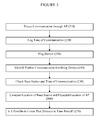
- Figure 3 is a flow diagram identifying the steps taken in an embodiment of the present invention, from a network point of view, where UE 1 moves from AP 20 to BTS 24.
- the network detects that the device is involved in a communication through access point 20.
- the time of the communication (T2) is logged and stored in a database of the mobile communication network.
- the device may then be flagged at 230 for the network to check its next communication.
- the device is engaged in a further communication.
- the network identifies the BTS 24 through which the device is communicating at 250.
- the network compares the location of the BTS 24 and the expected location of the AP 20 as stored in its register database and calculates the time between the communications (i.e. T3-T2). The network then calculates whether it is possible for the device to travel the distance between the BTS 24 and the expected location of AP 20 in the given time.
- the network engine determines that the movement between the two locations by the UE is outside the bounds of possibility, then it is likely that the AP may be being used in an unregistered location and it can take action against the access point, such as by barring its network access.
- the network operator can take different actions depending on the strength of evidence, for example different levels of warning could be given to the AP owner prior to blocking service.
- the network operator may also apply a different tariff, or a penalty fee, where movement of the AP is detected or suspected.
- the network in determining the feasibility of the UE's speed, may have access to flight or other transport timetables in order to identify whether the movement between the two locations by the UE is possible in the given time and at that time. In such embodiments, if the system detects a large geographical movement within a particular time period it could consult travel timetables for the relevant time period to determine whether it was possible to travel between the locations during that time period.
- Embodiments of the invention are required to make assumptions or calculations of the distance travelled by mobile devices between communications with different base stations and APs in order to avoid making incorrect assessments on the location of the AP.
- locations and timing of communications made before the device called through the AP can be utilised (e.g. communications through BTS 22 at time T1), rather than such communications after the occurrence of a communication through the AP.
- Such information may be found in a database of existing call detail records.
- This embodiment uses information sent by the AP in communications through it in order to identify the AP. For instance, a field may be added to the cell_ID that distinguishes APs from macro-base stations. In such embodiments, any call routed through the AP will be tagged with an identification of the AP, for example using the cell ID of the AP. Thus, call records will show that a particular call was routed through that specific AP. This embodiment of the invention can therefore also make use of calls made by AP guests that are charged at normal macro-cell network rates.
- This technique of identifying the AP may be used in addition to identifying the AP using the call detail records, or as a separate technique. Once the AP is identified, velocity checking would be performed using an approach as described above.
- This embodiment makes use of the signalling feed from mobile terminals, so that it is not necessary for a call to be made through a UE for location detection to be initiated.
- signalling from or to idle UEs can be used, such as when the UE performing a location update through an AP.
- the network can then investigate the macro base-stations through which the mobile device signalled before and/or after the AP signalling in order to identify whether the AP is in its expected location.
- the network would expect that any change in location of a device during a location update will show the device moving to a cell or tracking area adjacent to that in which the device was previously located. If the location update shows the device moving into the AP from a cell or tracking area which is a sufficient distance from the expected location of the AP, the network could conclude that the device is not in its expected location.
- this embodiment can make use of information about the movements of mobiles in and out of APs even if they do not make calls when attached to the AP.
- the engine is generally able to check the location of base stations with which a mobile device has communicated within a reasonably short time period. Further, the velocity checking system has little impact on the AP system itself, as the cell ID, location of the macro cells and registered location of the AP are compared within the core network. Overall, the embodiments are able to provide a good backup mechanism if preventative methods against movement of the AP are circumvented.
- a network may block the AP from being used. Networks could execute this AP blocking by, for example, identifying communications through the AP from the APID included in the communication and terminating or not connecting those communications.
- the movement analysis engine preferably performs its analysis in real time, but this is not always possible, so there is likely to be a time lag in detection, especially if the engine relies of call detail records from roamed to networks.
- the embodiments of the invention may be used in conjunction with preventative methods for stopping unauthorised movement of APs. As discussed above, there are important reasons for wanting to prevent movement of the AP including network planning, emergency routing and spectrum issues.
- the present invention may also be used in conjunction with additional fraud detection capabilities in order to further minimise the risk of APs being used in unauthorised locations.
- the embodiments of the invention have mainly described in relation to calls originating from an AP, however, they may equally apply to calls terminating at an AP.
- the embodiments of the invention may also be implemented separately or in combination with other embodiments.
Landscapes
- Engineering & Computer Science (AREA)
- Computer Networks & Wireless Communication (AREA)
- Signal Processing (AREA)
- Computer Security & Cryptography (AREA)
- Mobile Radio Communication Systems (AREA)
Applications Claiming Priority (1)
| Application Number | Priority Date | Filing Date | Title |
|---|---|---|---|
| GBGB0724063.3A GB0724063D0 (en) | 2007-12-10 | 2007-12-10 | Femtocell location |
Publications (3)
| Publication Number | Publication Date |
|---|---|
| EP2071888A2 true EP2071888A2 (de) | 2009-06-17 |
| EP2071888A3 EP2071888A3 (de) | 2010-11-10 |
| EP2071888B1 EP2071888B1 (de) | 2013-04-24 |
Family
ID=39016355
Family Applications (1)
| Application Number | Title | Priority Date | Filing Date |
|---|---|---|---|
| EP08171138.4A Not-in-force EP2071888B1 (de) | 2007-12-10 | 2008-12-09 | Femtozellenlokalisierung |
Country Status (4)
| Country | Link |
|---|---|
| US (1) | US8768301B2 (de) |
| EP (1) | EP2071888B1 (de) |
| ES (1) | ES2409092T3 (de) |
| GB (1) | GB0724063D0 (de) |
Cited By (5)
| Publication number | Priority date | Publication date | Assignee | Title |
|---|---|---|---|---|
| FR2966685A1 (fr) * | 2010-10-22 | 2012-04-27 | Radiotelephone Sfr | Procede de detection et d'inhibition d'un boitier femto installe hors du territoire d'un operateur |
| FR2966686A1 (fr) * | 2010-10-22 | 2012-04-27 | Radiotelephone Sfr | Procede de controle d'un boitier femto installe hors du territoire d'un operateur |
| WO2012128675A1 (en) * | 2011-03-18 | 2012-09-27 | Telefonaktiebolaget L M Ericsson (Publ) | Indicating physical change in relation to an exterior of a network node module |
| EP2824960A1 (de) * | 2013-07-09 | 2015-01-14 | Vodafone IP Licensing limited | Zellenstellen |
| EP2712261A4 (de) * | 2011-06-07 | 2015-09-16 | Ntt Docomo Inc | Basisstation und verfahren in einem mobilkommunikationssystem |
Families Citing this family (12)
| Publication number | Priority date | Publication date | Assignee | Title |
|---|---|---|---|---|
| GB2480191A (en) | 2007-02-02 | 2011-11-09 | Ubiquisys Ltd | Determining the location of a base station |
| EP2257117A1 (de) | 2009-05-28 | 2010-12-01 | Thomson Telecom Belgium | System und Verfahren zur Umleitung einer mobilen Vorrichtung |
| ES2377686B1 (es) * | 2010-05-31 | 2013-02-13 | Vodafone España, S.A.U. | Método para modificar la configuración de frecuencia de una estación base de femtocelda 3g o nodo-b doméstico (hnb). |
| US8644818B1 (en) * | 2010-10-14 | 2014-02-04 | Cisco Technology, Inc. | Radio access point device location verification based on wireless user device roaming history |
| US9729300B2 (en) * | 2011-12-06 | 2017-08-08 | Lg Electronics Inc. | Method and apparatus for controlling remote transmitting station in wireless communication system |
| JP5906763B2 (ja) * | 2012-01-27 | 2016-04-20 | 富士通株式会社 | 基地局および移動検出方法 |
| WO2014056538A1 (en) * | 2012-10-11 | 2014-04-17 | Nokia Solutions And Networks Oy | Fake base station detection with core network support |
| US9456301B2 (en) | 2012-12-11 | 2016-09-27 | Telecommunication Systems, Inc. | Efficient prisoner tracking |
| US9282433B2 (en) * | 2012-12-12 | 2016-03-08 | Qualcomm Incorporated | System and/or method of locating a portable service access transceiver |
| US9179436B1 (en) * | 2014-08-22 | 2015-11-03 | Cisco Technology, Inc. | System and method for location reporting in an untrusted network environment |
| US9271311B1 (en) | 2014-12-16 | 2016-02-23 | Motorola Solutions, Inc. | Methods and systems for automated activation and configuration of broadband incident area networks (IANs) |
| US9749810B1 (en) | 2016-02-23 | 2017-08-29 | At&T Mobility Ii Llc | User equipment assisted indoor small cell location determination |
Citations (3)
| Publication number | Priority date | Publication date | Assignee | Title |
|---|---|---|---|---|
| US6466777B1 (en) | 1998-12-15 | 2002-10-15 | Nec Corporation | Clone terminal detection system and method |
| WO2004040938A1 (en) | 2002-10-25 | 2004-05-13 | Ibis Telecom, Inc. | Internet base station |
| EP1763178A2 (de) | 2005-09-13 | 2007-03-14 | Roke Manor Research Limited | Verfahren zur Prüfung der Integrität des Zugangspunktes in einem drahtlosen Netz |
Family Cites Families (15)
| Publication number | Priority date | Publication date | Assignee | Title |
|---|---|---|---|---|
| US5734977A (en) * | 1994-11-10 | 1998-03-31 | Telefonaktiebolaget Lm Ericsson | Fraud detection in radio communications network |
| US5953652A (en) * | 1997-01-24 | 1999-09-14 | At&T Wireless Services Inc. | Detection of fraudulently registered mobile phones |
| JPH11298945A (ja) * | 1998-04-08 | 1999-10-29 | Oki Electric Ind Co Ltd | 移動体、移動体位置登録装置及び移動体通信システム |
| US7116957B2 (en) * | 2001-10-22 | 2006-10-03 | Qualcomm Incorporated | Velocity responsive filtering for pilot signal reception |
| US6898434B2 (en) * | 2001-10-30 | 2005-05-24 | Hewlett-Packard Development Company, L.P. | Apparatus and method for the automatic positioning of information access points |
| WO2003083601A2 (en) * | 2002-03-27 | 2003-10-09 | International Business Machines Corporation | Methods apparatus and program products for wireless access points |
| US20080010678A1 (en) * | 2004-09-17 | 2008-01-10 | Jeff Burdette | Authentication Proxy |
| US7543740B2 (en) * | 2004-09-17 | 2009-06-09 | Digital Envoy, Inc. | Fraud analyst smart cookie |
| US8369264B2 (en) * | 2005-10-28 | 2013-02-05 | Skyhook Wireless, Inc. | Method and system for selecting and providing a relevant subset of Wi-Fi location information to a mobile client device so the client device may estimate its position with efficient utilization of resources |
| US7236091B2 (en) * | 2005-02-10 | 2007-06-26 | Pinc Solutions | Position-tracking system |
| JPWO2006106918A1 (ja) * | 2005-03-31 | 2008-09-11 | 日本電気株式会社 | 携帯無線端末およびその移動速度検出方法 |
| US8798638B2 (en) * | 2005-07-20 | 2014-08-05 | Qualcomm Incorporated | Methods and apparatus for providing base station position information and using position information to support timing and/or frequency corrections |
| US7515578B2 (en) * | 2006-05-08 | 2009-04-07 | Skyhook Wireless, Inc. | Estimation of position using WLAN access point radio propagation characteristics in a WLAN positioning system |
| US8620342B2 (en) * | 2006-10-10 | 2013-12-31 | Broadcom Corporation | Sensing RF environment to determine geographic location of cellular base station |
| US8085715B2 (en) | 2006-10-19 | 2011-12-27 | Vodafone Group, Plc | Controlling the use of access points in a telecommunications networks |
-
2007
- 2007-12-10 GB GBGB0724063.3A patent/GB0724063D0/en not_active Ceased
-
2008
- 2008-12-09 ES ES08171138T patent/ES2409092T3/es active Active
- 2008-12-09 EP EP08171138.4A patent/EP2071888B1/de not_active Not-in-force
- 2008-12-09 US US12/316,118 patent/US8768301B2/en active Active
Patent Citations (3)
| Publication number | Priority date | Publication date | Assignee | Title |
|---|---|---|---|---|
| US6466777B1 (en) | 1998-12-15 | 2002-10-15 | Nec Corporation | Clone terminal detection system and method |
| WO2004040938A1 (en) | 2002-10-25 | 2004-05-13 | Ibis Telecom, Inc. | Internet base station |
| EP1763178A2 (de) | 2005-09-13 | 2007-03-14 | Roke Manor Research Limited | Verfahren zur Prüfung der Integrität des Zugangspunktes in einem drahtlosen Netz |
Cited By (9)
| Publication number | Priority date | Publication date | Assignee | Title |
|---|---|---|---|---|
| FR2966685A1 (fr) * | 2010-10-22 | 2012-04-27 | Radiotelephone Sfr | Procede de detection et d'inhibition d'un boitier femto installe hors du territoire d'un operateur |
| FR2966686A1 (fr) * | 2010-10-22 | 2012-04-27 | Radiotelephone Sfr | Procede de controle d'un boitier femto installe hors du territoire d'un operateur |
| EP2582190A1 (de) * | 2010-10-22 | 2013-04-17 | Société Française du Radiotéléphone-SFR | Steuerverfahren für eine FEMTO-Box, die außerhalb des Gebietes eines Bedieners installiert ist |
| WO2012128675A1 (en) * | 2011-03-18 | 2012-09-27 | Telefonaktiebolaget L M Ericsson (Publ) | Indicating physical change in relation to an exterior of a network node module |
| RU2557788C2 (ru) * | 2011-03-18 | 2015-07-27 | Телефонактиеболагет Л М Эрикссон (Пабл) | Индикация физического изменения внешней части модуля узла сети |
| US9398435B2 (en) | 2011-03-18 | 2016-07-19 | Telefonaktiebolaget Lm Ericsson (Publ) | Indicating physical change in relation to an exterior of a network node module |
| EP2712261A4 (de) * | 2011-06-07 | 2015-09-16 | Ntt Docomo Inc | Basisstation und verfahren in einem mobilkommunikationssystem |
| EP2824960A1 (de) * | 2013-07-09 | 2015-01-14 | Vodafone IP Licensing limited | Zellenstellen |
| GB2516059A (en) * | 2013-07-09 | 2015-01-14 | Vodafone Ip Licensing Ltd | Cell locations |
Also Published As
| Publication number | Publication date |
|---|---|
| GB0724063D0 (en) | 2008-01-23 |
| US8768301B2 (en) | 2014-07-01 |
| EP2071888A3 (de) | 2010-11-10 |
| ES2409092T3 (es) | 2013-06-24 |
| US20090149194A1 (en) | 2009-06-11 |
| EP2071888B1 (de) | 2013-04-24 |
Similar Documents
| Publication | Publication Date | Title |
|---|---|---|
| EP2071888B1 (de) | Femtozellenlokalisierung | |
| US9420507B2 (en) | Access control for macrocell to femtocell handover | |
| US8085715B2 (en) | Controlling the use of access points in a telecommunications networks | |
| US9877195B2 (en) | Location-based services in a femtocell network | |
| KR101258313B1 (ko) | 구별되는 네트워크 표시 | |
| US20100041364A1 (en) | Femtocell service registration, activation, and provisioning | |
| GB2430114A (en) | Verifying the integrity of an access point on a wireless network | |
| EP2227918B1 (de) | Verfahren und knot zur zugangsteuerung an einen telekommunikationnetzwerkkern | |
| CN101489214B (zh) | 一种检测用户端设备的方法、装置及系统 | |
| JP6378064B2 (ja) | オープンモードフェムトセルを実施する電気通信ネットワークにおける呼の受信者である移動ユーザー機器の精細なロケーションのための方法 | |
| EP2282585A1 (de) | Mobiles kommunikationsverfahren und vermittlungstation | |
| GB2466939A (en) | Performing a velocity check for a mobile terminal to identify unauthorised movement of a micro base station | |
| GB2450575A (en) | Controlling the use of access points in a telecommunications network | |
| KR101905581B1 (ko) | 특정 존의 진입 판별 방법 및 장치 | |
| EP2285151A1 (de) | Mobilkommunikationsverfahren und vermittlungsstation | |
| JP6382697B2 (ja) | オープンモードフェムトセルを実施する電気通信ネットワークにおけるsmsの受信者である移動ユーザー機器の精細なロケーションのための方法 | |
| KR20120066346A (ko) | 단말정보 획득 방법 |
Legal Events
| Date | Code | Title | Description |
|---|---|---|---|
| PUAI | Public reference made under article 153(3) epc to a published international application that has entered the european phase |
Free format text: ORIGINAL CODE: 0009012 |
|
| AK | Designated contracting states |
Kind code of ref document: A2 Designated state(s): AT BE BG CH CY CZ DE DK EE ES FI FR GB GR HR HU IE IS IT LI LT LU LV MC MT NL NO PL PT RO SE SI SK TR |
|
| AX | Request for extension of the european patent |
Extension state: AL BA MK RS |
|
| PUAL | Search report despatched |
Free format text: ORIGINAL CODE: 0009013 |
|
| AK | Designated contracting states |
Kind code of ref document: A3 Designated state(s): AT BE BG CH CY CZ DE DK EE ES FI FR GB GR HR HU IE IS IT LI LT LU LV MC MT NL NO PL PT RO SE SI SK TR |
|
| AX | Request for extension of the european patent |
Extension state: AL BA MK RS |
|
| RIC1 | Information provided on ipc code assigned before grant |
Ipc: H04W 64/00 20090101ALI20101007BHEP Ipc: H04W 16/32 20090101AFI20090404BHEP |
|
| 17P | Request for examination filed |
Effective date: 20110509 |
|
| AKX | Designation fees paid |
Designated state(s): AT BE BG CH CY CZ DE DK EE ES FI FR GB GR HR HU IE IS IT LI LT LU LV MC MT NL NO PL PT RO SE SI SK TR |
|
| RIC1 | Information provided on ipc code assigned before grant |
Ipc: H04W 64/00 20090101ALI20121023BHEP Ipc: H04W 16/32 20090101AFI20121023BHEP |
|
| GRAP | Despatch of communication of intention to grant a patent |
Free format text: ORIGINAL CODE: EPIDOSNIGR1 |
|
| GRAS | Grant fee paid |
Free format text: ORIGINAL CODE: EPIDOSNIGR3 |
|
| GRAA | (expected) grant |
Free format text: ORIGINAL CODE: 0009210 |
|
| AK | Designated contracting states |
Kind code of ref document: B1 Designated state(s): AT BE BG CH CY CZ DE DK EE ES FI FR GB GR HR HU IE IS IT LI LT LU LV MC MT NL NO PL PT RO SE SI SK TR |
|
| REG | Reference to a national code |
Ref country code: GB Ref legal event code: FG4D |
|
| REG | Reference to a national code |
Ref country code: CH Ref legal event code: EP |
|
| REG | Reference to a national code |
Ref country code: AT Ref legal event code: REF Ref document number: 609231 Country of ref document: AT Kind code of ref document: T Effective date: 20130515 |
|
| REG | Reference to a national code |
Ref country code: IE Ref legal event code: FG4D |
|
| REG | Reference to a national code |
Ref country code: DE Ref legal event code: R096 Ref document number: 602008024028 Country of ref document: DE Effective date: 20130620 |
|
| REG | Reference to a national code |
Ref country code: ES Ref legal event code: FG2A Ref document number: 2409092 Country of ref document: ES Kind code of ref document: T3 Effective date: 20130624 |
|
| REG | Reference to a national code |
Ref country code: AT Ref legal event code: MK05 Ref document number: 609231 Country of ref document: AT Kind code of ref document: T Effective date: 20130424 |
|
| REG | Reference to a national code |
Ref country code: LT Ref legal event code: MG4D |
|
| REG | Reference to a national code |
Ref country code: NL Ref legal event code: VDEP Effective date: 20130424 |
|
| PG25 | Lapsed in a contracting state [announced via postgrant information from national office to epo] |
Ref country code: GR Free format text: LAPSE BECAUSE OF FAILURE TO SUBMIT A TRANSLATION OF THE DESCRIPTION OR TO PAY THE FEE WITHIN THE PRESCRIBED TIME-LIMIT Effective date: 20130725 Ref country code: LT Free format text: LAPSE BECAUSE OF FAILURE TO SUBMIT A TRANSLATION OF THE DESCRIPTION OR TO PAY THE FEE WITHIN THE PRESCRIBED TIME-LIMIT Effective date: 20130424 Ref country code: FI Free format text: LAPSE BECAUSE OF FAILURE TO SUBMIT A TRANSLATION OF THE DESCRIPTION OR TO PAY THE FEE WITHIN THE PRESCRIBED TIME-LIMIT Effective date: 20130424 Ref country code: PT Free format text: LAPSE BECAUSE OF FAILURE TO SUBMIT A TRANSLATION OF THE DESCRIPTION OR TO PAY THE FEE WITHIN THE PRESCRIBED TIME-LIMIT Effective date: 20130826 Ref country code: AT Free format text: LAPSE BECAUSE OF FAILURE TO SUBMIT A TRANSLATION OF THE DESCRIPTION OR TO PAY THE FEE WITHIN THE PRESCRIBED TIME-LIMIT Effective date: 20130424 Ref country code: BE Free format text: LAPSE BECAUSE OF FAILURE TO SUBMIT A TRANSLATION OF THE DESCRIPTION OR TO PAY THE FEE WITHIN THE PRESCRIBED TIME-LIMIT Effective date: 20130424 Ref country code: IS Free format text: LAPSE BECAUSE OF FAILURE TO SUBMIT A TRANSLATION OF THE DESCRIPTION OR TO PAY THE FEE WITHIN THE PRESCRIBED TIME-LIMIT Effective date: 20130824 Ref country code: NO Free format text: LAPSE BECAUSE OF FAILURE TO SUBMIT A TRANSLATION OF THE DESCRIPTION OR TO PAY THE FEE WITHIN THE PRESCRIBED TIME-LIMIT Effective date: 20130724 Ref country code: SI Free format text: LAPSE BECAUSE OF FAILURE TO SUBMIT A TRANSLATION OF THE DESCRIPTION OR TO PAY THE FEE WITHIN THE PRESCRIBED TIME-LIMIT Effective date: 20130424 Ref country code: SE Free format text: LAPSE BECAUSE OF FAILURE TO SUBMIT A TRANSLATION OF THE DESCRIPTION OR TO PAY THE FEE WITHIN THE PRESCRIBED TIME-LIMIT Effective date: 20130424 |
|
| PG25 | Lapsed in a contracting state [announced via postgrant information from national office to epo] |
Ref country code: LV Free format text: LAPSE BECAUSE OF FAILURE TO SUBMIT A TRANSLATION OF THE DESCRIPTION OR TO PAY THE FEE WITHIN THE PRESCRIBED TIME-LIMIT Effective date: 20130424 Ref country code: PL Free format text: LAPSE BECAUSE OF FAILURE TO SUBMIT A TRANSLATION OF THE DESCRIPTION OR TO PAY THE FEE WITHIN THE PRESCRIBED TIME-LIMIT Effective date: 20130424 Ref country code: HR Free format text: LAPSE BECAUSE OF FAILURE TO SUBMIT A TRANSLATION OF THE DESCRIPTION OR TO PAY THE FEE WITHIN THE PRESCRIBED TIME-LIMIT Effective date: 20130424 Ref country code: BG Free format text: LAPSE BECAUSE OF FAILURE TO SUBMIT A TRANSLATION OF THE DESCRIPTION OR TO PAY THE FEE WITHIN THE PRESCRIBED TIME-LIMIT Effective date: 20130724 Ref country code: CY Free format text: LAPSE BECAUSE OF FAILURE TO SUBMIT A TRANSLATION OF THE DESCRIPTION OR TO PAY THE FEE WITHIN THE PRESCRIBED TIME-LIMIT Effective date: 20130424 |
|
| PG25 | Lapsed in a contracting state [announced via postgrant information from national office to epo] |
Ref country code: DK Free format text: LAPSE BECAUSE OF FAILURE TO SUBMIT A TRANSLATION OF THE DESCRIPTION OR TO PAY THE FEE WITHIN THE PRESCRIBED TIME-LIMIT Effective date: 20130424 Ref country code: SK Free format text: LAPSE BECAUSE OF FAILURE TO SUBMIT A TRANSLATION OF THE DESCRIPTION OR TO PAY THE FEE WITHIN THE PRESCRIBED TIME-LIMIT Effective date: 20130424 Ref country code: CZ Free format text: LAPSE BECAUSE OF FAILURE TO SUBMIT A TRANSLATION OF THE DESCRIPTION OR TO PAY THE FEE WITHIN THE PRESCRIBED TIME-LIMIT Effective date: 20130424 Ref country code: EE Free format text: LAPSE BECAUSE OF FAILURE TO SUBMIT A TRANSLATION OF THE DESCRIPTION OR TO PAY THE FEE WITHIN THE PRESCRIBED TIME-LIMIT Effective date: 20130424 |
|
| PG25 | Lapsed in a contracting state [announced via postgrant information from national office to epo] |
Ref country code: RO Free format text: LAPSE BECAUSE OF FAILURE TO SUBMIT A TRANSLATION OF THE DESCRIPTION OR TO PAY THE FEE WITHIN THE PRESCRIBED TIME-LIMIT Effective date: 20130424 Ref country code: NL Free format text: LAPSE BECAUSE OF FAILURE TO SUBMIT A TRANSLATION OF THE DESCRIPTION OR TO PAY THE FEE WITHIN THE PRESCRIBED TIME-LIMIT Effective date: 20130424 |
|
| PLBE | No opposition filed within time limit |
Free format text: ORIGINAL CODE: 0009261 |
|
| STAA | Information on the status of an ep patent application or granted ep patent |
Free format text: STATUS: NO OPPOSITION FILED WITHIN TIME LIMIT |
|
| 26N | No opposition filed |
Effective date: 20140127 |
|
| REG | Reference to a national code |
Ref country code: DE Ref legal event code: R097 Ref document number: 602008024028 Country of ref document: DE Effective date: 20140127 |
|
| REG | Reference to a national code |
Ref country code: CH Ref legal event code: PL |
|
| PG25 | Lapsed in a contracting state [announced via postgrant information from national office to epo] |
Ref country code: LU Free format text: LAPSE BECAUSE OF FAILURE TO SUBMIT A TRANSLATION OF THE DESCRIPTION OR TO PAY THE FEE WITHIN THE PRESCRIBED TIME-LIMIT Effective date: 20131209 Ref country code: MC Free format text: LAPSE BECAUSE OF FAILURE TO SUBMIT A TRANSLATION OF THE DESCRIPTION OR TO PAY THE FEE WITHIN THE PRESCRIBED TIME-LIMIT Effective date: 20130424 |
|
| REG | Reference to a national code |
Ref country code: IE Ref legal event code: MM4A |
|
| PG25 | Lapsed in a contracting state [announced via postgrant information from national office to epo] |
Ref country code: LI Free format text: LAPSE BECAUSE OF NON-PAYMENT OF DUE FEES Effective date: 20131231 Ref country code: CH Free format text: LAPSE BECAUSE OF NON-PAYMENT OF DUE FEES Effective date: 20131231 Ref country code: IE Free format text: LAPSE BECAUSE OF NON-PAYMENT OF DUE FEES Effective date: 20131209 |
|
| PG25 | Lapsed in a contracting state [announced via postgrant information from national office to epo] |
Ref country code: TR Free format text: LAPSE BECAUSE OF FAILURE TO SUBMIT A TRANSLATION OF THE DESCRIPTION OR TO PAY THE FEE WITHIN THE PRESCRIBED TIME-LIMIT Effective date: 20130424 |
|
| PG25 | Lapsed in a contracting state [announced via postgrant information from national office to epo] |
Ref country code: HU Free format text: LAPSE BECAUSE OF FAILURE TO SUBMIT A TRANSLATION OF THE DESCRIPTION OR TO PAY THE FEE WITHIN THE PRESCRIBED TIME-LIMIT; INVALID AB INITIO Effective date: 20081209 |
|
| PG25 | Lapsed in a contracting state [announced via postgrant information from national office to epo] |
Ref country code: MT Free format text: LAPSE BECAUSE OF FAILURE TO SUBMIT A TRANSLATION OF THE DESCRIPTION OR TO PAY THE FEE WITHIN THE PRESCRIBED TIME-LIMIT Effective date: 20130424 |
|
| REG | Reference to a national code |
Ref country code: FR Ref legal event code: PLFP Year of fee payment: 8 |
|
| PGFP | Annual fee paid to national office [announced via postgrant information from national office to epo] |
Ref country code: ES Payment date: 20151214 Year of fee payment: 8 |
|
| PGFP | Annual fee paid to national office [announced via postgrant information from national office to epo] |
Ref country code: IT Payment date: 20151228 Year of fee payment: 8 |
|
| REG | Reference to a national code |
Ref country code: FR Ref legal event code: PLFP Year of fee payment: 9 |
|
| PG25 | Lapsed in a contracting state [announced via postgrant information from national office to epo] |
Ref country code: IT Free format text: LAPSE BECAUSE OF NON-PAYMENT OF DUE FEES Effective date: 20161209 |
|
| REG | Reference to a national code |
Ref country code: FR Ref legal event code: PLFP Year of fee payment: 10 |
|
| PG25 | Lapsed in a contracting state [announced via postgrant information from national office to epo] |
Ref country code: ES Free format text: LAPSE BECAUSE OF NON-PAYMENT OF DUE FEES Effective date: 20161210 |
|
| REG | Reference to a national code |
Ref country code: ES Ref legal event code: FD2A Effective date: 20180627 |
|
| PGFP | Annual fee paid to national office [announced via postgrant information from national office to epo] |
Ref country code: GB Payment date: 20231220 Year of fee payment: 16 |
|
| PGFP | Annual fee paid to national office [announced via postgrant information from national office to epo] |
Ref country code: FR Payment date: 20231221 Year of fee payment: 16 Ref country code: DE Payment date: 20231214 Year of fee payment: 16 |
|
| REG | Reference to a national code |
Ref country code: DE Ref legal event code: R119 Ref document number: 602008024028 Country of ref document: DE |
|
| GBPC | Gb: european patent ceased through non-payment of renewal fee |
Effective date: 20241209 |
|
| PG25 | Lapsed in a contracting state [announced via postgrant information from national office to epo] |
Ref country code: DE Free format text: LAPSE BECAUSE OF NON-PAYMENT OF DUE FEES Effective date: 20250701 |
|
| PG25 | Lapsed in a contracting state [announced via postgrant information from national office to epo] |
Ref country code: GB Free format text: LAPSE BECAUSE OF NON-PAYMENT OF DUE FEES Effective date: 20241209 |
|
| PG25 | Lapsed in a contracting state [announced via postgrant information from national office to epo] |
Ref country code: FR Free format text: LAPSE BECAUSE OF NON-PAYMENT OF DUE FEES Effective date: 20241231 |