EP2072149A2 - Procédé et dispositif de fabrication de gaz de processus pour la séparation en phase vapeur - Google Patents
Procédé et dispositif de fabrication de gaz de processus pour la séparation en phase vapeur Download PDFInfo
- Publication number
- EP2072149A2 EP2072149A2 EP08022113A EP08022113A EP2072149A2 EP 2072149 A2 EP2072149 A2 EP 2072149A2 EP 08022113 A EP08022113 A EP 08022113A EP 08022113 A EP08022113 A EP 08022113A EP 2072149 A2 EP2072149 A2 EP 2072149A2
- Authority
- EP
- European Patent Office
- Prior art keywords
- process gas
- gas component
- reactor
- evaporator
- liquid
- Prior art date
- Legal status (The legal status is an assumption and is not a legal conclusion. Google has not performed a legal analysis and makes no representation as to the accuracy of the status listed.)
- Granted
Links
Images


Classifications
-
- C—CHEMISTRY; METALLURGY
- C23—COATING METALLIC MATERIAL; COATING MATERIAL WITH METALLIC MATERIAL; CHEMICAL SURFACE TREATMENT; DIFFUSION TREATMENT OF METALLIC MATERIAL; COATING BY VACUUM EVAPORATION, BY SPUTTERING, BY ION IMPLANTATION OR BY CHEMICAL VAPOUR DEPOSITION, IN GENERAL; INHIBITING CORROSION OF METALLIC MATERIAL OR INCRUSTATION IN GENERAL
- C23C—COATING METALLIC MATERIAL; COATING MATERIAL WITH METALLIC MATERIAL; SURFACE TREATMENT OF METALLIC MATERIAL BY DIFFUSION INTO THE SURFACE, BY CHEMICAL CONVERSION OR SUBSTITUTION; COATING BY VACUUM EVAPORATION, BY SPUTTERING, BY ION IMPLANTATION OR BY CHEMICAL VAPOUR DEPOSITION, IN GENERAL
- C23C16/00—Chemical coating by decomposition of gaseous compounds, without leaving reaction products of surface material in the coating, i.e. chemical vapour deposition [CVD] processes
- C23C16/44—Chemical coating by decomposition of gaseous compounds, without leaving reaction products of surface material in the coating, i.e. chemical vapour deposition [CVD] processes characterised by the method of coating
- C23C16/52—Controlling or regulating the coating process
-
- B—PERFORMING OPERATIONS; TRANSPORTING
- B05—SPRAYING OR ATOMISING IN GENERAL; APPLYING FLUENT MATERIALS TO SURFACES, IN GENERAL
- B05D—PROCESSES FOR APPLYING FLUENT MATERIALS TO SURFACES, IN GENERAL
- B05D1/00—Processes for applying liquids or other fluent materials
- B05D1/60—Deposition of organic layers from vapour phase
-
- B—PERFORMING OPERATIONS; TRANSPORTING
- B05—SPRAYING OR ATOMISING IN GENERAL; APPLYING FLUENT MATERIALS TO SURFACES, IN GENERAL
- B05D—PROCESSES FOR APPLYING FLUENT MATERIALS TO SURFACES, IN GENERAL
- B05D7/00—Processes, other than flocking, specially adapted for applying liquids or other fluent materials to particular surfaces or for applying particular liquids or other fluent materials
- B05D7/22—Processes, other than flocking, specially adapted for applying liquids or other fluent materials to particular surfaces or for applying particular liquids or other fluent materials to internal surfaces, e.g. of tubes
-
- C—CHEMISTRY; METALLURGY
- C23—COATING METALLIC MATERIAL; COATING MATERIAL WITH METALLIC MATERIAL; CHEMICAL SURFACE TREATMENT; DIFFUSION TREATMENT OF METALLIC MATERIAL; COATING BY VACUUM EVAPORATION, BY SPUTTERING, BY ION IMPLANTATION OR BY CHEMICAL VAPOUR DEPOSITION, IN GENERAL; INHIBITING CORROSION OF METALLIC MATERIAL OR INCRUSTATION IN GENERAL
- C23C—COATING METALLIC MATERIAL; COATING MATERIAL WITH METALLIC MATERIAL; SURFACE TREATMENT OF METALLIC MATERIAL BY DIFFUSION INTO THE SURFACE, BY CHEMICAL CONVERSION OR SUBSTITUTION; COATING BY VACUUM EVAPORATION, BY SPUTTERING, BY ION IMPLANTATION OR BY CHEMICAL VAPOUR DEPOSITION, IN GENERAL
- C23C16/00—Chemical coating by decomposition of gaseous compounds, without leaving reaction products of surface material in the coating, i.e. chemical vapour deposition [CVD] processes
- C23C16/04—Coating on selected surface areas, e.g. using masks
- C23C16/045—Coating cavities or hollow spaces, e.g. interior of tubes; Infiltration of porous substrates
-
- C—CHEMISTRY; METALLURGY
- C23—COATING METALLIC MATERIAL; COATING MATERIAL WITH METALLIC MATERIAL; CHEMICAL SURFACE TREATMENT; DIFFUSION TREATMENT OF METALLIC MATERIAL; COATING BY VACUUM EVAPORATION, BY SPUTTERING, BY ION IMPLANTATION OR BY CHEMICAL VAPOUR DEPOSITION, IN GENERAL; INHIBITING CORROSION OF METALLIC MATERIAL OR INCRUSTATION IN GENERAL
- C23C—COATING METALLIC MATERIAL; COATING MATERIAL WITH METALLIC MATERIAL; SURFACE TREATMENT OF METALLIC MATERIAL BY DIFFUSION INTO THE SURFACE, BY CHEMICAL CONVERSION OR SUBSTITUTION; COATING BY VACUUM EVAPORATION, BY SPUTTERING, BY ION IMPLANTATION OR BY CHEMICAL VAPOUR DEPOSITION, IN GENERAL
- C23C16/00—Chemical coating by decomposition of gaseous compounds, without leaving reaction products of surface material in the coating, i.e. chemical vapour deposition [CVD] processes
- C23C16/44—Chemical coating by decomposition of gaseous compounds, without leaving reaction products of surface material in the coating, i.e. chemical vapour deposition [CVD] processes characterised by the method of coating
- C23C16/448—Chemical coating by decomposition of gaseous compounds, without leaving reaction products of surface material in the coating, i.e. chemical vapour deposition [CVD] processes characterised by the method of coating characterised by the method used for generating reactive gas streams, e.g. by evaporation or sublimation of precursor materials
-
- G—PHYSICS
- G01—MEASURING; TESTING
- G01F—MEASURING VOLUME, VOLUME FLOW, MASS FLOW OR LIQUID LEVEL; METERING BY VOLUME
- G01F1/00—Measuring the volume flow or mass flow of fluid or fluent solid material wherein the fluid passes through a meter in a continuous flow
- G01F1/68—Measuring the volume flow or mass flow of fluid or fluent solid material wherein the fluid passes through a meter in a continuous flow by using thermal effects
- G01F1/684—Structural arrangements; Mounting of elements, e.g. in relation to fluid flow
-
- G—PHYSICS
- G01—MEASURING; TESTING
- G01F—MEASURING VOLUME, VOLUME FLOW, MASS FLOW OR LIQUID LEVEL; METERING BY VOLUME
- G01F13/00—Apparatus for measuring by volume and delivering fluids or fluent solid materials, not provided for in the preceding groups
-
- G—PHYSICS
- G05—CONTROLLING; REGULATING
- G05D—SYSTEMS FOR CONTROLLING OR REGULATING NON-ELECTRIC VARIABLES
- G05D7/00—Control of flow
- G05D7/06—Control of flow characterised by the use of electric means
- G05D7/0617—Control of flow characterised by the use of electric means specially adapted for fluid materials
- G05D7/0629—Control of flow characterised by the use of electric means specially adapted for fluid materials characterised by the type of regulator means
- G05D7/0635—Control of flow characterised by the use of electric means specially adapted for fluid materials characterised by the type of regulator means by action on throttling means
-
- B—PERFORMING OPERATIONS; TRANSPORTING
- B05—SPRAYING OR ATOMISING IN GENERAL; APPLYING FLUENT MATERIALS TO SURFACES, IN GENERAL
- B05D—PROCESSES FOR APPLYING FLUENT MATERIALS TO SURFACES, IN GENERAL
- B05D1/00—Processes for applying liquids or other fluent materials
- B05D1/62—Plasma-deposition of organic layers
-
- B—PERFORMING OPERATIONS; TRANSPORTING
- B05—SPRAYING OR ATOMISING IN GENERAL; APPLYING FLUENT MATERIALS TO SURFACES, IN GENERAL
- B05D—PROCESSES FOR APPLYING FLUENT MATERIALS TO SURFACES, IN GENERAL
- B05D2203/00—Other substrates
- B05D2203/30—Other inorganic substrates, e.g. ceramics, silicon
- B05D2203/35—Glass
Definitions
- the invention generally relates to the deposition of functional layers on substrates.
- the invention relates to the chemical vapor deposition and the dosage of the substances used for vapor deposition.
- the solvent composition is used for the liquid supply of organometallic precursor substances for the chemical vapor deposition, for example, to deposit so-called SBT layers (SrBi 2 Ta 2 O 9 layers) for data storage.
- SBT layers Si 2 Ta 2 O 9 layers
- flash evaporation is used. In this method, a partial evaporation by a Druckreztician.
- the DE 199 60 333 A1 describes an apparatus for producing a gas mixture of HMDSO (hexamethyldisiloxane) and oxygen as a process gas for plasma coating.
- HMDSO hexamethyldisiloxane
- oxygen a process gas for plasma coating.
- several filling packages are arranged one above the other in an elongated, vertically arranged, coolable column.
- an inlet pipe introduced from the outside into the column and a gas outlet connection are arranged.
- Another previously used system for the evaporation of precursors is a so-called bubbler.
- the carrier gas is injected into the liquid precursor.
- the precursor evaporates into the gas bubbles and is transported on with the carrier gas.
- bubblers are difficult to set production-stable with regard to the precursor flow, since pressure, temperature, and precursor gas flow simultaneously have a great influence on the evaporation rate. For example, only a small change in the size of the bubbles due to the associated change in the available evaporation surface already have a large influence on the precursor concentration. This is also the case with the other evaporators known from the prior art. So hangs in a column, like the DE 199 60 333 A1 suggests that the precursor content of the process gas sensitive to the temperature of the column. Also, the pressure prevailing in the column flows here as well as in the flash evaporation.
- the invention is therefore based on the object to provide a more controllable dosage of precursor substances for chemical vapor deposition, which is less prone to fluctuations in process parameters.
- the achievement of this object is set out in the independent claims.
- Advantageous embodiments and modifications of the invention are the subject of the dependent claims.
- the invention provides a method for producing layers on workpieces, in which at least one component for producing the layer, in particular a layer-forming component is metered, wherein this component is in a liquid phase during the metering and at least partially in a subsequent process step is transferred to another state of aggregation.
- the layer is produced from the component in the other physical state.
- states of aggregation in particular the gas phase and a plasma come into consideration.
- the invention is particularly suitable for various chemical vapor deposition (CV) method.
- CV chemical vapor deposition
- atmospheric pressure CVD methods such as thermal CVD under atmospheric pressure or atmospheric pressure plasma deposition may also be used.
- Further methods are flame pyrolysis or so-called “Combustion CVD” (CCVD, combustion CVD),
- the energy source can be advantageously controlled by means of a control device or a further control or regulating device.
- a source of electromagnetic fields is also understood to mean a source of electrostatic fields. This can be used for example for Schichabscheidung means of a plasma glow discharge.
- the invention can also be used for other types of chemical vapor deposition, generally for CVD.
- CVD chemical vapor deposition
- the source of electromagnetic fields can be omitted.
- thermal CVD is mentioned here.
- a fluid delivery device such as a pump or a pressurized reservoir may be provided.
- a gas can be introduced into the reservoir, so that the reservoir is under positive pressure relative to the evaporator. This is the case, for example, even if a vacuum is generated or maintained in the evaporator. In this case, a sufficient negative pressure is presupposed, the first process gas component is conveyed into the evaporator even if the reservoir is kept under normal pressure.
- Another possibility is to take advantage of the hydrostatic pressure generated due to the gravity and the arrangement of the reservoir relative to the evaporator. For this purpose, the liquid level in the reservoir above the entry point of the line is arranged in the evaporator.
- a liquid metering system for a controlled metering of organic and / or organometallic precursor substances is accordingly provided.
- liquid metering according to the invention makes possible a very exact, reproducible control of the mass flow and concomitantly also the properties of the deposited layers.
- a liquid can be dosed worse before evaporation, since the evaporation is accompanied by a strong volume increase.
- the dosage of the liquid therefore requires much smaller absolute errors with comparable accuracy.
- the method according to the invention represents a very simple way of plasma coating or the preparation of the precursor gases used. Due to its simple structure, the system according to the invention is also less expensive than, for example, systems with bubblers as gas generators.
- the liquid first process gas component is sprayed with a nozzle in the evaporator.
- the evaporation rate of the liquid process gas component in the evaporator can be set higher than the inflow of the liquid process gas component. This avoids that larger amounts of liquid material accumulates in the evaporator. The evaporator is thus operated in a difference to a bubbler in a sense "dry".
- the first process gas component with at least one second process gas component becomes a Mixed process gas mixture.
- Inert gases in particular noble gases, are particularly suitable. Among other things, such gases facilitate the ignition of the plasma and allow the plasma to be maintained at lower precursor concentrations.
- nitrogen can also be used as the inert gas.
- a reactive gas such as oxygen, ozone, hydrogen, ammonia or a hydrocarbon can be used.
- the mixture of the first and the second process gas component takes place in the evaporator.
- a supply line to the evaporator is provided for a second process gas component held in a reservoir in order to mix the first and the second process gas component in the evaporator to form a process gas mixture.
- the mixture already in the evaporator proves to be favorable for the prevention or reduction of fluctuations in the mass flow of the vaporized precursor, which can be caused by individual vaporizing drops.
- the instantaneous flow is determined by means of a suitable device.
- the flow then enters as size into the control process controlled by the control device.
- the flow of the liquid process gas component is measured in the supply line to the evaporator with a mass flow sensor. This is arranged in the supply line of the liquid first process gas component to the evaporator and connected to the control device.
- the liquid metered component must not be pure according to a further development of the invention. Rather, it is also thought to meter a mixture of at least two components liquid. In the evaporation of a mixture with a bubbler, the concentration of the components depends on the vapor pressure. In contrast, by means of the invention due to the rapid and complete evaporation of the components in the evaporator in a mixture, the quantitative ratio practically not dependent on the vapor pressure, unless accumulate large amounts of liquid in the evaporator.
- a suitable measuring principle is the measurement of mass flow based on the heat transfer through the liquid.
- Sensors of this type are for example from DE 2350848 A known.
- the temperature difference can be determined between two measurement points along the flow direction of the liquid first process gas component.
- two temperature sensors spaced along the flow direction of the liquid first process gas component are provided, with which a temperature difference is determined.
- the larger the temperature difference the higher the mass flow.
- a temperature change means is provided to generate a temperature gradient in the flowing liquid.
- the liquid can flow past a heating element for this purpose.
- the heater may also heat one or both of the temperature sensors themselves.
- a current-carrying resistance or thermocouple can be used as a temperature sensor, with which simultaneously measured the temperature and the liquid is heated.
- the pressure in the reactor during the coating is regulated according to a preferred embodiment of the invention by means of a throttle in the discharge from the reactor to the pump, which communicates with the control device, or connected to the control device and can be controlled by the control device. Accordingly, the control device is designed to control the pressure in the reactor by means of the throttle.
- a regulation of the amount of process gas present in the reactor can then take place by regulating the pressure on the one hand and controlling the mass flow through the liquid metering according to the invention on the other hand.
- a controlled throttling of the process gas quantity between the reactor and the evaporator is then not required.
- first process gas components can be vaporized and fed to the reactor, which at room temperature has a vapor pressure of less than 200 mbar, preferably less than 80 mbar, particularly preferably less than 10 mbar. This also applies to those components which have a vapor pressure of less than 10000 mbar, preferably less than 1300 mbar, particularly preferably less than 50 mbar, at a temperature of 130 ° C.
- the invention represents a very efficient method for achieving high mass flows even with precursors which have a low vapor pressure or a high boiling point.
- the storage of the precursor at room temperature leads to lower production costs and unwanted changes in the precursor are avoided, which can arise due to a longer heating.
- the liquid reservoir can even be cooled. Both allow the use of metastable substances as precursors, which is not permanently stable at the evaporation temperature in the evaporator or at a temperature of 130 ° C.
- precursors can be used and precisely metered, which both have a low vapor pressure, and are metastable. With a bubbler, this would not be possible because the precursor is kept in the liquid reservoir of the evaporator for a longer time at the evaporation temperature.
- non-cyclic polyethers such as mono-, di-, tri, tetra, penta or hexaethylene glycol dimethyl ether can be used as the first process gas component.
- An example is the liquid metering of tetraethylene glycol dimethyl ether ("tetraglyme”) Precursor, or first process gas component or component of the process gas component. This substance has a relatively low vapor pressure.
- a liquid metering device according to the invention has been used which uses a mass flow sensor, a metering valve controlled by an electronic control device, an inert carrier gas and an evaporator in order to convert the precursor into the gas phase.
- Proteins often tend to denature on glass surfaces, which can be avoided or at least significantly slowed down with a protein-repellent coating, such as a PEG coating which can be prepared according to the invention.
- a protein-repellent coating such as a PEG coating which can be prepared according to the invention.
- sensitive protein-based drugs such as vaccines can be stored better.
- Such products may be tubes, pharmaceutical syringes or associated elastomer components, cartridges or vials.
- products for diagnostic applications among other things thought of microarrays.
- process gas components can be handled more easily because of the ability to maintain the reservoir at low temperature.
- the invention can be used for substrates of glass, glass ceramic, polymers and elastomers, for example for the coating of glass tubes or pharmaceutical packaging.
- Examples of pharmaceutical packaging include vials, cartridges, syringe bodies, rubber stoppers or elastomer-coated sealing surfaces.
- the invention is also suitable for the coating of metallic surfaces, such as cannulas. Coated articles may then exhibit, as advantageous properties, reduced friction and improved barrier effect.
- optical functions can be realized, such as optical filter coatings, reflective coatings and antireflective coatings, and transparent barrier layers on lighting elements.
- Fig. 1 the construction of a device 1 for plasma-assisted CVD coating of workpieces is shown.
- the basic principle of this device is based on depositing a layer on a workpiece by metering at least one component to make the layer, this component being in a liquid phase during dispensing and at least partially in another in a subsequent process step Physical state is transferred.
- the device 1 comprises as central components a reactor 20 and a gas generator 4 with an evaporator 2.
- the gas generator 4 further comprises a liquid reservoir 3 with a liquid first process gas component.
- a fluid delivery device 5 promotes the liquid first process gas component through a supply line 9 to a nozzle 11 in the evaporator 2.
- a fluid conveying device for example, a pressurization of the reservoir 3 are used.
- the liquid first process gas component is sprayed to achieve rapid evaporation by forming small drops.
- an inert gas is passed as a second process gas component from a container 13 into the evaporator 2, where it is mixed with the evaporated first process gas component and thus the process gas used for layer deposition is produced.
- a reactive gas can also be supplied.
- a workpiece 30 is arranged in the interior 200 of the reactor 20, a workpiece 30 is arranged.
- the workpiece 30, here by way of example a syringe body, is hollow-body-shaped and should be coated on the inside.
- the interior 31 of the workpiece 30 is connected to a discharge line 22 to a pump 26 and evacuated. If the wall of the workpiece 30 is sufficiently strong, the environment of the workpiece can also remain at normal pressure. Otherwise, the environment is evacuated so far that the pressure difference is adapted to the mechanical load capacity of the workpiece and, if no plasma is to be ignited outside, the pressure for ignition of the plasma is either too small or too large.
- the process gas with the first and second process gas components produced in the evaporator 2 is supplied to the evacuated region of the reactor 20, that is to say to the interior 31 of the workpiece 30.
- An energy source for example a microwave source 21 generates an electromagnetic field, which is irradiated into the interior 200 of the reactor.
- a plasma is ignited in the evacuated region of the reactor filled with the process gas, a coating being deposited on the workpiece 30 with the reaction products of the first process gas component forming in the plasma.
- the inner space 31 accordingly forms a reactive zone 32, in which reaction products are generated, which precipitate as a coating on the workpiece.
- a medium frequency or radio frequency source may be used to generate the plasma.
- the coating process is controlled by a controller 40 by controlling the mass flow of the first process gas component into the reactor by means of a control of the flow of the liquid process gas component into the evaporator.
- Typical mass flows are in the range from 0.0005 to 2000 g / h, preferably in the range from 0.05 g / h to 50 g / h, more preferably in the range from 0.1 g / h to 20 g / h.
- typical ranges are between 5nl / min to 1000 ⁇ l / min, preferably between 10nl / min to 100 ⁇ l / min, more preferably between 20nl / min to 10 ⁇ l / min.
- a regulation of the pressure in the coating area takes place via a throttle 24 controlled by the control device 40 in the discharge line 22 to the pump 26.
- valve 19 in the supply line 17 from the evaporator 2 to the reactor 20, that also, as in the example shown, can be controlled by the control device 40. This can precede the removal and insertion of the workpieces 30 and the coating Evacuating the evaporator be shut off.
- a regulation of the mass flow of the first process gas component or of the process gas produced in the evaporator is preferably not carried out here.
- the valve 19 can therefore be easily designed as a switching valve.
- the flow is measured by means of a mass flow sensor 7 in the supply line 9 and the measured values are transmitted to the control device 40.
- the mass flow sensor 7 comprises two temperature sensors 71, 72, which are arranged along the direction of flow in the supply line 9 and with which a temperature gradient is measured.
- a heating source is provided to supply heat locally to produce a temperature gradient along the flow direction.
- the temperature sensors 71, 72 may be designed as current-heated resistance elements.
- the desired value is set by controlling the fluid delivery device 5.
- a control valve may be provided for this purpose. This is useful, for example, when the liquid first process gas component is conveyed by pressurizing the reservoir 3 into the evaporator 2.
- the energy source in the example shown so the microwave source 21 is controlled by the control device to control, among other things, the start and end times of the deposition process.
- Fig. 2 and Fig. 3 show properties of pharmaceutical glass vials coated with protein repellent coatings by the method of the invention.
- the coatings were deposited by CVD deposition with tetraethylene glycol dimethyl ether as the process gas component, wherein the liquid metering according to the invention was used.
- the precursor was stored in the reservoir at room temperature.
- the deposition was by plasma polymerization in a pulsed plasma.
- Fig. 2 shows in a diagram measured values of fibrinogen adsorption on protein-repellent polyethylene glycol coatings, as well as a reference value on an uncoated vial.
- the coatings were deposited with different pulse energies ranging between 0.7 and 8.8 joules.
- Fig. 3 shows the contact angle for water on the coated vials.
- a pulsed plasma is used to protein-repellent polyethylene glycol coatings or polyethylene glycol-like Coatings or layers with tetraethylene glycol dimethyl ether as a process gas component, wherein a low pulse energy is used, wherein the pulse energy does not exceed 3 joules.
- Pulsed plasmas are generally preferred without limitation to the above examples.
- the liquid precursor tetraethylene glycol dimethyl ether is stored at room temperature in a sealed container and pressurized by an inert gas.
- any gas is suitable as an inert gas, which does not react or not to a significant extent in the reservoir with the liquid first process gas component.
- the precursor flows into the liquid metering system, the flow being measured with a thermal mass flow sensor with thermocouples as temperature sensors. With a subsequent control valve, the setpoint of the mass flow is set. The precursor remains liquid during this dosing process.
- Argon gas is fed into the evaporator and serves as a carrier gas. The argon gas together with the precursor then forms the process gas used in the deposition.
- Two glass vials of 10 milliliters total volume are placed in a dual chamber reactor and simultaneously evacuated to a base pressure of less than 0.1 mbar.
- the mass flow of the tetraethylene glycol dimethyl ether is adjusted to 0.95 grams / hour by the control valve.
- For the carrier gas a parallel flow of 1.6sccm adjusted so that after evaporation, a precursor concentration of 52 percent by volume in the process gas is present.
- the vials are heated to a process temperature of 120 ° C using an argon plasma.
- the plasma is maintained with a pulsed microwave source with a microwave frequency of 2.45 GHz and an average power of 250 watts per vial.
- An argon mass flow of 50 sccm per vial and a process pressure of 0.2 mbar are set.
- the process gas is introduced from the evaporator into the reactor or into the vials arranged therein, a process gas pressure of 0.2 mbar being set.
- the power of the microwave source at the same frequency of 2.45 GHz is divided into the two chambers of the reactor and it is ignited a plasma in the process gas in the two vials.
- coatings were made with a thickness of about 50 nanometers on the inside of the vials.
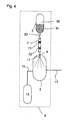
- Fig. 4 shows an embodiment of a gas generator 4, as it instead of the in Fig. 1 shown gas generator can be used.
- no fluid delivery device 5 is provided. Instead, the reservoir 3 is pressurized by an inert gas 35 is introduced into the reservoir until there is a certain overpressure in the container. The liquid first process gas component 34 then flows due to the overpressure through the line 9 to the nozzle 11. The regulation of the mass flow happens here via a control valve 33 which is connected to the control device 40 and is controlled by the control device 40.
Landscapes
- Chemical & Material Sciences (AREA)
- Engineering & Computer Science (AREA)
- Chemical Kinetics & Catalysis (AREA)
- Organic Chemistry (AREA)
- General Physics & Mathematics (AREA)
- Physics & Mathematics (AREA)
- Metallurgy (AREA)
- General Chemical & Material Sciences (AREA)
- Mechanical Engineering (AREA)
- Materials Engineering (AREA)
- Fluid Mechanics (AREA)
- Life Sciences & Earth Sciences (AREA)
- Wood Science & Technology (AREA)
- Automation & Control Theory (AREA)
- Chemical Vapour Deposition (AREA)
- Physical Or Chemical Processes And Apparatus (AREA)
- Physical Vapour Deposition (AREA)
Priority Applications (1)
| Application Number | Priority Date | Filing Date | Title |
|---|---|---|---|
| EP12002507A EP2474370A1 (fr) | 2007-12-21 | 2008-12-19 | Procédé et dispositif de fabrication de gaz de processus pour dépôt en phase vapeur |
Applications Claiming Priority (1)
| Application Number | Priority Date | Filing Date | Title |
|---|---|---|---|
| DE102007062977.1A DE102007062977B4 (de) | 2007-12-21 | 2007-12-21 | Verfahren zur Herstellung von Prozessgasen für die Dampfphasenabscheidung |
Publications (3)
| Publication Number | Publication Date |
|---|---|
| EP2072149A2 true EP2072149A2 (fr) | 2009-06-24 |
| EP2072149A3 EP2072149A3 (fr) | 2009-09-02 |
| EP2072149B1 EP2072149B1 (fr) | 2013-11-20 |
Family
ID=40433641
Family Applications (2)
| Application Number | Title | Priority Date | Filing Date |
|---|---|---|---|
| EP12002507A Withdrawn EP2474370A1 (fr) | 2007-12-21 | 2008-12-19 | Procédé et dispositif de fabrication de gaz de processus pour dépôt en phase vapeur |
| EP08022113.8A Active EP2072149B1 (fr) | 2007-12-21 | 2008-12-19 | Procédé fabrication de gaz de processus pour le dépôt en phase vapeur |
Family Applications Before (1)
| Application Number | Title | Priority Date | Filing Date |
|---|---|---|---|
| EP12002507A Withdrawn EP2474370A1 (fr) | 2007-12-21 | 2008-12-19 | Procédé et dispositif de fabrication de gaz de processus pour dépôt en phase vapeur |
Country Status (5)
| Country | Link |
|---|---|
| US (1) | US20090162571A1 (fr) |
| EP (2) | EP2474370A1 (fr) |
| JP (1) | JP2009167527A (fr) |
| CN (1) | CN101514448B (fr) |
| DE (1) | DE102007062977B4 (fr) |
Cited By (1)
| Publication number | Priority date | Publication date | Assignee | Title |
|---|---|---|---|---|
| US20190009410A1 (en) * | 2016-01-11 | 2019-01-10 | Kuka Deutschland Gmbh | Determining An Orientation Of A Robot Relative To The Direction Of Gravity |
Families Citing this family (35)
| Publication number | Priority date | Publication date | Assignee | Title |
|---|---|---|---|---|
| US20090226598A1 (en) * | 2008-02-11 | 2009-09-10 | Boston Scientific Scimed, Inc. | Substrate Coating Apparatus Having a Solvent Vapor Emitter |
| WO2013170052A1 (fr) | 2012-05-09 | 2013-11-14 | Sio2 Medical Products, Inc. | Enrobage protecteur en saccharide pour conditionnement pharmaceutique |
| US7985188B2 (en) | 2009-05-13 | 2011-07-26 | Cv Holdings Llc | Vessel, coating, inspection and processing apparatus |
| MX350703B (es) | 2009-05-13 | 2017-09-14 | Sio2 Medical Products Inc | Metodo de gasificacion para inspeccionar una superficie revestida. |
| US9458536B2 (en) | 2009-07-02 | 2016-10-04 | Sio2 Medical Products, Inc. | PECVD coating methods for capped syringes, cartridges and other articles |
| US11624115B2 (en) | 2010-05-12 | 2023-04-11 | Sio2 Medical Products, Inc. | Syringe with PECVD lubrication |
| US9878101B2 (en) | 2010-11-12 | 2018-01-30 | Sio2 Medical Products, Inc. | Cyclic olefin polymer vessels and vessel coating methods |
| US9272095B2 (en) | 2011-04-01 | 2016-03-01 | Sio2 Medical Products, Inc. | Vessels, contact surfaces, and coating and inspection apparatus and methods |
| DE102011051931A1 (de) * | 2011-07-19 | 2013-01-24 | Aixtron Se | Vorrichtung und Verfahren zum Bestimmen des Dampfdrucks eines in einem Trägergasstrom verdampften Ausgangsstoffes |
| US8851010B2 (en) * | 2011-10-12 | 2014-10-07 | Intermolecular, Inc. | Systems and methods for measuring, monitoring and controlling ozone concentration |
| SG11201401495TA (en) * | 2011-10-21 | 2014-05-29 | Oerlikon Advanced Technologies Ag | Direct liquid deposition |
| EP2776603B1 (fr) | 2011-11-11 | 2019-03-06 | SiO2 Medical Products, Inc. | Revêtement de passivation, de protection de ph ou à pouvoir lubrifiant pour conditionnement pharmaceutique, processus et appareil de revêtement |
| US11116695B2 (en) | 2011-11-11 | 2021-09-14 | Sio2 Medical Products, Inc. | Blood sample collection tube |
| AU2013208044A1 (en) * | 2012-01-10 | 2014-03-20 | Hzo, Inc. | Precursor supplies, material processing systems with which precursor supplies are configured to be used and associated methods |
| US20150297800A1 (en) | 2012-07-03 | 2015-10-22 | Sio2 Medical Products, Inc. | SiOx BARRIER FOR PHARMACEUTICAL PACKAGE AND COATING PROCESS |
| CA2890066C (fr) | 2012-11-01 | 2021-11-09 | Sio2 Medical Products, Inc. | Procedes d'inspection de revetement |
| US9903782B2 (en) | 2012-11-16 | 2018-02-27 | Sio2 Medical Products, Inc. | Method and apparatus for detecting rapid barrier coating integrity characteristics |
| JP6382830B2 (ja) | 2012-11-30 | 2018-08-29 | エスアイオーツー・メディカル・プロダクツ・インコーポレイテッド | 医療シリンジ、カートリッジ等上でのpecvd堆積の均一性制御 |
| US9764093B2 (en) | 2012-11-30 | 2017-09-19 | Sio2 Medical Products, Inc. | Controlling the uniformity of PECVD deposition |
| KR101515378B1 (ko) * | 2013-01-07 | 2015-04-27 | 주식회사 라이트브릿지 | 플라즈마 코팅장치 및 이를 가지는 증착 시스템 |
| US9662450B2 (en) | 2013-03-01 | 2017-05-30 | Sio2 Medical Products, Inc. | Plasma or CVD pre-treatment for lubricated pharmaceutical package, coating process and apparatus |
| EP2971228B1 (fr) | 2013-03-11 | 2023-06-21 | Si02 Medical Products, Inc. | Emballage revêtu |
| US9937099B2 (en) | 2013-03-11 | 2018-04-10 | Sio2 Medical Products, Inc. | Trilayer coated pharmaceutical packaging with low oxygen transmission rate |
| US20160017490A1 (en) | 2013-03-15 | 2016-01-21 | Sio2 Medical Products, Inc. | Coating method |
| CN103774099B (zh) * | 2014-01-20 | 2017-02-08 | 东莞市和域战士纳米科技有限公司 | 一种在工件表面形成水感印花的等离子生产方法 |
| WO2015148471A1 (fr) | 2014-03-28 | 2015-10-01 | Sio2 Medical Products, Inc. | Revêtements antistatiques pour des récipients en plastique |
| EP3337915B1 (fr) | 2015-08-18 | 2021-11-03 | SiO2 Medical Products, Inc. | Conditionnement pharmaceutique et autre présentant un faible taux de transmission d'oxygène |
| US12181452B2 (en) | 2017-09-18 | 2024-12-31 | Waters Technologies Corporation | Use of vapor deposition coated flow paths for improved chromatography of metal interacting analytes |
| US11709156B2 (en) | 2017-09-18 | 2023-07-25 | Waters Technologies Corporation | Use of vapor deposition coated flow paths for improved analytical analysis |
| US12180581B2 (en) | 2017-09-18 | 2024-12-31 | Waters Technologies Corporation | Use of vapor deposition coated flow paths for improved chromatography of metal interacting analytes |
| US11709155B2 (en) | 2017-09-18 | 2023-07-25 | Waters Technologies Corporation | Use of vapor deposition coated flow paths for improved chromatography of metal interacting analytes |
| EP3930867B1 (fr) | 2019-02-27 | 2025-11-12 | Waters Technologies Corporation | Joint chromatographique et trajets d'écoulement revêtus pour minimiser l'adsorption d'analytes |
| CN112023124B (zh) * | 2019-06-03 | 2022-11-29 | 上海微创医疗器械(集团)有限公司 | 结晶型涂层及其制备方法和应用 |
| US11918936B2 (en) | 2020-01-17 | 2024-03-05 | Waters Technologies Corporation | Performance and dynamic range for oligonucleotide bioanalysis through reduction of non specific binding |
| US12352734B2 (en) | 2020-09-24 | 2025-07-08 | Waters Technologies Corporation | Chromatographic hardware improvements for separation of reactive molecules |
Citations (6)
| Publication number | Priority date | Publication date | Assignee | Title |
|---|---|---|---|---|
| DE2350848A1 (de) | 1972-10-13 | 1974-04-25 | Tylan Corp | Durchflussmengenmesser |
| US6110531A (en) | 1991-02-25 | 2000-08-29 | Symetrix Corporation | Method and apparatus for preparing integrated circuit thin films by chemical vapor deposition |
| DE19960333A1 (de) | 1999-12-15 | 2001-06-21 | Tetra Laval Holdings & Finance | Vorrichtung zum Herstellen eines Gasgemisches |
| US20010004470A1 (en) | 1995-03-31 | 2001-06-21 | Advanced Technology Materials, Inc. | Alkane and polyamine solvent compositions for liquid delivery chemical vapor deposition |
| EP1122335A1 (fr) | 2000-02-01 | 2001-08-08 | Applied Materials, Inc. | Procédé et dispositif de vaporisation de liquides |
| US20050115501A1 (en) | 2002-02-07 | 2005-06-02 | Daisuke Toriya | Processing device and method of maintaining the device |
Family Cites Families (17)
| Publication number | Priority date | Publication date | Assignee | Title |
|---|---|---|---|---|
| DE3833232A1 (de) * | 1988-09-30 | 1990-04-05 | Leybold Ag | Verfahren und vorrichtung zum verdampfen von bei raumtemperatur fluessigen monomeren |
| US5115501A (en) * | 1988-11-04 | 1992-05-19 | International Business Machines Corporation | Procedure for automatically customizing the user interface of application programs |
| US5153072A (en) * | 1989-08-31 | 1992-10-06 | The Board Of Regents Of The University Of Washington | Method of controlling the chemical structure of polymeric films by plasma deposition and films produced thereby |
| US5356745A (en) * | 1989-11-15 | 1994-10-18 | Monsanto Company | Increasing adhesion of polyester and plasticized polyvinyl butyral layers |
| US5176930A (en) * | 1991-04-15 | 1993-01-05 | Sealed Air Corporation | Food package and absorbent pad with edge wicking |
| JPH06291040A (ja) | 1992-03-03 | 1994-10-18 | Rintetsuku:Kk | 液体気化供給方法と液体気化供給器 |
| US5376409B1 (en) | 1992-12-21 | 1997-06-03 | Univ New York State Res Found | Process and apparatus for the use of solid precursor sources in liquid form for vapor deposition of materials |
| US6482531B1 (en) * | 1996-04-16 | 2002-11-19 | Board Of Regents, The University Of Texas System | Non-fouling, wettable coated devices |
| US6244575B1 (en) * | 1996-10-02 | 2001-06-12 | Micron Technology, Inc. | Method and apparatus for vaporizing liquid precursors and system for using same |
| JPH11116247A (ja) | 1997-10-09 | 1999-04-27 | Nikon Corp | 合成石英ガラス製造方法 |
| US6409837B1 (en) | 1999-01-13 | 2002-06-25 | Tokyo Electron Limited | Processing system and method for chemical vapor deposition of a metal layer using a liquid precursor |
| US6096564A (en) * | 1999-05-25 | 2000-08-01 | Wisconsin Alumni Research Foundation | Plasma-aided treatment of surfaces against bacterial attachment and biofilm deposition |
| FR2812665B1 (fr) * | 2000-08-01 | 2003-08-08 | Sidel Sa | Procede de depot de revetement par plasma, dispositif de mise en oeuvre du procede et revetement obtenu par un tel procede |
| JP3872776B2 (ja) * | 2003-07-16 | 2007-01-24 | 東京エレクトロン株式会社 | 半導体製造装置及び半導体製造方法 |
| US6909839B2 (en) * | 2003-07-23 | 2005-06-21 | Advanced Technology Materials, Inc. | Delivery systems for efficient vaporization of precursor source material |
| WO2006098792A2 (fr) * | 2004-12-30 | 2006-09-21 | Msp Corporation | Generation et distribution de vapeur haute precision pour depot de couche mince |
| US8025915B2 (en) * | 2006-01-11 | 2011-09-27 | Schott Ag | Method of preparing a macromolecule deterrent surface on a pharmaceutical package |
-
2007
- 2007-12-21 DE DE102007062977.1A patent/DE102007062977B4/de active Active
-
2008
- 2008-12-19 EP EP12002507A patent/EP2474370A1/fr not_active Withdrawn
- 2008-12-19 EP EP08022113.8A patent/EP2072149B1/fr active Active
- 2008-12-20 US US12/340,663 patent/US20090162571A1/en not_active Abandoned
- 2008-12-21 CN CN200810107492.9A patent/CN101514448B/zh active Active
- 2008-12-22 JP JP2008325916A patent/JP2009167527A/ja active Pending
Patent Citations (6)
| Publication number | Priority date | Publication date | Assignee | Title |
|---|---|---|---|---|
| DE2350848A1 (de) | 1972-10-13 | 1974-04-25 | Tylan Corp | Durchflussmengenmesser |
| US6110531A (en) | 1991-02-25 | 2000-08-29 | Symetrix Corporation | Method and apparatus for preparing integrated circuit thin films by chemical vapor deposition |
| US20010004470A1 (en) | 1995-03-31 | 2001-06-21 | Advanced Technology Materials, Inc. | Alkane and polyamine solvent compositions for liquid delivery chemical vapor deposition |
| DE19960333A1 (de) | 1999-12-15 | 2001-06-21 | Tetra Laval Holdings & Finance | Vorrichtung zum Herstellen eines Gasgemisches |
| EP1122335A1 (fr) | 2000-02-01 | 2001-08-08 | Applied Materials, Inc. | Procédé et dispositif de vaporisation de liquides |
| US20050115501A1 (en) | 2002-02-07 | 2005-06-02 | Daisuke Toriya | Processing device and method of maintaining the device |
Cited By (1)
| Publication number | Priority date | Publication date | Assignee | Title |
|---|---|---|---|---|
| US20190009410A1 (en) * | 2016-01-11 | 2019-01-10 | Kuka Deutschland Gmbh | Determining An Orientation Of A Robot Relative To The Direction Of Gravity |
Also Published As
| Publication number | Publication date |
|---|---|
| EP2072149B1 (fr) | 2013-11-20 |
| EP2072149A3 (fr) | 2009-09-02 |
| US20090162571A1 (en) | 2009-06-25 |
| EP2474370A1 (fr) | 2012-07-11 |
| CN101514448B (zh) | 2014-11-26 |
| JP2009167527A (ja) | 2009-07-30 |
| DE102007062977A1 (de) | 2009-06-25 |
| CN101514448A (zh) | 2009-08-26 |
| DE102007062977B4 (de) | 2018-07-19 |
Similar Documents
| Publication | Publication Date | Title |
|---|---|---|
| EP2072149B1 (fr) | Procédé fabrication de gaz de processus pour le dépôt en phase vapeur | |
| DE102006058771B4 (de) | Behälter mit verbesserter Restentleerbarkeit und Verfahren zu dessen Herstellung | |
| EP1415018B1 (fr) | Materiau composite constitue d'un substrat et d'une couche barriere | |
| EP0523314B1 (fr) | Appareil pour l'évaporation d'un liquide | |
| EP0361171B1 (fr) | Procédé et dispositif pour évaporer des monomères liquides à température ambiante | |
| DE19801861C2 (de) | Verfahren zum Herstellen eines hohlen, innenbeschichteten Glasformkörpers | |
| DE102004017236B4 (de) | Verbundmaterial mit verbesserter chemischer Beständigkeit und Verfahren zu dessen Herstellung | |
| CN1121511C (zh) | 控制气氛化学气相淀积的设备和方法 | |
| DE69109224T2 (de) | Verfahren zum Bedecken eines Substrates mit einer Oberflächenschicht aus der Dampfphase und Vorrichtung zum Anwenden eines derartigen Verfahrens. | |
| JP7608163B2 (ja) | 水バリアコーティングで被覆された容器、コンテナ、及び表面 | |
| DE3016022C2 (de) | Hochfrequenzplasmabeschichtungsverfahren und Vorrichtung zu seiner Durchführung | |
| DE10258678A1 (de) | Schnelles Verfahren zur Herstellung von Multilayer-Barriereschichten | |
| DE102011121190A1 (de) | OMCTS-Verdampfungsverfahren | |
| WO2007141235A1 (fr) | Procédé et dispositif pour la vaporisation d'un matériau de départ organique sous forme de poudre | |
| DE102012220986B4 (de) | Dosiereinheit und ihre Verwendung | |
| EP4453274B1 (fr) | Technologie de revêtement pour récipients en matière plastique | |
| DE102011121356A1 (de) | Verfahren zur Herstellung von synthetischem Quarzglas | |
| DE102016226191B4 (de) | Verfahren und Vorrichtung zur Herstellung eines mit einer Sperrschicht und einer Schutzschicht beschichteten Substrats | |
| DE102012203212B4 (de) | Beschichtungsanlage und verfahren zur durchführung eines aufwachsprozesses | |
| DE102013020899A1 (de) | Verfahren zum Einbringen eines Prozessgases in einen Prozessraum für eine Plasma unterstützte chemische Gasphasenabscheidung und Vorrichtung für eine Plasma unterstützte chemische Gasphasenabscheidung | |
| DE102023103802A1 (de) | Vorrichtung und Verfahren zur Versorgung einer Anlage zur Beschichtung von Werkstücken mit für den Beschichtungsprozess benötigten Prozessgasen | |
| EP1531131A1 (fr) | Emballage de transport et procédure pour la production d'un emballage de transport | |
| DE102023117131A1 (de) | Vorrichtung zur Versorgung einer Beschichtungsanlage mit benötigten Prozessgasen und Verfahren zum Betreiben einer solchen Gasversorgungsvorrichtung | |
| DE102016124209A1 (de) | Beschichtungsvorrichtung und Beschichtungsverfahren für Kunststoffbehälter | |
| DE8910733U1 (de) | Vorrichtung zum Verdampfen von bei Raumtemperatur flüssigen Verbindungen mit einer Strömungsstelleinrichtung und einem dieser nachgeschalteten Verdampfer |
Legal Events
| Date | Code | Title | Description |
|---|---|---|---|
| PUAI | Public reference made under article 153(3) epc to a published international application that has entered the european phase |
Free format text: ORIGINAL CODE: 0009012 |
|
| 17P | Request for examination filed |
Effective date: 20090110 |
|
| AK | Designated contracting states |
Kind code of ref document: A2 Designated state(s): AT BE BG CH CY CZ DE DK EE ES FI FR GB GR HR HU IE IS IT LI LT LU LV MC MT NL NO PL PT RO SE SI SK TR |
|
| AX | Request for extension of the european patent |
Extension state: AL BA MK RS |
|
| PUAL | Search report despatched |
Free format text: ORIGINAL CODE: 0009013 |
|
| AK | Designated contracting states |
Kind code of ref document: A3 Designated state(s): AT BE BG CH CY CZ DE DK EE ES FI FR GB GR HR HU IE IS IT LI LT LU LV MC MT NL NO PL PT RO SE SI SK TR |
|
| AX | Request for extension of the european patent |
Extension state: AL BA MK RS |
|
| 17Q | First examination report despatched |
Effective date: 20100414 |
|
| AKX | Designation fees paid |
Designated state(s): CH DE FR GB IT LI |
|
| RAP1 | Party data changed (applicant data changed or rights of an application transferred) |
Owner name: SCHOTT AG |
|
| REG | Reference to a national code |
Ref country code: DE Ref legal event code: R079 Ref document number: 502008010969 Country of ref document: DE Free format text: PREVIOUS MAIN CLASS: B05D0007240000 Ipc: G01F0001684000 |
|
| GRAP | Despatch of communication of intention to grant a patent |
Free format text: ORIGINAL CODE: EPIDOSNIGR1 |
|
| RIC1 | Information provided on ipc code assigned before grant |
Ipc: B05D 1/00 20060101ALI20130528BHEP Ipc: G01F 1/684 20060101AFI20130528BHEP Ipc: C23C 16/04 20060101ALN20130528BHEP Ipc: C23C 16/52 20060101ALN20130528BHEP Ipc: B05D 7/22 20060101ALI20130528BHEP Ipc: C23C 16/448 20060101ALN20130528BHEP Ipc: G05D 7/06 20060101ALN20130528BHEP Ipc: G01F 13/00 20060101ALN20130528BHEP |
|
| RIC1 | Information provided on ipc code assigned before grant |
Ipc: C23C 16/52 20060101ALN20130617BHEP Ipc: G01F 13/00 20060101ALN20130617BHEP Ipc: G05D 7/06 20060101ALN20130617BHEP Ipc: B05D 7/22 20060101ALI20130617BHEP Ipc: C23C 16/448 20060101ALN20130617BHEP Ipc: B05D 1/00 20060101ALI20130617BHEP Ipc: G01F 1/684 20060101AFI20130617BHEP Ipc: C23C 16/04 20060101ALN20130617BHEP |
|
| INTG | Intention to grant announced |
Effective date: 20130702 |
|
| GRAS | Grant fee paid |
Free format text: ORIGINAL CODE: EPIDOSNIGR3 |
|
| GRAA | (expected) grant |
Free format text: ORIGINAL CODE: 0009210 |
|
| AK | Designated contracting states |
Kind code of ref document: B1 Designated state(s): CH DE FR GB IT LI |
|
| REG | Reference to a national code |
Ref country code: GB Ref legal event code: FG4D Free format text: NOT ENGLISH |
|
| REG | Reference to a national code |
Ref country code: CH Ref legal event code: EP Ref country code: CH Ref legal event code: NV Representative=s name: BOVARD AG, CH |
|
| REG | Reference to a national code |
Ref country code: DE Ref legal event code: R096 Ref document number: 502008010969 Country of ref document: DE Effective date: 20140116 |
|
| REG | Reference to a national code |
Ref country code: DE Ref legal event code: R097 Ref document number: 502008010969 Country of ref document: DE |
|
| PLBE | No opposition filed within time limit |
Free format text: ORIGINAL CODE: 0009261 |
|
| STAA | Information on the status of an ep patent application or granted ep patent |
Free format text: STATUS: NO OPPOSITION FILED WITHIN TIME LIMIT |
|
| 26N | No opposition filed |
Effective date: 20140821 |
|
| GBPC | Gb: european patent ceased through non-payment of renewal fee |
Effective date: 20140220 |
|
| REG | Reference to a national code |
Ref country code: DE Ref legal event code: R097 Ref document number: 502008010969 Country of ref document: DE Effective date: 20140821 |
|
| PG25 | Lapsed in a contracting state [announced via postgrant information from national office to epo] |
Ref country code: GB Free format text: LAPSE BECAUSE OF NON-PAYMENT OF DUE FEES Effective date: 20140220 |
|
| REG | Reference to a national code |
Ref country code: FR Ref legal event code: PLFP Year of fee payment: 8 |
|
| REG | Reference to a national code |
Ref country code: FR Ref legal event code: PLFP Year of fee payment: 9 |
|
| REG | Reference to a national code |
Ref country code: FR Ref legal event code: PLFP Year of fee payment: 10 |
|
| PGFP | Annual fee paid to national office [announced via postgrant information from national office to epo] |
Ref country code: IT Payment date: 20181220 Year of fee payment: 11 |
|
| PG25 | Lapsed in a contracting state [announced via postgrant information from national office to epo] |
Ref country code: IT Free format text: LAPSE BECAUSE OF NON-PAYMENT OF DUE FEES Effective date: 20191219 |
|
| P01 | Opt-out of the competence of the unified patent court (upc) registered |
Effective date: 20230516 |
|
| REG | Reference to a national code |
Ref country code: CH Ref legal event code: U11 Free format text: ST27 STATUS EVENT CODE: U-0-0-U10-U11 (AS PROVIDED BY THE NATIONAL OFFICE) Effective date: 20260101 |
|
| PGFP | Annual fee paid to national office [announced via postgrant information from national office to epo] |
Ref country code: DE Payment date: 20251211 Year of fee payment: 18 |
|
| PGFP | Annual fee paid to national office [announced via postgrant information from national office to epo] |
Ref country code: FR Payment date: 20251222 Year of fee payment: 18 |
|
| PGFP | Annual fee paid to national office [announced via postgrant information from national office to epo] |
Ref country code: CH Payment date: 20260101 Year of fee payment: 18 |