EP2072283B1 - Reifen mit Komponente, die Aramidfasern enthält - Google Patents
Reifen mit Komponente, die Aramidfasern enthält Download PDFInfo
- Publication number
- EP2072283B1 EP2072283B1 EP08170818A EP08170818A EP2072283B1 EP 2072283 B1 EP2072283 B1 EP 2072283B1 EP 08170818 A EP08170818 A EP 08170818A EP 08170818 A EP08170818 A EP 08170818A EP 2072283 B1 EP2072283 B1 EP 2072283B1
- Authority
- EP
- European Patent Office
- Prior art keywords
- tire
- weight
- previous
- sulfur
- percent
- Prior art date
- Legal status (The legal status is an assumption and is not a legal conclusion. Google has not performed a legal analysis and makes no representation as to the accuracy of the status listed.)
- Not-in-force
Links
- 229920006231 aramid fiber Polymers 0.000 title claims description 11
- 239000004760 aramid Substances 0.000 title claims description 10
- 229920001971 elastomer Polymers 0.000 claims description 92
- 239000005060 rubber Substances 0.000 claims description 72
- 239000000835 fiber Substances 0.000 claims description 66
- 239000000203 mixture Substances 0.000 claims description 50
- NINIDFKCEFEMDL-UHFFFAOYSA-N Sulfur Chemical compound [S] NINIDFKCEFEMDL-UHFFFAOYSA-N 0.000 claims description 41
- 210000000006 pectoral fin Anatomy 0.000 claims description 40
- 229910052717 sulfur Inorganic materials 0.000 claims description 40
- 239000011593 sulfur Substances 0.000 claims description 40
- 239000000806 elastomer Substances 0.000 claims description 20
- -1 aliphatic fatty acid Chemical class 0.000 claims description 19
- 239000005077 polysulfide Substances 0.000 claims description 17
- 229920001021 polysulfide Polymers 0.000 claims description 17
- 150000008117 polysulfides Polymers 0.000 claims description 17
- 150000003839 salts Chemical class 0.000 claims description 15
- 150000001993 dienes Chemical class 0.000 claims description 11
- 235000014113 dietary fatty acids Nutrition 0.000 claims description 11
- 239000000194 fatty acid Substances 0.000 claims description 11
- 229930195729 fatty acid Natural products 0.000 claims description 11
- 235000021355 Stearic acid Nutrition 0.000 claims description 9
- QIQXTHQIDYTFRH-UHFFFAOYSA-N octadecanoic acid Chemical group CCCCCCCCCCCCCCCCCC(O)=O QIQXTHQIDYTFRH-UHFFFAOYSA-N 0.000 claims description 9
- OQCDKBAXFALNLD-UHFFFAOYSA-N octadecanoic acid Natural products CCCCCCCC(C)CCCCCCCCC(O)=O OQCDKBAXFALNLD-UHFFFAOYSA-N 0.000 claims description 9
- 239000008117 stearic acid Substances 0.000 claims description 9
- 235000019808 microcrystalline wax Nutrition 0.000 claims description 8
- 239000004200 microcrystalline wax Substances 0.000 claims description 8
- 239000001993 wax Substances 0.000 claims description 5
- AFZSMODLJJCVPP-UHFFFAOYSA-N dibenzothiazol-2-yl disulfide Chemical group C1=CC=C2SC(SSC=3SC4=CC=CC=C4N=3)=NC2=C1 AFZSMODLJJCVPP-UHFFFAOYSA-N 0.000 claims description 3
- QXNVGIXVLWOKEQ-UHFFFAOYSA-N Disodium Chemical group [Na][Na] QXNVGIXVLWOKEQ-UHFFFAOYSA-N 0.000 claims description 2
- 239000004698 Polyethylene Substances 0.000 claims description 2
- 150000004683 dihydrates Chemical class 0.000 claims description 2
- 229920000573 polyethylene Polymers 0.000 claims description 2
- DHCDFWKWKRSZHF-UHFFFAOYSA-N sulfurothioic S-acid Chemical compound OS(O)(=O)=S DHCDFWKWKRSZHF-UHFFFAOYSA-N 0.000 claims description 2
- 239000000523 sample Substances 0.000 description 21
- PPBRXRYQALVLMV-UHFFFAOYSA-N Styrene Chemical compound C=CC1=CC=CC=C1 PPBRXRYQALVLMV-UHFFFAOYSA-N 0.000 description 18
- KAKZBPTYRLMSJV-UHFFFAOYSA-N Butadiene Chemical compound C=CC=C KAKZBPTYRLMSJV-UHFFFAOYSA-N 0.000 description 16
- VYPSYNLAJGMNEJ-UHFFFAOYSA-N Silicium dioxide Chemical compound O=[Si]=O VYPSYNLAJGMNEJ-UHFFFAOYSA-N 0.000 description 15
- 239000011324 bead Substances 0.000 description 15
- 239000003921 oil Substances 0.000 description 12
- 235000019198 oils Nutrition 0.000 description 12
- 238000012545 processing Methods 0.000 description 11
- 150000001875 compounds Chemical class 0.000 description 10
- 238000003801 milling Methods 0.000 description 10
- 238000000034 method Methods 0.000 description 9
- 150000003961 organosilicon compounds Chemical class 0.000 description 9
- XLOMVQKBTHCTTD-UHFFFAOYSA-N Zinc monoxide Chemical compound [Zn]=O XLOMVQKBTHCTTD-UHFFFAOYSA-N 0.000 description 8
- 125000004432 carbon atom Chemical group C* 0.000 description 8
- 239000000945 filler Substances 0.000 description 8
- 239000005062 Polybutadiene Substances 0.000 description 7
- 239000000377 silicon dioxide Substances 0.000 description 7
- 239000003963 antioxidant agent Substances 0.000 description 6
- 239000006229 carbon black Substances 0.000 description 6
- 235000019241 carbon black Nutrition 0.000 description 6
- DOIRQSBPFJWKBE-UHFFFAOYSA-N dibutyl phthalate Chemical compound CCCCOC(=O)C1=CC=CC=C1C(=O)OCCCC DOIRQSBPFJWKBE-UHFFFAOYSA-N 0.000 description 6
- 239000000463 material Substances 0.000 description 6
- NLHHRLWOUZZQLW-UHFFFAOYSA-N Acrylonitrile Chemical compound C=CC#N NLHHRLWOUZZQLW-UHFFFAOYSA-N 0.000 description 5
- 239000003795 chemical substances by application Substances 0.000 description 5
- 229920001577 copolymer Polymers 0.000 description 5
- 230000000694 effects Effects 0.000 description 5
- 238000007720 emulsion polymerization reaction Methods 0.000 description 5
- 238000002156 mixing Methods 0.000 description 5
- 229920002857 polybutadiene Polymers 0.000 description 5
- 238000012360 testing method Methods 0.000 description 5
- 238000004073 vulcanization Methods 0.000 description 5
- 244000043261 Hevea brasiliensis Species 0.000 description 4
- RRHGJUQNOFWUDK-UHFFFAOYSA-N Isoprene Chemical compound CC(=C)C=C RRHGJUQNOFWUDK-UHFFFAOYSA-N 0.000 description 4
- SMWDFEZZVXVKRB-UHFFFAOYSA-N Quinoline Chemical compound N1=CC=CC2=CC=CC=C21 SMWDFEZZVXVKRB-UHFFFAOYSA-N 0.000 description 4
- 239000000654 additive Substances 0.000 description 4
- 229920003235 aromatic polyamide Polymers 0.000 description 4
- 229920003052 natural elastomer Polymers 0.000 description 4
- 229920001194 natural rubber Polymers 0.000 description 4
- 239000000049 pigment Substances 0.000 description 4
- 230000002787 reinforcement Effects 0.000 description 4
- 230000003014 reinforcing effect Effects 0.000 description 4
- 229920005989 resin Polymers 0.000 description 4
- 239000011347 resin Substances 0.000 description 4
- 238000009864 tensile test Methods 0.000 description 4
- 229920001897 terpolymer Polymers 0.000 description 4
- 230000000930 thermomechanical effect Effects 0.000 description 4
- 239000011787 zinc oxide Substances 0.000 description 4
- 239000004215 Carbon black (E152) Substances 0.000 description 3
- 241000254043 Melolonthinae Species 0.000 description 3
- MTAZNLWOLGHBHU-UHFFFAOYSA-N butadiene-styrene rubber Chemical compound C=CC=C.C=CC1=CC=CC=C1 MTAZNLWOLGHBHU-UHFFFAOYSA-N 0.000 description 3
- 229920003193 cis-1,4-polybutadiene polymer Polymers 0.000 description 3
- 229920003211 cis-1,4-polyisoprene Polymers 0.000 description 3
- 239000002131 composite material Substances 0.000 description 3
- 229960002380 dibutyl phthalate Drugs 0.000 description 3
- HQQADJVZYDDRJT-UHFFFAOYSA-N ethene;prop-1-ene Chemical group C=C.CC=C HQQADJVZYDDRJT-UHFFFAOYSA-N 0.000 description 3
- 150000004665 fatty acids Chemical class 0.000 description 3
- 238000010528 free radical solution polymerization reaction Methods 0.000 description 3
- 229930195733 hydrocarbon Natural products 0.000 description 3
- 150000002430 hydrocarbons Chemical class 0.000 description 3
- 239000000178 monomer Substances 0.000 description 3
- 229920001195 polyisoprene Polymers 0.000 description 3
- 229920000642 polymer Polymers 0.000 description 3
- 239000010734 process oil Substances 0.000 description 3
- 238000010058 rubber compounding Methods 0.000 description 3
- QAZLUNIWYYOJPC-UHFFFAOYSA-M sulfenamide Chemical group [Cl-].COC1=C(C)C=[N+]2C3=NC4=CC=C(OC)C=C4N3SCC2=C1C QAZLUNIWYYOJPC-UHFFFAOYSA-M 0.000 description 3
- CBCKQZAAMUWICA-UHFFFAOYSA-N 1,4-phenylenediamine Chemical compound NC1=CC=C(N)C=C1 CBCKQZAAMUWICA-UHFFFAOYSA-N 0.000 description 2
- BNCADMBVWNPPIZ-UHFFFAOYSA-N 2-n,2-n,4-n,4-n,6-n,6-n-hexakis(methoxymethyl)-1,3,5-triazine-2,4,6-triamine Chemical compound COCN(COC)C1=NC(N(COC)COC)=NC(N(COC)COC)=N1 BNCADMBVWNPPIZ-UHFFFAOYSA-N 0.000 description 2
- ZGHFDIIVVIFNPS-UHFFFAOYSA-N 3-Methyl-3-buten-2-one Chemical compound CC(=C)C(C)=O ZGHFDIIVVIFNPS-UHFFFAOYSA-N 0.000 description 2
- HGINCPLSRVDWNT-UHFFFAOYSA-N Acrolein Chemical compound C=CC=O HGINCPLSRVDWNT-UHFFFAOYSA-N 0.000 description 2
- OKTJSMMVPCPJKN-UHFFFAOYSA-N Carbon Chemical compound [C] OKTJSMMVPCPJKN-UHFFFAOYSA-N 0.000 description 2
- ZRALSGWEFCBTJO-UHFFFAOYSA-N Guanidine Chemical compound NC(N)=N ZRALSGWEFCBTJO-UHFFFAOYSA-N 0.000 description 2
- 239000004677 Nylon Substances 0.000 description 2
- 239000004614 Process Aid Substances 0.000 description 2
- 230000009102 absorption Effects 0.000 description 2
- 238000010521 absorption reaction Methods 0.000 description 2
- 125000003545 alkoxy group Chemical group 0.000 description 2
- 125000002947 alkylene group Chemical group 0.000 description 2
- RTACIUYXLGWTAE-UHFFFAOYSA-N buta-1,3-diene;2-methylbuta-1,3-diene;styrene Chemical compound C=CC=C.CC(=C)C=C.C=CC1=CC=CC=C1 RTACIUYXLGWTAE-UHFFFAOYSA-N 0.000 description 2
- 229920005549 butyl rubber Polymers 0.000 description 2
- 239000013068 control sample Substances 0.000 description 2
- AUZONCFQVSMFAP-UHFFFAOYSA-N disulfiram Chemical compound CCN(CC)C(=S)SSC(=S)N(CC)CC AUZONCFQVSMFAP-UHFFFAOYSA-N 0.000 description 2
- 239000012990 dithiocarbamate Substances 0.000 description 2
- 239000000839 emulsion Substances 0.000 description 2
- FJKIXWOMBXYWOQ-UHFFFAOYSA-N ethenoxyethane Chemical compound CCOC=C FJKIXWOMBXYWOQ-UHFFFAOYSA-N 0.000 description 2
- 238000010438 heat treatment Methods 0.000 description 2
- 239000004615 ingredient Substances 0.000 description 2
- 229920001778 nylon Polymers 0.000 description 2
- 229920001084 poly(chloroprene) Polymers 0.000 description 2
- 238000010074 rubber mixing Methods 0.000 description 2
- 229920003051 synthetic elastomer Polymers 0.000 description 2
- 239000005061 synthetic rubber Substances 0.000 description 2
- 229960002447 thiram Drugs 0.000 description 2
- 125000000391 vinyl group Chemical group [H]C([*])=C([H])[H] 0.000 description 2
- PMJHHCWVYXUKFD-SNAWJCMRSA-N (E)-1,3-pentadiene Chemical compound C\C=C\C=C PMJHHCWVYXUKFD-SNAWJCMRSA-N 0.000 description 1
- KMYAABORDFJSLR-UHFFFAOYSA-N (carbamothioyltrisulfanyl) carbamodithioate Chemical compound NC(=S)SSSSC(N)=S KMYAABORDFJSLR-UHFFFAOYSA-N 0.000 description 1
- CBXRMKZFYQISIV-UHFFFAOYSA-N 1-n,1-n,1-n',1-n',2-n,2-n,2-n',2-n'-octamethylethene-1,1,2,2-tetramine Chemical compound CN(C)C(N(C)C)=C(N(C)C)N(C)C CBXRMKZFYQISIV-UHFFFAOYSA-N 0.000 description 1
- HECLRDQVFMWTQS-RGOKHQFPSA-N 1755-01-7 Chemical compound C1[C@H]2[C@@H]3CC=C[C@@H]3[C@@H]1C=C2 HECLRDQVFMWTQS-RGOKHQFPSA-N 0.000 description 1
- LLMLGZUZTFMXSA-UHFFFAOYSA-N 2,3,4,5,6-pentachlorobenzenethiol Chemical compound SC1=C(Cl)C(Cl)=C(Cl)C(Cl)=C1Cl LLMLGZUZTFMXSA-UHFFFAOYSA-N 0.000 description 1
- SDJHPPZKZZWAKF-UHFFFAOYSA-N 2,3-dimethylbuta-1,3-diene Chemical compound CC(=C)C(C)=C SDJHPPZKZZWAKF-UHFFFAOYSA-N 0.000 description 1
- OVSKIKFHRZPJSS-UHFFFAOYSA-N 2,4-D Chemical compound OC(=O)COC1=CC=C(Cl)C=C1Cl OVSKIKFHRZPJSS-UHFFFAOYSA-N 0.000 description 1
- SMZOUWXMTYCWNB-UHFFFAOYSA-N 2-(2-methoxy-5-methylphenyl)ethanamine Chemical compound COC1=CC=C(C)C=C1CCN SMZOUWXMTYCWNB-UHFFFAOYSA-N 0.000 description 1
- NIXOWILDQLNWCW-UHFFFAOYSA-N 2-Propenoic acid Natural products OC(=O)C=C NIXOWILDQLNWCW-UHFFFAOYSA-N 0.000 description 1
- CPGFMWPQXUXQRX-UHFFFAOYSA-N 3-amino-3-(4-fluorophenyl)propanoic acid Chemical compound OC(=O)CC(N)C1=CC=C(F)C=C1 CPGFMWPQXUXQRX-UHFFFAOYSA-N 0.000 description 1
- HLBZWYXLQJQBKU-UHFFFAOYSA-N 4-(morpholin-4-yldisulfanyl)morpholine Chemical compound C1COCCN1SSN1CCOCC1 HLBZWYXLQJQBKU-UHFFFAOYSA-N 0.000 description 1
- ZCYVEMRRCGMTRW-UHFFFAOYSA-N 7553-56-2 Chemical compound [I] ZCYVEMRRCGMTRW-UHFFFAOYSA-N 0.000 description 1
- IJGRMHOSHXDMSA-UHFFFAOYSA-N Atomic nitrogen Chemical compound N#N IJGRMHOSHXDMSA-UHFFFAOYSA-N 0.000 description 1
- 238000004438 BET method Methods 0.000 description 1
- BWGNESOTFCXPMA-UHFFFAOYSA-N Dihydrogen disulfide Chemical compound SS BWGNESOTFCXPMA-UHFFFAOYSA-N 0.000 description 1
- VQTUBCCKSQIDNK-UHFFFAOYSA-N Isobutene Chemical group CC(C)=C VQTUBCCKSQIDNK-UHFFFAOYSA-N 0.000 description 1
- CERQOIWHTDAKMF-UHFFFAOYSA-N Methacrylic acid Chemical compound CC(=C)C(O)=O CERQOIWHTDAKMF-UHFFFAOYSA-N 0.000 description 1
- VVQNEPGJFQJSBK-UHFFFAOYSA-N Methyl methacrylate Chemical compound COC(=O)C(C)=C VVQNEPGJFQJSBK-UHFFFAOYSA-N 0.000 description 1
- UTGQNNCQYDRXCH-UHFFFAOYSA-N N,N'-diphenyl-1,4-phenylenediamine Chemical compound C=1C=C(NC=2C=CC=CC=2)C=CC=1NC1=CC=CC=C1 UTGQNNCQYDRXCH-UHFFFAOYSA-N 0.000 description 1
- CHJJGSNFBQVOTG-UHFFFAOYSA-N N-methyl-guanidine Natural products CNC(N)=N CHJJGSNFBQVOTG-UHFFFAOYSA-N 0.000 description 1
- 239000006057 Non-nutritive feed additive Substances 0.000 description 1
- BPQQTUXANYXVAA-UHFFFAOYSA-N Orthosilicate Chemical compound [O-][Si]([O-])([O-])[O-] BPQQTUXANYXVAA-UHFFFAOYSA-N 0.000 description 1
- 229920005683 SIBR Polymers 0.000 description 1
- 229910006067 SO3−M Inorganic materials 0.000 description 1
- 229920000026 Si 363 Polymers 0.000 description 1
- XUIMIQQOPSSXEZ-UHFFFAOYSA-N Silicon Chemical compound [Si] XUIMIQQOPSSXEZ-UHFFFAOYSA-N 0.000 description 1
- 239000004115 Sodium Silicate Substances 0.000 description 1
- 229920002472 Starch Polymers 0.000 description 1
- 229920010741 Ultra High Molecular Weight Polyethylene (UHMWPE) Polymers 0.000 description 1
- 239000012190 activator Substances 0.000 description 1
- 230000000996 additive effect Effects 0.000 description 1
- 150000001299 aldehydes Chemical class 0.000 description 1
- 150000001336 alkenes Chemical class 0.000 description 1
- 125000005370 alkoxysilyl group Chemical group 0.000 description 1
- 125000000217 alkyl group Chemical group 0.000 description 1
- 150000001412 amines Chemical class 0.000 description 1
- 238000004458 analytical method Methods 0.000 description 1
- 230000003078 antioxidant effect Effects 0.000 description 1
- 125000003118 aryl group Chemical group 0.000 description 1
- 238000005452 bending Methods 0.000 description 1
- 229920005557 bromobutyl Polymers 0.000 description 1
- WFYPICNXBKQZGB-UHFFFAOYSA-N butenyne Chemical group C=CC#C WFYPICNXBKQZGB-UHFFFAOYSA-N 0.000 description 1
- DKVNPHBNOWQYFE-UHFFFAOYSA-N carbamodithioic acid Chemical compound NC(S)=S DKVNPHBNOWQYFE-UHFFFAOYSA-N 0.000 description 1
- 229920005556 chlorobutyl Polymers 0.000 description 1
- 230000000052 comparative effect Effects 0.000 description 1
- 229940125810 compound 20 Drugs 0.000 description 1
- 238000013329 compounding Methods 0.000 description 1
- 239000000470 constituent Substances 0.000 description 1
- 238000010276 construction Methods 0.000 description 1
- 125000000000 cycloalkoxy group Chemical group 0.000 description 1
- 125000000113 cyclohexyl group Chemical group [H]C1([H])C([H])([H])C([H])([H])C([H])(*)C([H])([H])C1([H])[H] 0.000 description 1
- 230000003111 delayed effect Effects 0.000 description 1
- 230000001419 dependent effect Effects 0.000 description 1
- PGAXJQVAHDTGBB-UHFFFAOYSA-N dibutylcarbamothioylsulfanyl n,n-dibutylcarbamodithioate Chemical compound CCCCN(CCCC)C(=S)SSC(=S)N(CCCC)CCCC PGAXJQVAHDTGBB-UHFFFAOYSA-N 0.000 description 1
- CJSBUWDGPXGFGA-UHFFFAOYSA-N dimethyl-butadiene Natural products CC(C)=CC=C CJSBUWDGPXGFGA-UHFFFAOYSA-N 0.000 description 1
- SWSQBOPZIKWTGO-UHFFFAOYSA-N dimethylaminoamidine Natural products CN(C)C(N)=N SWSQBOPZIKWTGO-UHFFFAOYSA-N 0.000 description 1
- 229910001873 dinitrogen Inorganic materials 0.000 description 1
- 239000006185 dispersion Substances 0.000 description 1
- 150000002019 disulfides Chemical class 0.000 description 1
- 150000004659 dithiocarbamates Chemical class 0.000 description 1
- 239000013536 elastomeric material Substances 0.000 description 1
- 230000003628 erosive effect Effects 0.000 description 1
- 150000002170 ethers Chemical class 0.000 description 1
- 125000005677 ethinylene group Chemical class [*:2]C#C[*:1] 0.000 description 1
- SLGWESQGEUXWJQ-UHFFFAOYSA-N formaldehyde;phenol Chemical compound O=C.OC1=CC=CC=C1 SLGWESQGEUXWJQ-UHFFFAOYSA-N 0.000 description 1
- 239000000499 gel Substances 0.000 description 1
- JAXFJECJQZDFJS-XHEPKHHKSA-N gtpl8555 Chemical compound OC(=O)C[C@H](N)C(=O)N[C@@H](CCC(O)=O)C(=O)N[C@@H](C(C)C)C(=O)N[C@@H](C(C)C)C(=O)N1CCC[C@@H]1C(=O)N[C@H](B1O[C@@]2(C)[C@H]3C[C@H](C3(C)C)C[C@H]2O1)CCC1=CC=C(F)C=C1 JAXFJECJQZDFJS-XHEPKHHKSA-N 0.000 description 1
- 150000002357 guanidines Chemical class 0.000 description 1
- 229920005555 halobutyl Polymers 0.000 description 1
- 125000004968 halobutyl group Chemical group 0.000 description 1
- 229910052740 iodine Inorganic materials 0.000 description 1
- 239000011630 iodine Substances 0.000 description 1
- 150000002576 ketones Chemical class 0.000 description 1
- 229910052744 lithium Inorganic materials 0.000 description 1
- 238000004519 manufacturing process Methods 0.000 description 1
- 239000011159 matrix material Substances 0.000 description 1
- 238000005259 measurement Methods 0.000 description 1
- OFHMODDLBXETIK-UHFFFAOYSA-N methyl 2,3-dichloropropanoate Chemical compound COC(=O)C(Cl)CCl OFHMODDLBXETIK-UHFFFAOYSA-N 0.000 description 1
- JRZJOMJEPLMPRA-UHFFFAOYSA-N olefin Natural products CCCCCCCC=C JRZJOMJEPLMPRA-UHFFFAOYSA-N 0.000 description 1
- 125000001979 organolithium group Chemical group 0.000 description 1
- 230000020477 pH reduction Effects 0.000 description 1
- 239000010690 paraffinic oil Substances 0.000 description 1
- PMJHHCWVYXUKFD-UHFFFAOYSA-N penta-1,3-diene Chemical compound CC=CC=C PMJHHCWVYXUKFD-UHFFFAOYSA-N 0.000 description 1
- 239000013500 performance material Substances 0.000 description 1
- 239000003208 petroleum Substances 0.000 description 1
- 229920001568 phenolic resin Polymers 0.000 description 1
- 125000001997 phenyl group Chemical group [H]C1=C([H])C([H])=C(*)C([H])=C1[H] 0.000 description 1
- XKJCHHZQLQNZHY-UHFFFAOYSA-N phthalimide Chemical compound C1=CC=C2C(=O)NC(=O)C2=C1 XKJCHHZQLQNZHY-UHFFFAOYSA-N 0.000 description 1
- 239000004014 plasticizer Substances 0.000 description 1
- 230000000379 polymerizing effect Effects 0.000 description 1
- 229910052700 potassium Inorganic materials 0.000 description 1
- 230000001698 pyrogenic effect Effects 0.000 description 1
- JPPLPDOXWBVPCW-UHFFFAOYSA-N s-(3-triethoxysilylpropyl) octanethioate Chemical compound CCCCCCCC(=O)SCCC[Si](OCC)(OCC)OCC JPPLPDOXWBVPCW-UHFFFAOYSA-N 0.000 description 1
- 229910052710 silicon Inorganic materials 0.000 description 1
- 239000010703 silicon Substances 0.000 description 1
- 229910052708 sodium Inorganic materials 0.000 description 1
- 239000011734 sodium Substances 0.000 description 1
- NTHWMYGWWRZVTN-UHFFFAOYSA-N sodium silicate Chemical compound [Na+].[Na+].[O-][Si]([O-])=O NTHWMYGWWRZVTN-UHFFFAOYSA-N 0.000 description 1
- 229910052911 sodium silicate Inorganic materials 0.000 description 1
- 239000002904 solvent Substances 0.000 description 1
- 238000010561 standard procedure Methods 0.000 description 1
- 239000008107 starch Substances 0.000 description 1
- 235000019698 starch Nutrition 0.000 description 1
- 239000000126 substance Substances 0.000 description 1
- 229920001059 synthetic polymer Polymers 0.000 description 1
- 239000004753 textile Substances 0.000 description 1
- 150000003557 thiazoles Chemical class 0.000 description 1
- 150000003585 thioureas Chemical class 0.000 description 1
- KUAZQDVKQLNFPE-UHFFFAOYSA-N thiram Chemical group CN(C)C(=S)SSC(=S)N(C)C KUAZQDVKQLNFPE-UHFFFAOYSA-N 0.000 description 1
- VTHOKNTVYKTUPI-UHFFFAOYSA-N triethoxy-[3-(3-triethoxysilylpropyltetrasulfanyl)propyl]silane Chemical compound CCO[Si](OCC)(OCC)CCCSSSSCCC[Si](OCC)(OCC)OCC VTHOKNTVYKTUPI-UHFFFAOYSA-N 0.000 description 1
- 235000015112 vegetable and seed oil Nutrition 0.000 description 1
- 239000008158 vegetable oil Substances 0.000 description 1
- 229920001567 vinyl ester resin Polymers 0.000 description 1
- 229910009112 xH2O Inorganic materials 0.000 description 1
- 239000012991 xanthate Substances 0.000 description 1
- PGNWIWKMXVDXHP-UHFFFAOYSA-L zinc;1,3-benzothiazole-2-thiolate Chemical compound [Zn+2].C1=CC=C2SC([S-])=NC2=C1.C1=CC=C2SC([S-])=NC2=C1 PGNWIWKMXVDXHP-UHFFFAOYSA-L 0.000 description 1
Images

Classifications
-
- C—CHEMISTRY; METALLURGY
- C08—ORGANIC MACROMOLECULAR COMPOUNDS; THEIR PREPARATION OR CHEMICAL WORKING-UP; COMPOSITIONS BASED THEREON
- C08K—Use of inorganic or non-macromolecular organic substances as compounding ingredients
- C08K9/00—Use of pretreated ingredients
- C08K9/04—Ingredients treated with organic substances
-
- B—PERFORMING OPERATIONS; TRANSPORTING
- B60—VEHICLES IN GENERAL
- B60C—VEHICLE TYRES; TYRE INFLATION; TYRE CHANGING; CONNECTING VALVES TO INFLATABLE ELASTIC BODIES IN GENERAL; DEVICES OR ARRANGEMENTS RELATED TO TYRES
- B60C1/00—Tyres characterised by the chemical composition or the physical arrangement or mixture of the composition
-
- B—PERFORMING OPERATIONS; TRANSPORTING
- B60—VEHICLES IN GENERAL
- B60C—VEHICLE TYRES; TYRE INFLATION; TYRE CHANGING; CONNECTING VALVES TO INFLATABLE ELASTIC BODIES IN GENERAL; DEVICES OR ARRANGEMENTS RELATED TO TYRES
- B60C11/00—Tyre tread bands; Tread patterns; Anti-skid inserts
- B60C11/14—Anti-skid inserts, e.g. vulcanised into the tread band
-
- C—CHEMISTRY; METALLURGY
- C08—ORGANIC MACROMOLECULAR COMPOUNDS; THEIR PREPARATION OR CHEMICAL WORKING-UP; COMPOSITIONS BASED THEREON
- C08K—Use of inorganic or non-macromolecular organic substances as compounding ingredients
- C08K7/00—Use of ingredients characterised by shape
- C08K7/02—Fibres or whiskers
-
- C—CHEMISTRY; METALLURGY
- C08—ORGANIC MACROMOLECULAR COMPOUNDS; THEIR PREPARATION OR CHEMICAL WORKING-UP; COMPOSITIONS BASED THEREON
- C08L—COMPOSITIONS OF MACROMOLECULAR COMPOUNDS
- C08L21/00—Compositions of unspecified rubbers
-
- B—PERFORMING OPERATIONS; TRANSPORTING
- B60—VEHICLES IN GENERAL
- B60C—VEHICLE TYRES; TYRE INFLATION; TYRE CHANGING; CONNECTING VALVES TO INFLATABLE ELASTIC BODIES IN GENERAL; DEVICES OR ARRANGEMENTS RELATED TO TYRES
- B60C15/00—Tyre beads, e.g. ply turn-up or overlap
- B60C15/06—Flipper strips, fillers, or chafing strips and reinforcing layers for the construction of the bead
- B60C2015/0614—Flipper strips, fillers, or chafing strips and reinforcing layers for the construction of the bead characterised by features of the chafer or clinch portion, i.e. the part of the bead contacting the rim
-
- C—CHEMISTRY; METALLURGY
- C08—ORGANIC MACROMOLECULAR COMPOUNDS; THEIR PREPARATION OR CHEMICAL WORKING-UP; COMPOSITIONS BASED THEREON
- C08L—COMPOSITIONS OF MACROMOLECULAR COMPOUNDS
- C08L77/00—Compositions of polyamides obtained by reactions forming a carboxylic amide link in the main chain; Compositions of derivatives of such polymers
-
- Y—GENERAL TAGGING OF NEW TECHNOLOGICAL DEVELOPMENTS; GENERAL TAGGING OF CROSS-SECTIONAL TECHNOLOGIES SPANNING OVER SEVERAL SECTIONS OF THE IPC; TECHNICAL SUBJECTS COVERED BY FORMER USPC CROSS-REFERENCE ART COLLECTIONS [XRACs] AND DIGESTS
- Y10—TECHNICAL SUBJECTS COVERED BY FORMER USPC
- Y10T—TECHNICAL SUBJECTS COVERED BY FORMER US CLASSIFICATION
- Y10T152/00—Resilient tires and wheels
- Y10T152/10—Tires, resilient
- Y10T152/10495—Pneumatic tire or inner tube
- Y10T152/10513—Tire reinforcement material characterized by short length fibers or the like
Definitions
- a tire is a composite of several components each serving a specific and unique function yet all synergistically functioning to produce the desired performance.
- One important component is the carcass ply.
- the carcass ply is a continuous layer of rubber-coated parallel cords which extends from bead to bead and functions as a reinforcing element of the tire.
- the ply is turned-up around the bead, thereby locking the bead into the assembly or carcass.
- In the immediate proximity of the carcass ply turn-up is an apex.
- the apex includes a rubber wedge located in the lower sidewall region above the bead and is bonded to and encased by the carcass plies.
- the apex also includes the area located between the lower sidewall rubber and the axially outer side of the carcass ply turn-up. Between the bead and apex, a flipper may be included, and between the carcass ply and chafer, a chipper may be included.
- the apex serves to stiffen the area near the bead in the lower sidewall.
- the flipper serves as an interface between the bead and carcass ply, to prevent erosion of the carcass ply and/or bead due to interfacial stresses.
- the chipper serves as an interface between the carcass ply and the rubber chafer contacting the wheel rim.
- the apex, flipper and chipper performance may improve when reinforced with short fibers having a specific orientation.
- an apex with radially oriented fibers may improve the bending stiffness of the lower sidewall of the tire.
- Known techniques for orienting reinforcing short fibers in an elastomeric material are generally methods for orienting fibers in a composite in a direction which is consistent with and parallel to the material flow direction in processing equipment.
- fiber orientation is often difficult to achieve in practice due to poor dispersion and/or adhesion of the fibers to the rubber. There is, therefore, a need for an improved apex, flipper, or chipper with oriented short fibers.
- the present invention is directed to a tire according to claim 1.
- a pneumatic tire comprising at least one of a apex, flipper, and chipper the at least one of an apex and flipper comprising a rubber composition, the rubber composition comprising a diene based elastomer and from 1 to 50, preferably 5 to 40 parts, by weight, per 100 parts by weight of elastomer, of an aramid fiber preferably having a length ranging from 0.5 to 20 mm, more preferably from 1 to 10 mm, and preferably having a thickness ranging from 2 to 30 microns, more preferably from 5 to 15 microns, said fiber having disposed on at least part of its surface a composition comprising an aliphatic fatty acid or a microcrystalline wax (preferably a synthetic microcrystalline wax); a Bunte salt; a polysulfide comprising the moiety -[S] n or - [S] o -Zn-[S] p wherein each of o and p is from 1 to 5 (such as 1, 2,
- Suitable aramid fibers are described for example in WO-A- 2007/042229 and WO-A- 2006/087161 .
- the short aramid fiber has a length ranging from 1 to 10 mm. In another embodiment, the short aramid fiber has a thickness ranging from 5 to 15 microns.
- the aliphatic fatty acid or the preferably synthetic microcrystalline wax is present in a mount ranging from 10 to 90 or from 30 to 70 percent by weight, based on the weight of the fiber, the fatty acid or wax, the Bunte salt, and the polysulfide.
- the aliphatic fatty acid or synthetic microcrystalline wax is an aliphatic fatty acid. In another embodiment the aliphatic fatty acid is stearic acid. In one embodiment, the synthetic microcrystalline wax is polyethylene wax.
- the Bunte salt is disodium hexamethylene-1,6-bis(thiosulfate) dihydrate.
- the amount of the Bunte salt ranges from 0.25 to 25 weight percent, based on the weight of the plain fiber. In a preferred embodiment, the amount of the Bunte salt ranges from 2 to 10 weight percent, based on the weight of the plain fiber.
- the polysulfide is selected from the group consisting of dicyclopentamethylene thiuram tetrasulfide, bis-3-triethoxysilylpropyl tetrasulfide, alkyl phenol polysulfide, zinc mercaptobenzothiazole, and 2-mercaptobenzothiazyl disulfide. In one embodiment, the polysulfide in 2-mercaptobenzothiazyl disulfide.
- the amount of the polysulfide ranges from 0.01 to 15 weight percent, based on the weight of the plain fiber. In a preferred embodiment, the amount of the polysulfide ranges from 0.1 to 3 weight percent, based on the weight of the fiber.
- the sulfur may be powdered sulfur, precipitated sulfur and insoluble sulfur.
- the sulfur donor is tetramethylthiuram disulfide, tetraethylthiuram disulfide, tetrabutylthiuram disulfide, dipentamethylene thiuram hexasulfide, dipentamethylene thiuram tetrasulfide, dithiodimorpholine, or mixtures thereof.
- the amount of the sulfur or sulfur donor ranges from 0.001 to 10 weight percent, based on the weight of the fiber. In one embodiment, the amount of the sulfur or sulfur donor ranges from 0.01 to 2.5 or 0.1 to 2.5 weight percent, based on the weight of the fiber.
- the combination of the Bunte salt, the polysulfide, and the sulfur or sulfur donor is present in an amount ranging from 0.5 to 30 percent by weight, based on the weight of the plain fiber. In a preferred embodiment, the combination of the Bunte salt, the polysulfide, and the sulfur or sulfur donor is present in an amount ranging from 1 to 20 percent by weight, based on the weight of the fiber. In a further preferred embodiment, the combination of the Bunte salt, the polysulfide, and the sulfur or sulfur donor is present in an amount ranging from 2 to 8 percent by weight, based on the weight of the fiber.
- the short fiber is present in the rubber composition in a concentration ranging from 5 to 50 parts by weight of fiber per 100 parts by weight of diene based elastomer (phr). In another embodiment, the short fiber is present in the rubber composition in a concentration ranging from 10 to 30 parts by weight of fiber per 100 parts by weight of diene based elastomer (phr).
- the rubber composition may be used with rubbers or elastomers containing olefinic unsaturation.
- the phrases "rubber or elastomer containing olefinic unsaturation” or “diene based elastomer” are intended to include both natural rubber and its various raw and reclaim forms as well as various synthetic rubbers.
- the terms “rubber” and “elastomer” may be used interchangeably, unless otherwise prescribed.
- the terms “rubber composition,” “compounded rubber” and “rubber compound” are used interchangeably to refer to rubber which has been blended or mixed with various ingredients and materials and such terms are well known to those having skill in the rubber mixing or rubber compounding art.
- Representative synthetic polymers are the homopolymerization products of butadiene and its homologues and derivatives, for example, methylbutadiene, dimethylbutadiene and pentadiene as well as copolymers such as those formed from butadiene or its homologues or derivatives with other unsaturated monomers.
- acetylenes for example, vinyl acetylene
- olefins for example, isobutylene, which copolymerizes with isoprene to form butyl rubber
- vinyl compounds for example, acrylic acid, acrylonitrile (which polymerize with butadiene to form NBR), methacrylic acid and styrene, the latter compound polymerizing with butadiene to form SBR, as well as vinyl esters and various unsaturated aldehydes, ketones and ethers, e.g., acrolein, methyl isopropenyl ketone and vinylethyl ether.
- synthetic rubbers include neoprene (polychloroprene), polybutadiene (including cis-1,4-polybutadiene), polyisoprene (including cis-1,4-potyisoprene), butyl rubber, halobutyl rubber such as chlorobutyl rubber or bromobutyl rubber, styrene/isoprene/butadiene rubber, copolymers of 1,3-butadiene or isoprene with monomers such as styrene, acrylonitrile and methyl methacrylate, as well as ethylene/propylene terpolymers, also known as ethylene/propylene/diene monomer (EPDM), and in particular, ethylene/propylene/ dicyclopentadiene terpolymers.
- neoprene polychloroprene
- polybutadiene including cis-1,4-polybutadiene
- rubbers which may be used include alkoxy-silyl end functionalized solution polymerized polymers (SBR, PBR, IBR and SIBR), silicon-coupled and tincoupled star-branched polymers.
- SBR alkoxy-silyl end functionalized solution polymerized polymers
- PBR polybutadiene
- SIBR silicon-coupled and tincoupled star-branched polymers.
- the preferred rubber or elastomers are polyisoprene (natural or synthetic), polybutadiene and SBR.
- the rubber is preferably of at least two of diene based rubbers.
- a combination of two or more rubbers is preferred such as cis 1,4-polyisoprene rubber (natural or synthetic, although natural is preferred), 3,4-polyisoprene rubber, styrene/isoprene/butadiene rubber, emulsion and solution polymerization derived styrene/butadiene rubbers, cis 1,4-polybutadiene rubbers and emulsion polymerization prepared butadiene/acrylonitrile copolymers.
- an emulsion polymerization derived styrene/butadiene might be used having a relatively conventional styrene content of 20 to 28 percent bound styrene or, for some applications, an E-SBR having a medium to relatively high bound styrene content, namely, a bound styrene content of 30 to 45 percent.
- E-SBR emulsion polymerization prepared E-SBR
- styrene and 1,3-butadiene are copolymerized as an aqueous emulsion.
- the bound styrene content can vary, for example, from 5 to 50 percent.
- the E-SBR may also contain acrylonitrile to form a terpolymer rubber, as E-SBAR, in amounts, for example, of 2 to 30 weight percent bound acrylonitrile in the terpolymer.
- Emulsion polymerization prepared styrene/butadiene/acrylonitrile copolymer rubbers containing 2 to 40 weight percent bound acrylonitrile in the copolymer are also contemplated as diene based rubbers for use in this invention.
- S-SBR solution polymerization prepared SBR
- S-SBR typically has a bound styrene content in a range of 5 to 50, preferably 9 to 36, percent.
- the S-SBR can be conveniently prepared, for example, by organo lithium catalyzation in the presence of an organic hydrocarbon solvent.
- cis 1,4-polybutadiene rubber may be used.
- BR cis 1,4-polybutadiene rubber
- Such BR can be prepared, for example, by organic solution polymerization of 1,3-butadiene.
- the BR may be conveniently characterized, for example, by having at least a 90 percent cis 1,4-content.
- cis 1,4-polyisoprene and cis 1,4-polyisoprene natural rubber are well known to those having skill in the rubber art.
- the rubber composition may also include up to 70 phr of processing oil.
- Processing oil may be included in the rubber composition as extending oil typically used to extend elastomers. Processing oil may also be included in the rubber composition by addition of the oil directly during rubber compounding.
- the processing oil used may include both extending oil present in the elastomers, and process oil added during compounding.
- Suitable process oils include various oils as are known in the art, including aromatic, paraffinic, naphthenic, vegetable oils, and low PCA oils, such as MES, TDAE, SRAE and heavy naphthenic oils.
- Suitable low PCA oils include those having a polycyclic aromatic content of less than 3 percent by weight as determined by the IP346 method. Procedures for the IP346 method may be found in Standard Methods for Analysis & Testing of Petroleum and Related Products and British Standard 2000 Parts, 2003, 62nd edition, published by the Institute of Petroleum, United Kingdom .
- the rubber composition may include from 10 to 150 phr of silica. In another embodiment, from 20 to 80 phr of silica is used.
- the commonly employed siliceous pigments which may be used in the rubber compound include conventional pyrogenic and precipitated siliceous pigments (silica).
- precipitated silica is used.
- the conventional siliceous pigments employed in this invention are precipitated silicas such as, for example, those obtained by the acidification of a soluble silicate, e.g., sodium silicate.
- Such conventional silicas might be characterized, for example, by having a BET surface area, as measured using nitrogen gas.
- the BET surface area may be in the range of 40 to 600 square meters per gram. In another embodiment, the BET surface area may be in a range of 80 to 300 square meters per gram. The BET method of measuring surface area is described in the Journal of the American Chemical Society, Volume 60, Page 304 (1930 ).
- the conventional silica may also be characterized by having a dibutylphthalate (DBP) absorption value in a range of 100 to 400, alternatively 150 to 300.
- DBP dibutylphthalate
- silicas commercially available from PPG Industries under the Hi-Sil trademark with designations 210, 243 silicas available from Rhodia, with, for example, designations of Z1165MP and Z165GR and silicas available from Degussa AG with, for example, designations VN2 and VN3.
- Commonly employed carbon blacks can be used as a conventional filler in an amount ranging from 10 to 150 phr. In another embodiment, from 20 to 80 phr of carbon black may be used.
- Representative examples of such carbon blacks include N110, N121, N134, N220, N231, N234, N242, N293, N299, N315, N326, N330, N332, N339, N343, N347, N351, N358, N375, N539, N550, N582, N630, N642, N650, N683, N754, N762, N765, N774, N787, N907, N908, N990 and N991.
- These carbon blacks have iodine absorptions ranging from 9 to 145 g/kg and DBP number ranging from 34 to 150 cm 3 /100 g.
- fillers may be used in the rubber composition including particulate fillers including ultra high molecular weight polyethylene (UHMWPE), crosslinked particulate polymer gels including those disclosed in US-A- 6,242,534 ; US-A-6,207,757 ; US-A- 6,133,364 ; US-A- 6,372,857 ; US-A- 5,395,891 ; or US-A-6,127,488 , and plasticized starch composite filler including that disclosed in US-A- 5,672,639 .
- UHMWPE ultra high molecular weight polyethylene
- crosslinked particulate polymer gels including those disclosed in US-A- 6,242,534 ; US-A-6,207,757 ; US-A- 6,133,364 ; US-A- 6,372,857 ; US-A- 5,395,891 ; or US-A-6,127,488
- plasticized starch composite filler including that disclosed in US-A- 5,672,639 .
- the rubber composition may contain a conventional sulfur containing organosilicon compound.
- suitable sulfur containing organosilicon compounds are of the formula: Z-Alk-S n -Alk-Z III in which Z is selected from the group consisting of where R 1 is an alkyl group of 1 to 4 carbon atoms, cyclohexyl or phenyl; R 2 is alkoxy of 1 to 8 carbon atoms, or cycloalkoxy of 5 to 8 carbon atoms; Alk is a divalent hydrocarbon of 1 to 18 carbon atoms and n is an integer of 2 to 8.
- the sulfur containing organosilicon compounds are the 3,3'-bis(trimethoxy or triethoxy silylpropyl) polysulfides. In one embodiment, the sulfur containing organosilicon compounds are 3,3'-bis(triethoxysilylpropyl) disulfide and/or 3,3'-bis(triethoxysilylpropyl) tetrasulfide. Therefore, as to formula III, Z may be where R 2 is an alkoxy of 2 to 4 carbon atoms, alternatively 2 carbon atoms; alk is a divalent hydrocarbon of 2 to 4 carbon atoms, alternatively with 3 carbon atoms; and n is an integer of from 2 to 5, alternatively 2 or 4.
- suitable sulfur containing organosilicon compounds include compounds disclosed in US-A- 6,608,125 .
- suitable sulfur containing organosilicon compounds include those disclosed in US-A- 2003/0130535 .
- the sulfur containing organosilicon compound is Si-363 from Degussa.
- the amount of the sulfur containing organosilicon compound in a rubber composition will vary depending on the level of other additives that are used. Generally speaking, the amount of the compound will range from 0.5 to 20 phr. In one embodiment, the amount ranges from 1 to 10 phr.
- the rubber composition would be compounded by methods generally known in the rubber compounding art, such as mixing the various sulfur-vulcanizable constituent rubbers with various commonly used additive materials such as, for example, sulfur donors, curing aids, such as activators and retarders and processing additives, such as oils, resins including tackifying resins and plasticizers, fillers, pigments, fatty acid, zinc oxide, waxes, antioxidants and antiozonants and peptizing agents.
- additives mentioned above are selected and commonly used in conventional amounts.
- sulfur donors include elemental sulfur (free sulfur), an amine disulfide, polymeric polysulfide and sulfur olefin adducts.
- the sulfur-vulcanizing agent is elemental sulfur.
- the sulfur-vulcanizing agent may be used in an amount ranging from 0.5 to 8 phr, alternatively with a range of from 1.5 to 6 phr.
- Typical amounts of tackifier resins, if used, comprise 0.5 to 10 phr, usually 1 to 5 phr.
- processing aids comprise 1 to 50 phr.
- Typical amounts of antioxidants comprise 1 to 5 phr.
- antioxidants may be, for example, diphenyl-p-phenylenediamine and others, such as, for example, those disclosed in The Vanderbilt Rubber Handbook (1978), Pages 344 through 346 .
- Typical amounts of antiozonants comprise 1 to 5 phr.
- Typical amounts of fatty acids, if used, which can include stearic acid comprise 0.5 to 3 phr.
- Typical amounts of zinc oxide comprise 2 to 5 phr.
- Typical amounts of waxes comprise 1 to 5 phr. Often microcrystalline waxes are used.
- peptizers comprise 0.1 to 1 phr.
- Typical peptizers may be, for example, pentachlorothiophenol and dibenzamidodiphenyl disulfide.
- Accelerators are used to control the time and/or temperature required for vulcanization and to improve the properties of the vulcanizate.
- the primary accelerator(s) are used in total amounts ranging from 0.5 to 4, alternatively 0.8 to 1.5, phr.
- combinations of a primary and a secondary accelerator might be used with the secondary accelerator being used in smaller amounts, such as from 0.05 to 3 phr, in order to activate and to improve the properties of the vulcanizate.
- delayed action accelerators may be used which are not affected by normal processing temperatures but produce a satisfactory cure at ordinary vulcanization temperatures.
- Vulcanization retarders might also be used.
- Suitable types of accelerators that may be used in the present invention are amines, disulfides, guanidines, thioureas, thiazoles, thiurams, sulfenamides, dithiocarbamates and xanthates.
- the primary accelerator is a sulfenamide.
- the secondary accelerator may be a guanidine, dithiocarbamate or thiuram compound.
- the mixing of the rubber composition can be accomplished by methods known to those having skill in the rubber mixing art.
- the ingredients are typically mixed in at least two stages, namely, at least one non-productive stage followed by a productive mix stage.
- the final curatives including sulfur-vulcanizing agents are typically mixed in the final stage which is conventionally called the "productive" mix stage in which the mixing typically occurs at a temperature, or ultimate temperature, lower than the mix temperature(s) than the preceding non-productive mix stage(s).
- the rubber composition may be subjected to a thermomechanical mixing step.
- the thermomechanical mixing step generally comprises a mechanical working in a mixer or extruder for a period of time suitable in order to produce a rubber temperature between 140°C and 190°C.
- the appropriate duration of the thermomechanical working varies as a function of the operating conditions, and the volume and nature of the components.
- the thermomechanical working may be from 1 to 20 minutes.
- the rubber composition is milled, calendared or extruded to form the apex, flipper, or chipper.
- the formed component will have the short fibers with an orientation in the direction of processing, that is, a substantial portion of the fibers will generally be oriented in a direction which is consistent with and parallel to the material flow direction in the processing equipment.
- the rubber composition will have a degree of anisotropy, that is, a modulus measured in a direction consistent with the processing direction will be greater than that measured in a direction perpendicular to the processing direction.
- the rubber composition is incorporated into an apex, flipper or chipper.
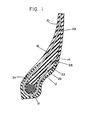
- a tire according to the invention contains a carcass ply 10 with a turn-up portion 12 and a terminal end 14.
- the apex 16 is in the immediate proximity of the carcass ply turn-up 14 including the area above the bead 18 and is encased by the carcass ply 10 and carcass ply turn-up 12 or sidewall compound 20.
- the apex also includes the area 22 located between the lower sidewall 20 and the axially outer side of the carcass ply turn-up 12.
- the interface between the bead 18 and the carcass ply 10 is a flipper 24.
- the chipper 26 Located outside of the carcass ply 10 and extending in an essentially parallel relationship to the carcass ply 10 is the chipper 26.
- chafer 28 Located around the outside of the bead 18 is the chafer 28 to protect the carcass ply 12 from the rim (not shown), distribute flexing above the rim, and seal the tire.
- At least one of apex 16, flipper 24, or chipper 26 comprises the rubber composition as described herein.
- the component is a flipper.
- a flipper typically comprises textile cord.
- the cord cannot be oriented in a zero degree radial direction to the radial direction of the tire, due to the increase in radius experienced at the bead during tire build.
- the cords are placed at a 45 degree angle with respect to the radial direction of the tire, to allow for the radius increase and deformation of the flipper during tire build; see for example, US-A- 6,659,148 .
- the flipper may be constructed such that the short fibers may be oriented at zero degrees or about zero degrees with respect to the radial direction of the tire.
- the flipper of the present invention is not restricted from a zero degree orientation, but may in one embodiment exist with the short fibers substantially oriented in an angle ranging from 0 to 90 degrees with respect to the radial direction of the tire.
- substantially oriented it is meant that the flipper compound is disposed such that with regard to the dimension of the flipper corresponding to that parallel to the direction of propagation through the flipper's fabrication process (i.e. calendar or extruded), that dimension may be oriented at an angle ranging from 0 to 90 degrees with respect to the radial direction of the tire.
- the flipper may be disposed with the fibers oriented at an angle ranging from 0 to 45 degrees with respect to the radial direction of the tire. In another embodiment, the flipper may be disposed with the fibers oriented at an angle ranging from 0 to 20 degrees with respect to the radial direction of the tire. In another embodiment, the flipper may be disposed with the fibers oriented at an angle ranging from 0 to 10 degrees with respect to the radial direction of the tire.
- the pneumatic tire of the present invention may be a race tire, passenger tire, aircraft tire, agricultural, earthmover, off-the-road, or truck tire.
- the tire is a passenger or truck tire.
- the tire may be a radial or bias.
- Vulcanization of the pneumatic tire of the present invention is generally carried out at conventional temperatures ranging from 100°C to 200°C. Any of the usual vulcanization processes may be used such as heating in a press or mold, heating with superheated steam or hot air. Such tires can be built, shaped, molded and cured by various methods which are known and will be readily apparent to those having skill in such art.
- Rubber compositions containing diene based elastomer, fillers, process aids, antidegradants, and curatives were prepared following recipes as shown in Table 1, with all amounts given in parts by weight per 100 parts by weight of base elastomer (phr).
- Sample 1 contained no short fiber and served as a control.
- Sample 2 included Sulfron® 3000 short fiber and is representative of the present invention.
- the stress ratio for Sample 2 containing the short fibers shows a maximum at 40 to 50 percent strain, indicating a strong anisotropic reinforcing effect of the fibers in the sample.
- anisotropy is important for applications such as apexes, flippers, and chippers where anisotropic reinforcement is advantageous due to the directional stresses experienced by these tire components at low strains.
- control sample 1 with no fiber shows no such anisotropy.
- Rubber compositions containing diene based elastomer, fillers, process aids, antidegradants, and curatives were prepared following recipes as shown in Table 1, with all amounts given in parts by weight per 100 parts by weight of base elastomer (phr).
- Sample 3 contained no short fiber and served as a control.
- Sample 4 included Sulfron® 3000 short fiber and is representative of the present invention.
- Sample 5 included short aramid fiber treated with nylon and is a comparative sample.
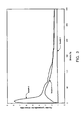
- Rubber samples were milled into a sheet and cut into tensile test specimens. Tensile test specimens were cut in two orientations, one with the test pulling direction parallel with the milling direction of the specimen, and one with the test pulling direction perpendicular with the milling direction of the specimen. In this way, the effect of fiber orientation (generally in the direction of milling) and thus the anisotropy of the rubber composition was measured. The tensile samples were then measured for stress at various strains. A stress ratio, defined as the (stress measured in the direction parallel to the milling direction)/(stress measured in the direction perpendicular to the milling direction) was then calculated for each strain. The results of the stress ratio versus strain are shown in FIG 3 . Table 2 Nonproductive Mix Stage Sample No.
- the stress ratio for Samples 4 and 5 containing the short fibers shows a maximum at low strain, indicating a strong anisotropic reinforcing effect of the fibers in these samples.
- Sample 4 containing the aramid short fibers treated according to the present invention shows a peak at higher strain with a much broader yield as compared with Sample 5, wherein a sharp yield is observed at a lower strain.
- Such behavior indicates that the inventive Sample 4 demonstrates superior adhesion of the short fibers to the rubber matrix, as illustrated by the broad yield peak at relatively higher strain.
- the sharp yield at relatively lower strain for Sample 5 demonstrates much poorer adhesion by fibers in Sample 5.
- Such anisotropy as demonstrated by Sample 4 is important for applications such as apexes, flippers, and chippers where anisotropic reinforcement along with good fiber adhesion is advantageous due to the directional stresses experienced by these tire components at low strains.
- the superior adhesion and broad yield at low strain for the inventive Sample 4 as compared to Sample 5 is surprising and unexpected.
- short fibers show behavior demonstrated by Sample 5, with a sharp yield at low strain, indicating poor adhesion and consequent inability to utilize any anisotropy in the compound at strains typically seen in apex, flipper and chipper applications.
- Sample 4 according to the present invention shows much superior adhesion and a broad yield at higher strain, indicating that the compound sample will better perform in an apex, flipper or chipper application.
- control Sample 3 with no fiber shows no such anisotropy.
- the rubber composition of the present invention has a stress ratio greater than 1.5 at 30 to 50 percent strain. In one embodiment, the rubber composition has a stress ratio greater than 2 at 30 to 50 percent strain.
- This example illustrates the effect of using a flipper comprising a rubber composition of the present invention.
- Three tires were having identical mass were made, each with different flipper constructions.
- Tire 1 was made with a flipper with conventional reinforcement cords.
- Tire 2 was made with a flipper with a rubber compound having short oriented fibers according to the present invention.
- Tire 3 was made with a flipper having an rubber compound without fibers or cords. The tires were measured for tangent stiffness at the nominal load of the tire, with measurement at a load of 492 kg for a deflection of 20 mm. The results are shown in Table 3.
- a tire made with a flipper of the present invention shows good vertical stiffness, between that of the cord reinforced flipper and the unreinforced flipper.
Landscapes
- Chemical & Material Sciences (AREA)
- Health & Medical Sciences (AREA)
- Chemical Kinetics & Catalysis (AREA)
- Medicinal Chemistry (AREA)
- Polymers & Plastics (AREA)
- Organic Chemistry (AREA)
- Engineering & Computer Science (AREA)
- Mechanical Engineering (AREA)
- Compositions Of Macromolecular Compounds (AREA)
Claims (15)
- Reifen, umfassend mindestens ein Bauteil ausgewählt aus der aus Kernprofilen, Wulstfahnen und Wulstverstärkern bestehenden Gruppe, wobei das mindestens eine Bauteil eine Kautschukzusammensetzung umfasst, wobei die Kautschukzusammensetzung ein dienbasiertes Elastomer und 1 bis 50 Gewichtsteile, je 100 Gewichtsteile Elastomer, an Aramidfasern umfasst, wobei die Fasern eine auf mindestens einem Teil ihrer Oberfläche angebrachte Zusammensetzung aufweisen, umfassend eine aliphatische Fettsäure oder ein mikrokristallines Wachs; ein Bunte-Salz; ein Polysulfid, umfassend den Anteil -[S]n oder -[S]o-Zn-[S]p, wobei jedes von o und p in einem Bereich von 1 bis 5 liegt, o + p = n, und n in einem Bereich von 2 bis 6 liegt; und Schwefel oder einen Schwefelspender.
- Reifen nach Anspruch 1, wobei die aliphatische Fettsäure oder das mikrokristalline Wachs Stearinsäure oder Polyethylenwachs ist.
- Reifen nach Anspruch 2, wobei 10 bis 90 Gewichtsprozent, alternativ 30 bis 70 Gewichtsprozent, der Gesamtheit von Fasern, Stearinsäure, Bunte-Salz, Polysulfid und Schwefel oder Schwefelspender die Stearinsäure ist.
- Reifen nach mindestens einem der vorgenannten Ansprüche, wobei das Bunte-Salz Dinatrium-hexamethylen-1,6-bis(thiosulfat)dihydrat ist.
- Reifen nach mindestens einem der vorgenannten Ansprüche, wobei die Menge des Bunte-Salzes sich auf 0,25 bis 25 Gewichtsprozent, alternativ 2 bis 10 Gewichtsprozent, auf Basis des Gewichts der Faser beläuft.
- Reifen nach mindestens einem der vorgenannten Ansprüche, wobei das Polysulfid 2-Mercaptobenzothiazyldisulfid ist.
- Reifen nach mindestens einem der vorgenannten Ansprüche, wobei die Menge des Polysulfids sich auf 0,01 bis 15 Gewichtsprozent, alternativ 0,1 bis 3 Gewichtsprozent, auf Basis des Gewichts der Faser beläuft.
- Reifen nach mindestens einem der vorgenannten Ansprüche, wobei die Menge von Schwefel oder Schwefelspender sich auf 0,001 bis 10 Gewichtsprozent, alternativ 0,1 bis 2,5 Gewichtsprozent, auf Basis des Gewichts der Fasern beläuft.
- Reifen nach mindestens einem der vorgenannten Ansprüche, wobei das Bauteil eine Wulstfahne ist.
- Reifen nach Anspruch 9, wobei die Wulstfahne so angeordnet ist, dass die Fasern mindestens im Wesentlichen in einem Winkel ausgerichtet sind, der sich auf 0 bis 90 Grad, alternativ 0 bis 10 Grad, bezüglich der radialen Richtung des Reifens beläuft.
- Reifen nach mindestens einem der vorgenannten Ansprüche, wobei die Kautschukzusammensetzung der vorliegenden Erfindung ein Spannungsverhältnis von größer als 1,5 bei 30 bis 50 Prozent Dehnung aufweist.
- Reifen nach Anspruch 10, wobei die Kautschukzusammensetzung ein Spannungsverhältnis von größer als 2 bei 30 bis 50 Prozent Dehnung aufweist.
- Reifen nach mindestens einem der vorgenannten Ansprüche, wobei die Aramidfasern eine Länge aufweisen, die sich auf 0,5 bis 20 mm beläuft, und eine Dicke aufweisen, die sich auf 2 bis 30 Mikron beläuft.
- Reifen nach mindestens einem der vorgenannten Ansprüche, wobei die Kautschukzusammensetzung 5 bis 40 Gewichtsteile, je 100 Gewichtsteile Elastomer, an Aramidfasern aufweist.
- Reifen nach mindestens einem der vorgenannten Ansprüche, wobei die Aramidfasern eine Länge aufweisen, die sich auf 1 bis 10 mm beläuft, und/oder eine Dicke aufweisen, die sich auf 5 bis 15 Mikron beläuft.
Applications Claiming Priority (1)
| Application Number | Priority Date | Filing Date | Title |
|---|---|---|---|
| US11/958,467 US20090151840A1 (en) | 2007-12-18 | 2007-12-18 | Tire with component containing short fiber |
Publications (2)
| Publication Number | Publication Date |
|---|---|
| EP2072283A1 EP2072283A1 (de) | 2009-06-24 |
| EP2072283B1 true EP2072283B1 (de) | 2010-07-28 |
Family
ID=40560212
Family Applications (1)
| Application Number | Title | Priority Date | Filing Date |
|---|---|---|---|
| EP08170818A Not-in-force EP2072283B1 (de) | 2007-12-18 | 2008-12-05 | Reifen mit Komponente, die Aramidfasern enthält |
Country Status (7)
| Country | Link |
|---|---|
| US (1) | US20090151840A1 (de) |
| EP (1) | EP2072283B1 (de) |
| CN (1) | CN101462467B (de) |
| AU (1) | AU2008255215A1 (de) |
| BR (1) | BRPI0811216A2 (de) |
| DE (1) | DE602008001948D1 (de) |
| ZA (1) | ZA200810641B (de) |
Families Citing this family (15)
| Publication number | Priority date | Publication date | Assignee | Title |
|---|---|---|---|---|
| US20090156740A1 (en) * | 2007-12-15 | 2009-06-18 | Annette Lechtenboehmer | Tire with component containing polymeric nanofiber |
| US8261796B2 (en) * | 2008-11-06 | 2012-09-11 | The Goodyear Tire & Rubber Company | Tire with component containing polybenzobisoxazole short fiber and epoxidized palm oil |
| US8127815B2 (en) * | 2008-11-06 | 2012-03-06 | The Goodyear Tire & Rubber Company | Tire with component containing polybenzobisoxazole short fiber and epoxidized polyisoprene |
| US8168709B2 (en) * | 2009-08-05 | 2012-05-01 | The Goodyear Tire & Rubber Company | Method of processing rubber composition, rubber composition and pneumatic tire |
| KR101382202B1 (ko) * | 2011-12-26 | 2014-04-08 | 한국타이어 주식회사 | 타이어 벨트용 고무 조성물 및 이를 이용하여 제조한 타이어 |
| KR101440099B1 (ko) * | 2011-12-28 | 2014-09-17 | 한국타이어 주식회사 | 타이어 벨트토핑용 고무 조성물 및 이를 이용하여 제조한 타이어 |
| FR2996230B1 (fr) * | 2012-09-28 | 2014-10-31 | Michelin & Cie | Cable gomme in situ comprenant une composition comprenant un polysulfure organique. |
| CN103057357A (zh) * | 2012-12-10 | 2013-04-24 | 朱炽达 | 仿足球鞋轮胎 |
| ITVR20120245A1 (it) * | 2012-12-19 | 2014-06-20 | Tumedei S P A | Composition for a disc-type flexible coupling and coupling including such composition. - composizione per un giunto flessibile del tipo a disco e giunto includente tale composizione. |
| KR101747503B1 (ko) * | 2014-12-09 | 2017-06-14 | 주식회사 엘지화학 | 고무조성물 및 이를 포함하는 타이어 트래드용 고무조성물 |
| US10179479B2 (en) | 2015-05-19 | 2019-01-15 | Bridgestone Americas Tire Operations, Llc | Plant oil-containing rubber compositions, tread thereof and race tires containing the tread |
| WO2017111902A1 (en) * | 2015-12-21 | 2017-06-29 | Compagnie Generale Des Etablissements Michelin | Method of creating tire bead core with a carbon fiber composite |
| RU2706658C1 (ru) * | 2019-03-29 | 2019-11-19 | Федеральное государственное автономное образовательное учреждение высшего образования "Северо-Восточный федеральный университет имени М.К.Аммосова" | Композиционный конструкционный материал на основе сверхвысокомолекулярного полиэтилена, оксида цинка, 2-меркаптобензотиазола и серы |
| FR3102181B1 (fr) * | 2019-10-18 | 2021-10-22 | Michelin & Cie | Composite comprenant des fibres courtes |
| JP7483587B2 (ja) * | 2020-10-23 | 2024-05-15 | 株式会社ブリヂストン | タイヤ用ゴム組成物、トレッドゴム及び冬用タイヤ |
Family Cites Families (20)
| Publication number | Priority date | Publication date | Assignee | Title |
|---|---|---|---|---|
| US4871004A (en) * | 1988-02-17 | 1989-10-03 | The Goodyear Tire & Rubber Company | Rubber containing aramid pulp reinforcement |
| JPH05155207A (ja) * | 1991-12-04 | 1993-06-22 | Toyo Tire & Rubber Co Ltd | 空気入りタイヤ |
| US5309971A (en) * | 1992-06-12 | 1994-05-10 | Michelin Recherche Et Technique S.A. | Tire flipper structure |
| DE4220563A1 (de) | 1992-06-24 | 1994-01-13 | Bayer Ag | Kautschukmischungen enthaltend Polybutadien-Gel |
| CA2081533A1 (en) * | 1992-09-16 | 1994-03-17 | Thomas Joseph Segatta | Tire with apex rubber blend |
| US5672639A (en) | 1996-03-12 | 1997-09-30 | The Goodyear Tire & Rubber Company | Starch composite reinforced rubber composition and tire with at least one component thereof |
| DE19701488A1 (de) | 1997-01-17 | 1998-07-23 | Bayer Ag | SBR-Kautschukgele enthaltende Kautschukmischungen |
| ATE239737T1 (de) | 1997-08-21 | 2003-05-15 | Crompton Corp | Blockierte merkaptosilane als kupplungsmittel für gefüllte kautschukzusammensetzung |
| DE19834802A1 (de) | 1998-08-01 | 2000-02-03 | Continental Ag | Kautschukmischung |
| DE19834804A1 (de) | 1998-08-01 | 2000-02-03 | Continental Ag | Kautschukmischung |
| DE19834803A1 (de) | 1998-08-01 | 2000-02-03 | Continental Ag | Kautschukmischung |
| US6659148B1 (en) * | 1998-12-01 | 2003-12-09 | The Goodyear Tire & Rubber Company | Bead reinforcing structure for radial truck tires |
| DE19942620A1 (de) | 1999-09-07 | 2001-03-08 | Bayer Ag | Mikrogelhaltige Kautschukmischungen mit verkappten bifunktionellen Mercaptanen und hieraus hergestellte Vulkanisate |
| BR9917463A (pt) * | 1999-09-07 | 2002-04-30 | Goodyear Tire & Rubber | Orientação de fibras curtas em um processo contìnuo |
| US6516847B1 (en) * | 1999-10-28 | 2003-02-11 | Pirelli Pneumatici S.P.A. | Low rolling resistance tire for vehicles having a composite tread |
| ATE314381T1 (de) | 2001-08-06 | 2006-01-15 | Degussa | Organosiliciumverbindungen |
| US20040173295A1 (en) * | 2003-03-07 | 2004-09-09 | Zanzig David John | Tire with rubber component containing electrically conductive carbon black and fibrillated aramid fibers |
| MY138552A (en) | 2005-02-18 | 2009-06-30 | Teijin Aramid Bv | Method for enhancing rubber properties by using bunte salt-treated fiber |
| WO2007024804A1 (en) * | 2005-08-22 | 2007-03-01 | Bridgestone/Firestone North American Tire, Llc | Pneumatic tires |
| RU2008118209A (ru) | 2005-10-10 | 2009-11-20 | Тейджин Арамид Б.В. (Nl) | Композиция, включающая сульфированные частицы |
-
2007
- 2007-12-18 US US11/958,467 patent/US20090151840A1/en not_active Abandoned
-
2008
- 2008-12-05 EP EP08170818A patent/EP2072283B1/de not_active Not-in-force
- 2008-12-05 DE DE602008001948T patent/DE602008001948D1/de active Active
- 2008-12-08 BR BRPI0811216-9A patent/BRPI0811216A2/pt not_active IP Right Cessation
- 2008-12-09 AU AU2008255215A patent/AU2008255215A1/en not_active Abandoned
- 2008-12-17 ZA ZA200810641A patent/ZA200810641B/xx unknown
- 2008-12-18 CN CN200810185986.9A patent/CN101462467B/zh not_active Expired - Fee Related
Also Published As
| Publication number | Publication date |
|---|---|
| ZA200810641B (en) | 2009-11-25 |
| CN101462467A (zh) | 2009-06-24 |
| DE602008001948D1 (de) | 2010-09-09 |
| CN101462467B (zh) | 2011-01-19 |
| BRPI0811216A2 (pt) | 2010-06-22 |
| US20090151840A1 (en) | 2009-06-18 |
| EP2072283A1 (de) | 2009-06-24 |
| AU2008255215A1 (en) | 2009-07-02 |
Similar Documents
| Publication | Publication Date | Title |
|---|---|---|
| EP2072283B1 (de) | Reifen mit Komponente, die Aramidfasern enthält | |
| US8701727B2 (en) | Truck drive tire | |
| EP4056644B1 (de) | Kautschukzusammensetzung und reifen | |
| EP2028021B1 (de) | Reifen mit Komponente mit Kombinationsweichmacher | |
| EP3888940B1 (de) | Kautschukzusammensetzung und kautschukprodukt | |
| US12018154B2 (en) | Rubber composition offering high stiffness and low hysteresis | |
| US8448684B2 (en) | Tire with component containing polybenzobisoxazole short fiber and epoxidized polyisoprene | |
| EP2353887A2 (de) | Pneumatischer Reifen | |
| US8261796B2 (en) | Tire with component containing polybenzobisoxazole short fiber and epoxidized palm oil | |
| US20100116404A1 (en) | Tire with component containing polyketone short fiber and functionalized elastomer | |
| US20090156740A1 (en) | Tire with component containing polymeric nanofiber | |
| EP3040212B1 (de) | Luftreifen | |
| EP2189306B1 (de) | Reifen mit Komponenten mit Polyketonkurzfaser und Polyethylenimin | |
| EP2380757A2 (de) | Luftreifen mit Fasern aufweisender Lauffläche | |
| EP2371895A1 (de) | Kautschukzusammensetzung und Reifen mit Komponente aus Kautschuk, die Alkylalkoxysilan und ein Siliconharz enthalten | |
| EP2030809A1 (de) | Reifen mit asphaltenhaltiger Komponente | |
| US12187895B2 (en) | Rubber composition and a tire | |
| EP3831873B1 (de) | Kautschukzusammensetzung und fertigungsgegenstand mit der kautschukzusammensetzung | |
| US20100116403A1 (en) | Tire with component containing polyketone short fiber and epoxidized polyisoprene |
Legal Events
| Date | Code | Title | Description |
|---|---|---|---|
| PUAI | Public reference made under article 153(3) epc to a published international application that has entered the european phase |
Free format text: ORIGINAL CODE: 0009012 |
|
| AK | Designated contracting states |
Kind code of ref document: A1 Designated state(s): AT BE BG CH CY CZ DE DK EE ES FI FR GB GR HR HU IE IS IT LI LT LU LV MC MT NL NO PL PT RO SE SI SK TR |
|
| AX | Request for extension of the european patent |
Extension state: AL BA MK RS |
|
| GRAP | Despatch of communication of intention to grant a patent |
Free format text: ORIGINAL CODE: EPIDOSNIGR1 |
|
| 17P | Request for examination filed |
Effective date: 20091228 |
|
| AKX | Designation fees paid |
Designated state(s): DE FR IT |
|
| GRAS | Grant fee paid |
Free format text: ORIGINAL CODE: EPIDOSNIGR3 |
|
| GRAA | (expected) grant |
Free format text: ORIGINAL CODE: 0009210 |
|
| AK | Designated contracting states |
Kind code of ref document: B1 Designated state(s): DE FR IT |
|
| REF | Corresponds to: |
Ref document number: 602008001948 Country of ref document: DE Date of ref document: 20100909 Kind code of ref document: P |
|
| PLBE | No opposition filed within time limit |
Free format text: ORIGINAL CODE: 0009261 |
|
| STAA | Information on the status of an ep patent application or granted ep patent |
Free format text: STATUS: NO OPPOSITION FILED WITHIN TIME LIMIT |
|
| 26N | No opposition filed |
Effective date: 20110429 |
|
| REG | Reference to a national code |
Ref country code: DE Ref legal event code: R097 Ref document number: 602008001948 Country of ref document: DE Effective date: 20110429 |
|
| REG | Reference to a national code |
Ref country code: FR Ref legal event code: PLFP Year of fee payment: 8 |
|
| PGFP | Annual fee paid to national office [announced via postgrant information from national office to epo] |
Ref country code: FR Payment date: 20151124 Year of fee payment: 8 |
|
| PGFP | Annual fee paid to national office [announced via postgrant information from national office to epo] |
Ref country code: DE Payment date: 20151230 Year of fee payment: 8 Ref country code: IT Payment date: 20151210 Year of fee payment: 8 |
|
| REG | Reference to a national code |
Ref country code: DE Ref legal event code: R119 Ref document number: 602008001948 Country of ref document: DE |
|
| REG | Reference to a national code |
Ref country code: FR Ref legal event code: ST Effective date: 20170831 |
|
| PG25 | Lapsed in a contracting state [announced via postgrant information from national office to epo] |
Ref country code: IT Free format text: LAPSE BECAUSE OF NON-PAYMENT OF DUE FEES Effective date: 20161205 Ref country code: FR Free format text: LAPSE BECAUSE OF NON-PAYMENT OF DUE FEES Effective date: 20170102 |
|
| PG25 | Lapsed in a contracting state [announced via postgrant information from national office to epo] |
Ref country code: DE Free format text: LAPSE BECAUSE OF NON-PAYMENT OF DUE FEES Effective date: 20170701 |