EP2072403A1 - Einschachtelvorrichtung und verpackungsvorrichtung - Google Patents
Einschachtelvorrichtung und verpackungsvorrichtung Download PDFInfo
- Publication number
- EP2072403A1 EP2072403A1 EP07807777A EP07807777A EP2072403A1 EP 2072403 A1 EP2072403 A1 EP 2072403A1 EP 07807777 A EP07807777 A EP 07807777A EP 07807777 A EP07807777 A EP 07807777A EP 2072403 A1 EP2072403 A1 EP 2072403A1
- Authority
- EP
- European Patent Office
- Prior art keywords
- weight
- group
- bags
- box
- individual
- Prior art date
- Legal status (The legal status is an assumption and is not a legal conclusion. Google has not performed a legal analysis and makes no representation as to the accuracy of the status listed.)
- Withdrawn
Links
Images



Classifications
-
- B—PERFORMING OPERATIONS; TRANSPORTING
- B65—CONVEYING; PACKING; STORING; HANDLING THIN OR FILAMENTARY MATERIAL
- B65B—MACHINES, APPARATUS OR DEVICES FOR, OR METHODS OF, PACKAGING ARTICLES OR MATERIALS; UNPACKING
- B65B5/00—Packaging individual articles in containers or receptacles, e.g. bags, sacks, boxes, cartons, cans, jars
- B65B5/06—Packaging groups of articles, the groups being treated as single articles
- B65B5/061—Filled bags
-
- B—PERFORMING OPERATIONS; TRANSPORTING
- B65—CONVEYING; PACKING; STORING; HANDLING THIN OR FILAMENTARY MATERIAL
- B65B—MACHINES, APPARATUS OR DEVICES FOR, OR METHODS OF, PACKAGING ARTICLES OR MATERIALS; UNPACKING
- B65B35/00—Supplying, feeding, arranging or orientating articles to be packaged
- B65B35/30—Arranging and feeding articles in groups
-
- G—PHYSICS
- G01—MEASURING; TESTING
- G01G—WEIGHING
- G01G15/00—Arrangements for check-weighing of materials dispensed into removable containers
-
- G—PHYSICS
- G01—MEASURING; TESTING
- G01G—WEIGHING
- G01G19/00—Weighing apparatus or methods adapted for special purposes not provided for in the preceding groups
- G01G19/387—Weighing apparatus or methods adapted for special purposes not provided for in the preceding groups for combinatorial weighing, i.e. selecting a combination of articles whose total weight or number is closest to a desired value
-
- G—PHYSICS
- G01—MEASURING; TESTING
- G01M—TESTING STATIC OR DYNAMIC BALANCE OF MACHINES OR STRUCTURES; TESTING OF STRUCTURES OR APPARATUS, NOT OTHERWISE PROVIDED FOR
- G01M3/00—Investigating fluid-tightness of structures
- G01M3/02—Investigating fluid-tightness of structures by using fluid or vacuum
- G01M3/36—Investigating fluid-tightness of structures by using fluid or vacuum by detecting change in dimensions of the structure being tested
-
- B—PERFORMING OPERATIONS; TRANSPORTING
- B65—CONVEYING; PACKING; STORING; HANDLING THIN OR FILAMENTARY MATERIAL
- B65B—MACHINES, APPARATUS OR DEVICES FOR, OR METHODS OF, PACKAGING ARTICLES OR MATERIALS; UNPACKING
- B65B1/00—Packaging fluent solid material, e.g. powders, granular or loose fibrous material, loose masses of small articles, in individual containers or receptacles, e.g. bags, sacks, boxes, cartons, cans, or jars
- B65B1/30—Devices or methods for controlling or determining the quantity or quality or the material fed or filled
- B65B1/32—Devices or methods for controlling or determining the quantity or quality or the material fed or filled by weighing
Definitions
- the present invention relates to a boxing device that packs a predetermined weight or a predetermined number of articles in a box by collecting a plurality of articles as a group and gathering a plurality of such groups.
- the present invention relates to a packaging device that packages a plurality of articles whose weights are known in a packaging material.
- an object of the present invention is to provide a boxing device that packs a predetermined weight or a predetermined number of articles in a box by collecting a plurality of articles as a group and gathering a plurality of such groups, in which the weight (number) of the group to be packed in a box is checked after the weights of individual articles are obtained and before these articles are packed in a box in order to prevent a reduction in production efficiency.
- the packaging material used for packaging is a cardboard container or a recyclable container
- the weight thereof may greatly change due to the humidity, aged deterioration, and other reasons, and therefore the range of the change in the weight of the packaging material may be greater than the weight of each article. Consequently, because of the change in the weight of the packaging material, there has been a case, for example, where the weight of packaged articles is erroneously determined to be adequate even when some of a plurality of articles to be packaged were left out before being packaged and therefore are not included in the packaging material. In other words, even when the gross weight with tare included is checked after packaging is completed, it has not been possible to confirm the adequacy of the weight (number) of articles themselves that are packaged.
- another object of the present invention is to provide a packaging device that packages a plurality of articles whose weights are known in a packaging material, in which the gross weight with tare included is checked after packaging is completed, thereby allowing to confirm the adequacy of the weight (number) of articles that are packaged.
- a boxing device includes a collecting unit, a group weight measuring unit, a determination unit, and a boxing unit, and packs a predetermined weight or a predetermined number of articles in a box.
- the collecting unit collects articles as a group.
- the group weight measuring unit measures a weight of the group. Based on the weight measured by the group weight measuring unit, the determination unit determines whether or not the group is appropriate to be packed in a box.
- the boxing unit packs, in the box, a plurality of the groups determined by the determination unit to be appropriate to be packed in the box.
- a boxing device is the boxing device according to the first aspect of the present invention, further including an individual weight measuring unit.
- the individual weight measuring unit measures a weight of each of the articles and positioned on the upstream side of the group weight measuring unit..
- a boxing device is the boxing device according to the first or second aspect of the present invention, further including a replenishment unit.
- the replenishment unit has a stocking place for stocking the articles.
- the replenishment unit replenishes, when the group is determined by the determination unit to be not adequate to be packed in the box because of a shortage in the number of the articles, the shortage with the article from the stocking place.
- a packaging device includes a tare weight obtaining unit, a packaging unit, and a weight checking unit.
- the tare weight obtaining unit obtains a weight of a packaging material.
- the packaging unit packages a plurality of articles whose weights are known in the packaging material.
- the weight checking unit checks a weight of the plurality of articles packaged in the packaging material, using a sum of the weight obtained by the tare weight obtaining unit and the known weights as a reference.
- a packaging device includes a tare weight obtaining unit, a packaging unit, a gross weight measuring unit, and a determination unit.
- the tare weight obtaining unit obtains a weight of a packaging material.
- the packaging unit packages a plurality of articles whose weights are known in the packaging material.
- the gross weight measuring unit measures a weight of the plurality of articles packaged in the packaging material.
- the determination unit determines whether or not the plurality of articles are adequately packaged in the packaging material based on a sum of the weight obtained by the tare weight obtaining unit and the known weights, and the weight measured by the gross weight measuring unit.
- a packaging device is the packaging device according to the fourth or fifth aspect of the present invention, wherein the tare weight obtaining unit measures the weight of the packaging material.
- a packaging device is the packaging device according to the fourth or fifth aspect of the present invention, wherein the packaging material has a memory medium in which the weight of the packaging material is stored.
- the tare weight obtaining unit reads the weight of the packaging material stored in the memory medium.
- a packaging device is the packaging device according to any one of the fourth through seventh aspects of the present invention, wherein the packaging material is a cardboard container.
- a packaging device is the packaging device according to any one of the fourth through eighth aspects of the present invention, wherein the packaging material is a recyclable container.
- the first aspect accomplishes a beneficial effect as follows. Because the weight of a group of articles is measured and the adequacy of the weight (number) of the articles to be packed in a box is determined based on the measured weight, it is possible to detect problems such as a defective article and the like before box packing is performed and take an appropriate countermeasure. As a result, the present invention is more efficient than the conventional boxing device that determines the adequacy of the weight (number) after box packing is completed and eliminates a whole box in which a problem is found from the production line.
- the second aspect accomplishes a beneficial effect as follows, in addition to the effect accomplished by the first aspect. Because the weight of each individual article is actually measured, it is possible to more accurately determine the weight of a group of articles.
- the third aspect accomplishes a beneficial effect as follows, in addition to the effects accomplished by the first and second aspects.
- the fourth through ninth aspects accomplish beneficial effects as follows. Because the sum of the known weights of the plurality of articles to be packed and the weight measured by the tare weight obtaining unit is used as a reference when checking the weight of the plurality of articles packaged in the packaging material, even when the tare weight significantly changes due to the humidity, aged deterioration, and other reasons, it is possible to confirm the adequacy of the weight (number) of the articles that are packaged by checking the gross weight with tare included after packaging is completed.
- the packaging material is made of cardboard (made of paper) that is highly hygroscopic and the weight easily changes due to the effect of humidity, or even when the packaging material is a recyclable container and there is a concern for the change in the weight due to long-term use, the adequacy of the weight or the number of the articles that are packaged is guaranteed.
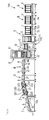
- Figure 1 is an elevation view of the boxing device 100
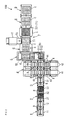
- Figure 2 is a plan view thereof
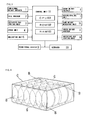
- Figure 3 is a function block view thereof
- Figure 4 is a perspective view of boxed products produced by the boxing device 100.
- the boxing device 100 is a packaging device that collects, as a group G, a plurality (6) of individual bags (articles) B sequentially supplied from a bag-manufacturing and packaging apparatus (not shown) in the upstream process, and repeatedly packs a plurality (2) of groups G of bags in a box C of a defined size.
- the box C as a packaging material is a cardboard container and is also a recyclable container that can be collected at the destination of delivery and reused.
- the boxing device 100 includes an individual weight checker 1, a seal checker 2, a defective bag sorting unit 3, a stock unit 4, a collecting unit 5, a group weight checker 6, a boxing/sealing unit 7, a gross weight checker 8, and a defective box sorting unit 9, which are arranged in that order from the upstream process side (left side in the figures).
- These components are controlled by a control unit 10 shown in Figure 3 .
- the control unit 10 includes a CPU (central processing unit) 101, a ROM (read-only memory) 102, and a RAM (random-access memory) 103.
- the CPU 101 transmits a control signal to each unit of the boxing device 100 and also executes, on the RAM 103, a program to perform calculation, determination, and selection processes based on an information signal that the control unit 10 receives from each unit of the boxing device 100.
- the control unit 10 includes a touch panel display 20 and a keyboard 30, which are connected thereto, and which respectively serve as a display unit that displays the device operating condition and the like and an operation inputting unit that is used for setting various setting values and for inputting operations.
- the individual weight checker 1 is an individual weight obtaining means to obtain a weight w n of each individual bag B while sequentially conveying the individual bags B, which are continuously supplied from the upstream process, to the downstream side at a predetermined speed.
- a transport conveyor 11 that receives the individual bags B supplied and conveys the same to the downstream side
- a weighing transport conveyor 12 that measures, by a load cell 12a, the weight w n of each individual bag B discharged from the transport conveyor 11 and that conveys the same to the downstream side are arranged in line.
- the control unit 10 determines whether or not the weight w n of the individual bag B is within a predetermined weight range (upper weight limit w U , lower weight limit w L ). When the weight w n of the individual bag B is outside the predetermined weight range, the control unit 10 discharges the bag B as a defective product to the outside of the process by the defective bag sorting unit 3 (described later).
- the control unit 10 calculates, in advance, a group weight W2 of such group G of bags, by adding the weights w n of the plurality of bags B included in that group G of bags whose weight Wg is measured by the group weight checker 6.
- the seal checker 2 is a thickness detection means to apply pressure on each individual bag B in a thickness direction thereof and detects a thickness d n of the individual bags B at the time of pressure application, while sequentially conveying the individual bags B continuously supplied from the individual weight checker 1 to the downstream side at a predetermined speed.
- the seal checker 2 is used for a determination of the adequacy of sealing of the individual bags B based on the thickness.
- the seal checker 2 includes a transport conveyor 21 that conveys, to the downstream side, the individual bags B continuously supplied from the individual weight checker 1 in the upstream process; a bag leveling unit 22 that applies pressure using a pressing member 221 to each individual bag B conveyed on the transport conveyor 21 to level out the entire individual bag to a uniform thickness; and a thickness detection unit 23 that applies pressure, using a pressing member 231 driven by a servo motor 233, to the individual bag B whose thickness is leveled out by the bag leveling unit 22, detects a thickness d n of the individual bag based on the angular displacement of the servo motor 233, and transmits a thickness information signal.
- the thickness detection unit 23 includes the pressing member 231 disposed so as to cover the conveying surface of the transport conveyor 21 from above; L-shaped parallel links 232 that are pivotally supported on the lateral side of the transport conveyor 21 and support the pressing member 231 such that the pressing member 231 can move closer to and away from the transport conveyor 21; and the servo motor 233 that moves the pressing member 231 closer to and away from the transport conveyor 21 by pivotally driving the parallel links 232.
- the servo motor 233 is driven in a direction indicated by the arrow in Figure 5 , and thereby the thickness of the individual bag B can be detected.
- the bag leveling unit 22 includes the pressing member 221 disposed with a plurality of rollers on its lower surface, which is supported by parallel links 222 ( Figure 2 ). By pivoting the parallel links 222 at a predetermined torque, the individual bag B that passes through below the pressing member 221 is leveled out and the thickness of the entire bag is made uniform.
- the control unit 10 determines whether or not the thickness d n of each individual bag B is within a predetermined thickness range (upper limit d U , lower limit d L ). When the thickness d n of the individual bag B is outside the predetermined thickness range, it may be due to an air leakage due to sealing failure or an excess or deficiency in the amount of charged air. Thus, the control unit 10 transmits a control signal to the defective bag sorting unit 3 in the downstream process so as to discharge such individual bag B as a defective product to the outside of the process.
- the control unit 10 serves as a determination means to determine, in advance, whether or not it is adequate to pack the group G of bags in the box C of the defined size based on a result of the addition.
- the defective bag sorting unit 3 discharges such individual bag B to the outside of the process based on the control signal from the control unit 10.
- an air jet nozzle (not shown) is disposed on the lateral side of a transport conveyor 31, and thereby a defective bag that passes through on the transport conveyor 31 is blown out in a direction orthogonal to the conveying direction. Note that when the weight of the individual bag B is large and cannot be easily discharged by the air jet, the individual bag B may be pushed out to the side by an elastic cylinder or the like.
- the stock unit 4 includes a plurality (2) of pairs of slide rails 41 and 42 extending in a direction orthogonal (transverse direction) to the conveying direction of the individual bag B on the conveyor; a plurality (3) of lines of the transport conveyors 43 --- 43 and 44 --- 44 respectively supported by the slide rails 41 and 42 and arranged in the transverse direction; and a drive unit (not shown) that moves the transport conveyors 43 --- 43 and 44 --- 44 along the slide rails 41, 42.
- the plurality of lines of the transport conveyors 43 --- 43 and 44-44 respectively have spare individual bags B S1 - S4 stocked therein.
- the spare individual bags B S1 - S4 are the bags that have passed through the individual weight checker 1 and the seal checker 2 and whose weights and thicknesses are known.
- the known data are stored by the control unit 10 in a manner associated with the transport conveyors each having the relevant individual bags stocked therein.
- the stock unit 4 selects an individual bag B Gn to be replaced from the group G of bags and discharges it.
- the stock unit 4 selects an individual bag from the spare bags B S1-S4 , whose thickness is smaller (or larger) than the individual bag B Gn to be replaced and with which the thickness of the group G of bags can be corrected to be within the predetermined range, and inserts the bag to the group.
- the control unit 10 selects an individual bag B Gn to be replaced and a bag B sn to be added to the group G of bags instead thereof.
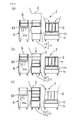
- the individual bag B S1 among the spare individual bags B S1-S4 is selected as the individual bag B to be added instead of the individual bag B G6 to be replaced, first, as shown in Figure 6(b) , after the individual bag B G6 to be replaced is taken onto the transport conveyor 43, as shown in Figure 6(c) , the plurality of lines of the transport conveyors 43 are transversely slid in order to change the position of the conveyors. Thereby, the selected individual bag B S1 is supplied downstream and added to the group G of bags. The individual bag B G6 that is replaced is stocked in the transport conveyor 43 instead of the individual bag B S1 that is added.
- the data of the weight and thickness detected by the individual weight checker 1 and the seal checker 2, respectively, are stored by the control unit 10 in a manner associated with the conveyor on which the individual bag B G6 is placed. Note that when the thickness of the group G of bags is determined to be inadequate to be packed in the box C although any one of the spare individual bags B S1-S4 is added and inserted instead of the individual bag B G6 that is replaced, the control unit 10 transmits to the touch panel display 20 a control signal to display a warning that the group is inadequate to be packed in the box, instead of replacing or adding an individual bag.
- control unit 10 transmits to a discharge member (described later) a control signal to discharge the group G of bags to the outside of the process.
- a control signal to stop the device may be transmitted instead of or together with displaying a warning and discharging a group of bags.
- the transport conveyors are set in 2 pairs x 3 lines: however, the same number (4) of spare bags can be secured even with 1 pair x 5 lines or 4 pairs x 2 lines of the transport conveyors. Further, the number of spare individual bags B sn may be increased by additionally installing a slide rail or a conveyor. By so doing, the occurrence of the situation where a group G of bags must be discharged as described above is reduced, improving process efficiency.
- the collecting unit 5 is a device that receives individual bags sequentially supplied from the upstream process and collects them as the group G of bags in a state capable of being packed in a box. As shown in Figure 7 , the collecting unit 5 includes a receiving unit 51 that receives the individual bags B from the upstream process and a holding unit 52 that holds the individual bags B received by the receiving unit 51, in a state of being collected in the thickness direction.
- the receiving unit 51 includes a rotor 511 that is rotated about a rotation axis 511a extending in a horizontal direction by a driving source (not shown), and a plurality (4) of receiving trays 512 that are disposed at predetermined intervals in a circumferential direction of the rotor 511 and that are rotatably supported by a rotation axis 512a.
- the receiving trays 512 are configured so as to move along a rotation path as shown by the dashed-dotted line along with the rotation of the rotor 511. Thereby, each receiving tray 512 receives the bag B supplied in a lying position at a position P1 shown in Figure 7 and supplies the bag B in a standing position to the holding unit 52 at a position P2.
- the holding unit 52 includes a plurality of pairs of sandwich structures 522 on the conveying surface of a transport conveyor 521, which sandwich, from the both sides, the group G of bags in a collected state in the thickness direction, and each sandwich structure 522 includes two sandwich members 522a, 522b disposed with a space therebetween which corresponds to the thickness of the group G of bags.
- the two sandwich members 522a, 522b move in the conveying direction.
- the sandwich member 522a moves while supporting the bags B sequentially supplied in the standing position from the receiving unit 51.
- the sandwich member 522b holds the group G of bags from behind to sandwich the same with the sandwich member 522a.
- a bag delivery position position P3 in Figure 7
- the bags B are delivered to the group weight checker 6 in the downstream process.
- the group G of bags is moved to the bag delivery position, the group G of bags is pushed out to the front by a pushing member (not shown) arranged at a position corresponding to the position P3, and is supplied to a tray 61 of the group weight checker 6.
- the group weight checker 6 is a group weight obtaining means to receive the group G of bags supplied from the collecting unit 5 in the upstream process and to obtain the weight Wg of the group G of bags by measuring by a load cell 61a disposed at the lower portion of the tray 61.
- the group weight checker 6 includes a boxing member (not shown) that pushes the group G of bags in the horizontal direction into the box C set in the boxing/sealing unit 7 in the downstream process, and the discharge member (not shown) that discharges the group G of bags by pushing out to the outside of the process.
- control unit 10 adds up the weights w n of the individual bags B included in the group G of bags and calculates, in advance, the group weight W2, which is the sum of the addition. Based on this sum and the weight Wg, the control unit 10 determines the adequacy of the weight or the number of the individual bags B included in such group G of bags.
- the control unit 10 determines that the weight or the number of the individual bags B included in such group G of bags is adequate and also transmits a control signal to the above described boxing member so as to pack the group G of bags in the box C.
- the control unit 10 determines that the weight or the number of the individual bags B included in such group G of bags is not adequate, i.e., that accidents such as that all or some of the individual bags in the group G of bags are left out in the course of the process and the like occurred.
- the control unit 10 also transmits a control signal to the above described discharge member so as to discharge the entire group G of bags to the outside of the process.
- the boxing/sealing unit 7 sets the empty box C in a state in which the box C is opened toward the group weight checker 6; and includes a boxing table 71 whose height is variable according to the number of lines (rows) of the groups G of bags pushed in from the group weight checker 6 and a sealing device 72 that seals the box C in which a predetermined number of rows of the groups G of bags are packed by the boxing table 71.
- the boxing table 71 is disposed with a base 711 and a lifting and lowering table 712 disposed to be capable of moving upward and downward with respect to the base 711.
- the lifting and lowering table 712 adjusts the lower surface of the box C that is set to the same height as the tray 61 of the group weight checker 6.
- the lifting and lowering table 712 lowers by the height of the group G of bags at a time and moves the box C downward to a position where the bags G on the second row and the followings can be received.
- the predetermined number of rows of the bags G are packed in the box as shown in Figure 8(c) simply by being pushed in the horizontal direction by the boxing member of the group weight checker 6.
- the box C in which box packing is completed is moved to the sealing device 72, and the opening of the box C is closed by a cover by the sealing device 72 as shown in Figures 8(a) and (b) .
- the box C is moved by a transport conveyor 721 to the gross weight checker 8 in a next process.
- the box C is set in the boxing table 71 by a weighing transport conveyor 73 ( Figure 2 ) equipped with a load cell, and at that time, as a tare weight obtaining means, the weighing transport conveyor 73 measures and obtains a weight (tare weight) Wp of the box C in an empty state, and transmits the weight information signal to the control unit 10.
- the gross weight checker 8 is a weighing transport conveyor equipped with a load cell 8a. As a conveying means, the gross weight checker 8 conveys the box C supplied from the boxing/sealing unit 7 to the downstream process, and as a gross weight obtaining means, the gross weight checker 8 measures and obtains a weight W h of the packaging material and a predetermined number of individual bags B packaged in the packaging material, and transmits the weight information signal to the control unit 10.
- the control unit 10 calculates a sum of the addition of that gross weight W1 of the predetermined number of rows of groups G of bags which is obtained from the weights Wg measured by the group weight checker 6 and the tare weight W p measured by the weighing transport conveyor 73, and this sum is used as a reference for the weight check of the plurality of individual bags B packaged in the packaging material.
- the control unit 10 transmits a control signal to the defective box sorting unit 9.
- the defective box sorting unit 9 is a transport conveyor.
- the defective box sorting unit 9 conveys the box C in which the individual bags B are adequately packaged to a next process based on the control signal from the control unit 10, and at the same time operates an elastic cylinder (not shown) disposed on the lateral side of the transport conveyor to discharge the box C, in which the individual bags B are not adequately packaged, to the outside of the process.
- control unit 10 integrally performs a determination process regarding the thickness of the individual bag B and the thickness of the group G of bags which is obtained as the sum of thicknesses of the individual bags B, and another determination process regarding the weight of the individual bag B, the weight of the group G of bags, and the weight of the packaging material in which the predetermined number of rows of the bags G are packaged: however, for the sake of simplicity of description, these determination process flows are mutually separated and described.
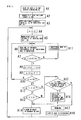
- Figure 9 shows a determination process flow that is performed based on the bag thickness.
- the control unit 10 Before operating the boxing device 100, as data necessary to the determination process by the control unit 10, it is required to set and input the size (width dimension D) of the box C that is used, the number N of the individual bags B included in one row (group), and the upper limit d U and the lower limit d L of the thickness dimension of the individual bag B (steps A1 to A3).
- the boxing device 100 starts operation, first, initial values of the number n of the individual bags B added to the group G of bags and a thickness sum d of these individual bags B are reset to zero (steps A4 and A5).
- a thickness d n of the individual bag B is detected by the seal checker 2 (step A6) to determine whether or not it is within the predetermined thickness range (step A7).
- the thickness d n of such individual bag B is added to the thickness sum d of the group (step A8), the number n of the individual bags B added is counted (step A9), and this process is repeated until the number N set in step A2 is reached (step A10).
- the thickness d n of the individual bag B is not within the predetermined thickness range, the thickness d n of such individual bag B is not added to the thickness sum d. Instead, such individual bag B is discharged to the outside of the process (step A11), and the thickness d n of a next individual bag B is detected (step A7).
- step A12 determines whether the thickness sum d of the group G of bags is too small (step A12) or large (step A13) compared to the width dimension D of the box C.
- a value ⁇ in step A12 is selected based on the width dimension D of the box C, the number N of bags in a group G, and the like, and it is an empirical value that indicates a possible occurrence of damage of a bag and a pinhole when the difference between the width dimension D and the bag thickness sum d (space between the box C and the group G of bags) is greater than the value ⁇ .
- step A15 When it is determined in step A15 that there is such an individual bag B, the bag B to be replaced is discharged from the group G of bags to the stock unit 4. At the same time, the individual bag B to be added is selected from the stock unit 4 and inserted to the group G of bags.
- step A17 a warning that such group G of bags is inadequate to be packed in the box is displayed on the touch panel display 20 (step A17), and such group G of bags is discharged to the outside of the process when reached the group weight checker 6 (step A18). Thereafter, the determination process after step A4 is repeated until the boxing device 100 is stopped.
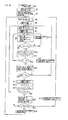
- Figure 10 shows the determination process flow performed based on the bag weight.
- the control unit 10 Before operating the boxing device 100, as data necessary to the determination process by the control unit 10, it is required to set and input the number K of rows (lines) of the groups G of bags to be packed in the box C, the number N of the individual bags B included in one row (group), and the upper limit w U and the lower limit w L of the weight of the individual bag B (steps B1 to B3).
- initial values of the gross weight W1, a counter k for the number of rows, the group weight W2, and the bag number counter n are reset to zero (steps B4 to B7).
- the weight w n of the individual bag B is detected by the individual weight checker 1 (step B8) and whether or not it is within the predetermined weight range is determined (step B9).
- the weight w n of such individual bag B is added to the group weight W2 (step B10), the number n of the individual bags B added is counted (step B11), and this process is repeated until the number N set in step A2 is reached (step B12).
- the weight w n of the individual bag B is not within the predetermined weight range, it is not added to the group weight W2. Instead, such individual bag B is discharged to the outside of the process (step B13), and the weight w n of a next individual bag B is detected (step B8).
- the weight Wg of the group G of bags is detected by the group weight checker 6 (step B 14), and whether or not the weight Wg is equal to the group weight W2 is determined (step B16).
- the group of bags is packed in the box (step B 17)
- the number k of rows to be packed in the box is counted (step B 18)
- the weight Wg is added to the gross weight W1 (step B19), and this process is repeated until the number K of rows set in the step B1 is reached (step B20).
- the group weight W2 is not equal to the weight Wg, such group G of bags is discharged to the outside of the process (step B13), and the process for a new group G of bags is started (step B6).
- step B 22 When the number of rows to be packed in the box reaches the set number K, the weight W h of the whole box is detected by the gross weight checker 8 (step B 22), and whether or not the weight W h is equal to the sum of the gross weight W1 and the tare weight Wp is determined (step B23). When it is determined that they are equal to each other, such box C is conveyed to a next process (step B24); and when it is determined that they are not equal to each other, such box C is discharged, as a defective product, to the outside of the process (step B 25). Thereafter, the determination process after step B4 is repeated until the boxing device 100 is stopped.
- the boxing device 100 has the following characteristics.
- the boxing device 100 includes the thickness detection means (seal checker 2) to detect the thickness d n of the each of individual bags B, and the calculation means (control unit 10) to add the thicknesses d n of individual bags B detected by the thickness detection means before the group G of bags, which is formed by collecting a plurality of individual bags B to be packed in the box C of the defined size, is packed in the box. Therefore, it is possible to detect, in advance, a possibility of occurrence of problems such as breakage of a bag during box packing, formation of a pinhole in the course of conveyance after box packing, and the like.
- the boxing device 100 includes a determination means (control unit 10) to determine whether or not it is adequate to pack the group G of bags in the box C of the defined size based on the result of addition by the calculation means. Therefore, it is possible to take an appropriate countermeasure, based on the determination result, to prevent problems such as breakage of a bag during box packing, formation of a pinhole in the course of conveyance after box packing, and the like.
- the boxing device 100 includes the selection means (control unit 10) that is configured such that when the group G of bags is determined by the determination means that it is inadequate to be packed in the box C of the defined size, the selection means selects a bag to be replaced from such group G of bags. Therefore, it is possible to easily take an appropriate countermeasure to prevent problems such as breakage of a bag, a pinhole, and the like.
- the boxing device 100 includes the stock unit 4 to stock spare individual bags B and the selection means (control unit 10) to select an individual bag B among spare individual bags B, which is to be added to the group G of bags instead of the bag to be replaced. Therefore, it is possible to further easily take an appropriate countermeasure to prevent problems such as breakage of a bag, a pinhole, and the like.
- the boxing device 100 automatically discharges the bag to be replaced from the group G of bags to the stock unit 4 and automatically inserts a bag to be added instead of the replaced bag from the stock unit 4. Therefore, occurrence of a broken bag, a pinhole, and the like is reliably prevented, without stopping the device or taking the time of an operator.
- the boxing device 100 is configured such that when an appropriate countermeasure cannot be taken with a spare individual bag B for the group G of bags determined to be inappropriate to be packed in the box C, the boxing device 100 discharges such group G of bags and issues a warning on the touch panel display 20. Therefore, even when there is not any appropriate individual bag B in the stock unit 4, occurrence of a broken bag, a pinhole, and the like is reliably prevented. Note that the device may be stopped along with displaying a warning, instead of discharging the group G of bags.
- the boxing device 100 serves as the thickness detection means by utilizing the seal checker 2 to apply pressure to each individual bag B in the thickness direction thereof to detect the bag thickness d n at the time of pressure application and then determine whether or not the bag is adequately sealed based on the thickness d n . Therefore, it is possible to produce the device at low cost, compared to the case where the thickness detection means is separately provided.
- the boxing device 100 includes the individual weight obtaining means (individual weight checker 1) to obtain the weight w n of the individual bag B; the group weight obtaining means (group weight checker 6) to measure the weight Wg of the group G of bags, which is formed by collecting a plurality of individual bags B to be packed in the box; and the determination means (control unit 10) to determine the adequacy of the weight or the number of articles to be packed in the box based on the weight Wg. Therefore, it is possible to detect problems before box packing and take an appropriate countermeasure.
- the boxing device 100 is configured such that the individual weight obtaining means is the individual weight checker 1 disposed on the upstream side of the group weight obtaining means. Therefore, it is possible to actually measure the weight of each individual bag B and more accurately determine the weight of the group G of bags.
- the boxing device 100 includes the tare weight obtaining means (weighing transport conveyor 73) that measures the weight W p of the box C that is a packaging material, and the sum of the known gross weight W1 and the weight Wp measured by the tare weight obtaining means is used as a reference for the weight check of the plurality of individual bags B packaged (packed) in the box C. Therefore, even when the tare weight of the box C that is a cardboard recyclable container significantly changes due to the humidity, aged deterioration, and other reasons, it is possible to confirm the adequacy of the weight or the number of the individual bags B that are packaged by checking the actual gross weight W h with the tare weight Wp included after packaging is completed.
- the tare weight obtaining means weighing transport conveyor 73
- the thicknesses d n of the individual bags B detected by the thickness detection means are added and whether or not it is adequate to pack the group G of bags in the box C is determined based on the result of the addition and the width dimension D of the box C.
- the thicknesses d n of individual bags B are subtracted one by one from a predetermined value (the width dimension D of the box C), and whether or not it is adequate to pack the group G of bags in the box C is determined based on the result of subtraction (a remaining space d1 resulted in the box C).
- the possibility of occurrence of a pinhole and a broken bag is determined in advance depending on whether the remaining space d1 is too large (step A12) or too small (step A13).
- whether or not it is adequate to pack the group G of bags in the box C of the defined size is determined when addition or subtraction from a predetermined value is finished for all of the individual bags B constituting the group G of bags.
- the number N of the individual bags B included in the group G of bags is large and when most of the individual bags B have the thicknesses d n close to either the upper limit or lower limit in the predetermined thickness range, it may be possible to determine that the group G of bags is inadequate to be packed in the box C before finishing addition or subtraction for all the individual bags B.
- a check may be performed to determine whether the remaining space is too small even if all the rest of the individual bags B are the ones each of which has the thickness d n close to the lower limit, or the remaining space is too large even if all the rest of the individual bags B are the ones each of which has the thickness d n close to the upper limit, and determine whether or not it is adequate to pack the group G of bags in the box C.
- the group weight W1 is not equal to the weight Wg measured by the group weight checker 6, such group G of bags is discharged to the outside of the process.
- the reason for the discrepancy is determined to be a shortage of the number of bags which is caused as some of the individual bags are left out, the shortage may be replenished from the stock unit 4.
- the amount of the shortage is automatically replenished. Thereby, a high productivity can be maintained.
- the weight w n of the individual bag B is measured by the individual weight checker 1 disposed in the upstream side of the group weight checker 6.
- a defined weight for example, the median of a defined weight range
- the weight W h of the whole box may have an error greater than the weight corresponding to one individual bag B. This situation is difficult to be distinguished from the situation where some bags are missing.
- the individual bags B to be packed in the box are weight-checked on a predetermined small number basis by separating such individual bags B into a plurality of groups each of which has the predetermined small number of bags B, it is possible to reliably prevent from erroneously regarding the variations in the weights of the individual bags B as the occurrence of missing of some bags B.
- the packaging material to be used is the box C of the defined size, which is a cardboard recyclable container.
- a container may be formed by a material other than a cardboard.
- it may be a plastic container, and it may not need to be a recyclable container.
- it may be a container having a different shape such as a bag shape other than a box shape.
- a memory medium that stores the weight W p of the box C may be mounted to the box C, and a transport conveyor having a function to read the tare weight W p from the memory medium may be disposed instead of the weighing transport conveyor 73.
- a transport conveyor having a function to read the tare weight W p from the memory medium may be disposed instead of the weighing transport conveyor 73.
- an IC tag in which the weight Wp of the box C is stored may be attached to the box C, and an IC tag reader may be disposed to the transport conveyor provided instead of the weighing transport conveyor 73.
- a barcode including a QR code
- a bar code reader may be disposed to the transport conveyor provided instead of the weighing transport conveyor 73.
- the transport conveyor used instead of the weighing transport conveyor 73 is preferably incorporated into the box-packing process line of the boxing device 100, in a manner in which the transport conveyor can smoothly perform the process to read the tare weight Wp.
- the tare weight W p that is read out is transmitted to the control unit 10, and thereafter the same process as described in the above embodiment is performed.
- boxing device of the present invention is not limited to the embodiment described above, and various changes and modifications can be made herein without departing from the scope of the invention.
Landscapes
- Physics & Mathematics (AREA)
- General Physics & Mathematics (AREA)
- Engineering & Computer Science (AREA)
- Mechanical Engineering (AREA)
- Container Filling Or Packaging Operations (AREA)
- Basic Packing Technique (AREA)
Applications Claiming Priority (3)
| Application Number | Priority Date | Filing Date | Title |
|---|---|---|---|
| JP2006261586 | 2006-09-26 | ||
| JP2006261587 | 2006-09-26 | ||
| PCT/JP2007/068446 WO2008038598A1 (en) | 2006-09-26 | 2007-09-21 | Boxing apparatus and packaging apparatus |
Publications (2)
| Publication Number | Publication Date |
|---|---|
| EP2072403A1 true EP2072403A1 (de) | 2009-06-24 |
| EP2072403A4 EP2072403A4 (de) | 2012-09-12 |
Family
ID=39230033
Family Applications (1)
| Application Number | Title | Priority Date | Filing Date |
|---|---|---|---|
| EP07807777A Withdrawn EP2072403A4 (de) | 2006-09-26 | 2007-09-21 | Einschachtelvorrichtung und verpackungsvorrichtung |
Country Status (6)
| Country | Link |
|---|---|
| US (1) | US20100115886A1 (de) |
| EP (1) | EP2072403A4 (de) |
| JP (1) | JP5237100B2 (de) |
| CN (1) | CN101516731A (de) |
| AU (1) | AU2007301209A1 (de) |
| WO (1) | WO2008038598A1 (de) |
Cited By (4)
| Publication number | Priority date | Publication date | Assignee | Title |
|---|---|---|---|---|
| EP2279948A1 (de) * | 2009-07-28 | 2011-02-02 | Ishida Co., Ltd. | Sammelpacker |
| CN106428671A (zh) * | 2016-10-14 | 2017-02-22 | 深圳万发创新进出口贸易有限公司 | 一种包装称重系统 |
| EP3118125A4 (de) * | 2014-03-11 | 2017-11-29 | Ishida Co., Ltd. | Schachtelsystem |
| BE1028396B1 (nl) * | 2020-06-15 | 2022-01-24 | Vroman Nv | Werkwijze voor het afvullen van vloeistoffen voor de automobielindustrie |
Families Citing this family (12)
| Publication number | Priority date | Publication date | Assignee | Title |
|---|---|---|---|---|
| CN102020024A (zh) * | 2010-11-19 | 2011-04-20 | 天津利福特电梯部件有限公司 | 电梯井道导轨架部件装箱流水线 |
| JP5758739B2 (ja) * | 2011-08-12 | 2015-08-05 | 株式会社イシダ | 搬送装置 |
| EP2885211B1 (de) | 2012-08-14 | 2018-10-03 | Altria Client Services LLC | System mit eingebauter gewichtskontrolle zum direkten abfüllen von hergestellten beuteln in behälter sowie zugehöriges verfahren |
| JP6379670B2 (ja) * | 2013-07-25 | 2018-08-29 | 株式会社リコー | 物流管理システム及び物流管理方法 |
| US10759550B2 (en) | 2015-09-25 | 2020-09-01 | Douglas Machine Inc. | Intermittent case packer assembly and methods |
| JP6469061B2 (ja) * | 2016-09-29 | 2019-02-13 | ファナック株式会社 | 積み付けパターン計算装置及び積み付けシステム |
| JP6927006B2 (ja) * | 2017-12-11 | 2021-08-25 | 株式会社ダイフク | 物品搬送設備 |
| FR3087427B1 (fr) * | 2018-10-19 | 2021-01-22 | Jacky Peterlini | Dispositif et procede de rassemblement et de dechargement d’articles |
| JP7244309B2 (ja) | 2019-03-11 | 2023-03-22 | 株式会社ニチレイフーズ | 組合せ計量システム、組合せ計量方法及び組合せ計量プログラム |
| CN115583385B (zh) * | 2022-09-08 | 2023-08-22 | 合肥哈工龙延智能装备有限公司 | 一种智能开装封箱码垛一体机的上料装置 |
| CN115839732B (zh) * | 2022-10-27 | 2025-12-23 | 长沙隆盛塑业有限公司 | 一种吹塑制品的堆垛检测方法、系统、终端及存储介质 |
| CN118529322B (zh) * | 2024-07-23 | 2024-09-20 | 浙江名瑞智能装备科技股份有限公司 | 一种智能识别下料装袋供料线 |
Family Cites Families (20)
| Publication number | Priority date | Publication date | Assignee | Title |
|---|---|---|---|---|
| US3200864A (en) * | 1962-12-19 | 1965-08-17 | Unexcelled Chemical Corp | Apparatus for stacking and weighing sliced food products |
| US3416619A (en) * | 1966-02-07 | 1968-12-17 | Stanley A. Mcclusky | Means and method for rapidly filling receptacles |
| GB1320344A (en) * | 1970-05-02 | 1973-06-13 | Simon Handling Engs Ltd | Batching material by weight |
| US4428179A (en) * | 1981-11-30 | 1984-01-31 | Banquet Foods Corporation | Chicken weighing apparatus |
| JPS61176821A (ja) * | 1985-01-31 | 1986-08-08 | Anritsu Corp | 自動包装装置 |
| US4827698A (en) * | 1988-03-03 | 1989-05-09 | Nabisco Brands, Inc. | Packaging weight control system |
| DE3830692A1 (de) * | 1988-09-09 | 1990-03-15 | Bosch Gmbh Robert | Verfahren und vorrichtung zum zusammenstellen von gebinden aus mehreren einzelpackungen |
| US5024047A (en) * | 1990-03-08 | 1991-06-18 | Durand-Wayland, Inc. | Weighing and sorting machine and method |
| JPH04311405A (ja) * | 1991-04-02 | 1992-11-04 | Dainippon Printing Co Ltd | 帳票の切断集積箱詰方法及び装置 |
| US5331792A (en) * | 1992-12-04 | 1994-07-26 | Kitchen Farms, Inc. | Packaging unit |
| US5325653A (en) * | 1992-12-14 | 1994-07-05 | Boyd Jerry L | Container filling apparatus |
| DK80593D0 (da) * | 1993-07-06 | 1993-07-06 | Scanvaegt As | Fremgangsmaade og anlaeg til udvejning af genstandsportioner |
| IE970406A1 (en) * | 1997-05-30 | 1998-12-02 | Oldbridge Investments Ltd | A biscuit manufacturing process |
| JP3735457B2 (ja) * | 1998-03-05 | 2006-01-18 | 株式会社東京自働機械製作所 | 製品供給装置 |
| JP4180704B2 (ja) * | 1998-09-21 | 2008-11-12 | 大和製衡株式会社 | 箱詰め装置 |
| JP2000266588A (ja) * | 1999-03-15 | 2000-09-29 | Kao Corp | 束状物搬送装置 |
| NZ518851A (en) * | 2002-05-08 | 2004-12-24 | Anzpac Systems Ltd | Sorting apparatus and method |
| JP2004155428A (ja) * | 2002-11-01 | 2004-06-03 | Ishida Co Ltd | 箱詰装置 |
| US7573386B2 (en) * | 2004-08-19 | 2009-08-11 | International Business Machines Corporation | System and method for smart radio frequency identification tags |
| US7279644B1 (en) * | 2006-06-02 | 2007-10-09 | Kasel Donald A | Conveyed product weight display system |
-
2007
- 2007-09-21 WO PCT/JP2007/068446 patent/WO2008038598A1/ja not_active Ceased
- 2007-09-21 US US12/442,805 patent/US20100115886A1/en not_active Abandoned
- 2007-09-21 CN CNA2007800358486A patent/CN101516731A/zh active Pending
- 2007-09-21 JP JP2008536360A patent/JP5237100B2/ja not_active Expired - Fee Related
- 2007-09-21 AU AU2007301209A patent/AU2007301209A1/en not_active Abandoned
- 2007-09-21 EP EP07807777A patent/EP2072403A4/de not_active Withdrawn
Cited By (5)
| Publication number | Priority date | Publication date | Assignee | Title |
|---|---|---|---|---|
| EP2279948A1 (de) * | 2009-07-28 | 2011-02-02 | Ishida Co., Ltd. | Sammelpacker |
| US8549825B2 (en) | 2009-07-28 | 2013-10-08 | Ishida Co., Ltd. | Case packer |
| EP3118125A4 (de) * | 2014-03-11 | 2017-11-29 | Ishida Co., Ltd. | Schachtelsystem |
| CN106428671A (zh) * | 2016-10-14 | 2017-02-22 | 深圳万发创新进出口贸易有限公司 | 一种包装称重系统 |
| BE1028396B1 (nl) * | 2020-06-15 | 2022-01-24 | Vroman Nv | Werkwijze voor het afvullen van vloeistoffen voor de automobielindustrie |
Also Published As
| Publication number | Publication date |
|---|---|
| WO2008038598A1 (en) | 2008-04-03 |
| EP2072403A4 (de) | 2012-09-12 |
| AU2007301209A1 (en) | 2008-04-03 |
| JP5237100B2 (ja) | 2013-07-17 |
| CN101516731A (zh) | 2009-08-26 |
| JPWO2008038598A1 (ja) | 2010-01-28 |
| US20100115886A1 (en) | 2010-05-13 |
Similar Documents
| Publication | Publication Date | Title |
|---|---|---|
| US20100115886A1 (en) | Boxing device and packaging device | |
| JP5718766B2 (ja) | 被包装物充填装置及び方法 | |
| JP4804025B2 (ja) | 生産システム | |
| CN100473582C (zh) | 包装机及计量机 | |
| JPH09301310A (ja) | 箱詰め装置 | |
| CN104114983A (zh) | 用于提供耗材的设备 | |
| CN108780310A (zh) | 装置管理系统 | |
| JP5037892B2 (ja) | 箱詰装置 | |
| JP3653389B2 (ja) | 長物農産物の仕分装置 | |
| JP2017132609A (ja) | 搬送装置及び計量包装システム | |
| CN120482480A (zh) | 装箱装置 | |
| JP2008068915A (ja) | 箱詰装置 | |
| JP5363099B2 (ja) | 計量機器及び計量方法 | |
| JP2011191074A (ja) | 計量システムおよび包装システム | |
| JP2017132514A (ja) | 計量包装検査システム | |
| JP5188102B2 (ja) | 箱詰め装置 | |
| US7361850B2 (en) | Method and apparatus for counting items in a container | |
| KR20110113866A (ko) | 계량장치 및 이를 갖는 제품 카운터 | |
| KR200440890Y1 (ko) | 제품이송장치 | |
| CN223457247U (zh) | 一种包装输送线 | |
| US20150068159A1 (en) | Storage magazine and method for the interim storage of snus bags | |
| CN205837340U (zh) | 一种用于生产线的称量机 | |
| JP2025025410A (ja) | 商品処理システム | |
| WO2024232868A1 (en) | Intermittent motion scale conveyor | |
| CN121425608A (zh) | 一种直列式组合秤分料机 |
Legal Events
| Date | Code | Title | Description |
|---|---|---|---|
| PUAI | Public reference made under article 153(3) epc to a published international application that has entered the european phase |
Free format text: ORIGINAL CODE: 0009012 |
|
| 17P | Request for examination filed |
Effective date: 20090424 |
|
| AK | Designated contracting states |
Kind code of ref document: A1 Designated state(s): AT BE BG CH CY CZ DE DK EE ES FI FR GB GR HU IE IS IT LI LT LU LV MC MT NL PL PT RO SE SI SK TR |
|
| DAX | Request for extension of the european patent (deleted) | ||
| A4 | Supplementary search report drawn up and despatched |
Effective date: 20120814 |
|
| RIC1 | Information provided on ipc code assigned before grant |
Ipc: G01G 19/387 20060101ALI20120808BHEP Ipc: G01M 3/36 20060101ALN20120808BHEP Ipc: G01G 15/00 20060101ALI20120808BHEP Ipc: B65B 5/06 20060101AFI20120808BHEP Ipc: B65B 35/30 20060101ALI20120808BHEP |
|
| STAA | Information on the status of an ep patent application or granted ep patent |
Free format text: STATUS: THE APPLICATION IS DEEMED TO BE WITHDRAWN |
|
| 18D | Application deemed to be withdrawn |
Effective date: 20130312 |