EP2073075A2 - Day of the month display for watch movement - Google Patents
Day of the month display for watch movement Download PDFInfo
- Publication number
- EP2073075A2 EP2073075A2 EP09154720A EP09154720A EP2073075A2 EP 2073075 A2 EP2073075 A2 EP 2073075A2 EP 09154720 A EP09154720 A EP 09154720A EP 09154720 A EP09154720 A EP 09154720A EP 2073075 A2 EP2073075 A2 EP 2073075A2
- Authority
- EP
- European Patent Office
- Prior art keywords
- mobile
- date
- mechanism according
- sequence
- units
- Prior art date
- Legal status (The legal status is an assumption and is not a legal conclusion. Google has not performed a legal analysis and makes no representation as to the accuracy of the status listed.)
- Withdrawn
Links
- 230000007246 mechanism Effects 0.000 claims abstract description 41
- 230000000717 retained effect Effects 0.000 claims description 6
- 230000008859 change Effects 0.000 description 4
- 230000003203 everyday effect Effects 0.000 description 2
- 230000007704 transition Effects 0.000 description 2
- 102100032392 Circadian-associated transcriptional repressor Human genes 0.000 description 1
- 101710130150 Circadian-associated transcriptional repressor Proteins 0.000 description 1
- 230000008901 benefit Effects 0.000 description 1
- 230000001419 dependent effect Effects 0.000 description 1
- 238000006073 displacement reaction Methods 0.000 description 1
- 239000011229 interlayer Substances 0.000 description 1
- 230000009191 jumping Effects 0.000 description 1
- 230000004048 modification Effects 0.000 description 1
- 238000012986 modification Methods 0.000 description 1
- 238000009987 spinning Methods 0.000 description 1
Images



Classifications
-
- G—PHYSICS
- G04—HOROLOGY
- G04B—MECHANICALLY-DRIVEN CLOCKS OR WATCHES; MECHANICAL PARTS OF CLOCKS OR WATCHES IN GENERAL; TIME PIECES USING THE POSITION OF THE SUN, MOON OR STARS
- G04B11/00—Click devices; Stop clicks; Clutches
- G04B11/006—Clutch mechanism between two rotating members with transfer of movement in only one direction (free running devices)
- G04B11/008—Clutch mechanism between two rotating members with transfer of movement in only one direction (free running devices) with friction members, e.g. click springs or jumper
-
- G—PHYSICS
- G04—HOROLOGY
- G04B—MECHANICALLY-DRIVEN CLOCKS OR WATCHES; MECHANICAL PARTS OF CLOCKS OR WATCHES IN GENERAL; TIME PIECES USING THE POSITION OF THE SUN, MOON OR STARS
- G04B19/00—Indicating the time by visual means
- G04B19/24—Clocks or watches with date or week-day indicators, i.e. calendar clocks or watches; Clockwork calendars
- G04B19/243—Clocks or watches with date or week-day indicators, i.e. calendar clocks or watches; Clockwork calendars characterised by the shape of the date indicator
- G04B19/247—Clocks or watches with date or week-day indicators, i.e. calendar clocks or watches; Clockwork calendars characterised by the shape of the date indicator disc-shaped
Definitions
- the present invention relates to a date display mechanism for watch movement, in particular a large date display mechanism.
- Needle watch movements that allow the display of the date of the date most often use a 31-position annular calendar disc, the dates from 1 to 31 being printed on these positions.
- the date disc is indexed each day by one position, so that another date appears every day through a window in the dial.
- Each indexing position thus occupies an angular portion of 360 ° / 31, on which a date with one or two digits must be indicated; the maximum size of the displayed numbers is therefore limited.
- Jaquet SA International demand WO9913383
- the disk of the units carries three times the sequence of digits from 0 to 9 plus an interlayer 1, corresponding to the sequence of units for the numbers from 0 to 31.
- the branches of the cross carry the digits from 0 to 3 respectively.
- a window on the dial is arranged to display both the portion of the cross covering the annular disk and the next digit of the units to the right of the cross.
- the cross of the units occupies an important space in the center of the watch; this space is therefore unavailable for other displays, for example for the axes of auxiliary function needles such as chrono, power reserve, display of the day of the week, etc.
- auxiliary function needles such as chrono, power reserve, display of the day of the week, etc.
- the size of the cross of the tens, and therefore the maximum dimension of the date digits displayed is limited by the distance between the disk of the units and the axis of the seconds.
- the tens star is driven by the annular disk units through a star meshing with the internal toothing of the disk units and retained by a jumper.
- the star may sometimes be driven with sufficient energy for the jumper to pass directly from a tooth, or branch, to a non-neighboring tooth of the star.
- the correspondence between the tens and the units is irremediably destroyed; the watch could for example display dates 32, 33, etc.
- it is therefore necessary to use a retaining collar of the star actuated by a sufficiently strong spring; this solution however has the disadvantage of considerably increasing the power and the energy required for the change of date.
- the motors must be oversized only to act on the jumper, and the power consumption is increased.
- An object of the present invention is to provide a date display mechanism which avoids these disadvantages.
- a date display mechanism for watch movement comprising a first mobile carrying a first sequence of digits and a second mobile carrying a second sequence of digits.
- the two mobiles are arranged and arranged so that, at least for certain dates, the date displayed to the user corresponds to the combination of indications carried by the first mobile and indications carried by the second mobile, while for at least one other date the displayed date corresponds to the combination of two digits or a digit and a space carried by the same mobile.
- the display mechanism of the invention is therefore a combination between a large date display mechanism, with two figures carried by two distinct mobiles, and a conventional date display mechanism for other dates, for which the single digit or two digits of the date are carried by the same mobile. This avoids, at least for some dates, the disadvantages of the display by two distinct mobiles, without having to give up the display of large dates.
- This solution also makes it possible to balance the number of indications carried by the two mobiles, by reporting certain indications of units on the tens disk and / or certain indications of tens on the disk of the units, so as to be able to display dates of the largest possible size.
- the two mobiles are preferably constituted by two concentric annular disks and preferably superposed. This avoids occupying the portions of the upper surface of the movement that could be used by other displays.
- the date can be displayed at any angular position on the dial by replacing only the annular disks, without changing or moving the drive mechanism.
- a date display mechanism for watch movement comprising a first mobile bearing a first sequence of digits, and a second mobile carrying a second sequence of digits.
- the two mobiles are arranged and arranged so that, at least for certain dates, the date displayed to the user corresponds to the combination of indications carried by the first mobile and indications carried by the second mobile.
- the second mobile for example the mobile carrying at least some tens, is driven by the other mobile, for example the mobile carrying at least some units, through a star held by a jumper.
- An abutment member is arranged to prevent the jumper from passing directly from a tooth of the star to a non-adjacent tooth upon the change of date.
- This solution has the advantage of reducing or eliminating the risk that the second disk is erroneously indexed by two positions instead of one when the date is changed, in particular during the manual correction of the date. It is thus possible to safely reduce the force of the spring acting on the retainer of the star, which reduces the energy and power required to change tens of the date.
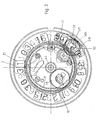
- the figure 1 shows a top view of the date drive mechanism according to a first variant of the invention; only the parts useful for the understanding of the mechanism have been represented in full lines for ease of understanding of the figure.
- the mechanism comprises two mobiles formed in this example by two concentric annular disks 1 and 2 superimposed.
- the first mobile 1, or ring of units carries a sequence of digits 10 ⁇ 1,2,3,4,5,6,7,8,9,0, 1,2,3,4,5,6,7 , 8,9,0,1,2,3,4,5,6,7,8,9 ⁇ .
- the numbers are regularly spaced except for a larger interval between the last 9 and the first 1 which is sufficient to display a two-digit date, as will be seen later.
- the dates are intended to be displayed at twelve o'clock on the dial; the figures of the units are thus arranged almost radially, so as to appear vertical when they are seen through a vertical window just to the right of the twelve o'clock position.
- the second mobile, or tens ring is constituted by a second ring 2 concentrically rotating over the ring of the units 1, as can be seen in particular on the Figures 5 and 6 .
- the dial 6 of the watch is at the bottom.
- the second ring 2 bears the sequence ⁇ 0,1,2,30,31,0,1,2,30,31 ⁇ .
- a vertical window 21 is stamped through the tens ring 2 to the right of the numerals 0, 1 and 2, making it possible to see the numbers carried by the ring of the units 1.
- the second mobile 2 could be constituted by a non-annular element, for example by a cross or a star rotating above the first mobile 1, and provided with non-rectangular cutouts 21, for example as suggested in the document WO9913383 mentioned.
- the mobile tens could carry a single sequence ⁇ 0,1,2,30,31 ⁇ , or more than twice this sequence.
- a single sequence however has the disadvantage of requiring significant angular steps at each indexing of the mobile, while the display of a larger number of sequences necessarily leads to use smaller numbers.
- the two mobiles could be concentric but of different diameters, and therefore not superimposed, or partially superimposed.
- at least one of the two annular discs could carry cutouts in the form of internal or external radial flaps to cover the figures or indications carried by the other mobile on certain dates.
- cuts provided in the various variants of the invention may also be constituted by transparent portions of one of the two mobiles.
- the arrangement of the numbers 10, 20 and the inclination of the windows 21 depends on the position chosen for displaying the date on the dial; for example, to display the date at three o'clock, it is necessary to rotate the numbers 10, 20 as well as the windows 21 by 90 °. In this the numbers and the windows occupy a larger angular segment, so that a number of sequences different from two on the tens ring 2 may be adopted.
- the angle of rotation depends, of course, on the angular position of the counter.
- the date 3 displayed through the window 60 in the dial 6 is generally formed of a number 20 coming from the ring of tens 2 and a second digit 10 coming from the ring of 1, visible through a window 21.
- the date 3 displayed to the user of the watch comprises two figures, both of which are carried by the tens ring. these particular dates, the problem of difference of depth between the digit of tens and the number of units.
- the maximum date size displayed in a conventional large-date display corresponds to the maximum size of the numbers that can be displayed on both the tens and units mobile.
- the ring of units 1 carries the sequence of digits 10 ⁇ 1,1,2,3,4,5,6,7,8,9,0,1,2,3,4,5,6,7, 8,9,0,1,2,3,4,5, -6,7,8,9 ⁇ while the tens ring carries the sequence of digits 20 ⁇ 0,1,2,30,3,0 , 1,2,30,3 ⁇ , the '0' can also be replaced by spaces.
- This configuration makes it possible to display all the dates by means of indications carried by the two mobiles 1, 2, with the exception of the date which is indicated by means of two figures carried by the tens ring 2.
- the ring of units 1 carries the sequence of digits 10 ⁇ 1,2,3,4,5,6,7,8,9 ⁇ repeated three times while the ring of tens carries the sequence of digits 20 ⁇ 0 , 10,1,20,2,30,31 ⁇ .
- This configuration allows you to display all the dates using of indications carried by the two mobiles 1, 2, with the exception of the dates 10, 20, 30 and 31 which are indicated by means of two figures carried by the tens ring 2.
- the ring of units 1 carries the sequence of digits 10 ⁇ 1,2,3,4,5,6,7,8,9,0,1,2,3,4,5,6,7,8, 9,0,1,2,3,4,5,6,7,8,9,0 ⁇ while the tens ring carries the sequence of digits ⁇ 0,1,2,3,31,0, 1,2,3,31 ⁇ .
- This configuration makes it possible to display all the dates by means of indications carried by the two mobiles 1, 2, with the exception of the date 31 which is indicated by means of two figures carried by the tens ring 2.
- the dates corresponding to dates 1 to 9 are displayed using a single mobile; this allows for example to display this date with a single digit that can also be centered in the window 60.
- the indication of the tens and the indication of the units can be displayed in two separate windows juxtaposed or arranged at different points of the dial, for example at ten o'clock and two o'clock.
- the two mobiles are driven by the same electromechanical or mechanical motor (not shown) and set by the same crown; it would however also be possible to drive and / or adjust the two mobiles by two independent motors, or by a single motor but through two separate kinematic chains.
- a pinion 44 actuated by the not shown motor drives a wheel 46 on the axis of which is mounted a pawl device 460 arranged to cause the rotation, each day, at midnight or at another time, the internal toothing 11
- ring 1 is indexed every day by 360/31 degrees to perform one round per month of 31 days.
- the number and the instant of the rotations of the tens ring depend on the sequences on the two mobiles 1 and 2, as can be seen by comparing the position of the stops 12 on the variants of Figures 1 to 4 .
- the star 50 drives at each rotation a wheel 52 mounted on the same axis, which in turn actuates a wheel 53.
- the wheel 53 is mounted on the axis of a wheel 54 meshing with the internal toothing 22 of the ring
- the gear ratio between the wheels 50 and 53 is chosen so that the indexing angle of the ring 2 caused by a displacement of the star 50 corresponds to the angular distance between two numbers. tens.
- the star 50 is retained by a jumper 51 pressed against the gap 502 between two teeth 501 of the star 50 by a spring 510.
- the jumper prevents the star 50 from spinning freely, particularly when is driven by a stop pin 12.
- a stop element 511 here constituted by a pin perpendicular to the plane of the watch, which moves in a slider 500 machined in the wheel 52.
- the shape of the slider 500 prevents the pin 511 from jumping directly from a gap 502 to a non-adjacent gap between two teeth of the star 50; it thus surrounds the star 50 by marrying approximately its contours.
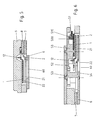
- the first mobile 1 slides directly on the upper deck 9 of the movement of the watch, and is retained by a first plate 8 mounted over this bridge.
- the second mobile 2 slides on an annular path over this first plate 8 and is retained by a second plate 7.
- the dial 6 is fixed over the second plate and provided with a window 60 to display the dates carried by the first and / or second mobile.
Landscapes
- Physics & Mathematics (AREA)
- General Physics & Mathematics (AREA)
- Electromechanical Clocks (AREA)
- Electric Clocks (AREA)
Abstract
Description
La présente invention concerne un mécanisme d'affichage du quantième pour mouvement de montre, en particulier un mécanisme d'affichage de quantième de grande taille.The present invention relates to a date display mechanism for watch movement, in particular a large date display mechanism.
Les mouvements de montre à aiguilles qui permettent l'affichage du quantième de la date utilisent le plus souvent un disque des quantièmes annulaire à 31 positions, les quantièmes de 1 à 31 étant imprimés sur ces positions. Le disque des quantièmes est indexé chaque jour d'une position, de manière à faire apparaître chaque jour un autre quantième au travers d'un guichet dans le cadran. Chaque position d'indexation occupe donc une portion angulaire de 360°/31, sur laquelle une date à un ou deux chiffres doit être indiquée; la taille maximale des nombres affichés est donc limitée.Needle watch movements that allow the display of the date of the date most often use a 31-position annular calendar disc, the dates from 1 to 31 being printed on these positions. The date disc is indexed each day by one position, so that another date appears every day through a window in the dial. Each indexing position thus occupies an angular portion of 360 ° / 31, on which a date with one or two digits must be indicated; the maximum size of the displayed numbers is therefore limited.
On connaît donc différents systèmes permettant d'afficher des quantièmes de plus grande taille. Les systèmes connus utilisent souvent deux mobiles distincts, l'un pour les dizaines et l'autre pour les unités du quantième; un système de contrôle mécanique ou électromécanique permet d'afficher chaque jour la bonne combinaison dizaine-unité au travers du ou des guichets.So we know different systems for displaying larger dates. Known systems often use two distinct mobiles, one for the tens and the other for the date units; a mechanical or electromechanical control system makes it possible to display each day the correct ten-unit combination through the window (s).
La demande internationale
Cette disposition a l'inconvénient de nécessiter des modifications importantes du mécanisme si l'on souhaite afficher la date à un autre endroit, par exemple à trois heures ou à six heures plutôt qu'à douze heures. Dans ce cas, l'axe de la croix des dizaines doit être déplacé, et tout le système d'entraînement adapté en conséquence.This provision has the disadvantage of requiring significant modifications of the mechanism if we wish to display the date to another place, for example at three o'clock or six o'clock rather than twelve o'clock. In this case, the axis of the tens cross must be moved, and the entire drive system adapted accordingly.
D'autre part, la croix des unités occupe un espace important au centre de la montre; cet espace est donc indisponible pour d'autres affichages, par exemple pour les axes d'aiguilles de fonctions auxiliaires telles que chrono, réserve de marche, affichage du jour de la semaine, etc. En tous les cas, la taille de la croix des dizaines, et donc la dimension maximale des chiffres de quantième affichés, est limitée par la distance entre le disque des unités et l'axe des secondes.On the other hand, the cross of the units occupies an important space in the center of the watch; this space is therefore unavailable for other displays, for example for the axes of auxiliary function needles such as chrono, power reserve, display of the day of the week, etc. In any case, the size of the cross of the tens, and therefore the maximum dimension of the date digits displayed, is limited by the distance between the disk of the units and the axis of the seconds.
Dans cette solution, les chiffres des dizaines et des unités sont dans tous les cas affichés par des mobiles se déplaçant dans deux plans différents; il y a donc, pour toutes les dates, une différence de profondeur entre le chiffre des dizaines et le chiffre unités, qui est visible à travers le guichet de date.In this solution, the figures of tens and units are in all cases displayed by mobiles moving in two different planes; therefore, for all dates, there is a difference in depth between the tens digit and the units digit, which is visible through the date window.
Par ailleurs, dans cette solution, l'étoile des dizaines est entraînée par le disque annulaire des unités au travers d'une étoile engrenant avec la denture interne du disque des unités et retenue par un sautoir. Lors du changement de date, en particulier lors d'une correction manuelle de la date, l'étoile risque parfois d'être entraînée avec une énergie suffisante pour que le sautoir passe directement d'une dent, ou branche,à une dent non voisine de l'étoile. Dans ce cas, la correspondance entre les dizaines et les unités est irrémédiablement détruite; la montre pourrait par exemple afficher des dates 32, 33, etc. Pour limiter ce risque, sans le supprimer complètement, il est donc nécessaire d'utiliser un sautoir de retenue de l'étoile actionné par un ressort suffisamment fort; cette solution a cependant l'inconvénient d'augmenter considérablement la puissance et l'énergie requise pour le changement de date. Les moteurs doivent donc être surdimensionnés uniquement pour agir sur le sautoir, et la consommation électrique s'en trouve d'autant accrue.Moreover, in this solution, the tens star is driven by the annular disk units through a star meshing with the internal toothing of the disk units and retained by a jumper. When changing the date, especially when manually correcting the date, the star may sometimes be driven with sufficient energy for the jumper to pass directly from a tooth, or branch, to a non-neighboring tooth of the star. In this case, the correspondence between the tens and the units is irremediably destroyed; the watch could for example display dates 32, 33, etc. To limit this risk, without completely eliminating it, it is therefore necessary to use a retaining collar of the star actuated by a sufficiently strong spring; this solution however has the disadvantage of considerably increasing the power and the energy required for the change of date. The motors must be oversized only to act on the jumper, and the power consumption is increased.
Un but de la présente invention est de proposer un mécanisme d'affichage de quantième qui évite ces inconvénients.An object of the present invention is to provide a date display mechanism which avoids these disadvantages.
Selon l'invention, ces problèmes sont résolus au moyen d'une montre qui présente les caractéristiques des revendications indépendantes, des caractéristiques préférentielles étant en outre indiquées dans les revendications dépendantes.According to the invention, these problems are solved by means of a watch which has the features of the independent claims, preferential features being further indicated in the dependent claims.
En particulier, ces problèmes sont résolus grâce à un mécanisme d'affichage du quantième pour mouvement de montre, comportant un premier mobile portant une première séquence de chiffres et un deuxième mobile portant une deuxième séquence de chiffres. Les deux mobiles sont agencés et disposés de manière à ce que, au moins pour certaines dates, le quantième affiché à l'utilisateur corresponde à la combinaison d'indications portées par le premier mobile et d'indications portées par le deuxième mobile, tandis que pour au moins une autre date le quantième affiché correspond à la combinaison de deux chiffres ou d'un chiffre et d'un espace portés par le même mobile.In particular, these problems are solved by a date display mechanism for watch movement, comprising a first mobile carrying a first sequence of digits and a second mobile carrying a second sequence of digits. The two mobiles are arranged and arranged so that, at least for certain dates, the date displayed to the user corresponds to the combination of indications carried by the first mobile and indications carried by the second mobile, while for at least one other date the displayed date corresponds to the combination of two digits or a digit and a space carried by the same mobile.
Le mécanisme d'affichage de l'invention est donc une combinaison entre un mécanisme d'affichage de grande date, avec deux chiffres portés par deux mobiles distincts, et un mécanisme d'affichage de quantième conventionnel pour d'autres dates, pour lesquelles le chiffre unique ou les deux chiffres du quantième sont portés par le même mobile. On évite ainsi, au moins pour certaines dates, les inconvénients de l'affichage par deux mobiles distincts, sans devoir renoncer à l'affichage de quantièmes de grande taille.The display mechanism of the invention is therefore a combination between a large date display mechanism, with two figures carried by two distinct mobiles, and a conventional date display mechanism for other dates, for which the single digit or two digits of the date are carried by the same mobile. This avoids, at least for some dates, the disadvantages of the display by two distinct mobiles, without having to give up the display of large dates.
Cette solution permet en outre d'équilibrer le nombre d'indications portées par les deux mobiles, en reportant certaines indications d'unités sur le disque des dizaines et/ou certaines indications de dizaines sur le disque des unités, de manière à pouvoir afficher des quantièmes de la plus grande taille possible.This solution also makes it possible to balance the number of indications carried by the two mobiles, by reporting certain indications of units on the tens disk and / or certain indications of tens on the disk of the units, so as to be able to display dates of the largest possible size.
Les deux mobiles sont de préférence constitués par deux disques annulaires concentriques et de préférence superposés. On évite ainsi d'occuper les portions de la surface supérieure du mouvement qui pourraient être utilisées par d'autres affichages. Par ailleurs, la date peut être affichée à n'importe quelle position angulaire sur le cadran en remplaçant uniquement les disques annulaires, sans modifier ni déplacer le mécanisme d'entraînement.The two mobiles are preferably constituted by two concentric annular disks and preferably superposed. This avoids occupying the portions of the upper surface of the movement that could be used by other displays. In addition, the date can be displayed at any angular position on the dial by replacing only the annular disks, without changing or moving the drive mechanism.
Ces objectifs sont aussi atteints au moyen d'un mécanisme d'affichage du quantième pour mouvement de montre, comportant un premier mobile portant une première séquence de chiffres, et un deuxième mobile portant une deuxième séquence de chiffres. Les deux mobiles sont agencés et disposés de manière à ce que, au moins pour certaines dates, le quantième affiché à l'utilisateur corresponde à la combinaison d'indications portées par le premier mobile et d'indications portées par le deuxième mobile. Le deuxième mobile, par exemple le mobile portant au moins certaines dizaines, est entraîné par l'autre mobile, par exemple le mobile portant au moins certaines unités, au travers d'une étoile retenue par un sautoir. Un élément de butée est agencé de manière à empêcher que le sautoir passe directement d'une dent de l'étoile à une dent non adjacente lors du changement de date.These objectives are also achieved by means of a date display mechanism for watch movement, comprising a first mobile bearing a first sequence of digits, and a second mobile carrying a second sequence of digits. The two mobiles are arranged and arranged so that, at least for certain dates, the date displayed to the user corresponds to the combination of indications carried by the first mobile and indications carried by the second mobile. The second mobile, for example the mobile carrying at least some tens, is driven by the other mobile, for example the mobile carrying at least some units, through a star held by a jumper. An abutment member is arranged to prevent the jumper from passing directly from a tooth of the star to a non-adjacent tooth upon the change of date.
Cette solution a l'avantage de réduire ou d'éliminer le risque que le deuxième disque soit indexé par erreur de deux positions au lieu d'une seule lors du changement de date, en particulier lors de la correction manuelle de la date. On peut ainsi réduire sans risque la force du ressort agissant sur le sautoir de retenue de l'étoile, ce qui permet de réduire l'énergie et la puissance nécessaires au changement de dizaines du quantième.This solution has the advantage of reducing or eliminating the risk that the second disk is erroneously indexed by two positions instead of one when the date is changed, in particular during the manual correction of the date. It is thus possible to safely reduce the force of the spring acting on the retainer of the star, which reduces the energy and power required to change tens of the date.
L'invention sera mieux comprise à la lecture de la description illustrée par les figures annexées qui montrent:
- La
figure 1 montre une vue de dessus du mécanisme d'entraînement selon une première variante de l'invention. - La
figure 1 montre une vue de dessus de l'anneau des dizaines dans la première variante de l'invention. - La
figure 2 montre une vue de dessus du mécanisme d'entraînement selon une deuxième variante de l'invention. - La
figure 3 montre une vue de dessus du mécanisme d'entraînement selon une troisième variante de l'invention. - La
figure 4 montre une vue de dessus du mécanisme d'entraînement selon une quatrième variante de l'invention. - La
figure 5 montre une coupe partielle selon l'axe V-V du mécanisme d'entraînement selon l'invention - La
figure 6 montre une coupe partielle selon l'axe VI-VI du mécanisme d'entraînement selon l'invention
- The
figure 1 shows a top view of the drive mechanism according to a first variant of the invention. - The
figure 1 shows a top view of the tens ring in the first variant of the invention. - The
figure 2 shows a top view of the drive mechanism according to a second variant of the invention. - The
figure 3 shows a top view of the drive mechanism according to a third variant of the invention. - The
figure 4 shows a top view of the drive mechanism according to a fourth variant of the invention. - The
figure 5 shows a partial section along the axis VV of the drive mechanism according to the invention - The
figure 6 shows a partial section along the axis VI-VI of the drive mechanism according to the invention
La
Le mécanisme comporte deux mobiles constitués dans cet exemple par deux disques annulaires concentriques 1 et 2 superposés. Le premier mobile 1, ou anneau des unités, porte une séquence de chiffres 10 {1,2,3,4,5,6,7,8,9,0, 1,2,3,4,5,6,7,8,9,0,1,2,3,4,5,6,7,8,9}. Les chiffres sont régulièrement espacés à l'exception d'un intervalle plus important entre le dernier 9 et le premier 1 qui est suffisant pour afficher un quantième à deux chiffres, comme on le verra plus loin. Dans l'exemple illustré, les quantièmes sont destinés à être affichés à douze heures sur le cadran; les chiffres des unités sont donc disposés presque radialement, de manière à apparaître verticaux lorsqu'ils sont vus au travers d'un guichet vertical juste à droite de la position douze heures.The mechanism comprises two mobiles formed in this example by two concentric
Le deuxième mobile, ou anneau des dizaines, est constitué par un deuxième anneau 2 tournant de manière concentrique par-dessus l'anneau des unités 1, comme on le voit en particulier sur les
Dans une variante non illustrée de l'invention, le deuxième mobile 2 pourrait être constitué par un élément non annulaire, par exemple par une croix ou une étoile tournant au-dessus du premier mobile 1, et muni de découpes 21 non rectangulaires, par exemple de la manière suggérée dans le document
Dans une autre variante non illustrée de l'invention, les deux mobiles pourraient être concentriques mais de diamètres différents, et donc non superposés, ou partiellement superposés. Dans ce cas, au moins un des deux disques annulaires pourrait porter des découpes en forme de volets radiaux internes ou externes pour recouvrir les chiffres ou indications portés par l'autre mobile à certaines dates.In another non-illustrated variant of the invention, the two mobiles could be concentric but of different diameters, and therefore not superimposed, or partially superimposed. In this case, at least one of the two annular discs could carry cutouts in the form of internal or external radial flaps to cover the figures or indications carried by the other mobile on certain dates.
Par ailleurs, l'homme du métier comprendra que les découpes prévues dans les différentes variantes de l'invention peuvent aussi être constituées par des portions transparentes d'un des deux mobiles.Moreover, those skilled in the art will understand that the cuts provided in the various variants of the invention may also be constituted by transparent portions of one of the two mobiles.
La disposition des chiffres 10, 20 et l'inclinaison des fenêtres 21 dépend de la position choisie pour l'affichage de la date sur le cadran; par exemple, pour afficher la date à trois heures, il est nécessaire de pivoter aussi bien les chiffres 10, 20 que les fenêtres 21 de 90°. Dans cette disposition, les chiffres et les fenêtres occupent un segment angulaire plus important, en sorte que l'on adoptera éventuellement un nombre de séquences différent de deux sur l'anneau des dizaines 2. L'angle de rotation dépend bien entendu de la position angulaire du guichet.The arrangement of the
Dans cette variante de l'invention, le quantième 3 affiché au travers du guichet 60 dans le cadran 6 est généralement formé d'un chiffre 20 provenant de l'anneau des dizaines 2 et d'un deuxième chiffre 10 provenant de l'anneau des unités 1, visible à travers une fenêtre 21. Toutefois, le 30 et le 31 du mois, le quantième 3 affiché à l'utilisateur de la montre comprend deux chiffres portés tous deux par l'anneau des dizaines 2. On évite ainsi, pour ces dates particulières, le problème de différence de profondeur entre le chiffre des dizaines et le chiffre des unités.In this variant of the invention, the
La taille maximale des quantièmes affichés dans un affichage à grande date conventionnel correspond à la taille maximale des chiffres que l'on peut apposer à la fois sur le mobile des dizaines et des unités. En choisissant d'afficher certains quantièmes à l'aide de deux chiffres provenant du même mobile, on gagne la possibilité de déplacer certaines indications d'un mobile à l'autre, ce qui permet au moins pour certaines configurations d'augmenter la taille des chiffres affichables.The maximum date size displayed in a conventional large-date display corresponds to the maximum size of the numbers that can be displayed on both the tens and units mobile. By choosing to display certain dates using two numbers from the same mobile, it gains the ability to move certain indications from one mobile to another, which allows at least for certain configurations to increase the size of displayable figures.
Sur la variante de la
Sur la variante de la
L'homme du métier comprendra que d'autres variantes sont imaginables dans le cadre de cette invention. Par exemple, sur la
Il serait également possible d'afficher certains quantièmes à l'aide de deux chiffres portés par l'anneau des unités 1, en affichant certaines indications de dizaines sur le disque des unités. Par exemple, on pourrait imaginer que le disque des unités porte la date 30 ou la date 31 en entier. Cette variante a toutefois l'inconvénient d'exiger des fenêtres 21 de grande dimension au travers de l'anneau des dizaines 2, ce qui risque d'affaiblir cet anneau et occupe par ailleurs une place plus importante. Par ailleurs, on pourrait aussi imaginer que certains quantièmes soient affichés à l'aide de deux chiffres portés par l'anneau des unités, d'autres à l'aide de deux chiffres de l'anneau des dizaines, et d'autres enfin à l'aide de deux chiffres portés par les deux anneaux. Enfin, on pourrait en particulier pour des montres de plus grande taille utiliser un disque des unités tournant par-dessus le disque des dizaines et muni de fenêtres pour voir les indications de dizaine sur le deuxième disque.It would also be possible to display certain dates using two numbers carried by the ring of the
On connaît aussi des mouvements dans lesquels la date est affichée à l'aide d'indications littérales, par exemple avec une indication du mois pour des quantièmes perpétuels et/ou avec une indication du jour de la semaine. On comprendra donc que l'invention s'applique aussi à ce type de mouvements, pour lesquels les différentes indications constituant la date sont portées par un nombre de mobiles variable selon le quantième. Par exemple, il serait possible dans le cadre de l'invention d'afficher le jour de la semaine et/ou le mois dans le même guichet 60, ou dans un ou deux guichets supplémentaires, le jour de la semaine et/ou le mois étant indiqué par un ou plusieurs mobiles selon la date.Also known are movements in which the date is displayed using literal indications, for example with an indication of the month for perpetual calendars and / or with an indication of the day of the week. It will therefore be understood that the invention also applies to this type of movement, for which the various indications constituting the date are carried by a number of mobiles variable according to the date. For example, it would be possible in the context of the invention to display the day of the week and / or the month in the
D'autre part, l'indication des dizaines et l'indication des unités peuvent être affichées dans deux guichets distincts juxtaposés ou disposés à différents endroits du cadran, par exemple à dix heures et à deux heures.On the other hand, the indication of the tens and the indication of the units can be displayed in two separate windows juxtaposed or arranged at different points of the dial, for example at ten o'clock and two o'clock.
Nous allons maintenant décrire à l'aide des
Un pignon 44 actionné par le moteur non représenté entraîne une roue 46 sur l'axe de laquelle est monté un dispositif de cliquet 460 agencé de manière à provoquer la rotation, chaque jour, à minuit ou à un autre moment, de la denture interne 11 de l'anneau des unités 1. Dans cet exemple, l'anneau 1 est donc indexé chaque jour de 360/31 degrés afin d'effectuer un tour par mois de 31 jours.A
On pourrait aussi dans le cadre de cette invention imaginer des mécanismes dans lesquels le changement de date ne se fait pas à minuit, ainsi que des mécanismes dans lesquels le disque 1 effectue un tour durant une période différente de 31 jours.One could also within the scope of this invention imagine mechanisms in which the date change is not done at midnight, and mechanisms in which the
L'anneau des unités 1 comporte des butées d'entraînement 12 constituées par des portions repliées par étampage de l'anneau 1. Comme on le voit en particulier sur la coupe de la
o Le 10 du mois, lors du passage de la dizaine 0 à la dizaine 1;o Le 20, lors du passage de la dizaine 1 à la dizaine 2;o Le 30, lors du passage de la dizaine 2au 30;o Le 31, lors du passage du 30au 31; eto Le 1er, lors du passage du 31 à la dizaine 0.
- o On the 10th of the month, during the transition from the 10th to the 10th;
- o On the 20th, during the transition from the 10th to the 10th;
- o On the 30th, during the passage from the 10th to the 30th;
- o The 31, during the passage from 30 to 31; and
- o The 1st , during the passage from the 31st to the 10th.
Le nombre et l'instant des rotations de l'anneau des dizaines dépendent des séquences sur les deux mobiles 1 et 2, comme on peut le voir en comparant la position des butées 12 sur les variantes de
L'étoile 50 entraîne à chaque rotation une roue 52 montée sur le même axe, qui actionne à son tour une roue 53. La roue 53 est montée sur l'axe d'une roue 54 engrenant avec la denture interne 22 de l'anneau des dizaines 2. Le rapport d'engrenage entre les roues 50 et 53 est choisi de manière à ce que l'angle d'indexation de l'anneau 2 provoqué par un déplacement de l'étoile 50 corresponde à la distance angulaire entre deux chiffres des dizaines.The
L'étoile 50 est retenue par un sautoir 51 appuyé contre l'interstice 502 entre deux dents 501 de l'étoile 50 par un ressort 510. Le sautoir permet d'éviter que l'étoile 50 ne tourne librement, en particulier lorsqu'elle est entraînée par une butée en ergot 12. Afin de forcer le sautoir 51 à se déplacer près du fond de l'interstice 502 entre deux dents 501, il est muni d'un élément de butée 511, constitué ici par une goupille perpendiculaire au plan de la montre, qui se déplace dans une coulisse 500 usinée dans la roue 52. La forme de la coulisse 500 empêche la goupille 511 de sauter directement d'un interstice 502 à un interstice non adjacent entre deux dents de l'étoile 50; elle entoure donc l'étoile 50 en épousant approximativement ses contours.The
Comme on le voit en particulier sur la
Claims (19)
Applications Claiming Priority (2)
| Application Number | Priority Date | Filing Date | Title |
|---|---|---|---|
| CH5712003 | 2003-04-02 | ||
| EP04723605A EP1609028B1 (en) | 2003-04-02 | 2004-03-26 | Day of the month display mechanism for watch movement |
Related Parent Applications (1)
| Application Number | Title | Priority Date | Filing Date |
|---|---|---|---|
| EP04723605A Division EP1609028B1 (en) | 2003-04-02 | 2004-03-26 | Day of the month display mechanism for watch movement |
Publications (2)
| Publication Number | Publication Date |
|---|---|
| EP2073075A2 true EP2073075A2 (en) | 2009-06-24 |
| EP2073075A3 EP2073075A3 (en) | 2010-01-06 |
Family
ID=33102863
Family Applications (2)
| Application Number | Title | Priority Date | Filing Date |
|---|---|---|---|
| EP04723605A Expired - Lifetime EP1609028B1 (en) | 2003-04-02 | 2004-03-26 | Day of the month display mechanism for watch movement |
| EP09154720A Withdrawn EP2073075A3 (en) | 2003-04-02 | 2004-03-26 | Day of the month display for watch movement |
Family Applications Before (1)
| Application Number | Title | Priority Date | Filing Date |
|---|---|---|---|
| EP04723605A Expired - Lifetime EP1609028B1 (en) | 2003-04-02 | 2004-03-26 | Day of the month display mechanism for watch movement |
Country Status (7)
| Country | Link |
|---|---|
| US (1) | US7724611B2 (en) |
| EP (2) | EP1609028B1 (en) |
| JP (1) | JP4567666B2 (en) |
| CN (1) | CN100480899C (en) |
| AT (1) | ATE425480T1 (en) |
| DE (1) | DE602004019892D1 (en) |
| WO (1) | WO2004088435A2 (en) |
Families Citing this family (19)
| Publication number | Priority date | Publication date | Assignee | Title |
|---|---|---|---|---|
| US7120091B1 (en) * | 2005-08-25 | 2006-10-10 | Timex Group B.V. | Electronic device with calendar function |
| JP5151637B2 (en) * | 2008-04-10 | 2013-02-27 | セイコーエプソン株式会社 | Clock with date display mechanism |
| JP5100523B2 (en) * | 2008-06-16 | 2012-12-19 | セイコーインスツル株式会社 | DAY DISPLAY DEVICE AND CLOCK HAVING THE SAME |
| JP5311559B2 (en) * | 2009-01-23 | 2013-10-09 | セイコーインスツル株式会社 | Clock with calendar mechanism with two date wheels |
| JP2011089847A (en) * | 2009-10-21 | 2011-05-06 | Seiko Instruments Inc | Calendar mechanism and analog timepiece including the same |
| JP5336997B2 (en) * | 2009-10-21 | 2013-11-06 | セイコーインスツル株式会社 | Calendar mechanism and analog timepiece having the mechanism |
| JP5382720B2 (en) * | 2009-12-24 | 2014-01-08 | セイコーインスツル株式会社 | A watch with a calendar mechanism including the 1st day wheel and the 2nd day wheel |
| JP5467596B2 (en) * | 2010-02-26 | 2014-04-09 | セイコーインスツル株式会社 | Clock with calendar mechanism |
| CH704622B1 (en) * | 2011-03-14 | 2016-03-15 | Christophe Claret S A | Timepiece. |
| CH707474A1 (en) * | 2013-01-17 | 2014-07-31 | Parmigiani Fleurier S A | Timepiece i.e. wrist watch, has driving mechanism driving disks and/or rings in uniform angular steps of around thirty six degrees per day when disks/rings form units and around forty five degrees every five days when disks/rings form tens |
| EP2902852B1 (en) * | 2014-01-31 | 2016-06-22 | ETA SA Manufacture Horlogère Suisse | Device for displaying the date for a timepiece |
| EP3018537B1 (en) * | 2014-11-05 | 2017-07-19 | Blancpain S.A. | Large date display device for a clock piece |
| EP3040784B1 (en) * | 2014-12-30 | 2018-08-15 | ETA SA Manufacture Horlogère Suisse | Date display device for timepiece |
| EP3040785B1 (en) * | 2014-12-30 | 2017-08-02 | ETA SA Manufacture Horlogère Suisse | Date display device of a timepiece |
| EP3040788B1 (en) | 2014-12-30 | 2017-08-09 | ETA SA Manufacture Horlogère Suisse | Clutch mechanism for date display mobiles |
| EP3339973B1 (en) * | 2016-12-21 | 2019-07-24 | Blancpain SA | Date mechanism |
| EP3839658B1 (en) | 2019-12-20 | 2026-01-28 | Blancpain SA | Display changing mechanism |
| DE102020123501B3 (en) | 2020-09-09 | 2022-03-10 | Horl 1993 Gmbh | Roller grinder with press fit between roller and axle |
| DE102020133853B3 (en) | 2020-12-16 | 2022-04-28 | Horl 1993 Gmbh | Cutting tool with support section for preset sharpening angle |
Citations (1)
| Publication number | Priority date | Publication date | Assignee | Title |
|---|---|---|---|---|
| WO1999013383A1 (en) | 1997-09-11 | 1999-03-18 | Jaquet S.A. | Mechanical system for indicating large size calendar date for watch or small clock movements |
Family Cites Families (15)
| Publication number | Priority date | Publication date | Assignee | Title |
|---|---|---|---|---|
| US3645086A (en) * | 1970-03-16 | 1972-02-29 | Bunker Ramo | Calendar clock |
| JPS5134748B2 (en) * | 1971-10-08 | 1976-09-28 | ||
| CH607557GA3 (en) * | 1974-11-06 | 1978-08-31 | Bulova Watch Co Inc | CLOCK CALENDAR SETUP. |
| DE4127825C1 (en) * | 1991-08-22 | 1992-10-01 | Jaeger-Le Coultre S.A., Le Sentier, Ch | |
| US5711100A (en) * | 1993-06-14 | 1998-01-27 | Elmer; William A. | Vehicle advertising sign, system and method |
| CH690869A5 (en) * | 1997-08-27 | 2001-02-15 | Jean Marc Wiederrecht | Mechanism and display for day of the month on timepiece, comprises pinion on hour shaft which drives concentric numbered tens and units rings through separate gear trains with truncated teeth |
| DE69806337T2 (en) * | 1998-03-05 | 2003-06-05 | Frederic Piguet S.A., Le Brassus | Calendar mechanism for clockwork |
| JP2000292557A (en) * | 1999-04-08 | 2000-10-20 | Citizen Watch Co Ltd | Electronic clock with calendar |
| CN2412233Y (en) * | 1999-12-28 | 2000-12-27 | 天津Isa有限公司 | Large calender mechanism of wrist watch |
| TW493113B (en) * | 2000-08-23 | 2002-07-01 | Ebauchesfabrik Eta Ag | Electronic watch with a large date aperture |
| SG102647A1 (en) * | 2000-12-22 | 2004-03-26 | Ebauchesfabrik Eta Ag | Timepiece provided with a date having a large aperture |
| DE20103818U1 (en) * | 2001-03-06 | 2001-06-13 | Paap, Karl-Ludwig, 63452 Hanau | Two-digit mechanical date display |
| FR2836245B1 (en) * | 2002-02-20 | 2004-05-21 | Jacques Andre Finet | WINDOW DATE DISPLAY DEVICE FOR WATCH |
| JP3772763B2 (en) * | 2002-02-28 | 2006-05-10 | セイコーエプソン株式会社 | Electronic clock with date display function |
| JP3536852B2 (en) * | 2002-03-27 | 2004-06-14 | セイコーエプソン株式会社 | Electronic clock |
-
2004
- 2004-03-26 DE DE602004019892T patent/DE602004019892D1/en not_active Expired - Lifetime
- 2004-03-26 AT AT04723605T patent/ATE425480T1/en not_active IP Right Cessation
- 2004-03-26 EP EP04723605A patent/EP1609028B1/en not_active Expired - Lifetime
- 2004-03-26 CN CNB2004800033781A patent/CN100480899C/en not_active Expired - Fee Related
- 2004-03-26 EP EP09154720A patent/EP2073075A3/en not_active Withdrawn
- 2004-03-26 WO PCT/EP2004/050370 patent/WO2004088435A2/en not_active Ceased
- 2004-03-26 JP JP2006505494A patent/JP4567666B2/en not_active Expired - Fee Related
-
2005
- 2005-09-29 US US11/238,751 patent/US7724611B2/en not_active Expired - Fee Related
Patent Citations (1)
| Publication number | Priority date | Publication date | Assignee | Title |
|---|---|---|---|---|
| WO1999013383A1 (en) | 1997-09-11 | 1999-03-18 | Jaquet S.A. | Mechanical system for indicating large size calendar date for watch or small clock movements |
Also Published As
| Publication number | Publication date |
|---|---|
| EP1609028B1 (en) | 2009-03-11 |
| EP2073075A3 (en) | 2010-01-06 |
| US20060028918A1 (en) | 2006-02-09 |
| CN1745342A (en) | 2006-03-08 |
| JP4567666B2 (en) | 2010-10-20 |
| US7724611B2 (en) | 2010-05-25 |
| DE602004019892D1 (en) | 2009-04-23 |
| ATE425480T1 (en) | 2009-03-15 |
| HK1086895A1 (en) | 2006-09-29 |
| EP1609028A2 (en) | 2005-12-28 |
| JP2006522323A (en) | 2006-09-28 |
| WO2004088435A3 (en) | 2005-02-03 |
| CN100480899C (en) | 2009-04-22 |
| WO2004088435A2 (en) | 2004-10-14 |
Similar Documents
| Publication | Publication Date | Title |
|---|---|---|
| EP1609028B1 (en) | Day of the month display mechanism for watch movement | |
| EP1636656B1 (en) | Cog system for watch action | |
| EP0940833B1 (en) | Calendar mechanism for watch movement | |
| EP2447789B1 (en) | Calendar display device and calendar watch | |
| EP2428856B1 (en) | Timepiece | |
| EP1351104B1 (en) | Device with program wheel for perpetual calendar mechanism, and timepiece provided with such a mechanism | |
| EP3690556B1 (en) | Timepiece comprising a display with variable pitch | |
| EP1536299B1 (en) | Calendar mechanism for a watch comprising two superposed date annuli | |
| EP3857313B1 (en) | Display mechanism with a single dial window | |
| EP3477402B1 (en) | Device for displaying the phases of the moon | |
| EP2720090B1 (en) | Universal timepiece | |
| EP1536300B1 (en) | Calendar mechanism for a watch comprising two superposed date annuli | |
| EP2713226B1 (en) | Date mechanism | |
| EP1426836B1 (en) | Date display mechanism for timepiece | |
| EP3667434B1 (en) | Large date mechanism and timepiece comprising such a mechanism | |
| EP1240559B1 (en) | Annual, perpetual or centennial calendar mechanism | |
| EP3644130B1 (en) | Date mechanism | |
| EP1351105B1 (en) | Timepiece with perpetual calender display | |
| EP3764171B1 (en) | Mechanism for displaying a horological value | |
| EP3460588B1 (en) | Date mechanism | |
| CH716556B1 (en) | Moon age display mechanism timepiece. | |
| EP1962153B1 (en) | Device for displaying the date | |
| EP2042945A2 (en) | Month display device for a timepiece | |
| EP3040784A1 (en) | Date display device for timepiece | |
| WO2006108878A1 (en) | Jumping hour display mechanism for timepiece |
Legal Events
| Date | Code | Title | Description |
|---|---|---|---|
| PUAI | Public reference made under article 153(3) epc to a published international application that has entered the european phase |
Free format text: ORIGINAL CODE: 0009012 |
|
| AC | Divisional application: reference to earlier application |
Ref document number: 1609028 Country of ref document: EP Kind code of ref document: P |
|
| AK | Designated contracting states |
Kind code of ref document: A2 Designated state(s): AT BE BG CH CY CZ DE DK EE ES FI FR GB GR HU IE IT LI LU MC NL PL PT RO SE SI SK TR |
|
| AX | Request for extension of the european patent |
Extension state: AL LT LV MK |
|
| PUAL | Search report despatched |
Free format text: ORIGINAL CODE: 0009013 |
|
| AK | Designated contracting states |
Kind code of ref document: A3 Designated state(s): AT BE BG CH CY CZ DE DK EE ES FI FR GB GR HU IE IT LI LU MC NL PL PT RO SE SI SK TR |
|
| AX | Request for extension of the european patent |
Extension state: AL LT LV MK |
|
| RIC1 | Information provided on ipc code assigned before grant |
Ipc: G04B 19/20 20060101ALI20091127BHEP Ipc: G04B 11/00 20060101ALI20091127BHEP Ipc: G04C 17/00 20060101ALI20091127BHEP Ipc: G04B 19/24 20060101AFI20090519BHEP |
|
| AKY | No designation fees paid | ||
| REG | Reference to a national code |
Ref country code: DE Ref legal event code: 8566 |
|
| STAA | Information on the status of an ep patent application or granted ep patent |
Free format text: STATUS: THE APPLICATION IS DEEMED TO BE WITHDRAWN |
|
| 18D | Application deemed to be withdrawn |
Effective date: 20100708 |