EP2073075A2 - Monatstaganzeigemechanismus für Uhrwerk - Google Patents
Monatstaganzeigemechanismus für Uhrwerk Download PDFInfo
- Publication number
- EP2073075A2 EP2073075A2 EP09154720A EP09154720A EP2073075A2 EP 2073075 A2 EP2073075 A2 EP 2073075A2 EP 09154720 A EP09154720 A EP 09154720A EP 09154720 A EP09154720 A EP 09154720A EP 2073075 A2 EP2073075 A2 EP 2073075A2
- Authority
- EP
- European Patent Office
- Prior art keywords
- mobile
- date
- mechanism according
- sequence
- units
- Prior art date
- Legal status (The legal status is an assumption and is not a legal conclusion. Google has not performed a legal analysis and makes no representation as to the accuracy of the status listed.)
- Withdrawn
Links
- 230000007246 mechanism Effects 0.000 claims abstract description 41
- 230000000717 retained effect Effects 0.000 claims description 6
- 230000008859 change Effects 0.000 description 4
- 230000003203 everyday effect Effects 0.000 description 2
- 230000007704 transition Effects 0.000 description 2
- 102100032392 Circadian-associated transcriptional repressor Human genes 0.000 description 1
- 101710130150 Circadian-associated transcriptional repressor Proteins 0.000 description 1
- 230000008901 benefit Effects 0.000 description 1
- 230000001419 dependent effect Effects 0.000 description 1
- 238000006073 displacement reaction Methods 0.000 description 1
- 239000011229 interlayer Substances 0.000 description 1
- 230000009191 jumping Effects 0.000 description 1
- 230000004048 modification Effects 0.000 description 1
- 238000012986 modification Methods 0.000 description 1
- 238000009987 spinning Methods 0.000 description 1
Images



Classifications
-
- G—PHYSICS
- G04—HOROLOGY
- G04B—MECHANICALLY-DRIVEN CLOCKS OR WATCHES; MECHANICAL PARTS OF CLOCKS OR WATCHES IN GENERAL; TIME PIECES USING THE POSITION OF THE SUN, MOON OR STARS
- G04B11/00—Click devices; Stop clicks; Clutches
- G04B11/006—Clutch mechanism between two rotating members with transfer of movement in only one direction (free running devices)
- G04B11/008—Clutch mechanism between two rotating members with transfer of movement in only one direction (free running devices) with friction members, e.g. click springs or jumper
-
- G—PHYSICS
- G04—HOROLOGY
- G04B—MECHANICALLY-DRIVEN CLOCKS OR WATCHES; MECHANICAL PARTS OF CLOCKS OR WATCHES IN GENERAL; TIME PIECES USING THE POSITION OF THE SUN, MOON OR STARS
- G04B19/00—Indicating the time by visual means
- G04B19/24—Clocks or watches with date or week-day indicators, i.e. calendar clocks or watches; Clockwork calendars
- G04B19/243—Clocks or watches with date or week-day indicators, i.e. calendar clocks or watches; Clockwork calendars characterised by the shape of the date indicator
- G04B19/247—Clocks or watches with date or week-day indicators, i.e. calendar clocks or watches; Clockwork calendars characterised by the shape of the date indicator disc-shaped
Definitions
- the present invention relates to a date display mechanism for watch movement, in particular a large date display mechanism.
- Needle watch movements that allow the display of the date of the date most often use a 31-position annular calendar disc, the dates from 1 to 31 being printed on these positions.
- the date disc is indexed each day by one position, so that another date appears every day through a window in the dial.
- Each indexing position thus occupies an angular portion of 360 ° / 31, on which a date with one or two digits must be indicated; the maximum size of the displayed numbers is therefore limited.
- Jaquet SA International demand WO9913383
- the disk of the units carries three times the sequence of digits from 0 to 9 plus an interlayer 1, corresponding to the sequence of units for the numbers from 0 to 31.
- the branches of the cross carry the digits from 0 to 3 respectively.
- a window on the dial is arranged to display both the portion of the cross covering the annular disk and the next digit of the units to the right of the cross.
- the cross of the units occupies an important space in the center of the watch; this space is therefore unavailable for other displays, for example for the axes of auxiliary function needles such as chrono, power reserve, display of the day of the week, etc.
- auxiliary function needles such as chrono, power reserve, display of the day of the week, etc.
- the size of the cross of the tens, and therefore the maximum dimension of the date digits displayed is limited by the distance between the disk of the units and the axis of the seconds.
- the tens star is driven by the annular disk units through a star meshing with the internal toothing of the disk units and retained by a jumper.
- the star may sometimes be driven with sufficient energy for the jumper to pass directly from a tooth, or branch, to a non-neighboring tooth of the star.
- the correspondence between the tens and the units is irremediably destroyed; the watch could for example display dates 32, 33, etc.
- it is therefore necessary to use a retaining collar of the star actuated by a sufficiently strong spring; this solution however has the disadvantage of considerably increasing the power and the energy required for the change of date.
- the motors must be oversized only to act on the jumper, and the power consumption is increased.
- An object of the present invention is to provide a date display mechanism which avoids these disadvantages.
- a date display mechanism for watch movement comprising a first mobile carrying a first sequence of digits and a second mobile carrying a second sequence of digits.
- the two mobiles are arranged and arranged so that, at least for certain dates, the date displayed to the user corresponds to the combination of indications carried by the first mobile and indications carried by the second mobile, while for at least one other date the displayed date corresponds to the combination of two digits or a digit and a space carried by the same mobile.
- the display mechanism of the invention is therefore a combination between a large date display mechanism, with two figures carried by two distinct mobiles, and a conventional date display mechanism for other dates, for which the single digit or two digits of the date are carried by the same mobile. This avoids, at least for some dates, the disadvantages of the display by two distinct mobiles, without having to give up the display of large dates.
- This solution also makes it possible to balance the number of indications carried by the two mobiles, by reporting certain indications of units on the tens disk and / or certain indications of tens on the disk of the units, so as to be able to display dates of the largest possible size.
- the two mobiles are preferably constituted by two concentric annular disks and preferably superposed. This avoids occupying the portions of the upper surface of the movement that could be used by other displays.
- the date can be displayed at any angular position on the dial by replacing only the annular disks, without changing or moving the drive mechanism.
- a date display mechanism for watch movement comprising a first mobile bearing a first sequence of digits, and a second mobile carrying a second sequence of digits.
- the two mobiles are arranged and arranged so that, at least for certain dates, the date displayed to the user corresponds to the combination of indications carried by the first mobile and indications carried by the second mobile.
- the second mobile for example the mobile carrying at least some tens, is driven by the other mobile, for example the mobile carrying at least some units, through a star held by a jumper.
- An abutment member is arranged to prevent the jumper from passing directly from a tooth of the star to a non-adjacent tooth upon the change of date.
- This solution has the advantage of reducing or eliminating the risk that the second disk is erroneously indexed by two positions instead of one when the date is changed, in particular during the manual correction of the date. It is thus possible to safely reduce the force of the spring acting on the retainer of the star, which reduces the energy and power required to change tens of the date.
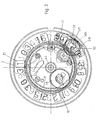
- the figure 1 shows a top view of the date drive mechanism according to a first variant of the invention; only the parts useful for the understanding of the mechanism have been represented in full lines for ease of understanding of the figure.
- the mechanism comprises two mobiles formed in this example by two concentric annular disks 1 and 2 superimposed.
- the first mobile 1, or ring of units carries a sequence of digits 10 ⁇ 1,2,3,4,5,6,7,8,9,0, 1,2,3,4,5,6,7 , 8,9,0,1,2,3,4,5,6,7,8,9 ⁇ .
- the numbers are regularly spaced except for a larger interval between the last 9 and the first 1 which is sufficient to display a two-digit date, as will be seen later.
- the dates are intended to be displayed at twelve o'clock on the dial; the figures of the units are thus arranged almost radially, so as to appear vertical when they are seen through a vertical window just to the right of the twelve o'clock position.
- the second mobile, or tens ring is constituted by a second ring 2 concentrically rotating over the ring of the units 1, as can be seen in particular on the Figures 5 and 6 .
- the dial 6 of the watch is at the bottom.
- the second ring 2 bears the sequence ⁇ 0,1,2,30,31,0,1,2,30,31 ⁇ .
- a vertical window 21 is stamped through the tens ring 2 to the right of the numerals 0, 1 and 2, making it possible to see the numbers carried by the ring of the units 1.
- the second mobile 2 could be constituted by a non-annular element, for example by a cross or a star rotating above the first mobile 1, and provided with non-rectangular cutouts 21, for example as suggested in the document WO9913383 mentioned.
- the mobile tens could carry a single sequence ⁇ 0,1,2,30,31 ⁇ , or more than twice this sequence.
- a single sequence however has the disadvantage of requiring significant angular steps at each indexing of the mobile, while the display of a larger number of sequences necessarily leads to use smaller numbers.
- the two mobiles could be concentric but of different diameters, and therefore not superimposed, or partially superimposed.
- at least one of the two annular discs could carry cutouts in the form of internal or external radial flaps to cover the figures or indications carried by the other mobile on certain dates.
- cuts provided in the various variants of the invention may also be constituted by transparent portions of one of the two mobiles.
- the arrangement of the numbers 10, 20 and the inclination of the windows 21 depends on the position chosen for displaying the date on the dial; for example, to display the date at three o'clock, it is necessary to rotate the numbers 10, 20 as well as the windows 21 by 90 °. In this the numbers and the windows occupy a larger angular segment, so that a number of sequences different from two on the tens ring 2 may be adopted.
- the angle of rotation depends, of course, on the angular position of the counter.
- the date 3 displayed through the window 60 in the dial 6 is generally formed of a number 20 coming from the ring of tens 2 and a second digit 10 coming from the ring of 1, visible through a window 21.
- the date 3 displayed to the user of the watch comprises two figures, both of which are carried by the tens ring. these particular dates, the problem of difference of depth between the digit of tens and the number of units.
- the maximum date size displayed in a conventional large-date display corresponds to the maximum size of the numbers that can be displayed on both the tens and units mobile.
- the ring of units 1 carries the sequence of digits 10 ⁇ 1,1,2,3,4,5,6,7,8,9,0,1,2,3,4,5,6,7, 8,9,0,1,2,3,4,5, -6,7,8,9 ⁇ while the tens ring carries the sequence of digits 20 ⁇ 0,1,2,30,3,0 , 1,2,30,3 ⁇ , the '0' can also be replaced by spaces.
- This configuration makes it possible to display all the dates by means of indications carried by the two mobiles 1, 2, with the exception of the date which is indicated by means of two figures carried by the tens ring 2.
- the ring of units 1 carries the sequence of digits 10 ⁇ 1,2,3,4,5,6,7,8,9 ⁇ repeated three times while the ring of tens carries the sequence of digits 20 ⁇ 0 , 10,1,20,2,30,31 ⁇ .
- This configuration allows you to display all the dates using of indications carried by the two mobiles 1, 2, with the exception of the dates 10, 20, 30 and 31 which are indicated by means of two figures carried by the tens ring 2.
- the ring of units 1 carries the sequence of digits 10 ⁇ 1,2,3,4,5,6,7,8,9,0,1,2,3,4,5,6,7,8, 9,0,1,2,3,4,5,6,7,8,9,0 ⁇ while the tens ring carries the sequence of digits ⁇ 0,1,2,3,31,0, 1,2,3,31 ⁇ .
- This configuration makes it possible to display all the dates by means of indications carried by the two mobiles 1, 2, with the exception of the date 31 which is indicated by means of two figures carried by the tens ring 2.
- the dates corresponding to dates 1 to 9 are displayed using a single mobile; this allows for example to display this date with a single digit that can also be centered in the window 60.
- the indication of the tens and the indication of the units can be displayed in two separate windows juxtaposed or arranged at different points of the dial, for example at ten o'clock and two o'clock.
- the two mobiles are driven by the same electromechanical or mechanical motor (not shown) and set by the same crown; it would however also be possible to drive and / or adjust the two mobiles by two independent motors, or by a single motor but through two separate kinematic chains.
- a pinion 44 actuated by the not shown motor drives a wheel 46 on the axis of which is mounted a pawl device 460 arranged to cause the rotation, each day, at midnight or at another time, the internal toothing 11
- ring 1 is indexed every day by 360/31 degrees to perform one round per month of 31 days.
- the number and the instant of the rotations of the tens ring depend on the sequences on the two mobiles 1 and 2, as can be seen by comparing the position of the stops 12 on the variants of Figures 1 to 4 .
- the star 50 drives at each rotation a wheel 52 mounted on the same axis, which in turn actuates a wheel 53.
- the wheel 53 is mounted on the axis of a wheel 54 meshing with the internal toothing 22 of the ring
- the gear ratio between the wheels 50 and 53 is chosen so that the indexing angle of the ring 2 caused by a displacement of the star 50 corresponds to the angular distance between two numbers. tens.
- the star 50 is retained by a jumper 51 pressed against the gap 502 between two teeth 501 of the star 50 by a spring 510.
- the jumper prevents the star 50 from spinning freely, particularly when is driven by a stop pin 12.
- a stop element 511 here constituted by a pin perpendicular to the plane of the watch, which moves in a slider 500 machined in the wheel 52.
- the shape of the slider 500 prevents the pin 511 from jumping directly from a gap 502 to a non-adjacent gap between two teeth of the star 50; it thus surrounds the star 50 by marrying approximately its contours.
- the first mobile 1 slides directly on the upper deck 9 of the movement of the watch, and is retained by a first plate 8 mounted over this bridge.
- the second mobile 2 slides on an annular path over this first plate 8 and is retained by a second plate 7.
- the dial 6 is fixed over the second plate and provided with a window 60 to display the dates carried by the first and / or second mobile.
Landscapes
- Physics & Mathematics (AREA)
- General Physics & Mathematics (AREA)
- Electromechanical Clocks (AREA)
- Electric Clocks (AREA)
Applications Claiming Priority (2)
| Application Number | Priority Date | Filing Date | Title |
|---|---|---|---|
| CH5712003 | 2003-04-02 | ||
| EP04723605A EP1609028B1 (de) | 2003-04-02 | 2004-03-26 | Monatstaganzeigemechanismus für uhrenbewegung |
Related Parent Applications (1)
| Application Number | Title | Priority Date | Filing Date |
|---|---|---|---|
| EP04723605A Division EP1609028B1 (de) | 2003-04-02 | 2004-03-26 | Monatstaganzeigemechanismus für uhrenbewegung |
Publications (2)
| Publication Number | Publication Date |
|---|---|
| EP2073075A2 true EP2073075A2 (de) | 2009-06-24 |
| EP2073075A3 EP2073075A3 (de) | 2010-01-06 |
Family
ID=33102863
Family Applications (2)
| Application Number | Title | Priority Date | Filing Date |
|---|---|---|---|
| EP04723605A Expired - Lifetime EP1609028B1 (de) | 2003-04-02 | 2004-03-26 | Monatstaganzeigemechanismus für uhrenbewegung |
| EP09154720A Withdrawn EP2073075A3 (de) | 2003-04-02 | 2004-03-26 | Monatstaganzeigemechanismus für Uhrwerk |
Family Applications Before (1)
| Application Number | Title | Priority Date | Filing Date |
|---|---|---|---|
| EP04723605A Expired - Lifetime EP1609028B1 (de) | 2003-04-02 | 2004-03-26 | Monatstaganzeigemechanismus für uhrenbewegung |
Country Status (7)
| Country | Link |
|---|---|
| US (1) | US7724611B2 (de) |
| EP (2) | EP1609028B1 (de) |
| JP (1) | JP4567666B2 (de) |
| CN (1) | CN100480899C (de) |
| AT (1) | ATE425480T1 (de) |
| DE (1) | DE602004019892D1 (de) |
| WO (1) | WO2004088435A2 (de) |
Families Citing this family (19)
| Publication number | Priority date | Publication date | Assignee | Title |
|---|---|---|---|---|
| US7120091B1 (en) * | 2005-08-25 | 2006-10-10 | Timex Group B.V. | Electronic device with calendar function |
| JP5151637B2 (ja) * | 2008-04-10 | 2013-02-27 | セイコーエプソン株式会社 | 日付表示機構付時計 |
| JP5100523B2 (ja) * | 2008-06-16 | 2012-12-19 | セイコーインスツル株式会社 | 日表示装置及びこれを備えた時計 |
| JP5311559B2 (ja) * | 2009-01-23 | 2013-10-09 | セイコーインスツル株式会社 | 2つの日車を有するカレンダ機構付き時計 |
| JP2011089847A (ja) * | 2009-10-21 | 2011-05-06 | Seiko Instruments Inc | カレンダ機構及び該機構を備えたアナログ式時計 |
| JP5336997B2 (ja) * | 2009-10-21 | 2013-11-06 | セイコーインスツル株式会社 | カレンダ機構及び該機構を備えたアナログ式時計 |
| JP5382720B2 (ja) * | 2009-12-24 | 2014-01-08 | セイコーインスツル株式会社 | 第一日車と第二日車を含むカレンダ機構付き時計 |
| JP5467596B2 (ja) * | 2010-02-26 | 2014-04-09 | セイコーインスツル株式会社 | カレンダ機構付き時計 |
| CH704622B1 (fr) * | 2011-03-14 | 2016-03-15 | Christophe Claret S A | Pièce d'horlogerie. |
| CH707474A1 (fr) * | 2013-01-17 | 2014-07-31 | Parmigiani Fleurier S A | Pièce d'horlogerie à affichage du quantième. |
| EP2902852B1 (de) * | 2014-01-31 | 2016-06-22 | ETA SA Manufacture Horlogère Suisse | Datumsanzeigevorrichtung für eine Uhr |
| EP3018537B1 (de) * | 2014-11-05 | 2017-07-19 | Blancpain S.A. | Große Datumsanzeigevorrichtung für Uhr |
| EP3040784B1 (de) * | 2014-12-30 | 2018-08-15 | ETA SA Manufacture Horlogère Suisse | Datumsanzeigevorrichtung für eine Uhr |
| EP3040785B1 (de) * | 2014-12-30 | 2017-08-02 | ETA SA Manufacture Horlogère Suisse | Datumsanzeigevorrichtung für eine Uhr |
| EP3040788B1 (de) | 2014-12-30 | 2017-08-09 | ETA SA Manufacture Horlogère Suisse | Kupplungsmechanismus für die Ziffernscheiben einer Datumsanzeige |
| EP3339973B1 (de) * | 2016-12-21 | 2019-07-24 | Blancpain SA | Datumsmechanismus |
| EP3839658B1 (de) | 2019-12-20 | 2026-01-28 | Blancpain SA | Anzeigeänderungsmechanismus |
| DE102020123501B3 (de) | 2020-09-09 | 2022-03-10 | Horl 1993 Gmbh | Rollschleifer mit Presspassung zwischen Laufrolle und Achse |
| DE102020133853B3 (de) | 2020-12-16 | 2022-04-28 | Horl 1993 Gmbh | Schneidwerkzeug mit Auflageabschnitt für voreingestellten Schleifwinkel |
Citations (1)
| Publication number | Priority date | Publication date | Assignee | Title |
|---|---|---|---|---|
| WO1999013383A1 (fr) | 1997-09-11 | 1999-03-18 | Jaquet S.A. | Systeme mecanique d'indication du quantieme de grand format pour mouvements de montres et pendulettes |
Family Cites Families (15)
| Publication number | Priority date | Publication date | Assignee | Title |
|---|---|---|---|---|
| US3645086A (en) * | 1970-03-16 | 1972-02-29 | Bunker Ramo | Calendar clock |
| JPS5134748B2 (de) * | 1971-10-08 | 1976-09-28 | ||
| CH607557GA3 (de) * | 1974-11-06 | 1978-08-31 | Bulova Watch Co Inc | Uhrenkalendereinrichtung. |
| DE4127825C1 (de) * | 1991-08-22 | 1992-10-01 | Jaeger-Le Coultre S.A., Le Sentier, Ch | |
| US5711100A (en) * | 1993-06-14 | 1998-01-27 | Elmer; William A. | Vehicle advertising sign, system and method |
| CH690869A5 (fr) * | 1997-08-27 | 2001-02-15 | Jean Marc Wiederrecht | Module de quantième pour pièce d'horlogerie. |
| DE69806337T2 (de) * | 1998-03-05 | 2003-06-05 | Frederic Piguet S.A., Le Brassus | Kalendermechanismus für Uhrwerk |
| JP2000292557A (ja) * | 1999-04-08 | 2000-10-20 | Citizen Watch Co Ltd | カレンダー付電子時計 |
| CN2412233Y (zh) * | 1999-12-28 | 2000-12-27 | 天津Isa有限公司 | 手表大日历机构 |
| TW493113B (en) * | 2000-08-23 | 2002-07-01 | Ebauchesfabrik Eta Ag | Electronic watch with a large date aperture |
| SG102647A1 (en) * | 2000-12-22 | 2004-03-26 | Ebauchesfabrik Eta Ag | Timepiece provided with a date having a large aperture |
| DE20103818U1 (de) * | 2001-03-06 | 2001-06-13 | Paap, Karl-Ludwig, 63452 Hanau | Zweistellige mechanische Datumsanzeige |
| FR2836245B1 (fr) * | 2002-02-20 | 2004-05-21 | Jacques Andre Finet | Dispositif d'affichage de date a guichet pour montre |
| JP3772763B2 (ja) * | 2002-02-28 | 2006-05-10 | セイコーエプソン株式会社 | 日付表示機能付電子時計 |
| JP3536852B2 (ja) * | 2002-03-27 | 2004-06-14 | セイコーエプソン株式会社 | 電子時計 |
-
2004
- 2004-03-26 DE DE602004019892T patent/DE602004019892D1/de not_active Expired - Lifetime
- 2004-03-26 AT AT04723605T patent/ATE425480T1/de not_active IP Right Cessation
- 2004-03-26 EP EP04723605A patent/EP1609028B1/de not_active Expired - Lifetime
- 2004-03-26 CN CNB2004800033781A patent/CN100480899C/zh not_active Expired - Fee Related
- 2004-03-26 EP EP09154720A patent/EP2073075A3/de not_active Withdrawn
- 2004-03-26 WO PCT/EP2004/050370 patent/WO2004088435A2/fr not_active Ceased
- 2004-03-26 JP JP2006505494A patent/JP4567666B2/ja not_active Expired - Fee Related
-
2005
- 2005-09-29 US US11/238,751 patent/US7724611B2/en not_active Expired - Fee Related
Patent Citations (1)
| Publication number | Priority date | Publication date | Assignee | Title |
|---|---|---|---|---|
| WO1999013383A1 (fr) | 1997-09-11 | 1999-03-18 | Jaquet S.A. | Systeme mecanique d'indication du quantieme de grand format pour mouvements de montres et pendulettes |
Also Published As
| Publication number | Publication date |
|---|---|
| EP1609028B1 (de) | 2009-03-11 |
| EP2073075A3 (de) | 2010-01-06 |
| US20060028918A1 (en) | 2006-02-09 |
| CN1745342A (zh) | 2006-03-08 |
| JP4567666B2 (ja) | 2010-10-20 |
| US7724611B2 (en) | 2010-05-25 |
| DE602004019892D1 (de) | 2009-04-23 |
| ATE425480T1 (de) | 2009-03-15 |
| HK1086895A1 (zh) | 2006-09-29 |
| EP1609028A2 (de) | 2005-12-28 |
| JP2006522323A (ja) | 2006-09-28 |
| WO2004088435A3 (fr) | 2005-02-03 |
| CN100480899C (zh) | 2009-04-22 |
| WO2004088435A2 (fr) | 2004-10-14 |
Similar Documents
| Publication | Publication Date | Title |
|---|---|---|
| EP1609028B1 (de) | Monatstaganzeigemechanismus für uhrenbewegung | |
| EP1636656B1 (de) | Zahnsystem für uhrenbetätigung | |
| EP0940833B1 (de) | Kalendermechanismus für Uhrwerk | |
| EP2447789B1 (de) | Kalenderanzeigevorrichtung und Kalenderuhr | |
| EP2428856B1 (de) | Uhr | |
| EP1351104B1 (de) | Vorrichtung mit Programmrad für den Mechanismus eines ewigen Kalenders sowie Uhr mit solchem Mechanismus | |
| EP3690556B1 (de) | Uhr, die eine anzeige mit variabler teilung umfasst | |
| EP1536299B1 (de) | Kalendermechanismus für eine Uhr mit zwei übereinanderliegenden Ringen | |
| EP3857313B1 (de) | Anzeigemechanismus mit einem einzigen fensterchen | |
| EP3477402B1 (de) | Mondphasen-anzeigevorrichtung | |
| EP2720090B1 (de) | Universaluhr | |
| EP1536300B1 (de) | Kalendermechanismus für eine Uhr mit zwei übereinliegenden Ringen | |
| EP2713226B1 (de) | Datumsmechanismus | |
| EP1426836B1 (de) | Datumanzeigemechanismus für Uhren | |
| EP3667434B1 (de) | Grossanzeigemechanismus für datum, und mit einem solchen mechanismus ausgestattete uhr | |
| EP1240559B1 (de) | Jahres-, dauer- oder jahrhundertsdatumschaltwerk | |
| EP3644130B1 (de) | Datumsmechanismus | |
| EP1351105B1 (de) | Uhr mit ewigem Kalender | |
| EP3764171B1 (de) | Anzeigemechanismus eines uhranzeigewerts | |
| EP3460588B1 (de) | Datumsmechanismus | |
| CH716556B1 (fr) | Pièce d'horlogerie à mécanisme d'affichage de l'âge de la lune. | |
| EP1962153B1 (de) | Vorrichtung zur Kalenderanzeige | |
| EP2042945A2 (de) | Monatsanzeigevorrichtung für eine Uhr | |
| EP3040784A1 (de) | Datumsanzeigevorrichtung für eine Uhr | |
| WO2006108878A1 (fr) | Mecanisme d'affichage sautant de l’heure pour piece d’horlogerie |
Legal Events
| Date | Code | Title | Description |
|---|---|---|---|
| PUAI | Public reference made under article 153(3) epc to a published international application that has entered the european phase |
Free format text: ORIGINAL CODE: 0009012 |
|
| AC | Divisional application: reference to earlier application |
Ref document number: 1609028 Country of ref document: EP Kind code of ref document: P |
|
| AK | Designated contracting states |
Kind code of ref document: A2 Designated state(s): AT BE BG CH CY CZ DE DK EE ES FI FR GB GR HU IE IT LI LU MC NL PL PT RO SE SI SK TR |
|
| AX | Request for extension of the european patent |
Extension state: AL LT LV MK |
|
| PUAL | Search report despatched |
Free format text: ORIGINAL CODE: 0009013 |
|
| AK | Designated contracting states |
Kind code of ref document: A3 Designated state(s): AT BE BG CH CY CZ DE DK EE ES FI FR GB GR HU IE IT LI LU MC NL PL PT RO SE SI SK TR |
|
| AX | Request for extension of the european patent |
Extension state: AL LT LV MK |
|
| RIC1 | Information provided on ipc code assigned before grant |
Ipc: G04B 19/20 20060101ALI20091127BHEP Ipc: G04B 11/00 20060101ALI20091127BHEP Ipc: G04C 17/00 20060101ALI20091127BHEP Ipc: G04B 19/24 20060101AFI20090519BHEP |
|
| AKY | No designation fees paid | ||
| REG | Reference to a national code |
Ref country code: DE Ref legal event code: 8566 |
|
| STAA | Information on the status of an ep patent application or granted ep patent |
Free format text: STATUS: THE APPLICATION IS DEEMED TO BE WITHDRAWN |
|
| 18D | Application deemed to be withdrawn |
Effective date: 20100708 |