EP2074900B1 - Austauschbarer Schuhabsatz, Schuhsohlenteil und Schuh - Google Patents
Austauschbarer Schuhabsatz, Schuhsohlenteil und Schuh Download PDFInfo
- Publication number
- EP2074900B1 EP2074900B1 EP20080450201 EP08450201A EP2074900B1 EP 2074900 B1 EP2074900 B1 EP 2074900B1 EP 20080450201 EP20080450201 EP 20080450201 EP 08450201 A EP08450201 A EP 08450201A EP 2074900 B1 EP2074900 B1 EP 2074900B1
- Authority
- EP
- European Patent Office
- Prior art keywords
- sole part
- pressure
- shoe
- heel
- sole
- Prior art date
- Legal status (The legal status is an assumption and is not a legal conclusion. Google has not performed a legal analysis and makes no representation as to the accuracy of the status listed.)
- Not-in-force
Links
Images



Classifications
-
- A—HUMAN NECESSITIES
- A43—FOOTWEAR
- A43B—CHARACTERISTIC FEATURES OF FOOTWEAR; PARTS OF FOOTWEAR
- A43B3/00—Footwear characterised by the shape or the use
- A43B3/24—Collapsible or convertible
-
- A—HUMAN NECESSITIES
- A43—FOOTWEAR
- A43B—CHARACTERISTIC FEATURES OF FOOTWEAR; PARTS OF FOOTWEAR
- A43B13/00—Soles; Sole-and-heel integral units
- A43B13/14—Soles; Sole-and-heel integral units characterised by the constructive form
- A43B13/18—Resilient soles
- A43B13/181—Resiliency achieved by the structure of the sole
- A43B13/183—Leaf springs
-
- A—HUMAN NECESSITIES
- A43—FOOTWEAR
- A43B—CHARACTERISTIC FEATURES OF FOOTWEAR; PARTS OF FOOTWEAR
- A43B21/00—Heels; Top-pieces or top-lifts
- A43B21/36—Heels; Top-pieces or top-lifts characterised by their attachment; Securing devices for the attaching means
-
- A—HUMAN NECESSITIES
- A43—FOOTWEAR
- A43B—CHARACTERISTIC FEATURES OF FOOTWEAR; PARTS OF FOOTWEAR
- A43B21/00—Heels; Top-pieces or top-lifts
- A43B21/36—Heels; Top-pieces or top-lifts characterised by their attachment; Securing devices for the attaching means
- A43B21/42—Heels with replaceable or adjustable parts, e.g. top lift
Definitions
- the invention relates to an exchangeable shoe heel, an adaptable shoe sole part and a shoe comprising such an exchangeable shoe heel and such an adaptable shoe sole part.
- a shoe is transformable by the combination of different shaped heels (especially with different heights) and shoe sole parts in shape and height.
- the invention has for its object to handle the complex interaction of the various shoe parts in the context of a transformable overall shoe holistically by the use of pressure and the tension generated thereby and to optimize the comfort wishes of the wearer individually, without neglecting the stability of the shoe.
- the invention has for its object to provide a transformable combination shoe with adaptable shoe sole parts and quickly exchangeable heels in different height and shape, wherein during or through the change of heel the shoe sole part or the entire shoe automatically by means of expenditure and transfer of pressure individually adjusted and fixed in the adjusted position with the voltage generated by the pressure, so as to stabilize the entire shoe, without the need for its own devices (eg mechanical type) for adjustment, fixation or stabilization (such as screws, gears, etc.) are required.
- devices eg mechanical type
- the present invention solves this problem by providing an exchangeable shoe heel and a mating shoe sole part according to claims 1 and 7.
- the shoe heel has a pressure generating element adapted to engage the shoe sole part under pressure in the toe direction on a portion the shoe sole part is formed, wherein a mechanical stress state can be built up by the pressure exerted in the shoe sole part, which acts shape-changing on at least a portion of the shoe sole part.
- the shoe sole portion has at least a portion which is variable by varying pressure in the toe direction in its angular position with respect to other shoe sole portions and / or its curvature, wherein the pressure exerted in the shoe sole part a mechanical stress state is constructed, the shape changing on at least a portion of the shoe sole part acts.
- shoe sole part is not limited to a sole of a shoe per se but also includes any upper material connected to a shoe sole in open or closed form.
- a shoe combined from a shoe heel according to the invention and a shoe sole part according to the invention is not limited in its shape and can be designed as a sandal, open or closed shoe, ankle-high shoe or even boots.
- a subassembly for forming a shoe comprising a flexible element that is incorporated into a base of the shoe and that can assume a variety of configurations due to its flexibility, and a toe having a support element that mechanically engages the flexible element engageable to bring the flexible element into a foot-supporting configuration and connect the stool to the flexible element.
- the flexible element is nothing more than a flexible shell without a defined outer shape, similar to a gymnastic shoe that adapts to the contour of the stool and the support element. Neither the stilts nor the support element constitute a "pressure generating element" in the sense of the present invention.
- a shoe with a replaceable shoe heel and a sole part is also off US 2006/0075662 and US 2001/0052 195 A1 known.
- the heel with its integrated components plays an active role in shaping and stabilizing the transformable combination shoe.
- Interchangeable paragraphs are known from the prior art, but not that during or by the change of paragraph a change in shape of Shoe sole part or the entire shoe takes place.
- the pressure generating element of the replaceable shoe heel determines the degree of walking and the extent to which the bale part of the outsole is raised by the extent of pressure generation on the sole part of the shoe.
- the pressure generating element is designed as a projection which acts as a compression spring.
- This protrusion may be made of a stiff and / or resilient material, such as e.g. Metal or plastic, be formed and extends from the interchangeable shoe heel in the toe direction. Due to the variability of material and design of the pressure generating element, in particular by different length and inclination, the extent to which the bale part of the outsole of the shoe sole part is raised and determines the degree of walking.
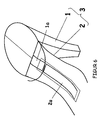
- FIGS. 5 to 7 Different achievable results by differently shaped pressure generating elements of the exchangeable shoe heel show the FIGS. 5 to 7 where the same shoe sole part 2 is combined with different shoe heels 1 having differently designed pressure generating elements 1a to shoes 3 of different outsole inclination and different degree of walking.
- the pressure generating element 1a acts in each case on a pressure transmission element 2a in the shoe sole part 2, as will be explained in more detail below.
- the shoe sole part is variable by variable pressure exertion of the pressure generating element in the toe direction in its angular position with respect to other shoe sole sections and / or its curvature.
- the pressure generating element can rest directly on a shoe sole portion section.
- the shoe sole part has a pressure transmission element for transmitting pressure in the toe direction to at least one section of the shoe sole part is currently preferred. In this case, the pressure generating element bears against the pressure transmission element.
- the pressure transmission element as a tongue embedded in the shoe sole part, is made of a stiff and / or resilient material, e.g. Metal or plastic formed.
- the pressure-transmitting element is designed as an air cushion or liquid-filled or gel-filled upholstery.
- At least one portion extending over the shoe sole part with increased flexibility is provided with respect to adjacent shoe sole portions, wherein in a preferred variant the pressure transmission element and / or the pressure generating element in or extend through at least one portion with increased flexibility / extend.
- the shoe sole portion is equipped with a heel connection element and the shoe heel with a complementary sole connecting element. It may be e.g. to act a rail system, or a tongue and groove system, or a dovetail connection, or the like., Wherein also known from the prior art systems can be used.
- the stability of the shoe according to the invention is further increased by the shoe sole part has at least one Absatzfixierelement, and the shoe heel a thus complementary Sohlenfixierelement.
- the shoe sole part may be a Einrastsystem, which should preferably be operated without tools.
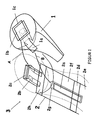
- FIG. 1 the assembly of a shoe 3 according to the invention from a shoe sole part 2 and a shoe heel 1 is shown.
- the shoe heel 1 a Pressure generating element 1a, which is formed in this variant as an extension of a stiff, but flexible material and extending from the shoe heel 1 in the toe direction.
- the shoe heel 1 on a sole connection element 1b which may be formed, for example, as projections, guide rails, grooves o. The like.
- the shoe heel 1 on the heel side also has a sole fixing element 1c, which in this embodiment is in the form of a depression.
- the shoe sole part 2 in turn comprises a pressure transmission element 2a for transmitting pressure in the direction of toe on at least a portion of the shoe sole part 2, in this embodiment on a foot ball side portion 2e and a middle portion 2d.
- the middle section 2d is more flexible than the ball-side section 2e and a heel-side section 2f by suitable choice of material and / or a reduced sole thickness.
- the pressure transmission element 2a is preferably formed as a embedded in the shoe sole part tongue of a rigid material, such as metal or plastic.
- the pressure transmitting member 2a is slidably supported in a cavity 2g, the cavity 2g extending from the heel-side portion 2f through the middle portion 2d to the bale-side portion 2e, pushing there against an end wall of the cavity 2g, and preferably also attached to this end wall is.
- the pressure transmission element 2a could be formed as an air cushion or liquid or gel-filled pad.
- the shoe sole part 2 has a heel connection element 2b into which the sole connection element 1b of the shoe heel 1 can be inserted.
- the shoe sole part 2 also comprises a heel fixing element 2c, which is designed to engage with the sole fixing element 1c of the shoe heel 1 and to effect a mutual locking.
- Fig. 1 It can be seen how the shoe heel 1 is positioned with his sole connecting element 1b on the heel joint 2b on the heel bottom of the shoe sole part 2, while simultaneously the front end of the pressure generating element 1a is inserted into the heel-side, incorporated in the outsole cavity 2g, as shown by the two arrows A, B is indicated.
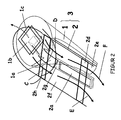
- Fig. 2 the device of the degree of walking (arrows C, D) and the adjustment of the ball position (arrows E, F) is shown, wherein the forced displacement of the portion 2 f of the shoe sole part 2 downwards due to the rigidity of the obliquely downward pressure generating element 1 a, which on the Pressure transmission element 2a acts.
- the change in the ball position results from the fact that the pressure-bearing element 2a is bent.
- the heel position is determined by the individual bevel of the top of the respective paragraph 1.
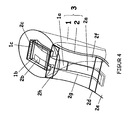
- Fig. 4 shows this end position in which the paragraph 1 and the shoe sole part 2 are held under tension in the adapted position and are stabilized in this way in the context of the overall shoe 3.
- the shoe 3 according to the invention by the individual fixation of flexible components positive influence on comfort in unwinding, position, stability, immobilization of joints and relief, with all the above parameters influenced by the exchange differently designed heels and ensures a secure sales position is guaranteed additionally stabilizes the transformed shoe.
- paragraph 1 plays an active role in the transformation of the shoe by not simply attached to the shoe sole part 2 is, but in the process of attachment via the pressure generating element 1 a and the pressure transmission element 2 a causes a transformation of ball position, degree, etc.
Landscapes
- Footwear And Its Accessory, Manufacturing Method And Apparatuses (AREA)
Description
- Die Erfindung betrifft einen austauschbaren Schuhabsatz, ein adaptierbares Schuhsohlenteil sowie einen Schuh, der einen solchen austauschbaren Schuhabsatz und ein solches adaptierbares Schuhsohlenteil umfasst. Ein solcher Schuh ist durch die Kombination unterschiedlich geformter Schuhabsätze (insbesondere mit unterschiedlicher Stöckelhöhe) und Schuhsohlenteile in Form und Höhe transformierbar.
- Um Schuhe flexibel zu gestalten, ist es bekannt, einzelne Schuhteile auszutauschen oder zu verändern. So finden sich austauschbare Absätze (
DE000002923926A1 ,DE000001719681U ,DE000029811942U1 ,DE2919639 ,DE000001761534U ,EP0314411 ,ES2006324 GR88100086 GB2004176 CN2720858Y ,US000004610100A US6023858 ,US2003163934 ,US6711835 ,JP8066204 JP59028903 JP10215914 JP2003319802 DE29702665U ,DE000029711890U1 ,DE000020303615U1 ,US000002707341A US000006021586A JP1110301 US2005055844 ,JP2004129815 DE000020309485U1 ,DE1909270U ,DE202005007804U ,US3464126 ). Das bekannte flexible Schuhwerk bewältigt das komplexe Zusammenwirken der verschiedenen Schuhteile im Rahmen eines adaptierbaren Gesamtschuhs aber nur sehr eingeschränkt, indem einzelne Schuhteile durch mechanische Vorrichtungen verbunden werden (US000004416072A JP53119147 US2003136028 ,US5309651 ), Fersenstellung (JP53119147 US000002258265A US000004416072A - Der Erfindung liegt die Aufgabe zugrunde, das komplexe Zusammenwirken der verschiedenen Schuhteile im Rahmen eines transformablen Gesamtschuhs ganzheitlich durch die Nutzung von Druck und die dadurch erzeugte Spannung zu bewältigen und die Komfortwünsche des Trägers individuell zu optimieren, ohne dabei die Stabilität des Schuhs zu vernachlässigen. Insbesondere liegt der Erfindung die Aufgabe zugrunde, einen transformablen Kombinationsschuh mit adaptierbaren Schuhsohlenteilen und schnell austauschbaren Absätzen in unterschiedlicher Höhe und Form bereitzustellen, wobei während des bzw. durch den Wechsel des Absatzes das Schuhsohlenteil bzw. der gesamte Schuh automatisch mittels Aufwendung und Übertragung von Druck individuell angepasst und in der angepassten Position mit der durch den Druck erzeugten Spannung fixiert wird, um so den Gesamtschuh zu stabilisieren, ohne dass dafür eigene Vorrichtungen (z.B. mechanischer Art) zur Justierung, Fixierung oder Stabilisierung (wie Schrauben, Zahnräder etc.) erforderlich sind.
- Die vorliegende Erfindung löst die gestellte Aufgabe durch Bereitstellen eines austauschbaren Schuhabsatzes und eines dazupassenden Schuhsohlenteils, gemäß Ansprüche 1 und 7. Der wobei der Schuhabsatz weist ein Druckerzeugungselement auf, das zum Angriff an bzw. zum Eingriff in das Schuhsohlenteil unter Druckausübung in Zehenrichtung auf einen Abschnitt des Schuhsohlenteils ausgebildet ist, wobei durch die Druckausübung im Schuhsohlenteil ein mechanischer Spannungszustand aufbaubar ist, der formverändernd auf zumindest einen Abschnitt des Schuhsohlenteils wirkt. Das Schuhsohlenteil weist zumindest einen Abschnitt auf, der durch variable Druckausübung in Zehenrichtung in seiner Winkelstellung in Bezug auf andere Schuhsohlenteilabschnitte und/oder seine Krümmung veränderbar ist, wobei durch die Druckausübung im Schuhsohlenteil ein mechanischer Spannungszustand aufgebaut wird, der formverändernd auf zumindest einen Abschnitt des Schuhsohlenteils wirkt. Es ist zu betonen, dass der Begriff "Schuhsohlenteil", wie hierin verwendet, nicht auf eine Schuhsohle an sich beschränkt ist, sondern auch jegliches mit einer Schuhsohle verbundenes Obermaterial in offener oder geschlossener Form umfasst. Ein aus einem erfindungsgemäßen Schuhabsatz und einem erfindungsgemäßen Schuhsohlenteil kombinierter Schuh ist in seiner Form nicht eingeschränkt und kann als Sandale, offener oder geschlossener Halbschuh, knöchelhoher Schuh oder auch Stiefel ausgebildet sein.
- Aus der
WO 01/78543 - Ein Schuh mit einem austauschbaren Schuabsatz und einem Sohlenteil ist auch aus
US 2006/0075 662 undUS 2001/0052 195 A1 bekannt. - Durch seinen Wechsel spielt der Absatz mit seinen integrierten Komponenten eine aktive Rolle in Formgebung und Stabilisierung des transformablen Kombinationsschuhs. Auswechselbare Absätze sind zwar aus dem Stand der Technik bekannt, nicht jedoch, dass während des bzw. durch den Wechsel des Absatzes eine Formveränderung des Schuhsohlenteils bzw. des gesamten Schuhs stattfindet. Durch seine Ausgestaltung, insbesondere seine Länge und Neigung bestimmt das Druckerzeugungselement des austauschbaren Schuhabsatzes durch das Ausmaß der Druckerzeugung auf das Schuhsohlenteil den Gehgrad und das Ausmaß, in dem der Ballenteil der Laufsohle angehoben wird. Durch den Tausch von Absätzen mit unterschiedlicher Kombination von Form, Höhe, Fersenstellung sowie unterschiedlich ausgestalteten Druckerzeugungselementen kann in kurzer Zeit individuell auf die Komfortwünsche der Trägerin bzw. des Trägers reagiert werden.
- In einer bevorzugten Ausgestaltung des erfindungsgemäßen austauschbaren Schuhabsatzes ist das Druckerzeugungselement als Vorsprung ausgebildet, der als Druckfeder wirkt. Dieser Vorsprung kann aus einem steifen und/oder federnden Material, wie z.B. Metall oder Kunststoff, ausgebildet sein und erstreckt sich vom austauschbaren Schuhabsatz in Zehenrichtung. Durch die Variabilität von Material und Ausgestaltung des Druckerzeugungselements, insbesondere durch unterschiedliche Länge und Neigung werden das Ausmaß, in dem der Ballenteil der Laufsohle des Schuhsohlenteils angehoben wird und der Gehgrad festgelegt.
- Unterschiedliche erzielbare Ergebnisse durch unterschiedlich geformte Druckerzeugungselemente des austauschbaren Schuhabsatzes zeigen die
Figuren 5 bis 7 , wo dasselbe Schuhsohlenteil 2 mit unterschiedlichen Schuhabsätzen 1, die verschieden ausgestaltete Druckerzeugungselemente 1a aufweisen, zu Schuhen 3 von unterschiedlicher Laufsohlenneigung und unterschiedlichem Gehgrad kombiniert ist. Das Druckerzeugungselement 1a wirkt dabei jeweils auf ein Druckübertragungselement 2a in dem Schuhsohlenteil 2, wie weiter unten näher erläutert wird. - Wie bereits erwähnt, ist bei dem erfindungsgemäßen Schuhsohlenteil zumindest ein Abschnitt des Schuhsohlenteils durch variable Druckausübung des Druckerzeugungselements in Zehenrichtung in seiner Winkelstellung in Bezug auf andere Schuhsohlenteilabschnitte und/oder seine Krümmung veränderbar. Dabei kann das Druckerzeugungselement direkt an einem Schuhsohlenteilabschnitt anliegen. Bevorzugt ist derzeit jedoch eine Ausführungsform, bei der das Schuhsohlenteil ein Druckübertragungselement zur Übertragung von Druck in Zehenrichtung auf zumindest einen Abschnitt des Schuhsohlenteils aufweist. In diesem Fall liegt das Druckerzeugungselement an dem Druckübertragungselement an.
- In einer Variante der Erfindung ist das Druckübertragungselement als eine im Schuhsohlenteil eingebettete Zunge aus einem steifen und/oder federnden Material, wie z.B. Metall oder Kunststoff ausgebildet. In einer alternativen Variante ist das Druckübertragungselement als Luftpolster oder flüssigkeits- oder gelgefüllter Polster ausgebildet. Für beide Ausführungsformen wesentlich ist, dass der vom Druckerzeugungselement des Schuhabsatzes ausgeübte Druck durch das Druckübertragungselement an die gewünschten Stellen im Schuhsohlenteil weitergeleitet wird, wozu bevorzugt das Druckübertragungselement im Schuhsohlenteil verlagerbar angeordnet ist.
- Um die Variabilität des Schuhsohlenteils noch besser steuern zu können, ist in einer Fortbildung der Erfindung zumindest ein sich quer über das Schuhsohlenteil erstreckender Abschnitt mit erhöhter Biegsamkeit bezogen auf dazu benachbarte Schuhsohlenteilabschnitte vorgesehen, wobei in einer bevorzugten Variante sich das Druckübertragungselement und/oder das Druckerzeugungselement in bzw. durch zumindest einen Abschnitt mit erhöhter Biegsamkeit erstreckt/erstrecken.
- Hervorragende Justierbarkeit, Stabilität und Fixierung des austauschbaren Schuhabsatzes an dem Schuhsohlenteil eines erfindungsgemäßen Schuhs werden erreicht, indem das Schuhsohlenteil mit einem Absatzverbindungselement und der Schuhabsatz mit einem sich damit ergänzenden Sohlenverbindungselement ausgestattet ist. Es kann sich dabei z.B. um ein Schienensystem handeln, oder ein Feder-Nut-System, oder eine Schwalbenschwanzverbindung, oder dergl., wobei auch auf aus dem Stand der Technik bekannte Systeme zurückgegriffen werden kann.
- Die Stabilität des erfindungsgemäßen Schuhs wird weiter erhöht, indem das Schuhsohlenteil zumindest ein Absatzfixierelement aufweist, und der Schuhabsatz ein sich damit ergänzendes Sohlenfixierelement. In der praktischen Ausgestaltung kann es sich dabei um ein Einrastsystem handeln, das vorzugsweise ohne Werkzeug bedienbar sein sollte.
- Die Erfindung wird nun anhand von Ausführungsbeispielen unter Bezugnahme auf die Zeichnungen näher erläutert. In den Zeichnungen zeigen
-
Fig. 1 bis Fig. 4 perspektivische Ansichten der Abfolge des Verbindens eines erfindungsgemäßen Schuhabsatzes mit einem erfindungsgemäßen Schuhsohlenelement zu einem Schuh; -
Fig. 5 bis Fig. 7 perspektivische Teilansichten erfindungsgemäßer Schuhe, bei denen jeweils dasselbe Schuhsohlenteil mit unterschiedlichen Schuhabsätzen zu Schuhen von unterschiedlicher Laufsohlenneigung und unterschiedlichem Gehgrad kombiniert ist. - Auf die
Figuren 1 bis 4 Bezug nehmend wird der Zusammenbau eines erfindungsgemäßen Schuhs 3 aus einem Schuhsohlenteil 2 und einem Schuhabsatz 1 dargestellt. In der Abfolge derFiguren 1 bis 4 erkennt man dabei deutlich die durch das Verbinden von Schuhsohlenteil 2 und Schuhabsatz 1 ausgelöste individuelle Umgestaltung und Stabilisierung des Schuhs 3 mittels Erzeugung von Druck durch den Schuhsohlenabsatz 1 und Übertragung des Drucks auf den Schuhsohlenteil 2. Wie aus der Zeichnung ersichtlich, weist der Schuhabsatz 1 ein Druckerzeugungselement 1a auf, das in dieser Variante als Fortsatz aus einem steifen, aber biegsamen Material ausgebildet ist und sich vom Schuhabsatz 1 in Zehenrichtung erstreckt. Weiters weist der Schuhabsatz 1 ein Sohlenverbindungselement 1b auf, das beispielsweise als Vorsprünge, Führungsschienen, Nuten o. dergl. ausgebildet sein kann. Schließlich weist der Schuhabsatz 1 fersenseitig auch noch ein Sohlenfixierelement 1c auf, das in dieser Ausführungsform als Vertiefung ausgebildet ist. - Das Schuhsohlenteil 2 wiederum umfasst ein Druckübertragungselement 2a zur Übertragung von Druck in Zehenrichtung auf zumindest einen Abschnitt des Schuhsohlenteils 2, in diesem Ausführungsbeispiel auf einen fußballenseitigen Abschnitt 2e und einen mittleren Abschnitt 2d. Der mittlere Abschnitt 2d ist durch geeignete Materialwahl und/oder eine verringerte Sohlenstärke biegsamer als der ballenseitige Abschnitt 2e und ein fersenseitiger Abschnitt 2f. Das Druckübertragungselement 2a ist vorzugsweise als eine im Schuhsohlenteil eingebettete Zunge aus einem steifen Material, wie z.B. Metall oder Kunststoff ausgebildet. Weiters ist das Druckübertragungselement 2a in einem Hohlraum 2g verschiebbar gelagert, wobei sich der Hohlraum 2g von dem fersenseitigen Abschnitt 2f durch den mittleren Abschnitt 2d bis in den ballenseitigen Abschnitt 2e erstreckt, dort gegen eine Endwand des Hohlraums 2g drückt und vorzugsweise auch an dieser Endwand befestigt ist. In einer alternativen Ausführungsform könnte das Druckübertragungselement 2a als Luftpolster oder flüssigkeits- oder gelgefüllter Polster ausgebildet sein. Weiters weist das Schuhsohlenteil 2 ein Absatzverbindungselement 2b auf, in welches das Sohlenverbindungselement 1b des Schuhabsatzes 1 einführbar ist. Schließlich umfasst das Schuhsohlenteil 2 noch ein Absatzfixierelement 2c, das dazu ausgebildet ist, mit dem Sohlenfixierelement 1c des Schuhabsatzes 1 ineinanderzugreifen und eine gegenseitige Arretierung zu bewirken.
- In
Fig. 1 ist zu sehen, wie der Schuhabsatz 1 mit seinem Sohlenverbindungselement 1b am Absatzverbindungselement 2b am Fersenboden des Schuhsohlenteils 2 positioniert wird, während gleichzeitig das vordere Ende des Druckerzeugungselements 1a in den fersenseitig offenen, in der Laufsohle eingearbeiteten Hohlraum 2g eingeführt wird, wie durch die beiden Pfeile A, B angedeutet ist. - In
Fig. 2 ist die Einrichtung des Gehgrads (Pfeile C, D) und die Anpassung der Ballenstellung (Pfeile E, F) dargestellt, wobei die Zwangsverlagerung des Abschnitts 2f des Schuhsohlenteils 2 nach unten aufgrund der Steifigkeit des schräg nach unten gerichteten Druckerzeugungselements 1a erfolgt, das auf das Druckübertragungselement 2a wirkt. Die Veränderung der Ballenstellung ergibt sich daraus, dass das Drucktragungselement 2a aufgebogen wird. Die Fersenstellung wird durch die individuelle Abschrägung der Oberseite des jeweiligen Absatzes 1 bestimmt. - Bei weiterer Vorwärtsbewegung des Druckerzeugungselements 1a stößt dieses gegen das hintere Ende des im Hohlraum befindlichen Druckübertragungselements 2a und erzeugt durch die Vorwärtsbewegung einen in Zehenrichtung gerichteten Druck, der durch die Verlagerbarkeit des Druckübertragungselements 2a im Hohlraum 2g auf den Abschnitt 2e übertragen wird, wie in
Fig. 3 dargestellt. Gleichzeitig erzeugt der Abschnitt 2e einen Gegendruck auf das Drucküberzeugungselement 2a, wie durch die gestrichelten Pfeile dargestellt. Dieser Gegendruck führt einerseits dazu, dass sich der Abschnitt 2d des Schuhsohlenteils 2 nach oben durchbiegt, und andererseits das Sohlenfixierelement 1c des Schuhabsatzes 1 und das Absatzfixierelement 2c des Schuhsohlenteils 2 fest ineinander greifen und sich unter Spannung fixieren. -
Fig. 4 zeigt diese Endstellung, in der der Absatz 1 und das Schuhsohlenteil 2 unter Spannung in der adaptierten Position gehalten und auf diese Weise im Rahmen des Gesamtschuhs 3 stabilisiert sind. Der erfindungsgemäße Schuh 3 nimmt durch die individuelle Fixierung flexibler Bestandteile positiven Einfluss auf Komfort in Abrollung, Stellung, Standsicherheit, Ruhigstellung von Gelenken und Entlastung, wobei auf alle genannten Parameter durch den Austausch unterschiedlich ausgestalteter Schuhabsätze Einfluss genommen wird und eine gesicherte Absatzstellung gewährleistet wird, die den transformierten Schuh zusätzlich stabilisiert. - Es sei nochmals darauf hingewiesen, dass im Gegensatz zum Stand der Technik bei den erfindungsgemäßen Ausführungsformen des Schuhs der Absatz 1 eine aktive Rolle bei der Transformation des Schuhs spielt, indem er nicht nur einfach am Schuhsohlenteil 2 befestigt wird, sondern beim Vorgang der Befestigung über das Druckerzeugungselement 1a und das Druckübertragungselement 2a eine Transformation von Ballenstellung, Gehgrad, etc. bewirkt.
Claims (16)
- Austauschbarer Schuhabsatz (1), gekennzeichnet durch ein integriertes Druckerzeugungselement (1a), das zum Angriff an bzw. zum Eingriff in ein Schuhsohlenteil (2) unter variabler Druckausübung in Zehenrichtung auf einen Abschnitt des Schuhsohlenteils ausgebildet ist, wobei durch die Druckausübung im Schuhsohlenteil ein mechanischer Spannungszustand aufbaubar ist, der formverändemd auf zumindest einen Abschnitt des Schuhsohlenteils wirkt, ohne dass ein formgebendes Element vorgegeben ist, das die Endform vorbestimmt, wobei durch das Ausmaß der Druckerzeugung auf das Schuhsohlenteil der Gehgrad und das Ausmaß, in dem der Ballenteil der Laufsohle angehoben wird, festlegbar ist.
- Austauschbarer Schuhabsatz nach Anspruch 1, dadurch gekennzeichnet, dass das Druckerzeugungselement (1a) als Vorsprung ausgebildet ist und vorzugsweise aus einem steifen und/oder federnden Material, wie z.B. Metall oder Kunststoff ausgebildet ist.
- Austauschbarer Schuhabsatz nach Anspruch 1 oder 2, dadurch gekennzeichnet, dass das Druckerzeugungselement (1a) als Druckfeder ausgebildet ist.
- Austauschbarer Schuhabsatz nach einem der vorhergehenden Ansprüche, dadurch gekennzeichnet, dass sich das Druckerzeugungselement (1a) vom austauschbaren Schuhabsatz (1) in Zehenrichtung erstreckt.
- Austauschbarer Schuhabsatz nach einem der vorhergehenden Ansprüche, gekennzeichnet durch zumindest ein Sohlenverbindungselement (1b).
- Austauschbarer Schuhabsatz nach einem der vorhergehenden Ansprüche, gekennzeichnet durch zumindest ein Sohlenfixierelement (1c).
- Schuhsohlenteil (2), dadurch gekennzeichnet, dass zumindest ein Abschnitt des Schuhsohlenteils durch variable Druckausübung in Zehenrichtung in seiner Winkelstellung in Bezug auf andere Schuhsohlenteilabschnitte und/oder seine Krümmung veränderbar ist, wobei durch die Druckausübung im Schuhsohlenteil ein mechanischer Spannungszustand aufgebaut wird, der formverändernd auf zumindest einen Abschnitt des Schuhsohlenteils wirkt, wobei durch das Ausmaß der Druckerzeugung auf das Schuhsohlenteil der Gehgrad und das Ausmaß, in dem der Ballenteil der Laufsohle angehoben wird, festlegbar ist.
- Schuhsohlenteil nach Anspruch 7, gekennzeichnet durch ein Druckübertragungselement (2a) zur Übertragung von Druck in Zehenrichtung auf zumindest einen Abschnitt des Schuhsohlenteils.
- Schuhsohlenteil nach Anspruch 8, dadurch gekennzeichnet, dass das Druckübertragungselement (2a) als eine im Schuhsohlenteil eingebettete Zunge aus einem steifen und/oder federnden Material, wie z.B. Metall oder Kunststoff ausgebildet ist.
- Schuhsohlenteil nach Anspruch 8, dadurch gekennzeichnet, dass das Druckübertragungselement (2a) als Luftpolster oder flüssigkeits- oder gelgefüllter Polster ausgebildet ist.
- Schuhsohlenteil nach Anspruch 9 oder 10, dadurch gekennzeichnet, dass das Druckübertragungselement (2a) im Schuhsohlenteil verlagerbar angeordnet ist.
- Schuhsohlenteil nach einem der Ansprüche 7 bis 11, gekennzeichnet durch zumindest einen sich quer über das Schuhsohlenteil erstreckenden Abschnitt (2d, 2h) mit erhöhter Biegsamkeit bezogen auf dazu benachbarte Schuhsohlenteilabschnitte.
- Schuhsohlenteil nach Anspruch 12, dadurch gekennzeichnet, dass sich das Druckübertragungselement (2a) und/oder das Druckerzeugungselement (1a) in bzw. durch zumindest einen Abschnitt (2d, 2h) mit erhöhter Biegsamkeit erstreckt/erstrecken.
- Schuhsohlenteil nach einem der Ansprüche 7 bis 13, gekennzeichnet durch zumindest ein Absatzverbindungselement (2b).
- Schuhsohlenteil nach einem der Ansprüche 7 bis 14, gekennzeichnet durch zumindest ein Absatzfixierelement (2b).
- Schuh (3), einen austauschbaren Schuhabsatz (1) nach einem der Ansprüche 1 bis 6 und ein Schuhsohlenteil (2) nach einem der Ansprüche 7 bis 15 umfassend.
Applications Claiming Priority (1)
| Application Number | Priority Date | Filing Date | Title |
|---|---|---|---|
| AT20842007A AT505748B1 (de) | 2007-12-20 | 2007-12-20 | Austauschbarer schuhabsatz |
Publications (3)
| Publication Number | Publication Date |
|---|---|
| EP2074900A1 EP2074900A1 (de) | 2009-07-01 |
| EP2074900B1 true EP2074900B1 (de) | 2013-02-20 |
| EP2074900B8 EP2074900B8 (de) | 2013-04-10 |
Family
ID=40428491
Family Applications (1)
| Application Number | Title | Priority Date | Filing Date |
|---|---|---|---|
| EP20080450201 Not-in-force EP2074900B8 (de) | 2007-12-20 | 2008-12-22 | Austauschbarer Schuhabsatz, Schuhsohlenteil und Schuh |
Country Status (3)
| Country | Link |
|---|---|
| EP (1) | EP2074900B8 (de) |
| AT (1) | AT505748B1 (de) |
| ES (1) | ES2407148T3 (de) |
Families Citing this family (13)
| Publication number | Priority date | Publication date | Assignee | Title |
|---|---|---|---|---|
| DE202012101281U1 (de) | 2012-04-10 | 2012-05-09 | Heinz Leiber | Schuhabsatz mit auswechselbarem Lauffleck |
| DE202012001405U1 (de) | 2012-02-14 | 2012-04-17 | Heinz Leiber | Auswechselbarer Lauffleck |
| DE202011101570U1 (de) | 2011-05-30 | 2012-04-16 | Heinz Leiber | Auswechselbarer Lauffleck |
| WO2012163785A2 (de) | 2011-05-30 | 2012-12-06 | Heinz Leiber | Auswechselbarer schuhabsatz und lauffleck |
| DE102011103575A1 (de) | 2011-05-30 | 2012-12-06 | Heinz Leiber | Auswechselbarer Lauffleck |
| GB2500257B (en) * | 2012-03-16 | 2016-04-20 | Denys Cronin | Reconfigurable footwear item |
| DE102012213809B4 (de) * | 2012-08-03 | 2016-01-21 | Flexheel Gmbh | Sohlenteil |
| DE202012103401U1 (de) | 2012-08-10 | 2012-10-22 | Heinz Leiber | Auswechselbarer Schuhabsatz |
| DE102014119561A1 (de) | 2014-12-23 | 2016-06-23 | Katrin Leiber | Auswechselbarer Schuhabsatz |
| FR3039750B1 (fr) * | 2015-08-04 | 2017-09-01 | Celine Brunone | Talon de chaussure amovible et chaussure agencee pour recevoir un tel talon |
| WO2018106098A1 (es) * | 2016-12-07 | 2018-06-14 | Contreras Hernandez Fernando | Calzado con tacón removible |
| BE1025619B1 (nl) * | 2017-10-05 | 2019-05-08 | Charlz | Schoen met een verwisselbare hak |
| CN111588140B (zh) * | 2020-06-01 | 2024-08-06 | 汇爆网络科技(杭州)有限公司 | 一种高度和翘度可调节的高跟鞋 |
Family Cites Families (39)
| Publication number | Priority date | Publication date | Assignee | Title |
|---|---|---|---|---|
| US2258265A (en) | 1940-09-17 | 1941-10-07 | Schwartz Frederick | Shoe |
| GB713290A (en) * | 1952-08-15 | 1954-08-11 | Antonio Benavides | Improvements in boots or shoes |
| US2707341A (en) | 1954-07-02 | 1955-05-03 | Frank T Romano | Shoes with convertible heels |
| DE1719681U (de) | 1954-09-17 | 1956-03-29 | Heinz Grabke | Wechselabsatz. |
| DE1761534U (de) | 1957-03-21 | 1958-02-13 | Kurt Bickel | Absatz fuer stoeckelschuhe. |
| CH365306A (it) * | 1962-06-01 | 1962-10-31 | Pica Vittorio | Dispositivo di fissaggio del tacco di una scarpa da donna |
| DE1909270U (de) | 1964-07-10 | 1965-01-28 | Franz Prokopius | Schuhabsatz mit gehgrad-einstellungsvorrichtung. |
| US3464126A (en) | 1967-10-30 | 1969-09-02 | Vahe B Sarkissian | Shoe with a hinged mechanically adjustable heel |
| US4092162A (en) | 1976-12-22 | 1978-05-30 | Eastman Kodak Company | Nitrogen containing polymers aelements |
| JPS53119147A (en) | 1977-03-24 | 1978-10-18 | Haruo Kubo | Extensible shoes |
| DE2839818A1 (de) | 1977-09-15 | 1979-03-29 | Uwe Waldemar Baum | Vorrichtung zum austausch von schuhabsaetzen |
| DE2919639A1 (de) | 1979-05-16 | 1980-11-20 | Herrmann Tretin | Schuh mit auswechselbarem absatz |
| DE2923926A1 (de) | 1979-06-13 | 1980-12-18 | Siegfried Krehn | Schuhabsatz |
| FR2491740B1 (fr) | 1980-10-09 | 1986-04-04 | Sarkissian Vahe | Ensemble semelle et talon pour chaussure a cambrure variable |
| US4610100A (en) | 1985-09-30 | 1986-09-09 | Rhodes Clifford A | Shoe with replaceable heel |
| DE3768954D1 (de) | 1987-02-18 | 1991-05-02 | Harry B P Vivier | Auswechselbarer absatz mit elastischer befestigung. |
| JPH01110301A (ja) | 1987-10-23 | 1989-04-27 | Yudai:Kk | 靴の踵部を高低調節する方法 |
| US4805320A (en) | 1987-10-26 | 1989-02-21 | Goldenberg Tzvika Y | Shoe with exchangeable heel |
| US5309651A (en) | 1991-05-28 | 1994-05-10 | Fabulous Feet Inc. | Transformable shoe |
| JPH0866204A (ja) | 1994-08-23 | 1996-03-12 | Y Goldenberg Zbika | 多目的婦人靴 |
| JPH10215914A (ja) | 1997-02-04 | 1998-08-18 | Hitoshi Aizawa | 靴及び靴用ヒール部品 |
| DE29702665U1 (de) | 1997-02-15 | 1997-05-15 | Blumberg, Rolf, 26123 Oldenburg | Höhenverstellbarer Schuhabsatz |
| DE29711890U1 (de) | 1997-07-01 | 1997-09-11 | Oehler, Michael, 12043 Berlin | Umwandelbarer Schuh |
| US6021586A (en) | 1997-12-02 | 2000-02-08 | Bucalo; Gladys Lopez | Adjustable heel assembly and shoe including the same |
| US6023858A (en) | 1998-05-12 | 2000-02-15 | Reflections Shoe Corp. | Two-piece shoe bottom system |
| DE29811942U1 (de) | 1998-06-27 | 1999-11-18 | Weihrauch, Clemens, 22337 Hamburg | Schuh mit auswechselbarem Absatz |
| AU4672701A (en) | 2000-04-13 | 2001-10-30 | Rosemary Jane Wallin | Shoes |
| US20010052195A1 (en) * | 2000-06-15 | 2001-12-20 | Blakey Colleen Banks | Convertible shoe ensemble |
| US7059068B2 (en) | 2001-04-09 | 2006-06-13 | Hilda Magallanes | Height adjustable flexible shoe |
| JP2003319802A (ja) | 2002-05-07 | 2003-11-11 | Yamasan Shoji Kk | 履 物 |
| US6711835B1 (en) | 2002-08-08 | 2004-03-30 | John Militello | Shoe and replaceable heel |
| JP2004129815A (ja) | 2002-10-10 | 2004-04-30 | Sumitomo Rubber Ind Ltd | 靴用の部品セット |
| DE20303615U1 (de) | 2003-03-07 | 2003-07-17 | Mathieu, E. Ulrich, 55546 Frei-Laubersheim | Schuhe mit veränderbarer Fersenhöhe |
| US7272897B2 (en) | 2003-03-28 | 2007-09-25 | Zu Sheng Yu | Sandal having a variety of lacing styles |
| DE20309485U1 (de) | 2003-06-20 | 2003-12-18 | Wachner, Mandy | Wechselschuh |
| CN2720858Y (zh) | 2004-08-26 | 2005-08-31 | 郭成昱 | 鞋底与鞋跟的连接结构 |
| US7185448B2 (en) * | 2004-10-13 | 2007-03-06 | Lori Ann Schupbach | Shoe with Interchangeable heel members |
| DE202005007804U1 (de) | 2005-05-18 | 2005-07-28 | Chian, Yan | Ein verstellbarer Fixierungsmechanismus der Sohle |
| CN101340831A (zh) * | 2005-10-21 | 2009-01-07 | 纳塔利娅·奥德尼斯·哈格 | 可拆开的鞋 |
-
2007
- 2007-12-20 AT AT20842007A patent/AT505748B1/de not_active IP Right Cessation
-
2008
- 2008-12-22 ES ES08450201T patent/ES2407148T3/es active Active
- 2008-12-22 EP EP20080450201 patent/EP2074900B8/de not_active Not-in-force
Also Published As
| Publication number | Publication date |
|---|---|
| EP2074900B8 (de) | 2013-04-10 |
| EP2074900A1 (de) | 2009-07-01 |
| ES2407148T3 (es) | 2013-06-11 |
| AT505748B1 (de) | 2009-04-15 |
| AT505748A4 (de) | 2009-04-15 |
Similar Documents
| Publication | Publication Date | Title |
|---|---|---|
| EP2074900B1 (de) | Austauschbarer Schuhabsatz, Schuhsohlenteil und Schuh | |
| DE69829998T2 (de) | Schuh-innensohle für fussrehabilitation | |
| DE102014215897B4 (de) | adistar boost | |
| DE19950121C1 (de) | Sohle | |
| DE60307344T2 (de) | Schuhsohle | |
| DE102020202237A1 (de) | Sohle umfassend individuell auslenkbaren Verstärkungselemente, und Schuh mit einer solchen Sohle | |
| DE102019104657B4 (de) | Sohlenstruktur und Schuh mit einer solchen Sohlenstruktur | |
| EP2543271A1 (de) | High-Heel-Schuh | |
| DE102018122832A1 (de) | Sohlenstruktur für Schuhe und Schuhe mit dieser Sohlenstruktur | |
| DE102013018265A1 (de) | Viskoelastische Einlage | |
| EP2000039A1 (de) | Einlage für einen Schuh | |
| EP1602294A1 (de) | Polyurethan-Schaum-Einlegesohle und Verfahren zu ihrer Herstellung | |
| DE8431831U1 (de) | Fußbett zur Einlage in Schuhe, insbesondere in Sportschuhe | |
| DE3439675A1 (de) | Fussbett zur einlage in schuhe, insbesondere in sportschuhe | |
| DE202011051652U1 (de) | Einlegesohle mit einem Unterstützungs- und Verstellaufbau für Fußgewölbe | |
| DE102020126406A1 (de) | Kniegelenk-Belastungsapparat | |
| EP2078467B1 (de) | Schuhsystem, vorzugsweise zur Herstellung eines kompletten Schuhs mit in einem Absatzfleck auslaufenden Absatz, sowie daraus hergestellter Schuh, insbesondere Damenschuh | |
| WO2011020798A1 (de) | Auftrittspuffer für schuhsohlen | |
| EP1767249B1 (de) | Trainingsmaschine | |
| EP0696889A1 (de) | Sportschuheinlage | |
| WO2019219482A1 (de) | Kunstfuss | |
| EP4117480B1 (de) | Einlegesohle | |
| DE102019208623A1 (de) | Sohle und Sportschuh für einen jungen Athleten | |
| DE102010016010A1 (de) | Fräseinlagenrohling für die Herstellung einer orthopädischen Schuheinlage | |
| CH580400A5 (en) | Moulded shoe inner sole giving correct support - has shaped toe region and differential resilience between toe and heel |
Legal Events
| Date | Code | Title | Description |
|---|---|---|---|
| PUAI | Public reference made under article 153(3) epc to a published international application that has entered the european phase |
Free format text: ORIGINAL CODE: 0009012 |
|
| AK | Designated contracting states |
Kind code of ref document: A1 Designated state(s): AT BE BG CH CY CZ DE DK EE ES FI FR GB GR HR HU IE IS IT LI LT LU LV MC MT NL NO PL PT RO SE SI SK TR |
|
| AX | Request for extension of the european patent |
Extension state: AL BA MK RS |
|
| 17P | Request for examination filed |
Effective date: 20091117 |
|
| AKX | Designation fees paid |
Designated state(s): AT BE BG CH CY CZ DE DK EE ES FI FR GB GR HR HU IE IS IT LI LT LU LV MC MT NL NO PL PT RO SE SI SK TR |
|
| GRAP | Despatch of communication of intention to grant a patent |
Free format text: ORIGINAL CODE: EPIDOSNIGR1 |
|
| GRAS | Grant fee paid |
Free format text: ORIGINAL CODE: EPIDOSNIGR3 |
|
| GRAA | (expected) grant |
Free format text: ORIGINAL CODE: 0009210 |
|
| AK | Designated contracting states |
Kind code of ref document: B1 Designated state(s): AT BE BG CH CY CZ DE DK EE ES FI FR GB GR HR HU IE IS IT LI LT LU LV MC MT NL NO PL PT RO SE SI SK TR |
|
| REG | Reference to a national code |
Ref country code: GB Ref legal event code: FG4D Free format text: NOT ENGLISH |
|
| REG | Reference to a national code |
Ref country code: CH Ref legal event code: EP |
|
| REG | Reference to a national code |
Ref country code: AT Ref legal event code: REF Ref document number: 597123 Country of ref document: AT Kind code of ref document: T Effective date: 20130315 |
|
| RAP2 | Party data changed (patent owner data changed or rights of a patent transferred) |
Owner name: STEINER, MICHAEL MAG. |
|
| RIN2 | Information on inventor provided after grant (corrected) |
Inventor name: STEINER, MICHAEL MAG. |
|
| REG | Reference to a national code |
Ref country code: IE Ref legal event code: FG4D Free format text: LANGUAGE OF EP DOCUMENT: GERMAN |
|
| REG | Reference to a national code |
Ref country code: DE Ref legal event code: R096 Ref document number: 502008009266 Country of ref document: DE Effective date: 20130418 |
|
| REG | Reference to a national code |
Ref country code: ES Ref legal event code: FG2A Ref document number: 2407148 Country of ref document: ES Kind code of ref document: T3 Effective date: 20130611 |
|
| REG | Reference to a national code |
Ref country code: NL Ref legal event code: T3 |
|
| REG | Reference to a national code |
Ref country code: LT Ref legal event code: MG4D |
|
| PG25 | Lapsed in a contracting state [announced via postgrant information from national office to epo] |
Ref country code: NO Free format text: LAPSE BECAUSE OF FAILURE TO SUBMIT A TRANSLATION OF THE DESCRIPTION OR TO PAY THE FEE WITHIN THE PRESCRIBED TIME-LIMIT Effective date: 20130520 Ref country code: LT Free format text: LAPSE BECAUSE OF FAILURE TO SUBMIT A TRANSLATION OF THE DESCRIPTION OR TO PAY THE FEE WITHIN THE PRESCRIBED TIME-LIMIT Effective date: 20130220 Ref country code: IS Free format text: LAPSE BECAUSE OF FAILURE TO SUBMIT A TRANSLATION OF THE DESCRIPTION OR TO PAY THE FEE WITHIN THE PRESCRIBED TIME-LIMIT Effective date: 20130620 Ref country code: BG Free format text: LAPSE BECAUSE OF FAILURE TO SUBMIT A TRANSLATION OF THE DESCRIPTION OR TO PAY THE FEE WITHIN THE PRESCRIBED TIME-LIMIT Effective date: 20130520 Ref country code: SE Free format text: LAPSE BECAUSE OF FAILURE TO SUBMIT A TRANSLATION OF THE DESCRIPTION OR TO PAY THE FEE WITHIN THE PRESCRIBED TIME-LIMIT Effective date: 20130220 |
|
| PG25 | Lapsed in a contracting state [announced via postgrant information from national office to epo] |
Ref country code: GR Free format text: LAPSE BECAUSE OF FAILURE TO SUBMIT A TRANSLATION OF THE DESCRIPTION OR TO PAY THE FEE WITHIN THE PRESCRIBED TIME-LIMIT Effective date: 20130521 Ref country code: PT Free format text: LAPSE BECAUSE OF FAILURE TO SUBMIT A TRANSLATION OF THE DESCRIPTION OR TO PAY THE FEE WITHIN THE PRESCRIBED TIME-LIMIT Effective date: 20130620 Ref country code: SI Free format text: LAPSE BECAUSE OF FAILURE TO SUBMIT A TRANSLATION OF THE DESCRIPTION OR TO PAY THE FEE WITHIN THE PRESCRIBED TIME-LIMIT Effective date: 20130220 Ref country code: FI Free format text: LAPSE BECAUSE OF FAILURE TO SUBMIT A TRANSLATION OF THE DESCRIPTION OR TO PAY THE FEE WITHIN THE PRESCRIBED TIME-LIMIT Effective date: 20130220 Ref country code: LV Free format text: LAPSE BECAUSE OF FAILURE TO SUBMIT A TRANSLATION OF THE DESCRIPTION OR TO PAY THE FEE WITHIN THE PRESCRIBED TIME-LIMIT Effective date: 20130220 Ref country code: PL Free format text: LAPSE BECAUSE OF FAILURE TO SUBMIT A TRANSLATION OF THE DESCRIPTION OR TO PAY THE FEE WITHIN THE PRESCRIBED TIME-LIMIT Effective date: 20130220 |
|
| PG25 | Lapsed in a contracting state [announced via postgrant information from national office to epo] |
Ref country code: HR Free format text: LAPSE BECAUSE OF FAILURE TO SUBMIT A TRANSLATION OF THE DESCRIPTION OR TO PAY THE FEE WITHIN THE PRESCRIBED TIME-LIMIT Effective date: 20130220 |
|
| PG25 | Lapsed in a contracting state [announced via postgrant information from national office to epo] |
Ref country code: DK Free format text: LAPSE BECAUSE OF FAILURE TO SUBMIT A TRANSLATION OF THE DESCRIPTION OR TO PAY THE FEE WITHIN THE PRESCRIBED TIME-LIMIT Effective date: 20130220 Ref country code: SK Free format text: LAPSE BECAUSE OF FAILURE TO SUBMIT A TRANSLATION OF THE DESCRIPTION OR TO PAY THE FEE WITHIN THE PRESCRIBED TIME-LIMIT Effective date: 20130220 Ref country code: CZ Free format text: LAPSE BECAUSE OF FAILURE TO SUBMIT A TRANSLATION OF THE DESCRIPTION OR TO PAY THE FEE WITHIN THE PRESCRIBED TIME-LIMIT Effective date: 20130220 Ref country code: RO Free format text: LAPSE BECAUSE OF FAILURE TO SUBMIT A TRANSLATION OF THE DESCRIPTION OR TO PAY THE FEE WITHIN THE PRESCRIBED TIME-LIMIT Effective date: 20130220 Ref country code: EE Free format text: LAPSE BECAUSE OF FAILURE TO SUBMIT A TRANSLATION OF THE DESCRIPTION OR TO PAY THE FEE WITHIN THE PRESCRIBED TIME-LIMIT Effective date: 20130220 |
|
| PG25 | Lapsed in a contracting state [announced via postgrant information from national office to epo] |
Ref country code: CY Free format text: LAPSE BECAUSE OF FAILURE TO SUBMIT A TRANSLATION OF THE DESCRIPTION OR TO PAY THE FEE WITHIN THE PRESCRIBED TIME-LIMIT Effective date: 20130220 |
|
| PLBE | No opposition filed within time limit |
Free format text: ORIGINAL CODE: 0009261 |
|
| STAA | Information on the status of an ep patent application or granted ep patent |
Free format text: STATUS: NO OPPOSITION FILED WITHIN TIME LIMIT |
|
| 26N | No opposition filed |
Effective date: 20131121 |
|
| PGFP | Annual fee paid to national office [announced via postgrant information from national office to epo] |
Ref country code: DE Payment date: 20131220 Year of fee payment: 6 Ref country code: GB Payment date: 20131219 Year of fee payment: 6 |
|
| PGFP | Annual fee paid to national office [announced via postgrant information from national office to epo] |
Ref country code: IT Payment date: 20131216 Year of fee payment: 6 Ref country code: ES Payment date: 20131226 Year of fee payment: 6 Ref country code: NL Payment date: 20131219 Year of fee payment: 6 |
|
| REG | Reference to a national code |
Ref country code: DE Ref legal event code: R097 Ref document number: 502008009266 Country of ref document: DE Effective date: 20131121 |
|
| PGFP | Annual fee paid to national office [announced via postgrant information from national office to epo] |
Ref country code: FR Payment date: 20131220 Year of fee payment: 6 |
|
| BERE | Be: lapsed |
Owner name: STEINER, MICHAEL MAG. Effective date: 20131231 |
|
| REG | Reference to a national code |
Ref country code: CH Ref legal event code: PL |
|
| PG25 | Lapsed in a contracting state [announced via postgrant information from national office to epo] |
Ref country code: LU Free format text: LAPSE BECAUSE OF FAILURE TO SUBMIT A TRANSLATION OF THE DESCRIPTION OR TO PAY THE FEE WITHIN THE PRESCRIBED TIME-LIMIT Effective date: 20131222 Ref country code: MC Free format text: LAPSE BECAUSE OF FAILURE TO SUBMIT A TRANSLATION OF THE DESCRIPTION OR TO PAY THE FEE WITHIN THE PRESCRIBED TIME-LIMIT Effective date: 20130220 |
|
| REG | Reference to a national code |
Ref country code: IE Ref legal event code: MM4A |
|
| PG25 | Lapsed in a contracting state [announced via postgrant information from national office to epo] |
Ref country code: LI Free format text: LAPSE BECAUSE OF NON-PAYMENT OF DUE FEES Effective date: 20131231 Ref country code: CH Free format text: LAPSE BECAUSE OF NON-PAYMENT OF DUE FEES Effective date: 20131231 Ref country code: BE Free format text: LAPSE BECAUSE OF NON-PAYMENT OF DUE FEES Effective date: 20131231 Ref country code: IE Free format text: LAPSE BECAUSE OF NON-PAYMENT OF DUE FEES Effective date: 20131222 |
|
| REG | Reference to a national code |
Ref country code: AT Ref legal event code: MM01 Ref document number: 597123 Country of ref document: AT Kind code of ref document: T Effective date: 20131222 |
|
| PG25 | Lapsed in a contracting state [announced via postgrant information from national office to epo] |
Ref country code: AT Free format text: LAPSE BECAUSE OF NON-PAYMENT OF DUE FEES Effective date: 20131222 |
|
| PG25 | Lapsed in a contracting state [announced via postgrant information from national office to epo] |
Ref country code: TR Free format text: LAPSE BECAUSE OF FAILURE TO SUBMIT A TRANSLATION OF THE DESCRIPTION OR TO PAY THE FEE WITHIN THE PRESCRIBED TIME-LIMIT Effective date: 20130220 |
|
| REG | Reference to a national code |
Ref country code: DE Ref legal event code: R119 Ref document number: 502008009266 Country of ref document: DE |
|
| REG | Reference to a national code |
Ref country code: NL Ref legal event code: V1 Effective date: 20150701 |
|
| REG | Reference to a national code |
Ref country code: NL Ref legal event code: V1 Effective date: 20150701 |
|
| PG25 | Lapsed in a contracting state [announced via postgrant information from national office to epo] |
Ref country code: HU Free format text: LAPSE BECAUSE OF FAILURE TO SUBMIT A TRANSLATION OF THE DESCRIPTION OR TO PAY THE FEE WITHIN THE PRESCRIBED TIME-LIMIT; INVALID AB INITIO Effective date: 20081222 |
|
| GBPC | Gb: european patent ceased through non-payment of renewal fee |
Effective date: 20141222 |
|
| PG25 | Lapsed in a contracting state [announced via postgrant information from national office to epo] |
Ref country code: MT Free format text: LAPSE BECAUSE OF FAILURE TO SUBMIT A TRANSLATION OF THE DESCRIPTION OR TO PAY THE FEE WITHIN THE PRESCRIBED TIME-LIMIT Effective date: 20130220 |
|
| REG | Reference to a national code |
Ref country code: FR Ref legal event code: ST Effective date: 20150831 |
|
| PG25 | Lapsed in a contracting state [announced via postgrant information from national office to epo] |
Ref country code: NL Free format text: LAPSE BECAUSE OF NON-PAYMENT OF DUE FEES Effective date: 20150701 |
|
| PG25 | Lapsed in a contracting state [announced via postgrant information from national office to epo] |
Ref country code: DE Free format text: LAPSE BECAUSE OF NON-PAYMENT OF DUE FEES Effective date: 20150701 Ref country code: GB Free format text: LAPSE BECAUSE OF NON-PAYMENT OF DUE FEES Effective date: 20141222 |
|
| PG25 | Lapsed in a contracting state [announced via postgrant information from national office to epo] |
Ref country code: FR Free format text: LAPSE BECAUSE OF NON-PAYMENT OF DUE FEES Effective date: 20141231 |
|
| PG25 | Lapsed in a contracting state [announced via postgrant information from national office to epo] |
Ref country code: IT Free format text: LAPSE BECAUSE OF NON-PAYMENT OF DUE FEES Effective date: 20141222 |
|
| REG | Reference to a national code |
Ref country code: ES Ref legal event code: FD2A Effective date: 20160127 |
|
| PG25 | Lapsed in a contracting state [announced via postgrant information from national office to epo] |
Ref country code: ES Free format text: LAPSE BECAUSE OF NON-PAYMENT OF DUE FEES Effective date: 20141223 |