EP2075224A2 - Verfahren zur Herstellung eines mikomechanischen oder nanomechanischen Elements mit Anti-Haft-Anschlägen - Google Patents
Verfahren zur Herstellung eines mikomechanischen oder nanomechanischen Elements mit Anti-Haft-Anschlägen Download PDFInfo
- Publication number
- EP2075224A2 EP2075224A2 EP08172570A EP08172570A EP2075224A2 EP 2075224 A2 EP2075224 A2 EP 2075224A2 EP 08172570 A EP08172570 A EP 08172570A EP 08172570 A EP08172570 A EP 08172570A EP 2075224 A2 EP2075224 A2 EP 2075224A2
- Authority
- EP
- European Patent Office
- Prior art keywords
- layer
- substrate
- sacrificial
- wall
- etching
- Prior art date
- Legal status (The legal status is an assumption and is not a legal conclusion. Google has not performed a legal analysis and makes no representation as to the accuracy of the status listed.)
- Granted
Links
- 238000000034 method Methods 0.000 title claims abstract description 18
- 238000004519 manufacturing process Methods 0.000 title claims description 11
- 239000000758 substrate Substances 0.000 claims abstract description 58
- 238000005530 etching Methods 0.000 claims abstract description 21
- 238000006243 chemical reaction Methods 0.000 claims abstract description 17
- XUIMIQQOPSSXEZ-UHFFFAOYSA-N Silicon Chemical compound [Si] XUIMIQQOPSSXEZ-UHFFFAOYSA-N 0.000 claims description 16
- 229910052710 silicon Inorganic materials 0.000 claims description 16
- 239000010703 silicon Substances 0.000 claims description 16
- 229910052751 metal Inorganic materials 0.000 claims description 15
- 239000002184 metal Substances 0.000 claims description 15
- 230000003647 oxidation Effects 0.000 claims description 12
- 238000007254 oxidation reaction Methods 0.000 claims description 12
- 239000004065 semiconductor Substances 0.000 claims description 8
- RTAQQCXQSZGOHL-UHFFFAOYSA-N Titanium Chemical compound [Ti] RTAQQCXQSZGOHL-UHFFFAOYSA-N 0.000 claims description 7
- 239000010936 titanium Substances 0.000 claims description 7
- 229910052719 titanium Inorganic materials 0.000 claims description 7
- PXHVJJICTQNCMI-UHFFFAOYSA-N Nickel Chemical compound [Ni] PXHVJJICTQNCMI-UHFFFAOYSA-N 0.000 claims description 6
- 238000010438 heat treatment Methods 0.000 claims description 5
- 229910052759 nickel Inorganic materials 0.000 claims description 3
- 238000001039 wet etching Methods 0.000 claims description 3
- 230000008021 deposition Effects 0.000 claims description 2
- 230000009466 transformation Effects 0.000 claims description 2
- 239000012808 vapor phase Substances 0.000 claims description 2
- 230000008030 elimination Effects 0.000 abstract description 4
- 238000003379 elimination reaction Methods 0.000 abstract description 4
- 239000010410 layer Substances 0.000 description 99
- 239000000463 material Substances 0.000 description 10
- 229910052814 silicon oxide Inorganic materials 0.000 description 5
- KRHYYFGTRYWZRS-UHFFFAOYSA-N Fluorane Chemical compound F KRHYYFGTRYWZRS-UHFFFAOYSA-N 0.000 description 4
- VYPSYNLAJGMNEJ-UHFFFAOYSA-N Silicium dioxide Chemical compound O=[Si]=O VYPSYNLAJGMNEJ-UHFFFAOYSA-N 0.000 description 4
- 229910021332 silicide Inorganic materials 0.000 description 4
- FVBUAEGBCNSCDD-UHFFFAOYSA-N silicide(4-) Chemical compound [Si-4] FVBUAEGBCNSCDD-UHFFFAOYSA-N 0.000 description 4
- 125000006850 spacer group Chemical group 0.000 description 4
- 238000007789 sealing Methods 0.000 description 3
- 238000006073 displacement reaction Methods 0.000 description 2
- 238000001035 drying Methods 0.000 description 2
- 238000000053 physical method Methods 0.000 description 2
- 238000001020 plasma etching Methods 0.000 description 2
- 238000007788 roughening Methods 0.000 description 2
- KWYUFKZDYYNOTN-UHFFFAOYSA-M Potassium hydroxide Chemical compound [OH-].[K+] KWYUFKZDYYNOTN-UHFFFAOYSA-M 0.000 description 1
- 230000001133 acceleration Effects 0.000 description 1
- 238000004026 adhesive bonding Methods 0.000 description 1
- 239000003795 chemical substances by application Substances 0.000 description 1
- 230000002950 deficient Effects 0.000 description 1
- 238000000151 deposition Methods 0.000 description 1
- 238000009826 distribution Methods 0.000 description 1
- 239000012212 insulator Substances 0.000 description 1
- 238000005259 measurement Methods 0.000 description 1
- 239000012528 membrane Substances 0.000 description 1
- 238000001465 metallisation Methods 0.000 description 1
- 230000010070 molecular adhesion Effects 0.000 description 1
- 238000000206 photolithography Methods 0.000 description 1
- 238000009877 rendering Methods 0.000 description 1
- 239000002356 single layer Substances 0.000 description 1
- 239000002904 solvent Substances 0.000 description 1
Images


Classifications
-
- B—PERFORMING OPERATIONS; TRANSPORTING
- B81—MICROSTRUCTURAL TECHNOLOGY
- B81B—MICROSTRUCTURAL DEVICES OR SYSTEMS, e.g. MICROMECHANICAL DEVICES
- B81B3/00—Devices comprising flexible or deformable elements, e.g. comprising elastic tongues or membranes
- B81B3/0002—Arrangements for avoiding sticking of the flexible or moving parts
- B81B3/001—Structures having a reduced contact area, e.g. with bumps or with a textured surface
Definitions
- the invention relates to the field of micromechanical devices and / or nanomechanical devices comprising mobile elements, and more particularly that of electromechanical microsystems (MEMS) and / or electromechanical nanosystems (NEMS) comprising mobile elements that may come into contact with the device. other elements of the MEMS and / or NEMS during its operation.
- MEMS electromechanical microsystems
- NEMS electromechanical nanosystems
- Some micromechanical or nanomechanical devices such as MEMS or NEMS (for example accelerometers or gyrometers), comprise movable elements making it possible, for example, to carry out physical measurements such as an acceleration undergone by such a MEMS or NEMS. These physical measurements are obtained by the relative movements of these moving elements relative to other MEMS or NEMS elements. It is therefore important that these moving elements are kept away from other elements of the MEMS or NEMS to preserve their freedom of movement. However, given this freedom of movement, the mobile elements are likely to come into contact with the other elements, fixed or mobile MEMS or NEMS, thus causing a "collage" elements between them. In the case of bonding, the movement of the moving parts is no longer ensured during the operation of the MEMS or NEMS, thus rendering it defective.
- MEMS or NEMS for example accelerometers or gyrometers
- Such gluing may also occur during the production of the device, and in particular during a step of drying solvents used for rinsing the structure after the implementation of wet etching steps.
- pins, or stops, anti-sticking on the surfaces of MEMS or NEMS elements that are likely to come into contact with each other.
- These anti-sticking pins in particular make it possible to limit the contact surface in the event of a collision and thus to reduce the risk of sticking of the mobile elements of the MEMS.
- the document EP 0 754 953 A1 discloses a method of producing anti-sticking studs on the surface of a structure which is formed in a silicon-based useful layer disposed on a silicon oxide layer and a silicon substrate.
- the method includes a first hydrofluoric acid etching step of the oxide layer to form silicon oxide spacers between the substrate and the useful layer.
- the useful layer and the substrate are then etched by wet etching, for example with a potassium hydroxide solution, the spacers then forming etching masks.
- This second etching step forms the anti-sticking pins in the useful layer and in the substrate.
- This method has the particular disadvantage of roughening the surfaces of the structure subjected to the etching agents, for example the front face of the useful layer. Such roughness can cause problems, especially for the subsequent implementation of operations on these surfaces, for example direct sealing (or molecular sealing) of a cover covering the structure on the front face of the useful layer.
- An object of the present invention is to propose a method for producing a micromechanical and / or nanomechanical device with stops, or pins, anti-sticking does not have the disadvantages of the prior art, and in particular does not deteriorate the surfaces of the device during the realization of the stops.
- a micromechanical and / or nanomechanical device comprising at least one anti-sticking stop is produced without damaging the surfaces of the device during its production method, and in particular without roughening these surfaces.
- this manufacturing method is compatible with subsequent steps using in particular non-rough surfaces, for example the realization of a cap by direct sealing, or molecular adhesion, on the device.
- the elimination step before the elimination step, several other steps can be implemented to achieve the micromechanical device and / or nanomechanical (deposits, etching, ).
- the chemical transformation step is carried out at high temperature, for example a silicidation step, it may be advantageous to implement these steps of producing the device between the chemical transformation step and the step of elimination.
- the chemical transformation step may comprise at least one thermal oxidation of the wall of the first layer and / or the substrate.
- the chemical transformation step may comprise at least one deposition of a metal layer on the wall of the first layer and / or of the substrate, and silicidation of the metal layer.
- the first layer and / or the substrate may be silicon-based.
- the metal layer may be based on titanium and / or nickel. This siliciding can be obtained by a heat treatment at about 700 ° C., for example for a few minutes, of a titanium layer deposited on the silicon (titanium-based metal layer and wall of the first layer and / or of the substrate). silicon base).
- the use of a chemical transformation to delimit the abutment before removing the chemically transformed material allows the implementation of a selective etching of the chemically converted material with respect to the rest of the useful layer and of the substrate. Moreover, since the interface between the transformed material and the remainder of the useful layer and / or the substrate can be defined by the chemical transformation, this interface does not exhibit the roughness of the etched surfaces as in the state of the art described. previously.
- the sacrificial layer may be based on at least one material insensitive to the chemical transformation step, that is to say a material such that the chemical transformation step does not affect this material.
- a material insensitive to the chemical transformation step that is to say a material such that the chemical transformation step does not affect this material.
- thermal oxidation of silicon or silicidation of silicon one can choose for example a sacrificial layer based on silicon oxide.
- the sacrificial layer may also be based on a material which, if it undergoes the chemical transformation, may be selectively removed from the useful layer and / or the substrate.
- the chemical transformation step also makes it possible to clean any material residues on the device generated by the preceding steps.
- Partial etching can be performed through at least one opening formed through the first layer.
- the first layer may be based on at least one semiconductor and / or the sacrificial layer may be based on at least one semiconductor oxide and / or the substrate may be based on at least one semiconductor -driver.
- the useful layer and / or the substrate are not necessarily monolayer nor homogeneous. They may for example comprise elements of the device made before the stops.
- the oxidation step may be carried out by a heat treatment, for example by wet or dry process.
- the etching step can be obtained by carrying out a wet or vapor phase etching.
- the chemical transformation of the wall can be performed over a thickness of between about 200 ⁇ and 2000 ⁇ .
- the height of the abutment obtained may correspond to the thickness removed from the chemically transformed wall of the first layer layer and / or the substrate.
- the method may further comprise, after the step of removing said portion of the sacrificial layer, a step of producing a cover on the first layer.
- the invention is particularly applicable to the production of microactuators and / or nanoactuators, micropumps and / or nanopumps, micromotors and / or nanomotors, accelerometers, microsensors and / or nanosensors, or any microsystem and / or nanosystem having at least one movable element.
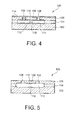
- Figures 1 to 5 representing the steps of a method for producing a micromechanical and / or nanomechanical device 100 with anti-stick stops according to a first embodiment.
- a micromechanical and / or nanomechanical device 100 is produced from a substrate 102, for example based on at least one semiconductor, for example silicon, on which a dielectric layer 104 is arranged. , for example based on an oxide such as silicon oxide and used here as a sacrificial layer, and a useful layer 106 for example based on at least one semiconductor such as silicon.
- the layers 102, 104 and 106 form here an SOI (silicon on insulator) substrate.
- the sacrificial layer 104 may for example have a thickness equal to approximately 0.4 ⁇ m, the useful layer 106 being able to have a thickness between about 1 micron and 200 microns.
- a useful layer is understood to mean a layer of material, or a portion of such a layer, in which a structure of micromechanical type is produced.
- Openings 108 are then made, for example in the useful layer 106, thus forming accesses to the sacrificial layer 104 (see FIG. figure 2 ).
- the openings 108 are made by taking advantage of photolithography and etching steps, for example of the RIE (reactive ion etching) type, implemented to produce and shape the MEMS structure. 100, that is the different elements of the MEMS 100.
- the openings 108 are, for example, trenches delimiting a portion 109 of the useful layer 106, forming a first element of the MEMS 100 such as a movable member of the MEMS 100, for example a suspended membrane if the MEMS 100 is a sensor.
- the portion 109 is intended to be mobile mainly along the axis y represented on the figure 3 .
- Partial etching of the sacrificial layer 104 is then performed through the openings 108 previously made.
- the sacrificial layer 104 is here based on silicon oxide, this etching can for example be performed by hydrofluoric acid.
- the entire sacrificial layer 104 is not etched.
- a cavity 110 is thus formed, disposed between the useful layer 106 and the substrate 102, in which one or more portions 112 of the sacrificial layer 104 are conserved, forming here spacers between the portion 109 of the useful layer 106 and the substrate 102.
- the number of these spacers and their distribution are adapted according to the portion 109, in particular according to the size and the shape of the portion 109.
- the portion 112 of the sacrificial layer 104 extends between the portion 109 of the useful layer 106 and the substrate 102, that is to say is in contact with the portion 109 of the useful layer 106 and with the substrate 102 .
- a thermal oxidation step of the silicon of the MEMS 100 is then performed.
- figure 4 it can be seen that all the silicon walls of the MEMS 100 are oxidized, forming an oxide layer 114.
- This oxidation can for example be carried out in a silicon depth for example between approximately 200 ⁇ and 2000 ⁇ .
- This oxidation can for example be obtained by a wet heat treatment at 800 ° C, for example for a few hours.
- the front face of the useful layer 106, the walls in the openings 108 and the silicon walls in the cavity 110 are oxidized.
- the oxide layer 114 may also be obtained by oxide growth, for example over a thickness of between approximately 600 ⁇ and 6000 ⁇ .
- This oxidation makes it possible to pre-form anti-sticking abutments in the useful layer 106 and / or in the substrate 102, at the level of the zones in contact with portions of the sacrificial layer 104 present in the cavity 110.
- the substrate 102 and the useful layer 106 are based on silicon. Since the portion 112 of the sacrificial layer 104 is in contact with both the substrate 102 and the useful layer 106, the pre-formed oxidation of the abutments in both the substrate 102 and the useful layer 106 (stops 116 and 118 on the figure 4 ).
- the portion or portions of the sacrificial layer 104 present in the cavity 110 thus form a mask, allowing the realization of anti-sticking stops at the portions of the substrate 102 and / or the useful layer 106 in contact with the portion or portions of the sacrificial layer 104.
- the substrate 102 and the useful layer 106 are not based on the same material.
- the oxidation is carried out only in one of the substrate 102 or the useful layer 106, the other being unaffected by this oxidation step.
- abutments can be made only in the substrate 102 or in the useful layer 106. Stops can also be formed successively in the substrate 102, then in the useful layer 106, or vice versa.
- the portion or portions of the sacrificial layer 104 preserved in the cavity 110 to be in contact only with the useful layer 106 or the substrate 102. In this case, stops are formed only in the layer contact with the portions of the sacrificial layer 104, that is to say either the substrate 102 or the useful layer 106.
- the oxide previously formed is then eliminated, as are the portions 112 of the sacrificial layer 104 preserved in the cavity 110.
- This elimination is carried out, for example, by carrying out an etching.
- the portion 109 of the useful layer 106 which is here the movable member of the MEMS 100, is thus released, or disengaged, from the substrate 102, except possibly at particular locations to preserve, for example, mechanical anchors of the pre-released structure.
- Anti-bonding abutments 116 and 118 make it possible to maintain the portion 109 of the useful layer 106 of the substrate 102 at a distance, and thus to avoid inadvertent bonding between this portion 109 and the substrate 102 during a displacement of the portion 109. relative to the substrate 102.
- Electronic means can then be made on the device 100, for example when it performs a measurement of the displacement of the portion 109 during its operation.
- a cover can also be made on the useful layer 106, covering and protecting the device 100.
- a second embodiment of the method of producing the device 100 is described below.
- a metallic deposit 120 is then produced on all the MEMS walls 100.
- the metal deposit 120 is sufficiently consistent to allow the walls of the cavity 110 to overlap at least at the level of the useful layer 106 and the substrate 102.
- this metal layer 120 may be deposited by ALD (deposit of atomic layer).
- the layer 120 may especially be based on nickel and / or titanium, and have a thickness of between about 200 ⁇ and 2000 ⁇ .
- a heat treatment is used to transform the metal layer 120 into a silicide layer 122, at least at the level of the useful layer 106 and the substrate 102 ( figure 7 ). Only metal portions 124 in contact with the sacrificial layer 104, which have not been converted into silicide, may be present in the cavity 110, as is the case on the figure 7 .
- One or more selective etching steps make it possible to eliminate these metal portions 124, the silicide layer 122 as well as the portion 112 of the sacrificial layer 104 present in the cavity 110.
- this etching is for example made from a solution of HF which makes it possible to achieve in a single step the etching of the metal (portions 124), silicide (layer 122) and sacrificial oxide (portion 112).
- the device 100 thus obtained is for example similar to the device 100 represented on the figure 5 .
- the chemical transformation carried out can also affect the side walls and the rear face of the device when they are not protected, without compromising the production of the anti-sticking or abutment.
Landscapes
- Engineering & Computer Science (AREA)
- Computer Hardware Design (AREA)
- Microelectronics & Electronic Packaging (AREA)
- Micromachines (AREA)
Applications Claiming Priority (1)
| Application Number | Priority Date | Filing Date | Title |
|---|---|---|---|
| FR0760402A FR2925889B1 (fr) | 2007-12-27 | 2007-12-27 | Procede de realisation d'un dispositif micromecanique et/ou nanomecanique a butees anti-collage |
Publications (3)
| Publication Number | Publication Date |
|---|---|
| EP2075224A2 true EP2075224A2 (de) | 2009-07-01 |
| EP2075224A3 EP2075224A3 (de) | 2010-08-11 |
| EP2075224B1 EP2075224B1 (de) | 2014-06-11 |
Family
ID=39745355
Family Applications (1)
| Application Number | Title | Priority Date | Filing Date |
|---|---|---|---|
| EP08172570.7A Active EP2075224B1 (de) | 2007-12-27 | 2008-12-22 | Verfahren zur Herstellung eines mikomechanischen oder nanomechanischen Elements mit Anti-Haft-Anschlägen |
Country Status (4)
| Country | Link |
|---|---|
| US (1) | US8557698B2 (de) |
| EP (1) | EP2075224B1 (de) |
| JP (1) | JP2009154286A (de) |
| FR (1) | FR2925889B1 (de) |
Cited By (1)
| Publication number | Priority date | Publication date | Assignee | Title |
|---|---|---|---|---|
| IT202200008822A1 (it) * | 2022-05-02 | 2023-11-02 | St Microelectronics Srl | Struttura mems includente una cavita' sepolta con protuberanze antiadesione, e relativi procedimenti di fabbricazione |
Families Citing this family (6)
| Publication number | Priority date | Publication date | Assignee | Title |
|---|---|---|---|---|
| FR2923650B1 (fr) | 2007-11-08 | 2010-09-03 | Commissariat Energie Atomique | Composant electronique a connexions par billes decouplees mecaniquement. |
| NO333724B1 (no) | 2009-08-14 | 2013-09-02 | Sintef | En mikromekanisk rekke med optisk reflekterende overflater |
| US8470628B2 (en) * | 2011-06-20 | 2013-06-25 | International Business Machines Corporation | Methods to fabricate silicide micromechanical device |
| DE102013101315A1 (de) * | 2013-02-11 | 2014-08-14 | Endress + Hauser Gmbh + Co. Kg | Verfahren zur Verlötung eines Anschlusselement |
| CN103420327B (zh) * | 2013-08-13 | 2015-09-09 | 中国电子科技集团公司第十三研究所 | 一种应用于图形化soi材料刻蚀工艺的界面保护方法 |
| KR101568761B1 (ko) | 2014-07-02 | 2015-11-13 | 서강대학교산학협력단 | 미세채널 공진기 및 그 제조방법 |
Citations (1)
| Publication number | Priority date | Publication date | Assignee | Title |
|---|---|---|---|---|
| EP0754953A1 (de) | 1995-07-21 | 1997-01-22 | Commissariat A L'energie Atomique | Verfahren zur Herstellung einer Struktur mit einer mittels Anschlägen auf Abstand von einem Substrat gehaltenen Nutzschicht, sowie Verfahren zur Loslösung einer solchen Schicht |
Family Cites Families (5)
| Publication number | Priority date | Publication date | Assignee | Title |
|---|---|---|---|---|
| JPS6035575A (ja) * | 1984-03-16 | 1985-02-23 | Toshiba Corp | Mos集積回路 |
| ATE269588T1 (de) * | 1993-02-04 | 2004-07-15 | Cornell Res Foundation Inc | Mikrostrukturen und einzelmask, einkristall- herstellungsverfahren |
| JP3778128B2 (ja) * | 2002-05-14 | 2006-05-24 | 株式会社デンソー | メンブレンを有する半導体装置の製造方法 |
| FR2857002B1 (fr) * | 2003-07-04 | 2005-10-21 | Commissariat Energie Atomique | Procede de desolidarisation d'une couche utile et composant obtenu par ce procede |
| US7482192B2 (en) * | 2006-05-16 | 2009-01-27 | Honeywell International Inc. | Method of making dimple structure for prevention of MEMS device stiction |
-
2007
- 2007-12-27 FR FR0760402A patent/FR2925889B1/fr not_active Expired - Fee Related
-
2008
- 2008-12-15 JP JP2008318264A patent/JP2009154286A/ja active Pending
- 2008-12-16 US US12/336,317 patent/US8557698B2/en not_active Expired - Fee Related
- 2008-12-22 EP EP08172570.7A patent/EP2075224B1/de active Active
Patent Citations (1)
| Publication number | Priority date | Publication date | Assignee | Title |
|---|---|---|---|---|
| EP0754953A1 (de) | 1995-07-21 | 1997-01-22 | Commissariat A L'energie Atomique | Verfahren zur Herstellung einer Struktur mit einer mittels Anschlägen auf Abstand von einem Substrat gehaltenen Nutzschicht, sowie Verfahren zur Loslösung einer solchen Schicht |
Cited By (2)
| Publication number | Priority date | Publication date | Assignee | Title |
|---|---|---|---|---|
| IT202200008822A1 (it) * | 2022-05-02 | 2023-11-02 | St Microelectronics Srl | Struttura mems includente una cavita' sepolta con protuberanze antiadesione, e relativi procedimenti di fabbricazione |
| EP4273091A1 (de) | 2022-05-02 | 2023-11-08 | STMicroelectronics S.r.l. | Mems-struktur mit einem vergrabenen hohlraum mit antihaftungsvorsprüngen und herstellungsverfahren dafür |
Also Published As
| Publication number | Publication date |
|---|---|
| US8557698B2 (en) | 2013-10-15 |
| JP2009154286A (ja) | 2009-07-16 |
| EP2075224A3 (de) | 2010-08-11 |
| EP2075224B1 (de) | 2014-06-11 |
| US20090170312A1 (en) | 2009-07-02 |
| FR2925889A1 (fr) | 2009-07-03 |
| FR2925889B1 (fr) | 2010-01-29 |
Similar Documents
| Publication | Publication Date | Title |
|---|---|---|
| EP2075224B1 (de) | Verfahren zur Herstellung eines mikomechanischen oder nanomechanischen Elements mit Anti-Haft-Anschlägen | |
| EP2808297B1 (de) | Verfahren zur Herstellung eines frei hängenden Teils einer mikro- und/oder nanoelektronischen Struktur in einem monolithischen Teil eines Substrats | |
| EP2075222B1 (de) | Method of manufacturing mechanical components of MEMS or NEMS structures in monocrystalline silicon | |
| EP2599746B1 (de) | Verfahren zur Herstellung einer Struktur mit mindestens einem aus mehreren Dicken bestehenden aktiven Teil | |
| EP2143684B1 (de) | Herstellungsverfahren von einer MEMS-/NEMS-Struktur die eine teilweise monokristalline Verankerung besitzt | |
| EP3495894B1 (de) | Verfahren zur herstellung einer uhrkomponente | |
| EP2599745B1 (de) | Verfahren zum Herstellen eines MEMS Bauteil mit bewegliche Teile unterschiedlicher Dicke | |
| EP2952472B1 (de) | Verbessertes herstellungsverfahren von hängeelementen unterschiedlicher dicke für mems- und nems-struktur | |
| EP2354083B1 (de) | Verpackungsverfahren für mikromechanisches Bauteil mit mechanisch verstärkter Kappe | |
| EP0983609B1 (de) | Verfahren zur herstellung eines mikrosensors mit mikrogefertigtem silizium | |
| EP2075223B1 (de) | Device with pre-released structure | |
| EP2138455A1 (de) | Verfahren zum Herstellen einer MEMS-Struktur mit einem beweglichen Element durch die Anwendung einer heterogenen Opferschicht | |
| EP0950172B1 (de) | Verfahren zur herstellung eines aufgehängten elementes in einer mikromechanischen struktur | |
| EP2309342A1 (de) | Freilauf-Triebfeder aus mikro-bearbeitbarem Material und ihr Herstellungsverfahren | |
| WO2016075098A1 (fr) | Procede de fabrication d'un dispositif electromecanique et dispositif correspondant | |
| FR2925887A1 (fr) | Dispositif micromecanique ou nanomecanique a couche d'interface anti-collage | |
| EP3173375B1 (de) | Einkapselungsverfahren einer mikroelektronischen vorrichtung mit einem auslassloch variabler grösse | |
| EP3459907B1 (de) | Mikro-vorrichtung, die ein element umfasst, das gegen eine hf-ätzung geschützt ist, und form eines materials, die einen halbleiter und ein metall umfasst | |
| EP3386910A1 (de) | Verfahren zur herstellung einer mikroelektromechanischen vorrichtung und zugehörige vorrichtung | |
| EP1736434A2 (de) | Method of manufacture of suspended sub-micrometric devices and mechanical characterisation of the devices | |
| CH701972A2 (fr) | Rouage avec mobile monté fou en matériau micro-usinable, son procédé de fabrication et pièce d'horlogerie comportant un tel rouage. |
Legal Events
| Date | Code | Title | Description |
|---|---|---|---|
| PUAI | Public reference made under article 153(3) epc to a published international application that has entered the european phase |
Free format text: ORIGINAL CODE: 0009012 |
|
| AK | Designated contracting states |
Kind code of ref document: A2 Designated state(s): AT BE BG CH CY CZ DE DK EE ES FI FR GB GR HR HU IE IS IT LI LT LU LV MC MT NL NO PL PT RO SE SI SK TR |
|
| AX | Request for extension of the european patent |
Extension state: AL BA MK RS |
|
| RAP1 | Party data changed (applicant data changed or rights of an application transferred) |
Owner name: COMMISSARIAT A L'ENERGIE ATOMIQUE ET AUX ENERGIES |
|
| PUAL | Search report despatched |
Free format text: ORIGINAL CODE: 0009013 |
|
| AK | Designated contracting states |
Kind code of ref document: A3 Designated state(s): AT BE BG CH CY CZ DE DK EE ES FI FR GB GR HR HU IE IS IT LI LT LU LV MC MT NL NO PL PT RO SE SI SK TR |
|
| AX | Request for extension of the european patent |
Extension state: AL BA MK RS |
|
| 17P | Request for examination filed |
Effective date: 20110124 |
|
| AKX | Designation fees paid |
Designated state(s): AT BE BG CH CY CZ DE DK EE ES FI FR GB GR HR HU IE IS IT LI LT LU LV MC MT NL NO PL PT RO SE SI SK TR |
|
| REG | Reference to a national code |
Ref country code: DE Ref legal event code: R079 Ref document number: 602008032676 Country of ref document: DE Free format text: PREVIOUS MAIN CLASS: B81C0001000000 Ipc: B81B0003000000 |
|
| RIC1 | Information provided on ipc code assigned before grant |
Ipc: B81B 3/00 20060101AFI20131127BHEP |
|
| GRAP | Despatch of communication of intention to grant a patent |
Free format text: ORIGINAL CODE: EPIDOSNIGR1 |
|
| INTG | Intention to grant announced |
Effective date: 20140103 |
|
| GRAS | Grant fee paid |
Free format text: ORIGINAL CODE: EPIDOSNIGR3 |
|
| GRAA | (expected) grant |
Free format text: ORIGINAL CODE: 0009210 |
|
| AK | Designated contracting states |
Kind code of ref document: B1 Designated state(s): AT BE BG CH CY CZ DE DK EE ES FI FR GB GR HR HU IE IS IT LI LT LU LV MC MT NL NO PL PT RO SE SI SK TR |
|
| REG | Reference to a national code |
Ref country code: GB Ref legal event code: FG4D Free format text: NOT ENGLISH |
|
| REG | Reference to a national code |
Ref country code: CH Ref legal event code: EP |
|
| REG | Reference to a national code |
Ref country code: IE Ref legal event code: FG4D Free format text: LANGUAGE OF EP DOCUMENT: FRENCH |
|
| REG | Reference to a national code |
Ref country code: AT Ref legal event code: REF Ref document number: 672160 Country of ref document: AT Kind code of ref document: T Effective date: 20140715 |
|
| REG | Reference to a national code |
Ref country code: DE Ref legal event code: R096 Ref document number: 602008032676 Country of ref document: DE Effective date: 20140724 |
|
| PG25 | Lapsed in a contracting state [announced via postgrant information from national office to epo] |
Ref country code: FI Free format text: LAPSE BECAUSE OF FAILURE TO SUBMIT A TRANSLATION OF THE DESCRIPTION OR TO PAY THE FEE WITHIN THE PRESCRIBED TIME-LIMIT Effective date: 20140611 Ref country code: NO Free format text: LAPSE BECAUSE OF FAILURE TO SUBMIT A TRANSLATION OF THE DESCRIPTION OR TO PAY THE FEE WITHIN THE PRESCRIBED TIME-LIMIT Effective date: 20140911 Ref country code: LT Free format text: LAPSE BECAUSE OF FAILURE TO SUBMIT A TRANSLATION OF THE DESCRIPTION OR TO PAY THE FEE WITHIN THE PRESCRIBED TIME-LIMIT Effective date: 20140611 Ref country code: GR Free format text: LAPSE BECAUSE OF FAILURE TO SUBMIT A TRANSLATION OF THE DESCRIPTION OR TO PAY THE FEE WITHIN THE PRESCRIBED TIME-LIMIT Effective date: 20140912 |
|
| REG | Reference to a national code |
Ref country code: NL Ref legal event code: VDEP Effective date: 20140611 |
|
| REG | Reference to a national code |
Ref country code: AT Ref legal event code: MK05 Ref document number: 672160 Country of ref document: AT Kind code of ref document: T Effective date: 20140611 |
|
| REG | Reference to a national code |
Ref country code: LT Ref legal event code: MG4D |
|
| PG25 | Lapsed in a contracting state [announced via postgrant information from national office to epo] |
Ref country code: LV Free format text: LAPSE BECAUSE OF FAILURE TO SUBMIT A TRANSLATION OF THE DESCRIPTION OR TO PAY THE FEE WITHIN THE PRESCRIBED TIME-LIMIT Effective date: 20140611 Ref country code: HR Free format text: LAPSE BECAUSE OF FAILURE TO SUBMIT A TRANSLATION OF THE DESCRIPTION OR TO PAY THE FEE WITHIN THE PRESCRIBED TIME-LIMIT Effective date: 20140611 Ref country code: SE Free format text: LAPSE BECAUSE OF FAILURE TO SUBMIT A TRANSLATION OF THE DESCRIPTION OR TO PAY THE FEE WITHIN THE PRESCRIBED TIME-LIMIT Effective date: 20140611 |
|
| PG25 | Lapsed in a contracting state [announced via postgrant information from national office to epo] |
Ref country code: RO Free format text: LAPSE BECAUSE OF FAILURE TO SUBMIT A TRANSLATION OF THE DESCRIPTION OR TO PAY THE FEE WITHIN THE PRESCRIBED TIME-LIMIT Effective date: 20140611 Ref country code: CZ Free format text: LAPSE BECAUSE OF FAILURE TO SUBMIT A TRANSLATION OF THE DESCRIPTION OR TO PAY THE FEE WITHIN THE PRESCRIBED TIME-LIMIT Effective date: 20140611 Ref country code: EE Free format text: LAPSE BECAUSE OF FAILURE TO SUBMIT A TRANSLATION OF THE DESCRIPTION OR TO PAY THE FEE WITHIN THE PRESCRIBED TIME-LIMIT Effective date: 20140611 Ref country code: PT Free format text: LAPSE BECAUSE OF FAILURE TO SUBMIT A TRANSLATION OF THE DESCRIPTION OR TO PAY THE FEE WITHIN THE PRESCRIBED TIME-LIMIT Effective date: 20141013 Ref country code: ES Free format text: LAPSE BECAUSE OF FAILURE TO SUBMIT A TRANSLATION OF THE DESCRIPTION OR TO PAY THE FEE WITHIN THE PRESCRIBED TIME-LIMIT Effective date: 20140611 Ref country code: SK Free format text: LAPSE BECAUSE OF FAILURE TO SUBMIT A TRANSLATION OF THE DESCRIPTION OR TO PAY THE FEE WITHIN THE PRESCRIBED TIME-LIMIT Effective date: 20140611 |
|
| PG25 | Lapsed in a contracting state [announced via postgrant information from national office to epo] |
Ref country code: IS Free format text: LAPSE BECAUSE OF FAILURE TO SUBMIT A TRANSLATION OF THE DESCRIPTION OR TO PAY THE FEE WITHIN THE PRESCRIBED TIME-LIMIT Effective date: 20141011 Ref country code: AT Free format text: LAPSE BECAUSE OF FAILURE TO SUBMIT A TRANSLATION OF THE DESCRIPTION OR TO PAY THE FEE WITHIN THE PRESCRIBED TIME-LIMIT Effective date: 20140611 Ref country code: NL Free format text: LAPSE BECAUSE OF FAILURE TO SUBMIT A TRANSLATION OF THE DESCRIPTION OR TO PAY THE FEE WITHIN THE PRESCRIBED TIME-LIMIT Effective date: 20140611 Ref country code: PL Free format text: LAPSE BECAUSE OF FAILURE TO SUBMIT A TRANSLATION OF THE DESCRIPTION OR TO PAY THE FEE WITHIN THE PRESCRIBED TIME-LIMIT Effective date: 20140611 |
|
| REG | Reference to a national code |
Ref country code: DE Ref legal event code: R097 Ref document number: 602008032676 Country of ref document: DE |
|
| PLBE | No opposition filed within time limit |
Free format text: ORIGINAL CODE: 0009261 |
|
| STAA | Information on the status of an ep patent application or granted ep patent |
Free format text: STATUS: NO OPPOSITION FILED WITHIN TIME LIMIT |
|
| PG25 | Lapsed in a contracting state [announced via postgrant information from national office to epo] |
Ref country code: DK Free format text: LAPSE BECAUSE OF FAILURE TO SUBMIT A TRANSLATION OF THE DESCRIPTION OR TO PAY THE FEE WITHIN THE PRESCRIBED TIME-LIMIT Effective date: 20140611 Ref country code: IT Free format text: LAPSE BECAUSE OF FAILURE TO SUBMIT A TRANSLATION OF THE DESCRIPTION OR TO PAY THE FEE WITHIN THE PRESCRIBED TIME-LIMIT Effective date: 20140611 |
|
| 26N | No opposition filed |
Effective date: 20150312 |
|
| REG | Reference to a national code |
Ref country code: DE Ref legal event code: R097 Ref document number: 602008032676 Country of ref document: DE Effective date: 20150312 |
|
| PG25 | Lapsed in a contracting state [announced via postgrant information from national office to epo] |
Ref country code: BE Free format text: LAPSE BECAUSE OF NON-PAYMENT OF DUE FEES Effective date: 20141231 |
|
| PG25 | Lapsed in a contracting state [announced via postgrant information from national office to epo] |
Ref country code: SI Free format text: LAPSE BECAUSE OF FAILURE TO SUBMIT A TRANSLATION OF THE DESCRIPTION OR TO PAY THE FEE WITHIN THE PRESCRIBED TIME-LIMIT Effective date: 20140611 Ref country code: LU Free format text: LAPSE BECAUSE OF FAILURE TO SUBMIT A TRANSLATION OF THE DESCRIPTION OR TO PAY THE FEE WITHIN THE PRESCRIBED TIME-LIMIT Effective date: 20141222 |
|
| REG | Reference to a national code |
Ref country code: CH Ref legal event code: PL |
|
| REG | Reference to a national code |
Ref country code: IE Ref legal event code: MM4A |
|
| PG25 | Lapsed in a contracting state [announced via postgrant information from national office to epo] |
Ref country code: IE Free format text: LAPSE BECAUSE OF NON-PAYMENT OF DUE FEES Effective date: 20141222 Ref country code: LI Free format text: LAPSE BECAUSE OF NON-PAYMENT OF DUE FEES Effective date: 20141231 Ref country code: CH Free format text: LAPSE BECAUSE OF NON-PAYMENT OF DUE FEES Effective date: 20141231 |
|
| REG | Reference to a national code |
Ref country code: FR Ref legal event code: PLFP Year of fee payment: 8 |
|
| PG25 | Lapsed in a contracting state [announced via postgrant information from national office to epo] |
Ref country code: MC Free format text: LAPSE BECAUSE OF FAILURE TO SUBMIT A TRANSLATION OF THE DESCRIPTION OR TO PAY THE FEE WITHIN THE PRESCRIBED TIME-LIMIT Effective date: 20140611 Ref country code: BG Free format text: LAPSE BECAUSE OF FAILURE TO SUBMIT A TRANSLATION OF THE DESCRIPTION OR TO PAY THE FEE WITHIN THE PRESCRIBED TIME-LIMIT Effective date: 20140611 |
|
| PG25 | Lapsed in a contracting state [announced via postgrant information from national office to epo] |
Ref country code: CY Free format text: LAPSE BECAUSE OF FAILURE TO SUBMIT A TRANSLATION OF THE DESCRIPTION OR TO PAY THE FEE WITHIN THE PRESCRIBED TIME-LIMIT Effective date: 20140611 |
|
| PG25 | Lapsed in a contracting state [announced via postgrant information from national office to epo] |
Ref country code: HU Free format text: LAPSE BECAUSE OF FAILURE TO SUBMIT A TRANSLATION OF THE DESCRIPTION OR TO PAY THE FEE WITHIN THE PRESCRIBED TIME-LIMIT; INVALID AB INITIO Effective date: 20081222 Ref country code: TR Free format text: LAPSE BECAUSE OF FAILURE TO SUBMIT A TRANSLATION OF THE DESCRIPTION OR TO PAY THE FEE WITHIN THE PRESCRIBED TIME-LIMIT Effective date: 20140611 Ref country code: MT Free format text: LAPSE BECAUSE OF FAILURE TO SUBMIT A TRANSLATION OF THE DESCRIPTION OR TO PAY THE FEE WITHIN THE PRESCRIBED TIME-LIMIT Effective date: 20140611 |
|
| REG | Reference to a national code |
Ref country code: FR Ref legal event code: PLFP Year of fee payment: 9 |
|
| REG | Reference to a national code |
Ref country code: FR Ref legal event code: PLFP Year of fee payment: 10 |
|
| PGFP | Annual fee paid to national office [announced via postgrant information from national office to epo] |
Ref country code: GB Payment date: 20171219 Year of fee payment: 10 |
|
| GBPC | Gb: european patent ceased through non-payment of renewal fee |
Effective date: 20181222 |
|
| PG25 | Lapsed in a contracting state [announced via postgrant information from national office to epo] |
Ref country code: GB Free format text: LAPSE BECAUSE OF NON-PAYMENT OF DUE FEES Effective date: 20181222 |
|
| PGFP | Annual fee paid to national office [announced via postgrant information from national office to epo] |
Ref country code: FR Payment date: 20241227 Year of fee payment: 17 |
|
| PGFP | Annual fee paid to national office [announced via postgrant information from national office to epo] |
Ref country code: DE Payment date: 20241219 Year of fee payment: 17 |