EP2075307A2 - Organisches Elektrolumineszenzmaterial und Element damit - Google Patents
Organisches Elektrolumineszenzmaterial und Element damit Download PDFInfo
- Publication number
- EP2075307A2 EP2075307A2 EP08021923A EP08021923A EP2075307A2 EP 2075307 A2 EP2075307 A2 EP 2075307A2 EP 08021923 A EP08021923 A EP 08021923A EP 08021923 A EP08021923 A EP 08021923A EP 2075307 A2 EP2075307 A2 EP 2075307A2
- Authority
- EP
- European Patent Office
- Prior art keywords
- group
- organic
- mentioned
- chemical formula
- light emitting
- Prior art date
- Legal status (The legal status is an assumption and is not a legal conclusion. Google has not performed a legal analysis and makes no representation as to the accuracy of the status listed.)
- Withdrawn
Links
- 0 Cc(c(*)c1*)c(*)c(c(*)c2*)c1c(*)c2-c1c(*)c2c(*)c(*)c(*)c(*)c2c(*)c1 Chemical compound Cc(c(*)c1*)c(*)c(c(*)c2*)c1c(*)c2-c1c(*)c2c(*)c(*)c(*)c(*)c2c(*)c1 0.000 description 1
Images
Classifications
-
- C—CHEMISTRY; METALLURGY
- C09—DYES; PAINTS; POLISHES; NATURAL RESINS; ADHESIVES; COMPOSITIONS NOT OTHERWISE PROVIDED FOR; APPLICATIONS OF MATERIALS NOT OTHERWISE PROVIDED FOR
- C09K—MATERIALS FOR MISCELLANEOUS APPLICATIONS, NOT PROVIDED FOR ELSEWHERE
- C09K11/00—Luminescent materials, e.g. electroluminescent or chemiluminescent
- C09K11/06—Luminescent materials, e.g. electroluminescent or chemiluminescent containing organic luminescent materials
-
- C—CHEMISTRY; METALLURGY
- C07—ORGANIC CHEMISTRY
- C07C—ACYCLIC OR CARBOCYCLIC COMPOUNDS
- C07C15/00—Cyclic hydrocarbons containing only six-membered aromatic rings as cyclic parts
- C07C15/40—Cyclic hydrocarbons containing only six-membered aromatic rings as cyclic parts substituted by unsaturated carbon radicals
- C07C15/56—Cyclic hydrocarbons containing only six-membered aromatic rings as cyclic parts substituted by unsaturated carbon radicals polycyclic condensed
- C07C15/58—Cyclic hydrocarbons containing only six-membered aromatic rings as cyclic parts substituted by unsaturated carbon radicals polycyclic condensed containing two rings
-
- C—CHEMISTRY; METALLURGY
- C07—ORGANIC CHEMISTRY
- C07D—HETEROCYCLIC COMPOUNDS
- C07D213/00—Heterocyclic compounds containing six-membered rings, not condensed with other rings, with one nitrogen atom as the only ring hetero atom and three or more double bonds between ring members or between ring members and non-ring members
- C07D213/02—Heterocyclic compounds containing six-membered rings, not condensed with other rings, with one nitrogen atom as the only ring hetero atom and three or more double bonds between ring members or between ring members and non-ring members having three double bonds between ring members or between ring members and non-ring members
- C07D213/04—Heterocyclic compounds containing six-membered rings, not condensed with other rings, with one nitrogen atom as the only ring hetero atom and three or more double bonds between ring members or between ring members and non-ring members having three double bonds between ring members or between ring members and non-ring members having no bond between the ring nitrogen atom and a non-ring member or having only hydrogen or carbon atoms directly attached to the ring nitrogen atom
- C07D213/24—Heterocyclic compounds containing six-membered rings, not condensed with other rings, with one nitrogen atom as the only ring hetero atom and three or more double bonds between ring members or between ring members and non-ring members having three double bonds between ring members or between ring members and non-ring members having no bond between the ring nitrogen atom and a non-ring member or having only hydrogen or carbon atoms directly attached to the ring nitrogen atom with substituted hydrocarbon radicals attached to ring carbon atoms
- C07D213/36—Radicals substituted by singly-bound nitrogen atoms
- C07D213/38—Radicals substituted by singly-bound nitrogen atoms having only hydrogen or hydrocarbon radicals attached to the substituent nitrogen atom
-
- C—CHEMISTRY; METALLURGY
- C07—ORGANIC CHEMISTRY
- C07D—HETEROCYCLIC COMPOUNDS
- C07D233/00—Heterocyclic compounds containing 1,3-diazole or hydrogenated 1,3-diazole rings, not condensed with other rings
- C07D233/54—Heterocyclic compounds containing 1,3-diazole or hydrogenated 1,3-diazole rings, not condensed with other rings having two double bonds between ring members or between ring members and non-ring members
- C07D233/56—Heterocyclic compounds containing 1,3-diazole or hydrogenated 1,3-diazole rings, not condensed with other rings having two double bonds between ring members or between ring members and non-ring members with only hydrogen atoms or radicals containing only hydrogen and carbon atoms, attached to ring carbon atoms
- C07D233/61—Heterocyclic compounds containing 1,3-diazole or hydrogenated 1,3-diazole rings, not condensed with other rings having two double bonds between ring members or between ring members and non-ring members with only hydrogen atoms or radicals containing only hydrogen and carbon atoms, attached to ring carbon atoms with hydrocarbon radicals, substituted by nitrogen atoms not forming part of a nitro radical, attached to ring nitrogen atoms
-
- C—CHEMISTRY; METALLURGY
- C07—ORGANIC CHEMISTRY
- C07D—HETEROCYCLIC COMPOUNDS
- C07D239/00—Heterocyclic compounds containing 1,3-diazine or hydrogenated 1,3-diazine rings
- C07D239/02—Heterocyclic compounds containing 1,3-diazine or hydrogenated 1,3-diazine rings not condensed with other rings
- C07D239/24—Heterocyclic compounds containing 1,3-diazine or hydrogenated 1,3-diazine rings not condensed with other rings having three or more double bonds between ring members or between ring members and non-ring members
- C07D239/26—Heterocyclic compounds containing 1,3-diazine or hydrogenated 1,3-diazine rings not condensed with other rings having three or more double bonds between ring members or between ring members and non-ring members with only hydrogen atoms, hydrocarbon or substituted hydrocarbon radicals, directly attached to ring carbon atoms
-
- H—ELECTRICITY
- H10—SEMICONDUCTOR DEVICES; ELECTRIC SOLID-STATE DEVICES NOT OTHERWISE PROVIDED FOR
- H10K—ORGANIC ELECTRIC SOLID-STATE DEVICES
- H10K85/00—Organic materials used in the body or electrodes of devices covered by this subclass
- H10K85/60—Organic compounds having low molecular weight
- H10K85/615—Polycyclic condensed aromatic hydrocarbons, e.g. anthracene
- H10K85/626—Polycyclic condensed aromatic hydrocarbons, e.g. anthracene containing more than one polycyclic condensed aromatic rings, e.g. bis-anthracene
-
- H—ELECTRICITY
- H10—SEMICONDUCTOR DEVICES; ELECTRIC SOLID-STATE DEVICES NOT OTHERWISE PROVIDED FOR
- H10K—ORGANIC ELECTRIC SOLID-STATE DEVICES
- H10K85/00—Organic materials used in the body or electrodes of devices covered by this subclass
- H10K85/60—Organic compounds having low molecular weight
- H10K85/649—Aromatic compounds comprising a hetero atom
- H10K85/654—Aromatic compounds comprising a hetero atom comprising only nitrogen as heteroatom
-
- C—CHEMISTRY; METALLURGY
- C09—DYES; PAINTS; POLISHES; NATURAL RESINS; ADHESIVES; COMPOSITIONS NOT OTHERWISE PROVIDED FOR; APPLICATIONS OF MATERIALS NOT OTHERWISE PROVIDED FOR
- C09K—MATERIALS FOR MISCELLANEOUS APPLICATIONS, NOT PROVIDED FOR ELSEWHERE
- C09K2211/00—Chemical nature of organic luminescent or tenebrescent compounds
- C09K2211/10—Non-macromolecular compounds
- C09K2211/1003—Carbocyclic compounds
- C09K2211/1011—Condensed systems
-
- C—CHEMISTRY; METALLURGY
- C09—DYES; PAINTS; POLISHES; NATURAL RESINS; ADHESIVES; COMPOSITIONS NOT OTHERWISE PROVIDED FOR; APPLICATIONS OF MATERIALS NOT OTHERWISE PROVIDED FOR
- C09K—MATERIALS FOR MISCELLANEOUS APPLICATIONS, NOT PROVIDED FOR ELSEWHERE
- C09K2211/00—Chemical nature of organic luminescent or tenebrescent compounds
- C09K2211/10—Non-macromolecular compounds
- C09K2211/1018—Heterocyclic compounds
- C09K2211/1025—Heterocyclic compounds characterised by ligands
- C09K2211/1029—Heterocyclic compounds characterised by ligands containing one nitrogen atom as the heteroatom
-
- C—CHEMISTRY; METALLURGY
- C09—DYES; PAINTS; POLISHES; NATURAL RESINS; ADHESIVES; COMPOSITIONS NOT OTHERWISE PROVIDED FOR; APPLICATIONS OF MATERIALS NOT OTHERWISE PROVIDED FOR
- C09K—MATERIALS FOR MISCELLANEOUS APPLICATIONS, NOT PROVIDED FOR ELSEWHERE
- C09K2211/00—Chemical nature of organic luminescent or tenebrescent compounds
- C09K2211/10—Non-macromolecular compounds
- C09K2211/1018—Heterocyclic compounds
- C09K2211/1025—Heterocyclic compounds characterised by ligands
- C09K2211/1044—Heterocyclic compounds characterised by ligands containing two nitrogen atoms as heteroatoms
-
- H—ELECTRICITY
- H10—SEMICONDUCTOR DEVICES; ELECTRIC SOLID-STATE DEVICES NOT OTHERWISE PROVIDED FOR
- H10K—ORGANIC ELECTRIC SOLID-STATE DEVICES
- H10K50/00—Organic light-emitting devices
- H10K50/10—OLEDs or polymer light-emitting diodes [PLED]
- H10K50/11—OLEDs or polymer light-emitting diodes [PLED] characterised by the electroluminescent [EL] layers
-
- Y—GENERAL TAGGING OF NEW TECHNOLOGICAL DEVELOPMENTS; GENERAL TAGGING OF CROSS-SECTIONAL TECHNOLOGIES SPANNING OVER SEVERAL SECTIONS OF THE IPC; TECHNICAL SUBJECTS COVERED BY FORMER USPC CROSS-REFERENCE ART COLLECTIONS [XRACs] AND DIGESTS
- Y02—TECHNOLOGIES OR APPLICATIONS FOR MITIGATION OR ADAPTATION AGAINST CLIMATE CHANGE
- Y02B—CLIMATE CHANGE MITIGATION TECHNOLOGIES RELATED TO BUILDINGS, e.g. HOUSING, HOUSE APPLIANCES OR RELATED END-USER APPLICATIONS
- Y02B20/00—Energy efficient lighting technologies, e.g. halogen lamps or gas discharge lamps
Definitions
- the present invention relates to an organic electroluminescence material made of a novel naphthalene derivative for obtaining blue luminescence excellent in color purity, and to an organic electroluminescence element (hereinafter referred to as organic EL element) using the same.
- the organic EL element is a self-luminescence type element which includes an organic compound as a light emitting material and allows luminescence at a high speed, it is suitable for displaying a video image, and it has features that allow an element structure to be simple and a display panel to be thin. Having such outstanding features, the organic EL element is spreading in everyday life as a cellular phone or a vehicle-mounted display.
- the above-mentioned organic EL element has been improved in luminescence efficiency by doping a host with a very small quantity of light emitting colorant. For this reason, the host material is an important material in order to obtain an efficient organic EL element.
- the host material which can efficiently take blue luminescence from the blue-light emitting colorant is indispensable.
- anthracene derivatives as shown in the following [Chemical Formula 1] and [Chemical Formula 2], a distyrylarylene derivative as shown in the following [Chemical Formula 3], a naphthalene derivative as shown in the following [Chemical Formula 4], etc. are known (for example, Japanese Patent Application Publication No. H11-312588 , Japanese Patent Application Publication No. 2005-222948 , Japanese Patent Application Publication No. H2-247278 , and J. Shi, et al., Applied Physics Letters, 80 (17), p.3201 ).
- the present invention arises in order to solve the above-mentioned technical problem, and aims at providing a new organic electroluminescence material which emits blue light excellent in color purity and an organic EL element using the same.
- the organic EL material in accordance with the present invention is expressed by the following general formula (1).
- R 1 -R 9 are selected from the group consisting of hydrogen, an alkyl group, a cycloalkyl group, an alkoxy group, a cycloalkoxy group, and an aryloxy group, and they may be the same groups or the groups different from one another.
- a 1 -P 4 are selected from the group consisting of a phenyl group which is either substituted or unsubstituted and a 5 or 6 member heterocyclic ring group which is either substituted or unsubstituted, and they may be the same groups or the groups different from one another.
- the organic EL element in accordance with the present invention is an organic EL element having one or a plurality of organic layers in which a light emitting layer is provided between a pair of electrodes, characterized in that at least one layer of the above-mentioned organic layers contains the above-mentioned organic EL material independently or as a mixture.
- At least one layer of the above-mentioned organic layers is a light emitting layer containing the above-mentioned organic EL material as a host material and a fluorescence or phosphorescence emitting material as a guest material.
- a transparent electroconductive thin-film is formed on a transparent substrate.
- the organic EL material in accordance with the present invention As described above, according to the organic EL material in accordance with the present invention, the blue luminescence excellent in color purity is obtained. Thus, by using this, it is possible to provide the white-light emitting element with high color rendering properties.
- the organic EL element in accordance with the present invention would be applied to flat panel displays for OA computers and flat TV sets which nowadays require better color reproducibility, a light source for an illumination apparatus, a light source for a copying machine, light sources which take advantage of planar light-emitting members, such as backlight sources for a liquid crystal display, meters, etc., a display board, and a beacon light.
- An organic EL material in accordance with the present invention is a compound expressed by the above-mentioned general formula (1).
- Such a binaphthyl derivative is a novel compound which emits blue light excellent in color purity. By using this, it is possible to provide the white light emitting element with high color rendering properties.
- R 1 -R 9 are selected from the group consisting of hydrogen, an alkyl group, a cycloalkyl group, an alkoxy group, a cycloalkoxy group, and an aryloxy group, and they may be the same groups or the groups different from one another.
- a 1 -A 4 are selected from the group consisting of a phenyl group which is either substituted or unsubstituted and a 5 or 6 member heterocyclic ring group which is either substituted or unsubstituted, and they may be the same groups or the groups different from one another.
- the alkyl group indicates a saturated aliphatic hydrocarbon group, such as for example a methyl group, an ethyl group, a propyl group, a butyl group, etc., and it may be of a straight chain or may be of a branched chain.
- the cycloalkyl group indicates a saturated alicyclic hydrocarbon group, such as for example, a cyclohexyl group, a norbornyl group, an adamantyl group, etc., and they may be either unsubstituted or substituted.
- the alkoxy group indicates, for example, a saturated aliphatic hydrocarbon group through ether bonds, such as a methoxy group etc. , and it may be of a straight chain, or may be of a branched chain.
- the cycloalkoxy group indicates a cyclic saturated aliphatic hydrocarbon group through ether bonds, such as for example, a cyclohexyl group etc., and it may be either unsubstituted or substituted.
- the aryloxy group indicates an aromatic hydrocarbon group through ether bonds, such as for example a phenoxy group etc., and the aromatic hydrocarbon group may be either unsubstituted or substituted.
- the substituted phenyl group indicates a phenyl group substituted with an alkyl group, a cycloalkyl group, an alkoxy group, a cycloalkoxy group, or an aryloxy group.
- the heterocyclic group indicates a group which contains either nitrogen and sulfur or oxygen as a ring constituent element in addition to carbon.
- the compound expressed by the above-mentioned general formula (1) can be synthesized by way of a conventionally known synthetic reaction.
- diamino-substituted naphthalene is used as a material, and an amino group is substituted by a predetermined halogen group by way of the Sandmeyer reaction.
- a predetermined halogen group is substituted by a predetermined halogen group by way of the Sandmeyer reaction.
- meta positions of the halogen substitution group are brominated in the presence of transition metal powder (preferably iron powder), to obtain a bromine derivative.
- a dimer is obtained in which the naphthalene rings are connected each other at the meta positions. Furthermore, the naphthalene derivative expressed by the above-mentioned general formula (1) is synthesized by way of the coupling reaction between this dimer and a corresponding cross coupling agent using the transition metal catalysts, such as Ni, Pd, etc.
- reaction selectivity it is possible to obtain reaction selectivity. It is also possible to perform previously the coupling reaction with the corresponding cross coupling agent using the transition metal catalysts, such as Ni, Pd, etc., then to carry out dimerization, thus synthesizing the naphthalene derivative expressed by the above-mentioned general formula (1). Further, by selecting the halogen group, the asymmetrical compound expressed by the above-mentioned general formula (1) can also be synthesized in the coupling reaction using the transition metal catalysts, such as Ni, Pd, etc.
- the material is not particularly limited, but a dihydroxy derivative, a dialkoxy derivative, etc. can also be used other than the above-mentioned diamino derivative of naphthalene.
- the compound expressed by the above-mentioned general formula (1) can also be synthesized by way of the Diels-Alder reaction.
- the organic EL element in accordance with the present invention provided with the layer containing the above-mentioned organic EL material which can obtain blue luminescence excellent in color purity has a structure in which one or a plurality of organic layers are laminated between electrodes.
- the known lamination structure further including a hole injection layer, a hole transport light emitting layer, an electron injection layer, an electron transport light emitting layer, etc.
- the transparent electroconductive thin-film is formed on the transparent substrate.
- the above-mentioned substrate is a support member of the organic EL element.
- the substrate side is a light emitting side
- a transparent substrate which is transmissive in visible light. It is preferable that the optical transmissivity is 80% or more. More preferably, it is 85% or more. Most preferably, it is 90% or more.
- the above-mentioned transparent substrate employs glass substrates made of, such as for example, optical glass (BK7, BaK1, F2, etc.), silica glass, non alkali glass, borosilicate glass, aluminosilicate glass, polymer substrate made of, such as for example, acrylic resins (PMMA, etc.), polycarbonate, polyether sulphonate, polystyrene, polyolefin, an epoxy resin, and polyethylene terephthalate, polyester, etc.
- glass substrates made of, such as for example, optical glass (BK7, BaK1, F2, etc.), silica glass, non alkali glass, borosilicate glass, aluminosilicate glass, polymer substrate made of, such as for example, acrylic resins (PMMA, etc.), polycarbonate, polyether sulphonate, polystyrene, polyolefin, an epoxy resin, and polyethylene terephthalate, polyester, etc.
- PMMA acrylic resins
- the above-mentioned substrate having a thickness of approximately 0.1-10 mm is usually used, it is preferable that the thickness is 0.3-5 mm in view of mechanical strength, weight, etc. More preferably it is 0.5-2 mm.
- the first electrode is provided on the above-mentioned substrate.
- this first electrode is usually an anode and is made of a metal, an alloy, an electroconductive compound, etc., with a large work function (4 eV or more), it is preferable to be formed as a transparent electrode on the above-mentioned transparent substrate.
- metal oxides such as indium tin oxide (ITO), indium zinc oxide, zinc oxide, etc. are used for this transparent electrode.
- ITO indium tin oxide
- ITO is preferably used in terms of its transparency, conductivity, etc.
- a film thickness of this transparent electrode is 80-400 nm. More preferably, it is 100-200 nm.
- the anode is usually formed by way of a sputtering method, a vacuum deposition method, etc., and formed as the transparent electroconductive thin-film.
- a cathode of the second electrode which faces this anode is made of a metal, an alloy, and a conductive compound having a small work function (4eV or less).
- a metal an alloy, and a conductive compound having a small work function (4eV or less).
- a metal an alloy, and a conductive compound having a small work function (4eV or less).
- a metal an alloy, and a conductive compound having a small work function (4eV or less.
- aluminum an aluminum-lithium alloy, a magnesium-silver alloy, etc.
- the film thickness of the above-mentioned cathode is 10-500 nm. More preferably, it is 50-200 nm.
- the above-mentioned anode and cathode can be formed by forming a film by way of methods usually used, such as a sputtering method, an ion plating method, a vapor-depositing method, etc.
- Respective materials used for the above-mentioned hole injection layer, hole transport layer, and hole transport light emitting layer are not particularly limited, but can be suitably selected from known materials to use.
- they may be bis(di(p-trill)aminophenyl)-1,1-cyclohexane (common name: TAPc), Spiro-TPD [Chemical Formula 11], N,N'-diphenyl-N,N'-bis(3-methylphenyl)-1,1'-biphenyl- 4,4'-diamine (common name: TPD), N,N'-diphenyl-N,N'-bis(1-naphthyl)-1,1'-biphenyl-4,4'-diamine (common name: alpha-NPD), TPTE [Chemical Formula 12], and arylamine derivatives such as starburst amines [Chemical Formula 13], styrylamines [Chemical Formula 14], etc.
- TAPc bis(di(p-trill)aminophenyl)-1,1-cyclohexane
- Spiro-TPD [Chemical Formula 11]
- carbazole derivatives such as bis(N-arylcarbazole) [Chemical Formula 15], bis(N-alkenylcarbazole), bis(N-alkylcarbazole), etc.
- a pyrazoline derivative such as [Chemical Formula 16], [Chemical Formula 17], [Chemical Formula 18], etc.
- fused multi-ring aromatic hydrocarbon compounds and those derivatives such as anthracene, triphenylene, perylene, naphthalene, pyrene, coronene, chrysene, naphthacene, tetracene, phenanthrene, etc.
- fused multi-ring aromatic hydrocarbon compounds and those derivatives such as anthracene, triphenylene, perylene, naphthalene, pyrene, coronene, chrysene, naphthacene, tetracene, phenanthrene, etc.
- multi-ring compounds and those derivatives such as paraterphenyl, quaterphenyl, m-phenylenes [Chemical Formula 19], [Chemical Formula 20], etc.
- the hole injection layer, the hole transport layer, and the hole transport light emitting layer may employ the above-mentioned organic compound which is dispersed in a polymer, an oligomer, or a dendrimer, or which is polymerized, oligomerized or dendrimerized.
- so-called ⁇ -conjugated polymers etc. such as polyparaphenylenevinylene, polyfluorene, their derivatives, etc., a hole transport disconjugate polymer represented by poly(N-vinylcarbazole), ⁇ -conjugated polymers represented by polysilanes, etc.
- conjugated oligomers such as a fluorene oligomer and its derivative, etc. can also be used.
- the hole injection layer may employ conductive polymers, such as metal phthalocyanines, non-metal phthalocyanines, carbon film, fluorocarbon film, polystyrene sulfonic acid (PEDOT-PSS), polyaniline, etc.
- conductive polymers such as metal phthalocyanines, non-metal phthalocyanines, carbon film, fluorocarbon film, polystyrene sulfonic acid (PEDOT-PSS), polyaniline, etc.
- organic compound may be reacted with organic oxidizing dopants, such as tetracyanoquinodimethane, trinitrofluorenone, etc., and inorganic oxidizing dopants, such as vanadium oxide, molybdenum oxide, tungstic oxide, aluminum oxide, etc., to form a radical cation, and can be used as the hole injection transport layer.
- organic oxidizing dopants such as tetracyanoquinodimethane, trinitrofluorenone, etc.
- inorganic oxidizing dopants such as vanadium oxide, molybdenum oxide, tungstic oxide, aluminum oxide, etc.
- the oxidizing dopant concentration in this hole injection transport layer is not particularly limited, but it is preferable to be approximately 0.1 - 99 % by weight.
- respective materials used for the electron injection layer, the electron transport layer, and the electron transport light emitting layer are not particularly limited either, but can be suitably selected from the known materials to use.
- multi-ring compounds and those derivatives such as paraterphenyl, quaterphenyl, m-phenylenes [Chemical Formula 19], [Chemical Formula 20], etc., and styryl compounds and those derivatives, such as [Chemical Formula 16], [Chemical Formula 17], [Chemical Formula 18], etc.
- fused multi-ring aromatic hydrocarbon compounds and those derivatives such as anthracene, triphenylene, perylene, naphthalene, pyrene, coronene, chrysene, naphthacene, tetracene, phenanthrene, etc.
- fused heterocyclic compounds and those derivatives such as phenanthroline, bathophenanthroline, bathocuproin, phenanthridine, acridine, quinolin, quinoxaline, pyridine [Chemical Formula 21], pyrimidine, pyrrole, pyrazole, pyridazine, pyrazine, phthalazine, naphthylidine, quinazoline, cinnoline, thiazole, oxadiazole, oxazole, triazine, phenazine, imidazole, benzoxazole, benzothiazole, benzo
- metal chelate complex materials for example, a quinolinol aluminum complex, a benzoxazole zinc complex, a benzothiazole zinc complex, an azomethine zinc complex, a europium complex, an iridium complex, a platinum complex, etc., in which Al, Zn, Be, Ir, Pt, Tb, Eu, etc. are provided as central metals, and oxadiazole, thiadiazole, phenylpyridine, and quinolin structures are provided as ligands.
- organosilicon compounds and those derivatives such as silole, siloxane, etc., organic boron compounds and those derivatives, such as triarylborane etc., and pentavalent phosphorus compounds and those derivatives etc., such as triarylphosphoxide etc.
- the electron injection layer, the electron transport layer, and the electron transport light emitting layer may employ the above-mentioned organic compound which is dispersed in a polymer, an oligomer, or a dendrimer, or which is polymerized, oligomerized or dendrimerized.
- so-called ⁇ -conjugated polymers such as polyparaphenylenevinylene, polyfluorene, their derivatives, etc.
- the electron transport disconjugate polymer etc. represented by polyvinyl oxadiazole can be used.
- conjugated oligomers etc such as a fluorene oligomer and its derivative, etc. can be used.
- the constituent material of the electron injection layer it is possible to use single metals, such as Ba, Ca, Li, Cs, Mg, Sr, W, etc., metal fluorides, such as magnesium fluoride, calcium fluoride, strontium fluoride, barium fluoride, lithium fluoride, cesium fluoride, etc., metal alloys, such as an aluminum lithium alloy etc., metal oxides, such as magnesium oxide, strontium oxide, aluminum oxide, etc., and organometallic complexes, such as sodium polymethylmethacrylate polystyrene sulphonate etc.
- metal fluorides such as magnesium fluoride, calcium fluoride, strontium fluoride, barium fluoride, lithium fluoride, cesium fluoride, etc.
- metal alloys such as an aluminum lithium alloy etc.
- metal oxides such as magnesium oxide, strontium oxide, aluminum oxide, etc.
- organometallic complexes such as sodium polymethylmethacrylate polystyrene sulphonate etc
- organic compound may be reacted with organic reducing dopants, such as 8-hydroxyquinolin Cs, Li organometallic complex, etc., to form a radical anion, which can be used as the electron injection transport layer.
- organic reducing dopants such as 8-hydroxyquinolin Cs, Li organometallic complex, etc.
- single metals such as Ba, Ca, Li, Cs, Mg, Sr, W, etc.
- metal oxides such as magnesium oxide, strontium oxide, aluminum oxide, etc.
- metal salts such as magnesium fluoride, calcium fluoride, strontium fluoride, barium fluoride, lithium fluoride, cesium fluoride, cesium chloride, strontium chloride, etc.
- inorganic reducing dopants may be mixed or dispersed to form a radical anion, which can be used as the electron injection transport layer.
- the reducing dopant concentration in the above-mentioned electron injection transport layers is not particularly limited, it is preferable to be approximately 0.1 - 99 % by weight.
- bipolar material is meant a material which can convey both the hole and the electron and may emit light by itself.
- Respective materials used for the bipolar transport layer and a bipolar light emitting layer are not particularly limited.
- styryl compounds and those derivatives such as [Chemical Formula 16], [Chemical Formula 17], [Chemical Formula 18], etc., multi-ring aromatic compounds and those derivatives, such as paraterphenyl, quaterphenyl, m-phenylenes [Chemical Formula 19], [Chemical Formula 20] etc., fused multi-ring aromatic hydrocarbon compounds and those derivatives, such as anthracene, triphenylene, perylene, naphthalene, pyrene, coronene, chrysene, naphthacene, tetracene, phenanthrene, etc., carbazole derivatives [Chemical Formula 15], such as bis(N-arylcarbazole), bis(N-alkenylcarbazole), and bis(N-alkylcarbazole), fused heterocyclic compounds, such as thiophene etc.
- carbazole derivatives such as bis(N-arylcarbazole), bis(N-
- the bipolar material may employ the above-mentioned organic compound which is dispersed in a polymer, an oligomer, or a dendrimer, or which is polymerized, oligomerized or dendrimerized.
- so-called ⁇ -conjugated polymers such as polyparaphenylene vinylene, polyfluorene, those derivatives, etc., and disconjugate polymers etc. represented by polyvinylcarbazole.
- conjugated oligomers etc. such as a fluorene oligomer and its derivative, etc. can also be used.
- copolymers such as poly(vinyltriarylaminevinyloxadiazole) etc., where monomers having a hole transport function and an electron transport function exist in the same molecule, and a dendrimer can also be used.
- the above-mentioned bipolar material which is reacted with the oxidizing dopant or reducing dopant as described above to form the hole injection layer or the electron injection layer.
- the oxidizing dopant is molybdenum oxide or vanadium oxide.
- organic EL material expressed by the above-mentioned general formula (1) can be used for the light emitting layer independently, it may be dispersed together with other hole transport material, light emitting material, electron transport material, etc., or doped, and can also be used combining with any of the above-mentioned organic layers.
- the above-mentioned blue luminescent material is used as a guest material to form the light emitting layer where it is included together with other host material. It is preferable that the concentration of the organic EL material expressed by the above-mentioned general formula (1) in this case is 0.1 - 99 % by weight. Further, it is possible to use it by combining with two or more types of other host materials.
- the guest material of the light emitting layer may be a fluorescence or phosphorescence emitting material.
- multi-ring compounds and those derivatives such as paraterphenyl, quaterphenyl, etc., distyrylaryl compounds and those derivatives, such as [Chemical Formula 16], [Chemical Formula 17], [Chemical Formula 18], etc., a tetraphenylbutadiene derivative, a pyrazoline derivative, an oxadiazole derivative, a coumarin derivative, a styrylamine derivative [Chemical Formula 14], fused multi-ring aromatic hydrocarbon compounds and those derivatives, such as anthracene [Chemical Formula 28], triphenylene, perylene, naphthalene [Chemical Formula 29], pyrene, coronene, chrysene, naphthacene, tetracene, phenanthrene, etc.
- multi-ring compounds and those derivatives such as paraterphenyl, quaterphenyl, etc., distyrylaryl compounds and those derivatives, such as [Chemical
- metal chelate complex materials for example, a quinolinol aluminum complex, a benzoxazole zinc complex, a benzothiazole zinc complex, an azomethine zinc complex, a europium complex, a terbium complex, an iridium complex, a platinum complex, etc., in which Al, Zn, Be, Ir, Pt, Tb, Eu, etc. are provided as central metals, and oxadiazole, thiadiazole, phenylpyridine, and quinolin structures are provided as ligands.
- the metal chelate complexes represented by FIrpic [Chemical Formula 30) and those derivatives are mentioned.
- the light emitting layer may be made of the bipolar material as described above.
- the organic EL material expressed by the above-mentioned general formula (1) is included in the layer formed of the bipolar material independent or as a mixture, so that blue luminescence can also be obtained.
- the bipolar material used for this light emitting layer may be a material which emits fluorescence or phosphorescence by itself.
- the bipolar material may be contained in any of the hole injection transport layer, the light emitting layer, and the electron injection transport layer.
- the material expressed by the above-mentioned general formula (1) can be used as the guest material, and the fluorescence or phosphorescence emitting material can also be used for the host material.
- m-phenylene derivatives [Chemical Formula 20] and [Chemical Formula 21]
- ketone compounds and those derivatives such as diarylketone etc.
- carbazole derivatives such as bis(N-arylcarbazole) [Chemical Formula 16], bis(N-alkenylcarbazole), and bis(N-alkylcarbazole), etc.
- Ir(ppz) 3 an iridium complex represented by Ir(ppz) 3 , [Chemical Formula 31).
- the above-mentioned host material may employ the above-mentioned organic compound which is polymerized, oligomerized or dendrimerized.
- conjugated oligomers such as a fluorene oligomer and its derivative, etc. can also be used.
- each of the above-mentioned organic layers can be performed by way of dry processes, such as a vacuum deposition process, a sputtering process, etc., and wet processes,' such as an ink-jet process, a casting process, a dip coat process, a bar coat process, a blade coat process, a roll coat process, a photogravure coat process, a flexographic printing process, a spray coat process, etc.
- dry processes such as a vacuum deposition process, a sputtering process, etc.
- wet processes such as an ink-jet process, a casting process, a dip coat process, a bar coat process, a blade coat process, a roll coat process, a photogravure coat process, a flexographic printing process, a spray coat process, etc.
- the film formation is carried out by vacuum deposition.
- a film thickness of each of the above-mentioned layers is suitably determined depending on its conditions in view of adaptability between the respective layers, the whole layer thickness to be required, etc., it is usually preferable to be within a range from 5 nm to 5 micrometers.
- the blue luminescence having high color purity and provided by the organic EL material expressed by the above-mentioned general formula (1) is combined with green and red luminescence so that white luminescence with high color-rendering properties may be obtained.
- a method of obtaining white luminescence with high color-rendering properties there may be mentioned a method of adding green luminescence and yellow to orange luminescence to the blue luminescence by the organic EL material expressed by the above-mentioned general formula (1) as complementary colors, a method of causing each of the blue, green, and red luminescent materials containing the material expressed by the above-mentioned general formula (1) to emit light independently, etc.
- the above-mentioned green luminescent material or the red luminescent material may be a fluorescence or phosphorescence emitting material.
- a quinacridone derivative As examples thereof, there may be mentioned a quinacridone derivative, a squarylium derivative, a porphyrin derivative, a coumarin derivative, a dicyanopyrane derivative, arylamine compounds and those derivatives, such as anthracenediamine etc., fused multi-ring aromatic hydrocarbon compounds and those derivatives, such as perylene, rubrene, tetracene, decacyclene, etc., phenoxazone, a quinoxaline derivative, a carbazole derivative, and a fluorene derivative.
- a quinacridone derivative As examples thereof, there may be mentioned a quinacridone derivative, a squarylium derivative, a porphyrin derivative, a coumarin derivative, a dicyanopyrane derivative, arylamine compounds and those derivatives, such as anthracenediamine etc., fused multi-ring aromatic hydrocarbon compounds and those derivatives, such as perylene, rubrene,
- metal chelate complex materials for example, a quinolinol aluminum complex, a benzoxazole zinc complex, a benzothiazole zinc complex, an azomethine zinc complex, a europium complex, a terbium complex, an iridium complex, a platinum complex, etc., in which Al, Zn, Be, Ir, Pt, Tb, Eu, etc. are provided as central metals, and oxadiazole, thiadiazole, phenylpyridine, and quinolin structures are provided as ligands.
- the metal chelate complexes represented by Ir(ppy) 3 [Chemical Formula 32], Irpiq 3 [Chemical Formula 33] and those derivatives are mentioned.
- TMBN was synthesized according to a synthetic scheme as shown below.
- the thus obtained solid was refined by means of a silica gel column using n-hexane as a developing solvent.
- This reaction solution was treated with a sodium thiosulfate solution, and filtered. The filtrate was washed twice with water and carbon tetrachloride was collected.
- the thus obtained solid was refined by means of a silica gel column using a mixed solvent of n-hexane and chloroform as a developing solvent. Further, it was heated in n-hexane, a dibromo derivative was removed by way of hot filtration, and the filtrate was subjected to re-crystallization.
- the thus obtained solid was refined by means of a silica gel column using chloroform as a developing solvent.
- the thus obtained solid was refined by means of a silica gel column using a mixed solvent of n-hexane and chloroform as a developing solvent.
- TMBN obtained by further subliming and refining the resultant material at 240°C and 2.0 ⁇ 10 -4 Pa was used.
- TMBN synthesized as described above was employed as a host material, a co-deposition film in which N2O (maximum wavelength: 436 nm (solution)) allowing blue luminescence was doped by 6 % was formed on a glass board to have a film thickness of 30 nm.
- N2O maximum wavelength: 436 nm (solution)
- the light emission spectrum was measured about this co-deposition film, and the maximum wave length was 428 nm.
- the above-mentioned co-deposition film gave blue luminescence with high color purity due to N2O, and it was confirmed that TMBN was effective as a host.
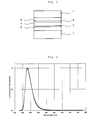
- TMBN synthesized as described above was employed as a host material, and an organic EL element having a light emitting layer in which the compound (N20) as shown in the above-mentioned [Chemical Formula 14] was doped, using a compound (DTVPF) as shown in the above-mentioned [Chemical Formula 18] as an organic EL material, and having a layer structure as shown in Fig. 1 was prepared according to the following methods.
- a glass substrate having formed thereon a patterned transparent electroconductive film (ITO) with a film thickness of 150 nm was subjected to washing treatments in the order of ultrasonic cleaning by pure water and a surfactant, washing with running pure water, ultrasonic cleaning by a 1:1 mixed solution of pure water and isopropyl alcohol, and boiling washing by isopropyl alcohol.
- This substrate was slowly pulled up from the boiling isopropyl alcohol, and dried in isopropyl alcohol vapor, and, finally ultraviolet ozone cleaning was performed.
- This substrate was used as an anode 1 and placed in a vacuum chamber which was evacuated to 1 ⁇ 10 -6 Torr.
- a vacuum chamber which was evacuated to 1 ⁇ 10 -6 Torr.
- each molybdenum boat filled up with a vapor deposition material and a vapor deposition mask for forming a film in a predetermined pattern were placed, the above-mentioned boat was electrically heated, and the vapor deposition material was evaporated to thereby form each organic layer one by one.
- a hole transport layer 3 made only of DTVPF was formed to have a film thickness 56 nm.
- An aluminum (Al) layer was formed having a film thickness of 100 nm to be a cathode 7.
- the vacuum chamber was returned to ambient pressure, and the substrate on which each layer was deposited as described above was taken out, and it was moved in a glove box in which nitrogen substitution was carried out. By using a UV curing resin, it was sealed with another glass board to obtain an organic EL element.
- a layer structure of this element may be simplified and shown as being ITO (150 nm) / DTVPF: MoO 3 (10 nm, 67:33) / DTVPF (56 nm) / TMBN:N20 (15 nm, 94:6) / DTVPF (38 nm) / DTVPF:Liq (10 nm, 50:50) / Al (100 nm).
- This organic EL element was supplied with a direct current of 100 A/m 2 , then pure blue luminescence due to N20 was obtained, and external quantum efficiency was 0.89 %. Further, a light emission spectrum of this organic EL element is shown in Fig. 2 .
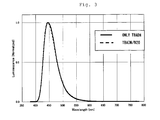
- the compound (TBADN) as shown in the above-mentioned [Chemical Formula 27] was employed as a host material, and an organic EL element having a light emitting layer in which N20 was doped was prepared similarly to Example 2.
- a layer structure of this element may be simplified and shown as being ITO (150 nm) / NS21: MoO 3 (59 nm, 90:10) / NS21 (10 nm) / TBADN:N20 (30 nm, 97:3) / BAlq(5 nm) /DPB (16nm) /DPB:Liq (5 nm, 74:26) / Al (100nm).
- FIG. 3 A light emission spectrum of this organic EL element is shown in Fig. 3 .
- TMBN was excellent as the host compared with TBADN.
- the organic EL material expressed by the general formula (1) in accordance with the present invention the blue luminescence excellent in color purity is obtained, it is confirmed that it is highly practical, and it is expected that it would be applied to a light source and a display apparatus in which excellent color purity is required.
Landscapes
- Chemical & Material Sciences (AREA)
- Organic Chemistry (AREA)
- Engineering & Computer Science (AREA)
- Materials Engineering (AREA)
- Physics & Mathematics (AREA)
- Spectroscopy & Molecular Physics (AREA)
- Electroluminescent Light Sources (AREA)
Applications Claiming Priority (1)
| Application Number | Priority Date | Filing Date | Title |
|---|---|---|---|
| JP2007332577A JP4628417B2 (ja) | 2007-12-25 | 2007-12-25 | 有機エレクトロルミネッセンス材料およびそれを用いた素子 |
Publications (2)
| Publication Number | Publication Date |
|---|---|
| EP2075307A2 true EP2075307A2 (de) | 2009-07-01 |
| EP2075307A3 EP2075307A3 (de) | 2009-08-12 |
Family
ID=40289616
Family Applications (1)
| Application Number | Title | Priority Date | Filing Date |
|---|---|---|---|
| EP08021923A Withdrawn EP2075307A3 (de) | 2007-12-25 | 2008-12-17 | Organisches Elektrolumineszenzmaterial und Element damit |
Country Status (6)
| Country | Link |
|---|---|
| US (1) | US20090160315A1 (de) |
| EP (1) | EP2075307A3 (de) |
| JP (1) | JP4628417B2 (de) |
| KR (1) | KR20090069250A (de) |
| CN (1) | CN101469267A (de) |
| TW (1) | TW200927881A (de) |
Cited By (1)
| Publication number | Priority date | Publication date | Assignee | Title |
|---|---|---|---|---|
| EP2091094A3 (de) * | 2008-02-14 | 2010-10-13 | Yamagata Promotional Organization for Industrial Technology | Organisches lichtemittierendes Element |
Families Citing this family (5)
| Publication number | Priority date | Publication date | Assignee | Title |
|---|---|---|---|---|
| CN102856504B (zh) * | 2011-06-28 | 2015-04-01 | 海洋王照明科技股份有限公司 | 一种有机电致发光器件及其制备方法 |
| CN108183172B (zh) * | 2016-12-08 | 2019-10-25 | 昆山国显光电有限公司 | 有机电致发光器件及其制备方法、显示装置 |
| CN107068883A (zh) * | 2017-03-27 | 2017-08-18 | 深圳市华星光电技术有限公司 | 一种oled显示器件及其制备方法 |
| CN110819141B (zh) * | 2018-08-10 | 2022-07-12 | Jsr株式会社 | 硬化性组合物及化合物 |
| KR20230170596A (ko) * | 2022-06-10 | 2023-12-19 | 주식회사 엘지화학 | 신규한 화합물 및 이를 이용한 유기 발광 소자 |
Citations (3)
| Publication number | Priority date | Publication date | Assignee | Title |
|---|---|---|---|---|
| JPH02247278A (ja) | 1989-03-20 | 1990-10-03 | Idemitsu Kosan Co Ltd | エレクトロルミネッセンス素子 |
| JPH11312588A (ja) | 1998-03-20 | 1999-11-09 | Eastman Kodak Co | 有機系エレクトロルミネセント装置 |
| JP2005222948A (ja) | 2004-02-09 | 2005-08-18 | Xerox Corp | 有機エレクトロルミネセンス素子に使用する新規青色発光体 |
Family Cites Families (9)
| Publication number | Priority date | Publication date | Assignee | Title |
|---|---|---|---|---|
| JP3297619B2 (ja) * | 1996-12-18 | 2002-07-02 | ティーディーケイ株式会社 | 有機elカラーディスプレイ |
| JP2002164178A (ja) * | 2000-11-27 | 2002-06-07 | Idemitsu Kosan Co Ltd | 有機エレクトロルミネッセンス素子 |
| JP4287198B2 (ja) * | 2002-11-18 | 2009-07-01 | 出光興産株式会社 | 有機エレクトロルミネッセンス素子 |
| JP2005170911A (ja) * | 2003-12-15 | 2005-06-30 | Idemitsu Kosan Co Ltd | 芳香族化合物およびそれを用いた有機エレクトロルミネッセンス素子 |
| US7666524B2 (en) * | 2004-10-29 | 2010-02-23 | Semiconductor Energy Laboratory Co., Ltd. | Oligonaphthalene derivatives, and light-emitting element and light-emitting device using oligonaphthalene derivatives |
| US20060286405A1 (en) * | 2005-06-17 | 2006-12-21 | Eastman Kodak Company | Organic element for low voltage electroluminescent devices |
| EP1937616B1 (de) * | 2005-10-21 | 2014-12-17 | LG Chem, Ltd. | Neue binaphthalinderivate, verfahren zu deren herstellung und organisches elektronisches gerät, bei dem diese verwendet werden |
| US20070092755A1 (en) * | 2005-10-26 | 2007-04-26 | Eastman Kodak Company | Organic element for low voltage electroluminescent devices |
| JP4675413B2 (ja) * | 2008-02-14 | 2011-04-20 | 財団法人山形県産業技術振興機構 | 有機発光素子 |
-
2007
- 2007-12-25 JP JP2007332577A patent/JP4628417B2/ja not_active Expired - Fee Related
-
2008
- 2008-12-17 EP EP08021923A patent/EP2075307A3/de not_active Withdrawn
- 2008-12-17 TW TW097149139A patent/TW200927881A/zh unknown
- 2008-12-22 US US12/340,938 patent/US20090160315A1/en not_active Abandoned
- 2008-12-24 KR KR1020080133904A patent/KR20090069250A/ko not_active Withdrawn
- 2008-12-25 CN CNA2008101886387A patent/CN101469267A/zh active Pending
Patent Citations (3)
| Publication number | Priority date | Publication date | Assignee | Title |
|---|---|---|---|---|
| JPH02247278A (ja) | 1989-03-20 | 1990-10-03 | Idemitsu Kosan Co Ltd | エレクトロルミネッセンス素子 |
| JPH11312588A (ja) | 1998-03-20 | 1999-11-09 | Eastman Kodak Co | 有機系エレクトロルミネセント装置 |
| JP2005222948A (ja) | 2004-02-09 | 2005-08-18 | Xerox Corp | 有機エレクトロルミネセンス素子に使用する新規青色発光体 |
Non-Patent Citations (2)
| Title |
|---|
| J. SH ET AL., APPLIED PHYSICS LETTERS, vol. 80, no. 17, pages 3201 |
| J. SHI ET AL., APPLIED PHYSICS LETTERS, vol. 80, no. 17, pages 3201 |
Cited By (1)
| Publication number | Priority date | Publication date | Assignee | Title |
|---|---|---|---|---|
| EP2091094A3 (de) * | 2008-02-14 | 2010-10-13 | Yamagata Promotional Organization for Industrial Technology | Organisches lichtemittierendes Element |
Also Published As
| Publication number | Publication date |
|---|---|
| JP2009158583A (ja) | 2009-07-16 |
| TW200927881A (en) | 2009-07-01 |
| CN101469267A (zh) | 2009-07-01 |
| EP2075307A3 (de) | 2009-08-12 |
| KR20090069250A (ko) | 2009-06-30 |
| US20090160315A1 (en) | 2009-06-25 |
| JP4628417B2 (ja) | 2011-02-09 |
Similar Documents
| Publication | Publication Date | Title |
|---|---|---|
| JP5984689B2 (ja) | 有機金属錯体及びこれを用いた有機発光素子 | |
| EP2031036B1 (de) | Lichtemittierendes Element, lichtemittierende Vorrichtung und elektronisches Gerät | |
| KR102006506B1 (ko) | 유기 일렉트로 루미네선스 소자 및 그것에 사용하는 화합물 | |
| EP2091094A2 (de) | Organisches lichtemittierendes Element | |
| JP4628435B2 (ja) | 有機エレクトロルミネッセンス素子 | |
| JP5243684B2 (ja) | 有機金属錯体、発光性固体、有機el素子及び有機elディスプレイ | |
| EP2075305A2 (de) | Oganisches Elektrolumineszenzelement | |
| JP2003336043A (ja) | 発光素子用材料およびそれを用いた発光素子 | |
| JP4880450B2 (ja) | 有機金属錯体、発光性固体、有機el素子及び有機elディスプレイ | |
| US20090160315A1 (en) | Organic electroluminescence material and element using the same | |
| EP2448894A1 (de) | Neue organische verbindung und organische lichtemittierende vorrichtung | |
| JP4786917B2 (ja) | 有機金属錯体、発光性固体、有機el素子及び有機elディスプレイ | |
| EP1619177B1 (de) | Organisches elektrolumineszierendes element | |
| JP2006069936A (ja) | 金属錯体、発光性固体、有機el素子及び有機elディスプレイ | |
| EP2075308A2 (de) | Organisches Elektrolumineszenzmaterial und Element damit | |
| JP4646157B2 (ja) | 有機エレクトロルミネッセンス材料およびそれを用いた素子 | |
| CN117580838A (zh) | 化合物及包含其的有机发光器件 | |
| EP2075306A2 (de) | Organisches Elektrolumineszenzmaterial und Element damit | |
| JP4662384B2 (ja) | 有機エレクトロルミネッセンス材料およびそれを用いた素子 | |
| JP2021007120A (ja) | 有機エレクトロルミネッセンス素子、表示装置、及び照明装置 |
Legal Events
| Date | Code | Title | Description |
|---|---|---|---|
| PUAI | Public reference made under article 153(3) epc to a published international application that has entered the european phase |
Free format text: ORIGINAL CODE: 0009012 |
|
| AK | Designated contracting states |
Kind code of ref document: A2 Designated state(s): AT BE BG CH CY CZ DE DK EE ES FI FR GB GR HR HU IE IS IT LI LT LU LV MC MT NL NO PL PT RO SE SI SK TR |
|
| AX | Request for extension of the european patent |
Extension state: AL BA MK RS |
|
| PUAL | Search report despatched |
Free format text: ORIGINAL CODE: 0009013 |
|
| AK | Designated contracting states |
Kind code of ref document: A3 Designated state(s): AT BE BG CH CY CZ DE DK EE ES FI FR GB GR HR HU IE IS IT LI LT LU LV MC MT NL NO PL PT RO SE SI SK TR |
|
| AX | Request for extension of the european patent |
Extension state: AL BA MK RS |
|
| RIN1 | Information on inventor provided before grant (corrected) |
Inventor name: TANAKA, JUNICH Inventor name: KIMURA, MASATO Inventor name: HORIUCHI, TAKAYUKI Inventor name: ODA, ATSUSHI |
|
| 17P | Request for examination filed |
Effective date: 20100212 |
|
| AKX | Designation fees paid |
Designated state(s): DE FR GB |
|
| GRAP | Despatch of communication of intention to grant a patent |
Free format text: ORIGINAL CODE: EPIDOSNIGR1 |
|
| STAA | Information on the status of an ep patent application or granted ep patent |
Free format text: STATUS: THE APPLICATION IS DEEMED TO BE WITHDRAWN |
|
| 18D | Application deemed to be withdrawn |
Effective date: 20110322 |