EP2076523B1 - Composés de silicone résistant à une hydrolyse - Google Patents
Composés de silicone résistant à une hydrolyse Download PDFInfo
- Publication number
- EP2076523B1 EP2076523B1 EP07838814.7A EP07838814A EP2076523B1 EP 2076523 B1 EP2076523 B1 EP 2076523B1 EP 07838814 A EP07838814 A EP 07838814A EP 2076523 B1 EP2076523 B1 EP 2076523B1
- Authority
- EP
- European Patent Office
- Prior art keywords
- group
- compound
- integer
- groups
- methyl
- Prior art date
- Legal status (The legal status is an assumption and is not a legal conclusion. Google has not performed a legal analysis and makes no representation as to the accuracy of the status listed.)
- Active
Links
- SNCMCDMEYCLVBO-UHFFFAOYSA-N CC(C(OCCCN)=O)=C Chemical compound CC(C(OCCCN)=O)=C SNCMCDMEYCLVBO-UHFFFAOYSA-N 0.000 description 2
- ITTNWUASVGKPCT-UHFFFAOYSA-N CC(COCOCC(COCCCNC)O)=C Chemical compound CC(COCOCC(COCCCNC)O)=C ITTNWUASVGKPCT-UHFFFAOYSA-N 0.000 description 1
- 0 C[S+](*)C(O1)OS(*)O[S+]O[Si]1(*)IN Chemical compound C[S+](*)C(O1)OS(*)O[S+]O[Si]1(*)IN 0.000 description 1
Images


Classifications
-
- C—CHEMISTRY; METALLURGY
- C07—ORGANIC CHEMISTRY
- C07F—ACYCLIC, CARBOCYCLIC OR HETEROCYCLIC COMPOUNDS CONTAINING ELEMENTS OTHER THAN CARBON, HYDROGEN, HALOGEN, OXYGEN, NITROGEN, SULFUR, SELENIUM OR TELLURIUM
- C07F7/00—Compounds containing elements of Groups 4 or 14 of the Periodic Table
- C07F7/02—Silicon compounds
- C07F7/08—Compounds having one or more C—Si linkages
- C07F7/0834—Compounds having one or more O-Si linkage
- C07F7/0838—Compounds with one or more Si-O-Si sequences
- C07F7/0872—Preparation and treatment thereof
-
- C—CHEMISTRY; METALLURGY
- C07—ORGANIC CHEMISTRY
- C07F—ACYCLIC, CARBOCYCLIC OR HETEROCYCLIC COMPOUNDS CONTAINING ELEMENTS OTHER THAN CARBON, HYDROGEN, HALOGEN, OXYGEN, NITROGEN, SULFUR, SELENIUM OR TELLURIUM
- C07F7/00—Compounds containing elements of Groups 4 or 14 of the Periodic Table
- C07F7/02—Silicon compounds
- C07F7/08—Compounds having one or more C—Si linkages
- C07F7/0834—Compounds having one or more O-Si linkage
- C07F7/0838—Compounds with one or more Si-O-Si sequences
-
- C—CHEMISTRY; METALLURGY
- C07—ORGANIC CHEMISTRY
- C07F—ACYCLIC, CARBOCYCLIC OR HETEROCYCLIC COMPOUNDS CONTAINING ELEMENTS OTHER THAN CARBON, HYDROGEN, HALOGEN, OXYGEN, NITROGEN, SULFUR, SELENIUM OR TELLURIUM
- C07F7/00—Compounds containing elements of Groups 4 or 14 of the Periodic Table
- C07F7/02—Silicon compounds
- C07F7/08—Compounds having one or more C—Si linkages
- C07F7/0834—Compounds having one or more O-Si linkage
- C07F7/0838—Compounds with one or more Si-O-Si sequences
- C07F7/0872—Preparation and treatment thereof
- C07F7/0876—Reactions involving the formation of bonds to a Si atom of a Si-O-Si sequence other than a bond of the Si-O-Si linkage
-
- C—CHEMISTRY; METALLURGY
- C07—ORGANIC CHEMISTRY
- C07F—ACYCLIC, CARBOCYCLIC OR HETEROCYCLIC COMPOUNDS CONTAINING ELEMENTS OTHER THAN CARBON, HYDROGEN, HALOGEN, OXYGEN, NITROGEN, SULFUR, SELENIUM OR TELLURIUM
- C07F7/00—Compounds containing elements of Groups 4 or 14 of the Periodic Table
- C07F7/02—Silicon compounds
- C07F7/08—Compounds having one or more C—Si linkages
- C07F7/18—Compounds having one or more C—Si linkages as well as one or more C—O—Si linkages
-
- C—CHEMISTRY; METALLURGY
- C07—ORGANIC CHEMISTRY
- C07F—ACYCLIC, CARBOCYCLIC OR HETEROCYCLIC COMPOUNDS CONTAINING ELEMENTS OTHER THAN CARBON, HYDROGEN, HALOGEN, OXYGEN, NITROGEN, SULFUR, SELENIUM OR TELLURIUM
- C07F7/00—Compounds containing elements of Groups 4 or 14 of the Periodic Table
- C07F7/02—Silicon compounds
- C07F7/08—Compounds having one or more C—Si linkages
- C07F7/20—Purification, separation
-
- C—CHEMISTRY; METALLURGY
- C07—ORGANIC CHEMISTRY
- C07F—ACYCLIC, CARBOCYCLIC OR HETEROCYCLIC COMPOUNDS CONTAINING ELEMENTS OTHER THAN CARBON, HYDROGEN, HALOGEN, OXYGEN, NITROGEN, SULFUR, SELENIUM OR TELLURIUM
- C07F7/00—Compounds containing elements of Groups 4 or 14 of the Periodic Table
- C07F7/02—Silicon compounds
- C07F7/21—Cyclic compounds having at least one ring containing silicon, but no carbon in the ring
-
- C—CHEMISTRY; METALLURGY
- C08—ORGANIC MACROMOLECULAR COMPOUNDS; THEIR PREPARATION OR CHEMICAL WORKING-UP; COMPOSITIONS BASED THEREON
- C08F—MACROMOLECULAR COMPOUNDS OBTAINED BY REACTIONS ONLY INVOLVING CARBON-TO-CARBON UNSATURATED BONDS
- C08F230/00—Copolymers of compounds having one or more unsaturated aliphatic radicals, each having only one carbon-to-carbon double bond, and containing phosphorus, selenium, tellurium or a metal
- C08F230/04—Copolymers of compounds having one or more unsaturated aliphatic radicals, each having only one carbon-to-carbon double bond, and containing phosphorus, selenium, tellurium or a metal containing a metal
- C08F230/08—Copolymers of compounds having one or more unsaturated aliphatic radicals, each having only one carbon-to-carbon double bond, and containing phosphorus, selenium, tellurium or a metal containing a metal containing silicon
-
- C—CHEMISTRY; METALLURGY
- C08—ORGANIC MACROMOLECULAR COMPOUNDS; THEIR PREPARATION OR CHEMICAL WORKING-UP; COMPOSITIONS BASED THEREON
- C08F—MACROMOLECULAR COMPOUNDS OBTAINED BY REACTIONS ONLY INVOLVING CARBON-TO-CARBON UNSATURATED BONDS
- C08F30/00—Homopolymers or copolymers of compounds having one or more unsaturated aliphatic radicals, each having only one carbon-to-carbon double bond, and containing phosphorus, selenium, tellurium or a metal
- C08F30/04—Homopolymers or copolymers of compounds having one or more unsaturated aliphatic radicals, each having only one carbon-to-carbon double bond, and containing phosphorus, selenium, tellurium or a metal containing a metal
- C08F30/08—Homopolymers or copolymers of compounds having one or more unsaturated aliphatic radicals, each having only one carbon-to-carbon double bond, and containing phosphorus, selenium, tellurium or a metal containing a metal containing silicon
-
- C—CHEMISTRY; METALLURGY
- C08—ORGANIC MACROMOLECULAR COMPOUNDS; THEIR PREPARATION OR CHEMICAL WORKING-UP; COMPOSITIONS BASED THEREON
- C08G—MACROMOLECULAR COMPOUNDS OBTAINED OTHERWISE THAN BY REACTIONS ONLY INVOLVING UNSATURATED CARBON-TO-CARBON BONDS
- C08G77/00—Macromolecular compounds obtained by reactions forming a linkage containing silicon with or without sulfur, nitrogen, oxygen or carbon in the main chain of the macromolecule
- C08G77/04—Polysiloxanes
-
- C—CHEMISTRY; METALLURGY
- C08—ORGANIC MACROMOLECULAR COMPOUNDS; THEIR PREPARATION OR CHEMICAL WORKING-UP; COMPOSITIONS BASED THEREON
- C08G—MACROMOLECULAR COMPOUNDS OBTAINED OTHERWISE THAN BY REACTIONS ONLY INVOLVING UNSATURATED CARBON-TO-CARBON BONDS
- C08G77/00—Macromolecular compounds obtained by reactions forming a linkage containing silicon with or without sulfur, nitrogen, oxygen or carbon in the main chain of the macromolecule
- C08G77/04—Polysiloxanes
- C08G77/20—Polysiloxanes containing silicon bound to unsaturated aliphatic groups
-
- G—PHYSICS
- G02—OPTICS
- G02B—OPTICAL ELEMENTS, SYSTEMS OR APPARATUS
- G02B1/00—Optical elements characterised by the material of which they are made; Optical coatings for optical elements
- G02B1/04—Optical elements characterised by the material of which they are made; Optical coatings for optical elements made of organic materials, e.g. plastics
- G02B1/041—Lenses
- G02B1/043—Contact lenses
Definitions
- monomers for preparing ophthalmic lenses monomers having silicon-containing groups are known.
- 3-[tris(trimethylsiloxy)silyl]propyl methacrylate is widely used as a monomer for preparing ophthalmic lenses.
- the polymer obtained by copolymerizing 3-[tris(trimethylsiloxy)silyl]propyl methacrylate and N,N-dimethylacrylamide which is a hydrophilic monomer has advantageous features that it is transparent and has a high oxygen permeability.
- the silicone component is gradually hydrolyzed, so that the physical properties of the contact lens may be degraded when the contact lens is stored for a long period.
- US 4,463,149 relates to contact lenses formed of polymerisable substituted alkyl and aryl siloxanes.
- EP 1424339 relates to polymers having high oxygen permability and high hydrophobicity and ophtalmic lenses comprising said polymers.
- EP 1426809 relates to polymers for ophtalmic lenses having high oxygen permability and superior surface wettability.
- EP 0733637 relates to epoxy-functional silanes.
- the invention in one aspect, relates to hydrolysis-resistant silicone compounds.
- the compounds can have a sterically hindered terminal silicon group.
- the compounds can have cyclic siloxane moieties.
- ophthalmic lenses for example contact lenses, intraocular lenses, artificial cornea, and spectacle lenses, comprising the disclosed compositions, disclosed polymers, disclosed compounds, and products of the disclosed processes.
- Ranges can be expressed herein as from “about” one particular value, and/or to "about” another particular value. When such a range is expressed, another embodiment includes from the one particular value and/or to the other particular value. Similarly, when values are expressed as approximations, by use of the antecedent "about,” it will be understood that the particular value forms another embodiment. It will be further understood that the endpoints of each of the ranges are significant both in relation to the other endpoint, and independently of the other endpoint. It is also understood that there are a number of values disclosed herein, and that each value is also herein disclosed as "about” that particular value in addition to the value itself. For example, if the value “10” is disclosed, then “about 10" is also disclosed. It is also understood that each unit between two particular units are also disclosed. For example, if 10 and 15 are disclosed, then 11, 12, 13, and 14 are also disclosed.
- a residue of a chemical species refers to the moiety that is the resulting product of the chemical species in a particular reaction scheme or subsequent formulation or chemical product, regardless of whether the moiety is actually obtained from the chemical species.
- an ethylene glycol residue in a polyester refers to one or more -OCH 2 CH 2 O- units in the polyester, regardless of whether ethylene glycol was used to prepare the polyester.
- a sebacic acid residue in a polyester refers to one or more -CO(CH 2 ) 8 CO- moieties in the polyester, regardless of whether the residue is obtained by reacting sebacic acid or an ester thereof to obtain the polyester.
- the terms "optional” or “optionally” means that the subsequently described event or circumstance may or may not occur, and that the description includes instances where said event or circumstance occurs and instances where it does not.
- copolymer refers to a polymer formed from two or more different repeating units (monomer residues).
- a copolymer can be an alternating copolymer, a random copolymer, a block copolymer, or a graft copolymer.
- substitution or “substituted with” include the implicit proviso that such substitution is in accordance with permitted valence of the substituted atom and the substituent, and that the substitution results in a stable compound, e.g., a compound that does not spontaneously undergo transformation such as by rearrangement, cyclization, elimination, etc.
- a 1 ,” “A 2 ,” “A 3 ,” and “A 4 " are used herein as generic symbols to represent various specific substituents. These symbols can be any substituent, not limited to those disclosed herein, and when they are defined to be certain substituents in one instance, they can, in another instance, be defined as some other substituents.
- alkyl as used herein is a branched or unbranched saturated hydrocarbon group of 1 to 24 carbon atoms, for example, 1 to 12 carbon atoms, or 1 to 6 carbon atoms, such as methyl, ethyl, n -propyl, isopropyl, n -butyl, isobutyl, s-butyl, t -butyl, n -pentyl, isopentyl, s-pentyl, neopentyl, hexyl, heptyl, octyl, nonyl, decyl, dode cyl, tetradecyl, hexadecyl, eicosyl, tetracosyl, and the like.
- the alkyl group can also be substituted or unsubstituted.
- the alkyl group can be substituted with one or more groups including, but not limited to, substituted or unsubstituted alkyl, cycloalkyl, alkoxy, amino, ether, halide, hydroxy, nitro, silyl, sulfo-oxo, or thiol, as described herein.
- a "lower alkyl” group is an alkyl group containing from one to six carbon atoms.
- alkylamino specifically refers to an alkyl group that is substituted with one or more amino groups, as described below, and the like.
- alkyl is used in one instance and a specific term such as “alkylalcohol” is used in another, it is not meant to imply that the term “alkyl” does not also refer to specific terms such as “alkylalcohol” and the like.
- cycloalkyl refers to both unsubstituted and substituted cycloalkyl moieties
- the substituted moieties can, in addition, be specifically identified herein; for example, a particular substituted cycloalkyl can be referred to as, e.g., an "alkylcycloalkyl.”
- a substituted alkoxy can be specifically referred to as, e.g., a "halogenated alkoxy”
- a particular substituted alkenyl can be, e.g., an "alkenylalcohol,” and the like.
- the cycloalkyl group and heterocycloalkyl group can be substituted or unsubstituted.
- the cycloalkyl group and heterocycloalkyl group can be substituted with one or more groups including, but not limited to, substituted or unsubstituted alkyl, cycloalkyl, alkoxy, amino, ether, halide, hydroxy, nitro, silyl, sulfo-oxo, or thiol as described herein.
- Alkoxy also includes polymers of alkoxy groups as just described; that is, an alkoxy can be a polyether such as -OA 1 -OA 2 or - OA 1 -(OA 2 ) a -OA 3 , where "a” is an integer of from 1 to 200 and A 1 , A 2 , and A 3 are alkyl and/or cycloalkyl groups.
- alkenyl as used herein is a hydrocarbon group of from 2 to 24 carbon atoms with a structural formula containing at least one carbon-carbon double bond.
- heterocycloalkenyl is a type of cycloalkenyl group as defined above, and is included within the meaning of the term “cycloalkenyl,” where at least one of the carbon atoms of the ring is replaced with a heteroatom such as, but not limited to, nitrogen, oxygen, sulfur, or phosphorus.
- the cycloalkenyl group and heterocycloalkenyl group can be substituted or unsubstituted.
- alkynyl as used herein is a hydrocarbon group of 2 to 24 carbon atoms with a structural formula containing at least one carbon-carbon triple bond.
- the alkynyl group can be unsubstituted or substituted with one or more groups including, but not limited to, substituted or unsubstituted alkyl, cycloalkyl, alkoxy, alkenyl, cycloalkenyl, alkynyl, cycloalkynyl, aryl, heteroaryl, aldehyde, amino, carboxylic acid, ester, ether, halide, hydroxy, ketone, azide, nitro, silyl, sulfo-oxo, or thiol, as described herein.
- cycloalkynyl as used herein is a non-aromatic carbon-based ring composed of at least seven carbon atoms and containing at least one carbon-carbon triple bound.
- cycloalkynyl groups include, but are not limited to, cycloheptynyl, cyclooctynyl, cyclononynyl, and the like.
- heterocycloalkynyl is a type of cycloalkenyl group as defined above, and is included within the meaning of the term “cycloalkynyl,” where at least one of the carbon atoms of the ring is replaced with a heteroatom such as, but not limited to, nitrogen, oxygen, sulfur, or phosphorus.
- the cycloalkynyl group and heterocycloalkynyl group can be substituted or unsubstituted.
- the cycloalkynyl group and heterocycloalkynyl group can be substituted with one or more groups including, but not limited to, substituted or unsubstituted alkyl, cycloalkyl, alkoxy, alkenyl, cycloalkenyl, alkynyl, cycloalkynyl, aryl, heteroaryl, aldehyde, amino, carboxylic acid, ester, ether, halide, hydroxy, ketone, azide, nitro, silyl, sulfo-oxo, or thiol as described herein.
- the aryl group can be substituted with one or more groups including, but not limited to, substituted or unsubstituted alkyl, cycloalkyl, alkoxy, alkenyl, cycloalkenyl, alkynyl, cycloalkynyl, aryl, heteroaryl, aldehyde, amino, carboxylic acid, ester, ether, halide, hydroxy, ketone, azide, nitro, silyl, sulfo-oxo, or thiol as described herein.
- biasing is a specific type of aryl group and is included in the definition of "aryl.”
- Biaryl refers to two aryl groups that are bound together via a fused ring structure, as in naphthalene, or are attached via one or more carbon-carbon bonds, as in biphenyl.
- amine or “amino” as used herein are represented by the formula NA 1 A 2 A 3 , where A 1 , A 2 , and A 3 can be, independently, hydrogen or substituted or unsubstituted alkyl, cycloalkyl, alkenyl, cycloalkenyl, alkynyl, cycloalkynyl, aryl, or heteroaryl group as described herein.
- carboxylic acid as used herein is represented by the formula -C(O)OH.
- ether as used herein is represented by the formula A 1 OA 2 , where A 1 and A 2 can be, independently, a substituted or unsubstituted alkyl, cycloalkyl, alkenyl, cycloalkenyl, alkynyl, cycloalkynyl, aryl, or heteroaryl group described herein.
- polyether as used herein is represented by the formula -(A 1 O-A 2 O) a -, where A 1 and A 2 can be, independently, a substituted or unsubstituted alkyl, cycloalkyl, alkenyl, cycloalkenyl, alkynyl, cycloalkynyl, aryl, or heteroaryl group described herein and "a" is an integer of from 1 to 500.
- polyether groups include polyethylene oxide, polypropylene oxide, and polybutylene oxide.
- halide refers to the halogens fluorine, chlorine, bromine, and iodine.
- hydroxyl as used herein is represented by the formula -OH.
- ketone as used herein is represented by the formula A 1 C(O)A 2 , where A 1 and A 2 can be, independently, a substituted or unsubstituted alkyl, cycloalkyl, alkenyl, cycloalkenyl, alkynyl, cycloalkynyl, aryl, or heteroaryl group as described herein.
- nitro as used herein is represented by the formula -NO 2 .
- nitrile as used herein is represented by the formula -CN.
- sil as used herein is represented by the formula -SiA 1 A 2 A 3 , where A 1 , A 2 , and A 3 can be, independently, hydrogen or a substituted or unsubstituted alkyl, cycloalkyl, alkoxy, alkenyl, cycloalkenyl, alkynyl, cycloalkynyl, aryl, or heteroaryl group as described herein.
- sulfo-oxo is represented by the formulas -S(O)A 1 , - S(O) 2 A 1 , -OS(O) 2 A 1 , or -OS(O) 2 OA 1 , where A 1 can be hydrogen or a substituted or unsubstituted alkyl, cycloalkyl, alkenyl, cycloalkenyl, alkynyl, cycloalkynyl, aryl, or heteroaryl group as described herein.
- sulfonyl is used herein to refer to the sulfo-oxo group represented by the formula -S(O) 2 A 1 , where A 1 can be hydrogen or a substituted or unsubstituted alkyl, cycloalkyl, alkenyl, cycloalkenyl, alkynyl, cycloalkynyl, aryl, or heteroaryl group as described herein.
- a 1 S(O) 2 A 2 is represented by the formula A 1 S(O) 2 A 2 , where A 1 and A 2 can be, independently, a substituted or unsubstituted alkyl, cycloalkyl, alkenyl, cycloalkenyl, alkynyl, cycloalkenyl, aryl, or heteroaryl group as described herein.
- sulfoxide as used herein is represented by the formula A 1 S(O)A 2 , where A 1 and A 2 can be, independently, a substituted or unsubstituted alkyl, cycloalkyl, alkenyl, cycloalkenyl, alkynyl, cycloalkynyl, aryl, or heteroaryl group as described herein.
- thiol as used herein is represented by the formula -SH.
- siloxanyl refers to a structure having at least one Si-O-Si bond.
- siloxanyl group means a group having at least one Si-O-Si moiety
- siloxanyl compound means a compound having at least one Si-O-Si group.
- alkoxysilyl refers to a structure having at least one Si-O-A 1 bond.
- alkoxysilyl group means a group having at least one Si-O-A 1 moiety
- alkoxysilyl compound means a compound having at least one Si-O-A 1 group.
- alkoxysilyl can have one Si-O-A 1 group.
- a 1 of an alkoxysilyl moiety can be a substituted or unsubstituted alkyl, cycloalkyl, alkenyl, cycloalkenyl, alkynyl, cycloalkynyl, aryl, or heteroaryl group as described herein.
- alkoxysilyl can, in a further aspect, include substituted alkoxysilyl groups and alkoxysilyl derivatives, including hydrolyzed alkoxysilyl groups (i.e., silanol groups).
- silyl halide refers to a structure represented by a formula X 1 SiA 1 A 2 A 3 or X 1 X 2 SiA 1 A 2 or X 1 X 2 X 3 SiA 1 or X 1 X 2 X 3 X 4 Si, where X 1 , X 2 , X 3 , and X 4 are independently fluorine, chlorine, bromine, or iodine, and where A 1 , A 2 , and A 3 are, independently, hydrogen or a substituted or unsubstituted alkyl, cycloalkyl, alkoxy, alkenyl, cycloalkenyl, alkynyl, cycloalkynyl, aryl, or heteroaryl group as described herein.
- silyl halide can have the structure X 1 SiA 1 A 2 A 3 .
- sianol refers to a silyl moiety having a structure represented by the formula -SiA 1 A 2 A 3 A 4 , where A 1 , A 2 , A 3 , and A 4 can be, independently, hydrogen or a substituted or unsubstituted alkyl, cycloalkyl, alkoxy, alkenyl, cycloalkenyl, alkynyl, cycloalkynyl, aryl, or heteroaryl group as described herein, with the proviso that at least one of A 1 , A 2 , A 3 , and A 4 is hydroxyl. In a further aspect, one of A 1 , A 2 , A 3 , and A 4 is hydroxyl.
- silyloxy and silyl refer to a silyl moiety having a structure represented by the formula -OSiA 1 A 2 A 3 , where A 1 , A 2 , and A 3 can be, independently, hydrogen or a substituted or unsubstituted alkyl, cycloalkyl, alkoxy, alkenyl, cycloalkenyl, alkynyl, cycloalkynyl, aryl, or heteroaryl group as described herein.
- alkylacrylic acid refers to acrylic acid, alkyl-substituted acrylic acids, salts thereof, and derivatives thereof.
- an alkylacrylic acid can be further substituted.
- an alkylacrylic acid is methacrylic acid.
- hydrolyzable group refers to a group or moiety which is convertible to hydrogen by hydrolysis or solvolysis.
- a hydrolyzable group can be hydrolyzed ( i.e., converted to a hydrogen group) by exposure to water or a protic solvent at or near ambient temperature and at or near atmospheric pressure.
- a hydrolyzable group can be hydrolyzed by exposure to water or a protic solvent at an elevated temperature or an elevated pressure.
- a hydrolyzable group can be hydrolyzed by exposure to acidic or alkaline water or acidic or alkaline protic solvent.
- sterically hindered refers to a tertiary or quaternary substituted moiety wherein at least one of the substituents has at least two carbon atoms.
- a sterically hindered moiety can have the structure: wherein A 1 is a carbon atom or silicon atom and wherein at least one of A 2 , A 3 , and A 4 is an organic group having at least two carbon atoms.
- at least one of A 2 , A 3 , and A 4 is methyl, and at least one of A 2 , A 3 , and A 4 is an organic group having at least two carbon atoms.
- a sterically hindered group is a sterically hindered terminal silicon group, which can have the structure: wherein at least one of A 2 , A 3 , and A 4 is an organic group having at least two carbon atoms. In a further aspect, at least one of A 2 , A 3 , and A 4 is methyl, and at least one of A 2 , A 3 , and A 4 is an organic group having at least two carbon atoms.
- radical-polymerizable group refers to a moiety that can undergo addition polymerization when exposed to a radical source, for example a radical initiator.
- Radical polymerizable groups include olefins and acrylates, for example acrylic acid and its derivatives ( e.g., alkyl acrylates) and methacrylic acid and its derivatives (e.g., alkyl methacrylates). Such a polymerization typically proceeds through a chain growth mechanism and exhibits chain growth kinetics.
- hydrolysis resistance refers to the capacity of a compound or composition to survive hydrolysis conditions. In one aspect, acid hydrolysis is contemplated. As used herein, the term “hydrolysis-resistant” refers to the characteristic of surviving hydrolysis conditions. In one aspect, a residue of a compound can be referred to as hydrolysis-resistant if a composition exhibits greater hydrolysis resistance when comprising the residue of the compound as compared to a similar composition in the absence of the residue of the compound.
- compositions of the invention Disclosed are the components to be used to prepare the compositions of the invention as well as the compositions themselves to be used within the methods disclosed herein.
- these and other materials are disclosed herein, and it is understood that when combinations, subsets, interactions, groups, etc. of these materials are disclosed that while specific reference of each various individual and collective combinations and permutation of these compounds may not be explicitly disclosed, each is specifically contemplated and described herein. For example, if a particular compound is disclosed and discussed and a number of modifications that can be made to a number of molecules including the compounds are discussed, specifically contemplated is each and every combination and permutation of the compound and the modifications that are possible unless specifically indicated to the contrary.
- compositions disclosed herein have certain functions. Disclosed herein are certain structural requirements for performing the disclosed functions, and it is understood that there are a variety of structures that can perform the same function that are related to the disclosed structures, and that these structures will typically achieve the same result.
- the invention relates to sterically hindered hydrolysis-resistant silicone compounds. That is, a silicone compound can have at least one sterically hindered terminal silicon group and, thus, having improved resistance to hydrolysis conditions.
- the invention relates to sterically hindered hydrolysis-resistant silicone compounds having the structure: wherein M represents a radical-polymerizable group selected from olefins, acrylates, methacrylic acid and alkyl methacrylates; wherein L has the structure:
- m is 2 or 3, and a, b, and c are independently from 1 to 20, for example, from 1 to 16, from 1 to 12, from 1 to 8, from 1 to 6, from 1 to 4, from 2 to 16, from 2 to 12, from 2 to 8, from 2 to 6, from 2 to 4, or from 4 to 20.
- m is 2 or 3; a, b, and c are 1; and n is 0.
- a compound can have the structure: wherein M represents a radical-polymerizable group selected from olefins, acrylates, methacrylic acid and alkyl methacrylates; wherein L has the structure:
- the sterically hindered hydrolysis-resistant silicone compounds can be cyclic siloxane monomers and can have the structure: wherein p is 1, 2, or 3; wherein M represents a radical-polymerizable group selected from olefins, acrylates, methacrylic acid and alkyl methacrylates; wherein L has the structure:
- the sterically hindered hydrolysis-resistant silicone compounds of the invention bear at least one radical-polymerizable group, M.
- M is any moiety known to those of skill in the art that can undergo addition polymerization when exposed to a radical source, for example a radical initiator.
- M can be an olefin.
- M can be an alkene group, including an ethylene, a 1,3-butadiene moiety, or a styryl moiety.
- M can be an acrylate.
- M can be a residue of acrylic acid or a derivative thereof (e.g., alkyl acrylates) or residue of methacrylic acid or a derivative thereof ( e.g ., alkyl methacrylates).
- M can be an acryloyloxy group or a methacryloyloxy group.
- M can be an acryloyloxy group, a methacryloyloxy group, acrylamide group, methacrylamide group, N-vinylamide group, or styryl group.
- one radical-polymerizable group can undergo a polymerization reaction with other radical-polymerizable groups of other compounds of the invention or with radical-polymerizable groups of comonomers, thereby producing a polymer comprising a residue of a compound of the invention.
- the sterically hindered hydrolysis-resistant silicone compounds of the invention optionally bear at least one linking group, L.
- L can be an optionally substituted divalent C 1 -C 20 organic group, for example, a substituted or unsubstituted C 1 -C 16 organic group, C 1 -C 12 organic group, C 1 -C 8 organic group, or a C 1 -C 4 organic group.
- linking group, L can be a substituted or unsubstituted polyalkylene group. That is, L can be a group having two or more CH 2 groups linked to one another, represented by the formula -(CH 2 ) a -, where "a" is an integer of from 1 to 20. Examples include methylene, ethylene, propylene, butylene, pentylene, and hexylene.
- the organic group can be branched or linear.
- linking group, L can be substituted by one or more functionalized groups.
- L can be substituted by hydroxy groups, hydroxyalkyl groups, amino groups, aminoalkyl groups, amide groups, alkylamide groups, alkoxy groups, alkoxyalkyl groups, alkoxycarbonyl groups, alkoxycabonylalkyl groups or a combination of those functionalized groups.
- L can be substituted by hydroxy groups or hydroxyalkyl groups. Specifically, in one aspect, L can be substituted by hydroxy groups.
- one or more CH 2 groups of linking group, L can be replaced by one or more hetero atoms.
- one or more CH 2 groups of L can be replaced by O, S, N-R L , P-R L or a combination of those hetero atoms, wherein R L is substituted or unsubstituted C 1 -C 20 alkyl groups or substituted or unsubstituted C 6 -C 20 aryl groups and R L can be substituted by one or more functionalized groups and CH 2 groups of R L can be replaced by one or more hetero atoms.
- one or more CH 2 groups of L can be replaced by O or N-R L .
- L has the structure: wherein G is hydrogen or a hydrolyzable group; wherein k represents an integer of 0 to 6; and wherein m represents an integer of 1 to 3 when k is 0, and represents an integer of from 1 to 20 when k is not 0, with the proviso that 1 ⁇ 3k + m ⁇ 20.
- k is 1, and wherein m is from 1 to 7.
- L is absent from the compounds and/or compositions of the invention.
- the sterically hindered hydrolysis-resistant silicone compounds of the invention can optionally bear siloxanyl chains having a general structure: wherein Z 1 and Z 2 are, independently, substituted or unsubstituted C 1 -C 20 alkyl groups or substituted or unsubstituted C 6 -C 20 aryl groups.
- the C 1 -C 20 alkyl groups can be, for example, C 1 -C 16 alkyl groups, C 1 -C 12 alkyl groups, C 1 -C 8 alkyl groups, C 1 -C 6 alkyl groups, or C 1 -C 4 alkyl groups.
- Examples include methyl, ethyl, n -propyl, i -propyl, n -butyl, s-butyl, i -butyl, t -butyl, n -pentyl, i -pentyl, s-pentyl, neopentyl, hexyl, heptyl, octyl, decyl, and dodecyl.
- the alkyl groups can be branched or linear.
- the C 6 -C 20 aryl groups can be, for example, C 6 -C 20 aryl groups, C 6 -C 12 aryl groups, or C 6 -C 10 aryl groups. Examples include phenyl, toluenyl, pyridinyl, and naphthalenyl.
- n can be from 0 to 200, for example, from 0 to 100, from 0 to 50, from 0 to 25, from 0 to 12, from 0 to 10, from 0 to 6, from 0 to 4, from 1 to 200, from 1 to 100, from 1 to 50, from 1 to 25, from 1 to 12, from 1 to 10, from 1 to 6, or from 1 to 4. It is understood that, in a polymer, the average for n can be a non-integer.
- the compounds of the invention can optionally bear siloxanyl chains having a general structure: wherein Z 3 to Z 11 independently represent optionally substituted C 1 -C 20 alkyl groups or optionally substituted C 6 -C 20 aryl groups, with the provisos that: at least one of Z 3 , Z 4 , and Z 9 is methyl, and at least one of Z 3 , Z 4 , and Z 9 is an organic group having at least two carbon atoms, at least one of Z 5 , Z 6 , and Z 10 is methyl, and at least one of Z 5 , Z 6 , and Z 10 is an organic group having at least two carbon atoms, and at least one of Z 7 , Z 8 , and Z 11 is methyl, and at least one of Z 5 , Z 6 , and Z 10 is an organic group having at least two carbon atoms.
- the C 1 -C 20 alkyl groups can be, for example, C 1 -C 16 alkyl groups, C 1 -C 12 alkyl groups, C 1 -C 8 alkyl groups, C 1 -C 6 alkyl groups, or C 1 -C 4 alkyl groups.
- Examples include methyl, ethyl, n -propyl, i -propyl, n -butyl, s-butyl, i -butyl, t -butyl, n -pentyl, i -pentyl, s-pentyl, neopentyl, hexyl, heptyl, octyl, decyl, and dodecyl.
- the alkyl groups can be branched or linear.
- each siloxanyl chain can, independently, have a structure represented by the formula:
- the C 6 -C 20 aryl groups can be, for example, C 6 -C 20 aryl groups, C 6 -C 12 aryl groups, or C 6 -C 10 aryl groups. Examples include phenyl, toluenyl, pyridinyl, and naphthalenyl.
- each siloxanyl chain can, independently, have a structure represented by the formula:
- each of a, b, and c can be an integers of from 0 to 20, for example, from 0 to 12, from 0 to 10, from 0 to 8, from 0 to 6, from 0 to 4, from 1 to 20, from 0 to 12, from 0 to 10, from 0 to 8, from 0 to 6, from 0 to 4, or from 1 to 20, including 1, 2, 3, 4, 5, 6, 7, 8, 9, 10, 11, 12, 13, 14, 15, 16, 17, 18, 19, ad 20. It is understood that, in a polymer, the average for any of a, b, and c can be a non-integer. Each of a, b, and c can be the same as or different from the others of a, b, and c.
- two of Z 3 , Z 4 , and Z 9 are methyl, and one of Z 3 , Z 4 , and Z 9 is ethyl, propyl, or butyl; wherein two of Z 5 , Z 6 , and Z 10 are methyl, and one of Z 5 , Z 6 , and Z 10 is ethyl, propyl, or butyl; and two of Z 7 , Z 8 , and Z 11 are methyl, and one of Z 5 , Z 6 , and Z 10 is ethyl, propyl, or butyl.
- Z 3 , Z 4 , Z 5 , Z 6 , Z 7 , and Z 8 are methyl, and wherein and Z 9 , Z 10 , and Z 11 are independently ethyl, propyl, or butyl.
- the sterically hindered hydrolysis-resistant silicone compounds of the invention can have a structure represented by the formula: or
- the invention relates processes for making sterically hindered hydrolysis-resistant silicone compounds. That is, the processes can make a silicone compound having at least one sterically hindered terminal silicon group and, thus, having improved resistance to hydrolysis conditions.
- the invention relates to a process for making a hydrolysis-resistant silicone compound having a sterically-hindered terminal silicon group, the process comprising the step of reacting an alkoxysilyl compound having the structure: with one or more silyl halide compounds having the structure:
- (a+a'), (b+b'), and (c+c') are, independently, integers of from 0 to 20, with the proviso that (a+a'), (b+b'), and (c+c') are not simultaneously 0.
- each of (a+a'), (b+b'), and (c+c') can be, independently, an integer of from 0 to 12, from 0 to 10, from 0 to 8, from 0 to 6, from 0 to 4, from 1 to 20, from 0 to 12, from 0 to 10, from 0 to 8, from 0 to 6, from 0 to 4, or from 1 to 20, including 1, 2, 3, 4, 5, 6, 7, 8, 9, 10, 11, 12, 13, 14, 15, 16, 17, 18, 19, and 20.
- Q 1 , Q 2 , and Q 3 independently represent alkyl.
- the processes of the invention produce compounds bearing at least one radical-polymerizable group, M, as disclosed herein. It is understood that a one radical-polymerizable group can undergo a polymerization reaction with other radical-polymerizable groups of other compounds of the invention or with radical-polymerizable groups of comonomers, thereby producing a polymer comprising a residue of a compound of the invention.
- one or more CH 2 groups of linking group, L can be replaced by one or more hetero atoms.
- one or more CH 2 groups of L can be replaced by O, S, N-R L , P-R L or a combination of those hetero atoms, wherein R L is substituted or unsubstituted C 1 -C 20 alkyl groups or substituted or unsubstituted C 6 -C 20 aryl groups and R L can be substituted by one or more functionalized groups and CH 2 groups of R L can be replaced by one or more hetero atoms.
- one or more CH 2 groups of L can be replaced by O or N-R L .
- L has the structure: wherein G is hydrogen or a hydrolyzable group; wherein k represents an integer of 0 to 6; and wherein m represents an integer of 1 to 3 when k is 0, and represents an integer of from 1 to 20 when k is not 0, with the proviso that 1 ⁇ 3k + m ⁇ 20.
- k is 1, and wherein m is from 1 to 7.
- L is absent from the processes of the invention.
- the processes of the invention produce compounds optionally bearing siloxanyl chains having a general structure: as disclosed herein.
- the processes of the invention relate to an alkoxysilyl compound having the structure:
- Q 1 , Q 2 , and Q 3 independently represent hydrogen or a hydrolyzable group.
- Q 1 , Q 2 , and Q 3 can independently represent an alkyl or aryl group including a methyl group, an ethyl group, a propyl group, a butyl group, a benzyl group, or a benzoyl group.
- Z 1 to Z 8 independently represent optionally substituted C 1 -C 20 alkyl groups or optionally substituted C 6 -C 20 aryl groups.
- the C 1 -C 20 alkyl groups can be, for example, C 1 -C 16 alkyl groups, C 1 -C 12 alkyl groups, C 1 -C 8 alkyl groups, C 1 -C 6 alkyl groups, or C 1 -C 4 alkyl groups.
- Examples include methyl, ethyl, n -propyl, i -propyl, n -butyl, s-butyl, i-butyl, t -butyl, n -pentyl, i-pentyl, s -pentyl, neopentyl, hexyl, heptyl, octyl, decyl, and dodecyl.
- the alkyl groups can be branched or linear.
- the C 6 -C 20 aryl groups can be, for example, C 6 -C 20 aryl groups, C 6 -C 12 aryl groups, or C 6 -C 10 aryl groups. Examples include phenyl, toluenyl, pyridinyl, and naphthalenyl.
- n can be from 0 to 200, for example, from 0 to 100, from 0 to 50, from 0 to 25, from 0 to 12, from 0 to 10, from 0 to 6, from 0 to 4, from 1 to 200, from 1 to 100, from 1 to 50, from 1 to 25, from 1 to 12, from 1 to 10, from 1 to 6, or from 1 to 4. It is understood that, in a polymer, the average for n can be a non-integer.
- a, b, and c independently represent integers of from 0 to 20, for example, from 0 to 12, from 0 to 10, from 0 to 8, from 0 to 6, from 0 to 4, from 1 to 20, from 0 to 12, from 0 to 10, from 0 to 8, from 0 to 6, from 0 to 4, or from 1 to 20, including 1, 2, 3, 4, 5, 6, 7, 8, 9, 10, 11, 12, 13, 14, 15, 16, 17, 18, 19, and 20.
- Each of a, b, and c can be the same as or different from the others of a, b, and c. It is understood that, in a polymer, the average for any of a, b, and c can be a non-integer.
- the alkoxysilyl compound can have the structure:
- silyl halides suitable for use in the process of the present invention have the structure:
- X 1 , X 2 , and X 3 independently represent a halogen selected from the group consisting of chlorine, bromine, and iodine.
- Z 3 to Z 11 independently represent optionally substituted C 1 -C 20 alkyl groups or optionally substituted C 6 -C 20 aryl groups.
- the C 1 -C 20 alkyl groups can be, for example, C 1 -C 16 alkyl groups, C 1 -C 12 alkyl groups, C 1 -C 8 alkyl groups, C 1 -C 6 alkyl groups, or C 1 -C 4 alkyl groups.
- Examples include methyl, ethyl, n -propyl, i -propyl, n -butyl, s-butyl, i-butyl, t -butyl, n -pentyl, i -pentyl, s -pentyl, neopentyl, hexyl, heptyl, octyl, decyl, and dodecyl.
- the alkyl groups can be branched or linear.
- the C 6 -C 20 aryl groups can be, for example, C 6 -C 20 aryl groups, C 6 -C 12 aryl groups, or C 6 -C 10 aryl groups. Examples include phenyl, toluenyl, pyridinyl, and naphthalenyl.
- a', b', and c' independently represent integers of from 0 to 20, for example, from 0 to 12, from 0 to 10, from 0 to 8, from 0 to 6, from 0 to 4, from 1 to 20, from 0 to 12, from 0 to 10, from 0 to 8, from 0 to 6, from 0 to 4, or from 1 to 20, including 1, 2, 3, 4, 5, 6, 7, 8, 9, 10, 11, 12, 13, 14, 15, 16, 17, 18, 19, and 20.
- Each of a', b', and c' can be the same as or different from the others of a', b', and c'. It is understood that, in a polymer, the average for any of a', b', and c' can be a non-integer.
- a silyl halide compound has the structure:
- an alkoxysilyl compound e.g., trialkoxysilylalkylacrylate
- a silyl halide e.g., trialkylsilyl halide
- the trialkoxysilylalkylacrylate and the trialkylsilyl halide can be added separately or as a mixture and are typically added by way of dropping funnel. Such addition is typically performed while the mixture is agitated by, for example, stirring, shaking, or sonicating.
- an alkoxysilyl compound as disclosed herein for example a trialkoxysilylalkylacrylate, can be used in connection with the disclosed methods.
- a trialkoxysilylalkylacrylate can be used in connection with the disclosed methods.
- one molar equivalent of this reagent is used.
- a silyl halide as disclosed herein for example a trialkylsilyl halide, can be used in connection with the disclosed methods.
- a silyl halide as disclosed herein for example a trialkylsilyl halide
- one of ordinary skill in the art of organic synthesis can readily determine the relative amount of silyl halide to be used in a reaction, typically, at least three molar equivalents of the silyl halide, relative to the alkoxysilyl compound, are used.
- four, five, six, or more molar equivalents can be used.
- water can be used in connection with the disclosed methods. More specifically, water can be used in the mixture to which the alkoxysilyl compound and the silyl halide are added. In further aspects, the water is deionized water or distilled water. Typically, about 0.5 mL of water is used per 1 mmol of alkoxysilyl compound to be reacted; however, from about 0.1 mL to about 3.0 mL of water can be used per 1 mmol of alkoxysilyl compound. Without wishing to be bound by theory, it is believed that the water participates in hydrolysis of the alkoxysilyl compound, thereby forming a nucleophile, which then reacts with the silyl halide.
- an alcohol can be used in connection with the disclosed methods.
- the alcohol can be, for example, methanol, ethanol, n -propanol, i-propanol, n -butanol, i-butanol, s-butanol, t -butanol, pentanol, hexanol, or other C 7 -C 12 alcohol.
- the alcohol is miscible with water. Typically, about 0.5 mL of alcohol is used per 1 mL of water in the mixture; however, from about 0.1 mL to about 3.0 mL of alcohol can be used per 1 mL of water.
- an organic solvent can be used in connection with the disclosed methods.
- the organic solvent can be a hydrocarbon, including pentane, cyclopentane, hexane, cyclohexane, heptane, octane, nonane, or decane; an ether, including diethyl ether; or an amide, including dimethylformamide, dimethylformamide, dimethylacetamide, and diethylacetamide.
- the organic solvent is selected so as to be immiscible with water. Typically, about 0.5 mL of organic solvent is used per 1 mL of water in the mixture; however, from about 0.1 mL to about 3.0 mL of organic solvent can be used per 1 mL of water.
- the addition is typically carried out at a temperature of from about 0 °C to about 10 °C, for example, from about 0 °C to about 5 °C or from about 2 °C to about 3°C. That is, the mixture of water, alcohol, and an organic solvent is typically cooled before and/or during addition of the alkoxysilyl compound and the silyl halide.
- the alkoxysilyl compound and/or the silyl halide are cooled before and/or during addition to a temperature of, for example, from about 0 °C to about 10 °C, for example, from about 0 °C to about 5 °C or from about 2 °C to about 3°C.
- the addition can be conveniently carried out at atmospheric pressure (i.e., about 760 Torr).
- the reaction is allowed to stir for a period from about 30 minutes to about 6 hours, for example, from about 1 hour to about 4 hours, or about 3 hours.
- starting materials e.g., alkoxysilyl compound
- chromatographic methods e.g., thin layer chromatography (TLC), high performance liquid chromatography (HPLC), or gas chromatography (GC)).
- the product Upon completion of the reaction, the product can be isolated by removal of the organic layer (i.e., organic solvent and components soluble therein) and disposal of the aqueous layer.
- the organic layer is typically washed one or more times with brine and then dried over anhydrous sodium sulfate.
- the crude product can then be filtered, concentrated, and purified by column chromatography (silica gel; hexane/ethyl acetate).
- the hydrolysis-resistant silicone compound produced by the process can have the structure: wherein M represents a radical-polymerizable group selected from olefins, acrylates, methacrylic acid and alkyl methacrylates; wherein L has the structure:
- hydrolysis-resistant silicone compound can have the structure: or
- the invention relates to cyclic siloxane monomers, polymers comprising residues of same, processes for making same, processes for polymerizing same.
- Silicone hydrogels comprising the polymer have improved thermal stability as compared to conventional silicone hydrogels.
- the cyclic siloxanes can be used as the sole source of silicone in silicone hydrogel-forming formulations, or can be used in combination with non-cyclic sloxanes such as TRIS, mPDMS, SiGMA, and others.
- C4-SiGMA can improve compatibility of silicone hydrogel forming blends, especially when high molecular weight internal wetting agents such as PVP are included in the blends.
- carboxylate groups can act as nucleophilic catalysts as shown below:
- Such monomers can be, for example, either cyclotetrasiloxanes or cyclopentasiloxanes.
- the compounds have the structure: wherein p is 1, 2, or 3; wherein M represents a radical-polymerizable group selected from olefins, acrylates, methacrylic acid and alkyl methacrylates; wherein L has the structure:
- Examples of preferred monomers are C4-TRIS and C4-SiMAA, shown below.
- the compound has the structure:
- the compound has the structure:
- R 1 , R 2a , R 2b , R 3a , R 3b , R 4a , and R 4b are methyl.
- the improved purity hydrolysis-resistant silicone compounds of the invention bear at least one radical-polymerizable group, M, as disclosed herein.
- M is an acryloyl group, acryloyloxy group, a methacryloyl group, methacryloyloxy group, acrylamide group, methacrylamide group, N-vinylamide group, or styryl group.
- one radical-polymerizable group can undergo a polymerization reaction with other radical-polymerizable groups of other compounds of the invention or with radical-polymerizable groups of comonomers, thereby producing a polymer comprising a residue of a compound of the invention.
- polymers comprising at least one residue of a compound of the disclosed cyclic siloxane monomers.
- the polymerizable group can be substituted with a compound having a functional group that can be chemically converted to a polymerizable group.
- a compound having a functional group that can be chemically converted to a polymerizable group For example, when allyl glycidyl ether is used, the resulting cyclic siloxane epoxide can be reacted with methacrylic acid to form C4-SiMAA.
- the improved purity hydrolysis-resistant silicone compounds of the invention optionally bear at least one linking group, L, as disclosed herein.
- L is a divalent linking group having the structure: -(CH 2 ) q - wherein q is 1, 3, 4, 5, or 6.
- q is 3.
- linking group, L can be substituted by one or more functionalized groups.
- L can be substituted by hydroxy groups, hydroxyalkyl groups, amino groups, aminoalkyl groups, amide groups, alkylamide groups, alkoxy groups, alkoxyalkyl groups, alkoxycarbonyl groups, alkoxycabonylalkyl groups or a combination of those functionalized groups.
- L can be substituted by hydroxy groups or hydroxyalkyl groups. Specifically, in one aspect, L can be substituted by hydroxy groups.
- one or more CH 2 groups of linking group, L can be replaced by one or more hetero atoms.
- one or more CH 2 groups of L can be replaced by O, S, N-R L , P-R L or a combination of those hetero atoms, wherein R L is substituted or unsubstituted C 1 -C 20 alkyl groups or substituted or unsubstituted C 6 -C 20 aryl groups and R L can be substituted by one or more functionalized groups and CH 2 groups of R L can be replaced by one or more hetero atoms.
- one or more CH 2 groups of L can be replaced by O or N-R L .
- L has the structure: wherein G is hydrogen or a hydrolyzable group; wherein k represents an integer of 0 to 6; and wherein m represents an integer of 1 to 3 when k is 0, and represents an integer of from 1 to 20 when k is not 0, with the proviso that 1 ⁇ 3k + m ⁇ 20.
- the invention relates to processes for making cyclic siloxane monomers. That is, in various aspects, disclosed are a process comprising the step of reacting n dihalosilyl compound with a siloxanyl diol compound and
- the invention relates to a process for making a cyclic siloxane monomer comprising the step of reacting a dihalosilyl compound having the structure: wherein M represents a radical-polymerizable group selected from olefins, acrylates, methacrylic acid and alkyl methacrylates; wherein L has the structure:
- the step can be represented by the following reaction:
- cyclic siloxane monomer has the structure:
- the process further comprises the step of polymerizing the monomer.
- the invention relates to a process for making a cyclic siloxane monomer comprising the step of hydrosilylating a unsaturated compound having the structure: wherein M represents a radical-polymerizable group; wherein L represents an optionally substituted divalent C 1 -C 20 organic group; and with a cyclic siloxanyl silane compound having the structure: wherein p is 1, 2, or 3; and wherein R 1 , R 2a , R 2b , R 3a , R 3b , R 4a , and R 4b independently represent optionally substituted C 1 -C 20 alkyl groups or optionally substituted C 6 -C 20 aryl groups, in the presence of a transition metal catalyst.
- the cyclic siloxane starting material is typically commercially available.
- the transition metal can be, for example, palladium or platinum.
- the step can be represented by the following reaction:
- cyclic siloxane monomer has the structure:
- the process further comprises the step of polymerizing the monomer.
- the invention relates to a polymer comprising at least one residue of a compound of the invention or at least one residue of a product prepared by a process of the invention. That is, one or more subunits of a hydrolysis-resistant polymer comprise residues of a hydrolysis-resistant compound.
- the polymer compositions of the invention can be provided as a copolymer. That is, the polymer comprises residues of a hydrolysis-resistant compound and residues of one or more additional monomers.
- the compounds of the invention can be copolymerized with at least one comonomer, for example, a hydrophilic comonomer. Suitable hydrophilic comonomers include 2-hydroxyethyl methacrylate.
- polymerizable materials which may be used for the copolymerization
- monomers having a polymerizable carbon-carbon unsaturated bond such as (meth)acryloylgroup, styryl group, allyl group, or vinyl group may be employed.
- Such monomers include 2-propenoic acid, 2-methyl-2-hydroxy-3-[3-[1,3,3,3-tetramethyl-1-[(trimethylsilyl)oxy]disiloxanyl]propoxy] propyl ester (SiGMA); monomethacryloxypropyl-terminated mono- n -butyl terminated polydimethylsiloxane (mPDMS; MW 800-1000 (M n )); bis-3-acryloxy-2-hydroxypropyloxypropyl polydimethylsiloxane (acPDMS) (MW 1000 and 2000, acrylated polydimethylsiloxane from Gelest and Degussa, respectively); methacryloxypropyl-terminated polydimethylsiloxane (MW 550-700) from Gelest (maPDMS); and mono-(3-methacryloxy-2-hydroxypropyloxy)propyl terminated, mono-butyl terminated polydimethylsiloxane (mPDMS-
- silicone containing components suitable for use in this invention include those described in WO 96/31792 such as macromers containing polysiloxane, polyalkylene ether, diisocyanate, polyfluorinated hydrocarbon, polyfluorinated ether and polysaccharide groups.
- U.S. Pat. Nos. 5,321,108 ; 5,387,662 ; and 5,539,016 describe polysiloxanes with a polar fluorinated graft or side group having a hydrogen atom attached to a terminal difluoro-substituted carbon atom.
- US 2002/0016383 describes hydrophilic siloxanyl methacrylates containing ether and siloxanyl linkanges and crosslinkable monomers containing polyether and polysiloxanyl groups.
- the polymer is a homopolymer. That is, substantially all of the monomer residues comprise residues of a hydrolysis-resistant compound.
- the monomer residues comprise residues of a hydrolysis-resistant compound.
- at least 5% of the polymer comprises residues of a compound of the invention or residues of a product prepared by a process of the invention.
- at least 10%, at least 15%, at least 20%, at least 25%, at least 30%, at least 35%, at least 40%, at least 45%, or at least 50% of the polymer can comprise residues of a compound of the invention or residues of a product prepared by a process of the invention.
- less than all of the mass of the polymer is provided by residues of a hydrolysis-resistant compound.
- at least 5% of the mass of the polymer is provided by residues of a compound of the invention or residues of a product prepared by a process of the invention.
- at least 10%, at least 15%, at least 20%, at least 25%, at least 30%, at least 35%, at least 40%, at least 45%, or at least 50% of the mass of the polymer can comprise residues of a compound of the invention or residues of a product prepared by a process of the invention.
- the compounds of the invention and the products prepared by a process of the invention can be employed in any application known to those of skill in the art that is suitable for hydrolysis resistant compounds and/or compositions
- the compounds, compositions, and products of processes of the invention can be employed as materials for the production of ophthalmic lenses, for example, contact lenses.
- the invention relates to an ophthalmic lens comprising a polymer comprising at least one residue of a compound of the invention or a residue of a product of a process of the invention.
- the invention relates to an contact lens comprising a polymer comprising at least one residue of a compound of the invention or a residue of a product of a process of the invention.
- the compounds of the invention, compositions of the invention, and products of processes of the invention are hydrolysis resistant. That is, compounds of the invention exhibit greater hydrolysis resistance than conventional compounds (i.e., compounds lacking a sterically hindered terminal silicon group). Also, a composition of the invention exhibits greater hydrolysis resistance when comprising a residue of a compound of the invention or a residue of a product of a process of the invention as compared to a similar composition in the absence of the residue of the compound or the product of a process.
- the hydrolysis resistance of a compound or a product of a process can be measured by, for example, heating in the presence of alcohol, water, an acid (e.g., a carboxylic acid, such as acetic acid), and optionally, a polymerization inhibitor (e.g., 2,6-di- t- butyl-4-methylphenol).
- the mixture can be heated at a hydrolysis temperature (e.g., 80 °C or 90 °C) for a hydrolysis time (e.g., 136 hours or 168 hours), and the degree of decomposition can be determined by gas chromatography (GC) of the crude product.
- a hydrolysis temperature e.g. 80 °C or 90 °C
- a hydrolysis time e.g., 136 hours or 168 hours
- the proportion (percentage) of the compound or product being tested that survives hydrolysis conditions can be determined.
- the compounds of the invention, the products of processes of the invention, and, thus, the compositions of the invention exhibit a hydrolysis resistance (approximately 5% by weight acetic acid in H 2 O/2-propanol; 80 °C; 136 hours) of at least about 90%, at least about 92%, at least about 94%, at least about 95%, at least about 96%, at least about 97%, or at least about 98%.
- comparative examples of conventional non-hydrolysis resistant compounds can exhibit a hydrolysis resistance (approximately 5% by weight acetic acid in H 2 O/2-propanol; 80 °C; 136 hours) as low as approximately 46%.
- the compounds of the invention, the products of processes of the invention and, thus, the compositions of the invention exhibit a hydrolysis resistance (approximately 5% by weight acetic acid in H 2 O/ n -butanol; 90 °C; 136 hours) of at least about 90%, at least about 92%, or at least about 94%.
- comparative examples of conventional non-hydrolysis resistant compounds typically exhibit a hydrolysis resistance (approximately 5% by weight acetic acid in H 2 O/n-butanol; 90 °C; 136 hours) of approximately 78%, approximately 61%, or even as low as approximately 35%.
- the polymer obtained by polymerizing the composition of the invention can exhibit a hydrolysis resistance (approximately 1.6 wt% of (meth)acrylic acid copolymerized, 55 °C for 8 weeks or 95 °C for 1 week) of not more than 50 % reduction of elongation, not more than 45% reduction of elongation, or not more than 40% reduction of elongation.
- comparative example of conventional non-hydrolysis resistant compounds typically exhibit a hydrolysis resistance (approximately 1.6 wt% of (meth)acrylic acid copolymerized, 55 °C for 8 weeks or 95 °C for 1 week) of approximately 55.6%, or even as high as approximately 69.7%.
- compositions disclosed herein have certain functions. Disclosed herein are certain structural requirements for performing the disclosed functions, and it is understood that there are a variety of structures which can perform the same function which are related to the disclosed structures, and that these structures will ultimately achieve the same result.
- Molded plastics can be prepared from the material of the present invention by polymerizing the material for producing molded plastics according to the present invention alone or with one or more other materials.
- the percentage of the polymerizable material to be copolymerized, having two or more copolymerizable carbon-carbon unsaturated bonds in the molecule, based on the total monomers to be copolymerized, is preferably not less than about 0.01% by weight, more preferably not less than about 0.05% by weight, still more preferably not less than about 0.1% by weight.
- thermal polymerization initiator or photopolymerization initiator typified by peroxides and azo compounds for easily attaining polymerization.
- thermal polymerization one having the optimum decomposition characteristics at the satisfactory reaction temperature is selected.
- azo initiators and peroxide initiators having a 10 hour half-life temperature of from about 40 °C to about 120 °C are preferred.
- the photoinitiator include carbonyl compounds, peroxides, azo compounds, sulfur compounds, halogenated compounds and metal salts. These polymerization initiators can be used individually or in combination.
- the amount of the polymerization initiator(s) can be up to about 1% by weight based on the polymerization mixture.
- a polymerization solvent can be used.
- the solvent various organic and inorganic solvents can be employed.
- the solvents include water; alcoholic solvents such as methyl alcohol, ethyl alcohol, normal propyl alcohol, isopropyl alcohol, normal butyl alcohol, isobutyl alcohol, tert -butyl alcohol, ethylene glycol, diethylene glycol, triethylene glycol, tetraethylene glycol and polyethylene glycol; glycol ether solvents such as methyl cellosolve, ethyl cellosolve, isopropyl cellosolve, butyl cellosolve, propylene glycol monomethyl ether, diethylene glycol monomethyl ether, triethylene glycol monomethyl ether, polyethylene glycol monomethyl ether, ethylene glycol dimethyl ether, diethylene glycol dimethyl ether, triethylene glycol dimethyl ether and polyethylene glycol dimethyl ether; ester
- the molded plastics may contain additional components, including, but not limited to UV absorbers, colorants, coloring agents, wetting agents, slip agents, pharmaceutical and nutraceutical components, compatibilizing components, antimicrobial compounds, release agents, combinations thereof and the like. Any of the foregoing may be incorporated in non-reactive, polymerizable, and/or copolymerized form.
- the method of polymerization of the material for producing molded plastics according to the present invention and as the method of molding the plastics, known methods can be employed. For example, a method in which the material is once polymerized and molded into the shape of round bar or plate and the resulting round bar or plate is then processed into the satisfactory shape by cutting or the like, mold polymerization method and spin cast polymerization method can be employed.
- a gap having a prescribed shape, between two mold parts is filled with the material composition and photopolymerization or thermal polymerization is carried out to shape the composition into the shape of the gap between the molds.
- the molds are made of a resin, glass, ceramics, metal, or the like.
- photopolymerization an optically transparent material is used, and a resin or glass is usually used.
- a gap is formed between two mold parts facing each other, and the gap is filled with the material composition.
- a gasket may be used in order to give the ophthalmic lens a prescribed thickness and to prevent leakage of the material composition filled in the gap.
- the molds containing the gap filled with the material composition are then irradiated with an actinic radiation such as ultraviolet light, visible light or a combination thereof, or placed in an oven or bath to heat the material composition, thereby carrying out polymerization.
- an actinic radiation such as ultraviolet light, visible light or a combination thereof
- the two polymerization methods may be employed in combination, that is, thermal polymerization may be carried out after photopolymerization, or photopolymerization may be carried out after thermal polymerization.
- a light containing ultraviolet light such as the light from a mercury lamp or insect lamp is radiated for a short time (usually not longer than 1 hour).
- the composition is slowly heated from room temperature to a temperature from about 60 °C to about 200 °C over a period of several hours to several tens hours, in view of the optical uniformity, high quality, and high reproducibility of the ophthalmic lens.
- the molded plastics produced from the material of the present invention may preferably have a dynamic contact angle (during forward movement, immersion rate: about 0.1 mm/sec) of not more than about 130°, more preferably not more than about 120°, still more preferably not more than about 100°.
- the water content thereof is preferably from about 3% to about 0%, more preferably from about 5% to about 50%, still more preferably from about 7% to about 50%. From the viewpoint of the small burden to the wearer when the ophthalmic lens is used as a contact lens, the higher the oxygen permeability, the better.
- the oxygen permeability coefficient [x 10 -11 (cm 2 /sec)mLO 2 /(mL ⁇ hPa)] is preferably not less than about 50, more preferably not less than about 60, still more preferably not less than about 65.
- the tensile modulus of elasticity is preferably from about 0.01 to about 30 MPa, more preferably from about 0.1 to about 7 MPa.
- the tensile elongation is preferably not less than about 50%, more preferably not less than about 100%. Since a higher tensile elongation gives higher resistance to breakage, it is preferred that the molded plastics have a high tensile elongation.
- the compounds of the invention, compositions of the invention, and products of processes of the invention provide materials from which molded plastics having enhanced hydrolysis resistance can be produced.
- the molded plastics can be useful as drug adsorbents used for drug delivery and ophthalmic lenses such as contact lenses, intraocular lenses, artificial cornea and spectacle lenses. Among these, they are particularly suited for contact lenses.
- the compounds and compositions of the invention can be used to provide a molded article comprising at least one of the compositions of the invention.
- the compounds and compositions of the invention can be used to provide an ophthalmic lens comprising at least one of the compositions of the invention.
- the compounds and compositions of the invention can be used to provide a contact lens comprising at least one of the compositions of the invention.
- Apparatus Model GC6890 manufactured by HEWLETT-PACKARD or equivalent thereof.
- Detector hydrogen flame ionization detector (FID).
- Column Restek DB-1HT (30 m x 0.25 mm x 0.1 ⁇ m or equivalent).
- Carrier Gas helium.
- Constant Flow 1.0 mL/min.
- Amount of Applied Sample 2.0 ⁇ L.
- Split Ratio 30:1.
- Inlet Temperature 300 °C.
- Detector Temperature 350 °C.
- Solvent for Washing Autosampler 2-propanol.
- Inlet Septum Alltech 7/16" HT-X-11 or equivalent thereof.
- Slope Sensitivity 50. Peak Width: 0.04. Area Reject: 1. Height Reject: 1. Integration Off: from 0 to 4 min.
- GC-MS Gas chromatography-mass spectrometry
- GPC was performed under the following conditions: Column: Shodex GPC K-801 and Shodex GPC K-802 manufactured by SHOKO CO., LTD. (each of them has an inner diameter of 8.0 mm and a length of 30 cm). The two columns were connected in series. Solvent: chloroform. Column Temperature: 40 °C. Flow Rate: 1.0 mL/min. Apparatus: HLC-8022GPC manufactured by TOSOH CORPORATION, which is an integral apparatus combining a UV detector and a differential refractometer.
- MALDI-TOF MS matrix-assisted laser desorption/ionisation time-of-flight mass spectrometry
- a sample's oxygen permeability coefficient was determined by using a Seikaken-shiki film oxygen permeability meter manufactured by RIKA SEIKI KOGYO CO., LTD.
- the oxygen permeability coefficient of a sample in the form of a film was measured in water at 35 °C.
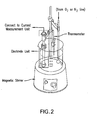
- Four film samples with different thickness were prepared (0.1 mm, 0.2 mm, 0.3 mm, and 0.4 mm; diameter 16 mm). The four samples with different thickness were measured to determine Pm of every example (see Figure 1 ).
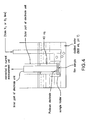
- One of the samples was set at an electrode.
- 0.5 N KCl (aqueous) was poured into the electrode as an electrolytic solution (see Figures 2-4 ).
- Tensile Test a sample in the form of a film sizing about 19.5 mm x 15 mm x 0.2 mm was used. The tensile modulus of elasticity was measured using Tensilon type RTM-100 manufactured by ORIENTEC. The speed of pulling was 100 mm/min and the distance between grips was 5 mm.
- a sample molded into the form of contact lens was irradiated with light with a projector for photograph films to project its image on a screen, and the projected image on the screen was visually observed to evaluate the degree of optical non-uniformity.
- the evaluation was performed by classification into the following three ranks:
- the organic layer was transferred to a separation funnel, washed once with saturated aqueous sodium hydrogen carbonate solution and twice with saturated saline, and dried over anhydrous sodium sulfate. The resultant was filtered, and the solvent was evaporated with an evaporator.
- the obtained crude product was purified by column chromatography on 40 g of silica gel using 80 mL each of 20/1, 15/1, 10/1, 7/1,4/1, and 4/1 mixtures of hexane/ethyl acetate as eluents, to obtain the silicone compound represented by the Formula (4p1) below.
- Example 4-1 The same synthesis and purification operations as in Example 4-1 were repeated except that n -propyldimethylchlorosilane was used in place of ethyldimethylchlorosilane to obtain the silicone compound represented by the Formula (4p2) below.
- Example 4-1 The same synthesis and purification operations as in Example 4-1 were repeated except that n -butyldimethylchlorosilane was used in place of ethyldimethylchlorosilane to obtain the silicone compound represented by the Formula (4p3) below.
- Example 4-4 The same synthesis and purification operations as in Example 4-4 were repeated except that 3-glycidoxypropyltrimethoxysilane was used in place of 3-glycidoxypropyldimethoxymethylsilane to obtain the silicone compound represented by the Formula (4p5) below.
- Example 4-1 The same synthesis and purification operations as in Example 4-1 were repeated except that triethylchlorosilane was used in place of ethyldimethylchlorosilane to obtain the silicone compound represented by the Formula (4r1) below.
- the silicone compound represented by the Formula (4r2) below was synthesized by the method described in Japanese Laid-open Patent Application (Kokai) No. 56-22325 .
- the obtained liquid was purified by silica gel column chromatography.
- Example 4-3 The silicone compounds obtained in the above-described Example 4-1, Example 4-2, and Example 4-3 and Comparative Examples 4-1 and 4-2, as well as a commercially available silicone compound (Comparative Example 4-3) represented by the Formula (4r3) below were tested for their hydrolysis resistance in the presence of a carboxylic acid.
- a solution of 0.1 g of the silicone compound, 3.90 g of 2-propanol, 0.24 g of acetic acid, 0.90 g of water and 2 mg of 2,6-di- t -butyl-4-methylphenol as a polymerization inhibitor was prepared.
- the obtained solution was heated in an oven at 80 °C for 168 hours, and the degree of decomposition was measured by gas chromatography (GC). Taking the GC area % of the peak of the silicone compound at the beginning (0 hr) of the test as 100, the ratios of the GC area % of the peak of the respective silicone compounds at 136 hours from the beginning of the test are shown in Table 1 in the column indicated by the heading "80 °C.”
- Example 4-3 Comparative Example 4-1 98 78 Comparative Example 4-2 46 35 Comparative Example 4-3 73 61
- the silicone compound (30 parts by weight) represented by Formula (p1) obtained in Example 4-1, N,N-dimethylacrylamide (40 parts by weight), polydimethylsiloxane of which terminals are methacrylated (molecular weight: about 1000, 30 parts by weight), triethylene glycol dimethacrylate (1 part by weight), methacrylic acid (1 part by weight) and Darocure 1173 (CIBA, 0.2 parts by weight) were mixed and stirred to obtain a uniform transparent monomer mixture.
- the monomer mixture was degassed under argon atmosphere.
- This monomer mixture was poured into a mold for contact lens, which was made of a transparent resin (poly(4-methylpent-1-ene), in a glove box under nitrogen atmosphere, and the mold was irradiated with light (1 mW/cm 2 , 10 minutes) with a fluorescent lamp (e.g., of the type used for insect control) to polymerize the monomers, thereby obtaining a contact lens-shaped sample.
- a fluorescent lamp e.g., of the type used for insect control
- the obtained lens-shaped sample was subjected to hydration treatment and then immersed in 5 wt% aqueous polyacrylic acid (molecular weight: about 150,000) solution at 40 °C for 8 hours, thereby modifying the sample.
- the sample was sufficiently washed with purified water, and immersed in borate buffer (pH of 7.1 to 7.3) in a vial container.
- borate buffer pH of 7.1 to 7.3
- the vial container was autoclaved for 30 minutes at 120 °C. After allowing the vial container to cool, the lens-shaped sample was taken out from the vial container, and immersed in borate buffer (pH of 7.1 to 7.3).
- the obtained sample was transparent and free from turbidity, and suitable for use as a contact lens.
- Example 4-3 The silicone compounds obtained in Example 4-1, Example 4-2, Example 4-3, Example 4-4, Example 4-5, Comparative Example 4-1, Comparative Example 4-2 and a commercially available silicone compound (Comparative Example 4-3) were polymerized and lens hydrolysis resistance test was performed as follows;
- One of the silicone compounds above (17.5 parts by weight), N,N-dimethylacrylamide (15 parts by weight), hydroxyethyl methacrylate (12.58 parts by weight), ethylene glycol dimethacrylate (1.5 parts by weight), methacrylic acid (0.8 part by weight), Irgacure 819 (CIBA Specialty Chemicals, 0.13 part by weight), PVP-K90 (2.5 parts by weight) and 3,7-dimethyl-3-octanol (50 parts by weight) were mixed and stirred to obtain a uniform transparent monomer mixture. The monomer mixture was degassed under argon atmosphere.
- This monomer mixture was poured into a mold for contact lens, which was made of a transparent resin (poly(4-methylpent-1-ene), in a glove box under nitrogen atmosphere, and the mold was irradiated with light (1.6 mW/cm 2 , 30 minutes) with a fluorescent lamp (20 watt) to polymerize the monomers at 55 °C, thereby obtaining a contact lens-shaped sample.
- the sample was immersed in borate buffer (pH of 7.1 to 7.3) in a vial container. After sealing, the vial container was autoclaved for 30 minutes at 120 °C.
- Example 4-1 (4p1) 195.8 124.1 36.0
- Example 4-2 (4p2) 116.0 133.1 -14.8
- Example 4-3 (4p3) 179.4 193.7 -7.9
- Example 4-4 (4p4) 180.7 144.5 20.0
- Example 4-5 (4p5) 136.8 167.9 -22.7
- Comparative Example 4-2 (4r2) 208.7 92.7 55.6
- Comparative Example 4-3 (4r3) 178.9 54.3 69.7
Landscapes
- Chemical & Material Sciences (AREA)
- Organic Chemistry (AREA)
- Chemical Kinetics & Catalysis (AREA)
- Health & Medical Sciences (AREA)
- Medicinal Chemistry (AREA)
- Polymers & Plastics (AREA)
- Physics & Mathematics (AREA)
- Optics & Photonics (AREA)
- General Physics & Mathematics (AREA)
- Ophthalmology & Optometry (AREA)
- Silicon Polymers (AREA)
- Addition Polymer Or Copolymer, Post-Treatments, Or Chemical Modifications (AREA)
- General Health & Medical Sciences (AREA)
- General Chemical & Material Sciences (AREA)
- Eyeglasses (AREA)
- Materials For Medical Uses (AREA)
- Low-Molecular Organic Synthesis Reactions Using Catalysts (AREA)
- Organic Low-Molecular-Weight Compounds And Preparation Thereof (AREA)
Claims (14)
- Composé ayant la structure :
 dans laquelle M représente un groupe polymérisable par voie radicalaire choisi parmi les oléfines, les acrylates et l'acide méthacrylique et les méthacrylates d'alkyle ;dans laquelle L possède la structure :
 dans laquelle G est un hydrogène ou un groupe hydrolysable ;dans laquelle k représente un nombre entier allant de 0 à 6 ; etdans laquelle m représente un nombre entier allant de 1 à 3 quand k est 0, et représente un nombre entier allant de 1 à 20 quand k n'est pas 0, à condition que 1 < 3k + m < 20 ;dans laquelle Z1 à Z11 représentent indépendamment des groupes alkyle en C1 à C20 ou des groupes aryle en C6 à C20, à condition :qu'au moins un parmi Z3, Z4 et Z9 soit un méthyle et qu'au moins un soit un groupe organique contenant au moins deux atomes de carbone,qu'au moins un parmi Z5, Z6 et Z10 soit un méthyle et qu'au moins un soit un groupe organique contenant au moins deux atomes de carbone, etqu'au moins un parmi Z7, Z8 et Z11 soit un méthyle et qu'au moins un soit un groupe organique contenant au moins deux atomes de carbone ;dans laquelle n représente un nombre entier allant de 0 à 200 ; etdans laquelle a, b et c représentent indépendamment des nombres entiers allant de 0 à 20, à condition que a, b et c ne soient pas simultanément 0.
 - Composé selon la revendication 1, dans lequel n est 0, et dans lequel a, b et c sont tous 1.
- Composé selon la revendication 1, dans lequel a est 0 ; dans lequel b et c sont 1 ; et dans lequel Z9 comprend un groupe méthyle, un groupe éthyle, un groupe propyle, un groupe butyle ou un groupe phényle.
- Composé selon la revendication 1, dans lequel deux parmi Z3, Z4 et Z9 sont des groupes méthyle et un est un groupe éthyle, propyle ou butyle ; dans lequel deux parmi Z5, Z6 et Z10 sont des groupes méthyle et un est un groupe éthyle, propyle ou butyle ; et deux parmi Z7, Z8 et Z11 sont des groupes méthyle et un est un groupe éthyle, propyle ou butyle ; ou
dans lequel Z3, Z4, Z5, Z6, Z7 et Z8 sont des groupes méthyle et dans lequel Z9, Z10 et Z11 sont indépendamment un groupe éthyle, propyle ou butyle. - Polymère comprenant au moins un résidu d'un composé selon la revendication 1, de préférence dans lequel au moins 25 % du polymère comprend des résidus d'un composé selon la revendication 1.
- Lentille ophtalmique ou lentille de contact comprenant le polymère selon la revendication 5.
- Procédé de préparation d'un composé de silicone résistant à l'hydrolyse et contenant un groupe silicié terminal stériquement encombré, le procédé comprenant l'étape de réaction d'un composé d'alcoxysilyle possédant la structure :

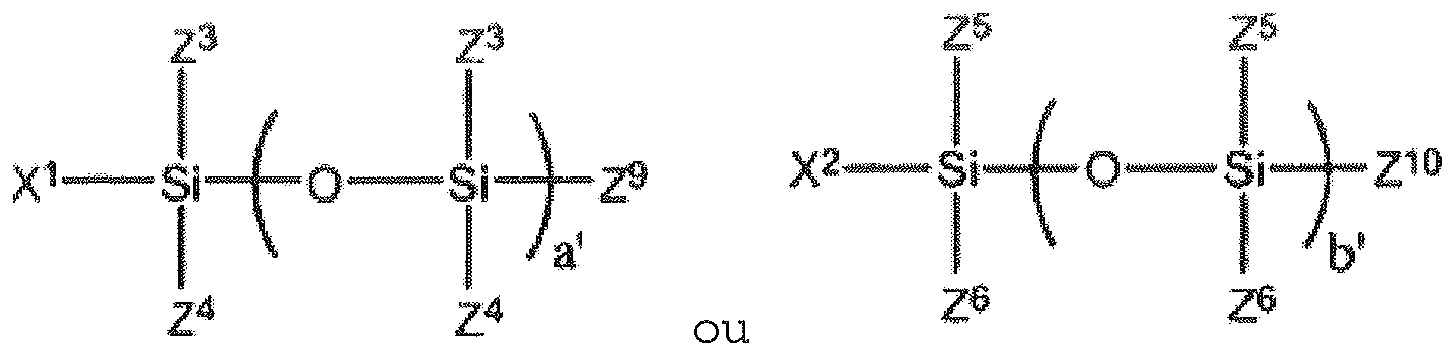
 dans laquelle X1, X2 et X3 représentent indépendamment un halogène choisi dans le groupe constitué du chlore, du brome et de l'iode ;dans laquelle M représente un groupe polymérisable par voie radicalaire choisi parmi les oléfines, les acrylates et l'acide méthacrylique et les méthacrylates d'alkyle ;dans laquelle L possède la structure :
 dans laquelle G est un hydrogène ou un groupe hydrolysable ;dans laquelle k représente un nombre entier allant de 0 à 6 ; etdans laquelle m représente un nombre entier allant de 1 à 3 quand k est 0, et représente un nombre entier allant de 1 à 20 quand k n'est pas 0, à condition que 1 < 3k + m < 20 ;dans laquelle n représente un nombre entier allant de 0 à 200 ;dans laquelle Q1, Q2 et Q3 représentent indépendamment un hydrogène ou un groupe hydrolysable ;dans laquelle Z1 à Z11 représentent indépendamment des groupes alkyle en C1 à C20 ou des groupes aryle en C6 à C20, à condition :qu'au moins un parmi Z3, Z4 et Z9 soit un méthyle et qu'au moins un soit un groupe organique contenant au moins deux atomes de carbone,qu'au moins un parmi Z5, Z6 et Z10 soit un méthyle et qu'au moins un soit un groupe organique contenant au moins deux atomes de carbone, etqu'au moins un parmi Z7, Z8 et Z11 soit un méthyle et qu'au moins un soit un groupe organique contenant au moins deux atomes de carbone ;dans laquelle a, a', b, b', c et c' représentent indépendamment des nombres entiers allant de 0 à 20 ; etdans laquelle (a + a'), (b + b') et (c + c') sont indépendamment des nombres entiers allant de 0 à 20,à condition que (a + a'), (b + b') et (c + c') ne soient pas simultanément 0.
 - Procédé selon la revendication 7, dans lequel le composé d'alcoxysilyle possède la structure :

- Procédé selon la revendication 8, dans lequel le composé d'halogénure de silyle possède la structure :

- Composé possédant la structure :
 dans laquelle p est 1, 2 ou 3 ;dans laquelle M représente un groupe polymérisable par voie radicalaire choisi parmi les oléfines, les acrylates et l'acide méthacrylique et les méthacrylates d'alkyle ;dans laquelle L possède la structure :
 dans laquelle G est un hydrogène ou un groupe hydrolysable ;dans laquelle k représente un nombre entier allant de 0 à 6 ; etdans laquelle m représente un nombre entier allant de 1 à 3 quand k est 0, et représente un nombre entier allant de 1 à 20 quand k n'est pas 0, à condition que 1 < 3k + m < 20 ; etdans laquelle R1, R2a, R2b, R3a, R3b, R4a et R4b représentent indépendamment des groupes alkyle en C1 à C20 ou des groupes aryle en C6 à C20.
 - Polymère comprenant au moins un résidu d'un composé selon la revendication 10.
- Procédé de préparation d'un monomère de siloxane cyclique comprenant l'étape de réaction d'un composé de dihalosilyle possédant la structure :
 dans laquelle M représente un groupe polymérisable par voie radicalaire choisi parmi les oléfines, les acrylates et l'acide méthacrylique et les méthacrylates d'alkyle ;dans laquelle L possède la structure :
 dans laquelle G est un hydrogène ou un groupe hydrolysable ;dans laquelle k représente un nombre entier allant de 0 à 6 ; etdans laquelle m représente un nombre entier allant de 1 à 3 quand k est 0, et représente un nombre entier allant de 1 à 20 quand k n'est pas 0, à condition que 1 < 3k + m < 20 ; etdans laquelle R1 représente un groupe alkyle en C1 à C20 ou un groupe aryle en C6 à C20,avec un composé de siloxanyl diol possédant la structure :
 dans laquelle p est 1, 2 ou 3 ; etdans laquelle R2a, R2b, R3a, R3b, R4a et R4b représentent indépendamment des groupes alkyle en C1 à C20 ou des groupes aryle en C6 à C20.
 - Procédé de préparation d'un monomère de siloxane cyclique comprenant l'étape d'hydrosilylation d'un composé insaturé possédant la structure :
 dans laquelle M représente un groupe polymérisable par voie radicalaire choisi parmi les oléfines, les acrylates et l'acide méthacrylique et les méthacrylates d'alkyle ;dans laquelle L possède la structure :
 dans laquelle G est un hydrogène ou un groupe hydrolysable ;dans laquelle k représente un nombre entier allant de 0 à 6 ; etdans laquelle m représente un nombre entier allant de 1 à 3 quand k est 0, et représente un nombre entier allant de 1 à 20 quand k n'est pas 0, à condition que 1 < 3k + m < 20 ;avec un composé de siloxanyl silane cyclique possédant la structure :
 dans laquelle p est 1, 2 ou 3 ; etdans laquelle R1, R2a, R2b, R3a, R3b, R4a et R4b représentent indépendamment des groupes alkyle en C1 à C20 ou des groupes aryle en C6 à C20,en présence d'un catalyseur à base d'un métal de transition.
 - Produit du procédé selon l'une quelconque des revendications 7, 12 ou 13.
Applications Claiming Priority (3)
| Application Number | Priority Date | Filing Date | Title |
|---|---|---|---|
| US84831706P | 2006-09-29 | 2006-09-29 | |
| US11/561,456 US7838698B2 (en) | 2006-09-29 | 2006-11-20 | Hydrolysis-resistant silicone compounds |
| PCT/US2007/020683 WO2008042163A1 (fr) | 2006-09-29 | 2007-09-25 | Composés de silicone résistant à une hydrolyse |
Publications (2)
| Publication Number | Publication Date |
|---|---|
| EP2076523A1 EP2076523A1 (fr) | 2009-07-08 |
| EP2076523B1 true EP2076523B1 (fr) | 2014-10-22 |
Family
ID=38917710
Family Applications (1)
| Application Number | Title | Priority Date | Filing Date |
|---|---|---|---|
| EP07838814.7A Active EP2076523B1 (fr) | 2006-09-29 | 2007-09-25 | Composés de silicone résistant à une hydrolyse |
Country Status (8)
| Country | Link |
|---|---|
| US (5) | US7838698B2 (fr) |
| EP (1) | EP2076523B1 (fr) |
| JP (1) | JP5515739B2 (fr) |
| KR (3) | KR101716640B1 (fr) |
| CN (1) | CN101553494B (fr) |
| ES (1) | ES2524020T3 (fr) |
| TW (2) | TWI519538B (fr) |
| WO (1) | WO2008042163A1 (fr) |
Cited By (1)
| Publication number | Priority date | Publication date | Assignee | Title |
|---|---|---|---|---|
| US9056878B2 (en) | 2006-09-29 | 2015-06-16 | Johnson & Johnson Vision Care, Inc. | Hydrolysis-resistant silicone compounds |
Families Citing this family (120)
| Publication number | Priority date | Publication date | Assignee | Title |
|---|---|---|---|---|
| US8569538B2 (en) * | 2006-06-30 | 2013-10-29 | Johnson & Johnson Vision Care, Inc. | Acryloyl materials for molded plastics |
| US8053539B2 (en) | 2006-06-30 | 2011-11-08 | Johnson & Johnson Vision Care Inc. | Siloxanyl materials for molded plastics |
| US20080081850A1 (en) * | 2006-09-29 | 2008-04-03 | Kazuhiko Fujisawa | Process for producing hydrolysis-resistant silicone compounds |
| US9056880B2 (en) | 2006-09-29 | 2015-06-16 | Johnson & Johnson Vision Care, Inc. | Process for producing hydrolysis-resistant silicone compounds |
| JP5111837B2 (ja) * | 2006-11-30 | 2013-01-09 | 東レ株式会社 | シリコーンモノマーの製造方法及びその中間体の製造方法及びその成形体 |
| US8080622B2 (en) | 2007-06-29 | 2011-12-20 | Johnson & Johnson Vision Care, Inc. | Soluble silicone prepolymers |
| EP2209779A1 (fr) * | 2007-10-29 | 2010-07-28 | Schering Corporation | Dérivés d'urée et de thiourée hétérocycliques et leurs procédés d'utilisation |
| US7897654B2 (en) * | 2007-12-27 | 2011-03-01 | Johnson & Johnson Vision Care Inc. | Silicone prepolymer solutions |
| US20130203812A1 (en) | 2008-09-30 | 2013-08-08 | Johnson & Johnson Vision Care, Inc. | Ionic silicone hydrogels comprising pharmaceutical and/or nutriceutical components and having improved hydrolytic stability |
| US8470906B2 (en) | 2008-09-30 | 2013-06-25 | Johnson & Johnson Vision Care, Inc. | Ionic silicone hydrogels having improved hydrolytic stability |
| WO2010082659A1 (fr) * | 2009-01-19 | 2010-07-22 | 日油株式会社 | Monomère de silicone |
| WO2011108520A1 (fr) | 2010-03-02 | 2011-09-09 | 東レ株式会社 | Produit pour la peau et son procédé de production |
| US8877103B2 (en) | 2010-04-13 | 2014-11-04 | Johnson & Johnson Vision Care, Inc. | Process for manufacture of a thermochromic contact lens material |
| US8697770B2 (en) | 2010-04-13 | 2014-04-15 | Johnson & Johnson Vision Care, Inc. | Pupil-only photochromic contact lenses displaying desirable optics and comfort |
| KR20170054532A (ko) | 2011-03-21 | 2017-05-17 | 모멘티브 퍼포먼스 머티리얼즈 인크. | 가수분해 저항성 카보실록산 연쇄를 포함하는 실론산 모노머들, 그 제조방법 및 그것들을 함유하는 콘텍트 렌즈용 박막 필름 |
| US8772367B2 (en) | 2011-03-21 | 2014-07-08 | Momentive Performance Materials Inc. | Siloxane monomers containing hydrolysis resistance carbosiloxane linkage, process for their preparation and thin films containing the same for contact lens application |
| US10209534B2 (en) | 2012-03-27 | 2019-02-19 | Johnson & Johnson Vision Care, Inc. | Increased stiffness center optic in soft contact lenses for astigmatism correction |
| JP6037453B2 (ja) * | 2013-11-14 | 2016-12-07 | 信越化学工業株式会社 | 眼科デバイス製造用モノマー |
| JP6037454B2 (ja) * | 2013-11-15 | 2016-12-07 | 信越化学工業株式会社 | 眼科デバイス製造用モノマー |
| WO2015164582A1 (fr) | 2014-04-25 | 2015-10-29 | Novartis Ag | Monomères vinyliques de carbosiloxane rendus hydrophiles |
| CA2940203C (fr) | 2014-04-25 | 2019-08-06 | Novartis Ag | Monomeres vinyliques de carbosiloxane |
| CA2952815A1 (fr) * | 2014-05-16 | 2016-11-24 | Masdar Institute Of Science And Technology | Micro-capteurs auto-alimentes pour mesures spatiales et temporelles in-situ, et leurs procedes d'utilisation en fracturation hydraulique |
| KR101599913B1 (ko) | 2014-06-19 | 2016-03-04 | 동신대학교산학협력단 | 신규한 실리콘 화합물, 이의 제조방법 및 이를 이용한 실리콘 하이드로겔 콘택트 렌즈의 제조방법 |
| JP5831616B2 (ja) * | 2014-11-28 | 2015-12-09 | 東レ株式会社 | シリコーン(メタ)アクリルアミドモノマー |
| CN205385532U (zh) * | 2016-01-07 | 2016-07-13 | 浙江宇视科技有限公司 | 一种摄像机防水结构及防水摄像机 |
| JP6715071B2 (ja) | 2016-04-27 | 2020-07-01 | 信越化学工業株式会社 | 耐加水分解性シリコーン化合物及びその製造方法 |
| US10370476B2 (en) | 2016-07-06 | 2019-08-06 | Johnson & Johnson Vision Care, Inc. | Silicone hydrogels comprising high levels of polyamides |
| US10371865B2 (en) | 2016-07-06 | 2019-08-06 | Johnson & Johnson Vision Care, Inc. | Silicone hydrogels comprising polyamides |
| US11125916B2 (en) | 2016-07-06 | 2021-09-21 | Johnson & Johnson Vision Care, Inc. | Silicone hydrogels comprising N-alkyl methacrylamides and contact lenses made thereof |
| AU2017293335B2 (en) | 2016-07-06 | 2022-06-30 | Johnson & Johnson Vision Care, Inc. | Increased stiffness center optic in soft contact lenses for astigmatism correction |
| US11021558B2 (en) | 2016-08-05 | 2021-06-01 | Johnson & Johnson Vision Care, Inc. | Polymer compositions containing grafted polymeric networks and processes for their preparation and use |
| US10676575B2 (en) | 2016-10-06 | 2020-06-09 | Johnson & Johnson Vision Care, Inc. | Tri-block prepolymers and their use in silicone hydrogels |
| WO2018224974A1 (fr) | 2017-06-07 | 2018-12-13 | Novartis Ag | Procédé de production de lentilles de contact en hydrogel de silicone |
| WO2018224975A1 (fr) | 2017-06-07 | 2018-12-13 | Novartis Ag | Lentilles de contact en hydrogel de silicone |
| EP4481478A3 (fr) | 2017-06-07 | 2025-03-26 | Alcon Inc. | Lentilles de contact en hydrogel de silicone |
| US10752720B2 (en) | 2017-06-26 | 2020-08-25 | Johnson & Johnson Vision Care, Inc. | Polymerizable blockers of high energy light |
| US10526296B2 (en) | 2017-06-30 | 2020-01-07 | Johnson & Johnson Vision Care, Inc. | Hydroxyphenyl naphthotriazoles as polymerizable blockers of high energy light |
| US10723732B2 (en) | 2017-06-30 | 2020-07-28 | Johnson & Johnson Vision Care, Inc. | Hydroxyphenyl phenanthrolines as polymerizable blockers of high energy light |
| JP6803304B2 (ja) | 2017-08-01 | 2020-12-23 | 信越化学工業株式会社 | シロキサン化合物及びその製造方法 |
| JP6800107B2 (ja) | 2017-08-01 | 2020-12-16 | 信越化学工業株式会社 | シロキサン化合物及びその製造方法 |
| JP6800131B2 (ja) * | 2017-11-29 | 2020-12-16 | 信越化学工業株式会社 | シロキサン化合物及びその製造方法 |
| US11034789B2 (en) | 2018-01-30 | 2021-06-15 | Johnson & Johnson Vision Care, Inc. | Ophthalmic devices containing localized grafted networks and processes for their preparation and use |
| US10961341B2 (en) | 2018-01-30 | 2021-03-30 | Johnson & Johnson Vision Care, Inc. | Ophthalmic devices derived from grafted polymeric networks and processes for their preparation and use |
| US12595370B2 (en) | 2018-03-02 | 2026-04-07 | Johnson & Johnson Vision Care, Inc. | Polymerizable absorbers of UV and high energy visible light |
| US10935695B2 (en) | 2018-03-02 | 2021-03-02 | Johnson & Johnson Vision Care, Inc. | Polymerizable absorbers of UV and high energy visible light |
| US12486348B2 (en) | 2019-08-30 | 2025-12-02 | Johnson & Johnson Vision Care, Inc. | Contact lens displaying improved vision attributes |
| US11543683B2 (en) | 2019-08-30 | 2023-01-03 | Johnson & Johnson Vision Care, Inc. | Multifocal contact lens displaying improved vision attributes |
| US12486403B2 (en) | 2018-03-02 | 2025-12-02 | Johnson & Johnson Vision Care, Inc. | Polymerizable absorbers of UV and high energy visible light |
| US11993037B1 (en) | 2018-03-02 | 2024-05-28 | Johnson & Johnson Vision Care, Inc. | Contact lens displaying improved vision attributes |
| US12595371B2 (en) | 2018-03-02 | 2026-04-07 | Johnson & Johnson Vision Care, Inc. | Contact lens with improved vision break-up time |
| US12534623B2 (en) | 2018-03-02 | 2026-01-27 | Johnson & Johnson Vision Care, Inc. | Contact lens with improved tear film optical quality |
| US10996491B2 (en) | 2018-03-23 | 2021-05-04 | Johnson & Johnson Vision Care, Inc. | Ink composition for cosmetic contact lenses |
| US11046636B2 (en) | 2018-06-29 | 2021-06-29 | Johnson & Johnson Vision Care, Inc. | Polymerizable absorbers of UV and high energy visible light |
| US12174465B2 (en) | 2018-08-03 | 2024-12-24 | Johnson & Johnson Vision Care, Inc. | Dynamically tunable apodized multiple-focus opthalmic devices and methods |
| US10932902B2 (en) | 2018-08-03 | 2021-03-02 | Johnson & Johnson Vision Care, Inc. | Dynamically tunable apodized multiple-focus opthalmic devices and methods |
| US20200073145A1 (en) | 2018-09-05 | 2020-03-05 | Johnson & Johnson Vision Care, Inc. | Vision care kit |
| US11493668B2 (en) | 2018-09-26 | 2022-11-08 | Johnson & Johnson Vision Care, Inc. | Polymerizable absorbers of UV and high energy visible light |
| KR102145367B1 (ko) | 2018-11-08 | 2020-08-28 | 이선정 | 신규한 친수성 실리콘 화합물, 이의 제조방법 및 이를 이용한 실리콘 하이드로겔 콘택트 렌즈 |
| US11724471B2 (en) | 2019-03-28 | 2023-08-15 | Johnson & Johnson Vision Care, Inc. | Methods for the manufacture of photoabsorbing contact lenses and photoabsorbing contact lenses produced thereby |
| US11578176B2 (en) | 2019-06-24 | 2023-02-14 | Johnson & Johnson Vision Care, Inc. | Silicone hydrogel contact lenses having non-uniform morphology |
| US12509428B2 (en) | 2019-06-28 | 2025-12-30 | Johnson & Johnson Vision Care, Inc. | Polymerizable fused tricyclic compounds as absorbers of UV and visible light |
| US11958824B2 (en) | 2019-06-28 | 2024-04-16 | Johnson & Johnson Vision Care, Inc. | Photostable mimics of macular pigment |
| US20210003754A1 (en) | 2019-07-02 | 2021-01-07 | Johnson & Johnson Vision Care, Inc. | Core-shell particles and methods of making and using thereof |
| JP2021026029A (ja) * | 2019-07-31 | 2021-02-22 | メルク、パテント、ゲゼルシャフト、ミット、ベシュレンクテル、ハフツングMerck Patent GmbH | ネガ型感光性組成物 |
| US11891526B2 (en) | 2019-09-12 | 2024-02-06 | Johnson & Johnson Vision Care, Inc. | Ink composition for cosmetic contact lenses |
| US11360240B2 (en) | 2019-12-19 | 2022-06-14 | Johnson & Johnson Vision Care, Inc. | Contact lens containing photosensitive chromophore and package therefor |
| US20210301088A1 (en) | 2020-03-18 | 2021-09-30 | Johnson & Johnson Vision Care, Inc. | Ophthalmic devices containing transition metal complexes as high energy visible light filters |
| US11853013B2 (en) | 2020-06-15 | 2023-12-26 | Johnson & Johnson Vision Care, Inc. | Systems and methods for indicating the time elapsed since the occurrence of a triggering event |
| US12116443B2 (en) | 2020-06-16 | 2024-10-15 | Johnson & Johnson Vision Care, Inc. | Amino acid-based polymerizable compounds and ophthalmic devices prepared therefrom |
| US12180318B2 (en) | 2020-06-16 | 2024-12-31 | Johnson & Johnson Vision Care, Inc. | Imidazolium zwitterion polymerizable compounds and ophthalmic devices incorporating them |
| TW202231215A (zh) | 2020-09-14 | 2022-08-16 | 美商壯生和壯生視覺關懷公司 | 單一觸碰式隱形眼鏡盒 |
| TW202225787A (zh) | 2020-09-14 | 2022-07-01 | 美商壯生和壯生視覺關懷公司 | 單指觸動隱形眼鏡包裝 |
| US20220113558A1 (en) | 2020-10-13 | 2022-04-14 | Johnson & Johnson Vision Care, Inc. | Contact lens position and rotation control using the pressure of the eyelid margin |
| WO2022123525A1 (fr) | 2020-12-13 | 2022-06-16 | Johnson & Johnson Vision Care, Inc. | Conditionnements de lentilles de contact et méthodes d'ouverture |
| US20220194944A1 (en) | 2020-12-18 | 2022-06-23 | Johnson & Johnson Vision Care, Inc. | Photostable mimics of macular pigment |
| US12049606B2 (en) | 2021-01-12 | 2024-07-30 | Johnson & Johnson Vision Care, Inc. | Compositions for ophthalmologic devices |
| US12054499B2 (en) | 2021-06-30 | 2024-08-06 | Johnson & Johnson Vision Care, Inc. | Transition metal complexes as visible light absorbers |
| CA3173598A1 (fr) | 2021-09-13 | 2023-03-13 | Johnson & Johnson Vision Care, Inc. | Emballages de verres de contact et methodes de manutention et de fabrication |
| WO2023052889A1 (fr) | 2021-09-29 | 2023-04-06 | Johnson & Johnson Vision Care, Inc. | Initiateurs de polymérisation à fonction amide et leur utilisation dans la fabrication de lentilles ophtalmiques |
| WO2023052890A1 (fr) | 2021-09-29 | 2023-04-06 | Johnson & Johnson Vision Care, Inc. | Initiateurs de polymérisation fonctionnalisés par l'anthraquinone et leur utilisation dans la fabrication de lentilles ophtalmiques |
| US20230176251A1 (en) | 2021-09-29 | 2023-06-08 | Johnson & Johnson Vision Care, Inc. | Ophthalmic lenses and their manufacture by in-mold modification |
| US11912800B2 (en) | 2021-09-29 | 2024-02-27 | Johnson & Johnson Vision Care, Inc. | Amide-functionalized polymerization initiators and their use in the manufacture of ophthalmic lenses |
| US12396534B2 (en) | 2021-10-08 | 2025-08-26 | Johnson & Johnson Vision Care, Inc. | Multi-material lens package |
| US11708209B2 (en) | 2021-11-05 | 2023-07-25 | Johnson & Johnson Vision Care, Inc. | Touchless contact lens packages and methods of handling |
| TW202335928A (zh) | 2021-12-08 | 2023-09-16 | 美商壯生和壯生視覺關懷公司 | 具鏡片升高臂的隱形眼鏡包裝及拿取方法 |
| TW202415312A (zh) | 2021-12-08 | 2024-04-16 | 美商壯生和壯生視覺關懷公司 | 開槽式隱形眼鏡包裝盒及處理方法 |
| US20250049184A1 (en) | 2021-12-13 | 2025-02-13 | Johnson & Johnson Vision Care, Inc. | Contact lens packages with sliding or tilting lens transfer and methods of handling |
| US20250041114A1 (en) | 2021-12-14 | 2025-02-06 | Johnson & Johnson Vision Care, Inc. | Contact lens packages having twisting or thimble levers and methods of handling |
| WO2023111851A1 (fr) | 2021-12-15 | 2023-06-22 | Johnson & Johnson Vision Care, Inc. | Emballages pour lentilles de contact sans solution et procédés de fabrication |
| WO2023111852A1 (fr) | 2021-12-15 | 2023-06-22 | Johnson & Johnson Vision Care, Inc. | Emballages de lentilles de contact sans contact et procédés de manipulation |
| WO2023111941A1 (fr) | 2021-12-16 | 2023-06-22 | Johnson & Johnson Vision Care, Inc. | Boîtiers de lentilles de contact sans contact et procédés de manipulation |
| KR20240124978A (ko) | 2021-12-16 | 2024-08-19 | 존슨 앤드 존슨 비젼 케어, 인코포레이티드 | 가압 또는 진공 밀봉형 콘택트 렌즈 패키지 |
| CN118679107A (zh) | 2021-12-17 | 2024-09-20 | 强生视力健公司 | 具有枢转机构的隐形眼镜包装及处理方法 |
| US20250051087A1 (en) | 2021-12-17 | 2025-02-13 | Johnson & Johnson Vision Care, Inc. | Contact lens dispenser |
| US12517282B2 (en) | 2021-12-20 | 2026-01-06 | Johnson & Johnson Vision Care, Inc. | Contact lenses containing light absorbing regions and methods for their preparation |
| US12509583B2 (en) | 2022-04-28 | 2025-12-30 | Johnson & Johnson Vision Care, Inc. | Particle surface modification to increase compatibility and stability in hydrogels |
| US11733440B1 (en) | 2022-04-28 | 2023-08-22 | Johnson & Johnson Vision Care, Inc. | Thermally stable nanoparticles and methods thereof |
| US20230348718A1 (en) | 2022-04-28 | 2023-11-02 | Johnson & Johnson Vision Care, Inc. | Light-filtering materials for biomaterial integration and methods thereof |
| US11971518B2 (en) | 2022-04-28 | 2024-04-30 | Johnson & Johnson Vision Care, Inc. | Shape engineering of particles to create a narrow spectral filter against a specific portion of the light spectrum |
| US12498590B2 (en) | 2022-04-28 | 2025-12-16 | Johnson & Johnson Vision Care, Inc. | Using particles for light filtering |
| US20250362432A1 (en) | 2022-06-16 | 2025-11-27 | Johnson & Johnson Vision Care, Inc. | Ophthalmic devices containing photostable mimics of macular pigment and other visible light filters |
| USD1061023S1 (en) | 2022-06-21 | 2025-02-11 | Johnson & Johnson Vision Care, Inc. | Contact lens package |
| USD1062223S1 (en) | 2022-06-21 | 2025-02-18 | Johnson & Johnson Vision Care, Inc. | Contact lens package |
| US12064018B2 (en) | 2022-09-27 | 2024-08-20 | Johnson & Johnson Vision Care, Inc. | Contact lens package with draining port |
| US20240099435A1 (en) | 2022-09-27 | 2024-03-28 | Johnson & Johnson Vision Care, Inc. | Flat contact lens packages and methods of handling |
| US20240122321A1 (en) | 2022-10-18 | 2024-04-18 | Johnson & Johnson Vision Care, Inc. | Contact lens packages having an absorbent member |
| US20240165019A1 (en) | 2022-11-21 | 2024-05-23 | Bausch + Lomb Ireland Limited | Methods for Treating Eyetear Film Deficiency |
| US20240228466A1 (en) | 2022-12-15 | 2024-07-11 | Johnson & Johnson Vision Care, Inc. | Transition metal complexes as visible light absorbers |
| WO2024134384A1 (fr) | 2022-12-21 | 2024-06-27 | Johnson & Johnson Vision Care, Inc. | Compositions pour dispositifs ophtalmologiques |
| TW202439974A (zh) | 2022-12-21 | 2024-10-16 | 美商壯生和壯生視覺關懷公司 | 眼用裝置之組成物 |
| TW202439973A (zh) | 2022-12-21 | 2024-10-16 | 美商壯生和壯生視覺關懷公司 | 眼科裝置之組成物(一) |
| WO2024134382A1 (fr) | 2022-12-21 | 2024-06-27 | Johnson & Johnson Vision Care, Inc. | Compositions pour dispositifs ophtalmologiques |
| US12187522B2 (en) | 2023-01-13 | 2025-01-07 | Johnson & Johnson Vision Care, Inc. | Contact lens packages having an absorbent member |
| JP2026512375A (ja) | 2023-03-20 | 2026-04-16 | ジョンソン・アンド・ジョンソン・ビジョン・ケア・インコーポレイテッド | 眼科用レンズ及び型内変性によるそれらの製造 |
| WO2024201156A1 (fr) | 2023-03-28 | 2024-10-03 | Johnson & Johnson Vision Care, Inc. | Dispositifs ophtalmiques greffés contenant des régions désactivées et leurs processus de préparation et d'utilisation |
| WO2025024631A1 (fr) | 2023-07-27 | 2025-01-30 | Johnson & Johnson Vision Care, Inc. | Systèmes de durcissement par apprentissage automatique supervisés |
| WO2025104612A1 (fr) | 2023-11-16 | 2025-05-22 | Johnson & Johnson Vision Care, Inc. | Lentille de contact cosmétique ayant un motif de points elliptique approprié pour former un anneau limbique apparent |
| WO2025125986A1 (fr) | 2023-12-12 | 2025-06-19 | Johnson & Johnson Vision Care, Inc. | Dispositifs ophtalmiques contenant des mimétiques photostables de pigment maculaire et d'autres filtres de lumière visible |
| WO2026028118A1 (fr) | 2024-07-31 | 2026-02-05 | Johnson & Johnson Vision Care, Inc. | Emballages de lentilles de contact et supports de lentilles destinés à être utilisés dans ceux-ci |
| WO2026042047A1 (fr) | 2024-08-23 | 2026-02-26 | Johnson & Johnson Vision Care, Inc. | Compositions et articles comprenant des complexes réversibles de carraghénane réticulé |
Family Cites Families (160)
| Publication number | Priority date | Publication date | Assignee | Title |
|---|---|---|---|---|
| US2793223A (en) | 1954-05-20 | 1957-05-21 | Dow Corning | Acryloxy methyl siloxanes |
| US2956044A (en) | 1956-08-06 | 1960-10-11 | Dow Corning | Acryloxymethylsilicon polymers |
| US3001975A (en) | 1957-04-05 | 1961-09-26 | Rohm & Haas | Monoepoxidation of esters, monomers, and polymers thereof |
| US3057902A (en) | 1960-08-31 | 1962-10-09 | Union Carbide Corp | Ester solvents and basic catalysts employed in an addition process |
| US3377371A (en) | 1964-09-03 | 1968-04-09 | Dow Corning | Tris-siloxy acrylic silanes |
| FR1532373A (fr) | 1967-05-03 | 1968-07-12 | Kodak Pathe | Nouvelles compositions et nouveaux produits photopolymérisables et procédé de reproduction d'images utilisant ces nouveaux produits |
| JPS491570B1 (fr) | 1968-10-31 | 1974-01-14 | ||
| US3699081A (en) | 1969-08-30 | 1972-10-17 | Sumitomo Chemical Co | Method for stabilizing acrylamide |
| GB1274382A (en) | 1970-03-05 | 1972-05-17 | Saltostomy Ltd | Improvements relating to post surgical drainage devices |
| UST908001I4 (en) | 1971-02-14 | 1973-03-27 | Defensive publication | |
| DE2207495A1 (de) | 1971-02-20 | 1972-08-24 | Dainippon Printing Co Ltd | Flachdruckplatten und Verfahren zu ihrer Herstellung |
| BE787750A (fr) | 1971-08-20 | 1973-02-19 | Union Carbide Corp | Procede pour inhiber la polymerisation d'acrylates et methacrylates pendant leur distillation |
| US3859320A (en) | 1972-05-22 | 1975-01-07 | Ici Ltd | Fluorine-containing organosilicon compounds |
| US3808178A (en) | 1972-06-16 | 1974-04-30 | Polycon Laboratories | Oxygen-permeable contact lens composition,methods and article of manufacture |
| JPS5014786Y2 (fr) | 1973-03-14 | 1975-05-08 | ||
| JPS5515110Y2 (fr) | 1974-09-30 | 1980-04-07 | ||
| US3959358A (en) | 1975-01-08 | 1976-05-25 | Nalco Chemical Company | Polymerization inhibition of acrylate esters |
| JPS5622325Y2 (fr) | 1976-06-14 | 1981-05-26 | ||
| US4120570A (en) | 1976-06-22 | 1978-10-17 | Syntex (U.S.A.) Inc. | Method for correcting visual defects, compositions and articles of manufacture useful therein |
| US4144137A (en) | 1976-12-13 | 1979-03-13 | Rohm And Haas Company | Method for removal of polymerization inhibitor |
| US4117001A (en) | 1977-07-05 | 1978-09-26 | Phillips Petroleum Company | Pyrolysis of heavies formed in production of unsaturated dinitriles |
| JPS584327B2 (ja) | 1978-07-15 | 1983-01-26 | 東洋コンタクトレンズ株式会社 | コンタクトレンズ |
| JPS5455455A (en) | 1977-10-12 | 1979-05-02 | Toyo Contact Lens Co Ltd | Contact lens |
| JPS5466853A (en) | 1977-11-08 | 1979-05-29 | Toyo Contact Lens Co Ltd | Soft contact lens |
| US4402887A (en) | 1978-03-14 | 1983-09-06 | Dainippon Ink And Chemicals Inc. | Sheet-like articles of polyvinyl chloride |
| JPS55111236A (en) | 1979-02-20 | 1980-08-27 | Katashi Aoki | Injection/stretching/blowing molding machine for two-layer molding |
| US4246389A (en) | 1979-06-25 | 1981-01-20 | American Optical Corporation | Contact lens composition having increased oxygen permeability |
| US4259467A (en) | 1979-12-10 | 1981-03-31 | Bausch & Lomb Incorporated | Hydrophilic contact lens made from polysiloxanes containing hydrophilic sidechains |
| US4260725A (en) | 1979-12-10 | 1981-04-07 | Bausch & Lomb Incorporated | Hydrophilic contact lens made from polysiloxanes which are thermally bonded to polymerizable groups and which contain hydrophilic sidechains |
| US4395496A (en) | 1981-11-16 | 1983-07-26 | Uco Optics, Inc. | Cured cellulose ester, method of curing same, and use thereof |
| US4463149A (en) * | 1982-03-29 | 1984-07-31 | Polymer Technology Corporation | Silicone-containing contact lens material and contact lenses made thereof |
| US4602074A (en) | 1983-12-20 | 1986-07-22 | Nippon Contact Lens Manufacturing Ltd. | Contact lens material |
| JPS60146219A (ja) | 1984-01-11 | 1985-08-01 | Toray Ind Inc | 樹脂の製造方法 |
| JPS60239491A (ja) | 1984-05-15 | 1985-11-28 | Kanegafuchi Chem Ind Co Ltd | 珪素含有メタクリル酸エステルの安定化方法 |
| JPH0632791Y2 (ja) | 1985-03-25 | 1994-08-24 | 松下電工株式会社 | インバ−タ装置 |
| US4711943A (en) * | 1985-04-26 | 1987-12-08 | Sola U.S.A. Inc. | Hydrophilic siloxane monomers and dimers for contact lens materials, and contact lenses fabricated therefrom |
| DE3517612A1 (de) | 1985-05-15 | 1987-01-02 | Titmus Eurocon Kontaktlinsen | Modifizierter siliconkautschuk und seine verwendung als material fuer eine optische linse sowie optische linse aus diesem material |
| JPS6254220A (ja) | 1985-09-03 | 1987-03-09 | Nippon Contact Lens:Kk | コンタクトレンズ材料 |
| EP0230597B1 (fr) | 1985-12-19 | 1992-04-08 | Nippon Shokubai Kagaku Kogyo Co., Ltd | Procédé pour inhiber la polymérisation des maléimides |
| US4861850A (en) | 1986-02-06 | 1989-08-29 | Progressive Chemical Research, Ltd. | Ophthalamic device from fluoro-silicon polymers |
| JPS63216044A (ja) * | 1987-03-05 | 1988-09-08 | Nippon Zeon Co Ltd | パタ−ン形成材料 |
| JPS63301919A (ja) | 1987-06-02 | 1988-12-08 | Seiko Epson Corp | コンタクトレンズ |
| JPS63316941A (ja) | 1987-06-19 | 1988-12-26 | Hitachi Cable Ltd | 信号伝送方法 |
| FR2618337B1 (fr) | 1987-07-22 | 1989-12-15 | Dow Corning Sa | Pansement chirurgical et procede pour le fabriquer |
| DE3729457A1 (de) | 1987-09-03 | 1989-03-16 | Bayer Ag | Kontaktoptische gegenstaende |
| US5128484A (en) | 1987-12-28 | 1992-07-07 | Sokubai Kagaku Kogyo, Co., Ltd. | Acrylonitrile maleimides solution composition of improved shelf life and method for production thereof |
| JP2842443B2 (ja) | 1988-09-30 | 1999-01-06 | 東レ・ダウコーニング・シリコーン株式会社 | 片方の末端に重合性官能基を有するオルガノポリシロキサンの製造方法 |
| US5070215A (en) | 1989-05-02 | 1991-12-03 | Bausch & Lomb Incorporated | Novel vinyl carbonate and vinyl carbamate contact lens material monomers |
| US5010141A (en) | 1989-10-25 | 1991-04-23 | Ciba-Geigy Corporation | Reactive silicone and/or fluorine containing hydrophilic prepolymers and polymers thereof |
| US5079319A (en) | 1989-10-25 | 1992-01-07 | Ciba-Geigy Corporation | Reactive silicone and/or fluorine containing hydrophilic prepolymers and polymers thereof |
| CA2038117A1 (fr) | 1990-03-29 | 1991-09-30 | Mahfuza B. Ali | Composes adhesifs a photodurcissement controle pour fixer les dispositifs microelectroniques et methode de fixation de dispositifs microelectroniques avec ces composes |
| US5057578A (en) | 1990-04-10 | 1991-10-15 | E. I. Du Pont De Nemours And Company | Silicone-containing block copolymers and macromonomers |
| US5314960A (en) | 1990-04-10 | 1994-05-24 | Permeable Technologies, Inc. | Silicone-containing polymers, oxygen permeable hydrophilic contact lenses and methods for making these lenses and treating patients with visual impairment |
| US5244981A (en) | 1990-04-10 | 1993-09-14 | Permeable Technologies, Inc. | Silicone-containing contact lens polymers, oxygen permeable contact lenses and methods for making these lenses and treating patients with visual impairment |
| AT396212B (de) | 1990-07-06 | 1993-07-26 | Akad Wissenschaften Ddr | Polierpellet zum polieren von funktionsflaechen aus glas oder kristall im anpressdruckbereich unter 6n/cm2 |
| JP2622186B2 (ja) | 1990-07-18 | 1997-06-18 | 株式会社クラレ | 有機珪素化合物の蒸留方法 |
| US5329034A (en) | 1990-08-09 | 1994-07-12 | Sagami Chemical Research Center | Silanol compounds, polymerizable monomers and polymers having mesogenic groups |
| US5371147A (en) | 1990-10-11 | 1994-12-06 | Permeable Technologies, Inc. | Silicone-containing acrylic star polymers, block copolymers and macromonomers |
| US5219965A (en) | 1990-11-27 | 1993-06-15 | Bausch & Lomb Incorporated | Surface modification of polymer objects |
| EP0859021A3 (fr) | 1991-10-31 | 1998-11-11 | Daicel Chemical Industries, Ltd. | Compositions époxydes |
| JPH0632791A (ja) | 1992-07-15 | 1994-02-08 | Kuraray Co Ltd | ケイ素含有化合物 |
| US5336797A (en) | 1992-12-30 | 1994-08-09 | Bausch & Lomb Incorporated | Siloxane macromonomers |
| US5321108A (en) | 1993-02-12 | 1994-06-14 | Bausch & Lomb Incorporated | Fluorosilicone hydrogels |
| JPH06239912A (ja) | 1993-02-18 | 1994-08-30 | Nippon Shokubai Co Ltd | 重合体の製造方法 |
| WO1994024180A1 (fr) | 1993-04-20 | 1994-10-27 | Sagami Chemical Research Center | Copolymere possedant un groupe cristal liquide dans sa chaine laterale |
| JP2869304B2 (ja) | 1993-08-18 | 1999-03-10 | 信越化学工業株式会社 | シラノール基含有オルガノポリシロキサンの製造方法 |
| JPH07216091A (ja) | 1994-01-27 | 1995-08-15 | Toray Dow Corning Silicone Co Ltd | シロキサニル・ホスフェートの製造方法 |
| JP3445370B2 (ja) | 1994-07-18 | 2003-09-08 | 東レ・ダウコーニング・シリコーン株式会社 | メタクリロキシプロピルジメチルクロロシランの製造方法 |
| US5888356A (en) | 1994-08-19 | 1999-03-30 | Huels Aktiengesellschaft | Inhibition of polymerization of vinylaromatic or vinylaliphatic |
| US5760100B1 (en) | 1994-09-06 | 2000-11-14 | Ciba Vision Corp | Extended wear ophthalmic lens |
| JPH08259574A (ja) * | 1995-03-22 | 1996-10-08 | Toray Dow Corning Silicone Co Ltd | 脂環式エポキシ基含有ラジカル重合性オリゴシロキサンおよびその製造方法 |
| JP3479378B2 (ja) | 1995-04-06 | 2003-12-15 | 株式会社メニコン | 眼用レンズ材料 |
| US5824195A (en) | 1995-07-10 | 1998-10-20 | Chisso Corporation | Process for distilling crude acrylic silane solution |
| JP3175548B2 (ja) | 1995-08-17 | 2001-06-11 | 信越化学工業株式会社 | 水素含有環状シロキサンの製造方法 |
| IT1283082B1 (it) | 1996-05-30 | 1998-04-07 | Hoechst Sara Spa | Procedimento per la sintesi di resine contenenti insaturazoni di tipo (met)acrilico induribili mediante radiazioni o calore e |
| BR9710129A (pt) | 1996-07-02 | 1999-08-10 | Ciba Sc Holding Ag | Processo para cura de uma composição polimerizável |
| US5994488A (en) | 1996-12-06 | 1999-11-30 | Toray Industries, Inc. | Plastic articles for medical use |
| KR100479275B1 (ko) | 1997-03-27 | 2005-11-23 | 후지 샤신 필름 가부시기가이샤 | 원자외선노광용포지티브포토레지스트조성물 |
| JP3746871B2 (ja) | 1997-04-14 | 2006-02-15 | Jsr株式会社 | 液状硬化性樹脂組成物 |
| KR100281513B1 (ko) | 1997-05-22 | 2001-02-15 | 울프 크라스텐센, 스트라쎄 로텐베르그 | 특히 당 라디칼 또는 당유도체인 폴리하이드록시오가닐 라디칼 및 폴리옥시 알킬렌 라디칼로 구성되는 오카노 폴리실록산 |
| US5831110A (en) | 1997-10-23 | 1998-11-03 | Chisso Corporation | Fluorine-containing siloxane compound and process for production thereof |
| US6140525A (en) * | 1997-11-24 | 2000-10-31 | Russian Academy Of Sciences | Hyperbranched polymers and methods for the preparation thereof |
| US7461937B2 (en) | 2001-09-10 | 2008-12-09 | Johnson & Johnson Vision Care, Inc. | Soft contact lenses displaying superior on-eye comfort |
| US6943203B2 (en) * | 1998-03-02 | 2005-09-13 | Johnson & Johnson Vision Care, Inc. | Soft contact lenses |
| US6822016B2 (en) | 2001-09-10 | 2004-11-23 | Johnson & Johnson Vision Care, Inc. | Biomedical devices containing internal wetting agents |
| US5962548A (en) | 1998-03-02 | 1999-10-05 | Johnson & Johnson Vision Products, Inc. | Silicone hydrogel polymers |
| US7052131B2 (en) | 2001-09-10 | 2006-05-30 | J&J Vision Care, Inc. | Biomedical devices containing internal wetting agents |
| US6218503B1 (en) | 1998-05-15 | 2001-04-17 | Bausch & Lomb Incorporated | Silicone-containing prepolymers |
| DE69920329T3 (de) | 1998-06-19 | 2009-07-09 | Shin-Etsu Chemical Co., Ltd. | Destillationsverfahren für (Meth)acryloxysilane |
| US6344495B1 (en) | 1998-07-31 | 2002-02-05 | Dai Nippon Printing Co., Ltd. | Photo-curable resin composition and method for forming concave-convex pattern |
| US5959117A (en) | 1998-08-10 | 1999-09-28 | Bausch & Lomb | Monomers useful for contact lens materials |
| US6031059A (en) | 1998-09-30 | 2000-02-29 | Johnson & Johnson Vision Products, Inc. | Optically transparent hydrogels and processes for their production |
| JP3674667B2 (ja) | 1998-11-25 | 2005-07-20 | 信越化学工業株式会社 | (メタ)アクリロキシプロピル基を有するシクロテトラシロキサン及びその製造方法 |
| JP4144088B2 (ja) | 1998-12-24 | 2008-09-03 | 東レ株式会社 | コンタクトレンズ用ポリマーおよびそれを用いたコンタクトレンズ |
| JP2000191730A (ja) | 1998-12-24 | 2000-07-11 | Toray Ind Inc | 眼用レンズ用モノマー、眼用レンズ用ポリマーおよびそれを用いたコンタクトレンズ |
| JP4236342B2 (ja) | 1999-07-30 | 2009-03-11 | 東レ・ダウコーニング株式会社 | カルボシロキサンデンドリマーおよびデンドリマー含有有機重合体 |
| JP4123648B2 (ja) | 1999-08-05 | 2008-07-23 | 東レ株式会社 | ポリマーおよびそれを用いた眼用レンズ |
| US6649722B2 (en) | 1999-12-10 | 2003-11-18 | Novartis Ag | Contact lens |
| DE60042841D1 (de) | 1999-12-16 | 2009-10-08 | Asahikasei Aime Co Ltd | Zum tragen über lange zeiträume geeignete weiche kontaktlinsen |
| WO2003027123A1 (fr) * | 2000-02-07 | 2003-04-03 | Johnson & Johnson Vision Care, Inc. | Monomeres, polymeres et lentilles ophtalmologiques |
| JP4524838B2 (ja) | 2000-02-07 | 2010-08-18 | 東レ株式会社 | 眼用レンズ |
| DE60104457T2 (de) | 2000-02-10 | 2005-08-04 | Nippon Shokubai Co., Ltd. | Verfahren zur Herstellung alpha, beta-ungesättigter Carbonsäureester sowie Katalysator zur Verwendung in diesem Verfahren |
| JP4438162B2 (ja) * | 2000-02-24 | 2010-03-24 | 東レ株式会社 | 眼用レンズ用ポリマーの製造法および眼用レンズ |
| JP4273612B2 (ja) | 2000-03-03 | 2009-06-03 | 東レ株式会社 | 眼用レンズ |
| CA2682118A1 (fr) | 2000-03-24 | 2001-09-27 | Novartis Ag | Nouveaux polymeres |
| US6372815B1 (en) | 2000-04-18 | 2002-04-16 | Ocular Sciences Inc | Ophthalmic lenses and compositions, and methods for producing same |
| JP4783963B2 (ja) | 2000-05-12 | 2011-09-28 | 東レ株式会社 | 眼用レンズ |
| US6177585B1 (en) | 2000-05-19 | 2001-01-23 | Dow Corning Corporation | Bimetallic platinum catalysts for hydrosilations |
| DE10026432A1 (de) | 2000-05-29 | 2002-02-14 | 3M Espe Ag | Präpolymere (Meth)acrylate mit polycyclischen oder aromatischen Segmenten |
| MY128134A (en) | 2000-09-28 | 2007-01-31 | Novartis Ag | Compositions and methods for cleaning contact lenses |
| JP5011601B2 (ja) | 2000-10-12 | 2012-08-29 | 東レ株式会社 | ポリマーおよびそれを用いた眼用レンズ |
| JP3874070B2 (ja) | 2001-03-01 | 2007-01-31 | 信越化学工業株式会社 | 珪素含有高分子化合物、レジスト材料及びパターン形成方法 |
| EP1386924B1 (fr) | 2001-03-30 | 2009-06-10 | Johnson & Johnson Vision Care, Inc. | Monomere, polymere et lentille oculaire et lentille de contact obtenues a partir de ceux-ci |
| WO2002081532A1 (fr) | 2001-03-30 | 2002-10-17 | Johnson & Johnson Vision Care, Inc. | Monomeres, polymeres, lentilles ophtalmiques et lentilles de contact fabriquees a l'aide de ces derniers |
| US20030065177A1 (en) | 2001-08-08 | 2003-04-03 | Crompton Corporation, A Corporation Of The State Of Delaware | High boiling inhibitors for distillable, polymerizable monomers |
| DE60143171D1 (de) | 2001-08-17 | 2010-11-11 | Johnson & Johnson Vision Care | Verfahren zur herstellung eines polymers für eine augenoptische linse und augenoptische linse |
| DK175862B1 (da) | 2001-09-24 | 2005-04-18 | Coloplast As | Stomiindretning |
| US7317117B2 (en) | 2001-10-02 | 2008-01-08 | Johnson & Johnson Vision Care, Inc. | Siloxanyl-containing monomers |
| US6776934B2 (en) | 2001-11-02 | 2004-08-17 | Bausch & Lomb Incorporated | Method for polymerizing lenses |
| US7169874B2 (en) | 2001-11-02 | 2007-01-30 | Bausch & Lomb Incorporated | High refractive index polymeric siloxysilane compositions |
| US6864341B2 (en) | 2001-11-02 | 2005-03-08 | Bausch & Lomb Incorporated | High refractive index aromatic-based prepolymer precursors |
| KR100419864B1 (ko) | 2001-11-15 | 2004-03-04 | 한국화학연구원 | 신규 가교제와 이를 함유하는 가교형 고체 고분자 전해질 |
| TW200300448A (en) | 2001-11-21 | 2003-06-01 | Novartis Ag | Conditioning solution for contact lenses |
| US6787615B2 (en) | 2002-01-25 | 2004-09-07 | The United States Of America As Represented By The Secretary Of The Navy | Synthesis of oligomeric poly(silarylene-siloxane-acetylene)'s and their conversion to high temperature plastics, elastomers, and coatings |
| JP4222945B2 (ja) | 2002-02-04 | 2009-02-12 | チバ ホールディング インコーポレーテッド | 界面活性シロキサン光開始剤 |
| US6846892B2 (en) | 2002-03-11 | 2005-01-25 | Johnson & Johnson Vision Care, Inc. | Low polydispersity poly-HEMA compositions |
| US6803406B2 (en) | 2002-03-29 | 2004-10-12 | National Starch And Chemical Investmnet Holding Corporation | Electron donors, electron acceptors and adhesion promoters containing disulfide |
| JP4273885B2 (ja) | 2002-09-06 | 2009-06-03 | 東レ株式会社 | シリコーンモノマー組成物の製造方法 |
| US7108893B2 (en) | 2002-09-23 | 2006-09-19 | Delphi Technologies, Inc. | Spray system with combined kinetic spray and thermal spray ability |
| US6922118B2 (en) | 2002-11-01 | 2005-07-26 | Hrl Laboratories, Llc | Micro electrical mechanical system (MEMS) tuning using focused ion beams |
| US6809155B2 (en) | 2002-11-20 | 2004-10-26 | National Starch And Chemical Investment Holding Corporation | Unsaturated compounds containing silane, electron donor and electron acceptor functionality |
| US7651485B2 (en) | 2002-11-27 | 2010-01-26 | Bristol-Myers Squibb Company | Ostomy pouch adhesives such as polysiloxanes that are resistant to stomal effluent |
| US20040114101A1 (en) | 2002-12-13 | 2004-06-17 | Ocular Sciences, Inc. | Contact lenses with color shifting properties |
| US6933401B2 (en) | 2003-06-30 | 2005-08-23 | Frank Molock | Process for the production of vicinal diesters from epoxides |
| US8373000B2 (en) | 2003-06-30 | 2013-02-12 | Johnson & Johnson Vision Care, Inc. | Process for the production of bis(trimethylsilyloxy)silylalkylglycerol methacrylates |
| US7368589B2 (en) | 2003-10-31 | 2008-05-06 | Johnson & Johnson Vision Care, Inc. | Purification of silicone containing compounds by supercritical fluid extraction |
| US7683206B2 (en) | 2004-02-27 | 2010-03-23 | Toray Industries, Inc. | Silicone compound and process for producing the same |
| JP4539131B2 (ja) | 2004-03-16 | 2010-09-08 | 住友化学株式会社 | 有機ケイ素系化合物、及びその製造方法 |
| WO2005090365A1 (fr) | 2004-03-18 | 2005-09-29 | Sharp Kabushiki Kaisha | Organosilanes, procede de fabrication de ceux-ci, et utilisation |
| MXPA06012125A (es) | 2004-04-21 | 2007-01-17 | Novartis Ag | Tintas de color curables para fabricar lentes de hidrogel de silicona coloreados. |
| JP4556491B2 (ja) | 2004-05-26 | 2010-10-06 | 三菱化学株式会社 | 重合禁止剤、これを含有する組成物、及び前記重合禁止剤を用いる易重合性化合物の製造方法 |
| JP4826150B2 (ja) | 2004-06-22 | 2011-11-30 | 東レ株式会社 | シリコーンモノマーの製造方法 |
| US20060047134A1 (en) | 2004-08-25 | 2006-03-02 | Frank Molock | Process for the production of (trimethylsilyloxy)silylalkylglycerol methacrylates |
| AU2006227418A1 (en) | 2005-03-17 | 2006-09-28 | Johnson & Johnson Vision Care, Inc. | Process for the production of monodisperse and narrow disperse monofunctional silicones |
| US7279538B2 (en) | 2005-04-01 | 2007-10-09 | Bausch & Lomb Incorporated | Aromatic-based polysiloxane prepolymers and ophthalmic devices produced therefrom |
| US20070138669A1 (en) | 2005-12-21 | 2007-06-21 | Yu-Chin Lai | Process for Casting and Extracting Biomedical Devices |
| JP4884998B2 (ja) | 2006-02-08 | 2012-02-29 | ジョンソン・アンド・ジョンソン・ビジョン・ケア・インコーポレイテッド | シリコーンヒドロゲル眼科レンズの離型容易化 |
| US7858000B2 (en) | 2006-06-08 | 2010-12-28 | Novartis Ag | Method of making silicone hydrogel contact lenses |
| US8569538B2 (en) | 2006-06-30 | 2013-10-29 | Johnson & Johnson Vision Care, Inc. | Acryloyl materials for molded plastics |
| US8053539B2 (en) | 2006-06-30 | 2011-11-08 | Johnson & Johnson Vision Care Inc. | Siloxanyl materials for molded plastics |
| DE102006037271A1 (de) | 2006-08-09 | 2008-02-14 | Wacker Chemie Ag | Vernetzbare reaktive Silikonorganocopolymere sowie Verfahren zu deren Herstellung und deren Verwendung |
| US20080081850A1 (en) | 2006-09-29 | 2008-04-03 | Kazuhiko Fujisawa | Process for producing hydrolysis-resistant silicone compounds |
| US7838698B2 (en) | 2006-09-29 | 2010-11-23 | Johnson & Johnson Vision Care, Inc. | Hydrolysis-resistant silicone compounds |
| CN101541815A (zh) | 2006-09-29 | 2009-09-23 | 庄臣及庄臣视力保护公司 | 制备抗水解的聚硅氧烷化合物的方法 |
| US20080119627A1 (en) | 2006-11-22 | 2008-05-22 | Masataka Nakamura | Methods for purifying siloxanyl monomers |
| JP5669396B2 (ja) | 2006-12-13 | 2015-02-12 | ノバルティス アーゲー | 化学線硬化性シリコーンヒドロゲルコポリマーおよびその使用 |
| KR101482808B1 (ko) | 2007-03-22 | 2015-01-14 | 노파르티스 아게 | 현수 폴리실록산-함유 중합체 사슬이 있는 예비중합체 |
| US8080622B2 (en) | 2007-06-29 | 2011-12-20 | Johnson & Johnson Vision Care, Inc. | Soluble silicone prepolymers |
| JP2011507563A (ja) | 2007-12-14 | 2011-03-10 | ボーシュ アンド ローム インコーポレイティド | バイオメディカルデバイス |
| US7897654B2 (en) | 2007-12-27 | 2011-03-01 | Johnson & Johnson Vision Care Inc. | Silicone prepolymer solutions |
-
2006
- 2006-11-20 US US11/561,456 patent/US7838698B2/en active Active
-
2007
- 2007-09-25 CN CN200780044049.5A patent/CN101553494B/zh active Active
- 2007-09-25 KR KR1020157014036A patent/KR101716640B1/ko not_active Expired - Fee Related
- 2007-09-25 KR KR1020097008010A patent/KR101636853B1/ko not_active Expired - Fee Related
- 2007-09-25 ES ES07838814.7T patent/ES2524020T3/es active Active
- 2007-09-25 EP EP07838814.7A patent/EP2076523B1/fr active Active
- 2007-09-25 JP JP2009530395A patent/JP5515739B2/ja active Active
- 2007-09-25 KR KR1020147023476A patent/KR20140119761A/ko not_active Ceased
- 2007-09-25 WO PCT/US2007/020683 patent/WO2008042163A1/fr not_active Ceased
- 2007-09-28 TW TW102110389A patent/TWI519538B/zh not_active IP Right Cessation
- 2007-09-28 TW TW096136451A patent/TWI515198B/zh not_active IP Right Cessation
-
2010
- 2010-10-08 US US12/901,191 patent/US8357818B2/en active Active
-
2013
- 2013-01-21 US US13/746,265 patent/US8779178B2/en active Active
- 2013-01-21 US US13/746,268 patent/US8921449B2/en active Active
-
2014
- 2014-06-10 US US14/301,094 patent/US9056878B2/en active Active
Cited By (1)
| Publication number | Priority date | Publication date | Assignee | Title |
|---|---|---|---|---|
| US9056878B2 (en) | 2006-09-29 | 2015-06-16 | Johnson & Johnson Vision Care, Inc. | Hydrolysis-resistant silicone compounds |
Also Published As
| Publication number | Publication date |
|---|---|
| US20110028673A1 (en) | 2011-02-03 |
| TW201329095A (zh) | 2013-07-16 |
| WO2008042163A1 (fr) | 2008-04-10 |
| US8357818B2 (en) | 2013-01-22 |
| JP2011503242A (ja) | 2011-01-27 |
| JP5515739B2 (ja) | 2014-06-11 |
| US9056878B2 (en) | 2015-06-16 |
| KR20150064247A (ko) | 2015-06-10 |
| US20130131298A1 (en) | 2013-05-23 |
| KR101716640B1 (ko) | 2017-03-15 |
| TWI515198B (zh) | 2016-01-01 |
| KR20140119761A (ko) | 2014-10-10 |
| EP2076523A1 (fr) | 2009-07-08 |
| US20140296554A1 (en) | 2014-10-02 |
| KR20090077923A (ko) | 2009-07-16 |
| US8779178B2 (en) | 2014-07-15 |
| HK1137458A1 (zh) | 2010-07-30 |
| KR101636853B1 (ko) | 2016-07-06 |
| TW200829597A (en) | 2008-07-16 |
| CN101553494B (zh) | 2016-05-11 |
| US7838698B2 (en) | 2010-11-23 |
| CN101553494A (zh) | 2009-10-07 |
| US8921449B2 (en) | 2014-12-30 |
| US20080081894A1 (en) | 2008-04-03 |
| US20130131369A1 (en) | 2013-05-23 |
| TWI519538B (zh) | 2016-02-01 |
| ES2524020T3 (es) | 2014-12-03 |
Similar Documents
| Publication | Publication Date | Title |
|---|---|---|
| EP2076523B1 (fr) | Composés de silicone résistant à une hydrolyse | |
| EP2076522B1 (fr) | Procédé de production de composés de silicone résistant à une hydrolyse | |
| EP2038327B1 (fr) | Matières siloxanylées pour matières plastiques moulées | |
| WO2009006285A1 (fr) | Prépolymères solubles de silicone | |
| JP7639702B2 (ja) | ホスホリルコリン基含有ポリシロキサンモノマー | |
| CN101541815A (zh) | 制备抗水解的聚硅氧烷化合物的方法 | |
| US9056880B2 (en) | Process for producing hydrolysis-resistant silicone compounds | |
| HK1137458B (en) | Hydrolysis-resistant silicone compounds |
Legal Events
| Date | Code | Title | Description |
|---|---|---|---|
| PUAI | Public reference made under article 153(3) epc to a published international application that has entered the european phase |
Free format text: ORIGINAL CODE: 0009012 |
|
| 17P | Request for examination filed |
Effective date: 20090427 |
|
| AK | Designated contracting states |
Kind code of ref document: A1 Designated state(s): AT BE BG CH CY CZ DE DK EE ES FI FR GB GR HU IE IS IT LI LT LU LV MC MT NL PL PT RO SE SI SK TR |
|
| 17Q | First examination report despatched |
Effective date: 20110114 |
|
| DAX | Request for extension of the european patent (deleted) | ||
| GRAP | Despatch of communication of intention to grant a patent |
Free format text: ORIGINAL CODE: EPIDOSNIGR1 |
|
| INTG | Intention to grant announced |
Effective date: 20140409 |
|
| GRAS | Grant fee paid |
Free format text: ORIGINAL CODE: EPIDOSNIGR3 |
|
| GRAA | (expected) grant |
Free format text: ORIGINAL CODE: 0009210 |
|
| RIN1 | Information on inventor provided before grant (corrected) |
Inventor name: NAKAMURA, MASATAKA Inventor name: VANDERLAAN, DOUGLAS, G. Inventor name: FUJISAWA, KAZUHIKO Inventor name: YOKOTA, MITSURU |
|
| AK | Designated contracting states |
Kind code of ref document: B1 Designated state(s): AT BE BG CH CY CZ DE DK EE ES FI FR GB GR HU IE IS IT LI LT LU LV MC MT NL PL PT RO SE SI SK TR |
|
| REG | Reference to a national code |
Ref country code: GB Ref legal event code: FG4D |
|
| REG | Reference to a national code |
Ref country code: CH Ref legal event code: EP |
|
| REG | Reference to a national code |
Ref country code: AT Ref legal event code: REF Ref document number: 692597 Country of ref document: AT Kind code of ref document: T Effective date: 20141115 |
|
| REG | Reference to a national code |
Ref country code: IE Ref legal event code: FG4D |
|
| REG | Reference to a national code |
Ref country code: ES Ref legal event code: FG2A Ref document number: 2524020 Country of ref document: ES Kind code of ref document: T3 Effective date: 20141203 |
|
| REG | Reference to a national code |
Ref country code: DE Ref legal event code: R096 Ref document number: 602007038999 Country of ref document: DE Effective date: 20141204 |
|
| REG | Reference to a national code |
Ref country code: NL Ref legal event code: VDEP Effective date: 20141022 |
|
| REG | Reference to a national code |
Ref country code: AT Ref legal event code: MK05 Ref document number: 692597 Country of ref document: AT Kind code of ref document: T Effective date: 20141022 |
|
| REG | Reference to a national code |
Ref country code: LT Ref legal event code: MG4D |
|
| PG25 | Lapsed in a contracting state [announced via postgrant information from national office to epo] |
Ref country code: NL Free format text: LAPSE BECAUSE OF FAILURE TO SUBMIT A TRANSLATION OF THE DESCRIPTION OR TO PAY THE FEE WITHIN THE PRESCRIBED TIME-LIMIT Effective date: 20141022 Ref country code: FI Free format text: LAPSE BECAUSE OF FAILURE TO SUBMIT A TRANSLATION OF THE DESCRIPTION OR TO PAY THE FEE WITHIN THE PRESCRIBED TIME-LIMIT Effective date: 20141022 Ref country code: PT Free format text: LAPSE BECAUSE OF FAILURE TO SUBMIT A TRANSLATION OF THE DESCRIPTION OR TO PAY THE FEE WITHIN THE PRESCRIBED TIME-LIMIT Effective date: 20150223 Ref country code: LT Free format text: LAPSE BECAUSE OF FAILURE TO SUBMIT A TRANSLATION OF THE DESCRIPTION OR TO PAY THE FEE WITHIN THE PRESCRIBED TIME-LIMIT Effective date: 20141022 Ref country code: IS Free format text: LAPSE BECAUSE OF FAILURE TO SUBMIT A TRANSLATION OF THE DESCRIPTION OR TO PAY THE FEE WITHIN THE PRESCRIBED TIME-LIMIT Effective date: 20150222 |
|
| PG25 | Lapsed in a contracting state [announced via postgrant information from national office to epo] |
Ref country code: PL Free format text: LAPSE BECAUSE OF FAILURE TO SUBMIT A TRANSLATION OF THE DESCRIPTION OR TO PAY THE FEE WITHIN THE PRESCRIBED TIME-LIMIT Effective date: 20141022 Ref country code: AT Free format text: LAPSE BECAUSE OF FAILURE TO SUBMIT A TRANSLATION OF THE DESCRIPTION OR TO PAY THE FEE WITHIN THE PRESCRIBED TIME-LIMIT Effective date: 20141022 Ref country code: SE Free format text: LAPSE BECAUSE OF FAILURE TO SUBMIT A TRANSLATION OF THE DESCRIPTION OR TO PAY THE FEE WITHIN THE PRESCRIBED TIME-LIMIT Effective date: 20141022 Ref country code: LV Free format text: LAPSE BECAUSE OF FAILURE TO SUBMIT A TRANSLATION OF THE DESCRIPTION OR TO PAY THE FEE WITHIN THE PRESCRIBED TIME-LIMIT Effective date: 20141022 Ref country code: CY Free format text: LAPSE BECAUSE OF FAILURE TO SUBMIT A TRANSLATION OF THE DESCRIPTION OR TO PAY THE FEE WITHIN THE PRESCRIBED TIME-LIMIT Effective date: 20141022 Ref country code: GR Free format text: LAPSE BECAUSE OF FAILURE TO SUBMIT A TRANSLATION OF THE DESCRIPTION OR TO PAY THE FEE WITHIN THE PRESCRIBED TIME-LIMIT Effective date: 20150123 |
|
| REG | Reference to a national code |
Ref country code: FR Ref legal event code: PLFP Year of fee payment: 9 |
|
| REG | Reference to a national code |
Ref country code: DE Ref legal event code: R097 Ref document number: 602007038999 Country of ref document: DE |
|
| PG25 | Lapsed in a contracting state [announced via postgrant information from national office to epo] |
Ref country code: EE Free format text: LAPSE BECAUSE OF FAILURE TO SUBMIT A TRANSLATION OF THE DESCRIPTION OR TO PAY THE FEE WITHIN THE PRESCRIBED TIME-LIMIT Effective date: 20141022 Ref country code: SK Free format text: LAPSE BECAUSE OF FAILURE TO SUBMIT A TRANSLATION OF THE DESCRIPTION OR TO PAY THE FEE WITHIN THE PRESCRIBED TIME-LIMIT Effective date: 20141022 Ref country code: DK Free format text: LAPSE BECAUSE OF FAILURE TO SUBMIT A TRANSLATION OF THE DESCRIPTION OR TO PAY THE FEE WITHIN THE PRESCRIBED TIME-LIMIT Effective date: 20141022 Ref country code: RO Free format text: LAPSE BECAUSE OF FAILURE TO SUBMIT A TRANSLATION OF THE DESCRIPTION OR TO PAY THE FEE WITHIN THE PRESCRIBED TIME-LIMIT Effective date: 20141022 Ref country code: CZ Free format text: LAPSE BECAUSE OF FAILURE TO SUBMIT A TRANSLATION OF THE DESCRIPTION OR TO PAY THE FEE WITHIN THE PRESCRIBED TIME-LIMIT Effective date: 20141022 |
|
| PLBE | No opposition filed within time limit |
Free format text: ORIGINAL CODE: 0009261 |
|
| STAA | Information on the status of an ep patent application or granted ep patent |
Free format text: STATUS: NO OPPOSITION FILED WITHIN TIME LIMIT |
|
| 26N | No opposition filed |
Effective date: 20150723 |
|
| PG25 | Lapsed in a contracting state [announced via postgrant information from national office to epo] |
Ref country code: SI Free format text: LAPSE BECAUSE OF FAILURE TO SUBMIT A TRANSLATION OF THE DESCRIPTION OR TO PAY THE FEE WITHIN THE PRESCRIBED TIME-LIMIT Effective date: 20141022 |
|
| PG25 | Lapsed in a contracting state [announced via postgrant information from national office to epo] |
Ref country code: LU Free format text: LAPSE BECAUSE OF FAILURE TO SUBMIT A TRANSLATION OF THE DESCRIPTION OR TO PAY THE FEE WITHIN THE PRESCRIBED TIME-LIMIT Effective date: 20150925 Ref country code: MC Free format text: LAPSE BECAUSE OF FAILURE TO SUBMIT A TRANSLATION OF THE DESCRIPTION OR TO PAY THE FEE WITHIN THE PRESCRIBED TIME-LIMIT Effective date: 20141022 |
|
| REG | Reference to a national code |
Ref country code: CH Ref legal event code: PL |
|
| PG25 | Lapsed in a contracting state [announced via postgrant information from national office to epo] |
Ref country code: CH Free format text: LAPSE BECAUSE OF NON-PAYMENT OF DUE FEES Effective date: 20150930 Ref country code: LI Free format text: LAPSE BECAUSE OF NON-PAYMENT OF DUE FEES Effective date: 20150930 |
|
| REG | Reference to a national code |
Ref country code: FR Ref legal event code: PLFP Year of fee payment: 10 |
|
| PG25 | Lapsed in a contracting state [announced via postgrant information from national office to epo] |
Ref country code: MT Free format text: LAPSE BECAUSE OF FAILURE TO SUBMIT A TRANSLATION OF THE DESCRIPTION OR TO PAY THE FEE WITHIN THE PRESCRIBED TIME-LIMIT Effective date: 20141022 |
|
| PG25 | Lapsed in a contracting state [announced via postgrant information from national office to epo] |
Ref country code: BG Free format text: LAPSE BECAUSE OF FAILURE TO SUBMIT A TRANSLATION OF THE DESCRIPTION OR TO PAY THE FEE WITHIN THE PRESCRIBED TIME-LIMIT Effective date: 20141022 Ref country code: HU Free format text: LAPSE BECAUSE OF FAILURE TO SUBMIT A TRANSLATION OF THE DESCRIPTION OR TO PAY THE FEE WITHIN THE PRESCRIBED TIME-LIMIT; INVALID AB INITIO Effective date: 20070925 |
|
| REG | Reference to a national code |
Ref country code: FR Ref legal event code: PLFP Year of fee payment: 11 |
|
| PG25 | Lapsed in a contracting state [announced via postgrant information from national office to epo] |
Ref country code: TR Free format text: LAPSE BECAUSE OF FAILURE TO SUBMIT A TRANSLATION OF THE DESCRIPTION OR TO PAY THE FEE WITHIN THE PRESCRIBED TIME-LIMIT Effective date: 20141022 |
|
| PG25 | Lapsed in a contracting state [announced via postgrant information from national office to epo] |
Ref country code: BE Free format text: LAPSE BECAUSE OF FAILURE TO SUBMIT A TRANSLATION OF THE DESCRIPTION OR TO PAY THE FEE WITHIN THE PRESCRIBED TIME-LIMIT Effective date: 20141022 |
|
| REG | Reference to a national code |
Ref country code: FR Ref legal event code: PLFP Year of fee payment: 12 |
|
| REG | Reference to a national code |
Ref country code: DE Ref legal event code: R082 Ref document number: 602007038999 Country of ref document: DE |
|
| PGFP | Annual fee paid to national office [announced via postgrant information from national office to epo] |
Ref country code: DE Payment date: 20250730 Year of fee payment: 19 |
|
| PGFP | Annual fee paid to national office [announced via postgrant information from national office to epo] |
Ref country code: IT Payment date: 20250825 Year of fee payment: 19 |
|
| PGFP | Annual fee paid to national office [announced via postgrant information from national office to epo] |
Ref country code: GB Payment date: 20250807 Year of fee payment: 19 |
|
| PGFP | Annual fee paid to national office [announced via postgrant information from national office to epo] |
Ref country code: FR Payment date: 20250808 Year of fee payment: 19 |
|
| PGFP | Annual fee paid to national office [announced via postgrant information from national office to epo] |
Ref country code: IE Payment date: 20250812 Year of fee payment: 19 |
|
| PGFP | Annual fee paid to national office [announced via postgrant information from national office to epo] |
Ref country code: ES Payment date: 20251017 Year of fee payment: 19 |