EP2077152A2 - Katalysator zur dampfumwandlung von kohlenmonoxid sowie verfahren zu seiner herstellung und verwendung - Google Patents
Katalysator zur dampfumwandlung von kohlenmonoxid sowie verfahren zu seiner herstellung und verwendung Download PDFInfo
- Publication number
- EP2077152A2 EP2077152A2 EP07834984A EP07834984A EP2077152A2 EP 2077152 A2 EP2077152 A2 EP 2077152A2 EP 07834984 A EP07834984 A EP 07834984A EP 07834984 A EP07834984 A EP 07834984A EP 2077152 A2 EP2077152 A2 EP 2077152A2
- Authority
- EP
- European Patent Office
- Prior art keywords
- catalyst
- iron
- chromium
- carbon monoxide
- vapour
- Prior art date
- Legal status (The legal status is an assumption and is not a legal conclusion. Google has not performed a legal analysis and makes no representation as to the accuracy of the status listed.)
- Withdrawn
Links
Images




Classifications
-
- C—CHEMISTRY; METALLURGY
- C01—INORGANIC CHEMISTRY
- C01B—NON-METALLIC ELEMENTS; COMPOUNDS THEREOF; METALLOIDS OR COMPOUNDS THEREOF NOT COVERED BY SUBCLASS C01C
- C01B3/00—Hydrogen; Gaseous mixtures containing hydrogen; Separation of hydrogen from mixtures containing it; Purification of hydrogen; Reversible storage of hydrogen
- C01B3/02—Production of hydrogen; Production of gaseous mixtures containing hydrogen
- C01B3/06—Production of hydrogen; Production of gaseous mixtures containing hydrogen by reaction of inorganic compounds containing electro-positively bound hydrogen with inorganic reducing agents
- C01B3/12—Production of hydrogen; Production of gaseous mixtures containing hydrogen by reaction of inorganic compounds containing electro-positively bound hydrogen with inorganic reducing agents by reaction of water vapour with carbon monoxide
- C01B3/16—Production of hydrogen; Production of gaseous mixtures containing hydrogen by reaction of inorganic compounds containing electro-positively bound hydrogen with inorganic reducing agents by reaction of water vapour with carbon monoxide using catalysts
-
- B—PERFORMING OPERATIONS; TRANSPORTING
- B01—PHYSICAL OR CHEMICAL PROCESSES OR APPARATUS IN GENERAL
- B01J—CHEMICAL OR PHYSICAL PROCESSES, e.g. CATALYSIS OR COLLOID CHEMISTRY; THEIR RELEVANT APPARATUS
- B01J23/00—Catalysts comprising metals or metal oxides or hydroxides, not provided for in group B01J21/00
- B01J23/002—Mixed oxides other than spinels, e.g. perovskite
-
- B—PERFORMING OPERATIONS; TRANSPORTING
- B01—PHYSICAL OR CHEMICAL PROCESSES OR APPARATUS IN GENERAL
- B01J—CHEMICAL OR PHYSICAL PROCESSES, e.g. CATALYSIS OR COLLOID CHEMISTRY; THEIR RELEVANT APPARATUS
- B01J23/00—Catalysts comprising metals or metal oxides or hydroxides, not provided for in group B01J21/00
- B01J23/70—Catalysts comprising metals or metal oxides or hydroxides, not provided for in group B01J21/00 of the iron group metals or copper
- B01J23/76—Catalysts comprising metals or metal oxides or hydroxides, not provided for in group B01J21/00 of the iron group metals or copper combined with metals, oxides or hydroxides provided for in groups B01J23/02 - B01J23/36
- B01J23/84—Catalysts comprising metals or metal oxides or hydroxides, not provided for in group B01J21/00 of the iron group metals or copper combined with metals, oxides or hydroxides provided for in groups B01J23/02 - B01J23/36 with arsenic, antimony, bismuth, vanadium, niobium, tantalum, polonium, chromium, molybdenum, tungsten, manganese, technetium or rhenium
- B01J23/85—Chromium, molybdenum or tungsten
- B01J23/86—Chromium
- B01J23/862—Iron and chromium
-
- B—PERFORMING OPERATIONS; TRANSPORTING
- B01—PHYSICAL OR CHEMICAL PROCESSES OR APPARATUS IN GENERAL
- B01J—CHEMICAL OR PHYSICAL PROCESSES, e.g. CATALYSIS OR COLLOID CHEMISTRY; THEIR RELEVANT APPARATUS
- B01J23/00—Catalysts comprising metals or metal oxides or hydroxides, not provided for in group B01J21/00
- B01J23/70—Catalysts comprising metals or metal oxides or hydroxides, not provided for in group B01J21/00 of the iron group metals or copper
- B01J23/76—Catalysts comprising metals or metal oxides or hydroxides, not provided for in group B01J21/00 of the iron group metals or copper combined with metals, oxides or hydroxides provided for in groups B01J23/02 - B01J23/36
- B01J23/84—Catalysts comprising metals or metal oxides or hydroxides, not provided for in group B01J21/00 of the iron group metals or copper combined with metals, oxides or hydroxides provided for in groups B01J23/02 - B01J23/36 with arsenic, antimony, bismuth, vanadium, niobium, tantalum, polonium, chromium, molybdenum, tungsten, manganese, technetium or rhenium
- B01J23/85—Chromium, molybdenum or tungsten
- B01J23/86—Chromium
- B01J23/868—Chromium copper and chromium
-
- B—PERFORMING OPERATIONS; TRANSPORTING
- B01—PHYSICAL OR CHEMICAL PROCESSES OR APPARATUS IN GENERAL
- B01J—CHEMICAL OR PHYSICAL PROCESSES, e.g. CATALYSIS OR COLLOID CHEMISTRY; THEIR RELEVANT APPARATUS
- B01J37/00—Processes, in general, for preparing catalysts; Processes, in general, for activation of catalysts
- B01J37/02—Impregnation, coating or precipitation
- B01J37/03—Precipitation; Co-precipitation
-
- B—PERFORMING OPERATIONS; TRANSPORTING
- B01—PHYSICAL OR CHEMICAL PROCESSES OR APPARATUS IN GENERAL
- B01J—CHEMICAL OR PHYSICAL PROCESSES, e.g. CATALYSIS OR COLLOID CHEMISTRY; THEIR RELEVANT APPARATUS
- B01J2235/00—Indexing scheme associated with group B01J35/00, related to the analysis techniques used to determine the catalysts form or properties
- B01J2235/10—Infrared [IR]
-
- B—PERFORMING OPERATIONS; TRANSPORTING
- B01—PHYSICAL OR CHEMICAL PROCESSES OR APPARATUS IN GENERAL
- B01J—CHEMICAL OR PHYSICAL PROCESSES, e.g. CATALYSIS OR COLLOID CHEMISTRY; THEIR RELEVANT APPARATUS
- B01J2235/00—Indexing scheme associated with group B01J35/00, related to the analysis techniques used to determine the catalysts form or properties
- B01J2235/15—X-ray diffraction
-
- B—PERFORMING OPERATIONS; TRANSPORTING
- B01—PHYSICAL OR CHEMICAL PROCESSES OR APPARATUS IN GENERAL
- B01J—CHEMICAL OR PHYSICAL PROCESSES, e.g. CATALYSIS OR COLLOID CHEMISTRY; THEIR RELEVANT APPARATUS
- B01J2523/00—Constitutive chemical elements of heterogeneous catalysts
-
- B—PERFORMING OPERATIONS; TRANSPORTING
- B01—PHYSICAL OR CHEMICAL PROCESSES OR APPARATUS IN GENERAL
- B01J—CHEMICAL OR PHYSICAL PROCESSES, e.g. CATALYSIS OR COLLOID CHEMISTRY; THEIR RELEVANT APPARATUS
- B01J37/00—Processes, in general, for preparing catalysts; Processes, in general, for activation of catalysts
- B01J37/0009—Use of binding agents; Moulding; Pressing; Powdering; Granulating; Addition of materials ameliorating the mechanical properties of the product catalyst
-
- B—PERFORMING OPERATIONS; TRANSPORTING
- B01—PHYSICAL OR CHEMICAL PROCESSES OR APPARATUS IN GENERAL
- B01J—CHEMICAL OR PHYSICAL PROCESSES, e.g. CATALYSIS OR COLLOID CHEMISTRY; THEIR RELEVANT APPARATUS
- B01J37/00—Processes, in general, for preparing catalysts; Processes, in general, for activation of catalysts
- B01J37/12—Oxidising
-
- Y—GENERAL TAGGING OF NEW TECHNOLOGICAL DEVELOPMENTS; GENERAL TAGGING OF CROSS-SECTIONAL TECHNOLOGIES SPANNING OVER SEVERAL SECTIONS OF THE IPC; TECHNICAL SUBJECTS COVERED BY FORMER USPC CROSS-REFERENCE ART COLLECTIONS [XRACs] AND DIGESTS
- Y02—TECHNOLOGIES OR APPLICATIONS FOR MITIGATION OR ADAPTATION AGAINST CLIMATE CHANGE
- Y02P—CLIMATE CHANGE MITIGATION TECHNOLOGIES IN THE PRODUCTION OR PROCESSING OF GOODS
- Y02P20/00—Technologies relating to chemical industry
- Y02P20/50—Improvements relating to the production of bulk chemicals
- Y02P20/52—Improvements relating to the production of bulk chemicals using catalysts, e.g. selective catalysts
Definitions
- the inventions relates to a method of producing hydrogen by means of the vapour conversion of carbon monoxide and catalysts for said process and can be used in different industries.
- a vapour conversion of carbon monoxide reaction is a step of the process for producing hydrogen from natural gas.
- a vapour conversion reaction of CO is exothermic, the conversion depth is determined by thermodynamic equilibrium, which is unambiguously associated with the temperature of the gas mixture at the catalyst layer.
- vapour conversion of carbon monoxide is implemented in two steps: in a range of temperatures (1) of 350 to 500°C based on an iron-chromium catalyst and (2) 190 to 300°C based on a copper-zinc-aluminum catalyst [Catalysts used in nitrogen industry. Edited by A. M. Alekseev. Cherkassy. NIITEkhim. 1979].
- the most promising catalysts in step 1 of the process are currently catalysts based on iron-chromium and iron-chromium-copper compounds.
- the main requirements to them are: (1) a sulphur content not greater than 0.03 mass%, (2) a chromium 6+ content is not greater than 0.05 mass%, (3) the catalyst activity providing implementing the process at temperatures at the start of the layer less than 350°C, for example, at 320 to 330°C, (4) ecological safety of the preparation technology.
- the disadvantages of the two methods are relatively low activity of the catalysts obtainable by means thereof.
- a method of producing a catalyst (RU 2170615, B01J 23/881, 20.07.01) obtainable by mixing iron oxide with an aqueous solution of chromic acid and a manganese salt followed by formation of granules, drying and backing thereof. Before backing, compounds of Mg, or Ca, Nd or Pr are additionally introduced.
- an iron-chromium catalyst (RU 2275963, B01J37/03, 10.05.06) by mixing chromic anhydride with iron compounds prepared by precipitating iron hydroxyl compound with solutions of ammonia or sodium carbonate from solutions of iron sulfates followed by washing off, molding and backing at 280-420°C.
- iron sulfate as a feed requires a lot of water and long time to remove sulphur.
- High content of chromium 6+ and relatively low activity of the catalyst are in the whole range of temperatures, particularly at temperatures below 350°C (cf. prototype disclosed in example 6) are also disadvantages.
- the variants of this invention suppose mixing chromic anhydride with iron hydroxyl compounds and backing the mixture at 50-200°C before molding the catalyst not allowing avoiding the above disadvantages, however, additionally resulting in great shrinkage of the catalyst in the course of using thereof.
- Improving the economic indicators in using containing no sulphur reagents is gained by producing nitrates under the technology of preparing a catalyst using cheap feed, for example, metal iron and chromic anhydride, by obtaining iron 2+ and 3+ and chromium 3+ nitrates by the oxidation-reduction interaction of metal iron, chromic anhydride and nitric acid.
- the closest invention to the set forth invention is the invention [BG 62040, B01J23/702, 9.01.1999], which discloses a method of producing an iron-chromium-copper catalyst for vapour conversion of CO with high hydroxyl surface coating operating at 300-360°C.
- the catalyst is obtained by mixing CO 2 -blowing solutions of ammonia and solutions of iron nitrates (III), chromium nitrates (III) and copper nitrate followed by drying and air backing at 350-450°C.
- Iron (III) and Cr (III) nitrates are obtained by dissolving waste metal iron and chromic anhydride in 23 mass% of nitric acid with air blowing-off at 40-60°C.
- the invention solves the object of developing a catalyst having high activity in a vapour conversion reaction at temperature 250-350°C.
- the present invention is aimed at providing a catalyst for vapour conversion of carbon monoxide containing an iron 3+ and chromium 3+ hydroxyl compound phase with a goethite (FeOOH, Pbnm (2/m 2/m 2/m), ICSD 28247, 6.1.1.2) and/or hydrohematite (FeO( 1.5-0.5x )(OH) x [ E. Wolska, Zeitschr. Fur Kristallogr. V.154, N1/2, 1981, p. 69-71 ] structure.
- a goethite FeOOH, Pbnm (2/m 2/m 2/m), ICSD 28247, 6.1.1.2
- hydrohematite FeO( 1.5-0.5x )(OH) x
- the atom ratio of iron and chromium in said catalyst is greater than 1.
- the catalyst can also contain more than 1.0 mass% of copper.
- the catalyst containing one of the above hydroxide phases has activity in a vapour conversion reaction at temperatures of 250-350°C greatly exceeding the known analogs containing mainly a phase having a hematite ⁇ -Fe 2 O 3 or magnetite Fe 3 O 4 structure as illustrated by the examples given hereafter.
- the present invention also provides a method of preparing a catalyst using as a feed metal iron or a composition containing metal iron, compounds of chromium 6+ or an aqueous solution thereof, compounds of copper 2+ or an aqueous solution thereof and a aqueous solution of nitric acid.
- the inventive method of preparing a catalyst for conversion of carbon monoxide containing iron and chromium comprises steps: mixing metal iron or a metal iron-containing composition with a compound of chromium 6+ or an aqueous solution thereof and an aqueous solution of nitric acid having the initial concentration of 6.0-46 mass% at a temperature below 40°C; bubbling the obtained mixture with air at a temperature of 40-60°C, mixing the resulted solution and an aqueous solution of carbonate and/or ammonium hydroxide, and/or potassium, and/or sodium, water washing off the precipitate from the mother solution, precipitate filtration and drying.
- the method allows producing hydroxyl compounds having the above mentioned structures.
- metal iron containing composition cast iron or steel are used.
- the mixture of compounds of iron, chromium and nitric acid is further added with compounds of Cu 2+ or an aqueous solution thereof.
- the steps of mixing the precipitate and graphite and molding or palletizing, as well as the steps of catalyst backing at a temperature of 150-250°C in the air stream and/or 150-450°C in the stream of inert gas, nitrogen and the mixture thereof and vapour can be additionally performed.
- the concrete structure of obtainable compounds is determined by the preparation parameters, such as the feed mixing temperature, pH of the mother solution and some others.
- a metal iron composition metallurgical production goods, as well as waste iron or machine-building production run-off can be used, however, using grey cast iron is preferable.
- Grey cast iron has a low content of sulphur (really it is possible to reach the content of 0.02 mass%) and phosphorus. Carbon and silicon containing in cast iron do not deteriorate the catalyst characteristics, but can improve the moldability thereof.
- Manganese containing in cast iron can have a positive influence on the catalytic properties (so using manganese as a promoting additive is set forth in patents RU 2170615, B01J37/04, 20.07.01 and RU 2275963, B01J37/03, 10.05.06).
- the present invention also provides a method of carrying out a process of vapour conversion of CO by using the aforesaid catalysts at temperatures greater than 250°C.
- the advantages of the claimed catalyst are: a wide range of operating temperatures having high activity between 250 and 350°C, the content of sulphur not greater than 0.03 mass%; the content of chromium (VI) not greater than 0.05 mass%.
- the advantages of the method for preparing a catalyst are: no release of NO and NO 2 ; no chromium (VI) in effluences; fast washing off, good filterability of the precipitate.
- An advantage of the method of carrying out the process for vapour conversion of carbon monoxide is an opportunity to carry out the process in a wide range of temperatures. Including at a temperature at the layer start of the catalyst lower than for a conventional catalyst.
- Example 1 A catalyst having a composition of Fe 0.9 Cr 0.1 with a goethite structure.
- a difractogram of the catalyst obtained is presented in Fig. 1 .
- a difractogram is obtained on a diffractometer D-500 (Siemens) in Cu-K ⁇ radiation with a graphite monochromator in a reflected beam at voltage of 35 kV and strength of current of 35 mA.
- the IR-spectrum of the resulted catalyst is given in Fig. 2 .
- IR-spectrum is obtained in a range of 250-4000 cm -1 by a Fourier spectrometer BomemMB-102. Samples are prepared by pressing into a KBr matrix.
- Fig. 1 the data of a simulative difractogram ⁇ -FeOOH (goethite) calculated according to ICSD 28247.
- the difractogram and IR-spectrum being observed testify that the resulted catalyst is a compound of Fe 3+ O(ON) and a goethite structure - orthorhombic syngony, a space group Pbnm (2/m 2/m 2/m), Dan's class. 6.1.1.2.
- Example 2 A catalyst having a composition of Fe 0.9 Cr 0.1 and a hydrohematite structure.
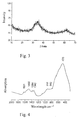
- the catalyst is prepared similarly to example 1, however, mixing cast iron, chromic anhydride and an aqueous solution of nitric acid is carried out at 15°C for 2 h, air bubbling the mixture is performed at 55 °C, and precipitation - at pH 97.5-8.0. Backing the dry catalyst mass is performed at 350 °C. The resulted mass is added with 1 mass% of graphite and palletized in cylindrical tablets of 5 mm x 5 mm. The difractogram of the catalyst obtained before graphite is introduced therein is presented in Fig. 3 . The IR-spectrum of the catalyst obtained is presented in Fig. 4 .
- the difractogram of the catalyst has thereon two wide reflexes at d about 2.7 ⁇ and 2.5 ⁇ characterizing the compound as a strongly disordered cubic structure phase.
- the IR-spectrum of the catalyst in the range of its specific oscillations is close to hydrohematite ( E. Wolska, Zeitschr. Fur Kristallogr. V.154, N1/2, 1981, p. 69-71 ).
- the IR-spectrum contains an absorption band in a range of 920 cm -1 which is distinctive for hydrohematites from ⁇ -Fe 2 O 3 oxide, hematite.
- the IR-spectrum contains absorption bands in a range of water fluctuations (3400 cm -1 and 1630 cm -1 ) and impurity anions CO 3 and NO 3 in a range of 1340-1540 cm -1 .
- the phase transition of the catalyst having a hydrohematite structure into the hematite structure is exothermic only in a range of temperatures 560-590°C.
- the catalyst backed at 600 °C in a nitrogen stream has a structure of well-crystallized hematite.
- the characteristic data of the catalytic properties of the catalyst are presented in the table.
- Example 3 A catalyst having a composition of Fe 0.89 Cr. 0.09 Cu 0.02 and a hematite structure.
- the catalyst is prepared similarly to example 1, however, the mixture of compounds of iron, chromium, and nitric acid is furthedr added with 0.35 g CuO and 2 g 15 mass% solution of nitric acid.
- the difractogram of the resulted catalyst is presented in Fig. 5 .
- Fig. 5 the data of the simulative difractogram ⁇ -FeOOH (goethite) calculated according to ICSD 28247.
- the difractogram being observed testifies that the catalyst is a compound of Fe 3+ O(OH) and a goethite structure - orthorhombic syngony, a space group Pbnm (2/m 2/m 2m), Dan's class. 6.1.1.2.].
- the characteristic data of the catalytic properties of the catalyst are presented in the table.
- Example 4 A catalyst having a composition of Fe 0.89 Cr 0.09 Cu 0.02 and a hydrohematite structure.
- the catalyst is prepared according to example 2, however, as a metal iron-containing composition, steel grit in an amount of 8.8 g is used, and the mixture of compounds of iron, chromium and nitric acid is further added with 0.35 g CuO and 2 g 15 mass% nitric acid.
- the difractogram of the catalyst obtained before graphite is introduced therein is presented in Fig. 6 .
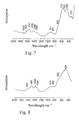
- the IR-spectrum of the catalyst obtained is presented in Fig. 7 .
- the IR-spectrum of the resulted Fe-Cr-Cu catalyst in a range of its specific oscillations is close to hydrohematite ( E. Wolska, Zeitschr. Fur Kristallogr. V.154, N1/2, 1981, p. 69-71 ).
- a band in a range of 920 cm -1 which is observed in the hydrohematite spectra and differs thereof from hematite is well-marked.
- the IR-spectrum contains absorption bands in a range of water fluctuations (3400 cm -1 and 1630 cm -1 ) and impurity anions CO 3 and NO 3 in a range of 1340-1540 cm -1 .
- the characteristic data of the catalytic properties of the catalyst are presented in the table.
- Example 5 A catalyst having a composition of Fe 0.73 Cr 0.07 Cu 0.2 and a hydrohematite structure.
- the catalyst is prepared similarly to example 2, however, the mixture of compounds of iron, chromium and nitric acid is added with 4.2 g CuO and 24 g 15 mass% nitric acid.
- the IR-spectrum of the catalyst obtained is presented in Fig. 8 .
- the IR-spectrum of the resulted Fe-Cr-Cu catalyst in a range of its specific oscillations is closely corresponds to the hydrohematite spectrum ( E. Wolska, Zeitschr. Fur Kristallogr. V.154, N1/2, 1981, p. 69-71 ).
- a band in a range of 920 cm -1 which is observed in the hydrohematite spectra and differs thereof from hematite is well-marked.
- the IR-spectrum contains absorption bands in a range of water fluctuations (3400 cm -1 and 1630 cm -1 ) and impurity anions CO 3 and NO 3 in a range of 1340-1540 cm -1 .
- the characteristic data of the catalytic properties of the catalyst are presented in the table.
- a catalyst having a composition of Fe 0.9 Cr 0.1 and a hematite structure having a composition of Fe 0.9 Cr 0.1 and a hematite structure.
- the catalyst is prepared according to the patent RU 2275963 by a series of steps (1) of precipitating iron compounds (II) from a solution of iron sulfate (II) with a mixture of solutions of sodium carbonate and hydroxide, (2) washing off the precipitate by decantation, (3) backing at 250°C, (4) sequential washing the backed mass by decantation and in the filter; (5) mixing the washed mass and chromic anhydride, (6) extrudate molding in diameter of 3 mm, (7) thermal treatment at a temperature of 350°C.
- the difractogram of the resulted catalyst is presented in Fig. 9 .
- the IR-spectrum of the catalyst obtained is presented in Fig. 10 .
- the data of simulative difractogram ⁇ -Fe 2 O 3 (hematite) calculated according to ICSD 64599 are also given in Fig. 9 .
- the characteristic data of the catalytic properties of the catalyst are presented in the table.
- a catalyst having a composition of Fe 0.89 Cr 0.09 Cu 0.02 and a hematite structure having a composition of Fe 0.89 Cr 0.09 Cu 0.02 and a hematite structure.
- the catalyst is prepared according to the patent RU 2275963 , similarly to example 6, however, the precipitation is carried out from a mixture of solutions of iron sulfate (II) and copper sulfate (II) in the ratios corresponding to the catalyst composition; to facilitate molding, graphite is added to the catalyst.
- the difractogram of the resulted catalyst is presented in Fig. 11 .
- the data presented in Fig. 11 testify that the resulted catalyst has a structure of ⁇ -Fe 2 O 3 (hematite).
Landscapes
- Chemical & Material Sciences (AREA)
- Chemical Kinetics & Catalysis (AREA)
- Engineering & Computer Science (AREA)
- Organic Chemistry (AREA)
- Materials Engineering (AREA)
- Health & Medical Sciences (AREA)
- General Health & Medical Sciences (AREA)
- Combustion & Propulsion (AREA)
- Inorganic Chemistry (AREA)
- Catalysts (AREA)
- Hydrogen, Water And Hydrids (AREA)
- Organic Low-Molecular-Weight Compounds And Preparation Thereof (AREA)
Applications Claiming Priority (2)
| Application Number | Priority Date | Filing Date | Title |
|---|---|---|---|
| RU2006132151/04A RU2314870C1 (ru) | 2006-09-06 | 2006-09-06 | Катализатор паровой конверсии моноксида углерода, способ его приготовления и способ его использования |
| PCT/RU2007/000470 WO2008030140A2 (en) | 2006-09-06 | 2007-08-23 | Catalyst for vapour conversion of carbon monoxide methods for the production and for the use thereof |
Publications (1)
| Publication Number | Publication Date |
|---|---|
| EP2077152A2 true EP2077152A2 (de) | 2009-07-08 |
Family
ID=39108545
Family Applications (1)
| Application Number | Title | Priority Date | Filing Date |
|---|---|---|---|
| EP07834984A Withdrawn EP2077152A2 (de) | 2006-09-06 | 2007-08-23 | Katalysator zur dampfumwandlung von kohlenmonoxid sowie verfahren zu seiner herstellung und verwendung |
Country Status (8)
| Country | Link |
|---|---|
| US (1) | US20100196260A1 (de) |
| EP (1) | EP2077152A2 (de) |
| EA (1) | EA013871B1 (de) |
| EE (1) | EE200900023A (de) |
| LT (1) | LT5649B (de) |
| RU (1) | RU2314870C1 (de) |
| UA (1) | UA92263C2 (de) |
| WO (1) | WO2008030140A2 (de) |
Families Citing this family (2)
| Publication number | Priority date | Publication date | Assignee | Title |
|---|---|---|---|---|
| RU2445160C1 (ru) * | 2011-04-05 | 2012-03-20 | Государственное образовательное учреждение высшего профессионального образования "Ивановский государственный химико-технологический университет" | Способ приготовления катализатора среднетемпературной конверсии оксида углерода водяным паром |
| RU2677650C1 (ru) * | 2017-12-27 | 2019-01-18 | Акционерное общество "Ангарский завод катализаторов и органического синтеза" (АО "АЗКиОС") | Железохромовый катализатор для паровой конверсии оксида углерода |
Family Cites Families (14)
| Publication number | Priority date | Publication date | Assignee | Title |
|---|---|---|---|---|
| SU651838A1 (ru) | 1977-07-14 | 1979-03-15 | Предприятие П/Я В-2609 | Способ приготовлени катализатора дл конверсии окиси углерода |
| DE3318131A1 (de) * | 1983-05-18 | 1984-11-22 | Süd-Chemie AG, 8000 München | Eisenoxid-chromoxid-katalysator fuer die hochtemperatur-co-konvertierung |
| RO100112B1 (ro) | 1987-12-03 | 1990-10-30 | CENTRALA INDUSTRIALA DE îNGRASAMINTE CHIMICE | Procedeu de obtinere a unui catalizator pentru conversia oxidului de carbon |
| DE69115579T2 (de) * | 1990-06-26 | 1996-08-22 | Toda Kogyo Corp | Magnetische spindelförmige Eisenlegierungsteilchen und Verfahren zu ihrer Herstellung |
| SU1790064A1 (ru) | 1990-11-11 | 1996-05-20 | Кемеровское производственное объединение "Азот" | Способ получения катализатора для конверсии монооксида углерода |
| US5830425A (en) * | 1993-02-09 | 1998-11-03 | Sud-Chemie Ag | Chromium-free catalyst based on iron oxide for conversion of carbon monoxide |
| RU2059430C1 (ru) * | 1993-04-30 | 1996-05-10 | Государственный научно-исследовательский и проектный институт азотной промышленности и продуктов органического синтеза | Катализатор для паровой конверсии оксида углерода |
| GB9407512D0 (en) * | 1994-04-15 | 1994-06-08 | Ici Plc | Catalysts |
| CA2207560A1 (en) * | 1994-12-14 | 1996-06-20 | Shell Internationale Research Maatschappij B.V. | Large particle dehydrogenation catalyst and process |
| BG62040B1 (bg) * | 1995-05-05 | 1999-01-29 | Атанас Андреев | метод за получаване на желязо-хром-мед оксиден катализатор за конверсия на въглероден оксид с водна пара |
| RU2170615C1 (ru) | 2000-08-24 | 2001-07-20 | Довганюк Владимир Федорович | Способ приготовления катализатора паровой конверсии оксида углерода и катализатор паровой конверсии оксида углерода |
| US7037876B2 (en) * | 2002-05-15 | 2006-05-02 | Sud-Chemie Inc. | High temperature shift catalyst prepared with a purity iron precursor |
| US7939463B1 (en) * | 2002-05-15 | 2011-05-10 | Sud-Chemie Inc. | Preparation of iron oxides |
| RU2275963C2 (ru) * | 2004-04-13 | 2006-05-10 | Общество с ограниченной ответственностью "Алвиго-М" | Способ приготовления железохромового катализатора (варианты) |
-
2006
- 2006-09-06 RU RU2006132151/04A patent/RU2314870C1/ru not_active IP Right Cessation
-
2007
- 2007-08-23 EE EEP200900023A patent/EE200900023A/xx unknown
- 2007-08-23 EP EP07834984A patent/EP2077152A2/de not_active Withdrawn
- 2007-08-23 US US12/439,871 patent/US20100196260A1/en not_active Abandoned
- 2007-08-23 EA EA200900346A patent/EA013871B1/ru not_active IP Right Cessation
- 2007-08-23 WO PCT/RU2007/000470 patent/WO2008030140A2/ru not_active Ceased
- 2007-08-23 UA UAA200903311A patent/UA92263C2/ru unknown
-
2009
- 2009-03-05 LT LT2009016A patent/LT5649B/lt not_active IP Right Cessation
Non-Patent Citations (1)
| Title |
|---|
| See references of WO2008030140A2 * |
Also Published As
| Publication number | Publication date |
|---|---|
| LT5649B (lt) | 2010-04-26 |
| WO2008030140A2 (en) | 2008-03-13 |
| EE200900023A (et) | 2009-06-15 |
| EA200900346A1 (ru) | 2009-06-30 |
| WO2008030140A9 (en) | 2009-05-22 |
| LT2009016A (en) | 2009-12-28 |
| US20100196260A1 (en) | 2010-08-05 |
| WO2008030140A3 (en) | 2008-04-24 |
| UA92263C2 (ru) | 2010-10-11 |
| EA013871B1 (ru) | 2010-08-30 |
| RU2314870C1 (ru) | 2008-01-20 |
Similar Documents
| Publication | Publication Date | Title |
|---|---|---|
| EP2237882B1 (de) | Wassergas-shift-katalysator auf eisenbasis | |
| JP3226436B2 (ja) | 触 媒 | |
| US7037876B2 (en) | High temperature shift catalyst prepared with a purity iron precursor | |
| EP1487578B1 (de) | Verfahren zur herstellung eines wasser-gas-shift katalysators | |
| CA1144911A (en) | Catalyst and method for producing the catalyst | |
| WO2004060556A1 (en) | Water gas shift catalyst | |
| KR20110039422A (ko) | Hts 반응기의 작동방법 | |
| PL137518B1 (en) | Catalyst for use in a process of obtaining methanol and higher alcohols | |
| US3899577A (en) | Carbon monoxide conversion catalysts | |
| EP3842140A1 (de) | Einzelkatalysator zur umwandlung von kohlendioxid und verfahren zur umwandlung von kohlendioxid unter verwendung des katalysators | |
| Khalafalla et al. | The role of metallic component in the iron-alumina bifunctional catalyst for reduction of SO2 with CO | |
| JPH08229399A (ja) | 助触媒を含む安定化酸化銅−酸化亜鉛触媒および製造方法 | |
| JPS644973B2 (de) | ||
| CA2991801A1 (en) | Process for producing catalysts from mining residue and catalysts produced therefrom | |
| Lou et al. | Catalytic oxidation of CO over a catalyst produced in the ferrite process | |
| US20100196260A1 (en) | Catalyst for vapour conversion of carbon monoxide methods for the production and for the use thereof | |
| AU2002309821B2 (en) | Fischer-Tropsch catalyst prepared with a high purity iron precursor | |
| US6548034B2 (en) | Process for reducing concentration of carbon monoxide in hydrogen-containing gas | |
| Zhang et al. | The role of CO2 over different binary catalysts in methanol synthesis | |
| US3752775A (en) | Catalyst for oxidation and a method for producing the same | |
| Gerzeliev et al. | Partial oxidation of lower alkanes by active lattice oxygen of metal oxide systems: 2. Synthesis of solid contacts and syngas production in a pilot plant with a riser reactor | |
| JP2023108468A (ja) | メタノールの製造方法 | |
| JPH0371174B2 (de) | ||
| Bilkova et al. | Surface Potassium Promotion of Co4MnAlO x in Direct NO Decomposition Generates the Same Type of Active Sites as Bulk Promotion | |
| US4000085A (en) | Process for manufacturing gels containing iron and molybdenum and the uses thereof |
Legal Events
| Date | Code | Title | Description |
|---|---|---|---|
| PUAI | Public reference made under article 153(3) epc to a published international application that has entered the european phase |
Free format text: ORIGINAL CODE: 0009012 |
|
| 17P | Request for examination filed |
Effective date: 20090323 |
|
| AK | Designated contracting states |
Kind code of ref document: A2 Designated state(s): AT BE BG CH CY CZ DE DK EE ES FI FR GB GR HU IE IS IT LI LT LU LV MC MT NL PL PT RO SE SI SK TR |
|
| AX | Request for extension of the european patent |
Extension state: AL BA HR MK RS |
|
| RAP1 | Party data changed (applicant data changed or rights of an application transferred) |
Owner name: INSTITUT KATALIZA IMENI G.K. BORESKOVA, SIBIRSKOGO |
|
| DAX | Request for extension of the european patent (deleted) | ||
| STAA | Information on the status of an ep patent application or granted ep patent |
Free format text: STATUS: THE APPLICATION IS DEEMED TO BE WITHDRAWN |
|
| 18D | Application deemed to be withdrawn |
Effective date: 20120301 |