EP2078863B1 - Verdichter - Google Patents
Verdichter Download PDFInfo
- Publication number
- EP2078863B1 EP2078863B1 EP07830377.3A EP07830377A EP2078863B1 EP 2078863 B1 EP2078863 B1 EP 2078863B1 EP 07830377 A EP07830377 A EP 07830377A EP 2078863 B1 EP2078863 B1 EP 2078863B1
- Authority
- EP
- European Patent Office
- Prior art keywords
- rotor
- gate
- plane
- center axis
- gate rotor
- Prior art date
- Legal status (The legal status is an assumption and is not a legal conclusion. Google has not performed a legal analysis and makes no representation as to the accuracy of the status listed.)
- Not-in-force
Links
- 230000006835 compression Effects 0.000 claims description 21
- 238000007906 compression Methods 0.000 claims description 21
- 230000000694 effects Effects 0.000 description 12
- 239000012530 fluid Substances 0.000 description 5
- 230000012447 hatching Effects 0.000 description 4
- 230000002093 peripheral effect Effects 0.000 description 3
- 238000011144 upstream manufacturing Methods 0.000 description 3
- 241000276420 Lophius piscatorius Species 0.000 description 1
- 230000001154 acute effect Effects 0.000 description 1
- 230000003247 decreasing effect Effects 0.000 description 1
- 238000003754 machining Methods 0.000 description 1
- 239000003507 refrigerant Substances 0.000 description 1
Images






Classifications
-
- F—MECHANICAL ENGINEERING; LIGHTING; HEATING; WEAPONS; BLASTING
- F04—POSITIVE - DISPLACEMENT MACHINES FOR LIQUIDS; PUMPS FOR LIQUIDS OR ELASTIC FLUIDS
- F04C—ROTARY-PISTON, OR OSCILLATING-PISTON, POSITIVE-DISPLACEMENT MACHINES FOR LIQUIDS; ROTARY-PISTON, OR OSCILLATING-PISTON, POSITIVE-DISPLACEMENT PUMPS
- F04C18/00—Rotary-piston pumps specially adapted for elastic fluids
- F04C18/48—Rotary-piston pumps with non-parallel axes of movement of co-operating members
- F04C18/50—Rotary-piston pumps with non-parallel axes of movement of co-operating members the axes being arranged at an angle of 90 degrees
- F04C18/52—Rotary-piston pumps with non-parallel axes of movement of co-operating members the axes being arranged at an angle of 90 degrees of intermeshing engagement type, i.e. with engagement of co-operating members similar to that of toothed gearing
-
- F—MECHANICAL ENGINEERING; LIGHTING; HEATING; WEAPONS; BLASTING
- F04—POSITIVE - DISPLACEMENT MACHINES FOR LIQUIDS; PUMPS FOR LIQUIDS OR ELASTIC FLUIDS
- F04C—ROTARY-PISTON, OR OSCILLATING-PISTON, POSITIVE-DISPLACEMENT MACHINES FOR LIQUIDS; ROTARY-PISTON, OR OSCILLATING-PISTON, POSITIVE-DISPLACEMENT PUMPS
- F04C18/00—Rotary-piston pumps specially adapted for elastic fluids
- F04C18/48—Rotary-piston pumps with non-parallel axes of movement of co-operating members
- F04C18/54—Rotary-piston pumps with non-parallel axes of movement of co-operating members the axes being arranged otherwise than at an angle of 90 degrees
- F04C18/56—Rotary-piston pumps with non-parallel axes of movement of co-operating members the axes being arranged otherwise than at an angle of 90 degrees of intermeshing engagement type, i.e. with engagement of co-operating members similar to that of toothed gearing
-
- F—MECHANICAL ENGINEERING; LIGHTING; HEATING; WEAPONS; BLASTING
- F01—MACHINES OR ENGINES IN GENERAL; ENGINE PLANTS IN GENERAL; STEAM ENGINES
- F01C—ROTARY-PISTON OR OSCILLATING-PISTON MACHINES OR ENGINES
- F01C3/00—Rotary-piston machines or engines with non-parallel axes of movement of co-operating members
- F01C3/02—Rotary-piston machines or engines with non-parallel axes of movement of co-operating members the axes being arranged at an angle of 90 degrees
- F01C3/025—Rotary-piston machines or engines with non-parallel axes of movement of co-operating members the axes being arranged at an angle of 90 degrees of intermeshing engagement type, i.e. with engagement of co-operating members similar to that of toothed gearing
Definitions
- the present invention is defined by a compressor according to claim 1, to be used in, for example, air conditioners, refrigerators and the like.
- a compressor according to claim 1 to be used in, for example, air conditioners, refrigerators and the like.
- Such type of compressor is known, e.g., from US 3, 905, 731 which discloses the preamble of claim 1 of the present invention.
- a compressor including a disc-shaped screw rotor which rotates about a center axis and which has, in its end face in a center-axis direction, a plurality of spirally extending groove portions radially outward from the center axis, and a gate rotor which rotates about a center axis and which has a plurality of tooth portions arrayed circumferentially on its outer circumference, the groove portions of the screw rotor and the tooth portions of the gate rotor being engaged with each other to form a compression chamber (see JP 60-10161 B ).
- this compressor is a so-called PP type single screw compressor.
- PP type means that the screw rotor is formed into a plate-like shape and moreover the gate rotor is formed into a plate-like shape.
- side faces of the gate rotor tooth portions are given a maximum angle and a minimum angle each of which is formed by a gate rotor tooth-portion side face and a screw rotor groove wall surface on a plane which orthogonally intersects with the gate rotor plane and which contains a rotational direction of a tooth center line extending radial direction of the gate rotor (hereinafter, angles formed between the maximum angle and the minimum angle will be referred to as edge angles of the gate rotor; see edge angles ⁇ 1, ⁇ 2 of Fig. 20 ).
- edge angles of gate rotor seal portions to be engaged with the side faces of the screw rotor groove portion become acute, so that a blow hole (leak clearance) present at an engagement portion between the screw rotor groove portion and the gate rotor tooth portion becomes larger. This would result in a lowered compression efficiency.
- an object of the present invention is to provide a compressor in which the blow hole is made smaller so as to improve the compression efficiency.
- the invention provides a compressor comprising: a disc-shaped screw rotor which rotates about a center axis and which has, in at least one end face thereof in a direction along the center axis, a plurality of spirally extending groove portions (10) radially outward from the center axis; and a gate rotor which rotates about a center axis and which has a plurality of tooth portions arrayed circumferentially on its outer circumference, the groove portions of the screw rotor and the tooth portions of the gate rotor being engaged with each other to form a compression chamber, wherein with respect to a first plane containing the screw rotor center axis, a second plane which intersects orthogonally with the screw rotor center axis, and a third plane which intersects orthogonally with the first plane (S1) and the second plane, the gate rotor center axis is on the third plane, characterized in that at least one of all the tooth portions of the gate rotor does not overlap with the first plane as viewed
- the gate rotor center axis is on the third plane, and at least one of all the tooth portions of the gate rotor does not overlap with the first plane as viewed in a direction orthogonal to the third plane. Therefore, the side face of the groove portion of the screw rotor to be in contact with the tooth portions of the gate rotor can be set at approximately 90° against the rotational direction of the gate rotor (i.e. circumferential direction of the gate rotor) in its portion to be in contact with the side face of the groove portion of the screw rotor.
- the variation width of an angle formed by the side face of the groove portion of the screw rotor (hereinafter, referred to as screw rotor groove inclination angle) against a plane orthogonally intersecting with the rotational direction of the gate rotor (the circumferential direction of the gate rotor) can be made smaller.
- edge angles of the seal portions of the gate rotor to be engaged with side faces of the groove portion of the screw rotor can be made obtuse, so that the blow holes (leak clearances) present at engagement portions between the groove portion of the screw rotor and the tooth portions of the gate rotor can be made smaller, allowing the compression efficiency to be improved.
- wear of the seal portions of the gate rotor can be reduced, allowing an improvement in durability to be achieved.
- a distance from an intersection point between a gate rotor plane formed by the first plane side end face of every tooth portion of the gate rotor and the gate rotor center axis (2a) to the first plane is 0.05 to 0.4 time as large as an outer diameter of the tooth portion of the gate rotor.
- a distance from an intersection point between a gate rotor plane formed by the first plane side end face of every tooth portion of the gate rotor and the gate rotor center axis to the first plane is 0.05 to 0.4 time as large as an outer diameter of the tooth portion of the gate rotor. Therefore, the variation width of the screw rotor groove inclination angle can be made even smaller.
- the gate rotor center axis is inclined by 5° to 30° against the second plane so that a tooth portion of the gate rotor closer to the screw rotor becomes closer to the screw rotor center axis than a tooth portion of the gate rotor farther from the screw rotor.
- the gate rotor center axis is inclined by 5° to 30° against the second plane so that a tooth portion of the gate rotor closer to the screw rotor becomes closer to the screw rotor center axis than a tooth portion of the gate rotor farther from the screw rotor. Therefore, the variation width of the screw rotor groove inclination angle can be made even smaller.
- a distance between the gate rotor center axis and the screw rotor center axis is 0.7 to 1.2 times as large as an outer diameter of the gate rotor.
- a distance L between the gate rotor center axis and the screw rotor center axis is 0.7 to 1.2 times as large as an outer diameter D of the gate rotor. Therefore, the distance L can be made smaller, allowing a downsizing to be achieved.
- seal portions of the tooth portions of the gate rotor to be in contact with the groove portions of the screw rotor are formed into a curved-surface shape.
- the seal portions of the tooth portions of the gate rotor to be in contact with the groove portion of the screw rotor are formed into a curved-surface shape, leakage of the compressed fluid from engagement portions between the tooth portions of the gate rotor and the groove portion of the screw rotor can be reduced, so that the compression efficiency can be improved.
- the gate rotor center axis is on the third plane, and at least one of all the tooth portions of the gate rotor does not overlap with the first plane as viewed in a direction orthogonal to the third plane. Therefore, the blow holes can be made smaller, allowing the compression efficiency to be improved.
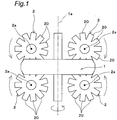
- Fig. 1 shows a simplified structural view which is an embodiment of the compressor of the invention.
- Fig. 2 shows a partial enlarged view of the compressor.
- the compressor includes: a disc-shaped screw rotor 1 which rotates about a center axis 1a and which has, in its end face in a direction along the center axis 1a, a plurality of spirally extending groove portions 10 radially outward from the center axis 1a; and a disc-shaped gate rotor 2 which rotates about a center axis 2a and which has a plurality of tooth portions 20 arrayed circumferentially on its outer circumference, the groove portions 10 of the screw rotor 1 and the tooth portions 20 of the gate rotor 2 being engaged with each other to form a compression chamber 30.
- this compressor is a so-called PP-type single screw compressor.
- the term 'PP-type' means that the screw rotor 1 is formed into a plate-like shape while the gate rotor 2 is formed into a plate-like shape.
- This compressor is to be used in, for example, air conditioners, refrigerators and the like.
- the groove portions 10 are formed in each of two end faces of the screw rotor 1.
- the gate rotor 2 is provided two in number on each end face of the screw rotor 1. Then, as the screw rotor 1 rotates about the screw rotor center axis 1a along a direction indicated by an arrow, each gate rotor 2 subordinately rotates about the gate rotor center axis 2a along an arrow direction by mutual engagement of the groove portions 10 and the tooth portions 20.
- a plurality of thread ridges 12 spirally extending radially outward from the screw rotor center axis 1a, where the groove portions 10 are formed between neighboring ones of the thread ridges 12, 12.
- a casing (not shown) which has grooves that allow the gate rotors 2 to rotate.
- a space closed by the groove portion 10, the tooth portion 20 and the casing serves as the compression chamber 30.
- a suction port (not shown) communicating with the groove portions 10 on the outer peripheral side of the screw rotor 1.
- a discharge port (not shown) communicating with the groove portions 10 on the center side of the screw rotor 1.
- a fluid such as refrigerant gas introduced to the groove portion 10 through the suction port is compressed in the compression chamber 30 as the capacity of the compression chamber 30 is reduced by rotation of the screw rotor 1 and the gate rotor 2. Then, the compressed fluid is discharged through the discharge port.
- a first plane S1 containing the screw rotor center axis 1a there are defined a first plane S1 containing the screw rotor center axis 1a, a second plane S2 orthogonally intersecting with the screw rotor center axis 1a, and a third plane S3 orthogonally intersecting with the two planes of the first plane S1 and the second plane S2.
- the second plane S2 is coincident with the axial end face of the screw rotor 1.
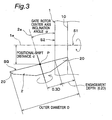
- Fig. 3 is a view taken along an arrow A direction of Fig. 2
- Fig. 4 is a view taken along an arrow B direction of Fig. 2 .
- the gate rotor center axis 2a is on the third plane S3. None of the tooth portions 20 of the gate rotor 2 overlaps with the first plane S1 as viewed in a direction orthogonal to the third plane S3.
- a distance d from an intersection point between a gate rotor plane SG formed by an first plane S1 side end face of every tooth portion 20 of the gate rotor 2 and the gate rotor center axis 2a to the first plane S1 (hereinafter, referred to as positional-shift distance d) is 0.05 to 0.4 time as large as an outer diameter D of the tooth portion 20 of the gate rotor 2 (0.05D ⁇ d ⁇ 0.4D).
- the gate rotor center axis 2a is inclined against the second plane S2 so that a tooth portion 20 of the gate rotor 2 closer to the screw rotor 1 becomes closer to the screw rotor center axis 1a than a tooth portion 20 of the gate rotor 2 farther from the screw rotor 1.
- An inclination angle ⁇ of the gate rotor center axis 2a is 5° - 30°.
- an engagement depth of the tooth portions 20 with the groove portions 10 is 0.2 time as large as an outer diameter D of the gate rotor 2.
- axis-to-axis distance L a distance L between the gate rotor center axis 2a and the screw rotor center axis 1a (hereinafter, referred to as axis-to-axis distance L) is 0.7 to 1.2 time as large as the outer diameter D of the gate rotor 2 (0.7D ⁇ L ⁇ 1.2D).
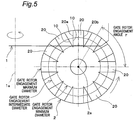
- an angle that a center line of the tooth portion 20 engaged with the groove portion 10 forms against a reference line parallel to the axial end face (second plane S2) of the screw rotor 1 is referred to as a gate rotor engagement angle ⁇ , and the angle of the center line (an intermediate line between leading side and unleading side) of the tooth portion 20 is measured from the reference line on a side of engagement starting.
- Fig. 5 shows, in a tooth portion 20 of the gate rotor 2, a minimum diameter, an intermediate diameter and a maximum diameter of engagement of the gate rotor 2, the engagement being done with the groove portions 10 of the screw rotor 1. Also in the tooth portion 20, a side face on the downstream side of the rotational direction of the gate rotor 2 is assumed as a leading-side side face 20a while a side face on the upstream side of the rotational direction of the gate rotor 2 is assumed as an unleading-side side face 20b.
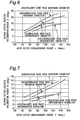
- Figs. 6 to 9 show relationships between the gate rotor engagement angle ⁇ (see Fig. 4 ) and the screw rotor groove inclination angle ⁇ when the positional-shift distance d of the gate rotor center axis 2a (see Fig. 3 ) is changed as 0D, 0.1D, 0.2D and 0.3D with the inclination angle ⁇ of the gate rotor center axis 2a (see Fig. 3 ) set at 12°.
- FIG. 5 plotted engagement maximum diameters and intermediate diameters of the gate rotor 2 with respect to the leading-side side face 20a and the unleading-side side face 20b (see Fig. 5 ), respectively.
- the number of groove portions 10 of the screw rotor 1 is three, and the number of tooth portions 20 of the gate rotor 2 is twelve.
- the screw rotor groove inclination angle ⁇ refers to an angle ⁇ formed by the side face 11 of a groove portion 10 of the screw rotor 1 against a plane St which orthogonally intersects with the rotational direction (indicated by an arrow RG) of the gate rotor 2 (i.e. a circumferential direction of the gate rotor 2) at a contact portion of the side face 11 of the groove portion 10 and the tooth portion 20 of the gate rotor 2.
- the screw rotor groove inclination angle ⁇ is expressed in positive values (+ direction) on the gate rotor rotational direction (arrow RG direction) side, and in negative values (- direction) on the side opposite to the gate rotor rotational direction (arrow RG direction).
- Fig. 6 shows a chart when the positional-shift distance d is 0D, where variation widths of the screw rotor groove inclination angle ⁇ become larger with respect to engagement maximum diameters and intermediate diameters of the gate rotor 2 in the leading-side side face 20a and the unleading-side side face 20b, respectively.
- Fig. 7 shows a chart when the positional-shift distance d is 0.1D, where variation widths of the screw rotor groove inclination angle ⁇ are smaller than those of the screw rotor groove inclination angle ⁇ shown in Fig. 6 .
- Fig. 8 shows a chart when the positional-shift distance d is 0.2D, where variation widths of the screw rotor groove inclination angle ⁇ are smaller than those of the screw rotor groove inclination angle ⁇ shown in Fig. 7 .
- Fig. 9 shows a chart when the positional-shift distance d is 0.3D, where variation widths of the screw rotor groove inclination angle ⁇ are smaller than those of the screw rotor groove inclination angle ⁇ shown in Fig. 6 .
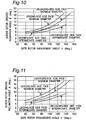
- Figs. 10 to 13 show relationships between the gate rotor engagement angle ⁇ and the screw rotor groove inclination angle ⁇ when the inclination angle ⁇ of the gate rotor center axis 2a is changed as 0°, 5°, 12° and 20° with the positional-shift distance d set at 0D.
- the rest of the conditions are similar to those of Figs. 6 to 9 .
- Fig. 10 shows a chart when the inclination angle ⁇ of the gate rotor center axis 2a is 0°
- Fig. 11 shows a chart when the inclination angle ⁇ of the gate rotor center axis 2a is 5°
- Fig. 12 shows a chart when the inclination angle ⁇ of the gate rotor center axis 2a is 12°
- Fig. 13 shows a chart when the inclination angle ⁇ of the gate rotor center axis 2a is 20°, where the variation width of the screw rotor groove inclination angle ⁇ becomes smaller as the inclination angle ⁇ of the gate rotor center axis 2a becomes larger.
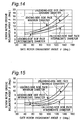
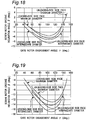
- Figs. 14 to 19 show relationships between the gate rotor engagement angle ⁇ and the screw rotor groove inclination angle ⁇ when the positional-shift distance d is changed as 0D, 0.05D, 0.1D, 0.15D, 0.2D and 0.3D with the inclination angle ⁇ of the gate rotor center axis 2a set at 0°.
- the rest of the conditions are similar to those of Figs. 6 to 9 .
- Fig. 14 shows a chart when the positional-shift distance d is 0D
- Fig. 15 shows a chart when the positional-shift distance d is 0.05D
- Fig. 16 shows a chart when the positional-shift distance d is 0.1D
- Fig. 17 shows a chart when the positional-shift distance d is 0.15D
- Fig. 18 shows a chart when the positional-shift distance d is 0.2D
- Fig. 19 shows a chart when the positional-shift distance d is 0.3D, where the variation width of the screw rotor groove inclination angle ⁇ is smaller when the positional-shift distance d is larger than 0D.
- seal portions 21a, 21b of the tooth portions 20 of the gate rotor 2 to be in contact with the groove portions 10 of the screw rotor 1 are formed into a curved-surface shape.
- a leading-side seal portion 21a is formed at the leading-side side face 20a of the tooth portion 20, while an unleading-side seal portion 21b is formed at the unleading-side side face 20b of the tooth portion 20.
- the screw rotor 1 moves along a downward-pointed arrow RS direction, while the gate rotor 2 moves along a leftward-pointed arrow RG direction.
- blow holes (leak clearances) 40, 50 shown by hatching are present.
- a leading-side blow hole 40 (shown by hatching) is present on an upstream side (compression chamber 30 side shown by hatching) of the leading-side seal portion 21a in the moving direction of the screw rotor 1
- an unleading-side blow hole 50 (shown by hatching) is present on an upstream side (the compression chamber 30 side) of the unleading-side seal portion 21b in the moving direction of the screw rotor 1.
- the fluid compressed in the compression chamber 30 passes through the blow holes 40, 50 to leak outside the casing 3 (shown by imaginary line).
- a degree of leakage effect of the leading-side blow hole 40 see Fig. 20
- a degree of leakage effect of the unleading-side blow hole 50 see Fig. 20
- a total degree of leakage effect of the leading-side blow hole 40 and the unleading-side blow hole 50 are shown.
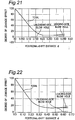
- degree of leakage effect refers to a degree obtained by converting areas of the leading-side blow hole 40 and the unleading-side blow hole 50 into corresponding leak amounts, respectively, wherein a degree of 100 corresponds to a leak amounts when the positional-shift distance d is 0D (as in the conventional case).
- Fig. 21 shows degrees of leakage effect when the number of groove portions 10 of the screw rotor 1 is three and the number of tooth portions 20 of the gate rotor 2 is twelve. As the positional-shift distance d becomes larger, the degree of leakage effect becomes smaller, so that the compression efficiency is improved.
- Fig. 22 shows degrees of leakage effect when the number of groove portions 10 of the screw rotor 1 is six and the number of tooth portions 20 of the gate rotor 2 is twelve. As the positional-shift distance d becomes larger, the degree of leakage effect becomes smaller, so that the compression efficiency is improved.
- the changing width of the screw rotor groove inclination angle ⁇ during the course from suction to discharge becomes 16.0° at the leading-side side face 20a and 15.6° at the unleading-side side face 20b.
- the variation width of the inclination angle of the side faces 11 of the groove portion 10 of the screw rotor 1 to be in contact with the tooth portion 20 of the gate rotor 2, the inclination being against the circumferential direction of the gate rotor 2 and the variation width measuring from a radially outer side of the screw rotor 1 to its inner side, is made smaller, as compared with the variation width resulting when all the tooth portions of the gate rotor 2 overlap with the first plane S1 containing the screw rotor center axis 1a.
- the term, “circumferential direction of the gate rotor 2,” can be reworded as the rotational direction of the tooth portion 20 of the gate rotor 2 to be in contact with the side faces 11 of the groove portion 10 of the screw rotor 1.
- the term, “variation width of the screw rotor 1 from a radially outer side of the screw rotor 1 to its inner side,” refers to a variation width of the inclination angles of all the groove portions 10 from radially outer side to inner side of the screw rotor 1 to be concurrently in contact with the tooth portions 20 of the gate rotor 2.
- edge angles 51, ⁇ 2 (see Fig. 20 ) of the seal portions of the gate rotor 2 to be engaged with the side faces of the groove portions 10 of the screw rotor 1 can be made obtuse, so that the blow holes (leak clearances) present at engagement portions between the groove portions 10 of the screw rotor 1 and the tooth portions 20 of the gate rotor 2 can be made smaller.
- the compression efficiency can be improved.
- wear of the seal portions of the gate rotor 2 can be reduced, allowing an improvement in durability to be achieved.
- the positional-shift distance d is 0.05 to 0.4 time as large as the outer diameter D of the tooth portion 20 of the gate rotor as viewed in the direction orthogonal to the third plane S3, the variation width of the screw rotor groove inclination angle ⁇ can be made even smaller.
- the gate rotor center axis 2a is inclined by 5° to 30° against the second plane S2 so that a tooth portion 20 of the gate rotor 2 closer to the screw rotor 1 becomes closer to the screw rotor center axis 1a than a tooth portion 20 of the gate rotor 2 farther from the screw rotor 1. Therefore, the variation width of the screw rotor groove inclination angler ⁇ can be made even smaller.
- the velocity of the screw rotor 1 engaged with the gate rotor 2 has large differences between outer peripheral portions and central portion.
- the rotational speed of the gate rotor 2 becomes larger relative to the rotational speed of the screw rotor 1, so that the screw rotor groove inclination angle ⁇ is varied to a large extent.
- the variation width of the screw rotor groove inclination angle ⁇ can be made smaller without increasing the outer diameter of the screw rotor 1.
- the distance L between the gate rotor center axis 2a and the screw rotor center axis 1a is 0.7 to 1.2 times as large as the outer diameter D of the gate rotor 2. Therefore, the distance L can be made smaller, allowing a downsizing to be achieved.
- the changing width of the screw rotor groove inclination angle ⁇ can be made small, the variation width of the contact angle between the gate rotor 2 and the screw rotor 1 can be suppressed even if the distance L is reduced.
- the downsizing can be achieved while the compression efficiency is maintained.
- seal portions 21a, 21b of the tooth portions 20 of the gate rotor 2 to be in contact with the groove portions 10 of the screw rotor 1 are formed into a curved-surface shape, leaks of the compressed fluid from engagement portions between the tooth portions 20 of the gate rotor 2 and the groove portions 10 of the screw rotor 1 can be reduced, so that the compression efficiency can be improved.
- the seal portions 21a, 21b of the gate rotor 2 can be formed into a curved-surface shape. More specifically, without increasing the thickness of the gate rotor 2, maximum and minimum values of the inclination angle of the seal portions 21a, 21b can be fulfilled by machining the groove portions 10 of the screw rotor 1 with an end mill and by forming the seal portions 21a, 21b of the tooth portions 20 of the gate rotor 2 into a curved-surface shape with an end mill.
- the groove portion 10 may be provided only in one of the end faces of the screw rotor 1.
- the number of the gate rotors 2 may be freely increased or decreased.
- the seal portions 21a, 21b of the tooth portions 20 of the gate rotor 2 to be in contact with the groove portions 10 of the screw rotor 1 may also be formed into an acute-angle shape.
- the screw rotor 1 and the gate rotor 2 may be rotated in opposite directions.
Landscapes
- Engineering & Computer Science (AREA)
- Mechanical Engineering (AREA)
- General Engineering & Computer Science (AREA)
- Applications Or Details Of Rotary Compressors (AREA)
Claims (5)
- Verdichter umfassend: einen scheibenförmigen Schraubenrotor (1), der um eine zentrale Achse (1a) rotiert und der in zumindest einer Stirnseite davon in einer Richtung entlang der zentralen Achse (1a) eine Anzahl von spiralförmig verlaufenden Nutabschnitten (10) radial von der zentralen Achse (1a) nach außen aufweist; und einen Gate-Rotor (2), der um eine zentrale Achse (2a) rotiert und der eine Anzahl von Zahnabschnitten (20) aufweist, die in Umfangsrichtung auf seinem äußeren Umfang verteilt angeordnet sind, wobei die Nutabschnitte (10) des Schraubenrotors (1) und die Zahnabschnitte (20) des Gate-Rotors (2) miteinander in Eingriff stehen, um eine Verdichtungskammer (30) zu bilden, wobei
in Bezug auf eine erste Ebene (S1), die die zentrale Achse (1a) des Schraubenrotors enthält, eine zweite Ebene (S2), die die zentrale Achse (1a) des Schraubenrotors rechtwinklig schneidet, und eine dritte Ebene (S3), die die erste Ebene (S1) und die zweite Ebene (S2) senkrecht schneidet,
die zentrale Achse (2a) des Gate-Rotors sich auf der dritten Ebene (S3) befindet, dadurch gekennzeichnet, dass zumindest einer von allen Zahnabschnitten (20) des Gate-Rotors (2) nicht mit der ersten Ebene (S1) überlappt, in einer Richtung senkrecht zu der dritten Ebene (S3) gesehen. - Verdichter nach Anspruch 1, dadurch gekennzeichnet, dass in der Richtung senkrecht zu der dritten Ebene (S3) gesehen, ein Abstand (d) von einem Schnittpunkt (P) zwischen einer Ebene (SG) des Gate-Rotors, die durch die Stirnfläche auf der Seite der ersten Ebene (S1) eines jeden Zahnabschnitts (20) des Gate-Rotors (2) gebildet wird, und der zentralen Achse (2a) des Gate-Rotors, zu der ersten Ebene (S1) 0,05 bis 0,4 mal so groß ist wie ein äußerer Durchmesser (D) des Zahnabschnitts (20) des Gate-Rotors (2).
- Verdichter nach Anspruch 1, dadurch gekennzeichnet, dass in der Richtung senkrecht zu der dritten Ebene (S3) gesehen, die zentrale Achse (2a) des Gate-Rotors um 5° bis 30° gegenüber der zweiten Ebene (S2) geneigt ist, so dass ein Zahnabschnitt (20) des Gate-Rotors (2), der sich näher an dem Schraubenrotor (1) befindet, näher an der zentralen Achse (1a) des Schraubenrotors liegt als ein Zahnabschnitt (20) des Gate-Rotors (2), der sich weiter entfernt von dem Schraubenrotor (1) befindet.
- Verdichter nach Anspruch 1, dadurch gekennzeichnet, dass in einer Richtung senkrecht zu der ersten Ebene (S1) gesehen, ein Abstand (L) zwischen der zentralen Achse (2a) des Gate-Rotors und der zentralen Achse (1a) des Schraubenrotors 0,7 bis 1,2 mal so groß wie ein äußerer Durchmesser (D) des Gate-Rotors (2) ist.
- Verdichter nach Anspruch 1, dadurch gekennzeichnet, dass Dichtungsabschnitte (21a, 21b) der Zahnabschnitte (20) des Gate-Rotors (2), die dazu bestimmt sind, in Kontakt mit den Nutabschnitten (10) des Schraubenrotors (1) zu sein, in einer gekrümmt flächigen Form ausgebildet sind.
Applications Claiming Priority (2)
| Application Number | Priority Date | Filing Date | Title |
|---|---|---|---|
| JP2006299227A JP4169068B2 (ja) | 2006-11-02 | 2006-11-02 | 圧縮機 |
| PCT/JP2007/070643 WO2008053749A1 (fr) | 2006-11-02 | 2007-10-23 | Compresseur |
Publications (3)
| Publication Number | Publication Date |
|---|---|
| EP2078863A1 EP2078863A1 (de) | 2009-07-15 |
| EP2078863A4 EP2078863A4 (de) | 2015-03-04 |
| EP2078863B1 true EP2078863B1 (de) | 2017-04-26 |
Family
ID=39344092
Family Applications (1)
| Application Number | Title | Priority Date | Filing Date |
|---|---|---|---|
| EP07830377.3A Not-in-force EP2078863B1 (de) | 2006-11-02 | 2007-10-23 | Verdichter |
Country Status (5)
| Country | Link |
|---|---|
| US (1) | US8192187B2 (de) |
| EP (1) | EP2078863B1 (de) |
| JP (1) | JP4169068B2 (de) |
| CN (1) | CN101529096B (de) |
| WO (1) | WO2008053749A1 (de) |
Families Citing this family (4)
| Publication number | Priority date | Publication date | Assignee | Title |
|---|---|---|---|---|
| US9057373B2 (en) | 2011-11-22 | 2015-06-16 | Vilter Manufacturing Llc | Single screw compressor with high output |
| RU2675639C2 (ru) * | 2017-02-14 | 2018-12-21 | Евгений Михайлович Пузырёв | Роторно-винтовая машина |
| CN107905849A (zh) * | 2017-11-02 | 2018-04-13 | 西安交通大学 | 一种平板式单螺杆膨胀机 |
| JP7364949B2 (ja) * | 2022-03-28 | 2023-10-19 | ダイキン工業株式会社 | シングルスクリュー圧縮機 |
Family Cites Families (7)
| Publication number | Priority date | Publication date | Assignee | Title |
|---|---|---|---|---|
| FR1331998A (fr) * | 1962-05-08 | 1963-07-12 | Perfectionnements aux compresseurs rotatifs à vis globique et à joints liquides | |
| IT956073B (it) * | 1971-06-03 | 1973-10-10 | Rylewski Eugeniusz | Macchina volumetrica |
| US3905731A (en) | 1974-10-04 | 1975-09-16 | Bernard Zimmern | Baffle structure for rotary worm compression-expansion machines |
| US4179250A (en) * | 1977-11-04 | 1979-12-18 | Chicago Pneumatic Tool Company | Thread construction for rotary worm compression-expansion machines |
| JPH06101668A (ja) * | 1992-09-18 | 1994-04-12 | Daikin Ind Ltd | シングルスクリュー圧縮機 |
| US7153112B2 (en) * | 2003-12-09 | 2006-12-26 | Dresser-Rand Company | Compressor and a method for compressing fluid |
| CN100408240C (zh) * | 2006-04-03 | 2008-08-06 | 西安交通大学 | 多圆柱铣削包络的单螺杆压缩机齿面型线构成方法 |
-
2006
- 2006-11-02 JP JP2006299227A patent/JP4169068B2/ja not_active Expired - Fee Related
-
2007
- 2007-10-23 WO PCT/JP2007/070643 patent/WO2008053749A1/ja not_active Ceased
- 2007-10-23 US US12/447,839 patent/US8192187B2/en not_active Expired - Fee Related
- 2007-10-23 EP EP07830377.3A patent/EP2078863B1/de not_active Not-in-force
- 2007-10-23 CN CN2007800387192A patent/CN101529096B/zh not_active Expired - Fee Related
Also Published As
| Publication number | Publication date |
|---|---|
| JP2008115750A (ja) | 2008-05-22 |
| EP2078863A1 (de) | 2009-07-15 |
| JP4169068B2 (ja) | 2008-10-22 |
| US20100003153A1 (en) | 2010-01-07 |
| CN101529096A (zh) | 2009-09-09 |
| CN101529096B (zh) | 2011-05-18 |
| EP2078863A4 (de) | 2015-03-04 |
| WO2008053749A1 (fr) | 2008-05-08 |
| US8192187B2 (en) | 2012-06-05 |
Similar Documents
| Publication | Publication Date | Title |
|---|---|---|
| US8105059B2 (en) | Compressor with screw rotor and gate rotor with inclined gate rotor center axis | |
| KR102249115B1 (ko) | 압축기 | |
| WO2016148006A1 (ja) | シールリング | |
| EP2078863B1 (de) | Verdichter | |
| EP2060789A1 (de) | Schneckenpumpe und schneckenrotor | |
| US20130129552A1 (en) | Rotary compressor | |
| US10400769B2 (en) | Rotor pair for a compression block of a screw machine | |
| US20170241427A1 (en) | Seal mechanism and rotating machine | |
| EP3546699B1 (de) | Dichtungselement | |
| KR101710261B1 (ko) | 베인 펌프 | |
| KR102390532B1 (ko) | 가변 정익 및 압축기 | |
| CN107683372A (zh) | 涡旋式流体机械 | |
| US7967586B2 (en) | Method for manufacturing trochoid pump and trochoid pump obtained | |
| US9765773B2 (en) | Pump having an inner and outer rotor | |
| CN109026696B (zh) | 压缩机泵体、压缩机、空调器 | |
| JP2008150982A (ja) | ベーンロータリー圧縮機 | |
| JP2005535827A (ja) | ヘリカルスクリューロータコンプレッサ | |
| JP2005201216A (ja) | ベーン式流体機械 | |
| JP2007120433A (ja) | ベーンポンプ | |
| JP2008150981A (ja) | ベーンロータリー圧縮機 | |
| WO2024142065A1 (en) | Rotary compressor, expander, and pump with a sealing system | |
| JP2023146895A (ja) | 摺動部品 | |
| JP2024000122A (ja) | 回転機械 | |
| KR20170024056A (ko) | 한 쌍의 연동형 스크류 로터 | |
| US20090185940A1 (en) | Method for manufacturing trochoid pump and trochoid pump obtained |
Legal Events
| Date | Code | Title | Description |
|---|---|---|---|
| PUAI | Public reference made under article 153(3) epc to a published international application that has entered the european phase |
Free format text: ORIGINAL CODE: 0009012 |
|
| 17P | Request for examination filed |
Effective date: 20090422 |
|
| AK | Designated contracting states |
Kind code of ref document: A1 Designated state(s): AT BE BG CH CY CZ DE DK EE ES FI FR GB GR HU IE IS IT LI LT LU LV MC MT NL PL PT RO SE SI SK TR |
|
| DAX | Request for extension of the european patent (deleted) | ||
| A4 | Supplementary search report drawn up and despatched |
Effective date: 20150203 |
|
| RIC1 | Information provided on ipc code assigned before grant |
Ipc: F04C 18/54 20060101ALI20150128BHEP Ipc: F04C 18/56 20060101ALI20150128BHEP Ipc: F01C 3/02 20060101ALN20150128BHEP Ipc: F04C 18/52 20060101AFI20150128BHEP |
|
| GRAP | Despatch of communication of intention to grant a patent |
Free format text: ORIGINAL CODE: EPIDOSNIGR1 |
|
| STAA | Information on the status of an ep patent application or granted ep patent |
Free format text: STATUS: GRANT OF PATENT IS INTENDED |
|
| INTG | Intention to grant announced |
Effective date: 20170109 |
|
| RIC1 | Information provided on ipc code assigned before grant |
Ipc: F04C 18/54 20060101ALI20161216BHEP Ipc: F01C 3/02 20060101ALN20161216BHEP Ipc: F04C 18/52 20060101AFI20161216BHEP Ipc: F04C 18/56 20060101ALI20161216BHEP |
|
| GRAS | Grant fee paid |
Free format text: ORIGINAL CODE: EPIDOSNIGR3 |
|
| GRAA | (expected) grant |
Free format text: ORIGINAL CODE: 0009210 |
|
| STAA | Information on the status of an ep patent application or granted ep patent |
Free format text: STATUS: THE PATENT HAS BEEN GRANTED |
|
| AK | Designated contracting states |
Kind code of ref document: B1 Designated state(s): AT BE BG CH CY CZ DE DK EE ES FI FR GB GR HU IE IS IT LI LT LU LV MC MT NL PL PT RO SE SI SK TR |
|
| REG | Reference to a national code |
Ref country code: GB Ref legal event code: FG4D |
|
| REG | Reference to a national code |
Ref country code: CH Ref legal event code: EP |
|
| REG | Reference to a national code |
Ref country code: AT Ref legal event code: REF Ref document number: 888148 Country of ref document: AT Kind code of ref document: T Effective date: 20170515 |
|
| REG | Reference to a national code |
Ref country code: IE Ref legal event code: FG4D |
|
| REG | Reference to a national code |
Ref country code: DE Ref legal event code: R096 Ref document number: 602007050790 Country of ref document: DE |
|
| REG | Reference to a national code |
Ref country code: NL Ref legal event code: MP Effective date: 20170426 |
|
| REG | Reference to a national code |
Ref country code: LT Ref legal event code: MG4D |
|
| REG | Reference to a national code |
Ref country code: AT Ref legal event code: MK05 Ref document number: 888148 Country of ref document: AT Kind code of ref document: T Effective date: 20170426 |
|
| PG25 | Lapsed in a contracting state [announced via postgrant information from national office to epo] |
Ref country code: NL Free format text: LAPSE BECAUSE OF FAILURE TO SUBMIT A TRANSLATION OF THE DESCRIPTION OR TO PAY THE FEE WITHIN THE PRESCRIBED TIME-LIMIT Effective date: 20170426 |
|
| REG | Reference to a national code |
Ref country code: FR Ref legal event code: PLFP Year of fee payment: 11 |
|
| PG25 | Lapsed in a contracting state [announced via postgrant information from national office to epo] |
Ref country code: AT Free format text: LAPSE BECAUSE OF FAILURE TO SUBMIT A TRANSLATION OF THE DESCRIPTION OR TO PAY THE FEE WITHIN THE PRESCRIBED TIME-LIMIT Effective date: 20170426 Ref country code: FI Free format text: LAPSE BECAUSE OF FAILURE TO SUBMIT A TRANSLATION OF THE DESCRIPTION OR TO PAY THE FEE WITHIN THE PRESCRIBED TIME-LIMIT Effective date: 20170426 Ref country code: ES Free format text: LAPSE BECAUSE OF FAILURE TO SUBMIT A TRANSLATION OF THE DESCRIPTION OR TO PAY THE FEE WITHIN THE PRESCRIBED TIME-LIMIT Effective date: 20170426 Ref country code: GR Free format text: LAPSE BECAUSE OF FAILURE TO SUBMIT A TRANSLATION OF THE DESCRIPTION OR TO PAY THE FEE WITHIN THE PRESCRIBED TIME-LIMIT Effective date: 20170727 Ref country code: LT Free format text: LAPSE BECAUSE OF FAILURE TO SUBMIT A TRANSLATION OF THE DESCRIPTION OR TO PAY THE FEE WITHIN THE PRESCRIBED TIME-LIMIT Effective date: 20170426 |
|
| PG25 | Lapsed in a contracting state [announced via postgrant information from national office to epo] |
Ref country code: IS Free format text: LAPSE BECAUSE OF FAILURE TO SUBMIT A TRANSLATION OF THE DESCRIPTION OR TO PAY THE FEE WITHIN THE PRESCRIBED TIME-LIMIT Effective date: 20170826 Ref country code: LV Free format text: LAPSE BECAUSE OF FAILURE TO SUBMIT A TRANSLATION OF THE DESCRIPTION OR TO PAY THE FEE WITHIN THE PRESCRIBED TIME-LIMIT Effective date: 20170426 Ref country code: PL Free format text: LAPSE BECAUSE OF FAILURE TO SUBMIT A TRANSLATION OF THE DESCRIPTION OR TO PAY THE FEE WITHIN THE PRESCRIBED TIME-LIMIT Effective date: 20170426 Ref country code: SE Free format text: LAPSE BECAUSE OF FAILURE TO SUBMIT A TRANSLATION OF THE DESCRIPTION OR TO PAY THE FEE WITHIN THE PRESCRIBED TIME-LIMIT Effective date: 20170426 Ref country code: BG Free format text: LAPSE BECAUSE OF FAILURE TO SUBMIT A TRANSLATION OF THE DESCRIPTION OR TO PAY THE FEE WITHIN THE PRESCRIBED TIME-LIMIT Effective date: 20170726 |
|
| REG | Reference to a national code |
Ref country code: DE Ref legal event code: R097 Ref document number: 602007050790 Country of ref document: DE |
|
| PG25 | Lapsed in a contracting state [announced via postgrant information from national office to epo] |
Ref country code: EE Free format text: LAPSE BECAUSE OF FAILURE TO SUBMIT A TRANSLATION OF THE DESCRIPTION OR TO PAY THE FEE WITHIN THE PRESCRIBED TIME-LIMIT Effective date: 20170426 Ref country code: DK Free format text: LAPSE BECAUSE OF FAILURE TO SUBMIT A TRANSLATION OF THE DESCRIPTION OR TO PAY THE FEE WITHIN THE PRESCRIBED TIME-LIMIT Effective date: 20170426 Ref country code: CZ Free format text: LAPSE BECAUSE OF FAILURE TO SUBMIT A TRANSLATION OF THE DESCRIPTION OR TO PAY THE FEE WITHIN THE PRESCRIBED TIME-LIMIT Effective date: 20170426 Ref country code: SK Free format text: LAPSE BECAUSE OF FAILURE TO SUBMIT A TRANSLATION OF THE DESCRIPTION OR TO PAY THE FEE WITHIN THE PRESCRIBED TIME-LIMIT Effective date: 20170426 Ref country code: RO Free format text: LAPSE BECAUSE OF FAILURE TO SUBMIT A TRANSLATION OF THE DESCRIPTION OR TO PAY THE FEE WITHIN THE PRESCRIBED TIME-LIMIT Effective date: 20170426 |
|
| PLBE | No opposition filed within time limit |
Free format text: ORIGINAL CODE: 0009261 |
|
| STAA | Information on the status of an ep patent application or granted ep patent |
Free format text: STATUS: NO OPPOSITION FILED WITHIN TIME LIMIT |
|
| 26N | No opposition filed |
Effective date: 20180129 |
|
| PG25 | Lapsed in a contracting state [announced via postgrant information from national office to epo] |
Ref country code: SI Free format text: LAPSE BECAUSE OF FAILURE TO SUBMIT A TRANSLATION OF THE DESCRIPTION OR TO PAY THE FEE WITHIN THE PRESCRIBED TIME-LIMIT Effective date: 20170426 Ref country code: MC Free format text: LAPSE BECAUSE OF FAILURE TO SUBMIT A TRANSLATION OF THE DESCRIPTION OR TO PAY THE FEE WITHIN THE PRESCRIBED TIME-LIMIT Effective date: 20170426 |
|
| REG | Reference to a national code |
Ref country code: CH Ref legal event code: PL |
|
| REG | Reference to a national code |
Ref country code: IE Ref legal event code: MM4A |
|
| PG25 | Lapsed in a contracting state [announced via postgrant information from national office to epo] |
Ref country code: LU Free format text: LAPSE BECAUSE OF NON-PAYMENT OF DUE FEES Effective date: 20171023 Ref country code: LI Free format text: LAPSE BECAUSE OF NON-PAYMENT OF DUE FEES Effective date: 20171031 Ref country code: CH Free format text: LAPSE BECAUSE OF NON-PAYMENT OF DUE FEES Effective date: 20171031 |
|
| REG | Reference to a national code |
Ref country code: BE Ref legal event code: MM Effective date: 20171031 |
|
| PG25 | Lapsed in a contracting state [announced via postgrant information from national office to epo] |
Ref country code: BE Free format text: LAPSE BECAUSE OF NON-PAYMENT OF DUE FEES Effective date: 20171031 |
|
| REG | Reference to a national code |
Ref country code: FR Ref legal event code: PLFP Year of fee payment: 12 |
|
| PG25 | Lapsed in a contracting state [announced via postgrant information from national office to epo] |
Ref country code: MT Free format text: LAPSE BECAUSE OF NON-PAYMENT OF DUE FEES Effective date: 20171023 |
|
| PG25 | Lapsed in a contracting state [announced via postgrant information from national office to epo] |
Ref country code: IE Free format text: LAPSE BECAUSE OF NON-PAYMENT OF DUE FEES Effective date: 20171023 |
|
| PGFP | Annual fee paid to national office [announced via postgrant information from national office to epo] |
Ref country code: FR Payment date: 20180913 Year of fee payment: 12 |
|
| PGFP | Annual fee paid to national office [announced via postgrant information from national office to epo] |
Ref country code: DE Payment date: 20181009 Year of fee payment: 12 |
|
| PGFP | Annual fee paid to national office [announced via postgrant information from national office to epo] |
Ref country code: IT Payment date: 20181018 Year of fee payment: 12 Ref country code: GB Payment date: 20181017 Year of fee payment: 12 |
|
| PG25 | Lapsed in a contracting state [announced via postgrant information from national office to epo] |
Ref country code: HU Free format text: LAPSE BECAUSE OF FAILURE TO SUBMIT A TRANSLATION OF THE DESCRIPTION OR TO PAY THE FEE WITHIN THE PRESCRIBED TIME-LIMIT; INVALID AB INITIO Effective date: 20071023 |
|
| PG25 | Lapsed in a contracting state [announced via postgrant information from national office to epo] |
Ref country code: CY Free format text: LAPSE BECAUSE OF NON-PAYMENT OF DUE FEES Effective date: 20170426 |
|
| PG25 | Lapsed in a contracting state [announced via postgrant information from national office to epo] |
Ref country code: TR Free format text: LAPSE BECAUSE OF FAILURE TO SUBMIT A TRANSLATION OF THE DESCRIPTION OR TO PAY THE FEE WITHIN THE PRESCRIBED TIME-LIMIT Effective date: 20170426 |
|
| REG | Reference to a national code |
Ref country code: DE Ref legal event code: R119 Ref document number: 602007050790 Country of ref document: DE |
|
| PG25 | Lapsed in a contracting state [announced via postgrant information from national office to epo] |
Ref country code: PT Free format text: LAPSE BECAUSE OF FAILURE TO SUBMIT A TRANSLATION OF THE DESCRIPTION OR TO PAY THE FEE WITHIN THE PRESCRIBED TIME-LIMIT Effective date: 20170426 |
|
| PG25 | Lapsed in a contracting state [announced via postgrant information from national office to epo] |
Ref country code: DE Free format text: LAPSE BECAUSE OF NON-PAYMENT OF DUE FEES Effective date: 20200501 |
|
| GBPC | Gb: european patent ceased through non-payment of renewal fee |
Effective date: 20191023 |
|
| PG25 | Lapsed in a contracting state [announced via postgrant information from national office to epo] |
Ref country code: GB Free format text: LAPSE BECAUSE OF NON-PAYMENT OF DUE FEES Effective date: 20191023 Ref country code: FR Free format text: LAPSE BECAUSE OF NON-PAYMENT OF DUE FEES Effective date: 20191031 Ref country code: IT Free format text: LAPSE BECAUSE OF NON-PAYMENT OF DUE FEES Effective date: 20191023 |