EP2080548A1 - Segment en nid d'abeille doté d'un espaceur et structure en nid d'abeille - Google Patents
Segment en nid d'abeille doté d'un espaceur et structure en nid d'abeille Download PDFInfo
- Publication number
- EP2080548A1 EP2080548A1 EP09250093A EP09250093A EP2080548A1 EP 2080548 A1 EP2080548 A1 EP 2080548A1 EP 09250093 A EP09250093 A EP 09250093A EP 09250093 A EP09250093 A EP 09250093A EP 2080548 A1 EP2080548 A1 EP 2080548A1
- Authority
- EP
- European Patent Office
- Prior art keywords
- spacers
- spacer
- outer peripheral
- axial direction
- honeycomb
- Prior art date
- Legal status (The legal status is an assumption and is not a legal conclusion. Google has not performed a legal analysis and makes no representation as to the accuracy of the status listed.)
- Withdrawn
Links
Images



Classifications
-
- B—PERFORMING OPERATIONS; TRANSPORTING
- B01—PHYSICAL OR CHEMICAL PROCESSES OR APPARATUS IN GENERAL
- B01D—SEPARATION
- B01D46/00—Filters or filtering processes specially modified for separating dispersed particles from gases or vapours
- B01D46/24—Particle separators, e.g. dust precipitators, using rigid hollow filter bodies
- B01D46/2403—Particle separators, e.g. dust precipitators, using rigid hollow filter bodies characterised by the physical shape or structure of the filtering element
- B01D46/2418—Honeycomb filters
- B01D46/2451—Honeycomb filters characterized by the geometrical structure, shape, pattern or configuration or parameters related to the geometry of the structure
- B01D46/2466—Honeycomb filters characterized by the geometrical structure, shape, pattern or configuration or parameters related to the geometry of the structure of the adhesive layers, i.e. joints between segments
-
- B—PERFORMING OPERATIONS; TRANSPORTING
- B01—PHYSICAL OR CHEMICAL PROCESSES OR APPARATUS IN GENERAL
- B01D—SEPARATION
- B01D46/00—Filters or filtering processes specially modified for separating dispersed particles from gases or vapours
- B01D46/24—Particle separators, e.g. dust precipitators, using rigid hollow filter bodies
- B01D46/2403—Particle separators, e.g. dust precipitators, using rigid hollow filter bodies characterised by the physical shape or structure of the filtering element
- B01D46/2418—Honeycomb filters
- B01D46/2451—Honeycomb filters characterized by the geometrical structure, shape, pattern or configuration or parameters related to the geometry of the structure
- B01D46/2478—Structures comprising honeycomb segments
-
- F—MECHANICAL ENGINEERING; LIGHTING; HEATING; WEAPONS; BLASTING
- F01—MACHINES OR ENGINES IN GENERAL; ENGINE PLANTS IN GENERAL; STEAM ENGINES
- F01N—GAS-FLOW SILENCERS OR EXHAUST APPARATUS FOR MACHINES OR ENGINES IN GENERAL; GAS-FLOW SILENCERS OR EXHAUST APPARATUS FOR INTERNAL-COMBUSTION ENGINES
- F01N3/00—Exhaust or silencing apparatus having means for purifying, rendering innocuous, or otherwise treating exhaust
- F01N3/02—Exhaust or silencing apparatus having means for purifying, rendering innocuous, or otherwise treating exhaust for cooling, or for removing solid constituents of, exhaust
- F01N3/021—Exhaust or silencing apparatus having means for purifying, rendering innocuous, or otherwise treating exhaust for cooling, or for removing solid constituents of, exhaust by means of filters
- F01N3/022—Exhaust or silencing apparatus having means for purifying, rendering innocuous, or otherwise treating exhaust for cooling, or for removing solid constituents of, exhaust by means of filters characterised by specially adapted filtering structure, e.g. honeycomb, mesh or fibrous
- F01N3/0222—Exhaust or silencing apparatus having means for purifying, rendering innocuous, or otherwise treating exhaust for cooling, or for removing solid constituents of, exhaust by means of filters characterised by specially adapted filtering structure, e.g. honeycomb, mesh or fibrous the structure being monolithic, e.g. honeycombs
-
- B—PERFORMING OPERATIONS; TRANSPORTING
- B01—PHYSICAL OR CHEMICAL PROCESSES OR APPARATUS IN GENERAL
- B01D—SEPARATION
- B01D46/00—Filters or filtering processes specially modified for separating dispersed particles from gases or vapours
- B01D46/24—Particle separators, e.g. dust precipitators, using rigid hollow filter bodies
- B01D46/2403—Particle separators, e.g. dust precipitators, using rigid hollow filter bodies characterised by the physical shape or structure of the filtering element
- B01D46/2418—Honeycomb filters
- B01D46/2451—Honeycomb filters characterized by the geometrical structure, shape, pattern or configuration or parameters related to the geometry of the structure
- B01D46/2482—Thickness, height, width, length or diameter
-
- B—PERFORMING OPERATIONS; TRANSPORTING
- B01—PHYSICAL OR CHEMICAL PROCESSES OR APPARATUS IN GENERAL
- B01D—SEPARATION
- B01D46/00—Filters or filtering processes specially modified for separating dispersed particles from gases or vapours
- B01D46/24—Particle separators, e.g. dust precipitators, using rigid hollow filter bodies
- B01D46/2403—Particle separators, e.g. dust precipitators, using rigid hollow filter bodies characterised by the physical shape or structure of the filtering element
- B01D46/2418—Honeycomb filters
- B01D46/2498—The honeycomb filter being defined by mathematical relationships
-
- F—MECHANICAL ENGINEERING; LIGHTING; HEATING; WEAPONS; BLASTING
- F01—MACHINES OR ENGINES IN GENERAL; ENGINE PLANTS IN GENERAL; STEAM ENGINES
- F01N—GAS-FLOW SILENCERS OR EXHAUST APPARATUS FOR MACHINES OR ENGINES IN GENERAL; GAS-FLOW SILENCERS OR EXHAUST APPARATUS FOR INTERNAL-COMBUSTION ENGINES
- F01N2260/00—Exhaust treating devices having provisions not otherwise provided for
- F01N2260/10—Exhaust treating devices having provisions not otherwise provided for for avoiding stress caused by expansions or contractions due to temperature variations
-
- F—MECHANICAL ENGINEERING; LIGHTING; HEATING; WEAPONS; BLASTING
- F01—MACHINES OR ENGINES IN GENERAL; ENGINE PLANTS IN GENERAL; STEAM ENGINES
- F01N—GAS-FLOW SILENCERS OR EXHAUST APPARATUS FOR MACHINES OR ENGINES IN GENERAL; GAS-FLOW SILENCERS OR EXHAUST APPARATUS FOR INTERNAL-COMBUSTION ENGINES
- F01N2330/00—Structure of catalyst support or particle filter
- F01N2330/06—Ceramic, e.g. monoliths
-
- F—MECHANICAL ENGINEERING; LIGHTING; HEATING; WEAPONS; BLASTING
- F01—MACHINES OR ENGINES IN GENERAL; ENGINE PLANTS IN GENERAL; STEAM ENGINES
- F01N—GAS-FLOW SILENCERS OR EXHAUST APPARATUS FOR MACHINES OR ENGINES IN GENERAL; GAS-FLOW SILENCERS OR EXHAUST APPARATUS FOR INTERNAL-COMBUSTION ENGINES
- F01N2330/00—Structure of catalyst support or particle filter
- F01N2330/30—Honeycomb supports characterised by their structural details
-
- F—MECHANICAL ENGINEERING; LIGHTING; HEATING; WEAPONS; BLASTING
- F01—MACHINES OR ENGINES IN GENERAL; ENGINE PLANTS IN GENERAL; STEAM ENGINES
- F01N—GAS-FLOW SILENCERS OR EXHAUST APPARATUS FOR MACHINES OR ENGINES IN GENERAL; GAS-FLOW SILENCERS OR EXHAUST APPARATUS FOR INTERNAL-COMBUSTION ENGINES
- F01N2450/00—Methods or apparatus for fitting, inserting or repairing different elements
-
- F—MECHANICAL ENGINEERING; LIGHTING; HEATING; WEAPONS; BLASTING
- F01—MACHINES OR ENGINES IN GENERAL; ENGINE PLANTS IN GENERAL; STEAM ENGINES
- F01N—GAS-FLOW SILENCERS OR EXHAUST APPARATUS FOR MACHINES OR ENGINES IN GENERAL; GAS-FLOW SILENCERS OR EXHAUST APPARATUS FOR INTERNAL-COMBUSTION ENGINES
- F01N2450/00—Methods or apparatus for fitting, inserting or repairing different elements
- F01N2450/28—Methods or apparatus for fitting, inserting or repairing different elements by using adhesive material, e.g. cement
-
- Y—GENERAL TAGGING OF NEW TECHNOLOGICAL DEVELOPMENTS; GENERAL TAGGING OF CROSS-SECTIONAL TECHNOLOGIES SPANNING OVER SEVERAL SECTIONS OF THE IPC; TECHNICAL SUBJECTS COVERED BY FORMER USPC CROSS-REFERENCE ART COLLECTIONS [XRACs] AND DIGESTS
- Y02—TECHNOLOGIES OR APPLICATIONS FOR MITIGATION OR ADAPTATION AGAINST CLIMATE CHANGE
- Y02T—CLIMATE CHANGE MITIGATION TECHNOLOGIES RELATED TO TRANSPORTATION
- Y02T10/00—Road transport of goods or passengers
- Y02T10/10—Internal combustion engine [ICE] based vehicles
- Y02T10/12—Improving ICE efficiencies
-
- Y—GENERAL TAGGING OF NEW TECHNOLOGICAL DEVELOPMENTS; GENERAL TAGGING OF CROSS-SECTIONAL TECHNOLOGIES SPANNING OVER SEVERAL SECTIONS OF THE IPC; TECHNICAL SUBJECTS COVERED BY FORMER USPC CROSS-REFERENCE ART COLLECTIONS [XRACs] AND DIGESTS
- Y10—TECHNICAL SUBJECTS COVERED BY FORMER USPC
- Y10T—TECHNICAL SUBJECTS COVERED BY FORMER US CLASSIFICATION
- Y10T428/00—Stock material or miscellaneous articles
- Y10T428/24—Structurally defined web or sheet [e.g., overall dimension, etc.]
- Y10T428/24149—Honeycomb-like
-
- Y—GENERAL TAGGING OF NEW TECHNOLOGICAL DEVELOPMENTS; GENERAL TAGGING OF CROSS-SECTIONAL TECHNOLOGIES SPANNING OVER SEVERAL SECTIONS OF THE IPC; TECHNICAL SUBJECTS COVERED BY FORMER USPC CROSS-REFERENCE ART COLLECTIONS [XRACs] AND DIGESTS
- Y10—TECHNICAL SUBJECTS COVERED BY FORMER USPC
- Y10T—TECHNICAL SUBJECTS COVERED BY FORMER US CLASSIFICATION
- Y10T428/00—Stock material or miscellaneous articles
- Y10T428/24—Structurally defined web or sheet [e.g., overall dimension, etc.]
- Y10T428/24149—Honeycomb-like
- Y10T428/24165—Hexagonally shaped cavities
Definitions
- the present invention relates to a honeycomb segment with spacer and a honeycomb structure.
- a honeycomb structure is in heavy usage as a trapping filter for exhaust gas for environmental improvement, pollution protection, and the like.
- a SiC DPF diesel particulate filter
- a bonding material ceramic cement
- the present invention aims to provide a honeycomb segment with spacer capable of allowing the bonding layer between honeycomb segments to have desired thickness, inhibiting misalignment upon bonding honeycomb segments, and forming a honeycomb structure having little dimensional error and a honeycomb structure constituted of the honeycomb segment with spacers.
- the present inventors found out that the above problems can be solved by forming spacers having a length of 30 to 80% of a route length through the center from a long side to the other long side of an outer peripheral surface on an outer peripheral surface of an outer peripheral wall of a honeycomb segment, thereby suppressing protrusion of a bonding material. That is, according to the present invention, there are provided the following honeycomb segment with spacer and honeycomb structure.
- a honeycomb segment with spacer comprising: a plurality of cells defined by porous partition walls, extending through an axial direction, and functioning as fluid passages, and spacers arranged in a predetermined region from one end face of the axial direction toward inside along the axial direction on an outer peripheral surface of an outer peripheral wall and in a predetermined region from the other end face of the axial direction toward inside along the axial direction; wherein the spacers are formed so as to occupy 30 to 80% of a route length through the center from a long side to the other long side of an outer peripheral surface of an outer peripheral wall.
- a honeycomb structure formed by piling up honeycomb segment with spacers according to any one of the above [1] to [3].
- spacers By forming spacers so as to occupy 30 to 80% of a route length through the center from a long side to the other long side of an outer peripheral surface on each of one end face side and the other end face side of the outer peripheral surface of the outer peripheral wall of a honeycomb segment, protrusion of a bonding material can be suppressed, and honeycomb segments can be assembled to form a honeycomb structure with a fixed bonding width between the segments each other.
- honeycomb segments having uniform bonding layers can be manufactured.
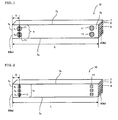
- Fig. 1 is a schematic view showing an embodiment of a honeycomb segment with spacer of the present invention.
- Fig. 2 is a schematic view showing another embodiment of a honeycomb segment with spacer of the present invention.
- Fig. 3 is a cross-sectional view showing a cross section perpendicular to the axial direction of a honeycomb segment.
- Fig. 4 is a cross-sectional view of another embodiment showing a cross section perpendicular to the axial direction of a honeycomb segment.
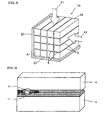
- Fig. 5 is a schematic view showing assembled honeycomb segment with spacers.
- Fig. 6 is a schematic view describing protrusion of a conventional bonding material.
- Fig. 7 is a schematic view describing protrusion of a bonding material of the present invention.
- Fig. 8 is a perspective view showing an embodiment of a honeycomb structure formed by piling up honeycomb segment with spacers of the present invention.
- Fig. 9 is an explanatory view for describing the idea of a route.
- Fig. 10 is another explanatory view for describing the idea of a route.
- Fig. 11 is an explanatory view for describing the idea of a route in the case that spacers are aligned in the long side direction.
- Fig. 12 is another explanatory view for describing the idea of a route in the case that spacers are aligned in the long side direction.
- 1 honeycomb structure
- 1a honeycomb segment bonded body
- 2 partition wall
- 3 cell
- 5 bonding layer
- 7s outer peripheral surface
- 7x long side (of outer peripheral surface)
- 7y short side (of outer peripheral surface)
- 8 end face
- 10 honeycomb segment
- 11 spacer
- 20 vertical backing plate
- 21 horizontal backing plate
- Fig. 1 shows a honeycomb segment 10 having spacers 11 formed thereon.
- the honeycomb segment 10 is formed of ceramic and has outer peripheral walls 7, partition walls 2 formed inside the outer peripheral walls 7, and a plurality of cells 3 partitioned by the partition walls 2.
- the spacers were formed on the outer peripheral surfaces 7s of the outer peripheral walls 7.
- the honeycomb segment with spacer 10 of the present invention shown in Fig. 1 has a plurality of cells 3 defined by porous partition walls 2, extending in the axial direction, and functioning as fluid passages.
- honeycomb structure 1 where honeycomb segments 10 of the present invention are bonded as a filter
- the adjacent cells 3 are alternately plugged in the end faces 8 opposite to each other and that each of the end faces 8 shows a checkerwise pattern.
- the target fluid for purification enters from one of the end faces 8, passes through the partition walls, and flows out from the other end face 8.
- porous partition walls 2 play a role of a filter to remove target substances.
- the honeycomb segment 10 is provided with the spacers 11 in predetermined regions from one end side of the axial direction toward inside along the axial direction on an outer peripheral surface 7s of an outer peripheral wall 7 and in a predetermined region from the other end side of the axial direction toward inside along the axial direction.
- the spacers 11 are formed so as to occupy 30 to 80% of a route length through the center from a long side 7x to the other long side 7x of an outer peripheral surface 7s.
- Fig. 1 shows an embodiment where two spacers are formed in one region. Since spacers 11 are aligned in a direction along the short side 7y in the embodiment of Fig.
- the spacers 11 are formed in such a manner that the length b 1 +b 2 in the short side direction of the spacer 11 occupies 30 to 80% with respect to the length a of the short side 7y.
- the positions where the spacers 11 are formed are in predetermined regions from both the end faces on one end side and the other end side toward inside along the axial direction, specifically, in a region of 20% or less of the long side from one end face and in a region of 20% or less of the long side from the other end face of the axial direction toward inside along the axial direction. That is, S shown in Fig. 1 shows 20% of the length L of the long side 7x, and spacers 11 are formed on the end face side with respect to S.
- the spacers are disposed in the vicinity of the end faces, the spacers are hardly influenced by the shape such as warpage of segment, and therefore bonding width can stably be formed.
- the spacers 11 there is no limitation on the shape of the spacers 11 as long as the spacers are formed so as to occupy 30 to 80% of a route length through the center from a long side on one side to a long side on the other side of an outer peripheral surface.
- the spacers 11 of Fig. 1 are formed to have a cylindrical shape (see Fig. 7 ).
- Fig. 2 shows an example where three quadrangular prism-shaped spacers are formed in one region. In the case of Fig. 2 , the length b 1 +b 2 +b 3 in the short side direction of three spacers is 30 to 80% of the short side length a.
- spacers 11 are preferably formed in one region in that they function as supports and that they can easily be produced. However, since the case of one spacer shows weak support, and parallelism can hardly be obtained, the case of two spacers is most preferable.
- the route length is length of a shortest route passing through the centers of the spacers 11 from a long side 7x on one side to the long side 7x on the other side on the outer peripheral surface 7s.
- the route passes through the centers m 2 , m 3 , and m 4 of the spacers 11, m 1 is determined by drawing a perpendicular line from m 2 to a long side 7x, m 5 is determined by drawing a perpendicular line from m 4 to the other long side 7x, and the length of the route from m 1 to m 5 is determined as the route length.
- the spacers 11 are formed so that the length (heavy-line portions, b 1 +b 2 +b 3 , in Fig. 9 ,) of the spacers 11 on the route occupies 30 to 80% of the whole route length.
- the length dasheavy-line portions, b 1 +b 2 +b 3 , in Fig. 9 ,
- the route length should be considered as the shortest length of the route passing through the centers of the spacers 11 from one long side 7x to the other long side 7x of the outer peripheral surface.
- the reason why the length of the spacers with respect to the route length (spacer ratio) is considered is because the spacer ratio influences on flowability of a bonding material. That is, when the proportion of the spacers 11 with respect to the route length is smaller, it means that the gap where the bonding material flows is larger, and, when the proportion of the spacers 11 with respect to the route length is larger, it means that the gap where the bonding material flows is smaller.
- a route passing through the spacer 11 dominant with respect to the flow resistance should be considered. That is, when the spacers 11 have different sizes, a route passing through the spacer 11 having the largest area should be considered.
- the route passing through the spacers 11a, 11b, and 11c is considered, and the spacers 11 are formed in such a manner that the length (heavy-line portions, b 1 +b 2 +b 3 , in Fig. 11 ) of the spacers 11a, 11b and 11c on the route is 30 to 80% of the whole route length.
- Figs. 3 and 4 show cross-sectional views cut along a plane perpendicular to the axial direction of the honeycomb segment 10 of Fig. 1 (cells 3 are omitted).
- On the honeycomb segment 10 of an embodiment shown in Fig. 1 two spacers on each of the end sides of the axial direction in an outer peripheral surface 7s of the outer peripheral wall 7.
- Four spacers 11 are formed on each of four outer peripheral surfaces 7s as shown in Fig 3 or on each of two adjacent outer peripheral surfaces 7s as shown in Fig. 4 (Incidentally, the number of spacers 11 is not limited to the number in the present embodiment).
- the honeycomb segment 10 can be formed of a ceramic material, and the ceramic is preferably selected from the group consisting of cordierite, SiC, alumina, mullite, silicon nitride, zirconium phosphate, aluminum titanate, zirconia, titania, and a combination thereof from the viewpoints of strength, thermal resistance, and the like.
- the material may contain one of Fe-Cr-Al based metals, nickel based metals, metal silicon (Si), and silicon carbide (SiC).
- the honeycomb segment bonded body 1a of the present invention is used for a DPF, it is preferable to use silicon carbide or a silicon-silicon carbide based composite phase from the viewpoint of improving thermal resistance, and it is preferable to use cordierite from the view point of lowering the thermal expansion coefficient to show good thermal shock resistance.
- the honeycomb segment bonded body 1a is of metal silicon (Si) and silicon carbide (SiC) in the present invention, when Si content defined by Si/ (Si+SiC) of the honeycomb segment bonded body 1a is too small, effect of adding Si cannot be obtained to deteriorate strength. When the content is above 50 mass%, effect in thermal resistance and high thermal conductivity, which are characteristics of SiC, cannot be obtained.
- the Si content is preferably 5 to 50 mass%, more preferably 10 to 40%.
- a binder such as methyl cellulose and hydroxypropoxylmethyl cellulose, an organic pore former, a surfactant, water, and the like to prepare kneaded clay having plasticity.
- the kneaded clay is subjected to, for example, extrusion-forming to form a quadrangular prism-shaped honeycomb formed body having a large number of cells 3 partitioned by the partition walls 2 and extending through in the axial direction.
- the honeycomb formed body is dried by, for example, microwaves and hot air, it is calcined to remove the binder and the organic pore former, followed by firing to manufacture a honeycomb segment 10.
- the plugging portions in the case that cells 3 are plugged in the end face 8 preferably contain, as the main crystal phase, at least one kind of a crystal phase selected from the components suitable for the main phase for the aforementioned partition walls 2, more preferably contains, as the main crystal phase, a crystal phase of a kind similar to that of the main phase of the honeycomb segment 10.
- a honeycomb segment without spacers 11 is manufactured in the following manner.
- the aforementioned preferable material for example, a silicon carbide power is used, and binders, for example, methyl cellulose and hydroxypropoxylmethyl cellulose, a surfactant, and water are added to the material to prepare kneaded clay having plasticity.
- the clay is subjected to extrusion forming to form a honeycomb segment (without spacers 11) as shown in Fig. 1 , for example. That is, a honeycomb segment 10 having a plurality of cells 3 defined by porous partition walls 2, extending through the axial direction, and functioning as fluid passages is formed.
- a clogging-inhibition tape for inhibiting clogging of the cells 3 due to a bonding material is attached to each of the end faces 8, and a spacer-forming material having, for example, the same composition as the clay is applied on the outer peripheral surfaces 7s to form spacers 11 as shown in Figs. 1 to 4 .
- an unsolidified spacer-forming material to form spacers is deposited in the aforementioned regions toward inside in the axial direction from both the ends of the axial direction on the outer peripheral surfaces 7s of the outer peripheral walls 7 of the honeycomb segments 10, and the spacer-forming material is solidified to form spacers 11 having a length of 30 to 80% of the route length.
- the honeycomb segments 10 can be bonded with a fixed thickness of the bonding layer 5 to manufacture a honeycomb structure.
- Fig. 5 shows a bonding method for a honeycomb segment bonded body 1a as an embodiment of the present invention.
- the honeycomb segment bonded body 1a is constituted of a plurality of ceramic porous honeycomb segments 10 each having a large number of cells 3 partitioned by partition walls 2 and extending through in the axial direction and bonded by means of bonding layers 5.
- honeycomb segments 10 are assembled by interposing a bonding layer 5 between bonding faces which are the outer peripheral walls 7. They are assembled in such a manner that two faces of each of the segments 10 are disposed along the vertical backing plate 20 and the horizontal backing plate 21.
- the bonding material for the bonding layer 5 contains inorganic particles and an inorganic adhesive as the main components, and an organic binder, a surfactant, a resin balloon, water, and the like as accessory components.
- the inorganic particles there can be employed plate-shaped particles, spherical particles, aggregated particles, fibrous particles, acicular particles, or the like.
- the inorganic adhesive there can be employed colloidal silica (SiO 2 sol), colloidal alumina (alumina sol), various kinds of oxide sol, ethyl silicate, liquid glass, silica polymer, aluminum phosphate, or the like.
- the main components contain a ceramic powder in common with the components constituting the honeycomb segment 10 and that the main components do not contain fibrous particles such as ceramic fibers from the view point of health problems but contain plate-shapedparticles.
- Astheplate-shapedparticles there cay be employed, for example, mica, talc, boron nitride, or glass flakes.
- the bonding material is applied on a bonding face of the honeycomb segment 10 to form a bonding layer 5.
- the bonding layer 5 may be formed on the honeycomb segment 10 before piling up of the honeycomb segments 10 or may be formed on the exposed bonding faces of the honeycomb segments 10 already assembled. In addition, the honeycomb segments 10 are assembled one by one.
- spacers 11 were small, and a bonding material protruded upon pressurization to make the bonding width uneven.
- spacers 11 by forming spacers 11 having a length of 30 to 80% of a route length by increasing the spacer application amount, protrusion of the bonding material is suppressed as much as possible as shown in Fig. 7 , which enables to stabilize the bonding width. That is, since spacers of a fixed amount or more are present, the bonding width can be uniformalized by the effect of hindering the movement of the bonding material in the end face direction.
- the spacers 11 having a length of above 80% of the route length are formed, flowability of the bonding material decreases too much, and the bonding layer becomes thick.
- a plurality of honeycomb segments 10 are bound by means of the bonding layers 5 to obtain a honeycomb segment bonded body 1a. Then, a part of the outer periphery of the honeycomb segment bonded body 1a is removed, and a coating material is applied to manufacture a honeycomb structure 1 as shown in Fig. 8 . Incidentally, when the honeycomb structure 1 is dried, the mask tape attached to the end faces 8 upon bonding the honeycomb segments 10 is peeled off lest the drying speed of the end faces 8 should be slow.
- the honeycomb segments were assembled to form 6 rows ⁇ 6 rows to manufacture a SiC-DPF (capacity of 2.5 L, partition wall thickness of 12 mil, cell density of 300 cpsi) having an average pore size of 25 ⁇ m and a porosity of 58%.
- a ceramic adhesive spacer-forming material constituted of a material containing SiC (40 mass%) as the main material, ceramic fibers of 60 mass%, a pore former of 12 mass% as an extra addition without SiC and ceramic fibers, a surfactant, and water.
- the spacer-forming material was solidified by heating at 180°C for 45 seconds, and the spacers each having a design value of a thickness (bonding width) of 1.0 mm were formed on all the outer peripheral surfaces (four faces) of the outer peripheral walls.
- the present invention can be used as a carrier for an internal combustion engine, a boiler, a chemical reactor, fuel cell reformer, or the like, or a filter for trapping particulate matter in exhaust gas, or the like and a honeycomb segment with spacer can used in a manufacturing method of a honeycomb structure constituted of a plurality of honeycomb segments.
Landscapes
- Physics & Mathematics (AREA)
- Geometry (AREA)
- Chemical & Material Sciences (AREA)
- Engineering & Computer Science (AREA)
- Chemical Kinetics & Catalysis (AREA)
- Combustion & Propulsion (AREA)
- Mechanical Engineering (AREA)
- General Engineering & Computer Science (AREA)
- Filtering Materials (AREA)
- Filtering Of Dispersed Particles In Gases (AREA)
- Processes For Solid Components From Exhaust (AREA)
- Ceramic Products (AREA)
Applications Claiming Priority (1)
| Application Number | Priority Date | Filing Date | Title |
|---|---|---|---|
| JP2008007939A JP5242178B2 (ja) | 2008-01-17 | 2008-01-17 | スペーサー付ハニカムセグメント、及びハニカム構造体 |
Publications (1)
| Publication Number | Publication Date |
|---|---|
| EP2080548A1 true EP2080548A1 (fr) | 2009-07-22 |
Family
ID=40545991
Family Applications (1)
| Application Number | Title | Priority Date | Filing Date |
|---|---|---|---|
| EP09250093A Withdrawn EP2080548A1 (fr) | 2008-01-17 | 2009-01-14 | Segment en nid d'abeille doté d'un espaceur et structure en nid d'abeille |
Country Status (3)
| Country | Link |
|---|---|
| US (1) | US8202602B2 (fr) |
| EP (1) | EP2080548A1 (fr) |
| JP (1) | JP5242178B2 (fr) |
Cited By (1)
| Publication number | Priority date | Publication date | Assignee | Title |
|---|---|---|---|---|
| EP2388057A1 (fr) * | 2010-03-29 | 2011-11-23 | Ibiden Co., Ltd. | Corps à structure en nid d'abeille et son procédé de fabrication |
Families Citing this family (6)
| Publication number | Priority date | Publication date | Assignee | Title |
|---|---|---|---|---|
| WO2008155856A1 (fr) * | 2007-06-21 | 2008-12-24 | Ibiden Co., Ltd. | Structure en nid d'abeille et son procédé de production |
| WO2011061839A1 (fr) * | 2009-11-19 | 2011-05-26 | イビデン株式会社 | Structure en nid d'abeille et appareil de purification des gaz d'échappement |
| WO2011061840A1 (fr) * | 2009-11-19 | 2011-05-26 | イビデン株式会社 | Structure en nid d'abeilles |
| WO2011061841A1 (fr) * | 2009-11-19 | 2011-05-26 | イビデン株式会社 | Structure en nid d'abeille et appareil de purification des gaz d'échappement |
| JP6404161B2 (ja) * | 2015-03-31 | 2018-10-10 | 日本碍子株式会社 | ハニカム構造体、及びその製造方法 |
| JP7385450B2 (ja) * | 2019-12-05 | 2023-11-22 | 日本碍子株式会社 | ハニカム構造体 |
Citations (7)
| Publication number | Priority date | Publication date | Assignee | Title |
|---|---|---|---|---|
| JP2000007455A (ja) | 1998-06-25 | 2000-01-11 | Ibiden Co Ltd | セラミックス構造体の接合装置及び接合方法 |
| JP2002102627A (ja) | 2000-09-27 | 2002-04-09 | Ibiden Co Ltd | セラミック構造体及びその製造方法 |
| EP1435348A1 (fr) * | 2001-10-02 | 2004-07-07 | Ngk Insulators, Ltd. | Corps structural en nid d'abeille et procede de fabrication |
| EP1790623A1 (fr) * | 2003-11-12 | 2007-05-30 | Ibiden Co., Ltd. | Structure en céramique, dispositif pour fabriquer une structure en céramique, et procédé de fabrication de la structure en céramique |
| WO2007068022A1 (fr) * | 2005-12-16 | 2007-06-21 | Porzellanfabrik Frauenthal Gmbh | Procede et corps en nid d'abeilles pour l'epuration et/ou la regeneration de gaz |
| EP1854773A1 (fr) * | 2005-03-03 | 2007-11-14 | Asahi Glass Co., Ltd. | Corps fritte avec entretoises et son procede de production et de jonction |
| EP2006010A1 (fr) * | 2007-06-21 | 2008-12-24 | Ibiden Co., Ltd. | Corps à structure de nid d'abeille et son procédé de fabrication |
Family Cites Families (1)
| Publication number | Priority date | Publication date | Assignee | Title |
|---|---|---|---|---|
| JP4455818B2 (ja) * | 2003-01-14 | 2010-04-21 | 日本碍子株式会社 | セラミックハニカム構造体およびその製造方法 |
-
2008
- 2008-01-17 JP JP2008007939A patent/JP5242178B2/ja active Active
-
2009
- 2009-01-12 US US12/352,026 patent/US8202602B2/en active Active
- 2009-01-14 EP EP09250093A patent/EP2080548A1/fr not_active Withdrawn
Patent Citations (7)
| Publication number | Priority date | Publication date | Assignee | Title |
|---|---|---|---|---|
| JP2000007455A (ja) | 1998-06-25 | 2000-01-11 | Ibiden Co Ltd | セラミックス構造体の接合装置及び接合方法 |
| JP2002102627A (ja) | 2000-09-27 | 2002-04-09 | Ibiden Co Ltd | セラミック構造体及びその製造方法 |
| EP1435348A1 (fr) * | 2001-10-02 | 2004-07-07 | Ngk Insulators, Ltd. | Corps structural en nid d'abeille et procede de fabrication |
| EP1790623A1 (fr) * | 2003-11-12 | 2007-05-30 | Ibiden Co., Ltd. | Structure en céramique, dispositif pour fabriquer une structure en céramique, et procédé de fabrication de la structure en céramique |
| EP1854773A1 (fr) * | 2005-03-03 | 2007-11-14 | Asahi Glass Co., Ltd. | Corps fritte avec entretoises et son procede de production et de jonction |
| WO2007068022A1 (fr) * | 2005-12-16 | 2007-06-21 | Porzellanfabrik Frauenthal Gmbh | Procede et corps en nid d'abeilles pour l'epuration et/ou la regeneration de gaz |
| EP2006010A1 (fr) * | 2007-06-21 | 2008-12-24 | Ibiden Co., Ltd. | Corps à structure de nid d'abeille et son procédé de fabrication |
Cited By (1)
| Publication number | Priority date | Publication date | Assignee | Title |
|---|---|---|---|---|
| EP2388057A1 (fr) * | 2010-03-29 | 2011-11-23 | Ibiden Co., Ltd. | Corps à structure en nid d'abeille et son procédé de fabrication |
Also Published As
| Publication number | Publication date |
|---|---|
| US20090186188A1 (en) | 2009-07-23 |
| JP5242178B2 (ja) | 2013-07-24 |
| US8202602B2 (en) | 2012-06-19 |
| JP2009167058A (ja) | 2009-07-30 |
Similar Documents
| Publication | Publication Date | Title |
|---|---|---|
| US7138002B2 (en) | Honeycomb structure and process for production thereof | |
| KR100753377B1 (ko) | 허니컴 구조체 및 시일재층 | |
| EP2090414B1 (fr) | Procédé de fabrication d'un élément structuré en nid d'abeille | |
| US8168127B2 (en) | Honeycomb structure, exhaust gas purifying apparatus and method for manufacturing honeycomb structure | |
| EP1473445B1 (fr) | Structure filtrante en nid d'abeilles | |
| EP1780187A1 (fr) | Structure en nid d'abeille | |
| KR101108902B1 (ko) | 허니컴 필터 | |
| US20090239028A1 (en) | Honeycomb structure | |
| US8202602B2 (en) | Honeycomb segment with spacer and honeycomb structure | |
| WO2006137150A1 (fr) | Corps de structure en nid d’abeille | |
| KR20130135929A (ko) | 밀봉된 하니컴 구조체 | |
| EP1884275A1 (fr) | Corps de structure alvéolaire | |
| JP2004261623A (ja) | ハニカム構造体 | |
| US8236404B2 (en) | Honeycomb structure | |
| EP2221098B2 (fr) | Structure en nid d'abeille | |
| KR20090101817A (ko) | 허니컴 구조체 | |
| JP6521683B2 (ja) | ハニカム構造体 | |
| WO2019187126A1 (fr) | Segment en nid d'abeilles bouché, et structure en nid d'abeilles bouchée | |
| US9470131B2 (en) | Honeycomb structure | |
| EP1482016B1 (fr) | Materiau d'etancheite, procede permettant de realiser l'etancheite d'une strucure nid d'abeille et structure nid d'abeille sur laquelle l'etancheite a ete realisee | |
| EP2233453A2 (fr) | Structure en nid d'abeille | |
| EP2177493B1 (fr) | Procédé de fabrication d'un segment en nid d'abeilles avec des espaceurs | |
| EP2514503B1 (fr) | Structure en nid d'abeille raccordée | |
| EP2127720B1 (fr) | Structure en nids d'abeille | |
| EP2505254B1 (fr) | Structure en nid d'abeille raccordée |
Legal Events
| Date | Code | Title | Description |
|---|---|---|---|
| PUAI | Public reference made under article 153(3) epc to a published international application that has entered the european phase |
Free format text: ORIGINAL CODE: 0009012 |
|
| AK | Designated contracting states |
Kind code of ref document: A1 Designated state(s): AT BE BG CH CY CZ DE DK EE ES FI FR GB GR HR HU IE IS IT LI LT LU LV MC MK MT NL NO PL PT RO SE SI SK TR |
|
| AX | Request for extension of the european patent |
Extension state: AL BA RS |
|
| AKX | Designation fees paid |
Designated state(s): DE FR PL |
|
| STAA | Information on the status of an ep patent application or granted ep patent |
Free format text: STATUS: THE APPLICATION IS DEEMED TO BE WITHDRAWN |
|
| 18D | Application deemed to be withdrawn |
Effective date: 20100123 |