EP2081541B1 - Mikroverkapselte photoinitiatoren und deren verwendung für dentalmaterialien - Google Patents
Mikroverkapselte photoinitiatoren und deren verwendung für dentalmaterialien Download PDFInfo
- Publication number
- EP2081541B1 EP2081541B1 EP07821712A EP07821712A EP2081541B1 EP 2081541 B1 EP2081541 B1 EP 2081541B1 EP 07821712 A EP07821712 A EP 07821712A EP 07821712 A EP07821712 A EP 07821712A EP 2081541 B1 EP2081541 B1 EP 2081541B1
- Authority
- EP
- European Patent Office
- Prior art keywords
- alkyl
- weight
- phenyl
- substituted
- mixture
- Prior art date
- Legal status (The legal status is an assumption and is not a legal conclusion. Google has not performed a legal analysis and makes no representation as to the accuracy of the status listed.)
- Not-in-force
Links
- 239000003999 initiator Substances 0.000 title claims abstract description 51
- 239000005548 dental material Substances 0.000 title claims abstract description 24
- 239000000203 mixture Substances 0.000 claims abstract description 99
- 150000001875 compounds Chemical class 0.000 claims abstract description 24
- 239000003094 microcapsule Substances 0.000 claims abstract description 20
- 150000001412 amines Chemical class 0.000 claims abstract description 15
- 229920000642 polymer Polymers 0.000 claims abstract description 14
- 239000000178 monomer Substances 0.000 claims description 45
- 239000000853 adhesive Substances 0.000 claims description 41
- 125000001997 phenyl group Chemical group [H]C1=C([H])C([H])=C(*)C([H])=C1[H] 0.000 claims description 40
- 230000001070 adhesive effect Effects 0.000 claims description 39
- VFHVQBAGLAREND-UHFFFAOYSA-N diphenylphosphoryl-(2,4,6-trimethylphenyl)methanone Chemical compound CC1=CC(C)=CC(C)=C1C(=O)P(=O)(C=1C=CC=CC=1)C1=CC=CC=C1 VFHVQBAGLAREND-UHFFFAOYSA-N 0.000 claims description 21
- 125000004178 (C1-C4) alkyl group Chemical group 0.000 claims description 20
- 210000004268 dentin Anatomy 0.000 claims description 19
- 125000004430 oxygen atom Chemical group O* 0.000 claims description 18
- XLYOFNOQVPJJNP-UHFFFAOYSA-N water Substances O XLYOFNOQVPJJNP-UHFFFAOYSA-N 0.000 claims description 17
- 125000006710 (C2-C12) alkenyl group Chemical group 0.000 claims description 16
- 125000000113 cyclohexyl group Chemical group [H]C1([H])C([H])([H])C([H])([H])C([H])(*)C([H])([H])C1([H])[H] 0.000 claims description 16
- 125000001511 cyclopentyl group Chemical group [H]C1([H])C([H])([H])C([H])([H])C([H])(*)C1([H])[H] 0.000 claims description 16
- 229910052736 halogen Inorganic materials 0.000 claims description 16
- 150000002367 halogens Chemical class 0.000 claims description 16
- 125000003837 (C1-C20) alkyl group Chemical group 0.000 claims description 12
- 238000005530 etching Methods 0.000 claims description 12
- 229910052739 hydrogen Inorganic materials 0.000 claims description 12
- 239000001257 hydrogen Substances 0.000 claims description 12
- 238000002360 preparation method Methods 0.000 claims description 11
- 230000000977 initiatory effect Effects 0.000 claims description 9
- 238000000034 method Methods 0.000 claims description 7
- 230000008569 process Effects 0.000 claims description 7
- 238000010526 radical polymerization reaction Methods 0.000 claims description 7
- 239000004094 surface-active agent Substances 0.000 claims description 7
- 125000000229 (C1-C4)alkoxy group Chemical group 0.000 claims description 6
- GUCYFKSBFREPBC-UHFFFAOYSA-N [phenyl-(2,4,6-trimethylbenzoyl)phosphoryl]-(2,4,6-trimethylphenyl)methanone Chemical compound CC1=CC(C)=CC(C)=C1C(=O)P(=O)(C=1C=CC=CC=1)C(=O)C1=C(C)C=C(C)C=C1C GUCYFKSBFREPBC-UHFFFAOYSA-N 0.000 claims description 5
- 150000001338 aliphatic hydrocarbons Chemical class 0.000 claims description 5
- 210000003298 dental enamel Anatomy 0.000 claims description 5
- 229920000193 polymethacrylate Polymers 0.000 claims description 4
- 125000001424 substituent group Chemical group 0.000 claims description 4
- 125000004181 carboxyalkyl group Chemical group 0.000 claims description 3
- 238000010438 heat treatment Methods 0.000 claims description 3
- 238000002604 ultrasonography Methods 0.000 claims description 3
- 125000004169 (C1-C6) alkyl group Chemical group 0.000 claims description 2
- 150000004945 aromatic hydrocarbons Chemical class 0.000 claims description 2
- 125000004435 hydrogen atom Chemical class [H]* 0.000 claims 4
- 150000002734 metacrylic acid derivatives Chemical class 0.000 claims 1
- FQPSGWSUVKBHSU-UHFFFAOYSA-N methacrylamide Chemical class CC(=C)C(N)=O FQPSGWSUVKBHSU-UHFFFAOYSA-N 0.000 claims 1
- 238000004519 manufacturing process Methods 0.000 abstract description 3
- 238000009472 formulation Methods 0.000 description 42
- 238000006116 polymerization reaction Methods 0.000 description 32
- NIXOWILDQLNWCW-UHFFFAOYSA-M Acrylate Chemical compound [O-]C(=O)C=C NIXOWILDQLNWCW-UHFFFAOYSA-M 0.000 description 20
- VVQNEPGJFQJSBK-UHFFFAOYSA-N Methyl methacrylate Chemical compound COC(=O)C(C)=C VVQNEPGJFQJSBK-UHFFFAOYSA-N 0.000 description 17
- 239000002245 particle Substances 0.000 description 16
- 238000003860 storage Methods 0.000 description 15
- 239000002775 capsule Substances 0.000 description 14
- 239000000463 material Substances 0.000 description 13
- LFQSCWFLJHTTHZ-UHFFFAOYSA-N Ethanol Chemical compound CCO LFQSCWFLJHTTHZ-UHFFFAOYSA-N 0.000 description 11
- NIXOWILDQLNWCW-UHFFFAOYSA-N acrylic acid group Chemical group C(C=C)(=O)O NIXOWILDQLNWCW-UHFFFAOYSA-N 0.000 description 11
- -1 acyl phosphonates Chemical class 0.000 description 11
- 239000000945 filler Substances 0.000 description 11
- 239000011257 shell material Substances 0.000 description 11
- 239000002253 acid Substances 0.000 description 10
- 125000000217 alkyl group Chemical group 0.000 description 9
- 238000005538 encapsulation Methods 0.000 description 9
- FZUGPQWGEGAKET-UHFFFAOYSA-N parbenate Chemical compound CCOC(=O)C1=CC=C(N(C)C)C=C1 FZUGPQWGEGAKET-UHFFFAOYSA-N 0.000 description 9
- 229920003229 poly(methyl methacrylate) Polymers 0.000 description 9
- 239000004926 polymethyl methacrylate Substances 0.000 description 9
- VNQXSTWCDUXYEZ-UHFFFAOYSA-N 1,7,7-trimethylbicyclo[2.2.1]heptane-2,3-dione Chemical compound C1CC2(C)C(=O)C(=O)C1C2(C)C VNQXSTWCDUXYEZ-UHFFFAOYSA-N 0.000 description 8
- 229930006711 bornane-2,3-dione Natural products 0.000 description 8
- 238000000576 coating method Methods 0.000 description 8
- DCAYPVUWAIABOU-UHFFFAOYSA-N hexadecane Chemical compound CCCCCCCCCCCCCCCC DCAYPVUWAIABOU-UHFFFAOYSA-N 0.000 description 8
- 150000002431 hydrogen Chemical class 0.000 description 8
- 229910052757 nitrogen Inorganic materials 0.000 description 8
- 238000003756 stirring Methods 0.000 description 8
- CQEYYJKEWSMYFG-UHFFFAOYSA-N butyl acrylate Chemical compound CCCCOC(=O)C=C CQEYYJKEWSMYFG-UHFFFAOYSA-N 0.000 description 7
- 239000011248 coating agent Substances 0.000 description 7
- IISBACLAFKSPIT-UHFFFAOYSA-N bisphenol A Chemical compound C=1C=C(O)C=CC=1C(C)(C)C1=CC=C(O)C=C1 IISBACLAFKSPIT-UHFFFAOYSA-N 0.000 description 6
- 238000004132 cross linking Methods 0.000 description 6
- 239000011521 glass Substances 0.000 description 6
- KFZMGEQAYNKOFK-UHFFFAOYSA-N Isopropanol Chemical compound CC(C)O KFZMGEQAYNKOFK-UHFFFAOYSA-N 0.000 description 5
- DBMJMQXJHONAFJ-UHFFFAOYSA-M Sodium laurylsulphate Chemical compound [Na+].CCCCCCCCCCCCOS([O-])(=O)=O DBMJMQXJHONAFJ-UHFFFAOYSA-M 0.000 description 5
- 230000002378 acidificating effect Effects 0.000 description 5
- 150000003926 acrylamides Chemical class 0.000 description 5
- 238000001035 drying Methods 0.000 description 5
- 238000002296 dynamic light scattering Methods 0.000 description 5
- 230000000694 effects Effects 0.000 description 5
- 230000007717 exclusion Effects 0.000 description 5
- UEKHZPDUBLCUHN-UHFFFAOYSA-N 2-[[3,5,5-trimethyl-6-[2-(2-methylprop-2-enoyloxy)ethoxycarbonylamino]hexyl]carbamoyloxy]ethyl 2-methylprop-2-enoate Chemical compound CC(=C)C(=O)OCCOC(=O)NCCC(C)CC(C)(C)CNC(=O)OCCOC(=O)C(C)=C UEKHZPDUBLCUHN-UHFFFAOYSA-N 0.000 description 4
- UFHFLCQGNIYNRP-UHFFFAOYSA-N Hydrogen Chemical compound [H][H] UFHFLCQGNIYNRP-UHFFFAOYSA-N 0.000 description 4
- WOBHKFSMXKNTIM-UHFFFAOYSA-N Hydroxyethyl methacrylate Chemical compound CC(=C)C(=O)OCCO WOBHKFSMXKNTIM-UHFFFAOYSA-N 0.000 description 4
- CERQOIWHTDAKMF-UHFFFAOYSA-N Methacrylic acid Chemical compound CC(=C)C(O)=O CERQOIWHTDAKMF-UHFFFAOYSA-N 0.000 description 4
- AMFGWXWBFGVCKG-UHFFFAOYSA-N Panavia opaque Chemical compound C1=CC(OCC(O)COC(=O)C(=C)C)=CC=C1C(C)(C)C1=CC=C(OCC(O)COC(=O)C(C)=C)C=C1 AMFGWXWBFGVCKG-UHFFFAOYSA-N 0.000 description 4
- XYFCBTPGUUZFHI-UHFFFAOYSA-N Phosphine Chemical compound P XYFCBTPGUUZFHI-UHFFFAOYSA-N 0.000 description 4
- KYQCOXFCLRTKLS-UHFFFAOYSA-N Pyrazine Chemical compound C1=CN=CC=N1 KYQCOXFCLRTKLS-UHFFFAOYSA-N 0.000 description 4
- VYPSYNLAJGMNEJ-UHFFFAOYSA-N Silicium dioxide Chemical compound O=[Si]=O VYPSYNLAJGMNEJ-UHFFFAOYSA-N 0.000 description 4
- 239000004568 cement Substances 0.000 description 4
- 239000011162 core material Substances 0.000 description 4
- 125000005594 diketone group Chemical group 0.000 description 4
- GHLKSLMMWAKNBM-UHFFFAOYSA-N dodecane-1,12-diol Chemical compound OCCCCCCCCCCCCO GHLKSLMMWAKNBM-UHFFFAOYSA-N 0.000 description 4
- 239000000047 product Substances 0.000 description 4
- 239000002904 solvent Substances 0.000 description 4
- 238000013112 stability test Methods 0.000 description 4
- CSCPPACGZOOCGX-UHFFFAOYSA-N Acetone Chemical compound CC(C)=O CSCPPACGZOOCGX-UHFFFAOYSA-N 0.000 description 3
- XEKOWRVHYACXOJ-UHFFFAOYSA-N Ethyl acetate Chemical compound CCOC(C)=O XEKOWRVHYACXOJ-UHFFFAOYSA-N 0.000 description 3
- XLYOFNOQVPJJNP-ZSJDYOACSA-N Heavy water Chemical compound [2H]O[2H] XLYOFNOQVPJJNP-ZSJDYOACSA-N 0.000 description 3
- 239000004907 Macro-emulsion Substances 0.000 description 3
- OKKJLVBELUTLKV-UHFFFAOYSA-N Methanol Chemical compound OC OKKJLVBELUTLKV-UHFFFAOYSA-N 0.000 description 3
- 229910010413 TiO 2 Inorganic materials 0.000 description 3
- 150000001252 acrylic acid derivatives Chemical class 0.000 description 3
- 239000000654 additive Substances 0.000 description 3
- 150000002148 esters Chemical class 0.000 description 3
- 239000003178 glass ionomer cement Substances 0.000 description 3
- QYZFTMMPKCOTAN-UHFFFAOYSA-N n-[2-(2-hydroxyethylamino)ethyl]-2-[[1-[2-(2-hydroxyethylamino)ethylamino]-2-methyl-1-oxopropan-2-yl]diazenyl]-2-methylpropanamide Chemical compound OCCNCCNC(=O)C(C)(C)N=NC(C)(C)C(=O)NCCNCCO QYZFTMMPKCOTAN-UHFFFAOYSA-N 0.000 description 3
- ABLZXFCXXLZCGV-UHFFFAOYSA-N phosphonic acid group Chemical group P(O)(O)=O ABLZXFCXXLZCGV-UHFFFAOYSA-N 0.000 description 3
- 239000000049 pigment Substances 0.000 description 3
- 239000003381 stabilizer Substances 0.000 description 3
- 239000000725 suspension Substances 0.000 description 3
- 150000003512 tertiary amines Chemical class 0.000 description 3
- ATOUXIOKEJWULN-UHFFFAOYSA-N 1,6-diisocyanato-2,2,4-trimethylhexane Chemical compound O=C=NCCC(C)CC(C)(C)CN=C=O ATOUXIOKEJWULN-UHFFFAOYSA-N 0.000 description 2
- YERHJBPPDGHCRJ-UHFFFAOYSA-N 1-[4-(1-oxoprop-2-enyl)-1-piperazinyl]-2-propen-1-one Chemical compound C=CC(=O)N1CCN(C(=O)C=C)CC1 YERHJBPPDGHCRJ-UHFFFAOYSA-N 0.000 description 2
- AAMTXHVZOHPPQR-UHFFFAOYSA-N 2-(hydroxymethyl)prop-2-enoic acid Chemical compound OCC(=C)C(O)=O AAMTXHVZOHPPQR-UHFFFAOYSA-N 0.000 description 2
- 125000000954 2-hydroxyethyl group Chemical group [H]C([*])([H])C([H])([H])O[H] 0.000 description 2
- CDIYIEKBGHJSDO-UHFFFAOYSA-N 2-methyl-n-[3-(2-methylprop-2-enoylamino)propyl]prop-2-enamide Chemical compound CC(=C)C(=O)NCCCNC(=O)C(C)=C CDIYIEKBGHJSDO-UHFFFAOYSA-N 0.000 description 2
- DSWAQZBIVDRGLP-UHFFFAOYSA-N 3-ethenyl-1-[6-(3-ethenyl-2-oxopyrrolidin-1-yl)hexyl]pyrrolidin-2-one Chemical compound O=C1C(C=C)CCN1CCCCCCN1C(=O)C(C=C)CC1 DSWAQZBIVDRGLP-UHFFFAOYSA-N 0.000 description 2
- LCFVJGUPQDGYKZ-UHFFFAOYSA-N Bisphenol A diglycidyl ether Chemical compound C=1C=C(OCC2OC2)C=CC=1C(C)(C)C(C=C1)=CC=C1OCC1CO1 LCFVJGUPQDGYKZ-UHFFFAOYSA-N 0.000 description 2
- 101000623895 Bos taurus Mucin-15 Proteins 0.000 description 2
- 239000004971 Cross linker Substances 0.000 description 2
- IGXWBGJHJZYPQS-SSDOTTSWSA-N D-Luciferin Chemical compound OC(=O)[C@H]1CSC(C=2SC3=CC=C(O)C=C3N=2)=N1 IGXWBGJHJZYPQS-SSDOTTSWSA-N 0.000 description 2
- CYCGRDQQIOGCKX-UHFFFAOYSA-N Dehydro-luciferin Natural products OC(=O)C1=CSC(C=2SC3=CC(O)=CC=C3N=2)=N1 CYCGRDQQIOGCKX-UHFFFAOYSA-N 0.000 description 2
- BJGNCJDXODQBOB-UHFFFAOYSA-N Fivefly Luciferin Natural products OC(=O)C1CSC(C=2SC3=CC(O)=CC=C3N=2)=N1 BJGNCJDXODQBOB-UHFFFAOYSA-N 0.000 description 2
- DDWFXDSYGUXRAY-UHFFFAOYSA-N Luciferin Natural products CCc1c(C)c(CC2NC(=O)C(=C2C=C)C)[nH]c1Cc3[nH]c4C(=C5/NC(CC(=O)O)C(C)C5CC(=O)O)CC(=O)c4c3C DDWFXDSYGUXRAY-UHFFFAOYSA-N 0.000 description 2
- WYWZRNAHINYAEF-UHFFFAOYSA-N Padimate O Chemical compound CCCCC(CC)COC(=O)C1=CC=C(N(C)C)C=C1 WYWZRNAHINYAEF-UHFFFAOYSA-N 0.000 description 2
- PCNDJXKNXGMECE-UHFFFAOYSA-N Phenazine Natural products C1=CC=CC2=NC3=CC=CC=C3N=C21 PCNDJXKNXGMECE-UHFFFAOYSA-N 0.000 description 2
- ZJCCRDAZUWHFQH-UHFFFAOYSA-N Trimethylolpropane Chemical compound CCC(CO)(CO)CO ZJCCRDAZUWHFQH-UHFFFAOYSA-N 0.000 description 2
- 239000006096 absorbing agent Substances 0.000 description 2
- 238000010521 absorption reaction Methods 0.000 description 2
- 150000001298 alcohols Chemical class 0.000 description 2
- 150000008064 anhydrides Chemical class 0.000 description 2
- 125000000129 anionic group Chemical group 0.000 description 2
- 230000000845 anti-microbial effect Effects 0.000 description 2
- TZCXTZWJZNENPQ-UHFFFAOYSA-L barium sulfate Chemical compound [Ba+2].[O-]S([O-])(=O)=O TZCXTZWJZNENPQ-UHFFFAOYSA-L 0.000 description 2
- 150000008366 benzophenones Chemical class 0.000 description 2
- 125000001797 benzyl group Chemical group [H]C1=C([H])C([H])=C(C([H])=C1[H])C([H])([H])* 0.000 description 2
- 230000015572 biosynthetic process Effects 0.000 description 2
- FNVBALFTMLKFEC-UHFFFAOYSA-N bis(4-methyl-2-oxochromen-7-yl) phosphono phosphate Chemical compound CC1=CC(=O)OC2=CC(OP(=O)(OC3=CC=4OC(=O)C=C(C=4C=C3)C)OP(O)(O)=O)=CC=C21 FNVBALFTMLKFEC-UHFFFAOYSA-N 0.000 description 2
- CDQSJQSWAWPGKG-UHFFFAOYSA-N butane-1,1-diol Chemical compound CCCC(O)O CDQSJQSWAWPGKG-UHFFFAOYSA-N 0.000 description 2
- WQAQPCDUOCURKW-UHFFFAOYSA-N butanethiol Chemical compound CCCCS WQAQPCDUOCURKW-UHFFFAOYSA-N 0.000 description 2
- 125000000484 butyl group Chemical group [H]C([*])([H])C([H])([H])C([H])([H])C([H])([H])[H] 0.000 description 2
- 230000015556 catabolic process Effects 0.000 description 2
- 238000006243 chemical reaction Methods 0.000 description 2
- 239000002131 composite material Substances 0.000 description 2
- 229920001577 copolymer Polymers 0.000 description 2
- FOTKYAAJKYLFFN-UHFFFAOYSA-N decane-1,10-diol Chemical compound OCCCCCCCCCCO FOTKYAAJKYLFFN-UHFFFAOYSA-N 0.000 description 2
- 238000006731 degradation reaction Methods 0.000 description 2
- 239000011350 dental composite resin Substances 0.000 description 2
- 150000004985 diamines Chemical class 0.000 description 2
- MTHSVFCYNBDYFN-UHFFFAOYSA-N diethylene glycol Chemical compound OCCOCCO MTHSVFCYNBDYFN-UHFFFAOYSA-N 0.000 description 2
- NBIIXXVUZAFLBC-UHFFFAOYSA-M dihydrogenphosphate Chemical compound OP(O)([O-])=O NBIIXXVUZAFLBC-UHFFFAOYSA-M 0.000 description 2
- IQIJRJNHZYUQSD-UHFFFAOYSA-N ethenyl(phenyl)diazene Chemical compound C=CN=NC1=CC=CC=C1 IQIJRJNHZYUQSD-UHFFFAOYSA-N 0.000 description 2
- 125000001495 ethyl group Chemical group [H]C([H])([H])C([H])([H])* 0.000 description 2
- 230000009477 glass transition Effects 0.000 description 2
- 230000002209 hydrophobic effect Effects 0.000 description 2
- 238000003760 magnetic stirring Methods 0.000 description 2
- 125000002496 methyl group Chemical group [H]C([H])([H])* 0.000 description 2
- 125000000325 methylidene group Chemical group [H]C([H])=* 0.000 description 2
- JKGFLKYTUYKLQL-UHFFFAOYSA-N n-[4-(prop-2-enoylamino)butyl]prop-2-enamide Chemical compound C=CC(=O)NCCCCNC(=O)C=C JKGFLKYTUYKLQL-UHFFFAOYSA-N 0.000 description 2
- NWVVVBRKAWDGAB-UHFFFAOYSA-N p-methoxyphenol Chemical compound COC1=CC=C(O)C=C1 NWVVVBRKAWDGAB-UHFFFAOYSA-N 0.000 description 2
- WXZMFSXDPGVJKK-UHFFFAOYSA-N pentaerythritol Chemical compound OCC(CO)(CO)CO WXZMFSXDPGVJKK-UHFFFAOYSA-N 0.000 description 2
- 150000002978 peroxides Chemical class 0.000 description 2
- 125000002467 phosphate group Chemical group [H]OP(=O)(O[H])O[*] 0.000 description 2
- 229910000073 phosphorus hydride Inorganic materials 0.000 description 2
- 229920001223 polyethylene glycol Polymers 0.000 description 2
- 239000000843 powder Substances 0.000 description 2
- 238000000746 purification Methods 0.000 description 2
- CRTBNOWPBHJICM-UHFFFAOYSA-N pyrazine Chemical compound C1=CN=CC=N1.C1=CN=CC=N1 CRTBNOWPBHJICM-UHFFFAOYSA-N 0.000 description 2
- 150000004040 pyrrolidinones Chemical class 0.000 description 2
- 150000003254 radicals Chemical class 0.000 description 2
- 239000000126 substance Substances 0.000 description 2
- 238000003786 synthesis reaction Methods 0.000 description 2
- UWHCKJMYHZGTIT-UHFFFAOYSA-N tetraethylene glycol Chemical compound OCCOCCOCCOCCO UWHCKJMYHZGTIT-UHFFFAOYSA-N 0.000 description 2
- ZIBGPFATKBEMQZ-UHFFFAOYSA-N triethylene glycol Chemical compound OCCOCCOCCO ZIBGPFATKBEMQZ-UHFFFAOYSA-N 0.000 description 2
- 150000007934 α,β-unsaturated carboxylic acids Chemical class 0.000 description 2
- JZNDTNIMGJMICF-UHFFFAOYSA-N (2,4,6-trimethylphenyl) 2-methylprop-2-enoate Chemical compound CC(=C)C(=O)OC1=C(C)C=C(C)C=C1C JZNDTNIMGJMICF-UHFFFAOYSA-N 0.000 description 1
- IJAOUFAMBRPHSJ-UHFFFAOYSA-N (4-ethenylphenyl)methylphosphonic acid Chemical compound OP(O)(=O)CC1=CC=C(C=C)C=C1 IJAOUFAMBRPHSJ-UHFFFAOYSA-N 0.000 description 1
- CJBYXOUKKQTXPF-UHFFFAOYSA-N (4-ethenylphenyl)phosphonic acid Chemical compound OP(O)(=O)C1=CC=C(C=C)C=C1 CJBYXOUKKQTXPF-UHFFFAOYSA-N 0.000 description 1
- NEEZVPNWXQAKHD-UHFFFAOYSA-N 1,3-bis(2-methylprop-2-enoylamino)propan-2-yl dihydrogen phosphate Chemical compound CC(=C)C(=O)NCC(OP(O)(O)=O)CNC(=O)C(C)=C NEEZVPNWXQAKHD-UHFFFAOYSA-N 0.000 description 1
- HGFPNCCIFWOGHW-UHFFFAOYSA-N 1,3-bis[prop-2-enoyl(propyl)amino]propan-2-yl dihydrogen phosphate Chemical compound CCCN(C(=O)C=C)CC(OP(O)(O)=O)CN(CCC)C(=O)C=C HGFPNCCIFWOGHW-UHFFFAOYSA-N 0.000 description 1
- CFKBCVIYTWDYRP-UHFFFAOYSA-N 10-phosphonooxydecyl 2-methylprop-2-enoate Chemical compound CC(=C)C(=O)OCCCCCCCCCCOP(O)(O)=O CFKBCVIYTWDYRP-UHFFFAOYSA-N 0.000 description 1
- NGRNLZCYRVFRFP-UHFFFAOYSA-M 12-pyridin-1-ium-1-yldodecyl 2-methylprop-2-enoate;bromide Chemical compound [Br-].CC(=C)C(=O)OCCCCCCCCCCCC[N+]1=CC=CC=C1 NGRNLZCYRVFRFP-UHFFFAOYSA-M 0.000 description 1
- 238000005160 1H NMR spectroscopy Methods 0.000 description 1
- OXBLVCZKDOZZOJ-UHFFFAOYSA-N 2,3-Dihydrothiophene Chemical compound C1CC=CS1 OXBLVCZKDOZZOJ-UHFFFAOYSA-N 0.000 description 1
- UKRQMDIFLKHCRO-UHFFFAOYSA-N 2,4,6-trimethylbenzoyl chloride Chemical compound CC1=CC(C)=C(C(Cl)=O)C(C)=C1 UKRQMDIFLKHCRO-UHFFFAOYSA-N 0.000 description 1
- AVTLBBWTUPQRAY-UHFFFAOYSA-N 2-(2-cyanobutan-2-yldiazenyl)-2-methylbutanenitrile Chemical compound CCC(C)(C#N)N=NC(C)(CC)C#N AVTLBBWTUPQRAY-UHFFFAOYSA-N 0.000 description 1
- OZAIFHULBGXAKX-UHFFFAOYSA-N 2-(2-cyanopropan-2-yldiazenyl)-2-methylpropanenitrile Chemical compound N#CC(C)(C)N=NC(C)(C)C#N OZAIFHULBGXAKX-UHFFFAOYSA-N 0.000 description 1
- SMZOUWXMTYCWNB-UHFFFAOYSA-N 2-(2-methoxy-5-methylphenyl)ethanamine Chemical compound COC1=CC=C(C)C=C1CCN SMZOUWXMTYCWNB-UHFFFAOYSA-N 0.000 description 1
- CHLIEYMSXLYEBR-UHFFFAOYSA-N 2-(2-phosphonooxyphenyl)ethyl 2-methylprop-2-enoate Chemical compound CC(=C)C(=O)OCCC1=CC=CC=C1OP(O)(O)=O CHLIEYMSXLYEBR-UHFFFAOYSA-N 0.000 description 1
- IZNVNFGCUTXHEH-UHFFFAOYSA-N 2-(ethoxymethyl)prop-2-enoic acid Chemical compound CCOCC(=C)C(O)=O IZNVNFGCUTXHEH-UHFFFAOYSA-N 0.000 description 1
- GPLACOONWGSIIP-UHFFFAOYSA-N 2-(n-[2-hydroxy-3-(2-methylprop-2-enoyloxy)propyl]anilino)acetic acid Chemical compound CC(=C)C(=O)OCC(O)CN(CC(O)=O)C1=CC=CC=C1 GPLACOONWGSIIP-UHFFFAOYSA-N 0.000 description 1
- JDKSTARXLKKYPS-UHFFFAOYSA-N 2-[10-(2-methylprop-2-enoyloxy)decyl]propanedioic acid Chemical compound CC(=C)C(=O)OCCCCCCCCCCC(C(O)=O)C(O)=O JDKSTARXLKKYPS-UHFFFAOYSA-N 0.000 description 1
- NGNBDVOYPDDBFK-UHFFFAOYSA-N 2-[2,4-di(pentan-2-yl)phenoxy]acetyl chloride Chemical compound CCCC(C)C1=CC=C(OCC(Cl)=O)C(C(C)CCC)=C1 NGNBDVOYPDDBFK-UHFFFAOYSA-N 0.000 description 1
- LRQCBMGUUWENBW-UHFFFAOYSA-N 3-(2-methylprop-2-enoylamino)propane-1-sulfonic acid Chemical compound CC(=C)C(=O)NCCCS(O)(=O)=O LRQCBMGUUWENBW-UHFFFAOYSA-N 0.000 description 1
- IXXLKTZOCSRXEM-UHFFFAOYSA-N 3-(n-methylanilino)propanenitrile Chemical compound N#CCCN(C)C1=CC=CC=C1 IXXLKTZOCSRXEM-UHFFFAOYSA-N 0.000 description 1
- ATVJXMYDOSMEPO-UHFFFAOYSA-N 3-prop-2-enoxyprop-1-ene Chemical compound C=CCOCC=C ATVJXMYDOSMEPO-UHFFFAOYSA-N 0.000 description 1
- YDIYEOMDOWUDTJ-UHFFFAOYSA-N 4-(dimethylamino)benzoic acid Chemical compound CN(C)C1=CC=C(C(O)=O)C=C1 YDIYEOMDOWUDTJ-UHFFFAOYSA-N 0.000 description 1
- MAGFQRLKWCCTQJ-UHFFFAOYSA-N 4-ethenylbenzenesulfonic acid Chemical compound OS(=O)(=O)C1=CC=C(C=C)C=C1 MAGFQRLKWCCTQJ-UHFFFAOYSA-N 0.000 description 1
- IRQWEODKXLDORP-UHFFFAOYSA-N 4-ethenylbenzoic acid Chemical compound OC(=O)C1=CC=C(C=C)C=C1 IRQWEODKXLDORP-UHFFFAOYSA-N 0.000 description 1
- SJDILFZCXQHCRB-UHFFFAOYSA-N 4-tert-butyl-n,n-dimethylaniline Chemical compound CN(C)C1=CC=C(C(C)(C)C)C=C1 SJDILFZCXQHCRB-UHFFFAOYSA-N 0.000 description 1
- OZAIFHULBGXAKX-VAWYXSNFSA-N AIBN Substances N#CC(C)(C)\N=N\C(C)(C)C#N OZAIFHULBGXAKX-VAWYXSNFSA-N 0.000 description 1
- 229910018072 Al 2 O 3 Inorganic materials 0.000 description 1
- NLZUEZXRPGMBCV-UHFFFAOYSA-N Butylhydroxytoluene Chemical compound CC1=CC(C(C)(C)C)=C(O)C(C(C)(C)C)=C1 NLZUEZXRPGMBCV-UHFFFAOYSA-N 0.000 description 1
- 0 C*c1c(*)c(*)c(C(P(*)(*)=O)=O)c(*)c1*(C)C Chemical compound C*c1c(*)c(*)c(C(P(*)(*)=O)=O)c(*)c1*(C)C 0.000 description 1
- FSAWNSCOUUWXMP-UHFFFAOYSA-N CC1=C(C(=O)P(C2=CC=CC=C2)C(C2=C(C=C(C=C2C)C)C)=O)C(=CC(=C1)C)C.CC1=C(C(=O)Cl)C(=CC(=C1)C)C Chemical compound CC1=C(C(=O)P(C2=CC=CC=C2)C(C2=C(C=C(C=C2C)C)C)=O)C(=CC(=C1)C)C.CC1=C(C(=O)Cl)C(=CC(=C1)C)C FSAWNSCOUUWXMP-UHFFFAOYSA-N 0.000 description 1
- KRHYYFGTRYWZRS-UHFFFAOYSA-M Fluoride anion Chemical compound [F-] KRHYYFGTRYWZRS-UHFFFAOYSA-M 0.000 description 1
- WHXSMMKQMYFTQS-UHFFFAOYSA-N Lithium Chemical compound [Li] WHXSMMKQMYFTQS-UHFFFAOYSA-N 0.000 description 1
- WHNWPMSKXPGLAX-UHFFFAOYSA-N N-Vinyl-2-pyrrolidone Chemical compound C=CN1CCCC1=O WHNWPMSKXPGLAX-UHFFFAOYSA-N 0.000 description 1
- 238000005481 NMR spectroscopy Methods 0.000 description 1
- 229910019142 PO4 Inorganic materials 0.000 description 1
- OFOBLEOULBTSOW-UHFFFAOYSA-N Propanedioic acid Natural products OC(=O)CC(O)=O OFOBLEOULBTSOW-UHFFFAOYSA-N 0.000 description 1
- 229910004298 SiO 2 Inorganic materials 0.000 description 1
- GSEJCLTVZPLZKY-UHFFFAOYSA-N Triethanolamine Chemical compound OCCN(CCO)CCO GSEJCLTVZPLZKY-UHFFFAOYSA-N 0.000 description 1
- 239000004837 Ultraviolet (UV) light curing adhesive Substances 0.000 description 1
- BEUGBYXJXMVRFO-UHFFFAOYSA-N [4-(dimethylamino)phenyl]-phenylmethanone Chemical compound C1=CC(N(C)C)=CC=C1C(=O)C1=CC=CC=C1 BEUGBYXJXMVRFO-UHFFFAOYSA-N 0.000 description 1
- CIUQDSCDWFSTQR-UHFFFAOYSA-N [C]1=CC=CC=C1 Chemical group [C]1=CC=CC=C1 CIUQDSCDWFSTQR-UHFFFAOYSA-N 0.000 description 1
- 150000007513 acids Chemical class 0.000 description 1
- 150000001253 acrylic acids Chemical class 0.000 description 1
- HFBMWMNUJJDEQZ-UHFFFAOYSA-N acryloyl chloride Chemical compound ClC(=O)C=C HFBMWMNUJJDEQZ-UHFFFAOYSA-N 0.000 description 1
- 230000009471 action Effects 0.000 description 1
- 230000004913 activation Effects 0.000 description 1
- 125000002252 acyl group Chemical group 0.000 description 1
- 230000010933 acylation Effects 0.000 description 1
- 238000005917 acylation reaction Methods 0.000 description 1
- 230000006978 adaptation Effects 0.000 description 1
- 125000004849 alkoxymethyl group Chemical group 0.000 description 1
- 150000001448 anilines Chemical class 0.000 description 1
- 230000000844 anti-bacterial effect Effects 0.000 description 1
- 150000004982 aromatic amines Chemical class 0.000 description 1
- 125000003118 aryl group Chemical group 0.000 description 1
- 239000012965 benzophenone Substances 0.000 description 1
- 229920001400 block copolymer Polymers 0.000 description 1
- 238000010504 bond cleavage reaction Methods 0.000 description 1
- 125000004432 carbon atom Chemical group C* 0.000 description 1
- 125000002843 carboxylic acid group Chemical group 0.000 description 1
- 150000001735 carboxylic acids Chemical class 0.000 description 1
- 125000002091 cationic group Chemical group 0.000 description 1
- WOWHHFRSBJGXCM-UHFFFAOYSA-M cetyltrimethylammonium chloride Chemical compound [Cl-].CCCCCCCCCCCCCCCC[N+](C)(C)C WOWHHFRSBJGXCM-UHFFFAOYSA-M 0.000 description 1
- 239000003795 chemical substances by application Substances 0.000 description 1
- 238000003776 cleavage reaction Methods 0.000 description 1
- 239000002521 compomer Substances 0.000 description 1
- 239000011258 core-shell material Substances 0.000 description 1
- 230000006378 damage Effects 0.000 description 1
- 239000003479 dental cement Substances 0.000 description 1
- 150000008049 diazo compounds Chemical class 0.000 description 1
- 125000000664 diazo group Chemical group [N-]=[N+]=[*] 0.000 description 1
- IMDXZWRLUZPMDH-UHFFFAOYSA-N dichlorophenylphosphine Chemical compound ClP(Cl)C1=CC=CC=C1 IMDXZWRLUZPMDH-UHFFFAOYSA-N 0.000 description 1
- 239000006185 dispersion Substances 0.000 description 1
- 239000000975 dye Substances 0.000 description 1
- 239000000839 emulsion Substances 0.000 description 1
- 238000011049 filling Methods 0.000 description 1
- 239000000706 filtrate Substances 0.000 description 1
- 239000000796 flavoring agent Substances 0.000 description 1
- 235000019634 flavors Nutrition 0.000 description 1
- 238000004108 freeze drying Methods 0.000 description 1
- 229910021485 fumed silica Inorganic materials 0.000 description 1
- 239000002241 glass-ceramic Substances 0.000 description 1
- 150000004820 halides Chemical class 0.000 description 1
- 239000003112 inhibitor Substances 0.000 description 1
- 239000007788 liquid Substances 0.000 description 1
- 229910052744 lithium Inorganic materials 0.000 description 1
- VZCYOOQTPOCHFL-UPHRSURJSA-N maleic acid Chemical compound OC(=O)\C=C/C(O)=O VZCYOOQTPOCHFL-UPHRSURJSA-N 0.000 description 1
- 239000011976 maleic acid Substances 0.000 description 1
- OAADXJFIBNEPLY-UHFFFAOYSA-N methoxy(diphenyl)phosphane Chemical compound C=1C=CC=CC=1P(OC)C1=CC=CC=C1 OAADXJFIBNEPLY-UHFFFAOYSA-N 0.000 description 1
- CRVGTESFCCXCTH-UHFFFAOYSA-N methyl diethanolamine Chemical compound OCCN(C)CCO CRVGTESFCCXCTH-UHFFFAOYSA-N 0.000 description 1
- JZBZLRKFJWQZHU-UHFFFAOYSA-N n,n,2,4,6-pentamethylaniline Chemical compound CN(C)C1=C(C)C=C(C)C=C1C JZBZLRKFJWQZHU-UHFFFAOYSA-N 0.000 description 1
- NBFRQCOZERNGEX-UHFFFAOYSA-N n,n,3,5-tetramethylaniline Chemical compound CN(C)C1=CC(C)=CC(C)=C1 NBFRQCOZERNGEX-UHFFFAOYSA-N 0.000 description 1
- GYVGXEWAOAAJEU-UHFFFAOYSA-N n,n,4-trimethylaniline Chemical compound CN(C)C1=CC=C(C)C=C1 GYVGXEWAOAAJEU-UHFFFAOYSA-N 0.000 description 1
- BSCJIBOZTKGXQP-UHFFFAOYSA-N n-(2-hydroxyethyl)-2-methylprop-2-enamide Chemical compound CC(=C)C(=O)NCCO BSCJIBOZTKGXQP-UHFFFAOYSA-N 0.000 description 1
- VYHUMZYFJVMWRC-UHFFFAOYSA-N n-(2-hydroxyethyl)-n-methylprop-2-enamide Chemical compound OCCN(C)C(=O)C=C VYHUMZYFJVMWRC-UHFFFAOYSA-N 0.000 description 1
- UUORTJUPDJJXST-UHFFFAOYSA-N n-(2-hydroxyethyl)prop-2-enamide Chemical compound OCCNC(=O)C=C UUORTJUPDJJXST-UHFFFAOYSA-N 0.000 description 1
- ZIWDVJPPVMGJGR-UHFFFAOYSA-N n-ethyl-2-methylprop-2-enamide Chemical compound CCNC(=O)C(C)=C ZIWDVJPPVMGJGR-UHFFFAOYSA-N 0.000 description 1
- NCOOVOHQKQGDSY-UHFFFAOYSA-N n-ethyl-n-[3-[ethyl(prop-2-enoyl)amino]propyl]prop-2-enamide Chemical compound C=CC(=O)N(CC)CCCN(CC)C(=O)C=C NCOOVOHQKQGDSY-UHFFFAOYSA-N 0.000 description 1
- SWPMNMYLORDLJE-UHFFFAOYSA-N n-ethylprop-2-enamide Chemical compound CCNC(=O)C=C SWPMNMYLORDLJE-UHFFFAOYSA-N 0.000 description 1
- WDFKEEALECCKTJ-UHFFFAOYSA-N n-propylprop-2-enamide Chemical compound CCCNC(=O)C=C WDFKEEALECCKTJ-UHFFFAOYSA-N 0.000 description 1
- IJGRMHOSHXDMSA-UHFFFAOYSA-N nitrogen Substances N#N IJGRMHOSHXDMSA-UHFFFAOYSA-N 0.000 description 1
- QJGQUHMNIGDVPM-UHFFFAOYSA-N nitrogen group Chemical group [N] QJGQUHMNIGDVPM-UHFFFAOYSA-N 0.000 description 1
- 230000000269 nucleophilic effect Effects 0.000 description 1
- 230000003287 optical effect Effects 0.000 description 1
- 150000002894 organic compounds Chemical class 0.000 description 1
- 150000001451 organic peroxides Chemical class 0.000 description 1
- 230000003647 oxidation Effects 0.000 description 1
- 238000007254 oxidation reaction Methods 0.000 description 1
- DXGLGDHPHMLXJC-UHFFFAOYSA-N oxybenzone Chemical group OC1=CC(OC)=CC=C1C(=O)C1=CC=CC=C1 DXGLGDHPHMLXJC-UHFFFAOYSA-N 0.000 description 1
- 238000005191 phase separation Methods 0.000 description 1
- 239000010452 phosphate Substances 0.000 description 1
- 125000001476 phosphono group Chemical group [H]OP(*)(=O)O[H] 0.000 description 1
- 150000003014 phosphoric acid esters Chemical class 0.000 description 1
- 239000003504 photosensitizing agent Substances 0.000 description 1
- 239000004014 plasticizer Substances 0.000 description 1
- 239000002685 polymerization catalyst Substances 0.000 description 1
- 238000011045 prefiltration Methods 0.000 description 1
- 238000000425 proton nuclear magnetic resonance spectrum Methods 0.000 description 1
- 239000010453 quartz Substances 0.000 description 1
- 230000009257 reactivity Effects 0.000 description 1
- 239000012966 redox initiator Substances 0.000 description 1
- 150000003839 salts Chemical class 0.000 description 1
- 230000007017 scission Effects 0.000 description 1
- 239000000565 sealant Substances 0.000 description 1
- 239000011163 secondary particle Substances 0.000 description 1
- 239000000377 silicon dioxide Substances 0.000 description 1
- 125000006850 spacer group Chemical group 0.000 description 1
- BUUPQKDIAURBJP-UHFFFAOYSA-N sulfinic acid Chemical compound OS=O BUUPQKDIAURBJP-UHFFFAOYSA-N 0.000 description 1
- 125000000542 sulfonic acid group Chemical group 0.000 description 1
- 150000003460 sulfonic acids Chemical class 0.000 description 1
- 230000008961 swelling Effects 0.000 description 1
- VZCYOOQTPOCHFL-UHFFFAOYSA-N trans-butenedioic acid Natural products OC(=O)C=CC(O)=O VZCYOOQTPOCHFL-UHFFFAOYSA-N 0.000 description 1
- ZTWTYVWXUKTLCP-UHFFFAOYSA-N vinylphosphonic acid Chemical compound OP(O)(=O)C=C ZTWTYVWXUKTLCP-UHFFFAOYSA-N 0.000 description 1
- NLVXSWCKKBEXTG-UHFFFAOYSA-N vinylsulfonic acid Chemical compound OS(=O)(=O)C=C NLVXSWCKKBEXTG-UHFFFAOYSA-N 0.000 description 1
- XASAPYQVQBKMIN-UHFFFAOYSA-K ytterbium(iii) fluoride Chemical compound F[Yb](F)F XASAPYQVQBKMIN-UHFFFAOYSA-K 0.000 description 1
Classifications
-
- A—HUMAN NECESSITIES
- A61—MEDICAL OR VETERINARY SCIENCE; HYGIENE
- A61K—PREPARATIONS FOR MEDICAL, DENTAL OR TOILETRY PURPOSES
- A61K6/00—Preparations for dentistry
- A61K6/60—Preparations for dentistry comprising organic or organo-metallic additives
- A61K6/62—Photochemical radical initiators
-
- A—HUMAN NECESSITIES
- A61—MEDICAL OR VETERINARY SCIENCE; HYGIENE
- A61K—PREPARATIONS FOR MEDICAL, DENTAL OR TOILETRY PURPOSES
- A61K6/00—Preparations for dentistry
- A61K6/20—Protective coatings for natural or artificial teeth, e.g. sealings, dye coatings or varnish
-
- A—HUMAN NECESSITIES
- A61—MEDICAL OR VETERINARY SCIENCE; HYGIENE
- A61K—PREPARATIONS FOR MEDICAL, DENTAL OR TOILETRY PURPOSES
- A61K6/00—Preparations for dentistry
- A61K6/30—Compositions for temporarily or permanently fixing teeth or palates, e.g. primers for dental adhesives
-
- A—HUMAN NECESSITIES
- A61—MEDICAL OR VETERINARY SCIENCE; HYGIENE
- A61K—PREPARATIONS FOR MEDICAL, DENTAL OR TOILETRY PURPOSES
- A61K6/00—Preparations for dentistry
- A61K6/80—Preparations for artificial teeth, for filling teeth or for capping teeth
- A61K6/884—Preparations for artificial teeth, for filling teeth or for capping teeth comprising natural or synthetic resins
- A61K6/887—Compounds obtained by reactions only involving carbon-to-carbon unsaturated bonds
Definitions
- the present invention relates to the preparation of microencapsulated photoinitiators and their use in dental materials, in particular for use in adhesives, coating materials or cements, and to a process for the preparation of self-etching, self-conditioning dental compositions.
- Radically polymerizable dental materials such as sealants, dentin / enamel adhesives, fixing materials or filling composites are usually cured by irradiation with light.
- the reason for this is the easy handling of the light-curing materials. They are usually one-component, ie they do not need to be mixed before use, they have a long pot life and then, if desired, cure rapidly upon irradiation. In addition, they also have good storage stability at room temperature. Because of the tissue compatibility and the sufficient through-hardening in pigmented systems, nowadays irradiation is almost exclusively with light in the wavelength range from 400 to 500 nm.
- One of the first photoinitiator systems used in radically polymerizable dental materials was the combination of an alpha-diketone and an amine co-initiator ( GB 1408265 ).
- Corresponding dental compositions in which this photoinitiator system has been used are disclosed, for example, in US Pat US 4,457,818 or US 4,525,256 claimed, wherein preferably camphorquinone was used as the diketone.
- Diketone combinations such as the combination of 1-aryl-2-alkyl-1,2-ethanediones with cyclic diketones have also been described ( US 6,204,302 ).
- Photoinitiator systems consisting of only one initiator molecule, so-called.
- titanocenes such as titanocenes, acyl phosphonates, Acylphosphinoxide or Bisacylphosphinoxide
- titanocenes alone are not particularly reactive and are therefore preferably used in combination with amines and / or peroxides ( EP 0334338 ).
- Acyl phosphonates such as the benzoyl di (2,6-dimethylphenyl) phosphonate are also preferably used in combination with a second initiator system such as the camphorquinone / amine system because of their low depth of cure or reactivity ( EP 0336417 ).
- Acylphosphine oxides such as those in DE 2909992 described 2,4,6-trimethylbenzoyl-diphenylphosphine oxide, are also preferably used in dental composites ( EP 0173567 ).
- EP 1236459 also a dental composite is described, which can be photohardened by means of acylphosphine oxide, with the difference to EP 0173567 in that a special mixture of filler particles is used.
- EP 0948955 describes a dental composition in which an initiator combination of acylphosphine oxide, organic peroxide, tertiary amine and aromatic sulfinic acid or a salt thereof is used.
- An antibacterial adhesive composition is disclosed in U.S. Pat US 2002/0035169 claimed in the initiator system preferably a mixture of acylphosphine oxide and an alpha-diketone is used.
- the DE 3801511 describes photopolymerizable dental compositions that can be cured in two steps.
- the compositions described therein contain, inter alia, a photoinitiator component I having an absorption maximum of ⁇ 450 nm and a photoinitiator component II having an absorption maximum of> 450 nm, using a bisacylphosphine oxide as photoinitiator component I and a diketone as photoinitiator component II.
- a disadvantage of photoinitiator systems which are composed of an alpha-diketone and an amine, is that they are only suitable for use in self-etching, self-conditioning dental restorative materials.
- Self-etching, case-conditioning dental materials are characterized by the fact that no preconditioning of the tooth hard substance is necessary. These include the self-etching dentin / enamel adhesives, self-etching coating materials, methacrylate-reinforced glass ionomer cements and self-adhesive composites or so-called compomers.
- Photoinitiators such as the acyl or bisacylphosphine oxides, which form monomolecular bond cleavage, so-called Norrish type 1 cleavage, polymerization-initiating radicals, show the disadvantage that the carbon-phosphorus bond occurring in both molecules is easily attacked by nucleophilic compounds, such as Water or alcohols is split ( Crivello JV and Dietliker K .: "Photoinitiators for free radical cationic & anionic photopolymerization", in: Surface Coatings Technology, Bradley G (ed.), 2nd Edition, John Wiley & Sons, 1998 ).
- the photoinitiator is degraded successively, the initiation of the corresponding restoration material is only insufficient, it cures incomplete. This means that such dental materials also lose their mechanical properties during storage and the corresponding adhesive, the coating material or the luting cement over time its clinical Fitness loses.
- the microencapsulation of initiators for use in dental materials has been described in eg US 5,154,762 such as WO 03/057792 already described.
- no photoinitiators were microencapsulated, but only Redoxinitiatoranteile of chemically curing dental materials, consisting of several components, with the aim to bring them into one component, without these reacting with each other immediately. In use, the capsule must be mechanically disrupted to activate the redox initiator system.
- the JP 2004330704 A mentions microcapsules with acylphosphine oxides. But it is not the field of dental technology.
- the DE 19906834 A1 relates to dental glass ionomer cement compositions of the paste type. These include a first paste comprising an alpha, beta-unsaturated carboxylic acid polymer, water and a non-reactive with the alpha, beta-unsaturated carboxylic acid polymer filler, and a second paste comprising a fluoroaluminosilicate glass powder and an acid group-free polymerizable monomer.
- One of the two pastes contains a polymerization catalyst. To achieve a hardness of the mass, both pastes are mixed together. A miniemulsion is not mentioned.
- the DE 102004020726A1 relates to a process for preparing an aqueous dispersion of polymer-encapsulated pigments. It is therefore not the encapsulation of initiators.
- JP 2005 289961 A It is known to produce microcapsules that consist of any shell materials and core materials. These microcapsules must be destroyed by external influence, so that the core materials become accessible.
- R 1 , R 2 , R 3 , R 4 and R 5 independently of one another are hydrogen, halogen, C 1 -C 20 -alkyl, cyclopentyl, cyclohexyl, C 2 -C 12 -alkenyl, C 2 interrupted by one or more O atoms -C 18 alkyl, phenyl-substituted C 1 -C 4 alkyl, unsubstituted or substituted by one or two C 1 -C 4 alkyl and / or C 1 -C 4 alkoxy-substituted phenyl and R 6 and R 7 and R 6 and R 7 may independently have different substituents, wherein R 1 ' , R 2' , R 3 ' , R 4' and R 5 ' independently of one another are hydrogen, halogen, C 1 -C 20 -alkyl, cyclopentyl, cyclo
- R 1 , R 2 , R 3 , R 4 , R 5 , R 8 , R 9 , R 10 , R 11 and R 12 independently of one another are hydrogen, halogen, C 1 -C 20 -alkyl, cyclopentyl, cyclohexyl, C 2 - C 12 alkenyl, interrupted by one or more O atoms C 2 -C 18 alkyl, phenyl-substituted C 1 -C 4 alkyl, unsubstituted or with one or two C 1 -C 4 alkyl and / or C 1 -C 4 alkoxy-substituted phenyl and R 6 can be, being R 1 ' , R 2' , R 3 ' , R 4' and R 5 ' independently of one another are hydrogen, halogen, C 1 -C 20 -alkyl, cyclopenty
- Acylphosphine oxides and bisacylphosphine oxides are commercially available.
- the acylphosphine oxide 2,4,6-trimethylbenzoyl-diphenylphosphine oxide is commercially available under the trade name Darocur® TPO and Lucirin® TPO
- the bisacylphosphine oxide bis (2, 4,6-trimethylbenzoyl) phenylphosphine oxide is under the trade name Irgacure ® 819 commercially available.
- Darocur® and Irgacure® are registered trademarks of Ciba Specialties, Lucirin® is a registered trademark of BASF AG.
- acylphosphine oxides and bisacylphosphine oxides are relatively easily accessible synthetically.
- DE 2909992 described in detail the synthesis of Acylphosphinoxiden. An acid halide is reacted with a corresponding phosphine.
- 2,4,6-trimethylbenzoyldiphenylphosphine oxide 2,4,6-trimethylbenzoyl chloride is reacted with methoxydiphenylphosphine.
- DE 19708294 For example, the synthesis of bisacylphosphine oxides is described in detail.
- amine co-initiators of the general formula (III) in which R 13 is C 1 -C 20 -alkyl, C 2 -C 18 -alkyl interrupted by one or more O atoms, C 1 -C 4 -alkyl substituted by CN, OH may be R 14 and R 15 independently of one another are C 1 -C 20 -alkyl, C 2 -C 18 -alkyl interrupted by one or more O atoms, C 1 -C 4 -alkyl substituted by CN, OH, unsubstituted or having one or two or three C 1 -C 6 alkyl or / and with carboxyalkyl substituted phenyl.
- Amine co-initiators are preferably understood to mean trifunctional amines which promote fast curing under the action of light, provided they are used in combination with a photosensitizer.
- An example of such are benzophenones.
- Particularly preferred amine co-initiators of the general formula (III) are esters of p-dimethylaminobenzoic acid such as, for example, ethyl 4-dimethylaminobenzoate, 2-ethylhexyl-4-dimethylaminobenzoate or benzophenone derivatives such as 4- (dimethylamino) benzophenone or Aniline derivatives such as 3,5, N, N-tetramethylaniline, 4, N, N-trimethylaniline, 4-tert-butyl-N, N-dimethylaniline, N-cyanoethyl-N-methyl-aniline or 2, 4,6, N, N-pentamethylaniline, but also non-aromatic amines such as triethanolamine or N-methyl-diethanolamine.
- esters of p-dimethylaminobenzoic acid such as, for example, ethyl 4-dimethylaminobenzoate, 2-ethylhexyl-4-
- Tertiary amine co-initiators are commercially available, 2-ethylhexyl-4-dimethylaminobenzoate is e.g. under the name Genocure® EHA or ethyl 4-dimethylaminobenzoate under the name Genocure® EPD traded (Rahn Chemie Zurich).
- the representation means that the phenyl radical is bonded to the nitrogen of the tertiary amine and the carboxyalkyl group can be arbitrarily bonded to the phenyl ring.
- the number of C atoms of the alkyl group is in the range C 1 to C 8 .
- Polymethacrylates or polymethacrylamides or mixtures thereof are used according to the invention as polymers for the shell of the photonitiation system, it being possible to adjust the degree of crosslinking of the polymer and thus the release rate of photoinitiator by using specific amounts of polyfunctionalized (meth) acrylic compounds.
- the monomer droplets formed are polymerized, thereby forming the microcapsules of the invention.
- the microcapsules obtained in this way can be redispersed in the dental material according to the invention.
- Mono- or polyfunctional (meth) acrylates or (meth) acrylamides ((meth) acrylic compounds) can be used as free-radically polymerizable monomers. be used.
- Monofunctional (meth) acrylic compounds are understood to mean compounds having one or more polyfunctional (meth) acrylic compounds and compounds having two or more, preferably from 2 to 3, (meth) acrylic groups. Multifunctional monomers have crosslinking properties.
- Preferred monofunctional (meth) acrylic compounds are commercially available monofunctional monomers, such as methyl, ethyl, butyl, benzyl, furfuryl or phenyl (meth) acrylate, and also 2-hydroxyethyl or -propyl (meth) acrylate.
- Preferred polyfunctional (meth) acrylic compounds are bisphenol A di (meth) acrylate, bis-GMA (an addition product of methacrylic acid and bisphenol A diglycidyl ether), ethoxylated bisphenol A di (meth) acrylate, UDMA (an addition product of 2-hydroxyethyl methacrylate and 2,2,4-trimethylhexamethylene diisocyanate), di-, tri- or tetraethylene glycol di (meth) acrylate, trimethylolpropane tri (meth) acrylate, pentaerythritol tetra (meth) acrylate, and butanediol di (meth) acrylate, 1,10-decanediol (meth) acrylate or 1,12-dodecanediol di (meth) acrylate, crosslinking pyrrolidones, such as 1,6-bis (3-vinyl-2-pyrrolidonyl) hexane,
- ultrahydrophobic compounds such as in particular aliphatic or aromatic hydrocarbons are used.
- aliphatic hydrocarbons in particular the C 6 -C 20 -alkanes are preferred.
- Very particularly preferred are those selected from the group of aliphatic hydrocarbons, in particular consisting of hexadecane.
- the surfactant used for the preparation of emulsions known ionic and nonionic amphiphilic compounds.
- the anionic sodium dodecyl sulfate, the cationic cetyltrimethylammonium chloride, the nonionic C 16 -EO 50 (Lutensol® AT50) or block copolymers is preferably used.
- a hydrophobic diazo compound is preferably employed as the thermal initiator.
- Thermal initiation polymerizes the monomer to form a shell at the interface of the droplet to the continuous phase.
- the monomer and photoinitiator of formula (1) and (2), respectively are miscible, but phase separation occurs during the polymerization.
- Preferred diazo initiators are the commercially available compounds for initiating free-radical polymerizations, e.g. AIBN or 2,2'-azobis (2-methylbutyronitrile).
- the described photoinitiator systems are suitable for use for self-etching, self-conditioning dental materials. They are particularly suitable for the use of dentin / enamel adhesives. Accordingly, such dental materials are preferably suitable as self-adhesive coating materials and / or self-conditioning luting cements, particularly preferably as self-etching adhesives.
- Dental materials preferably in the form of self-etch, self-conditioning dental compositions for use as an adhesive or coating material preferably contain from 1 to 30% by weight of filler and dental materials for use as a cement from 20 to 85% by weight of filler.
- Adhesives and coating materials also preferably 5 to 60 wt .-% solvents are used.
- Preferred solvents are water, methanol, ethanol, isopropanol, ethyl acetate, acetone and mixtures thereof.
- the dental materials obtained according to the invention using the photoinitiators described may contain as mono- or polyfunctional (meth) acrylates or (meth) acrylamides ((meth) acrylic compounds) free-radically polymerizable monomers.
- monofunctional (meth) acrylic compounds are compounds having one, among polyfunctional (meth) acrylic compounds compounds with two or three more, preferably 2 to 3 (meth) acrylic groups understood.
- Multifunctional monomers have crosslinking properties.
- Preferred monofunctional (meth) acrylic compounds are commercially available monofunctional monomers, such as methyl, ethyl, butyl, benzyl, furfuryl or phenyl (meth) acrylate, and also 2-hydroxyethyl or -propyl (meth) acrylate.
- hydrolysis-stable monomers such as hydrolysis-stable mono (meth) acrylates, e.g. Mesityl methacrylate or 2- (alkoxymethyl) acrylic acids, e.g. 2- (ethoxymethyl) acrylic acid, 2- (hydroxymethyl) acrylic acid, N-mono- or disubstituted acrylamides, e.g. N-ethylacrylamide, N, N-dimethacrylamide, N- (2-hydroxyethyl) acrylamide or N-methyl-N- (2-hydroxyethyl) acrylamide, and N-monosubstituted methacrylamides, e.g. N-ethylmethacrylamide or N- (2-hydroxyethyl) methacrylamide and also N-vinylpyrrolidone and allyl ether.
- These monomers are liquid at room temperature and therefore are also useful as thinners.
- Preferred polyfunctional monomers are bisphenol A di (meth) acrylate, bis-GMA (an addition product of methacrylic acid and bisphenol A diglycidyl ether), ethoxylated bisphenol A di (meth) acrylate, UDMA (an addition product of 2-hydroxyethyl methacrylate and 2,2,4-trimethylhexamethylene diisocyanate), di-, tri- or tetraethylene glycol di (meth) acrylate, trimethylolpropane tri (meth) acrylate, pentaerythritol tetra (meth) acrylate, and butanediol di (meth) acrylate, 1,10-decanediol di (meth) acrylate or 1,12-dodecanediol di (meth) acrylate.
- hydrolysis-stable crosslinking monomers for example crosslinking pyrrolidones, for example 1,6-bis (3-vinyl-2-pyrrolidonyl) hexane, or commercially available bisacrylamides, such as methylene or ethylenebisacrylamide, bis (meth) acrylamides, for example N, N'-diethyl-1,3-bis- (acrylamido) -propane (DBAP), 1,3-bis (methacrylamido) -propane, 1,4-bis (acrylamido) -butane or 1,4- Bis (acryloyl) piperazine, which by reaction from the corresponding diamines can be synthesized with (meth) acrylic acid chloride.
- crosslinking pyrrolidones for example 1,6-bis (3-vinyl-2-pyrrolidonyl) hexane
- bisacrylamides such as methylene or ethylenebisacrylamide, bis (meth) acrylamides, for example N,
- the dental materials obtained according to the invention using the photoinitiators described preferably also contain at least one free-radically polymerizable, acid group-containing monomer.
- Preferred acid groups are carboxylic acid groups, phosphonic acid groups, phosphate groups and / or sulfonic acid groups, which groups may be present in the acid form, as anhydride or in the form of an ester.
- Particularly preferred are monomers with phosphonic acid groups or phosphate groups.
- the monomers may have one or more acidic groups, preferred are compounds having 1 to 2 acidic groups.
- Preferred polymerizable carboxylic acids are maleic acid, acrylic acid, methacrylic acid, 2- (hydroxymethyl) acrylic acid, 4- (meth) acryloyloxyethyltrimellitic acid and the corresponding anhydride, 10-methacryloyloxydecylmalonic acid, N- (2-hydroxy-3-methacryloyloxypropyl) -N-phenylglycine, N Acryloyl- ⁇ -aspartic acid (AAA) and 4-vinylbenzoic acid.
- Preferred phosphonic acid monomers are vinylphosphonic acid, 4-vinylphenylphosphonic acid, 4-vinylbenzylphosphonic acid, 2-methacryloyloxyethylphosphonic acid, 2-methacrylamidoethylphosphonic acid, 4-methacrylamido-4-methylpentylphosphonic acid 2- [4- (dihydroxyphosphoryl) -2-oxa-butyl] -acrylic acid, 2- [2-Dihydroxyphosphoryl) -ethoxy-methyl] -acrylic acid 2,4,6-trimethyl-phenyl ester and 2- [2-dihydroxyphosphoryl) -ethoxy-methyl] -acrylic acid ethyl ester (DPEAE).
- DPEAE 2- [2-dihydroxyphosphoryl) -ethoxy-methyl] -acrylic acid ethyl ester
- Preferred acidic polymerizable phosphoric acid esters are 2-methacryloyloxypropylmono- and dihydrogenphosphate, 2-methacryloyloxyethylmono- and dihydrogenphosphate, 2-methacryloyloxyethylphenylhydrogenphosphate, dipentaerythritol-pentamethacryloyloxyphosphate, 10-methacryloyloxydecyldihydrogenphosphate, dipentaerythritolpentamethacryloyloxyphosphate, phosphoric mono (1-acryloyl-piperidine-4-) yl) ester, 6- (methacrylamido) hexyl dihydrogen phosphate, 1,3-bis (N-acryloyl-N-propylamino) -propan-2-yl dihydrogen phosphate, and 1,3-bis (methacrylamido) -propan-2-yl dihydrogen phosphate (BM PP).
- Preferred polymerizable sulfonic acids are vinylsulfonic acid, 4-vinylphenylsulfonic acid or 3- (methacrylamido) propylsulfonic acid.
- polymerizable compounds having an antimicrobial effect such as e.g. 12-Methacryloyloxydodecylpyridiniumbromid, particularly preferred are so-called macromers containing a polymeric spacer between the polymerizable and the antimicrobial group.
- the dental materials may contain organic or inorganic particulate fillers to improve the mechanical properties or to adjust the viscosity.
- Preferred inorganic particulate fillers are amorphous spherical materials based on oxides such as ZrO 2 and TiO 2 , nanoparticulate or microfine fillers such as fumed silica nanoparticulate Al 2 O 3 , Ta 2 O 5 , Yb 2 O 3 , ZrO 2 , Ag or TiO 2 or mixed oxides of SiO 2 , ZrO 2 and / or TiO 2 or precipitated silica and minifullers, such as quartz, glass ceramic or glass powder having an average particle size of 0.01 to 5 m and X-ray opaque fillers, such as ytterbium trifluoride or nanoparticulate barium sulfate.
- Particularly suitable are fillers which are surface-modified with polymerizable groups.
- the dental materials prepared with the described photoinitiators may contain one or more other additives selected from stabilizers, flavors, dyes, pigments, fluoride ion donating additives, optical brighteners, plasticizers, and / or UV absorbers.
- a preferred UV absorber is 2-hydroxy-4-methoxybenzophenone, preferred stabilizers are 2,6-di-tert-butyl-4-cresol and 4-methoxyphenol.
- the resulting macro-emulsion is miniemulgiert by means of an ultrasonic rod (1 ⁇ 2 "tip) for a period of 2 min at 90% amplitude in an ice bath.
- the sample is transferred to a 50 ml brown glass bulb, sealed and overnight with continuous stirring polymerized at 1000 U * min -1 in an oil bath preheated to 72 ° C.
- the suspension is filtered warm and freeze-dried for purification and removal of unencapsulated Lucirin® TPO, the capsules are placed on a Büchner funnel, mixed with 30 ml of ethanol and then applied vacuum. By renewed freeze-drying residual ethanol is removed, thereby preventing swelling of the capsules.
- Lucirin® TPO To determine the Lucirin® TPO content, 60 mg of the dried capsule material with 2.0 mg of pyrazine (1,4-diazine) are dissolved in 1 ml of CDCl 3 and measured in the brown glass NMR tube. In the 1 H NMR spectrum pyrazine serves as a reference for the quantitative determination of the contained Lucirin® TPO.
- the particle size determined by dynamic light scattering (DLS) is 132 nm
- the lucyrin content in the capsules is 28.71% by weight of the lucirin originally used (corresponding to about 5% by weight of pure lucirin content of the capsules).
- MMA methyl methacrylate
- BA butyl acrylate
- T g calorimetrically determined glass transition temperature
- the monomer mixture used was a mixture of methyl methacrylate and crosslinker DBAP.
- the amount of crosslinker can be varied in other areas.
- Table 3 Lucirin encapsulation in cross-linked PMMA shell sample name Monomer mixture [g] Particle size [nm] Lucirin content * [%] 4A 4.5 g MMA 107 89.81 (14) 0.5g DBAP 4B 4.0g MMA 189 66.35 (11) 1.0g DBAP * first value: based on weighed amount Lucerin; second value in parenthesis: based on final particles.
- the resulting macro-emulsion is miniemulgiert by means of an ultrasonic rod (1 ⁇ 2 "tip) for a period of 2 min at 90% amplitude in an ice bath.
- the sample is transferred to a 50 ml brown glass bulb, sealed and overnight with continuous stirring polymerized at 1000 U * min -1 in an oil bath preheated to 72 ° C.
- the suspension is filtered warm and freeze-dried
- the particle size of the particles determined by means of dynamic light scattering is about 170 nm.
- EMBO p-dimethylamino-benzoic acid ethyl ester
- EMBO p-dimethylamino-benzoic acid ethyl ester
- methyl methacrylate 0.5 g of N, N'-diethyl-N, N'-diacrylopropyldiamine, 250 mg of hexadecane and 100 mg of 2,2'-azobis
- 2,2'-azobis 2-methylbutyl-1-nitrile
- 72 mg of sodium dodecyl sulfate are dissolved in 24.0 g of demineralized water.
- the continuous phase is added to the disperse phase with continuous stirring and stirred for 1 h at 2000 U * min -1 .
- the resulting macro-emulsion by means of a Ultrasound bar (1 ⁇ 2 "tip) miniemulgiert for a period of 2 min at 90% amplitude in an ice bath.
- the sample is transferred to a 50 ml glass flask, sealed and overnight with continuous stirring at 1000 U * min -1 in one already to 72 After removal from the oil bath, the suspension is filtered warm and freeze-dried.
- the diameter of the capsules determined with the DLS is 114 nm, the content of lucirin in the capsules was determined to be 15.7%.
- the encapsulated initiator used in Formulation 7A shows a significantly improved storage stability compared to the non-encapsulated system. Due to the slow release of the initiator in formulation 7A, only a relatively slow polymerization and thus a long polymerization time of the formulation can be observed at the beginning of the storage stability test. By adding a defined amount of non-encapsulated initiator, this effect can be circumvented, as shown in Example 7C.
- Dentine adhesive 2 encapsulated photoinitiator (I) containing
- the encapsulated initiator used in Formulation 8A shows a significantly improved storage stability compared to the non-encapsulated system. Due to the slow release of the initiator in Formulation 8A, only a relatively slow polymerization and thus a long polymerization time of the formulation can be observed at the beginning of the storage stability test. By adding a defined amount of non-encapsulated initiator, this effect can be circumvented, as shown in Example 8C.
- the adhesive formulation (8C) 99.23% dentin adhesive mixture 2, 0.67% of Example 4A encapsulated and 0.10% of non-encapsulated Lucirin® TPO are mixed with a magnetic stirrer. As shown in Table 5, the polymerization time of Formulation 8C remains constant throughout the study period.
- Table 5 Storage time (42 ° C) Polymerization time (s) 0 days 14 days 28 days 56 days 84 days 112 days Formulation 8A > 60 s 57 s 35 s 24 s 26 s 25s Formulation 8B 27 s 25 s 26 s 30 s 45 s 58 s Formulation 8C 28 s 26 s 25 s 27 s 23 s 25 s
- Dentine adhesive 1 encapsulated Amincoinitiator (III) containing
- the encapsulated initiator used in Formulation 9A shows a significantly improved storage stability compared to the non-encapsulated system. Due to the slow release of the initiator in formulation 9A, only a relatively slow polymerization and thus a long polymerization time of the formulation can be observed at the beginning of the storage stability test. By adding a defined amount of non-encapsulated initiator, this effect can be circumvented, as shown in Example 9C.
- the encapsulated initiator used in Formulation 10A shows a significantly improved storage stability compared to the non-encapsulated system. Due to the slow release of the initiator in formulation 10A, only a relatively slow polymerization and thus a long polymerization time of the formulation can be observed at the beginning of the storage stability test. By adding a defined amount of non-encapsulated initiator, this effect can be circumvented, as shown in Example 10C.
Landscapes
- Health & Medical Sciences (AREA)
- Oral & Maxillofacial Surgery (AREA)
- Life Sciences & Earth Sciences (AREA)
- Epidemiology (AREA)
- Animal Behavior & Ethology (AREA)
- General Health & Medical Sciences (AREA)
- Public Health (AREA)
- Veterinary Medicine (AREA)
- Plastic & Reconstructive Surgery (AREA)
- Biophysics (AREA)
- Dental Preparations (AREA)
Abstract
Description
- Die vorliegende Erfindung betrifft die Herstellung von mikroverkapselten Photoinitiatoren und deren Verwendung in Dentalmaterialien, insbesondere zur Verwendung in Adhäsiven, Beschichtungsmaterialien oder Zementen, sowie ein Verfahren zur Herstellung von selbstätzenden, selbstkonditionierenden Dentalmassen.
- Radikalisch polymerisierbare Dentalmaterialien, wie z.B. Versiegler, Dentin/Schmelz-Adhäsive, Befestigungsmaterialien oder Füllungskomposite werden in der Regel durch Bestrahlung mit Licht zur Aushärtung gebracht. Grund dafür ist die einfache Handhabung der lichthärtenden Materialien. Meist sind sie einkomponentig, d.h. sie müssen vor der Anwendung nicht angemischt werden, sie haben eine lange Verarbeitungszeit und härten dann, wenn gewünscht, bei Bestrahlung schnell aus. Zudem weisen sie auch eine gute Lagerstabilität bei Raumtemperatur auf. Wegen der Gewebeverträglichkeit und der ausreichenden Durchhärtung bei pigmentierten Systemen, wird heutzutage nahezu ausschließlich mit Licht im Wellenlängenbereich von 400 bis 500 nm bestrahlt. Eines der ersten in radikalisch polymerisierbaren Dentalmaterialien eingesetzten Photoinitiatorsysteme war die Kombination aus einem alpha-Diketon und einem Amincoinitiator (
GB 1408265 US 4.457.818 oderUS 4.525.256 beansprucht, wobei vorzugsweise Campherchinon als -Diketon eingesetzt wurde. Auch sind Diketonkombinationen wie z.B. die Kombination aus 1-Aryl-2-alkyl-1,2-ethandionen mit cyclischen Diketonen beschrieben worden (US 6.204.302 ). Photoinitiatorsysteme, bestehend nur aus einem Initiatormolekül, sog. -Spaltern wie Titanocene, Acylphosphonate, Acylphosphinoxide oder Bisacylphosphinoxide, finden in lichthärtenden Dentalmaterialen ebenfalls Einsatz. Allein sind Titanocene jedoch nicht besonders reaktiv und werden deshalb vorzugsweise in Kombination mit Aminen und/oder Peroxiden angewendet (EP 0334338 ). Acylphosphonate wie z.B. das Benzoyl-di(2,6-dimethylphenyl)phosphonat werden ebenfalls wegen ihrer geringen Durchhärtungstiefe bzw. -reaktivität bevorzugt in Kombination mit einem zweiten Initiatorsystem, wie z.B. dem Campherchinon/Aminsystem, angewendet (EP 0336417 ). Acylphosphinoxide, wie z.B. das inDE 2909992 beschriebene 2,4,6-Trimethylbenzoyl-diphenylphosphinoxid, werden ebenfalls bevorzugt in Dentalkomposite eingesetzt (EP 0173567 ). InEP 1236459 wird ebenfalls ein dentales Komposit beschrieben, das mittels Acylphosphinoxid lichtgehärtet werden kann, mit dem Unterschied zurEP 0173567 , dass eine spezielle Mischung aus Füllstoffpartikeln Verwendung findet.EP 0948955 beschreibt eine dentale Zusammensetzung, bei der eine Initiatorkombination aus Acylphosphinoxid, organischem Peroxid, tertiärem Amin und aromatischer Sulfinsäure bzw. einem Salz davon zum Einsatz kommt. Eine antibakterielle Adhäsivzusammensetzung wird inUS 2002/0035169 beansprucht, bei der als Initiatorsystem bevorzugt eine Mischung aus Acylphosphinoxid und einem alpha-Diketon eingesetzt wird. - Bisacylphosphinoxide und deren Anwendung als Initiatoren für die Photopolymerisation von Verbindungen mit C-C-Doppelbindungen wurden erstmals in der
DE 3443221 beschrieben. DieDE 3801511 beschreibt photopolymerisierbare Dentalmassen, die in zwei Schritten ausgehärtet werden können. Die darin beschriebenen Massen enthalten unter anderem eine Photoinitiatorkomponente I mit einem Absorptionsmaximum von < 450 nm sowie eine Photoinitiatorkomponente II mit einem Absorptionsmaximum von > 450 nm, wobei als Photoinitiatorkomponente I ein Bisacylphosphinoxid und als Photoinitiatorkomponente II ein -Diketon Anwendung finden. In derDE 3837569 wird ebenfalls eine photopolymerisierbare Dentalmasse, die ein Bisacylphosphinoxid als Photoinitiator enthält, beansprucht, wobei damit eine Thiol-En-Polymerisation initiiert wird. Weiterhin sind Bisacylphosphinoxide auch in derUS 5.399.770 (Alkylbisacylphosphinoxide),DE 19532358 (Alkoxyphenylsubstituierte Bisacylphosphinoxide) oderWO 03/019295 - Nachteilig bei Photoinitiatorsystemen, die aus einem alpha-Diketon und einem Amin aufgebaut sind, ist, dass sie für den Einsatz in selbstätzenden, selbstkonditionierenden dentalen Restaurationsmaterialien nur bedingt tauglich sind. Selbstätzende, setbstkonditionierende Dentalmaterialien zeichnen sich dadurch aus, dass keine Prekonditionierung der Zahnhartsubstanz notwendig ist. Dazu zählen die selbstätzenden Dentin/Schmelzadhäsive, selbstätzende Beschichtungsmaterialien, Methacrylat-verstärkte Glasionomerzemente sowie selbsthaftende Komposite oder auch so genannte Compomere. Sie sind meist derart aufgebaut, dass sie ein oder mehrere Haftmonomere mit Säurefunktion, ein oder mehrere nicht saure Comonomere und ein Photoinitiatorsystem sowie weitere Additive wie Füllstoffe oder gegebenenfalls auch Lösungsmittel enthalten. Werden in diesen Systemen alpha-Diketon/Amin-Photoinitiatorsysteme wie oben beschrieben eingesetzt, besteht das Problem, dass Amine unter sauren Bedingungen protoniert und abgebaut werden und dadurch das Initiatorsystem an Effizienz verliert.
- Photoinitiatoren, wie die Acyl- bzw. Bisacylphosphinoxide, die durch monomolekulare Bindungsspaltung, sog. Norrish-Typ 1-Spaltung, polymerisationsauslösende Radikale bilden, zeigen den Nachteil, dass die in beiden Molekülen vorkommende Kohlenstoff-Phosphor-Bindung leicht durch nucleophile Verbindungen, wie z.B. Wasser oder Alkohole gespalten wird (Crivello J.V. and Dietliker K.: "Photoinitiators for free radical cationic & anionic photopolymerization", in: Surface Coatings Technology, Bradley G (ed.), 2nd Edition, John Wiley & Sons, 1998). Dadurch wird der Photoinitiator sukzessive abgebaut, die Initiierung des entsprechenden Restaurationsmaterials ist nur noch unzureichend, es härtet unvollständig aus. Dies bedeutet, dass derart aufgebaute Dentalmaterialien ebenfalls bei Lagerung ihre mechanischen Eigenschaften verlieren und das entsprechende Adhäsiv, das Beschichtungsmaterial oder der Befestigungszement mit der Zeit seine klinische Tauglichkeit verliert. Die Mikroverkapselung von Initiatoren zur Anwendung in Dentalmaterialien wurde z.B. in
US 5.154.762 sowieWO 03/057792 - Die
JP 2004330704 A - Die
DE 19906834 A1 betrifft dentale Glasionomerzementmassen vom Pastentyp. Diese umfassen eine erste Paste, die ein alpha-, beta-ungesättigtes Carbonsäurepolymer, Wasser und einen mit den alpha-, beta-ungesättigten Carbonsäurepolymer nicht-reaktiven Füllstoff umfasst, sowie eine zweite Paste, die ein Fluoraluminosilicatglaspulver und ein säuregruppenfreies polymerisierbares Monomer umfasst. Eine der beiden Pasten enthält einen Polymerisationskatalysator. Um ein Härten der Masse zu erreichen, werden beide Pasten miteinander vermischt. Eine Miniemulsion wird aber nicht erwähnt. - Aus der
DE 60116142 T2 sind Dentalzusammensetzungen bekannt. Es handelt sich um ein Zweikomponentensystem aus den Teilen A und B. Demnach befinden sich die Initiatoren abwechselnd in A oder B. Hier werden Radikalinitiatoren, z. B. Acylphosphinoxide eingesetzt. Ferner wird der Einsatz von Peroxiden und Aminen erwähnt. Diese können mikroverkapselt sein. - Aus dieser Entgegenhaltung gehen Einkomponentensysteme nicht hervor.
- Die
DE 102004020726A1 betrifft ein Verfahren zur Herstellung einer wässrigen Dispersion polymerverkapselter Pigmente. Es handelt sich also nicht um die Verkapselung von Initiatoren. - Aus
JP 2005 289961 A - Der Erfindung liegt die Aufgabe zugrunde, Photoinitiatorsysteme bereitzustellen, die im sichtbarem Bereich polymerisationsauslösend sind und in Gegenwart von Wasser, Alkoholen und Säuren eine verbesserte Lagerstabilität zeigen und damit für selbstätzende, selbstkonditionierende Dentalmassen, vor allem zur Herstellung von selbstätzenden Dentin/Schmelzadhäsiven, selbstätzenden Beschichtungsmaterialien sowie Methacrylat-verstärkten Glasionomerzementen für dentale Zwecke besonders geeignet sind, wobei eine Aktivierung des Initiatorsystems durch mechanische Zerstörung der Kapseln nicht notwendig ist.
- Die Aufgabe wird durch Mikrokapseln bestehend aus einer Hülle aus Polymeren und aus einem Kern enthaltend Photoinitiatoren, welche Acylphosphinoxide, Bisacylphosphinoxide, Derivate davon oder Amincoinitiatoren oder Gemische dieser Verbindungen aufweisen, wobei
- a) die Photoinitiatoren Acylphosphinoxide der allgemeinen Formel (I)

R1, R2, R3, R4 und R5 unabhängig voneinander Wasserstoff, Halogen, C1-C20-Alkyl, Cyclopentyl, Cyclohexyl, C2-C12-Alkenyl, durch ein oder mehrere O-Atome unterbrochenes C2-C18-Alkyl, durch Phenyl substituiertes C1-C4-Alkyl, unsubstituiertes oder mit ein oder zwei C1-C4-Alkyl oder/und C1-C4-Alkoxy substituiertes Phenyl sowie R6 und R7
R1', R2', R3', R4' und R5' unabhängig voneinander Wasserstoff, Halogen, C1-C20-Alkyl, Cyclopentyl, Cyclohexyl, C2-C12-Alkenyl, durch ein oder mehrere O-Atome unterbrochenes C2-C18-Alkyl, durch Phenyl substituiertes C1-C4-Alkyl, unsubstituiertes oder mit ein oder zwei C1-C4-Alkyl oder/und C1-C4-Alkoxysubstituiertes Phenyl sein kann,
oder - b) die Photoinitiatoren Bisacylphosphinoxide der allgemeinen Formel (II)

R1, R2, R3, R4, R5, R8, R9, R10, R11 und R12 unabhängig voneinander Wasserstoff, Halogen, C1-C20-Alkyl, Cyclopentyl, Cyclohexyl, C2-C12-Alkenyl, durch ein oder mehrere O-Atome unterbrochenes C2-C18-Alkyl, durch Phenyl substituiertes C1-C4-Alkyl, unsubstituiertes oder mit ein oder zwei C1-C4-Alkyl oder/und C1-C4-Alkoxy-substituiertes Phenyl sein kann, sowie R6
wobei R1', R2', R3', R4', und R5' unabhängig voneinander Wasserstoff, Halogen, C1-C20-Alkyl, Cyclopentyl, Cyclohexyl, C2-C12-Alkenyl, durch ein oder mehrere O-Atome unterbrochenes C2-C18-Alkyl, durch Phenyl substituiertes C1-C4-Alkyl, unsubstituiertes oder mit ein oder zwei C1-C4-Alkyl oder/und C1-C4-Alkoxy substituiertes Phenyl sein kann,
oder - c) die Photoinitiatoren Amincoinitiatoren der allgemeinen Formel (III)

R13 C1-C20-Alkyl, durch ein oder mehrere O-Atome unterbrochenes C2-C18-Alkyl, durch CN, OH substituiertes C1-C4-Alkyl sein kann,
R14 und R15 unabhängig voneinander C1-C20-Alkyl, durch ein oder mehrere O-Atome unterbrochenes C2-C18-Alkyl, durch CN, OH substituiertes C1-C4-Alkyl, unsubstituiertes oder mit ein, zwei oder drei C1-C6-Alkyl oder/und mit carboxyalkyl-substituiertes Phenyl sein kann,
und wobei - d) die Hülle als Polymere Polymethacrylate oder Polymethacrylamide oder Mischungen daraus eingesetzt werden, gelöst. Die Problematik des Abbaus der Initiatoren wird demgemäß erfindungsgemäß derart gelöst, dass die Photoinitiatoren durch Mikroverkapselung in einer Polymerhülle geschützt werden und nur ein bestimmter Anteil nach und nach freigesetzt wird. Dabei handelt es sich um einen Depoteffekt, bei dem der Anteil aus den Kapseln nachgeliefert wird, der sich zersetzt hat, so dass ein konstantes Niveau an Photoinitiator in der kontinuierlichen Phase erreicht wird.
- Erfindungsgemäß eingesetzt werden Acylphosphinoxide der allgemeinen Formel (I)

R1, R2, R3, R4 und R5 unabhängig voneinander Wasserstoff, Halogen, C1-C20-Alkyl, Cyclopentyl, Cyclohexyl, C2-C12-Alkenyl, durch ein oder mehrere O-Atome unterbrochenes C2-C18-Alkyl, durch Phenyl substituiertes C1-C4-Alkyl, unsubstituiertes oder mit ein oder zwei C1-C4-Alkyl oder/und C1-C4-Alkoxy substituiertes Phenyl sein kann sowie R6 und R7
R1', R2', R3', R4'und R5' unabhängig voneinander Wasserstoff, Halogen, C1-C20-Alkyl, Cyclopentyl, Cyclohexyl, C2-C12-Alkenyl, durch ein oder mehrere O-Atome unterbrochenes C2-C18-Alkyl, durch Phenyl substituiertes C1-C4-Alkyl, unsubstituiertes oder mit ein oder zwei C1-C4-Alkyl oder/und C1-C4-Alkoxy substituiertes Phenyl sein kann - Erfindungsgemäß eingesetzt werden alternativ Bisacylphosphinoxide der allgemeinen Formel (II),

R1, R2, R3, R4, R5, R8, R9, R10, R11 und R12 unabhängig voneinander Wasserstoff, Halogen, C1-C20-Alkyl, Cyclopentyl, Cyclohexyl, C2-C12-Alkenyl, durch ein oder mehrere O-Atome unterbrochenes C2-C18-Alkyl, durch Phenyl substituiertes C1-C4-Alkyl, unsubstituiertes oder mit ein oder zwei C1-C4-Alkyl oder/und C1-C4-Alkoxy substituiertes Phenyl sein kann sowieR6
R1', R2', R3', R4' und R5' unabhängig voneinander Wasserstoff, Halogen, C1-C20-Alkyl, Cyclopentyl, Cyclohexyl, C2-C12-Alkenyl, durch ein oder mehrere O-Atome unterbrochenes C2-C18-Alkyl, durch Phenyl substituiertes C1-C4-Alkyl, unsubstituiertes oder mit ein oder zwei C1-C4-Alkyl oder/und C1-C4-Alkoxy substituiertes Phenyl sein kann. - Acylphosphinoxide sowie Bisacylphosphinoxide sind kommerziell erhältlich. So wird das Acylphosphinoxid 2,4,6-Trimethyl-benzoyl-diphenylphosphinoxid zum Beispiel unter dem Handelsnamen Darocur® TPO sowie Lucirin® TPO kommerziell vertrieben, das Bisacylphosphinoxid Bis(2, 4,6-Trimethylbenzoyl)phenylphosphinoxid ist zum Beispiel unter dem Handelsnamen Irgacure® 819 im Handel erhältlich.

- Darocur® und Irgacure® sind eingetragene Markenzeichen der Firma Ciba Specialities, Lucirin® ist ein eingetragenes Markenzeichen der Firma BASF AG.
- Zudem sind Acylphosphinoxide sowie Bisacylphosphinoxide synthetisch relativ einfach zugänglich. So wird z.B. in
DE 2909992 ausführlich die Synthese von Acylphosphinoxiden beschrieben. Dabei wird ein Säurehalogenid mit einem entsprechenden Phosphin umgesetzt. Im Fall des 2,4,6-Trimethylbenzoyldiphenylphosphinoxid wird 2,4,6-Trimethylbenzoylchlorid mit Methoxydiphenylphosphin umgesetzt. InDE 19708294 ist zum Beispiel ausführlich die Synthese von Bisacylphosphinoxiden beschrieben. So können Verbindungen der Formel (II) hergestellt werden durch doppelte Acylierung eines primären Phosphins mit mindestens 2 Äquivalenten eines Säurechlorids in Gegenwart einer Base und anschliessender Oxidation des erhaltenen Diacylphosphins zum entsprechenden Bisacylphosphinoxid. So wird im Fall des Bis-(2, 4,6-trimethylbenzoyl)phenylphosphinoxid zunächst Dichlorphenylphosphin mit elementarem Lithium umgesetzt. Danach bildet sich aus dem entstehenden Phenylphosphindilithium durch Zugabe von 2 Äquivalenten 2,4,6-Trimethylbenzoesäurechlorid das Bis-(2, 4,6-trimethylbenzoyl)phenylphosphin, welches mittels H2O2 anschliessend zum Bis-(2,4,6-trimethylbenzoyl)phenylphosphinoxid oxidiert wird. - Erfindungsgemäß eingesetzt werden alternativ außerdem Amincoinitiatoren der allgemeinen Formel (III),

R13 C1-C20-Alkyl, durch ein oder mehrere O-Atome unterbrochenes C2-C18-Alkyl, durch CN, OH substituiertes C1-C4-Alkyl sein kann,
R14 und R15 unabhängig voneinander C1-C20-Alkyl, durch ein oder mehrere O-Atome unterbrochenes C2-C18-Alkyl, durch CN, OH substituiertes C1-C4-Alkyl, unsubstituiertes oder mit ein, zwei oder drei C1-C6-Alkyl oder/und mit carboxyalkyl substituiertes Phenyl sein kann. - Unter Amincoinitiatoren werden vorzugsweise trifunktionale Amine verstanden, welche unter Lichtwirkung eine schnelle Härtung begünstigen, sofern sie in Kombination mit einem Photosensitizer eingesetzt werden. Ein Beispiel für einen solchen sind Benzophenone.
- Besonders bevorzugte Amincoinitiatoren der allgemeinen Formel (III) sind Ester der p-Dimethylaminobenzoesäure wie zum Beispiel Ethyl-4-dimethylaminobenzoat, 2-Ethylhexyl-4-dimethylaminobenzoat oder Benzophenonderivate wie das 4-(Dimethylamino)benzophenon oder Anilinderivate wie das 3,5,N,N-Tetramethylanilin, das 4,N,N-Trimethylanilin, das 4-tert.-Butyl-N,N-dimethylanilin, das N-Cyanoethyl-N-Methyl-Anilin oder das 2,4,6,N,N-Pentamethylanilin, aber auch nichtaromatische Amine wie das Triethanolamin oder N-Methyl-Diethanolamin.
- Tertiäre Amincoinitiatoren sind kommerziell erhältlich, 2-Ethylhexyl-4-dimethylaminobenzoat wird z.B. unter dem Namen Genocure® EHA bzw. Ethyl-4-dimethylaminobenzoat unter dem Namen Genocure® EPD gehandelt (Rahn Chemie Zürich).
- Unter "carboxyalkyl substituiertes Phenyl" sind Verbindungen der Formel IV

- Diese kann als ein Substituent R14 und/oder R15 für die Amincoinitiatoren der Formel (III) dienen. Die Darstellung bedeutet, dass der Phenylrest am Stickstoff des tertiären Amins gebunden ist und die Carboxyalkyl-Gruppe beliebig am Phenylring gebunden sein kann. Die Zahl der C-Atome der Alkylgruppe liegt im Bereich C1 bis C8.
- Als Polymere für die Hülle des Photonitiatorsystems werden erfindungsgemäß Polymethacrylate oder Polymethacrylamide oder Mischungen daraus eingesetzt, wobei durch Einsatz von bestimmten Mengen an mehrfach funktionalisierten (Meth)acrylverbindungen sich der Vernetzungsgrad des Polymeren und somit die Freisetzungsrate an Photoinitiator einstellen lässt.
- Die Herstellung der erfindungsgemäßen Mikrokapseln erfolgt über den Weg einer Miniemulsion (N. Bechthold, F. Tiarks, M. Willert, K. Landfester, and M. Antonietti "Miniemulsion polymerization: Applications and new materials" Macromol. Symp., 2000, 151, 549-555), besonders bevorzugt über die direkte Miniemulsion (Öl in Wasser). Dazu wird zuerst ein Zweiphasensystem bestehend aus einer Mischung aus
- i) dem zu verkapselnden Photoinitiator nach Formel (1), (2) oder (3), oder einer Mischung daraus,
- ii) mindestens einem radikalisch polymerisierbaren Monomer,
- iii) mindestens einer ultrahydrophoben Verbindung und
- iv) mindestens einem Initiator zur thermischen Initiierung der radikalischen Polymerisation
in eine Mischung aus Wasser und mindestens einem Tensid gegeben und - vi) anschließend mit Ultraschall versetzt um eine stabile Miniemulsion zu bilden.
- Durch anschließende Erwärmung werden die gebildeten Monomertröpfchen polymerisiert, wodurch sich die erfindungsgemäßen Mikrokapseln bilden. Nach Aufreinigung und Trocknung lassen sich die auf diese Weise gewonnenen Mikrokapseln in dem erfindungsgemäßen Dentalmaterial redispergieren.
- Die erfindungsgemäßen Miniemulsionen enthalten vorzugsweise bezogen auf das Gesamtgewicht der Miniemulsion:
- 0,1 bis 40 Gew.-% von dem zu verkapselnden Photoinitiator nach Formel (I), (II) oder (III), oder einer Mischung daraus, besonders bevorzugt 0,5 bis 20 Gew.%,
- 1,0 bis 80 Gew.-% polymerisierbares Monomer, besonders bevorzugt 2,0 bis 50 Gew.-%,
- zwischen 0,1 und 3 Gew.-%, besonders bevorzugt zwischen 0.5 und 2 Gew.-% der ultrahydrophoben Verbindung,
- 0,05 bis 5 Gew.-% von mindestens einem Initiator zur thermischen Initiierung der radikalischen Polymerisation, besonders bevorzugt 0,1 bis 3 Gew.-%,
- 0,01 bis 5 Gew.-% von mindestens einem Tensid, besonders bevorzugt 0,1 bis 3 Gew.-%,
- Als radikalisch polymerisierbare Monomere können mono- oder mehrfach funktionelle (Meth)acrylate bzw. (Meth)acrylamide ((Meth)acrylverbindungen) eingesetzt werden. Unter monofunktionellen (Meth)acrylverbindungen werden Verbindungen mit einer, unter mehrfach funktionellen (Meth)acrylverbindungen Verbindungen mit zwei oder mehr, vorzugsweise 2 bis 3 (Meth)acrylgruppen verstanden. Mehrfach funktionelle Monomere haben vernetzende Eigenschaften.
- Bevorzugte monofunktionelle (Meth)acrylverbindungen sind kommerziell verfügbare monofunktionelle Monomere, wie Methyl-, Ethyl-, Butyl-, Benzyl-, Furfuryl- oder Phenyl(meth)acrylat sowie 2-Hydroxyethyl- oder -propyl(meth)acrylat.
- Bevorzugte mehrfach funktionelle (Meth)acrylverbindungen sind Bisphenol-A-di(meth)acrylat, Bis-GMA (ein Additionsprodukt aus Methacrylsäure und Bisphenol-A-diglycidylether), ethoxyliertes Bisphenol-A-di(meth)acrylat, UDMA (ein Additionsprodukt aus 2-Hydroxyethylmethacrylat und 2,2,4-Trimethylhexamethylendiisocyanat), Di-, Tri- oder Tetraethylenglycoldi(meth)acrylat, Trimethylolpropantri(meth)acrylat, Pentaerythrittetra(meth)acrylat, sowie Butandioldi-(meth)acrylat, 1,10-Decandioldi(meth)acrylat oder 1,12-Dodecandiol-di(meth)acrylat, vernetzende Pyrrolidone, wie z.B. 1,6-Bis-(3-vinyl-2-pyrrolidonyl)-hexan, oder kommerziell zugängliche Bisacrylamide wie Methylen- oder Ethylenbisacrylamid, Bis-(meth)acrylamide, wie z.B. N,N"-Diethyl-1,3-bis-(acrylamido)-propan, 1,3-Bis-(methacrylamido)-propan, 1,4-Bis-(acrylamido)-butan oder 1,4-Bis-(acryloyl)-piperazin, die durch Umsetzung aus den entsprechenden Diaminen mit (Meth)acrylsäurechlorid synthetisiert werden können.
- Als ultrahydrophobe Verbindungen werden sehr unpolare organische Verbindungen wie insbesondere aliphatische oder aromatische Kohlenwasserstoffe eingesetzt. Unter den aliphatischen Kohlenwasserstoffen sind insbesondere die C6-C20-Alkane bevorzugt. Ganz besonders bevorzugt sind solche ausgewählt aus der Gruppe der aliphatischen Kohlenwasserstoffe, insbesondere bestehend aus Hexadecan.
- Als Tensid werden für die Herstellung von Emulsionen bekannte ionische und nicht-ionische amphiphile Verbindungen eingesetzt. Bevorzugt wird das anionische Natriumdodecylsulfat, das kationische Cetyltrimethylammoniumchlorid, das nicht-ionische C16-EO50 (Lutensol® AT50) oder Blockcopolymere einsetzt.
- Um sicherzustellen, dass die Polymerisation des relativ hydrophilen Monomers (z.B. Methylmethacrylat) nur in den Photoinitiator enthaltenden Tröpfchen abläuft und sich keine Sekundärpartikel bilden, wird als thermischer Initiator bevorzugt eine hydrophobe Diazoverbindung eingesetzt. Durch die thermische Initiierung wird das Monomer derart polymerisiert, dass sich eine Schale am Interface des Tröpfchens zur kontinuierlichen Phase bildet. Im Stadium der Miniemulsion sind das Monomer und der Photoinitiator nach Formel (1) bzw. (2) mischbar, während der Polymerisation tritt jedoch Phasenseparation auf. Durch den hydrophoben Charakter des Photoinitiators nach Formel (1) bzw. (2) und dem hydrophileren Charakter des Polymeren bilden sich Mikrokapseln mit einer Kern-Schale-Geometrie, wobei sich der Photoinitiator im Kern befindet, eingekapselt in einer Polymerschale.
- Bevorzugte Diazoinitiatoren sind die kommerziell verfügbaren Verbindungen zum Starten von radikalische Polymerisationen wie z.B. AIBN oder 2,2'-Azobis-(2-methylbutyronitril).
- Die beschriebenen Photoinitiatorsysteme eignen sich vor allen Dingen für die Verwendung für selbstätzende, selbstkonditionierende Dentalmassen. Besonders eignen sie sich für den Einsatz von Dentin/Schmelzadhäsiven. Derartige Dentalmaterialien eignen sich demgemäß bevorzugt als selbsthaftende Beschichtungsmaterialien und/oder selbstkonditionierende Befestigungszemente, besonders bevorzugt als selbstätzende Adhäsive.
- Vorzugsweise können Dentalmaterialien, vorzugsweise in Form von selbstätzenden, selbstkonditionierenden Dentalmassen, in folgender Zusammensetzung mit den erfindungsgemäßen Mikrokapseln hergestellt werden:
- a) 0,05 bis 20,0 Gew.-%, bevorzugt 0,5 bis 15 Gew.-% und besonders bevorzugt 0,5 bis 10 Gew.-% mikroverkapselten Photoinitiator der Formel (I) oder (II) oder (III) oder Mischungen daraus;
- b) 0 bis 10,0 Gew.-%, bevorzugt 0,05 bis 7,5 Gew.-% und besonders bevorzugt 0,1 bis 5,0 Gew.-% -Diketon ;
- c) 0 bis 10,0 Gew.-%, bevorzugt 0,1 bis 5 Gew.-% nicht mikroverkapselten Photoinitiator der Formel (I) oder (II) oder (III) oder Mischungen daraus;
- d) 5 bis 95 Gew.-%, bevorzugt 5 bis 85 Gew.-% und besonders bevorzugt 5 bis 70 Gew.-% mono- oder multifunktionelles Monomer;
- e) 0 bis 60 Gew.-%, bevorzugt 5 bis 50 Gew.-% und besonders bevorzugt 5 bis 45 Gew.-% acides radikalisch polymerisierbares Monomer;
- f) 0 bis 80 Gew.-%, bevorzugt 5 bis 60 Gew.-% und besonders bevorzugt 10 bis 40 Gew.-% Lösungsmittel;
- g) 0 bis 85 Gew.-% Füllstoff, besonders bevorzugt 1 bis 75 Gew.-% und
- h) 0,01 - 5,0 Gew.-% Pigmente, Inhibitoren und Stabilisatoren,
- Dentalmaterialien, vorzugsweise in Form von selbstätzenden, selbstkonditionierenden Dentalmassen, zur Verwendung als Adhäsiv oder Beschichtungsmaterial enthalten vorzugsweise 1 bis 30 Gew.-% Füllstoff und Dentalmaterialien zur Verwendung als Zement 20 bis 85 Gew.-% Füllstoff. In Adhäsiven und Beschichtungsmaterialien werden zudem vorzugsweise 5 bis 60 Gew.-% Lösungsmittel eingesetzt. Bevorzugte Lösungsmittel sind Wasser, Methanol, Ethanol, Isopropanol, Ethylacetat, Aceton und Mischungen daraus.
- Die erfindungsgemäß unter Verwendung der beschriebenen Photoinitiatoren erhaltenen Dentalwerkstoffe können als radikalisch polymerisierbare Monomere, mono- oder mehrfach funktionelle (Meth)acrylate bzw. (Meth)acrylamide ((Meth)acrylverbindungen) enthalten. Unter monofunktionellen (Meth)acrylverbindungen werden Verbindungen mit einer, unter mehrfach funktionellen (Meth)acrylverbindungen Verbindungen mit zwei oder mehr, vorzugsweise 2 bis 3 (Meth)acrylgruppen verstanden. Mehrfach funktionelle Monomere haben vernetzende Eigenschaften.
- Bevorzugte monofunktionelle (Meth)acrylverbindungen sind kommerziell verfügbare monofunktionelle Monomere, wie Methyl-, Ethyl-, Butyl-, Benzyl-, Furfuryl- oder Phenyl(meth)acrylat sowie 2-Hydroxyethyl- oder - propyl(meth)acrylat.
- Besonders bevorzugt sind hydrolysestabile Monomere wie hydrolysestabile Mono(meth)acrylate, z.B. Mesitylmethacrylat oder 2-(Alkoxymethyl)acrylsäuren, z.B. 2-(Ethoxymethyl)acrylsäure, 2-(Hydroxymethyl)acrylsäure, N-mono- oder -disubstituierte Acrylamide, wie z.B. N-Ethylacrylamid, N,N-Dimethacrylamid, N-(2-Hydroxyethyl)acrylamid oder N-Methyl-N-(2-hydroxyethyl)acrylamid, und N-monosubstituierte Methacrylamide, wie z.B. N-Ethylmethacrylamid oder N-(2-Hydroxyethyl)methacrylamid sowie außerdem N-Vinylpyrrolidon und Allylether. Diese Monomere sind bei Raumtemperatur flüssig und eignen sich daher auch als Verdünner.
- Bevorzugte mehrfach funktionelle Monomere sind Bisphenol-A-di(meth)acrylat, Bis-GMA (ein Additionsprodukt aus Methacrylsäure und Bisphenol-A-diglycidylether), ethoxyliertes Bisphenol-A-di(meth)acrylat, UDMA (ein Additionsprodukt aus 2-Hydroxyethylmethacrylat und 2,2,4-Trimethylhexamethylendiisocyanat), Di-, Tri- oder Tetraethylenglycoldi(meth)acrylat, Trimethylolpropantri(meth)acrylat, Pentaerythrittetra(meth)acrylat, sowie Butandioldi-(meth)acrylat, 1,10-Decandioldi(meth)acrylat oder 1,12-Dodecandiol-di(meth)acrylat.
- Besonders bevorzugt sind hydrolysestabile Vernetzermonomere, wie z.B. vernetzende Pyrrolidone, wie z.B. 1,6-Bis-(3-vinyl-2-pyrrolidonyl)-hexan, oder kommerziell zugängliche Bisacrylamide wie Methylen- oder Ethylenbisacrylamid, Bis-(meth)acrylamide, wie z.B. N,N'-Diethyl-1,3-bis-(acrylamido)-propan (DBAP), 1,3-Bis-(methacrylamido)-propan, 1,4-Bis-(acrylamido)-butan oder 1,4-Bis-(acryloyl)-piperazin, die durch Umsetzung aus den entsprechenden Diaminen mit (Meth)acrylsäurechorid synthetisiert werden können.
- Die erfindungsgemäß unter Verwendung der beschriebenen Photoinitiatoren erhaltenen Dentalmaterialien enthalten vorzugsweise auch mindestens ein radikalisch polymerisierbares, säuregruppenhaltiges Monomer. Bevorzugte Säuregruppen sind Carbonsäuregruppen, Phosphonsäuregruppen, Phosphatgruppen und/oder Sulfonsäuregruppen, wobei diese Gruppen in der Säureform, als Anhydrid oder in Form eines Esters vorliegen können. Besonders bevorzugt sind Monomere mit Phosphonsäuregruppen oder Phosphatgruppen. Die Monomere können eine oder mehrere acide Gruppen aufweisen, bevorzugt sind Verbindungen mit 1 bis 2 aciden Gruppen.
- Bevorzugte polymerisationsfähige Carbonsäuren sind Maleinsäure, Acrylsäure, Methacrylsäure, 2-(Hydroxymethyl)acrylsäure, 4-(Meth)acryloyloxyethyltrimellitsäure bzw. das entsprechende Anhydrid, 10-Methacryloyloxydecylmalonsäure, N-(2-Hydroxy-3-methacryloyloxypropyl)-N-phenylglycin, N-Acryloyl-□-asparaginsäure (AAA) und 4-Vinylbenzoesäure.
- Bevorzugte Phosphonsäuremonomere sind Vinylphosphonsäure, 4-Vinylphenylphosphonsäure, 4-Vinylbenzylphosphonsäure, 2-Methacryloyloxyethylphosphonsäure, 2-Methacrylamidoethylphosphonsäure, 4-Methacrylamido-4-methyl-pentyl-phosphonsäure 2-[4-(Dihydroxyphosphoryl)-2-oxa-butyl]-acrylsäure, 2-[2-Dihydroxyphosphoryl)-ethoxy-methyl]-acrylsäure-2,4,6-trimethyl-phenylester und 2-[2-Dihydroxyphosphoryl)-ethoxy-methyl]-acrylsäure-ethylester (DPEAE).
- Bevorzugte acide polymerisationsfähige Phosphorsäureester sind 2-Methacryloyloxypropylmono- und -dihydrogenphosphat, 2-Methacryloyloxyethylmono- und -dihydrogenphosphat, 2-Methacryloyloxyethyl-phenylhydrogenphosphat, Dipentaerythritol-pentamethacryloyloxyphosphat, 10-Methacryloyloxydecyl-dihydrogenphosphat, Dipentaerythritolpentamethacryloyloxyphosphat, Phosphorsäuremono-(1-acryloyl-piperidin-4-yl)-ester, 6-(Methacrylamido)hexyldihydrogenphosphat, 1,3-Bis-(N-acryloyl-N-propyl-amino)-propan-2-yl-dihydrogenphosphat und 1,3-Bis-(methacrylamido)-propan-2-yl-dihydrogenphosphat (BM PP).
- Bevorzugte polymerisationsfähige Sulfonsäuren sind Vinylsulfonsäure, 4-Vinylphenylsulfonsäure oder 3-(Methacrylamido)propylsulfonsäure.
- Als mono- oder multifunktionelles Monomer können auch polymerisierbare Verbindungen zum Einsatz kommen, die eine antimikrobielle Wirkung aufweisen, wie z.B. 12-Methacryloyloxydodecylpyridiniumbromid, besonders bevorzugt sind so genannte Makromere, die einen polymeren Spacer zwischen der polymerisierbaren und der antimikrobiell wirksamen Gruppe enthalten.
- Weiterhin können die Dentalmaterialien zur Verbesserung der mechanischen Eigenschaften oder zur Einstellung der Viskosität organische oder anorganische partikuläre Füllstoffe enthalten. Bevorzugte anorganische partikuläre Füllstoffe sind amorphe kugelförmige Materialien auf der Basis von Oxiden, wie ZrO2 und TiO2, nanopartikuläre oder mikrofeine Füllstoffe, wie pyrogene Kieselsäure nanopartikuläres Al2O3, Ta2O5, Yb2O3, ZrO2, Ag oder TiO2 bzw. Mischoxide aus SiO2, ZrO2 und/oder TiO2 oder Fällungskieselsäure sowie Minifüllstoffe, wie Quarz-, Glaskeramik- oder Glaspulver mit einer durchschnittlichen Teilchengröße von 0,01 bis 5 m sowie röntgenopake Füllstoffe, wie Ytterbiumtrifluorid oder nanopartikuläres Bariumsulfat. Besonders geeignet sind Füllstoffe, die mit polymerisationsfähigen Gruppen oberflächenmodifiziert sind.
- Außerdem können die mit den beschriebenen Photoinitiatoren hergestellten Dentalmaterialien ein oder mehrere weitere Additive enthalten, die aus Stabilisatoren, Aromastoffen, Farbstoffen, Pigmenten, Fluoridionen abgebenden Additiven, optischen Aufhellern, Weichmachern und/oder UV-Absorbern ausgewählt sind. Ein bevorzugter UV-Absorber ist 2-Hydroxy-4-methoxybenzophenon, bevorzugte Stabilisatoren sind 2,6-Di-tert-butyl-4-cresol und 4-Methoxyphenol.
- Gegenstand der Erfindung sind auch die Ausgangsgemische zur Herstellung der Mikrokapseln für die beschriebenen Dentalmassen, welche
- i) zu verkapselnde(n) Photoinitiator(en)
- ii) mindestens ein polymerisierbaren Monomer
- iii) mindestens eine ultrahydrophobe Verbindung und
- iv) mindestens einen Initiator zur thermischen Initiierung der radikalischen Polymerisation, enthalten.
- Bezüglich der Mengen- und Stoffangaben zu den Komponenten i) - iv) sei auf die obige Beschreibung verwiesen.
- Die Erfindung wird im Folgenden anhand von Beispielen näher erläutert.
- Zur Herstellung der dispersen Phase werden 1.0 g 2,4,6-Trimethylbenzoyl-diphenylphosphinoxid (Lucirin® TPO), 5.0 g Methylmethacrylat, 250 mg Hexadecan und 100 mg 2,2'-Azobis-(2-methylbutyl-1-nitrit) im 50 ml Becherglas vermischt und unter Lichtausschluss gerührt, bis das Lucirin® TPO vollständig gelöst ist. Für die kontinuierliche Phase werden 72 mg Natriumdodecylsulfat in 24.0 g demineralisiertem Wasser gelöst. Anschließend wird die kontinuierliche Phase unter Lichtausschluss und kontinuierlichem Rühren zur dispersen Phase gegeben und 1 h bei 2000 U*min-1 gerührt. Nach Entfernen des Magnetrührstabs wird die entstandene Makro-Emulsion mittels eines Ultraschallstabes (½" Spitze) für eine Schalldauer von 2 min bei 90% Amplitude im Eisbad miniemulgiert. Die Probe wird in einen 50 ml Braunglaskolben überführt, fest verschlossen und über Nacht unter kontinuierlichem Rühren bei 1000 U*min-1 in einem bereits auf 72°C vorgeheizten Ölbad polymerisiert. Nach Entnahme aus dem Ölbad wird die Suspension warm filtriert und gefriergetrocknet. Zur Aufreinigung und Entfernung von unverkapseltem Lucirin® TPO werden die Kapseln auf einen Büchnertrichter gegeben, mit 30 ml Ethanol versetzt und anschließend Vakuum angelegt. Durch erneute Gefriertrocknung wird restliches Ethanol entfernt, hierdurch wird eine Quellung der Kapseln verhindert. Zur Bestimmung des Lucirin® TPO Gehalts werden 60 mg des getrockneten Kapselmaterials mit 2.0 mg Pyrazin (1,4-Diazin) in 1 ml CDCl3 gelöst und im Braunglas-NMR-Röhrchen vermessen. Im 1H-NMR-Spektrum dient Pyrazin als Referenz zur quantitativen Bestimmung des enthaltenen Lucirin® TPO. Die mit der dynamischen Lichtstreuung (DLS) bestimmte Teilchengröße beträgt 132 nm, der Lucirinanteil in den Kapseln beträgt 28.71 Gew.% des ursprünglich eingesetzten Lucirins (entspricht ca. 5 Gew.% reinem Lucirinanteil der Kapseln).
- Statt Methylmethacrylat (MMA) als einziges Monomer wird eine Mischung aus Butylacrylat (BA) und Methylmethacrylat als Monomermischung eingesetzt. Die Menge beträgt 5 g. Die mit der DLS bestimmte Teilchengröße, der Luciringehalt sowie die kalorimetrisch bestimmte Glasübergangstemperatur (Tg ) der Proben sind in Tabelle 1 zusammengefasst. In Tabelle 1 ist deutlich zu erkennen, dass durch die Zugabe von Butylacrylat die Glastemperatur der Polymerhülle der Partikel gesenkt wird.
Tabelle 1: Copolymerverkapselte Lucirinproben Probe Monomer-mischung [g] Teilchengröße [nm] T g [°C] Lucirin-Gehalt* [Gew.-%] 2A 2.4 g MMA 112 -1.1 83.78 (13) 2.6 g BA 2B 2.6 g MMA 132 6.0 97.02 (15) 2.4 g BA 2C 3.0 g MMA 108 28.9 77.79 (12.5) 2.0 q BA 2D 3.4 g MMA 106 32.0 70.60 (11.5) 1.6 g BA * erster Wert: bezogen auf eingewogene Menge Lucirin; zweiter Wert in Klammer: bezogen auf Endpartikel. - Zur Herabsetzung des Molekulargewichts wird eine Mischung aus Methylmethacrylat und Butylmercaptan (BuSH) eingesetzt. Die Teilchengröße, der Luciringehalt sowie das mittels GPC bestimmte Molekulargewicht (M w) der Proben sind in Tabelle 2 zusammengefasst
Tabelle 2: Verkapseltes Lucirin in PMMA-Hülle mit Molekulargewichtsregler. Probe Monomer-mischung [g] Teilchengröße [nm] M w[g/mol] Lucirin-Gehalt* [Gew.-%] 3A 5.0 g MMA 109 1.5·105 55.89 (9) 6.2 mq BuSH 3B 5.0 g MMA 126 4.13·104 42.00 (7) 26.8 mg BuSH 3C 5.0 g MMA 134 2.95·104 68.75 (11) 48.7 mg BuSH * erster Wert: bezogen auf eingewogene Menge Lucerin; zweiter Wert in Klammer: bezogen auf Endpartikel. - Als Monomermischung wurde eine Mischung aus Methylmethacrylat und Vernetzer DBAP eingesetzt. Die Menge des Vernetzers kann in weiteren Bereichen variiert werden. Die Charakteristika sind in Tabelle 3 zusammengefasst.
Tabelle 3: Lucirinverkapselung in vernetzter PMMA-Hülle Probenbezeichnung Monomermischung [g] Teilchengröße [nm] Lucirin-Gehalt* [%] 4A 4.5 g MMA 107 89.81 (14) 0.5 g DBAP 4B 4.0 g MMA 189 66.35(11) 1.0 g DBAP * erster Wert: bezogen auf eingewogene Menge Lucerin; zweiter Wert in Klammer: bezogen auf Endpartikel. - Zur Herstellung der dispersen Phase werden 0.7 g Irgacure® 819, 5.3 g Methylmethacrylat, 250 mg Hexadecan und 100 mg 2,2'-Azobis(2-methylbutyl-1-nitril) im 50 ml Becherglas (hohe Form) vermischt und unter Lichtausschluss gerührt, bis das Irgacure® 819 vollständig gelöst ist. Für die kontinuierliche Phase werden 72 mg Natriumdodecylsulfat (SDS) in 24.0 g demineralisiertem Wasser gelöst. Anschließend wird die kontinuierliche Phase unter Lichtausschluss und kontinuierlichem Rühren zur dispersen Phase gegeben und 1 h bei 2000 U*min-1 gerührt (ebenfalls unter Lichtausschluss). Nach Entfernen des Magnetrührstabs wird die entstandene Makro-Emulsion mittels eines Ultraschallstabes (½" Spitze) für eine Schalldauer von 2 min bei 90% Amplitude im Eisbad miniemulgiert. Die Probe wird in einen 50 ml Braunglaskolben überführt, fest verschlossen und über Nacht unter kontinuierlichem Rühren bei 1000 U*min-1 in einem bereits auf 72 °C vorgeheizten Ölbad polymerisiert. Nach Entnahme aus dem Ölbad wird die Suspension warm filtriert und gefriergetrocknet. Die mittels dynamischer Lichtstreuung bestimmte Teilchengröße der Partikel beträgt ca. 170 nm.
- 100.0 mg gefriergetrocknete, aufgereinigte Kapseln hergestellt nach Beispiel 1 bzw. 4A werden in 1.0 ml isopropanolischer Pyrazin (1,4-Diazin) -Lösung für eine definierte Zeit dispergiert und die Kapseln anschließend durch einen Spritzenfilter mit Vorfilterabfiltriert. Das Filtrat wird mit einem externen Standard aus D2O (deuteriertes Wasser, Deuteriumoxid) im 1H-NMR Spektrometer vermessen. Pyrazin dient hierbei als Referenz zur quantitativen Bestimmung der freigesetzten Lucirin® TPO Menge. Hierbei wird der in den Kapseln enthaltene maximale Lucirin® TPO Gehalt als 100 % Freisetzung gewertet.
- Die Freisetzung des Initiators aus den nach Beispiel 1 und 4A hergestellten Kapseln wurde in 2-Propanol untersucht (Abbildung 1). Es ist zu erkennen, dass die Freisetzungszeit von 10 min für reine PMMA-Partikel auf eine Freisetzungszeit von 90 min für die vernetzten PMMA-Partikel ansteigt. Dies zeigt, dass die Freisetzungskinetik des verkapselten Initators durch Variation der Polymerhülle einfach und in weiten Grenzen beeinflusst werden kann. Eine Anpassung der Freisetzungsgeschwindigkeit der verkapselten Initiatorsysteme auf die jeweils eingesetzten Monomermischungen ist so möglich.
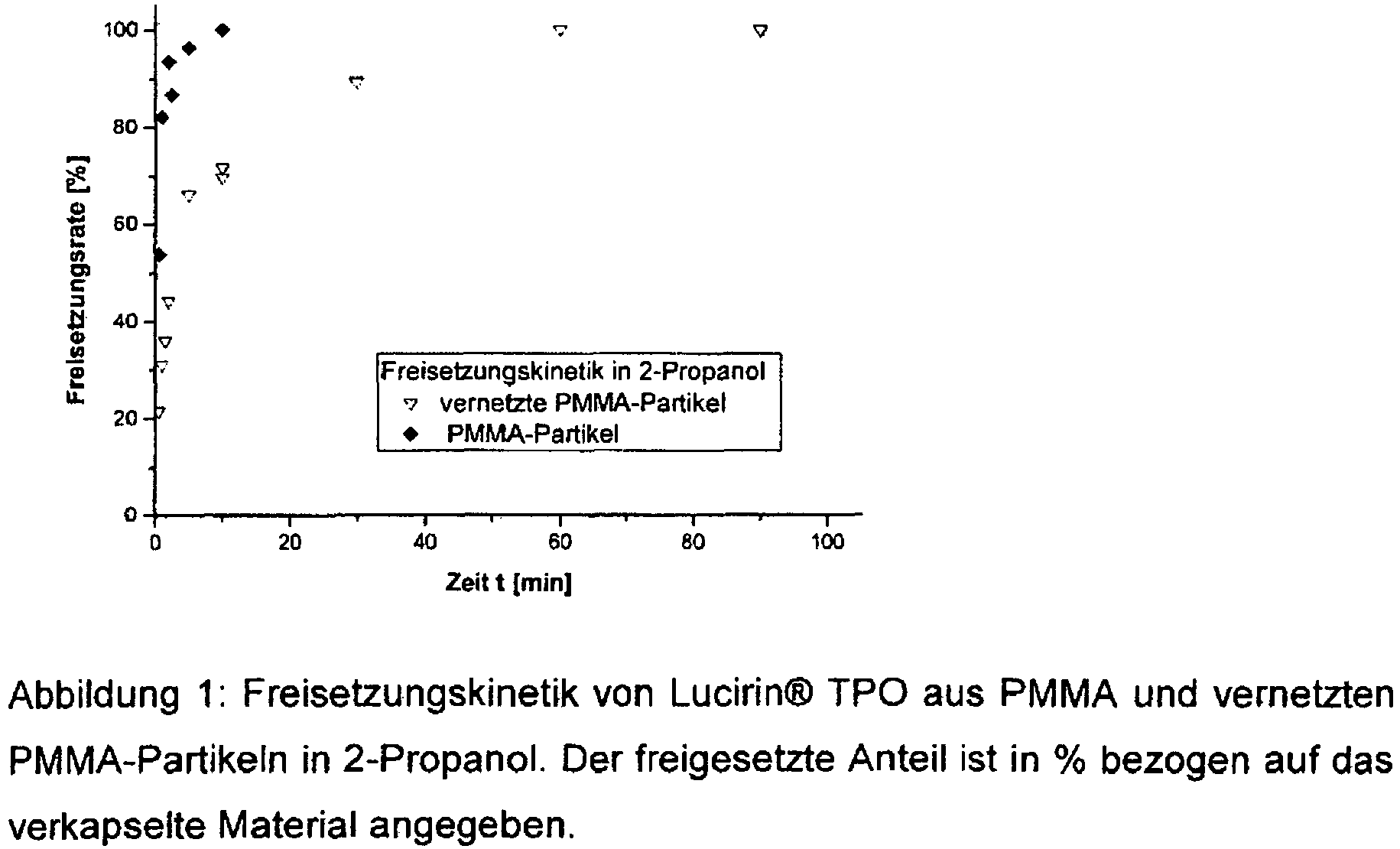
- Zur Herstellung der dispersen Phase werden 1.0 g p-Dimethylamino-Benzoesäureethylester (EMBO), 4.5 g Methylmethacrylat, 0.5 g N,N'-diethyl-N,N'-diacrylpropylendiamin, 250 mg Hexadecan und 100 mg 2,2'-Azobis-(2-methylbutyl-1-nitril) im 50 ml Becherglas (hohe Form) vermischt und gerührt, bis das EMBO vollständig gelöst ist. Für die kontinuierliche Phase werden 72 mg Natriumdodecylsulfat in 24.0 g demineralisiertem Wasser gelöst. Anschließend wird die kontinuierliche Phase unter kontinuierlichem Rühren zur dispersen Phase gegeben und 1 h bei 2000 U*min-1 gerührt. Nach Entfernen des Magnetrührstabs wird die entstandene Makro-Emulsion mittels eines Ultraschallstabes (½" Spitze) für eine Schalldauer von 2 min bei 90% Amplitude im Eisbad miniemulgiert. Die Probe wird in einen 50 ml Glaskolben überführt, fest verschlossen und über Nacht unter kontinuierlichem Rühren bei 1000 U*min-1 in einem bereits auf 72 °C vorgeheizten Ölbad polymerisiert. Nach Entnahme aus dem Ölbad wird die Suspension warm filtriert und gefriergetrocknet.
- Der mit der DLS bestimmte Durchmesser der Kapseln beträgt 114 nm, der Gehalt an Lucirin in den Kapseln wurde mit 15.7% bestimmt.
- Die erfindungsgemäß verkapselten Initiatorsysteme wurden in folgende für Adhäsive im Dentalbereich verwendete Monomermischungen eingearbeitet:
- Dentinadhäsivmischung 1:
- Zur Herstellung der Monomermischung werden 15 % 2-Hydroxyethylmethacrylat, 10 % DPEAE, 30% Bis-GMA, 20 % UDMA und 25 % Ethanol mit einem Magnetrührer vermischt und 30 min gerührt.
- Dentinadhäsivmischung 2:
- Zur Herstellung der Monomermischung werden 25% Wasser, 50% DBAP, 15% BMPP und 10% AAA mit einem Magnetrührer vermischt und 30 min gerührt.
- Zur Herstellung der Adhäsivformulierung (7A) werden 99 % Dentinadhäsivmischung 1 sowie 1.0 % nach Beispiel 4A verkapseltes Lucirin® TPO mit einem Magnetrührer vermischt. Die erhaltene Lösung wird bei 42°C im Trockenschrank gelagert und nach regelmäßigen Zeitabständen die Polymerisationszeit nach ISO 6874 (1988) bestimmt. Mit Hilfe der Polymerisationszeit kann die einwandfreie Funktion des Initiators in der Adhäsivformulierung kontrolliert werden. Eine Verlangsamung der Polymerisation und damit eine Verlängerung der Polymerisationszeit ist ein eindeutiger Hinweis auf einen Abbau des Initiatorsystems innerhalb der Formulierung. Die Polymerisationszeiten sind in Tabelle 4 aufgeführt.
- Als Vergleich dient eine Adhäsivformulierung (7B) bestehend aus 99,85% Dentinadhäsivmischung 2 sowie 0,15% Lucirin® TPO.
- Wie aus Tabelle 4 hervorgeht, zeigt der in Formulierung 7A eingesetzte verkapselte Initiator eine im Vergleich zum nicht verkapselten System deutlich verbesserte Lagerstabilität. Durch die langsame Freisetzung des Initiators in Formulierung 7A ist zu Beginn der Lagerstabilitätsuntersuchung nur eine relativ langsame Polymerisation und damit lange Polymerisationszeit der Formulierung zu beobachten. Durch Zugabe einer definierten Menge nicht verkapselten Initiators kann dieser Effekt umgangen werden, wie dies in Beispiel 7C gezeigt ist. Zur Herstellung der Adhäsivformulierung (7C) werden 99.57 % Dentinadhäsivmischung 1, 0.33 % nach Beispiel 4A verkapseltes sowie 0.10% nicht verkapseltes Lucirin® TPO mit einem Magnetrührer vermischt. Wie in Tabelle 4 gezeigt wird, bleibt die Polymerisationszeit von Formulierung 7C während des gesamten Untersuchungszeitraums konstant.
Tabelle 4 Lagerzeit (42°C) Polymerisationszeit (s) 0 Tage 14 Tage 28 Tage 56 Tage 84 Tage 112 Tage Formulierung 7A > 60 s 30 s 15s 13s 12s 13s Formulierung 7B 12s 13 s 12s 19s 34 s 50 s Formulierung 7C 15 s 13 s 12s 11 s 13 s 12 s - Zur Herstellung der Adhäsivformulierung (8A) werden 98.67 % Dentinadhäsivmischung 2 sowie 1.33 % nach Beispiel 4A verkapseltes Lucirin® TPO mit einem Magnetrührer vermischt. Die erhaltene Lösung wird bei 42°C im Trockenschrank gelagert und nach regelmäßigen Zeitabständen die Polymerisationszeit bestimmt. Die Polymerisationszeiten sind in Tabelle 5 aufgeführt.
- Als Vergleich dient eine Adhäsivformulierung (8B) bestehend aus 99,8% Dentinadhäsivmischung 2 sowie 0,2% Lucirin® TPO.
- Wie aus Tabelle 5 hervorgeht, zeigt der in Formulierung 8A eingesetzte verkapselte Initiator eine im Vergleich zum nicht verkapselten System deutlich verbesserte Lagerstabilität. Durch die langsame Freisetzung des Initiators in Formulierung 8A ist zu Beginn der Lagerstabilitätsuntersuchung nur eine relativ langsame Polymerisation und damit lange Polymerisationszeit der Formulierung zu beobachten. Durch Zugabe einer definierten Menge nicht verkapselten Initiators kann dieser Effekt umgangen werden, wie dies in Beispiel 8C gezeigt ist. Zur Herstellung der Adhäsivformulierung (8C) werden 99.23 % Dentinadhäsivmischung 2, 0.67 % nach Beispiel 4A verkapseltes sowie 0.10% nicht verkapseltes Lucirin® TPO mit einem Magnetrührer vermischt. Wie in Tabelle 5 gezeigt wird, bleibt die Polymerisationszeit von Formulierung 8C während des gesamten Untersuchungszeitraums konstant.
Tabelle 5 Lagerzeit (42°C) Polymerisationszeit (s) 0 Tage 14 Tage 28 Tage 56 Tage 84 Tage 112 Tage Formulierung 8A > 60 s 57 s 35 s 24 s 26 s 25s Formulierung 8B 27 s 25 s 26 s 30 s 45 s 58 s Formulierung 8C 28 s 26 s 25 s 27 s 23 s 25 s - Zur Herstellung der Adhäsivformulierung (9A) werden 96.47 % Dentinadhäsivmischung 1, 0,2% Campherchinon sowie 3.33 % nach Beispiel 6 verkapselter p-Dimethylamino-Benzoesäureethylester (EMBO), mit einem Magnetrührer vermischt. Die erhaltene Lösung wird bei 42°C im Trockenschrank gelagert und nach regelmäßigen Zeitabständen die Polymerisationszeit bestimmt. Die Polymerisationszeiten sind in Tabelle 6 aufgeführt.
- Als Vergleich dient eine Adhäsivformulierung (9B) bestehend aus 99,3% Dentinadhäsivmischung 1, 0.2% Campherchinon sowie 0,5% p-Dimethylamino-Benzoesäureethylester (EMBO).
- Wie aus Tabelle 6 hervorgeht, zeigt der in Formulierung 9A eingesetzte verkapselte Initiator eine im Vergleich zum nicht verkapselten System deutlich verbesserte Lagerstabilität. Durch die langsame Freisetzung des Initiators in Formulierung 9A ist zu Beginn der Lagerstabilitätsuntersuchung nur eine relativ langsame Polymerisation und damit lange Polymerisationszeit der Formulierung zu beobachten. Durch Zugabe einer definierten Menge nicht verkapselten Initiators kann dieser Effekt umgangen werden, wie dies in Beispiel 9C gezeigt ist. Zur Herstellung der Adhäsivformulierung (9C) werden 97.88% Dentinadhäsivmischung 1, 0,2% Campherchinon 1.67 % nach Beispiel 6 verkapseltes p-Dimethylamino-Benzoesäureethylester (EMBO) sowie 0.25% nicht verkapseltes EMBO mit einem Magnetrührer vermischt. Wie in Tabelle 6 gezeigt wird, bleibt die Polymerisationszeit von Formulierung 9C während des gesamten Untersuchungszeitraums konstant.
Tabelle 6 Lagerzeit (42°C) Polymerisationszeit (s) 0 Tage 14 Tage 28 Tage 56 Tage 84 Tage 112 Tage Formulierung 9A 50 s 31 s 25 s 27 s 26 s 27 s Formulierung 9B 26 s 25s 27 s 35 s 43 s 50 s Formulierung 9C 26 s 27 s 24 s 25 s 27 s 25 s - Zur Herstellung der Adhäsivformulierung (10A) werden 96.47 % Dentinadhäsivmischung 2, 0,2% Campherchinon sowie 3.33 % nach Beispiel 6 verkapselter p-Dimethylamino-Benzoesäureethylester (EMBO), mit einem Magnet-rührer vermischt. Die erhaltene Lösung wird bei 42°C im Trockenschrank gelagert und nach regelmäßigen Zeitabständen die Polymerisationszeit bestimmt. Die Polymerisationszeiten sind in Tabelle 7 aufgeführt.
- Als Vergleich dient eine Adhäsivformulierung (10B) bestehend aus 99,3% Dentinadhäsivmischung 1, 0.2% Campherchinon sowie 0,5% p-Dimethylamino-Benzoesäureethylester (EMBO).
- Wie aus Tabelle 7 hervorgeht, zeigt der in Formulierung 10A eingesetzte verkapselte Initiator eine im Vergleich zum nicht verkapselten System deutlich verbesserte Lagerstabilität. Durch die langsame Freisetzung des Initiators in Formulierung 10A ist zu Beginn der Lagerstabilitätsuntersuchung nur eine relativ langsame Polymerisation und damit lange Polymerisationszeit der Formulierung zu beobachten. Durch Zugabe einer definierten Menge nicht verkapselten Initiators kann dieser Effekt umgangen werden, wie dies in Beispiel 10C gezeigt ist. Zur Herstellung der Adhäsivformulierung (10C) werden 97.88% Dentinadhäsivmischung 2, 0,2% Campherchinon, 1.67 % nach Beispiel 6 verkapseltes p-Dimethylamino-Benzoesäureethylester (EMBO) sowie 0.25% nicht verkapseltes EMBO mit einem Magnetrührer vermischt. Wie in Tabelle 7 gezeigt wird, bleibt die Polymerisationszeit von Formulierung 10C während des gesamten Untersuchungszeitraums konstant.
Tabelle 7 Lagerzeit (42°C) Polymerisationszeit (s) 0 Tage 14 Tage 28 Tage 56 Tage 84 Tage 112 Tage Formulierung 10A > 60 s 45 s 42 s 44s 46 s 43 s Formulierung 10B 42 s 45 s 46 s 57 s >60 s >60 s Formulierung 10C 47 s 44 s 43 s 46 s 44s 45 s
Claims (12)
- Mikrokapseln bestehend aus einer Hülle aus Polymeren und aus einem Kern enthaltend Photoinitiatoren, welche Acylphosphinoxide, deren Derivate oder Amincoinitiatoren oder Gemische dieser Verbindungen aufweisen wobeia) die Photoinitiatoren Acylphosphinoxide der allgemeinen Formel (I)

R1, R2, R3, R4 und R5 unabhängig voneinander Wasserstoff, Halogen, C1-C20-Alkyl, Cyclopentyl, Cyclohexyl, C2-C12-Alkenyl, durch ein oder mehrere O-Atome unterbrochenes C2-C18-Alkyl, durch Phenyl substituiertes C1-C4-Alkyl, unsubstituiertes oder mit ein oder zwei C1-C4-Alkyl oder/und C1-C4-Alkoxy substituiertes Phenyl sowie R6 und R7
oderb) die Photoinitiatoren Bisacylphosphinoxide der allgemeinen Formel (II)
R1, R2, R3, R4, R5, R6, R9, R10, R11 und R12 unabhängig voneinander Wasserstoff, Halogen, C1-C20-Alkyl, Cyclopentyl, Cyclohexyl, C2-C12-Alkenyl, durch ein oder mehrere O-Atome unterbrochenes C2-C18-Alkyl, durch Phenyl substituiertes C1-C4-Alkyl, unsubstituiertes oder mit ein oder zwei C1-C4-Alkyl oder/und C1-C4-Alkoxy-substituiertes Phenyl sein kann, sowie R6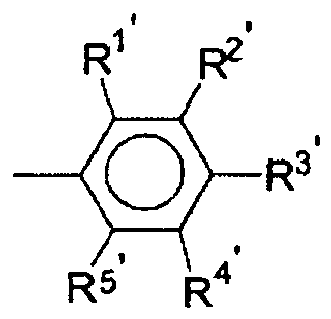
wobei R1', R2', R3', R4', und R5' unabhängig voneinander Wasserstoff, Halogen, C1-C20-Alkyl, Cyclopentyl, Cyclohexyl, C2-C12-Alkenyl, durch ein oder mehrere O-Atome unterbrochenes C2-C18-Alkyl, durch Phenyl substituiertes C1-C4-Alkyl, unsubstituiertes oder mit ein oder zwei C1-C4-Alkyl oder/und C1-C4-Alkoxy substituiertes Phenyl sein kann,
oderc) die Photoinitiatoren Amincoinitiatoren der allgemeinen Formel (III)
R13 C1-C20-Alkyl, durch ein oder mehrere O-Atome unterbrochenes C2-C18-Alkyl, durch CN, OH substituiertes C1-C4-Alkyl sein kann, R14 und R15 unabhängig voneinander C1-C20-Alkyl, durch ein oder mehrere O-Atome unterbrochenes C2-C18-Alkyl, durch CN, OH substituiertes C1-C4-Alkyl, unsubstituiertes oder mit ein, zwei oder drei C1-C6-Alkyl oder/und mit carboxyalkyl-substituiertes Phenyl sein kann,
und wobeid) für die Hülle als Polymere Polymethacrylate oder Polymethacrylamide oder Mischungen daraus eingesetzt werden. - Mikrokapseln nach Anspruch 1, dadurch gekennzeichnet, dass die Mikrokapseln hergestellt werden indem ein Zweiphasensystem bestehend aus einer Mischung ausi) einem zu verkapselnden Photoinitiator (I), (II), (III) oder einer Mischung daraus,ii) mindestens einem radikalisch polymerisierbaren Monomer,iii) mindestens einer ultrahydrophobe Verbindung undiv) mindestens einem Initiator zur thermischen Initiierung der radikalischen Polymerisation
in eine Mischung aus Wasser und mindestens einem Tensid gegeben wird undvi) anschließend daraus mit Ultraschall eine stabile Miniemulsion gebildet wird, welche durch anschließende Erwärmung polymerisiert wird. - Mikrokapseln nach Anspruch 1 oder 2, dadurch gekennzeichnet, dass die Photoinitiatoren 2,4,6-Trimethylbenzoyl-Diphenyl-Phosphinoxide aufweisen.
- Mikrokapseln nach Anspruch 1 oder 2, dadurch gekennzeichnet, dass sie Bis-(2,4,6-Trimethylbenzoyl)-Phenylphosphinoxid enthalten.
- Verfahren zur Herstellung der Mikrokapseln nach einem der vorhergehenden Ansprüche, dadurch gekennzeichnet, dass ein Zweiphasensystem bestehend aus einer Mischung ausi) einem zu verkapselnden Photoinitiator aus einem der vorhergehenden Ansprüche oder einer Mischung daraus,ii) mindestens einem radikalisch polymerisierbaren Monomer,iii) mindestens einer ultrahydrophoben Verbindung undiv) mindestens einem Initiator zur thermischen Initiierung der radikalischen Polymerisation
in eine Mischung aus Wasser und mindestens einem Tensid gegeben wird undvi) anschließend daraus eine stabile Miniemulsion gebildet wird, welche durch anschließende Erwärmung polymerisiert wird. - Verfahren nach Anspruch 5, dadurch gekennzeichnet, dass 0,1 - 40 Gew.-%, bevorzugt 0,5 - 20 Gew.-%, des zu verkapselnden Photoinitiators,1,0 - 80 Gew.-%, bevorzugt 2,0 - 50 Gew.-%, des polymerisierbaren Monomers,0,1 - 2 Gew.-%, bevorzugt 0,5 - 2 Gew.-%, der ultrahydrophoben Verbindung,0,05 - 5 Gew.-%, bevorzugt 0,1 - 3 Gew.-%, eines Initiators zur thermischen Initiierung der radikalischen Polymerisation und0,01 - 5 Gew.-%, bevorzugt 0,1 - 3 Gew.-%, eines Tensids eingesetzt werden, wobei die Angaben in Gew.-% sich auf jeweils 100 Gew.-% addieren.
- Verfahren nach einem der Ansprüche 5 oder 6, dadurch gekennzeichnet, dass als Monomere Methacrylate oder Methacrylamide eingesetzt werden.
- Verfahren nach einem der Ansprüche 5 bis 7, dadurch gekennzeichnet, dass als ultrahydrophobe Verbindungen aliphatische Kohlenwasserstoffe oder aromatische Kohlenwasserstoffe eingesetzt werden.
- Verfahren nach einem der Ansprüche 5 bis 8, dadurch gekennzeichnet, dass als ultrahydrophobe Verbindungen aliphatische Kohlenwasserstoffe mit C6- bis C20-Alkanen eingesetzt werden.
- Verfahren nach einem der Ansprüche 5 bis 9, dadurch gekennzeichnet, dass als Tenside ionische und nichtionische amphiphile Verbindungen eingesetzt werden.
- Verwendung der Mikrokapseln nach einem der Ansprüche 1 bis 4 für selbstätzende, selbstkonditionierende Dentalmassen.
- Verwendung der Mikrokapseln nach einem der Ansprüche 1 bis 4 für Dentin/Schmelzadhäsive.
Applications Claiming Priority (2)
| Application Number | Priority Date | Filing Date | Title |
|---|---|---|---|
| DE102006050153A DE102006050153A1 (de) | 2006-10-25 | 2006-10-25 | Mikroverkapselte Photoinitiatoren und deren Verwendung für Dentalmaterialien |
| PCT/EP2007/061348 WO2008049839A1 (de) | 2006-10-25 | 2007-10-23 | Mikroverkapselte photoinitiatoren und deren verwendung für dentalmaterialien |
Publications (2)
| Publication Number | Publication Date |
|---|---|
| EP2081541A1 EP2081541A1 (de) | 2009-07-29 |
| EP2081541B1 true EP2081541B1 (de) | 2012-07-04 |
Family
ID=38925537
Family Applications (1)
| Application Number | Title | Priority Date | Filing Date |
|---|---|---|---|
| EP07821712A Not-in-force EP2081541B1 (de) | 2006-10-25 | 2007-10-23 | Mikroverkapselte photoinitiatoren und deren verwendung für dentalmaterialien |
Country Status (4)
| Country | Link |
|---|---|
| US (1) | US20120123012A1 (de) |
| EP (1) | EP2081541B1 (de) |
| DE (1) | DE102006050153A1 (de) |
| WO (1) | WO2008049839A1 (de) |
Cited By (1)
| Publication number | Priority date | Publication date | Assignee | Title |
|---|---|---|---|---|
| WO2018202868A1 (de) | 2017-05-05 | 2018-11-08 | Fraunhofer-Gesellschaft zur Förderung der angewandten Forschung e.V. | Barriere-verkapselung wasserbasierter systeme auf basis uv-härtbarer schalensysteme |
Families Citing this family (28)
| Publication number | Priority date | Publication date | Assignee | Title |
|---|---|---|---|---|
| DE102009004368A1 (de) | 2009-01-08 | 2010-07-15 | Heraeus Kulzer Gmbh | Dentalmaterialien enthaltend antimikrobielle Wirkstoffe zur Verhinderung von Plaque-Anlagerungen |
| DE102009016025B4 (de) | 2009-04-02 | 2014-12-11 | Voco Gmbh | Kunststoffmodifizierter Glasionomerzement, seine Verwendung sowie Verfahren zu seiner Herstellung |
| DE102010003884A1 (de) | 2010-04-12 | 2011-10-13 | Voco Gmbh | Dualhärtende, mehrkomponentige dentale Zusammensetzung |
| DE102010003883A1 (de) | 2010-04-12 | 2011-10-13 | Voco Gmbh | Lichthärtbares Kompositmaterial |
| DE102010003881A1 (de) | 2010-04-12 | 2011-10-13 | Voco Gmbh | Dentale Abdeckmasse |
| JP2011219430A (ja) * | 2010-04-13 | 2011-11-04 | Panasonic Electric Works Co Ltd | 硬化性組成物及び歯科用硬化物 |
| EP2436365B1 (de) | 2010-09-30 | 2017-03-08 | VOCO GmbH | Kompositmaterial umfassend ein Monomer mit einem polyalicyclischen Strukturelement |
| US9079828B2 (en) | 2010-09-30 | 2015-07-14 | Voco Gmbh | Polymerizable compounds comprising a polyalicylic structure element |
| US8669302B2 (en) | 2010-09-30 | 2014-03-11 | Voco Gmbh | Composite material comprising a monomer with a polyalicyclic structure element as a sealing material |
| EP2436363B1 (de) | 2010-09-30 | 2017-01-18 | VOCO GmbH | Zusammensetzung umfassend ein Monomer mit einem polyalicyclischen Strukturelement zum Füllen und/oder Versiegeln eines Wurzelkanals |
| EP2436364B1 (de) | 2010-09-30 | 2017-05-31 | VOCO GmbH | Lackzusammensetzung umfassend ein Monomer mit einem polyalicyclischen Strukturelement |
| EP2450025B1 (de) | 2010-11-08 | 2012-11-28 | VOCO GmbH | Polymerisierbare Phosphorsäurederivate umfassend ein polyalicyclisches Strukturelement |
| DE102011003289A1 (de) | 2011-01-27 | 2012-08-02 | Voco Gmbh | Dentale provisorische Suprakonstruktionen sowie Materialien zu ihrer Herstellung und entsprechende Verfahren |
| DE102012001979A1 (de) | 2012-02-02 | 2013-08-08 | Voco Gmbh | Härtbares Gemisch umfassend Weichmacher mit einem polyalicyclischen Strukturelement zur Anwendung bei der Herstellung dentaler Werkstoffe |
| DE102012001978A1 (de) | 2012-02-02 | 2013-08-08 | Voco Gmbh | Dentale Kompositmaterialien enthaltend tricyclische Weichmacher |
| DE102012212429A1 (de) | 2012-07-16 | 2014-01-16 | Voco Gmbh | Dentalhandgerät, Verfahren und Verwendung desselben zum Aushärten lichthärtbaren Materials |
| DE102012214540A1 (de) | 2012-08-15 | 2014-02-20 | Helmholtz-Zentrum für Infektionsforschung GmbH | Zahnfüllungsmaterialien und Zahnlacke zur Hemmung der Biofilmbildung von Streptococcus mutans und deren Herstellung |
| DE102012016418B4 (de) * | 2012-08-21 | 2024-04-25 | Kulzer Gmbh | Dentaler Haftvermittler für Hochleistungspolymere |
| DE102013008176A1 (de) | 2012-10-05 | 2014-04-10 | Voco Gmbh | Kit und Verfahren zur indirekten chairside Herstellung von Kompositinlays |
| DE102014116389A1 (de) | 2014-11-11 | 2016-05-12 | Voco Gmbh | Radikalisch härtbare dentale Zusammensetzungen |
| DE102014116402A1 (de) | 2014-11-11 | 2016-05-12 | Voco Gmbh | Verwendung radikalisch härtbarer Zusammensetzungen in generativen Fertigungsverfahren |
| WO2016191378A1 (en) * | 2015-05-22 | 2016-12-01 | Orthobond, Inc. | Methods, compositions and techniques for polydimethylsiloxane surface modifications |
| DE102017103084A1 (de) | 2017-02-15 | 2018-08-16 | Voco Gmbh | Dentaler Kompositblock zur Herstellung permanenter indirekter Restaurationen im CAD/CAM Verfahren |
| DE102017105841A1 (de) | 2017-03-17 | 2018-09-20 | Voco Gmbh | Fräsrohling zur Herstellung einer indirekten dentalen Restauration, entsprechende Verwendungen und Verfahren |
| DE102018103415A1 (de) | 2018-02-15 | 2019-08-22 | Voco Gmbh | Dentale Formkörper mit kontinuierlichem Farbverlauf |
| DE102018114690A1 (de) | 2018-06-19 | 2019-12-19 | Voco Gmbh | Thermowirksame dentale Kompositzusammensetzung |
| DE102019122174A1 (de) | 2019-08-19 | 2021-02-25 | Voco Gmbh | Dentale polymerisierbare Zusammensetzung auf der Basis kondensierter Silane |
| CN119119327B (zh) * | 2024-11-11 | 2025-04-18 | 江苏苏博特新材料股份有限公司 | 一种用于提升水泥基材料力学性能的pH响应引发剂及其制备方法和应用 |
Family Cites Families (25)
| Publication number | Priority date | Publication date | Assignee | Title |
|---|---|---|---|---|
| GB1408265A (en) | 1971-10-18 | 1975-10-01 | Ici Ltd | Photopolymerisable composition |
| DE2909992A1 (de) | 1979-03-14 | 1980-10-02 | Basf Ag | Photopolymerisierbare aufzeichnungsmassen, insbesondere zur herstellung von druckplatten und reliefformen |
| DE2964564D1 (en) | 1978-12-18 | 1983-02-24 | Ici Plc | Dental compositions comprising a selected vinyl urethane prepolymer and processes for their manufacture |
| US4525256A (en) | 1983-07-01 | 1985-06-25 | Johnson & Johnson Dental Products Company | Photopolymerizable composition including catalyst comprising diketone plus 4-(N,N-dimethylamino)benzoic acid or ester thereof |
| GR852068B (de) | 1984-08-30 | 1985-12-24 | Johnson & Johnson Dental Prod | |
| DE3443221A1 (de) | 1984-11-27 | 1986-06-05 | ESPE Fabrik pharmazeutischer Präparate GmbH, 8031 Seefeld | Bisacylphosphinoxide, ihre herstellung und verwendung |
| DE3801511C2 (de) | 1988-01-20 | 1996-11-14 | Espe Stiftung | Verwendung von Photoinitiatoren zur Herstellung von in zwei Schritten härtbaren Dentalmassen |
| EP0334338A3 (de) | 1988-03-24 | 1990-06-20 | Dentsply International, Inc. | Titanatinitiatoren für lichthärtende Zusammensetzungen |
| EP0336417A3 (de) | 1988-04-07 | 1991-09-11 | Dentsply International, Inc. | Phosphonat-Initiatoren für lichtvernetzbare Zusammensetzungen |
| DE3837569A1 (de) | 1988-11-04 | 1990-05-10 | Espe Stiftung | Mit sichtbarem licht aushaertbare dentalmassen |
| US5154762A (en) | 1991-05-31 | 1992-10-13 | Minnesota Mining And Manufacturing Company | Universal water-based medical and dental cement |
| RU2091385C1 (ru) | 1991-09-23 | 1997-09-27 | Циба-Гейги АГ | Бисацилфосфиноксиды, состав и способ нанесения покрытий |
| TW381106B (en) | 1994-09-02 | 2000-02-01 | Ciba Sc Holding Ag | Alkoxyphenyl-substituted bisacylphosphine oxides |
| CH691970A5 (de) | 1996-03-04 | 2001-12-14 | Ciba Sc Holding Ag | Alkylphenylbisacylphosphinoxide und Photoinitiatormischungen. |
| AU729791B2 (en) | 1997-06-09 | 2001-02-08 | Kuraray Co., Ltd. | Polymerizable composition for dental use |
| JPH11228327A (ja) * | 1998-02-18 | 1999-08-24 | Gc Corp | 歯科用ペースト系グラスアイオノマーセメント組成物 |
| AU763355B2 (en) | 1998-08-20 | 2003-07-17 | Kuraray Co., Ltd. | Bonding compositions for dental use |
| US6204302B1 (en) | 1998-11-20 | 2001-03-20 | Bisco, Inc. | Photosensitizers for free radical polymerization initiation resins and method of making the same |
| EP1236459B1 (de) | 2000-07-19 | 2005-11-23 | Tokuyama Corporation | Photohärtbares material für zahnreparaturen |
| US6613812B2 (en) * | 2001-01-03 | 2003-09-02 | 3M Innovative Properties Company | Dental material including fatty acid, dimer thereof, or trimer thereof |
| CN100437354C (zh) | 2001-08-21 | 2008-11-26 | 西巴特殊化学品控股有限公司 | 红移单-和双-酰基氧化膦和硫化膦及其作为光引发剂的应用 |
| WO2003057792A2 (en) | 2001-12-29 | 2003-07-17 | 3M Innovative Properties Company | Composition containing a polymerizable reducing agent, kit, and method |
| JP2004330704A (ja) * | 2003-05-09 | 2004-11-25 | Fuji Photo Film Co Ltd | 感熱記録材料 |
| JP2005289961A (ja) | 2004-03-12 | 2005-10-20 | Shiyoufuu:Kk | 微小カプセルを含有する硬化性組成物 |
| DE102004020726A1 (de) * | 2004-04-28 | 2005-11-24 | Clariant Gmbh | Verfahren zur Herstellung polymerverkapselter Pigmente |
-
2006
- 2006-10-25 DE DE102006050153A patent/DE102006050153A1/de not_active Ceased
-
2007
- 2007-10-23 EP EP07821712A patent/EP2081541B1/de not_active Not-in-force
- 2007-10-23 US US12/312,015 patent/US20120123012A1/en not_active Abandoned
- 2007-10-23 WO PCT/EP2007/061348 patent/WO2008049839A1/de not_active Ceased
Cited By (2)
| Publication number | Priority date | Publication date | Assignee | Title |
|---|---|---|---|---|
| WO2018202868A1 (de) | 2017-05-05 | 2018-11-08 | Fraunhofer-Gesellschaft zur Förderung der angewandten Forschung e.V. | Barriere-verkapselung wasserbasierter systeme auf basis uv-härtbarer schalensysteme |
| DE102017109673A1 (de) * | 2017-05-05 | 2018-11-08 | Fraunhofer-Gesellschaft zur Förderung der angewandten Forschung e.V. | Barriere-Verkapselung wasserbasierter Systeme auf Basis UV-härtbarer Schalensysteme |
Also Published As
| Publication number | Publication date |
|---|---|
| DE102006050153A1 (de) | 2008-05-08 |
| EP2081541A1 (de) | 2009-07-29 |
| US20120123012A1 (en) | 2012-05-17 |
| WO2008049839A1 (de) | 2008-05-02 |
Similar Documents
| Publication | Publication Date | Title |
|---|---|---|
| EP2081541B1 (de) | Mikroverkapselte photoinitiatoren und deren verwendung für dentalmaterialien | |
| EP1749513B1 (de) | Photopolymerisierbare Dentalmaterialien mit Bisacylphosphinoxiden als Initiator | |
| EP3120827B1 (de) | Adhäsive dentalwerkstoffe mit stark aciden haftpolymeren | |
| EP3150641B1 (de) | Acylgermanium-photoinitiatoren und verfahren zu deren herstellung | |
| EP3166569B1 (de) | Komposite mit gesteuerter netzwerkstruktur | |
| EP3692976B1 (de) | Dentalmaterialien auf basis von redoxsystemen mit geruchsarmen cumolhydroperoxidderivaten | |
| EP2103296B1 (de) | Polymerbeschichteter Glasfüllstoff zur Verwendung in Dentalwerkstoffen | |
| EP3293215B1 (de) | Polymerisierbare zusammensetzungen mit acylzinn-photoinitiatoren | |
| EP4205724A1 (de) | Selbsthaftende dentale kompositzemente mit guter transparenz auf basis säurebehandelter füllstoffe | |
| EP4205723A1 (de) | Sulfathaltiger oder phosphataltiger, selbsthaftender dentaler kompositzement mit guter transparenz | |
| EP3166568B1 (de) | Dentalmaterialien mit debonding-on-demand eigenschaften | |
| DE10101523B4 (de) | Dentalmaterialien auf der Basis polyfunktioneller Amide | |
| EP3692974B1 (de) | Dentalmaterialien mit verbesserten mechanischen eigenschaften | |
| EP3090722B1 (de) | Durch kettenübertragungspolymerisation härtbare dentalmaterialien | |
| EP2277496B1 (de) | Dentalwerkstoff enthaltend oberflächenmodifizierte Füllstoffe | |
| DE102004011497B4 (de) | Dentalwerkstoffe mit verbesserter Verträglichkeit | |
| EP3868767B1 (de) | Langwellig absorbierende photoinitiatoren | |
| EP4039220A1 (de) | Dentalmaterialien auf der basis von polymerisationsfähigen thioharnstoff-derivaten | |
| EP2198824B1 (de) | Polymerisierbares Dentalmaterial mit Initiatorsystem | |
| EP3064192B1 (de) | Dentalmaterialien auf der Basis von Hybridmonomeren | |
| WO2017064042A1 (de) | Polymerisierbare zusammensetzungen auf basis von thermisch spaltbaren verbindungen | |
| EP3692975B1 (de) | Dentalmaterialien mit verbessertem abbindeverhalten | |
| EP2489344B1 (de) | Dentalwerkstoff auf der Basis einer antimikrobiell wirksamen Verbindung | |
| EP4094748A1 (de) | Dentalwerkstoffe auf basis von redoxsystemen mit oligomeren cumolhydro-peroxid-derivaten | |
| WO2015139811A1 (de) | Monomermischung zur herstellung von dentalwerkstoffen |
Legal Events
| Date | Code | Title | Description |
|---|---|---|---|
| PUAI | Public reference made under article 153(3) epc to a published international application that has entered the european phase |
Free format text: ORIGINAL CODE: 0009012 |
|
| 17P | Request for examination filed |
Effective date: 20090406 |
|
| AK | Designated contracting states |
Kind code of ref document: A1 Designated state(s): AT BE BG CH CY CZ DE DK EE ES FI FR GB GR HU IE IS IT LI LT LU LV MC MT NL PL PT RO SE SI SK TR |
|
| DAX | Request for extension of the european patent (deleted) | ||
| 17Q | First examination report despatched |
Effective date: 20101105 |
|
| GRAP | Despatch of communication of intention to grant a patent |
Free format text: ORIGINAL CODE: EPIDOSNIGR1 |
|
| GRAC | Information related to communication of intention to grant a patent modified |
Free format text: ORIGINAL CODE: EPIDOSCIGR1 |
|
| GRAS | Grant fee paid |
Free format text: ORIGINAL CODE: EPIDOSNIGR3 |
|
| GRAA | (expected) grant |
Free format text: ORIGINAL CODE: 0009210 |
|
| AK | Designated contracting states |
Kind code of ref document: B1 Designated state(s): AT BE BG CH CY CZ DE DK EE ES FI FR GB GR HU IE IS IT LI LT LU LV MC MT NL PL PT RO SE SI SK TR |
|
| REG | Reference to a national code |
Ref country code: GB Ref legal event code: FG4D Free format text: NOT ENGLISH |
|
| REG | Reference to a national code |
Ref country code: CH Ref legal event code: EP |
|
| REG | Reference to a national code |
Ref country code: AT Ref legal event code: REF Ref document number: 564845 Country of ref document: AT Kind code of ref document: T Effective date: 20120715 |
|
| REG | Reference to a national code |
Ref country code: IE Ref legal event code: FG4D Free format text: LANGUAGE OF EP DOCUMENT: GERMAN |
|
| REG | Reference to a national code |
Ref country code: CH Ref legal event code: NV Representative=s name: R. A. EGLI & CO. PATENTANWAELTE |
|
| REG | Reference to a national code |
Ref country code: DE Ref legal event code: R096 Ref document number: 502007010167 Country of ref document: DE Effective date: 20120830 |
|
| REG | Reference to a national code |
Ref country code: NL Ref legal event code: VDEP Effective date: 20120704 |
|
| PG25 | Lapsed in a contracting state [announced via postgrant information from national office to epo] |
Ref country code: SI Free format text: LAPSE BECAUSE OF FAILURE TO SUBMIT A TRANSLATION OF THE DESCRIPTION OR TO PAY THE FEE WITHIN THE PRESCRIBED TIME-LIMIT Effective date: 20120704 |
|
| REG | Reference to a national code |
Ref country code: LT Ref legal event code: MG4D Effective date: 20120704 |
|
| PG25 | Lapsed in a contracting state [announced via postgrant information from national office to epo] |
Ref country code: FI Free format text: LAPSE BECAUSE OF FAILURE TO SUBMIT A TRANSLATION OF THE DESCRIPTION OR TO PAY THE FEE WITHIN THE PRESCRIBED TIME-LIMIT Effective date: 20120704 Ref country code: CY Free format text: LAPSE BECAUSE OF FAILURE TO SUBMIT A TRANSLATION OF THE DESCRIPTION OR TO PAY THE FEE WITHIN THE PRESCRIBED TIME-LIMIT Effective date: 20120704 Ref country code: LT Free format text: LAPSE BECAUSE OF FAILURE TO SUBMIT A TRANSLATION OF THE DESCRIPTION OR TO PAY THE FEE WITHIN THE PRESCRIBED TIME-LIMIT Effective date: 20120704 Ref country code: IS Free format text: LAPSE BECAUSE OF FAILURE TO SUBMIT A TRANSLATION OF THE DESCRIPTION OR TO PAY THE FEE WITHIN THE PRESCRIBED TIME-LIMIT Effective date: 20121104 |
|
| PG25 | Lapsed in a contracting state [announced via postgrant information from national office to epo] |
Ref country code: LV Free format text: LAPSE BECAUSE OF FAILURE TO SUBMIT A TRANSLATION OF THE DESCRIPTION OR TO PAY THE FEE WITHIN THE PRESCRIBED TIME-LIMIT Effective date: 20120704 Ref country code: PL Free format text: LAPSE BECAUSE OF FAILURE TO SUBMIT A TRANSLATION OF THE DESCRIPTION OR TO PAY THE FEE WITHIN THE PRESCRIBED TIME-LIMIT Effective date: 20120704 Ref country code: PT Free format text: LAPSE BECAUSE OF FAILURE TO SUBMIT A TRANSLATION OF THE DESCRIPTION OR TO PAY THE FEE WITHIN THE PRESCRIBED TIME-LIMIT Effective date: 20121105 Ref country code: SE Free format text: LAPSE BECAUSE OF FAILURE TO SUBMIT A TRANSLATION OF THE DESCRIPTION OR TO PAY THE FEE WITHIN THE PRESCRIBED TIME-LIMIT Effective date: 20120704 Ref country code: GR Free format text: LAPSE BECAUSE OF FAILURE TO SUBMIT A TRANSLATION OF THE DESCRIPTION OR TO PAY THE FEE WITHIN THE PRESCRIBED TIME-LIMIT Effective date: 20121005 |
|
| PG25 | Lapsed in a contracting state [announced via postgrant information from national office to epo] |
Ref country code: NL Free format text: LAPSE BECAUSE OF FAILURE TO SUBMIT A TRANSLATION OF THE DESCRIPTION OR TO PAY THE FEE WITHIN THE PRESCRIBED TIME-LIMIT Effective date: 20120704 |
|
| BERE | Be: lapsed |
Owner name: IVOCLAR VIVADENT AG Effective date: 20121031 |
|
| PG25 | Lapsed in a contracting state [announced via postgrant information from national office to epo] |
Ref country code: DK Free format text: LAPSE BECAUSE OF FAILURE TO SUBMIT A TRANSLATION OF THE DESCRIPTION OR TO PAY THE FEE WITHIN THE PRESCRIBED TIME-LIMIT Effective date: 20120704 Ref country code: CZ Free format text: LAPSE BECAUSE OF FAILURE TO SUBMIT A TRANSLATION OF THE DESCRIPTION OR TO PAY THE FEE WITHIN THE PRESCRIBED TIME-LIMIT Effective date: 20120704 Ref country code: EE Free format text: LAPSE BECAUSE OF FAILURE TO SUBMIT A TRANSLATION OF THE DESCRIPTION OR TO PAY THE FEE WITHIN THE PRESCRIBED TIME-LIMIT Effective date: 20120704 Ref country code: RO Free format text: LAPSE BECAUSE OF FAILURE TO SUBMIT A TRANSLATION OF THE DESCRIPTION OR TO PAY THE FEE WITHIN THE PRESCRIBED TIME-LIMIT Effective date: 20120704 Ref country code: ES Free format text: LAPSE BECAUSE OF FAILURE TO SUBMIT A TRANSLATION OF THE DESCRIPTION OR TO PAY THE FEE WITHIN THE PRESCRIBED TIME-LIMIT Effective date: 20121015 |
|
| PLBE | No opposition filed within time limit |
Free format text: ORIGINAL CODE: 0009261 |
|
| STAA | Information on the status of an ep patent application or granted ep patent |
Free format text: STATUS: NO OPPOSITION FILED WITHIN TIME LIMIT |
|
| PG25 | Lapsed in a contracting state [announced via postgrant information from national office to epo] |
Ref country code: MC Free format text: LAPSE BECAUSE OF NON-PAYMENT OF DUE FEES Effective date: 20121031 Ref country code: SK Free format text: LAPSE BECAUSE OF FAILURE TO SUBMIT A TRANSLATION OF THE DESCRIPTION OR TO PAY THE FEE WITHIN THE PRESCRIBED TIME-LIMIT Effective date: 20120704 |
|
| 26N | No opposition filed |
Effective date: 20130405 |
|
| REG | Reference to a national code |
Ref country code: IE Ref legal event code: MM4A |
|
| PG25 | Lapsed in a contracting state [announced via postgrant information from national office to epo] |
Ref country code: IE Free format text: LAPSE BECAUSE OF NON-PAYMENT OF DUE FEES Effective date: 20121023 Ref country code: BE Free format text: LAPSE BECAUSE OF NON-PAYMENT OF DUE FEES Effective date: 20121031 Ref country code: BG Free format text: LAPSE BECAUSE OF FAILURE TO SUBMIT A TRANSLATION OF THE DESCRIPTION OR TO PAY THE FEE WITHIN THE PRESCRIBED TIME-LIMIT Effective date: 20121004 |
|
| REG | Reference to a national code |
Ref country code: DE Ref legal event code: R097 Ref document number: 502007010167 Country of ref document: DE Effective date: 20130405 |
|
| PG25 | Lapsed in a contracting state [announced via postgrant information from national office to epo] |
Ref country code: MT Free format text: LAPSE BECAUSE OF FAILURE TO SUBMIT A TRANSLATION OF THE DESCRIPTION OR TO PAY THE FEE WITHIN THE PRESCRIBED TIME-LIMIT Effective date: 20120704 |
|
| REG | Reference to a national code |
Ref country code: AT Ref legal event code: MM01 Ref document number: 564845 Country of ref document: AT Kind code of ref document: T Effective date: 20121031 |
|
| PG25 | Lapsed in a contracting state [announced via postgrant information from national office to epo] |
Ref country code: AT Free format text: LAPSE BECAUSE OF NON-PAYMENT OF DUE FEES Effective date: 20121031 |
|
| PG25 | Lapsed in a contracting state [announced via postgrant information from national office to epo] |
Ref country code: TR Free format text: LAPSE BECAUSE OF FAILURE TO SUBMIT A TRANSLATION OF THE DESCRIPTION OR TO PAY THE FEE WITHIN THE PRESCRIBED TIME-LIMIT Effective date: 20120704 |
|
| PG25 | Lapsed in a contracting state [announced via postgrant information from national office to epo] |
Ref country code: LU Free format text: LAPSE BECAUSE OF NON-PAYMENT OF DUE FEES Effective date: 20121023 |
|
| PG25 | Lapsed in a contracting state [announced via postgrant information from national office to epo] |
Ref country code: HU Free format text: LAPSE BECAUSE OF FAILURE TO SUBMIT A TRANSLATION OF THE DESCRIPTION OR TO PAY THE FEE WITHIN THE PRESCRIBED TIME-LIMIT Effective date: 20071023 |
|
| PGFP | Annual fee paid to national office [announced via postgrant information from national office to epo] |
Ref country code: FR Payment date: 20141021 Year of fee payment: 8 Ref country code: CH Payment date: 20141024 Year of fee payment: 8 Ref country code: GB Payment date: 20141024 Year of fee payment: 8 |
|
| PGFP | Annual fee paid to national office [announced via postgrant information from national office to epo] |
Ref country code: IT Payment date: 20141028 Year of fee payment: 8 |
|
| REG | Reference to a national code |
Ref country code: CH Ref legal event code: PL |
|
| GBPC | Gb: european patent ceased through non-payment of renewal fee |
Effective date: 20151023 |
|
| PG25 | Lapsed in a contracting state [announced via postgrant information from national office to epo] |
Ref country code: CH Free format text: LAPSE BECAUSE OF NON-PAYMENT OF DUE FEES Effective date: 20151031 Ref country code: LI Free format text: LAPSE BECAUSE OF NON-PAYMENT OF DUE FEES Effective date: 20151031 Ref country code: IT Free format text: LAPSE BECAUSE OF NON-PAYMENT OF DUE FEES Effective date: 20151023 Ref country code: GB Free format text: LAPSE BECAUSE OF NON-PAYMENT OF DUE FEES Effective date: 20151023 |
|
| REG | Reference to a national code |
Ref country code: FR Ref legal event code: ST Effective date: 20160630 |
|
| PG25 | Lapsed in a contracting state [announced via postgrant information from national office to epo] |
Ref country code: FR Free format text: LAPSE BECAUSE OF NON-PAYMENT OF DUE FEES Effective date: 20151102 |
|
| REG | Reference to a national code |
Ref country code: DE Ref legal event code: R079 Ref document number: 502007010167 Country of ref document: DE Free format text: PREVIOUS MAIN CLASS: A61K0006083000 Ipc: A61K0006887000 |
|
| PGFP | Annual fee paid to national office [announced via postgrant information from national office to epo] |
Ref country code: DE Payment date: 20190912 Year of fee payment: 13 |
|
| REG | Reference to a national code |
Ref country code: DE Ref legal event code: R082 Ref document number: 502007010167 Country of ref document: DE Representative=s name: MEISSNER BOLTE PATENTANWAELTE RECHTSANWAELTE P, DE |
|
| REG | Reference to a national code |
Ref country code: DE Ref legal event code: R082 Ref document number: 502007010167 Country of ref document: DE |
|
| REG | Reference to a national code |
Ref country code: DE Ref legal event code: R119 Ref document number: 502007010167 Country of ref document: DE |
|
| PG25 | Lapsed in a contracting state [announced via postgrant information from national office to epo] |
Ref country code: DE Free format text: LAPSE BECAUSE OF NON-PAYMENT OF DUE FEES Effective date: 20210501 |