EP2083606A2 - Mobiles Endgerät mit Multi-Bereitschaft und Verfahren zur Host-Funktionsbereitstellung dafür - Google Patents
Mobiles Endgerät mit Multi-Bereitschaft und Verfahren zur Host-Funktionsbereitstellung dafür Download PDFInfo
- Publication number
- EP2083606A2 EP2083606A2 EP09151156A EP09151156A EP2083606A2 EP 2083606 A2 EP2083606 A2 EP 2083606A2 EP 09151156 A EP09151156 A EP 09151156A EP 09151156 A EP09151156 A EP 09151156A EP 2083606 A2 EP2083606 A2 EP 2083606A2
- Authority
- EP
- European Patent Office
- Prior art keywords
- mobile terminal
- data
- voice signal
- storage area
- received
- Prior art date
- Legal status (The legal status is an assumption and is not a legal conclusion. Google has not performed a legal analysis and makes no representation as to the accuracy of the status listed.)
- Granted
Links
Images



Classifications
-
- H—ELECTRICITY
- H04—ELECTRIC COMMUNICATION TECHNIQUE
- H04M—TELEPHONIC COMMUNICATION
- H04M1/00—Substation equipment, e.g. for use by subscribers
- H04M1/60—Substation equipment, e.g. for use by subscribers including speech amplifiers
- H04M1/6025—Substation equipment, e.g. for use by subscribers including speech amplifiers implemented as integrated speech networks
-
- H—ELECTRICITY
- H04—ELECTRIC COMMUNICATION TECHNIQUE
- H04M—TELEPHONIC COMMUNICATION
- H04M7/00—Arrangements for interconnection between switching centres
- H04M7/0003—Interconnection between telephone networks and data networks
- H04M7/0006—Interconnection between telephone networks and data networks where voice calls cross both networks
-
- H—ELECTRICITY
- H04—ELECTRIC COMMUNICATION TECHNIQUE
- H04W—WIRELESS COMMUNICATION NETWORKS
- H04W76/00—Connection management
- H04W76/10—Connection setup
- H04W76/15—Setup of multiple wireless link connections
-
- H—ELECTRICITY
- H04—ELECTRIC COMMUNICATION TECHNIQUE
- H04W—WIRELESS COMMUNICATION NETWORKS
- H04W76/00—Connection management
- H04W76/40—Connection management for selective distribution or broadcast
-
- H—ELECTRICITY
- H04—ELECTRIC COMMUNICATION TECHNIQUE
- H04M—TELEPHONIC COMMUNICATION
- H04M2207/00—Type of exchange or network, i.e. telephonic medium, in which the telephonic communication takes place
- H04M2207/18—Type of exchange or network, i.e. telephonic medium, in which the telephonic communication takes place wireless networks
- H04M2207/187—Type of exchange or network, i.e. telephonic medium, in which the telephonic communication takes place wireless networks combining circuit and packet-switched, e.g. GPRS
-
- H—ELECTRICITY
- H04—ELECTRIC COMMUNICATION TECHNIQUE
- H04M—TELEPHONIC COMMUNICATION
- H04M2250/00—Details of telephonic subscriber devices
- H04M2250/62—Details of telephonic subscriber devices user interface aspects of conference calls
-
- H—ELECTRICITY
- H04—ELECTRIC COMMUNICATION TECHNIQUE
- H04M—TELEPHONIC COMMUNICATION
- H04M3/00—Automatic or semi-automatic exchanges
- H04M3/42—Systems providing special services or facilities to subscribers
- H04M3/56—Arrangements for connecting several subscribers to a common circuit, i.e. affording conference facilities
- H04M3/568—Arrangements for connecting several subscribers to a common circuit, i.e. affording conference facilities audio processing specific to telephonic conferencing, e.g. spatial distribution, mixing of participants
-
- H—ELECTRICITY
- H04—ELECTRIC COMMUNICATION TECHNIQUE
- H04M—TELEPHONIC COMMUNICATION
- H04M7/00—Arrangements for interconnection between switching centres
- H04M7/0024—Services and arrangements where telephone services are combined with data services
- H04M7/0033—Notification or handling of incoming calls by a computer
-
- H—ELECTRICITY
- H04—ELECTRIC COMMUNICATION TECHNIQUE
- H04M—TELEPHONIC COMMUNICATION
- H04M7/00—Arrangements for interconnection between switching centres
- H04M7/12—Arrangements for interconnection between switching centres for working between exchanges having different types of switching equipment, e.g. power-driven and step by step or decimal and non-decimal
- H04M7/1205—Arrangements for interconnection between switching centres for working between exchanges having different types of switching equipment, e.g. power-driven and step by step or decimal and non-decimal where the types of switching equipement comprises PSTN/ISDN equipment and switching equipment of networks other than PSTN/ISDN, e.g. Internet Protocol networks
- H04M7/1225—Details of core network interconnection arrangements
- H04M7/1235—Details of core network interconnection arrangements where one of the core networks is a wireless network
-
- H—ELECTRICITY
- H04—ELECTRIC COMMUNICATION TECHNIQUE
- H04W—WIRELESS COMMUNICATION NETWORKS
- H04W88/00—Devices specially adapted for wireless communication networks, e.g. terminals, base stations or access point devices
- H04W88/02—Terminal devices
- H04W88/06—Terminal devices adapted for operation in multiple networks or having at least two operational modes, e.g. multi-mode terminals
Definitions
- the present invention relates generally to a mobile terminal. More particularly, the present invention relates to a multi-standby mobile terminal that supports multi-party conversations and data sharing between other mobile terminals on distinct networks and to a method of providing a host function for the same.
- multi-mode mobile terminals can receive services from two or more different mobile communication networks.
- a multi-mode mobile terminal can communicate within the service areas of two or more different mobile communication networks.
- a dual-mode mobile terminal supporting a Code Division Multiple Access (CDMA) network and a Global System for Mobile communications (GSM) network can receive services from both the service area of a CDMA network and the service area of a GSM network.
- CDMA Code Division Multiple Access
- GSM Global System for Mobile communications
- a dual-mode mobile terminal provides greater availability than a single-mode mobile terminal.
- switching between different networks involves menu manipulation in an idle mode and rebooting, thus requiring a manual operation and a long duration of time.
- dual-standby mobile terminals have been developed that can simultaneously communicate with multiple networks, for example, a CDMA network and a GSM network.
- a conference call is registered as a supplementary string in the network and controlled accordingly.
- the dual-standby mobile terminal can communicate one by one with the mobile terminals on the different networks, but cannot provide a conference call service. That is, one user can have a separate conversation with one of multiple counterparts at a time, but the counterparts cannot participate in the multi-party conversations at the same time as in the case of a conference call.
- the mobile terminals on the different networks may be unable to join a conference call together.
- An aspect of the present invention is to address at least the above-mentioned problems and/or disadvantages and to provide at least the advantages described below. Accordingly, an aspect of the present invention is to provide an apparatus and method that enable a multi-standby mobile terminal to provide a conference call between mobile terminals on different networks.
- Another aspect of the present invention is to provide an apparatus and method that enable a multi-standby mobile terminal to provide a data sharing function to mobile terminals on different networks.
- Still another aspect of the present invention is to provide an apparatus and method that enable a multi-standby mobile terminal to function as a host for voice data transfer and data sharing between mobile terminals on different networks when the multi-standby mobile terminal is connected through a call with the mobile terminals.
- a method for providing a host function between different networks in a multi-standby mobile terminal includes creating a call from a first mobile terminal, as a multi-standby mobile terminal, to a second mobile terminal on a first network and to a third mobile terminal on a second network, outputting a received voice signal through a speaker of the first mobile terminal, when the voice signal is received from at least one of the second mobile terminal and third mobile terminal,, and transmitting, from the first mobile terminal, the received voice signal through a loopback process to one of the second mobile terminal and third mobile terminal that does not transmit the voice signal.
- the method may further include forming at least one transmission path by reserving at least one of communication modules leading respectively to the second mobile terminal and third mobile terminal, when a voice signal is input from a microphone, and transmitting the input voice signal to at least one of the second mobile terminal and third mobile terminal through the at least one of the communication modules.
- the method may further include receiving, by the first mobile terminal, data from at least one of the second mobile terminal and third mobile terminal, storing the received data in a sharing storage area, and transmitting, from the first mobile terminal, the received data to the one of the second mobile terminal and third mobile terminal that does not transmit the voice signal.
- At least one of a master modem and a slave modem for receiving data stores the received data in a sharing storage area, and outputs an interrupt signal for notification to the modem associated with a transmission path for the data.
- a multi-standby mobile terminal includes at least two communication modules for establishing communication channels to corresponding mobile terminals on distinct networks to transmit and receive voice signals and data, a control unit for controlling voice transmission paths involving the communication modules and for controlling an operation to transmit at least one of a received voice signal and received data to the remaining mobile terminals when at least one of a voice signal and data is received from one of the mobile terminals, a vocoder for converting a voice signal in a preset format and for converting a voice signal for loopback; a codec for outputting a voice signal input from the vocoder to a speaker and for outputting a voice signal input from a microphone to the vocoder, and a memory unit for storing data received through the communication modules.
- the memory unit may include a first storage area for storing data associated with the master modem, a second storage area for storing data associated with the slave modem, and a sharing storage area for functioning as a medium relating the master modem and slave modem together and for storing data derived from the first storage area and second storage area for data sharing.
- the master modem outputs, after moving data from the first storage area to the sharing storage area, an interrupt signal to the slave modem, and moves, in response to an interrupt signal from the slave modem, data from the sharing storage area to the first storage area.
- the slave modem outputs, after moving data from the second storage area to the sharing storage area, an interrupt signal to the master modem, and moves, in response to an interrupt signal from the master modem, data from the sharing storage area to the second storage area.
- the multi-standby mobile terminal which communicates with two or more different networks at the same time, may provide a multiparty call service to other mobile terminals on different networks. That is, the multi-standby mobile terminal of the present invention enables a conference call between mobile terminals on different networks. The multi-standby mobile terminal also enables data sharing between mobile terminals on different networks.
- the multi-standby mobile terminal when the multi-standby mobile terminal is connected to other mobile terminals on different networks, the multi-standby mobile terminal may act as a host enabling voice data transfer and data sharing between the mobile terminals.
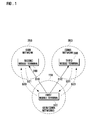
- FIG. 1 illustrates a voice signal and data transfer between mobile terminals on different networks according to an exemplary embodiment of the present invention
- FIGs. 2 and 3 are block diagrams illustrating a mobile terminal according to an exemplary embodiment of the present invention.
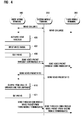
- FIG. 4 is a sequence diagram illustrating voice signal transfer between mobile terminals on different networks according to an exemplary embodiment of the present invention
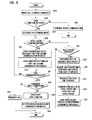
- FIG. 5 is a flowchart illustrating a control procedure of a mobile terminal for conference calling according to an exemplary embodiment of the present invention.
- FIG. 6 is a flowchart illustrating a control procedure of a mobile terminal for data sharing according to an exemplary embodiment of the present invention.
- a multi-standby mobile terminal of the present invention communicates with a Code Division Multiple Access (CDMA) network and a Global System for Mobile communications (GSM) network.
- CDMA Code Division Multiple Access
- GSM Global System for Mobile communications
- the present invention is not limited thereto, and the multi-standby mobile terminal may also communicate with other types of networks.
- a 'network' may denote one of a CDMA network, a GSM network, a network capable of providing a packet service and an extended or modified version thereof.
- a dual-standby mobile terminal capable of simultaneously communicating with a CDMA network and GSM network is described as a multi-standby mobile terminal.
- the multi-standby mobile terminal may also communicate with two or more of a CDMA network, GSM network and other types of networks.
- the multi-standby mobile terminal when the multi-standby mobile terminal is connected to other mobile terminals on different networks, the multi-standby mobile terminal permits all users in conversation to join a call for a multiparty conversation. During the multiparty connection, the multi-standby mobile terminal also permits all the users in conversation to share data. That is, when the multi-standby mobile terminal is connected to other mobile terminals on different networks, the multi-standby mobile terminal may transfer voice signals and data between mobile terminals.
- FIG. 1 illustrates voice signal/data transfer between mobile terminals on different networks according to an exemplary embodiment of the present invention.
- a first mobile terminal 100 is a multi-standby mobile terminal simultaneously communicating with GSM and CDMA networks 150
- a second mobile terminal 200 is a mobile terminal communicating with a GSM network 250
- a third mobile terminal 300 is a mobile terminal communicating with a CDMA network 350.
- the first mobile terminal 100 is connected to both the second mobile terminal 200 and the third mobile terminal 300. That is, the first mobile terminal 100 is connected to the second mobile terminal 200 through a GSM communication module for communication with the GSM network 250, and is connected to the third mobile terminal 300 through a CDMA communication module for communication with the CDMA network 350.
- the first mobile terminal 100 may activate a host function associated with one of a conference call and data sharing between the mobile terminals 200 and 300 on the GSM network 250 and the CDMA network 350 according to a host function control scheme set in advance or by a user request.
- the host function control scheme may automatically activate the host function when mobile terminals on different networks are connected together. Alternatively, when mobile terminals on different networks are connected together, the user may activate the host function by inputting a preset key.
- the host function is related to at least one of conference calling and data sharing.
- the first mobile terminal 100 When the host function is activated, the first mobile terminal 100 establishes a communication path to each of the second mobile terminal 200 and third mobile terminal 300, and sends a generated voice signal and data to the second mobile terminal 200 on the GSM network 250 and to the third mobile terminal 300 on the CDMA network 350.
- the first mobile terminal 100 may send a generated voice signal and data to a selected one of the second mobile terminal 200 on the GSM network 250 and the third mobile terminal 300 on the CDMA network 350. Thereto, the first mobile terminal 100 may leave open a transmission path leading to the selected mobile terminal and temporarily block a transmission path leading to the other mobile terminal. In this case, the reception path from the mobile terminal associated with the blocked transmission path may be left open or blocked. Therefore, reception of a voice signal or data from the mobile terminal may be continued or discontinued accordingly.
- the first mobile terminal 100 converts an analog voice signal of the user input from a microphone using Pulse Code Modulation (PCM) into PCM data, further converts the PCM data into a voice packet, and sends the voice packet to both the second mobile terminal 200 and third mobile terminal 300 (S10).
- PCM Pulse Code Modulation
- the first mobile terminal 100 may use a first communication module connecting to the second mobile terminal 200 on the GSM network 250, and a second communication module connecting to the third mobile terminal 300 on the CDMA network 350.
- the first mobile terminal 100 buffers the received voice packet, converts the voice packet into PCM data through pulse code modulation, further converts the PCM data into an analog voice signal and outputs the analog voice signal through a speaker.
- the first mobile terminal 100 converts the PCM data corresponding to the received voice packet into a voice packet (similar to a voice signal from the microphone), and sends the voice packet to the third mobile terminal 300 on the CDMA network 350 (S23). That is, voice packets from the second mobile terminal 200 on the GSM network 250 are output through the speaker of the first mobile terminal 100 and also sent to the third mobile terminal 300 on the CDMA network 350.
- the first mobile terminal 100 buffers the received voice packet, converts the voice packet into PCM data through pulse code modulation, further converts the PCM data into an analog voice signal, and outputs the analog voice signal through the speaker.
- the first mobile terminal 100 converts the PCM data corresponding to the received voice packet into a voice packet (similar to a voice signal from the microphone), and sends the voice packet to the second mobile terminal 200 on the GSM network 250 (S33). That is, voice packets from the third mobile terminal 300 on the CDMA network 350 are output through the speaker of the first mobile terminal 100 and also sent to the second mobile terminal 200 on the GSM network 250.
- the first mobile terminal 100 may send an input voice signal to at least one of the second mobile terminal 200 and third mobile terminal 300 on the GSM network 250 and the CDMA network 350.
- the first mobile terminal 100 outputs the received voice signal through the speaker and also sends the received voice signal to the other one of the second mobile terminal 200 and the third mobile terminal 300.
- the user of one of the second mobile terminal 200 and the third mobile terminal 300 on the GSM network 250 and CDMA network 350 may receive the voice signal that the user of the other mobile terminal sends to the first mobile terminal 100. That is, a multiparty call between different networks may be served.
- the first mobile terminal 100 sends its data to the second mobile terminal 200 and third mobile terminal 300.
- the first mobile terminal 100 sends data through the first communication module for GSM communication to the second mobile terminal 200 on the GSM network 250, and also sends the data through the second communication module for CDMA communication to the third mobile terminal 300 on the CDMA network 350 (S10).
- the data may include any type of data that may be generated in a mobile terminal such as a photograph, a moving image, a song, a text message, an electronic mail, a document and the like.
- the first mobile terminal 100 may store the received data in a first storage area.
- the first mobile terminal 100 may transfer the received data stored in the first storage area to a sharing storage area for data sharing, and further transfer the received data to a second storage area.
- the first mobile terminal 100 sends the received data in the second storage area to the third mobile terminal 300 on the CDMA network 350 (S23).
- the first mobile terminal 100 may output the data received from the second mobile terminal 200 through its output unit, such as a display unit or speaker.
- the first mobile terminal 100 may store the received data in the second storage area.
- the first mobile terminal 100 may transfer the received data stored in the second storage area to the sharing storage area for data sharing, and further transfer the received data to the first storage area.
- the first mobile terminal 100 sends the received data in the first storage area to the second mobile terminal 200 on the GSM network 250 (S33).
- the first mobile terminal 100 may output the data received from the third mobile terminal 300 through its output unit such as a display unit or speaker.
- FIGs. 2 and 3 are block diagrams illustrating a mobile terminal according to an exemplary embodiment of the present invention.
- FIG. 2 is related to voice signal transfer
- FIG. 3 is related to data transfer.
- the configurations shown in FIGs. 2 and 3 are only for the purpose of description, and are merely examples of the multi-standby mobile terminal of the present invention.
- the mobile terminal in FIGs. 2 and 3 is a dual-standby mobile terminal and is assumed to be in overlapping service areas of a GSM network and CDMA network.
- the mobile terminal as a dual-standby mobile terminal may include two slots accommodating CDMA and GSM cards for communicating with the corresponding networks, or one slot accommodating a dual card supporting both the CDMA network and GSM network.
- the dual-standby mobile terminal having a host function includes a first antenna 110, second antenna 115, first communication module 120 for a first communication service (for example, a GSM communication service), second communication module 125 for a second communication service (for example, a CDMA communication service), control unit 130, vocoder 135, codec 160, first storage area 170, second storage area 175, and sharing storage area 180.
- first communication service for example, a GSM communication service
- second communication module 125 for a second communication service
- control unit 130 for example, a CDMA communication service
- codec 160 codec 160
- first storage area 170 for example, second storage area 175, and sharing storage area 180.
- the control unit 130 includes a master modem 140 and slave modem 145.
- the master modem 140 controls communication with the GSM network as a primary controller and the slave modem 145 controls communication with the CDMA network.
- the roles of the master modem 140 and slave modem 145 are not fixed and may be changed according to their performance.
- the first antenna 110 covers a first frequency band for a first communication service (for example, a GSM communication service), and the second antenna 115 covers a second frequency band for a second communication service (for example, a CDMA communication service).
- a first communication service for example, a GSM communication service
- the second antenna 115 covers a second frequency band for a second communication service (for example, a CDMA communication service).
- the first antenna 110 and second antenna 115 are configured as separate antennas in FIGs. 2 and 3 , they may be configured as a single antenna covering multiple frequency bands.
- the first communication module 120 establishes a communication channel to the GSM network serving a mobile terminal (the second mobile terminal 200), and sends and receives Radio Frequency (RF) signals according to GSM communication.
- the second communication module 125 establishes a communication channel to the CDMA network serving a mobile terminal (the third mobile terminal 300), and sends and receives RF signals according to CDMA communication.
- the control unit 130 functions as a special purpose processor that controls the first communication module 120 and second communication module 125 to communicate with corresponding networks.
- the control unit 130 also controls signal exchange between the first communication module 120, second communication module 125, vocoder 135, codec 160, first storage area 170, second storage area 175 and sharing storage area 180.
- the control unit 130 determines a requested communication service, and controls at least one of the first communication module 120 and second communication module 125 to connect to a corresponding network according to the determination.
- the control unit 130 controls at least one of the first communication module 120 and second communication module 125 to connect to the requesting network.
- the control unit 130 controls the first communication module 120 and the second communication module 125 to connect to the corresponding networks.
- the control unit 130 may block the operation of an unrequested one of the first communication module 120 and second communication module 125.
- the control unit 130 may control the first communication module 120 and second communication module 125 according to communication conditions of the corresponding networks.
- the dual-standby mobile terminal may transition to a dual-standby mode by simultaneously activating the first communication module 120 and second communication module 125 upon a power-on state.
- the dual-standby mobile terminal may handle incoming calls from the GSM network and CDMA network at the same time.
- the dual-standby mobile terminal may handle incoming and outgoing calls through one of the first communication module 120 and the second communication module 125 when a preferred network is pre-selected.
- the dual-standby mobile terminal may control at least one of the first communication module 120 and the second communication module 125 for communication according to network conditions.
- control unit 130 includes the master modem 140 and the slave modem 145.
- the master modem 140 may act as a main controller of the first mobile terminal 100, and control signal transmission and reception through the first communication module 120 and the second communication module 125.
- the master modem 140 examines a signal from one of the first communication module 120 and the second communication module 125, and may process the signal by itself or control the slave modem 145 to process the signal based on the examination.
- the master modem 140 controls the second communication module 125 to send the received voice signal or data to the third mobile terminal 300 on the CDMA network 350.
- the master modem 140 also controls the output means, such as a display unit and speaker, to output the voice signal or data received from the second mobile terminal 200.
- the master modem 140 may control an operation to convert a voice signal of the user input by the microphone MIC into a voice packet, and to send the voice packet to the second mobile terminal 200 through the first communication module 120.
- the master modem 140 may also control an operation to convert data stored in the sharing storage area 180 into a data packet, and to send the data packet to the second mobile terminal 200 through the first communication module 120.
- the slave modem 145 controls the operation of the first mobile terminal 100 under the control of the master modem 140.
- the slave modem 145 controls the first communication module 120 to send the received voice signal or data to the second mobile terminal 200 on the GSM network 350.
- the slave modem 145 also controls the output means, such as a display unit or speaker, to output the voice signal or data received from the third mobile terminal 300.
- the slave modem 145 may control an operation to convert a voice signal of the user input by the microphone MIC into a voice packet, and to send the voice packet to the third mobile terminal 300 through the second communication module 125.
- the slave modem 145 may also control an operation to convert data stored in the sharing storage area 180 into a data packet, and to send the data packet to the third mobile terminal 300 through the second communication module 125.
- the master modem 140 forwards the received voice packet to the vocoder 135 (S21).
- the master modem 140 notifies the slave modem 145 of the reception and transfers control to the slave modem 145, which then forwards the received voice packet to the vocoder 135 (S31).
- the master modem 140 When a voice packet from the vocoder 135 is detected, the master modem 140 identifies the destination of the voice packet, and controls the first communication module 120 to send the voice packet to the GSM network 250 according to the identification (S10 and S33). The slave modem 145 controls the second communication module 125 to send the voice packet from the vocoder 135 to the CDMA network 350 (S10 and S23).
- the control unit 130 may control loopback of PCM data processed by the vocoder 135 (S22 and S32, or S22' and S32'). That is, when the dual-standby mobile terminal is in communication with both the GSM network and CDMA network and the host function is activated, to transfer a voice packet from one of the GSM network 250 and CDMA network 350 to the other network, the control unit 130 may control loopback of PCM data corresponding to the voice packet (S22 and S32, or S22' and S32').
- the PCM data may be looped back from output terminals of the vocoder 135 (S22 and S32) or from input terminals of the codec 160 (S22' and S32'), depending upon the design.
- the vocoder 135 decodes a voice packet from the control unit 130 into PCM data, and outputs the PCM data to the codec 160 (S21 or S31).
- the vocoder 135 encodes PCM data from the codec 160 into a voice packet, and outputs the voice packet to the control unit 130 (S10, S33 or S23). That is, the vocoder 135 encodes and decodes a voice signal (voice packet, PCM data).
- the vocoder 135 may return a voice packet from the control unit 130 thereto for loopback according to settings.
- the codec 160 converts PCM data from the vocoder 135 into an analog voice signal (S21 or S31), and sends the analog voice signal to the speaker (SPK), which then outputs the analog voice signal as an audible sound.
- the codec 160 converts an analog voice signal from the microphone (MIC) into PCM data, and sends the PCM data to the vocoder 135 (S10).
- the codec 160 may return PCM data from the vocoder 135 thereto for loopback according to settings (S21 or S31) (S22' or S32') (S33 or S23).
- the master modem 140 and slave modem 145 of the control unit 130 perform the host function in response to a data transfer event in communication with the second mobile terminal 200 and the third mobile terminal 300.
- a data transfer event may occur when data is received from a mobile terminal in communication or when the user of the first mobile terminal 100 issues a request for data transmission.
- a data transfer event may occur while the first mobile terminal 100 is in communication with the second mobile terminal 200 and third mobile terminal 300, or during a data-only connection.
- the master modem 140 When data is received through the first communication module 120 from the second mobile terminal 200 (the data from the second mobile terminal 200 is referred to as "first data") after activation of the host function, the master modem 140 demodulates the received data according to a preset format and stores the demodulated data in the first storage area 170. Upon detection of a data transfer event associated with the first data, the master modem 140 stores the first data in the sharing storage area 180 and outputs an interrupt signal to the slave modem 145 for notification of the first data.
- the slave modem 145 moves the first data in the sharing storage area 180 to the second storage area 175, modulates the first data, converts the modulated first data into a data packet and sends the data packet through the second communication module 125 to the third mobile terminal 300.
- the master modem 140 transfers the control to the slave modem 145.
- the slave modem 145 demodulates the received second data according to a preset format, and stores the demodulated second data in the second storage area 175.
- the slave modem 145 Upon detection of a data transfer event associated with the second data, stores the second data in the sharing storage area 180 and outputs an interrupt signal to the master modem 140 for notification of the second data.
- the master modem 140 moves the second data in the sharing storage area 180 to the first storage area 170, modulates the second data according to a preset format, converts the modulated second data into a data packet and sends the data packet through the first communication module 120 to the second mobile terminal 200.
- the master modem 140 may output, according to a preset option or user request, the received data (first data and second data) through the output means, such as a display unit and speaker, in accordance with data types.
- the first storage area 170 and second storage area 175 may store various types of data and voice signals (voice packet and PCM data), and may include a flash memory that preserves data even in a power-off state and enables easy data read and write.
- One of the first storage area 170 and second storage area 175 may store an application and associated setting data in relation to the host function.
- the sharing storage area 180 acts as a medium linking the master modem 140 and slave modem 145 together. That is, when the master modem 140 writes first data for the slave modem 145, the master modem 140 sends an interrupt signal to the slave modem 145 for notification of the first data. When the slave modem 145 writes second data for the master modem 140, the slave modem 145 sends an interrupt signal to the master modem 140 for notification of the second data.
- the sharing storage area 180 may include a dual port RAM.
- first storage area 170, second storage area 175 and sharing storage area 180 are represented as separate entities in FIG. 3 , they may be formed as a single memory unit, which includes a storage section corresponding to the first storage area 170 and second storage area 175, and a sharing section corresponding to the sharing storage area 180.
- control unit 130 vocoder 135 and codec 160 are represented as separate entities in FIG. 2 , they may be formed as a single chip control unit, which includes the master modem 140, slave modem 145, vocoder 135 and codec 160.
- the dual-standby mobile terminal of the present invention having two cards (GSM card and CDMA card) is connected to two mobile terminals on the GSM network 250 and CDMA network 350
- the dual-standby mobile terminal may adjust voice and data transmission paths to transfer voice signals and data between the mobile terminals on the different networks.
- the first mobile terminal 100 may send a voice packet or data packet to the second mobile terminal 200 on the GSM network 250 through the first communication module 120 and to the third mobile terminal 300 on the CDMA network 350 through the second communication module 125.
- the first mobile terminal 100 When the first mobile terminal 100 is connected to both the second mobile terminal 200 and third mobile terminal 300, the first mobile terminal 100 may block one of the two connections for transmission of a voice packet or data packet. Thereto, the first mobile terminal 100 may have a toggle function to selectively block the connections, and may include an input key for the toggle function.
- the first mobile terminal 100 When a voice signal is received from the second mobile terminal 200 on the GSM network 250, the first mobile terminal 100 returns, for loopback, the voice signal at the vocoder 135 or codec 160 to the second communication module 125 communicating with the CDMA network 350. Then, the second communication module 125 may send the voice signal from the second mobile terminal 200 on the GSM network 250 to the third mobile terminal 300 on the CDMA network 350.
- the first mobile terminal 100 may transfer a voice signal from the third mobile terminal 300 on the CDMA network 350 to the second mobile terminal 200 on the GSM network 250.
- the first mobile terminal 100 may transfer a voice signal from a network to another network for loopback, like a voice signal input from the first mobile terminal 100, providing a multi-party call service. That is, the second mobile terminal 200 and third mobile terminal 300 on the different networks may be connected together through the first mobile terminal 100 and make a conference call.
- the dual-standby mobile terminal supporting the GSM network 250 and CDMA network 350 is described as an example of the multi-standby mobile terminal of the present invention, the dual-standby mobile terminal is not limited to the GSM network and CDMA network.
- the dual-standby mobile terminal of the present invention may also be applied to a multi-standby mobile terminal supporting two or more existing commercial communication networks as well as those to be developed and deployed in the future.
- FIG. 4 is a sequence diagram illustrating voice signal transfer between mobile terminals on different networks according to an exemplary embodiment of the present invention.
- the first mobile terminal 100 makes a call to the second mobile terminal 200 on the GSM network 250 in step S401 and to the third mobile terminal 300 on the CDMA network 350 in step S403.
- the first mobile terminal 100 activates the host function in response to a request event in step S405.
- a request event is related to the host function, and may correspond to an event generated by the user or to a preset event automatically generated when a call is made between mobile terminals on different networks.
- the first mobile terminal 100 may perform an operation related to sending or receiving a voice signal.
- the first mobile terminal 100 sends a voice signal first and then receives a voice signal from the second mobile terminal 200 or third mobile terminal 300.
- a receiving operation may be performed before or at the same time as a sending operation.
- the first mobile terminal 100 receives a voice signal of the user input from the microphone in step S407, and converts the voice signal to a voice packet through an above-described process for an originating voice signal and sets transmission paths for the voice packet in step S409. That is, because the first mobile terminal 100 is in communication with the second mobile terminal 200 on the GSM network 250 and the third mobile terminal 300 on the CDMA network 350, the first mobile terminal 100 reserves the first communication module 120 in relation to GSM communication and the second communication module 125 in relation to CDMA communication for voice packet paths.
- the first mobile terminal 100 sends the voice packet to the second mobile terminal 200 through the first communication module 120 in step S411, and to the third mobile terminal 300 through the second communication module 125 in step S413.
- the first mobile terminal 100 sends the voice packet to one of the second mobile terminal 200 and the third mobile terminal 300.
- the first mobile terminal 100 may process a voice packet coming from one of the second mobile terminal 200 on the GSM network 250 and the third mobile terminal 300 on the CDMA network 350.
- the first mobile terminal 100 receives a first voice packet from the second mobile terminal 200 in step S415 and receives a second voice packet from the third mobile terminal 300 in step S417.
- the first mobile terminal 100 converts the first voice packet and second voice packet to PCM data through an above-described process for a received voice packet, outputs the PCM data through the speaker (SPK), and starts a loopback process for the PCM data in step S419.
- the first mobile terminal 100 converts the PCM data into voice packets through the above-described process for an originating voice signal, and sets transmission paths for the voice packets in step S421. That is, the first mobile terminal 100 reserves the second communication module 125, communicating with the third mobile terminal 300 on the CDMA network 350, for the voice packet associated with the second mobile terminal 200. The first mobile terminal 100 also reserves the first communication module 125, communicating with the second mobile terminal 200 on the GSM network 250, for the voice packet associated with the third mobile terminal 300.
- the first mobile terminal 100 sends, through the set paths, the voice packet associated with the third mobile terminal 300 to the second mobile terminal 200 in step S423, and also sends the voice packet associated with the second mobile terminal 200 to the third mobile terminal 300 in step S425.
- FIG. 5 is a flowchart illustrating a control procedure of a mobile terminal for conference calling according to an exemplary embodiment of the present invention.
- a first mobile terminal 100 makes a call to a second mobile terminal 200 on a first network and to a third mobile terminal 300 on a second network in step S501. It is assumed that the first mobile terminal 100 is a multi-standby mobile terminal of the present invention, the first network is a GSM network 250, and the second network is a CDMA network 350. Hence, the first network is assumed to be distinct from the second network.
- the first mobile terminal 100 verifies activation of the host function in step S503.
- the host function may be activated in response to a user request, or be automatically activated when a multiparty call is made between mobile terminals on different networks.
- step S503 may correspond to determining whether a user request for the host function is issued or an option for automatic host function activation is set.
- the first mobile terminal privately communicates with one of the second mobile terminal and third mobile terminal in step S505. That is, the first mobile terminal 100 may send and receive voice packets to and from one of the second mobile terminal 200 and third mobile terminal 300, and the other mobile terminal may remain in a wait mode until resumption of voice signal transmission.
- the first mobile terminal activates a path control mode to control transmission and reception paths for voice packets in step S507.
- the procedure is optional and may be skipped.
- the first mobile terminal determines whether a voice signal is input from the microphone in step S509.
- the first mobile terminal 100 converts the voice signal into a voice packet, opens voice transmission paths involving the first communication module leading to the first network and second communication module leading to the second network in step S511, and sends the voice packet to the second mobile terminal 200 on the first network and to the third mobile terminal 300 on the second network in step S513.
- the first mobile terminal 100 may block one of the voice transmission paths according to a user request, and send the voice packet to only one of the second mobile terminal 200 and third mobile terminal 300.
- the first mobile terminal determines whether a voice packet is received from one of the second mobile terminal 200 and third mobile terminal 300 in step S521. If a voice packet is received, the first mobile terminal 100 determines which of the second mobile terminal 200 and third mobile terminal 300 has sent the voice packet in step S523. That is, the first mobile terminal 100 determines whether the received voice packet is received through the first communication module 120 and associated with the second mobile terminal 200 on the first network, or is received through the second communication module 125 and associated with the third mobile terminal 300 on the second network. Then, the first mobile terminal may determine the voice transmission path for loopback.
- the first mobile terminal 100 decodes the received voice packet into PCM data and outputs the PCM data through the speaker in step S525.
- the first mobile terminal 100 converts the PCM data into a voice packet for loopback in step S525, and opens a corresponding voice transmission path in step S529.
- the first mobile terminal 100 reserves one of the first communication module 120 and second communication module 125 involved in the voice transmission path for loopback.
- the first mobile terminal 100 sends the voice packet through the reserved communication module to the corresponding mobile terminal in step S531.
- the network associated with the incoming voice packet is distinct from that associated with the outgoing voice packet for loopback.
- the first mobile terminal 100 determines whether a call termination request is issued in step S541. If a call termination request is issued, the first mobile terminal 100 determines whether the issued call termination request applies to both the first mobile terminal 100 and second mobile terminal 200 in step S543. If the issued call termination request applies to both the first mobile terminal 100 and second mobile terminal 200, the first mobile terminal 100 deactivates the first communication module 120 and second communication module 125 to terminate the multiparty call in step S545.
- the first mobile terminal 100 terminates the call to the requested mobile terminal and deactivates the host function in step S547.
- the first mobile terminal 100 sets a voice transmission and reception path to the mobile terminal still in communication in step S549. That is, voice packets are processed in an ordinary (e.g., separate call) manner.
- FIG. 6 is a flowchart illustrating a control procedure of a mobile terminal for data sharing according to an exemplary embodiment of the present invention.
- the present invention is not limited to the above assumption, and data transfer may be performed while a call connection is not made between mobile terminals. Further, the first mobile terminal 100 may transfer data received from the third mobile terminal 300 to the second mobile terminal 200, and may send data to one or both of the second mobile terminal 200 and third mobile terminal 300.
- the master modem of the first mobile terminal 100 receives data through the first communication module 120 from the second mobile terminal 200 in step S601, stores the received data in the first storage area 170 in step S603, and outputs information on the received data through an output means according to settings in step S605. If an option for information on received data is not set, step S605 may be skipped.
- the master modem determines whether a transmission request for the received data is issued in step S607.
- a transmission request for received data may be automatically issued when data is received from the second mobile terminal 200, or be issued in response to a user selection.
- the master modem stores the received data in the sharing storage area 180 in step (S609), and sends an interrupt signal to the slave modem for notification of the data.
- the slave modem moves the received data in the sharing storage area 180 to the second storage area 175 in step S611, and sends the received data through the second communication module 125 to the third mobile terminal 300 in step S613.
- the master modem determines whether an output request for the received data is issued in step S621. If an output request for the received data is issued, the master modem outputs the received data stored in the first storage area 170 through an output means, such as a display unit or speaker in step S623.
- the master modem performs a requested operation in step S625. For example, the master modem may await a command from the user for the data.
Landscapes
- Engineering & Computer Science (AREA)
- Signal Processing (AREA)
- Computer Networks & Wireless Communication (AREA)
- Multimedia (AREA)
- Mobile Radio Communication Systems (AREA)
- Telephonic Communication Services (AREA)
Applications Claiming Priority (2)
| Application Number | Priority Date | Filing Date | Title |
|---|---|---|---|
| KR20080007169 | 2008-01-23 | ||
| KR1020080044322A KR20090081310A (ko) | 2008-01-23 | 2008-05-14 | 멀티스탠바이 휴대단말에서 호스트 기능 지원 방법 및 장치 |
Publications (3)
| Publication Number | Publication Date |
|---|---|
| EP2083606A2 true EP2083606A2 (de) | 2009-07-29 |
| EP2083606A3 EP2083606A3 (de) | 2012-04-18 |
| EP2083606B1 EP2083606B1 (de) | 2014-01-01 |
Family
ID=40564996
Family Applications (1)
| Application Number | Title | Priority Date | Filing Date |
|---|---|---|---|
| EP09151156.8A Ceased EP2083606B1 (de) | 2008-01-23 | 2009-01-22 | Mobiles Endgerät mit Multi-Bereitschaft und Verfahren zur Host-Funktionsbereitstellung dafür |
Country Status (4)
| Country | Link |
|---|---|
| US (1) | US8565742B2 (de) |
| EP (1) | EP2083606B1 (de) |
| KR (1) | KR20090081310A (de) |
| CN (1) | CN101494928B (de) |
Families Citing this family (18)
| Publication number | Priority date | Publication date | Assignee | Title |
|---|---|---|---|---|
| JP5531767B2 (ja) | 2009-07-31 | 2014-06-25 | ソニー株式会社 | 送信電力制御方法、通信装置及びプログラム |
| JP5565082B2 (ja) | 2009-07-31 | 2014-08-06 | ソニー株式会社 | 送信電力決定方法、通信装置及びプログラム |
| JP5429036B2 (ja) | 2009-08-06 | 2014-02-26 | ソニー株式会社 | 通信装置、送信電力制御方法、及びプログラム |
| JP5353812B2 (ja) * | 2009-08-12 | 2013-11-27 | ソニー株式会社 | 通信制御方法、通信装置、及びプログラム |
| KR101580157B1 (ko) * | 2009-08-24 | 2015-12-28 | 삼성전자주식회사 | 듀얼 모드 단말의 데이터 송수신 장치 및 방법 |
| CN101945244A (zh) * | 2010-09-03 | 2011-01-12 | 中兴通讯股份有限公司 | 会议电视的远端环回控制方法、系统和内置mcu会议终端 |
| CN102568480A (zh) * | 2010-12-27 | 2012-07-11 | 深圳富泰宏精密工业有限公司 | 双模手机语音传输系统 |
| CN102833701B (zh) * | 2011-06-15 | 2017-05-10 | 中兴通讯股份有限公司 | 多模终端的短信发送方法及多模终端 |
| KR20130019159A (ko) * | 2011-08-16 | 2013-02-26 | 삼성전자주식회사 | 이동통신단말기에서 다자 통화 서비스를 제공하기 위한 장치 및 방법 |
| CN103368622B (zh) * | 2012-03-27 | 2017-02-22 | 联芯科技有限公司 | 多模双待终端及其天线资源分配方法 |
| KR102003850B1 (ko) * | 2012-06-04 | 2019-07-25 | 삼성전자주식회사 | 단말의 애플리케이션 제공 방법 및 그 단말 |
| CN102917326B (zh) * | 2012-10-15 | 2016-03-30 | 华为终端有限公司 | 双卡双通终端的通信方法、装置及双卡双通终端 |
| CN105472774B (zh) * | 2015-09-25 | 2018-12-07 | 努比亚技术有限公司 | 用户设备、无线通信方法及终端 |
| CN105657691B (zh) * | 2016-01-27 | 2020-02-07 | 努比亚技术有限公司 | 移动终端及其双芯片系统的数据共享方法 |
| CN105611010B (zh) * | 2016-03-25 | 2018-08-24 | 银隆新能源股份有限公司 | 移动通信终端 |
| US10979530B2 (en) * | 2017-03-03 | 2021-04-13 | LGS Innovations LLC | Methods and apparatuses for batch radio resource command and control |
| KR102521830B1 (ko) * | 2018-09-19 | 2023-04-17 | 현대자동차주식회사 | 모바일 데이터 공유를 위한 제어방법 및 그 제어방법을 제공하는 차량 |
| CN110365849A (zh) * | 2019-07-29 | 2019-10-22 | 深圳市沃特沃德股份有限公司 | 一种多方通话的方法、装置、存储介质和计算机设备 |
Citations (3)
| Publication number | Priority date | Publication date | Assignee | Title |
|---|---|---|---|---|
| WO1999063735A1 (de) | 1998-06-03 | 1999-12-09 | Chaussy, Christian | Zusatzvorrichtung für mobilfunkgeräte zur verbindung mit telekommunikationsnetzen |
| EP1052863A2 (de) | 1999-05-11 | 2000-11-15 | Kyocera Corporation | Multimode Mobiltelefongerät |
| US20070110029A1 (en) | 2005-11-12 | 2007-05-17 | Motorola, Inc. | Method for linking communication channels of disparate access technologies in a selective call unit |
Family Cites Families (6)
| Publication number | Priority date | Publication date | Assignee | Title |
|---|---|---|---|---|
| US6594688B2 (en) * | 1993-10-01 | 2003-07-15 | Collaboration Properties, Inc. | Dedicated echo canceler for a workstation |
| KR100241901B1 (ko) * | 1997-08-28 | 2000-02-01 | 윤종용 | 핸드셋과 핸즈프리킷 공용 음성인식기의 등록 엔트리 관리방법 |
| KR100365800B1 (ko) | 2000-06-09 | 2002-12-26 | 삼성전자 주식회사 | 아날로그모드에서 음성기능이 가능한 이중모드 무선이동 통신기기 |
| US20060019698A1 (en) * | 2004-07-23 | 2006-01-26 | Motorola, Inc. | Method and apparatus for radio system with multiple communication modes |
| JP4438671B2 (ja) * | 2005-03-31 | 2010-03-24 | 日本電気株式会社 | マルチモーダルサービス提供方法及び提供システム並びにその制御プログラム |
| CN1992958A (zh) * | 2005-12-28 | 2007-07-04 | 上海原动力通信科技有限公司 | 不同接入系统共存时多模终端的网络附着方法 |
-
2008
- 2008-05-14 KR KR1020080044322A patent/KR20090081310A/ko not_active Ceased
-
2009
- 2009-01-22 CN CN2009100059714A patent/CN101494928B/zh not_active Expired - Fee Related
- 2009-01-22 US US12/358,045 patent/US8565742B2/en active Active
- 2009-01-22 EP EP09151156.8A patent/EP2083606B1/de not_active Ceased
Patent Citations (3)
| Publication number | Priority date | Publication date | Assignee | Title |
|---|---|---|---|---|
| WO1999063735A1 (de) | 1998-06-03 | 1999-12-09 | Chaussy, Christian | Zusatzvorrichtung für mobilfunkgeräte zur verbindung mit telekommunikationsnetzen |
| EP1052863A2 (de) | 1999-05-11 | 2000-11-15 | Kyocera Corporation | Multimode Mobiltelefongerät |
| US20070110029A1 (en) | 2005-11-12 | 2007-05-17 | Motorola, Inc. | Method for linking communication channels of disparate access technologies in a selective call unit |
Also Published As
| Publication number | Publication date |
|---|---|
| CN101494928B (zh) | 2012-12-12 |
| US20090186608A1 (en) | 2009-07-23 |
| KR20090081310A (ko) | 2009-07-28 |
| CN101494928A (zh) | 2009-07-29 |
| US8565742B2 (en) | 2013-10-22 |
| EP2083606B1 (de) | 2014-01-01 |
| EP2083606A3 (de) | 2012-04-18 |
Similar Documents
| Publication | Publication Date | Title |
|---|---|---|
| EP2083606B1 (de) | Mobiles Endgerät mit Multi-Bereitschaft und Verfahren zur Host-Funktionsbereitstellung dafür | |
| EP1359779B1 (de) | Mobilfunkendgerät | |
| CA2621681C (en) | Radio accessory for a mobile device | |
| US6941156B2 (en) | Automatic handoff for wireless piconet multimode cell phone | |
| US20060264235A1 (en) | Method and system for transmitting character messages in mobile communication terminal during conversation by telephone | |
| US6243573B1 (en) | Personal communications system | |
| US8190178B2 (en) | Cellular phone and mobile switching controller | |
| US20160219418A1 (en) | Hybrid terminal capable of avoiding signals originated by own terminal | |
| US20060172727A1 (en) | Method of providing one-to-one call during conference call in a mobile terminal | |
| JP3839582B2 (ja) | 移動体通信システムにおける待ち受け処理方式 | |
| JPH11205219A (ja) | パケット通信カード | |
| US12244753B2 (en) | Dual-mode voice communications system | |
| CN101150335A (zh) | 实现多种功能的蓝牙电话终端设备 | |
| US20050265311A1 (en) | Method for establishing packet-switched connection, and cellular network utilizing the method, and cellular terminal | |
| CN101662845B (zh) | 一种移动终端对讲通信中话权切换的方法 | |
| EP0661897A1 (de) | Vermittlungsanordnung zum Weiterreichen von schnurlosen Endgeräten von einer Feststation zur anderen mittels Verfahren welche für leitungsgebundene Endgeräte verwendet werden | |
| CN102480313B (zh) | 移动无线电通信装置 | |
| KR100241723B1 (ko) | 유무선 통화 기능을 가지는 전화기의 기능 확대장치 및방법 | |
| JPH09233547A (ja) | 移動通信着信方式 | |
| JP2001086562A (ja) | 移動無線通信システム、移動無線通信用端末、及び移動無線通信用基地局 | |
| JP2000101506A (ja) | 外部有線インタフェースおよび赤外線インタフェース付き移動通信端末 | |
| JP4447335B2 (ja) | 移動体通信システムにおける緊急通信処理システム及び方法 | |
| JP2002290307A (ja) | 無線装置 | |
| US20030218975A1 (en) | Communication terminal, operating equipment, communication system, and communication control method | |
| JP2001285946A (ja) | 無線通信システム及び無線通信装置 |
Legal Events
| Date | Code | Title | Description |
|---|---|---|---|
| PUAI | Public reference made under article 153(3) epc to a published international application that has entered the european phase |
Free format text: ORIGINAL CODE: 0009012 |
|
| 17P | Request for examination filed |
Effective date: 20090122 |
|
| AK | Designated contracting states |
Kind code of ref document: A2 Designated state(s): AT BE BG CH CY CZ DE DK EE ES FI FR GB GR HR HU IE IS IT LI LT LU LV MC MK MT NL NO PL PT RO SE SI SK TR |
|
| AX | Request for extension of the european patent |
Extension state: AL BA RS |
|
| PUAL | Search report despatched |
Free format text: ORIGINAL CODE: 0009013 |
|
| AK | Designated contracting states |
Kind code of ref document: A3 Designated state(s): AT BE BG CH CY CZ DE DK EE ES FI FR GB GR HR HU IE IS IT LI LT LU LV MC MK MT NL NO PL PT RO SE SI SK TR |
|
| AX | Request for extension of the european patent |
Extension state: AL BA RS |
|
| RIC1 | Information provided on ipc code assigned before grant |
Ipc: H04M 3/56 20060101ALN20120313BHEP Ipc: H04W 88/04 20090101AFI20120313BHEP |
|
| RAP1 | Party data changed (applicant data changed or rights of an application transferred) |
Owner name: SAMSUNG ELECTRONICS CO., LTD. |
|
| AKX | Designation fees paid |
Designated state(s): DE GB NL |
|
| GRAP | Despatch of communication of intention to grant a patent |
Free format text: ORIGINAL CODE: EPIDOSNIGR1 |
|
| RIC1 | Information provided on ipc code assigned before grant |
Ipc: H04M 3/56 20060101ALN20130531BHEP Ipc: H04W 88/04 20090101AFI20130531BHEP |
|
| INTG | Intention to grant announced |
Effective date: 20130701 |
|
| GRAS | Grant fee paid |
Free format text: ORIGINAL CODE: EPIDOSNIGR3 |
|
| GRAA | (expected) grant |
Free format text: ORIGINAL CODE: 0009210 |
|
| AK | Designated contracting states |
Kind code of ref document: B1 Designated state(s): DE GB NL |
|
| REG | Reference to a national code |
Ref country code: GB Ref legal event code: FG4D |
|
| REG | Reference to a national code |
Ref country code: DE Ref legal event code: R096 Ref document number: 602009021097 Country of ref document: DE Effective date: 20140213 |
|
| REG | Reference to a national code |
Ref country code: NL Ref legal event code: T3 |
|
| REG | Reference to a national code |
Ref country code: DE Ref legal event code: R026 Ref document number: 602009021097 Country of ref document: DE |
|
| PLBI | Opposition filed |
Free format text: ORIGINAL CODE: 0009260 |
|
| 26 | Opposition filed |
Opponent name: FRITSCHE, ENRICO Effective date: 20140929 |
|
| PLAX | Notice of opposition and request to file observation + time limit sent |
Free format text: ORIGINAL CODE: EPIDOSNOBS2 |
|
| REG | Reference to a national code |
Ref country code: DE Ref legal event code: R026 Ref document number: 602009021097 Country of ref document: DE Effective date: 20140929 |
|
| PLAF | Information modified related to communication of a notice of opposition and request to file observations + time limit |
Free format text: ORIGINAL CODE: EPIDOSCOBS2 |
|
| PLBB | Reply of patent proprietor to notice(s) of opposition received |
Free format text: ORIGINAL CODE: EPIDOSNOBS3 |
|
| PLAB | Opposition data, opponent's data or that of the opponent's representative modified |
Free format text: ORIGINAL CODE: 0009299OPPO |
|
| PLAB | Opposition data, opponent's data or that of the opponent's representative modified |
Free format text: ORIGINAL CODE: 0009299OPPO |
|
| R26 | Opposition filed (corrected) |
Opponent name: FRITSCHE, ENRICO Effective date: 20140929 |
|
| R26 | Opposition filed (corrected) |
Opponent name: ENRICO FRITSCHE Effective date: 20140929 |
|
| REG | Reference to a national code |
Ref country code: DE Ref legal event code: R100 Ref document number: 602009021097 Country of ref document: DE |
|
| PLCK | Communication despatched that opposition was rejected |
Free format text: ORIGINAL CODE: EPIDOSNREJ1 |
|
| PLBN | Opposition rejected |
Free format text: ORIGINAL CODE: 0009273 |
|
| STAA | Information on the status of an ep patent application or granted ep patent |
Free format text: STATUS: OPPOSITION REJECTED |
|
| 27O | Opposition rejected |
Effective date: 20161018 |
|
| PGFP | Annual fee paid to national office [announced via postgrant information from national office to epo] |
Ref country code: NL Payment date: 20191223 Year of fee payment: 12 |
|
| REG | Reference to a national code |
Ref country code: NL Ref legal event code: MM Effective date: 20210201 |
|
| PG25 | Lapsed in a contracting state [announced via postgrant information from national office to epo] |
Ref country code: NL Free format text: LAPSE BECAUSE OF NON-PAYMENT OF DUE FEES Effective date: 20210201 |
|
| PGFP | Annual fee paid to national office [announced via postgrant information from national office to epo] |
Ref country code: GB Payment date: 20211220 Year of fee payment: 14 |
|
| PGFP | Annual fee paid to national office [announced via postgrant information from national office to epo] |
Ref country code: DE Payment date: 20211220 Year of fee payment: 14 |
|
| REG | Reference to a national code |
Ref country code: DE Ref legal event code: R119 Ref document number: 602009021097 Country of ref document: DE |
|
| GBPC | Gb: european patent ceased through non-payment of renewal fee |
Effective date: 20230122 |
|
| PG25 | Lapsed in a contracting state [announced via postgrant information from national office to epo] |
Ref country code: GB Free format text: LAPSE BECAUSE OF NON-PAYMENT OF DUE FEES Effective date: 20230122 Ref country code: DE Free format text: LAPSE BECAUSE OF NON-PAYMENT OF DUE FEES Effective date: 20230801 |