EP2090329B1 - Cathéter, système d'introduction d'une endoprothèse intraluminale et procédé de fabrication de celle-ci - Google Patents
Cathéter, système d'introduction d'une endoprothèse intraluminale et procédé de fabrication de celle-ci Download PDFInfo
- Publication number
- EP2090329B1 EP2090329B1 EP20090150824 EP09150824A EP2090329B1 EP 2090329 B1 EP2090329 B1 EP 2090329B1 EP 20090150824 EP20090150824 EP 20090150824 EP 09150824 A EP09150824 A EP 09150824A EP 2090329 B1 EP2090329 B1 EP 2090329B1
- Authority
- EP
- European Patent Office
- Prior art keywords
- balloon
- catheter
- active substance
- pharmaceutically active
- wing
- Prior art date
- Legal status (The legal status is an assumption and is not a legal conclusion. Google has not performed a legal analysis and makes no representation as to the accuracy of the status listed.)
- Active
Links
Images






Classifications
-
- A—HUMAN NECESSITIES
- A61—MEDICAL OR VETERINARY SCIENCE; HYGIENE
- A61M—DEVICES FOR INTRODUCING MEDIA INTO, OR ONTO, THE BODY; DEVICES FOR TRANSDUCING BODY MEDIA OR FOR TAKING MEDIA FROM THE BODY; DEVICES FOR PRODUCING OR ENDING SLEEP OR STUPOR
- A61M25/00—Catheters; Hollow probes
- A61M25/10—Balloon catheters
-
- A—HUMAN NECESSITIES
- A61—MEDICAL OR VETERINARY SCIENCE; HYGIENE
- A61M—DEVICES FOR INTRODUCING MEDIA INTO, OR ONTO, THE BODY; DEVICES FOR TRANSDUCING BODY MEDIA OR FOR TAKING MEDIA FROM THE BODY; DEVICES FOR PRODUCING OR ENDING SLEEP OR STUPOR
- A61M25/00—Catheters; Hollow probes
- A61M25/10—Balloon catheters
- A61M25/1027—Making of balloon catheters
- A61M25/1029—Production methods of the balloon members, e.g. blow-moulding, extruding, deposition or by wrapping a plurality of layers of balloon material around a mandril
-
- A—HUMAN NECESSITIES
- A61—MEDICAL OR VETERINARY SCIENCE; HYGIENE
- A61M—DEVICES FOR INTRODUCING MEDIA INTO, OR ONTO, THE BODY; DEVICES FOR TRANSDUCING BODY MEDIA OR FOR TAKING MEDIA FROM THE BODY; DEVICES FOR PRODUCING OR ENDING SLEEP OR STUPOR
- A61M25/00—Catheters; Hollow probes
- A61M25/10—Balloon catheters
- A61M25/1027—Making of balloon catheters
- A61M25/1038—Wrapping or folding devices for use with balloon catheters
-
- A—HUMAN NECESSITIES
- A61—MEDICAL OR VETERINARY SCIENCE; HYGIENE
- A61M—DEVICES FOR INTRODUCING MEDIA INTO, OR ONTO, THE BODY; DEVICES FOR TRANSDUCING BODY MEDIA OR FOR TAKING MEDIA FROM THE BODY; DEVICES FOR PRODUCING OR ENDING SLEEP OR STUPOR
- A61M25/00—Catheters; Hollow probes
- A61M25/10—Balloon catheters
- A61M25/1027—Making of balloon catheters
- A61M25/1029—Production methods of the balloon members, e.g. blow-moulding, extruding, deposition or by wrapping a plurality of layers of balloon material around a mandril
- A61M2025/1031—Surface processing of balloon members, e.g. coating or deposition; Mounting additional parts onto the balloon member's surface
Definitions
- the present invention relates to a catheter having a balloon wherein the balloon has at least one wing in a non-dilated state.
- a catheter describes US-A-2007/0244501 , which is to be regarded as a nightligender state of the art.
- the invention further relates to a system for introducing an intraluminal endoprosthesis, preferably a stent, into a body cavity consisting of the intraluminal endoprosthesis and such a catheter, and a method of making such a catheter and a method of making such a system.
- Catheters are tubes or tubes of various diameters which can be inserted into the respective body cavity to be treated.
- So-called balloon catheters which are mainly used in angioplasty to dilate or reopen a vessel, have a guidewire that is first inserted into the vessel to be treated. Subsequently, a tube having a non-dilated, folded balloon in a predetermined area of the tube is advanced along the guide wire to the site of the vessel to be treated so that the balloon in the region of the site of the vessel to be treated, e.g. has a stenosis is placed. Thereafter, the balloon is dilated, i.
- the balloon is initially introduced in the folded, ie not dilated, state into the body cavity to be treated.
- the balloons are wrinkled after balloon formation and then fixed to the folded balloon (embossing) by application of compressive forces.
- the work steps used for this and the corresponding Device are expensive, since in the embossing step high temperatures and long embossing times are required.
- the heat treatment often causes a shrinkage of the balloon, so that the dimensions of the balloon are changed.
- a further disadvantage of this procedure is that the wing shape is lost after the first dilatation, so that the balloon unfolds when deflated differently than before and partly incorrectly.
- the balloon has wings that are parallel to the axis of the balloon. These wings create an anisotropic bending moment of the folded balloon.
- the disadvantage of such a fold is that the catheter in the area of the balloon becomes more susceptible to kinking of the catheter and the wings set up in tight curves when inserted into the body cavity to be treated, so that insertion is hindered.
- wings that are parallel to the catheter axis can cause undesirable transverse creases when the inner shaft does not plastically expand with the balloon. Also, this may require an increased pullback force.
- balloons integrally provided with a pharmaceutically active substance when uncontrolled refolding at the wrong time, for example, during recirculation, may deliver residual amounts of the substance to the surrounding body fluid. This can cause unwanted side effects.
- a "pharmaceutically active substance” in the sense of the invention is understood to mean a plant, animal or synthetic active substance (medicament) or a hormone which, in suitable dosage, can be used as therapeutics for influencing states or functions of the body, as a substitute for naturally produced by the human or animal body active ingredients, such as insulin, as well as for the elimination or to make Harmful of pathogens, tumors, cancer cells or body foreign substances use.
- the release of the substance in the endoprosthesis environment has a positive effect on the healing process or has pathological effects Tissue damage as a result of surgery is used to neutralize malady cells in oncology.
- Such pharmaceutically active substances have, for example, an anti-inflammatory and / or antiproliferative and / or spasmolytic action, as a result of which, for example, restenoses, inflammations or (vascular) spasms can be avoided.
- Such substances may, in particularly preferred embodiments, comprise one or more substances of the active ingredient group of calcium channel blockers, lipid regulators (such as fibrates), immunosuppressive agents, calcineurin inhibitors (such as tacrolimus), antiflogistics (such as cortisone or dichlofenac), antiinflammatory agents (e.g.
- imidazoles for example), antiallergics, oligonucleotides (such as dODN), estrogens (such as genistein), endothelium formers (such as fibrin), steroids, proteins, hormones, insulins, cytostatic agents, peptides, Vasodilatatoren (such as Sartane) and the antiproliferative substances, taxols or taxanes, here preferably paclitaxel or sirolimus exist.
- oligonucleotides such as dODN
- estrogens such as genistein
- endothelium formers such as fibrin
- steroids proteins
- hormones insulins
- cytostatic agents such as peptides
- peptides such as paclitaxel or sirolimus
- the antiproliferative substances taxols or taxanes, here preferably paclitaxel or sirolimus exist.
- a balloon catheter that includes a catheter body and a balloon disposed along the length of the catheter body.
- the balloon is further provided with means for inflating and deflating it from outside and means for delivering a medicament or combination of medicaments for treatment or diagnosis within a body larynx when the catheter is positioned and inflated therein.
- the feeder has microcapsules on the outside of the balloon, the microcapsules being retained in folds on the balloon as they are formed when the balloon has shrunk.
- the microcapsules are designed so that they are breakable or degradable. They open when they are left behind on the hollow organ walls. The capsules may also rupture due to the application of ultrasonic waves.
- microencapsulated drugs must be used, which are expensive and expensive to manufacture.
- microencapsulation can not be produced for every drug in question.
- a balloon of such a microcapsule-equipped catheter has a comparatively large diameter, the profile of which can not be used in practice and makes the catheter stiff and inflexible.
- the drug can be rubbed off not only at the site to be treated but also during insertion or dilatation of the balloon. This increases the side effects associated with the treatment.
- Balloon catheters can also be used to deliver intraluminal endoprostheses to a site to be treated in a body cavity.
- Intraluminal endoprostheses in the form of stents are currently widely used, as they allow a simple and inexpensive treatment. They often have a tubular or hollow cylindrical base grid which is open at both longitudinal ends. The basic grid of such endoprosthesis is inserted by means of a catheter into the body cavity to be treated and dilated or released. After removal of the catheter, the endoprosthesis serves to support the body cavity.
- Such stents have been established in particular for the treatment of vascular diseases. By using stents, narrowed areas in the vessels can be widened to enlarge the vessel lumen.
- Intraluminal endoprostheses are now also often provided with pharmaceutically active substances that are released over a certain period of time in the body.
- These pharmaceutically active substances can serve, for example, to avoid restenosis or agglomeration.
- pharmaceutically active substances can serve, for example, to avoid restenosis or agglomeration.
- LDD Local Drug Delivery
- biodegradation is understood as meaning hydrolytic, enzymatic or other metabolism-related degradation processes in the living organism, which are primarily due to the contact with the endoprosthesis Body fluids are caused and lead to a gradual dissolution of at least large parts of the endoprosthesis.
- biocorrosion is often used.
- bioresorption covers the subsequent absorption of the degradation products by the living organism.
- biodegradable materials can be realized from polymers or metals.
- AMS A bsorbierbarer M etal S tent
- Such stents contain a biodegradable metal, preferably magnesium and / or a magnesium alloy.
- Other candidate degradable metals are iron, zinc, tungsten and their alloys.
- intraluminal endoprostheses which are made of a biodegradable material and are also provided with a pharmaceutically active substance
- intraluminal endoprostheses which are made of a biodegradable material and are also provided with a pharmaceutically active substance
- the endoprosthesis change the pH of the environment and / or the endoprosthesis can corrode uncontrollably and is thereby undermined strong.
- the delivery of the pharmaceutically active substance is thus not in the desired manner or the desired period.
- the object of the present invention is to provide a catheter which is easier to fold and, especially when refolding, avoids the above problems of the catheter.
- the object is also to provide a system of a catheter and an intraluminal endoprosthesis which additionally limits the release of the pharmaceutically active substance when the intraluminal endoprosthesis is introduced to the site where the intraluminal endoprosthesis is used.
- the object is further to provide a method for producing such a catheter and such a system, which is simple and inexpensive.
- a catheter on and / or in the balloon material for each wing at least one substantially longitudinally extending folding element is provided, which arranged when folding the balloon in one of the longitudinally extending portions of the wing with a minimum in the bending radius is.
- the longitudinal direction is to be understood as meaning the direction of the axis of the catheter.
- substantially longitudinally extending folding element is meant a folding element which is predominantly longitudinal, e.g. can also obliquely or spirally in the longitudinal direction, ie with a component in a direction perpendicular to the longitudinal direction, can run.
- Folds or fold lines are areas of the balloon membrane in which they have a minimum in the bending radius. These wrinkles arise when the balloon membrane is overstretched outside (at the outer wing tip) or inside (at the juncture of adjacent wings).
- the term “wrinkles” in the context of "folding the balloon” is understood to mean both the first-time folding of the balloon in the manufacture of the catheter and the folding-over (rewrap) during deflating.
- the inventive design of the balloon with the at least one folding element has the advantage that the balloon is folded along the at least one folding element, so that the predetermined and desired arrangement of the wings on the balloon is facilitated.
- the balloon collapses during refolding and further folding of the balloon over and over again along the at least one folding element, so that the folding back (Rewrap) is reproducible. This avoids faulty refolding and increased pullback forces.
- the at least one folding element compared to the other areas of the balloon has a modified stiffness, preferably a lower stiffness.
- a preferred possibility to integrate stiffness differences in the balloon membrane is that the balloon in the region of the at least one folding element depressions or elevations or at least one wall thickness jump.
- the at least one folding element forms a region of the balloon which has a different material composition from the other regions of the balloon.
- These areas are, for example, web-shaped, wherein such a web can be provided on the surface of the balloon or embedded in the volume of the balloon.
- longitudinal areas on the outside along the balloon can be inserted with the material PA12, which under tension pulls more strongly than the balloon material.
- these areas When folding the balloon, these areas will thus arrange in the minimum of the bending radius, in which one wing of the balloon adjacent to the adjacent wing.
- PA12 when PA12 is used as the balloon material, portions of the PEBAX material running longitudinally along the inside of the balloon may be introduced. These areas will be located at the tip of a wing when folding the balloon, as these areas are under less tension than the rest of the balloon material. Both variants can also be combined. Other material combinations can also use the materials PA11 and PVC.
- the material of the balloon which does not belong to the folding elements will be provided with a reinforcing layer which produces areas of increased wall thickness. The reinforcing layer may be embedded as an intermediate layer in the material of the balloon.
- the at least one folding element which is preferably formed as a depression or elevation, interruptions, which provide greater stability of the fold lines.
- a catheter in which the at least one folding element extends at a fixed predetermined angle to the balloon axis.
- the respective wing is generated at an angle to the balloon axis.
- the at least one folding element extends on or in the area of the balloon around the balloon and not only parallel to the balloon axis.
- a uniform bending moment of the folded balloon is generated about its longitudinal axis.
- strains and strains compensate each other.
- the catheter according to the invention is characterized by a uniform trackability due to the angle-independent bending moment of the folded balloon.
- the circumferential wings in tight curves no longer arise because the prevailing forces, as described above, compensate and the stiff wing is no longer perpendicular to the direction of stress and thus can better reduce deformation on their flank.
- the folding elements of the balloon are formed by longitudinal struts, which form a framework, which is arranged on the inside and / or on the outside of the balloon and which supports the balloon at defined locations.
- the framework can absorb very high stresses during folding of the balloon.
- the longitudinal struts can also run spirally.
- framework materials for example nitinol or thermoplastics can be used.
- the catheter in the non-dilated state has at least one pharmaceutically active substance which is at least partially disposed below the at least one wing of the balloon of the catheter.
- non-dilated state includes all states of the balloon of the catheter in which it is not fully unfolded, i. at least one wing on the balloon is at least partially present, even if this is already partially expanded. Also included are conditions in which the balloon is deflated, i. was already dilated once and then folded again. With the “non-dilated state” but in particular states are addressed in which the balloon is present after folding and embossing completely folded or after deflating again almost completely folded.
- disposed below the at least one wing of the balloon means that the at least one pharmaceutically active substance within the wing of the balloon, i. is arranged on or in the surfaces of the wings, which lie one above the other after folding.
- the pharmaceutically active substance arranged under the wing is thus covered by the outer part of the respective wing.
- the at least one pharmaceutically active substance is provided on one or more supports arranged under a wing or arranged on a plurality of wings of the balloon. This makes it possible in a particularly simple manner, a once used catheter again for delivery a pharmaceutically active substance, since one or more carriers can be easily placed under the wing or wings.
- the wings of the balloon are bonded by means of the at least one pharmaceutically active substance. This increases the effect that the pharmaceutically active substance escapes from the wings not uncontrolled.
- the adhesive connection is such that upon dilation of the balloon, it is broken open, so that the balloon can be dilated without significant delay and without much effort.
- the catheter is particularly inexpensive to produce if the at least one pharmaceutically active substance, preferably containing taxols and / or taxanes, more preferably paclitaxel or sirolimus, and / or preferably containing at least one hyperplastic agent having a partition coefficient between butanol and water of ⁇ 0.5 , by dipping, spraying, brushing or pressing on the balloon, possibly embedded in a carrier or carrier, is applied.
- the hyperplastic active substance optionally contained in the pharmaceutically active substance serves for the localized treatment of potentially hyperproliferative tissue.
- a cytostatic agent, a corticosteroid, a prostacyclin, an antioxidant, an agent for inhibiting cell proliferation, or an immunosuppressant may be used as the antihyperplastic agent.
- the intraluminal endoprosthesis is fixedly mounted on the folded balloon such that it at least partially surrounds it.
- the endoprosthesis at least partially surrounds the folded balloon, it is expressed that the endoprosthesis is arranged on the outside of the outer surfaces of the balloon after folding.
- the endoprosthesis covers these outer surfaces at least partially.
- the arrangement of the endoprosthesis on the balloon is not considered to be permanently fixed.
- the endoprosthesis is fixedly disposed on the balloon until the beginning of the balloon dilatation, thus also during storage and during introduction into the human or animal body. After reaching the maximum dilated state when the balloon is deflated, the endoprosthesis remains in the body cavity while the catheter is removed therefrom.
- the pharmaceutically active substance which is not necessarily microencapsulated, can be delivered to the surrounding body fluid and tissue directly where the intraluminal endoprosthesis is implanted into the body cavity, because it is only by dilating that the pharmaceutically active substance is opened by opening the Wing is released.
- the fixed placement of the intraluminal endoprosthesis on the balloon ensures that the system of intraluminal endoprosthesis and balloon occupies an overall very small volume when inserting the system into the body cavity, so that it is flexible and easy to handle. It is also not necessary to provide the pharmaceutically active substance in a microencapsulation.
- the release of the at least one pharmaceutically active substance may occur immediately after dilatation of the balloon along with the intraluminal endoprosthesis, resulting in rapid efficacy of the pharmaceutically active substance and efficacy at the exact site of treatment.
- the intraluminal endoprosthesis is crimped onto the balloon. This is a very simple and inexpensive way of attaching the intraluminal endoprosthesis to the balloon.
- the intraluminal endoprosthesis is designed as a biodegradable stent, preferably as an AMS stent.
- a biodegradable stent is no longer in the tissue of the treated body cavity after dissolution of its treatment function (dissolves almost completely) and causes fewer side effects. Since the pharmaceutically active substance is released into the environment only during the short dilation time of the balloon of the catheter, the degradation of the biodegradable endoprosthesis does not or only slightly influences the effect of the pharmaceutically active substances, since at this time the degradation is not or only insignificantly Measurements started.
- a particularly good coverage of the pharmaceutically active substance balloon in the non-dilated state is achieved when, in a preferred embodiment, the intraluminal endoprosthesis completely covers the underlying outer surfaces of the folded balloon.
- outer surfaces it is meant the outer surfaces or surface areas of the pleated balloon which are external after folding and embossing.
- the superimposed outer surfaces or surface areas of the balloon located below the wing or wings do not belong to the outer surfaces.
- the intraluminal endoprosthesis is provided luminally with an easily soluble coating, preferably with one or more of the substances from the group of sugars, preferably polysaccharides, glycans, glucose, glycogen, amylose, amylopectin, chitin, callose and cellulose, and fats , preferably cholesterol, cholesterol, palm oil, partially hydrogenated soybean oils and saturated oils.
- an easily soluble coating preferably with one or more of the substances from the group of sugars, preferably polysaccharides, glycans, glucose, glycogen, amylose, amylopectin, chitin, callose and cellulose, and fats , preferably cholesterol, cholesterol, palm oil, partially hydrogenated soybean oils and saturated oils.
- the balloon is first provided with at least one folding element, then the catheter body is provided with inner shaft and outer shaft and then the balloon is connected to the inner shaft and the outer shaft.
- the catheter body has an inner shaft and an outer shaft, wherein the outer shaft surrounds the inner shaft.
- the balloon is connected at one end to the inner shaft and the other end to the outer shaft. Possibly.
- markings are arranged, e.g. serve as X-ray markers.
- the balloon can also be initially connected without a folding element with the provided catheter body, for which purpose the balloon is connected at one end to the inner shaft and at the other end to the outer shaft. Subsequently, the at least one folding element is introduced into the balloon, this being e.g. produced by chemical processes.
- An advantageous manufacturing method of a catheter according to the invention involves the preparation of the balloon before connection to the catheter body by means of blow molding, the blow mold where the at least one folding element is to emerge, with a depression or elevation or more depressions or elevations, for example in the form of round or elongated nubs or broken grooves, provided.
- the balloon can be produced by means of injection blow molding, wherein at least one defined wall thickness jump is generated in the region of the at least one folding element. Both by the depressions and elevations of the blow mold and by the at least one wall thickness jump during injection blow molding stiffness differences are generated in the balloon in a simple manner, which lead to the formation of at least one folding element.
- the balloon externally and / or internally with a self-X-frame consisting of longitudinal struts, which supports the balloon in certain areas.
- the scaffold can be made of a highly elastic material, which must still be applied to the balloon inner wall even in the maximum dilated state (rated burst pressure). If the balloon internal pressure is lowered, then the balloon is kept open only in the area of the scaffold and collapses in the non-supported areas between the longitudinal struts. So the course of the wrinkles can be controlled very precisely.
- Such a framework could, for example, consist of two spirally running Nitinoldrähten, which are welded in rings in the balloon necks.
- the at least one folding element can also be advantageously produced such that the balloon is treated locally thermally, for example by means of a laser, and / or by means of a solvent in the region of the at least one folding element, preferably before the application of the at least one pharmaceutically active substance.
- the balloon also preferably before the application of the at least one pharmaceutically active substance, can be provided with an additional reinforcing material in the region outside the at least one folding element.
- the at least one folding element is provided such that it runs at a fixed predetermined angle to the balloon axis on the surface of the balloon or in the balloon surface.
- At least the pharmaceutically active substance is first applied to the balloon of the catheter prior to folding on or in the outer surface of the balloon, preferably by means of dipping, spraying, brushing or pressing.
- a method is particularly simple and inexpensive to provide a pharmaceutically active substance on or in the balloon surface for direct treatment of the body cavity into which the catheter is inserted.
- the pharmaceutically active substance is applied embedded in a carrier on the balloon, wherein in the carrier optionally a contrast agent and / or an inorganic salt and / or an organic salt and / or at least one further additive may be provided, for example Improvement of the mechanical adhesion to the balloon surface and / or to improve the delivery of the pharmaceutically active substance to the vessel wall and / or to improve the receptivity of the vessel wall.
- the pharmaceutically active substance preferably contains taxols and / or taxanes, more preferably paclitaxel or sirolimus, and / or preferably at least one hyperplastic agent having a partition coefficient between butanol and water of ⁇ 0.5. These additives improve the properties of the carrier with the pharmaceutically active substance.
- a method of manufacturing a catheter is further preferred in which the excess at least one pharmaceutically active substance is removed on the post-wrinkled outer surfaces or surfaces of the balloon after the folding step, preferably by wiping. This ensures that the at least one pharmaceutically active substance is arranged only under the wing.
- the pharmaceutically active substance for example, porous cell paper, sponge or the like, optionally soaked with a solvent, may be used.
- the at least one pharmaceutically active substance is cured or polymerized on the balloon prior to the placement of the intraluminal endoprosthesis. Curing can also be done with the aid of a polymer or solvent on the balloon surface. The pharmaceutically active substance thereby adheres particularly well to the surface of the balloon.
- the Curing or polymerization is realized in particular by UV irradiation, irradiation by means of beta radiation and / or thermal treatment.
- the at least one pharmaceutically active substance is preferably applied together with a carrier or carrier (e.g., a polymer and / or a solvent).
- a carrier or carrier e.g., a polymer and / or a solvent
- this evaporates at and / or after application.
- the expulsion of the solvent with simultaneous curing of the polymer carrier is also referred to as cures.
- Suitable solvents depending on the pharmaceutically active substance, preferably the following substances into consideration: DMSO, acetone, ether (di-ethyl ether), methanol, isopropanol, esters and other suitable alcohols.
- Hyaloronic acid, P4HB, polyvinylpyrolidone, liposomes, nanoparticles, silk proteins and cyclodextrins are particularly suitable from this point of view.
- contrast media and / or inorganic and / or organic salts as well as further solid additives. These serve to improve the mechanical adhesion on the surface of the balloon and / or to improve the delivery of the pharmaceutically active substance to the vessel wall and / or to improve the receptivity of the vessel wall for the pharmaceutically active substance.
- the method according to the invention is preferably modified so that after application of the carrier with solvent and pharmaceutically active substance, the balloon is folded and the outside, after application, excess Material is removed. Subsequently, the balloon is inflated (dilated) and the solvent expelled, for example by a heat treatment. Thereafter, the pharmaceutically active substance, which optionally contains further additives described above in the carrier, is fixedly arranged on the surface of the balloon.
- the balloon can be refolded and the pharmaceutically active substance is placed under the wings of the balloon, for which purpose the balloon is folded together by using a defined folding balloon according to the invention in the same places as in the first folding, so that the at least one pharmaceutical active substance lies reliably under the wings of the balloon.
- the applied pharmaceutically active substance it is then applied to the balloon in an advantageous embodiment of the method according to the invention when the balloon is in the inflated (dilated) state.
- the inner shaft and the outer shaft of the catheter are rotated and / or displaced relative to one another, wherein the balloon is already connected to inner shaft and outer shaft prior to rotation and / or displacement.
- the twisted and / or shifted state is the normal state of the instrument in this embodiment.
- the inner shaft and outer shaft store the torsion energy and thus favor the spiral folding back of the balloon during deflating.
- a system comprising a catheter with a balloon and an intraluminal endoprosthesis, wherein first the catheter produced by one of the methods described above, then formed on the balloon at least one wing, then this at least one wing to the Inner shaft is placed tightly and then the intraluminal endoprosthesis on the folded balloon is placed so tightly that it at least partially surrounds it.
- the method of fabricating the system of the present invention is inexpensive and easy to perform, and provides a system that provides the desired local treatment of the body cavity.
- the manufacturing process is further simplified when the intraluminal endoprosthesis is placed on the balloon by crimping.
- the distal and proximal ends of the balloon are recessed upon application of at least one pharmaceutically active substance, preferably by capping during application of the substance.
- An uncontrolled release of at least one pharmaceutically active substance from the Regions of the proximal or distal end of the balloon that may not be completely surrounded by the endoprosthesis are thereby prevented.
- the intraluminal endoprosthesis before placement of the intraluminal endoprosthesis on the balloon luminal with a slightly washable coating, preferably with one or more of the substances from the group sugars, preferably polysaccharides, glycans, glucose, glycogen , Amylose, amylopectin, chitin, callose and cellulose, and fats, preferably cholesterol, cholesterol, palm oil, partially hydrogenated soybean oils and saturated oils.
- sugars preferably polysaccharides, glycans, glucose, glycogen , Amylose, amylopectin, chitin, callose and cellulose
- fats preferably cholesterol, cholesterol, palm oil, partially hydrogenated soybean oils and saturated oils.
- FIG. 1 illustrated first embodiment of a catheter shows the balloon 10 of the catheter in the dilated state (without pressure).
- the balloon 10 has a plurality of folding elements extending parallel over most of its length (also referred to below as folding lines) 11, which are at an angle ⁇ to the catheter axis A ( ⁇ ⁇ 0 °) on the surface of the balloon 10.
- the fold lines 11 extend substantially along the longitudinal direction, which represents the catheter axis A.
- Each fold line 11 is formed as a recess with a certain width in the balloon membrane, alternatively, the fold line 11 may also be formed as an increase with a certain width or wall thickness change or wall thickness change. This ensures that the balloon 10 in the region of the fold line 11 has a higher rigidity than the other areas of the balloon.
- the balloon 10 is connected to the inner shaft 14, while it is attached to the outer shaft 15 at the rear, proximal end.
- the balloon 10 is welded to inner shaft 14 and outer shaft 15, respectively.
- the fold lines 11 do not run parallel and gradually merge into the adjacent area of the balloon 10. This means that, for example, in the case of a fold line 11 formed as a depression, its depth in the region of its ends slowly decreases until the fold line 11 assumes the depth zero. At the same time, the width of the fold lines 11 decreases in the region of their ends.
- the width and height of the elevations or depressions depends on the diameter of the balloon 10, the balloon material used and the wall thickness of the balloon membrane.
- the width of the elevations or depressions is at least twice as large as the wall thickness of the balloon membrane.
- the balloon material is thermoformed such that the grooves do not lose any of the original wall thickness of the balloon, but that the contour changes (comparable to a corrugated sheet shape).
- the fold lines 11 are respectively arranged at the front end of the wing 12, and thus in each case in the region with the smallest bending radius.
- a minimum in the bending radius of the wings 12 is approximately where the front end of the wings 12 is arranged, ie, the wing 12 is folded along the fold line 11.
- a fold line can be provided where, as in the variants in FIGS. 2b and c is shown with two or three wings 12, which adjoins a wing 12 to the other wing.
- the inner inner shaft 14 of the catheter is shown, which is surrounded by the balloon 10.
- the catheters are the FIGS. 2a, b and c shown again in the state in which the wings 12 fit tightly against the inner shaft 14. This is achieved by wrapping the wings 12 around the inner shaft and stamping them in this position.
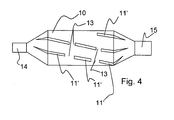
- FIG. 4 illustrated fifth embodiment of a catheter according to the invention has folding elements or fold lines 11 'in the form of depressions, in which over its entire length (ie in the longitudinal direction) a plurality of interruptions 13 are provided. It is also conceivable to provide only one interruption 13 along a folding line 11 '.
- FIG. 5 illustrated section of the balloon 10 can be seen that in the area (interruptions, webs) 13 between the wells along the formed as depressions fold lines 11 'at tensile forces F locally increased tensile load arises (shown as a hatched area).
- the recesses along the fold lines 11 ' are set up again when relieving the balloon, so that the wrinkling along the fold lines 11' is supported.
- FIG. 6 is finally the production of the in the FIGS. 4 and 5 shown embodiment shown.
- these are twisted to each other (twisted, arrows 17).
- inner shaft 14 and outer shaft 15 are moved away from each other in the direction of the longitudinal axis A (see arrows 18).
- Inner shaft 14 and outer shaft 15 are so twisted and fastened together.
- Such a balloon 10, which in the ground state is twisted and mounted displaced on the catheter, exerts a torsional force on the catheter during dilatation.
- This torsional force is stored in the inner shaft 14 and the outer shaft 15 and acts on the balloon ends during deflating.
- Such a balloon 10 can fold back with folding fold lines 11 'better along the fold lines 11'.
- FIG. 7 shows a sixth embodiment of a catheter according to the invention, in which under each wing 12, a pharmaceutically active substance 20 is arranged.
- This pharmaceutically active substance 20 is preferably disposed in or on a carrier that firmly adheres to the balloon surface that comes to lie in the wing interspaces.
- FIGS. 3a, b and c such as FIG. 7 inasmuch as they contain a schematisation in that parts of the wing 12 are shown lifted from the remaining areas of the respective wing 12 in relation to the reality.
- the balloon areas of each wing 12 arranged inside in the direction of the inner shaft 14 closely adjoin the underlying areas of the wings 12, so that only small forces (eg pullback forces) have to be expended during insertion and removal of the catheter.
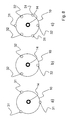
- FIG. 8 shows further embodiments of a catheter according to the invention, in which a self-X-frame is provided.
- the Self-X scaffold points in the in FIG. 8a illustrated embodiment longitudinal struts 31 as folding elements which extend in the longitudinal direction on the outer surface of the balloon 10.
- the in FIG. 8b shown catheter has on the inner surface of the balloon longitudinal struts 32 as folding elements.
- longitudinal struts 31 and 32 are provided both on the outer surface of the balloon as well as on the inner surface of the balloon.
- FIG. 9 shows the behavior of the balloon membrane when deflating the in FIG. 8 illustrated catheter variants.
- each of the sub-figures a, b and c of the figures mentioned shows, for example, an embodiment of a catheter according to the invention in different stages of deflating.
- the FIGS. 8a . 9a and 10a the same embodiment in different stages of deflating. The same applies to the in the Figures 11 . 12 and 13 illustrated embodiments.
- FIGS. 11 . 12 and 13 show a balloon in which areas (webs) of material different from the balloon material act as folding elements.
- a balloon 10 is shown made of the material PEBAX, which has on the inside of the balloon surface webs 41 made of the material PA12, which extend in the longitudinal direction of the balloon.
- the PA12 bars 41 resist the balloon pressure more and store more elastic energy than the PEBAX balloon wall.
- the resulting shape difference is sufficient so that the webs 41 are placed in the folds that form the transition between two wings 12.
- the externally mounted webs draw less during the unloading together than the surrounding balloon wall, for example, if they have stored less frozen tension from the thermoforming process.
- the balloon material PA12 is used, while the webs 42, which are arranged on the outside of the balloon surface and extend in the longitudinal direction of the catheter, for example, consist of PEBAX.
- the folding elements 42 are placed in the fold at the front end of the wings 12 during deflating, since they are under lower tension than the balloon wall.
- FIGS. 11c . 12c and 13c show an embodiment that combines the embodiments shown in 11a, 12a and 13a and 11 b, 12b and 13b, is used as a balloon material PEBAX.
- web 42 represents a region of increased wall thickness. Due to the lower elongation of the outer membrane in the thermoforming process in comparison to the inner membrane, a web which is mounted on the outer surface immediately after molding basically has less stress than the inner membrane or balloon membrane.
- FIGS. 4 to 6 illustrated embodiment with a twisted balloon which was permanently thermally fixed in its twisted state, represents a further advantageous alternative to produce a self-folding, ie a defined refolding, balloon with uniform bending moment.
- the balloon may also be retrofitted, i. after joining with inner and outer shafts, for example in the dilated state, are provided with fold lines 11 by the balloon membrane, e.g. locally thermally treated by means of a laser.
- the laser can be used in such a way that the focus of the laser is guided along the folding lines 11 to be introduced, and in this region the upper layer of the balloon membrane is thermally removed.
- a solvent can be used, which wets the areas along the fold lines 11 to be introduced and there changes the structure of the balloon membrane. In this way, in each case the rigidity of the balloon membrane in the thermally modified or treated by the solvent region is changed from the environment.
Landscapes
- Health & Medical Sciences (AREA)
- Heart & Thoracic Surgery (AREA)
- Life Sciences & Earth Sciences (AREA)
- Engineering & Computer Science (AREA)
- Biomedical Technology (AREA)
- Pulmonology (AREA)
- Biophysics (AREA)
- Anesthesiology (AREA)
- Child & Adolescent Psychology (AREA)
- Hematology (AREA)
- Animal Behavior & Ethology (AREA)
- General Health & Medical Sciences (AREA)
- Public Health (AREA)
- Veterinary Medicine (AREA)
- Manufacturing & Machinery (AREA)
- Materials For Medical Uses (AREA)
- Media Introduction/Drainage Providing Device (AREA)
Claims (16)
- Cathéter avec un ballon (10) comportant au moins une aile (12), dans l'état non dilaté, ainsi qu'au moins un élément de pliage (11, 11', 31, 32, 41, 42) s'étendant essentiellement dans le sens longitudinal sur et/ou dans le matériau du ballon (10), pour chaque aile (12), dans lequel l'élément de pliage est agencé avec un rayon de flexion minimum, lors du pliage du ballon (10) dans l'une des zones d'aile (12) s'étendant dans le sens longitudinal, caractérisé en ce que l'au moins un élément de pliage (11') comporte des brèches (13) le long du sens longitudinal.
- Cathéter selon la revendication 1, caractérisé en ce que l'au moins un élément de pliage (11, 11', 31, 32, 41, 42) forme une région du ballon (10) présentant une rigidité modifiée, de préférence une rigidité inférieure, par rapport aux autres régions du ballon (10), et/ou en ce que l'au moins un élément de pliage (11, 11', 31, 32, 41, 42) forme une région du ballon (10) présentant une composition de matériaux différente par rapport aux autres régions du ballon (10), et/ou en ce que l'au moins un élément de pliage (11, 11') s'étend selon un angle fixement défini (α) par rapport à l'axe (A) du ballon.
- Cathéter selon la revendication 2, caractérisé en ce que le ballon (10) comporte des renfoncements ou des surélévations dans la région de l'élément de pliage (11, 11'), ou du moins une différence d'épaisseur de paroi.
- Cathéter selon la revendication 1, caractérisé en ce que les éléments de pliage (11, 11', 31, 32, 41, 42) du ballon (10) sont constitués par des renforts longitudinaux (31, 32) formant une structure agencée du côté intérieur et/ou du côté extérieur du ballon (10) et soutenant le ballon (10) à des endroits prédéfinis.
- Cathéter selon l'une des revendications précédentes, caractérisé en ce que dans l'état non dilaté, au moins une substance active pharmaceutique (20), contenant de préférence du taxol et/ou des taxanes, et mieux encore du paclitaxel ou du sirolimus, et/ou contenant de préférence au moins une substance active hyper-plastique, avec un coefficient de répartition entre le butanol et l'eau, ≥ à 0,5, est placée au moins partiellement sous l'au moins une aile (12) du ballon (10), et/ou en ce que l'au moins une substance pharmaceutique active (20) est placée sur un substrat agencé sous une aile (12) ou sur plusieurs substrats agencés sous plusieurs ailes (12) du ballon (10).
- Cathéter selon la revendication 5, caractérisé en ce que l'au moins une aile (12) du ballon (10) est collée au moyen de l'au moins une substance pharmaceutique active (20), et/ou en ce que l'au moins une substance pharmaceutique active (20) est appliquée par immersion, vaporisation, étalage ou pressage sur le ballon (10), éventuellement par enrobage sur un substrat.
- Système pour l'introduction d'une endoprothèse intraluminale, de préférence un stent, dans un espace creux d'un corps, constitué d'une endoprothèse intraluminale et d'un cathéter selon l'une des revendications précédentes, caractérisé en ce que l'endoprothèse intraluminale est agencée fixement sur le ballon plié (10), de manière à entourer au moins partiellement celui-ci, l'endoprothèse intraluminale étant sertie sur le ballon (10).
- Système selon la revendication 7, caractérisé en ce que l'endoprothèse intraluminale est conçue comme un stent biodégradable, de préférence comme un stent AMS.
- Système selon la revendication 7 ou 8, caractérisé en ce que dans l'état non dilaté, l'endoprothèse intraluminale recouvre entièrement la surface extérieure (16) du ballon plié (10) se trouvant en-dessous, et/ou en ce que l'endoprothèse intraluminale est pourvue luminalement d'un revêtement facilement soluble, contenant de préférence l'une ou de plusieurs des substances parmi le groupe comprenant le sucre, de préférence le polysaccaride, le glycane, le glucose, le glycogène, l'amylose, l'amylopectine, la chitine, la callose et la cellulose, ainsi que des graisses, de préférence le cholestérol, l'huile de palme, les huiles de soja partiellement hydrogénées et les huiles saturées.
- Procédé pour la fabrication d'un cathéter selon l'une des revendications 1 à 6, caractérisé en ce que le ballon (10) est tout d'abord pourvu d'au moins un élément de pliage (11, 11',31,32, 41, 42), puis le corps de base du cathéter est préparé avec une tige intérieure (14) et une tige extérieure (15), et le ballon (10) est ensuite relié à la tige intérieure (14) et à la tige extérieure (15), et/ou en ce que le ballon (10) est relié, à l'extérieur et/ou à l'intérieur, à une structure constituée de renforts longitudinaux (31, 32), destinée à soutenir le ballon (10) à des endroits prédéterminés.
- Procédé selon la revendication 10, caractérisé en ce que le ballon (10) est fabriqué à l'aide de moules de soufflage, dans lequel le moule de soufflage est pourvu d'un renfoncement ou d'une surélévation, à l'endroit où l'au moins un élément de pliage (11, 11') est censé apparaître, ou en ce que le ballon (10) est fabriqué à l'aide d'un soufflage à injection, de manière à obtenir au moins une différence d'épaisseur de paroi prédéfinie, à l'endroit où l'élément de pliage (11, 11') est censé apparaître.
- Procédé selon les revendications 10 ou 11, caractérisé en ce que le ballon (10) est traité localement, de façon thermique, dans la région de l'au moins un élément de pliage (11, 11', 31, 32, 41, 42), de préférence avant une application d'une substance pharmaceutique active (20) sur la surface du ballon (10), et/ou en ce que le ballon (10) est traité au moyen d'un solvant, dans la région de l'au moins un élément de pliage (11, 11', 31, 32, 41, 42), de préférence avant l'application d'une substance pharmaceutique active (20), et/ou en ce que le ballon (10) est pourvu d'un matériau de renfort supplémentaire, dans la région externe à l'au moins un élément de pliage (11, 11', 31, 32, 41, 42), de préférence avant une application d'une substance pharmaceutique active (20).
- Procédé selon l'une des revendications 10 à 12, caractérisé en ce qu'au moins une substance pharmaceutique active (20), éventuellement enrobée dans un substrat, est tout d'abord incorporée ou appliquée dans et/ou sur la surface extérieure du ballon (10), avant le pliage, de préférence par immersion, vaporisation, étalage ou pressage, dans lequel la substance pharmaceutique active (20) contient de préférence du taxol et/ou des taxanes, et mieux encore du paclitaxel ou du sirolimus, et/ou de préférence au moins une substance active hyper-plastique, avec un coefficient de répartition entre le butanol et l'eau, ≥ à 0,5, dans lequel la substance pharmaceutique active enrobée dans un substrat est appliquée sur le ballon, dans lequel est prévu un agent de contraste et/ou un sel anorganique et/ou un sel organique et/ou au moins un adjuvant supplémentaire, servant par exemple à améliorer l'adhérence mécanique sur la surface du ballon, et/ou à améliorer le dépôt mécanique de la substance pharmaceutique active sur la paroi de vaisseau, et/ou à améliorer la capacité d'assimilation de la paroi de vaisseau.
- Procédé selon la revendication 13, caractérisé en ce qu'après le pliage, la substance pharmaceutique active (20) excédentaire et éventuellement le substrat, éventuellement avec au moins un adjuvant supplémentaire, est éliminée des surfaces (16) du ballon (10) situées à l'extérieur après le pliage, de préférence par essuyage, et/ou en ce que l'au moins une substance pharmaceutique active (20) est durcie ou polymérisée, et/ou en ce que la substance pharmaceutique active (20) est appliquée sur la ballon (10) lorsque le ballon (10) se trouve dans l'état dilaté.
- Procédé selon l'une des revendications 10 à 14, caractérisé en ce que la tige intérieure (14) et la tige extérieure (15) du cathéter sont tournées et/ou déplacées l'une par rapport à l'autre, avant l'assemblage, le ballon (10) étant déjà relié à la tige intérieure (14) et à la tige extérieure (15) avant la rotation et/ou le déplacement.
- Procédé pour la fabrication d'un système selon l'une des revendications 7 à 9, constitué d'un cathéter avec un ballon (10) et d'une endoprothèse intraluminale, caractérisé en ce que le cathéter est tout d'abord fabriqué à l'aide d'un procédé selon l'une des revendications 10 à 15, puis au moins une aile (12) est formée sur le ballon (10), puis cette au moins une aile (12) est serrée contre la tige intérieure (14), puis l'endoprothèse intraluminale est disposée fixement sur le ballon plié (10), de manière à entourer au moins partiellement celui-ci, l'endoprothèse intraluminale étant fixée sur le ballon (10) au moyen d'un sertissage, et pourvue luminalement d'un revêtement facilement soluble, contenant de préférence l'une ou de plusieurs des substances parmi le groupe comprenant le sucre, de préférence le polysaccaride, le glycane, le glucose, le glycogène, l'amylose, l'amylopectine, la chitine, la callose et la cellulose, ainsi que des graisses, de préférence le cholestérol, l'huile de palme, les huiles de soja partiellement hydrogénées et les huiles saturées, avant la mise en place de l'endoprothèse intraluminale.
Applications Claiming Priority (1)
| Application Number | Priority Date | Filing Date | Title |
|---|---|---|---|
| DE200810008925 DE102008008925A1 (de) | 2008-02-13 | 2008-02-13 | Katheter, System zum Einbringen einer intraluminalen Endoprothese sowie Verfahren zur Herstellung derselben |
Publications (2)
| Publication Number | Publication Date |
|---|---|
| EP2090329A1 EP2090329A1 (fr) | 2009-08-19 |
| EP2090329B1 true EP2090329B1 (fr) | 2013-01-23 |
Family
ID=40785570
Family Applications (1)
| Application Number | Title | Priority Date | Filing Date |
|---|---|---|---|
| EP20090150824 Active EP2090329B1 (fr) | 2008-02-13 | 2009-01-19 | Cathéter, système d'introduction d'une endoprothèse intraluminale et procédé de fabrication de celle-ci |
Country Status (3)
| Country | Link |
|---|---|
| US (1) | US9095687B2 (fr) |
| EP (1) | EP2090329B1 (fr) |
| DE (1) | DE102008008925A1 (fr) |
Families Citing this family (27)
| Publication number | Priority date | Publication date | Assignee | Title |
|---|---|---|---|---|
| US8979921B2 (en) * | 2006-02-07 | 2015-03-17 | Tepha, Inc. | Polymeric, degradable drug-eluting stents and coatings |
| US7777399B2 (en) * | 2006-07-31 | 2010-08-17 | Boston Scientific Scimed, Inc. | Medical balloon incorporating electroactive polymer and methods of making and using the same |
| NZ578341A (en) | 2007-01-21 | 2011-06-30 | Hemoteq Ag | Method for producing a coated catheter balloon |
| US9192697B2 (en) | 2007-07-03 | 2015-11-24 | Hemoteq Ag | Balloon catheter for treating stenosis of body passages and for preventing threatening restenosis |
| US10117760B2 (en) | 2009-04-02 | 2018-11-06 | Q3 Medical Devices Limited | Stent |
| US10022164B2 (en) | 2008-06-11 | 2018-07-17 | Eventions, Llc | Orthopedic fastener device |
| US11207199B2 (en) | 2008-06-11 | 2021-12-28 | Q3 Medical Devices Limited | Stent with anti-migration devices |
| US20100256731A1 (en) | 2009-04-02 | 2010-10-07 | Mangiardi Eric K | Stent |
| US10245165B2 (en) | 2009-04-02 | 2019-04-02 | Q3 Medical Devices Limited | Stent |
| EP2944332B1 (fr) | 2009-07-10 | 2016-08-17 | Boston Scientific Scimed, Inc. | Utilisation de nanocristaux pour un ballonnet de distribution de médicament |
| EP2453938B1 (fr) | 2009-07-17 | 2015-08-19 | Boston Scientific Scimed, Inc. | Nucléation de ballons d administration de médicament pour fournir une taille et une densité des cristaux améliorées |
| JP2013529507A (ja) | 2010-06-21 | 2013-07-22 | ゾリオン メディカル インコーポレイテッド | 生体吸収性インプラント |
| EP2611476B1 (fr) | 2010-09-02 | 2016-08-10 | Boston Scientific Scimed, Inc. | Procédé d'enrobage de ballonnets d'administration de médicaments utilisant une mémoire d'enveloppe induite par la chaleur |
| US20120071825A1 (en) * | 2010-09-21 | 2012-03-22 | Hollister Incorporated | Soluble material insertion aid for balloon catheter |
| US8986369B2 (en) | 2010-12-01 | 2015-03-24 | Zorion Medical, Inc. | Magnesium-based absorbable implants |
| WO2013022458A1 (fr) | 2011-08-05 | 2013-02-14 | Boston Scientific Scimed, Inc. | Procédés de conversion d'une substance médicamenteuse amorphe en une forme cristalline |
| US9056152B2 (en) | 2011-08-25 | 2015-06-16 | Boston Scientific Scimed, Inc. | Medical device with crystalline drug coating |
| AU2013229825A1 (en) * | 2012-03-09 | 2014-09-25 | Clearstream Technologies Limited | Parison for forming blow molded medical balloon with midified portion, medical balloon, and related methods |
| WO2015013301A1 (fr) | 2013-07-22 | 2015-01-29 | Boston Scientific Scimed, Inc. | Cathéter d'ablation de nerf rénal ayant un ballonnet de torsion |
| US10201683B2 (en) * | 2014-06-17 | 2019-02-12 | Covidien Lp | Medical balloon including pleats |
| CN109937016A (zh) * | 2016-09-30 | 2019-06-25 | 苏尔莫迪克斯公司 | 包括泄放导引件的介入性球囊系统 |
| JP2020521611A (ja) * | 2017-05-24 | 2020-07-27 | カーディアック アシスト ホールディング, エルエルシー | 大動脈内スパイラルバルーンポンプ |
| CN107088259A (zh) * | 2017-06-09 | 2017-08-25 | 上海心至医疗科技有限公司 | 一种药物球囊及其制备方法 |
| JP6961442B2 (ja) * | 2017-09-29 | 2021-11-05 | テルモ株式会社 | 薬剤コート層の形成方法 |
| CN108853690A (zh) * | 2018-08-14 | 2018-11-23 | 张海军 | 一种膜封储药球囊及制备方法 |
| KR20200035798A (ko) * | 2018-09-27 | 2020-04-06 | 울산대학교 산학협력단 | 의료용 카테터 |
| EP4389188A4 (fr) * | 2021-08-16 | 2025-08-06 | Goodman Co Ltd | Ballonnet pour cathéter et cathéter à ballonnet |
Family Cites Families (23)
| Publication number | Priority date | Publication date | Assignee | Title |
|---|---|---|---|---|
| US5041125A (en) * | 1989-01-26 | 1991-08-20 | Cordis Corporation | Balloon catheter |
| DE69011784D1 (de) * | 1989-08-25 | 1994-09-29 | Bard Inc C R | Plissierter Ballondilatationskatheter und Verfahren zur Herstellung. |
| US5102402A (en) | 1991-01-04 | 1992-04-07 | Medtronic, Inc. | Releasable coatings on balloon catheters |
| US5456666A (en) * | 1994-04-26 | 1995-10-10 | Boston Scientific Corp | Medical balloon folding into predetermined shapes and method |
| US5458572A (en) * | 1994-07-01 | 1995-10-17 | Boston Scientific Corp. | Catheter with balloon folding into predetermined configurations and method of manufacture |
| US5853389A (en) * | 1996-03-07 | 1998-12-29 | Cordis Corporation | Balloon catheter and method for manufacturing |
| US6013055A (en) * | 1997-11-13 | 2000-01-11 | Boston Scientific Corporation | Catheter balloon having selected folding characteristics |
| US6544224B1 (en) * | 2000-05-05 | 2003-04-08 | Advanced Cardiovascular Systems, Inc. | Lobed balloon catheter and method of use |
| JP5178984B2 (ja) * | 2000-07-24 | 2013-04-10 | グレイゼル、ジェフリー | 拡張術およびステント術用の補剛バルーン・カテーテル |
| DE10115740A1 (de) * | 2001-03-26 | 2002-10-02 | Ulrich Speck | Zubereitung für die Restenoseprophylaxe |
| US7004963B2 (en) * | 2001-09-14 | 2006-02-28 | Scimed Life Systems, Inc. | Conformable balloons |
| US20030144683A1 (en) * | 2001-12-13 | 2003-07-31 | Avantec Vascular Corporation | Inflatable members having concentrated force regions |
| US7160317B2 (en) * | 2002-01-04 | 2007-01-09 | Boston Scientific Scimed, Inc. | Multiple-wing balloon catheter to reduce damage to coated expandable medical implants |
| US7070613B2 (en) * | 2002-01-04 | 2006-07-04 | Boston Scientific Scimed, Inc. | Non-compliant balloon with compliant top-layer to protect coated stents during expansion |
| US20050177130A1 (en) * | 2004-02-10 | 2005-08-11 | Angioscore, Inc. | Balloon catheter with spiral folds |
| US20060182873A1 (en) * | 2005-02-17 | 2006-08-17 | Klisch Leo M | Medical devices |
| US20070112300A1 (en) * | 2005-11-14 | 2007-05-17 | Roman Ricardo D | Balloon folding design, apparatus and method of making the same |
| US20070129748A1 (en) * | 2005-12-07 | 2007-06-07 | Tracee Eidenschink | Selectively coated medical balloons |
| EP3150236B1 (fr) * | 2006-02-09 | 2018-12-26 | B. Braun Melsungen AG | Procédé de revêtement de ballonnet repliable |
| WO2007105067A1 (fr) * | 2006-03-14 | 2007-09-20 | Arterial Remodeling Technologies, S.A. | Procédé destiné à commander le positionnement de stents polymères |
| US20070244501A1 (en) * | 2006-04-18 | 2007-10-18 | Horn Daniel J | Medical balloons |
| US20070260300A1 (en) * | 2006-05-04 | 2007-11-08 | Daniel Gregorich | Intraluminal medical device having a curable coating |
| US8845581B2 (en) * | 2006-11-14 | 2014-09-30 | Boston Scientific Scimed, Inc. | Medical balloon deflation |
-
2008
- 2008-02-13 DE DE200810008925 patent/DE102008008925A1/de not_active Withdrawn
-
2009
- 2009-01-19 EP EP20090150824 patent/EP2090329B1/fr active Active
- 2009-02-13 US US12/370,829 patent/US9095687B2/en active Active
Also Published As
| Publication number | Publication date |
|---|---|
| US20090204082A1 (en) | 2009-08-13 |
| DE102008008925A1 (de) | 2009-08-20 |
| US9095687B2 (en) | 2015-08-04 |
| EP2090329A1 (fr) | 2009-08-19 |
Similar Documents
| Publication | Publication Date | Title |
|---|---|---|
| EP2090329A1 (fr) | Cathéter, système d'introduction d'une endoprothèse intraluminale et procédé de fabrication de celle-ci | |
| EP2090269B1 (fr) | Système d'introduction d'une endoprothèse intraluminale et procédé de fabrication d'un tel système | |
| EP2361651B1 (fr) | Système comprenant une enveloppe de protection et un appareil médical ainsi que son procédé de fabrication | |
| DE602004010344T2 (de) | Katheter ohne Ballon zum Einsetzen eines Stents | |
| DE69527636T3 (de) | Stent und verfahren zu seiner herstellung | |
| EP3322387B1 (fr) | Cathéter à ballonnet | |
| EP2329799A1 (fr) | Système de cathéter avec dispositif de coupage pour la gaine du cathéter | |
| EP2258323B1 (fr) | Dispositif d'implantation pour stents à surface structurée fonctionnelle | |
| EP2446917A1 (fr) | Cathéter, système d'introduction d'une endoprothèse intraluminale et son procédé de fabrication | |
| CN102858281B (zh) | 药物洗脱折叠支架和支架输送系统 | |
| DE69924260T2 (de) | Expandierbarer stent für kleinlumige gefässe | |
| EP3287152B1 (fr) | Revêtement de cathéters à ballonnet | |
| EP2098194B1 (fr) | Cathéter et système d'introduction d'une endoprothèse intraluminale | |
| EP4558208A1 (fr) | Dispositif de cathéter à ballonnet pour la dilatation atraumatique d'organes creux et procédé de fabrication d'un tel dispositif de cathéter à ballonnet | |
| EP3740256B1 (fr) | Revêtement à base de polysaccharide | |
| EP4034053B1 (fr) | Cathéter à ballonnet anti-torsion | |
| DE102018123050B4 (de) | Wirkstoffbeschichtung für Ballons von Ballonkathetern | |
| EP2111827A1 (fr) | Système de fixation de stent | |
| DE102020111805A1 (de) | Durchmesserreduzierung | |
| DE102024126582A1 (de) | Medizinische Vorrichtung zur Behandlung von Blutgefäßerkrankungen, insbesondere endovaskuläres Implantat, sowie Herstellungsverfahren | |
| DE102018123064A1 (de) | Durchmesserreduzierung |
Legal Events
| Date | Code | Title | Description |
|---|---|---|---|
| PUAI | Public reference made under article 153(3) epc to a published international application that has entered the european phase |
Free format text: ORIGINAL CODE: 0009012 |
|
| AK | Designated contracting states |
Kind code of ref document: A1 Designated state(s): AT BE BG CH CY CZ DE DK EE ES FI FR GB GR HR HU IE IS IT LI LT LU LV MC MK MT NL NO PL PT RO SE SI SK TR |
|
| AX | Request for extension of the european patent |
Extension state: AL BA RS |
|
| 17P | Request for examination filed |
Effective date: 20100201 |
|
| 17Q | First examination report despatched |
Effective date: 20100225 |
|
| AKX | Designation fees paid |
Designated state(s): CH DE FR GB IE LI |
|
| GRAP | Despatch of communication of intention to grant a patent |
Free format text: ORIGINAL CODE: EPIDOSNIGR1 |
|
| GRAS | Grant fee paid |
Free format text: ORIGINAL CODE: EPIDOSNIGR3 |
|
| GRAA | (expected) grant |
Free format text: ORIGINAL CODE: 0009210 |
|
| AK | Designated contracting states |
Kind code of ref document: B1 Designated state(s): CH DE FR GB IE LI |
|
| REG | Reference to a national code |
Ref country code: GB Ref legal event code: FG4D Free format text: NOT ENGLISH |
|
| REG | Reference to a national code |
Ref country code: CH Ref legal event code: EP |
|
| REG | Reference to a national code |
Ref country code: CH Ref legal event code: EP |
|
| REG | Reference to a national code |
Ref country code: IE Ref legal event code: FG4D Free format text: LANGUAGE OF EP DOCUMENT: GERMAN |
|
| REG | Reference to a national code |
Ref country code: DE Ref legal event code: R096 Ref document number: 502009006089 Country of ref document: DE Effective date: 20130321 |
|
| PLBE | No opposition filed within time limit |
Free format text: ORIGINAL CODE: 0009261 |
|
| STAA | Information on the status of an ep patent application or granted ep patent |
Free format text: STATUS: NO OPPOSITION FILED WITHIN TIME LIMIT |
|
| 26N | No opposition filed |
Effective date: 20131024 |
|
| REG | Reference to a national code |
Ref country code: DE Ref legal event code: R097 Ref document number: 502009006089 Country of ref document: DE Effective date: 20131024 |
|
| REG | Reference to a national code |
Ref country code: DE Ref legal event code: R082 Ref document number: 502009006089 Country of ref document: DE Representative=s name: RANDOLL, SOEREN, DIPL.-CHEM. UNIV. DR. RER. NA, DE |
|
| REG | Reference to a national code |
Ref country code: FR Ref legal event code: PLFP Year of fee payment: 8 |
|
| REG | Reference to a national code |
Ref country code: FR Ref legal event code: PLFP Year of fee payment: 9 |
|
| REG | Reference to a national code |
Ref country code: FR Ref legal event code: PLFP Year of fee payment: 10 |
|
| REG | Reference to a national code |
Ref country code: DE Ref legal event code: R082 Ref document number: 502009006089 Country of ref document: DE Ref country code: DE Ref legal event code: R081 Ref document number: 502009006089 Country of ref document: DE Owner name: BIOTRONIK AG, CH Free format text: FORMER OWNER: BIOTRONIK VI PATENT AG, BAAR, CH |
|
| REG | Reference to a national code |
Ref country code: GB Ref legal event code: 732E Free format text: REGISTERED BETWEEN 20180719 AND 20180725 |
|
| REG | Reference to a national code |
Ref country code: FR Ref legal event code: TP Owner name: BIOTRONIK AG, CH Effective date: 20180907 |
|
| PGFP | Annual fee paid to national office [announced via postgrant information from national office to epo] |
Ref country code: IE Payment date: 20230119 Year of fee payment: 15 |
|
| P01 | Opt-out of the competence of the unified patent court (upc) registered |
Effective date: 20230605 |
|
| PG25 | Lapsed in a contracting state [announced via postgrant information from national office to epo] |
Ref country code: IE Free format text: LAPSE BECAUSE OF NON-PAYMENT OF DUE FEES Effective date: 20240119 |
|
| PG25 | Lapsed in a contracting state [announced via postgrant information from national office to epo] |
Ref country code: IE Free format text: LAPSE BECAUSE OF NON-PAYMENT OF DUE FEES Effective date: 20240119 |
|
| REG | Reference to a national code |
Ref country code: DE Ref legal event code: R082 Ref document number: 502009006089 Country of ref document: DE Representative=s name: WSL PATENTANWAELTE PARTNERSCHAFT MBB, DE |
|
| REG | Reference to a national code |
Ref country code: CH Ref legal event code: U11 Free format text: ST27 STATUS EVENT CODE: U-0-0-U10-U11 (AS PROVIDED BY THE NATIONAL OFFICE) Effective date: 20260201 |
|
| PGFP | Annual fee paid to national office [announced via postgrant information from national office to epo] |
Ref country code: GB Payment date: 20260123 Year of fee payment: 18 |
|
| PGFP | Annual fee paid to national office [announced via postgrant information from national office to epo] |
Ref country code: DE Payment date: 20260116 Year of fee payment: 18 |
|
| PGFP | Annual fee paid to national office [announced via postgrant information from national office to epo] |
Ref country code: FR Payment date: 20260123 Year of fee payment: 18 |
|
| PGFP | Annual fee paid to national office [announced via postgrant information from national office to epo] |
Ref country code: CH Payment date: 20260201 Year of fee payment: 18 |