EP2090331A1 - Matrice à micro-aiguilles et son procédé de production - Google Patents
Matrice à micro-aiguilles et son procédé de production Download PDFInfo
- Publication number
- EP2090331A1 EP2090331A1 EP07832285A EP07832285A EP2090331A1 EP 2090331 A1 EP2090331 A1 EP 2090331A1 EP 07832285 A EP07832285 A EP 07832285A EP 07832285 A EP07832285 A EP 07832285A EP 2090331 A1 EP2090331 A1 EP 2090331A1
- Authority
- EP
- European Patent Office
- Prior art keywords
- microneedle
- needle
- producing
- resin fluid
- mold
- Prior art date
- Legal status (The legal status is an assumption and is not a legal conclusion. Google has not performed a legal analysis and makes no representation as to the accuracy of the status listed.)
- Withdrawn
Links
Images




Classifications
-
- A—HUMAN NECESSITIES
- A61—MEDICAL OR VETERINARY SCIENCE; HYGIENE
- A61M—DEVICES FOR INTRODUCING MEDIA INTO, OR ONTO, THE BODY; DEVICES FOR TRANSDUCING BODY MEDIA OR FOR TAKING MEDIA FROM THE BODY; DEVICES FOR PRODUCING OR ENDING SLEEP OR STUPOR
- A61M37/00—Other apparatus for introducing media into the body; Percutany, i.e. introducing medicines into the body by diffusion through the skin
- A61M37/0015—Other apparatus for introducing media into the body; Percutany, i.e. introducing medicines into the body by diffusion through the skin by using microneedles
-
- B—PERFORMING OPERATIONS; TRANSPORTING
- B29—WORKING OF PLASTICS; WORKING OF SUBSTANCES IN A PLASTIC STATE IN GENERAL
- B29C—SHAPING OR JOINING OF PLASTICS; SHAPING OF MATERIAL IN A PLASTIC STATE, NOT OTHERWISE PROVIDED FOR; AFTER-TREATMENT OF THE SHAPED PRODUCTS, e.g. REPAIRING
- B29C43/00—Compression moulding, i.e. applying external pressure to flow the moulding material; Apparatus therefor
- B29C43/02—Compression moulding, i.e. applying external pressure to flow the moulding material; Apparatus therefor of articles of definite length, i.e. discrete articles
- B29C43/021—Compression moulding, i.e. applying external pressure to flow the moulding material; Apparatus therefor of articles of definite length, i.e. discrete articles characterised by the shape of the surface
-
- B—PERFORMING OPERATIONS; TRANSPORTING
- B29—WORKING OF PLASTICS; WORKING OF SUBSTANCES IN A PLASTIC STATE IN GENERAL
- B29C—SHAPING OR JOINING OF PLASTICS; SHAPING OF MATERIAL IN A PLASTIC STATE, NOT OTHERWISE PROVIDED FOR; AFTER-TREATMENT OF THE SHAPED PRODUCTS, e.g. REPAIRING
- B29C43/00—Compression moulding, i.e. applying external pressure to flow the moulding material; Apparatus therefor
- B29C43/02—Compression moulding, i.e. applying external pressure to flow the moulding material; Apparatus therefor of articles of definite length, i.e. discrete articles
- B29C43/04—Compression moulding, i.e. applying external pressure to flow the moulding material; Apparatus therefor of articles of definite length, i.e. discrete articles using movable moulds
- B29C43/06—Compression moulding, i.e. applying external pressure to flow the moulding material; Apparatus therefor of articles of definite length, i.e. discrete articles using movable moulds continuously movable in one direction, e.g. mounted on chains, belts
-
- B—PERFORMING OPERATIONS; TRANSPORTING
- B29—WORKING OF PLASTICS; WORKING OF SUBSTANCES IN A PLASTIC STATE IN GENERAL
- B29C—SHAPING OR JOINING OF PLASTICS; SHAPING OF MATERIAL IN A PLASTIC STATE, NOT OTHERWISE PROVIDED FOR; AFTER-TREATMENT OF THE SHAPED PRODUCTS, e.g. REPAIRING
- B29C43/00—Compression moulding, i.e. applying external pressure to flow the moulding material; Apparatus therefor
- B29C43/22—Compression moulding, i.e. applying external pressure to flow the moulding material; Apparatus therefor of articles of indefinite length
- B29C43/222—Compression moulding, i.e. applying external pressure to flow the moulding material; Apparatus therefor of articles of indefinite length characterised by the shape of the surface
-
- B—PERFORMING OPERATIONS; TRANSPORTING
- B29—WORKING OF PLASTICS; WORKING OF SUBSTANCES IN A PLASTIC STATE IN GENERAL
- B29C—SHAPING OR JOINING OF PLASTICS; SHAPING OF MATERIAL IN A PLASTIC STATE, NOT OTHERWISE PROVIDED FOR; AFTER-TREATMENT OF THE SHAPED PRODUCTS, e.g. REPAIRING
- B29C43/00—Compression moulding, i.e. applying external pressure to flow the moulding material; Apparatus therefor
- B29C43/32—Component parts, details or accessories; Auxiliary operations
- B29C43/36—Moulds for making articles of definite length, i.e. discrete articles
-
- A—HUMAN NECESSITIES
- A61—MEDICAL OR VETERINARY SCIENCE; HYGIENE
- A61M—DEVICES FOR INTRODUCING MEDIA INTO, OR ONTO, THE BODY; DEVICES FOR TRANSDUCING BODY MEDIA OR FOR TAKING MEDIA FROM THE BODY; DEVICES FOR PRODUCING OR ENDING SLEEP OR STUPOR
- A61M37/00—Other apparatus for introducing media into the body; Percutany, i.e. introducing medicines into the body by diffusion through the skin
- A61M37/0015—Other apparatus for introducing media into the body; Percutany, i.e. introducing medicines into the body by diffusion through the skin by using microneedles
- A61M2037/0046—Solid microneedles
-
- A—HUMAN NECESSITIES
- A61—MEDICAL OR VETERINARY SCIENCE; HYGIENE
- A61M—DEVICES FOR INTRODUCING MEDIA INTO, OR ONTO, THE BODY; DEVICES FOR TRANSDUCING BODY MEDIA OR FOR TAKING MEDIA FROM THE BODY; DEVICES FOR PRODUCING OR ENDING SLEEP OR STUPOR
- A61M37/00—Other apparatus for introducing media into the body; Percutany, i.e. introducing medicines into the body by diffusion through the skin
- A61M37/0015—Other apparatus for introducing media into the body; Percutany, i.e. introducing medicines into the body by diffusion through the skin by using microneedles
- A61M2037/0053—Methods for producing microneedles
-
- B—PERFORMING OPERATIONS; TRANSPORTING
- B29—WORKING OF PLASTICS; WORKING OF SUBSTANCES IN A PLASTIC STATE IN GENERAL
- B29C—SHAPING OR JOINING OF PLASTICS; SHAPING OF MATERIAL IN A PLASTIC STATE, NOT OTHERWISE PROVIDED FOR; AFTER-TREATMENT OF THE SHAPED PRODUCTS, e.g. REPAIRING
- B29C43/00—Compression moulding, i.e. applying external pressure to flow the moulding material; Apparatus therefor
- B29C43/02—Compression moulding, i.e. applying external pressure to flow the moulding material; Apparatus therefor of articles of definite length, i.e. discrete articles
- B29C43/021—Compression moulding, i.e. applying external pressure to flow the moulding material; Apparatus therefor of articles of definite length, i.e. discrete articles characterised by the shape of the surface
- B29C2043/023—Compression moulding, i.e. applying external pressure to flow the moulding material; Apparatus therefor of articles of definite length, i.e. discrete articles characterised by the shape of the surface having a plurality of grooves
-
- B—PERFORMING OPERATIONS; TRANSPORTING
- B29—WORKING OF PLASTICS; WORKING OF SUBSTANCES IN A PLASTIC STATE IN GENERAL
- B29C—SHAPING OR JOINING OF PLASTICS; SHAPING OF MATERIAL IN A PLASTIC STATE, NOT OTHERWISE PROVIDED FOR; AFTER-TREATMENT OF THE SHAPED PRODUCTS, e.g. REPAIRING
- B29C43/00—Compression moulding, i.e. applying external pressure to flow the moulding material; Apparatus therefor
- B29C43/02—Compression moulding, i.e. applying external pressure to flow the moulding material; Apparatus therefor of articles of definite length, i.e. discrete articles
- B29C43/021—Compression moulding, i.e. applying external pressure to flow the moulding material; Apparatus therefor of articles of definite length, i.e. discrete articles characterised by the shape of the surface
- B29C2043/023—Compression moulding, i.e. applying external pressure to flow the moulding material; Apparatus therefor of articles of definite length, i.e. discrete articles characterised by the shape of the surface having a plurality of grooves
- B29C2043/025—Compression moulding, i.e. applying external pressure to flow the moulding material; Apparatus therefor of articles of definite length, i.e. discrete articles characterised by the shape of the surface having a plurality of grooves forming a microstructure, i.e. fine patterning
-
- B—PERFORMING OPERATIONS; TRANSPORTING
- B29—WORKING OF PLASTICS; WORKING OF SUBSTANCES IN A PLASTIC STATE IN GENERAL
- B29C—SHAPING OR JOINING OF PLASTICS; SHAPING OF MATERIAL IN A PLASTIC STATE, NOT OTHERWISE PROVIDED FOR; AFTER-TREATMENT OF THE SHAPED PRODUCTS, e.g. REPAIRING
- B29C43/00—Compression moulding, i.e. applying external pressure to flow the moulding material; Apparatus therefor
- B29C43/32—Component parts, details or accessories; Auxiliary operations
- B29C43/34—Feeding the material to the mould or the compression means
- B29C2043/3405—Feeding the material to the mould or the compression means using carrying means
- B29C2043/3416—Feeding the material to the mould or the compression means using carrying means conveyor belts
-
- B—PERFORMING OPERATIONS; TRANSPORTING
- B29—WORKING OF PLASTICS; WORKING OF SUBSTANCES IN A PLASTIC STATE IN GENERAL
- B29C—SHAPING OR JOINING OF PLASTICS; SHAPING OF MATERIAL IN A PLASTIC STATE, NOT OTHERWISE PROVIDED FOR; AFTER-TREATMENT OF THE SHAPED PRODUCTS, e.g. REPAIRING
- B29C43/00—Compression moulding, i.e. applying external pressure to flow the moulding material; Apparatus therefor
- B29C43/32—Component parts, details or accessories; Auxiliary operations
- B29C43/36—Moulds for making articles of definite length, i.e. discrete articles
- B29C43/361—Moulds for making articles of definite length, i.e. discrete articles with pressing members independently movable of the parts for opening or closing the mould, e.g. movable pistons
- B29C2043/3615—Forming elements, e.g. mandrels or rams or stampers or pistons or plungers or punching devices
- B29C2043/3628—Forming elements, e.g. mandrels or rams or stampers or pistons or plungers or punching devices moving inside a barrel or container like sleeve
-
- B—PERFORMING OPERATIONS; TRANSPORTING
- B29—WORKING OF PLASTICS; WORKING OF SUBSTANCES IN A PLASTIC STATE IN GENERAL
- B29C—SHAPING OR JOINING OF PLASTICS; SHAPING OF MATERIAL IN A PLASTIC STATE, NOT OTHERWISE PROVIDED FOR; AFTER-TREATMENT OF THE SHAPED PRODUCTS, e.g. REPAIRING
- B29C43/00—Compression moulding, i.e. applying external pressure to flow the moulding material; Apparatus therefor
- B29C43/32—Component parts, details or accessories; Auxiliary operations
- B29C43/44—Compression means for making articles of indefinite length
- B29C43/46—Rollers
- B29C2043/461—Rollers the rollers having specific surface features
- B29C2043/464—Rollers the rollers having specific surface features having projections or knives, e.g. for cutting-out or for forming local depressions
-
- B—PERFORMING OPERATIONS; TRANSPORTING
- B29—WORKING OF PLASTICS; WORKING OF SUBSTANCES IN A PLASTIC STATE IN GENERAL
- B29C—SHAPING OR JOINING OF PLASTICS; SHAPING OF MATERIAL IN A PLASTIC STATE, NOT OTHERWISE PROVIDED FOR; AFTER-TREATMENT OF THE SHAPED PRODUCTS, e.g. REPAIRING
- B29C43/00—Compression moulding, i.e. applying external pressure to flow the moulding material; Apparatus therefor
- B29C43/32—Component parts, details or accessories; Auxiliary operations
- B29C43/56—Compression moulding under special conditions, e.g. vacuum
- B29C2043/561—Compression moulding under special conditions, e.g. vacuum under vacuum conditions
-
- B—PERFORMING OPERATIONS; TRANSPORTING
- B29—WORKING OF PLASTICS; WORKING OF SUBSTANCES IN A PLASTIC STATE IN GENERAL
- B29C—SHAPING OR JOINING OF PLASTICS; SHAPING OF MATERIAL IN A PLASTIC STATE, NOT OTHERWISE PROVIDED FOR; AFTER-TREATMENT OF THE SHAPED PRODUCTS, e.g. REPAIRING
- B29C59/00—Surface shaping of articles, e.g. embossing; Apparatus therefor
- B29C59/02—Surface shaping of articles, e.g. embossing; Apparatus therefor by mechanical means, e.g. pressing
- B29C59/022—Surface shaping of articles, e.g. embossing; Apparatus therefor by mechanical means, e.g. pressing characterised by the disposition or the configuration, e.g. dimensions, of the embossments or the shaping tools therefor
- B29C2059/023—Microembossing
-
- B—PERFORMING OPERATIONS; TRANSPORTING
- B29—WORKING OF PLASTICS; WORKING OF SUBSTANCES IN A PLASTIC STATE IN GENERAL
- B29C—SHAPING OR JOINING OF PLASTICS; SHAPING OF MATERIAL IN A PLASTIC STATE, NOT OTHERWISE PROVIDED FOR; AFTER-TREATMENT OF THE SHAPED PRODUCTS, e.g. REPAIRING
- B29C43/00—Compression moulding, i.e. applying external pressure to flow the moulding material; Apparatus therefor
- B29C43/02—Compression moulding, i.e. applying external pressure to flow the moulding material; Apparatus therefor of articles of definite length, i.e. discrete articles
- B29C43/18—Compression moulding, i.e. applying external pressure to flow the moulding material; Apparatus therefor of articles of definite length, i.e. discrete articles incorporating preformed parts or layers, e.g. compression moulding around inserts or for coating articles
-
- B—PERFORMING OPERATIONS; TRANSPORTING
- B29—WORKING OF PLASTICS; WORKING OF SUBSTANCES IN A PLASTIC STATE IN GENERAL
- B29L—INDEXING SCHEME ASSOCIATED WITH SUBCLASS B29C, RELATING TO PARTICULAR ARTICLES
- B29L2031/00—Other particular articles
- B29L2031/753—Medical equipment; Accessories therefor
- B29L2031/7544—Injection needles, syringes
-
- B—PERFORMING OPERATIONS; TRANSPORTING
- B29—WORKING OF PLASTICS; WORKING OF SUBSTANCES IN A PLASTIC STATE IN GENERAL
- B29L—INDEXING SCHEME ASSOCIATED WITH SUBCLASS B29C, RELATING TO PARTICULAR ARTICLES
- B29L2031/00—Other particular articles
- B29L2031/756—Microarticles, nanoarticles
Definitions
- the present invention relates to a microneedle, a method for producing the microneedle, a microneedle array using the microneedle and a method for producing the microneedle array.
- a liquid or gel drug is often applied for administration of a drug through the skin, the mucous membrane, or a like biological surface.
- a liquid or gel drug is often applied for administration of a drug through the skin, the mucous membrane, or a like biological surface.
- an application of a drug on a biological surface is a noninvasive method, the applied drug is easily removed by sweating, external contact, and the like. Further, when the administration is continued for a long period of time, a safety problem such as dermopathy may be caused. Further, when the subject drug has a large molecular weight, is water soluble, etc., such a drug is hardly absorbed into the body even if applied on a biological surface, and percutaneous administration thereof has thus been difficult.
- microneedles are excellent in the puncturing ability as they are formed on a silicon single crystal substrate, however, there is a problem in that when the microneedles break, the residues remain in the skin.
- the present invention was accomplished in view of the above background.
- An object thereof is to provide a production method for molding a microneedle and a microneedle array which do not obtain blunt needle tips at the time of molding, do not undergo hydrolysis, thus maintaining a stable molecular weight, do not suffer from coloring, and have excellent shape stability; and also to provide products therefrom.
- a method for producing a microneedle of the present invention is characterized by comprising a feeding step of feeding a resin fluid to a forming mold having a needle-forming portion with an opening diameter of 50 to 200 ⁇ m and a depth of 100 to 450 ⁇ m, a charging step of charging the fed resin fluid into the needle-forming portion, and a solidifying step of cooling and solidifying the charged resin fluid, wherein the feeding step, the charging step, and the solidifying step are performed under reduced pressure or vacuum.
- Another method for producing a microneedle of the present invention is characterized by comprising a feeding step of feeding a resin fluid to a forming mold having a needle-forming portion with an opening diameter of 50 to 200 ⁇ m and a depth of 100 to 450 ⁇ m, an overheating and melting step of fluidizing the fed resin to produce a resin fluid, a charging step of charging the resin fluid into the needle-forming portion, and a solidifying step of cooling and solidifying the charged resin fluid, wherein the feeding step, the overheating and melting step, the charging step, and the solidifying step are performed under reduced pressure or vacuum.
- the forming mold may have two or more needle-forming portions.
- the forming mold may have a protruding portion in an area other than the needle-forming portion, or alternatively, may have a protruding portion in the needle-forming portion.
- the step of charging the resin fluid may be performed by pressing the resin fluid.
- the resin fluid may be placed also in an area on the forming mold other than the needle-forming portion.
- the resin may contain a biocompatible material, and the biocompatible material may be a material containing polylactic acid (PLA), glycol lactic acid, chitin, chitosan, hyaluronic acid, collagen, glucose/cellulose, or magnesium alloy.
- PLA polylactic acid
- glycol lactic acid glycol lactic acid
- chitin chitosan
- hyaluronic acid collagen, glucose/cellulose, or magnesium alloy.
- a microneedle according to the present invention is characterized in that it is produced by either of the above producing methods.
- the microneedle may be the one that does not undergo plastic deformation under a load of 5 kg/cm 2 or less.
- a method for producing a microneedle array according to the present invention is characterized by comprising a placing step of placing, after forming the microneedle, a substrate on the needle-forming portion of the forming mold, and a stacking step of integrating the needle-forming portion and the substrate together.
- the microneedle and the substrate may be made of different materials.
- molding is performed under reduced pressure or vacuum, and therefore, a sharp microneedle tip can be obtained. Further, since hydrolysis reaction is suppressed, reduction in the molecular weight is made less prone to occur and maintaining the strength of the microneedle is made possible. In addition, the suppression of reactions can avoid the problem of coloring.
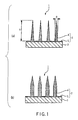
- a microneedle array according to a first embodiment of the invention is explained with reference to FIG. 1 to FIG. 3 .
- a microneedle array 1 of this embodiment comprises a microneedle 2 and a substrate 3 which is provided beneath the microneedle 2 and supports the microneedle 2.
- the microneedle 2 is made of PLA, a biocompatible material, and comprises a large number of conical-shaped needle portions 4 integrally formed on a sheet portion 5.
- the substrate 3 is made of acryl (PMMA).
- the sheet portion 5 of the microneedle 2 is thermally fused to the surface of the substrate 3, thereby forming the microneedle array 1.
- the microneedle array 1 has microneedles formed at intervals of 200 to 1,200 microneedles/cm 2 .
- the needle portions 4 and the sheet portion 5 are made of medical-grade polylactic acid (PLA), a biocompatible material.
- the needle portions 4 have a bottom diameter ⁇ of 50 ⁇ m to 200 ⁇ m and a height h of 100 ⁇ m to 500 ⁇ m.
- the bottom diameter ⁇ be within the range of 80 ⁇ m to 120 ⁇ m
- the height h be within the range of 200 ⁇ m to 400 ⁇ m.
- the shape of the needle portions 4 may be so-called pencil-like, having a cylindrical column shape with a conical upper portion, or may also be a polyangular pyramid whose section is triangle, quadrangle, or the like.
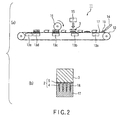
- FIG. 2 (a) is a schematic diagram of a production apparatus 11 for the microneedle array 1 of this embodiment.
- the production apparatus 11 comprises a conveyor belt 12, heaters 13a to 13e provided along the transferring surface of the conveyor belt 12, a nozzle 14 provided in a predetermined position on the upstream portion of the conveyor belt, a substrate feeder 15 provided in a position downstream the nozzle 14, and a roll 16 provided downstream the substrate feeder 15 so as to pressurize the transferring surface of the conveyor belt 12.
- a mold 17 for forming the microneedle 2 is installed on the conveyor belt 12.
- the mold 17 is obtained by forming needle-forming portions 18 in a metal material by a known method such as photolithography, dry etching, or the like.
- a solution or a cutting block of medical-grade PLA 19, a product of Birmingham Polymers Inc. is fed onto the mold 17 from the nozzle 14.
- the temperature of the heater 13a is set at the melting point (hereinafter referred to as "Tm") of PLA 19 or higher.
- the mold 17 is heated with the heater through the belt, whereby the PLA 19 is heated to the temperature range (°C) expressed by the equation (1) below and is spread out over the entire surface of the mold 17 to obtain the shape of the large number of needle portions 4 integrated at the sheet portion 5 (microneedle formation process).
- the temperature of the heater 13b is set at the Tm of PLA.
- Tm + X X is 2 or more and less than 50 , and preferably 2 or more and less than 10
- the mold 17 moves on the conveyor belt 12, and a substrate 3 is installed on the mold 17 from the substrate feeder 15.
- the substrate 3 is made of PMMA as mentioned above, a copolymer of butyl acrylate and methacrylate or the like is also suitable. Further, other plastic materials are also usable. In addition, alumina and metal, which are porous materials, may also be used.
- the temperature of the heater 13c is set at a temperature higher than the Tm of PLA by about 20°C, and is adjusted to be in the temperature range of the equation (1) when PLA reaches the heater 13c.
- At least the processes from the feeding of PLA onto the mold to the formation of microneedle are to be performed under reduced pressure or vacuum.
- the integrated substrate 3 and mold 17 are pressurized by the roll 16 and thus closely adhered, and, as shown in FIG. 2 (b) , the substrate 3 and the sheet portion 5 are thermally fused (fusion process). At this time, the temperature of the roll 16 is set within the range of the above equation (1) (Tm is the melting point of PLA).
- the temperature of the substrate 3 and the mold 17 are gradually lowered to about 70°C by the heaters 13d and 13e.
- the substrate 3 integrated with the microneedle 2 is removed from the mold 17, and is punched into a desired shape, thereby giving the microneedle array 1 of this embodiment.
- insulin, estradiol, or a like hormone drug, nitroglycerin, or a like desired drug is applied in the form of a spray or a gel to form a drug layer.
- the microneedle array 1 can be used in transcutaneous administration of the drug.
- the needle portions 4 are sufficiently adhered to the substrate 3 made of PMMA at the sheet portion 5, and thus have sufficient strength to resist plastic deformation even under a load of 5 kgf/cm 2 or less. Accordingly, when puncturing through the skin or a like biological surface, the needle portions satisfactorily reach the body tissue without plastic deformation. Further, the needle portions do not break in the body tissue. Even if they break, PLA that forms the needle portions 4 is decomposed in the body and disappears, and this thus causes no harm to the patient.
- the microneedle 2 is made of medical-grade PLA, as compared with the case where the entire microneedle array (i.e., the microneedle 2 and the substrate 3) is made of medical-grade PLA, the amount of the expensive medical-grade PLA to be used can be reduced by about 50% to about 80%. Accordingly, in comparison with conventional microneedle arrays, the manufacturing cost can be greatly reduced, while maintaining comparable performance.
- the substrate 3 is made of flexible PMMA, it sufficiently follows the change in skin shape, and there is no need to worry about the separation of the microneedle 2 from the substrate 3, etc.
- the microneedle 2 of this embodiment may have slots 21 formed on the surface thereof, as shown in FIG. 3 (a) . According to such a structure, when a drug is applied to the surface of the microneedle 2, the drug is stored in the slots 21. This allows extension of the drug-releasing time and also enables more accurate control of drug release.
- communicating holes (let-out means) 21a each extending from a slot 21 and penetrating through the sheet portion 5 may also be provided.
- a drug layer 22 comprising a polymer impregnated with a drug, for example, is provided in the gap between the sheet portion 5 and the substrate 3, the drug is let out from the drug layer 22 into the microneedle 2 through the communicating holes 21a and the release is thus continued even after the whole drug on the microneedle 2 is released. Accordingly, this allows further extension of the drug-releasing time.
- the drug layer 22 may be provided inside the substrate 3, as shown in FIG. 3 (b) .
- FIGS. 3 (a) and (b) each shows a section of a part of the substrate 3, the sheet portion 5, the drug layer 22, and the microneedles 2.
- a microneedle array may be produced by heating a fixed mold, feeding PLA or a like biocompatible material thereto from micro-nozzles provided above the mold in correspondence with needle-forming portions to form a microneedle, and thermally fusing it with a substrate.
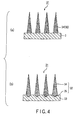
- the microneedle array 31 of this embodiment is different from the above first embodiment in that, as shown in FIG. 4 (a) , the sheet portion 5 present in the microneedle 2 of the first embodiment is not present in a microneedle 32.
- the components common with the first embodiment are indicated with the same reference numerals, and duplicate explanations are omitted.
- FIG. 5 (a) is a schematic diagram of a production apparatus 41 for the microneedle array 31 of this embodiment.
- the production apparatus 41 comprises a conveyor belt 42; a first roll 43 provided above the conveyor belt 42; a second roll 44 provided beneath the conveyor belt 42 to sandwich the conveyor belt together with the first roll 43, so that the conveyor belt can be pressurized; a nozzle 45 provided in a predetermined position above the first roll; and a knife edge 46 provided in a predetermined position beneath the nozzle 45, in such a manner that the tip thereof contacts the surface of the first roll.
- the first roll 43 is an imbricate roll, as shown in FIG. 5 (b) , which has the above microneedle-forming mold 17 attached thereto in a many-sided manner with the needle-forming portions 18 facing the outer periphery.
- a substrate 3 made of PC is installed on the conveyor belt 42.
- medical-grade PLA 19 which has been heated to the melting temperature or higher, is fed to the surface of the first roll 43 from the nozzle 45.
- the first roll 43 has also been heated with a non-illustrated heater or the like to the PLA 19 melting temperature or higher.
- the knife edge 46 removes excessive PLA 19 from the surface of the first roll 43. For this reason, the sheet portion 5 that is present in the microneedle 2 in the first embodiment is not formed in this embodiment.
- the substrate 3 moves on the conveyor belt 42, and is inserted between the first roll 43 and the second roll 44, PLA 19 melted on the surface of the first roll 43 is transferred to the surface of the substrate 3 to form microneedles 34, and, at the same time, the substrate 3 and the microneedles 34 are thermally fused.
- the second roll 44 is heated by a non-illustrated heater or the like to a temperature lower than the PLA 19 melting temperature by about 20°C.
- the substrate 3 After passing between the first roll 43 and the second rolls 44, the substrate 3 is naturally cooled by ambient air while moving on the conveyor belt 42.
- the thus-obtained substrate 3 having the microneedles 34 is punched into a desired shape and size, thereby giving the microneedle array 31 of this embodiment.
- the amount of the medical-grade PLA to be used can be further reduced, thereby enabling reduction of manufacturing cost.
- the microneedles 34 of this embodiment have a flat bottom, the microneedles 34 may each have an anchor portion 35 that digs into the substrate as shown in FIG. 4 (b) .
- performing production by the above method using a substrate 33 having fine asperities previously formed on the surface thereof can form a microneedle array provided with microneedles 34 having anchor portions 35.
- the substrate 3 is in the form of a sheet
- the substrate may also be a continuous film.
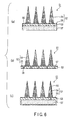
- a microneedle array 51 of this embodiment is different from the above embodiments, as shown in FIG. 6 (a) , in that a large number of communicating holes 56 communicating with a substrate 53 are formed in a sheet portion 55, and that a drug layer 57 is provided beneath the substrate.
- the components common with the above embodiments are indicated with the same reference numerals, and duplicate explanations are omitted.
- a method for producing the microneedle array 51 of this embodiment is explained with reference to FIG. 7 .
- a production apparatus 61 for the microneedle array 51 comprises an outer frame 62, a mold 63 to be inserted into the outer frame 62, and a press plate 64. Unlike the above embodiments, the outer frame 62 and the mold 63 are previously formed into the shape and size of the microneedle array 51 to be produced.
- the mold 63 is formed by machining a mold produced by almost the same method as that of the first embodiment into a desired shape and size, however, unlike the above mold 17, the mold 63 has a large number of protruding portions 65 formed thereon for forming the communicating holes 56 in the sheet portion 55.
- the mold 63 is inserted into the outer frame 62, and a block of medical-grade PLA 19 is fed onto the mold 63.
- the block may have any shape, such as the shape of a sphere, a rectangular solid, a cylinder column, or the like.
- the mold 63 is heated with a non-illustrated heater, etc.
- PLA 19 is heated by the mold 63 to a temperature T°C expressed by the following equation (2), and is spread out in needle-forming portions 66 following the shape of the mold 63.
- the amount of PLA 19 is an amount to allow the PLA 19 to fill needle-forming portions 66 of the mold 63 and further form the sheet portion 55. Subsequently, as shown in FIG.
- Tg + Yw ⁇ T ⁇ Tm + 50 Tg is the glass transition temperature ; and Y is 2 or more and less than 50 , and preferably 20 or more
- a block of PMMA 67 used as a material of the substrate 53 is fed onto the sheet portion 55.
- PMMA 67 polyethylene (PE) or a like material may also be used.
- PE polyethylene
- a material having a Tm comparable to or lower than that of the material of the microneedles 54 is preferably used.
- the amount of PMMA 67 is adjusted so that when the PMMA 67 is spread out uniformly over the sheet portion 55, the tips of the protruding portions 65 are not buried.
- the press plate 64 while heating PMMA 67 to the temperature T calculated by the above equation (2), the press plate 64 applies a pressure of 50 MPa to compress PMMA 67 as shown in FIG. 7 (d) , and the substrate 53 is thus formed (substrate formation and adhesion process).
- FIG. 7 (e) shows the drug layer 57 comprising a polymer impregnated with a desired drug.
- FIG. 7 (f) the substrate 53 is removed from the mold 63.
- FIG. 7 (g) shows an end product formed of the microneedle array 51 incorporated with a patch member 58 coated with an adhesive material.
- the drug is released through the communicating holes 56 without being influenced by the behavior of the microneedles 54 in the body tissue, and thus, stably released into the body tissue through the holes formed in the biological surface by the puncture of the microneedles 54. Accordingly, drug release can be controlled more stably.
- the amount of charged drug is not large, it is also possible to form the drug layer 57 only in the communicating holes 56, as shown in FIG. 6 (b) . Further, in the case where the protruding portions 65 of the mold 63 are provided in the needle-forming portions 66, the microneedles 54 can be formed into a hollow structure, as shown in FIG. 6 (c) . In such a case, the drug can be administered into the body tissue more efficiently through the communicating holes 56 formed in the microneedles 54.
- the invention may be structured so that, as shown in FIG. 8 , a microneedle 101 and a substrate 102 are formed in a single layer. Such an embodiment is explained hereinafter as a fourth embodiment of the invention.
- FIG. 9 (b) medical-grade PLA 19 is fed onto a mold 73 under reduced pressure or vacuum.
- PLA 19 is heated, and, as shown in FIG. 9 (c) , is spread out in needle-forming portions 66 following the shape of the mold 73.
- the amount of PLA 19 is an amount to allow the PLA 19 to fill the needle-forming portions 66 of the mold 73 and further form a sheet portion 65 with a thickness sufficient for the sheet portion 65 to serve as a substrate.
- FIG. 9 (d) a downward pressure is applied by a press plate 74, then the temperature is lowered to cause cooling and solidification, and the press plate 74 is raised, thereby giving a microneedle array 64.
- the microneedle array 64 of this embodiment because the microneedle array 64 is formed of a single layer, the number of manufacturing processes can be reduced, and the productivity can be improved.
- the mold As shown in the third embodiment, it is also possible to provide the mold with protruding portions to form communicating holes in the microneedle.
- the microneedle is made of medical-grade PLA in the above embodiments, insofar as the medical grade is satisfied, PLGA, chitin, chitosan, hyaluronic acid, collagen, glucose, cellulose, magnesium alloy, and other biocompatible materials may also be used. Further, the microneedle may also be made of a mixed material of the above biocompatible materials and the drug. In such a case, the drug is released by dissolution of the microneedle in the body tissue.
- the substrate is made of PMMA in the above embodiments, as mentioned above, a copolymer of butyl acrylate and butyl methacrylate, polycarbonate, polyurethane, polypropylene, and other resin materials, metals, ceramics, and the like may also be used.
- PLA and like materials of a grade lower than the medical grade are also usable.
- the substrate is preferably made of a highly expansible resin material. Further, it is also possible that a plurality of layers made of the above various materials be integrated to form a substrate.
- the substrate and the microneedle are adhered by thermal fusion in the above embodiments, they may be adhered by plasma welding. Further, although the substrate and the microneedle are formed by compression molding in the above embodiment, a common plastic molding technique, such as injection molding or the like, may be used instead to form the substrate and the microneedle.
- PLA on a mold was heated to 210°C.
- the PLA was charged into needle-forming portions, and then cooled and solidified at normal temperature over 1 hour, thereby molding a microneedle array.
- the apparatus shown in FIG. 9 was used for the molding of microneedles.
- the molded microneedle array was removed, and the shape of the needle tip portions was observed. As a result, the needle tip portions were sharp, and the tip portions of all the microneedles on the microneedle array had the same shape.
- PLA on a mold was heated to 210°C without vacuuming.
- the PLA was charged into needle-forming portions, and then cooled and solidified at normal temperature over 1 hour, thereby molding a microneedle array.
- the apparatus shown in FIG. 9 was used for the molding of microneedles.
- the molded microneedle array was removed, and the shape of the needle tip portions was observed. As a result, rounded tip portions were observed in 80 needles out of every 800.
- the microneedles varied in shape and height.
- Chitin was dissolved in chloroform to give a resin fluid.
- the resin fluid was fed onto the mold, and vacuuming was performed while increasing the temperature to 60°C. After 1 hour, at the time when the organic solvent chloroform evaporated, the temperature was lowered to normal temperature, whereby only a chitin molded product was left on the mold. A chitin microneedle array was thus obtained.
- the apparatus shown in FIG. 9 was used for the molding of microneedles.
- the molded microneedle array was removed, and the shape of the needle tip portions was observed. As a result, the needle tip portions were sharp, and all the microneedle tip portions on the microneedle array had the same shape.
- Chitin was dissolved in chloroform to give a resin fluid.
- the resin fluid was fed onto the mold, and charged into the mold while increasing the mold temperature to 60°C.
- the temperature was lowered to normal temperature, thereby molding a microneedle array.
- the apparatus shown in FIG. 9 was used for the molding of the microneedle array.
- the obtained microneedle array contained the organic solvent chloroform remaining therein, and thus was unusable for puncturing through a biological surface.
- the molded microneedle array was removed, and the shape of the needle tip portions was observed. As a result, the needle tip portions were sharp, and all the microneedle tip portions on the microneedle array had the same shape.
- the invention can be used as a microneedle array for medical applications.
Landscapes
- Engineering & Computer Science (AREA)
- Mechanical Engineering (AREA)
- Health & Medical Sciences (AREA)
- Life Sciences & Earth Sciences (AREA)
- General Health & Medical Sciences (AREA)
- Biomedical Technology (AREA)
- Heart & Thoracic Surgery (AREA)
- Hematology (AREA)
- Medical Informatics (AREA)
- Animal Behavior & Ethology (AREA)
- Anesthesiology (AREA)
- Public Health (AREA)
- Veterinary Medicine (AREA)
- Dermatology (AREA)
- Media Introduction/Drainage Providing Device (AREA)
- Micromachines (AREA)
- Casting Or Compression Moulding Of Plastics Or The Like (AREA)
Applications Claiming Priority (2)
| Application Number | Priority Date | Filing Date | Title |
|---|---|---|---|
| JP2006315371 | 2006-11-22 | ||
| PCT/JP2007/072555 WO2008062832A1 (fr) | 2006-11-22 | 2007-11-21 | Matrice à micro-aiguilles et son procédé de production |
Publications (2)
| Publication Number | Publication Date |
|---|---|
| EP2090331A1 true EP2090331A1 (fr) | 2009-08-19 |
| EP2090331A4 EP2090331A4 (fr) | 2012-04-18 |
Family
ID=39429761
Family Applications (1)
| Application Number | Title | Priority Date | Filing Date |
|---|---|---|---|
| EP07832285A Withdrawn EP2090331A4 (fr) | 2006-11-22 | 2007-11-21 | Matrice à micro-aiguilles et son procédé de production |
Country Status (4)
| Country | Link |
|---|---|
| US (1) | US20090234301A1 (fr) |
| EP (1) | EP2090331A4 (fr) |
| JP (1) | JPWO2008062832A1 (fr) |
| WO (1) | WO2008062832A1 (fr) |
Cited By (6)
| Publication number | Priority date | Publication date | Assignee | Title |
|---|---|---|---|---|
| CN104780968A (zh) * | 2012-11-13 | 2015-07-15 | 富士胶片株式会社 | 经皮吸收片材及其制造方法 |
| CN104888343A (zh) * | 2015-05-07 | 2015-09-09 | 北京化工大学 | 一种高分子实心微针及其批量制备方法 |
| WO2018124808A1 (fr) * | 2016-12-29 | 2018-07-05 | 랩앤피플주식회사 | Micro-aiguille |
| KR20180077879A (ko) * | 2016-12-29 | 2018-07-09 | 랩앤피플주식회사 | 멀티형 마이크로 니들 |
| EP3444003A4 (fr) * | 2016-04-07 | 2019-11-13 | Labnpeople Co.,Ltd. | Micro-aiguille mettant en oeuvre un métal biodégradable |
| WO2021032701A1 (fr) * | 2019-08-22 | 2021-02-25 | Lts Lohmann Therapie-Systeme Ag | Dispositif et procédé de fabrication de microstructures |
Families Citing this family (65)
| Publication number | Priority date | Publication date | Assignee | Title |
|---|---|---|---|---|
| JP2009083125A (ja) * | 2007-09-27 | 2009-04-23 | Fujifilm Corp | 機能性膜の製造方法および製造装置 |
| JP5120624B2 (ja) * | 2008-01-31 | 2013-01-16 | 芳一 飛永 | 微細糖質針、その製造方法及び製造装置 |
| JP5183375B2 (ja) * | 2008-09-04 | 2013-04-17 | 凸版印刷株式会社 | 針状体製造方法、針状体製造装置および針状体 |
| JP5233534B2 (ja) * | 2008-09-11 | 2013-07-10 | 凸版印刷株式会社 | 針状体 |
| JP5472673B2 (ja) * | 2008-09-29 | 2014-04-16 | コスメディ製薬株式会社 | マイクロニードルアレイ |
| KR20100037389A (ko) * | 2008-10-01 | 2010-04-09 | 연세대학교 산학협력단 | 다중 약물방출조절이 가능한 솔리드 마이크로구조체 및 이의 제조방법 |
| KR20110099777A (ko) * | 2008-12-29 | 2011-09-08 | 쓰리엠 이노베이티브 프로퍼티즈 컴파니 | 구조화 표면을 갖는 필름 및 그의 제조 방법 |
| JP5402069B2 (ja) * | 2009-02-20 | 2014-01-29 | 凸版印刷株式会社 | 針状構造物の製造方法 |
| JP5343653B2 (ja) * | 2009-03-25 | 2013-11-13 | 凸版印刷株式会社 | 成形品の成形装置及び成形方法 |
| JP5072899B2 (ja) * | 2009-04-17 | 2012-11-14 | 株式会社日本製鋼所 | 貫通孔を有する微細構造成形体の製造方法及び製造装置 |
| JP2011012050A (ja) * | 2009-06-03 | 2011-01-20 | Bioserentack Co Ltd | 多孔性基盤を用いたマイクロニードル・アレイとその製造方法 |
| JP5152935B2 (ja) * | 2010-04-28 | 2013-02-27 | 株式会社日本製鋼所 | 貫通孔を有する微細構造成形体の製造方法及び微細構造成形体素材 |
| WO2011135531A2 (fr) | 2010-04-28 | 2011-11-03 | Kimberly-Clark Worldwide, Inc. | DISPOSITIFS MÉDICAUX POUR L'ADMINISTRATION D'ARNsi |
| CN102958556B (zh) | 2010-04-28 | 2017-02-15 | 金伯利-克拉克环球有限公司 | 细胞相互作用增强的纳米图案化医疗装置 |
| JP6327852B2 (ja) | 2010-05-04 | 2018-05-23 | コリウム インターナショナル, インコーポレイテッド | 微小突起アレイを使用した副甲状腺ホルモンの経皮送達のための方法及びデバイス |
| GB2483505B (en) * | 2010-09-13 | 2012-10-10 | Ndm Technologies Ltd | Devices for transdermal drug delivery |
| JP2012235899A (ja) * | 2011-05-12 | 2012-12-06 | Bioserentack Co Ltd | 大量の目的物質を皮膚内へデリバリーするためのマイクロニードル・アレイ・チップ |
| WO2012167162A2 (fr) * | 2011-06-03 | 2012-12-06 | University Of Washington | Procédés de fabrication de nanofibres de chitine et utilisations de celles-ci |
| JP2013162861A (ja) * | 2012-02-10 | 2013-08-22 | Bioserentack Co Ltd | 細胞間液モニター用マイクロニードル |
| EP2815784A4 (fr) * | 2012-02-17 | 2015-07-01 | Cosmed Pharmaceutical Co Ltd | Microaiguille du type à dissolution rapide |
| JP6277953B2 (ja) * | 2012-02-29 | 2018-02-14 | 凸版印刷株式会社 | 針状体の製造方法 |
| JP2013216044A (ja) * | 2012-04-11 | 2013-10-24 | Teijin Ltd | 積層成形品の成形方法 |
| CN104780967B (zh) * | 2012-11-13 | 2017-04-12 | 富士胶片株式会社 | 经皮吸收片的制造方法 |
| JP2014097163A (ja) * | 2012-11-14 | 2014-05-29 | Ikeda Kikai Sangyo Kk | マイクロニードルアレイの製造方法 |
| JP6111634B2 (ja) * | 2012-12-10 | 2017-04-12 | 凸版印刷株式会社 | 針状構造体の製造装置 |
| RU2698095C2 (ru) | 2012-12-21 | 2019-08-22 | Кориум Интернэшнл, Инк. | Микроматрица для доставки терапевтического средства и способы использования |
| WO2014113679A1 (fr) * | 2013-01-18 | 2014-07-24 | The University Of North Carolina At Chapel Hill | Fabrication à haut rendement de micro-aiguilles |
| BR122020006959B1 (pt) | 2013-03-12 | 2022-04-26 | Corium, Inc | Aplicador de microprojeções |
| CN105228522B (zh) * | 2013-03-14 | 2018-06-26 | 萨诺智能公司 | 用于生物监测的人体上的微传感器 |
| US10820860B2 (en) | 2013-03-14 | 2020-11-03 | One Drop Biosensor Technologies, Llc | On-body microsensor for biomonitoring |
| AU2014233695A1 (en) | 2013-03-15 | 2015-10-01 | Corium International, Inc. | Microarray for delivery of therapeutic agent and methods of use |
| WO2014175310A1 (fr) * | 2013-04-26 | 2014-10-30 | 凸版印刷株式会社 | Procédé de production d'un corps aciculaire |
| EP3006078B1 (fr) * | 2013-06-03 | 2020-10-07 | Toppan Printing Co., Ltd. | Procédé de fabrication de corps d'aiguille |
| JP6370296B2 (ja) * | 2013-07-30 | 2018-08-08 | Asti株式会社 | マイクロニードルアレイとマイクロニードルアレイ製造方法 |
| JP5652525B2 (ja) * | 2013-09-10 | 2015-01-14 | 凸版印刷株式会社 | 針状構造物の製造装置 |
| JP5652524B2 (ja) * | 2013-09-10 | 2015-01-14 | 凸版印刷株式会社 | 針状構造物の製造装置 |
| JP5931110B2 (ja) * | 2014-03-26 | 2016-06-08 | 日本写真印刷株式会社 | 錐体状突起シートの梱包体の製造方法 |
| EP3135334A4 (fr) * | 2014-06-13 | 2017-06-21 | Toppan Printing Co., Ltd. | Procédé de fabrication de corps en forme d'aiguille et corps en forme d'aiguille |
| EP3188714A1 (fr) | 2014-09-04 | 2017-07-12 | Corium International, Inc. | Matrice de microstructures, procédé de production et procédés d'utilisation |
| US20210346664A1 (en) * | 2014-10-06 | 2021-11-11 | Nikolai Tankovich | Sandwiched biodegradable microneedle |
| US10973757B2 (en) * | 2014-10-06 | 2021-04-13 | StemProtein, LLC | Biodegardable microneedle device |
| KR101676861B1 (ko) * | 2015-04-10 | 2016-11-17 | 씨앤텍 주식회사 | 마이크로 니들 패치 제조장치와 방법, 및 이에 의해 제조되는 마이크로 니들 패치 |
| WO2017004067A1 (fr) * | 2015-06-29 | 2017-01-05 | Corium International, Inc. | Micro-réseau pour l'administration d'un agent thérapeutique, procédés d'utilisation, et procédés de fabrication |
| CA3001413A1 (fr) * | 2015-10-20 | 2017-04-27 | National Research Council Of Canada | Membranes polymeres comprenant des trous traversants ouverts et procede de fabrication associe |
| EP3391935A4 (fr) * | 2015-12-18 | 2019-08-14 | Labo Juversa Co., Ltd. | Micro-aiguille et timbre à micro-aiguilles |
| CN105498082B (zh) * | 2015-12-24 | 2017-10-27 | 广州新济药业科技有限公司 | 微针芯片及其制备方法 |
| KR101636070B1 (ko) * | 2015-12-30 | 2016-07-14 | 주식회사 라파스 | 마이크로니들 제조장치 |
| JP2017131397A (ja) * | 2016-01-27 | 2017-08-03 | 花王株式会社 | 微細中空突起具の製造方法 |
| WO2017159779A1 (fr) * | 2016-03-16 | 2017-09-21 | コスメディ製薬株式会社 | Boîtier de timbre à micro-aiguilles |
| WO2017204418A1 (fr) * | 2016-05-23 | 2017-11-30 | 주식회사유한양행 | Timbre à micro-aiguilles contenant de la bléomycine pour le traitement de verrue et son procédé de fabrication |
| KR101697556B1 (ko) * | 2016-08-05 | 2017-01-18 | 이상혁 | 마이크로 구조체 제조장치, 제조방법 및 이로부터 제조된 마이크로 구조체 |
| KR101716447B1 (ko) * | 2016-09-30 | 2017-03-14 | 이상혁 | 진동과 중력을 이용한 마이크로니들 제조방법 |
| KR101868872B1 (ko) * | 2016-10-28 | 2018-06-19 | 권영덕 | 마이크로 니들 및 그 제조 방법 |
| KR101905040B1 (ko) | 2017-04-19 | 2018-10-08 | (주) 오스타테크 | 마이크로 니들 충전장치 및 충전방법 |
| JP6965068B2 (ja) * | 2017-09-13 | 2021-11-10 | 花王株式会社 | 中空突起具の製造方法、中空突起具の製造装置、及び中空突起具 |
| KR102296331B1 (ko) * | 2017-11-15 | 2021-08-30 | 주식회사 엘지생활건강 | 마이크로니들 연속 제조용 장치 및 공정 |
| KR102184940B1 (ko) | 2017-11-15 | 2020-12-01 | 주식회사 엘지생활건강 | 마이크로니들 연속 제조용 장치 및 공정 |
| KR102139335B1 (ko) | 2017-11-24 | 2020-07-29 | 주식회사 엘지생활건강 | 니들 팁에 코팅부를 보유하는 마이크로니들을 제조하는 방법 및 장치 |
| EP3520979B1 (fr) * | 2018-02-01 | 2022-12-28 | SABIC Global Technologies B.V. | Réseau de micro-aiguilles et procédé de fabrication d'un réseau de micro-aiguilles |
| CN111770824B (zh) * | 2018-03-27 | 2021-11-23 | 富士胶片株式会社 | 具有凹状底座图案的模具的制作方法及图案片材的制造方法 |
| JP6956680B2 (ja) | 2018-05-16 | 2021-11-02 | 富士フイルム株式会社 | モールドケース及びマイクロニードルアレイの製造方法 |
| CN111298280B (zh) * | 2018-12-11 | 2024-04-12 | 尹忠 | 一种软背微针及其制作方法 |
| CN111298279B (zh) * | 2018-12-11 | 2024-01-26 | 尹忠 | 一种给药微针的制备装置及制备方法 |
| CN111300708B (zh) * | 2018-12-11 | 2024-12-17 | 尹忠 | 给药微针的制备装置及制备方法 |
| US20230415383A1 (en) * | 2021-02-11 | 2023-12-28 | The Boeing Company | Method and apparatus for fabricating brittle microneedle |
Family Cites Families (17)
| Publication number | Priority date | Publication date | Assignee | Title |
|---|---|---|---|---|
| US4163900A (en) * | 1977-08-17 | 1979-08-07 | Connecticut Research Institute, Inc. | Composite electron microscope grid suitable for energy dispersive X-ray analysis, process for producing the same and other micro-components |
| JPH10146206A (ja) * | 1996-09-19 | 1998-06-02 | Ykk Corp | 一体成形面ファスナー部材とその製造方法 |
| US6312612B1 (en) * | 1999-06-09 | 2001-11-06 | The Procter & Gamble Company | Apparatus and method for manufacturing an intracutaneous microneedle array |
| US6256533B1 (en) * | 1999-06-09 | 2001-07-03 | The Procter & Gamble Company | Apparatus and method for using an intracutaneous microneedle array |
| MXPA02004863A (es) * | 1999-11-15 | 2003-01-28 | Velcro Ind | Miembro de sujecion dermica. |
| NL1016779C2 (nl) * | 2000-12-02 | 2002-06-04 | Cornelis Johannes Maria V Rijn | Matrijs, werkwijze voor het vervaardigen van precisieproducten met behulp van een matrijs, alsmede precisieproducten, in het bijzonder microzeven en membraanfilters, vervaardigd met een dergelijke matrijs. |
| US9302903B2 (en) * | 2000-12-14 | 2016-04-05 | Georgia Tech Research Corporation | Microneedle devices and production thereof |
| US6767341B2 (en) | 2001-06-13 | 2004-07-27 | Abbott Laboratories | Microneedles for minimally invasive drug delivery |
| US6908453B2 (en) * | 2002-01-15 | 2005-06-21 | 3M Innovative Properties Company | Microneedle devices and methods of manufacture |
| US6899838B2 (en) * | 2002-07-12 | 2005-05-31 | Becton, Dickinson And Company | Method of forming a mold and molding a micro-device |
| US20050008821A1 (en) * | 2003-07-07 | 2005-01-13 | Pricone Robert M. | Process and apparatus for fabricating precise microstructures and polymeric molds for making same |
| US7708544B2 (en) * | 2003-07-21 | 2010-05-04 | 10X Technology Llc | Apparatus and method for manufacturing microneedles |
| WO2005082593A1 (fr) * | 2004-02-17 | 2005-09-09 | Avery Dennison Corporation | Procede de fabrication de micro-aiguilles |
| JP2007523771A (ja) * | 2004-02-23 | 2007-08-23 | スリーエム イノベイティブ プロパティズ カンパニー | マイクロニードルアレイの成形方法 |
| KR20070100820A (ko) * | 2005-01-31 | 2007-10-11 | 가부시키가이샤 바이오세렌택 | 경피 흡수 제제, 경피 흡수 제제 유지 시트 및 경피 흡수제제 유지 용구 |
| WO2006121110A1 (fr) | 2005-05-13 | 2006-11-16 | Hisamitsu Pharmaceutical Co., Inc. | Instrument de transport de médicaments et procédé de fabrication idoine |
| TW200829215A (en) * | 2007-01-03 | 2008-07-16 | Univ Nat Chiao Tung | Micro probe array and manufacturing method of the trans-print mold thereof |
-
2007
- 2007-11-21 EP EP07832285A patent/EP2090331A4/fr not_active Withdrawn
- 2007-11-21 WO PCT/JP2007/072555 patent/WO2008062832A1/fr not_active Ceased
- 2007-11-21 JP JP2008545431A patent/JPWO2008062832A1/ja active Pending
-
2009
- 2009-05-21 US US12/453,783 patent/US20090234301A1/en not_active Abandoned
Cited By (7)
| Publication number | Priority date | Publication date | Assignee | Title |
|---|---|---|---|---|
| CN104780968A (zh) * | 2012-11-13 | 2015-07-15 | 富士胶片株式会社 | 经皮吸收片材及其制造方法 |
| CN104888343A (zh) * | 2015-05-07 | 2015-09-09 | 北京化工大学 | 一种高分子实心微针及其批量制备方法 |
| EP3444003A4 (fr) * | 2016-04-07 | 2019-11-13 | Labnpeople Co.,Ltd. | Micro-aiguille mettant en oeuvre un métal biodégradable |
| WO2018124808A1 (fr) * | 2016-12-29 | 2018-07-05 | 랩앤피플주식회사 | Micro-aiguille |
| KR20180077879A (ko) * | 2016-12-29 | 2018-07-09 | 랩앤피플주식회사 | 멀티형 마이크로 니들 |
| WO2021032701A1 (fr) * | 2019-08-22 | 2021-02-25 | Lts Lohmann Therapie-Systeme Ag | Dispositif et procédé de fabrication de microstructures |
| US12036705B2 (en) | 2019-08-22 | 2024-07-16 | Lts Lohmann Therapie-Systeme Ag | Device and method for producing microstructures |
Also Published As
| Publication number | Publication date |
|---|---|
| JPWO2008062832A1 (ja) | 2010-03-04 |
| WO2008062832A1 (fr) | 2008-05-29 |
| US20090234301A1 (en) | 2009-09-17 |
| EP2090331A4 (fr) | 2012-04-18 |
Similar Documents
| Publication | Publication Date | Title |
|---|---|---|
| US20090234301A1 (en) | Microneedle array and method for producing microneedle array | |
| EP2343101A1 (fr) | Matrice pour feuille de micro-aiguille, procédé de fabrication de la matrice, et procédé de fabrication de micro-aiguille à l'aide de la matrice | |
| EP2343102A1 (fr) | Procédé de fabrication d'une matrice pour micro-aiguille | |
| EP3409318A1 (fr) | Réseau de micro-aiguilles, et feuille de micro-aiguilles | |
| EP2842595B1 (fr) | Micro-aiguille et matrice de micro-aiguilles | |
| CA2546688C (fr) | Dispositif d'administration transdermique de substances actives | |
| CA2528512A1 (fr) | Procede servant a produire une plaquette de base pour l'administration transdermique d'un medicament, plaque de base et aiguille | |
| WO2008020632A1 (fr) | Micro-aiguille et timbre à micro-aiguilles | |
| EP2990072B1 (fr) | Procédé de production d'un corps aciculaire | |
| WO2008015782A1 (fr) | Timbre à micro-aiguilles et procédé de production | |
| JP2015116335A (ja) | 経皮薬剤投与システム及び経皮薬剤投与システムの製造方法 | |
| EP3381498A1 (fr) | Microaiguille et procédé pour la produire | |
| CN106853271B (zh) | 微结构体的制造方法 | |
| KR102249513B1 (ko) | 캔들형 마이크로 구조체 및 이의 제조 방법 | |
| JP2005021678A (ja) | 経皮投薬用パッドベースの製造方法及び経皮投薬用パッドベース、並びに注射針 | |
| EP3363491B1 (fr) | Instrument d'administration | |
| US20240350784A1 (en) | Microneedle patch and manufacturing method thereof | |
| JP2003321350A (ja) | 経皮吸収型製剤およびそれを用いた薬物の経皮吸収方法 | |
| KR101697556B1 (ko) | 마이크로 구조체 제조장치, 제조방법 및 이로부터 제조된 마이크로 구조체 | |
| Guillot et al. | Microneedles: Fabrication, Characterization and Translational Potential | |
| JP4237819B1 (ja) | 経皮吸収型製剤 | |
| KR20210010595A (ko) | 생리활성물질 피부 전달용 마이크로 구조체 제조방법 | |
| KR20210115455A (ko) | 피부 부착 박막의 제조를 위한 성형몰드 및 이를 이용한 피부 부착 박막 제조 방법 | |
| KR20200122629A (ko) | 생리활성물질 피부 전달용 마이크로 구조체 제조방법 | |
| CN119732935A (zh) | 微针贴片、经皮吸收组成物及可溶性膜 |
Legal Events
| Date | Code | Title | Description |
|---|---|---|---|
| PUAI | Public reference made under article 153(3) epc to a published international application that has entered the european phase |
Free format text: ORIGINAL CODE: 0009012 |
|
| 17P | Request for examination filed |
Effective date: 20090520 |
|
| AK | Designated contracting states |
Kind code of ref document: A1 Designated state(s): AT BE BG CH CY CZ DE DK EE ES FI FR GB GR HU IE IS IT LI LT LU LV MC MT NL PL PT RO SE SI SK TR |
|
| DAX | Request for extension of the european patent (deleted) | ||
| A4 | Supplementary search report drawn up and despatched |
Effective date: 20120319 |
|
| RIC1 | Information provided on ipc code assigned before grant |
Ipc: B29C 43/56 20060101ALI20120312BHEP Ipc: B29C 59/02 20060101ALN20120312BHEP Ipc: B29C 43/36 20060101ALN20120312BHEP Ipc: A61M 37/00 20060101AFI20120312BHEP Ipc: B29C 43/02 20060101ALI20120312BHEP |
|
| RIC1 | Information provided on ipc code assigned before grant |
Ipc: A61M 37/00 20060101AFI20161129BHEP Ipc: B29C 43/02 20060101ALI20161129BHEP Ipc: B29C 43/36 20060101ALN20161129BHEP Ipc: B29C 43/56 20060101ALI20161129BHEP Ipc: B29C 59/02 20060101ALN20161129BHEP |
|
| RIC1 | Information provided on ipc code assigned before grant |
Ipc: B29C 43/02 20060101ALI20161220BHEP Ipc: B29C 43/56 20060101ALI20161220BHEP Ipc: A61M 37/00 20060101AFI20161220BHEP Ipc: B29C 59/02 20060101ALN20161220BHEP Ipc: B29C 43/36 20060101ALN20161220BHEP |
|
| STAA | Information on the status of an ep patent application or granted ep patent |
Free format text: STATUS: THE APPLICATION HAS BEEN WITHDRAWN |
|
| 18W | Application withdrawn |
Effective date: 20170314 |