EP2090419B1 - Versiegelungsvorrichtung - Google Patents
Versiegelungsvorrichtung Download PDFInfo
- Publication number
- EP2090419B1 EP2090419B1 EP08002744.4A EP08002744A EP2090419B1 EP 2090419 B1 EP2090419 B1 EP 2090419B1 EP 08002744 A EP08002744 A EP 08002744A EP 2090419 B1 EP2090419 B1 EP 2090419B1
- Authority
- EP
- European Patent Office
- Prior art keywords
- gas inlet
- container
- removal unit
- end section
- accordance
- Prior art date
- Legal status (The legal status is an assumption and is not a legal conclusion. Google has not performed a legal analysis and makes no representation as to the accuracy of the status listed.)
- Active
Links
Images

Classifications
-
- B—PERFORMING OPERATIONS; TRANSPORTING
- B29—WORKING OF PLASTICS; WORKING OF SUBSTANCES IN A PLASTIC STATE IN GENERAL
- B29C—SHAPING OR JOINING OF PLASTICS; SHAPING OF MATERIAL IN A PLASTIC STATE, NOT OTHERWISE PROVIDED FOR; AFTER-TREATMENT OF THE SHAPED PRODUCTS, e.g. REPAIRING
- B29C73/00—Repairing of articles made from plastics or substances in a plastic state, e.g. of articles shaped or produced by using techniques covered by this subclass or subclass B29D
- B29C73/16—Auto-repairing or self-sealing arrangements or agents
- B29C73/166—Devices or methods for introducing sealing compositions into articles
-
- B—PERFORMING OPERATIONS; TRANSPORTING
- B29—WORKING OF PLASTICS; WORKING OF SUBSTANCES IN A PLASTIC STATE IN GENERAL
- B29L—INDEXING SCHEME ASSOCIATED WITH SUBCLASS B29C, RELATING TO PARTICULAR ARTICLES
- B29L2030/00—Pneumatic or solid tyres or parts thereof
Definitions
- the invention relates to an apparatus for the sealing of inflatable articles, in particular tires and has a pressure-tight container for receiving a sealant, the container having a connection element, a removal unit for connection to the connection element of the container, a gas inlet and an outlet in the removal unit which communicate via the internal space of the container and a non-return valve which is provided in the gas inlet.
- the invention relates furthermore to a removal unit which can in particular be used with such an apparatus.
- Such apparatuses serve to seal a leak in an inflatable article, for example in a punctured tire or a tire which has been damaged during travel in that a special sealant is introduced via the tire valve into the tire and the tire is subsequently pumped up, at least to a pressure at which it can be driven again.
- a pressure-tight container with a sealant such as is described for example in DE 196 52 546 A1 is connected to a removal unit.
- the removal unit has a gas inlet through gas which can be introduced into the container and an outlet which can be connected to the valve of the damaged tire.
- a compressor is connected either inside of the removal unit or to the inlet of the removal unit, with the aid of which an elevated pressure can be generated in the container through the gas inlet of the removal unit. Through this elevated pressure the sealant is pressed through the outlet in the direction of the damaged tire as is described in EP 1 121 324 B1 .
- the non-return valve is provided in an end section of the gas inlet which opens into the container without being deflected when the removal unit is connected to the container.
- the non-return valve consists of a closure element, preferably a ball, which is sealingly pressed against a valve seat by elevated pressure in the container.
- the non-return valve is provided at the end of the gas inlet and is easy to reach in this manner through the gas inlet. In an otherwise completely finished removal unit the closure element of the non-return valve only has to be introduced through the gas inlet.
- the closure element lies on the valve seat of the non-return valve and seals the gas inlet to the extent that elevated pressure prevails in the container and thus at the end of the gas inlet.
- elevated pressure can for example arise when the compressor switches off during the pumping of the sealings into the tire or when residual pressure is present in the tire on connection of the apparatus to the tire.
- Sealing medium from the container can in this manner not enter into the gas inlet of the removal unit.
- the gas pressure source with which elevated pressure is generated in the container through the gas inlet in order to press the sealant out of the outlet is protected against backwardly flowing sealant.
- the layout of the so disposed non-return valve is particularly simple and requires only the introduction of the closure element into the gas inlet of the removal unit.
- a simple design provides that the gas inlet and the outlet are coaxially arranged in the region of the end section of the gas inlet.
- the outlet surrounds the gas inlet in which the non-return valve is provided.
- the gas inlet containing the non-return valve is effectively protected against external influences such as for examples jolts etc. and, on the other hand, the gas inlet is readily accessible in order to introduce the closure element.
- the inventive arrangement is of advantage since the end section of the gas inlet projects beyond the removal unit so that the closure element can be reliably introduced.
- the closure element cannot leave the gas inlet, i.e. the closure element can in particular not be thrown out of the gas inlet into the container when an elevated pressure is applied to the gas inlet with the aid of a compressor.
- a corresponding net can be placed over the gas inlet for this purpose after the introduction of the closure element.
- a particularly simple design however provides that after the introduction of the closure element into the gas inlet a deformation of the gas inlet is effected which is designed in such a way that the closure element cannot pass it.
- the gas inlet is provided within the outlet and/or the end section of the gas inlet projects beyond the rest of the removal unit.
- the end section for example can be squeezed together a little from the outside, to which end it may for example be formed from thin metal.
- the squeezing together can take place by hand or by a corresponding crimping or indenting apparatus.
- Another preferred embodiment in particular for an end section formed from plastic, provides for the outer end of the end section to have projecting lugs at least projecting to the inside. These lugs can be formed in a simple manner for example by a hot embossing process.
- non-return valve is provided in a region of the gas inlet which is vertically aligned and the valve seat is arranged beneath the closure element when the removal unit is connected to the connection element of the container and the container stands on its head.
- the arrangement during sealing is as a rule operated with the container standing on its head.
- the described advantageous embodiment with the non-return valve in a vertical section of the gas inlet and with a valve seat arranged beneath the closure element, ensures, in this mode of operation, that the closure element comes to lie sealingly in the valve seat, simply as a result of gravity, for example when the gas pressure source is switched off during the sealing process or when the arrangement is placed on its head without the gas pressure source being connected.
- the removal unit can directly contain the gas pressure source, for example a compressor.
- An arrangement in which the removal unit has a connection to the end of the gas inlet which is spaced from the container is however particularly flexible, in order to be able to connect an external gas pressure source.
- a modular construction of this kind is in particular advantageous with the tight special conditions in a motor vehicle when the apparatus is not in use and must for example be stowed in the trunk.
- Both the container and also the removal unit can be manufactured of plastic, preferably plastic which is capable of being recycled. This enables a cost favourable and simple manufacture, for example as an injection moulded part. Further, with a plastic member, the above described deformation of the end section of the gas inlet can be achieved with the help of a hot embossing process in an easy way.
- the entire removal unit can be manufactured as a one-piece plastic part and in the final working step it is only necessary to introduce the closure element into the gas inlet.
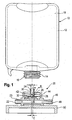
- the sealing apparatus has a pressure-tight container 10 of bottle-like shape made of plastic which is capable of being recycled. It includes a container wall 12 which surrounds a container inner space 18 in which the sealant is received.
- the container 10 has a somewhat cylindrical connection stub 16 which is formed in a manner of a bottle neck and which has an external thread 14 and forms the connection element of the container.
- connection possibilities such as for example an internal thread or latch devices or an internal thread recessed within the container.
- a removal unit 20 which is likewise manufactured generally or entirely of a plastic capable of being recycled includes a gas inlet 22 which has a cylindrical end section 24 projecting beyond the rest of the removal unit and which is surrounded by a wall 30.
- the upper end of the end section 24 of the gas inlet 22 at least partly has a reduced internal dimension, as will be explained with reference to Fig. 3 and Fig. 4 , but which is not however shown in Fig. 1 for the sake of clarity.
- the gas inlet 22 has an inlet tube 23 onto which a corresponding connection hose can be plugged.
- the removal unit 20 moreover has a tube stub 44 which has an internal thread 42. This inner thread 42 matches the outer thread 14 of the container 10. If the container 10 is screwed onto the removal unit 20 the end section 24 of the gas inlet 22 points into the container 10.
- valve seat 28 In the gas inlet 22, and in particular in the end section 24, there is a valve seat 28, with the gas inlet having a round cross-section in the region of the valve seat.
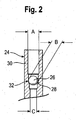
- the internal diameter of the end section 24 of the gas inlet 22 reduces conically in this region from a larger diameter A at the open end of the end section 24 of the gas inlet 22 to a small internal diameter C.
- the region of the smaller diameter C is accordingly located beneath the region of the larger diameter A.
- the valve seat 28 forms, in cooperation with a ball 26, a non-return valve 32.
- the ball 26 has an outer diameter B which is, on the one hand, smaller than the larger inner diameter A of the end section 24 of the gas inlet 22 and is, on the other hand, larger than the reduced diameter C of the gas inlet 22 beneath the valve seat 28.
- the tube stub 44 with the internal thread 42 surrounds the end section 24 of the gas inlet coaxially.
- the inner space of the tube stub 44 is part of the outlet 40 of the removal unit 20 which is connected to an outlet tube 46 onto which for example a hose can be plugged in order to connect the removal unit 20 to the valve of a tire to be sealed.
- a standing frame 50 is shown purely schematically in Fig. 1 to which the removal unit 20 is secured or which is included in the removal unit 20. This is for example a tripod or a quadripod which enables secure standing during the operation of the sealing apparatus.
- FIG. 2 the end section 24 of the housing 22 is shown once again in an enlarged detail.
- Fig. 2 shows the end section 24 in a stage shortly after the ball 26 has been introduced
- Fig. 3 and 4 each show an installation state following this of two different embodiments, respectively.
- the upper end of the gas inlet 22 which may be metallic, is pressed together for example by hand whereby the wall 30 has lost its cylindrical shape at the end without however being completely closed.
- the internal extent of the end section 24 of the gas inlet 22 has been reduced in one spatial direction to an internal measure D which is smaller than the outer diameter B of the ball 26.
- the ball 26 can accordingly no longer pass through the end of the end section 24 of the gas inlet 22.
- the internal diameter A of the end section 24 for example can be 4 mm and the diameter B of the ball 26 3.6 mm.
- the internal diameter C of the gas inlet 22 beneath the valve seat 28 then for example is 2.5 mm.
- the reduced internal dimension B in any case must be smaller than the diameter B of the ball 26, that is, smaller than 3.6 mm for the described dimensions.
- Fig. 4a shows another embodiment in a sectional view from the side and Fig. 4b shows a top view seen in the direction IV as indicated in Fig. 4a .
- the entire removing unit 20 is formed from a moulded plastic part and may be connected to a standing frame 50.
- the injection moulding process is carried out such that the end of the gas cylinder 24 still has the internal diameter A.
- the ball 26 is introduced through the opening in the end section 24 of the gas inlet and falls onto the valve seat 28.
- a hot embossing tool is used for forming the projecting lugs 52.
- This can for example be a hot embossing stamp with projections projecting downwardly or radially to the outside and which are disposed for example in the form of a star with an angle of 120 degrees between each other.
- the tool can be pressed into or on the end section 24 of the gas inlet 22.
- the heated projections the tool melts the edge of the opening of the end section 24 at the locations of the projections.
- the thus forming semi-fluid plastic of the end section of the gas inlet 22 moves a little downward and forms the projecting lugs 52 projecting at least also inwardly.
- the end section 24 projects beyond the rest of the removal unit so that the wall 30 of the end section 24 is easily accessible in order to bring about the indenting or the compression.
- the container 10 contains a liquid sealant.
- the removal unit 20 is placed with the aid of the standing frame 50 on the ground.
- a non-indicated filling line is plugged onto the outlet tube 46 and is connected at its other end to the valve of the tire to be sealed in a manner known per se. Any residual pressure which may still be present in the tire to be sealed can now escape through the filling line and the connection 40.
- connection stub 16 of the container 10 is screwed into the internal thread 42 and is thus positioned inverted. In doing so the end of the end section 24 of the gas inlet 22 penetrates a foil-like cover which is optionally provided at the connection stub 16 in order to provide access to the container 10.
- the removal unit is first screwed onto the container and the entire arrangement is then first brought into a position in which the container is inverted
- the ball 26 of the non-return valve 32 prevents the entry of sealant from the container 10 into the gas inlet 22 even when the container 10 is arranged inverted.
- a gas pressure source for example a small compressor, is connected to the inlet tube 23 of the gas inlet 22 in a manner known per se. Air is forced by this gas pressure source through the gas inlet 22. The ball 26 thus lifts out of the valve seat 28 and permits the pumping of air into the container 10.
- the sealant located in the container is pressed through the outlet 40 and the non-illustrated filling line into the tire to be sealed.
- the sealing apparatus of the invention When the required quantity of sealant has been introduced into the tire to repair the tire leak and when a residual quantity of sealant is present in the container 10 the sealing apparatus of the invention is turned through 180° and placed on the base of the container.
- the sealant now collects at the side of the container 10 remote from the removal unit 20 in the region of the base of the container so that the gas which still flows through the gas inlet 22 into the container flows directly into the outlet 40 and into the tire. In this manner the tire can be blown up to its operating pressure directly following the introduction of the sealant, or at least to a pressure at which the relevant vehicle can travel a certain distance.
- the special design and arrangement of the non-return valve 32 in the removing unit 20 enables the simple installation of the non-return valve.
- the ball 26 only simply has to be introduced through the opening into the end section 24 of the gas inlet 22 and for example the end of the end section 24 is squeezed together in one direction to a smaller diameter D ( Fig. 3 ) or the lugs 52 projecting inwardly are formed with a hot embossing process ( Fig. 4 ).
- the particular arrangement of the non-return valve 32 however in particular also ensures reliable operation. If residual pressure is still present in the tire during installation of the container 10 onto the removal unit 20, then this cannot lead to the sealant being pressed out of the container 10 through the gas inlet 22 in the direction of the compressor. This is prevented by the ball 26 which is pressed against the valve seat 28 by the elevated pressure from the tire acting through the container 10 and insofar prevents passage of the sealant in the direction of the compressor. During operation of the compressor, the ball 26 is lifted upwardly out of the valve seat 28 by the air flowing in from the compressor through the gas inlet 22. If the compressor is switched off during the operation then the ball 26 falls again in the direction of the valve seat 28, brought about solely by gravity, and closes the gas inlet 22. Sealant from the container 10 can thus not pass in the direction of the compressor even when this produces no pressure.
Landscapes
- Engineering & Computer Science (AREA)
- Mechanical Engineering (AREA)
Claims (15)
- Vorrichtung für das Abdichten aufblasbarer Gegenstände, insbesondere Reifen, die das Folgende umfasst:- einen druckdichten Behälter (10) zur Aufnahme eines Dichtmittels und mit einem Verbindungselement (16),- eine Entfernungseinheit (20) für die Verbindung, bevorzugt für eine Schraubverbindung mit dem Verbindungselement (16) des Behälters (10),- einen Gaseinlass (22) und einen Auslass (40), die mit dem abzudichtenden Gegenstand gekoppelt werden können, wobei der Gaseinlass und der Auslass in der Entfernungseinheit (20) angeordnet sind und über den Behälterinnenraum (18) kommunizieren, wenn die Entfernungseinheit (20) mit dem Verbindungselement (16) des Behälters verbunden ist, und- ein Rückschlagventil (32), das in dem Gaseinlass (22) auf solche Weise vorgesehen ist, dass es schließt, wenn ein erhöhter Druck in dem Behälter (10) vorherrscht, und ein Verschlusselement (26), bevorzugt eine Kugel, besitzt, die durch den erhöhten Druck in dem Behälter (10) abdichtend auf einen Ventilsitz (28) in dem Gaseinlass gepresst wird,
dadurch gekennzeichnet, dass- das Rückschlagventil (32) in einem Endabschnitt (24) des Gaseinlasses (22) vorgesehen ist, der sich ohne Auslenkung zu dem Behälter (10) öffnet, wenn die Entfernungseinheit (20) mit dem Behälter (10) verbunden ist,- der Endabschnitt (24) des Gaseinlasses (22) über den Rest der Entfernungseinheit vorragt, und- zum Verhindern des Entweichens des Verschlusselements (26) aus dem Endabschnitt (24) des Gaseinlasses (22) eine Verformung der Innenwand des Endabschnittes (24) des Gaseinlasses vorgesehen ist, die so bemessen ist, dass das Verschlusselement (26) nicht vorbei gelangen kann. - Vorrichtung nach Anspruch 1, dadurch gekennzeichnet, dass der Gaseinlass (22) und der Auslass (40) koaxial zueinander in dem Bereich des Endabschnittes (24) des Gaseinlasses (22) angeordnet sind, wobei der Auslass (40) den Gaseinlass (22) in diesem Bereich umgibt.
- Vorrichtung nach einem der Ansprüche 1 oder 2, dadurch gekennzeichnet, dass- das Verschlusselement eine Kugel (26) aufweist,- der Endabschnitt (24) des Gaseinlasses (22) ein zylindrisches Rohr (30) aufweist, und- die Verformung eine Abweichung des Endabschnittes (24) von einer zylindrischen Form aufweist, die bevorzugt durch Zusammenpressen des Endabschnittes (24) erreicht wird.
- Vorrichtung nach einem der Ansprüche 1 oder 2, dadurch gekennzeichnet, dass der Endabschnitt (24) des Gaseinlasses (22) eine Mehrzahl, bevorzugt drei vorragende Ansätze, die einwärts vorragen, umfasst, die eine Abmessung besitzen und derart angeordnet sind, dass die freie Innenabmessung des Endabschnitts (24) in dem Bereich der vorragenden Ansätze (52) kleiner als die Außenabmessung des Verschlusselements (26) ist.
- Vorrichtung nach einem der Ansprüche 1 bis 4, dadurch gekennzeichnet, dass das Rückschlagventil (32) in einem Bereich des Gaseinlasses (22) vorgesehen ist, der vertikal ausgerichtet ist, und der Ventilsitz (28) unterhalb des Verschlusselements (26) angeordnet ist, wenn die Entfernungseinheit (20) mit dem Verbindungselement (16) des Behälters (10) verbunden und der Behälter (10) umgedreht ist.
- Vorrichtung nach einem der Ansprüche 1 bis 5, dadurch gekennzeichnet, dass der Gaseinlass (22) stromaufwärts des Rückschlagventils (32) mit einer Gasdruckquelle verbunden sein kann.
- Vorrichtung nach einem der Ansprüche 1 bis 6, dadurch gekennzeichnet, dass der Behälter (10) und/oder die Entfernungseinheit (20) aus Kunststoff hergestellt ist/sind, der bevorzugt recycelbar ist.
- Entfernungseinheit, insbesondere für eine Vorrichtung nach einem oder mehreren der vorhergehenden Ansprüche, die das Folgende umfasst:- eine Verbindungsvorrichtung (42), bevorzugt ein Gewinde, für die Verbindung mit einem Verbindungselement (16) eines druckdichten Behälters (10) für die Aufnahme eines Dichtmittels,- einen Gaseinlass (22) und einen Auslass (40), der mit einem abzudichtenden Gegenstand gekoppelt werden kann, wobei der Gaseinlass und der Auslass in der Entfernungseinheit (20) angeordnet sind und über den Innenraum (18) des Behälters kommunizieren, wenn die Entfernungseinheit (20) mit einem Verbindungselement (16) eines Behälters (10) verbunden ist, und- ein Rückschlagventil (32), das in dem Gaseinlass (22) auf solche Weise vorgesehen ist, dass es schließt, wenn in einem befestigten Behälter (10) ein erhöhter Druck vorherrscht, und ein Verschlusselement (26), bevorzugt eine Kugel, aufweist, die abdichtend in einen Ventilsitz (28) in dem Gaseinlass (22) durch erhöhten Druck in dem befestigten Behälter (10) gepresst wird,
dadurch gekennzeichnet, dass- das Rückschlagventil (32) in einem Endabschnitt (24) des Gaseinlasses (22) vorgesehen ist, der sich ohne Auslenkung zu dem Behälter (10) öffnet, wenn die Entfernungseinheit (20) mit einem Behälter (10) verbunden ist,- der Endabschnitt (24) des Gaseinlasses (22) über den Rest der Entfernungseinheit vorragt, und- für das Verhindern des Entweichens des Verschlusselements (26) von dem Endabschnitt (24) des Gaseinlasses (22) eine Verformung der Innenwand des Endabschnittes (24) des Gaseinlasses (22) vorgesehen ist, die so bemessen ist, dass das Verschlusselement (26) nicht vorbei gelangen kann. - Entfernungseinheit nach Anspruch 8, dadurch gekennzeichnet, dass der Gaseinlass (22) und der Auslass (40) koaxial zueinander in dem Bereich des Endabschnittes (24) des Gaseinlasses (22) angeordnet sind, wobei der Auslass (40) den Gaseinlass (22) in diesem Bereich umgibt.
- Entfernungseinheit nach einem der Ansprüche 8 oder 9, dadurch gekennzeichnet, dass- das Verschlusselement eine Kugel (16) aufweist,- der Endabschnitt (24) des Gaseinlasses (22) ein zylindrisches Rohr (30) aufweist, und- die Verformung eine Abweichung des Endabschnittes (24) von der zylindrischen Form aufweist, die bevorzugt durch Zusammenpressen des Endabschnittes (24) erreicht wird.
- Entfernungseinheit nach einem der Ansprüche 8 oder 9, dadurch gekennzeichnet, dass der Endabschnitt (24) des Gaseinlasses (22) eine Mehrzahl, bevorzugt drei vorragende Ansätze, die einwärts vorragen, umfasst, die eine Abmessung besitzen und so angeordnet sind, dass die freie Innenabmessung des Endabschnitts (24) in dem Bereich der vorragenden Ansätze (52) kleiner als die Außenabmessung des Verschlusselementes (26) ist.
- Entfernungseinheit nach einem der Ansprüche 8 bis 11, dadurch gekennzeichnet, dass das Rückschlagventil (32) in einem Bereich des Gaseinlasses (22) vorgesehen ist, der vertikal ausgerichtet ist, und der Ventilsitz (28) unterhalb des Verschlusselements (26) angeordnet ist, wenn die Entfernungseinheit (20) mit dem Verbindungselement (16) eines Behälters (10) verbunden ist und der Behälter (10) auf seinem Kopf steht.
- Entfernungseinheit nach einem der Ansprüche 8 bis 12, dadurch gekennzeichnet, dass der Gaseinlass (22) stromaufwärts des Rückschlagventils (32) mit einer Gasdruckquelle verbunden sein kann.
- Entfernungseinheit nach einem der Ansprüche 8 bis 13, dadurch gekennzeichnet, dass die Entfernungseinheit (20) aus Kunststoff hergestellt ist, der bevorzugt recycelbar ist.
- Entfernungseinheit nach einem der Ansprüche 8 bis 14, dadurch gekennzeichnet, dass die Entfernungseinheit (20) mit Ausnahme des Verschlusselements (26) des Rückschlagventils (32) einteilig ausgebildet ist.
Priority Applications (1)
| Application Number | Priority Date | Filing Date | Title |
|---|---|---|---|
| EP08002744.4A EP2090419B1 (de) | 2008-02-14 | 2008-02-14 | Versiegelungsvorrichtung |
Applications Claiming Priority (1)
| Application Number | Priority Date | Filing Date | Title |
|---|---|---|---|
| EP08002744.4A EP2090419B1 (de) | 2008-02-14 | 2008-02-14 | Versiegelungsvorrichtung |
Publications (2)
| Publication Number | Publication Date |
|---|---|
| EP2090419A1 EP2090419A1 (de) | 2009-08-19 |
| EP2090419B1 true EP2090419B1 (de) | 2013-12-25 |
Family
ID=39556174
Family Applications (1)
| Application Number | Title | Priority Date | Filing Date |
|---|---|---|---|
| EP08002744.4A Active EP2090419B1 (de) | 2008-02-14 | 2008-02-14 | Versiegelungsvorrichtung |
Country Status (1)
| Country | Link |
|---|---|
| EP (1) | EP2090419B1 (de) |
Families Citing this family (7)
| Publication number | Priority date | Publication date | Assignee | Title |
|---|---|---|---|---|
| WO2011106271A2 (en) * | 2010-02-23 | 2011-09-01 | Shell Oil Company | Apparatus and method for repairing a tire |
| WO2011109176A2 (en) * | 2010-02-23 | 2011-09-09 | Itw Ccip Holdings Llc | System and method for repairing a tire |
| US9010383B2 (en) * | 2010-03-12 | 2015-04-21 | Sumitomo Rubber Industries, Ltd. | Cap unit for a tire puncture repair apparatus |
| GB2482016A (en) * | 2010-07-16 | 2012-01-18 | David Leslie White | Device for dispensing liquids |
| DE102013223107A1 (de) * | 2013-11-13 | 2015-05-13 | Continental Reifen Deutschland Gmbh | Vorrichtung zum Abdichten und Aufpumpen aufblasbarer Gegenstände mit Lageventil |
| DE102018219038A1 (de) * | 2018-11-08 | 2020-05-14 | Continental Reifen Deutschland Gmbh | Verteilervorrichtung zur Erzeugung eines Aerosols, System zum Abdichten und Aufpumpen von Fahrzeugluftreifen und ein Verfahren zum Abdichten von Fahrzeugluftreifen oder aufblasbaren technischen Gummiartikeln sowie die Verwendung einer Dosiereinheit zum Erzeugen eines Aerosols |
| DE102021205682A1 (de) * | 2021-06-04 | 2022-12-08 | Continental Reifen Deutschland Gmbh | Dichtmittelvorrichtung zum Abdichten eines Fahrzeugreifens, Pannenhilfeset mit einer solchen Dichtmittelvorrichtung sowie ein Verfahren zur Herstellung einer solchen Dichtmittelvorrichtung |
Family Cites Families (6)
| Publication number | Priority date | Publication date | Assignee | Title |
|---|---|---|---|---|
| DE19652546B4 (de) | 1996-12-17 | 2012-11-22 | Sumitomo Rubber Industries Ltd. | Mittel zum Abdichten von Reifen bei Pannen, Vorrichtungen zum Abdichten und Aufpumpen von Reifen und Reifen mit integriertem Abdichtmittel |
| DE19846451C5 (de) | 1998-10-08 | 2018-08-23 | Sumitomo Rubber Industries Ltd. | Vorrichtung zum Abdichten aufblasbarer Gegenstände, insbesondere Reifen |
| DE20211295U1 (de) * | 2001-02-16 | 2002-12-12 | Continental Aktiengesellschaft, 30165 Hannover | Gerät zum Abdichten und Aufpumpen eines aufblähbaren Objekts |
| EP1401689A1 (de) | 2001-07-02 | 2004-03-31 | Active Tools A/S | Aufblaseinheit mit dichtungsmerkmalen für einen mit luft gefüllten reifen |
| ITTO20040121A1 (it) * | 2004-02-27 | 2004-05-27 | Tek Srl | Contenitore per un liquido sigillante per la riparazione di oggetti gonfiabili, in particolare pnematici, e kit di riparazione provvisto di tale contenitore |
| ITTO20060662A1 (it) * | 2006-09-18 | 2008-03-19 | Tek Srl | Kit per la riparazione e il gonfiaggio di articoli gonfiabili |
-
2008
- 2008-02-14 EP EP08002744.4A patent/EP2090419B1/de active Active
Also Published As
| Publication number | Publication date |
|---|---|
| EP2090419A1 (de) | 2009-08-19 |
Similar Documents
| Publication | Publication Date | Title |
|---|---|---|
| EP2090419A1 (de) | Versiegelungsvorrichtung | |
| CA2347421C (en) | Sealing device | |
| KR101542252B1 (ko) | 용기에서 타이어 밀봉재를 송출하는 장치 | |
| CA2773255C (en) | Tire repair device containing tire cement | |
| KR100705370B1 (ko) | 키 코드 링을 구비한 액체 화학물 분배 시스템 | |
| US9199783B2 (en) | Plastic valves and methods of using the same | |
| AU782129B2 (en) | Sealing device | |
| AU2007234616B2 (en) | Induction-sealable closure for liquid container | |
| KR100561958B1 (ko) | 일체형 자동밀봉 밸브를 구비한 디스펜싱 클로우져 | |
| US20150108175A1 (en) | Container with Pressure Relief Valve | |
| US20060272731A1 (en) | Container for sealant for pneumatic tires | |
| CN110325474B (zh) | 具有一体式通气系统的桶封闭件 | |
| EP2841375A2 (de) | Behälter mit druckentlastungsventil | |
| AU2010266856A1 (en) | Tapping apparatus and compressible bottle therefore, and a preform for forming such container | |
| US10472142B2 (en) | Closure device for a container | |
| CN1315699C (zh) | 液体运输和存储用容器的塑料取出阀 | |
| KR101435996B1 (ko) | 용기의 부정사용 방지용 안전캡 | |
| KR101324530B1 (ko) | 재활용 가능한 내부 확인 이중 구조 분사 용기 제조방법 | |
| TWM506233U (zh) | 改良之高壓氣瓶 | |
| KR20190086575A (ko) | 타이어 수리 장치 | |
| US20210292080A1 (en) | Housing for a pressurised container | |
| CN105324328B (zh) | 用于具有气态介质供给可能性的饮料瓶的封帽 | |
| EP3061597B1 (de) | Maschine zur reparatur von luftreifen | |
| US10640361B1 (en) | Manual fluid extractor | |
| KR200280843Y1 (ko) | 부정주입 방지용 병마개 |
Legal Events
| Date | Code | Title | Description |
|---|---|---|---|
| PUAI | Public reference made under article 153(3) epc to a published international application that has entered the european phase |
Free format text: ORIGINAL CODE: 0009012 |
|
| AK | Designated contracting states |
Kind code of ref document: A1 Designated state(s): AT BE BG CH CY CZ DE DK EE ES FI FR GB GR HR HU IE IS IT LI LT LU LV MC MT NL NO PL PT RO SE SI SK TR |
|
| AX | Request for extension of the european patent |
Extension state: AL BA MK RS |
|
| 17P | Request for examination filed |
Effective date: 20090909 |
|
| 17Q | First examination report despatched |
Effective date: 20091113 |
|
| AKX | Designation fees paid |
Designated state(s): DE FR IT |
|
| GRAP | Despatch of communication of intention to grant a patent |
Free format text: ORIGINAL CODE: EPIDOSNIGR1 |
|
| INTG | Intention to grant announced |
Effective date: 20130716 |
|
| RIC1 | Information provided on ipc code assigned before grant |
Ipc: B29C 73/16 20060101AFI20130709BHEP |
|
| GRAS | Grant fee paid |
Free format text: ORIGINAL CODE: EPIDOSNIGR3 |
|
| GRAA | (expected) grant |
Free format text: ORIGINAL CODE: 0009210 |
|
| AK | Designated contracting states |
Kind code of ref document: B1 Designated state(s): DE FR IT |
|
| REG | Reference to a national code |
Ref country code: DE Ref legal event code: R096 Ref document number: 602008029473 Country of ref document: DE Effective date: 20140213 |
|
| REG | Reference to a national code |
Ref country code: DE Ref legal event code: R097 Ref document number: 602008029473 Country of ref document: DE |
|
| PLBE | No opposition filed within time limit |
Free format text: ORIGINAL CODE: 0009261 |
|
| STAA | Information on the status of an ep patent application or granted ep patent |
Free format text: STATUS: NO OPPOSITION FILED WITHIN TIME LIMIT |
|
| 26N | No opposition filed |
Effective date: 20140926 |
|
| REG | Reference to a national code |
Ref country code: DE Ref legal event code: R097 Ref document number: 602008029473 Country of ref document: DE Effective date: 20140926 |
|
| REG | Reference to a national code |
Ref country code: FR Ref legal event code: PLFP Year of fee payment: 9 |
|
| REG | Reference to a national code |
Ref country code: FR Ref legal event code: PLFP Year of fee payment: 10 |
|
| REG | Reference to a national code |
Ref country code: FR Ref legal event code: PLFP Year of fee payment: 11 |
|
| P01 | Opt-out of the competence of the unified patent court (upc) registered |
Effective date: 20230510 |
|
| PGFP | Annual fee paid to national office [announced via postgrant information from national office to epo] |
Ref country code: FR Payment date: 20251231 Year of fee payment: 19 |
|
| PGFP | Annual fee paid to national office [announced via postgrant information from national office to epo] |
Ref country code: DE Payment date: 20251230 Year of fee payment: 19 |
|
| PGFP | Annual fee paid to national office [announced via postgrant information from national office to epo] |
Ref country code: IT Payment date: 20260122 Year of fee payment: 19 |