EP2090598B1 - Polymère, composition de vernis à masquer et procédé de formation de motifs - Google Patents
Polymère, composition de vernis à masquer et procédé de formation de motifs Download PDFInfo
- Publication number
- EP2090598B1 EP2090598B1 EP09001922A EP09001922A EP2090598B1 EP 2090598 B1 EP2090598 B1 EP 2090598B1 EP 09001922 A EP09001922 A EP 09001922A EP 09001922 A EP09001922 A EP 09001922A EP 2090598 B1 EP2090598 B1 EP 2090598B1
- Authority
- EP
- European Patent Office
- Prior art keywords
- polymer
- branched
- straight
- alkyl
- hydrogen
- Prior art date
- Legal status (The legal status is an assumption and is not a legal conclusion. Google has not performed a legal analysis and makes no representation as to the accuracy of the status listed.)
- Active
Links
- 0 CC*1=*(C)C1(C*(C)C)C(OC(*)(*)C(C(F)(F)F)(C(F)(F)F)O*)=O Chemical compound CC*1=*(C)C1(C*(C)C)C(OC(*)(*)C(C(F)(F)F)(C(F)(F)F)O*)=O 0.000 description 43
- WIRWUKXQYIFMPY-UHFFFAOYSA-N C/[O]=C(/C(C1(N)[IH]N1)I)\OC(CC1C2)C2CC1(CCO1)C1=O Chemical compound C/[O]=C(/C(C1(N)[IH]N1)I)\OC(CC1C2)C2CC1(CCO1)C1=O WIRWUKXQYIFMPY-UHFFFAOYSA-N 0.000 description 1
- ZGFHCROBSQONGD-UHFFFAOYSA-N CC(C(C(OC1(CCCC1)C(C)(C)C)=O)I)NI Chemical compound CC(C(C(OC1(CCCC1)C(C)(C)C)=O)I)NI ZGFHCROBSQONGD-UHFFFAOYSA-N 0.000 description 1
- GBZKTUYGBJXMFZ-UHFFFAOYSA-N CC(C)(C)OC(C(CI)(C(F)(F)F)I)=O Chemical compound CC(C)(C)OC(C(CI)(C(F)(F)F)I)=O GBZKTUYGBJXMFZ-UHFFFAOYSA-N 0.000 description 1
- DTSYASWCVMCBCB-UHFFFAOYSA-N CC(C1[IH]N1)(C(OC(CC(C1)C2)C1C2(C1)COC1=O)=O)I Chemical compound CC(C1[IH]N1)(C(OC(CC(C1)C2)C1C2(C1)COC1=O)=O)I DTSYASWCVMCBCB-UHFFFAOYSA-N 0.000 description 1
- BAMHTPHQXMDLTN-UHFFFAOYSA-N CC(CC(C(F)(F)F)(C(F)(F)F)O)OC(C(C)(CI)I)=O Chemical compound CC(CC(C(F)(F)F)(C(F)(F)F)O)OC(C(C)(CI)I)=O BAMHTPHQXMDLTN-UHFFFAOYSA-N 0.000 description 1
- ZUPCWNVJIPCXBP-UHFFFAOYSA-N CC(CI)(C(OC(C(F)(F)F)C(F)(F)F)=O)I Chemical compound CC(CI)(C(OC(C(F)(F)F)C(F)(F)F)=O)I ZUPCWNVJIPCXBP-UHFFFAOYSA-N 0.000 description 1
- FBNOOEUXWQCOJS-UHFFFAOYSA-N CC(CI)(C(OC(CC(C1)C2)C1C2(CCO1)C1=O)=O)I Chemical compound CC(CI)(C(OC(CC(C1)C2)C1C2(CCO1)C1=O)=O)I FBNOOEUXWQCOJS-UHFFFAOYSA-N 0.000 description 1
- CAKWRXVKWGUISE-UHFFFAOYSA-N CC1(CCCC1)O Chemical compound CC1(CCCC1)O CAKWRXVKWGUISE-UHFFFAOYSA-N 0.000 description 1
- WLMQPNRIJSCGBM-UHFFFAOYSA-N CC1(CCCCC1)OC(C(C1NC1)I)=O Chemical compound CC1(CCCCC1)OC(C(C1NC1)I)=O WLMQPNRIJSCGBM-UHFFFAOYSA-N 0.000 description 1
- VKOKAZVJXJMDIT-SJPFEQQNSA-N CCC(C(O[C@H](CC(C1)C2)C1C2(CCO1)C1=O)=O)I Chemical compound CCC(C(O[C@H](CC(C1)C2)C1C2(CCO1)C1=O)=O)I VKOKAZVJXJMDIT-SJPFEQQNSA-N 0.000 description 1
- AMRUIIAJSXSHOP-UHFFFAOYSA-N CCC(C)C(OC(CC(C1)C2)C1C2(C1)COC1=O)=O Chemical compound CCC(C)C(OC(CC(C1)C2)C1C2(C1)COC1=O)=O AMRUIIAJSXSHOP-UHFFFAOYSA-N 0.000 description 1
- PIKMOZAKGUBOTG-UHFFFAOYSA-N CCC(CC)C(OC1C(C2)CC(C3)(COC3=O)C2C1)=O Chemical compound CCC(CC)C(OC1C(C2)CC(C3)(COC3=O)C2C1)=O PIKMOZAKGUBOTG-UHFFFAOYSA-N 0.000 description 1
- LPCWIFPJLFCXRS-UHFFFAOYSA-N CCC1(CCCC1)O Chemical compound CCC1(CCCC1)O LPCWIFPJLFCXRS-UHFFFAOYSA-N 0.000 description 1
- VRUWBXILNCCBTR-UHFFFAOYSA-N CCC1(CCCCC1)OC(C(CI)I)=O Chemical compound CCC1(CCCCC1)OC(C(CI)I)=O VRUWBXILNCCBTR-UHFFFAOYSA-N 0.000 description 1
- WOUAWWZLYDRQSS-UHFFFAOYSA-N CCCC(C)(CC)C(OC1C(C2)CC(C3)(COC3=O)C2C1)=O Chemical compound CCCC(C)(CC)C(OC1C(C2)CC(C3)(COC3=O)C2C1)=O WOUAWWZLYDRQSS-UHFFFAOYSA-N 0.000 description 1
- PIJKZKKBFIGMCG-UHFFFAOYSA-N CCCC1(CCCC1)OC(C(C1[IH]N1)I)=O Chemical compound CCCC1(CCCC1)OC(C(C1[IH]N1)I)=O PIJKZKKBFIGMCG-UHFFFAOYSA-N 0.000 description 1
- OIJBERNGTNEDHI-UHFFFAOYSA-N CCCC1(CCCCC1)OC(C(CC)I)=O Chemical compound CCCC1(CCCCC1)OC(C(CC)I)=O OIJBERNGTNEDHI-UHFFFAOYSA-N 0.000 description 1
- YJQPISNYPNYEIC-UHFFFAOYSA-N CCCCC1(CCCC1)OC(C(C1[IH]N1)I)=O Chemical compound CCCCC1(CCCC1)OC(C(C1[IH]N1)I)=O YJQPISNYPNYEIC-UHFFFAOYSA-N 0.000 description 1
- LWVJDHHBKQMHNE-FBAUCUACSA-N CCCOC(C1C(CC2)CC2[C@@H]1C)=O Chemical compound CCCOC(C1C(CC2)CC2[C@@H]1C)=O LWVJDHHBKQMHNE-FBAUCUACSA-N 0.000 description 1
- BBISXMSCIBVPFW-IENPIDJESA-N CCCOC(C1[C@@H](C)CCC1)=O Chemical compound CCCOC(C1[C@@H](C)CCC1)=O BBISXMSCIBVPFW-IENPIDJESA-N 0.000 description 1
- ZCZFMDHXVJSFOS-RGURZIINSA-N CCCOC(C1[C@@H](C)CCCC1)=O Chemical compound CCCOC(C1[C@@H](C)CCCC1)=O ZCZFMDHXVJSFOS-RGURZIINSA-N 0.000 description 1
- PGIWRBQNEBFKFG-VYLIWOFFSA-N C[C@H](C(CC12)[C@H](C)C1O1)C2C1=O Chemical compound C[C@H](C(CC12)[C@H](C)C1O1)C2C1=O PGIWRBQNEBFKFG-VYLIWOFFSA-N 0.000 description 1
- KVONSBFNZTUFDJ-UHFFFAOYSA-N Cc(c1c(C)c(O2)c3[o]1)c3C2=O Chemical compound Cc(c1c(C)c(O2)c3[o]1)c3C2=O KVONSBFNZTUFDJ-UHFFFAOYSA-N 0.000 description 1
Classifications
-
- C—CHEMISTRY; METALLURGY
- C08—ORGANIC MACROMOLECULAR COMPOUNDS; THEIR PREPARATION OR CHEMICAL WORKING-UP; COMPOSITIONS BASED THEREON
- C08F—MACROMOLECULAR COMPOUNDS OBTAINED BY REACTIONS ONLY INVOLVING CARBON-TO-CARBON UNSATURATED BONDS
- C08F220/00—Copolymers of compounds having one or more unsaturated aliphatic radicals, each having only one carbon-to-carbon double bond, and only one being terminated by only one carboxyl radical or a salt, anhydride ester, amide, imide or nitrile thereof
- C08F220/02—Monocarboxylic acids having less than ten carbon atoms; Derivatives thereof
- C08F220/10—Esters
- C08F220/22—Esters containing halogen
-
- G—PHYSICS
- G03—PHOTOGRAPHY; CINEMATOGRAPHY; ANALOGOUS TECHNIQUES USING WAVES OTHER THAN OPTICAL WAVES; ELECTROGRAPHY; HOLOGRAPHY
- G03F—PHOTOMECHANICAL PRODUCTION OF TEXTURED OR PATTERNED SURFACES, e.g. FOR PRINTING, FOR PROCESSING OF SEMICONDUCTOR DEVICES; MATERIALS THEREFOR; ORIGINALS THEREFOR; APPARATUS SPECIALLY ADAPTED THEREFOR
- G03F7/00—Photomechanical, e.g. photolithographic, production of textured or patterned surfaces, e.g. printing surfaces; Materials therefor, e.g. comprising photoresists; Apparatus specially adapted therefor
- G03F7/004—Photosensitive materials
- G03F7/0046—Photosensitive materials with perfluoro compounds, e.g. for dry lithography
-
- C—CHEMISTRY; METALLURGY
- C08—ORGANIC MACROMOLECULAR COMPOUNDS; THEIR PREPARATION OR CHEMICAL WORKING-UP; COMPOSITIONS BASED THEREON
- C08F—MACROMOLECULAR COMPOUNDS OBTAINED BY REACTIONS ONLY INVOLVING CARBON-TO-CARBON UNSATURATED BONDS
- C08F220/00—Copolymers of compounds having one or more unsaturated aliphatic radicals, each having only one carbon-to-carbon double bond, and only one being terminated by only one carboxyl radical or a salt, anhydride ester, amide, imide or nitrile thereof
- C08F220/02—Monocarboxylic acids having less than ten carbon atoms; Derivatives thereof
- C08F220/10—Esters
-
- C—CHEMISTRY; METALLURGY
- C08—ORGANIC MACROMOLECULAR COMPOUNDS; THEIR PREPARATION OR CHEMICAL WORKING-UP; COMPOSITIONS BASED THEREON
- C08F—MACROMOLECULAR COMPOUNDS OBTAINED BY REACTIONS ONLY INVOLVING CARBON-TO-CARBON UNSATURATED BONDS
- C08F220/00—Copolymers of compounds having one or more unsaturated aliphatic radicals, each having only one carbon-to-carbon double bond, and only one being terminated by only one carboxyl radical or a salt, anhydride ester, amide, imide or nitrile thereof
- C08F220/02—Monocarboxylic acids having less than ten carbon atoms; Derivatives thereof
- C08F220/10—Esters
- C08F220/22—Esters containing halogen
- C08F220/24—Esters containing halogen containing perhaloalkyl radicals
-
- C—CHEMISTRY; METALLURGY
- C08—ORGANIC MACROMOLECULAR COMPOUNDS; THEIR PREPARATION OR CHEMICAL WORKING-UP; COMPOSITIONS BASED THEREON
- C08F—MACROMOLECULAR COMPOUNDS OBTAINED BY REACTIONS ONLY INVOLVING CARBON-TO-CARBON UNSATURATED BONDS
- C08F220/00—Copolymers of compounds having one or more unsaturated aliphatic radicals, each having only one carbon-to-carbon double bond, and only one being terminated by only one carboxyl radical or a salt, anhydride ester, amide, imide or nitrile thereof
- C08F220/02—Monocarboxylic acids having less than ten carbon atoms; Derivatives thereof
- C08F220/10—Esters
- C08F220/26—Esters containing oxygen in addition to the carboxy oxygen
- C08F220/28—Esters containing oxygen in addition to the carboxy oxygen containing no aromatic rings in the alcohol moiety
- C08F220/281—Esters containing oxygen in addition to the carboxy oxygen containing no aromatic rings in the alcohol moiety and containing only one oxygen, e.g. furfuryl (meth)acrylate or 2-methoxyethyl (meth)acrylate
-
- G—PHYSICS
- G03—PHOTOGRAPHY; CINEMATOGRAPHY; ANALOGOUS TECHNIQUES USING WAVES OTHER THAN OPTICAL WAVES; ELECTROGRAPHY; HOLOGRAPHY
- G03F—PHOTOMECHANICAL PRODUCTION OF TEXTURED OR PATTERNED SURFACES, e.g. FOR PRINTING, FOR PROCESSING OF SEMICONDUCTOR DEVICES; MATERIALS THEREFOR; ORIGINALS THEREFOR; APPARATUS SPECIALLY ADAPTED THEREFOR
- G03F7/00—Photomechanical, e.g. photolithographic, production of textured or patterned surfaces, e.g. printing surfaces; Materials therefor, e.g. comprising photoresists; Apparatus specially adapted therefor
- G03F7/004—Photosensitive materials
-
- G—PHYSICS
- G03—PHOTOGRAPHY; CINEMATOGRAPHY; ANALOGOUS TECHNIQUES USING WAVES OTHER THAN OPTICAL WAVES; ELECTROGRAPHY; HOLOGRAPHY
- G03F—PHOTOMECHANICAL PRODUCTION OF TEXTURED OR PATTERNED SURFACES, e.g. FOR PRINTING, FOR PROCESSING OF SEMICONDUCTOR DEVICES; MATERIALS THEREFOR; ORIGINALS THEREFOR; APPARATUS SPECIALLY ADAPTED THEREFOR
- G03F7/00—Photomechanical, e.g. photolithographic, production of textured or patterned surfaces, e.g. printing surfaces; Materials therefor, e.g. comprising photoresists; Apparatus specially adapted therefor
- G03F7/004—Photosensitive materials
- G03F7/0045—Photosensitive materials with organic non-macromolecular light-sensitive compounds not otherwise provided for, e.g. dissolution inhibitors
-
- G—PHYSICS
- G03—PHOTOGRAPHY; CINEMATOGRAPHY; ANALOGOUS TECHNIQUES USING WAVES OTHER THAN OPTICAL WAVES; ELECTROGRAPHY; HOLOGRAPHY
- G03F—PHOTOMECHANICAL PRODUCTION OF TEXTURED OR PATTERNED SURFACES, e.g. FOR PRINTING, FOR PROCESSING OF SEMICONDUCTOR DEVICES; MATERIALS THEREFOR; ORIGINALS THEREFOR; APPARATUS SPECIALLY ADAPTED THEREFOR
- G03F7/00—Photomechanical, e.g. photolithographic, production of textured or patterned surfaces, e.g. printing surfaces; Materials therefor, e.g. comprising photoresists; Apparatus specially adapted therefor
- G03F7/004—Photosensitive materials
- G03F7/039—Macromolecular compounds which are photodegradable, e.g. positive electron resists
- G03F7/0392—Macromolecular compounds which are photodegradable, e.g. positive electron resists the macromolecular compound being present in a chemically amplified positive photoresist composition
-
- G—PHYSICS
- G03—PHOTOGRAPHY; CINEMATOGRAPHY; ANALOGOUS TECHNIQUES USING WAVES OTHER THAN OPTICAL WAVES; ELECTROGRAPHY; HOLOGRAPHY
- G03F—PHOTOMECHANICAL PRODUCTION OF TEXTURED OR PATTERNED SURFACES, e.g. FOR PRINTING, FOR PROCESSING OF SEMICONDUCTOR DEVICES; MATERIALS THEREFOR; ORIGINALS THEREFOR; APPARATUS SPECIALLY ADAPTED THEREFOR
- G03F7/00—Photomechanical, e.g. photolithographic, production of textured or patterned surfaces, e.g. printing surfaces; Materials therefor, e.g. comprising photoresists; Apparatus specially adapted therefor
- G03F7/004—Photosensitive materials
- G03F7/039—Macromolecular compounds which are photodegradable, e.g. positive electron resists
- G03F7/0392—Macromolecular compounds which are photodegradable, e.g. positive electron resists the macromolecular compound being present in a chemically amplified positive photoresist composition
- G03F7/0397—Macromolecular compounds which are photodegradable, e.g. positive electron resists the macromolecular compound being present in a chemically amplified positive photoresist composition the macromolecular compound having an alicyclic moiety in a side chain
-
- C—CHEMISTRY; METALLURGY
- C08—ORGANIC MACROMOLECULAR COMPOUNDS; THEIR PREPARATION OR CHEMICAL WORKING-UP; COMPOSITIONS BASED THEREON
- C08F—MACROMOLECULAR COMPOUNDS OBTAINED BY REACTIONS ONLY INVOLVING CARBON-TO-CARBON UNSATURATED BONDS
- C08F220/00—Copolymers of compounds having one or more unsaturated aliphatic radicals, each having only one carbon-to-carbon double bond, and only one being terminated by only one carboxyl radical or a salt, anhydride ester, amide, imide or nitrile thereof
- C08F220/02—Monocarboxylic acids having less than ten carbon atoms; Derivatives thereof
- C08F220/10—Esters
- C08F220/12—Esters of monohydric alcohols or phenols
- C08F220/16—Esters of monohydric alcohols or phenols of phenols or of alcohols containing two or more carbon atoms
- C08F220/18—Esters of monohydric alcohols or phenols of phenols or of alcohols containing two or more carbon atoms with acrylic or methacrylic acids
- C08F220/1805—C5-(meth)acrylate, e.g. pentyl (meth)acrylate
-
- C—CHEMISTRY; METALLURGY
- C08—ORGANIC MACROMOLECULAR COMPOUNDS; THEIR PREPARATION OR CHEMICAL WORKING-UP; COMPOSITIONS BASED THEREON
- C08F—MACROMOLECULAR COMPOUNDS OBTAINED BY REACTIONS ONLY INVOLVING CARBON-TO-CARBON UNSATURATED BONDS
- C08F220/00—Copolymers of compounds having one or more unsaturated aliphatic radicals, each having only one carbon-to-carbon double bond, and only one being terminated by only one carboxyl radical or a salt, anhydride ester, amide, imide or nitrile thereof
- C08F220/02—Monocarboxylic acids having less than ten carbon atoms; Derivatives thereof
- C08F220/10—Esters
- C08F220/12—Esters of monohydric alcohols or phenols
- C08F220/16—Esters of monohydric alcohols or phenols of phenols or of alcohols containing two or more carbon atoms
- C08F220/18—Esters of monohydric alcohols or phenols of phenols or of alcohols containing two or more carbon atoms with acrylic or methacrylic acids
- C08F220/1809—C9-(meth)acrylate
Definitions
- This invention generally relates to a photolithography process for the microfabrication of semiconductor devices, and particularly to an immersion photolithography process involving directing ArF excimer laser radiation having a wavelength of 193 nm from a projection lens toward a substrate, with a liquid (e.g., water) intervening between the lens and the substrate. More particularly, it relates to a resist composition for use in the lithography process, a polymer as an additive to the resist composition, and a process for forming a pattern using the same.
- the pattern rule is made drastically finer.
- the background supporting such a rapid advance is a reduced wavelength of the light source for exposure.
- the change-over from i-line (365 nm) of a mercury lamp to shorter wavelength KrF laser (248 nm) enabled mass-scale production of dynamic random access memories (DRAM) with an integration degree of 64 MB (processing feature size ⁇ 0.25 ⁇ m).
- DRAM dynamic random access memories
- the ArF excimer laser lithography combined with a high NA lens (NA ⁇ 0.9), is considered to comply with 65-nm node devices.
- the F 2 lithography of 157 nm wavelength became a candidate.
- ArF immersion lithography was proposed as a substitute for the F 2 lithography. Efforts have been made for the early introduction of ArF immersion lithography (see Proc. SPIE, Vol. 4690, xxix, 2002 ).
- the space between the projection lens and the wafer is filled with water and ArF excimer laser is irradiated through the water. Since water has a refractive index of 1.44 at 193 nm, pattern formation is possible even using a lens with NA of 1.0 or greater. Theoretically, it is possible to increase the NA to 1.44. The resolution is improved by an increment of NA.
- a combination of a lens having NA of at least 1.2 with ultra-high resolution technology suggests a way to the 45-nm node (see Proc. SPIE, Vol. 5040, p724, 2003 ).
- ARCOR antireflective coating on resist
- JP-A 62-62520 JP-A 62-62521
- JP-A 60-38821 The ARCs are made of fluorinated compounds having a low refractive index, such as perfluoroalkyl polyethers and perfluoroalkyl amines. Since these fluorinated compounds are less compatible with organic substances, fluorocarbon solvents are used in coating and stripping of protective coatings, raising environmental and cost issues.
- resist protective coating materials under investigation include water-soluble or alkali-soluble materials. See, for example, JP-A 6-273926 , Japanese Patent No. 2,803,549 , and J. Photopolymer Sci. and Technol., Vol. 18, No. 5, p615, 2005 . Since the alkali-soluble resist protective coating material is strippable with an alkaline developer, it eliminates a need for an extra stripping unit and offers a great cost saving. From this standpoint, great efforts have been devoted to develop water-insoluble, alkali-soluble resist protective coating materials, for example, methacrylate resins having fluorinated alcohol on side chain.
- JP-A 2006-48029 Effective means for preventing resist components from being leached out and water from penetrating into the resist film without a need for a protective coating material is proposed in JP-A 2006-48029 as adding an alkali-soluble, hydrophobic compound to the resist material.
- This method achieves equivalent effects to the use of resist protective coating material because the hydrophobic compound is segregated at the resist surface during resist film formation. Additionally, this method is economically advantageous over the use of a resist protective film because steps of forming and stripping the protective film are unnecessary.
- resist protective coating materials or hydrophobic resist additives are not only the ability to prevent the generated acid and basic compound in the photoresist film from being leached out in water and to prevent water from penetrating into the resist film, but also such properties as water repellency and water slip.
- water repellency is improved by introducing fluorine into the resin and water slip is improved by combining water repellent groups of different species to form a micro-domain structure, as reported, for example, in XXIV FATIPEC Congress Book, Vol. B, p15 (1997 ) and Progress in Organic Coatings, 31, p97 (1997 ).
- One exemplary polymer exhibiting high water slip is a fluorinated ring-closing polymerization polymer having hexafluoroalcohol pendants. It is reported in Proc. SPIE, Vol. 6519, p651905 (2007 ) that this polymer is further improved in water slip by protecting hydroxyl groups on its side chains with acid labile groups. Use of the polymer having hydroxyl groups protected as a resist additive provides higher water slip than a topcoat of a similar polymer having hydroxyl groups unprotected.
- the materials discussed above are needed not only in the ArF immersion lithography, but also in the electron beam (EB) lithography.
- the resist undergoes changes in sensitivity during EB lithography for mask image writing or the like.
- the resist sensitivity changes due to evaporation of the acid generated during image writing, evaporation of vinyl ether produced by deprotection of acetal protective groups, or the like, as discussed in JP-A 2002-99090 . It is proposed to suppress resist sensitivity variation by applying a protective coating material or a hydrophobic additive-containing resist material to form a barrier film on top of a resist layer.
- An object of the invention is to provide a resist composition which has improved water repellency and water slip and suffer from few development defects; an additive polymer capable of attaining such functions; and a pattern forming process using the composition.
- the inventors have discovered that a polymer obtained through copolymerization of a monomer having a hexafluoroalcohol pendant whose hydroxyl moiety has been protected and a tertiary ester monomer is useful as an additive to a photoresist composition for immersion lithography.
- the present invention provides a polymer, resist composition, and pattern forming process, as defined below.
- One embodiment of the invention is a polymer (A) comprising repeat units of the general formulae (1), (2) and (3) and having a weight average molecular weight of 1,000 to 500,000.
- R 1 is hydrogen, fluorine, or straight or branched C 1 -C 4 alkyl or fluoroalkyl
- R 2a and R 2b are hydrogen or straight, branched or cyclic C 1 -C 10 alkyl
- R 3 is straight, branched or cyclic C 1 -C 10 alkyl or an acid labile group
- R 4a and R 4b are hydrogen or straight, branched or cyclic C 1 -C 10 alkyl
- R 5 is hydrogen, straight, branched or cyclic C 1 -C 10 alkyl, or an acid labile group
- R 6 is an acid labile group
- R 2a and R 2b and R 1a and R 4b may bond together to form a non-aromatic ring of 1 to 20 carbon atoms with the carbon atom
- the invention provides a polymer (A1) comprising repeat units of the general formulae (1a), (2) and (3) and having a weight average molecular weight of 1,000 to 500,000.
- R 1 is hydrogen, fluorine, or straight or branched C 1 -C 4 alkyl or fluoroalkyl
- R 2a and R 2b are hydrogen or straight, branched or cyclic C 1 -C 10 alkyl
- R 3a and R 3b are hydrogen or straight, branched or cyclic C 1 -C 6 alkyl
- R 3a is straight, branched or cyclic C 1 -C 10 alkyl
- R 4a and R 4b are hydrogen or straight, branched or cyclic C 1 -C 10 alkyl
- R 5 is hydrogen, straight, branched or cyclic C 1 -C 10 alkyl, or an acid labile group
- R 6 is an acid labile group
- R 2a and R 2b and R 4a and R 4b may bond together to form a non-aromatic ring of 1 to 20 carbon atoms with the carbon atom to which they are attached
- m is an integer of 1 to 6, a1, a
- Another embodiment of the invention is a resist composition
- a resist composition comprising (A) a polymer comprising repeat units of the general formulae (1), (2) and (3), (B) a polymer having a lactone ring and/or maleic anhydride-derived structure which becomes soluble in an alkaline developer under the action of an acid, (C) a compound capable of generating an acid upon exposure to high-energy radiation, and (D) an organic solvent.
- R 1 , R 2a , R 2b , R 3 , R 4a , R 4b , R 5 , R 6 , m, a1, a2 and a3 are as defined above.
- a resist composition comprising (A1) a polymer comprising repeat units of the general formulae (1a), (2) and (3), (B) a polymer having a lactone ring and/or maleic anhydride-derived structure which becomes soluble in an alkaline developer under the action of an acid, (C) a compound capable of generating an acid upon exposure to high-energy radiation, and (D) an organic solvent.
- R 1 , R 2a , R 2b , R 3a , R 3b , R 3c , R 4a , R 4b , R 5 , R 6 , m, a1, a2 and a3 are as defined above.
- the resist compositions may further comprise (E) a basic compound and/or (F) a dissolution inhibitor.
- the liquid used herein is typically water, and the high-energy radiation typically has a wavelength in the range of 180 to 250 nm.
- the pattern forming process comprises the steps of (1) applying the resist composition defined above onto a mask blank to form a resist coating, (2) heat treating and exposing the resist coating in vacuum to electron beam, and (3) developing with a developer.
- the resist composition of the invention exhibits excellent water repellency and water slip, immersion lithography can be conducted in a satisfactory manner without substantial development defects.
- the notation (Cn-Cm) means a group containing from n to m carbon atoms per group.
- the polymer (A) or (A1) of the invention for use in resist compositions is defined as comprising repeat units of the general formulae (1), (2) and (3) or repeat units of the general formulae (1a), (2) and (3).
- R 1 is a hydrogen atom, fluorine atom, or straight or branched C 1 -C 4 alkyl or fluoroalkyl group
- R 2a and R 2b are each independently a hydrogen atom or straight, branched or cyclic C 1 -C 10 alkyl group
- R 3 is a straight, branched or cyclic C 1 -C 10 alkyl group or an acid labile group
- R 3a and R 3b are each independently a hydrogen atom or straight, branched or cyclic C 1 -C 6 alkyl group
- R 3c is a straight, branched or cyclic C 1 -C 10 alkyl group
- R 4a and R 4b are each independently a hydrogen atom or straight, branched or cyclic C 1
- a proportion of repeat units (1) or (1a) is from 0.4 to 0.9, and more preferably from 0.5 to 0.8
- a proportion of repeat units (2) is preferably from 0 to 0.6, and more preferably from 0 to 0.5
- a proportion of repeat units (3) is preferably from 0 to 0.6, and more preferably from 0 to 0.5.
- a1+a2+a3 ⁇ 1 is that the total of repeat units (1) to (3) or (1a) to (3) is less than 100 mol% based on the total amount of entire repeat units, indicating the inclusion of other repeat units.
- the sum of a1+a2+a3 is preferably at least 0.5, and more preferably at least 0.7.
- the remaining repeat units are preferably repeat units of at least one type having formulae (4a) to (4d), shown later.
- suitable straight or branched C 1 -C 4 alkyl groups represented by R 1 include, but are not limited to, methyl, ethyl, n-propyl, isopropyl, n-butyl, sec-butyl, and tert-butyl; and suitable fluoroalkyl groups include trifluoromethyl, 2,2,2-trifluoroethyl, 3,3,3-trifluoropropyl, 2,2,3,3,3-pentafluoropropyl, and 1,1,2,2,3,3,3-heptafluoropropyl.
- suitable straight, branched or cyclic C 1 -C 10 alkyl groups represented by R 2a , R 2b , R 3 , R 3c , R 4a , R 4b and R 5 include, but are not limited to, methyl, ethyl, n-propyl, isopropyl, n-butyl, sec-butyl, tert-butyl, tert-amyl, n-pentyl, n-hexyl, n-heptyl, n-octyl, n-nonyl, n-decyl, cyclopentyl, cyclohexyl, cyclopentylmethyl, cyclopentylethyl, cyclopentylbutyl, cyclohexylmethyl, cyclohexylethyl, cyclohexylbutyl, and adamantyl.
- Suitable straight, branched or cyclic C 1 -C 6 alkyl groups represented by R 3a and R 3b include, but are not limited to, methyl, ethyl, n-propyl, isopropyl, n-butyl, sec-butyl, tert-butyl, tert-amyl, n-pentyl, n-hexyl, cyclopentyl, cyclohexyl, and cyclopentylmethyl.
- R 2a and R 2b , R 3a and R 3b , and R 4a and R 4b may bond together to form a ring, wherein each is an alkylene group, examples of which include the above-exemplified alkyl groups with one hydrogen atom eliminated.
- the acid labile group represented by R 3 in formula (1), R 5 in formula (2) or R 6 in formula (3) may be selected from a variety of such groups.
- Examples of the acid labile group are groups of the following general formulae (L1) to (L4), tertiary alkyl groups of 4 to 20 carbon atoms, preferably 4 to 15 carbon atoms, trialkylsilyl groups in which each alkyl moiety has 1 to 6 carbon atoms, and oxoalkyl groups of 4 to 20 carbon atoms.
- R L01 and R L02 are hydrogen or straight, branched or cyclic alkyl groups of 1 to 18 carbon atoms, preferably 1 to 10 carbon atoms.
- exemplary alkyl groups include methyl, ethyl, propyl, isopropyl, n-butyl, sec-butyl, tert-butyl, cyclopentyl, cyclohexyl, 2-ethylhexyl, n-octyl, and adamantyl.
- R L03 is a monovalent hydrocarbon group of 1 to 18 carbon atoms, preferably 1 to 10 carbon atoms, which may contain a heteroatom such as oxygen, examples of which include unsubstituted straight, branched or cyclic alkyl groups and substituted forms of such alkyl groups in which some hydrogen atoms are replaced by hydroxyl, alkoxy, oxo, amino, alkylamino or the like.
- Illustrative examples of the straight, branched or cyclic alkyl groups are as exemplified above for R L01 and R L02 , and examples of the substituted alkyl groups are as shown below.
- R L01 and R L02 , R L02 and R L03 , or R L02 and R L03 may bond together to form a ring with carbon and oxygen atoms to which they are attached.
- Each of ring-forming R L01 , R L02 and R L03 is a straight or branched alkylene group of 1 to 18 carbon atoms, preferably 1 to 10 carbon atoms when they form a ring.
- R L04 is a tertiary alkyl group of 4 to 20 carbon atoms, preferably 4 to 15 carbon atoms, a trialkylsilyl group in which each alkyl moiety has 1 to 6 carbon atoms, an oxoalkyl group of 4 to 20 carbon atoms, or a group of formula (L1).
- tertiary alkyl groups are tert-butyl, tert-amyl, 1,1-diethylpropyl, 2-cyclopentylpropan-2-yl, 2-cyclohexylpropan-2-yl, 2-(bicyclo[2.2.1]heptan-2-yl)propan-2-yl, 2-(adamantan-1-yl)propan-2-yl, 1-ethylcyclopentyl, 1-butylcyclopentyl, 1-ethylcyclohexyl, 1-butylcyclohexyl, 1-ethyl-2-cyclopentenyl, 1-ethyl-2-cyclohexenyl, 2-methyl-2-adamantyl, 2-ethyl-2-adamantyl, and the like.
- Exemplary trialkylsilyl groups are trimethylsilyl, triethylsilyl, and dimethyl-tert-butylsilyl.
- Exemplary oxoalkyl groups are 3-oxocyclohexyl, 4-methyl-2-oxooxan-4-yl, and 5-methyl-2-oxooxolan-5-yl.
- Letter y is an integer of 0 to 6.
- R L05 is an optionally substituted, straight, branched or cyclic C 1 -C 10 alkyl group or an optionally substituted C 6 -C 20 aryl group.
- the optionally substituted alkyl groups include straight, branched or cyclic alkyl groups such as methyl, ethyl, propyl, isopropyl, n-butyl, sec-butyl, tert-butyl, tert-amyl, n-pentyl, n-hexyl, cyclopentyl, cyclohexyl, and bicyclo[2.2.1]heptyl, and substituted forms of such groups in which some hydrogen atoms are replaced by hydroxyl, alkoxy, carboxy, alkoxycarbonyl, oxo, amino, alkylamino, cyano, mercapto, alkylthio, sulfo or other groups or in which some methylene groups are replaced by oxygen or
- optionally substituted aryl groups include phenyl, methylphenyl, naphthyl, anthryl, phenanthryl, and pyrenyl.
- Letter m is equal to 0 or 1
- n is equal to 0, 1 2 or 3
- 2m+n is equal to 2 or 3.
- R L06 is an optionally substituted, straight, branched or cyclic C 1 -C 10 alkyl group or an optionally substituted C 6 -C 20 aryl group. Examples of these groups are the same as exemplified for R L05 .
- R L07 to R L16 independently represent hydrogen or monovalent hydrocarbon groups of 1 to 15 carbon atoms.
- hydrocarbon groups are straight, branched or cyclic alkyl groups such as methyl, ethyl, propyl, isopropyl, n-butyl, sec-butyl, tert-butyl, tert-amyl, n-pentyl, n-hexyl, n-octyl, n-nonyl, n-decyl, cyclopentyl, cyclohexyl, cyclopentylmethyl, cyclopentylethyl, cyclopentylbutyl, cyclohexylmethyl, cyclohexylethyl and cyclohexylbutyl, and substituted forms of these groups in which some hydrogen atoms are replaced by hydroxyl, alkoxy, carboxy, alkoxycarbonyl, oxo, amino, alkylamino, cyano, mercapto, alkylthio, sulfo or other groups
- R L07 to R L16 may bond together to form a ring with the carbon atom(s) to which they are attached (for example, a pair of R L07 and R L08 , R L07 and R L09 , R L08 and R L10 , R L09 and R L10 , R L11 and R L12 , R L13 and R L14 , or a similar pair form a ring).
- Each of R L07 to R L16 represents a divalent C 1 -C 15 hydrocarbon group when they form a ring, examples of which are those exemplified above for the monovalent hydrocarbon groups, with one hydrogen atom being eliminated.
- R L07 to R L16 which are attached to vicinal carbon atoms may bond together directly to form a double bond (for example, a pair of R L07 and R L09 , R L09 and R L15 , R L13 and R L15 , or a similar pair).
- the cyclic ones are, for example, tetrahydrofuran-2-yl, 2-methyltetrahydrofuran-2-yl, tetrahydropyran-2-yl, and 2-methyltetrahydropyran-2-yl.
- Examples of the acid labile groups of formula (L2) include tert-butoxycarbonyl, tert-butoxycarbonylmethyl, tert-amyloxycarbonyl, tert-amyloxycarbonylmethyl, 1,1-diethylpropyloxycarbonyl, 1,1-diethylpropyloxycarbonylmethyl, 1-ethylcyclopentyloxycarbonyl, 1-ethylcyclopentyloxycarbonylmethyl, 1-ethyl-2-cyclopentenyloxycarbonyl, 1-ethyl-2-cyclopentenyloxycarbonylmethyl, 1-ethoxyethoxycarbonylmethyl, 2-tetrahydropyranyloxycarbonylmethyl, and 2-tetrahydrofuranyloxycarbonylmethyl.
- Examples of the acid labile groups of formula (L3) include 1-methylcyclopentyl, 1-ethylcyclopentyl, 1-n-propylcyclopentyl, 1-isopropylcyclopentyl, 1-n-butylcyclopentyl, 1-sec-butylcyclopentyl, 1-cyclohexylcyclopentyl, 1-(4-methoxybutyl)cyclopentyl, 1-(bicyclo[2.2.1]heptan-2-yl)cyclopentyl, 1-(7-oxabicyclo[2.2.1]heptan-2-yl)cyclopentyl, 1-methylcyclohexyl, 1-ethylcyclohexyl, 3-methyl-1-cyclopenten-3-yl, 3-ethyl-1-cyclopenten-3-yl, 3-methyl-1-cyclohexen-3-yl, and 3-ethyl-1-cyclohexen-3-yl.
- R L41 is each independently a monovalent hydrocarbon group, typically a straight, branched or cyclic C 1 -C 10 alkyl group, such as methyl, ethyl, propyl, isopropyl, n-butyl, sec-butyl, tert-butyl, tert-amyl, n-pentyl, n-hexyl, cyclopentyl and cyclohexyl.
- the general formula (L4-3) represents one or a mixture of two selected from groups having the following general formulas (L4-3-1) and (L4-3-2).
- R L41 is as defined above.
- the general formula (L4-4) represents one or a mixture of two or more selected from groups having the following general formulas (L4-4-1) to (L4-4-4). Note that R L41 is as defined above.
- Each of formulas (L4-1) to (L4-4), (L4-3-1) and (L4-3-2), and (L4-4-1) to (L4-4-4) collectively represents an enantiomer thereof and a mixture of enantiomers.
- Examples of the tertiary C 4 -C 20 alkyl groups, trialkylsilyl groups in which each alkyl moiety has 1 to 6 carbon atoms, and C 4 -C 21 oxoalkyl groups, represented by R 3 , R 5 and R 6 , are as exemplified for R L04 and the like.
- R 1 is hydrogen, fluorine or straight or branched C 1 -C 4 alkyl or fluoroalkyl.
- R 1 is hydrogen, fluorine or straight or branched C 1 -C 4 alkyl or fluoroalkyl
- R 5 is hydrogen, straight, branched or cyclic C 1 -C 10 alkyl, or an acid labile group.
- R 1 is hydrogen, fluorine or straight or branched C 1 -C 4 alkyl or fluoroalkyl.
- polymer (A) or (A1) is used as an additive to resist material. Specifically, polymer (A) or (A1) is combined with (B) a base polymer having a lactone ring and/or maleic anhydride-derived structure, which will be described later. In this embodiment, polymer (A) or (A1) need not always have sufficient alkaline solubility. In exposed areas, the acid generated within the system drives deprotection reaction on acid labile groups in formulae (1) and (2), acetal groups in formula (1a), and acid labile groups in formula (3) whereby the polymer turns to be soluble in an alkaline developer.
- polymer (A) or (A1) undergoes phase separation from polymer (B) during film formation so that it is segregated in a sub-surface layer of the resist film.
- the resist surface becomes more water repellent and more water slippery, inhibiting the acid generator from being leached out.
- polymer (A) or (A1) used in the resist composition of the invention exerts its performance to a full extent by merely combining repeat units of formulae (1) to (3) or (1a) to (3), it may be further combined with repeat units of one or more types selected from the general formulae (4a) to (4d) shown below, for the purpose of imparting further water repellency or water slip or controlling developer affinity.
- R 7a to R 7d are each independently a hydrogen atom, a fluorine atom or a straight or branched C 1 -C 4 alkyl or fluoroalkyl group.
- R 8 is a C 2 -C 10 fluoroalkyl group.
- R 9 is an adhesive group.
- R 10 is a divalent organic group of 1 to 20 carbon atoms.
- suitable straight or branched C 1 -C 4 alkyl groups represented by R 7a to R 7d include, but are not limited to, methyl, ethyl, n-propyl, isopropyl, n-butyl, sec-butyl, and tert-butyl; and suitable fluoroalkyl groups include, but are not limited to, trifluoromethyl, 2,2,2-trifluoroethyl, 3,3,3-trifluoropropyl, 2,2,3,3,3-pentafluoropropyl, and 1,1,2,2,3,3,3-heptafluoropropyl.
- Suitable C 2 -C 10 fluoroalkyl groups represented by R 8 include, but are not limited to, 2,2,2-trifluoroethyl, 3,3,3-trifluoropropyl, 1,1,2,2,3,3,3-heptafluoropropyl, 1H, 1H, 3H-tetrafluoropropyl, 1H, 1H, 5H-octafluoropentyl, 1H,1H,7H-dodecafluoroheptyl, 2-(perfluorobutyl)ethyl, 2-(perfluorohexyl)ethyl, 2-(perfluorooctyl)ethyl, and 2-(perfluorodecyl)ethyl.
- the adhesive group represented by R 9 is selected from a variety of such groups, with those groups of the formulae shown below being preferred.
- Suitable divalent organic groups represented by R 10 include C 1 -C 20 alkylene groups such as methylene as well as groups of the following formulae.
- the polymers (A) or (A1) disclosed herein may be synthesized by general polymerization processes including radical copolymerizataion using initiators such as 2,2'-azobisisobutyronitrile (AIBN), ionic (or anionic) polymerization using alkyllithium, and the like.
- initiators such as 2,2'-azobisisobutyronitrile (AIBN), ionic (or anionic) polymerization using alkyllithium, and the like.
- AIBN 2,2'-azobisisobutyronitrile
- ionic (or anionic) polymerization using alkyllithium and the like.
- the polymerization may be carried out by its standard technique.
- the polymers are prepared by radical polymerization while the polymerization conditions may be determined in accordance with the type of initiator, temperature, pressure, concentration, solvent, additives, and the like.
- radical initiator used herein examples include azo compounds such as 2,2'-azobisisobutyronitrile (AIBN), 2,2'-azobis(4-methoxy-2,4-dimethylvaleronitrile), 2,2'-azobis(2,4-dimethylvaleronitrile), 2,2'-azobis(2,4,4-trimethylpentane), dimethyl 2,2'-azobis(isobutyrate); peroxides such as tert-butylperoxypivalate, lauroyl peroxide, benzoyl peroxide, tert-butylperoxylaurate; water-soluble polymerization initiators such as potassium persulfate; and redox initiators comprising a peroxide (e.g., potassium persulfate or hydrogen peroxide) combined with a reducing agent (e.g., sodium sulfite).
- AIBN 2,2'-azobisisobutyronitrile
- a peroxide e.g., potassium
- the amount of polymerization initiator used may vary with its type and other polymerization conditions, it is generally used in an amount of 0.001 to 10 mol%, and preferably 0.01 to 5 mol% based on the total moles of monomers to be polymerized.
- any known chain transfer agent such as dodecyl mercaptan or 2-mercaptoethanol may be added for molecular weight control purpose.
- the amount of chain transfer agent added is preferably 0.01 to 10 mol% based on the total moles of monomers to be polymerized.
- a solvent may be used during the synthesis of the polymer (A) or (A1). Any solvent may be used as long as it does not interfere with the desired polymerization reaction.
- suitable organic solvents used herein include esters such as ethyl acetate, n-butyl acetatae, and ⁇ -butyrolactone; ketones such as acetone, methyl ethyl ketone, and methyl isobutyl ketone; aliphatic or aromatic hydrocarbons such as toluene, xylene and cyclohexane; alcohols such as isopropyl alcohol and ethylene glycol monomethyl ether; and ether solvents such as diethyl ether, dioxane, and tetrahydrofuran, which may be used alone or in admixture.
- the amount of solvent used may vary with the desired degree of polymerization (or molecular weight), the amount of initiator added, and other polymerization conditions such as polymerization temperature, it is generally used in such an amount as to provide a concentration of 0.1 to 95% by weight, preferably 5 to 90% by weight of monomers to be polymerized.
- the temperature of the polymerization reaction may vary with the identity of polymerization initiator or the boiling point of solvent, it is preferably 20 to 200°C, and more preferably 50 to 140°C. Any desired reactor or vessel may be used for the polymerization reaction.
- the organic solvent or water serving as the reaction medium is removed by any of well-known techniques. Suitable techniques include, for example, re-precipitation followed by filtration, and heat distillation under vacuum.
- the polymer (A) or (A1) has a weight average molecular weight (Mw) of 1,000 to 500,000, and especially 2,000 to 30,000, as determined by gel permeation chromatography (GPC) using polystyrene standards.
- Mw weight average molecular weight
- GPC gel permeation chromatography
- the acid labile groups presented by R 3 in formula (1), R 5 in formula (2) and R 6 in formula (3) may be introduced into a polymer by post-protection reaction according to the reaction scheme shown below. Specifically, once a polymer wherein R 3 , R 5 and R 6 are hydrogen is prepared, it is reacted with 1 to 2 equivalents (based on a molar number of hydroxyl groups) of a base, and then with 1 to 2 equivalents (based on the base) of R-X. This results in a compound corresponding to polymer (A) or (A1).
- R 1 is as defined above
- R is R 3 , R 5 or R 6
- X is chlorine, bromine or iodine.
- any desired solvent may be used in the reaction.
- the solvent may be selected from hydrocarbons such as benzene and toluene, and ethers such as dibutyl ether, diethylene glycol diethyl ether, diethylene glycol dimethyl ether, tetrahydrofuran, 1,4-dioxane, and mixtures thereof.
- Suitable bases include, but are not limited to, sodium hydride, n-butyllithium, lithium diisopropylamide, triethylamine, and pyridine.
- a ratio of U to U' is preferably determined so as to meet 0 ⁇ U/U' s 1.0, more preferably 0.5 ⁇ U/U' s 1.0, and even more preferably 0.7 ⁇ U/U' ⁇ 1.0.
- polymer (A) or (A1) is used as an additive to resist material, it is combined with base polymer (B) preferably in such amounts that the amount of polymer (A) or (A1) is 0.1 to 50 parts, more preferably 0.5 to 10 parts by weight per 100 parts by weight of base polymer (B).
- At least 0.1 phr of the additive polymer is effective in forming a photoresist film having an increased receding contact angle with water on its surface. Up to 50 phr of the additive polymer ensures to form a photoresist film having a low dissolution rate in an alkaline developer, maintaining the height of a fine pattern formed therefrom.
- the resist composition is typically a chemically amplified positive resist composition.
- Base polymer (B) to be combined with polymer (A) or (A1) is a polymer having a lactone ring and/or maleic anhydride-derived structure which becomes soluble in an alkaline developer under the action of an acid.
- Suitable polymers or base resins (B) include polymers of (meth)acrylic acid esters, copolymers of ( ⁇ -trifluoromethyl)acrylate and maleic anhydride, alternating copolymers of cyclolefins and maleic anhydride, polynorbornene, cycloolefin metathesis ring-opening polymers, hydrogenated products of cycloolefin metathesis ring-opening polymers, and the like.
- the base polymer (B) used herein includes, but is not limited to, those polymers comprising units of the following formula (R1) and/or (R2) and having a weight average molecular weight (Mw) of 1,000 to 100,000, and especially 3,000 to 30,000, as measured by GPC versus polystyrene standards.
- R 001 is hydrogen, methyl, trifluoromethyl or CH 2 CO 2 R 003 .
- R 002 is hydrogen, methyl or -CO 2 R 003 .
- R 003 is a straight, branched or cyclic C 1 -C 15 alkyl group, for example, methyl, ethyl, propyl, isopropyl, n-butyl, sec-butyl, tert-butyl, tert-amyl, n-pentyl, n-hexyl, cyclopentyl, cyclohexyl, ethylcyclopentyl, butylcyclopentyl, ethylcyclohexyl, butylcyclohexyl, adamantyl, ethyladamantyl, and butyladamantyl.
- R 004 is hydrogen or a monovalent C 1 -C 15 hydrocarbon group having at least one of fluorinated substituent groups, carboxyl groups and hydroxyl groups, for example, hydrogen, carboxyethyl, carboxybutyl, carboxycyclopentyl, carboxycyclohexyl, carboxynorbornyl, carboxyadamantyl, hydroxyethyl, hydroxybutyl, hydroxycyclopentyl, hydroxycyclohexyl, hydroxynorbornyl, hydroxyadamantyl, hydroxyhexafluoroisopropylcyclohexyl, and di(hydroxyhexafluoroisopropyl)cyclohexyl.
- At least one of R 005 to R 008 represents a monovalent C 1 -C 15 hydrocarbon group having at least one of fluorinated substituent groups, carboxyl groups and hydroxyl groups while the remaining R's independently represent hydrogen or straight, branched or cyclic C 1 -C 15 alkyl groups.
- Examples of the monovalent C 1 -C 15 hydrocarbon group having at least one of fluorinated substituent groups, carboxyl groups and hydroxyl groups include carboxy, carboxymethyl, carboxyethyl, carboxybutyl, hydroxymethyl, hydroxyethyl, hydroxybutyl, 2-carboxyethoxycarbonyl, 4-carboxybutoxycarbonyl, 2-hydroxyethoxycarbonyl, 4-hydroxybutoxycarbonyl, carboxycyclopentyloxycarbonyl, carboxycyclohexyloxycarbonyl, carboxynorbornyloxycarbonyl, carboxyadamantyloxycarbonyl, hydroxycyclopentyloxycarbonyl, hydroxycyclohexyloxycarbonyl, hydroxynorbornyloxycarbonyl, hydroxyadamantyloxycarbonyl, hydroxyhexafluoroisopropylcyclohexyloxycarbonyl, and di(hydroxyhexafluoroisopropyl)cyclohexyl
- R 005 to R 008 may bond together to form a ring with the carbon atom(s) to which they are attached.
- at least one of ring-forming R 005 to R 008 is a divalent C 1 -C 15 hydrocarbon group having at least one of fluorinated substituent groups, carboxyl groups and hydroxyl groups, while the remaining are independently a single bond or a straight, branched or cyclic C 1 -C 15 alkylene group.
- Examples of the divalent C 1 -C 15 hydrocarbon group having at least one of fluorinated substituent groups, carboxyl groups and hydroxyl groups include the groups exemplified as the monovalent hydrocarbon group having at least one of fluorinated substituent groups, carboxyl groups and hydroxyl groups, with one hydrogen atom eliminated therefrom.
- Examples of the straight, branched or cyclic C 1 -C 15 alkylene groups include the groups exemplified for R 003 , with one hydrogen atom eliminated therefrom.
- R 009 is a monovalent C 3 -C 15 hydrocarbon group containing a -CO 2 - partial structure, for example, 2-oxooxolan-3-yl, 4,4-dimethyl-2-oxooxolan-3-yl, 4-methyl-2-oxooxan-4-yl, 2-oxo-1,3-dioxolan-4-ylmethyl, and 5-methyl-2-oxooxolan-5-yl.
- At least one of R 010 to R 013 is a monovalent C 2 -C 15 hydrocarbon group containing a -CO 2 - partial structure, while the remaining R's are independently hydrogen or straight, branched or cyclic C 1 -C 15 alkyl groups.
- Examples of the monovalent C 2 -C 15 hydrocarbon group containing a -CO 2 - partial structure include 2-oxooxolan-3-yloxycarbonyl, 4,4-dimethyl-2-oxooxolan-3-yloxycarbonyl, 4-methyl-2-oxooxan-4-yloxycarbonyl, 2-oxo-1,3-dioxolan-4-ylmethyloxycarbonyl, and 5-methyl-2-oxooxolan-5-yloxycarbonyl.
- Examples of the straight, branched or cyclic C 1 -C 15 alkyl groups are the same as exemplified for R 003 .
- R 010 to R 013 may bond together to form a ring with the carbon atom(s) to which they are attached.
- at least one of ring-forming R 010 to R 013 is a divalent C 2 -C 15 hydrocarbon group containing a -CO 2 - partial structure, while the remaining are independently a single bond or a straight, branched or cyclic C 1 -C 15 alkylene group.
- Examples of the divalent C 2 -C 15 hydrocarbon group containing a -CO 2 - partial structure include 1-oxo-2-oxapropane-1,3-diyl, 1,3-dioxo-2-oxapropane-1,3-diyl, 1-oxo-2-oxabutane-1,4-diyl, and 1,3-dioxo-2-oxabutane-1,4-diyl, as well as the groups exemplified as the monovalent hydrocarbon group containing a -CO 2 - partial structure, with one hydrogen atom eliminated therefrom.
- Examples of the straight, branched or cyclic C 1 -C 15 alkylene groups include the groups exemplified for R 003 , with one hydrogen atom eliminated therefrom.
- R 014 is a polycyclic C 7 -C 15 hydrocarbon group or an alkyl group containing such a polycyclic hydrocarbon group, for example, norbornyl, bicyclo[3.3.1]nonyl, tricyclo[5.2.1.0 2,6 ]decyl, adamantyl, ethyladamantyl, butyladamantyl, norbornylmethyl, and adamantylmethyl.
- R 015 is an acid labile group.
- X is -CH 2 or an oxygen atom.
- the subscript k is 0 or 1.
- the acid labile groups represented by R 015 may be selected from a variety of such groups.
- Examples of the acid labile group are groups of the general formulae (L1) to (L4), tertiary alkyl groups of 4 to 20 carbon atoms, preferably 4 to 15 carbon atoms, trialkylsilyl groups in which each alkyl moiety has 1 to 6 carbon atoms, and oxoalkyl groups of 4 to 20 carbon atoms. Examples are the same as illustrated for the acid labile groups R 3 , R 5 and R 6 in formula (1) to (3).
- R 016 and R 018 are hydrogen or methyl.
- R 017 is a straight, branched or cyclic C 1 -C 8 alkyl.
- any of indene, norbornadiene, acenaphthylene, and vinyl ether monomers may be copolymerized.
- repeat units having a photosensitive sulfonium salt as represented by the general formula (PA) may be copolymerized with (R1) and/or (R2) and incorporated in the polymers.
- R p1 is hydrogen or methyl.
- R p3 and R p4 are each independently a straight, branched or cyclic C 1 -C 12 alkyl group which may contain a carbonyl, ester or ether group, or a C 6 -C 12 aryl group, C 7 -C 20 aralkyl group or thiophenyl group.
- X - is a non-nucleophilic counter ion.
- the polymer used as the base resin (B) is not limited to one type and a mixture of two or more polymers may be added.
- the use of plural polymers allows for easy adjustment of resist properties.
- an acid generator specifically a compound capable of generating an acid in response to high-energy radiation may be included in order that the resist composition function as a chemically amplified positive resist composition.
- the acid generator may be any compound capable of generating an acid upon exposure of high-energy radiation, which is generally referred to as "photoacid generator” or PAG.
- Suitable photoacid generators include sulfonium salts, iodonium salts, sulfonyldiazomethane, N-sulfonyloxyimide, and oxime-O-sulfonate acid generators. Exemplary acid generators are given below while they may be used alone or in admixture of two or more.
- Sulfonium salts are salts of sulfonium cations with sulfonates, bis(substituted alkylsulfonyl)imides and tris(substituted alkylsulfonyl)methides.
- Exemplary sulfonium cations include triphenylsulfonium, (4-tert-butoxyphenyl)diphenylsulfonium, bis(4-tert-butoxyphenyl)phenylsulfonium, tris(4-tert-butoxyphenyl)sulfonium, (3-tert-butoxyphenyl)diphenylsulfonium, bis(3-tert-butoxyphenyl)phenylsulfonium, tris(3-tert-butoxyphenyl)sulfonium, (3,4-di-tert-butoxyphenyl)diphenylsulfonium, bis(3,4-di-tert-butoxyphenyl)phenylsulfonium, tris(3,4-di-tert-butoxyphenyl)sulfonium, diphenyl(4-thiophenoxyphenyl)sulfonium, (4-tert-butoxycarbony
- Exemplary sulfonates include trifluoromethanesulfonate, pentafluoroethanesulfonate, nonafluorobutanesulfonate, dodecafluorohexanesulfonate, pentafluoroethylperfluorocyclohexanesulfonate, heptadecafluorooctanesulfonate, 2,2,2-trifluoroethanesulfonate, pentafluorobenzenesulfonate, 4-trifluoromethylbenzenesulfonate, 4-fluorobenzenesulfonate, mesitylenesulfonate, 2,4,6-triisopropylbenzenesulfonate, toluenesulfonate, benzenesulfonate, 4-(4'-toluenesulfonyloxy)benzenesulfonate, naphthalenesulfon
- Exemplary bis(substituted alkylsulfonyl)imides include bistrifluoromethylsulfonylimide, bispentafluoroethylsulfonylimide, bisheptafluoropropylsulfonylimide, and 1,3-propylenebissulfonylimide.
- a typical tris(substituted alkylsulfonyl)methide is tristrifluoromethylsulfonylmethide.
- Sulfonium salts based on combination of the foregoing examples are included.
- Iodonium salts are salts of iodonium cations with sulfonates, bis(substituted alkylsulfonyl)imides and tris(substituted alkylsulfonyl)methides.
- Exemplary iodonium cations are aryliodonium cations including diphenyliodinium, bis(4-tert-butylphenyl)iodonium, 4-tert-butoxyphenylphenyliodonium, and 4-methoxyphenylphenyliodonium.
- Exemplary sulfonates include trifluoromethanesulfonate, pentafluoroethanesulfonate, nonafluorobutanesulfonate, dodecafluorohexanesulfonate, pentafluoroethylperfluorocyclohexanesulfonate, heptadecafluorooctanesulfonate, 2,2,2-trifluoroethanesulfonate, pentafluorobenzenesulfonate, 4-trifluoromethylbenzenesulfonate, 4-fluorobenzenesulfonate, mesitylenesulfonate, 2,4,6-triisopropylbenzenesulfonate, toluenesulfonate, benzenesulfonate, 4-(4-toluenesulfonyloxy)benzenesulfonate, naphthalenesulfonate
- Exemplary bis(substituted alkylsulfonyl)imides include bistrifluoromethylsulfonylimide, bispentafluoroethylsulfonylimide, bisheptafluoropropylsulfonylimide, and 1,3-propylenebissulfonylimide.
- a typical tris(substituted alkylsulfonyl)methide is tristrifluoromethylsulfonylmethide.
- Iodonium salts based on combination of the foregoing examples are included.
- Exemplary sulfonyldiazomethane compounds include bissulfonyldiazomethane compounds and sulfonyl-carbonyldiazomethane compounds such as bis(ethylsulfonyl)diazomethane, bis(1-methylpropylsulfonyl)diazomethane, bis(2-methylpropylsulfonyl)diazomethane, bis(1,1-dimethylethylsulfonyl)diazomethane, bis(cyclohexylsulfonyl)diazomethane, bis(perfluoroisopropylsulfonyl)diazomethane, bis(phenylsulfonyl)diazomethane, bis(4-methylphenylsulfonyl)diazomethane, bis(2,4-dimethylphenylsulfonyl)diazomethane, bis
- N-sulfonyloxyimide photoacid generators include combinations of imide skeletons with sulfonates.
- Exemplary imide skeletons are succinimide, naphthalene dicarboxylic acid imide, phthalimide, cyclohexyldicarboxylic acid imide, 5-norbornene-2,3-dicarboxylic acid imide, and 7-oxabicyclo[2.2.1]-5,-heptene-.2,3-dicarboxylic acid imide.
- Exemplary sulfonates include trifluoromethanesulfonate, pentafluoroethanesulfonate, nonafluorobutanesulfonate, dodecafluorohexanesulfonate, pentafluoroethylperfluorocyclohexanesulfonate, heptadecafluorooctanesulfonate, 2,2,2-trifluoroethanesulfonate, pentafluorobenzenesulfonate, 4-trifluoromethylbenzenesulfonate, 4-fluorobenzenesulfonate, mesitylenesulfonate, 2,4,6-triisopropylbenzenesulfonate, toluenesulfonate, benzenesulfonate, naphthalenesulfonate, camphorsulfonate, octanesulfonate, dodecylbenz
- Benzoinsulfonate photoacid generators include benzoin tosylate, benzoin mesylate, and benzoin butanesulfonate.
- Pyrogallol trisulfonate photoacid generators include pyrogallol, phloroglucinol, catechol, resorcinol, and hydroquinone, in which all the hydroxyl groups are substituted by trifluoromethanesulfonate, pentafluoroethanesulfonate, nonafluorobutanesulfonate, dodecafluorohexanesulfonate, pentafluoroethylperfluorocyclohexanesulfonate, heptadecafluorooctanesulfonate, 2,2,2-trifluoroethanesulfonate, pentafluorobenzenesulfonate, 4-trifluoromethylbenzenesulfonate, 4-fluorobenzenesulfonate, toluenesulfonate, benzenesulfonate, naphthalenesulfonate, camphor
- Nitrobenzyl sulfonate photoacid generators include 2,4-dinitrobenzyl sulfonate, 2-nitrobenzyl sulfonate, and 2,6-dinitrobenzyl sulfonate, with exemplary sulfonates including trifluoromethanesulfonate, pentafluoroethanesulfonate, nonafluorobutanesulfonate, dodecafluorohexanesulfonate, pentafluoroethylperfluorocyclohexanesulfonate, heptadecafluorooctanesulfonate, 2,2,2-trifluoroethanesulfonate, pentafluorobenzenesulfonate, 4-trifluoromethylbenzenesulfonate, 4-fluorobenzenesulfonate, toluenesulfonate, benzenesulfonate, naphthal
- Sulfone photoacid generators include bis(phenylsulfonyl)methane, bis(4-methylphenylsulfonyl)methane, bis(2-naphthylsulfonyl)methane, 2,2-bis(phenylsulfonyl)propane, 2,2-bis(4-methylphenylsulfonyl)propane, 2,2-bis(2-naphthylsulfonyl)propane, 2-methyl-2-(p-toluenesulfonyl)propiophenone, 2-cyclohexylcarbonyl-2-(p-toluenesulfonyl)propane, and 2,4-dimethyl-2-(p-toluenesulfonyl)pentan-3-one.
- Photoacid generators in the form of glyoxime derivatives are described in Japanese Patent No. 2,906,999 and JP-A 9-301948 and include bis-O-(p-toluenesulfonyl)- ⁇ -dimethylglyoxime, bis-O-(p-toluenesulfonyl)- ⁇ -diphenylglyoxime, bis-O-(p-toluenesulfonyl)- ⁇ -dicyclohexylglyoxime, bis-O-(p-toluenesulfonyl)-2,3-pentanedioneglyoxime, bis-O-(n-butanesulfonyl)- ⁇ -dimethylglyoxime, bis-O-(n-butanesulfonyl)- ⁇ -diphenylglyoxime, bis-O-(n-butanesulfonyl)- ⁇ -dicyclohexylglyoxime,
- oxime sulfonates described in USP 6,004,724 , for example, (5-(4-toluenesulfonyl)oxyimino-5H-thiophen-2-ylidene)phenylacetonitrile, (5-(10-camphorsulfonyl)oxyimino-5H-thiophen-2-ylidene)phenylacetonitrile, (5-n-octanesulfonyloxyimino-5H-thiophen-2-ylidene)phenylacetonitrile, (5-(4-toluenesulfonyl)oxyimino-5H-thiophen-2-ylidene)(2-methylphenyl)acetonitrile, (5-(10-camphorsulfonyl)oxyimino-5H-thiophen-2-ylidene)(2-methylphenyl)acetonitrile, (5-n-octanesulfonyloxyimin
- oxime sulfonates described in USP 6,916,591 , for example, (5-(4-(4-toluenesulfonyloxy)benzenesulfonyl)oxyimino-5H-thiophen-2-ylidene)phenylacetonitrile and (5-(2,5-bis(4-toluenesulfonyloxy)benzenesulfonyl)oxyimino-5H-thiophen-2-ylidene)phenylacetonitrile.
- oxime sulfonates described in USP 6,261,738 and JP-A 2000-314956 , for example, 2,2,2-trifluoro-1-phenyl-ethanone oxime-O-methylsulfonate; 2,2,2-trifluoro-1-phenyl-ethanone oxime-O-(10-camphoryl-sulfonate); 2,2,2-trifluoro-1-phenyl-ethanone oxime-O-(4-methoxyphenylsulfonate); 2,2,2-trifluoro-1-phenyl-ethanone oxime-O-(1-naphthylsulfonate); 2,2,2-trifluoro-1-phenyl-ethanone oxime-O-(2-naphthylsulfonate); 2,2,2-trifluoro-1-phenyl-ethanone oxime-O-(2,4,6-trimethylphenylsulfonate); 2,2,2-trifluoro-1
- oxime sulfonates described in USP 6,916,591 , for example, 2,2,2-trifluoro-1-(4-(3-(4-(2,2,2-trifluoro-1-(4-(4-methylphenylsulfonyloxy)phenylsulfonyloxy-imino)-ethyl)-phenoxy)-propoxy)-phenyl)ethanone oxime(4-(4-methylphenylsulfonyloxy)phenylsulfonate) and 2,2,2-trifluoro-1-(4-(3-(4-(2,2,2-trifluoro-1-(2,5-bis(4-methylphenylsulfonyloxy)benzenesulfonyloxy)phenylsulfonyloxy-imino)-ethyl)-phenoxy)-propoxy)-phenyl)ethanone oxime(2,5-bis(4-methylphenylsulfonates)
- oxime sulfonates described in JP-A 9-95479 and JP-A 9-230588 and the references cited therein, for example, ⁇ -(p-toluenesulfonyloxyimino)-phenylacetonitrile, ⁇ -(p-chlorobenzenesulfonyloxyimino)-phenylacetonitrile, ⁇ -(4-nitrobenzenesulfonyloxyimino)-phenylacetonitrile, ⁇ -(4-nitro-2-trifluoromethylbenzenesulfonyloxyimino)-phenylacetonitrile, ⁇ -(benzenesulfonyloxyimino)-4-chlorophenylacetonitrile, ⁇ -(benzenesulfonyloxyimino)-2,4-dichlorophenylacetonitrile, ⁇ -(benzenesulfonyloxyimino
- oxime sulfonates having the formula: wherein R s1 is a substituted or unsubstituted haloalkylsulfonyl or halobenzenesulfonyl group of 1 to 10 carbon atoms, R s2 is a haloalkyl group of 1 to 11 carbon atoms, and Ar s1 is substituted or unsubstituted aromatic or hetero-aromatic group, as described in WO 2004/074242 .
- Examples include 2-[2,2,3,3,4,4,5,5-octafluoro-1-(nonafluorobutylsulfonyloxyimino)-pentyl]-fluorene, 2-[2,2,3,3,4,4-pentafluoro-1-(nonafluorobutylsulfonyloxyimino)-butyl]-fluorene, 2-[2,2,3,3,4,4,5,5,6,6-decafluoro-1-(nonafluorobutylsulfonyloxyimino)-hexyl]-fluorene, 2-[2,2,3,3,4,4,5,5-octafluoro-1-(nonafluorobutylsulfonyloxyimino)-pentyl]-4-biphenyl, 2-[2,2,3,3,4,4-pentafluoro-1-(nonafluorobutylsulfonyloxyimino)-butyl
- Suitable bisoxime sulfonates include those described in JP-A 9-208554 , for example, bis( ⁇ -(4-toluenesulfonyloxy)imino)-p-phenylenediacetonitrile, bis( ⁇ -(benzenesulfonyloxy)imino)-p-phenylenediacetonitrile, bis( ⁇ -(methanesulfonyloxy)imino)-p-phenylenediacetonitrile, bis( ⁇ -(butanesulfonyloxy)imino)-p-phenylenediacetonitrile, bis( ⁇ -(10-camphorsulfonyloxy)imino)-p-phenylenediacetonitrile, bis( ⁇ -(4-toluenesulfonyloxy)imino)-p-phenylenediacetonitrile, bis( ⁇ -(trifluoromethanesulfonyloxy)i
- preferred photoacid generators are sulfonium salts, bissulfonyldiazomethanes, N-sulfonyloxyimides, oxime-O-sulfonates and glyoxime derivatives. More preferred photoacid generators are sulfonium salts, bissulfonyldiazomethanes, N-sulfonyloxyimides, and oxime-O-sulfonates.
- Typical examples include triphenylsulfonium p-toluenesulfonate, triphenylsulfonium camphorsulfonate, triphenylsulfonium pentafluorobenzenesulfonate, triphenylsulfonium nonafluorobutanesulfonate, triphenylsulfonium 4-(4'-toluenesulfonyloxy)benzenesulfonate, triphenylsulfonium 2,4,6-triisopropylbenzenesulfonate, 4-tert-butoxyphenyldiphenylsulfonium p-toluenesulfonate, 4-tert-butoxyphenyldiphenylsulfonium camphorsulfonate, 4-tert-butoxyphenyldiphenylsulfonium 4-(4'-toluenesulfonyloxy)benzenesulf
- an appropriate amount of the photoacid generator is, but not limited to, 0.1 to 20 parts, and especially 0.1 to 10 parts by weight per 100 parts by weight of the base resin (B). If the amount of the PAG is up to 20 phr, the resulting photoresist film has a sufficiently high transmittance to minimize a risk of degrading resolution.
- the PAG may be used alone or in admixture of two or more.
- the transmittance of the resist film can be controlled by using a PAG having a low transmittance at the exposure wavelength and adjusting the amount of the PAG added.
- the resist composition there may be added a compound which is decomposed with an acid to generate another acid, that is, acid-amplifier compound.
- acid-amplifier compound a compound which is decomposed with an acid to generate another acid.
- the acid-amplifier compound examples include tert-butyl-2-methyl-2-tosyloxymethyl acetoacetate and 2-phenyl-2-(2-tosyloxyethyl)-1,3-dioxolane, but are not limited thereto.
- photoacid generators many of those compounds having poor stability, especially poor thermal stability exhibit an acid amplifier-like behavior.
- an appropriate amount of the acid-amplifier compound is up to 2 parts, and preferably up to 1 part by weight per 100 parts by weight of the base resin (B). Up to 2 phr of the acid-amplifier compound allows for diffusion control, minimizing a risk of degrading resolution and pattern profile.
- the resist composition of the invention may further comprise (D) an organic solvent, (E) a basic compound, and (F) a dissolution inhibitor.
- the organic solvent used herein may be any organic solvent in which the additive polymer, base resin, acid generator, and other components are soluble.
- the organic solvent include ketones such as cyclohexanone and methyl-2-n-amyl ketone; alcohols such as 3-methoxybutanol, 3-methyl-3-methoxybutanol, 1-methoxy-2-propanol, and 1-ethoxy-2-propanol; ethers such as propylene glycol monomethyl ether, ethylene glycol monomethyl ether, propylene glycol monoethyl ether, ethylene glycol monoethyl ether, propylene glycol dimethyl ether, and diethylene glycol dimethyl ether; esters such as propylene glycol monomethyl ether acetate (PGMEA), propylene glycol monoethyl ether acetate, ethyl lactate, ethyl pyruvate, butyl acetate, methyl 3-me
- PMEA propylene
- solvents may be used alone or in combinations of two or more thereof.
- organic solvents it is recommended to use diethylene glycol dimethyl ether, 1-ethoxy-2-propanol, propylene glycol monomethyl ether acetate, and mixtures thereof because the acid generator is most soluble therein.
- An appropriate amount of the organic solvent used is 200 to 3,000 parts, especially 400 to 2,500 parts by weight per 100 parts by weight of the base resin (B).
- an organic nitrogen-containing compound or compounds may be compounded as the basic compound.
- the organic nitrogen-containing compound used herein is preferably a compound capable of suppressing the rate of diffusion when the acid generated by the acid generator diffuses within the resist film.
- the inclusion of organic nitrogen-containing compound holds down the rate of acid diffusion within the resist film, resulting in better resolution. In addition, it suppresses changes in sensitivity following exposure and reduces substrate and environment dependence, as well as improving the exposure latitude and the pattern profile.
- Suitable organic nitrogen-containing compounds include primary, secondary, and tertiary aliphatic amines, mixed amines, aromatic amines, heterocyclic amines, nitrogen-containing compounds having carboxyl group, nitrogen-containing compounds having sulfonyl group, nitrogen-containing compounds having hydroxyl group, nitrogen-containing compounds having hydroxyphenyl group, alcoholic nitrogen-containing compounds, amide derivatives, imide derivatives, and carbamate derivatives.
- Suitable primary aliphatic amines include ammonia, methylamine, ethylamine, n-propylamine, isopropylamine, n-butylamine, isobutylamine, sec-butylamine, tert-butylamine, pentylamine, tert-amylamine, cyclopentylamine, hexylamine, cyclohexylamine, heptylamine, octylamine, nonylamine, decylamine, dodecylamine, cetylamine, methylenediamine, ethylenediamine, and tetraethylenepentamine.
- Suitable secondary aliphatic amines include dimethylamine, diethylamine, di-n-propylamine, diisopropylamine, di-n-butylamine, diisobutylamine, di-sec-butylamine, dipentylamine, dicyclopentylamine, dihexylamine, dicyclohexylamine, diheptylamine, dioctylamine, dinonylamine, didecylamine, didodecylamine, dicetylamine, N,N-dimethylmethylenediamine, N,N-dimethylethylenediamine, and N,N-dimethyltetraethylenepentamine.
- Suitable tertiary aliphatic amines include trimethylamine, triethylamine, tri-n-propylamine, triisopropylamine, tri-n-butylamine, triisobutylamine, tri-sec-butylamine, tripentylamine, tricyclopentylamine, trihexylamine, tricyclohexylamine, triheptylamine, trioctylamine, trinonylamine, tridecylamine, tridodecylamine, tricetylamine, N,N,N',N'-tetramethylmethylenediamine, N,N,N',N'-tetramethylethylenediamine, and N,N,N',N'-tetramethyltetraethylenepentamine.
- suitable mixed amines include dimethylethylamine, methylethylpropylamine, benzylamine, phenethylamine, and benzyldimethylamine.
- suitable aromatic and heterocyclic amines include aniline derivatives (e.g., aniline, N-methylaniline, N-ethylaniline, N-propylaniline, N,N-dimethylaniline, 2-methylaniline, 3-methylaniline, 4-methylaniline, ethylaniline, propylaniline, trimethylaniline, 2-nitroaniline, 3-nitroaniline, 4-nitroaniline, 2,4-dinitroaniline, 2,6-dinitroaniline, 3,5-dinitroaniline, and N,N-dimethyltoluidine), diphenyl(p-tolyl)amine, methyldiphenylamine, triphenylamine, phenylenediamine, naphthylamine, diaminonaphthalene, pyrrole derivatives (
- suitable nitrogen-containing compounds having carboxyl group include aminobenzoic acid, indolecarboxylic acid, and amino acid derivatives (e.g. nicotinic acid, alanine, alginine, aspartic acid, glutamic acid, glycine, histidine, isoleucine, glycylleucine, leucine, methionine, phenylalanine, threonine, lysine, 3-aminopyrazine-2-carboxylic acid, and methoxyalanine).
- suitable nitrogen-containing compounds having sulfonyl group include 3-pyridinesulfonic acid and pyridinium p-toluenesulfonate.
- nitrogen-containing compounds having hydroxyl group nitrogen-containing compounds having hydroxyphenyl group, and alcoholic nitrogen-containing compounds
- 2-hydroxypyridine aminocresol, 2,4-quinolinediol, 3-indolemethanol hydrate, monoethanolamine, diethanolamine, triethanolamine, N-ethyldiethanolamine, N,N-diethylethanolamine, triisopropanolamine, 2,2'-iminodiethanol, 2-aminoethanol, 3-amino-1-propanol, 4-amino-1-butanol, 4-(2-hydroxyethyl)morpholine, 2-(2-hydroxyethyl)pyridine, 1-(2-hydroxyethyl)piperazine, 1-[2-(2-hydroxyethoxy)ethyl]piperazine, piperidine ethanol, 1-(2-hydroxyethyl)pyrrolidine, 1-(2-hydroxyethyl)-2-pyrrolidinone, 3-piperidino-1,2-propanediol, 3-pyr
- Suitable amide derivatives include formamide, N-methylformamide, N,N-dimethylformamide, acetamide, N-methylacetamide, N,N-dimethylacetamide, propionamide, benzamide, and 1-cyclohexylpyrrolidone.
- Suitable imide derivatives include phthalimide, succinimide, and maleimide.
- Suitable carbamate derivatives include N-t-butoxycarbonyl-N,N-dicyclohexylamine, N-t-butoxycarbonylbenzimidazole and oxazolidinone.
- organic nitrogen-containing compounds of the following general formula (B)-1 may also be included alone or in admixture.
- R 300 , R 302 and R 305 are independently straight or branched C 1 -C 4 alkylene groups;
- R 301 and R 304 are independently hydrogen or a straight, branched or cyclic C 1 -C 20 alkyl group which may contain at least one hydroxyl, ether, ester group or lactone ring;
- R 303 is a single bond or a straight or branched C 1 -C 4 alkylene group;
- R 306 is a straight, branched or cyclic C 1 -C 20 alkyl group which may contain at least one hydroxyl, ether, ester group or lactone ring.
- Illustrative examples of the compounds of formula (B)-1 include tris(2-methoxymethoxyethyl)amine, tris ⁇ 2-(2-methoxyethoxy)ethyl ⁇ amine, tris ⁇ 2-(2-methoxyethoxymethoxy)ethyl ⁇ amine, tris ⁇ 2-(1-methoxyethoxy)ethyl ⁇ amine, tris ⁇ 2-(1-ethoxyethoxy)ethyl ⁇ amine, tris ⁇ 2-(1-ethoxypropoxy)ethyl ⁇ amine, tris[2- ⁇ 2-(2-hydroxyethoxy)ethoxy ⁇ ethyl]amine, 4,7,13,16,21,24-hexaoxa-1,10-diazabicyclo[8.8.8]hexacosane, 4,7,13,18-tetraoxa-1,10-diazabicyclo[8.5.5]eicosane, 1,4,10,13-tetraoxa-7,16-d
- organic nitrogen-containing compounds having cyclic structure represented by the following general formula (B)-2.
- X is as defined above, and R 307 is a straight or branched C 2 -C 20 , alkylene group which may contain one or more carbonyl, ether, ester or sulfide groups.
- organic nitrogen-containing compounds having formula (B)-2 include 1-[2-(methoxymethoxy)ethyl]pyrrolidine, 1-[2-(methoxymethoxy)ethyl]piperidine, 4-[2-(methoxymethoxy)ethyl]morpholine, 1-[2-[(2-methoxyethoxy)methoxy]ethyl]pyrrolidine, 1-[2-[(2-methoxyethoxy)methoxy]ethyl]piperidine, 4-[2-[(2-methoxyethoxy)methoxy]ethyl]morpholine, 2-(1-pyrrolidinyl)ethyl acetate, 2-piperidinoethyl acetate, 2-morpholinoethyl acetate, 2-(1-pyrrolidinyl)ethyl formate, 2-piperidinoethyl propionate, 2-morpholinoethyl acetoxyacetate, 2-(1-pyrrolidin
- one or more organic nitrogen-containing compounds having cyano group represented by the following general formulae (B)-3 to (B)-6 may be blended.
- X, R 307 and n are as defined above, and R 308 and R 309 are each independently a straight or branched C 1 -C 4 alkylene group.
- Illustrative examples of the organic nitrogen-containing compounds having cyano represented by formulae (B)-3 to (B)-6 include 3-(diethylamino)propiononitrile, N,N-bis(2-hydroxyethyl)-3-aminopropiononitrile, N,N-bis(2-acetoxyethyl)-3-aminopropiononitrile, N,N-bis(2-formyloxyethyl)-3-aminopropiononitrile, N,N-bis(2-methoxyethyl)-3-aminopropiononitrile, N,N-bis[2-(methoxymethoxy)ethyl]-3-aminopropiononitrile, methyl N-(2-cyanoethyl)-N-(2-methoxyethyl)-3-aminopropionate, methyl N-(2-cyanoethyl)-N-(2-hydroxyethyl)-3-aminopropionate, methyl N-(2-ace
- R 310 is a straight, branched or cyclic alkyl group of 2 to 20 carbon atoms bearing at least one polar functional group selected from among hydroxyl, carbonyl, ester, ether, sulfide, carbonate, cyano and acetal groups ;
- R 311 , R 312 and R 313 are each independently a hydrogen atom, a straight, branched or cyclic alkyl group, aryl group or aralkyl group having 1 to 10 carbon atoms.
- organic nitrogen-containing compounds having a benzimidazole structure and a polar functional group, represented by the general formula (B)-8.
- R 314 is a hydrogen atom, a straight, branched or cyclic alkyl group, aryl group or aralkyl group having 1 to 10 carbon atoms.
- R 315 is a polar functional group-bearing, straight, branched or cyclic C 1 -C 20 alkyl group, and the alkyl group contains as the polar functional group at least one group selected from among ester, acetal and cyano groups, and may additionally contain at least one group selected from among hydroxyl, carbonyl, ether, sulfide and carbonate groups.
- heterocyclic nitrogen-containing compounds having a polar functional group represented by the general formulae (B)-9 and (B)-10.
- A is a nitrogen atom or ⁇ C-R 322
- B is a nitrogen atom or ⁇ C-R 323
- R 316 is a straight, branched or cyclic alkyl group of 2 to 20 carbon atoms bearing at least one polar functional group selected from among hydroxyl, carbonyl, ester, ether, sulfide, carbonate, cyano and acetal groups
- R 317 , R 318 , R 319 and R 320 are each independently a hydrogen atom, a straight, branched or cyclic alkyl group or aryl group having 1 to 10 carbon atoms, or a pair of R 317 and R 318 and a pair of R 319 and R 320 , taken together, may form a benzene, naphthalene or pyridine ring with the carbon atoms to which they
- R 324 is a C 6 -C 20 aryl group or C 4 -C 20 hetero-aromatic group, in which some or all hydrogen atoms may be replaced by halogen atoms, straight, branched or cyclic C 1 -C 20 alkyl groups, C 6 -C 20 aryl groups, C 7 -C 20 aralkyl groups, C 1 -C 10 alkoxy groups, C 1 -C 10 acyloxy groups or C 1 -C 10 alkylthio groups.
- R 325 is CO 2 R 326 , OR 327 or cyano group.
- R 326 is a C 1 -C 10 alkyl group, in which some methylene groups may be replaced by oxygen atoms.
- R 327 is a C 1 -C 10 alkyl or acyl group, in which some methylene groups may be replaced by oxygen atoms.
- R 328 is a single bond, methylene, ethylene, sulfur atom or -O(CH 2 CH 2 O) n -group wherein n is 0, 1, 2, 3 or 4.
- R 329 is hydrogen, methyl, ethyl or phenyl.
- X is a nitrogen atom or CR 330 .
- Y is a nitrogen atom or CR 331 .
- Z is a nitrogen atom or CR 332 .
- R 330 , R 331 and R 332 are each independently hydrogen, methyl or phenyl. Alternatively, a pair of R 330 and R 331 or a pair of R 331 and R 332 may bond together to form a C 6 -C 20 aromatic ring or C 2 -C 20 hetero-aromatic ring with the carbon atoms to which they are attached.
- R 333 is hydrogen or a straight, branched or cyclic C 1 -C 10 alkyl group.
- R 334 and R 335 are each independently a C 1 -C 20 alkyl group, C 6 -C 20 aryl group or C 1 -C 2 , aralkyl group, which may contain one or more polar functional groups selected from among ether, carbonyl, ester, alcohol, sulfide, nitrile, amine, imine, and amide and in which some hydrogen atoms may be replaced by halogen atoms.
- R 334 and R 335 taken together, may form a heterocyclic or hetero-aromatic ring of 2 to 20 carbon atoms with the nitrogen atom to which they are attached.
- the organic nitrogen-containing compounds may be used alone or in admixture of two or more.
- the organic nitrogen-containing compound is preferably formulated in an amount of 0.001 to 2 parts, and especially 0.01 to 1 part by weight, per 100 parts by weight of the base resin (B). At least 0.001 phr of the nitrogen-containing compound achieves a desired addition effect whereas up to 2 phr minimizes a risk of lowering sensitivity.
- the dissolution inhibitor which can be added to the resist composition is a compound having on the molecule at least two phenolic hydroxyl groups, in which an average of from 0 to 100 mol% of all the hydrogen atoms on the phenolic hydroxyl groups are replaced by acid labile groups or a compound having on the molecule at least one carboxyl group, in which an average of 50 to 100 mol% of all the hydrogen atoms on the carboxyl groups are replaced by acid labile groups, both the compounds having a weight average molecular weight within a range of 100 to 1,000, and preferably 150 to 800.
- the degree of substitution of the hydrogen atoms on the phenolic hydroxyl groups with acid labile groups is on average at least 0 mol%, and preferably at least 30 mol%, of all the phenolic hydroxyl groups.
- the upper limit is 100 mol%, and preferably 80 mol%.
- the degree of substitution of the hydrogen atoms on the carboxyl groups with acid labile groups is on average at least 50 mol%, and preferably at least 70 mol%, of all the carboxyl groups, with the upper limit being 100 mol%.
- Such compounds having two or more phenolic hydroxyl groups or compounds having a carboxyl group include those of formulas (D1) to (D14) below.
- R 201 and R 202 are each hydrogen or a straight or branched C 1 -C 8 alkyl or alkenyl group, for example, hydrogen, methyl, ethyl, butyl, propyl, ethynyl and cyclohexyl.
- R 203 is hydrogen, a straight or branched C 1 -C 8 alkyl or alkenyl group, or - -(R 207 ) h -COOH wherein R 207 is a straight or branched C 1 -C 10 alkylene, for example, those exemplified for R 201 and R 202 and -COOH and -CH 2 COOH.
- R 205 is a C 1 -C 10 alkylene, a C 6 -C 10 arylene, carbonyl, sulfonyl, an oxygen atom, or a sulfur atom, for example, methylene and those exemplified for R 204
- R 206 is hydrogen, a straight or branched C 1 -C 8 alkyl or alkenyl, or a phenyl or naphthyl group in which at least one hydrogen atom is substituted by a hydroxyl group, for example, hydrogen, methyl, ethyl, butyl, propyl, ethynyl, cyclohexyl, hydroxyl-substituted phenyl, and hydroxyl-substituted naphthyl.
- R 208 is hydrogen or hydroxyl.
- Exemplary acid labile groups on the dissolution inhibitor include a variety of such groups, typically groups of the general formulae (L1) to (L4), tertiary C 4 -C 20 alkyl groups, trialkylsilyl groups in which each of the alkyls has 1 to 6 carbon atoms, and C 4 -C 20 oxoalkyl groups. Examples of the respective groups are as previously described.
- the dissolution inhibitor may be formulated in an amount of 0 to 50 parts, preferably 0 to 40 parts, and more preferably 0 to 30 parts by weight, per 100 parts by weight of the base resin (B), and may be used singly or as a mixture of two or more thereof. Up to 50 parts of the dissolution inhibitor may minimize a risk of slimming the patterned film to invite a decline in resolution.
- the dissolution inhibitor can be synthesized by introducing acid labile groups into a compound having phenolic hydroxyl or carboxyl groups in accordance with an organic chemical formulation.
- the resist composition of the invention may further comprise a carboxylic acid compound, acetylene alcohol derivative or other optional ingredients.
- Optional ingredients may be added in conventional amounts so long as this does not compromise the objects of the invention.
- the carboxylic acid compound used herein may be one or more compounds selected from Groups I and II below, but is not limited thereto. Including this compound improves the post-exposure delay (PED) stability of the resist and ameliorates edge roughness on nitride film substrates.
- Group I the post-exposure delay
- R 402 and R 403 are each hydrogen or a straight or branched C 1 -C 8 alkyl or alkenyl.
- R 404 is hydrogen, a straight or branched C 1 -C 8 alkyl or alkenyl, or a -(R 409 ) h1 -COOR' group wherein R' is hydrogen or R 409 -COOH.
- R 405 is -(CH 2 ) i - (wherein i is 2 to 10), a C 6 -C 10 arylene, carbonyl, sulfonyl, an oxygen atom, or a sulfur atom.
- R 406 is a C 1 -C 10 alkylene, a C 6 -C 10 arylene, carbonyl, sulfonyl, an oxygen atom, or a sulfur atom.
- R 407 is hydrogen, a straight or branched C 1 -C 8 alkyl or alkenyl, or a hydroxyl-substituted phenyl or naphthyl.
- R 408 is hydrogen or methyl.
- R 409 is a straight or branched C 1 -C 10 alkylene.
- R 410 is hydrogen, a straight or branched C 1 -C 8 alkyl or alkenyl, or a -R 411 -COOH group wherein R 411 is a straight or branched C 1 -C 10 alkylene.
- R 412 is hydrogen or hydroxyl.
- Illustrative, non-limiting examples of the compound having a carboxyl group include compounds of the general formulas AI-1 to AI-14 and AII-1 to AII-10 below.
- R" is hydrogen or a -CH 2 COOH group such that the -CH 2 COOH group accounts for 10 to 100 mol% of R" in each compound, ⁇ and X are as defined above.
- the compound having a ⁇ C-COOH group may be used singly or as combinations of two or more thereof.
- the compound having a ⁇ C-COOH group is added in an amount ranging from 0 to 5 parts, preferably 0.1 to 5 parts, more preferably 0.1 to 3 parts, further preferably 0.1 to 2 parts by weight, per 100 parts by weight of the base polymer (B). Up to 5 phr of the compound may have a minimal risk of reducing the resolution of the resist composition.
- Preferred examples of the acetylene alcohol derivative which can be added to the resist composition include those having the general formula (S1) or (S2) below.
- R 501 , R 502 , R 503 , R 504 . and R 505 are each hydrogen or a straight, branched or cyclic C 1 -C 8 alkyl; and X and Y are each 0 or a positive number, satisfying 0 ⁇ X ⁇ 30, 0 ⁇ Y s 30, and 0 ⁇ X+Y s 40.
- acetylene alcohol derivative examples include Surfynol 61, Surfynol 82, Surfynol 104, Surfynol 104E, Surfynol 104H, Surfynol 104A, Surfynol TG, Surfynol PC, Surfynol 440, Surfynol 465, and Surfynol 485 from Air Products and Chemicals Inc., and Surfynol E1004 from Nisshin Chemical Industries Ltd.
- the acetylene alcohol derivative is preferably added in an amount of 0.01 to 2%, and more preferably 0.02 to 1% by weight based on the resist composition. At least 0.01 wt% of the acetylene alcohol derivative is effective for improving the coating characteristics and shelf stability whereas up to 2 wt% may have little impact on the resolution of the resist composition.
- the resist composition of the invention may include optional ingredients, for example, a surfactant which is commonly used for improving the coating characteristics.
- Optional ingredients may be added in conventional amounts so long as this does not compromise the objects of the invention.
- Nonionic surfactants are preferred, examples of which include perfluoroalkylpolyoxyethylene ethanols, fluorinated alkyl esters, perfluoroalkylamine oxides, perfluoroalkyl EO-addition products, and fluorinated organosiloxane compounds.
- Useful surfactants are commercially available under the trade names Fluorad FC-430 and FC-431 from Sumitomo 3M, Ltd., Surflon S-141, S-145, KH-10, KH-20, KH-30 and KH-40 from Asahi Glass Co., Ltd., Unidyne DS-401, DS-403 and DS-451 from Daikin Industry Co., Ltd., Megaface F-8151 from Dai-Nippon Ink & Chemicals, Inc., and X-70-092 and X-70-093 from Shin-Etsu Chemical Co., Ltd.
- Preferred surfactants are Fluorad FC-430 from Sumitomo 3M, Ltd., KH-20 and KH-30 from Asahi Glass Co., Ltd., and X-70-093 from Shin-Etsu Chemical Co., Ltd.
- any well-known lithography may be employed.
- the composition is applied onto a substrate, typically a silicon wafer by a suitable coating technique such as spin coating.
- the coating is prebaked on a hot plate at a temperature of 60 to 150°C for 1 to 10 minutes, preferably 80 to 140°C for 1 to 5 minutes, to form a resist film of 0.1 to 2.0 ⁇ m thick.
- spin coating means for reducing the amount of the resist composition dispensed is proposed in JP-A 9-246173 wherein the substrate is wetted with the resist solvent or a solution miscible with the resist solvent before it is coated with the resist composition.
- a patterning mask having the desired pattern is then placed over the resist film, and the film exposed through the mask to an electron beam or to high-energy radiation such as deep-UV, excimer laser or x-ray in a dose of 1 to 200 mJ/cm 2 , and preferably 10 to 100 mJ/cm 2 .
- the high-energy radiation used herein preferably has a wavelength in the range of 180 to 250 nm.
- Light exposure may be done by conventional lithography or immersion lithography of providing a liquid, typically water between the photoresist film and the projection lens.
- the immersion lithography involves prebaking a resist film and exposing the resist film to light through a projection lens, with deionized water or similar liquid interposed between the resist film and the projection lens. Since this allows projection lenses to be designed to a NA of 1.0 or higher, formation of finer patterns is possible.
- the immersion lithography is important for the ArF lithography to survive to the 45-nm node.
- the liquid used herein may be a liquid with a refractive index of at least 1 which is highly transparent at the exposure wavelength, typically deionized water or alkane.
- the photoresist film formed from the resist composition of the invention has such barrier properties to water that it may inhibit resist components from being leached out in water and as a consequence, eliminate a need for a protective coating in immersion lithography and reduce the cost associated with protective coating formation or the like.
- the photoresist film has so high a receding contact angle with water that few liquid droplets may be left on the surface of the photoresist film after immersion lithography scanning, minimizing pattern formation failures induced by liquid droplets left on the film surface.
- a protective coating may be formed on top of the resist film.
- the resist protective coatings generally include solvent-strippable type and developer-soluble type coatings.
- a protective coating of the developer-soluble type is advantageous for process simplification in that it can be stripped during development of the photoresist film.
- the resist protective coating used in the immersion lithography may be formed from a coating solution, for example, a solution of a polymer having 1,1,1,3,3,3-hexafluoro-2-propanol residues or carboxyl groups which is insoluble in water and soluble in an alkaline developer liquid, in a solvent selected from alcohols of at least 4 carbon atoms, ethers of 8 to 12 carbon atoms, and mixtures thereof.
- a coating solution for example, a solution of a polymer having 1,1,1,3,3,3-hexafluoro-2-propanol residues or carboxyl groups which is insoluble in water and soluble in an alkaline developer liquid, in a solvent selected from alcohols of at least 4 carbon atoms, ethers of 8 to 12 carbon atoms, and mixtures thereof.
- the resist protective coating may be formed by spin coating a topcoat solution onto a prebaked photoresist film, and prebaking on a hot plate at 50 to 150°C for 1 to 10 minutes, preferably at 70 to 140°C for 1 to 5 minutes.
- the protective coating has a thickness in the range of 10 to 500 nm.
- the amount of the protective coating composition dispensed in forming a protective coating by spin coating may be reduced by previously wetting the resist film surface with a suitable solvent and applying the protective coating composition thereto.
- the means of wetting the resist surface may be spin coating, vapor priming or the like, with the spin coating being often employed.
- the solvent used herein may be selected from the aforementioned higher alcohols, ether solvents and fluorochemical solvents in which the resist film is not dissolvable.
- the resist film is post-exposure baked (PEB) on a hot plate at 60 to 150°C for 1 to 5 minutes, and preferably at 80 to 140°C for 1 to 3 minutes.
- PEB post-exposure baked
- a resist protective coating is used, sometimes water is left on the protective coating prior to PEB. If PEB is performed in the presence of residual water, water can penetrate through the protective coating to suck up the acid in the resist during PEB, impeding pattern formation.
- the water on the protective coating should be dried or recovered by suitable means, for example, spin drying, purging the protective coating surface with dry air or nitrogen, or optimizing the shape of a water recovery nozzle on the relevant stage or a water recovery process.
- suitable means for example, spin drying, purging the protective coating surface with dry air or nitrogen, or optimizing the shape of a water recovery nozzle on the relevant stage or a water recovery process.
- the use of a material having water repellency and water slip as the protective coating is also useful in water removal.
- aqueous alkaline solution such as a 0.1 to 5 wt%, preferably 2 to 3 wt%, aqueous solution of tetramethylammonium hydroxide (TMAH), this being done by a conventional method such as dip, puddle, or spray development for a period of 10 to 300 seconds, and preferably 0.5 to 2 minutes.
- TMAH tetramethylammonium hydroxide
- a typical developer is a 2.38 wt% TMAH aqueous solution.
- novolac resins and hydroxystyrene are often used as the base resin.
- Those resins in which alkali soluble hydroxyl groups are substituted by acid labile groups are used for positive resists while these resins in combination with crosslinking agents are used for negative resists.
- Base polymers which can be used herein include copolymers of hydroxystyrene with one or more of a (meth)acrylic derivative, styrene, vinyl naphthalene, vinyl anthracene, vinyl pyrene, hydroxyvinyl naphthalene, hydroxyvinyl anthracene, indene, hydroxyindene, acenaphthylene, and norbornadiene.
- a resist solution is prepared by adding polymer (A) or (A1) to any one of the aforementioned base resins.
- the resist solution is coated on a mask blank substrate of SiO 2 , Cr, CrO, CrN, MoSi or the like.
- a SOG film and an organic undercoat film between the photoresist and the blank substrate there is provided a three-layer structure which is also acceptable herein.
- Mw and Mn are determined by GPC versus polystyrene standards.
- the resin was analyzed for composition by 1 H-NMR, finding that the copolymer consisted of Monomers 1 and 5 in a ratio of 50/50 mol%.
- the copolymer was also analyzed for molecular weight by GPC, finding Mw of 9,300 and Mw/Mn of 1.4.
- Polymers 2 to 14 were synthesized in accordance with the formulation shown in Table 1 and analyzed by GPC. The results are shown in Table 1.
- the polymerization solution was added dropwise to 2,000 g of water, after which the precipitated copolymer was filtered.
- the copolymer was washed four times with 600 g of a 9/1 mixture of hexane and isopropyl ether whereupon white solids were separated.
- the white solids were dried in vacuum at 50°C for 20 hours, obtaining 90.8 g of a polymer consisting of Monomers 5 and 11 in a ratio of 50/50 mol%.
- a percent protection of hydroxyl groups was analyzed by 1 H-NMR, finding that 91% of the overall hydroxyl groups were substituted with 1-methoxy-2-methylpropyl groups.
- the copolymer was also analyzed for molecular weight by GPC, finding Mw of 9,000 and Mw/Mn of 1.5.
- the polymerization solution thus obtained was added dropwise to 2,000 g of water, after which the precipitated copolymer was filtered.
- the copolymer was washed four times with 600 g of a 9/1 solvent mixture of hexane and isopropyl ether whereupon white solids were isolated.
- the white solids were vacuum dried at 50°C for 20 hours, obtaining 92.8 g of the target polymer, Comparative Polymer 1.
- the resin was analyzed for composition by 1 H-NMR, finding that the copolymer consisted of Monomers 11 and 12 in a ratio of 22/78 mol%.
- the copolymer was also analyzed by GPC, finding Mw of 7,300 and Mw/Mn of 1.6.
- a homopolymer of Monomer 11 (Comparative Polymer 2) was synthesized in accordance with the procedure of Comparative Polymer Synthesis Example 1.
- the copolymer was also analyzed by GPC, finding Mw of 7,900 and Mw/Mn of 1.6.
- Resist solutions were prepared by selecting a base polymer from Resist Polymers A, B and C and an additive polymer from Polymers 1 to 15 and Comparative Polymers 1 and 2, dissolving 5 g of the base polymer (see Table 2), 0.5 g of the additive polymer, 0.25 g of PAG1, and 0.05 g of Quencher 1 in 75 g of propylene glycol monomethyl ether acetate (PGMEA), and filtering through a polypropylene filter having a pore size of 0.2 ⁇ m.
- Comparative resist solutions were prepared by dissolving 5 g of the base polymer, 0.25 g of PAG1, and 0.05 g of Quencher 1 in 75 g of PGMEA.
- An antireflective coating ARC-29A (Nissan Chemical Co., Ltd.) of 87 nm thick was formed on a silicon substrate, after which each resist solution was applied onto the ARC and baked at 120°C for 60 seconds to form a resist film of 150 nm thick.
- a contact angle with water of the resist film was measured, using an inclination contact angle meter Drop Master 500 by Kyowa Interface Science Co., Ltd. Specifically, the wafer covered with the resist film was kept horizontal, and 50 ⁇ L of deionized water was dropped on the resist film to form a droplet. While the wafer was gradually inclined, the angle (sliding angle) at which the droplet started sliding down was determined as well as receding contact angle. The results are shown in Table 2.
- a smaller sliding angle indicates an easier flow of water on the resist film.
- a larger receding contact angle indicates that fewer liquid droplets are left during high-speed scan exposure. It is demonstrated that the inclusion of the additive polymer of the invention in a resist solution achieves a drastic improvement in the receding contact angle of photoresist film without adversely affecting the sliding angle, as compared with those photoresist films free of the additive polymer.
- the resist film-bearing wafer (prepared above) was irradiated through an open frame at an energy dose of 50 mJ/cm 2 using an ArF scanner S305B (Nikon Corp.). Then a true circle ring of Teflon® having an inner diameter of 10 cm was placed on the resist film, 10 mL of deionized water was carefully injected inside the ring, and the resist film was kept in contact with water at room temperature for 60 seconds. Thereafter, the water was recovered, and a concentration of photoacid generator (PAG1) anion in the water was measured by an LC-MS analyzer (Agilent). The anion concentration measured indicates an amount of anions leached out for 60 seconds. The results are shown in Table 3.
- PAG1 photoacid generator
- the photoresist films formed from the resist solutions having the additive polymers of the invention compounded therein are effective for preventing the PAG component from being leached out in water.
- the resist film-bearing wafer (prepared above) was exposed by means of an ArF scanner model S307E (Nikon Corp., NA 0.85, ⁇ 0.93, 4/5 annular illumination, 6% halftone phase shift mask), rinsed for 5 minutes while splashing deionized water, post-exposure baked (PEB) at 110°C for 60 seconds, and developed with a 2.38 wt% TMAH aqueous solution for 60 seconds, forming a 75-nm line-and-space pattern.
- PEB post-exposure baked
- the wafer was sectioned, and the profile and sensitivity of the 75-nm line-and-space pattern were evaluated. The results are shown in Table 4.
- the resist film having the additive polymer of the invention formulated therein formed a pattern of rectangular profile, in stark contrast with the resist film free of the additive polymer of the invention forming a pattern of T-top profile.
Landscapes
- Physics & Mathematics (AREA)
- Chemical & Material Sciences (AREA)
- Spectroscopy & Molecular Physics (AREA)
- General Physics & Mathematics (AREA)
- Medicinal Chemistry (AREA)
- Chemical Kinetics & Catalysis (AREA)
- Health & Medical Sciences (AREA)
- Polymers & Plastics (AREA)
- Organic Chemistry (AREA)
- Materials For Photolithography (AREA)
- Photosensitive Polymer And Photoresist Processing (AREA)
- Exposure And Positioning Against Photoresist Photosensitive Materials (AREA)
- Addition Polymer Or Copolymer, Post-Treatments, Or Chemical Modifications (AREA)
Claims (12)
- Polymère représenté par (A) comprenant des motifs répétitifs des formules générales (1), (2) et (3) et ayant une masse moléculaire moyenne en poids de 1000 à 500 000,

- Polymère selon la revendication 1, dans lequel le polymère est représenté par (A1) comprenant des motifs répétitifs des formules générales (la), (2) et (3) et ayant une masse moléculaire moyenne en poids de 1000 à 500 000,

- Composition de réserve comprenant (A) un polymère comprenant des motifs répétitifs des formules générales (1), (2) et (3), (B) un polymère comprenant une structure de cycle lactone et/ou dérivée de l'anhydride maléique qui devient soluble dans un révélateur alcalin grâce à l'action d'un acide, (C) un composé susceptible de générer un acide lors d'une exposition à un rayonnement de grande énergie, et (D) un solvant organique,
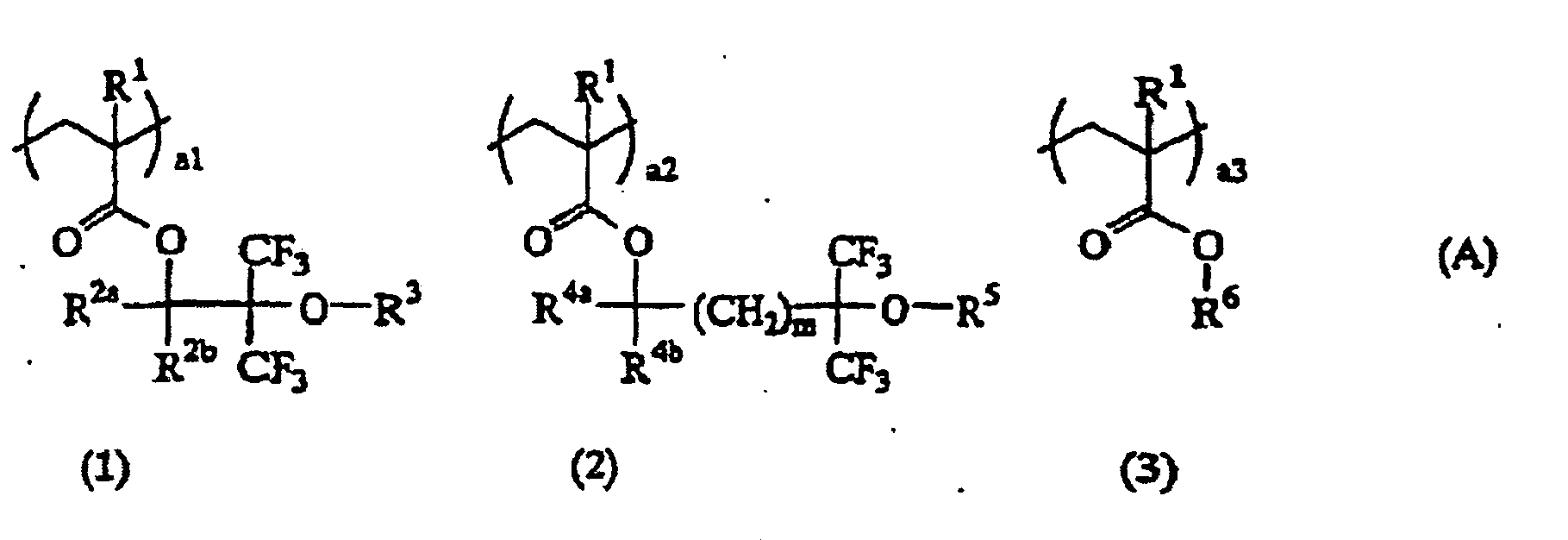
- Composition de réserve selon la revendication 3, dans laquelle le polymère est représenté par (A1) comprenant des motifs répétitifs des formules générales (1a), (2) et (3), (B) un polymère comprenant une structure de cycle lactone et/ou dérivée de l'anhydride maléique qui devient soluble dans un révélateur alcalin grâce à l'action d'un acide, (C) un composé susceptible de générer un acide lors d'une exposition à un rayonnement de grande énergie, et (D) un solvant organique,

- Composition de réserve selon la revendication 3 ou 4, comprenant en outre (E) un composé basique.
- Composition de réserve selon l'une quelconque des revendications 3 à 5, comprenant en outre (F) un inhibiteur de dissolution.
- Procédé de formation d'un motif comprenant les étapes consistant à (1) appliquer la composition de réserve selon l'une quelconque des revendications 3 à 6 sur un substrat pour former un revêtement de réserve, (2) traiter thermiquement le revêtement de réserve et l'exposer à un rayonnement de grande énergie par le biais d'un masque photographique, et (3) développer le revêtement exposé avec un révélateur.
- Procédé de formation d'un motif comprenant les étapes consistant à (1) appliquer la composition de réserve selon l'une quelconque des revendications 3 à 6 sur un substrat pour former un revêtement de réserve, (2) traiter thermiquement le revêtement de réserve et l'exposer à un rayonnement de grande énergie à partir d'une lentille de projection par le biais d'un masque photographique tout en maintenant un liquide entre le substrat et la lentille de projection, et (3) développer le revêtement exposé avec un révélateur.
- Procédé de formation d'un motif comprenant les étapes consistant à (1) appliquer la composition de réserve selon l'une quelconque des revendications 3 à 6 sur un substrat pour former un revêtement de réserve, (2) former un revêtement protecteur sur le revêtement de réserve, (3) traiter thermiquement et exposer le substrat enduit à un rayonnement de grande énergie à partir d'une lentille de projection par le biais d'un masque photographique tout en maintenant un liquide entre le substrat et la lentille de projection, et (4) développer avec un révélateur.
- Procédé selon la revendication 8 ou 9, dans lequel le liquide est l'eau.
- Procédé selon l'une quelconque des revendications 7 à 10, dans lequel le rayonnement de grande énergie a une longueur d'onde comprise dans la plage allant de 180 à 250 nm.
- Procédé de formation d'un motif comprenant les étapes consistant à (1) appliquer la composition de réserve selon l'une quelconque des revendications 3 à 6 sur un blanc de masque pour former un revêtement de réserve, (2) traiter thermiquement et exposer le revêtement de réserve sous vide à un faisceau d'électrons, et (3) développer avec un révélateur.
Applications Claiming Priority (1)
| Application Number | Priority Date | Filing Date | Title |
|---|---|---|---|
| JP2008032921A JP5131461B2 (ja) | 2008-02-14 | 2008-02-14 | 高分子化合物、レジスト材料、及びパターン形成方法 |
Publications (2)
| Publication Number | Publication Date |
|---|---|
| EP2090598A1 EP2090598A1 (fr) | 2009-08-19 |
| EP2090598B1 true EP2090598B1 (fr) | 2011-06-29 |
Family
ID=40548802
Family Applications (1)
| Application Number | Title | Priority Date | Filing Date |
|---|---|---|---|
| EP09001922A Active EP2090598B1 (fr) | 2008-02-14 | 2009-02-11 | Polymère, composition de vernis à masquer et procédé de formation de motifs |
Country Status (5)
| Country | Link |
|---|---|
| US (1) | US8252504B2 (fr) |
| EP (1) | EP2090598B1 (fr) |
| JP (1) | JP5131461B2 (fr) |
| KR (1) | KR101434690B1 (fr) |
| TW (1) | TWI392691B (fr) |
Families Citing this family (51)
| Publication number | Priority date | Publication date | Assignee | Title |
|---|---|---|---|---|
| JPH0683820B2 (ja) | 1987-02-05 | 1994-10-26 | 日本電装株式会社 | 洗浄方法及び装置 |
| JP5071658B2 (ja) * | 2008-02-14 | 2012-11-14 | 信越化学工業株式会社 | レジスト材料、レジスト保護膜材料、及びパターン形成方法 |
| JP5401086B2 (ja) | 2008-10-07 | 2014-01-29 | 東京応化工業株式会社 | 液浸露光用レジスト組成物、レジストパターン形成方法および含フッ素樹脂 |
| EP2189845B1 (fr) * | 2008-11-19 | 2017-08-02 | Rohm and Haas Electronic Materials LLC | Compositions et procédés de photolithographie |
| JP4748331B2 (ja) * | 2008-12-02 | 2011-08-17 | 信越化学工業株式会社 | レジスト材料及びパターン形成方法 |
| JP5387014B2 (ja) * | 2009-01-30 | 2014-01-15 | Jsr株式会社 | 感放射線性樹脂組成物及びレジストパターン形成方法 |
| US8283410B2 (en) * | 2009-03-30 | 2012-10-09 | Isp Investments Inc. | Ring-opening metathesis polymerization of norbornene and oxanorbornene moieties and uses thereof |
| CN102597878B (zh) * | 2009-11-18 | 2015-09-02 | Jsr株式会社 | 放射线敏感性树脂组合物、聚合物及抗蚀剂图案形成方法 |
| JP5375811B2 (ja) * | 2010-01-18 | 2013-12-25 | 信越化学工業株式会社 | 高分子化合物、レジスト材料、及びパターン形成方法 |
| JP5216032B2 (ja) | 2010-02-02 | 2013-06-19 | 信越化学工業株式会社 | 新規スルホニウム塩、高分子化合物、高分子化合物の製造方法、レジスト材料及びパターン形成方法 |
| JP5750272B2 (ja) * | 2010-02-18 | 2015-07-15 | 東京応化工業株式会社 | レジストパターン形成方法 |
| US8536031B2 (en) * | 2010-02-19 | 2013-09-17 | International Business Machines Corporation | Method of fabricating dual damascene structures using a multilevel multiple exposure patterning scheme |
| JP5246220B2 (ja) | 2010-08-23 | 2013-07-24 | 信越化学工業株式会社 | スルホニウム塩、レジスト材料及びパターン形成方法 |
| JP5609815B2 (ja) | 2010-08-26 | 2014-10-22 | 信越化学工業株式会社 | ポジ型化学増幅レジスト材料及びパターン形成方法 |
| US8597869B2 (en) | 2010-10-25 | 2013-12-03 | Shin-Etsu Chemical Co., Ltd. | Sulfonium salt, resist composition, and patterning process |
| JP5454458B2 (ja) | 2010-11-25 | 2014-03-26 | 信越化学工業株式会社 | ポジ型レジスト材料及びパターン形成方法 |
| JP5685919B2 (ja) * | 2010-12-13 | 2015-03-18 | Jsr株式会社 | 感放射線性樹脂組成物及びレジストパターン形成方法 |
| JP5527236B2 (ja) | 2011-01-31 | 2014-06-18 | 信越化学工業株式会社 | ポジ型化学増幅レジスト材料、パターン形成方法及び酸分解性ケトエステル化合物 |
| JP5491450B2 (ja) | 2011-05-30 | 2014-05-14 | 信越化学工業株式会社 | 高分子化合物、化学増幅レジスト材料、該化学増幅レジスト材料を用いたパターン形成方法。 |
| JP2013225094A (ja) * | 2011-10-07 | 2013-10-31 | Jsr Corp | フォトレジスト組成物及びレジストパターン形成方法 |
| JP5678864B2 (ja) | 2011-10-26 | 2015-03-04 | 信越化学工業株式会社 | ArF液浸露光用化学増幅ポジ型レジスト材料及びパターン形成方法 |
| KR101354639B1 (ko) * | 2011-12-30 | 2014-01-27 | 제일모직주식회사 | 포토레지스트 하부막 형성용 조성물, 이를 이용한 패턴 형성 방법 및 상기 패턴을 포함하는 반도체 집적회로 디바이스 |
| JP5699943B2 (ja) | 2012-01-13 | 2015-04-15 | 信越化学工業株式会社 | パターン形成方法及びレジスト材料 |
| JP5675664B2 (ja) * | 2012-01-24 | 2015-02-25 | 信越化学工業株式会社 | パターン形成方法 |
| JP5668710B2 (ja) | 2012-02-27 | 2015-02-12 | 信越化学工業株式会社 | 高分子化合物及びそれを含んだレジスト材料並びにパターン形成方法、該高分子化合物の製造方法 |
| JP2013173855A (ja) | 2012-02-27 | 2013-09-05 | Shin-Etsu Chemical Co Ltd | 高分子化合物の製造方法、該製造方法によって製造された高分子化合物及びそれを含んだレジスト材料並びにパターン形成方法 |
| JP6020347B2 (ja) | 2012-06-04 | 2016-11-02 | 信越化学工業株式会社 | 高分子化合物、レジスト材料及びパターン形成方法 |
| JP5783137B2 (ja) | 2012-06-15 | 2015-09-24 | 信越化学工業株式会社 | スルホニウム塩、高分子化合物、レジスト材料及びパターン形成方法 |
| JP6115322B2 (ja) * | 2012-06-19 | 2017-04-19 | 信越化学工業株式会社 | パターン形成方法 |
| JP5894953B2 (ja) * | 2012-07-27 | 2016-03-30 | 富士フイルム株式会社 | 感活性光線性又は感放射線性樹脂組成物、それを用いたレジスト膜、パターン形成方法、及び電子デバイスの製造方法 |
| JP5873826B2 (ja) * | 2012-07-27 | 2016-03-01 | 富士フイルム株式会社 | パターン形成方法、及び電子デバイスの製造方法 |
| JP5836299B2 (ja) * | 2012-08-20 | 2015-12-24 | 富士フイルム株式会社 | パターン形成方法、感電子線性又は感極紫外線性樹脂組成物、及びレジスト膜、並びに、これらを用いた電子デバイスの製造方法 |
| JP5790631B2 (ja) | 2012-12-10 | 2015-10-07 | 信越化学工業株式会社 | スルホニウム塩及び高分子化合物、レジスト材料及びパターン形成方法、並びに該高分子化合物の製造方法 |
| JP5815576B2 (ja) | 2013-01-11 | 2015-11-17 | 信越化学工業株式会社 | パターン形成方法 |
| JP5815575B2 (ja) | 2013-01-11 | 2015-11-17 | 信越化学工業株式会社 | パターン形成方法 |
| JP5828325B2 (ja) * | 2013-01-28 | 2015-12-02 | 信越化学工業株式会社 | パターン形成方法 |
| JP5812030B2 (ja) | 2013-03-13 | 2015-11-11 | 信越化学工業株式会社 | スルホニウム塩及び高分子化合物、レジスト材料及びパターン形成方法 |
| US9164384B2 (en) | 2013-04-26 | 2015-10-20 | Shin-Etsu Chemical Co., Ltd. | Patterning process and resist composition |
| JP5904180B2 (ja) | 2013-09-11 | 2016-04-13 | 信越化学工業株式会社 | スルホニウム塩、化学増幅型レジスト組成物、及びパターン形成方法 |
| JP6488769B2 (ja) | 2014-03-18 | 2019-03-27 | セントラル硝子株式会社 | 含フッ素ヒドロキシアルデヒド、含フッ素プロパンジオールおよび含フッ素アルコール単量体の製造方法 |
| JP6206311B2 (ja) | 2014-04-22 | 2017-10-04 | 信越化学工業株式会社 | 光酸発生剤、化学増幅型レジスト材料及びパターン形成方法 |
| JP6125468B2 (ja) | 2014-07-04 | 2017-05-10 | 信越化学工業株式会社 | 光酸発生剤、化学増幅型レジスト材料及びパターン形成方法 |
| JP6217561B2 (ja) | 2014-08-21 | 2017-10-25 | 信越化学工業株式会社 | 新規オニウム塩化合物及びレジスト組成物並びにパターン形成方法 |
| JP6507065B2 (ja) | 2014-08-25 | 2019-04-24 | 住友化学株式会社 | 化合物、樹脂、レジスト組成物及びレジストパターンの製造方法 |
| JP6394481B2 (ja) | 2015-04-28 | 2018-09-26 | 信越化学工業株式会社 | レジスト組成物及びパターン形成方法 |
| JP6346129B2 (ja) | 2015-08-05 | 2018-06-20 | 信越化学工業株式会社 | 化合物、高分子化合物、レジスト組成物、及びパターン形成方法 |
| JP6714533B2 (ja) | 2017-03-22 | 2020-06-24 | 信越化学工業株式会社 | スルホニウム塩、レジスト組成物、及びパターン形成方法 |
| KR102164614B1 (ko) | 2017-11-24 | 2020-10-12 | 주식회사 엘지화학 | 포토레지스트 조성물 및 이를 이용한 포토레지스트 필름 |
| KR20200078671A (ko) | 2017-12-22 | 2020-07-01 | 후지필름 가부시키가이샤 | 감활성광선성 또는 감방사선성 수지 조성물, 레지스트막, 패턴 형성 방법, 레지스트막 구비 마스크 블랭크, 포토마스크의 제조 방법, 전자 디바이스의 제조 방법 |
| JP7277797B2 (ja) * | 2018-03-30 | 2023-05-19 | セントラル硝子株式会社 | 硬化性組成物およびパターン付き部材の製造方法 |
| JP7344108B2 (ja) | 2019-01-08 | 2023-09-13 | 信越化学工業株式会社 | レジスト組成物、及びパターン形成方法 |
Family Cites Families (36)
| Publication number | Priority date | Publication date | Assignee | Title |
|---|---|---|---|---|
| US3438946A (en) * | 1966-12-06 | 1969-04-15 | Allied Chem | Fluoroalkyl-substituted esters,diesters,and polymers therefrom |
| JPS6038821A (ja) | 1983-08-12 | 1985-02-28 | Hitachi Ltd | エッチング方法 |
| JPS6262520A (ja) | 1985-09-13 | 1987-03-19 | Hitachi Ltd | パタ−ン形成方法 |
| JPH0799730B2 (ja) | 1985-09-13 | 1995-10-25 | 株式会社日立製作所 | パターン形成方法 |
| JPH06273926A (ja) | 1993-03-23 | 1994-09-30 | Shin Etsu Chem Co Ltd | 反射防止膜材料 |
| JP2803549B2 (ja) | 1993-12-21 | 1998-09-24 | 信越化学工業株式会社 | 光反射性防止材料及びパターン形成方法 |
| JP2906999B2 (ja) | 1994-04-26 | 1999-06-21 | 信越化学工業株式会社 | レジスト材料 |
| JP3830183B2 (ja) | 1995-09-29 | 2006-10-04 | 東京応化工業株式会社 | オキシムスルホネート化合物及びレジスト用酸発生剤 |
| JP3587413B2 (ja) | 1995-12-20 | 2004-11-10 | 東京応化工業株式会社 | 化学増幅型レジスト組成物及びそれに用いる酸発生剤 |
| JP3798458B2 (ja) | 1996-02-02 | 2006-07-19 | 東京応化工業株式会社 | オキシムスルホネート化合物及びレジスト用酸発生剤 |
| JPH09246173A (ja) | 1996-03-08 | 1997-09-19 | Canon Sales Co Inc | 塗布方法 |
| JP3879139B2 (ja) | 1996-05-08 | 2007-02-07 | 住友化学株式会社 | グリオキシム系エステル、その製法および用途 |
| TW550439B (en) | 1997-07-01 | 2003-09-01 | Ciba Sc Holding Ag | New oxime sulfonates as latent acids and compositions and photoresists comprising said oxime sulfonates |
| JP3719837B2 (ja) * | 1998-01-07 | 2005-11-24 | 株式会社東芝 | パターン形成方法 |
| CN1177096C (zh) * | 1998-08-04 | 2004-11-24 | 宝洁公司 | 减少折皱的组合物 |
| JP2000336121A (ja) | 1998-11-02 | 2000-12-05 | Shin Etsu Chem Co Ltd | 新規なエステル化合物、高分子化合物、レジスト材料、及びパターン形成方法 |
| US6312867B1 (en) | 1998-11-02 | 2001-11-06 | Shin-Etsu Chemical Co., Ltd. | Ester compounds, polymers, resist compositions and patterning process |
| SG78412A1 (en) | 1999-03-31 | 2001-02-20 | Ciba Sc Holding Ag | Oxime derivatives and the use thereof as latent acids |
| NL1014545C2 (nl) | 1999-03-31 | 2002-02-26 | Ciba Sc Holding Ag | Oxim-derivaten en de toepassing daarvan als latente zuren. |
| JP3956088B2 (ja) | 2000-07-19 | 2007-08-08 | 信越化学工業株式会社 | 化学増幅ポジ型レジスト材料 |
| TWI253543B (en) | 2000-07-19 | 2006-04-21 | Shinetsu Chemical Co | Chemically amplified positive resist composition |
| JP4083399B2 (ja) * | 2001-07-24 | 2008-04-30 | セントラル硝子株式会社 | 含フッ素重合性単量体およびそれを用いた高分子化合物 |
| TW200403523A (en) | 2002-03-22 | 2004-03-01 | Shinetsu Chemical Co | Photoacid generators, chemically amplified resist compositions, and patterning process |
| US6806026B2 (en) * | 2002-05-31 | 2004-10-19 | International Business Machines Corporation | Photoresist composition |
| JP2004086020A (ja) * | 2002-08-28 | 2004-03-18 | Fuji Photo Film Co Ltd | ポジ型レジスト組成物 |
| CA2511979A1 (fr) | 2003-02-19 | 2004-09-02 | Akira Matsumoto | Derives d'oxime halogenee et utilisation de ceux-ci comme acides latents |
| US20050147920A1 (en) * | 2003-12-30 | 2005-07-07 | Chia-Hui Lin | Method and system for immersion lithography |
| TWI368825B (en) | 2004-07-07 | 2012-07-21 | Fujifilm Corp | Positive type resist composition for use in liquid immersion exposure and a method of forming the pattern using the same |
| JP4740666B2 (ja) | 2004-07-07 | 2011-08-03 | 富士フイルム株式会社 | 液浸露光用ポジ型レジスト組成物及びそれを用いたパターン形成方法 |
| JP2006225476A (ja) * | 2005-02-16 | 2006-08-31 | Shin Etsu Chem Co Ltd | ポジ型レジスト材料及びパターン形成方法 |
| JP4742685B2 (ja) * | 2005-06-03 | 2011-08-10 | Jsr株式会社 | 液浸上層膜用重合体および液浸用上層膜形成組成物 |
| JP4717640B2 (ja) * | 2005-12-12 | 2011-07-06 | 東京応化工業株式会社 | 液浸露光用レジスト組成物およびレジストパターン形成方法 |
| JP4614092B2 (ja) * | 2006-01-31 | 2011-01-19 | 信越化学工業株式会社 | フッ素アルコール化合物の製造方法 |
| TWI440978B (zh) * | 2006-02-15 | 2014-06-11 | Sumitomo Chemical Co | 化學增幅正型阻劑組合物 |
| JP2006287236A (ja) * | 2006-04-07 | 2006-10-19 | Hoya Corp | マスクブランク、及びマスク |
| JP4993138B2 (ja) * | 2007-09-26 | 2012-08-08 | 信越化学工業株式会社 | レジスト材料及びこれを用いたパターン形成方法 |
-
2008
- 2008-02-14 JP JP2008032921A patent/JP5131461B2/ja active Active
-
2009
- 2009-01-22 TW TW098102502A patent/TWI392691B/zh active
- 2009-02-11 EP EP09001922A patent/EP2090598B1/fr active Active
- 2009-02-13 US US12/371,455 patent/US8252504B2/en active Active
- 2009-02-13 KR KR1020090011856A patent/KR101434690B1/ko active Active
Also Published As
| Publication number | Publication date |
|---|---|
| JP2009191151A (ja) | 2009-08-27 |
| JP5131461B2 (ja) | 2013-01-30 |
| TWI392691B (zh) | 2013-04-11 |
| US8252504B2 (en) | 2012-08-28 |
| KR101434690B1 (ko) | 2014-08-26 |
| US20090208873A1 (en) | 2009-08-20 |
| EP2090598A1 (fr) | 2009-08-19 |
| KR20090088330A (ko) | 2009-08-19 |
| TW200936616A (en) | 2009-09-01 |
Similar Documents
| Publication | Publication Date | Title |
|---|---|---|
| US8252504B2 (en) | Polymer, resist composition, and patterning process | |
| US8101335B2 (en) | Resist composition and patterning process | |
| US7537880B2 (en) | Polymer, resist composition, and patterning process | |
| US8057981B2 (en) | Resist composition, resist protective coating composition, and patterning process | |
| US7622242B2 (en) | Resist composition and patterning process | |
| US7771914B2 (en) | Resist composition and patterning process | |
| US7514204B2 (en) | Resist composition and patterning process | |
| JP4858714B2 (ja) | 高分子化合物、レジスト材料、及びパターン形成方法 | |
| US20080090173A1 (en) | Polymer, resist composition, and patterning process | |
| EP2081083B1 (fr) | Compositions de réserve positive et procédé de formation de motifs | |
| US7618765B2 (en) | Positive resist composition and patterning process | |
| US7541133B2 (en) | Positive resist composition and patterning process | |
| US7687222B2 (en) | Polymerizable ester compounds, polymers, resist compositions and patterning process | |
| US7718342B2 (en) | Polymers, resist compositions and patterning process | |
| US20110054133A1 (en) | Resist polymer, preparing method, resist composition and patterning process | |
| US7601479B2 (en) | Polymer, resist composition and patterning process | |
| US7727704B2 (en) | Positive resist compositions and patterning process | |
| US20050282083A1 (en) | Polymer, resist composition and patterning process | |
| US7691561B2 (en) | Positive resist compositions and patterning process | |
| US20080118863A1 (en) | Positive resist compositions and patterning process |
Legal Events
| Date | Code | Title | Description |
|---|---|---|---|
| PUAI | Public reference made under article 153(3) epc to a published international application that has entered the european phase |
Free format text: ORIGINAL CODE: 0009012 |
|
| AK | Designated contracting states |
Kind code of ref document: A1 Designated state(s): AT BE BG CH CY CZ DE DK EE ES FI FR GB GR HR HU IE IS IT LI LT LU LV MC MK MT NL NO PL PT RO SE SI SK TR |
|
| AX | Request for extension of the european patent |
Extension state: AL BA RS |
|
| 17P | Request for examination filed |
Effective date: 20091016 |
|
| 17Q | First examination report despatched |
Effective date: 20091215 |
|
| AKX | Designation fees paid |
Designated state(s): DE |
|
| RIC1 | Information provided on ipc code assigned before grant |
Ipc: C08F 20/28 20060101ALI20100517BHEP Ipc: C08F 220/18 20060101ALN20100517BHEP Ipc: C08F 220/16 20060101AFI20100517BHEP Ipc: C08F 220/28 20060101ALN20100517BHEP Ipc: C08F 220/24 20060101ALN20100517BHEP Ipc: G03F 7/004 20060101ALI20100517BHEP Ipc: C08F 20/24 20060101ALI20100517BHEP Ipc: C08F 220/20 20060101ALI20100517BHEP |
|
| GRAP | Despatch of communication of intention to grant a patent |
Free format text: ORIGINAL CODE: EPIDOSNIGR1 |
|
| RIC1 | Information provided on ipc code assigned before grant |
Ipc: C08F 220/20 20060101ALI20101216BHEP Ipc: C08F 220/18 20060101ALN20101216BHEP Ipc: C08F 220/24 20060101ALN20101216BHEP Ipc: C08F 220/28 20060101AFI20101216BHEP Ipc: G03F 7/004 20060101ALI20101216BHEP Ipc: C08F 220/16 20060101ALI20101216BHEP |
|
| GRAS | Grant fee paid |
Free format text: ORIGINAL CODE: EPIDOSNIGR3 |
|
| GRAA | (expected) grant |
Free format text: ORIGINAL CODE: 0009210 |
|
| AK | Designated contracting states |
Kind code of ref document: B1 Designated state(s): DE |
|
| REG | Reference to a national code |
Ref country code: DE Ref legal event code: R096 Ref document number: 602009001637 Country of ref document: DE Effective date: 20110825 |
|
| PLBE | No opposition filed within time limit |
Free format text: ORIGINAL CODE: 0009261 |
|
| STAA | Information on the status of an ep patent application or granted ep patent |
Free format text: STATUS: NO OPPOSITION FILED WITHIN TIME LIMIT |
|
| 26N | No opposition filed |
Effective date: 20120330 |
|
| REG | Reference to a national code |
Ref country code: DE Ref legal event code: R097 Ref document number: 602009001637 Country of ref document: DE Effective date: 20120330 |
|
| PGFP | Annual fee paid to national office [announced via postgrant information from national office to epo] |
Ref country code: DE Payment date: 20251230 Year of fee payment: 18 |